Search This Blog

De Omnibus Dubitandum - Lux Veritas

Showing posts with label Pensions. Show all posts

Thursday, December 26, 2024

Mirror, Mirror, on the Wall, Which State Has the Most OPEB Debt of All?

December 23, 2024 by Dan Mitchell @ International Liberty 

Part I of this series looked at unfunded pension debt of states and Part II examined the unfunded pension debt of cities.

In Part III, let’s look at the degree to which state taxpayers are exposed to big unfunded liabilities for “Other Post-Employment Benefits” such as health care and life insurance.

The American Legislative Exchange Council issued a report earlier this year that calculated the state-by-state burdens. Hawaii is the worst of the worst, followed by New Jersey and Alaska. South Dakota and Nebraska do the best job of protecting taxpayers, followed by Kansas.

But what does is mean to be the “worst of the worst”?

The ALEC report calculated that the burden for taxpayers in Hawaii, New Jersey, and Alaska is nearly $20,000 for every man, woman, and child in those states.

That compares to zero burden in Nebraska and South Dakota and almost zero in Kansas.
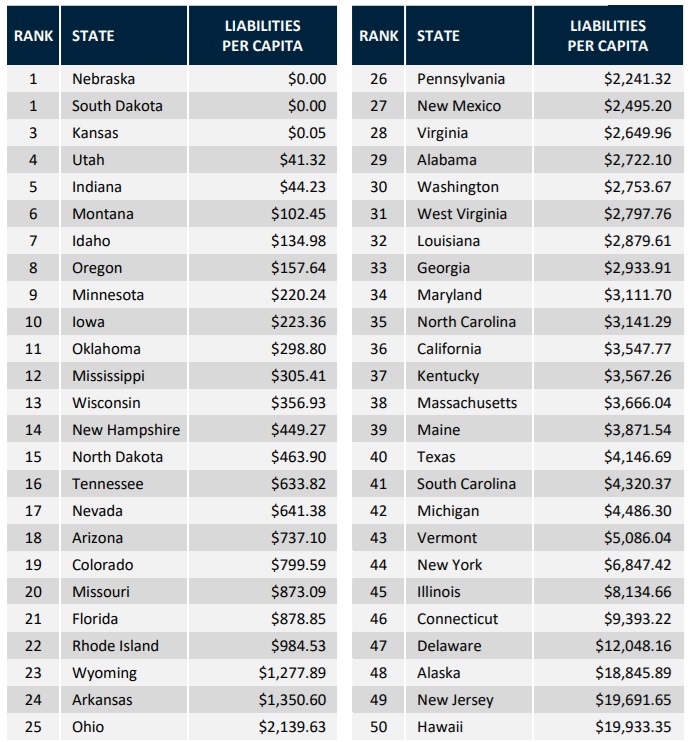
The nationwide burden of OPEB is now over $1 trillion according to the report.

Here are some highlights (lowlights would be a better term) from ALEC.


Other post-employment benefits (OPEB), also known as the “trillion-dollar acronym,” covers all the benefits a retired public employee is eligible to receive in retirement that are not a pension. These benefits include health insurance, life insurance, Medicare Supplement Insurance, and other benefits. …unfunded OPEB liabilities, now totaling over $1.14 trillion, just under $3,500 for every man, woman, and child in the United States. …

State OPEB plans face many of the same problems as public sector pension plans. Without real reforms, defined benefit OPEB plans will place a severe burden on taxpayers. By offering a range of defined contribution options as well as implicit subsidies by pooling retirees together with active employees, states can keep the promises made to both public employees and taxpayers.

The solution (both for pensions and OPEB) is for states to shift to systems based on “defined contribution” rather than “defined benefit.”

By definition, DC systems don’t have unfunded liabilities. Here’s a summary of the difference between the two approaches put together by the South Carolina-based Palmetto Promise.

The ALEC report notes that the two states with no unfunded liabilities use the DC approach.

Nebraska and South Dakota are the ideal models for state retiree health plans. Plan structures in both states now require current employees and retirees to purchase an HSA, where employees and retirees make tax-free contributions and the states match contributions up to a certain amount as well.

The report also praises Iowa, Indiana, and North Carolina for reforms moving in the right direction.

I’ll conclude by warning that columns about state and local unfunded liabilities may not be overly exciting, but there are big implications. At some point, reckless states such as Illinois and New Jersey are going to suffer a fiscal crisis and some politicians in Washington are going to want to provide bailouts.

That would be horrible policy, rewarding irresponsibility by profligate states.

Wednesday, May 1, 2024

A New Member of the Poverty Huckster Club

May 1, 2024 by Dan Mitchell @ International Liberty

Genuine material deprivation is almost nonexistent in rich nations such as the United States. This is a huge improvement compared to how people lived just 100 or 20o years ago.  Yet public policy fights about poverty will probably never end for the simple reason that people have different goals.


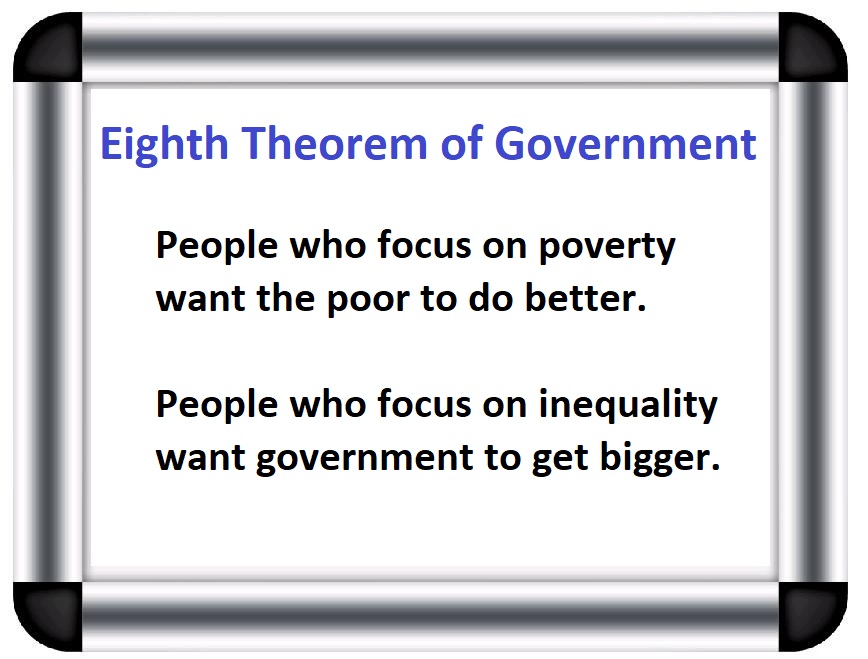
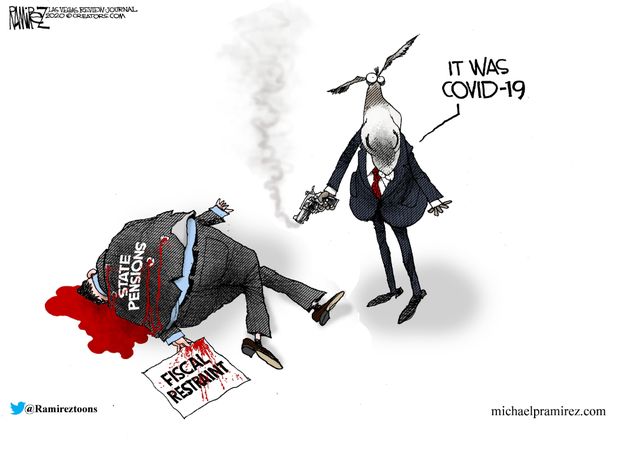
The cartoon is a good illustration of the first question.  And my Eighth Theorem of Government summarizes the second question. To elaborate on the second question, some of our friends on the left have blurred the distinction between poverty and inequality.  Let’s look at some excerpts from a Project Syndicate article by Teresa Ghilarducci of the New School for Social Research.


America’s retirement system isn’t working. It is failing older workers, pensioners, and would-be retirees, and if we don’t fix it soon, it will also fail future generations, lowering living standards and increasing the risk of poverty. …

Already, America’s elderly suffer a far higher rate of poverty – defined as half the median income or lower – than their peers in other high-income countries. …the old-age poverty rate in the US is 23%, compared to about 15% in the United Kingdom, 12% in Canada, 4.4% in France, and just 3.1% in the Netherlands.

Since there are massive problems with Social Security, I agree with Ms. Ghilarducci that America’s retirement system isn’t working.  But her numbers on old-age poverty seem very strange. How can the poverty rate be much higher in the United States when the other countries she mentions have much lower living standards?


Notice, though, that she wrote that poverty is “defined as half the median income or lower.”

So if you were a millionaire and lived in a house with Jeff Bezos, Elon Musk, and Bill Gates, you would be poor based on this definition. Needless to say, that’s crazy. Poverty should be a concrete number. And it usually is. The World Bank (which is concerned about genuine material deprivation) measures poverty based on whether people are subsisting at very low levels, such as $1.90 per day. In the United States, the poverty rate is a specific calculation of what a household needs to subsist at a modest level.

Ms. Ghilarducci’s numbers, however, come from the left-leaning bureaucrats at the Paris-based Organization for Economic Cooperation and Development. And they have a make-believe measure of poverty based on the distribution of income.  I’m not joking, if you go to their website, you will find these crazy numbers.

  • There’s supposedly more old-age poverty in the United States than there is in countries such as Costa Rica, Greece, Italy, Poland, and Turkey.
  • There’s supposedly more overall poverty in the United States than there is in countries such as Hungary, Mexico, Portugal, Slovenia, and Turkey.

These are garbage numbers, at least for the purpose of measuring poverty. The average senior (or average person) in the United States is much better off than their counterparts in other countries.  So congratulations to Ms. Ghilarducci, who is now a member of the Poverty Hucksters Club.

P.S. In fairness to Ms. Ghilarducci, her article does make some good points about overall retirement policy. I’m sure we disagree on many things, but she favorably cites nations with private Social Security systems, such as Denmark and the Netherlands.

Monday, March 4, 2024

Washington’s Sixth Sense: Paying Dead People

The spaghettification of taxpayer dollars in the fiscal black hole.

by | Mar 3, 2024 @ Liberty Nation News Tags: Articles, Business News, Good Reads, Opinion

Though both sides of the aisle have their own ideas of what constitutes tossing money down the drain, the US government has a penchant for waste. Perhaps the baseline should be not handing out millions of dollars to dead people every year. Despite the mountains of evidence over the decades of how politicians and bureaucrats mail sizable checks to the deceased, the errors are never corrected.

Uncle Sam Pays Dead People

A pair of US lawmakers penned a letter to Gordon Hartogensis, the director of the Pension Benefit Guaranty Corporation (PBGC), a 50-year-old entity established through the Employee Retirement Income Security Act that protects 31 million US workers in private sector-defined benefit pension plans. Reps. Virginia Foxx (R-NC) and Bob Good (R-VA) inquired why tens of millions of dollars from the American Rescue Plan were given to thousands of dead people.


As part of President Joe Biden’s pandemic-era legislation, special financial assistance was extended to PBGC that would then be transferred to underfunded pension plans, including the Central States Pension Fund (CSPF). According to a PBGC inspector general report, $127 million was shipped to 3,479 deceased participants. While the issue is being probed, the GOP representatives purported that there has not been an adequate explanation for how the incorrect payments occurred or what is being done to recover the money. “Because PBGC did not provide an adequate response, it appears PBGC fails to recognize that its overpayments need to be rectified and suggests a total disregard for taxpayer dollars,” the letter stated.

Sen. Bill Cassidy (R-LA) also remarked on the findings during a recent Senate Committee on Health, Education, Labor and Pensions hearing. He noted that workers covered by the CSPF “should be alarmed” because it told the committee that “it would be impossible for them to repay the money that they were improperly paid” and returning funds “would destabilize the fund.” He added: “Frankly, it is infuriating to hear that a union’s pension plan could be on the verge of collapse only a few years after they received tens of billions of dollars from taxpayers to bail them out.”

The CSPF has defended itself by admitting that the error was an oversight because it cannot access the Social Security Administration Full Death Master File (DMF). Officials, including the PGBC inspector general, said the DMF should be used in the future and vowed to institute this recommendation by the end of March.

Been There, Done That

Of course, the mistake is not entirely surprising. It has happened before, and it will almost certainly happen again.

According to the annual Festivus report, courtesy of Sen. Rand Paul (R-KY), the US government paid $38 million in COVID-19 payments to dead people. “Specifically, $10 million was paid to individuals who were already dead on the date someone applied for funding. The government doled out $1.3 million of your money to 30 individuals who were dead for at least a year, in what fraud inspectors deemed one of the ‘particularly egregious examples,'” the senator wrote. In June 2023, fiscal watchdog organization OpenTheBooks found that the current administration paid dead people nearly $1 billion in 2021 and 2022. “Dead people received $532.5 million in 2022 and $441.7 million in 2021 in mistaken payments,” the group wrote. “Federal retirement services (pensions), old-age, survivors, and disability insurance, and social security were sent to dead recipients.”

In May 2021, the Treasury Department announced that almost 60,000 stimulus checks from the CARES Act were shipped out to deceased individuals. In July 2020, the Government Accountability Office reported that $1.4 billion in pandemic stimulus checks was sent to more than one million Americans who died. Federal officials say that the government sprang into action as fast as possible and sent millions of checks quickly. In other words, the mistakes should be forgiven because it was a crazy time for everyone. When the GAO released its report, then-Treasury Secretary Steve Mnuchin and the IRS urged the return of these funds. Uh, who should have told them that it is hard for dead people to do anything?

To Err Is Government

Unlike a private company, the government is a monopoly that faces zero competition, meaning the state can make countless errors that cost taxpayers billions of dollars without repercussions. There is no incentive for elected officials and bureaucrats to do better, prevent these mistakes from happening, or even make the necessary corrections. English author Alexander Pope famously wrote, “To err is human; to forgive, divine.” Today, it would be: “To err is government; to correct, impossible.”

 
Read More From Andrew Moran

Thursday, May 19, 2022

China’s Far-Too-Little Pension Reform

April 30, 2022 by Dan Mitchell @ International Liberty

In the make-believe country of Libertaria, there is no such thing as Social Security or any other type of government-mandated retirement policy.

In the real world, however, most nations have created “pay-as-you-go” retirement schemes based on taxing young workers to give benefits to old retirees.

That’s the bad news.

The good news is that a growing number of nations have created personal retirement accounts based on private savings. These “funded” systems are designed to replace and/or augment the government programs.

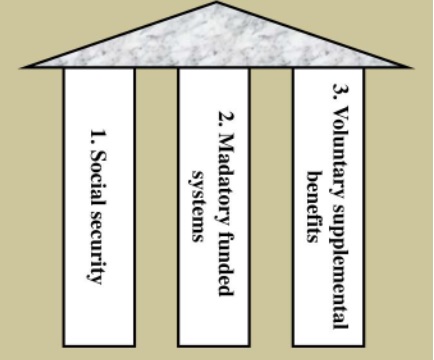
People who study these issues often refer to “three pillars” that represent the various potential sources of retirement income.


  1. Payments from mandatory government tax-and-transfer programs like Social Security in the United States (Pillar One).
  2. Payments from mandated private retirement accounts, such as those in places such as Australia and Chile (Pillar Two).
  3. Payments from voluntary private savings, such as the funds put in IRAs or 401(K)s in the United States (Pillar Three).

In our libertarian fantasy world, everyone would use option #3 and there would not be options #1 and #2.

In a libertarian-ish world, everyone would use option #2 with option #1 only as an emergency back-up.

A few days ago, I saw a headline that got me excited. I thought China was joining the libertarian-ish world by shifting from a pay-as-you-go government system to mandatory private savings (going from option #1 to option #2). Here are some excerpts from a Nasdaq report.


The China Security Regulatory Commission (CSRC) announced the launch of the first private pension plan due to anticipated economic challenges with an aging population. …the CSRC said that pension money “can provide more long-term, and stable funds to develop the real economy, via capital markets.” …This program was created to add additional resources for China’s aging population. In 20 years, 28% of China’s population will be more than 60 years old, up from 10% today, according to the World Health Organization.

But as I read more details, I learned that China was keeping its government system and simply adding an option #3.

Public pensions are currently in place in China; both employees and employers have contributed fixed amounts under state pension plans. …Private pensions are seen as an additional program to state pension plans. Employees can contribute up to 12,000 yuan ($1,860) per year. Contributions will be eligible for tax breaks.

Since people already had the ability to save money, this is hardly an earth-shaking development.

To be sure, it seems like Chinese workers will not have their saving subject to any double taxation if they use these new pension vehicles, so I suppose that deserves some applause.

But it would be much more exciting and praiseworthy if the Chinese government (which has been backsliding in recent years) had proposed some something far bolder.

P.S. To understand why I’m not optimistic about China, here’s my summary of the nation’s post-World War II economic history.

P.P.S. And if China takes advice from either the IMF or OECD, I’ll be even less optimistic.


Sunday, June 6, 2021

Why Are Ex-lawmakers Convicted of Corruption Still Receiving Federal Pensions?

By Demian Brady June 5, 2021

Washington bureaucrats have stymied efforts to ensure that a law against the practice is being enforced.

Members of Congress convicted of corruption should be legally prohibited from receiving taxpayer money. This is simple common sense, as even Congress itself agrees. Yet federal bureaucrats have stymied efforts to make it so.

After several high-profile scandals involving politicians, the Honest Leadership and Open Government Act (HLOGA) of 2007 specified corruption-related crimes that would lead to the loss of a lawmaker's congressional pension. Additional crimes were added to the list in 2012 by the Stop Trading on Congressional Knowledge (STOCK) Act.

Since these restrictions could not be applied retroactively, the National Taxpayers Union Foundation (NTUF) monitored the criminal cases of crooked politicians to see who would be the first to lose a pension. It looked like it would be Representative Chaka Fattah (D., Pa.) who was found guilty of 23 charges of corruption and sentenced to ten years in prison in 2016. Fattah's 22 years in Congress would have entitled him to a $55,000 annual pension assuming he opted for the maximum benefit level, had he not been convicted........To Read More....

Wednesday, March 17, 2021

States Want Coronavirus Aid to Pay for Years of Fiscal Mismanagement, Not Coronavirus Fight

Kay Coles  James Kay Coles James | May 29, 2020

(Editor's Note:  This was tucked in my Draft file.  Recent vents make this even more profound now than it was in May of 2020RK) 


https://media.townhall.com/Townhall/Car/b/mrz052820dAPR20200527114540.jpg 

At a time when huge spending bills marked “coronavirus relief” are easily passing Congress with little scrutiny, poorly run states are asking unscrupulous members of Congress to slip in taxpayer bailouts to rescue them from years of their own fiscal mismanagement.In response, the House of Representatives recently passed a coronavirus relief bill that includes a half trillion dollars (trillion with a “t”) in unrestricted funds to bail out state governments for years of reckless expenditures entirely unrelated to the pandemic...........Some states haven’t even spent all of their coronavirus grant money because the pandemic didn’t hit them as hard as anticipated, yet many are asking for more. They just don’t want to have to spend the money on actual coronavirus relief this time.

Sen. Rick Scott (R-Fla.) is one of the voices in Congress speaking out against state bailouts, calling the funding “a piggy bank for unrelated expenses that have nothing to do with responding to the coronavirus.” He rightly warns that the money will be used to bail out pension plans, reward decades of mismanagement, and encourage states to become even more dependent on the federal government..........To Read More.....


Friday, February 12, 2021

Illinois Policy Institute: Property Taxes

Hilary Gowins Vice President of Communications Illinois Policy Institute

 https://mcusercontent.com/7fe208d3c85ffa1d03aeaade4/images/821585b3-08ca-403d-bd4d-b38c2cd07490.jpg

Vincent Mazzaferro is an engineer. He can see the potential in things  even when they're falling apart. So, when it came time to buy a home, he picked a fixer-upper in Elmwood Park where he lives today with his fiance.

Mazzaferro's love of refurbishing unloved properties also led him to the opposite end of Cook County in 2019, when he decided to buy a five-unit property in Thornton, Illinois, population 2,338. He bought the place for $125,000, hoping to turn it into high-quality, affordable rental units. 

Mazzaferro knew the property would require a lot of work and lacked the basics, such as good flooring, drywall or proper plumbing. He estimated each of the units would need at least $20,000 in repairs to catch up on years of neglect. So he was stunned when he got his property tax bill or $20,000, or 16% of the purchase price. 

 "$20,000 annually in property taxes is what you pay for on a mansion," Mazzaferro said. "This is not a mansion."


His monthly payment on the property is $3,030. The principal is $600 and the interest is $400, but his taxes are $1,650. That means taxes make up more than half of what he's paying each month. 

How does a person end up with a $20,000 property tax bill on a $125,000 house? It defies logic and the answer is complicated. "My recourse is asking them to assess it fairly," Mazzaferro said. "And they're just throwing my appeal out the window like it doesn't exist."

 Over 60% of Mazzaferro]s property tax bill goes toward two school districts and costs $11,534.


Thornton Township High School District 205 serves 4,722 students in three schools in grades 9-12. Thornton School District 154 serves just 226 K-8 students in one school.

This isn't an efficient way to run four small schools.

If those two school districts were consolidated and the savings were passed on to local homeowners, Vincent could see his property tax bill cut by nearly $4,200.

Illinois has 859 school districts and 25% of them serve just one school. Florida, which serves over 700,000 more students than Illinois, has 75 districts. Florida averages 38,000 students per district.

In addition to Illinois being home to the second-highest property taxes in the country, one of the most painful facts about owning a home here is that tax dollars don't go to the services people expect and value.

Consider the situation in Elmwood Park, where Mazzaferro lives and paid $10,373 in property taxes in 2019.

Roughly 41% of property tax dollars for the village of Elmwood Park went to fund pensions. The police pension fund is less than 30% funded and the fire fund is less than 40% funded. Elmwood Park leaders cited police and fire directly as the reason why taxes went up in 2019.

Most attention surrounding Illinois' pension crisis focuses on the $144 billion hole Springfield is staring down. But the pension crisis is a local problem, too, worth $63 billion that causes property taxes to rise each year.

For Mazzaferro, with two property tax bills costing him over $30,000, he can't make the numbers work in Thornton.

"I see potential in fixing [up that property] because I want to add value to the community, but I'll have to sell it," he said. "I can't afford it because I can't raise rents enough to cover the renovations and the taxes."

"High taxes drive the money out. And I can't reinvest. I can't reinvest in the property, or the community, and no one else can afford to, either."

Thursday, January 7, 2021

For Chicago Homeowners, It’s All Pain, Little Gain

Driven by exploding pension costs, the city’s property-tax hikes are depressing the housing market. 

Steven Malanga January 4, 2021  @ City Journal, published with permission.  I recommend subscribing, it's free.

Early in 2019, a real-estate website predicted that Chicago’s housing market would be one of the nation’s worst over the next year. Chicago-area home prices, among the slowest to recover from the 2009 housing recession, were being suppressed by various factors, including escalating property taxes. 

Now it’s clear from a new study just how much of a burden those taxes have become. 

Over the past 20 years, they’ve risen about four times faster than the rate of local inflation and more than twice as fast as Chicago-area wages, eating up more and more of the average homeowner’s disposable income. And there’s more to come, thanks to Mayor Lori Lightfoot’s latest budget, which raises Chicago property taxes again. Much of that money, moreover, isn’t targeted to better services but simply to pay off the city’s and Chicago school system’s enormous debt. For local homeowners, it’s all pain, little gain.

The study, by Cook County Treasurer Maria Pappas, found that residential property taxes in Chicago have risen, on average, by 164 percent over the past 20 years, while inflation increased by 36 percent in the greater Chicago area and wages grew by 57 percent during that time. For a home valued at $300,000, the average annual tax bite is now $6,351, according to SmartAsset.com. That’s nearly twice the national average for property taxes on a similarly valued home. Local homeowners have been battered by a few big increases in the last few years, including a $543 million property tax hike in 2015 by the city, and a $224 million boost in 2017 from the Chicago Public Schools, which also has dibs on local property taxes. 

Now Lightfoot has added $94 million in property taxes in her latest budget, along with a host of other levies, including a “cloud tax” on business computing services.  These increases are driven by city and school system debts, especially in their deeply underfunded pension systems. Chicago’s pension payments have risen from about $500 million in 2015 to $1.2 billion last year. They’re set to grow by another $1 billion by 2023. The pension system alone now consumes all of the city of Chicago’s property tax collection.

The situation is little better at the school system. In 2008, its pension costs were a bit above $200 million, and the state contributed a chunk of that money. In 2021, total costs for school pensions will rise to $885 million. The school system has financed that big increase in large part with a so-called supplemental-pension property-tax levy on top of the real-estate taxes it already collects. That new levy alone will dun Chicago property owners for $490 million next year. The rising pension costs are one reason taxes are soaring even as the size of the school system shrinks. In 2009, city schools enrolled 407,157 students. By 2019, that number had slipped to 355,156. In part because of Covid-19, enrollment fell this school year to 340,658. Even so, local revenues collected by the school system have increased by 58 percent in that time.

Because of the way Chicago tax assessors have valued properties, homeowners have borne the brunt of the tax increases, the Pappas study found. Commercial property taxes have grown at 81 percent over the last 20 years, still faster than inflation or wage growth, but nothing like the impact on homeowners, who pay about half of all real estate taxes collected in the city. Businesses, however, are now bracing for even larger tax increases aimed at them. The Cook County tax assessor has begun hitting local business properties—including apartment buildings and office towers—with double-digit increases in its assessments.

While nearly everyone agrees that the problem is getting out of control, the progressives who run Chicago argue that the solution is not to cut costs but to shift the burden away from homeowners by funding more of the school system through state revenues. They were counting on the state’s new progressive income tax on wealthy individuals in Illinois to produce a windfall for Chicago schools, but voters, wary of claims that a new tax would relieve the pressure on property levies, handily defeated the proposed constitutional amendment that would have permitted the new tax.

If the experience of other states is a standard, Illinois voters were right to entertain suspicions. New Jersey, for instance, instituted an income tax in the 1970s expressly to allow the state to move more funding toward that tax. Nearly 50 years later, New Jersey has one of the nation’s highest state income-tax rates, yet its property taxes have continuing rising and are also among the nation’s highest—even steeper than Illinois. And it has just about as much pension debt as state and local governments do in Illinois.

Skyrocketing property taxes are not only bad news for homeowners now, but also for when they try to sell their properties, because high taxes suppress the value of real estate. A 2019 article in the Journal of Finance and Accountancy found, not surprisingly, that states with low property taxes tend to see house values appreciate more rapidly than in states where real-estate taxes are higher. Appreciation has been a big problem in Chicago. It took a decade for housing prices in the city to recover from the 2009 real-estate bust, and even today, Chicago home prices aren’t growing nearly as much as in other places. The Case-Schiller Index of housing prices in 20 major markets, for instance, ranks Chicago next-to-last in housing appreciation for the last 12 months.

It’s unlikely that yet another property tax increase will help.

Photo by Scott Olson/Getty Images

City Journal is a publication of the Manhattan Institute for Policy Research (MI), a leading free-market think tank. Are you interested in supporting the magazine? As a 501(c)(3) nonprofit, donations in support of MI and City Journal are fully tax-deductible as provided by law (EIN #13-2912529).

Thursday, December 10, 2020

Swamponomics: The Long Dark Winter for Social Security

Social Security, federal salaries, and Chicago's demise. 

Articles, Economic Affairs, Election 2020, Liberty Rewind, Politics, Social Issues

Former Vice President Joe Biden stated during the second and final presidential debate that Social Security is facing bankruptcy by 2023. This has been an open secret for a long time, and politicians on both sides of the aisle have refused to address the retirement scheme’s fiscal severity. Biden is attempting to blame President Donald Trump as if Social Security was on sound fiscal footing until Inauguration Day 2017. Anyone who has monitored the black hole knows that the U.S. has been on the event horizon for years. Coronavirus merely accelerated the implosion.

Feeling Insecure in Retirement

The Bipartisan Policy Center recently published a forecast that the Social Security trust fund could be depleted by 2030, five years earlier than previous estimates. Even under the rosiest of economic expectations, the fund could be out of cash by 2034.

The reason? A lousy, rotten, no-good respiratory illness originated from a wet market in Wuhan, a laboratory, or a cave in the Yunnan Province. Authors stated in the report:

“If policymakers fail to address Social Security’s financial imbalance soon, they will be left with only drastic solutions or financing a portion of promised retirement benefits through general revenues. Tax increases will be sharper, benefit cuts will be more severe, and the cohorts of workers who bear these changes will have less time to plan their finances accordingly.”


This was a certainty, and the COVID-19 financial crisis only sped up the scheme’s demise. Some lawmakers have presented remedies, including raising the age of eligibility and performing means tests. But these are not politically feasible since any resolutions will immediately perturb the senior vote.

Public v. Private Sector Salaries

For years, folks in the private sector have lambasted their public sector counterparts for earning more in a myriad of different ways, from salaries to benefits. But this has finally changed, according to new data from the Federal Salary Council. Today, federal civil servants earn an average of 23.1% less money than private-sector workers. The pay gap between these two classes of workers declined 3.6% from the same time a year ago. With bloated budgets and indebted governments, Uncle Sam may no longer be able to afford giving federal employees a raise or lucrative benefits packages. That has not stopped President Donald Trump from proposing giving these people a 1% pay hike in the new year.

Chicago Mayor Lori Lightfoot

Ouch, My Lightfoot!

What do you do when people are fleeing your city, and you are running out of cash? Why, you raise their taxes, of course! Chicago Mayor Lori Lightfoot recently unveiled the city’s “pandemic budget,” a fiscal framework that involves terminating or eliminating up to 1,000 city workers, increasing the gas tax by a nickel to eight cents, and introducing a $94 million property tax hike.

Chicago presently faces a $1.2 billion budget gap. Lightfoot is perhaps learning about the dangerous long-term consequences of hard lockdowns in the fight against coronavirus when she is not too busy pretending to be a Clorox superhero for Halloween.

Her right-hand man, Alderman Gilbert Villegas, has the unenviable task of trying to gather 26 votes to increase taxes at a time when everyone is suffering. But Villegas believes Chicago has no other alternative at its disposal, particularly when Lightfoot spent one-time cash injections last year. He told reporters:

“If property taxes is [sic] not something they can support, then I would welcome them to bring some recommendations that we can talk about and see if we can get votes on that. We’re not getting any help from D.C. We’re not getting any help from Springfield. This is a go-it-alone budget for a city we were elected to represent. These are the levers we have. This is what’s being proposed by the mayor. Ultimately, my colleagues will either support it or not support it.”

Chicago, and the rest of the province of Illinois, had already been entrenched in fiscal disarray before COVID-19 decimated the nation’s economy. Wealthier households were moving away, policymakers turned to bonds to postpone the financial collapse, and the leadership fails to do anything more except maintain the status quo. At least Mayor Lightfoot can achieve the progressive dream: Equal misery for all.

~

Read more from Andrew Moran.

Wednesday, October 7, 2020

The $822,000-per-Year Bureaucrat and the Death of California

Over the years, I’ve shared some outrageous examples of overpaid bureaucrats.

Hopefully we’re all disgusted when insiders rig the system to rip off taxpayers. And I suspect you’re not surprised to see that the worst example on that list comes from California, which is in a race with Illinois to see which state can become the Greece of America.

Well, the Golden State has a new über-bureaucrat. Here are some of the jaw-dropping details from a Bloomberg report.

The numbers are even larger in California, where a state psychiatrist was paid $822,000, a highway patrol officer collected $484,000 in pay and pension benefits and 17 employees got checks of more than $200,000 for unused vacation and leave. The best-paid staff in other states earned far less for the same work, according to the data.

Wow, $822,000 for a state psychiatrist. Not bad for government work. So what is Governor Jerry Brown doing to fix the mess? As you might expect, he’s part of the problem.

…the state’s highest-paid employees make far more than comparable workers elsewhere in almost all job and wage categories, from public safety to health care, base pay to overtime. …California has set a pattern of lax management, inefficient operations and out-of-control costs. …In California, Governor Jerry Brown hasn’t curbed overtime expenses that lead the 12 largest states or limited payments for accumulated vacation time that allowed one employee to collect $609,000 at retirement in 2011. …Last year, Brown waived a cap on accrued leave for prison guards while granting them additional paid days off. California’s liability for the unused leave of its state workers has more than doubled in eight years, to $3.9 billion in 2011, from $1.4 billion in 2003, according to the state’s annual financial reports. …The per-worker costs of delivering services in California vastly exceed those even in New York, New Jersey, Illinois and Ohio.

Actually, it’s not just that he’s part of the problem. He’s making things worse, having seduced voters into approving a ballot measure to dramatically increase the tax burden on the upper-income taxpayers.

I suppose the silver lining to that dark cloud is that many bureaucrats now rank as part of the top 1 percent, so they’ll have to recycle some of their loot back to the political vultures in Sacramento.

Cartoon California Promised Land

But the biggest impact of the tax hike – as shown in the Ramirez cartoon – will be to accelerate the shift of entrepreneurs, investors, and small business owners to states that don’t steal as much. Indeed, a study from the Manhattan Institute looks at the exodus to lower-tax states.

The data also reveal the motives that drive individuals and businesses to leave California. One of these, of course, is work. …Taxation also appears to be a factor, especially as it contributes to the business climate and, in turn, jobs. Most of the destination states favored by Californians have lower taxes. States that have gained the most at California’s expense are rated as having better business climates. The data suggest that many cost drivers—taxes, regulations, the high price of housing and commercial real estate, costly electricity, union power, and high labor costs—are prompting businesses to locate outside California, thus helping to drive the exodus.

Yet another example of why tax competition is such an important force for economic liberalization. It punishes governments that are too greedy and gives taxpayers a chance to protect their property from the looter cla


Saturday, August 1, 2020

Plug the Golden State’s Leaks

For too long, California’s schools have operated on deficits.
 
David Crane July 31, 2020

As Congress considers a $100 billion Covid-related financial-support package to help states and localities gear up for the coming school year, California should act quickly to plug leaks that will cost its own schools their likely share of that aid. The San Francisco Unified School District (UFUSD), for example, which serves 60,000 students, received more than $1 billion in revenues last fiscal year............

Indeed, the district now spends more than $100 million per year on retirement costs, equivalent to $1,750 per pupil. To make matters worse, that $100 million doesn’t even include accrued-but-unpaid retirement costs for which debt is issued—and the balance of which now exceeds $1 billion..........

This explosion in costs was due to sharp growth in pension liabilities that were hidden by deceptive accounting..............San Francisco’s insurance-subsidy program, for example, provides medical-insurance benefits to retirees and their spouses—even when those beneficiaries are already eligible for Medicare..............

Based on its population, California’s share of Congress’s $100 billion K-12 package would be $12 billion. Thus, more than 100 percent of federal support for California’s schools would be consumed by retirement spending.............The evidence is clear: before sending more money down the drain, California should plug these leaks........To Read More....

Friday, June 26, 2020

America’s Next Crisis: Unfunded Pensions for State and Local Bureaucrats

June 25, 2020 by Dan Mitchell @ International Liberty

 I’m a long-time critic of the Federal Reserve, Fannie Mae, and Freddie Mac, but I had no idea they would produce something as bad as the 2008 financial meltdown. It’s not easy to predict the timing and severity of a crisis. Unless we’re talking about the ticking time bomb described in this video.


In theory, of course, state politicians and their local counterparts are supposed to set aside enough money to pay the lavish future benefits they promise their bureaucrats.

Far too often, however, that doesn’t happen. And that means the governments (to be more accurate, their taxpayers) have a big “unfunded liability.”

This racket is a good deal for the bureaucrats – who get lots of pay now and lots of promised benefits in the future. And it’s a good deal for the state and local politicians who get votes and campaign contributions from the bureaucrats.

But, as explained in a new report from the American Legislative Exchange Council, it is a fiscal disaster that is going to explode at some point in the not-too-distant future.
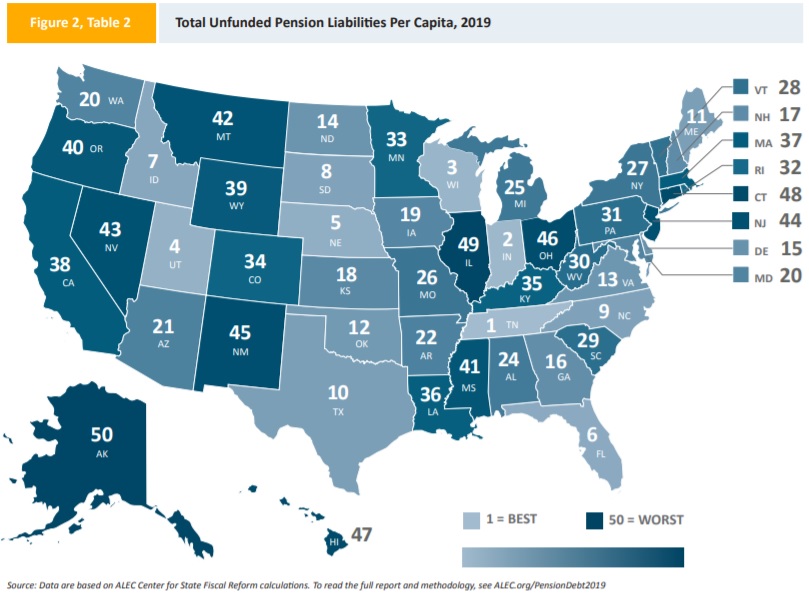
Unfunded state pension liabilities total $4.9 trillion or $15,080 for every man, woman and child in the United States. State governments are often obligated, by contract and state constitutional law, to make these pension payments regardless of economic conditions. As these pension payments continue to grow, revenue that would have gone to essential services like public safety and education, or tax relief, goes to paying off these liabilities instead. …Most state pension plans are structured as defined-benefit plans. Under a defined-benefit plan, an employee receives a fixed payout at retirement based on the employee’s final average salary, the number of years worked and a benefit multiplier.
There are several ways to measure the degree to which a state has dug a big hole by promising big goodies to bureaucrats.

Figure 2 shows per-capita unfunded liabilities on a state-by-state basis. Tennessee is in the best shape, followed by Indiana and Wisconsin (thanks in part to former Governor Scott Walker). Alaska has the biggest fiscal hole, along with Illinois (no surprise) and Connecticut (no surprise).


It’s important to recognize, though, that some states have more income than others.  So in addition to a per-capita estimate of pension liabilities, here’s a map showing the burden as a share of each state’s economic output. Once again, Tennessee, Indiana (the #22 is a misprint), and Wisconsin rank the highest. Alaska stays at the bottom, joined by Mississippi and New Mexico.


Let’s also give credit and blame to states that are the top 10 and bottom 10 on each map.
In addition to Tennessee, Indiana, and Wisconsin, good states include Utah, Nebraska, South Dakota and Texas (honorable mention to Florida, which just missed).

Bad states are led by Alaska, with Nevada, New Mexico, Mississippi, Illinois, and Ohio also being governed by particularly short-sighted politicians.

So what’s the solution for the bad states? The ALEC report gives the answer.
Ultimately, one of the best ways to solve the pension crisis is to change the way pension plans are structured. Changing from the current defined-benefit system toward a defined-contribution system for new employees will improve the health of state pension plans by giving employees full control over their retirement savings.
By the way, it’s worth noting that blue states may have a bigger problem than red states, but this is a bipartisan mess. In a recent column in the Wall Street Journal, Steve Malanga says there is plenty of blame to share.
The crisis in state pension systems is a result of decades of fiscal mismanagement. The problem, however, goes well beyond deeply indebted Illinois and New Jersey. Many state and municipal retirement funds have been on an unrelenting downward trajectory… This fiscal nightmare stems in part from politicians’ habit of increasing employee benefits while markets are booming, thereby squandering fund surpluses. …Politicians have consistently neglected to contribute to these systems even during good budgetary times, preferring to fund more popular programs. …Meanwhile, elected officials and pension administrators have endorsed overly optimistic economic assumptions that made their systems look affordable.
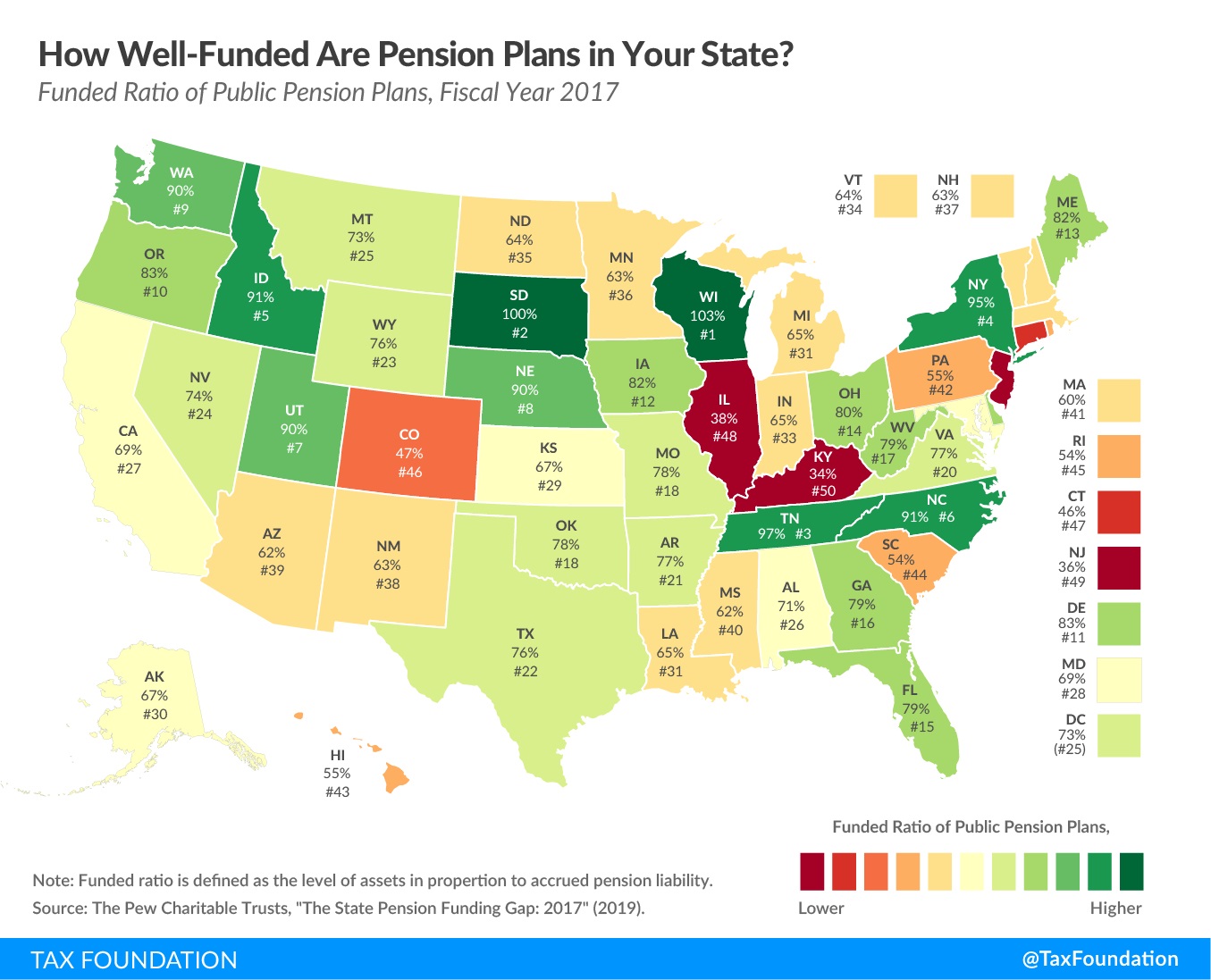
Let’s close today’s grim column with another way of measuring the problem. Here’s a map from the Tax Foundation that shows how much money is set aside in pension programs compared to the level of benefits that bureaucrats are promised.


Looking at the data from this angle, Kentucky has the biggest hole, followed by New Jersey, Illinois (the only state to be in the bottom 10 on all three maps), and Connecticut, while the good states are led by Wisconsin, South Dakota, and Tennessee.

The bottom line is that some states have a very grim future, which is why even Warren Buffett is advising investors and entrepreneurs to steer clear of doing business in those places.

P.S. Unfortunately, you can’t avoid the massive unfunded liabilities of Social Security, Medicare, and Medicaid by moving across state lines.

Sunday, May 24, 2020

Colorado Considers Reducing Pension Contributions in Response to Budget Concerns

If pension contribution policies are adjusted it would result in the addition of significant long-term costs and a public pension plan that is no longer en route to full funding.

By Zachary Christensen and Truong Bui May 21, 2020

Just two years after sweeping reforms were made to set the Colorado Public Employees’ Retirement System (PERA) on a path to improved funding, the state’s Joint Budget Committee is considering options that would postpone some of those changes and even permanently reduce supplemental contributions that were implemented in 2004. The proposal is an attempt to reduce the short-term costs associated with PERA, in anticipation of what will obviously be a difficult year for Colorado’s revenue and pension assets.

While the coronavirus pandemic and economic downturn are making the need for budget-saving actions very real, Colorado policymakers should understand the long-term costs of shorting PERA contributions in 2020.

 A major part of the 2018 pension reform—which had significant bipartisan support—was a direct annual distribution of $225 million into the pension fund from the state budget. The purpose of this additional infusion of cash was to make up for several decades of significant shortfalls in investment returns and pension contributions, among other factors that have been a drag on PERA’s funding. As a part of the current Joint Budget Committee (JBC) proposal, the state would suspend this funding assistance for two years, picking it back up in the summer of 2022 and continuing (as originally planned) into perpetuity............To Read More.....

Friday, April 24, 2020

The Middle Class, Despotism and the Argument for Term Limits

By  April 21st, 2020

Bats recently entered our daily lexicon because the Chinese have tried to blame a “Wet Market” in Wuhan, where bats and other odd creatures are sold alive for later consumption to local citizens, as the source of the China Virus that is supposedly now ravaging the world. Nobody else I know of eats bats except perhaps aborigines in the outback or the odd starving tribe of African natives who have arrived culturally, at their highest level of societal achievement.

Taking advantage of this alleged endemic, Pelosi and Schumer’s refusal to launch the Paycheck Protection Plan is another Democrat blow to eliminate the middle class.

I do not diminish the impact this “virus” has had in America, but as the pandemic seems to be subsiding and data on afflicted and dead citizens seems to be falling below the annual deaths rates by flu, suggests that we’ve been panicked by “experts” and Leftists politicians almost into a self-destruction mode, like Lemmings headed over a cliff following their leaders.
This virus presented the ideal situation for vile politicians like Pelosi and Schumer, to maintain the fiction that Trump’s wonderful economy is in ruins because of his ineptitude, and it would therefore be better for all if the Democrat Party filled the governing needs of Americans.
It’s the Communist goal to eliminate the middle class. Socialism is the first step. Under the panic situation created to bring down Donald Trump, Pelosi, expects taxpayers to first fund the far left unions and Blue State retirement programs, bills she could never get passed otherwise..........To Read More....

Mitch McConnell is right about refusing to bail out bloated blue-state pensions

April 23, 2020 By Monica Showalter

Senate majority leader Mitch McConnell is taking tons of flak, even from members of his own party, for telling free-spending blue city and state governments, which were already reeling under massive unfunded pension liabilities, that they weren't going to get bailouts under the pretext of coronavirus stimulus............Like Puerto Rico in the wake of its recent hurricanes, it was bankrupt to start with, not bankrupt in the wake of the unforeseen hurricanes, and the reason was mismanagement.  In the private sector, such mismanagement has consequences, and it's called "bankruptcy."  The Puerto Rican governments, who had mismanaged not only their finances, but their massive aid packages, too, had been insistent on getting a bailout for their own baseline mismanagement on the pretext of disaster relief.

That's what these blue city and state one-party Democratic governments are trying to pull now: a get-out-of-bankruptcy-free card to cover up for the consequences of their bad economic decisions and a license to go right on doing what they have been doing, which is hiring bureaucrats and spending lavishly on them, always making the private sector pay.

We already know that most of these civil servants are drawing six-figure salaries way out of proportion to their education, talents, or academic achievements, such as they are found in the private sector..............

McConnell is right to see the dynamics of these blue city bailout demands and call a stop to them. Because if he doesn't, they will never learn that if you want to run a place where productive people want to live, you need to lower taxes and get serious about improving the quality of life for the private sector, not prioritize the interests of the campaign-donating bureaucrat class. If these places get bailed out, a message will be sent that they can go right back to doing what they had been doing and spend as though there is no tomorrow............To Read More.....

Thursday, April 23, 2020

Could Poorly Managed States End Up in Bankruptcy?

Mitch McConnell Is Open to the Idea

Tuesday, September 17, 2019

While de Blasio Fiddles, New York City Burns

September 4, 2019 by Dan Mitchell @ International Liberty
In 2016, Bernie Sanders was considered very extreme for wanting to transform America into a very expensive European-style welfare state.

If the Democratic Party’s presidential debates this summer are any guide, that radical approach is now mainstream. Almost all the candidates have been competing over who could most quickly turn American into Greece.

The Mayor of New York City, Bill de Blasio, was especially determined to show that he was even more radical than Bernie Sanders. At one point, while watching de Blasio bellow about class-warfare taxes, I thought about a satirical version of the Pizza Hut commercial, with the Vermont Senator exclaiming “No one out-crazies the Bern.”

But give de Blasio credit for trying. His only signature moment in an otherwise lackluster campaign occurred when he said he wanted to “tax the hell out of the wealthy.”

He even has a www.taxthehell.com website where he outlines his various proposals to cripple investment and entrepreneurship by imposing confiscatory taxes.

In other words, he is like Crazy Bernie in that he seems to really believe in ever-larger government.

Consider these excerpts from a Q&A session he did with New York Magazine.
…our legal system is structured to favor private property. I think people all over this city, of every background, would like to have the city government be able to determine which building goes where, how high it will be, who gets to live in it, what the rent will be. I think there’s a socialistic impulse, which I hear every day, in every kind of community, that they would like things to be planned in accordance to their needs. And I would, too. Unfortunately, what stands in the way of that is hundreds of years of history that have elevated property rights… Look, if I had my druthers, the city government would determine every single plot of land, how development would proceed. And there would be very stringent requirements around income levels and rents. That’s a world I’d love to see, and I think what we have, in this city at least, are people who would love to have the New Deal back, on one level. They’d love to have a very, very powerful government, including a federal government… I’m calling for a millionaires tax… need to see the wealthy paying their fair share. It frustrates me greatly that we don’t have the power here to tax the wealthy in this city.
Not only does he talk the talk, he also walks the walk.

Albeit in a bad way.

Here are some excerpts from a news report about one of his attacks on property rights.
Liberal New York City Mayor Bill de Blasio is rolling out a new plan that would potentially allow the city government to seize buildings of landlords who force tenants out — a plan his opponents say amounts to “straight communism.” De Blasio…wants to take action against landlords who try to force tenants out by making the property unliveable — and pulled out an executive order to create a Mayor’s Office to Protect Tenants. He said that in the event the government intervenes, the buildings would then be controlled by a “community nonprofit.” …“My first reaction was: Is this communist Cuba?” state Assemblymember Nicole Malliotakis, who ran against De Blasio in the 2017 mayoral race, told Fox News. “ I can say that as a daughter of Cuban refugees who fled Castro’s Cuba in 1959, this is what happened to her family, she had her home taken, my grandfather had his gas station taken.” “This is extreme even for Mayor de Blasio, because we know that he has socialist leanings, but this is straight communism and I think it’s very scary to America-loving, democracy-loving people.”
By the way, I’m guessing that landlords are in a tough position because of NYC’s rent control laws.

To be fair, many of the problems in New York City didn’t start with de Blasio.

There’s a long history of wasting money.

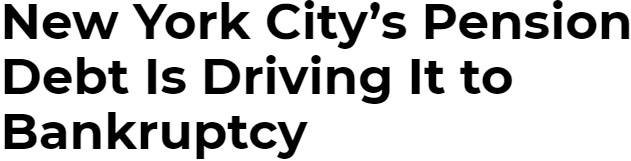
To be more specific, unfunded pensions are the biggest reason NYC is in deep trouble.
…the city is staring bankruptcy in the face. …but there’s been little talk about one of the main causes of the city’s growing debt: public employee pensions. As of today, nearly 75 percent of the city’s $197.8 billion deficit is due to pension and other retirement liabilities. …Sick of high taxes, residents and businesses are already leaving in droves… NYC offers five different pension plans to its municipal employees, from teachers to members of the school board. These pensions serve as a source of retirement income to former city employees and are defined benefit plans, meaning that benefits are guaranteed by the employer. …it’s no surprise that the pension plans’ funded ratio, which shows the ratio of the plans’ assets to liabilities, has dropped to 71.4 percent for NYCERS and 58.6 percent for TRS—thanks to accumulated debt. …for every dollar spent on NYCERS payroll, 34 cents goes toward pensions, and that number is 10 cents higher for TRS. …Pension contributions make up 11 percent of the city’s total budget and consume 17 percent of the city’s tax revenues. And it’s worth remembering that in the city ranked number one in local tax burden in the United States.
As you might suspect, Mayor de Blasio certainly isn’t doing anything to address this problem.

I’m simply noting that the problem existed before he took office and presumably would still exist with any other mayor.

And there are other officials in New York City who deserve scorn.
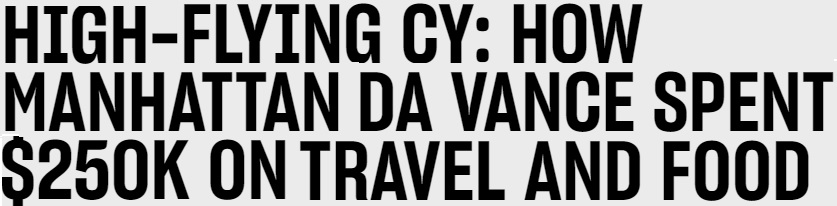
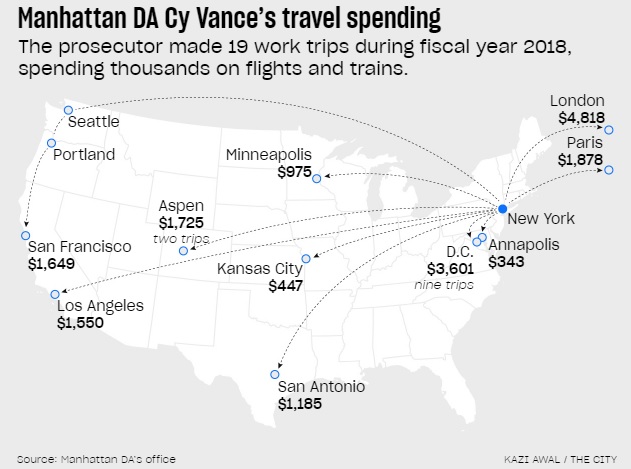
Manhattan District Attorney Cy Vance is a traveling man with some high-end tastes. The prosecutor spent $249,716 on meals and work trips to everywhere from the City of Angels to the City of Lights over the past five years, according to records obtained via a Freedom of Information Law request. Vance paid for it all – including a $4,780 roundtrip flight to London and a $2,800 stay at a five-star Paris hotel – with money his office obtained from state-asset forfeiture funds largely tied to big-sum legal settlements with banks, records show. He controls more than $600 million stemming from forfeitures. …the other city district attorneys say they did not use asset forfeiture money to cover their work travel expenses. …Vance also does not skimp when it comes to eating out… He spent $645 at Patroon on East 46th Street to cover dinner… Vance also has expensed five meals at Tribeca’s Odeon for a total of $897… During his Paris visit, he spent $94 at Le Nemrod, $124 at Marco Polo, $72 at Le Saint Regis and $169 at Le Christine, according to the expense reports. …DAs have wide-ranging flexibility on how asset forfeiture money is used. Expenditures must cover “law enforcement” issues — but few other rules exist.
Here’s a map showing Vance’s travel.


By the way, the most outrageous part of this story isn’t the luxury travel or the expensive meals.
What really irks me is that his high-flying lifestyle is made possible by asset forfeiture, which is what happens when the government steals someone’s property – oftentimes without any finding of guilt!

The bottom line is that New York City has a terrible mayor, but the problem goes way beyond one person.

Which is why this final story, from Bloomberg, should be the canary in the coal mine when contemplating the future of the city.
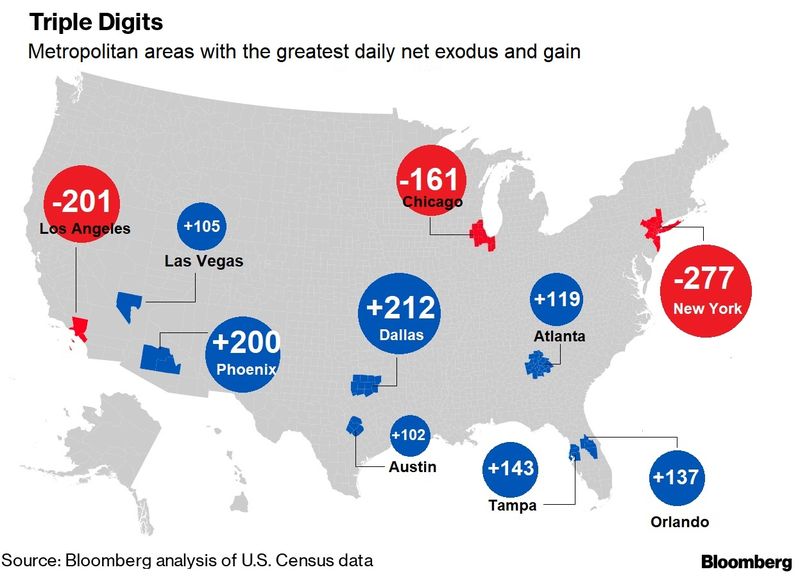
New York leads all U.S. metro areas as the largest net loser with 277 people moving every day — more than double the exodus of 132 just one year ago. Los Angeles and Chicago were next with triple digit daily losses of 201 and 161 residents, respectively. This is according to 2018 Census data on migration flows to the 100 largest U.S. metropolitan areas compiled by Bloomberg News. …While New York is experiencing the biggest net exodus, the blow is being softened by international migrant inflows. From July 2017 to July 2018, a net of close to 200,000 New Yorkers sought a new life outside the Big Apple while the area welcomed almost 100,000 net international migrants. …Some areas are affected by high home prices and local taxes, which are pushing residents out and deterring potential movers from other parts of the country. About 200,000 residents left New York last year. Los Angeles had a decline of nearly 120,000 and Chicago fell by 84,000.
Here’s the map showing the cities losing the most people and gaining the most people.


By the way, it’s no coincidence that most of the fast-growth cities are in states with no income taxes.

P.S. Mayor de Blasio wants to “tax the hell out of the wealthy” in New York City, but fortunately he’s been somewhat frustrated in that goal because of limits on his power.

P.P.S. Because taxpayers in NYC no longer have unlimited ability to deduct their state and local taxes on their federal returns, the 2017 tax law almost certainly is contributing to the exodus from New York City. And every time one of those taxpayers escape, NYC gets closer to fiscal crisis.

Sunday, September 15, 2019

Pension Bailout Would Only Worsen Underfunding Crisis

By Rachel Greszler | September 13, 2019

A friend of mine recently had the unfortunate experience of dealing with multiple abscessed teeth in her children.

These abscesses occurred because a neglectful dentist had “treated” her kids’ cavities by concealing them with quick, painless fixes instead of drilling down and eliminating the root of the problem.
In the end, the kids had to undergo much more intense, expensive, and painful treatments than if their cavities had been properly treated to begin with.

The Congressional Budget Office has recently found that Congress’ so-called “solution” to a $638 billion multiemployer pension crisis would similarly exacerbate the situation—but without the benefit of Novocain................But even that costly and ineffective assessment only scratches the surface of the pervasive multiemployer pension crisis. That’s because only 139 pension plans would be eligible for taxpayer assistance..

According to the Pension Benefit Guaranty Corporation, there are 1,374 multiemployer, or union, pension plans across the U.S., meaning only about 10% of them would qualify for assistance under this bill............To Read More....

My Take - This is absolutely outrageous.  If they do this it will only allow them to continue down these disgusting practices.  These elected officials at the local and state level bought the unions votes by negotiating contracts that were clearly unsustainable, and now, they want the rest of the nation to pay for it.  And the Congress, including the "Stupid Party", AKA, the Republicans, are on board.  

Well, they made the deal let them live with the consequences.  I hope every municipal, county and state government that sold out their constituents to these unions goes broke, right along with the unions and their members.  They voted for these lunatics, let them all pay the price. 

Monday, August 12, 2019

Underfunded Public Pensions Put Future Taxpayers on the Hook

Ivan Osorio August 9, 2019

One of the most well-known and enduring lessons of public choice economics is the dynamic of concentrated benefits and diffuse costs. Well-organized groups have both the incentive and ability to lobby government for benefits for themselves, paid for by taxpayers at large, who lack organization and whose individual payouts toward said benefits aren’t large enough to prompt them to expend much effort opposing this arrangement.

This has gone on as long as there have been governments. That’s bad enough, but this rent-seeking scenario doesn’t just transfer wealth from the general populace to organized interest groups; it also works across time.

This often occurs with the funding of public employee pensions, as a recent Cato Institute research brief by UCLA economist Christian Dippel highlights..........For more on public sector unions, see here........To Read More...

Wednesday, June 12, 2019

New Book Presents Solutions for Financially Insolvent Entitlement Programs

Provides straightforward explanations and direct, simple solutions to the nation’s entitlements crisis.

May 23, 2019 By Jay Lehr

On the Edge: America Faces the Entitlements Cliff, by Mark E. Litow and Merrill Mathews, Ph.D. (Institute for Policy Innovation: 2019), 211 pages, ISBN 9781645501046; $10.95
 
The authors of On the Edge skillfully unravel the mess our political leaders have gotten the nation into over almost 100 years, providing straightforward explanations and direct, simple solutions to the nation’s entitlements crisis.
 
The “entitlements cliff” of the book’s title is the fact that our social insurance programs are financially unsound and our income redistribution programs are unaffordable.
 
Describing 84 social insurance and means-tested welfare programs, Mark Litow and Merrill Matthews focus on the biggies with which we are all familiar: health care, Social Security, public employee pensions, and cash welfare.
 
Fiscally Unsound Premises
 
Employers and employees contribute to social insurance programs, and many retirees pay premiums for Medicare. Over the years, however, politicians have increased the benefits faster than the taxes and premiums dedicated to fund these schemes. They have also added new groups of beneficiaries whose benefits are subsidized by other participants or taxpayers in general.
 
In managing Social Security, health care, and pensions, the government never follows the prescription that allows insurance companies to stay in business while insuring all kinds of risk.
 
Insurance companies do it by practicing actuarial science, which is the quantification of risk using math, probability, and statistics. In the end, to stay in business for long, income must equal or exceed expenditures.
 
Unfortunately, with only rare exceptions, government safety-net programs are set up and later expanded based on political considerations instead of economics and actuarial science.
 
“Finding a U.S. entitlement program that has remained the same over time is about as difficult as finding one that will be solvent over the long term,” the authors write.
 
Explosion in Spending
 
Litow and Matthews concisely describe how Medicare and Medicaid exploded in cost.
 
Medicare’s “unfunded liability had been estimated by the trustees in 2009 at about $90 trillion,” they write. Then came the Affordable Care Act, which subsidized health insurance premiums for non-seniors, expanded Medicaid eligibility, and undermined Medicare by imposing cuts in price-controlled reimbursements to hospitals.
 
In 2012, the Actuary estimated that by 2080 Medicare’s hospital expenditures could rise to 9.9 percent of all taxable payroll and that payments to physicians could mount to nearly 4.39 percent of the nation’s gross domestic product.
 
“Medicare is in much worse financial shape than Social Security, and Medicaid consumes an ever-expanding percentage of federal and state budgets,” the authors write.
 
‘Financial Malpractice’
 
Litow and Mathews do an excellent job of explaining the disaster of unfunded pension programs for public employees. “Many states are facing unfunded liabilities far beyond anything they can cover without dramatic changes,” they write.
 
A recent study shows the unfunded liabilities for state employee pension plans are $6 trillion.
 
“For example, according to the American Legislative Exchange Council, Connecticut’s unfunded pension liability in 2017 was $248 billion, New Jersey’s was $249 billion, Illinois’s was $388 billion and California’s was $988 billion—almost $1 trillion,” Litow and Matthews write.
 
“These shortfalls are nothing less than financial malpractice,” the authors write.
 
Losing War on Poverty
 
In case you have any warm feeling for former president Lyndon Johnson and his initiation of our War on Poverty, you will learn it only made things worse, and not for lack of money.
 
“In 2017, we calculate that states spent nearly $500 billion on means-tested welfare programs,” the authors write. “Adding state to federal means-tested spending brings the total to about $1.1 trillion.”
 
The authors estimate we have spent $29 trillion on antipoverty programs in the United States with little to show for it to date. The poverty rate “has fluctuated between 11 percent and 15 percent for 50 years, and [stood] at about 12.7 percent in 2016.”
 
Solution: Temporary Safety Nets
 
The key to a solution to this fiscal mess is to differentiate safety nets that will help those in temporary need from those in need of permanent help and to create programs that incentivize getting back to work instead of encouraging people with low incomes to stay in need, the authors argue. A good program must separate the able-bodied from those not so fortunate.
 
Litow and Matthews stress the principles of the Society of Actuaries, which are to make programs available only to those in need, with meaningful benefits that are fiscally sound. The authors recommend combining private and public funding based on a free-market platform with incentives for recipients to leave the government’s safety-net system.
 
Solution: Individually Owned Accounts
 
Most federal entitlement spending is on Social Security and Medicare, costing $1.63 trillion per year by the authors’ estimate. The only way to solve these programs’ financial challenges is to move to a system of accounts owned and controlled by the individuals, not the government, the authors argue.
 
Litow and Mathews suggest several ways to address the inherent risks that come with people managing their own accounts and occasional stock market declines. They also offer simple models to create actuarially sound safety-net, health care, and welfare programs.
 
Sadly, the authors’ solutions are not likely to happen given the power of advocacy groups that benefit from government ineptitude.
 
This well-thought-out book offers a set of solutions that could solve the long-term fiscal and economic problems we face—if ever we can get the government to stop kicking the can down the road.
 
Jay Lehr, Ph.D. is senior policy analyst at the International Climate Science Coalition.