Search This Blog

De Omnibus Dubitandum - Lux Veritas

Showing posts with label Dan Mitchell. Show all posts

Friday, November 7, 2025

The Value-Added Tax: A Recipe for More Spending…and More Debt: Part II

 November 6, 2025 by Dan Mitchell @ International Liberty 

The case against the value-added tax (VAT) is not complicated.

Simply stated, this hidden type of national sales tax was a key precursor for the expansion of the European welfare state. As you can see in the chart, the burden of government spending in Europe  after World War II was similar to the size of the public sector in the United States.

Then European governments began to adopt the VAT in the late 1960s. Those VATs quickly expanded and became money machines for more spending (and more debt!).
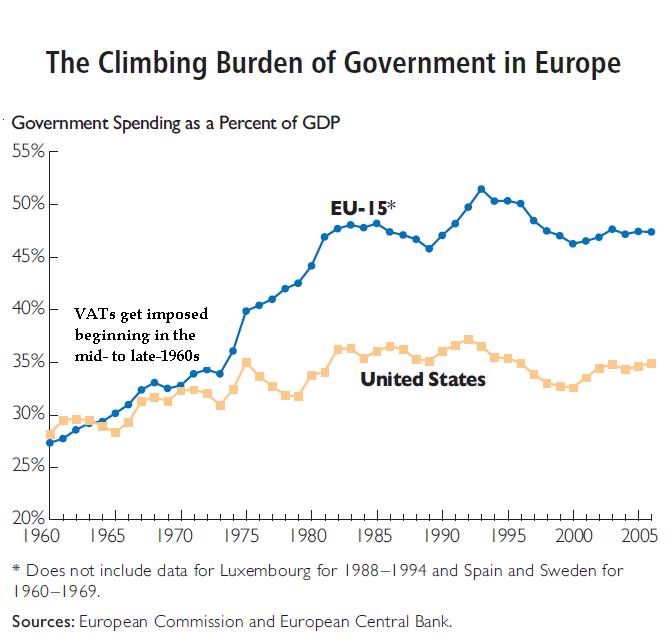
Needless to say, the United States should not make the same mistake. Bigger government has led to worse economic outcomes in Europe, as I’ve documented in my four-part series (herehere, here, and here).

Even the pro-tax International Monetary Fund inadvertently produced a study showing why the VAT is a money machine for big government.

Financing bigger government with a VAT would weaken economic performance. In a 2010 study for the Mercatus Center, Professor Randall Holcombe crunched some numbers and reached some depressing conclusions.


…the effect of various VAT rates on GDP looking 10 years out and 20 years out. …In the revenue-enhancement case, where VAT revenue adds to existing sources of tax revenue, a 3 percent VAT would exact a 2.1 percent GDP penalty by 2020 and a 3.7 percent GDP penalty by 2030. A 5 percent VAT rate would bring with it a 3 percent GDP penalty by 2020 and a 5.6 percent GDP penalty by 2030. A 7 percent VAT rate…would reduce GDP by 4.1 percent by 2020 and 7.5 percent by 2030.

And here’s one of his tables, showing the negative effect on economic output (as well as some calculations showing that the VAT would not collect as much money as supporters hope).

Now let’s look at some more-recent research.

In 2024, Adam Michel wrote a report on the tax implications of bigger government.

Here’s his section on the VAT.

…consumption taxes (taxes on goods and services) account for almost three times as much revenue in the EU countries than in the United States. Every European country uses a value-added tax (VAT), a type of national sales tax collected by businesses at each stage of production instead of at the point of sale. In the United States, most consumption tax revenue is collected by state governments through a point-of-sale retail sales tax. In 2022, the average standard VAT rate in the EU countries was 21.8 percent, and the average state and local sales tax rate in the US was 6.6 percent.  

EU country VATs raise revenue equal to 12 percent of GDP, compared to sales taxes, which collect 4.3 percent of GDP in the United States. The adoption of VATs is closely associated with government growth because new revenue sources, especially when the cost of the tax is not transparent, tend to fuel new public expenditures and reduce pressure on spending reforms. This association is evident in the reliance on VAT revenue across EU countries, where governments are almost 20 percent larger than in the United States.

Here’s Adam’s chart, showing how the absence of a VAT is the main reason the United States has a fiscal advantage over the European Union.

The clinching argument is that one of America’s best presidents opposed a VAT and one of America’s worst presidents supported a VAT. That tells you everything you need to know.

P.S. You can enjoy some amusing – but also painfully accurate – cartoons about the VAT by clicking herehere, and here.

Thursday, November 6, 2025

G20 Report on Inequality Urges More Statism, More Poverty

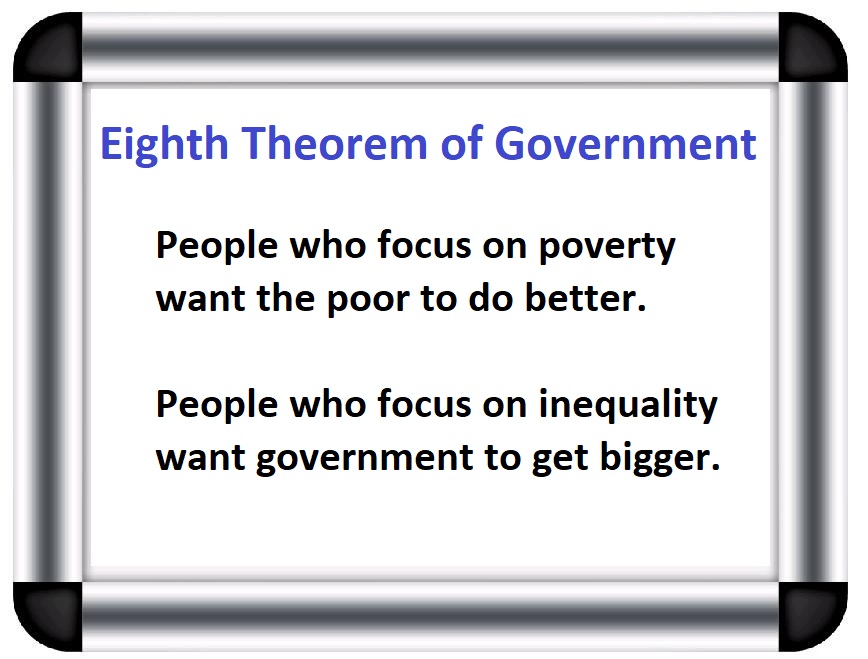
When I unveiled my Eighth Theorem of Government in 2020, my target was the head of the International Monetary Fund, a bureaucrat with a very generous tax-free salary who wanted other people to pay higher taxes to fund bigger welfare states.


Her excuse was fighting inequality, but her policy was bigger government.

And since the IMF had published research implying that societies would be better off if everyone was poorer but more equal (I’m not joking), I decided that I needed a way of capturing this perverse mindset.

Now I have a new reason to share my Eighth Theorem. The failed government of South Africa recently paid some leftist academics to issue a report on inequality.

It was led by Joseph Stiglitz, the guy who infamously praised Venezuela’s failed socialist policies. And it included Jayati Ghosh, who was the lead signatory of the world’s most inaccurate letter.

Here’s their premise (keep in mind that “neoliberal” in much of the world means free market).


A series of economic policies that found favour from the 1980s led to steep increases in economic inequality in many high-, middle- and low-income countries. …Collectively, these policies have been described as ‘neoliberal’. They have been a common feature in most nations at different times over the last four decades… Broadly they are based on the idea that unregulated markets are the most efficient way of allocating resources. They were adopted nationally and globally through globalisation. Several of these policies led directly to higher inequality.

The authors are partly right. As I noted yesterday, there was a global shift to free-market policies that started under Reagan and Thatcher (an era sometimes known as the Washington Consensus).

Did this period of  “neoliberalism” mean more inequality?

My responses is that I don’t care if some people get richer faster than other people get richer. I just want a system that produces more prosperity for everyone.

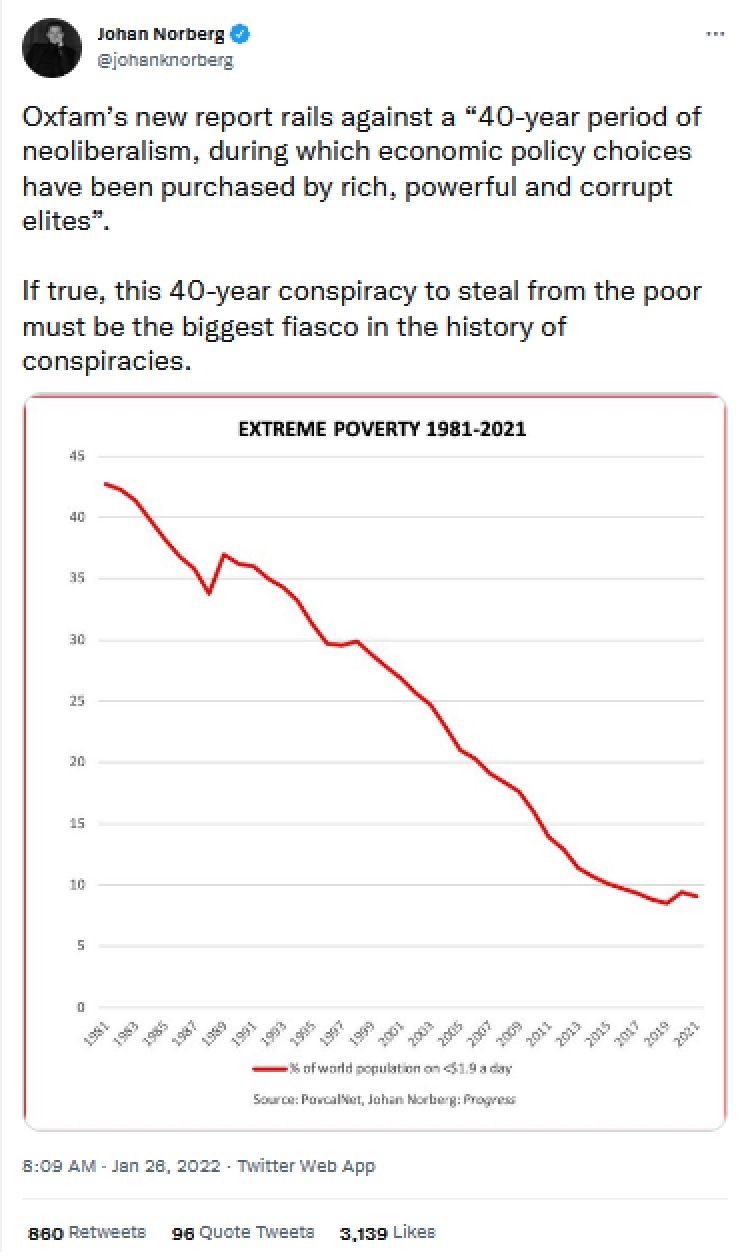
And, as Johan Norberg noted back in 2022 when responding to a different attack on neoliberalism, it was a spectacularly wonderful time for poor people.

Since the authors started with the wrong premise (fixating on inequality rather than looking at how to reduce poverty), it will come as no surprise that their proposed policies are misguided as well.

At various points, they endorse more spending, industrial policy, price controls, weakening property rights, and protectionism.

As you might suspect, I found their analysis of tax policy especially loathsome.

There is no ‘magic bullet’ to reduce inequality. But there is a menu of prudent policies that have proven to be highly effective, and could even be seen as preconditions, for reducing various dimensions of inequality. …we have a specific emphasis on the international approaches and strategies to reduce inequality… 

An agreement among countries to have a minimum corporate income tax would, for instance, help prevent the destructive race to the bottom in corporate taxation. …new negotiations at the UN towards a Framework Convention on International Tax Cooperation provide a historic opportunity to redesign the international tax architecture. Minimum global tax rates on corporate incomes and extreme wealth could be vital elements of this, which in turn would require…ideally the creation of a global asset register to identify and track wealth ownership.

Their agenda can be summarized as “eliminate tax competition to enable goldfish government.”

P.S. The part about a “global asset register” is especially Orwellian. Fits well with the left’s desire to abolish cash and require everyone to use central bank digital currencies.


Monday, November 3, 2025

Personal Retirement Accounts Are (Still) Superior to Social Security

Here’s a video I narrated nearly 15 years ago explaining why personal retirement accounts are superior to a government pay-as-you-go regime.

Given the passage of time, it’s worth revisiting the issue to see what’s changed.


Some information needs to be updated.

  • The Social Security system now has a far bigger long-run deficit, $65.8 trillion. That’s more than twice the size of the shortfall in 2011.
  • There are now more nations that have shifted to personal retirement accounts, meaning wealth accumulation rather than taxes and spending.

So let’s now look at a new analysis of why Social Security reform is desirable, authored by Scott Beyer for the Independent Institute.

As these passages show, the argument for reform has not changed. Personal accounts are better for the nation…and better for workers.


…the SS system has quietly made Americans poorer. By removing trillions of dollars from private investment and placing them in the hands of a slow, bureaucratic system that earns virtually no return, the program has robbed the average worker of what could have been generational wealth. …let’s compare two scenarios. In the first, we’ll look at what would happen if an average American worker were allowed to keep their SS contributions and invest them in the U.S. stock market. In the second, we’ll look at what they actually get under today’s SS system. It’s a stark difference in lifetime asset accumulation. …

The median American worker today earns roughly $60,000 per year. Over a 50-year career—say, from age 17 to 67—that worker and his employer will pay a combined 12.4% of every paycheck into the SS system, or $7,440 per year. …Since 1957, the S&P 500 has averaged a 10.4% annual return, or about 7% after adjusting for inflation. Using a standard compound interest model, $7,440 invested annually at 7% for 50 years would grow to roughly $3,244,000. …

Now let’s look at what that same worker actually gets. …For an average worker earning around $60,000, the expected monthly benefit at full retirement age (67) is roughly $1,900 per month. …If that person lives to 85, they’ll collect those benefits for 18 years, totaling $410,000 in lifetime benefits…equivalent to around $380,000 in today’s dollars… That’s a far cry from $3 million.

Needless to say, it would have been better to have reformed the system back in 2011, when the above video was released.

And I recently shared some analysis of why we would be better off if the program was reformed when George W. Bush was president.

But how many people know that we came close to reforming the program when Bill Clinton was in the White House?

Here are some excerpts from an article by Kristin Tokarev and Ryan Yonk for the Daily Economy.


Twenty-five years ago, Bill Clinton was gearing up to “save” Social Security. The year was 1998, and…there were discussions about bringing the American spirit of innovation and personal freedom to one of the most stagnant policy areas: Social Security and retirement options more generally. … 

Chile had implemented the world’s first fully funded system of personal retirement accounts, empowering workers to invest their own money, choose among private firms, and build wealth. President Clinton’s team took notice. In 1996, Mack McLarty — Clinton’s special envoy to the Americas and former chief of staff — visited Chile and wrote upon his return, “Without a doubt, the reform of Chile’s pension system has been a critical contributing factor… 

to Chile’s ongoing economic success… I believe we can learn a great deal from your country’s bold initiative.” …By 1998, Clinton stood at the podium for his State of the Union address and declared: “I will convene the leaders of Congress to craft historic bipartisan legislation… a Social Security system that is strong in the twenty-first century.” It was a moment. A window. A 

shot at real reform. But soon, Clinton, impeached, diminished, and drained of political capital, was sidelined. Personal retirement accounts, once on the verge of becoming law with growing bipartisan support, became just another “what if” in the annals of American policy. In 1999, Clinton made one last effort. “With the number of elderly Americans set to double by 2030,” he said, “I propose that we… establish universal savings accounts.”

Needless to say, Clinton was much better on the issue than Obama and Biden. Heck, he was much better on the issue than his wife!

The bottom line is that personal retirement accounts were the best option then, they are the best option now, and they will remain the best option in the future.

P.S. Just in case anyone wonders whether personal retirement accounts are practical, they already exist in dozens of nations, including Australia, Chile, Switzerland, Hong Kong, Netherlands, the Faroe Islands, Denmark, Israel, and Sweden.

Tuesday, October 28, 2025

Part V: Yes, Taxes Change Behavior

October 24, 2025 by Dan Mitchell  @ International Liberty 

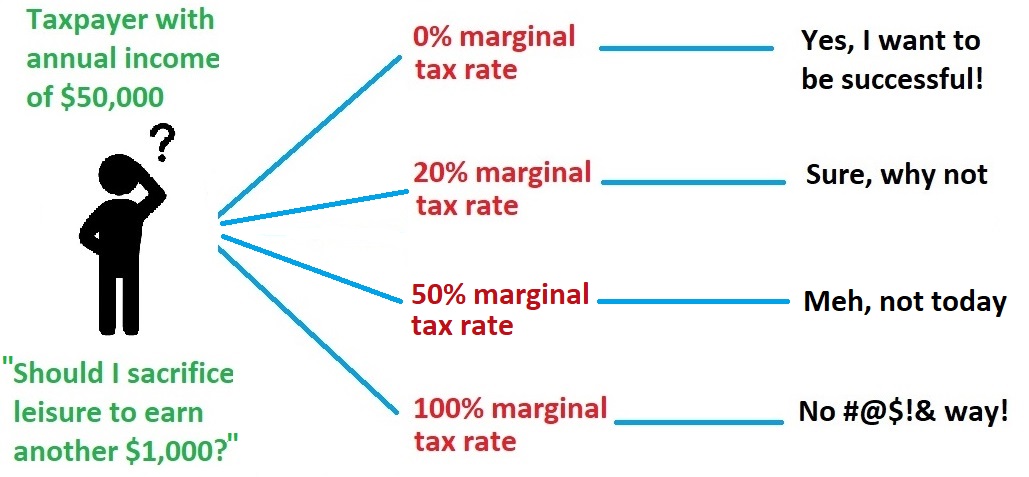
Economic analysis of taxation is fairly simple and straightforward: The more you tax of something, the less you get of it.


Yes, you want to focus on marginal tax rates, and yes, you want to look at “double taxation” to get effective marginal tax rates.

If you have quantitative skills, you can even estimate the slopes of supply and demand curves and try to quantify the “deadweight loss” from a tax.

But it still boils down to the fact that the more you tax of something, the less you get of it.

In this series (previous editions available here, here, here, and here), I’m using simple examples to show that taxes matter. They change behavior.

Today, let’s go to Japan to see that politicians in a scenic city decided to impose higher taxes because they wanted to reduce the number of tourists. Here are some excerpts from a report in USA Today by Kathleen Wong.


Travelers wanting to see the ancient temples and shrines in Kyoto will soon need to increase their budget as the historic city announced on Oct. 3 a 900% hike on its tourist tax. This will mark Japan’s highest tourist tax. …the increase will apply to the city’s accommodation fee – a per-night tax calculated based on the daily rate of your hotel, according to the website. … 

Those staying in more expensive accommodations will be charged a higher tax. Hotels with nightly rates at 100,000 yen (about $665) or more will face the biggest tax increase from $6.65 to $66.55 per night added to their final bill at checkout. …The move makes Kyoto the latest destination to implement a tourist tax as a way to curb overtourism, with Greece, New Zealand, Bali, Amsterdam and Venice all introducing some sort of similar fee within the past several years.

I have no idea if this tax is a good idea or bad idea (my knee-jerk assumption is that any tax is bad, but maybe there really is over-tourism and this is the most efficient way of dealing with the issue).

That being said, the politicians in Kyoto have shown that they understand the economics of taxation. At the risk of repeating myself (again): The more you to of something, the less you get of it.

My frustration with politicians is that they often fail to demonstrate the same economic insight when considering tax rates on behaviors that are unambiguously good for society – such as work, saving, investment, and entrepreneurship.

P.S. I actually suspect many politicians do understand the damage of high tax rates on productive behavior, but they pretend otherwise because they put vote-buying about the national interest.

Friday, October 24, 2025

The Looming Fiscal Crisis, Part II

October 17, 2025 by Dan Mitchell @ International Liberty

Because economists are lousy forecasters, I don’t pretend to know when a fiscal crisis will occur or which nation will be the first debt domino.

But it will happen.

Indeed, I suspect it will happen the next time there’s an economic downturn (though I obviously can’t predict when that will happen, either).

Here’s a chart showing average government debt levels in the industrialized world.

It used to be that governments only incurred lots of debt because of war. They then paid down debts after wars ended.

But that pattern broke down about 50 years ago thanks to the creation of the welfare state.

Though not all governments are equally bad. I’ve noted that there are nations like Switzerland, Denmark, and Estonia that have low and/or falling debt levels.

Unfortunately, most of the world’s major nations are far less prudent. Here’s a chart looking at the G-7 countries. Only Germany and Canada have manageable debt levels (and even both of them have been rapidly deteriorating in recent years).

The above charts come from an article in the U.K.-based Economist.

Here are some excerpts, starting with a description of how governments get in trouble.


The magic of borrowing…comes with a temptation—one that David Hume and Alexander Hamilton worried about in the late 18th century. If a country is sufficiently creditworthy to cover its existing debts, it is in a position to borrow more. Having manageable debts means you can manage more debt. And so it is all too easy for debt to grow. If this goes on for too long, governments start to face pushback. 

The bond markets which meet their need for debt start to charge them more. New borrowing gets harder—and so does rolling over old debts. If governments do not then tighten their belts, the country’s all-important creditworthiness erodes in a way which can easily spiral out of control. …today the biggest, richest countries have fallen into a dangerous pattern of borrowing ever more. Debts have reached vertiginous highs and bond markets are showing resistance.

The article then looks at some specific problem in western nations.

Governments have adopted mechanisms to constrain debts, such as America’s “pay as you go” rules in Congress or the EU’s Stability and Growth Pact. But politicians suspend, abuse or evade them almost as they please. …Bond markets are responding. …the longer the duration of a bond, the more investors must pay attention to the risks posed by lax budgeting. … 

The prospect investors must worry about is not just—or even mainly—that of default. There is another weapon that can hurt them over long horizons: inflation. …Another problem in Europe is that taxes are high as a share of GDP, limiting the scope to raise them without doing excessive economic damage. …The IMF has estimated that debt interest, pensions, health, defence and climate change in Europe’s advanced economies will create additional annual spending “pressure” worth nearly 6% of GDP by 2050.

Since the above excerpt mentioned inflation, the Economist has a separate article predicting that’s how politicians will respond when a crisis unfolds.

Here are some of the relevant passages.

How long can governments live so far beyond their means? Rich-world public debt is already worth 110% of GDP… It is therefore increasingly likely that governments will instead resort to inflation and financial repression to reduce the real value of their high debts, as they did in the decades after the second world war. …Price rises are unpopular—just ask the hapless Joe Biden—but they do not need political support to get going. Nobody voted for them in the 1970s or in 2022. When governments cannot get their act together, and run economic policies that are unsustainable, bouts of inflation just happen. …Yet that downward spiral is not inevitable. …Ronald Reagan and Margaret Thatcher…saw sound money as central to the pact between the state and the citizen. …Which path will the rich world take—ruinous or prudent? …If the world emerges with lower debts and conscious of the dangers of excessive borrowing, a renewal of sorts is possible. The alternative would be for the world’s most important economies to descend into chaos.

I have three comments on these two stories.

The first two deal with media bias, or perhaps media ignorance, while the final comment deals with substance.

  • First, the writers at the Economist did not oppose the spending orgies during either the 2008 financial crisis or the 2020 pandemic, both of which played a big role in boosting red ink, so their sudden pearl-clutching about debt- while appropriate – is ironic.
  • Second, while the authors acknowledge that higher taxes might not work, the second chart shared above doesn’t include a column on the burden of government spending, which probably will lead many readers to falsely think the solution is additional tax increases.
  • Third, while the Economist does not seem to have the correct perspective, the issues raised in the two stories are deadly serious. Barring a sudden outbreak of Milei-ism, the western world is stumbling toward a very serious and very debilitating fiscal crisis.

But here’s the most important thing to understand. The problem is spending, not debt.

Excessive spending undermines prosperity whether it is financed by taxes, borrowing, or money-printing.

P.S. Notwithstanding the title of the magazine, the Economist has a weak record on some big economic issues (see here, here, and here).


Thursday, October 23, 2025

More U.N. Lies about Poverty

October 22, 2025 by Dan Mitchell @ International Liberty

In 2018, I shared a visual that I referred to as the western world’s “most depressing chart.”


It showed how the welfare state exploded in size after World War II and is now an enormous fiscal burden.

This has been bad news for taxpayers, of course, but also bad news for poor people since they get trapped in dependency.

I’m recycling this data today because I just read a report in Washington Post by Ishaan Tharoor about how the “far right” has been enabled by a “decline of the welfare state.”

Here are some excerpts.


…the United Nations’s special rapporteur on extreme poverty and human rights will deliver a report to the U.N. General Assembly on how cuts and curbs to welfare programs and social spending across the world have stoked popular discontent and, as a result, far-right politics. …De Schutter contends that there’s even more reason to widen and bolster social spending. …De Schutter, who is an independent expert appointed by the United Nations to advise on a specific issue, argues… “Welfare is not a luxury for a society, not something we can dispense with in times of crisis… Social protection is not just a cost, it’s an investment.”

I don’t like welfare for immigrants, but I also don’t like welfare for native-born people. So I’m not interested in the article’s political analysis.

But I care a lot about the fiscal burden of government, so I zeroed in on the mention of “cuts and curbs to welfare programs and social spending.”

This surprised me. I like to think I keep close track of fiscal developments, and not just in the United States. Yet I’m not aware of any shift away from the welfare state.

Did I miss something?

So I went to Our World in Data (the source for my 2018 chart) to get the latest numbers.

Lo and behold, the U.N.’s supposed expert is either a bald-faced liar or a blithering idiot. Social spending is still on an upward trajectory.

At the risk of understatement, it is absurd for the U.N. to complain about non-existent cuts. Indeed, it’s grossly dishonest.

Since I’m fair, I’ll acknowledge that the report also complains about “curbs” such as work requirements and anti-fraud measures, and at least some of those measures are real.

The bottom line is that I wish there were cuts in the welfare state. Government is far too big already and, because of demographic change and poorly designed entitlement programs, the problem is going to get much worse in the  absence of reform.

P.S. The chart show that there was a spike in social spending in 2020 because of the pandemic. But the U.N. bureaucrat who produced the report was not complaining about redistribution spending returning to the trend after all the COVID-related outlays. Indeed, if you read the report, there’s not a single mention of the pandemic. Indeed, do a search of the document and you won’t find a single mention of terms such as “pandemic” or “COVID.” Same for “coronavirus” or even just “virus.”

P.P.S. The United Nations has a track record of lying about poverty.

Wednesday, October 22, 2025

Part III: Is Switzerland the World’s Best Nation?

October 21, 2025 by Dan Mitchell @ International Liberty

Building on yesterday’s column, let’s look at some more data about the “improbable success” of Switzerland.

We’ll start with a comparison of per-capita GDP, showing Switzerland out-performing other nations (I’ve shared similar charts in previous columns).

The chart comes from Simon Grimm, who shared some thoughts after his recent trip to Switzerland.

As you read these excerpts, keep in mind that he is using “liberal” in the European sense, meaning free markets.


Switzerland is far wealthier than most of Europe. The country has a median household income higher than that of the United States…and the world’s highest share of Fortune 500 companies relative to its GDP. …But the country is rarely discussed… Given Europe’s stagnant economies and increasing debt burden, this seems like an oversight… 

Switzerland differs from most of Europe: its economic governance is far more liberal. All else being equal, this should explain a large part of Switzerland’s economic success. …The country has low corporate taxes, flexible labor laws, and a large number of free trade agreements. 

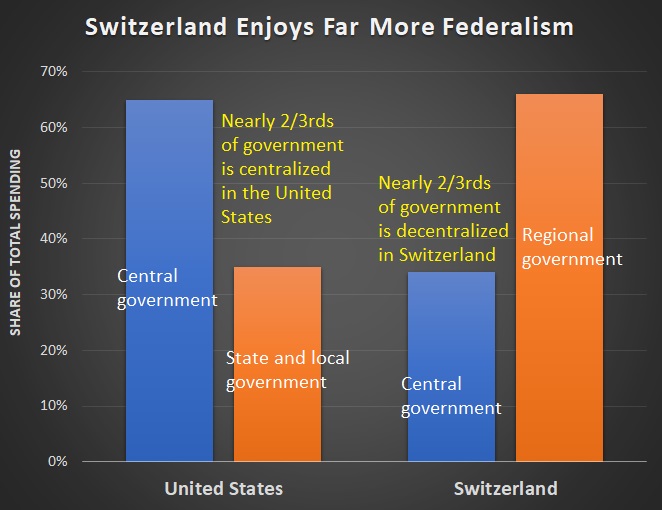
Unlike France or Germany, income taxes are mostly levied on the state level, incentivizing local administrations to run efficiently for fear that citizens will move to low-tax states. This provides the country both with a debt-to-GDP-ratio of only 38% and some of the lowest income taxes in Europe… 

Relatively liberal parties always make up a majority of the government… Voters reject nearly all ballot initiatives that might threaten Switzerland’s economic position: a 2012 referendum increasing the number of mandatory holidays was rejected by 66% of voters. …overall, Switzerland…seems like a good example of what a century-long attachment to liberalism can yield.

Professor John Cochrane of the Hoover Institution also wrote about Switzerland after a recent trip.

He’s particularly impressed by Switzerland’s fiscal policy.


Swiss inflation barely exceeded 3% in the post-pandemic surge, and is back to zero. …Here is recent Swiss fiscal policy. The worst deficit in the pandemic was under 20 billion, or about 3% of GDP. The US by contrast hit 25% of GDP deficit. The budget went quickly back to balance — total balance not just primary balance. Debt is a tiny 16.8% of GDP. Yes, 16.8, not 168. … 

Balance is not just accidental. Switzerland has a constitutional “debt brake,” passed by referendum, that requires cyclical budget balance. …adding it all up, it’s if anything a puzzle that the Swiss had any inflation at all. The deficit was very small. The debt was tiny. And, most of all, the “debt brake” assures people that the debt will be repaid.

Here’s a chart from his analysis.

It’s in French, but all you need to know is that the blue line is revenue and the green line is spending. The purple bars are surpluses or deficits.

Cochrane is certainly correct that Switzerland has far less debt than its neighbors.

And I’m obviously a fan of the Swiss debt brake (which actually functions as a spending cap).

But I think he’s missing the most important fact, which is that Switzerland has a much lower burden of government spending.

This is what allows the nation to have low taxes. This is what enables prosperity since the government is not diverting as many resources from the productive sector of the economy.

Tuesday, October 21, 2025

Part II: Is Switzerland the World’s Best Nation?

October 20, 2025 by Dan Mitchell @ International Liberty 

I’ve shared a two-part video series (here and here) on the “improbable success” of Switzerland.

Building on that, here’s a report from CNBC about the “world’s best nation.”

There are many reasons to admire Switzerland.


Today, let’s heap more praise on the Alpine Republic.

Some of it, surprisingly, from an article in the New York Times by Ruchir Sharma.

Here are some excerpts.


There is…a country far richer and just as fair as any in the Scandinavian trio of Sweden, Denmark and Norway. But no one talks about it. This $700 billion European economy is among the world’s 20 largest, significantly bigger than any in Scandinavia. It delivers…lighter taxes, smaller government, and a more open and stable economy. Steady growth recently made it the second richest nation in the world, …with an average income of $84,000, or $20,000 more than the Scandinavian average. … 

This less socialist but more successful utopia is Switzerland. …Capitalist to its core, Switzerland imposes lighter taxes on individuals, consumers and corporations than the Scandinavian countries do. In 2018 its top income tax rate was the lowest in Western Europe at 36 percent, well below the Scandinavian average of 52 percent. Government spending amounts to a third of gross domestic product, compared with half in Scandinavia. …The Swiss have become the world’s richest nation by getting it right.

I’m not sure why the author wrote that Switzerland is “less socialist” while then soon after noting that the country is “capitalist to its core.”

That seems like “not socialist” to me, but overall, a fair article.

The Swiss also got some positive attention from the U.K.-based Economist, which ranked Switzerland as having the world’s most innovative economy.

And the OECD ranks Switzerland as having the best combination of political efficiency and democracy satisfaction.

Since I occasionally compare Switzerland and France, I think this visual is very compelling.

By the way, I’m assuming the slender Swiss document is in multiple languages, so the above image actually understates Switzerland’s advantage.

Last but not least, here’s a potential explanation for why Switzerland is so far ahead of its neighbors.

There are some versions of “right” that I don’t particularly like, so the most important part of the above visual is the last sentence.

In my simple way of thinking about the world, Switzerland is a case study for why “classical liberalism” is the best role model. Though nowadays it would be called small-government conservatism (or Reaganism) in the United States and “neoliberalism” in Europe.

P.S. As I wrote in 2011, I nonetheless prefer the United States over Switzerland.

Wednesday, October 15, 2025

Part IV: Yes, Taxes Change Behavior

October 14, 2025 by Dan Mitchell @ International Liberty  

There can be honest and constructive debates about the size of government, such as when I cross swords with someone on the left who understands Arthur Okun’s efficiency-equity tradeoff.

Another legitimate debate is about the impact of tax policy, specifically whether higher or lower tax rates have big effects or small effects.

But to have such debates, it is necessary for for sides to recognize that taxes impact behavior. Which is why I started the Yes-Taxes-Change-Behavior series.

For our fourth installment, let’s travel to the Mediterranean.

As explained in a 2024 Reuters report by Renee Maltezou, the Greek government decided to use taxes to discourage over-tourism. Here are some passages.


Greece plans to impose a 20-euro levy on cruise ship visitors to the islands of Santorini and Mykonos during the peak summer season, in a bid to avert overtourism, Prime Minister Kyriakos Mitsotakis said… Speaking at a press conference a day after outlining his main economic policies for 2025,

Mitsotakis clarified that excessive tourism was only a problem in a few destinations. “Greece does not have a structural overtourism problem… Some of its destinations have a significant issue during certain weeks or months of the year, which we need to deal with,” he said. “Cruise shipping has burdened Santorini and Mykonos and this is why we are proceeding with interventions,” he added, announcing the levy. …The government also plans to regulate the number of cruise ships that arrive simultaneously at certain destinations, while rules to protect the environment and tackle water shortages must also be imposed on islands, he said.

By the way, the purpose of today’s column is not to support this new tax. Or to condemn this new tax.

I’m simply making the point that Greek politicians understand economics. They know that when you tax something at a higher rate, you get less of it.

Much as American politicians sometimes understand economics, such as when they try to discourage certain behaviors with higher tax rates on tobacco, plastic bags, and sugary products.

What I want, however, is for politicians around the world (and especially in the United States) to demonstrate the same economic insight when considering tax rates on behaviors that are unambiguously good for society – such as work, saving, investment, and entrepreneurship.

Given their twisted ideologies and perverse incentives, I won’t be holding my breath.

Monday, October 13, 2025

Part III: Yes, Taxes Change Behavior

October 8, 2025 by Dan Mitchell @ International Liberty

Part I of this series looked at how the capital gains tax discourages old people from selling their homes.

Part II of this series looked at how a so-called luxury tax was distorting the vehicle market in Australia.

For our third installment in the series, we’re going to look at the impact of marginal tax rates in the United Kingdom.

We’ll start with this chart showing – as income rises – both average tax rates (what share of overall income is taken by government) and marginal tax rates (what government takes if you earn additional income).

As you can see, the marginal tax rates jumps substantially – up to 60 percent – once income hits £100 thousand.

This means a taxpayer earning £100K who earns another £1,000 will only keep £400 pounds. Politicians will grab the other £600.

The chart comes from an article in the U.K.-based Telegraph by

Here are some excerpts.


David…has gone to extreme measures to make sure that his income doesn’t creep over £100,000. He has taken pay cuts, gone part-time and carefully kept a spreadsheet of his earnings, all to make sure he avoids the tax trap that leaves high earners thousands of pounds a year worse off. … 

To ensure he earns less than £100,000, he has taken a 9pc pay cut by choosing not to work in February, and instead goes on holiday for four weeks. He also works just three days a week on average. … 

Without his deductions, David estimates his salary last year would have been around £120,000, but instead he keeps it at £99,000. …Those earning between £100,000 and £125,140 face the highest effective tax rate, as they lose £1 of their £12,570 personal allowance for every £2 earned, until it completely disappears. Although on paper they pay 40pc tax, it means their effective tax rate is actually 60pc. … 

For a pilot like David, this means if his company offers £600 for a day’s overtime it is reduced to £240 because of the effective 60pc tax rate. …The 60pc tax trap has existed since Alistair Darling, Gordon Brown’s chancellor, introduced the tapering of the personal allowance in 2010.

Gordon Brown was a terrible Prime Minister, so no surprise things worsened during his tenure. There are two other passages from the article that merit attention. 

First, some pilots take much bigger steps than David.

David has seen many of his fellow pilots move to the Middle East to work for airlines based there, to take advantage of the much lower taxes.

In other words, it’s not just millionaires that are escaping the United Kingdom.

Second, the number of households getting hit by the punitive 60 percent rate is climbing.

This year, 725,000 workers will fall into the 60pc tax trap – more than double the 300,000 in 2018 – according to figures from HMRC. The number of workers caught in the 60pc tax bracket is expected to soar to 850,000 by 2028-29.

One reason the number is climbing is that another terrible Prime Minister, Rishi Sunak, eliminated inflation indexing. This means politicians profit from bad monetary policy since taxpayers can get pushed into higher tax brackets even if their inflation-adjusted incomes haven’t changed.

P.S. The article also notes that implicit marginal tax rates can be very high for households with young children.

Here’s the chart showing that it is possible to have more disposable income at £99.9k as opposed to £144k.

The bottom line is that “phase-outs” of all kinds have the same impact as higher marginal tax rates. This is a non-trivial problem with redistribution programs in America that punish poor people for trying to escape dependency. This is sometimes know as the “poverty trap.”

Friday, October 10, 2025

George Orwell, Joy Reid, and the Economics of Fascism

October 9, 2025 by Dan Mitchell @ International Liberty

From a wonky economic perspective, fascism is a system based on nominal private ownership but de facto government control.


For most people, however, I think George Orwell had the best description.

Fascism is simply something you don’t like, especially if it can be mixed with accusations of authoritarianism or racism.

With this in mind, Joy Reid was recently interviewed by BET. As a former host on MSNBC, she’s definitely a leftist, so almost nothing she said was surprising (read this Fox report on her interview if you want criticism from a right-of-center perspective).

I also was not surprised that she channeled Orwell and described the Trump agenda as being fascist.

But here’s the part that made me laugh.

I have two reactions.

  • First, I wish Trump had a serious plan to shrink government, end regulations, and get rid of the income tax.
  • Second, that agenda is the opposite of fascism, which is very much a big-government ideology.

Here’s an article from Econlib. Written by Sheldon Richman, it explains the economic component of fascism. Here are some excerpts.


As an economic system, fascism is socialism with a capitalist veneer. …Fascism substituted the particularity of nationalism and racialism—“blood and soil”—for the internationalism of both classical liberalism and Marxism. Where socialism sought totalitarian control of a society’s economic processes through direct state operation of the means of production, fascism sought that control indirectly, through domination of nominally private owners. 

Where socialism nationalized property explicitly, fascism did so implicitly, by requiring owners to use their property in the “national interest”—that is, as the autocratic authority conceived it. …fascism left the appearance of market relations while planning all economic activities. Where socialism abolished money and prices, fascism controlled the monetary system and set all prices and wages politically. …As with communism, under fascism, every citizen was regarded as an employee and tenant of the totalitarian, party-dominated state.

Sheldon then points out that interventionism is basically a halfway step on the road to fascism.

Fascism is to be distinguished from interventionism, or the mixed economy. …Under fascism, the state, through official cartels, controlled all aspects of manufacturing, commerce, finance, and agriculture. Planning boards set product lines, production levels, prices, wages, working conditions, and the size of firms. Licensing was ubiquitous; no economic activity could be undertaken without government permission. Levels of consumption were dictated by the state, and “excess” incomes had to be surrendered as taxes or “loans.”

My two cents can be summed up by this adaptation of my philosophy triangle.

I’ve augmented it to make fun of Joy Reid.

I don’t include “interventionism” as a category, but if I did, it would be probably be right beneath “technocratic governance.” So my analysis would be consistent with the Econlib analysis.

P.S. Here’s one final excerpt from Sheldon’s article.

In the United States, beginning in 1933, the constellation of government interventions known as the New Deal had features suggestive of the corporate state. …It is a matter of controversy whether President Franklin Roosevelt’s New Deal was directly influenced by fascist economic policies. Mussolini praised the New Deal as “boldly . . . interventionist in the field of economics,” and Roosevelt complimented Mussolini.

For what it’s worth, there are ample similarities between Mussolini and FDR.

Thursday, October 9, 2025

France, Germany, and and the 17th Theorem of Government

October 7, 2025 by Dan Mitchell @ International Liberty

I have a three-part series (here, here, and here) about a likely fiscal crisis hitting Europe.

As a matter of fact, I don’t actually think it is “likely.”


It’s a given at this point. The only mystery is which domino falls first.

My pessimism is based on the fact that European nations already suffer from staggering fiscal burdens.

And because of aging populations, government spending is projected to consume ever-larger shares of economic output in the future.

It seems more people are now aware of the problem.

Here are some excerpts from a report in the Washington Post by Annabelle TimsitAnthony Faiola, and Aaron Wiener. They focus on France and Germany and the news is grim.

Across Europe, and especially in France, the bill is coming due. The cost of…the so-called European way of life, offering health care, affordable education and a dignified retirement to all, through high social spending — is becoming unbearably high. …In France, …the nation’s debt soars, its credit rating slips, incomes stagnate, prime ministers fall and the country stumbles into ungovernability… 

Related challenges loom in neighboring Germany, where the economy is flat after two consecutive years of decline, companies are shedding jobs, infrastructure has crumbled, and the government is bracing the populace for tumultuous cuts… For France and Germany, long the pillars of the European Union, it is unclear that they can still afford to be the West’s guiding lights of economic justice.

Here are some passages showing the dependency mindset in France.

Anastasia Blay, 31, a camera assistant in Paris, does not believe her generation should…sacrifice benefits. For years, Blay survived with the help of a government subsidy for entertainment workers…which she and others view as an unbreakable social contract… A monthly social welfare payment for low-income workers now supports her during periods of unemployment… 

She has joined a string of street protests aimed at paralyzing the country. Even with government aid and a family apartment that allows her to live rent-free, she says it’s hard to make ends meet. “For me, the problem is injustice, the gap between the poor and the rich, and the rich who, in reality, are barely taxed compared to what they earn,” she said. While she said she feels “a bit ashamed” to rely on welfare and fears people’s judgment, the payments help her “keep my dignity and … live decently.” “It’s a right and not a privilege, in my opinion,” she said.

Ms. Blay obviously does not understand economics, as shown by her views that upper-income people are under-taxed.


But the biggest problem with the above is that she thinks mooching off taxpayers is “a right and not a privilege.”

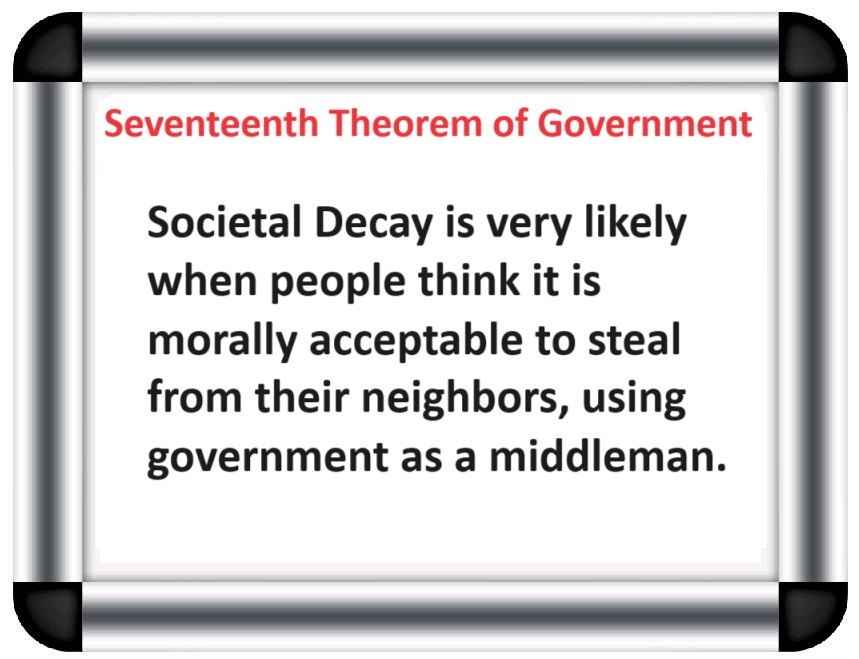
She could be the poster child for my 17th Theorem of Government.

Makes me wonder if she is friends with Olga and Natalija.

Let’s shift to Germany. Here’s an excerpt showing fiscal extravagance – and fiscal delusion – in Germany.

Today, between basic welfare and housing assistance, a German family of four on welfare can receive as much as 5,000 euros a month — roughly $5,873, or $70,476 a year, an unthinkably high amount in the United States. …Labor Minister and co-SPD chief Bärbel Bas responded curtly to Merz’s claim that Germany can’t afford its social programs. “That is bulls—,” Bas said.

At the risk of understatement, Miniser Bas is wrong. And interest rates of long-term German government bonds suggest financial markets agree with me.

I’ll close with a chart, based on IMF data, showing that the problem in much of Europe is excessive government spending. As you can see, both taxes and spending consume much greater shares of economic output in Germany and France than Switzerland.

I also included Italy to show that France and Germany are just as bad – or even worse – on fiscal policy.

Actually, I’ll include one more chart. It’s no coincidence that Switzerland is much richer than its neighbors – more than $22,000 of additional economic output per year compared to the average of Germany, France, and Italy!

Maybe, just maybe, there’s a lesson to be learned about the relationship between the size of government and national prosperity.

P.S. I should have written “Medium-Sized Government Switzerland” since the East Asian tiger economies have significantly smaller spending burdens.

Wednesday, October 8, 2025

Measuring the Benefits of Deregulation

October 5, 2025 by Dan Mitchell @ International Liberty

The Organization for Economic Cooperation and Development is a Paris-based international bureaucracy that is infamous for its efforts to hinder tax competition.

The bureaucrats basically want to export the anti-competitive fiscal policies of the European welfare states that dominate its membership.

But that doesn’t mean everything the OECD does is bad. Indeed the bureaucracy has an economics department that often publishes useful studies in support of free markets. Heck, it sometimes even publishes good studies on fiscal issues (which apparently have no impact on the political types who run the organization).

Today, we’re going to look at a good study dealing with regulation. And we’ll start with something very positive. Here’s a chart showing there has been significant deregulation in the energy, transport, and communications sectors over the past five decades.

It’s good to see that the United States was a leader in the shift to deregulation. And this was a bipartisan success with Jimmy Carter, Ronald Reagan, and Bill Clinton all playing important roles.


But today’s column isn’t about American regulatory policy. Instead, it’s about the positive economic impact of deregulation in OECD nations.

So let’s take a look at the study, which was authored by Dan Andrews, Balázs Égert, Cassie Castle, and Christine de La Maisonneuve. Here are some key excerpts.

…we provide fresh evidence on the impacts of product market regulation on economic growth using cross-country industry-level data. …we find that anticompetitive regulations in upstream sectors – particularly barriers to entry – curbs long-run economic performance in downstream sectors. On average across the OECD, network sector deregulation between 1980 and 2023 boosted economy-wide labour productivity by an around 5 percent in cumulative terms, underpinned by material gains to value added (~6 percent), employment (~2 percent) and capital stock (~4 percent). … 

While rapid network sector deregulation contributed around 0.25 percentage points to annual labour productivity growth during the 1995-2005 boom, its subsequent slowdown could account for up to one-sixth of the post2005 productivity slowdown. 

Looking forward, reloading network sector deregulation could yield smaller, yet still material, productivity gains. …we estimate that aggregate labour productivity could rise by up to 1.7% on average across the OECD if countries with more regulated network sectors converged toward the least regulated settings. And it is likely that the productivity gains from market reforms in professional services3 – which remains sheltered from competition in many OECD countries – would be even larger. … 

The country-specific results highlight large potential for lagging countries: for example, eight OECD countries stand to gain around 1%, while Mexico and Korea could achieve gains of 1.7% in productivity if they were to fully align with the regulatory frontier.

Regarding the gains mentioned above, Figure 7 of the report shows how deregulation could boost economic performance in different OECD nations.

The U.S. could benefit from about a 1-percentage point increase in productivity and value added. Mexico and Korea would be the biggest winners.

I’ll close by noting that OECD economists did similar research on the country-specific benefits of spending reduction and lower tax rates.

Sadly, I’m very confident that those studies had zero impact on the pro-statism mindset of the political hacks who run the OECD.

Tuesday, October 7, 2025

Should Iceland Join the European Union?

October 6, 2025 by Dan Mitchell @ International Liberty

I left Iceland this morning, where I spoke at a conference examining whether that island nation in the North Atlantic should join the European Union.

My speech focused on the European Union’s economic performance (which is anemic and on a downward trajectory) and my main takeaway is that joining the E.U. would be akin to booking a ticket on the Titanic.

After it hit the iceberg!

More specifically, the E.U. is almost surely destined to suffer a massive fiscal crisis and more responsible nations in the region will be expected to bail out the irresponsible countries such as France and Italy.

Not just “expected.” Both the European Commission and the European Central Bank already have violated their charters to prop up profligate governments, so the only unknown is the degree to which taxpayers in countries such as Estonia and Denmark will get pillaged.

And Iceland, if it decides to climb on the E.U.’s sinking ship.

To augment my views, I want to share a couple of slides from a presentation by Professor Ragnar Arnason, an economist from the University of Iceland.

Here’s his analysis regarding whether there would be a net economic benefit if Iceland joined the E.U.

As you can see, he is very skeptical.

He also had some slides examining national security arguments and social arguments.

In both cases, he explained that likely costs of E.U. membership would be much higher than likely benefits.

But here’s the most interesting part of his presentation.

As shown by this next slide, he makes the elementary – but insightful – observation that there is no downside to saying no today and seeing what happens in the future.

From this perspective, the strong case against joining the E.U. becomes a slam-dunk case.

For what it’s worth, I’ve written that E.U. membership may make sense for a poor nation from Eastern Europe (and the case is weak even for those countries).

For a relatively prosperous country like Iceland, E.U. membership would be a lot of pain and little if any gain.

P.S. If you want to enjoy some E.U.-themed humor, click here and here.