Search This Blog

De Omnibus Dubitandum - Lux Veritas

Showing posts with label Economics. Show all posts

Thursday, October 29, 2026

The 2026 Midterm Election, Part IV

“So-called “progressives” are ignorant, bitter, nasty, wannabe tyrants who contribute nothing to the society that they so wish to destroy.” Eric Utter

By Rich Kozlovich, Tags: Daily Reminder of Just How Awful Democrats Are!, ''You have sat too long here for any good you have been doing. In the name of God, go!". 

James Carville, famed for his theme while running Bill Clinton's presidential campaign was: "It's the economy stupid", and who thought the Harris/Walz act was "classy" and the Trump/Vance act was "trashy".  Imagine that, James Carville defining trash.  

Well, I've always thought Carville had a screw loose, but he's right, it really is about the economy.  So let's take a look at that. 

The Democrats have ranted about "affordability" and the media ignored the "affordable" reality of the Biden and Obama administrations, while in the real world Trump's economic efforts have been .... at least by comparison.... stellar.  
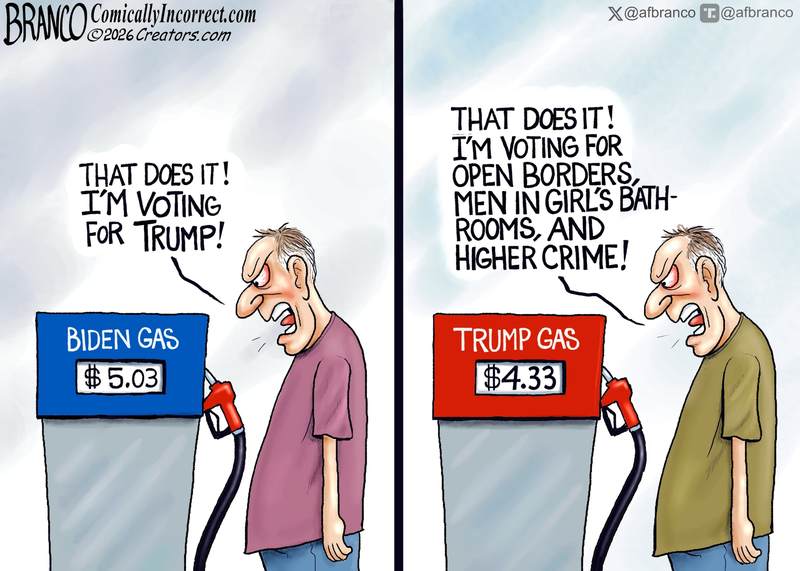
AF Branco cartoon

Let's start with the price of gas, which is not higher under Trump than Biden, and when it was skyrocketing under Biden the left was thrilled as they wanted it to be like Europe at ten dollars a gallon to fight...global warming.   So, let's ask ourselves, how can the Democrats run on affordability, and not just on the price of gas? Energy as a whole is higher in Democrat run states. 

  • The New York Times Shows Democrats How To Run On "Energy Affordability".......for reasons that I don’t understand, the price of electricity seems to be a big issue for Democrats in the upcoming elections. The post cited easily-available data from the federal Energy Information Administration showing that, among the contiguous 48 states, there is a sharp divide between states run by Democrats — which have the highest prices — and those run by Republicans — which have the lowest prices. .....If you study the issue even a little, it becomes obvious that the higher prices in the blue states are driven in part by higher taxes and more regulations, but particularly by so-called “climate” policies that in practice greatly drive up costs.....

Under Trump the BLM has opened up 35,000 California acres to oil and gas leases, and is considering gas tax suspensions, while Democrat states with " green energy mandates" have increased the cost of electricity for their citizens.  

The difference between economic reality and the media take By Jack Hellner|  The media and other Democrats are falsely claiming that they are the party with policies that will address inflation and affordability. They cheered COVID mania and Biden’s policies as inflation rose from under 2% when he took office to a forty-year high of over 9% by June 2022. The Democrats didn’t care about inflation or affordability then, and they don’t care now because they support the same policies. They care only about winning, no matter how many lies they have to tell. In March 2021, Democrats passed the $1.9 trillion American Rescue Plan Act, essentially printing and handing out money like candy. They passed this act based on a lie that continues to this day: that Biden inherited a disastrous economy.......

Most Democrat run states, all adhering to party principles, are running states that are "less affordable.” If that's true, and it mostly is, why would we think they're going to bring a different result to the rest of the nation if they take over the Congress? They want more government, more spending, more taxes, and more regulations, and the failed consequences of those policies are provable.  Not to mention their insatiable desire to steal everything!   

Robert Reich And Organized Theft - What is it with Democrats and their unrelenting lust for other people’s property? Are they hardwired to steal because they can’t build anything themselves? ..............Robert Reich is encouraging the Democrats to “lay the groundwork for nationalizing” SpaceX and Starlink..........71% of Democrats and 80% of self-identified liberals want to see Musk in prison for the dastardly crime of teaming up with President Donald Trump and daring to downsize the federal leviathan..............

Rep. Alexandria Ocasio-Cortez wants to nationalize the entire U.S. economy. If Massachusetts Sen. Elizabeth Warren’s Accountable Capitalism Act had become law, it would have led to “the outright confiscation of wealth through the nationalization of corporate boards that would be forever beholden to political figures.” 

During the ugly Biden years, top Democrats urged the president to nationalize the oil and gas industry. In the 1970s, around the time he was kicked out of a “commune for loafing,” Vermont Sen. Bernie Sanders advocated for “the nationalization of most major industries, including energy companies, factories, and banks.” 

Federal regulations are a massive.... massive.... undeclared tax on the nation to the tune of up to three trillion dollars a year, and that doesn't include the cost of state and local regulations.  Trump's solution? His EPA amassed $1.6 Trillion in savings through cuts to regulations, all of which the Democrats would almost immediately reverse.

The left... especially those from the nitwit celebrity brigade... scream cuts in Medicaid will kill thousands, but what cuts are they talking about?  Medicaid spending shot up 8% in 2026 to the tune of just under two trillion dollars.  Not one peep out of them about the massive fraud in Medicaid possibly as high as 100 billion dollars a year.  Fraud the Democrats are working hard to maintain. 

Trump became the abundance President by doing the exact opposite of the Democrats.  During his second term, Americans without college degrees are having one of the best job markets in years.  The private sector added 90,000 jobs in September, growth for the second half of this year was upgraded and consumer spending soared in August.  As for inflation, which is like a chronic disease, it was much lower than expected.

But then we come to my personal passion.... the national debt.... 40 trillion dollars which increases by six to seven billions of dollars .... a day.... and make no mistake, the clock is ticking, and the nation needs a knight to drive a spear into that dragon.  Which party will be the white knight to slay that dragon?  Neither of them if America doesn't force fiscal responsibility from Congress by choosing fiscally responsible candidates... no guts no glory candidates.

Update, 10/30/26:

  1. Questions The Media Should Be Asking Democrats About Affordability - Two things are missing from almost every media report attacking President Trump over affordability: acknowledgment that Democrats supported Biden’s policies during the inflation surge, which left Americans paying substantially higher prices, and any serious examination of which Democrat policies would actually make life more affordable...... Instead, much of the media focuses its scrutiny on Trump while ignoring the economic consequences of Democrat policies. It treats Democrat promises as solutions without demanding details or examining past results.  Americans deserve better. They deserve journalists who ask hard questions of both parties, investigate the consequences of government policies, and distinguish genuine affordability measures from campaign slogans.


Wednesday, June 17, 2026

Is There a New Golden Age on the Horizon?

By Rich Kozlovich

There's something I find really interesting.  There are those who are really smart and really successful, many of them economists who also believe we are on the verge of a "Golden Age" if we can crush the deep state and drain the leftist fever swamps.  Crushing the deep state and draining the leftist fever swamps will make a huge difference admittedly, but a “golden age”? I doubt that.

I've always believed in historical cycles, and I've read three books on the subject, and while the writers all have their own terminology and odd ways of creating coherence through connectives, they all come to the same conclusion. We’re in an end cycle, and all end cycles involve massive economic downturns, and violence, and much of the violence and economic folly is the result of embracing multiculturalism and globalism.  

Remember how Henry Kissinger promoted globalism and multiculturalism as the answer to the world's economic and social issues, and Western nations bought into that insanity?  Well, I recently published a Kissinger article, Henry Kissinger: Time is The Great Leveler of Truth, outlining what a disaster Henry Kissinger was for the world.  

Europe made a grave mistake by listening to this nitwit and the man he mentored, Klaus Schwab of the World Economic Forum, which is in fact pushing on the world a form of viral neo-communism.  At the end of his life he proclaimed it was a grave mistake for Europe to have listened to him.   

As of 2024 the world’s governments were in debt to the tune of almost 310 trillion dollars, and many of these nations are incapable of repaying that debt, and the debt holders are incapable of collecting it, and I include China.

There are six things a nation needs to be self-sufficient. The ability to feed itself, fuel itself, arm itself, defend itself, create its own internal market, and pay off their national debt. There’s only one nation on Earth that can do all six, and that’s the United States. The international debt will destroy the world’s economy, except for America, but make no mistake, there will be economic pain in America also. 

While international trade is an important economic factor, it’s not life saving for the United States but there will be no golden age, just national survival.  While much of the rest of the world breaks up into semi to totally autonomous states, which is Europe’s foundational social paradigm, as well as China’s, and the Middle East and Africa will break up into tribal states, South America will mostly remain as it is because the geography is so difficult, but they will all be broke. 

Can there ever be a new golden age?  Yes, after the new historical cycle begins, but this end cycle has to finish playing out first, and let's not get too excited about this "deal" with Iran.  Deals with the Muslim world become meaningless as soon as things change and they can justify reneging on anything they've agreed to in the past, it's called "taqiyya", a doctrine of deception.  The concept is to deceive adversaries in order to protect themselves, and then later renege on the agreements when it becomes convenient.  The Barbary Pirate Wars with early America is just one example. 

That's history, and that history is incontestable.  

 Here's are some articles you may find interesting, especially number four. 

  1. Chilling details of California terror ring’s plot against Freedom 250 — as ‘mastermind’ is unmasked 
  2. FBI disrupts alleged explosive-drone plot targeting White House UFC event, officials say
  3. Socialist ‘Red Rabbits’ are training for national uprising against cops 
  4. The Dawn of the Modern Nationalist Age

Tuesday, June 16, 2026

Why Europe is Doomed

 By Rich Kozlovich
Over the years I've stated the EU would collapse by 2025 or at the latest by 2030.  Well, 2025 was wrong, will it be in 2030?  Truth be told, it's coming, and it's coming soon.  The actual date is immaterial.  It's the cycles and patterns that matter.  Let's start with England.  

There's been a lot of talk over the years about England's "free" health care system, but the end result has been disastrous, and right from early on.  As of now the UK's emergency room waits kills 300 poeple a week in their "free" system of socialized medicine.

The opposition leader of the Reform UK movement, Nigel Farage, was "referred for potential prosecution over his public critiques of the British justice system amid the controversial "Manchester Airport trial", comments that needed to be made over the failure of the British government to properly prosecute as a result of their two tiered criminal system involving Muslim criminals.

How clueless is Prime Minister Starmer?   

Keir Starmer says 'successful, brilliant, creative' Muslim immigrants have made great contributions to Britain’s story .............Well, they certainly have been successfully creative at bilking British taxpayers out of billions of pounds of hard-earned money. And they have been similarly successful in their creative use of knives against the native island-dwellers...............It is almost impossible to overstate the trouble the United Kingdom is in.

The knife attack in Belfast has triggered protests across Scotland and in England over the explosion of Muslim immigrant crimes and the government's efforts to hide them.  Brits are finally getting angry, but does the Labour party change their position and actions?  No... of course not.... the problem isn't Islam, illegal immigration, or mass immigration of people who hate western civilization and wish to violently destroy it.  The problem is the public is being misinformed, so their solution is to create a secret unit of ‘Thought Police’ that will manipulate the narratives and control the anger of the peasants. This is a massive government effort to curtail free speech.

In the wake of violent unrest in Belfast sparked by yet another brutal attack involving an asylum seeker, details have emerged of a secretive government operation working overtime to shape what the British public is allowed to think and say about the failures of mass migration. This isn’t organic crisis management—it’s engineered narrative control, straight out of a Cold War playbook, now deployed against ordinary citizens frustrated by unchecked violence and cultural erosion.

And we wonder why young Brits are ignorant of their history.  These demonstrations are shaking things up.  Even supporters want Prime Minister Starmer gone, and the Brits want the Labour party to join him.  

The EU is run by bureaucrats .........who are "petty, exhausting, and expensive, Euro-bureaucracy is steadily eroding Europe’s competitiveness and turning private-sector investment into a gamble. The idea of the free market -- namely that consumer demand for cleaner, more environmentally friendly production and logistics can be expressed through competition itself, one of civilization’s greatest achievements -- appears to have largely vanished within today’s EU.........

"Brussels always tells the same story: regulation is supposed to strengthen the European single market and harmonize economic and environmental objectives. A beautiful narrative -- especially for those who stand to profit from it. Similar dynamics have already emerged in other sectors, such as carbon emissions trading. In the end, compliance costs for affected businesses rise, the bureaucratic apparatus expands through new control and sanctioning mechanisms, and the overall economy loses competitiveness."

In France the 1 in 3 people are either foreign born or descendant of immigrants.  The issue in this case isn't just that they're immigrates. The issue is they're Muslim immigrants, and rightly so.  Would it matter if they were from Switzerland, Germany, Poland, or any of the other western nation?  No, it only matters because they're Muslims, and for good reason.   This isn't immigration, it's invasion.  An invasion by people who subscribe to a religion that demands the destruction of any and all who refuse to convert.  They want to destroy the nations that are foolishly taking them in, and worse yet, these foolish governments are pandering to them.  

The stupidity of Europe's leaders and the arrogance of Europeans overall is mind boggling.  One example is their smug superior act over their position on gun ownership, and yet foolishly ignore the rising crime involving knives, mostly done by Muslim immigrants, mostly to the unarmed local ethnic population, making them helpless victims.  Just as the knife attack by that Sudanese asylum claimer against an unarmed man in Belfast who he slashed, and blinded in one eye.  If a bystander hadn't taken a shovel to his head he might have beheaded his victim. 

Now the EU has decided trade with China isn't "sustainable".  Wow!  I'm shocked, shocked I tell you! Well, the bugman understood that from early on, and that should have been obvious from day one to the EU leadership.   But the EU being the EU, filled with arrogant multicultural wokeness, they just didn't get it.

It's interesting how the EU's pandering to Russia over the years is now playing out.  They're concerned Putin's ambitions for expansion aren't necessarily stopping with Ukraine, although he's claimed he has no aspirations to attack NATO nations.  But in response to Europe's efforts at what they're calling ‘Strategic Autonomy,’ he's also said:

...... "that membership in NATO “will not protect” Baltic states – Latvia, Lithuania, and Estonia – that may be aiding Ukraine by hosting its military drones, something Russia accuses Latvia of doing. All three countries are members of the European Union that border Russian territory. "

Well, personally, I think that's big talk he can't walk.  He's in deep economic trouble and has serious demographic problems he can't solve.  In no way can he afford another battle front, but nonetheless,  Europe's scared now. 

Here's the lesson American's need to take away from all this European insanity.  These are the policies Democrats want for America, and disaster is sure to follow.  Europe no longer counts, economically, philosophically or culturally.  All they have left is arrogance.  Here's a reality that's going to come home to roost.  International debt, and inflation. 

Every major currency in the world has lost most of its value since 1971:

  1. US:  $100 in 1971 is equivalent in purchasing power to about $822 today, a cumulative loss of roughly 87%.
  2. UK:  The British pound has lost roughly 95% of its purchasing power between 1971.
  3. EU:  The euro, which replaced the lira, has itself lost purchasing power: €100 in 1997, the year the ECB’s Harmonized Index of Consumer Prices series begins, is equivalent to about €184 today, a loss of 46% in under three decades.
  4. Russia:  From 1993 alone, the ruble lost over 99.9% of its purchasing power, per OECD and World Bank data.
  5. Canada: The Canadian dollar has lost roughly 87% of its purchasing power since 1971.
  6. Germany: Deutsche mark lost roughly 76% of its purchasing power between 1971 and 2002. 

This is the tip of the iceberg, and for no other reason than these nations are writing checks they can't cover.  The legendary 37 trillion dollar national debt of the United States is shocking, but the federal government owns 150 trillion dollars in assets.  That debt can be paid, none of these other nations are true capital generating nations and they don't have trillions in assets that can be liquidated.  

There are four things that determine the state of any nation, or region.  Geographics, demographics, economics, and happiness. Those four points represent the first of my seven rules on geopolitics.

  1. First Rule of Geopolitics: All geopolitics is about four factors, geographics, demographics, economics, and that most elusive factor of all, the happiness factor.  
  2. Second Rule of Geopolitics:  Everything is about the basics.  You have to be able to see issues at their foundational root levels in order to understand and fix complex problems.
  3. Third Rule of Geopolitics: History is everything since historical events lay the foundation for the social paradigms of nations, which have been in effect for centuries in most areas of the world. In short, culture is king.
  4.  Fourth Rule of Geopolitics:  People are like nations, and will act in their own best interests, unless they don't.  
  5. Fifth Rule of Geopolitics: Nothing is ever as it appears.  Look behind the curtain, there's always something hidden.
  6. Sixth Rule of Geopolitics:  The patterns of life keep repeating over and over again. 
  7. Seventh Rule of Geopolitics:  Everyone lies.     

Europe is failing in understanding all seven, and now the EU has invited the Taliban to visit Brussels for mass migration talks.  If you had any doubt as to their cluelessness, that should dispel them.  

Updates:  One of the things Americans fail to understand is the EU is made up of a bunch of nations that are made up of a bunch of smaller nations that were packed together by wars, treaties, etc, and they have history.... a lot of history.... and when you scratch the surface you find.... they really....really... don't like or trust each other, and speaking over 25 main languages and 200 hundred sub-languages doesn't help. 

I subscribe to the subscription site Geopolitical Futures and get worldwide reports daily about what going on, and I think this is profound.  Since I can't link it... you'll just have to take my word for it or not.... as it pleases you. 

"Polish President Karol Nawrocki called for banning the flag of the Ukrainian Insurgent Army, a group that fought for Ukrainian independence in the 1940s and 1950s and that Warsaw has accused of committing atrocities against ethnic Poles. He made the comments during a memorial for the victims of a genocide committed by Ukrainian nationalists during World War II in Volyn. The issue has been a growing source of tension between the two countries in recent months."

Truthfully, this isn't just about WWII, and its not an anomaly between these two European nations.  This is Europe.  It's who and what they are under the surface, and it doesn't take much to have all the harsh feelings for centuries of conflict rise to the surface.  

My Take - Sane civilized people hate this kind of thing, but reality has so often forced it on sane civilized people. I’ve so often said in the past this was where all this migratory insanity was going to lead. I’m convinced we’re going to see governments overthrown, civil order disappear and violence on a level not seen since the middle ages. All it will take is a collapse of their economy, and that’s coming soon. At the end of it all, Europe will be left with nothing, a third rate continent that will revert back to their natural social paradigms of small independent or semi-independent nations based on ethnicity, language and a shared historical cultural. RK


Friday, October 24, 2025

The Looming Fiscal Crisis, Part II

October 17, 2025 by Dan Mitchell @ International Liberty

Because economists are lousy forecasters, I don’t pretend to know when a fiscal crisis will occur or which nation will be the first debt domino.

But it will happen.

Indeed, I suspect it will happen the next time there’s an economic downturn (though I obviously can’t predict when that will happen, either).

Here’s a chart showing average government debt levels in the industrialized world.

It used to be that governments only incurred lots of debt because of war. They then paid down debts after wars ended.

But that pattern broke down about 50 years ago thanks to the creation of the welfare state.

Though not all governments are equally bad. I’ve noted that there are nations like Switzerland, Denmark, and Estonia that have low and/or falling debt levels.

Unfortunately, most of the world’s major nations are far less prudent. Here’s a chart looking at the G-7 countries. Only Germany and Canada have manageable debt levels (and even both of them have been rapidly deteriorating in recent years).

The above charts come from an article in the U.K.-based Economist.

Here are some excerpts, starting with a description of how governments get in trouble.


The magic of borrowing…comes with a temptation—one that David Hume and Alexander Hamilton worried about in the late 18th century. If a country is sufficiently creditworthy to cover its existing debts, it is in a position to borrow more. Having manageable debts means you can manage more debt. And so it is all too easy for debt to grow. If this goes on for too long, governments start to face pushback. 

The bond markets which meet their need for debt start to charge them more. New borrowing gets harder—and so does rolling over old debts. If governments do not then tighten their belts, the country’s all-important creditworthiness erodes in a way which can easily spiral out of control. …today the biggest, richest countries have fallen into a dangerous pattern of borrowing ever more. Debts have reached vertiginous highs and bond markets are showing resistance.

The article then looks at some specific problem in western nations.

Governments have adopted mechanisms to constrain debts, such as America’s “pay as you go” rules in Congress or the EU’s Stability and Growth Pact. But politicians suspend, abuse or evade them almost as they please. …Bond markets are responding. …the longer the duration of a bond, the more investors must pay attention to the risks posed by lax budgeting. … 

The prospect investors must worry about is not just—or even mainly—that of default. There is another weapon that can hurt them over long horizons: inflation. …Another problem in Europe is that taxes are high as a share of GDP, limiting the scope to raise them without doing excessive economic damage. …The IMF has estimated that debt interest, pensions, health, defence and climate change in Europe’s advanced economies will create additional annual spending “pressure” worth nearly 6% of GDP by 2050.

Since the above excerpt mentioned inflation, the Economist has a separate article predicting that’s how politicians will respond when a crisis unfolds.

Here are some of the relevant passages.

How long can governments live so far beyond their means? Rich-world public debt is already worth 110% of GDP… It is therefore increasingly likely that governments will instead resort to inflation and financial repression to reduce the real value of their high debts, as they did in the decades after the second world war. …Price rises are unpopular—just ask the hapless Joe Biden—but they do not need political support to get going. Nobody voted for them in the 1970s or in 2022. When governments cannot get their act together, and run economic policies that are unsustainable, bouts of inflation just happen. …Yet that downward spiral is not inevitable. …Ronald Reagan and Margaret Thatcher…saw sound money as central to the pact between the state and the citizen. …Which path will the rich world take—ruinous or prudent? …If the world emerges with lower debts and conscious of the dangers of excessive borrowing, a renewal of sorts is possible. The alternative would be for the world’s most important economies to descend into chaos.

I have three comments on these two stories.

The first two deal with media bias, or perhaps media ignorance, while the final comment deals with substance.

  • First, the writers at the Economist did not oppose the spending orgies during either the 2008 financial crisis or the 2020 pandemic, both of which played a big role in boosting red ink, so their sudden pearl-clutching about debt- while appropriate – is ironic.
  • Second, while the authors acknowledge that higher taxes might not work, the second chart shared above doesn’t include a column on the burden of government spending, which probably will lead many readers to falsely think the solution is additional tax increases.
  • Third, while the Economist does not seem to have the correct perspective, the issues raised in the two stories are deadly serious. Barring a sudden outbreak of Milei-ism, the western world is stumbling toward a very serious and very debilitating fiscal crisis.

But here’s the most important thing to understand. The problem is spending, not debt.

Excessive spending undermines prosperity whether it is financed by taxes, borrowing, or money-printing.

P.S. Notwithstanding the title of the magazine, the Economist has a weak record on some big economic issues (see here, here, and here).


Wednesday, October 22, 2025

Part III: Is Switzerland the World’s Best Nation?

October 21, 2025 by Dan Mitchell @ International Liberty

Building on yesterday’s column, let’s look at some more data about the “improbable success” of Switzerland.

We’ll start with a comparison of per-capita GDP, showing Switzerland out-performing other nations (I’ve shared similar charts in previous columns).

The chart comes from Simon Grimm, who shared some thoughts after his recent trip to Switzerland.

As you read these excerpts, keep in mind that he is using “liberal” in the European sense, meaning free markets.


Switzerland is far wealthier than most of Europe. The country has a median household income higher than that of the United States…and the world’s highest share of Fortune 500 companies relative to its GDP. …But the country is rarely discussed… Given Europe’s stagnant economies and increasing debt burden, this seems like an oversight… 

Switzerland differs from most of Europe: its economic governance is far more liberal. All else being equal, this should explain a large part of Switzerland’s economic success. …The country has low corporate taxes, flexible labor laws, and a large number of free trade agreements. 

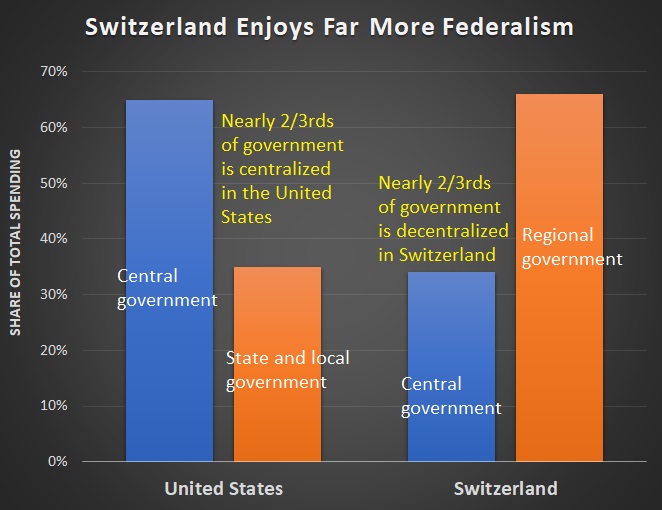
Unlike France or Germany, income taxes are mostly levied on the state level, incentivizing local administrations to run efficiently for fear that citizens will move to low-tax states. This provides the country both with a debt-to-GDP-ratio of only 38% and some of the lowest income taxes in Europe… 

Relatively liberal parties always make up a majority of the government… Voters reject nearly all ballot initiatives that might threaten Switzerland’s economic position: a 2012 referendum increasing the number of mandatory holidays was rejected by 66% of voters. …overall, Switzerland…seems like a good example of what a century-long attachment to liberalism can yield.

Professor John Cochrane of the Hoover Institution also wrote about Switzerland after a recent trip.

He’s particularly impressed by Switzerland’s fiscal policy.


Swiss inflation barely exceeded 3% in the post-pandemic surge, and is back to zero. …Here is recent Swiss fiscal policy. The worst deficit in the pandemic was under 20 billion, or about 3% of GDP. The US by contrast hit 25% of GDP deficit. The budget went quickly back to balance — total balance not just primary balance. Debt is a tiny 16.8% of GDP. Yes, 16.8, not 168. … 

Balance is not just accidental. Switzerland has a constitutional “debt brake,” passed by referendum, that requires cyclical budget balance. …adding it all up, it’s if anything a puzzle that the Swiss had any inflation at all. The deficit was very small. The debt was tiny. And, most of all, the “debt brake” assures people that the debt will be repaid.

Here’s a chart from his analysis.

It’s in French, but all you need to know is that the blue line is revenue and the green line is spending. The purple bars are surpluses or deficits.

Cochrane is certainly correct that Switzerland has far less debt than its neighbors.

And I’m obviously a fan of the Swiss debt brake (which actually functions as a spending cap).

But I think he’s missing the most important fact, which is that Switzerland has a much lower burden of government spending.

This is what allows the nation to have low taxes. This is what enables prosperity since the government is not diverting as many resources from the productive sector of the economy.

Tuesday, October 21, 2025

Part II: Is Switzerland the World’s Best Nation?

October 20, 2025 by Dan Mitchell @ International Liberty 

I’ve shared a two-part video series (here and here) on the “improbable success” of Switzerland.

Building on that, here’s a report from CNBC about the “world’s best nation.”

There are many reasons to admire Switzerland.


Today, let’s heap more praise on the Alpine Republic.

Some of it, surprisingly, from an article in the New York Times by Ruchir Sharma.

Here are some excerpts.


There is…a country far richer and just as fair as any in the Scandinavian trio of Sweden, Denmark and Norway. But no one talks about it. This $700 billion European economy is among the world’s 20 largest, significantly bigger than any in Scandinavia. It delivers…lighter taxes, smaller government, and a more open and stable economy. Steady growth recently made it the second richest nation in the world, …with an average income of $84,000, or $20,000 more than the Scandinavian average. … 

This less socialist but more successful utopia is Switzerland. …Capitalist to its core, Switzerland imposes lighter taxes on individuals, consumers and corporations than the Scandinavian countries do. In 2018 its top income tax rate was the lowest in Western Europe at 36 percent, well below the Scandinavian average of 52 percent. Government spending amounts to a third of gross domestic product, compared with half in Scandinavia. …The Swiss have become the world’s richest nation by getting it right.

I’m not sure why the author wrote that Switzerland is “less socialist” while then soon after noting that the country is “capitalist to its core.”

That seems like “not socialist” to me, but overall, a fair article.

The Swiss also got some positive attention from the U.K.-based Economist, which ranked Switzerland as having the world’s most innovative economy.

And the OECD ranks Switzerland as having the best combination of political efficiency and democracy satisfaction.

Since I occasionally compare Switzerland and France, I think this visual is very compelling.

By the way, I’m assuming the slender Swiss document is in multiple languages, so the above image actually understates Switzerland’s advantage.

Last but not least, here’s a potential explanation for why Switzerland is so far ahead of its neighbors.

There are some versions of “right” that I don’t particularly like, so the most important part of the above visual is the last sentence.

In my simple way of thinking about the world, Switzerland is a case study for why “classical liberalism” is the best role model. Though nowadays it would be called small-government conservatism (or Reaganism) in the United States and “neoliberalism” in Europe.

P.S. As I wrote in 2011, I nonetheless prefer the United States over Switzerland.

Monday, October 6, 2025

Ukraine’s Self-Imposed Statism Crisis, Part II

More than 10 years ago, I warned that Ukraine was suffering from statism.

In that column, I compared Ukraine’s economic anemia to Poland’s economic rebound and explained the gap was due to Poland’s pro-market reforms.

That same year, I explained that Ukraine was suffering from Putinomics.


Based on the latest data from Economic Freedom of the World, that’s still the case.

Both nations get terrible scores. Both are in the “least free” category. Both are economic laggards compared to almost all other nations in Eastern Europe.

Ukraine’s immediate crisis is ongoing war with Russian invaders, of course, but let’s think ahead to what should happen with hostilities finally cease.

In 2022 and 2023, I argued that Ukraine needs a dramatic shift to free markets.

That’s still true today, so I was very interested to see a column by Michael Tory in the Wall Street Journal that also addresses Ukraine’s economic future.

The good news is that he correctly identifies Russia’s economic backwardness and believes Ukraine could expose Putin’s bad economic policy be becoming more prosperous.


The most serious threat to Putin’s regime is the vast disparity in prosperity between Russia and the nations on its periphery that have escaped Moscow’s rule. Since 1990, the former Russian satellites that have joined the European Union have generated an almost 10-fold average increase in national GDP. By contrast, the national GDP of Russia itself and the non-EU countries on its western border have grown by just a factor of four over that same period. … 

As experience shows, such disparate economic performance among nations intimately linked by history and geography almost invariably leads to resentment. …Ukraine is, in effect, the tipping-point state. Once it joins the EU and generates economic growth comparable to the other former Soviet satellites already in the economic bloc, the gravitational pull of Ukraine’s prosperity will be irresistible for its three smaller neighbors. … 

The Russian public is so conditioned to view Ukraine as ethnically and linguistically similar to Russia that its prosperity would raise difficult questions inside Russia. If the countries are so much the same, the only plausible explanation for a radical divergence in their economic success would be the political and economic fundamentals of Russia itself.

The bad news is that Mr. Tory thinks that European Union membership is what produces economic prosperity.


His main evidence is this table which shows post-1990 growth in former communist nations.

At first glance, it does seem that EU membership is a driving force. And, having written that East European nations probably do benefit from joining the EU, I think this could be a partial explanation.

But notice that I’ve added red numbers to the left of every country’s name. And there seems to be a fairly strong relationship between those numbers and economic outcomes.

Well, those numbers are the rankings for economic freedom according to EFW.

In other words, what Ukraine needs is more economic liberty, regardless of whether it ever becomes a member of the European Union (and, if Ukraine does become a member, it should be very aware of the potential pluses and minuses).

Indeed, there is research showing that countries can enjoy faster growth by staying out of the EU.

P.S.  In a cruel bit of history, a single death may have blocked Ukraine from becoming free and prosperous.

As noted in a 2014 New Yorker article, the man who oversaw dramatic pro-market reforms in Georgia was about to be in charge of economic liberalization in Ukraine.


Bendukidze left Georgia for Ukraine, where President Petro Poroshenko asked him to become his economic adviser. Even though he was unsure whether Ukrainians would accept the changes that he wanted to carry out, he agreed to work with Poroshenko, friends say, because he saw Ukraine as the frontline of the battle for liberal reforms in the former Soviet states. …He advocated cutting government spending, reducing retirement benefits for public servants, and radically deregulating the economy. Ukraine, he said, in one of his last interviews, had too many ministries and agencies. ”Who needs them when the government’s sole function these days is to take money from the International Monetary Fund…” Bendukidze’s death, in London, came only days before he was expected officially to join Poroshenko’s cabinet.

Maybe Ukraine’s next step should be to invite Javier Milei to be in charge of reforms. Especially if Argentine voters opt for decline by voting for Peronists later this month. After all, if the left wins the mid-term elections, there will be very little chance of enacting the additional reforms that Argentina needs. So Milei may as go someplace that wants to be prosperous.

Thursday, September 11, 2025

The United States vs. Europe, Part IV

September 9, 2025 by Dan Mitchell @ International Liberty

I put a lot of focus on “convergence” and “divergence” because economic theory says rich countries should not grow faster than poor countries.

So when there are examples of divergence, especially when looking at decades of data, we can learn very important lessons about economic policy.

Those lessons, in every single case, teach us that free markets and limited government are a recipe for faster long-run growth and higher living standards.

Today, let’s consider another example. And we’ll start with this chart from Sam Bowman, which shows that Americans are getting richer faster than Europeans are getting richer.

The chart comes from an article he wrote for Reason on the prosperity gap between the United States and Europe.

Here are some excerpts, starting with some comparative statistics.


Europe may be beautiful, but it has become a byword for economic malaise… Most of us in Europe don’t own ice makers. …air conditioning is still a luxury across the continent. …Like most Europeans, I don’t own a dryer. The average American could stop working in the first week of October and still will have earned more than the average Frenchman working until the end of the year. In Western Europe, GDP per capita—the average economic output per person—is about $63,000 per year, adjusted for the cost of living. In the United States, it is $86,000. … 

For roughly two decades, Western Europe, home to the continent’s largest economies, has stagnated. In 1995, its labor productivity—the value of goods and services produced per hour worked—was 95 percent of what it was in the United States, having risen from just 22 percent in 1945. By 2023, it was down to 80 percent. …the median American household has a disposable income that is 16 percent higher than the median German household, adjusted for purchasing power.

He then looks at potential reasons for Europe’s lagging performance.

He touches on several areas. I especially liked his discussion of labor market red tape.

What explains this gap between Europe and the U.S.? There are many factors, from rigid labor markets to energy restrictions to trade barriers to burdensome regulations on tech companies. The connecting thread is that Europe is poor because of specific policy choices. Europe is poor because it chose to be poor. …what really separates European companies from American ones is Europe’s high cost of business failure, rooted in its inflexible labor laws. …In markets where companies have to take risks, mass layoffs can be unavoidable. But in the United States, layoffs are usually quick and relatively low-cost; in the E.U., they can take months or even years.

Regular readers presumably won’t be surprised. So called employment-protection legislation discourages employers from creating jobs.

You can and should read the entire article for analysis of how other policies are undermining European prosperity.

I’ll close by pointing out that the growing gap between Europe and the United States is not just a story about divergence.


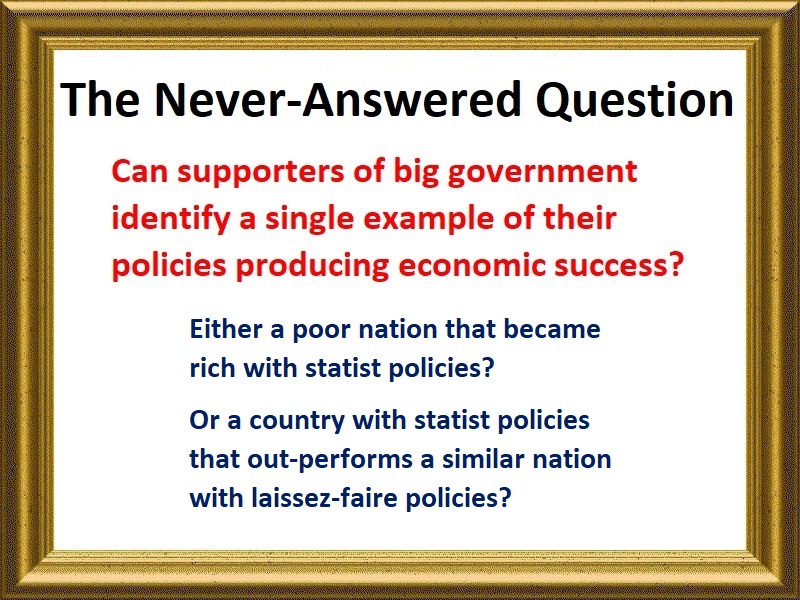
It also gives me a good excuse to recycle my never-answered question.

Supporters of free markets have dozens and dozens of examples of how economic liberty leads to more national prosperity.

I keep asking my leftist friends to show me any example, at any point in history, of big government leading to more prosperity.

They can’t answer, because global economic history shows there is only one economic system that generates mass prosperity.

P.S. The article also includes a section on “mutual recognition,” which is vastly underappreciated as a cornerstone of good cross-border economic policy.

Rather than trying to harmonize regulations with a single rule book written in Brussels, trust that rules that are good enough for Swedish consumers are acceptable for Spanish ones too. If something is legal in one European country, you should be able to trade it and use it in all the others, provided it is clear where it comes from. “Mutual recognition” of this kind was supposed to be the basis of the single market. Restoring it would be one of the biggest trade liberalizations in world history.

Our friends on the left don’t like this approach, however, since it means jurisdictional competition. They prefer harmonization, which effectively means cartels for the benefit of governments.

P.P.S. The three previous editions in this series can be read here, here, and here

Monday, September 8, 2025

The 2025 Version of a “Sniveling and Despicable French Thief”

September 5, 2025 by Dan Mitchell @ International Liberty

Back in 2012, I mocked French politicians because they were whining about upper-income taxpayers escaping from France.

That column discussed well-to-do French taxpayers moving to Belgium, which is also a high-tax welfare state, but has the advantage of having no capital gains tax.

Today will feature a new version of that column.

But instead of being about French politicians complaining about tax refugees going to Belgium, the new controversy is French politicians complaining about tax refugees going to Italy.

Let’s look at some excerpts from an article in the European Conservative by

Try not to laugh as you read about Prime Minister Bayrou’s complaints.


French Prime Minister François Bayrou has accused Italy of luring away France’s wealthy taxpayers… In a televised interview on Sunday evening carried by four news channels, Bayrou accused Giorgia Meloni’s government of pursuing a “tax dumping” policy that, according to him, is driving wealthy taxpayers out of France and weakening the state’s revenues. “The wealthiest people are leaving. …Italy is currently applying a tax dumping policy,” Bayrou stated… The exchange has once again highlighted long-standing tensions within the European Union over tax competition between member states.

Like Belgium, Italy is a high-tax welfare state.

But it is also like Belgium in that it has a specific policy – in Italy’s case, a special flat tax regime – that makes it attractive for wealthy foreigners.

For the most part, Italy is defending itself. Here are some passages from a story in Bloomberg by Donato Paolo Mancini.


Italy and France sparred over tax competition within the European Union… Italian Prime Minister Giorgia Meloni’s office replied with an unusual personal rebuke that called the claim “utterly baseless.” …In Italy, measures include incentives for high net-worth individuals to move their fiscal residence to Italy in exchange for a flat tax on their worldwide assets and earnings… Italy’s plan — known in private wealth circles as “empty London” — has lured rich foreigners from the UK, attracting a range of wealthy emigrants from hedge fund managers to ex-CEOs and Middle Eastern billionaires. The law also includes tax breaks for inheritances. …Marco Osnato, the head of the economic department in Meloni’s Brothers of Italy party, said in an interview. “France would do better to reflect on its own conduct rather than accuse others.”

The final sentence in the above excerpt is key.

Taxpayers are escaping France because the French tax system is bad. Rather that whining about Italy, politicians in Paris should lower tax rates (I’m not holding my breath).

P.S. The United Kingdom used to have a “non-dom” policy that was very similar to the Italian system. But greedy and short-sighted British politicians have eroded that system. So many of the affected taxpayers have moved and Italy is a favored destination – hence the “Empty London” moniker.

Friday, August 29, 2025

Switzerland’s Superior Fiscal Discipline

August 28, 2025 by Dan Mitchell @ International Liberty

When I wrote yesterday about Germany, I could imagine readers shrugging their shoulders and thinking it was just another column about European decline. Indeed, I’ve written similar columns about other welfare states such as France, Italy, Spain, and the United Kingdom. Though not all European nations are the same. I wrote back in May, for instance, about Denmark moving in the right direction.

For purposes of today’s column, however, I want to look at Switzerland.

More specifically, I want to compare Switzerland’s prudence and Germany’s decline. Here’s a chart, based on the IMF’s database, comparing annual growth of overall government spending in the two nations. As you can see, Germany has increased the fiscal burden of government at a much faster rate than Switzerland since 2015.

From an economic perspective, the best way of measuring the burden of government is to see what share of a nation’s economic output is being consumed by the public sector.

Switzerland is much better than Germany in that regard, with 32.1 percent of GDP diverted to government compared to 49.9 percent of GDP going to government in Germany.

But trends also are important, and this next chart shows that the economic burden of government spending has dramatically increased in Germany (and fallen slightly in Switzerland).

I’m tempted to highlight the critical role of Switzerland’s spending cap and conclude this column. But since the majority of my readers are from the U.S., let’s expand today’s analysis by including data on what has happened to government spending in America over the same time period. Lo and behold, we see that politicians in the United States have been even worse than German politicians.

However, since the United States has enjoyed faster economic growth, the government/GDP ratio has not deteriorated as much. Here’s a chart showing how the burden of government spending has increased in the U.S., but fortunately not as much as it has expanded in Germany.

The should-be-obvious takeaway is that lawmakers should strive for both spending restraint and faster growth. That’s the recipe for shrinking the burden of government spending. At this point, I could wrap up with another endorsement of Switzerland’s spending cap. But I want to make one final point.

I recently saw on Twitter this analysis of interest rates in six key nations, including Germany, Switzerland, and the United States. Notice that interest rates are trending higher in every country other than Switzerland. Why? Because investors can look at Swiss fiscal policy and feel confident that there won’t be a future crisis.

Yes, Switzerland did make the mistake of spending more money during the pandemic, and that pushed up interest. But not nearly as much as spending increased and interest rates rose in the other five nations.

The moral of the story is that investors obviously are much less concerned about a potential default (or some other type of fiscal crisis) in Switzerland. And they obviously are much less worried about politicians using the printing press to finance budget deficits (which also would push up interest rates).

So now I’ll conclude by saying that the United States (as well as Germany, Australia, Canada, and the United Kingdom) should copy Switzerland’s spending cap.

You can click here to learn more about that much-needed reform.

Thursday, August 28, 2025

Germany and the 20th Theorem of Government

August 27, 2025 by Dan Mitchell @ International Liberty 

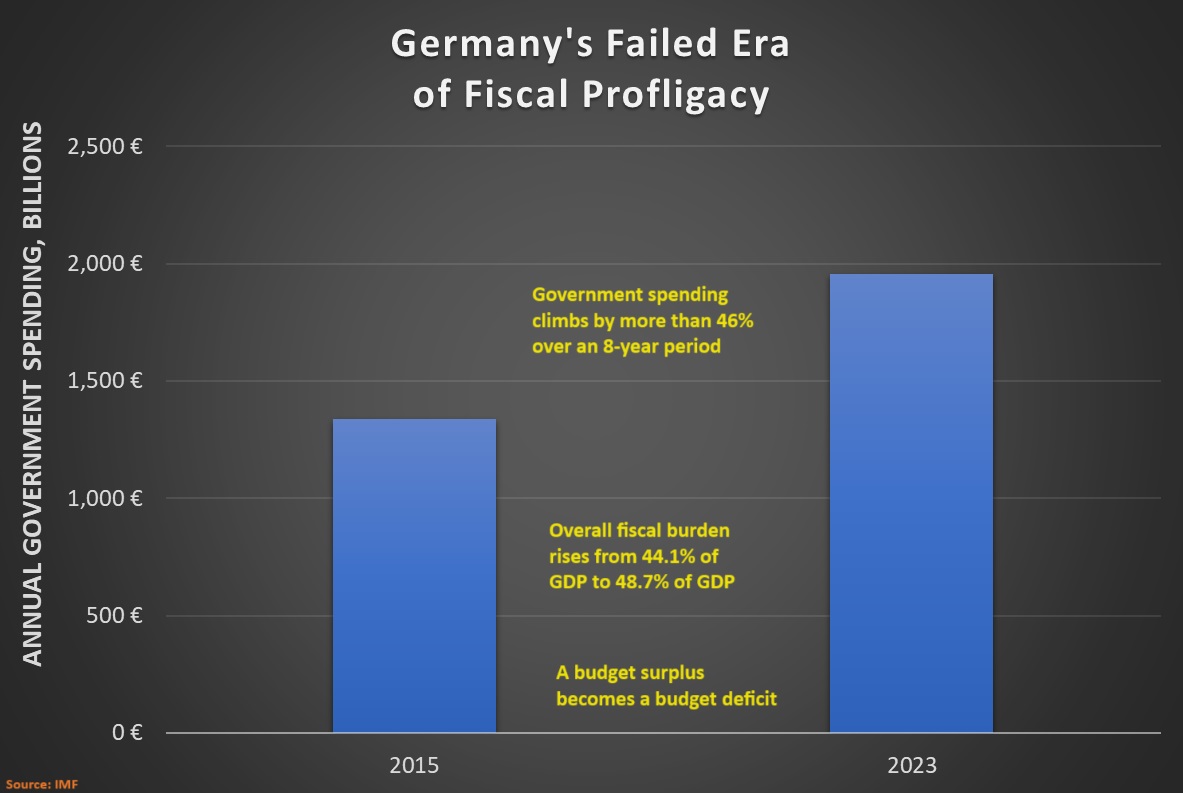
In 2023, I wrote about Germany’s fiscal decay, noting that the burden of government spending had been increasing faster than the productive sector of the economy. 

This violated my Golden Rule.

In the accompanying chart, I noted that government was consuming 48.7 percent of economic output, up from 44.1 percent of GDP in 2015.

And, for those who fixate on red ink and fiscal balance, I also noted that Germany’s 8-year experiment in profligacy turned a budget surplus into a budget deficit.

My message was simple. Germany needed to change direction.

The good news is that politicians in Berlin did shift policy.

The bad news is that they decided to make a bad situation even worse. Following elections earlier this year, new Prime Minister Friedrich Merz decided to make government even bigger.

Even the Washington Post has noticed, as illustrated by the headline from this story from last month.

Though I can’t help but point out that it has been about 20 years since Germany budget could be described as “tightfisted.”

But the story was largely accurate even if the title had an error. Merz and the other politicians in Berlin are increasing the fiscal burden of government.

So I was flummoxed to see that Germany’s Prime Minister has suddenly realized that his country is in a fiscal ditch. Here are some excerpts from an editorial in the Wall Street Journal.

Friedrich Merz, the German Chancellor, said at a Christian Democratic Union conference on Saturday that “the welfare state that we have today can no longer be financed with what we produce in the economy.” Thank you, Chancellor, for this burst of candor. …Nations have built welfare and entitlement states that are so large they have outstripped the ability of slow-growing economies to pay for them. …there’s no more difficult challenge in politics than reforming government handouts—whether in pensions, jobless benefits, government healthcare, or income subsidies. It will be worth watching what Mr. Merz and his coalition propose. But the first step toward solving the problem is admitting it exists.

In my not-so-humble opinion, the WSJ‘s editorial writers are being too kind.

They are praising Merz for acknowledging the problem when they should have been condemning him for making the problem worse.


Merz reminds me of the old joke about the kid who murders his parents and then asks for mercy because he’s an orphan.

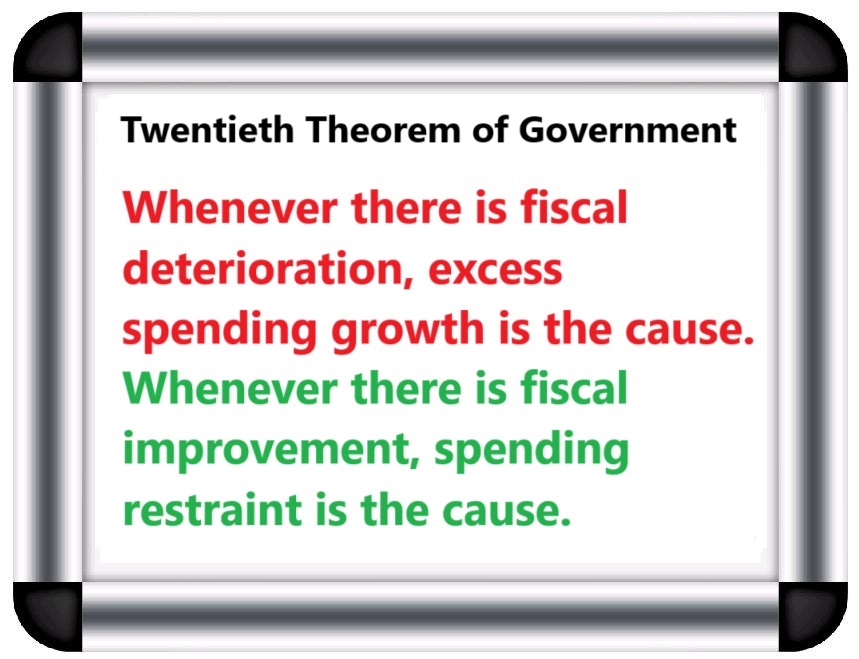
I’ll close by observing that Germany is another example of my 20th Theorem of Government.  It’s running out of other people’s money because government is too big and it’s been growing too fast. Maybe Merz has had an epiphany and will now do what’s right, but I’m not holding my breath.

P.S. When I did the chart in 2023, I noted that the burden of government spending had increased by 4.6 percentage points of GDP since 2015. The latest numbers show that government is now consuming an additional 5.3 percent of GDP.

P.P.S. Predictably, the IMF is pushing the wrong advice for Germany.

Tuesday, August 26, 2025

The Ongoing Tragedy of Cuban Socialism

August 25, 2025 by Dan Mitchell @ International Liberty 

I’ve written several articles about the failure of Cuban socialism (2024, 2022, 2021, 2019, and 2016).  My leftist friends almost always respond by claiming that U.S.-imposed trade restrictions are the primary reason for Cuba’s terrible economy.

Since I like free trade, I certainly agree that trade restrictions are bad for growth (a lesson I wish Trump would learn). But I’ve always assumed – given socialism’s terrible track record – that the U.S. embargo has not been a big factor in Cuba’s economic malaise.

Editor's Note: Dan Mitchell has great information, but Dan is a Libertarian and beats this free trade drum unendingly, but that's a delusion.  Free trade ends up being free to the world and costly to America, as Trump's tariffs are fixing and proving to be the right thing to do.  I do wish that was a lesson Dan would learn. RK) 

It appears my assumption was correct. Here’s a chart showing Cuba’s economic performance compared to what would have happened under different scenarios.

The chart comes from a new scholarly study by three economists (João Pedro Bastos, Vincent Geloso, and Jamie Bologna Pavlik).

They crunched the data a found that Cuba’s experiment with socialism has been a disaster, with per-capita GDP barely half as high as it would have been without Castro.

They also found that U.S. embargo has had a very small impact.

Here are excerpts from their research.


The dashed red line represents the counterfactual Cuba — that is, Cuba without the Revolution, the U.S. trade embargo, or Soviet aid. The orange line shows the “conventional” data, while the green line depicts the corrected estimates… As shown, under the corrected series, Cuban GDP per capita is 46.7% below the counterfactual by 1975 and 44.3% below by 1989… 

The blue line in Figure 1, which removes the effect of Soviet subsidies, shows that by 1975 Cuban GDP is 52.1% below the counterfactual, and by 1989 the gap is 55.4%. These figures reflect the combined impact of the Revolution and the U.S. trade embargo (net of Soviet Aid which amounted generally to 20% of GDP).  This leaves only the issue of isolating the effect of the US trade embargo. … 

Here we use three sets of trade data (i.e., total trade in the form of exports plus imports) to create a range of estimates. …We adjust the GDP number to work in the lost trade and find that GDP per capita would have been 3.3% higher without the embargo– accounting for a trivial portion of the Revolution’s effect.

Sadly, the economic cost of Cuban socialism is still with us.

Let’s look at some passages from a recent column by Mary Anastasia O’Grady in the Wall Street Journal.


Cuba’s communist dictatorship is broke and seems to have run out of suckers who might lend it more. This month we learned that it’s turned to confiscating dollars and euros from foreign businesses on the island. …going after corporate profits is like hanging a “closed” sign on the moribund economy. …medicine, housing and fuel are in short supply. 

Inflation is galloping. Parents find it hard to feed their children. In September the government cut back bread rations to 60 grams a day from 80 grams. …it cannot provide even a skimpy list of staples. …The infrastructure, from roads to electricity, has collapsed. One demographer estimates 18% of the population emigrated between 2022 and 2023. 

Those left behind stare into an abyss of hopelessness. …Havana wants to blame its poverty on the U.S. embargo. But Cuba’s dismal track record with sovereign lenders and the private sector goes a lot further in explaining why capital steers clear of the island.

Even CNN has noticed the economic carnage.

Here are excerpts from a report by Gonzalo Zegarra.


The smell of garbage is overwhelming and intense under the Caribbean sun. The accumulated waste is such that an entire street in Havana, far from its tourist district, was blocked to traffic. Yet garbage collectors here aren’t on strike; they simply don’t come often enough. 

It’s just another example of Cuba’s decline over the past year, alongside blackouts and water cuts… The Unión Eléctrica de Cuba, part of the Ministry of Energy and Mines, reports daily about the energy deficit between supply and demand on its social media pages. It is already common for simultaneous blackouts to cover over 40% of the country…  

This week, a group of residents blocked the streets of Havana for hours to protest the lack of drinking water. …“Cuba has a collapsed productive sector, meaning it faces a serious problem of supply shortages,” De Miranda said. …The availability of subsidized food has decreased in recent months.

I want to close by updating a chart I first shared back in 2010.

It uses the Maddison data to compared Chile and Cuba. As you can see, Chile leapt way ahead after shifting to free markets about 50 years ago.

Cuba, by contrast, has endured anemic economic performance.

P.S. On the issue of long-run economic performance, I have a column comparing Taiwan and Cuba and two columns (here and here) comparing Hong Kong and Cuba.

P.P.S. Folks on the left are very sensitive about being accused of being Cuba apologists, My advice to them is to stop being pimps for Cuba (see here, here, here, here, here, here, and here).