Search This Blog

De Omnibus Dubitandum - Lux Veritas

Showing posts with label Doomed. Show all posts

Thursday, September 11, 2025

The United States vs. Europe, Part IV

September 9, 2025 by Dan Mitchell @ International Liberty

I put a lot of focus on “convergence” and “divergence” because economic theory says rich countries should not grow faster than poor countries.

So when there are examples of divergence, especially when looking at decades of data, we can learn very important lessons about economic policy.

Those lessons, in every single case, teach us that free markets and limited government are a recipe for faster long-run growth and higher living standards.

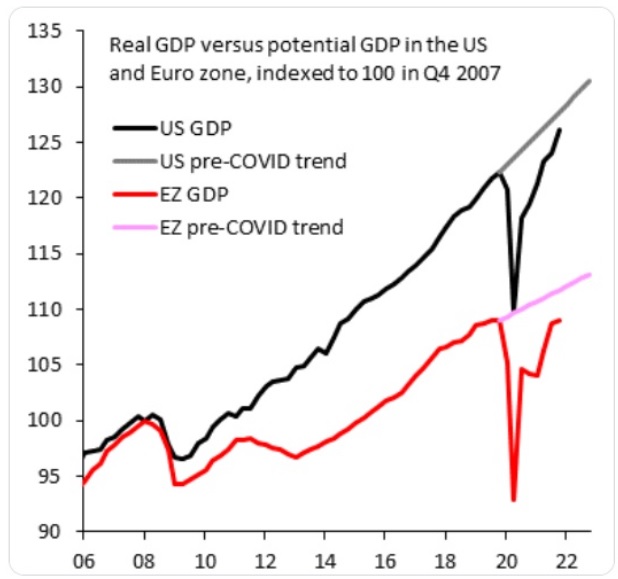
Today, let’s consider another example. And we’ll start with this chart from Sam Bowman, which shows that Americans are getting richer faster than Europeans are getting richer.

The chart comes from an article he wrote for Reason on the prosperity gap between the United States and Europe.

Here are some excerpts, starting with some comparative statistics.


Europe may be beautiful, but it has become a byword for economic malaise… Most of us in Europe don’t own ice makers. …air conditioning is still a luxury across the continent. …Like most Europeans, I don’t own a dryer. The average American could stop working in the first week of October and still will have earned more than the average Frenchman working until the end of the year. In Western Europe, GDP per capita—the average economic output per person—is about $63,000 per year, adjusted for the cost of living. In the United States, it is $86,000. … 

For roughly two decades, Western Europe, home to the continent’s largest economies, has stagnated. In 1995, its labor productivity—the value of goods and services produced per hour worked—was 95 percent of what it was in the United States, having risen from just 22 percent in 1945. By 2023, it was down to 80 percent. …the median American household has a disposable income that is 16 percent higher than the median German household, adjusted for purchasing power.

He then looks at potential reasons for Europe’s lagging performance.

He touches on several areas. I especially liked his discussion of labor market red tape.

What explains this gap between Europe and the U.S.? There are many factors, from rigid labor markets to energy restrictions to trade barriers to burdensome regulations on tech companies. The connecting thread is that Europe is poor because of specific policy choices. Europe is poor because it chose to be poor. …what really separates European companies from American ones is Europe’s high cost of business failure, rooted in its inflexible labor laws. …In markets where companies have to take risks, mass layoffs can be unavoidable. But in the United States, layoffs are usually quick and relatively low-cost; in the E.U., they can take months or even years.

Regular readers presumably won’t be surprised. So called employment-protection legislation discourages employers from creating jobs.

You can and should read the entire article for analysis of how other policies are undermining European prosperity.

I’ll close by pointing out that the growing gap between Europe and the United States is not just a story about divergence.
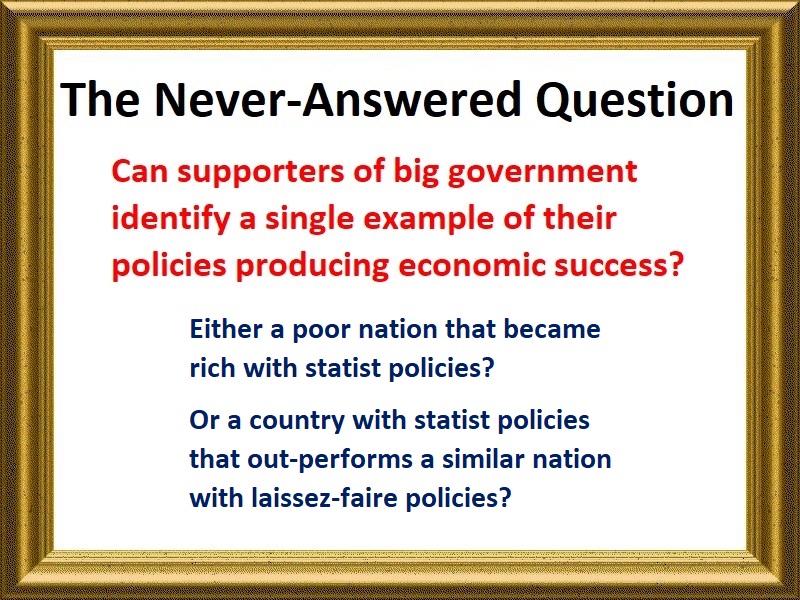
 

It also gives me a good excuse to recycle my never-answered question.

Supporters of free markets have dozens and dozens of examples of how economic liberty leads to more national prosperity.

I keep asking my leftist friends to show me any example, at any point in history, of big government leading to more prosperity.

They can’t answer, because global economic history shows there is only one economic system that generates mass prosperity.

P.S. The article also includes a section on “mutual recognition,” which is vastly underappreciated as a cornerstone of good cross-border economic policy.

Rather than trying to harmonize regulations with a single rule book written in Brussels, trust that rules that are good enough for Swedish consumers are acceptable for Spanish ones too. If something is legal in one European country, you should be able to trade it and use it in all the others, provided it is clear where it comes from. “Mutual recognition” of this kind was supposed to be the basis of the single market. Restoring it would be one of the biggest trade liberalizations in world history.

Our friends on the left don’t like this approach, however, since it means jurisdictional competition. They prefer harmonization, which effectively means cartels for the benefit of governments.

P.P.S. The three previous editions in this series can be read here, here, and here

Friday, May 3, 2024

Recovery for the PIGS?

May 2, 2024 by Dan Mitchell @ International Liberty

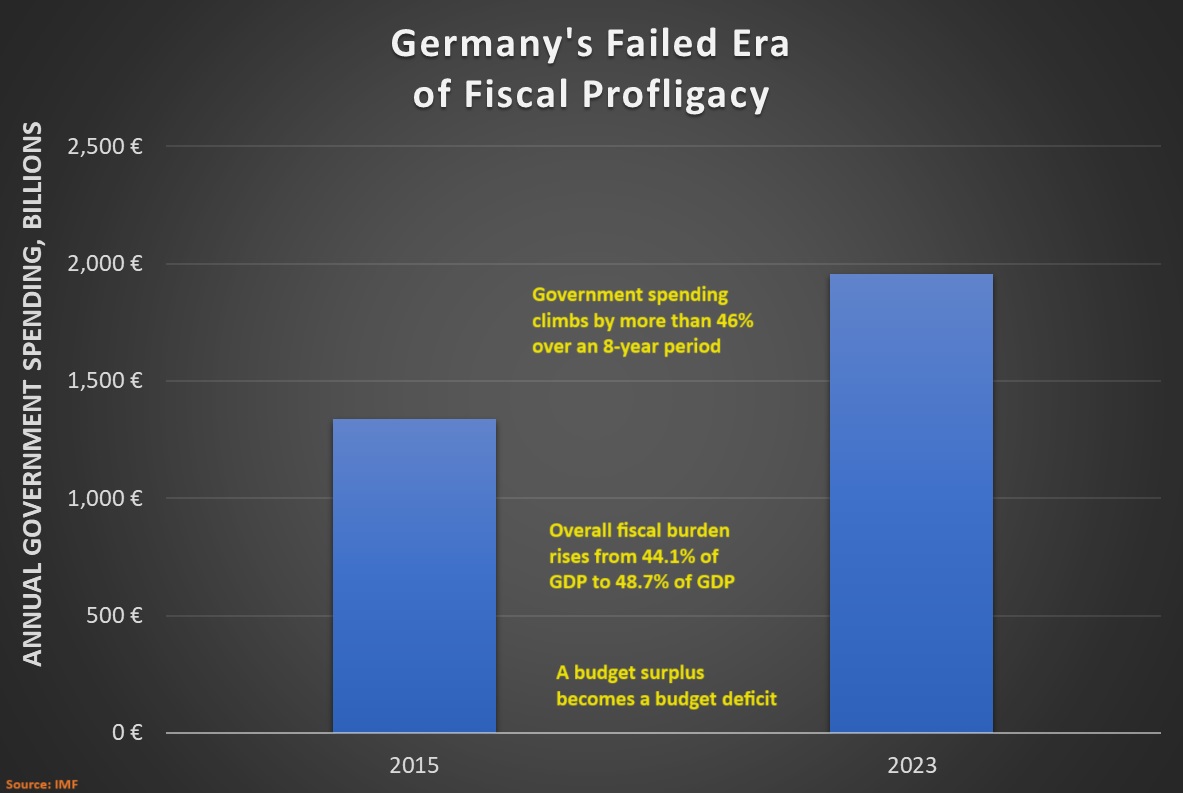
Just a few months ago, I wrote about Germany’s fiscal decay.


Over the past eight years, government spending has grown much faster than the private sector, thus violating the Golden Rule of fiscal policy.

Given the shift to bad policy in Germany, I was very interested to see that the New York Times has a report by Liz Alderman and that explains how Germany no longer is the economic engine in Europe.

Here are some excerpts.


Something extraordinary is happening to the European economy: Southern nations that nearly broke up the euro currency bloc during the financial crisis in 2012 are growing faster than Germany… In a reversal of fortunes, the laggards have become leaders. Greece, Spain and Portugal grew in 2023 more than twice as fast as the eurozone average. Italy was not far behind. …southern European countries made crucial changes that have attracted investors, revived growth and…reversed record-high unemployment. Governments cut red tape and corporate taxes to stimulate business and pushed through changes to their once-rigid labor markets, including making it easier for employers to hire and fire workers.

It’s encouraging to read about some pro-market reforms in Southern Europe.

It’s also encouraging that the New York Times seems to be acknowledging that free markets are the way to achieve more growth.

That being said, I’m not ready to declare that the PIGS (Portugal, Italy, Greece, and Spain) are the new role models for economic policy.

For instance, the NYT story is based on just one year of economic data. And I’ve warned that it is risky to draw big conclusions without seeing decades of evidence.

But a journey of a thousand miles begins with a first step. Given my interest in fiscal policy, I looked at the IMF data to see which countries have been most responsible over the past few years.

Lo and behold, Greece and Italy have been doing a decent job.

Three years of fiscal restraint may not seem like much, but it’s worth noting that the burden of government spending in Greece has declined by more than 10 percentage points of GDP.

And the spending burden in Italy has been reduced by nearly 7 percentage points of GDP.

Keep that up for 5-10 more years, and those countries could become Switzerland.

Do it for 10-20 years, and they can become Singapore or Taiwan.

Friday, March 3, 2023

South Africa is in freefall

March 1, 2023 By Andrea Widburg

I received an email from a South African friend today, infuriated at his country’s destruction at the hands of his own government’s ideology and incompetence. This was not hyperbole. In fact, the power grid is on the verge of complete collapse, which will leave people without food or water, and, when combined with South Africa’s decay in all other areas, may lead to civil unrest on a scale that could trigger a full civil war.

As a predicate to this post, it’s important to note that, since 1994, when the all-white government finally ended, all South Africa’s presidents have come from the African National Congress, a communist front group. It’s also important to note that South Africa, although in chaotic fashion, has been bowing down before “green colonialism.” As I use it, that phrase means that economically fragile countries destroy their energy infrastructure to suit the climate delusions coming from affluent western nations........To Read More.....

Thursday, November 3, 2022

European Fiscal Policy Week, Part V: The European Union, Centralization, and Redistribution

October 28, 2022 by Dan Mitchell @ International Liberty

The European Union started as a good idea (unfettered free trade between member nations) and has morphed into a troubling idea (a super-state based on centralization, harmonization, and bureaucratization).

And I fear it is heading further in the wrong direction since many European politicians want European-wide taxes and spending to facilitate more redistribution (on top of all the taxes and spending by member nations!).

Even if it means breaking existing EU rules in order to make government bigger.


Today, as part of “European Fiscal Policy Week,” let’s assess whether the EU is a positive or negative force.

And I’ll start by observing that the economic data is unfavorable when compared to the United States. Not only are living standards lower in EU nations, but those countries also are continually falling further behind.

It’s possible, of course, that these countries would be even further behind if there was no European Union, but the academic evidence points in the other direction.

In an article for Law & Liberty, Douglas Carswell questions the very existence of the European Union.


Instead of asking if Europe can hold together, we should be asking if Europe should be held together at all. Why is it felt necessary to unify Europe’s disparate peoples in the first place? What is it that compels European leaders to support pan-European systems of governance at all? It is not as if European integration has been a success. …

If the Euro was supposed to give Europe a competitive edge, how come the Eurozone lags behind the rest of the world by almost every measure of output and innovation? …The urge to integrate came about, it is often suggested, to prevent Germany from becoming overbearing… Seriously? Does anyone really believe that if it was not for an army of bureaucrats in Brussels these past thirty years, Germany might have invaded France again?

…Maastricht, and indeed the various subsequent EU treaties, need to be seen for what they are: a power grab by Europe’s political elites. …Thirty years after Maastricht, the European Union is no more capable of making the kind of reforms it needs to save itself than it was back then. Rather like the Habsburg Empire, to which it is in many ways the successor, the European Union will stumble on, lurching from crisis to crisis, bits of it breaking away from time to time, as a once-great civilization becomes a cultural and economic backwater.

In a way that appeals to me, Liam Warner explains in National Review that the European Union represents the wrong type of globalism.


The 1957 Treaty of Rome established the European Economic Community, for example, was a customs union by which member countries agreed to trade freely with one another and maintain common external tariffs. With the 1993 Treaty of Maastricht, which established the EU, and its subsequent amendments, European integration began to look less like a cooperation of equals and more like a submission to a supranational authority. …internationalism in its modern form has often been a means of…imposing on the world a stultifying monotony… The deep flaws of the present system having been exposed, European leaders must give up their dream…and revisit their ancestors’ healthier forms of globalism.

That “healthier form of globalism” should be based on jurisdictional competition and mutual recognition.

Is that remotely feasible?

A few European leaders realize that there’s too much centralization. Kai Weiss highlighted the views of the Dutch Prime Minster in a column for CapX.


In his Strasbourg speech on the future of Europe, Mark Rutte struck a markedly different tone and delivered an entirely different message to Macron and others. The Prime Minister of the Netherlands has recently come to the fore as one of Europe’s more sceptical voices. Speaking in front of the European Parliament, he once again made it clear that for him, more and more EU is simply not the answer to today’s problems. “For some, ‘ever closer union’ is still a goal in itself. Not for me,” Rutte said…

Instead of finding ever new competences and tasks, Rutte argued that Brussels should hold onto the “original promise of Europe”, the “promise of sovereign member states working together to help each other achieve greater prosperity…” For Rutte, this means focusing on the core benefit of the EU: free trade. …the emergence of the Netherlands, as well as Nordic and Baltic states, as vocal critics of Macron’s federalist plans should be the source of much hope for Europe’s future.

I applaud that there are a few leaders and a few governments trying to block further centralization.

But I have three reasons for being a pessimist about the European Union.

  • First, I don’t think there’s any hope for achieving any decentralization. Indeed, the more sensible people in Europe will face endless battles to stop bad ideas.
  • Second, Europe’s demographics are terrible. And that will specifically mean lots of pressure for redistribution by imposing EU-wide taxes and spending.
  • Third, public policy is moving in the wrong direction at the national level. This compounds the damage of bad policies imposed by EU bureaucrats in Brussels.

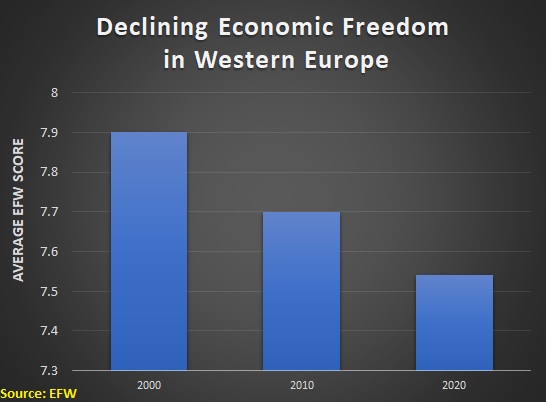
Here’s a chart, based on the latest edition of Economic Freedom of the World, showing how economic liberty is declining in the nations that dominate the European Union.

P.S. For amusement value, here’s a cartoon showing the future of the European Union.

P.P.S. If you like European-themed satire, click here, here, here, here, here, here, and here.

P.P.P.S. On a related note, Brexit-themed humor can be found here, here, here, and here.