Search This Blog

De Omnibus Dubitandum - Lux Veritas

Showing posts with label Spending. Show all posts

Thursday, October 9, 2025

France, Germany, and and the 17th Theorem of Government

October 7, 2025 by Dan Mitchell @ International Liberty

I have a three-part series (here, here, and here) about a likely fiscal crisis hitting Europe.

As a matter of fact, I don’t actually think it is “likely.”
 

It’s a given at this point. The only mystery is which domino falls first.

My pessimism is based on the fact that European nations already suffer from staggering fiscal burdens.

And because of aging populations, government spending is projected to consume ever-larger shares of economic output in the future.

It seems more people are now aware of the problem.

Here are some excerpts from a report in the Washington Post by Annabelle Timsit, Anthony Faiola, and Aaron Wiener. They focus on France and Germany and the news is grim.

Across Europe, and especially in France, the bill is coming due. The cost of…the so-called European way of life, offering health care, affordable education and a dignified retirement to all, through high social spending — is becoming unbearably high. …In France, …the nation’s debt soars, its credit rating slips, incomes stagnate, prime ministers fall and the country stumbles into ungovernability… 

Related challenges loom in neighboring Germany, where the economy is flat after two consecutive years of decline, companies are shedding jobs, infrastructure has crumbled, and the government is bracing the populace for tumultuous cuts… For France and Germany, long the pillars of the European Union, it is unclear that they can still afford to be the West’s guiding lights of economic justice.

Here are some passages showing the dependency mindset in France.

Anastasia Blay, 31, a camera assistant in Paris, does not believe her generation should…sacrifice benefits. For years, Blay survived with the help of a government subsidy for entertainment workers…which she and others view as an unbreakable social contract… A monthly social welfare payment for low-income workers now supports her during periods of unemployment… 

She has joined a string of street protests aimed at paralyzing the country. Even with government aid and a family apartment that allows her to live rent-free, she says it’s hard to make ends meet. “For me, the problem is injustice, the gap between the poor and the rich, and the rich who, in reality, are barely taxed compared to what they earn,” she said. While she said she feels “a bit ashamed” to rely on welfare and fears people’s judgment, the payments help her “keep my dignity and … live decently.” “It’s a right and not a privilege, in my opinion,” she said.

Ms. Blay obviously does not understand economics, as shown by her views that upper-income people are under-taxed.
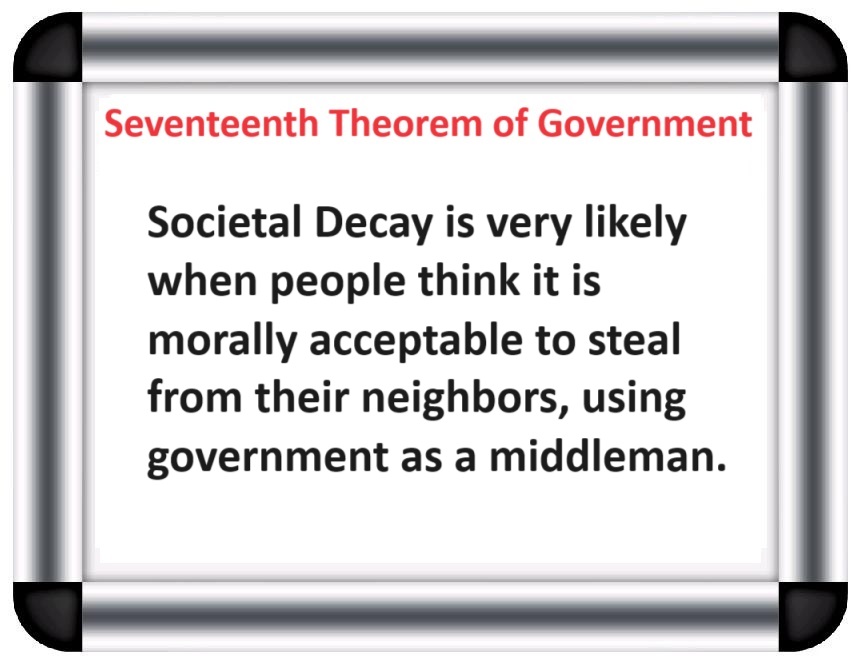
 

But the biggest problem with the above is that she thinks mooching off taxpayers is “a right and not a privilege.”

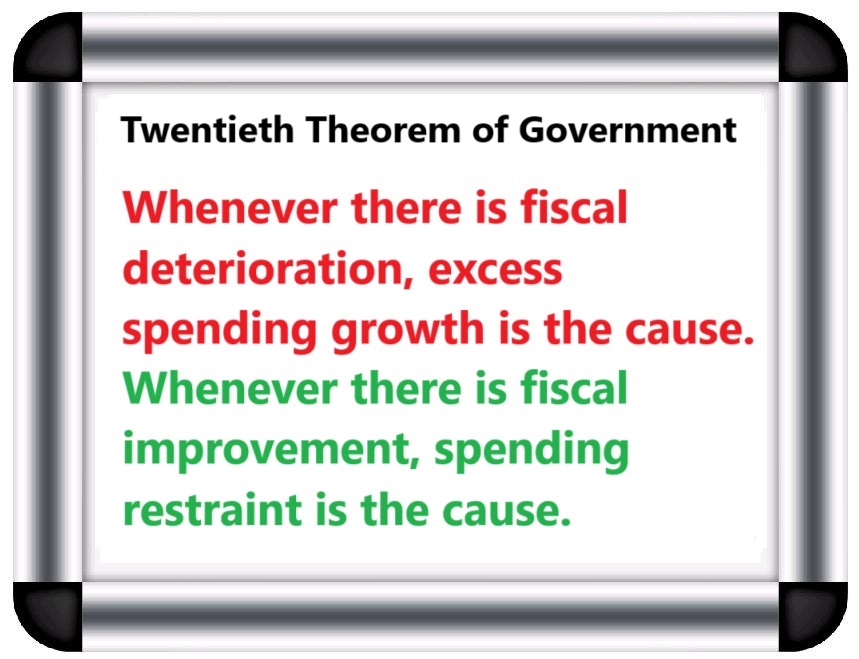
She could be the poster child for my 17th Theorem of Government.

Makes me wonder if she is friends with Olga and Natalija.

Let’s shift to Germany. Here’s an excerpt showing fiscal extravagance – and fiscal delusion – in Germany.

Today, between basic welfare and housing assistance, a German family of four on welfare can receive as much as 5,000 euros a month — roughly $5,873, or $70,476 a year, an unthinkably high amount in the United States. …Labor Minister and co-SPD chief Bärbel Bas responded curtly to Merz’s claim that Germany can’t afford its social programs. “That is bulls—,” Bas said.

At the risk of understatement, Miniser Bas is wrong. And interest rates of long-term German government bonds suggest financial markets agree with me.

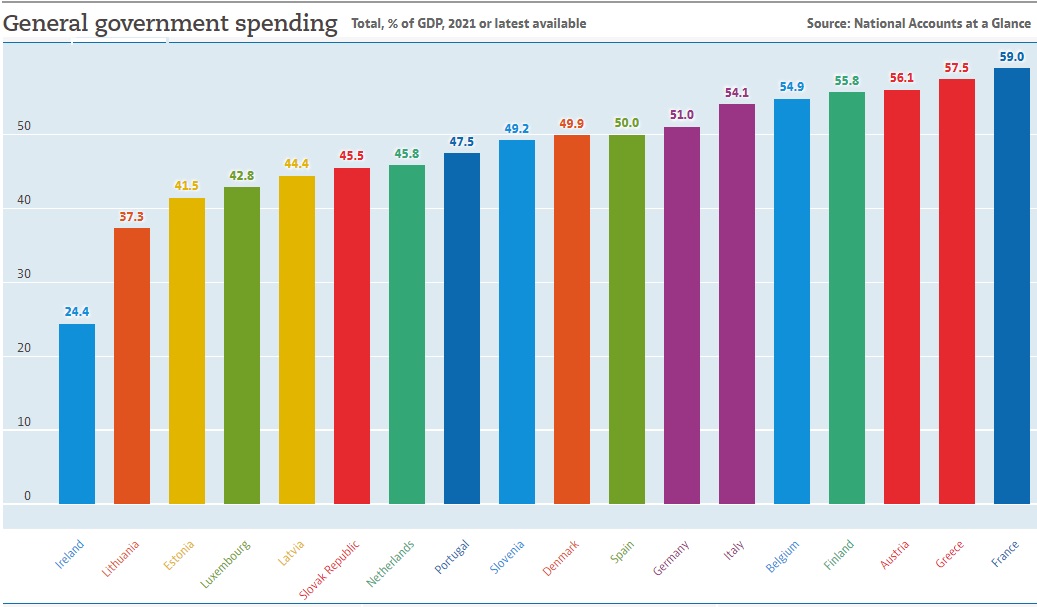
I’ll close with a chart, based on IMF data, showing that the problem in much of Europe is excessive government spending. As you can see, both taxes and spending consume much greater shares of economic output in Germany and France than Switzerland.

I also included Italy to show that France and Germany are just as bad – or even worse – on fiscal policy.

Actually, I’ll include one more chart. It’s no coincidence that Switzerland is much richer than its neighbors – more than $22,000 of additional economic output per year compared to the average of Germany, France, and Italy!

Maybe, just maybe, there’s a lesson to be learned about the relationship between the size of government and national prosperity.

P.S. I should have written “Medium-Sized Government Switzerland” since the East Asian tiger economies have significantly smaller spending burdens.

Thursday, September 4, 2025

A Debt Crisis for France?

September 2, 2025 by Dan Mitchell @ International Liberty

I’ve been explaining for years that economists are lousy forecasters.  But we are capable of noticing trends, including trends that will lead of bad outcomes if not reversed.


For instance, my recent series on “France and Fiscal Suicide” points out (see Part I, Part II, Part III, and Part IV) that the country will have some sort of crisis unless there is a serious effort to reduce the burden of government spending.

Heck, I’ve been beating that drum for a long time, and I also made France a case study for my 20th Theorem of Government.

So even though I’m still not willing to make specific predictions, it certainly appears that a fiscal meltdown may be on the horizon.

Here are some excerpts from a Wall Street Journal editorial last week.

…after all these years Paris still can’t get a grip on its budget or the economy. Prime Minister François Bayrou said Monday he’ll call a confidence vote on Sept. 8. He’s likely to lose. …Cue a steep drop in French shares…and surging bond yields. …French unemployment remains persistently high, and the productive parts of the economy are straining under a welfare state that extracted 51.4% of GDP last year in revenue… You’d think an economic and fiscal disaster of this magnitude would produce a burst of creative policy and political thinking. Instead, politicians mostly agree that they’d prefer to raise taxes than cut any spending or reform any entitlements.

That’s not encouraging.

But prepare to be even more pessimistic after perusing passages from Matthew Lynn’s column in the U.K.-based Telegraph.


The Government is teetering on the edge of collapse, the budget is out of control, there are emergency tax rises on the way and the rioters are gearing up for protests… With worries about government debt and the affordability of lavish welfare systems rising all the time, France could be about to trigger a full-blown market crash. … 

State spending has hit 58pc of GDP, while the tax burden on workers has hit 47pc, one of the highest levels in the OECD. And yet despite that, the deficit is forecast to hit 5.7pc of GDP this year and will probably punch through 6pc, while its debt-to-GDP ratio is over 113pc… It is hardly surprising that investors are starting to feel nervous about lending the country even more money. Yields have already spiked above Greece and Portugal, two countries at the epicentre of the last eurozone crisis, and that is hardly reassuring, while the finance minister, Eric Lombard, has started warning about an IMF bailout.

Here’s a chart that accompanied the column.

As you can see, one symptom of excessive government spending is that debt is becoming an ever-greater burden.

The author warns that a crisis in France may spread to other nations, which is a very real possibility given their fiscal problems.

…watch out for contagion. …France is the most fiscally irresponsible of all the major developed global economies. …if it crashes, then other countries – most notably the UK – will very quickly get caught up in the storm as well, just as Ireland and Portugal were after Greece crashed. The markets will be looking for the next domino to fall, and it won’t be long before they find it.

I’ll close with two comments.

  • First, if France does have a crisis (i.e., a loss of confidence by investors, leading to a sudden spike in yields on government bonds, perhaps accompanied by troubles for the entire financial system), I will have to eat crow because I’ve been speculating for years that Italy will be the first domino to fall.
  • Second, Mr. Lynn seems to think it would be good if France still had its own currency so it could just use inflation as a means of partially repudiating its debt. That is wrong. France’s problem is excessive government, not the euro currency. French politicians instead should opt for “internal devaluation,” which is just a wonky way of saying they need small government and free markets.

Because France seems to be a cesspool of statism, I won’t be holding my breath waiting for the right approach.

Though, five years ago, I never would have predicted Argentina’s renaissance, so one should never give up hope.

P.S. I’m going to add one more comment.

  • Third, a nation’s debt burden matters, but what also matters is whether policy is moving in the right direction or wrong direction. For instance, the EU chart below shows that Greece has the highest debt burden in the European Union, yet it is now considered to be in decent shape because of short-run spending restraint and long-run pension reform. In other words, it is heading in the right direction and debt is declining. France, by contrast, is vulnerable because politicians are in a never-ending cycle of more taxes, more spending, and more debt.

Here’s the chart showing European debt burdens, courtesy of Eurostat.

P.P.S. The chart also shows that it is possible to be a high-tax welfare state with reasonable debt levels, though it is worth noting that nations such as Sweden, Denmark, and Luxembourg are very pro-market in areas other than fiscal policy. And Denmark and Sweden have been moving in the right direction on fiscal policy.

Monday, September 1, 2025

The Netherlands and the 20th Theorem of Government

August 30, 2025 by Dan Mitchell @ International Liberty

Ever since unveiling my 20th Theorem of Government, I’ve mostly shared bad news about jurisdictions with profligate politicians (France, Brazil, Colombia, Maryland, Washington, Australia, Germany, and Canada).

My only positive example has been Greece, though I was being somewhat charitable since I was highlighting a five-year period where spending grew by more than 4 percent annually (which was progress since nominal GDP grew more than 8 percent annually over the same years).

Today, I’m going to cite a much more impressive example of spending restraint.

Here’s a chart – based on IMF data – showing that the Netherlands had a seven-year period last decade where spending grew by an average of less than 1 percent annually.

The chart shows the two big consequences on Dutch fiscal discipline.

  • The burden of government spending declined by more than 6-percentage points of GDP.
  • Spending restraint turned a large budget deficit into a small budget surplus.

The Netherlands is a rare positive case study for my 20th Theorem.


But it’s more than that.

Any nation that has a multi-year period with spending growth averaging less than 2 percent annually also qualifies for my Golden Rule Club.

That’s the good news. The bad news is that fiscal policy has deteriorated a bit since the 2010-2017 period.

Government is now consuming 44.7 percent of GDP. That may not seem like an enormous shift, but keep in mind that the Netherlands has some long-term fiscal challenges.

So any slippage is bad news.

P.S. One bright spot is that the Netherlands has a well-regarded system of personal retirement accounts, which I’ve ranked as 4th-best in the world.

Since Upper-Income Taxpayers Finance the American Welfare State, Leftists Should Be Nice to Rich People, Part III

August 31, 2025 by Dan Mitchell @ International Liberty

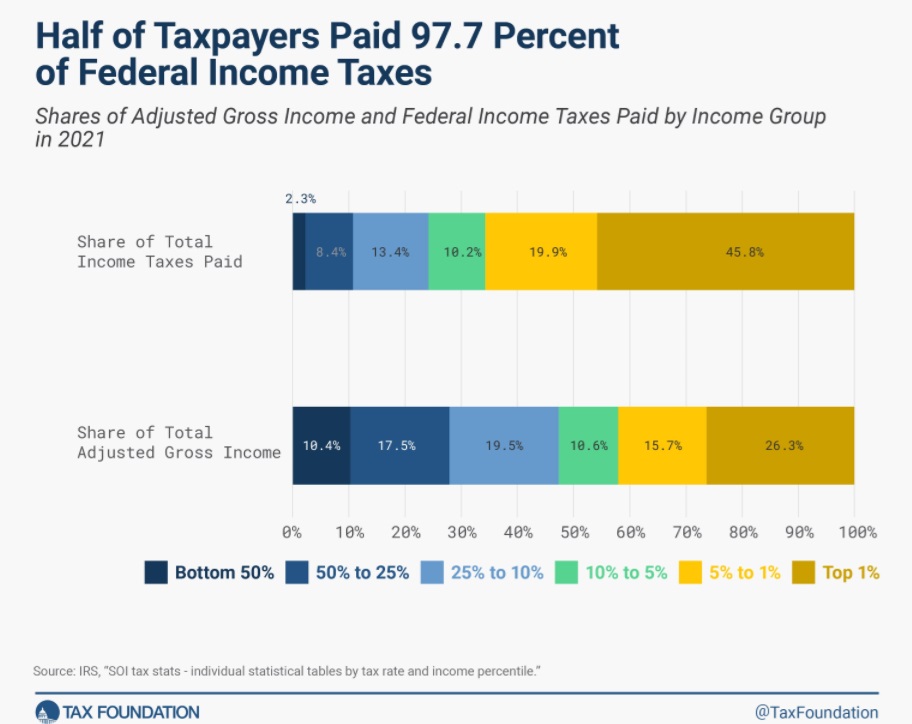
I’ve written a couple of columns (in 2016 and earlier this year) about how upper-income taxpayers finance the vast majority of the welfare state.


The data I shared involved the federal budget in Washington.

And I explained that the Bernie-AOC crowd, instead of despising the rich, should be grateful for them (yes, I realize that is very unlikely, but I view myself as the Don Quixote of economic freedom).

The same lesson applies to state and local governments. Or perhaps I should say it especially applies to state and local governments since internal tax migration is much easier than international tax migration.

Interestingly, some folks in New York are capable of learning. Here are some excerpts from a column by Matthew Haag in the New York Times.


The rate at which New York State has been adding millionaires to its population in recent years has fallen below that of other large states, potentially costing the state billions in unrealized tax revenue, according to a new report from a nonpartisan fiscal watchdog group. At the same time, California, Florida and Texas had large increases in the number of people with annual incomes of at least $1 million residing in their states, all adding them at a faster rate than New York did from 2010 to 2022. The millionaire population in New York nearly doubled over that same time period, but it more than tripled in those other states. …“We have a debate about affordability, but we need to raise more revenue,” said Andrew Rein, the president of the Citizens Budget Commission, “and we can raise even more revenue if we have even more millionaires.” …the group’s arguments that New York City needs more millionaires and that any increase in personal income taxes could drive them away…is in opposition to the platform of Zohran Mamdani, a state assemblyman who is the Democratic nominee. Mr. Mamdani has proposed a new 2 percent tax on income greater than $1 million.

Here are the most important numbers in Haag’s column.

While just 1 percent of the city’s taxpayers are millionaires, their contributions make up 40 percent of all personal income tax collected. If New York’s rate of growth had kept pace with that of other states, the group said, the state and city would have together collected $13 billion in additional taxes in 2022.

The bottom line is that folks on the left in New York have to decide what matters most.


  • Is their main goal to persecute rich people and drive them away? If that’s the case, they should continue what they’re doing and (for the ones in New York City) even take it to the next level by electing Zohran Mamdani, the Champagne Socialist with a lunatic agenda.
  • Or, is their main goal to provide benefits and services to lower-income people? If that’s the case, they should realize that rich taxpayers are the geese with the golden eggs. As such, they should be very grateful for them and maybe, just maybe, they should hope for more of them.

Sadly, I fear that many folks on the left are motivated by envy and instinctively prefer the persecution option.

P.S. It was interesting to read in the NYT column that California still creates millionaires, but perhaps that is not surprising since the state hasn’t figured out how to tax unrealized capital gains. The problem for the not-so-Golden State is that many of those successful taxpayers then emigrate.

Friday, August 29, 2025

Switzerland’s Superior Fiscal Discipline

August 28, 2025 by Dan Mitchell @ International Liberty

When I wrote yesterday about Germany, I could imagine readers shrugging their shoulders and thinking it was just another column about European decline. Indeed, I’ve written similar columns about other welfare states such as France, Italy, Spain, and the United Kingdom. Though not all European nations are the same. I wrote back in May, for instance, about Denmark moving in the right direction.

For purposes of today’s column, however, I want to look at Switzerland.

More specifically, I want to compare Switzerland’s prudence and Germany’s decline. Here’s a chart, based on the IMF’s database, comparing annual growth of overall government spending in the two nations. As you can see, Germany has increased the fiscal burden of government at a much faster rate than Switzerland since 2015.

From an economic perspective, the best way of measuring the burden of government is to see what share of a nation’s economic output is being consumed by the public sector.

Switzerland is much better than Germany in that regard, with 32.1 percent of GDP diverted to government compared to 49.9 percent of GDP going to government in Germany.

But trends also are important, and this next chart shows that the economic burden of government spending has dramatically increased in Germany (and fallen slightly in Switzerland).

I’m tempted to highlight the critical role of Switzerland’s spending cap and conclude this column. But since the majority of my readers are from the U.S., let’s expand today’s analysis by including data on what has happened to government spending in America over the same time period. Lo and behold, we see that politicians in the United States have been even worse than German politicians.

However, since the United States has enjoyed faster economic growth, the government/GDP ratio has not deteriorated as much. Here’s a chart showing how the burden of government spending has increased in the U.S., but fortunately not as much as it has expanded in Germany.

The should-be-obvious takeaway is that lawmakers should strive for both spending restraint and faster growth. That’s the recipe for shrinking the burden of government spending. At this point, I could wrap up with another endorsement of Switzerland’s spending cap. But I want to make one final point.

I recently saw on Twitter this analysis of interest rates in six key nations, including Germany, Switzerland, and the United States. Notice that interest rates are trending higher in every country other than Switzerland. Why? Because investors can look at Swiss fiscal policy and feel confident that there won’t be a future crisis.

Yes, Switzerland did make the mistake of spending more money during the pandemic, and that pushed up interest. But not nearly as much as spending increased and interest rates rose in the other five nations.

The moral of the story is that investors obviously are much less concerned about a potential default (or some other type of fiscal crisis) in Switzerland. And they obviously are much less worried about politicians using the printing press to finance budget deficits (which also would push up interest rates).

So now I’ll conclude by saying that the United States (as well as Germany, Australia, Canada, and the United Kingdom) should copy Switzerland’s spending cap.

You can click here to learn more about that much-needed reform.

Thursday, August 28, 2025

Germany and the 20th Theorem of Government

August 27, 2025 by Dan Mitchell @ International Liberty 

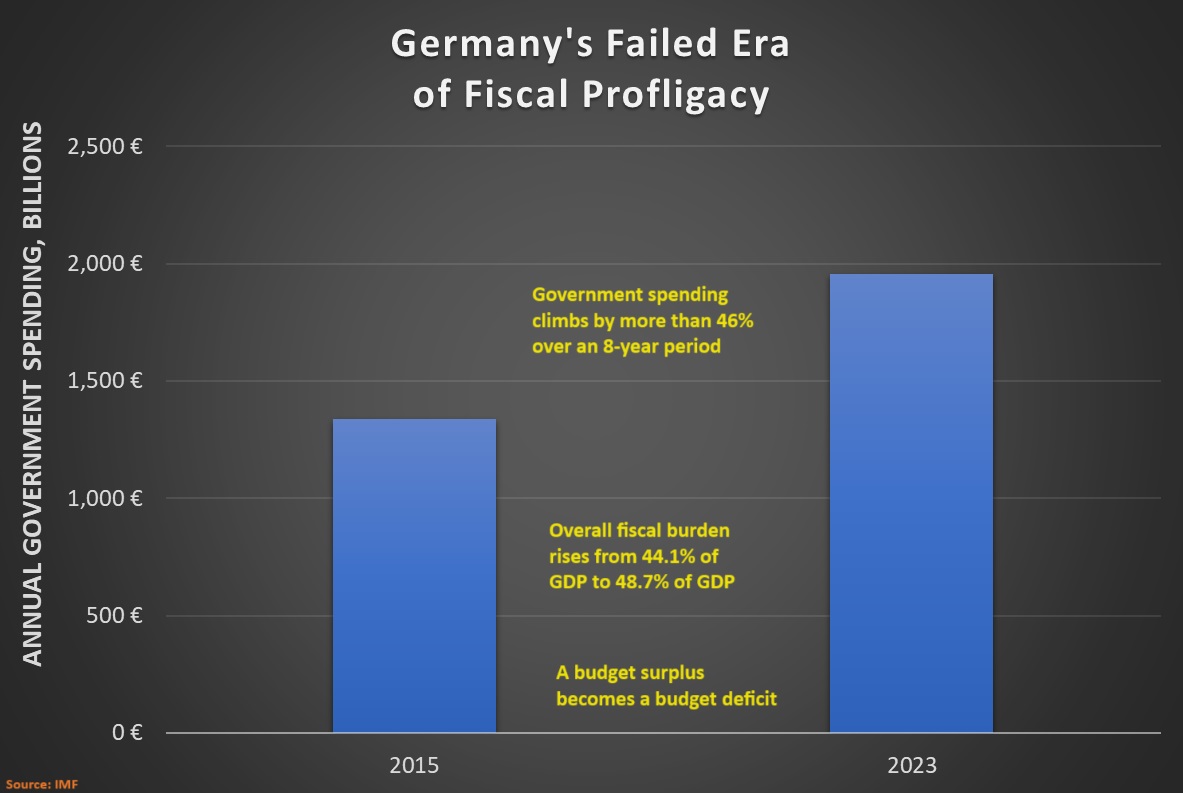
In 2023, I wrote about Germany’s fiscal decay, noting that the burden of government spending had been increasing faster than the productive sector of the economy. 

This violated my Golden Rule.

In the accompanying chart, I noted that government was consuming 48.7 percent of economic output, up from 44.1 percent of GDP in 2015.

And, for those who fixate on red ink and fiscal balance, I also noted that Germany’s 8-year experiment in profligacy turned a budget surplus into a budget deficit.

My message was simple. Germany needed to change direction.

The good news is that politicians in Berlin did shift policy.

The bad news is that they decided to make a bad situation even worse. Following elections earlier this year, new Prime Minister Friedrich Merz decided to make government even bigger.

Even the Washington Post has noticed, as illustrated by the headline from this story from last month.

Though I can’t help but point out that it has been about 20 years since Germany budget could be described as “tightfisted.”

But the story was largely accurate even if the title had an error. Merz and the other politicians in Berlin are increasing the fiscal burden of government.

So I was flummoxed to see that Germany’s Prime Minister has suddenly realized that his country is in a fiscal ditch. Here are some excerpts from an editorial in the Wall Street Journal.

Friedrich Merz, the German Chancellor, said at a Christian Democratic Union conference on Saturday that “the welfare state that we have today can no longer be financed with what we produce in the economy.” Thank you, Chancellor, for this burst of candor. …Nations have built welfare and entitlement states that are so large they have outstripped the ability of slow-growing economies to pay for them. …there’s no more difficult challenge in politics than reforming government handouts—whether in pensions, jobless benefits, government healthcare, or income subsidies. It will be worth watching what Mr. Merz and his coalition propose. But the first step toward solving the problem is admitting it exists.

In my not-so-humble opinion, the WSJ‘s editorial writers are being too kind.

They are praising Merz for acknowledging the problem when they should have been condemning him for making the problem worse.


Merz reminds me of the old joke about the kid who murders his parents and then asks for mercy because he’s an orphan.

I’ll close by observing that Germany is another example of my 20th Theorem of Government.  It’s running out of other people’s money because government is too big and it’s been growing too fast. Maybe Merz has had an epiphany and will now do what’s right, but I’m not holding my breath.

P.S. When I did the chart in 2023, I noted that the burden of government spending had increased by 4.6 percentage points of GDP since 2015. The latest numbers show that government is now consuming an additional 5.3 percent of GDP.

P.P.S. Predictably, the IMF is pushing the wrong advice for Germany.

Wednesday, August 20, 2025

Say, Whatever Happened To All Those Devastating Spending Cuts We Were Warned About?

Turns out that, despite all the protests, the screaming, and purple-hair-pulling and nose-ring-wiping about President Donald Trump’s “devastating cuts,” spending in July was $55.5 billion higher than it was a year ago.   

What’s more, there were jumps for outlays for agencies such as Veterans Affairs (up $3 billion year-over-year), Medicaid (up $15 billion), the EPA (up $195 million), the National Science Foundation (up $14 million) – all of which were supposedly being slashed and burned.

In fact, just five of the 15 Cabinet-level agencies spent less this July than they did last year.

As we’ve pointed out many, many times in this space, when it comes to spending cuts, both sides exaggerate what’s going on. Democrats do so because they want never-ending spending increases, and Republicans do so because they want to look like fiscal hawks.

The truth is that spending keeps growing, and growing, and growing. That is nowhere more true than when it comes to Medicaid, which as we exposed here (see “One Chart To Kill The Medicaid Lies For Good”), continues to climb at an unsustainable pace under the One Big Beautiful Bill.

But, don’t despair, because things are getting better under Trump.

First, cumulative deficits in the six months since Trump took office – that is, from February through July – are $196 billion lower than they were compared with the same months last year, when President Joe Biden’s autopen was still in charge.

Revenues are up $250.7 billion.

And, while spending is up, the total year-over-year increase in spending over those six months is relatively small – $54.5 billion.

Compare that to the last six months of Biden’s term.

From August 2024 through January 2025, cumulative deficits were $542 billion higher than the previous year, thanks to a $636 billion increase in spending and just $94 billion in revenue growth.

Trump and the Republican Congress have a lot more work to do before they can claim to have gotten the country’s fiscal house in order. But at least they’ve changed course a bit.

— Written by the I&I Editorial Board

Monday, July 28, 2025

OECD Pushes Welfare-State Policies on Thailand

July 25, 2025 by Dan Mitchell @ International Liberty

Hong Kong used to be a role model for good economic policy, but China’s crackdown has had a negative effect, so Singapore is now considered the jurisdiction with the most economic freedom.

But I also like to cite Taiwan, which is a top-20 nation for economic liberty.

Especially if the alternative is Thailand, which only ranks #65.

Unsurprisingly, differences in economic freedom translate to differences in per-capita GDP. Here’s a chart based on the Maddison database.

One reason for the big gap is that Thailand has a bigger burden of government spending.

This second chart utilizes IMF data to compare the three nations.

Looking at these two charts, one obvious conclusion is that Thailand should reduce the burden of government spending.

It makes sense, after all, to mimic the policies of nations that are much richer.

Unfortunately, the bureaucrats at the Organization for Economic Cooperation and Development must have flunked Econ 101.

The Paris-based bureaucracy just published a report that explicitly urges the Thai government to increase taxes and spending.

I’m not joking. Here are some excerpts.


Thailand has made significant progress in expanding its social protection system in recent years, but there is scope to further expand coverage and increase benefit levels. …spending on social protection (excluding healthcare) is only 2.1% of gross domestic product (GDP), which remains low in international comparison… Additional public spending requires increasing Thailand’s tax-to-GDP ratio… 

Raising more tax revenues will require reform across a wide range of direct and indirect taxes. There is scope to increase the standard value added tax (VAT) rate (currently at 7%)… The role of the personal income tax could be strengthened… Further, the dividend withholding tax rate could be increased. …the ceiling on social security contributions…could be raised to increase the contributions from higher incomes.

For those keeping score, the OECD wants more income tax revenue, more payroll tax revenue, and more value-added tax revenue.

And if you read the entire report, they want more energy taxes, more excise taxes, and other taxes as well.

Here’s the OECD’s list of recommendations.

We may as well call this the turn-Thailand-into-France recipe.

Except France became a (relatively) rich nation when government was very small and then made the mistake of adopting an expensive welfare state.

The OECD wants Thailand to adopt a costly welfare state today, which means the country (notwithstanding absurd OECD analysis) will never become rich.

To make matters worse, the OECD is subsidized by money from American taxpayers. So I’m helping to pay for terrible advice that will hurt the people of Thailand.

P.S. Adding insult to injury, OECD bureaucrats get tax-free salaries. So those hypocrites push tax increases on everyone else while being insulated from suffering any real-world consequences.

P.P.S. To be fair, the OECD wants all nations to have higher taxes and bigger welfare states, so it’s not selectively attacking Thailand.

Friday, July 25, 2025

China and the 20th Theorem of Government

July 19, 2025 by Dan Mitchell @ International Liberty

I’ve expressed admiration for China’s partial economic liberalization and the impressive growth it produced.

But I’ve also warned that there are some misguided government policies that will make it very difficult for China to become a rich country. I’ve been especially concerned about industrial policy and other types of cronyism.

However, I may need to worry about fiscal policy as well. Teaching earlier today in Shenyang, China, I shared this chart with a group of students.

It shows, based on the IMF’s big database, that government spending has increased dramatically over the past 40-plus years.

This chart looks terrible, but it’s also misleading.

The best measure of a government’s fiscal burden is to compare the size of the budget to the size of the private sector (in other words, government spending as a share of GDP).

On this basis, you immediately notice that China’s fiscal policy was very good for almost 15 years, with the burden of government dropping to about 11 percent of GDP in 1996 (better than Singapore or Hong Kong!).

Unfortunately, that positive trend was only temporary. Since the mid-1990s, the burden of government has been on an upward trajectory.

Indeed, government now consumes more than one-third of the economy’s output, more than three times greater than in 1996.


At the risk of understatement, this eventually will lead to fiscal crisis. Especially when you consider China’s demographic challenge. A clear example of my 20th Theorem of Government.

For wonky readers who want even more data, the next chart provides a breakdown of average spending growth during the 1982-1996 and 1997-2025 periods.

Interestingly, the main difference between the two periods is not the average annual growth of the budget (13.9 percent compared to 15.4 percent). Instead, it is the growth rate of the economy.

For the 1982-1996 period, the private sector was growing faster than the government (fulfilling the Golden Rule). That’s when progress occurred.

Sadly, but that relationship reversed starting in 1997.

By the way, these are all nominal numbers, meaning they are not adjusted for inflation. So I also show the average inflation rate for the two periods on the right side of the chart.

Notice that the burden of government has grown faster than the economy during the 1997-2025 period, and also that the budget has grown far faster than inflation.

The moral of the story is that China should enact a spending cap.

P.S. Some economists believe Chinese government data is untrustworthy, but presumably any corrections would not change the fact that fiscal policy has been moving in the wrong direction.

Thursday, July 17, 2025

"California Leavin"

This is part 1 of a 3 part series

By Robin Itzler 

Editor's Note:  This is one of the commentaries selected from Robin's weekly newsletter Patriot Neighbors. If you wish to get the full edition, E-mail her at PatriotNeighbors@yahoo.com to get on her list, it's free.

GOP Chair Rankin Spending $10,000 on nat’l. anthem singer

In this three-part series, we share examples of California Republican “leaders” failing the America First agenda. Part one is about the California Republican Party’s recently elected chairwoman Corrin Rankin approving, without board approval, hiring her opera singer friend to sing The Star-Spangled Banner for an outrageous $10,000.

Registered Republicans in the once golden state are regularly inundated with emails, texts and letters from the California Republican Party (CRP) begging for contributions. Steve Frank of California News & Views reported that CRP will be paying a massive $10,000 for an opera singer to sing The Star-Spangled Banner during the CRP’s September three-day statewide convention in Orange County. The performance is planned for the Saturday evening dinner.

According to those who follow the CRP, Chair Corrin Rankin approved the outlay without board approval. Chair Rankin informed the board that her “friend” is singing at a discount, and she did not allow any discussion.

California Republicans, whose mailboxes and in-boxes are stuffed with CRP requests for donations, will be thrilled that the previous chair earned a massive annual salary of $250,000 plus benefits, bonuses and travel expenses. The current chair’s salary was increased to a whopping $260,000 plus benefits, bonuses and travel expenses. Mind you, the governor of California (a state with nearly 40 million residents) is only paid $224,000.

Compare the Republican chair’s huge salary to the chairman of the California Democrat Party who earns just $127,500 a year. (Guess losing pays better.)

There are about 85 words in our national anthem. At $10,000, it comes to approximately $118 per word. How many local talented singers would have been honored to sing this glorious song at the Republican convention? Instead CAGOP Chair Corrine Rankin signed the contract that will let her opera singer friend belt out the song for $10,000. Maybe the song will start with:

♬ O say can you see How the California GOP Wastes our money on thee… ♬

This extravagant $10,000 expenditure by CRP Chair Corrin Rankin offers a prime example of why many America First Patriots in California donate directly to candidates and ignore the elitist CRP.

World’s Most Biased Headline or World’s Most Misleading Headline?

July 16, 2025 by Dan Mitchell @ International Liberty

Even though it did not do much to slow the growth of federal spending in fiscal year 2026 and beyond, I was glad to see Trump’s One Big Beautiful Bill get enacted.

If nothing else, it saved the country from a big, automatic tax increase next year.

Now there’s another fiscal fight in Washington. Lawmakers are squabbling over whether to approve Trump’s plan to rescind about $9 billion of spending for the current 2025 fiscal year.

To some extent, the rescission package is too small to care about. The burden of federal spending this year is about $7 trillion, so getting rid of $9 billion is way less than one percent of the budget. Heck, it’s not even 2/10ths of one percent of total federal spending.

Indeed, it’s almost impossible to see the impact of the rescission in this chart I created using CBO data.

Here are some excerpts from a report in the Washington Post, which was authored by Theodoric Meyer. As you can see, what he wrote was straightforward and balanced.

But notice the absurd headline!


The Senate voted Tuesday to advance President Donald Trump’s request to claw back $9 billion… The vote was 51-50, with Vice President JD Vance breaking a tie… The rescissions bill is a top priority for the Trump Administration… Tuesday’s vote was a first step toward passing the bill. …Congress must send the bill to Trump’s desk by Friday or the administration will be forced to release the funds. …If the bill passes, it would be the first rescissions package that Congress has passed at a president’s request in decades.

Knowing a bit about journalism, it is very unlikely that Meyer concocted that headline. Presumably, it was an editor.

But whoever decided to use “slash” must not be very good at math.

Even if we compare the rescission to the narrow slice of the budget known as “domestic discretionary” rather than overall spending, there is no “slash.”

There’s not even a cut.

To be fair, the headline could have been accurate if it specified that the rescission package would “slash” foreign aid and government-run media (NPR and CPB).

Those are the only two spending categories (out of hundreds and hundreds) that actually take a hit.

And that type of journalistic honesty would correctly put the focus on whether foreign aid plays a useful role (it doesn’t) and whether government-run media is a wise way to spending money (it isn’t).

P.S. Reagan pushed through a far bigger rescission package in 1981, further solidifying his record of easily being the most fiscally prudent president since the end of World War II.

Wednesday, June 4, 2025

What Can Be Learned from the Republican Spending Orgy in Texas?

June 2, 2025 by Dan Mitchell @ International Liberty

  As shown by the lack of spending restraint in Trump’s absurdly named One Big Beautiful Bill. there are plenty of big-government Republicans in Washington. 

At the risk of understatement, they are not complying with the Golden Rule of fiscal policy.

What might surprise readers, however, is to learn that there are also plenty of big-government Republicans in Texas.

How many?

Enough to make some experts wonder whether there is much difference between Texas Republicans and California Democrats. Here are some excerpts from Vance Ginn’s recent analysis.

…lawmakers are preparing to pass a $337 billion budget for 2026–27, with state funds up 42.8% since 2022. That’s not “conservative governing”—that’s runaway progressive budgeting with an R next to it.  

This moment is especially troubling because Texas had every advantage: a booming economy, a $24 billion surplus, and $28 billion parked in the Rainy Day Fund. Yet from the outset, the political appetite was clear—not to return excess funds to taxpayers, but to spend, expand, ban, and centralize.  

Of that massive surplus, only about $6.5 billion is going to tax relief, and only about $3.5 billion in new relief that wasn’t already in law. The rest is poured into bloated agencies, corporate handouts, and vote-buying schemes that defy every principle of responsible budgeting.

While the most recent budget is very disappointing, GOP profligacy in the Lon Star State is hardly a new phenomenon.

Here’s a chart Vance shared in another one of his recent articles.

Returning to Vance’s original article, he zeroes in on the real problem, which is that there’s not an effective cap on spending growth.

What’s most frustrating is that all of this could have been avoided. The Sustainable Budget Project lays out a clear path forward: tie budget growth to population plus inflation—a principle that matches government growth with the average taxpayer’s ability to fund it. 

Had lawmakers followed this rule, we could have prevented overspending, driven down taxes… This session may go down as the most progressive in Texas history, not because Democrats were in control… 

We must adopt a strong constitutional spending limit that applies to all state and local spending, closes every property tax limit loophole, and requires a supermajority to exceed the limit.

What makes a spending cap so vital is that a state that has relatively good economic policy (Texas ranks #5 according to Economic Freedom of North America and ranks #6 according to Freedom in the Fifty States) is going to enjoy good growth.

And good growth will generate plenty of tax revenue (not income tax revenue since Texas has never made the mistake of adopting an income tax, but other tax revenues have grown rapidly because of more economic activity).

The problem, as Vance explained above, is that politicians have a hard time letting go of this extra revenue. Which is why a spending cap so important.

Indeed, it’s worth noting that some of the scholarly research on spending caps notes that they are effective for exactly this reason. They prevent politicians from spending windfall revenues.

The bottom line is that Texas needs a Colorado-style spending cap that restricts the budget so it can grow no faster than population plus inflation.

And government spending is the problem. Limit government and the symptoms of tax increases and more debt will go away.

P.S. The above analysis applies to countries (Greece, Barbados, France, Finland, Brazil, Colombia, and the United Kingdom), to states and provinces (Alaska, Puerto Rico, Alberta, Washington, Western Australia, Maryland, and California), and to local governments (New York City and Fairfax County).

Friday, May 23, 2025

The Looming Trump/GOP Tax Hike

May 22, 2025 by Dan Mitchell @ International Liberty

Republicans are going to saddle the country with a massive tax increase, and I’m not referring to Trump’s huge protectionist tax increase on American consumers and producers.

Instead, I’m referring to my long-held view that a failure to address the problem of runaway entitlement spending inevitably will lead to massive tax increases.

And because there are not nearly enough rich people to finance big government, that tax increase overwhelmingly will fall on lower-income and middle-class taxpayers.

Sadly, Trump and Republicans could have used the current budget as a vehicle for much-needed reforms.

Instead, they’re extending the 2017 tax cut (a mostly good idea) while doing almost nothing to address the long-run spending problem (an utterly terrible choice).

As a result, Jessica Riedl of the Manhattan Institute projects a massive spike in interest payments in coming decades.

However, it’s inconceivable that interest costs will ever reach 6 or 7 percent of GDP, much less 8 or 9 percent of economic output.

We’ll have a Greek-style crisis of some sort, presumably accompanied by massive damage to financial market and 1970s-style inflation.

Jessica’s analysis is from a conservative perspective.

But folks on the left have reached the same conclusion. In a column for the Wall Street Journal, William Galston explains how Republicans are dooming the nation to a massive tax hike.

…the nonpartisan Committee for a Responsible Federal Budget estimated that the bill would have increased the national debt by $3.3 trillion more than the CBO’s baseline projection for the next decade, and the projected debt-to-GDP ratio would rise from the baseline 118% to 125%. Worse still, if all the gimmicky “temporary” measures in this bill were subsequently made permanent, as often happens, the national debt would rise to $5.2 trillion above the baseline projection, and the debt-to-GDP ratio would surge to 129%.

This was the context in which Moody’s downgraded the United States’ sovereign credit rating on Friday, citing the government’s persistent failure to adopt measures that would “reverse the trend of large annual fiscal deficits and growing interest costs.” …As the U.S. population continues to age, the costs of Social Security and Medicare as a share of GDP will mount inexorably. Together, these two programs will account for more than 100% of the increase in federal spending as a share of GDP over the next decade. …

These demographic and political realities point to the same conclusion: that increased revenue will be needed to secure these programs for the long term. …the next president will be forced to address this issue… The necessary changes would be easier to bear if they could be phased in before the crisis hits, but past performance suggests that the government will act only when it can postpone difficult choices no longer.

What’s tragic is that it was only about 10 years ago that Republicans had presided over a five-year spending freeze and were also voting for the Paul Ryan budgets that were predicated on genuine and meaningful reform of Medicaid and Medicare.

Sadly, those Tea Party-inspired Republicans have morphed into big-government hacks. The modern-day version of Rockefeller Republicans.

P.S. Nothing written above should be interpreted in any way as being favorable to a tax increase. That’s a recipe for making a bad situation even worse. When the “unavoidable choice” gets made, I want the option that will actually work.

Monday, May 19, 2025

Implications of Washington’s Spending and Debt Binge

May 17, 2025 by Dan Mitchell @ International Liberty

Whenever anyone starts griping about government debt, I tell them they’re right. But I also tell that debt is just a symptom and that the real problem is an ever-growing burden of government spending.

Moreover, I warn them that fixating on red ink is a tactical mistake because proponents of bigger government can respond by stating, “I agree with you, so let’s raise taxes.”

That would be a huge mistake since all the evidence, from the United States and elsewhere, shows that higher taxes will merely give Washington an excuse to further increase the spending burden and we’ll have even more debt when the dust settles.

Have set the the parameters of today’s discussion, now let’s look at two visuals. First, here’s the CRFB estimate of future debt (as a share of GDP) based on Trump’s “big, beautiful bill” that Republicans are considering.

Second, here’s a headline from CNBC about the U.S. losing its AAA credit rating.

So what should we think about these developments?

In the grand scheme of things, we can ignore the Moody’s downgrade. With regards to the safety and soundness of the federal government’s debt, the credit rating agencies are giving us a lagging indicator.

In other words, Moody’s isn’t telling the financial markets anything that isn’t common knowledge.

However, the chart is something to worry about. I’ve assumed for a long time that the United States would be one of the last dominoes to fall when a debt crisis happens.

But we’ve had fiscally irresponsible presidents for the entire 21st century. And then politicians used the pandemic as an excuse for a spending binge.

And now entitlement spending is exploding because the baby boomers are retiring and Social Security, Medicare, and Medicaid expenditures are growing rapidly.

The bottom line is that America is careening toward a fiscal crisis. Democrats want to step on the gas and most Republicans are happy to go along for the ride.

This won’t end well.

Cutting Federal Spending: The Case Of Food Stamps

M @ Manhattan Contrarian

Down in the swamps of Washington, D.C., our Congress is said to be hard at work hammering out a budget for the coming fiscal year. With a crisis of massive deficits looming, supposedly they are going to come up with some major areas where government spending can be cut.

One of the areas under consideration for significant cuts is the program formally known as the “Supplemental Nutrition Assistance Program,” or SNAP, and informally known as “food stamps.” According to the latest data from the Department of Agriculture, as of February 2025 the SNAP program had some 42+ million “participation persons,” with the cost of the program running at just under $8 billion per month, which is close to $100 billion per year.

Is it possible to achieve meaningful savings in this program? That depends on whether you think that the government’s goal should be to maximize the number of people living on handouts and in a state of dependency, or whether instead you think that the government’s goal should be to maximize the number of people living by their own resources and without dependency. The history of the program over the past several decades would suggest that plenty of current program participants are fully capable of making it on their own.

However, needless to say, the left-wing press has risen to the occasion to defend every last penny of current spending on the ground that any cut would constitute a cruel blow to the vulnerable. For one example among many that are available, let me pick on my usual whipping boy, the New York Times. The Times has a piece from Monday (May 12) with the headline and subheadline “Republicans Target Federal Anti-Hunger Program as They Prepare Trump Tax Package; Limiting funding for SNAP could help defray the costs of President Trump’s tax plans, but could result in millions of low-income families losing access to aid.” Excerpt:

House Republicans on Monday proposed a series of sharp restrictions on the federal anti-hunger program known as food stamps, seeking to limit its funding and benefits as part of a sprawling package to advance President Trump’s tax cuts. . . . The moves could result in potentially millions of low-income families losing access to the safety net program.

On cue, the Times rolls out a program advocate to throw around some inflammatory rhetoric:

Proponents of the food stamp program say that it has long served as a critical lifeline for low-income families by ensuring that they do not experience hunger. . . . “Slashing billions from SNAP would deepen hunger, increase poverty, and weaken communities,” said Crystal FitzSimons, interim president of the Food Research & Action Center, an advocacy group.

However, looking at the history of the program, what emerges is that it became bloated during the Covid pandemic, and the Bidenauts were only to happy to keep it that way. The best resource I find for a counter-view on food stamps is something called the Economic Policy Innovation Center, or EPIC. They have a web page called the EPIC Food Stamps Resource, updated to May 1, 2025. Some key data:

  • In 2001, when Bill Clinton left office, the number of participants in the food stamp program was 17.3 million.
  • During the George W. Bush years, food stamp enrollment went up substantially, reaching 28 million in 2008.
  • But then, once Barack Obama took office, enrollment really started to soar. As recounted in this Manhattan Contrarian post from 2013, the Obama administration undertook an aggressive advertising and outreach effort to maximize food stamp enrollment. By 2013, enrollment had reached 47.24 million. Essentially all of that increase took place during times of economic expansion, when the normal expectation would be that enrollment would decline.
  • During his first term, Trump and his people made substantial progress in decreasing the food stamp rolls. By Trump’s last year in office, enrollment was down to just over 34 million, almost a 30% decrease.

Covid was the excuse for letting the food stamp rolls begin to explode again. But at this point the pandemic has been over for at least three years. It’s hard to escape the conclusion that the rolls are at a high level because the Biden people wanted them to be at a high level.

EPIC gives some insights into how the numbers come to be so high. For example, the food stamp program supposedly has work requirements for any able-bodied adults. But the work requirements “are currently waived completely or in part in 34 states.” As a result, many able-bodied adults enrolled in the program simply do not work. EPIC gives figures for 2017-19: 

 “Before the pandemic and Biden expansions, 13 million able-bodied adults received food stamp benefits on average between 2017 and 2019, yet 62 percent of these work-capable recipients did not work at all.” 

 Since then, the evasion of the supposed work requirements has only gotten worse.

With food stamp program expenditures currently running at an annual rate of around $100 billion or more, there is lots of room for that to be reduced without anyone actually going hungry. If Bill Clinton could have food stamp rolls of well under 20 million people, that should be achievable again.

Thursday, April 24, 2025

Greece and the 20th Theorem of Government

April 23, 2025 by Dan Mitchell @ International Liberty

In the past seven months, I’ve used my 20th Theorem of Government to analyze three countries (France, Brazil, Colombia) and two states (Maryland, Washington).

All of those case studies were examples of “fiscal deterioration,” which occurs when politicians violate the Golden Rule of fiscal policy by spending too much and too quickly over a multi-year period.

But what about “fiscal improvement,” which is the second part of the 20th Theorem? Isn’t there any good news to share?

I could point to this 2014 column to prove that there occasionally are examples of countries that improved public finances with spending restraint. Later that year, I even wrote about how the Tea Party produced some progress in the United States.

If you want present-day examples of spending restraint, it’s very unfortunate that there are almost no countries doing the right thing.

Argentina is an obvious exception, though we only have one year of data (though that one year is extremely impressive). So I prefer waiting until 2026 or 2027 before drawing any big conclusions.

Today’s column will focus instead on a very unlikely exception. We’re going to cite Greece as an example of fiscal rectitude.

Sounds crazy, I realize, but Greece has been fiscally responsible this decade. Using the IMF’s big database, I prepared this chart showing average spending growth over the past five years and compared that number to GDP growth and growth of tax revenue.

This is progress, no matter how you measure it.

But it’s also just a small step on what hopefully will be a long journey. Here are four things to understand.

  • Both the tax burden and spending burden in Greece are nearly 50 percent of GDP according to the IMF database, way beyond the growth-maximizing size of government.
  • The good news, relatively speaking, is that spending consumed nearly 60 percent of GDP in 2020 (like in many nations, politicians used the pandemic as an excuse to spend more money). So there’s some progress.
  • Government revenue has stayed relatively constant as a share of GDP, so all the progress in Greece is on the spending side of the fiscal ledger.
  • While Greece has basically reached fiscal balance, there is still an enormous amount of government debt. A new fiscal crisis seems unlikely, but who knows what will happen if Trump’s protectionism triggers a global downturn.

What Greece needs is a Swiss-style spending cap so there are several decades of fiscal restraint rather than just five years.  Though it’s great that Greece at least is heading in the right direction.

Dominic Pino of National Review certainly is impressed. Here are some excerpts from his recent article about fiscal restraint in both Argentina and Greece, but let’s focus on what he wrote about the latter.


Argentina and Greece have actually been shining lights of fiscal responsibility in recent years. You read that right: The countries that had been bywords for ballooning debt have been getting their acts together while the supposedly responsible countries like the U.S. have gone the other way. Prime Minister Kyriakos Mitsotakis of Greece is a purposefully anti-populist center-right technocrat… Greece has announced a budget surplus of 1.3 percent of GDP in 2024. ….........

Greece’s unemployment rate has dropped to 8.6 percent, still high by U.S. standards but the lowest rate in Greece in 17 years. S&P upgraded Greek sovereign debt back to investment grade in 2023 and just upgraded it again last week, citing “unwavering fiscal discipline.” The IMF projects Greece’s economy will grow at twice the average rate for advanced European economies this year… It might have been hard to explain to someone in 2010 that Greece…would be modeling fiscal responsibility for the world, but here we are.

I’ll close with the observation that Greece used to be a case study of the 20th Theorem, but in a bad way.

Makes me wonder how bad things have to get in America before we (hopefully!) begin to move in the right direction.