Search This Blog

De Omnibus Dubitandum - Lux Veritas

Showing posts with label Greece. Show all posts

Friday, July 11, 2025

Debt Lessons from Greece

July 10, 2025 by Dan Mitchell @ International Liberty

For many years (2009, 2010, 2011, 2012, 2013, 2014, 2015, 2016, 2017, 2018, 2019), Greece has been one of my go-to examples for bad government policy.


But that’s changed this decade. I wrote earlier this year about how Greece reduced the burden of government spending over the past five years.

Yes, the public sector is still far too big, but all it took was some modest spending restraint to shrink government from nearly 60 percent of GDP to slightly under 50 percent of GDP.

I want to expand on that analysis by now sharing a chart showing what has happened to government debt.

As you can see, the IMF has calculated that gross debt as a share of GDP has plunged from more than 200 percent of economic output to less than 150 percent of GDP.

By the way, debt is projected to drop to 125 percent of GDP if Greece stays on its present path of spending restraint.

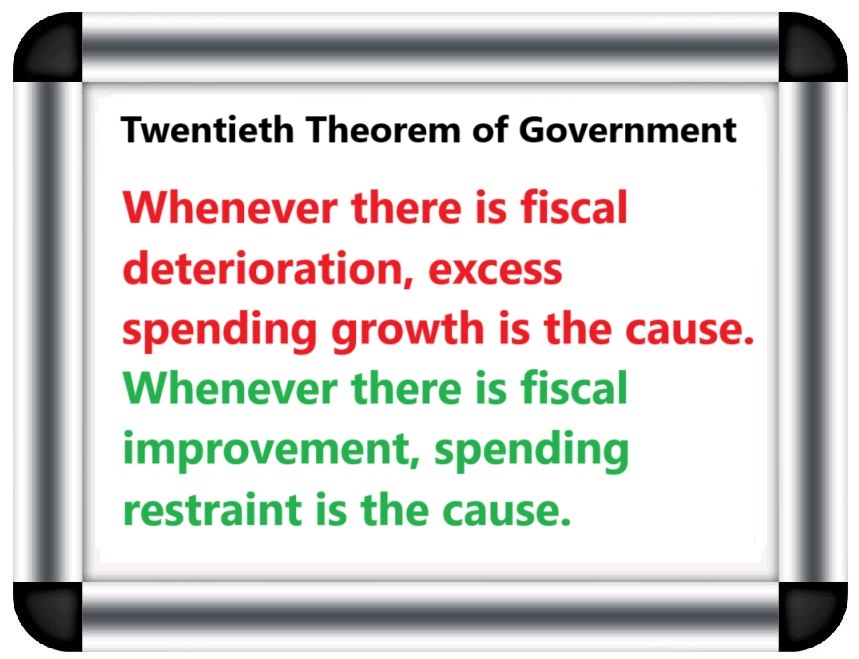
All things considered, a very strong example of both my Golden Rule and the 20th Theorem of Government.

It’s also validation of what I wrote in 2015 about Greece’s debt being sustainable. Simply stated, any nation can dig itself out of a fiscal hole with spending restraint.

Heck, these lessons go back to the 1800s.

So how did Greece reverse its decline? As the Wall Street Journal opined back in 2020, voters elected a sensible government that shifted policy in the right direction.


The eurozone’s perennial laggard suddenly finds itself six months into a remarkable economic turnaround. …Credit Kyriakos Mitsotakis, …whom fed-up voters elected prime minister in July after a decade of failed experiments with centrist technocracy and radical leftism. …Mr. Mitsotakis has cut the top tax rate on corporate profits to 24% from 28%, and some individuals have seen their tax rate fall to 9% from 22% and their property taxes cut. 

He aims to introduce a flat tax of €100,000 for wealthy foreigners who move to Greece to invest. He’s also dusting off privatization plans… Athens has already proven the Keynesian doubters wrong. Bailout after bailout after dreary bailout failed because EU leaders took slow growth for granted and focused instead on tax increases to salvage the fisc.

Three years later, the U.K.-based Economist lauded Greece’s improved policy environment.


Ten years ago it was crippled by a debt crisis and ridiculed on Wall Street. Incomes had plunged, the social contract was fraying and extremist parties of the left and right were rampant. …Today Greece is far from perfect. …But after years of painful restructuring, Greece topped our annual ranking of rich-world economies in 2023. Its centre-right government was re-elected in June. …Greece shows that from the verge of collapse it is possible to enact tough, sensible economic reforms, rebuild the social contract, exhibit restrained patriotism—and still win elections.

Now, Bloomberg has added an endorsement.

Here are some excerpts from a story last week by Viktoria Dendrinou, Sotiris Nikas, and Paul Tugwell.


For many Greeks — pensioners, unemployed youth, small business owners — the scars persist in a country that was on its knees. But for the believers, the transformation of an economic outcast into a poster child for financial prudence is yielding rewards… Today, Greece is outperforming its euro zone peers on several fronts. It’s growing faster than the European average and is one of only a handful of EU nations achieving budget surpluses. … 

Greece has consistently outperformed its fiscal targets at a time when many European nations face worsening public finances. …Greece’s 10-year bonds now yield around 3.30%, while the premium over equivalent German debt narrowed to its tightest level since 2008. In early 2012, the yield was 44.2%. …At 7.9%, Greece’s unemployment rate is at a 17-year-low… In 2023, the latest data available, more people moved to Greece than those departing for the first time in 14 years.

The article notes that there are still plenty of reasons to worry.

But there’s no doubt that Greece has moved in the right direction. Financial markets seem to agree, based on this chart from the Bloomberg story.

I’ll conclude with two lessons.

But notice I wrote “should be.” I’m not very optimistic that there are any Republicans or Democrats in today’s Washington that are willing to enact the policies (spending cap, entitlement reform, etc) that would save America.

P.S. Shifting back to Greece, here are two amusing videos (here and here) from 2012 about the Greek economic/fiscal crisis.

P.P.S. Sadly (but predictably), the OECD continues to give Greece bad advice.

Thursday, April 24, 2025

Greece and the 20th Theorem of Government

April 23, 2025 by Dan Mitchell @ International Liberty

In the past seven months, I’ve used my 20th Theorem of Government to analyze three countries (France, Brazil, Colombia) and two states (Maryland, Washington).

All of those case studies were examples of “fiscal deterioration,” which occurs when politicians violate the Golden Rule of fiscal policy by spending too much and too quickly over a multi-year period.

But what about “fiscal improvement,” which is the second part of the 20th Theorem? Isn’t there any good news to share?

I could point to this 2014 column to prove that there occasionally are examples of countries that improved public finances with spending restraint. Later that year, I even wrote about how the Tea Party produced some progress in the United States.

If you want present-day examples of spending restraint, it’s very unfortunate that there are almost no countries doing the right thing.

Argentina is an obvious exception, though we only have one year of data (though that one year is extremely impressive). So I prefer waiting until 2026 or 2027 before drawing any big conclusions.

Today’s column will focus instead on a very unlikely exception. We’re going to cite Greece as an example of fiscal rectitude.

Sounds crazy, I realize, but Greece has been fiscally responsible this decade. Using the IMF’s big database, I prepared this chart showing average spending growth over the past five years and compared that number to GDP growth and growth of tax revenue.

This is progress, no matter how you measure it.

But it’s also just a small step on what hopefully will be a long journey. Here are four things to understand.

  • Both the tax burden and spending burden in Greece are nearly 50 percent of GDP according to the IMF database, way beyond the growth-maximizing size of government.
  • The good news, relatively speaking, is that spending consumed nearly 60 percent of GDP in 2020 (like in many nations, politicians used the pandemic as an excuse to spend more money). So there’s some progress.
  • Government revenue has stayed relatively constant as a share of GDP, so all the progress in Greece is on the spending side of the fiscal ledger.
  • While Greece has basically reached fiscal balance, there is still an enormous amount of government debt. A new fiscal crisis seems unlikely, but who knows what will happen if Trump’s protectionism triggers a global downturn.

What Greece needs is a Swiss-style spending cap so there are several decades of fiscal restraint rather than just five years.  Though it’s great that Greece at least is heading in the right direction.

Dominic Pino of National Review certainly is impressed. Here are some excerpts from his recent article about fiscal restraint in both Argentina and Greece, but let’s focus on what he wrote about the latter.


Argentina and Greece have actually been shining lights of fiscal responsibility in recent years. You read that right: The countries that had been bywords for ballooning debt have been getting their acts together while the supposedly responsible countries like the U.S. have gone the other way. Prime Minister Kyriakos Mitsotakis of Greece is a purposefully anti-populist center-right technocrat… Greece has announced a budget surplus of 1.3 percent of GDP in 2024. ….........

Greece’s unemployment rate has dropped to 8.6 percent, still high by U.S. standards but the lowest rate in Greece in 17 years. S&P upgraded Greek sovereign debt back to investment grade in 2023 and just upgraded it again last week, citing “unwavering fiscal discipline.” The IMF projects Greece’s economy will grow at twice the average rate for advanced European economies this year… It might have been hard to explain to someone in 2010 that Greece…would be modeling fiscal responsibility for the world, but here we are.

I’ll close with the observation that Greece used to be a case study of the 20th Theorem, but in a bad way.

Makes me wonder how bad things have to get in America before we (hopefully!) begin to move in the right direction.

Tuesday, December 17, 2024

The OECD Pushes Higher Taxes for High-Tax Greece

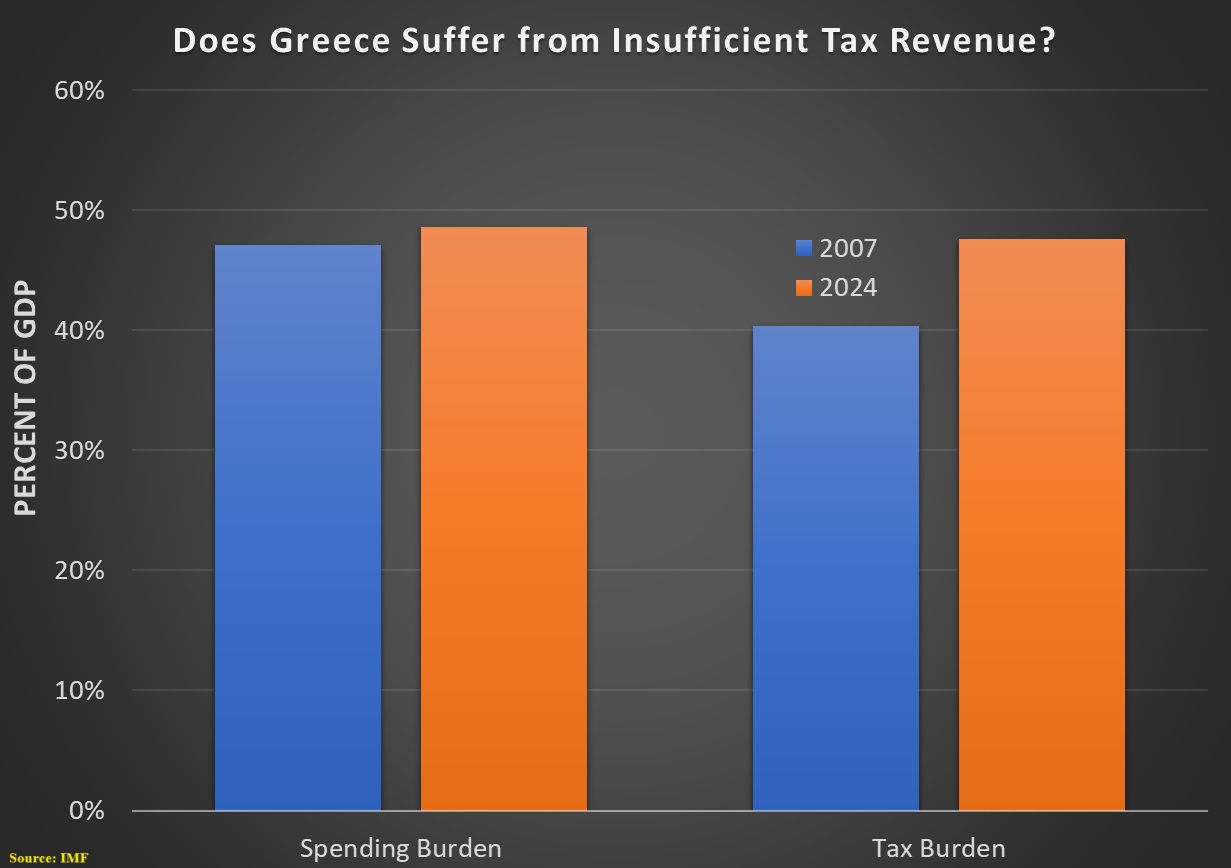
Fifteen years ago, I explained that the bailout of Greece (by the IMF-EC-ECB “troika“) was a mistake because the net effect was a much bigger tax burden and no reduction in the spending burden.

And I did the same thing five years ago and found the same (predictable) result.

In other words, politicians responded to a crisis of over-spending by raising taxes.

Let’s see if anything has changed.

Here are the latest numbers for Greece’s spending burden and tax burden, courtesy of the IMF. Lo and behold, we find the same evidence of failure.

I could wrap up my column at this point by recycling my argument that bailouts are a bad idea.

And I certainly don’t mind writing I-told-you-so columns.

But I want to make a more-important point about the knee-jerk statism of the Paris-based Organization for Economic Cooperation and Development.

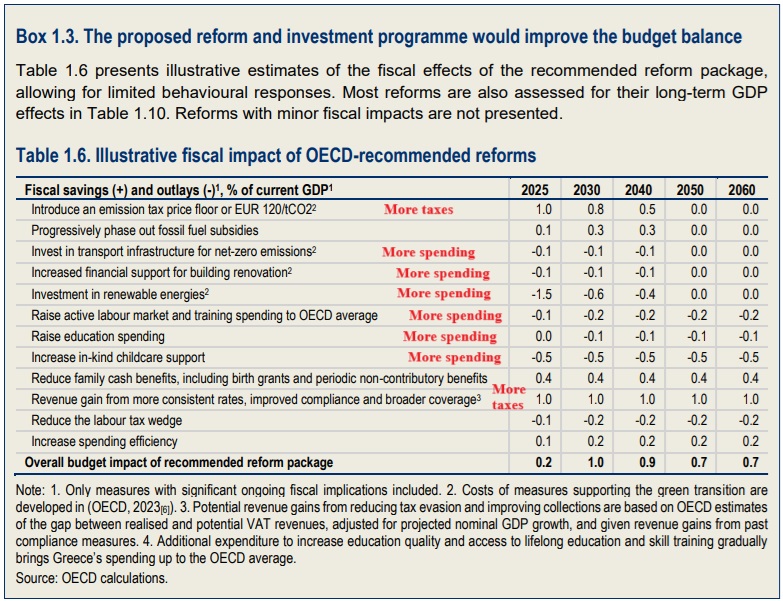
The OECD just released its Country Survey about Greece. Amazingly, the bureaucrats are suggesting even-higher taxes. I’m not joking. Here are some excerpts.


…more domestic resources will be needed to maintain high rates of public investment. …Tax revenue has increased from 33.4% of GDP in 2000 to 41% in 2022, above the OECD average. …Previous Economic Surveys pointed to the need to simplify the tax system by reducing the use of tax expenditures including tax allowances, credits, exemptions and reduced tax rates. …Continuing the government’s efforts to make tax compliance easier can boost collection… The effectiveness of the value added tax (VAT) remains also hampered by a wide range of goods and services that are exempt or taxed at reduced rates. …Greece also has room to raise excise taxes… The introduction of ETS2 also provides an opportunity to revise fuel excise taxes and phase out fossil fuel subsidies to harmonise and raise effective carbon prices.

By the way, the Survey generally has sensible observations about the economic impact of various taxes.

The part that is troubling is that the OECD thinks the Greek government should be bigger and that is should have more money.

Here’s a table summarizing the recommendations and I’ve highlighted which ones raises tax burden and which ones raise the spending burden.

At the risk of over-simplifying, the OECD thinks Greece should move in the wrong direction, but in a way that minimizes economic damage.

I have a different view. Move in the right direction.

Instead of taking advice from the wrong type of people, maybe Greece should put Javier Milei in charge of fiscal policy?

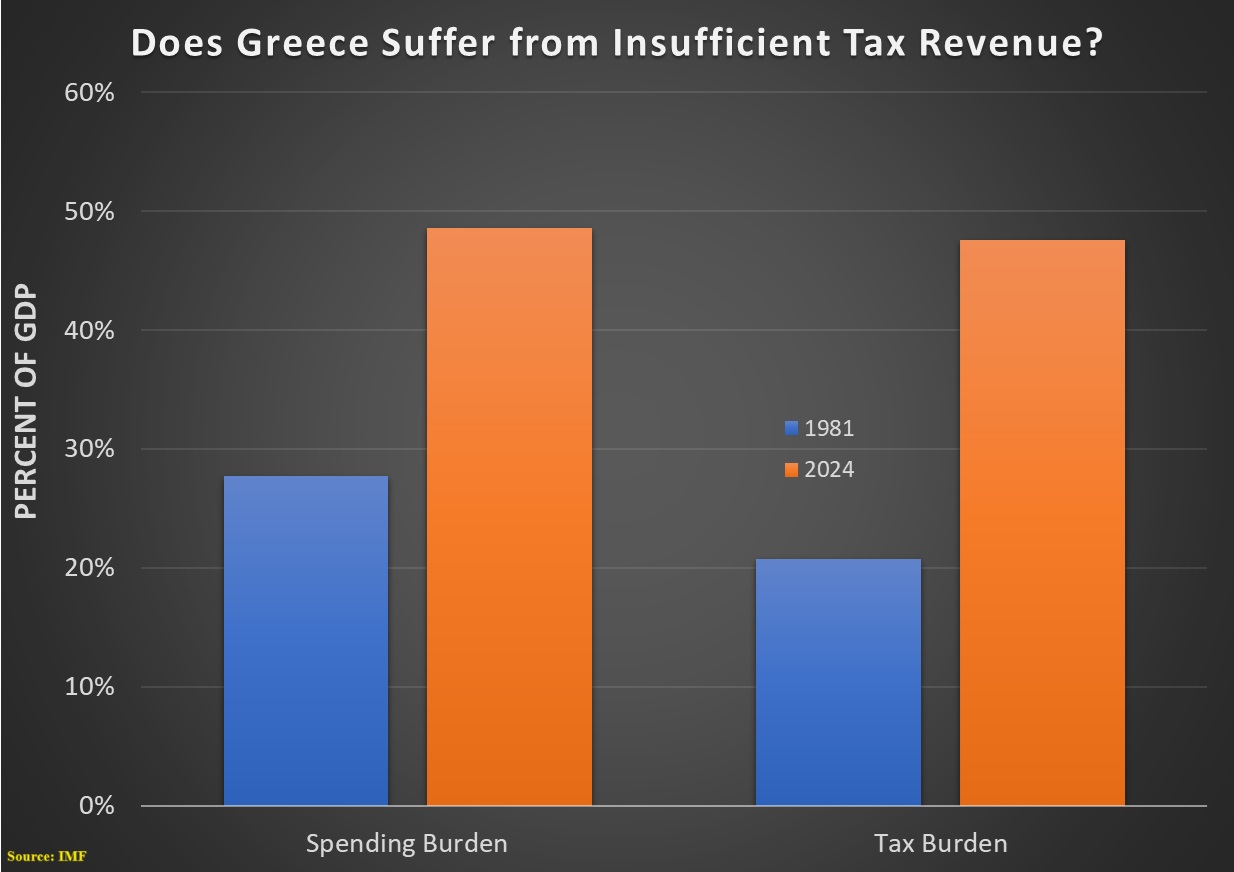
P.S. Just in case anyone thinks there is anything deceptive about the chart at the beginning of this column, here’s a look at the long-run data on taxes and spending in Greece.

The bottom line is that the tax burden and spending burden have increased in the past 15 years, but the numbers over the past 45 years are far more depressing.

Greece is way beyond the growth-maximizing size of government. And even OECD economists agree!

P.P.S. The political appointees are the reason why the OECD produces rubbish. But, to be fair, they don’t discriminate. The bureaucrats push for higher taxes and bigger government in every region of the world (China, Central America, Africa, Asia, Northern Europe, the United States, etc).

P.P.P.S. The Greek government has had interesting and unusual ways of moving in the wrong direction.


Thursday, May 16, 2024

Biden’s “Ironclad” Commitments to the World

 By Daniel Greenfield @ Sultan Knish Blog

Biden recently visited the Holocaust Museum and delivered a speech in which he pledged an “ironclad” commitment to the “security of Israel”.

On Wednesday, Biden sat down with CNN and announced an arms embargo on Israel.

This is bad news for the Jewish State, but it’s also bad news for every nation to whom Biden had offered his “ironclad” commitments in the past. And that turns out to be much of the world.

In March, Biden had greeted Polish President Andrzej Duda and Prime Minister Donald Tusk at the White House and vowed that, “America’s commitment to Poland is ironclad.”

In April, ahead of a meeting with Japanese Prime Minister Fumio Kishida and Philippine President Ferdinand Marcos, Biden promised, “The United States defense commitments to Japan and to the Philippines are ironclad. They’re ironclad.”

Then at a press conference with Prime Minister Kishida, Biden touted another, now discredited, ironclad promise. “As I told Prime Minister Netanyahu, our commitment to Israel’s security against these threats from Iran and its proxies is ironclad. Let me say it again: ironclad.”

And in troubling news for Ukraine, Biden agreed in a 60 Minutes interview that his commitment to that war was also ironclad.

But is there a country out there that doesn’t have an ironclad commitment from Biden?

Last year, Biden held a joint press conference with President Yoon Suk Yeol of South Korea and assured him that, “our mutual defense treaty is ironclad.”

Biden has been throwing out ironclad commitments around the world like a peddler selling secondhand goods. As Obama’s veep, he boasted to Jordan’s King Abdullah of “America’s ironclad support”. And he more recently told the Greeks of our “ironclad friendship.”

The Gulf nations looking for an “ironclad security pact” with America may get one, but the price of iron isn’t what it used to be. Especially iron out of the ice cold forges of Washington D.C.

While he has been offering a lot of “ironclad” commitments to the rest of the world, it’s not just individual nations that may be reevaluating the value of Biden’s ironclad assurances.

“My commitment to NATO and Article 5 is ironclad,” Biden had claimed in 2022 as Sweden and Finland had lined up to join the security alliance.

“Our sacred commitment to NATO remains ironclad,” the White House recently posted.

At a meeting with the leaders of 9 Eastern European countries and the NATO Secretary General, Biden assured them all of America’s “ironclad commitment to NATO’s Article 5.”

To paraphrase Oprah, you get an ironclad commitment, you get an ironclad commitment, and you get an ironclad commitment. And it’s worth about as much as those empty words.

The rest of the world has learned that Biden’s ironclad is rusted through, but what about his past “ironclad” promises to Americans?

Biden had described social security as “an ironclad commitment” and the White House claims that “President Biden’s 2024 budget shows an ironclad commitment to protecting Social Security and Medicare against all cuts.” The reality is that Biden’s inflationary wasteful 2024 budget further bankrupts Social Security. Biden’s iron isn’t good at home or abroad.

In further bad news for Americans, Biden also claimed that the budget “fulfills my ironclad promise that no one earning less than $400,000 per year would pay an additional penny in new taxes.” So assume that the tax hikes on everyone are coming.

Last year, we were told that “the President has an ironclad commitment to supporting communities across the Nation as they recover from disasters.”No wonder America has become a disaster area.

Ironclads were battleships impervious to the weapons of the day because they were covered in heavy armor. It’s not really the best metaphor for a commitment, but it’s a perfectly good metaphor for Biden’s imperviousness to telling the truth or remembering what he once said.

When you offer “ironclad commitments” to everyone you meet, they’re worthless. A commitment to everyone is a commitment to no one. That is one of the great gaping flaws of globalism.

Adding “ironclad” or any particular word to a commitment doesn’t make it stronger. Iron may add more armor to a warship, but it doesn’t add anything to a man’s word. What makes a man’s word count is the strength of his character and that is shown by his willingness to keep his word.

Biden betrayed Israel because he had made a lot of ironclad commitments. He had made commitments to Jewish voters in New York City and Hamas supporters in Dearborn, Michigan. His administration had made commitments to leftists and to moderates. In the face of escalating fire from leftists, his ironclad armor buckled and he sank in the shallow mud off Foggy Bottom.

This is a problem for America more than anyone else.

International relationships, like all human relationships, are built on trust. Treaties are just pieces of paper and handshakes are so routine that diplomats need wrist braces. The Pax Americana is more than anything else an empire of trust. And we held off WWIII for three generations because most of the world believed that we meant what we said about things like nuclear retaliation, NATO’s Article 5 or anything else. Whatever you believe about those policies, American power and influence would be a non-starter if the president’s word were worthless.

When a president draws a red line and then does nothing, more wars are likely to follow. If he offers defense commitments that he doesn’t keep, our enemies are more likely to attack. If America stops defending its allies, those enemies will then test if we will defend ourselves.

And if we don’t, they will attack the United States of America.

Our military is short of recruits, our Navy is short of ships and our Air Force has a whole lot of planes that won’t fly. In war games, China tends to win and we tend to lose. What keeps China from pushing farther is all those nukes sitting quietly under Iowa cornfields. Will we use them?

Beijing doesn’t know for sure, but every time Biden offers another worthless promise, the odds look better for the People’s Republic of China and all our other enemies. And worse for us.

Americans and the world have learned the worthlessness of Biden’s ironclad commitments. None of us know what the future will bring, the one thing we know is whom we can’t trust.


Daniel Greenfield is a Shillman Journalism Fellow at the David Horowitz Freedom Center. This article previously appeared at the Center's Front Page Magazine. Click here to subscribe to my articles. And click here to support my work with a donation. Thank you for reading.

Wednesday, February 7, 2024

Islam: Theory vs Experience

February 7, 2024 By Raymond Ibrahim

The gulf between understanding Islam in theory and in practice is wide and telling. Based on the findings of a recent study, what western peoples think of Islam when relying on secondhand information from the powers-that-be (the media, the political “elite,” etc.) is vastly different from what they think of Islam after personally experiencing it. According to the report:

In 2009, Public Issue investigated, for the first time in Greece, the attitudes of Greeks towards Islam, the social perceptions of the concepts and symbols associated with the Islamic religion, the degree of knowledge and familiarity of citizens with the Islamic tradition, as well as the existing social beliefs regarding Islam-West and Islam-Greece relations.

The study found a dramatic shift of opinion among Greeks between 2009, when Muslims in Greece were few and far between -- meaning Greek opinion on Islam was theoretical and largely shaped by the media, etc. -- and 2023, seven years after large Muslim migrant populations first began landing in or passing through Greece in 2016.

Now, after experiencing Islam firsthand, “Greek public opinion… treats the Muslim world clearly more negatively or even hostilely,” the report found..............Little wonder. Since 2016, Greeks have had a major taste of Islam, leading to a “Crime explosion in Greece -- 55% of prisoners are migrants,” to quote from another recent report............. One report found “a correlation between the increase in illegal migration and the incidents of attacks on Greek Orthodox religious churches and religious spaces during the five-year period which occurred during the peak of the migration crisis.”.............In short, although public opinion towards Islam is negatively shifting, these changes are not as pronounced as might be expected -- underscoring the power of generations’ worth of indoctrination. In other words, abstract theory -- enshrined by the notion that Islam is the otherwise forever “misunderstood” religion of “peace,” etc. -- is still having an influence..............To Read More....

Sunday, April 25, 2021

Preventing Fiscal Meltdowns with a Spending Cap

As part of my recent interview about European economic policy with Gunther Fehlinger, I pontificated on issues such as Convergence and Wagner’s Law.  I also explained why a Swiss-style spending cap could have saved Greece and Italy from fiscal crisis. Here’s that part of the discussion.


For those not familiar with spending caps, this six-minute video tells you everything you need to know.  Simply stated, this policy requires politicians to abide by fiscal policy’s Golden Rule, meaning that – on average – government spending grows slower than the private economy.

And that’s a very effective recipe for a lower burden of spending and falling levels of red ink.

One of the points I made in the video is that spending caps would prevented the fiscal mess in Greece and Italy.

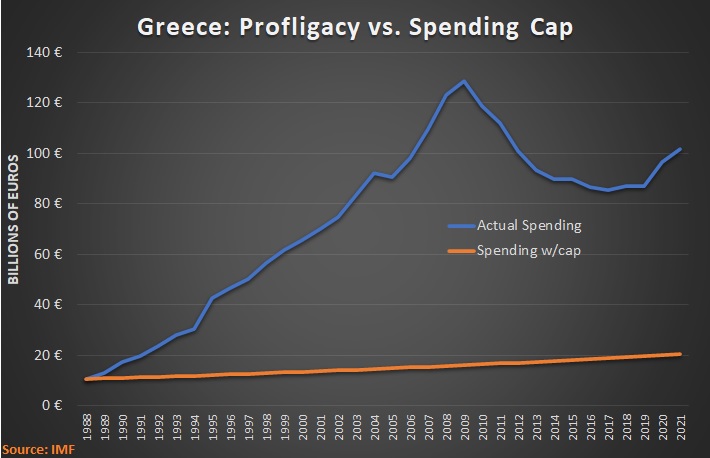
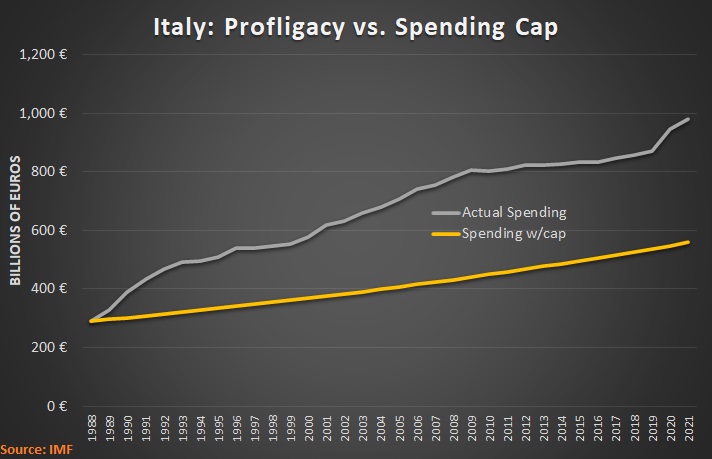
To show what I mean, I went to the International Monetary Funds World Economic Outlook database and downloaded the historical budget data for those two nations. I then created charts showing actual spending starting in 1988 compared to how much spending would have grown if there was a requirement that the budget could only increase by 2 percent each year.

Here are the shocking numbers for Greece.

The obvious takeaway is that there never would have been a fiscal crisis if Greece had a spending cap.

That also would be true even if the spending cap allowed 3-percent budget increases starting in 1998.

And it would be true if the 2-percent spending cap didn’t start until 2000.

There are all sorts of ways of adjusting the numbers. The bottom line is that any reasonable level of spending restraint could have prevented the horrible misery Greece has suffered.

Here are the numbers for Italy.

As you can see, the government budget has not increased nearly as fast in Italy as it did in Greece, but the burden of spending nonetheless has become more onerous – particularly when compared to what would have happened if there was a 2-percent spending cap.

I’ve written many times (here, here, here, and here) about Italy’s looming fiscal crisis. As I said in the interview, I don’t know when the house of cards will collapse, but it won’t be pretty.

And tax reform, while very desirable, is not going to avert that crisis. At least not unless it is combined with very serious spending restraint.

P.S. For those who want information about real-world success stories, I shared three short video presentations back in 2015 about the spending caps in Switzerland, Hong Kong, and Colorado.

P.P.S. It’s also worth noting that the United States would be in a much stronger position today if we had enacted a spending cap a couple of decades ago.


Monday, April 1, 2019

A Simple Reform to Avert a Future Greek-Style Fiscal Crisis in America

March 22, 2019 by Dan Mitchell @ International Liberty
 
In the absence of genuine entitlement reform, the United States at some point is going to suffer from a debt crisis.

But red ink is merely a symptom. I used numbers from Greece in this interview to underscore the fact that the real problem is government spending.


The discussion was triggered by comments from the Chairman of the Federal Reserve.
Federal Reserve Chairman Jerome Powell said Wednesday that reducing the federal debt needs to return to the forefront of the agenda, warning that the government’s finances are unsustainable. “I do think that deficits matter and do think it’s not really controversial to say our debt can’t grow faster than our economy indefinitely — and that’s what it’s doing right now,” Powell said.
As I noted in my comments, Powell is right, but he’s focusing on the wrong variable.

The real crisis is that spending is growing faster than the private sector (Powell needs to learn the six principles to guide spending policy).

To be more specific, politicians are violating my Golden Rule.

Spending grew too fast under Bush. It grew too fast under Obama (except for a few years when the “Tea Party” was in the ascendancy). And it’s growing too fast under Trump.
Most worrisome, the burden of spending is expected to grow faster than the private sector far into the future according to the long-run forecast from the Congressional Budget Office.

That doesn’t mean we’ll have a crisis this year or next year. We probably won’t even have a crisis in the next 10 years or 20 years.

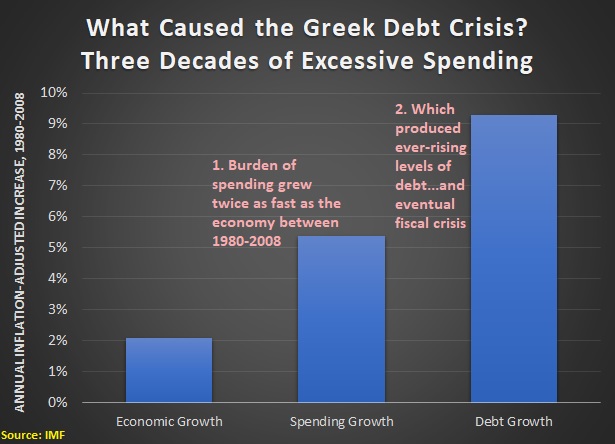
But I cited Greek data in the interview to point out that excessive spending eventually does create a major problem.

Here’s the data from International Monetary Fund’s World Economic Outlook database. To make matters simple (I should have done this for the interview as well), I adjusted the numbers for inflation.


So how can America avoid a Greek-style fiscal nightmare?

Simple, just impose a spending cap. At the end of the interview, I added a plug for the very successful system in Switzerland, but I’d also be happy if we copied Hong Kong’s spending cap. Or the Taxpayer Bill of Rights from Colorado.

The bottom line is that spending restraint works and a constitutional spending cap is the best way to achieve permanent fiscal discipline.

P.S. By contrast, proponents of “Modern Monetary Theory” argue governments can finance ever-growing government by printing money. For what it’s worth, nations that have used central banks to finance big government (most recently, Venezuela and Zimbabwe) are not exactly good role models.

Friday, February 15, 2019

Socialism in the Modern World, Part III: The Tragedy of Greece in Five Charts

February 14, 2019 by Dan Mitchell

In Part I of this series, we examined the horrific tragedy of Venezuelan statism, and in Part II of this series, we looked at the Scandinavian “free-market welfare state.”

Today, Part III will look at the ongoing deterioration of Greece.

I’ve written many times about how the mess in Greece was caused by an ever-rising fiscal burden.
Let’s look at two charts, drawing from the government spending section of Our World in Data, that confirm my argument.

This first chart shows the overall burden of government spending starting in 1880. As you can see, spending generally consumed a bit more than 20 percent of the nation’s economy (other than during wars) all the way from 1880 to the mid-1960s.

And then the spending burden exploded............To Read More.....

Monday, December 3, 2018

'Human sacrifices' in Greece: International consultant levels charge

WND EXCLUSIVE

Claim children granted visas 'to facilitate illegal removal of their organs' supported by 93 court filings.  An international consultant and expert on foreign affairs is charging that “human sacrifices” are happening in Greece after officials were found granting visa to unaccompanied children “to facilitate illegal removal of their organs.”

Maria Polizoidou, who has a post-graduate degree in “Geopolitics and Security Issues in the Islamic complex of Turkey and the Middle East,” reports from Greece and wrote about her concerns at the the Gatestone Institute.

It was in an interview just days ago that Greece former Minister of Foreign Affairs Nikos Kotzias confirmed the existence of the problem, she explained.   He confirmed, “for a second time,” that he launched 93 prosecutions that involved “Greek diplomats issuing visas to unaccompanied children in order to facilitate illegal removal of their organs.”

Those diplomats already are in jail, she wrote. But they are just the “tip of the iceberg.”

“According to an April 24, 2018, report in the newspaper Kathimerini, there are thousands of unaccompanied children in Greece who have illegally entered the country, and government authorities have not turned their attention to them. Kathimerini reports that there are 3,050 unaccompanied child migrants in Greece, of whom 1,272 (42 percent) are either homeless, or live in a non-permanent residence or in an unknown location. They all face the risks of sexual exploitation and illicit organ removal,” she wrote...........To Read More.......

Sunday, October 28, 2018

Greece and the Grim Consequences of Democratic Socialism

October 28, 2018 by Dan Mitchell @ International Liberty
 
My left-leaning friends periodically tell me that there’s a big difference between their benign policies of democratic socialism and the wretched track records of Marxist socialism, national socialism, and other forms of totalitarianism.

I agree. Living in a European welfare state, after all, is much better than living in a hellhole like Cuba, North Korea, Zimbabwe, or Venezuela.

Not only do you enjoy the rule of law (no Khmer Rouge-style concentration camps!), but you also enjoy considerable prosperity compared to the rest of the world.

But there are two things to understand about that prosperity.
Let’s consider the case of Greece. I’ve written many times about the debilitating impact of high tax rates and wasteful spending in that nation. It has the least economic freedom of all nations in Western Europe, so it’s no surprise that it is falling further behind.

But sometimes a compelling example is the best way of helping people understand the harmful impact of big government.
We were on Filis Street — a warren of alleyways and dingy two-story houses — which has been home to Athenian brothels for most of the past century. The trade is more desperate now because of Greece’s lost decade since the 2008 financial crisis, which has left no profession unscathed. The collapsed economy and the arrival of tens of thousands of migrants have pushed even more women into prostitution — even as prices have fallen through the floor. …“I had a flower shop for 18 years — and now I’m here out of necessity, not out of joy,” said Dimitra, a middle-aged woman who lost her shop in the crisis and now works as a madam…the number of prostitutes in the city had increased by 7 percent since 2012, yet prices have dropped drastically, both for women working on the streets and in brothels. “In 2012, it would require an average of 39 euros” for a client to hire a prostitute in a brothel, Mr. Lazos said, “while in 2017 just €17 — a 56 percent decrease.”
The saddest part of the story is the commentary of the prostitutes.
“I hate sex,” Elena said. “I like the money, not the job.” Anastasia…has worked as a prostitute since she was 14. She’s now 33, and says the work is harder than ever. “People don’t have money anymore,” she said… Monica, a 30-year-old Albanian prostitute…spends six to eight hours a day trying to entice clients, but most do not stay. “They don’t have money,” she said. “They haven’t had money for the past seven years.” …Many Greek men are simply too poor to pay anymore.
I support legal prostitution, in part because the alternative of pushing these unfortunate women even further into the underground economy would be worse.

(Editor's Note:  I'm not in harmony with the author's views on prostitution, but one thing this article points to is the economic mess socialism brings to society making prostitution a default setting for so many women in countries run by socialists. Venezuela is a clasic example.  RK)

But that doesn’t change the fact that these women don’t have good lives. And the misery of democratic socialism in Greece is making their lives even sadder.

The bottom line is that I now have three awful anecdotes from Greece to help illustrate the wretched impact of big government. In addition to the price-cutting prostitutes we discussed today, let’s not forget that Greece subsidizes pedophiles and requires stool samples to set up online companies.

Needless to say, I hope we never go that far in the wrong direction.

The moral of the story is that socialism (however defined) has never worked in any form at any time in history.

Thursday, December 28, 2017

Is Greece Ready for a Ronald Reagan or Margaret Thatcher?

December 27, 2017 by Dan Mitchell @ International Liberty
 
I’ve written that it’s theoretically possible for Greece to pay its debts and restore prosperity.

After all, it’s simply a matter of obeying fiscal policy’s Golden Rule and reforming a suffocating tax system.

But I’ve always figured none of that will happen because Greek voters would never vote for a government that favors Reagan-style or Thatcher-style economic reforms.

Simply stated, there are too may Greek people living off the state. But that’s just part of the problem. An even bigger obstacle to reform is that the people have decided that it’s morally acceptable to mooch off the government.

As a result, I’ve assumed that Greece has passed a tipping point because the moral foundation of Greek society has been corroded by dependency. And it’s very difficult to put that toothpaste back in the tube.

But maybe I’ve been wrong. Courtesy of the great people at the Atlas Network, here’s some remarkable polling data from Greece.
…the people may finally be fed up with big government, runaway spending, public-sector corruption, and job-killing regulations. A recent in-depth survey, published by the daily Kathimerini newspaper and the new think tank Dianeosis, reveals that Greek society seems to be experiencing an ideological sea change.
On a philosophical level, Greeks seem to be embracing the principles of classical liberalism.
In Greece, the term “liberalism” retains its classical meaning of support for individual liberty, free markets, and social tolerance. The latest finding from the Dianeosis poll shows that 27 percent of respondents identify as either liberal or neoliberal, together making the largest ideological group for the country’s overall population. These ideas have taken even stronger hold among the rising generation, with an astonishing 50 percent of Greek youth identifying as either liberals or neoliberals.
And this translates into greater support for small-government policies.
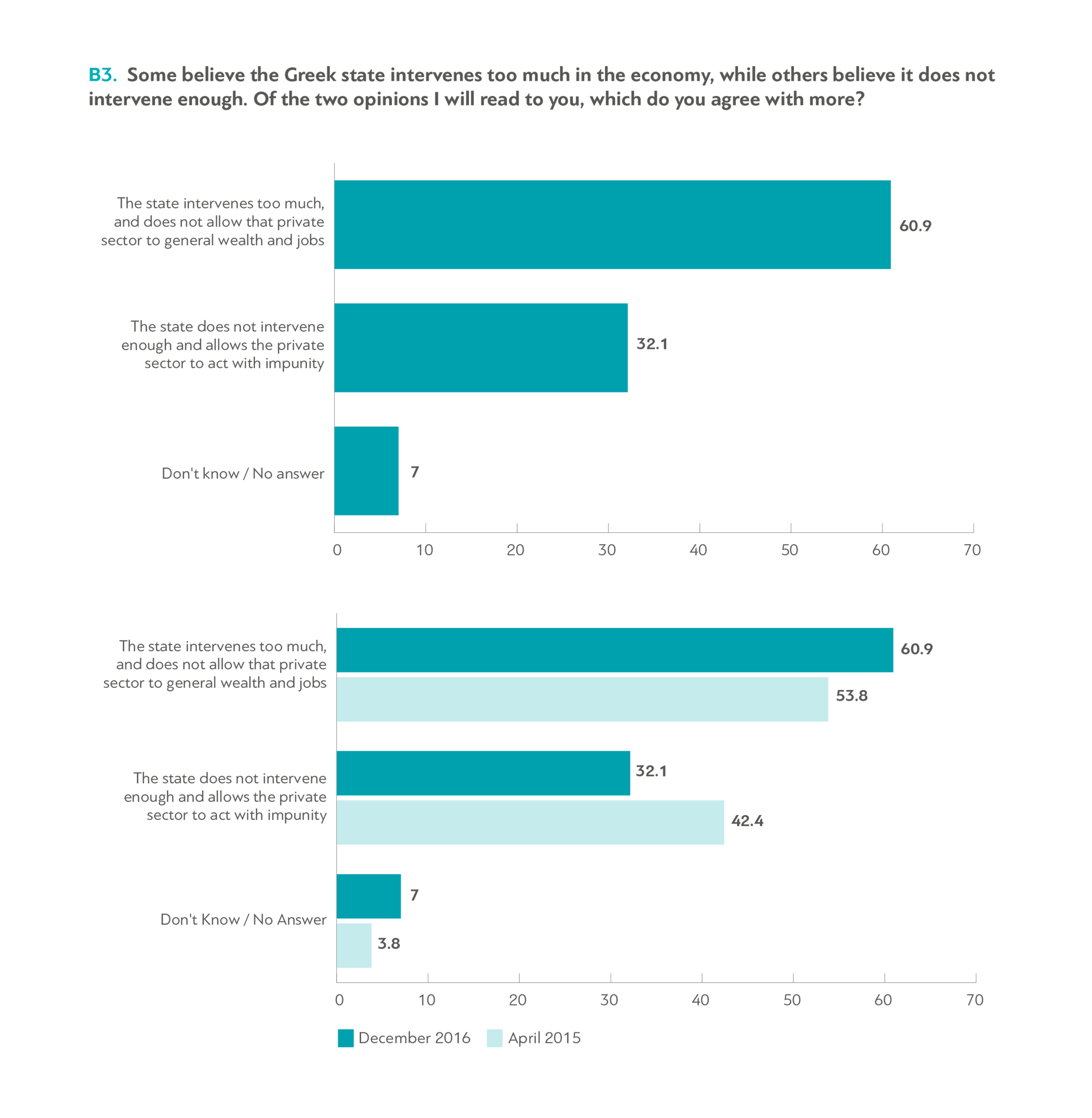
About 60 percent agree that government is intervening too much in economic matters, and thereby prevents the private sector from creating jobs and wealth.
Here’s some of the relevant polling data.


It’s also encouraging to see that there was movement in the right direction between April 2015 and December 2016.

On a policy level, the Greeks now seem to recognize that the state is too big.
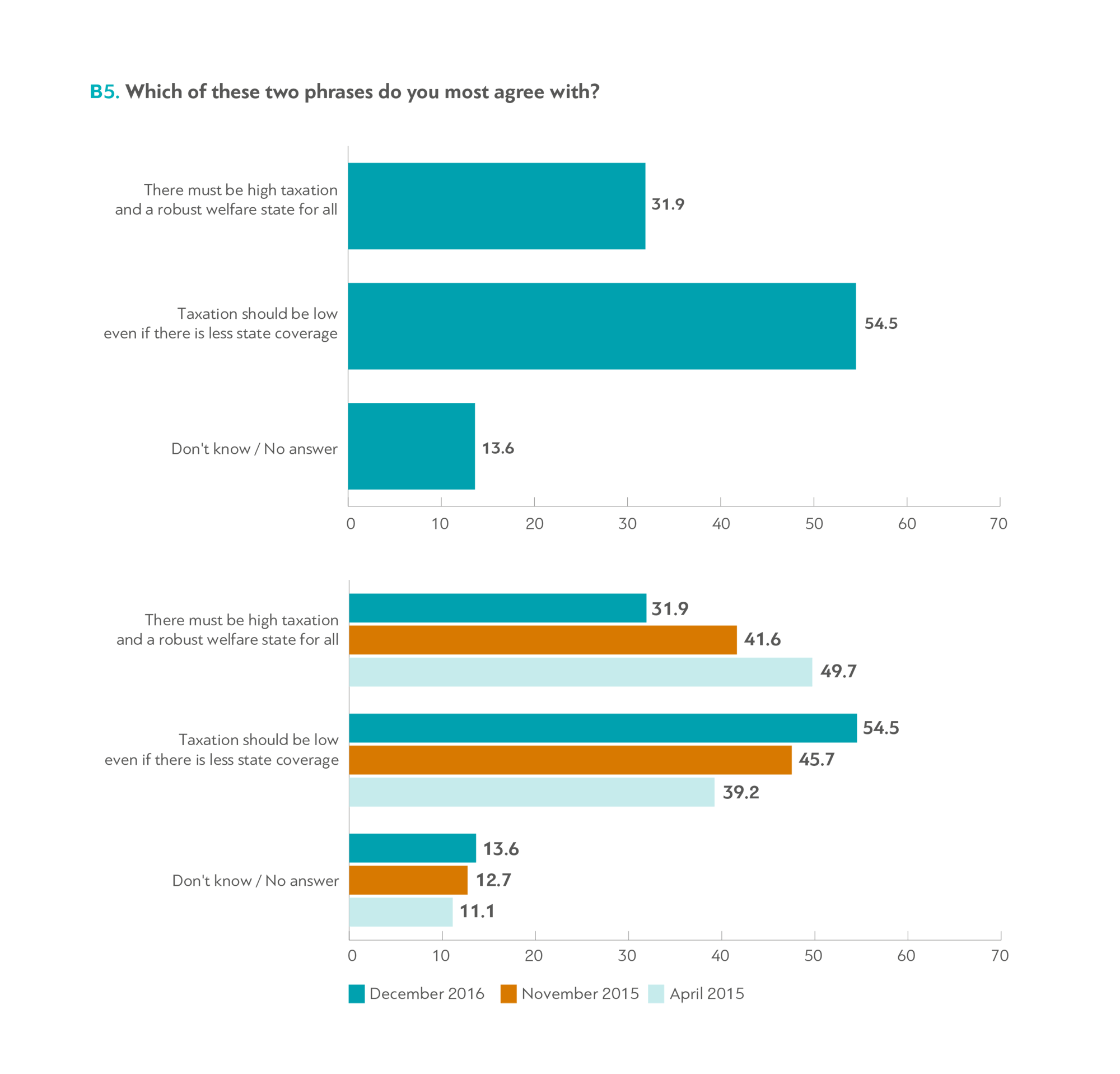
Even more telling is that the majority of Greeks, 55 percent, believe that lower taxation is preferable even if that results in less government welfare. This finding is particularly important because two years ago only 39.2 percent agreed with that statement.
Here are those numbers from the survey.


The last bit of good news from the survey is that Greeks have positive feelings about market-oriented terms.
Greeks today also seem to show overwhelming support for many fundamental concepts of the free-market tradition. About 73 percent agreed that “markets” have a positive connotation…a primary reason for this turn toward free markets is that the government regimes in Greece have clearly failed, thereby tainting their devotion to destructive statism and populism. This has caused many Greeks to consider economic freedom as a viable solution for the country’s devastating problems.
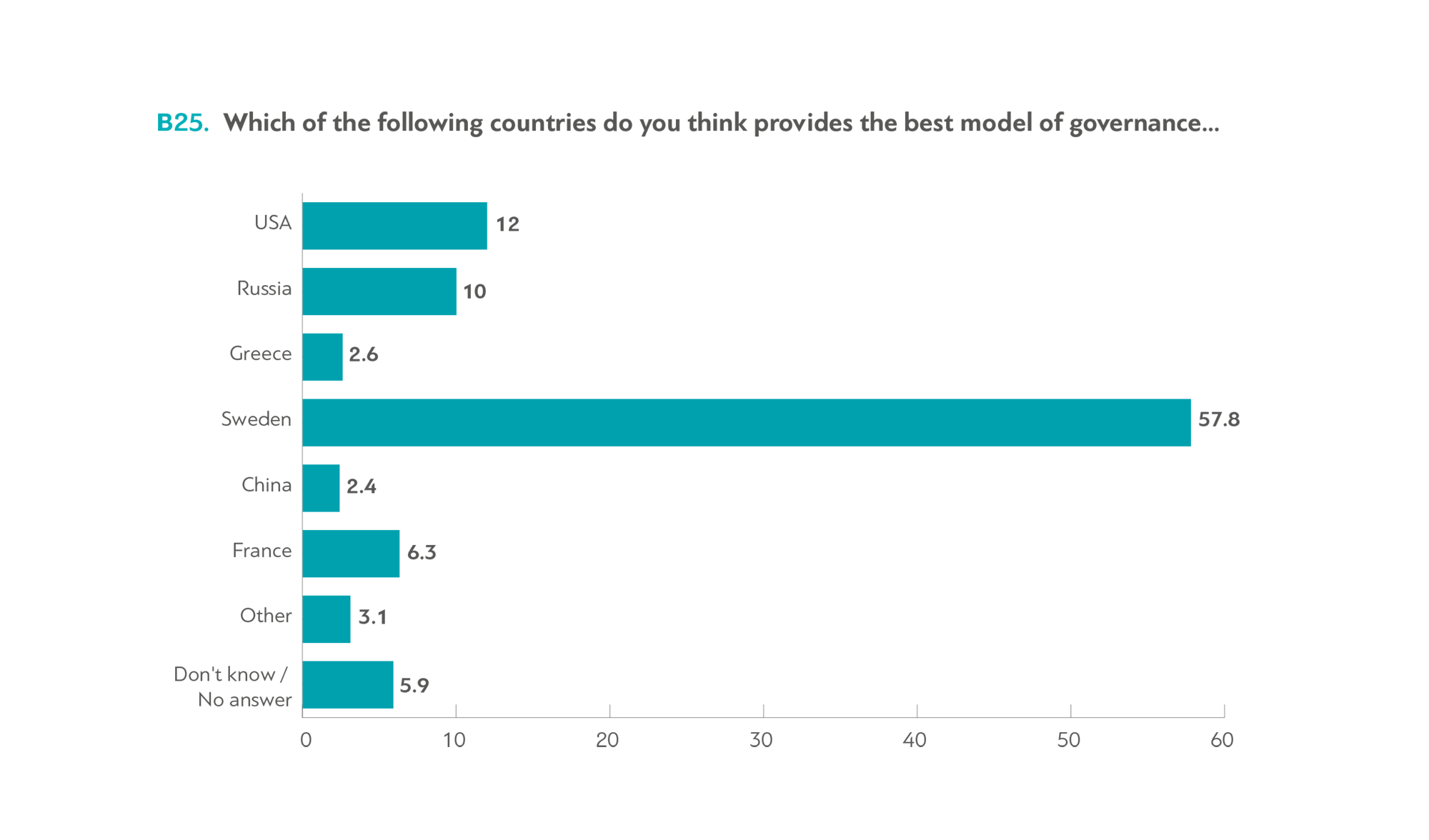
On the other hand, the country they most want to mimic is Sweden.
And it’s not even close (though I wonder if this chart would look different if Switzerland and Hong Kong were options).


You may be wondering (like me) how the Greeks can tell pollsters they want smaller government while simultaneously picking Sweden as a role model?

The pessimistic answer is that Greeks don’t know what they’re talking about. Or maybe they are hypocrites, willing to pay lip service to economic liberty but ultimately yearning for a cradle-to-grave welfare state.

The optimistic answer is that Sweden actually is a pretty good role model.

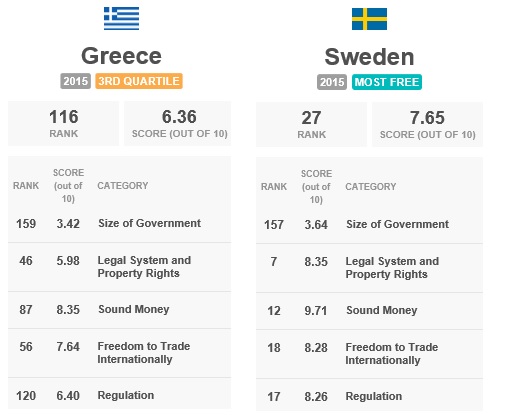
Check out this comparison of Greece and Sweden, based on data from Economic Freedom of the World. Sweden is ranked #27, which is in the top-20 percent of nations for economic liberty. Greece, by contrast, is way down at #116.


Yes, both countries have terrible fiscal policy, but it turns out that Sweden is very market-oriented in areas like money, trade, regulation, and rule of law. And even though it still has a long way to go, Sweden significantly improved fiscal policy in the 1990s and has even enjoyed some modest improvement in recent years.

That’s definitely not the case in Greece.

In other words, I certainly don’t mind if Swedish policy is the short-run goal for Greek voters. If they ever get to that point, then I’ll try to convince them to go the Full Hong Kong.

P.S. In the real world, are there any examples of countries that have escaped statism and enjoyed something akin to a Greece-to-Sweden jump in economic liberty?

The answer is yes. Chile would be an obvious example, as would certain post-Soviet Bloc nations such as Estonia.

It would be great to add Greece to the collection.

Sunday, December 17, 2017

The Greek Experiment: Can an Economy Be Wiped Out by Taxation?

December 16, 2017 by Dan Mitchell @ International Liberty
 
Greece has confirmed that a nation can spend itself into a fiscal crisis.
 
And the Greek experience also has confirmed that bailouts exacerbate a fiscal crisis by enabling more bad policy, while also rewarding spendthrift politicians and reckless lenders (as I predicted when Greece’s finances first began to unravel).
 
So now let’s look at a third question: Can a country tax itself to death? Greek politicians are doing their best to see if this is possible, with a seemingly endless parade of tax increases (so many that even the tax-loving folks at the IMF have balked).
 
At the very least, they’ve pushed the private sector into hospice care.
 
Let’s peruse a couple of recent stories from Ekathimerini, an English-language Greek news outlet. We’ll start with a rather grim look at a very punitive tax regime that is aggressively grabbing money from taxpayers with arrears.
Tax authorities have confiscated the salaries, pensions and assets of more that 180,000 taxpayers since the start of the year, but expired debts to the state have continued to rise, reaching almost 100 billion euros, as the taxpaying capacity of the Greeks is all but exhausted. In the month of October, authorities made almost 1,000 confiscations a day from people with debts to the state of more than 500 euros. In the first 10 months of the year, the state confiscated some 4 billion euros.
But the Greek government is losing a race. The more it raises taxes, the more people fall behind.
in October alone, the unpaid tax obligations of households and enterprises came to 1.2 billion euros. Unpaid taxes from January to October amounted to 10.44 billion euros, which brings the total including unpaid debts from previous years to almost 100 billion euros (99.8 billion), or about 55 percent of the country’s gross domestic product. The inability of citizens and businesses to meet their obligations is also confirmed by the course of public revenues, which this year have declined by more than 2.5 billion euros. The same situation is expected to continue into next year, as the new tax burdens and increased social security contributions look set to send debts to the state soaring.
The fact that revenues have declined should be a glaring signal to politicians that they are past the revenue-maximizing point on the Laffer Curve.
 
But the government probably won’t be satisfied until everyone in the private sector is in debt to the state.
There are now 4.17 million taxpayers who owe the state money. This means that one in every two taxpayers is in arrears to the state, with 1,724,708 taxpayers facing the risk of forced collection measures. Of the 99.8 billion euros of total debt, just 10-15 billion euros is still considered to be collectible.
Here’s another article from Ekathimerini that looks at how Greece is doubling down on suicidal fiscal policy.
Greece is defying the prevalent trend among the world’s industrialized nations for reducing tax rates in order to boost investment and competitiveness… According to the report, in contrast to the majority of OECD member states, Greece has raised taxes and social security contributions as government policy is geared toward reaching fiscal targets, even though this inevitably harms the crisis-hit country’s competitiveness.
It’s hard to think of a tax that Greek politicians haven’t increased.
Greece…is also the only one among them that increased taxes on labor and corporate profits. …eight OECD member states reduced rates in 2017 on an average of 2.7 percent…, in stark contrast to Greece, which…has the highest corporate tax rates in the OECD compared to 2008. Many countries also offered breaks and reductions on income tax, …also cutting social contributions in 2015-2016. Not so Greece, which in 2016 raised both, thereby increasing the overall burden on low-income earners by 1.5 percent. Greece was also the only country in the OECD to raise value-added tax rates in 2016.
And what was accomplished by all these tax increases? Less tax revenue and recession. That’s a lose-lose scenario by almost any standard.
…in the 2014-2015 period, 25 of the 32 countries for which data is available recorded an increase in tax-to-GDP levels. The report…mentions Greece as an exception to this trend as well, noting that the country was in recession in that two-year period.
Even an establishment outlet like the U.K.-based Financial Times has noticed.
Unemployment is at 23 per cent and 44 per cent of those aged 15-24 are out of work. More than a fifth of Greeks get by without basics such as heating or a telephone connection. …Sweeping new taxes imposed across the economy have already left communities scrabbling to survive. …this year will bring €1bn worth of new taxes on cars, telecoms, television, fuel, cigarettes, coffee and beer… New taxes have eroded disposable incomes still further. Value added tax has increased to 24 per cent on food, disproportionately hurting the poor, for whom living costs represent a far higher proportion of income. Most detested is the Enfia property levy, which brings in €2.65bn a year – roughly €650 from each of Greece’s four million households. …recent direct taxes like the new estate tax have affected households that have seen their income decline greatly during the crisis. The rise of VAT, meanwhile, only adds to the cost of life of poor families.” …this month, new levies will mean the taxes paid by his business will jump 29 per cent.
Interestingly, the article acknowledges that profligate politicians created the mess, while also noting that the Greek people also deserve blame.
…blame is laid on the politicians who spent the 27 years of Greece’s EU membership before the crisis loading the country with debt to fund increased defence expenditure, more public sector jobs and higher pension and other social benefit payments. …“The Greek people should be blamed. We voted for these people,” he concludes.
The problem, of course, is that Greek voters don’t show any interest in now voting for politicians who will clean up the mess. Simply stated, too many people in the country are living off the government.
 
In other words, even though it’s mathematically possible to fix the problems, the erosion of societal capital suggests that Greece may have reached the point of collapse.
 
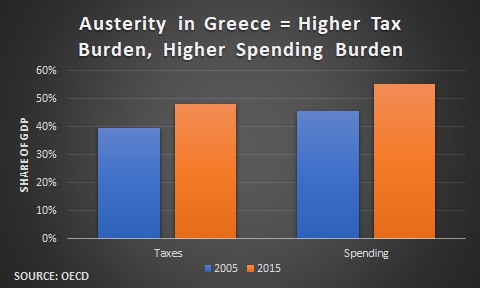
From a fiscal perspective, this chart from OECD data confirms that policy
 
 is getting worse rather than better. Measured as a share of economic output, taxes and spending have both become a bigger burden over the past 10 years.

 
What makes this chart especially depressing is that economic output is lower today than it was in 2005, which means that the problem isn’t so much that annual tax receipts and spending level are climbing, but rather that the private economy is declining.
 
Let’s close with an additional look at the moribund Greek economy and a discussion of how the bailouts have made a bad situation even worse.
 
The Wall Street Journal editorialized on the impact of ever-higher taxes and a still-stifling bureaucratic business environment.
…the bailout is not in fact working, if you think the goal should be to restore Athens to sound public finances and to offer Greeks economic hope for the future. The European Commission’s autumn forecast predicts eurozone economic growth of 2.2% this year, the fastest in a decade. But Greece is falling further behind. …Investment has collapsed in the country, to 11% of GDP last year from 26% of GDP in 2007. …The bailouts are creating a dangerous situation in which the government has enough cash to meet its debts but no one else in Greece can thrive.
And here’s the scary part. What happens when there’s another global recession? The already-bad numbers in Greece will get even worse. Not a pleasant thought.
 
P.S. If you want to know why I’m not optimistic about Greece’s future, how can you expect good policy from a nation that subsidizes pedophiles and requires stool samples to set up online companies? I’d be more hopeful if Greek politicians instead had learned some lessons from Slovakia or Latvia.
 
P.P.S. Notwithstanding a the constant stream of bad policy, I am capable of feeling sorry for Greece.
 
P.P.P.S. Newer readers may not be familiar with my collection of Greek-related humor. This cartoon is quite  good, but this this one is my favorite. And the final cartoon in this post also has a Greek theme.
 
We also have a couple of videos. The first one features a European romantic comedy and the second one features a Greek comic pontificating about Germany.
 
Last but not least, here are some very un-PC maps of how various peoples – including the Greeks – view different European nations. Speaking of stereotypes, the Greeks are in a tight race with the Italians and Germans for being considered untrustworthy.

Friday, September 1, 2017

Greek Government’s Moral Bankruptcy on Soviet Terror Generates Strong Response from Estonia

August 31, 2017 by Dan Mitchell

I like the Baltic nations, as illustrated by what I wrote last year.
I’m a big fan of…Estonia, Latvia, and Lithuania. These three countries emerged from the collapse of the Soviet Empire and they have taken advantage of their independence to become successful market-driven economies. One key to their relative success is tax policy. All three nations have flat taxes. And the Baltic nations all deserve great praise for cutting the burden of government spending in response to the global financial crisis/great recession (an approach that produced much better results than the Keynesian policies and/or tax hikes that were imposed in many other countries).
No wonder the Baltic nations are doing a good job of achieving economic convergence.
I’ve specifically praised Estonia on several occasions.
Estonia’s system is so good (particularly its approach to business taxation) that the Tax Foundation ranks it as the best in the OECD. …Estonia…may be my favorite Baltic nation if for no other reason than the humiliation it caused for Paul Krugman.
Indeed, I strongly recommend this TV program that explored the country’s improbable success. And here’s some data showing that Estonia is leading the Baltics in convergence.

Now I have a new reason to admire Estonia. Having experienced the brutality of both fascism and communism, they have little tolerance for those who make excuses for totalitarianism. And the issue has become newsworthy since Greece decided to boycott a ceremony to remember the victims of communism and fascism.
Estonian Minister of Justice Urmas Reinsalu responded to his Greek counterpart, Stavros Kontonis following the uproar caused by the decision by Greece to not participate in the recent European Day of Remembrance for Victims of Stalinism and Nazism in Estonia.
The letter sent by Reinsalu is a masterpiece of moral clarity. He unambiguously condemns all ideologies that are contrary to free societies. Let’s look at some excerpts.
Our values are human rights, democracy and the rule of low, to which I see no alternative. This is why I am opposed to any ideology or any political movement that negates these values or which treads upon them once it has assumed power. In this regard there is no difference between Nazism, Fascism or Communism.
Amen. That’s basically what I wrote just a few days ago.

Reinsalu points out that free societies (sometimes called liberal democracies, with “liberal” used in the “classical liberal” sense) don’t oppress people, which is inherent with fascist and communist regimes.
Condemnation of crimes against humanity must be particularly important for us as ministers of justice whose task it is to uphold law and justice. …Every person, irrespective of his or her skin colour, national or ethnic origin, occupation or socio-economic status, has the right to live in dignity within the framework of a democratic state based on the rule of law. All dictatorships – be they Nazi, Fascist or Communist – have robbed millions of their own citizens but also citizens of conquered states and subjugated peoples.
The Estonian Justice Minister refers to the bitter experience of his nation.
Unlike Greece, Estonia has the experience of living under two occupations, under two totalitarian dictatorships. …In light of the experience of my country and people, I strongly dispute your claim that Communism also had positive aspects. ……in 1949, …the communist regime deported nearly 2 percent of the population of Estonia only because they as individual farmers refused to go along with the Communist agricultural experiment and join a collective farm. This was in addition to the tens of thousands who had already been imprisoned in the Gulag prison camps or deported and exiled earlier. Thousands more would follow, taken into prison up to mid-1950.
He points out that communism is incompatible with freedom.
…it is not possible to build freedom, democracy and the rule of law on the foundation of Communist ideology. …this has been attempted… This has always culminated in economic disaster and the gradual destruction of the rule of law…there are also countries and peoples for whom the price of a lesson in Communism has been millions of human lives.
The bottom line, he writes, is that all forms of totalitarianism should be summarily rejected.
…we must condemn all attempts or actions that incite others to destroy peoples or societal groups…there is no need to differentiate. It makes no difference to a victim if he is murdered in the name of a better future for the Aryan race or because he belongs to a social class that has no place in a Communist society. We must remember all of the victims of all totalitarian and authoritarian dictatorships.
Kudos for Minister Reinsalu. He doesn’t shrink from telling the truth about communism and other forms of dictatorship.

None of this should be interpreted to mean that western societies are perfect. Heck, I spend most of my time criticizing bad policy in the United States and other western nations. But there’s no moral equivalence.

Here’s Reinsalu’s entire letter, which contains additional points..........To Read More....

My Take - Greece is a mess that's unfixable and is unlikely to be an independent country within the next 25 years, and they won't be alone in that regard among the EU nations. 

Friday, May 26, 2017

Greece: George Soros’ Trojan Horse Against Europe

Victor Gaetan

One of the few fascinating things you learn by looking closely at George Soros’s output is how often he is wrong.  The financial Dark Lord, who made a billion dollars overnight when he bet against the British pound in 1992, constantly predicts the sky is falling.

Most of the time, it isn’t.

He was mocked for exaggerating risks to the economic order in his 1998 book, The Crisis of Global Capitalism. Last year, he declared, “The EU is on the verge of collapse,” in a New York Review of Books interview. His end-of-year assessment for 2016 was: “Democracy is now in crisis.” At the global elite retreat in Davos, Switzerland, this year, he predicted Donald Trump’s inauguration would be bad news for the stock market.

No, no, nope, and wrong again.

Regarding Greece, Soros routinely anticipated disaster in the first years of its financial crisis......To Read More.....

My Take - Soros is an evil and vile man, but I think he's right - Greece is doomed and so is the EU.   Financially Greece may not even be able to be an independent country by 2030.