Search This Blog

De Omnibus Dubitandum - Lux Veritas

Showing posts with label Poland. Show all posts

Tuesday, August 27, 2024

Friedman vs Stiglitz: Estonia and Poland vs. Argentina and Venezuela

August 25, 2024 by Dan Mitchell @ International Liberty

About 10 days ago, I showed that Milton Friedman was a much better economist than Joseph Stiglitz by comparing Chile (which followed Friedman’s ideas) and Venezuela (which followed Stiglitz’s ideas).

It was a slam-dunk win for Friedman. Chile started poor and has become relatively prosperous.

The opposite happened in Venezuela, which started relatively prosperous and has since suffered a horrible economic decline.

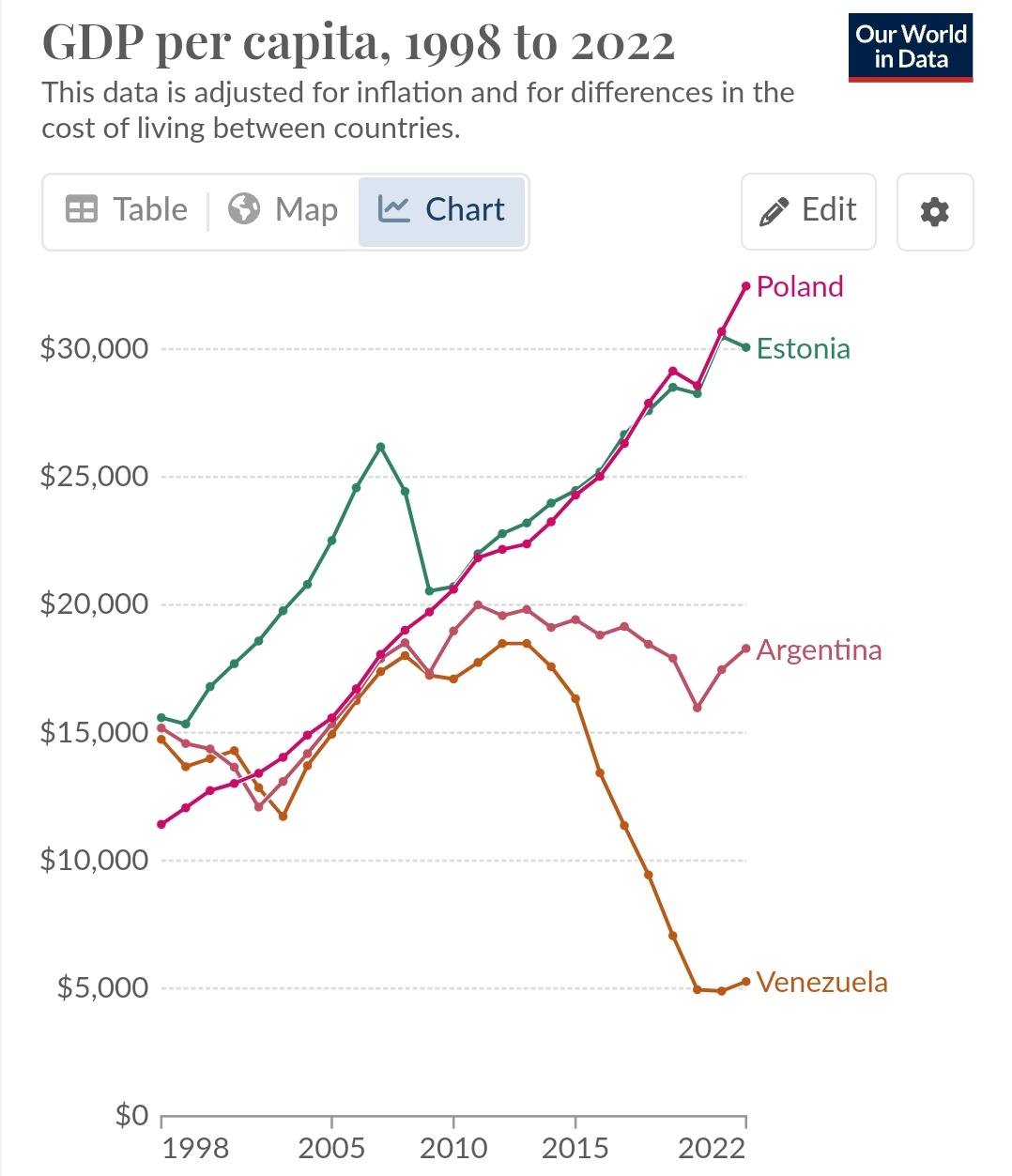
I then noticed a tweet a few days ago that tells a very similar story. It includes this chart, showing what has has happened to per-capita GDP since 1998 in Argentina, Estonia, Poland, and Venezuela.

The author the tweet, Charles Lajoie, explained the significance of the data.

If you want to know the difference between Milton Friedman and Joseph Stiglitz, I present to you 4 countries with a GDP per capita of about $15,000 in 1998 (Poland being a bit poorer back then).

The first one, Estonia, reformed its way out of socialism through shock therapy. Mart Laar, the architect of the reforms, cited Free to Choose as his main inspiration. The second, Poland, also reformed its way out of socialism, and it did so through even more radical shock therapy than Estonia.

Leszek Balcerowicz, who’s widely seen as the main actor behind those reforms, has won the Milton Friedman Prize for Advancing Liberty in 2014, a reflection of his reforms’ adherence to Friedman’s…ideas.

The third one, Argentina, has followed the ideas of Néstor Kirchner since 2003, a man who was directly advised and praised by Joseph Stiglitz. As late as 2022, Stiglitz praised its economic policies.

The fourth, Venezuela, followed economic policies that were openly praised by Stiglitz as late as 2007… And, there you go. That’s the difference between Milton Friedman and Joseph Stiglitz.

I might quibble with a few details. For instance, I think Estonia’s reforms were more radical than Poland’s reforms.

But Lajoie’s core point I spot on. Friedman-style policies have worked and Stiglitz-style policies have failed.

P.S. Now that Argentina has the world’s best leader, it will be interesting to see how fast and how far Argentina will improve (President Milei faces a hostile legislature, so he can’t turn his country into Singapore overnight).

Thursday, May 16, 2024

Biden’s “Ironclad” Commitments to the World

 By Daniel Greenfield @ Sultan Knish Blog

Biden recently visited the Holocaust Museum and delivered a speech in which he pledged an “ironclad” commitment to the “security of Israel”.

On Wednesday, Biden sat down with CNN and announced an arms embargo on Israel.

This is bad news for the Jewish State, but it’s also bad news for every nation to whom Biden had offered his “ironclad” commitments in the past. And that turns out to be much of the world.

In March, Biden had greeted Polish President Andrzej Duda and Prime Minister Donald Tusk at the White House and vowed that, “America’s commitment to Poland is ironclad.”

In April, ahead of a meeting with Japanese Prime Minister Fumio Kishida and Philippine President Ferdinand Marcos, Biden promised, “The United States defense commitments to Japan and to the Philippines are ironclad. They’re ironclad.”

Then at a press conference with Prime Minister Kishida, Biden touted another, now discredited, ironclad promise. “As I told Prime Minister Netanyahu, our commitment to Israel’s security against these threats from Iran and its proxies is ironclad. Let me say it again: ironclad.”

And in troubling news for Ukraine, Biden agreed in a 60 Minutes interview that his commitment to that war was also ironclad.

But is there a country out there that doesn’t have an ironclad commitment from Biden?

Last year, Biden held a joint press conference with President Yoon Suk Yeol of South Korea and assured him that, “our mutual defense treaty is ironclad.”

Biden has been throwing out ironclad commitments around the world like a peddler selling secondhand goods. As Obama’s veep, he boasted to Jordan’s King Abdullah of “America’s ironclad support”. And he more recently told the Greeks of our “ironclad friendship.”

The Gulf nations looking for an “ironclad security pact” with America may get one, but the price of iron isn’t what it used to be. Especially iron out of the ice cold forges of Washington D.C.

While he has been offering a lot of “ironclad” commitments to the rest of the world, it’s not just individual nations that may be reevaluating the value of Biden’s ironclad assurances.

“My commitment to NATO and Article 5 is ironclad,” Biden had claimed in 2022 as Sweden and Finland had lined up to join the security alliance.

“Our sacred commitment to NATO remains ironclad,” the White House recently posted.

At a meeting with the leaders of 9 Eastern European countries and the NATO Secretary General, Biden assured them all of America’s “ironclad commitment to NATO’s Article 5.”

To paraphrase Oprah, you get an ironclad commitment, you get an ironclad commitment, and you get an ironclad commitment. And it’s worth about as much as those empty words.

The rest of the world has learned that Biden’s ironclad is rusted through, but what about his past “ironclad” promises to Americans?

Biden had described social security as “an ironclad commitment” and the White House claims that “President Biden’s 2024 budget shows an ironclad commitment to protecting Social Security and Medicare against all cuts.” The reality is that Biden’s inflationary wasteful 2024 budget further bankrupts Social Security. Biden’s iron isn’t good at home or abroad.

In further bad news for Americans, Biden also claimed that the budget “fulfills my ironclad promise that no one earning less than $400,000 per year would pay an additional penny in new taxes.” So assume that the tax hikes on everyone are coming.

Last year, we were told that “the President has an ironclad commitment to supporting communities across the Nation as they recover from disasters.”No wonder America has become a disaster area.

Ironclads were battleships impervious to the weapons of the day because they were covered in heavy armor. It’s not really the best metaphor for a commitment, but it’s a perfectly good metaphor for Biden’s imperviousness to telling the truth or remembering what he once said.

When you offer “ironclad commitments” to everyone you meet, they’re worthless. A commitment to everyone is a commitment to no one. That is one of the great gaping flaws of globalism.

Adding “ironclad” or any particular word to a commitment doesn’t make it stronger. Iron may add more armor to a warship, but it doesn’t add anything to a man’s word. What makes a man’s word count is the strength of his character and that is shown by his willingness to keep his word.

Biden betrayed Israel because he had made a lot of ironclad commitments. He had made commitments to Jewish voters in New York City and Hamas supporters in Dearborn, Michigan. His administration had made commitments to leftists and to moderates. In the face of escalating fire from leftists, his ironclad armor buckled and he sank in the shallow mud off Foggy Bottom.

This is a problem for America more than anyone else.

International relationships, like all human relationships, are built on trust. Treaties are just pieces of paper and handshakes are so routine that diplomats need wrist braces. The Pax Americana is more than anything else an empire of trust. And we held off WWIII for three generations because most of the world believed that we meant what we said about things like nuclear retaliation, NATO’s Article 5 or anything else. Whatever you believe about those policies, American power and influence would be a non-starter if the president’s word were worthless.

When a president draws a red line and then does nothing, more wars are likely to follow. If he offers defense commitments that he doesn’t keep, our enemies are more likely to attack. If America stops defending its allies, those enemies will then test if we will defend ourselves.

And if we don’t, they will attack the United States of America.

Our military is short of recruits, our Navy is short of ships and our Air Force has a whole lot of planes that won’t fly. In war games, China tends to win and we tend to lose. What keeps China from pushing farther is all those nukes sitting quietly under Iowa cornfields. Will we use them?

Beijing doesn’t know for sure, but every time Biden offers another worthless promise, the odds look better for the People’s Republic of China and all our other enemies. And worse for us.

Americans and the world have learned the worthlessness of Biden’s ironclad commitments. None of us know what the future will bring, the one thing we know is whom we can’t trust.


Daniel Greenfield is a Shillman Journalism Fellow at the David Horowitz Freedom Center. This article previously appeared at the Center's Front Page Magazine. Click here to subscribe to my articles. And click here to support my work with a donation. Thank you for reading.
Tuesday, May 7, 2024

United Kingdom Vs. Poland

Because it should not happen according to conventional economic theory, I put together an anti-convergence club to highlight richer nations that grow faster than poorer nations.

The common theme is that the richer nations have more economic liberty.

So even though convergence theory is generally true, it can go the other way if poorer nations are suffering from excessive government.

For today’s column, though, we’re going to look at an example of convergence rather than divergence. Here’s a chart, based on World Bank data, showing how Poland is catching up to the United Kingdom

This example of convergence is hardly a surprise. Poland’s economy was suppressed for decades because of communism.

And that meant genuine socialism, including government ownershipcentral planning, and price controls.

So when the Soviet Empire finally collapsed, Poland’s per-capita economic output was only about one-third of gross domestic product in the United Kingdom.

But since 1990, Poland has liberalized its economy and made significant progress.

Which raises the question of whether Poland will catch up – and perhaps even pass the United Kingdom.

That’s the focus of an article by James Crisp in the U.K.-based Telegraph. Here are some excerpts.


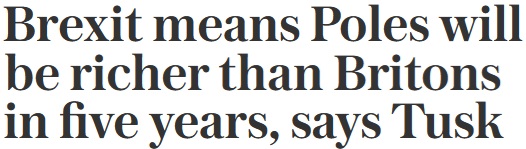
Poles will be richer than Britons in five years time because of Brexit, Donald Tusk, the prime minister of Poland, has said. …“A fierce debate is taking place in Great Britain, caused by the World Bank’s forecast that GDP per capita will be higher in Poland than in the UK in 2025,” said Mr Tusk on the 20th anniversary of Poland’s membership of the EU. …The World Bank data shows GDP per capita in 2021 was $44,979 (£35,935) in Britain and $34,915 (£27,894) in Poland, which has an average growth of 3.6 per cent annually. That would mean Poland would overtake the UK by 2030, according to the calculations.

I have two reactions to the article.

First, the United Kingdom ranks higher than Poland according to both Economic Freedom of the World and the Index of Economic Freedom. Everything else being equal, that suggests Poland won’t catch up.

Second, the article suggests that Poland will surpass the United Kingdom because of Brexit. That’s nonsense. If the United Kingdom falls behind, it will be in large part because that nation’s politicians failed to take advantage of Brexit. Instead of becoming “Singapore-on-Thames,” British politicians since Brexit have increased the burden of government.

Indeed, Poland now has a smaller burden of government spending, according to OECD data.

P.S. Many people think China’s growth has been impressive, but it doesn’t look very good compared to Poland.

P.P.S. Meanwhile, the United Kingdom doesn’t look very good compared to Australia and Switzerland.

Tuesday, July 25, 2023

Poland’s Recovery from Socialism

July 24, 2023 by Dan Mitchell @ International Liberty

I was surprised to learn last year that Poland’s economy has out-performed China’s economy over the past three decades.

Given the way free markets out-perform statism, I should have known this would be the result.

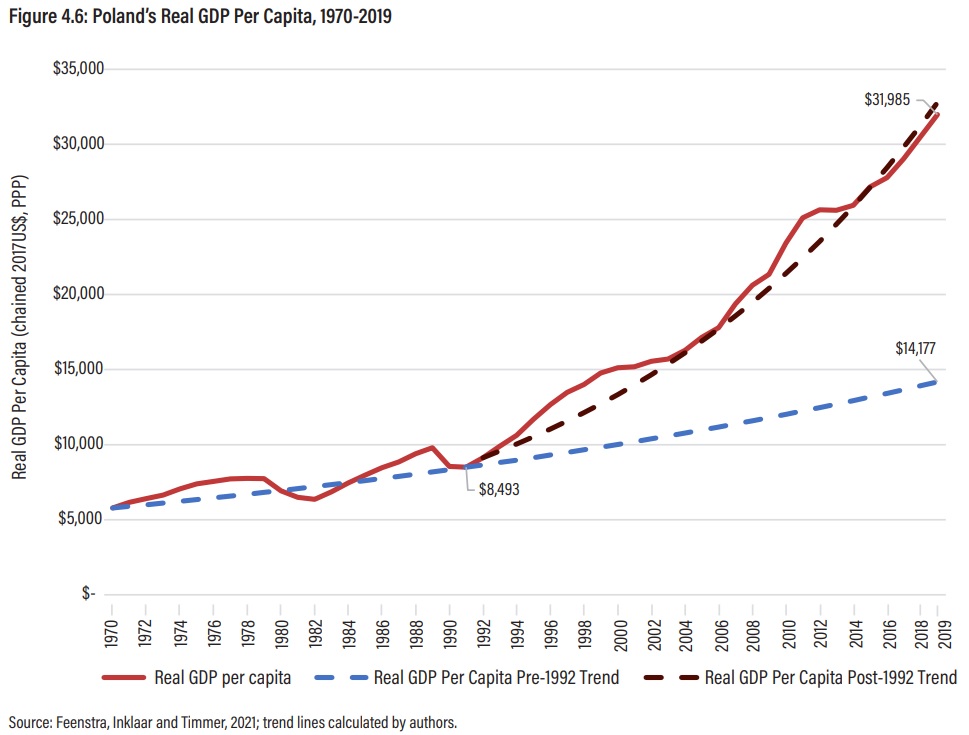
Today, let’s take a closer look at how Poland has recovered from socialism. And we’ll start with this chart showing much better economic performance after the early-1990s transition from communist control.

The chart comes from a new book, The Road to Socialism and Back, published by the Fraser Institute.

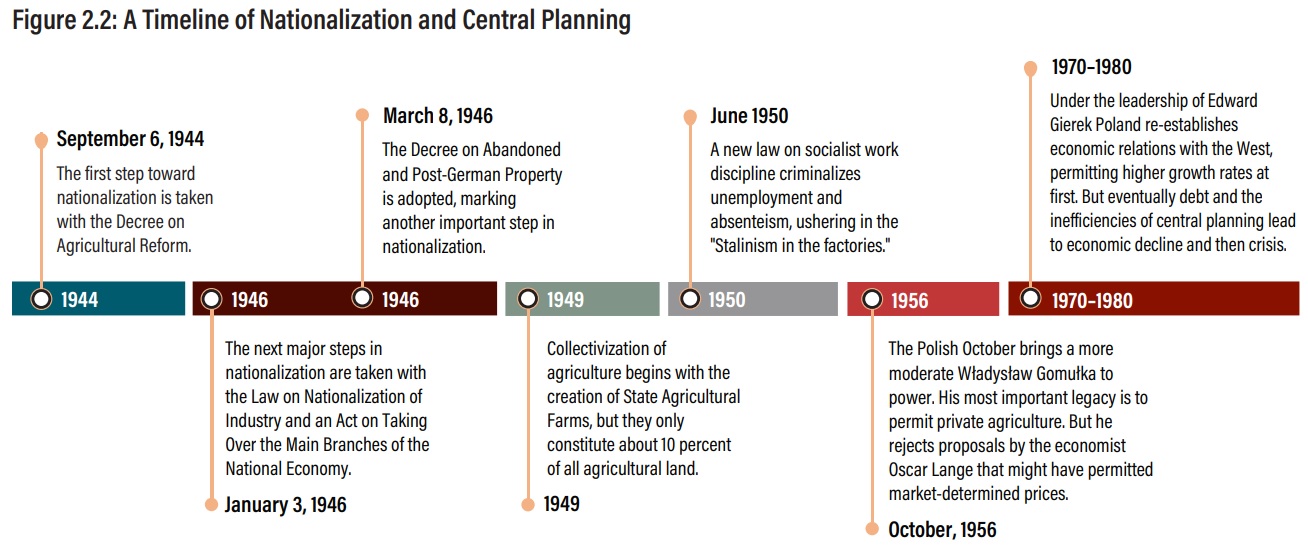
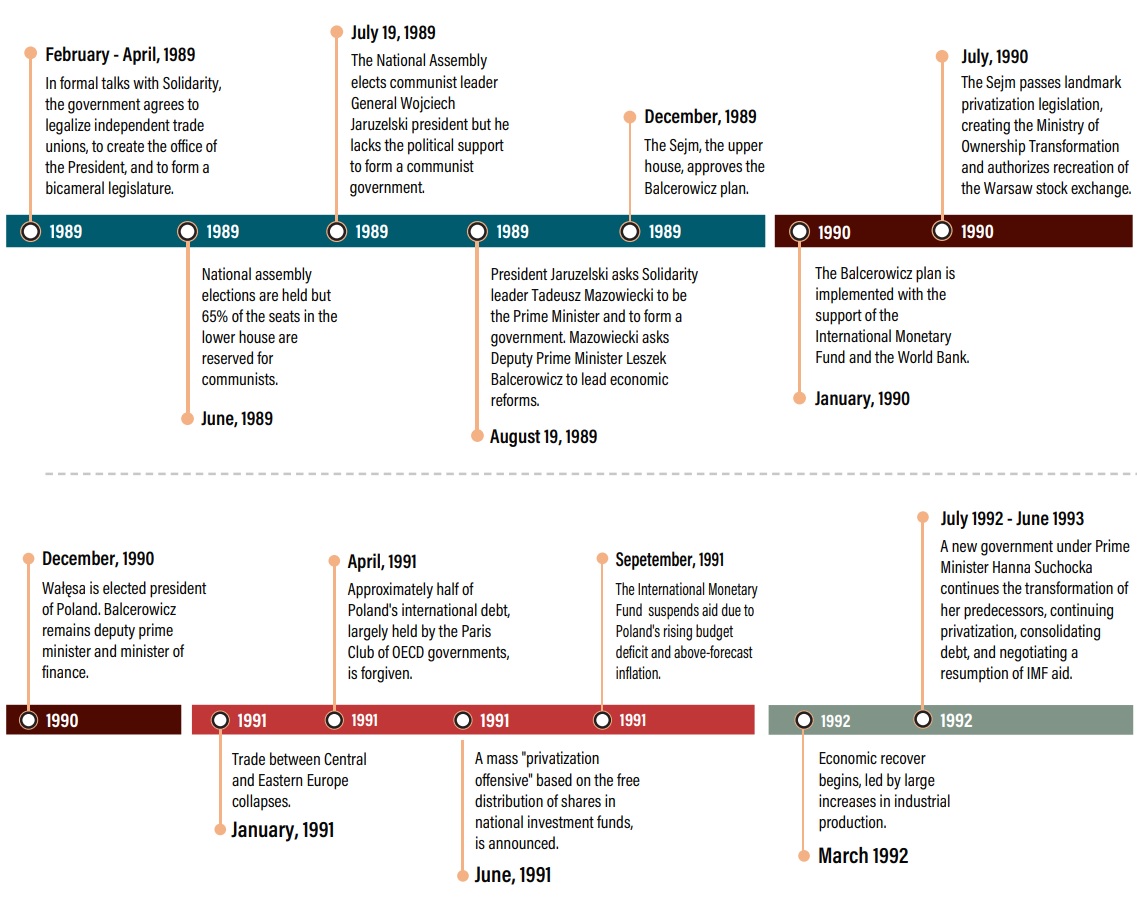
Written by Peter J. Boettke, Konstantin Zhukov, and Matthew Mitchell, it explains that Poland’s economy was stagnant after World War II because the Soviet Union imposed socialism. But the collapse of the Soviet Empire enabled Poland to adopt market-friendly reforms and the economy has since flourished.


For 45 years, the Polish people were the subjects of a grand national experiment. …unquestionably a negative result experiment. …the Polish economy stagnated. While real incomes grew at a sluggish pace, shortages of necessities—meat, electrical appliances, even toilet paper and sanitary napkins—were endemic. …In time, the system collapsed in on itself. Weighed down by foreign debt, hamstrung by corruption and privilege, stagnating under sluggish growth and spiraling inflation, and stalked by the ever-present threat of mass shortages, the economy fell apart… Under the leadership of Minister of Finance Leszek Balcerowicz, the nation embarked on a bold plan to transform itself back into a mixed economy. …once growth resumed, real per capita GDP grew at more than twice its pre-reform rate. Shortages that had plagued the economy for decades disappeared within weeks. Hyperinflation was tamed. Living standards—and even life expectancy—rose.

The authors do not claim Poland is a laissez-faire role model. Indeed, some of the latter chapters point out that the country still has an excessive burden of government and other sub-optimal policies.

But a key message from the book is that Poland’s economy is now much stronger since it gets about a 7 (on a 1-10 scale) from Economic Freedom of the World. That’s not a a great score, but it’s much better than a score of 4, which is where Poland was during the communist era.

I’ll close by observing that the book is filled with details on how socialism was imposed in Poland.

And it is filled with details on how Poland extricated itself from those wretched policies.

P.S. People can make a difference. The book repeatedly cites the critical role of Leszek Balcerowicz, who served as Deputy Prime Minster, Finance Minister, and head of the central bank. I’ve cited some of his research in other columns (see here and here).

P.P.S. I wrote in 2017 how socialism followed by reform caused Poland to diverge and then converge with Spain. I guess that means Poland counts as a former member of the anti-convergence club?

Rate this:

Wednesday, February 10, 2021

Reflections on Poland’s Alliances

Alliances like NATO are built on interests, not values, and they’re never eternal.

Once again, on the Vistula River, we are worried about security guarantees in the wake of a U.S. election. Politics is a dynamic, not a static, condition. The competition never ends.

For Poland to stay ahead in this competition, the United States will have to demonstrate that despite its vast distance from Eurasia, U.S. interests in the supercontinent are so important that Washington is ready to incur the same costs as the Russians or the Chinese. This was certainly the case during the Cold War, when the United States convinced West Germany and other allies that Washington would defend Western Europe even at the cost of a nuclear attack on the U.S. Will the American attitude be the same in the new strategic environment of the 21st century?..............

In an autumn 2017 essay titled “Without America: Australia in the New Asia,” Hugh White described what would happen if Trump suddenly called the Australian prime minister, announced that a war had broken out in the South China Sea and asked for allied solidarity. White believed that the prime minister probably would have no choice but to agree, because such is the software of politics, and it is no different in Australia.........To Read More....

My Take - First, this appeared in Geopolitical Futures, apparently as one of there free articles, so don't miss out reading it.  There's a lot more than I've linked here. 

Secondly, I think this is a really well done piece!  Poland has always been the meat between the slices of bread and has had to put much effort into defending itself.  It's my belief America will walk away from its commitments in Europe, and later on in Asia.  Bretton Woods is over and it’s just a matter of time and circumstance before it happens, which is why I like this statement by the author, “Alliances like NATO are built on interests, not values, and they’re never eternal”, and is my Quote of the Day.  
 
If there ever was a single sentence that qualifies as the best lesson geopolitics, that’s it!
 
However, with Biden in place it's hard to know what America will do as his administration is filled with some really strange people with radical conflicting views.  Worse yet, neither Biden or Harris has a clue about anything, or have ever accomplished anything, in or out of government. 
 
Wisdom is the application of knowledge and understanding, and for most of us that’s acquired through successes and failures.  But whether we succeeded or failure, we tried, and we learned.  Neither of them has had any solid successes, or failures in or out of politics, and winning or losing elections doesn’t qualify, and their personal and professional histories don't create a lot of confidence in them. 
 
There's no solid "experience in life" foundation of logic or practical experience they can fall back on to make the hard decisions between the two of them.  Decisions that must be made predicated on instinctual logic, because there’s never enough data, and too much date is overrated.  And that lack of insight isn’t overcome by a lifetime in government, which quantifies their lives.  Being surrounded by "experts" is pretty much worthless if a leader has no gut instinct based on experience in life. 
 
I like his American/European analysis and the American/Australian analysis on what happens if America does walk away.  I also think it's right on.

Thursday, October 3, 2019

Poland Rejects European Union Migrant Redistribution Plan

Chris Tomlinson 29 Sep 2019

The Polish ambassador in Rome has rejected the new European Union migrant redistribution agreement, stating that no migrants will be accepted in Poland.  Ambassador Anna Maria Anders said that the government in Warsaw would only welcome migrants who share linguistic and cultural traditions with the Polish people, Italian newspaper Il Giornale reports.

“The EU wants redistribution, but we do not change our point of view. Warsaw is already doing so much. In Poland, there are two million Ukrainians, many of whom have fled from war zones. They integrate well, share in part our language, traditions, and culture,” Anders said.

She went on to stress the importance of Christianity in Poland, saying: “The role of Christianity is a glue of the Polish nation. And this must be respected.”

“For almost half a century we have not had the opportunity to show our flags, to freely demonstrate, to sing our slogans and anthem. Now, we have the freedom to do so and it is not possible to be dismissed as a nationalist just because we proudly reveal our identity,” she added, referring to the country long years under a communist puppet regime during the Cold War. ...........To Read More......

Tuesday, July 9, 2019

Bizarre Moments in Taxation

July 8, 2019 by Dan Mitchell @ International Liberty
 
Every so often, I share very weird stories about government regulations, from both America and around the world. And when I say weird, I’m not exaggerating.

But we also have some strange examples of tax loopholes.

I’m not talking about corporate jets, which should be characterized as a business expense.

Instead, I’m referring to bizarre examples of income that is arbitrarily exempt from tax.

The weirdest example in the United States is from Nevada (probably because politicians have a conflict of interest).

Today I want to write about a new tax loophole in Poland.
Polish lawmakers have approved a measure that would exonerate most workers under the age of 26 from income taxes… The bill would exonerate workers under the age of 26 from Poland’s 18 percent personal income tax for those whose gross earnings don’t surpass 85,500 zlotys (20,000 euros, $22,500) per year. That level is higher than Poland’s average income… Some two million people could benefit from the measure.
So what’s motivating this example of age-based tax discrimination?
Poland has long been haemorrhaging skilled workers to other EU states where they can find better paying jobs, posing both a long-term demographic risk and short-term problem finding enough labourers to continue the country’s streak of economic growth since the fall of communism in 1989.
I certainly agree that Poland faces a demographic challenge (along with other nations in Eastern Europe), both because of emigration and low birth rates.

And I also agree that Poland’s economy has been relatively successful since escaping the evil of communism.


But I’m not very confident that this policy is the right recipe for continued prosperity.
  • First, I don’t like discrimination in the tax code, whether based on the source of income, the use of income, the level of income, or – in this case – the age at which income is earned.
  • Second, this policy doesn’t affect social insurance taxes and value-added taxes, which are actually the biggest burden for ordinary workers in many Eastern European nations.
  • Third, unless Poland’s government imposes some spending discipline, a tax preference for young people may lead to higher taxes on other groups, thus offsetting any economic benefit.
To be sure, I’m glad Poland is addressing the issue by lowering taxes rather than by creating new programs and subsidies, as we’ve seen in some other European nations.

I’m simply not expecting big results.

P.S. You can click here to peruse other oddball examples of international tax policy.

Sunday, December 9, 2018

The snow job in Poland

IPCC climate confab seeks to stampede the world into adopting destructive energy policies

Craig Rucker                                                                                                                                     
Any blizzards that blanket Poland this winter can’t compare to the massive snow job climate campaigners are trying to pull off.
Some 30,000 politicians, activists, computer modelers, bureaucrats, lawyers, journalists, renewable energy sellers and a few scientists are in Katowice, Poland December 2-14, for another Intergovernmental Panel on Climate Change conference. Four issues will dominate the agenda.
* Proclaim that humanity and planet face existential cataclysms, unless fossil fuel use and carbon dioxide (CO2) emissions are slashed to zero by 2050 – to “prevent” average planetary temperatures from rising more than 1.5 degrees Celsius (2.7 F) above what they were in 1820, when the Little Ice Age ended and the modern industrial era began.
* Finalize 300 pages of “guidelines,” to implement the Paris climate agreement – by driving the switch from coal, oil and natural gas to wind, solar and biofuel energy.
* Reach a binding agreement that wealthy countries (excluding China and other newly rich nations) must transfer at least $100 billion annually to poor countries.
* Ensure “transparency” on discussions, disclosures and treaty compliance.
This entire agenda deserves skepticism and ridicule.
Earth’s climate is always changing somewhere, due to powerful natural forces over which humans have no control. To say we can now perpetuate current conditions by controlling emissions of plant-fertilizing carbon dioxide is sheer fantasy.
Average global temperatures have already (thankfully) risen nearly a degree since 1820. To suggest that another half degree would be catastrophic is absurd. Indeed, average temperatures were higher during the Medieval Warm Period – and except during recent El Niño events have barely risen since 1998, even as CO2 levels climbed significantly, spurring plant growth worldwide.
Constant references to the “hottest ever” day or month involve hundredths of a degree, less than the margin of measurement error, often by activist scientists who have a history of doctoring data. They also ignore record cold snaps, like this Thanksgiving weekend in the U.S. Northeast.
Human activities certainly affect climate and weather to some degree, at least locally. But there is no real-world evidence that they have major (much less cataclysmic) impacts. Computer models say otherwise, but their record for accuracy is abysmal to zero.
Regarding guidelines to implement Paris, they would put the United Nations and IPCC in charge of our energy use, economies, lives and living standards – which would be disastrous. Fossil fuels still provide 80% of all U.S. and global energy; wind and solar provide less than 5% and only intermittently.
Forcing us to convert to wind and solar would increase electricity prices ten times over – and blanket areas many times the size of California with turbines, panels, batteries, and huge mines to dig out the raw materials needed for these “eco-friendly, climate-safe, sustainable” replacements.
Expensive, unreliable “renewable” energy would destroy jobs and economies, depress living standards, keep poor nations impoverished – and cause conflicts, famines and refugee migrations, as countries fight over increasingly scarce energy, food and resources.
Developing countries say they were promised $100 billion a year, for starters, plus free energy technology transfers. That’s the primary reason they signed the Paris climate treaty.
They’re angry that barely $3.5 billion has been put on the table, and rich countries say they cannot afford to pay more, especially if they’re also supposed to slash their fossil fuel use and thus economic prosperity.
The biggest snow job is any claimed devotion to transparency. Secrecy and deception are fundamental to the IPCC process. Anyone who questions the “fossil fuels cause climate chaos” thesis is silenced. So is anyone who suggests that data and evidence should determine policy – instead of computer models.
Katowice organizers are furious that a Trump Administration exhibit will highlight the remarkable benefits of fossil fuels. They vilify scientists who emphasize the sun’s vital role in climate change, or point out the many ways that temperature, storm, drought and other climate data are cherrypicked, “homogenized,” manipulated or even fabricated to drive alarmist narratives. They ignore the Medieval Warm Period, Little Ice Age and 1970-1976 global cooling scare.
The real IPCC and Paris treaty agenda is simple. Blame humans and fossil fuels for virtually all climate and weather events. Control energy use, economic growth and living standards – lowering them in industrialized countries and limiting them in developing nations. Redistribute the world’s wealth and resources. And replace the capitalist economic model with a global green socialist system, controlled by the UN, IPCC and green activists.
Lack of energy, jobs, safe water and decent living standards is a far more pressing issue for poor countries than climate change. No wonder Asia alone already has some 2,000 gigawatts of coal-fired power plants operating or under construction. That’s nearly twice as much as total US summertime generating capacity.
Meanwhile, every Irish household faces new carbon taxes of $3,000 to $5,000 a year (!) unless their government imposes equally costly measures to reduce “greenhouse gas” emissions and avoid paying punitive EU fines. To gauge likely Irish reaction to that, look to France – where tens of thousands have been rioting over President Macron’s plans to implement higher carbon taxes.
Climate insanity needs to be reined in. CFACT’s delegation to Katowice is working hard to get that process underway.
Craig Rucker is president of CFACT, the Committee For A Constructive Tomorrow, a free market think tank devoted to sound science for both people and planet.

Friday, September 29, 2017

Geopolitical Futures

(Editor's Note: I just updated this post with  a link to their latest information about Spain, but the one thing that keeps coming through every article posted about Europe - the EU is doomed. RK)

A Fight Spain Can’t Win

By Jacob L. Shapiro


The autonomous Spanish community of Catalonia plans to hold an independence referendum on Oct. 1. The Spanish government intends to prevent that referendum from taking place ­– by any means necessary. Ironically, Spain’s crackdown, while predictable, exacerbates the very threat Spain is trying to subdue. Whether or not Madrid’s heavy-handed approach prevents a declaration of independence, in the long term it will only push more Catalans toward the conclusion that their future lies not with Spain but with themselves.  Spain, the European Union’s fourth-largest economy, sits on the verge of a major political crisis that it has no way of solving.

Nations Within Nations

This standoff is only the latest expression of an issue between Madrid and Barcelona that is almost a millennium old: the Catalan people’s desire to rule themselves. Present-day Catalonia has a culture, language and history that is unique and all its own. It has preserved this identity despite losing multiple wars for self-rule, and despite periods of intense suppression. Catalonia’s desire for independence played a major role in the 1936-39 Spanish Civil War, another conflict in which Catalonia ended up on the losing side. Francisco Franco’s rule and repression of Catalonia after the war did nothing to dim Catalonia’s identity, or for that matter any of the identities of the various nations that today make up the Kingdom of Spain. ........ If Catalonia were to leave Spain, not only would roughly 20 percent of SpainĂ¢€™s gross domestic product disappear overnight, but it would also raise the possibility that other autonomous regions might be interested in national self-determination too...............To read more the post A Fight Spain Can’t Win appeared first on Geopolitical Futures.


Poland Challenges the European Identity

By George Friedman

I am writing this from a hotel room in Warsaw, surrounded by memorials to Frederic Chopin, the great Polish composer and champion of self-determination for the Polish people. This is a particularly appropriate time to be here, since Poland is locked in a battle with the European Union over the question of Polish national self-determination – more than two centuries after Chopin was born.
The issue comes down to this: Poland elected a government that pledged to change the direction in which the country was moving. The new government was of the right. It opposed the policies and institutional stance of the previous, left-of-center government. The previous government had embedded its followers in various institutions, such as the courts and national radio, as governments tend to do. The new government saw itself as facing a hostile judiciary and state-owned media. And so it sought to change the management of the state-owned media and “reform” (in its terms) the judiciary............

What makes the Polish situation different is the threatened intervention by the European Union bureaucracy and the vocal hostility of Germany to the new government’s policies. This includes threats to suspend Poland from participation in some EU functions and various hostile claims about the Polish government.......The Polish government’s misfeasance is not really about courts or broadcasting. Rather, it is about Poland deviating from the EU’s ideology...... has opposed unlimited immigration into Poland by Muslims, arguing that it would change the country’s national character. In other words, Poland has elevated national distinctions to a level unacceptable to the European Union. It insists that there is a Polish nation and that others with differing values cannot become part of it...........To Read more, the post Poland Challenges the European Identity appeared first on Geopolitical Futures.


An End in Sight for Ukraine … Maybe

By Jacob L. Shapiro

The conflict in Ukraine has developed an interminable quality. We are now over three years into the war in Donbass, and every day brings new updates on cease-fire violations or steps forward and backward on implementing the Minsk accord. This can make it hard to determine when conditions have actually changed. There have been a few key developments lately, however, that suggest real change is in the offing. The likeliest shape of this change is an acceptance of the stalemate and formalization of the status quo so that the fighting can finally stop. It’s a little too soon to say that this is what’s happening, but the early indicators are there. ............

Consider also that Russia is spending a lot of money to keep those separatist areas, Donetsk and Luhansk, afloat. The exact amount is impossible to know. A study by the German newspaper BILD concluded that Russia was spending 1 billion euros ($1.17 billion) a year on public service salaries and pensions alone in separatist Ukraine.......The Russian economy is not in a state that it can afford to throw money at a problem with no end in sight..........To read more the post An End in Sight for Ukraine … Maybe appeared first on Geopolitical Futures.


Eastern Europe’s Competitive Edge

Summary


Eastern Europe is the most dynamic part of the European continent. So great is its potential that it is among the subjects at our annual conference in October.  But before we can explain why this is, we must first define what we mean by Eastern Europe. For the purposes of this Deep Dive, Eastern Europe includes nine countries: Bulgaria, the Czech Republic, Estonia, Latvia, Lithuania, Hungary, Poland, Romania and Slovakia.

We are, however, leaving out some countries that are widely considered Eastern European. We’ve excluded the Balkans, for example, because the geopolitics of that region is fundamentally different from the geopolitics of the countries we are including in our analysis. Belarus, Ukraine, Moldova and Russia are similarly often lumped into Eastern Europe, but they have different economic and political structures, so they should be dealt with separately. We are, however, including the Baltic states. They see themselves as part of Northern Europe rather than Eastern Europe but mostly out of a desire not to be called “eastern.” ............ To read more the post Eastern Europe’s Competitive Edge appeared first on Geopolitical Futures.


Monday, April 3, 2017

EU Tusk Affair: Poland is No UK

By Anna Wellisz

The unity of V-4 is visibly broken, which strengthens the centralizing forces in the EU and weakens the “less Europe” camp; the Hungary-Poland deal in the EU Parliament to protect each other with vetoes from the bloc’s authoritarian whims is uncertain at best; Poland’s position as a broker in EU-UK divorce negotiations — and the leverage that came with it — is gone; publicly humiliated, the Polish government is weakened at home. Critics are right: heads must roll. High time for real diplomacy — having a strategy and executing it, some behind the scenes and some publicly, without paper trail, and ALWAYS with a plan B handy...........Meanwhile, Poland has to start behaving like a mature and independent country, act with calm dignity instead of desperation, and have a — gasp! — grand strategy and implement it with patience and self-discipline. Why not try competent execution and political efficacy instead of impotent and infantile self-indulgence?..............

The new generation in Poland is absolutely worth watching – it is they, contrary to the popular narrative, and not the retirees, who swayed the last electoral cycle: the young, who don’t watch traditional TV, get their news from independent web outlets, and remain impervious to the charms of the internationalist cabal’s siren calls...........Read More