Search This Blog

De Omnibus Dubitandum - Lux Veritas

Showing posts with label Estonia. Show all posts

Thursday, May 8, 2025

Estonia’s Transition from Socialist Misery to Free-Market Prosperity, Part III

May 7, 2025 by Dan Mitchell @ International Freedom 

I’m in Estonia as part of the Free Market Road Show, so this is a good opportunity for Part III of my series on that country’s rebound from communism.

To follow up on Part I and Part II, let’s start with this Fraser Institute video.

I’ve always been a fan of Estonia, going all the way back to the 1990s when Mart Laar, a history professor, became the nation’s first post-communist leader and copied the ideas of Milton Friedman with reforms such as the flat tax.
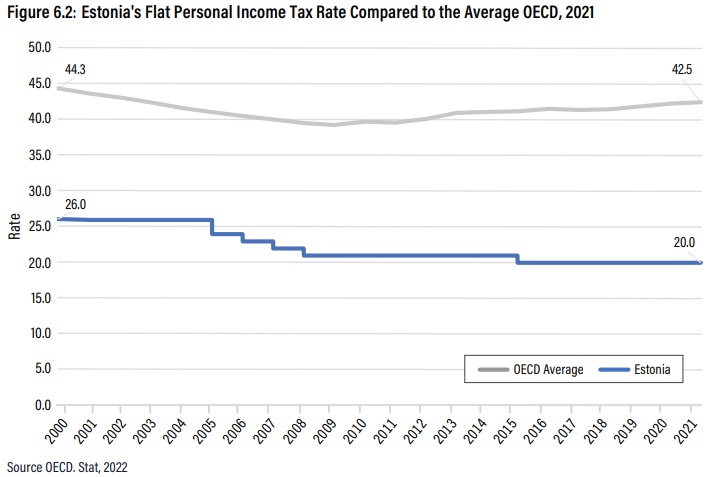
 

  • The good news is that the rate of the flat tax has declined from where it started at 26 percent.
  • The bad news is that rate just increased from 20 percent in 2024 to 22 percent in 2025.

But that’s still much better than income tax rates in other European nations. And Estonia’s overall tax system ranks as the best among all OECD nations.

Another way of gauging Estonia’s success is to review how well it is doing compared to other nations that emerged when the Soviet Union collapsed.

I’ve already shared data showing Estonia being a star performer, so let’s look at excerpts from Matt Mitchell’s column comparing market-oriented Estonia with statist Russia.


Estonia is…an uncomfortable reminder to Russians of what could have been. …Since leaving the Soviet Union in 1991, Estonia has grown faster than any former Soviet state. Today, the typical Estonian earns nearly 40 percent more than the typical Russian.

The share of Estonians living in poverty is one-sixth that in Russia. Relative to its population, Estonia has 50 times (!) as many business startups as Russia… An Estonian can expect to live eight years longer than a Russian. Estonian infants die at less than half the rate of Russian infants. Estonians are far more likely to report satisfaction with their lives (ranking 38 slots ahead of Russia) and government services. Estonia has one of the lowest perceptions of corruption globally (tied with Canada, Iceland and Uruguay at 14th; Russia ranks 137th out of 180 countries). …How did this happen? …

Once Estonia left the Soviet Union, it embarked on a seemingly radical plan to free its people and economy. …Estonia’s leaders privatized every business they could. They reduced government spending and consistently balanced the budget. They introduced the world’s first flat personal income tax at half the rate of other industrialized countries. They stabilized the growth rate of their money supply to bring inflation under control. They reduced regulations and made it easier to start businesses.

Almost unprecedented in the modern era, they unilaterally eliminated all tariffs and barriers to trade, giving their people proper access to the global marketplace.

All that is very impressive. The country is moving in the right direction.

Indeed, Estonia should be a role model for other post-Soviet nations, as Andy Kessler explained last year for the Wall Street Journal.


“You can’t bribe a computer,” Estonian Prime Minister Kaja Kallas told me. When it’s time to rebuild, Ukrainian President Volodymyr Zelensky should heed these words. …Ms. Kallas noted her government uses these digital tools “to decrease, diminish bureaucracy.” That’s how to create small government. “It’s cheaper and our debt is much lower as well.” Though it’s rising, Estonia still has the lowest ratio of government debt to gross domestic product in the EU. …the Reagan playbook is working. …Estonia is working to increase everyone’s equity value. Purchasing power is up 400% since Soviet occupation… Free trade, low taxes, small government, e-services, educated workers, low debt and negligible corruption. Ukraine—and the U.S.—can learn a lot from Estonia.

I’ll close by shifting to pessimism.

Estonia has not made much progress on further liberalization in the past 10-15 years, and it’s overall ranking for economic freedom has dropped to #20. Not bad by global standards, but Estonia should strive to be at Swiss levels (#3 in the world) of economic liberty.

And there are other challenges, such as the demographic decline that I wrote about back in 2016.

P.S. In Estonia’s defense, the main reason for the recent decline in economic freedom is bad monetary policy, but that’s the fault of the European Central Bank (and it’s grossly incompetent head bureaucrat) in Frankfurt.

Tuesday, August 27, 2024

Friedman vs Stiglitz: Estonia and Poland vs. Argentina and Venezuela

August 25, 2024 by Dan Mitchell @ International Liberty

About 10 days ago, I showed that Milton Friedman was a much better economist than Joseph Stiglitz by comparing Chile (which followed Friedman’s ideas) and Venezuela (which followed Stiglitz’s ideas).

It was a slam-dunk win for Friedman. Chile started poor and has become relatively prosperous.

The opposite happened in Venezuela, which started relatively prosperous and has since suffered a horrible economic decline.

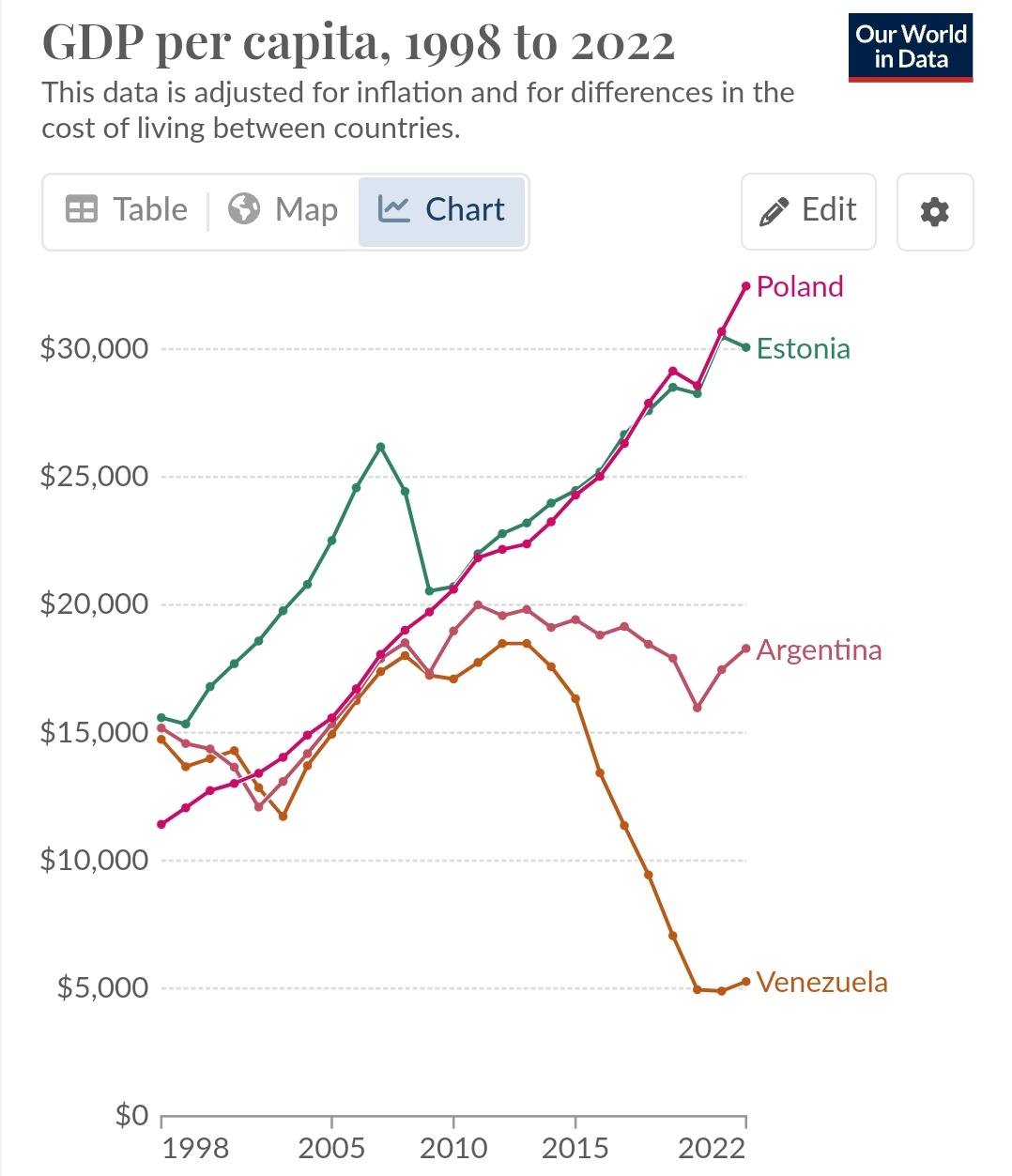
I then noticed a tweet a few days ago that tells a very similar story. It includes this chart, showing what has has happened to per-capita GDP since 1998 in Argentina, Estonia, Poland, and Venezuela.

The author the tweet, Charles Lajoie, explained the significance of the data.

If you want to know the difference between Milton Friedman and Joseph Stiglitz, I present to you 4 countries with a GDP per capita of about $15,000 in 1998 (Poland being a bit poorer back then).

The first one, Estonia, reformed its way out of socialism through shock therapy. Mart Laar, the architect of the reforms, cited Free to Choose as his main inspiration. The second, Poland, also reformed its way out of socialism, and it did so through even more radical shock therapy than Estonia.

Leszek Balcerowicz, who’s widely seen as the main actor behind those reforms, has won the Milton Friedman Prize for Advancing Liberty in 2014, a reflection of his reforms’ adherence to Friedman’s…ideas.

The third one, Argentina, has followed the ideas of Néstor Kirchner since 2003, a man who was directly advised and praised by Joseph Stiglitz. As late as 2022, Stiglitz praised its economic policies.

The fourth, Venezuela, followed economic policies that were openly praised by Stiglitz as late as 2007… And, there you go. That’s the difference between Milton Friedman and Joseph Stiglitz.

I might quibble with a few details. For instance, I think Estonia’s reforms were more radical than Poland’s reforms.

But Lajoie’s core point I spot on. Friedman-style policies have worked and Stiglitz-style policies have failed.

P.S. Now that Argentina has the world’s best leader, it will be interesting to see how fast and how far Argentina will improve (President Milei faces a hostile legislature, so he can’t turn his country into Singapore overnight).

Wednesday, January 10, 2024

Estonia’s Transition from Socialist Misery to Free-Market Prosperity, Part II

January 8, 2024 by Dan Mitchell @ International liberty

In Part I of this series, we looked at the many pro-market reforms that turned Estonia into an “improbable success.”

For Part II, let’s look at fiscal policy. And we’ll start with the country’s best feature: Estonia has a very simple and fair flat tax with a relatively low rate.

Here’s the Estonian income tax compared to the average of other developed nations.

The above chart comes from a new book, The Road to Freedom, which describes Estonia’s escape from communist oppression.

Here’s some of what the authors, Matthew Mitchell, Peter Boettke, and Konstantin Zhukov, wrote about the nation’s tax reform.


Laar’s government implemented the world’s first flat tax in 1994. Initially set at 26 percent, it was reduced in several steps to 20 percent by 2015… In 2021, it was the second-lowest top rate and less than half the average rate in the OECD (see Figure 6.3). Estonia’s flat tax applies to all personal and corporate income above a minimum threshold, with no exemptions, deductions, or credits. To avoid double-taxation, it does not apply to dividends when the underlying profits have already been taxed. …Estonians soon found that their simple and easy to administer flat tax raised revenue without discouraging economic activity. …Estonia’s flat tax also applies to corporate income. The marginal effective corporate tax rate…is close to the statutory rate, reflecting the system’s minimal loopholes. And while many countries distinguish between different forms of businesses (LLC, S-Corp, etc.), and between service companies and manufacturers, Estonia taxes all corporate income the same. …Estonia’s flat tax also applies to corporate income. The marginal effective corporate tax rate…is close to the statutory rate, reflecting the system’s minimal loopholes. And while many countries distinguish between different forms of businesses (LLC, S-Corp, etc.), and between service companies and manufacturers, Estonia taxes all corporate income the same. …Estonian firms only spend about five hours a year on tax compliance, whereas American firms spend 87 hours on compliance.

As you just read, it’s not just that Estonia has a flat tax. It’s also a properly designed flat tax, with no double taxation and expensing rather than depreciation.

No wonder Estonia routinely ranks at the top of the Tax Foundation’s International Tax Competitiveness Index.

But it’s important to understand that Estonia isn’t the Cayman Islands or Monaco. It’s not even Singapore or Jersey (the island in the English Channel, not the over-taxed American state).

In a column last year for National Review, Meelis Kitsing provided a balanced assessment of his country’s tax regime. Here are some excerpts.


A maximum of 20 percent tax on any income exceeding 2,100 euros per month may seem a good deal, but, on top of that, employers have to pay social taxes of 33 percent on salaries, which can (even if there are no direct employee contributions) operate as an indirect tax on income. …According to the OECD, Estonia had a tax-to-GDP ratio of 33.5 percent in 2021. This was slightly lower than the OECD average of 34.1 percent. …it is far from being a tax haven. The U.S. tax-to-GDP ratio was 26.6 percent. …Estonia has…consumption taxes above the OECD average. …Tax policy has been an important ingredient in Estonia’s reform efforts that have been among the most radical and far-reaching of all those seen in Central and Eastern Europe since the breakup of the Soviet Union and the fall of communism in its satellite states. …Tax policy should not be seen in isolation; carried out well, it can be key to a sound economic environment. In Estonia, that has been the case.

To put it in simple terms, Estonia has a well-designed tax system, but it is not a low-tax economy.

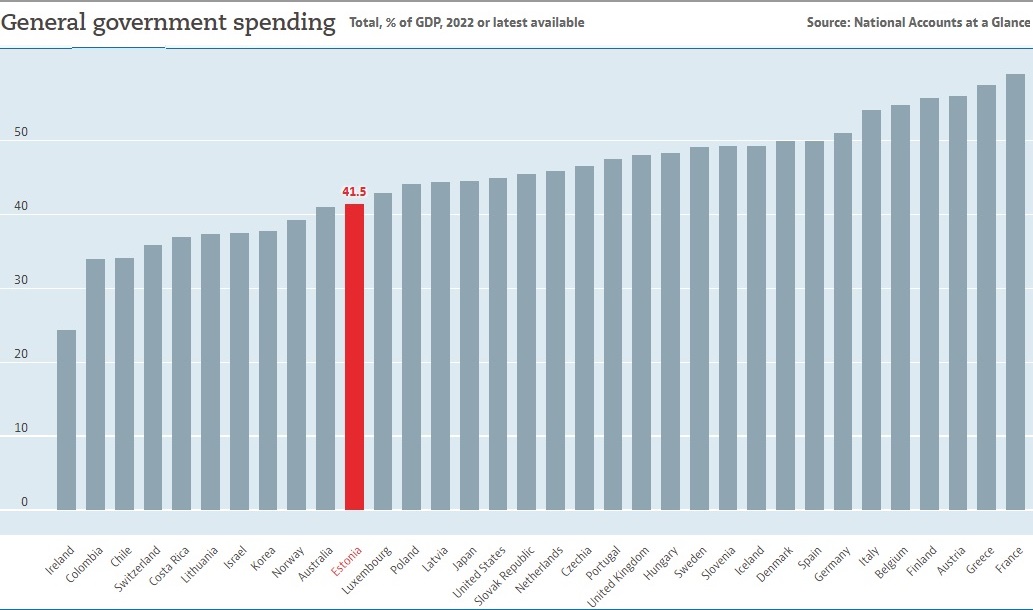
Which brings us to the bad news. The reason Estonia is not a low-tax nation is because it is not a small-government nation.

Here’s the latest data from the OECD on the burden of government spending in member nations.

Yes, Estonia is not as bad as most other European countries, but that’s hardly a big achievement given the continent’s propensity for profligacy. What matters most is that the public sector is far above the growth-maximizing level.

To make matters worse, Estonia has major demographic challenges, which means there will be long-run pressure for even more spending.

Which helps to explain our final bit of bad news, which is that Estonia recently increased its flat tax to 22 percent as part of a broad tax-hike pacakge.

The moral of the story, as I have written before, is that you can’t have a good tax system with big government.

P.S. Estonia should have learned a lesson after a tax increase backfired a few years ago.

Tuesday, January 9, 2024

Estonia’s Transition from Socialist Misery to Free-Market Prosperity, Part I

January 7, 2024 by Dan Mitchell <@ International Liberty

I shared a 44-minute video on the “improbable success” of Estonia back in 2016. For those with time constraints, here’s a new video on the same topic that’s only 56 seconds.

The video is part of a project on the Realities of Socialism, which includes a book on Estonia’s tragic impoverishment under Soviet oppression and then subsequent enrichment after getting independence.

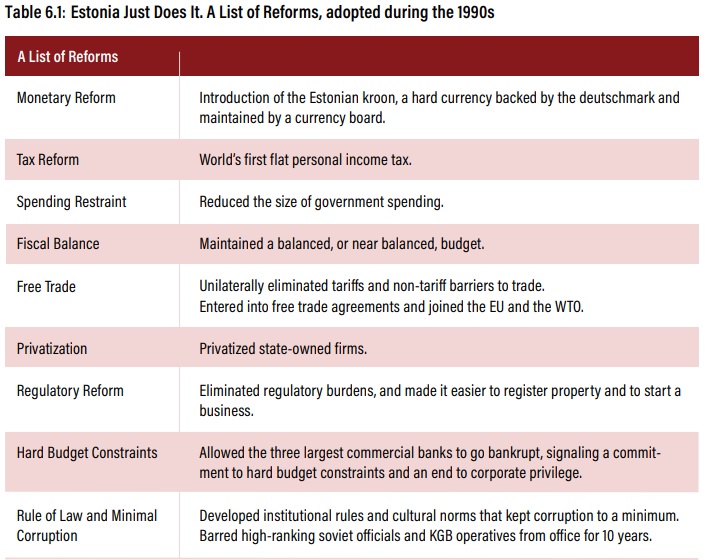
Written by Matthew Mitchell, Peter Boettke, and Konstantin Zhukov, the book lists the main economic reforms enacted after escaping communism.

All together, these reforms changes helped make Estonia one of the world’s most market-oriented nations. It has the world’s 12th-freest economy according to Economic Freedom of the World and the 6th-freest economy according to the Index of Economic Freedom.

Here are some brief excerpts from the book.


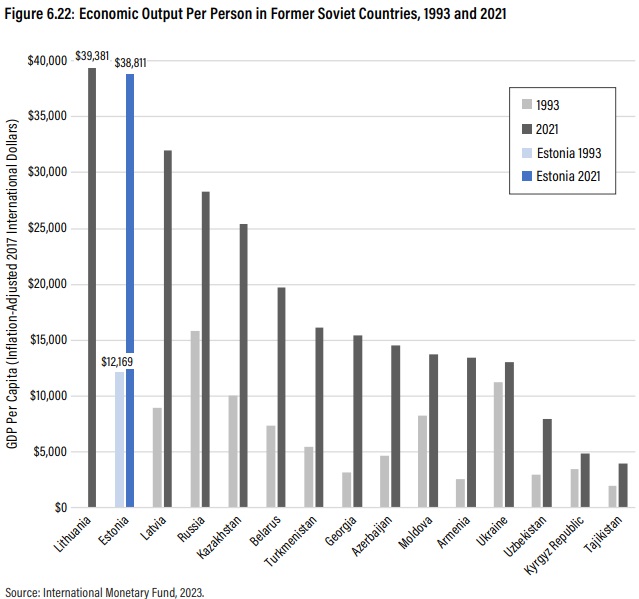
Estonia is a testament to the productive and ennobling power of freedom. …In contrast with others who had been trapped behind the Iron Curtain, the Estonian break from socialism was swift and bold. ….In 1993, GDP per capita in Estonia was just $12,169, but by 2021 it was $38,811, more than three times as much. This made Estonia the second-most prosperous former Soviet state, just a hair behind Lithuania, which was equally economically free. Estonia’s growth is not just impressive compared with other former Soviet states. Out of 169 countries worldwide, it had the 17th-fasted growth in GDP per capita from 1993 through 2021. …To put it briefly, Estonia’s achievements are astounding. In their first post-socialist generation, Estonians have built an enterprising culture and a wealthy society. They have vanquished poverty, privilege, and corruption. They have extended life and made premature death exceedingly rare.

To illustrate Estonia’s success, here is a look at per-capita economic output.

The obvious lesson (which I’ve discussed on other occasions) is that the post-Soviet nations with more economic liberty have enjoyed the best recoveries from communism.

Heck, even the OECD has acknowledged Estonia’s strong performance.

It’s almost as if there’s a recipe for poor nations to become rich nations.

Saturday, August 3, 2019

Estonia Experiments with Higher Taxes, Learns a Lesson

August 2, 2019 by Dan Mitchell @ International Liberty
 
When I write about Estonia, I generally have something nice to say.
Today, I want to add to my praise for this Baltic nation.

Unlike politicians in many other nations, lawmakers in Estonia responded wisely when they saw a tax increase was backfiring.
As Estonia tries to recover its alcohol customers lost to neighbouring Latvia due to high excise duty, the parliament in Tallinn has passed a 25% cut in excise duty rate. Estonian public broadcaster ERR reports that the bill was passed on Thursday, June 13, in the Riigikogu by landslide. In the final reading, the bill was passed by 70-9 MP in favour backing the cutting of the alcohol excise duty rates for beer, cider and hard liquor by 25% beginning July 1. The amendments to the Estonian Alcohol, Tobacco, Fuel and Electricity Excise Duty Law…are aimed at reducing cross-border trade of Estonians buying their drinks much cheaper in northern Latvia.
Of course, it’s worth pointing out that Estonian politicians shouldn’t have increased excise taxes on booze in the first place.

And they may have fixed the problem because they got on the wrong side of the Laffer Curve (i.e., tax revenue was falling), not because of a philosophical preference for lower tax rates.

But rectifying a mistake is definitely better than doubling down on a mistake, which is how politicians in many other nations probably would have reacted.

This approach, combined with the good policies listed above, helps to explain why Estonia is one of the few economic success stories to emerge from the collapse of the Soviet Empire.

Though, in closing, I’ll note that the country needs additional pro-market reform to deal with the challenge of demographic decline.

P.S. Read what Estonia’s Minister of Justice wrote about totalitarian socialism.

P.P.S. Also read about how Paul Krugman earned an “exploding cigar” with some sloppy analysis about Estonia.

Wednesday, November 21, 2012

The Estonian Solution To America’s Fiscal Cliff: Cut Spending

by Matthew Melchiorre on November 20, 2012

Real austerity brings real growth. That’s the story of Estonia, which broke the common European mold of tax increase-based economic retrenchment by taking an axe to its public sector. Economic data for the third quarter just released last week indicated that the small Baltic state was the fastest growing in the Euro Area.  I explain in USA Today how Estonia has succeeded, as well as what America can learn from its success and the rest of Europe’s failures. The Estonian government implemented an austerity program in 2009 composed two-thirds of spending cuts and one-third of tax increases. These were real cuts, too—cutting into public employee wages by 40 percent and slashing total government spending by 16 percent by 2011. Estonia’s economy contracted severely in 2009 but bounced back with 2 percent growth the following year and, for the past two years, has expanded more than twice as fast as that of Germany.  To Read More…..