Search This Blog

De Omnibus Dubitandum - Lux Veritas

Showing posts with label Argentina. Show all posts

Thursday, September 18, 2025

Can Milei-ism Save the United Kingdom?

September 13, 2025 by Dan Mitchell @ International Liberty

In an interview with Patrick Young, I pontificated on a wide range of issues.

Here’s a clip of me making the case that Javier Milei might save the world from a seemingly inevitable fiscal crisis.


If you don’t want to spend three minutes to watch the clip, my message is simple: Milei is showing the world – especially the supposedly conservative parties in different nations – that it is possible to solve a fiscal crisis with genuine spending restraint.

In the United Kingdom, a former member of Parliament has already grasped this message.

Here’s some of what Steve Baker wrote for City A.M., starting with his grim assessment of the United Kingdom’s fiscal situation.


This country stands on the brink of a fiscal crisis unlike anything we have seen in our lifetimes. The numbers are stark: a projected £41.2bn shortfall by 2029-30; a debt-to-GDP ratio nearing 96 per cent; and interest payments on government debt that doubled in a single year, now topping £16.4bn a month. …This isn’t some distant theoretical problem – it’s a looming catastrophe that will devastate millions of hardworking families within my lifetime. …Labour MPs refuse to countenance spending cuts and continue to demand higher spending that they simply cannot fund. The Chancellor raised taxes to record levels and will do so again within months. …We’re asking working people today to fund promises we know we cannot keep. Unfunded state and public sector pension liabilities are on top of that.

He’s right. If anything, he’s understating the problem on his side of the Atlantic.


Though I would add that it’s not just the fault of big-spending politicians from the Labour Party, though they are hopelessly bad.

The past two Prime Ministers from the Conservative Party have been big disappointments as well. Both Boris Johnson and Rishi Sunak surrendered on fiscal policy and pushed through more spending and tax increases.

Margaret Thatcher must have been spinning in her grave.

The author says that the United Kingdom needs a dramatic change. Indeed, the U.K. needs Milei-ism.

Argentina faced a choice between decline and radical reform. Milei chose reform, cutting government departments entirely, slashing public spending and refusing to fund the state through currency debasement. The results speak for themselves: inflation falling from over 200 per cent to manageable levels, the first budget surpluses in decades, and growing economic optimism. Argentina moved from basket case to economic poster child in 18 months. …We can continue pretending the welfare state is affordable and public services can improve through higher spending, or we can embrace the radical honesty that Argentina found under Milei, acknowledging that the current system has failed and building something better in its place. …The battle for our free future begins now.

Baker is right.

I went to the IMF’s big database and showed that copying Milei’s fiscal policy would yield amazing results for the United Kingdom.

In one fell swoop, Milei-ism would undo six years of bad fiscal policy and give the United Kingdom a budget surplus in just one year.

P.S. We also need Milei-ism in the United States. As well as France. And Italy. And…well, you get the idea.

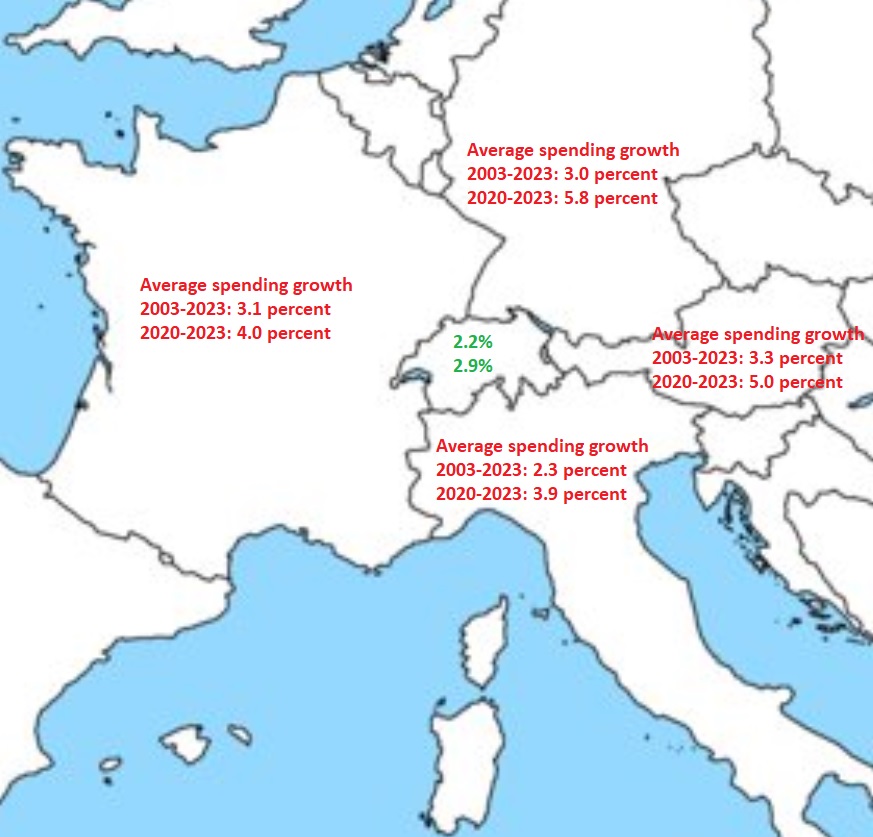
Pretty much everywhere in the world other than Switzerland.

Wednesday, August 27, 2025

The Most Important Election(s) of 2025

August 26, 2025 by Dan Mitchell @ International Liberty

Javier Milei has generated amazingly good results in just 20 months. But more reform is needed to undo the damage of 80 years of Peronism, which is why I explain that Argentina’s mid-term elections will be very important.

Milei wants to turn Argentina into the world’s freest economy. That won’t be possible so long as the left has de facto control of the nation’s legislature. So let’s examine the outlook for Milei and his party (La Libertad Avanza, or LLA) in the upcoming mid-term elections on October 26.

We’ll start with a look at Wikipedia’s summary of partisan divisions in both the Senate and the Chamber of Deputies.  As you can see, Milei’s LLA party holds only a small fraction of the seats (16 percent in the Chamber of Deputies and 8 percent in the Senate).

But you can see that Milei and LLA have allies, particularly the PRO party (akin to establishment Republicans in that they sort of want to do what’s right but have a weak track record).

Unfortunately, the Peronists (known as either UP or Fuerza Patria) easily have the most seats, so Milei has very limited ability to get reforms through the legislature.

The bottom line is some of the big changes that are still needed, such as labor market liberalization and tax reform, will only happen if Milei and LLA do very well in the October mid-term elections.

In the Argentinian system, their Senate is like the U.S. Senate, with six-year terms and 1/3 of seats up for election every two years. The Argentinian Chamber of Deputies, unlike the U.S. House, has four-year terms and 1/2 of seats are up for election every two years.

Here is a breakdown of the seats held by various parties and how many are being contested this October. The key thing to notice is that Milei’s party (LLA) is defending very few seats while the Peronists (Fuerza Patria) are defending about half of their seats.

One final thing to understand is how members get elected.

Wikipedia has a good explanation.

  • The 257 members of the Chamber of Deputies are elected by proportional representation in 24 multi-member constituencies based on the provinces (plus the City of Buenos Aires). Seats are allocated…with a 3% electoral threshold. In the 2025 election, 127 of the 257 seats are up for renewal for a four-year term.
  • The 72 members of the Senate are elected in the same 24 constituencies, with three seats in each. The party receiving the most votes in each constituency wins two seats, with the third seat awarded to the second-placed party. The 2025 elections will see one-third of senators renewed, with eight provinces electing three senators.

These rules mean that it is important for LLA to get the most votes in each province, particularly in the Senate since that automatically means winning two (out of three) seats.

I’ll close by defining victory for Milei.

Based on my conversations in Buenos Aires last week, the top goal is winning a plurality of votes. In other words, LLA doesn’t need a majority of votes (highly unlikely in a system of proportional representation), but Milei’s party needs to get more votes than the Peronists.

Next, it will be impossible for Milei and LLA to win a majority of legislative seats. However, they would be in a position to declare victory if they wind up controlling 1/3 of the Chamber of Deputies and can flip at least five Peronist-controlled Senate seats.

Those outcomes would not give Milei and LLA full control of the legislature, but at least there would be the possibility to work with independent legislators to advance a second stage of reforms.

And those outcomes would eliminate any risk of the Peronists having enough power to push their statist agenda.

P.S. I’m not ready to make any predictions, but I’m cautiously optimistic based on recent polling data along with the results from some regional elections earlier this year.

Tuesday, August 19, 2025

Shrinking the State in Argentina

August 16, 2025 by Dan Mitchell @ International Liberty

Since I’m a huge fan of Javier Milei’s free-market agenda, it’s very exciting to be in Argentina this week.

Two days ago, I shared some slides about Milei’s achievements from the head of the International Chamber of Commerce for Argentina.

Today, let’s look at some slides from Maximiliano Matias Farina, who works for Ministry of Deregulation and State Transformation, which he presented at the Liberty International World Conference.

We’ll start with this 50-year comparison of Argentinian growth with the average for the rest of Latin America. As you can see, Argentina has has been a laggard, with per-capita GDP expanding only 15 percent while the rest of the region enjoyed 100 percent-plus growth.

Having share similar examples of Argentina and divergence (see here, here, here, and here), I’m not surprised at these grim numbers.

After all, Argentina before Milei was the world’s worst-performing economy over the previous 100 years.

So there’s no question that Milei inherited an economic crisis.

What makes Milei special is how he responded. Part of his agenda has been deep spending cuts, which I’ve highlighted, and here’s a slide showing a few of the bureaucracies that have been eliminated

Milei has also been getting rid of bureaucrats.

Here’s a slide from Maximiliano’s presentation showing that 15 percent of the bureaucracy is now looking for jobs in the productive sector of the economy.

Last but not least, I want to share his slide that reviewed the amount of red tape imposed on watermelon sellers.

The slide on the right shows how much paperwork was necessary before Milei took office (the back stack) and how much is necessary now (the front stack).

The photo on the right reminds me of the comparison of labor law in Switzerland and France, modern-day union contracts, and the European Union’s strange version of a free-trade agreement.


Thursday, July 31, 2025

Milei Slashes Argentina’s Debt Burden

July 27, 2025 by Dan Mitchel @ International Liberty

The main goal of fiscal policy should be to shrink the burden of government spending, not to balance the budget or lower debt.

However, those two goals are not in conflict if policy makers pursue good policy. The evidence is overwhelming that spending restraint is a very effective way to limit red ink.

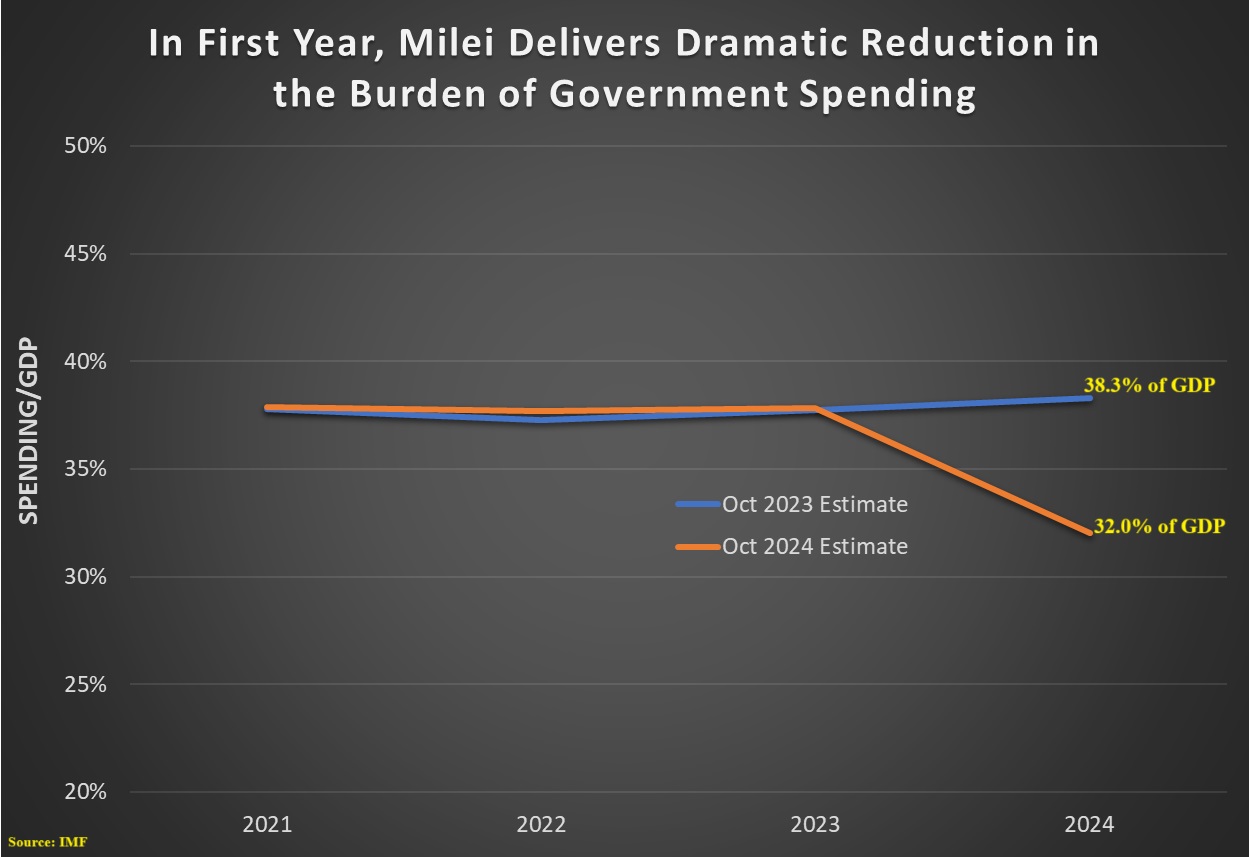
A good example is what has happened in Argentina. Thanks to big spending cuts, Javier Milei has implemented the largest peacetime fiscal consolidation in world history.

Lo and behold, look at how government debt has dramatically declined since he took office.

The above chart is based on the IMF’s big database. And if you peruse the numbers for Argentina, you’ll see that nominal debt has not actually decreased.

Instead, Milei has made progress for these two reasons.

  1. Nominal debt is no longer growing rapidly.
  2. Nominal GDP is growing rapidly.

The combination of these two factors means that debt as a share of GDP (debt/GDP) is quickly declining. Much as debt in the United States declined after World War II, albeit as a much slower rate than what we’re seeing in Argentina.


The key thing to understand is that debt is no longer growing rapidly in Argentina because Milei imposed record spending restraint

By the way, the same thing is actually happening today in Greece, though at a much more modest pace. All of which confirms what I wrote back in 2015.

And we have very powerful evidence from the 1800s showing that large debt burdens can be solved with spending restraint.

Sadly, it appears that American policy makers are incapable of learning.

P.S. Tax increases are not a successful strategy to reduce the burden of red ink.

P.P.S. Politicians can (and do) use inflation as a strategy to reduce debt burdens, but that only works in the short run and should be viewed as a form of financial repression.

Wednesday, July 30, 2025

Is Milei Winning Hearts and Minds?

July 29, 2025 by Dan Mitchell  @ International Liberty

Javier Milei’s economic agenda has been amazingly successful, which is hardly a surprise to people like me.

But is his libertarian agenda politically successful? Was his 2023 election a quirk, driven by the total failure of Peronism? Or has Milei created a durable movement in favor of economic liberty?

I’m cautiously optimistic, in part because Milei’s party did well in some regional elections earlier this year. And I’m also encouraged by polling data for the the mid-term elections this autumn (LLA is Milei’s party and the UxP are the Peronists).

That polling data is from late May, so I’m anxiously awaiting new numbers.

That being said, there are other positive signs for Milei. Here’s some encouraging polling data showing support for reducing the bureaucracy.

Some recent news reports also suggest that Milei is in good shape.

Here are some excerpts from a report in the latest issues of the Economist.…the Peronists are in disarray… Just 29% of Argentines say they will vote for them in the midterms, while nearly 40% plan to vote for Liberty Advances. …One good reason for the Peronists to worry is the sense that Argentine attitudes have profoundly changed. In 2011 some 70% of Argentines “wanted to live in a country where most things are done by the state rather than the private sector”, according to Isonomía, a pollster. 

By 2024 that number had fallen to 42%. …Mr Milei is well placed, but expectations are high. He must work with the opposition after the midterms, no matter the outcome. Only a third of the seats in the Senate and half of those in the lower house are up for grabs, and Mr Milei has only a few lawmakers now. His ability to legislate by decree, granted to him by Congress in 2024, expired on July 8th. …For a chance to truly crush the opposition, he must wait for the general election in 2027.

The good news is that Milei’s party almost surely will pick up seats.

The bad news is that the staggered elections (only 1/3 of Senate seats and 1/2 of lower house seats are up this year) make it well nigh impossible for Milei to win an overall majority.

Let’s look at another news report that has very encouraging polling data.

A Spanish-language article in Derecha Diario suggests that public opinion has shifted in the right direction. Here are some excerpts, courtesy of Google translate.


The vast majority of Argentines prefer to maintain the path pioneered by President Javier Milei and deepen the reforms underwayAccording to the study, conducted between July 8 and 9 on 1,830 cases across the country, 73.5% of respondents said they would vote for continuing the current course in the October elections… 

The results not only consolidate Milei’s leadership, but also reflect explicit approval of his reform program and a clear social mandate to continue cutting public spending , deregulating the economy , and advancing his ” chainsaw ” over the state. …Ahead of the October legislative elections, these figures represent a serious setback for the opposition parties, especially Kirchnerism, which has yet to define a clear strategy or a figure who embodies a convincing alternative to the libertarian ruling party. 

Interestingly, Milei gets his strongest support from the rich and the poor, as well as the young and the old.

By the way, the above numbers show Milei’s approval/disapproval rating and they are not overly positive.

However, I’m encouraged by the fact that the Peronists are underwater on their approval numbers. And a candidate/party with so-so approval numbers will probably prevail over a candidate/party with bad numbers.

Let’s close with one final bit of electoral data showing that Milei does best outside the capital city.

My fingers are crossed that Milei and his party are the victors this fall. That would show that the 17th Theorem of Government is not a national death sentence.

And it hopefully will give Milei momentum to deal with some of the big remaining challenges for his nation (including employment regulation, tax policy, and protectionism).

Wednesday, July 23, 2025

The Milei Miracle, Part II

I almost feel sorry for the 108 leftist economists who predicted back in 2023 that Argentina would suffer if Javier Milei won the presidential election.

Not only were they disappointed when he enjoyed a landslide victory, but the subsequent events in Argentina have shown that they were wildly wrong (all of which is discussed in my 10-part series: here, here, here, here, here, here, here, here, here, and here).

The bottom line is that libertarian policies have been incredibly successful.

Today, let’s look at even more evidence of Argentina’s remarkable renaissance.

We’ll start by recycling this tweet about the impressive wage growth in Argentina.

Very rarely in public policy do you see such a clear and obvious turnaround. Milei takes office, starts reducing the burden of government, and suddenly wages go up.

Opining for the U.K.-based Telegraph, Matthew Lynn celebrates Argentina’s recovery.


Moody’s this week gave Argentina its second upgrade since its radical libertarian president Javier Milei took power. It is yet more evidence of the dramatic improvement in the country’s fortunes. Growth has accelerated, inflation is coming under control, rents are falling and its debts are steadily becoming more manageable. …That is just one indicator among many. 

The economy overall is expected to expand by 5.7pc this year… Inflation came down to a monthly rate of 1.6pc last month…a lot lower than the 200pc-plus it was running at when Milei took office. …in the 18 months since Milei took office, Argentina’s economy has been transformed. It has been achieved by radically slashing the size of the state. 

Promising a “shock therapy” for the economy, the government has laid off more than 50,000 public sector workers, closed or merged more than 100 state departments and agencies, frozen public infrastructure projects, cut energy and transport subsidies, and even returned the state budget to a surplus. …open, free markets and a smaller state are the only way to restore growth, and Milei is proving it all over again.

Mr. Lynn concludes by wondering why people in other nations are not taking more notice.

The only question now is this: when will the rest of the world wake up to the Argentinian miracle?

Lynn also has a chart showing that Argentina is expected to enjoy very rapid growth this year.

However, since I don’t think economists are good forecasters, I would rather focus on what’s been achieved.

On that basis, I especially hope that folks on the left are paying attention to what’s happening.

If they really care about the poor, they should be Milei’s biggest supporters. Here are some details from a report by Adele Cardin in the Rio Times.

Argentina’s urban poverty rate dropped to 31.6% in the first half of 2025, its lowest level since 2018… Extreme poverty fell to 7.4%, down from 18.2% a year ago. This marks a significant turnaround after poverty surged to 52.9% in early 2024… The decline reflects a rare moment of income recovery and price stability. …real wages in the private sector grew 10.4% between December 2023 and May 2025, allowing incomes to finally outpace the rising cost of living. For lower-income groups, the shift was even sharper. Their incomes rose 8.5% in early 2025, while the cost of the basic food basket increased by just 2% over six months. …The speed of the poverty drop-over 21 percentage points in just one year-offers a rare signal of social improvement.

Once again, the data tell a very compelling story.

Here’s a chart showing what’s happened to poverty. Notice the steep decline that began shortly after Milei took office.

I’ll conclude by acknowledging that I don’t want to get too excited too quickly.

There’s no possibility of Argentina turning into another Switzerland in the next year or two. You don’t undo 80 years of terrible policy in just 19 months.

But Milei has achieved far more than I hoped for in a amazingly short period of time.

P.S. Gary Johnson now has an answer to the question he was asked back in 2016.

Thursday, July 17, 2025

Argentina Economy Update: All Is Proceeding As I Have Foreseen

July 15, 2025/ Francis Menton @ Manhattan Contrarian

https://images.squarespace-cdn.com/content/v1/503a5bade4b0b543ed240317/1e116159-4b84-4fc6-a4ba-235f83df84f1/Screenshot+2025-07-15+at+10.26.42%E2%80%AFPM.png?format=2500w

Javier Milei (pictured above) was elected President of Argentina in October 2023, and took office in December of that year. He promised large cuts to government spending, bureaucracy, and regulation as the means to revive a long moribund Argentine economy crippled by government over-spending, over-regulation, excess unionism, and corporate cronyism. But would Milei’s program work?

I last wrote about Milei’s implementation of his program in this post in November 2024. That post reported that Milei had succeeded in putting through substantial cuts in government spending and bureaucracy, but that the economy had experienced a recession during his first year in office in 2024. Likely much of that reported recession was not real, reflecting instead the removal from the GDP accounts of wasteful government spending that perversely had been counted as an addition to the economy. But would the economy then revive in 2025 as a result of the new program?

Since that post, I have held off writing further about Argentina, while waiting for sufficient data to make a call as to the success or failure of the Milei program. In recent days data have emerged as to Argentina’s economic performance through the first half of 2025. Here are reports from the OECD on July 7, the Rio Times on July 7, and Argentina Reports on July 10.

The bottom line is that the Argentine economy is now booming. From the Rio Times:

Argentina’s economy grew 7.6% in the second quarter of 2025, official data shows. This is the country’s best performance in years, coming after a long crisis marked by high inflation and shrinking incomes. The main drivers of this growth are a strong rebound in commerce and construction, both of which have responded quickly to new government policies. President Javier Milei’s government took office in late 2023 and made big changes.

To what is the sudden economic success attributable?

The administration cut government spending, ended the central bank’s money printing, and removed many rules that made business difficult. These steps helped restore confidence among investors and business owners. Official figures show private investment jumped 22.7% this year, and construction activity is up sharply. Inflation, which was over 200% in 2023, has dropped fast. By May 2025, monthly inflation fell to 1.5%.

The OECD report mainly focuses on the remainder of 2025 and 2026, predicting strong economic growth if the program of spending cuts (they call it “fiscal consolidation”) and deregulation is continued:

The latest OECD Economic Survey of Argentina projects GDP to grow by 5.2% in 2025 and 4.3% in 2026, following contractions in both 2023 and 2024. . . . “Argentina has achieved an unprecedented fiscal consolidation, but fiscal policy will require further fine-tuning to maintain fiscal prudence in the medium to long term while boosting potential growth,” OECD Director of Country Studies Luiz de Mello said. . . .

Over at Argentina Reports, they admit to skepticism about Milei’s program, but are forced to admit that it seems to be working:

Argentina’s economy recorded a surge of 7.7% in April 2025 compared to the same month last year, outperforming projected growth rates for the Latin American nation. . . . Though many continue to observe (them) with a skeptical eye, Milei may hope to regain the confidence of the Argentinian people with his austerity measures which seem to have fostered his promised economic turnaround.

Really, there’s nothing very complicated about this. Less government spending and less oppressive regulation freed entrepreneurs to go out and create businesses and wealth.

In other economic news from Argentina, during 2024 Milei ended controls on apartment rents. The result: apartment availabilities soared, and asking rents (inflation adjusted) actually went down. From the Cato Institute, February 19, 2025:

With the 2020 rent control law now scrapped, apartments have poured back into Buenos Aires’ rental market, offering a plethora of new options. On Zonaprop, one of Argentina’s largest real estate platforms, traditional rental listings have skyrocketed—from 5,500 before the reform to 15,300 today, a staggering 180 percent rise. A third of that increase occurred within just one month of Milei’s deregulation. Real (i.e. inflation-adjusted) rents have fallen, short-term workarounds are declining, and tenants are finding properties suited to their needs.

Meanwhile, we have a leading candidate for Mayor of New York who is proposing the exact opposite of the Milei program: higher taxes, more regulation, stricter rent controls, and increases in government-owned businesses. It seems that neither he nor his supporters can be bothered to look out there in the world to see which government policies work and which ones don’t.

Wednesday, July 16, 2025

Expanding the Milei Miracle: Pro-Growth Tax Reform

July 14, 2025 by Dan Mitchell @ International Liberty

Part I of this series celebrated economic progress in Argentina, but noted that many more reforms are needed.

Part II explained the need to liberalize labor markets. This new video, Part III in the series, points out that Argentina needs better tax policy.


The video cites a couple of very depressing statistics.

First, a recent OECD report notes that the aggregate tax burden in Argentina is the fourth highest in Latin America and the Caribbean in 2023.

And second highest (behind only the basket case of Brazil) when looking just at Latin America.

In either case, that’s bad news for Argentina.

Especially when you consider that people are not getting good value.

Which brings us to the second grim statistic.


As I noted earlier this year, Argentina is the world’s third-worst country in the 1841 Foundation’s Tax Hell Index. Which means a country that has a heavy fiscal burden combined with very poor scores for governance (bad rule of law, for instance).

The good news is that President Milei has been very successful in reducing the burden of government spending. This should give him some leeway to lower tax rates and (as shown in the video) eliminate a wide range of nuisance taxes.

Hopefully that will soon happen, especially if Milei’s libertarian-oriented party gains seats in the mid-term elections later this year (I’m cautiously optimistic).

I’ll close with an analogy to show what’s happened in Argentina. Imagine going to a doctor and finding out you have all sorts of health problems because you weigh 400 lbs.

You decide you need to get serious (the diet-and-exercise equivalent of electing Milei) and you weigh 300 lbs. at your next appointment.

The doctor is very impressed and happy with your progress, but he reminds you that you still need to lose at least another 100 lbs.

The bottom line is that Milei has an incredible goal of turning his country into a free-market Mecca. And he deserves immense praise for what’s already been accomplished, but so much more still needs to be done.

Remember, it took the Peronists about 80 years to drive Argentina into a ditch. Even in a best-case scenario, it will take a few years to undo all their mistakes.

P.S. Never forget that 100-plus leftist economists warned that Milei would produce disaster if he became president. Have a group of people ever been so wildly wrong?

Tuesday, July 15, 2025

Expanding the Milei Miracle: Labor Market Deregulation

July 11, 2025 by Dan Mitchell @ International Liberty

Part I of this video series gave a brief summary of how Javier Milei’s free market policies have rejuvenated Argentina’s economy.  But more reform is needed and this second video makes the case for labor market deregulation.

Politicians impose so-called employment protection laws because of “public choice.” To be more specific, they understand that the beneficiaries of such laws (certain incumbent workers, often unionized) will give them votes and campaign contributions in exchange for laws that allow them to exploit employers.

But I explained three years ago, when writing about Spanish policy, that such laws reduce overall job creation and depress wages for others.

  • Making it more expensive to hire workers means fewer workers will be hired.
  • Making it more expensive to fire workers means fewer workers will be hired.
  • Making it more expensive to employ workers means fewer workers will be hired.

To understand why Argentina needs labor market liberalization, here are the nation’s scores from Economic Freedom of the World (on a 0-10 ranking) as of 2022.

Other than regulations on the number of hours worked, Argentina gets failing grades.

The same is true when looking at the Heritage Foundation’s Index of Economic Freedom.

As you can see, Milei inherited a “Mostly Unfree” system of labor regulation.

Not as bad as the “Unfree” monetary policy he inherited, to be sure, but 55.2 (on a 0-100 scale) is a failing grade.

To conclude, Milei has an amazing list of accomplishments, but there’s a limit to how much he can liberalize using the powers of the presidency.

To promote job creation and higher wages, the legislature will need to repeal the nation’s horribly misnamed employment protection laws.

And since the Peronists still control the legislature, that presumably will depend on what happens later this year when Argentina has mid-term elections (based on my Fourth Theorem of Government, I’m cautiously optimistic).

P.S. Copying Denmark’s approach would be a good outcome for Argentina.

Monday, June 30, 2025

What’s the Most Important Election of 2025?

June 24, 2025 by Dan Mitchell @ International Liberty

Today, voters in New York City may elect a lunatic leftist as Mayor, following Chicago into the toilet of statism. Is that the most important election of 2025?

Later this year, voters in Argentina will decide in mid-term elections whether to give Javier Milei a governing majority in the legislature. Is that the most important election of 2025?

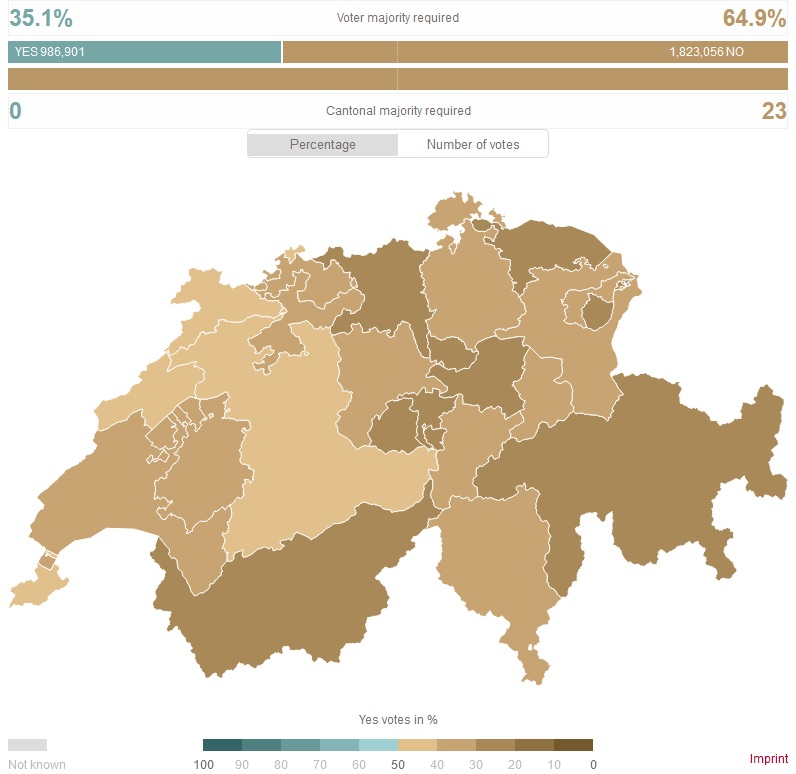
In November, Swiss voters will be voting whether to adopt a class-warfare nationwide tax on inheritances. Is that the most important election of 2025?

I’m not sure if there is a correct answer to these questions. For purposes of today’s column, though, let’s focus on the Swiss referendum. The good news is that the Swiss have a very good track record of making sensible decisions.

Heck, even the French-speaking regions of Switzerland are sensible.

But good voting habits in the past are no guarantee of good voting habits in the future. Based on excerpts from this report by Mercedes Ruehl for the Financial Times, people are worried.


The Alpine nation is due to hold a popular vote in November on the introduction of a federal tax on inheritances and gifts worth more than CHF50 million ($61 million). …the proposal does not include an exemption for spouses or direct descendants. The looming vote comes after the UK sparked a rush for the exit among wealthy foreigners by making the global assets of non-domiciled residents liable to inheritance tax – a move it is now considering reversing. Meanwhile, jurisdictions such as Dubai and Italy have stepped up efforts to lure the rich. … 

The new tax was proposed by the far-left Young Socialists party in 2022 as a way of raising money to tackle the climate crisis. Under Swiss law, such proposals go to a public vote if they are backed by 100,000 signatures. …The proposed tax would also affect those running the thousands of small- and medium-sized businesses, as well as entrepreneurial families, spread across the country, many of whom have their money tied up in the business…  

The new levy would place Switzerland above other jurisdictions such as Italy where inheritance taxes range between 4% and 8%, or Dubai and Hong Kong which have no inheritance or gift tax. Business lobby group Economiesuisse said this week that the initiative “endangers Switzerland’s position as a reliable and stable business location internationally”. …The federal council, the country’s executive branch, has rejected the initiative, as have the two houses of parliament.

Sadly, some damage already is occurring.

Lombard Odier had “seen Swiss-based families that have decided not to take any risk and to relocate ahead of the vote taking place”, while overseas clients had decided not to move to the country… Another Zurich-based private banker said a top client had relocated to Liechtenstein ahead of the vote.

 Since Liechtenstein is also a sensible nation, I certainly can understand why successful people think it’s a good place to live.

But hopefully Swiss voters will avert any possible exodus by delivering a crushing defeat to the class-warfare referendum.

There are very few countries in the world with good public policy. Switzerland is one of them (see here and here), and it would be great if it continued to be a role model.

It has a wide range of good policies, such as low taxesprivate retirement savings, and federalism.

My personal favorite is the country’s spending cap, which has been incredibly successful.

Let’s hope November’s vote doesn’t put the nation on a downward spiral.

Wednesday, June 25, 2025

Assessing Javier Milei, the World’s Best Leader: Part X

 June 21, 2025 by Dan Mitchell @ International Liberty

In Part VII of this series about Javier Milei’s libertarian policies in Argentina, I celebrated a 10-percentage point reduction in the nation’s poverty rate.

That’s amazing progress in a short amount of time.

As shown in this updated chart, that good news is now better news. The poverty rate has now fallen by 18-percentage points.

But the best news is that child poverty is dramatically declining.

Here are some excerpts from a report in La Derecha Diario.


…the UNICEF representative in Argentina, Rafael Ramírez Mesec, celebrated that “1.7 million children have come out of poverty” in the country over the past year, despite the strong adjustment promoted by the government of Javier Milei. The statements were made during an interview, where the official praised the policies implemented by the libertarian administration, highlighting as “very striking and worthy of note” the social outcome achieved. …” 

…It can’t be denied that it is a strong adjustment, with a 5-point reduction in GDP spending, and having managed to reduce poverty…”, stated Ramírez Mesec… The figure released by UNICEF is significant: 1.7 million boys and girls who have come out of poverty in a context where many voices predicted an irreversible deterioration of social indicators.

A story by Adele Cardin in the Rio Times also notes the huge progress in reducing childhood poverty.


Argentina reduced child poverty by 1.7 million in 2024 despite implementing one of Latin America’s most aggressive fiscal reforms, according to UNICEF and the INDEC statistics bureau. The national urban poverty rate plummeted from 52.9% to 38.1% in six months, while extreme poverty halved to 8.2%, marking the sharpest decline in decades. President Javier Milei’s administration achieved this while slashing public spending by 5% of GDP… 

Private-sector wages grew 3% above inflation in early 2025, restoring purchasing power after years of decline. …Milei’s reforms—deregulation, spending cuts, and currency stabilization—yielded Argentina’s first budget surplus in 14 years. …Argentina’s experiment offers lessons for nations balancing fiscal discipline and social protection. …1.7 million children now face better odds of breaking poverty’s cycle—a tangible outcome in a region long plagued by economic instability.

This news is so good that I wonder whether the lefty economists who warned against Milei’s election are having second thoughts?

But I doubt it. Support for statism is ideological, not rational.

Some of them are outright Marxists. Others are merely (but profoundly) naive.

In every case, however, it appears they want to make life worse for rich people more than they want to improve the lives of poor people.

As Margaret Thatcher famously observed, that’s one of the great tragedies of modern economic policy.

I have no doubt that many statists would love Milei to fail, even though lower-income people would be the biggest losers. That’s a damning indictment of those who put politics above humanity.

And it’s one of the reasons for my Eighth Theorem of Government.

Thursday, January 30, 2025

Assessing Javier Milei, the World’s Best Leader: Part VIII

January 29, 2025 by Dan Mitchell @ International Liberty

I wrote a few weeks ago about how 108 leftist economists, including  Thomas Piketty and Gabriel Zucman, were wildly wrong when they warned in 2023 that Javier Milei’s agenda would be “very harmful for the Argentine economy.”

This new video from John Stossel is further evidence of their ideological blindness.

I’m not surprised that Milei’s policies are working, of course, but I am surprised about how quickly we are seeing good results.

…these numbers are much better than I would have predicted. Milei is making radical changes and people losing government jobs and/or welfare benefits won’t necessarily have immediate success transitioning to the productive sector of the economy. Especially since there’s also usually some short-run pain when an economy is weaned off the sugar high of easy money and inflation. So I expected at least one year of bad economic news from Argentina before a rebound. Yet it seems the good news is already beginning to materialize.

Today, let’s look at more good news.

We’ll start with this tweet summarizing some of the positive outcomes.

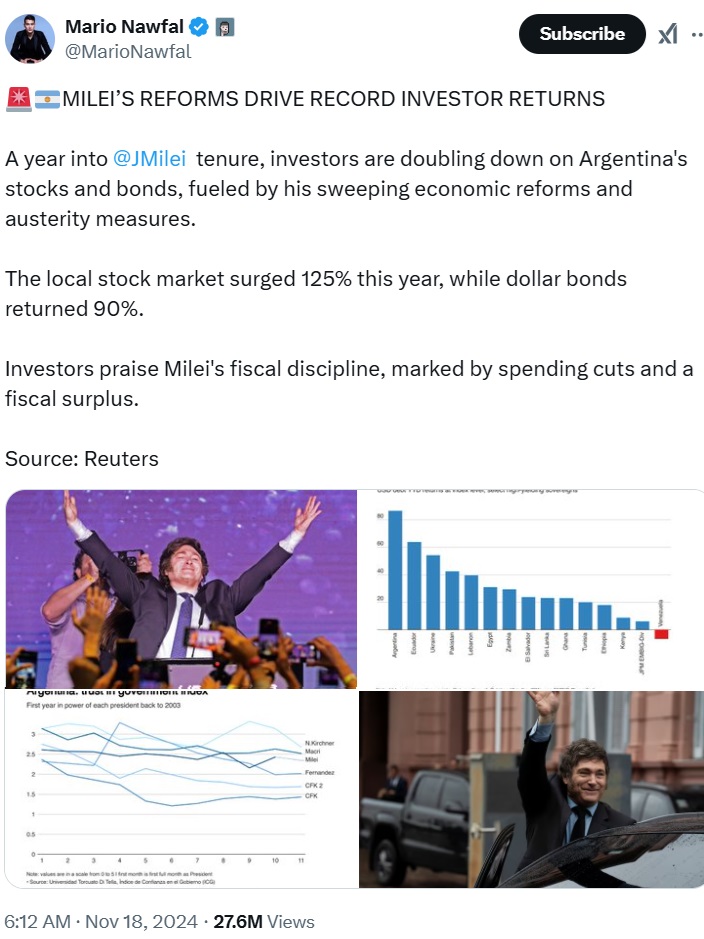
There’s even more evidence that investors are happy.

Here are some excerpts from a Reuters story by Walter Bianchi.

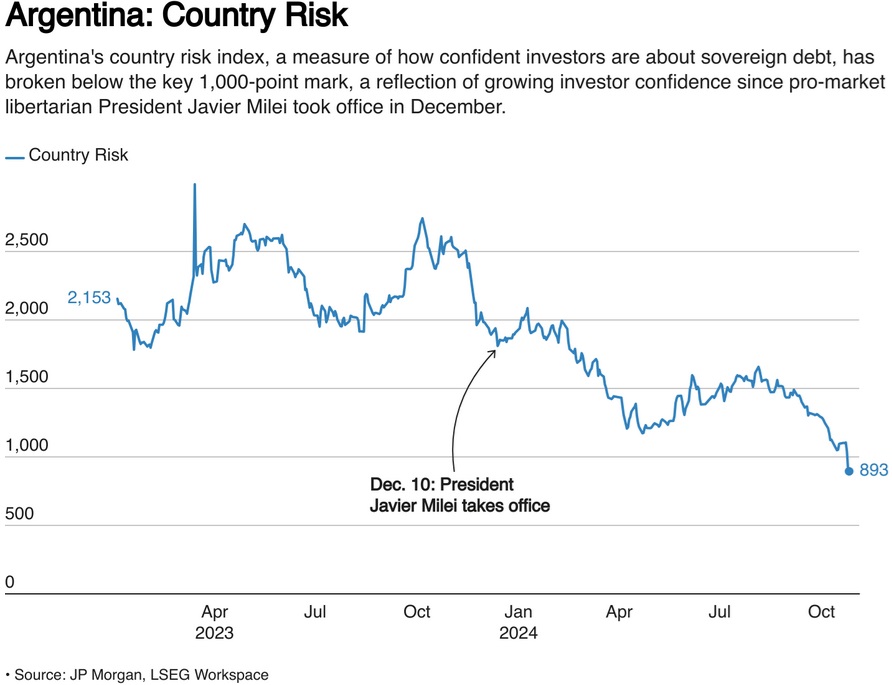
Argentina’s closely-watched country risk index, a reflection of how investors view the country’s debt, broke below a key level of 1,000 basis points on Friday, the lowest in at least four years as markets cheer libertarian President Javier Milei. …The new government has dramatically cut state spending, overturning a deep fiscal deficit, focused on rebuilding depleted foreign reserves, turned off the taps of new money supply and managed to temper triple-digit inflation. That’s gone down well with investors…while the long-embattled peso currency has strengthened.

Here’s a chart from the story showing the progress since Milei took office.

Many of my left-leaning friends won’t be impressed by good news from investors and for investors.

They will ask about poor people.

So they should be very happy about these passages from a report in the Buenos Aires Times.


With inflation tumbling from a peak of a monthly 25.5 percent and wages recovering some of the lost ground, the number of poor people had been reduced to as low as 36.8 percent by the end of the second half of last year… The data stem from the rigourous measurements by the economist and Universidad Torcuato Di Tella (UTDT) lecturer Martín González-Rozada.

The specialist estimated December’s Total Basic Shopping-Basket, calculating a reduction of poverty by 16.1 percentage points from its peak. …This situation propitiated a fall in the calculations of poverty and destitution for the last six months of last year, descending to 36.8 and 9.2 percent respectively with the number of destitute almost halved.

Even the Washington Post has noticed the good news, as indicated by these excerpts from a column by Ian Birrell.


The self-styled “anarcho-capitalist,” who campaigned with a chainsaw as a symbol of his desire to slash the bloated state and free the economy, has embarked upon a messianic mission to salvage his stagnant nation. Carried unexpectedly to power on a wave of public contempt for failed politicians and a corrupt elite, Milei is trying to unleash, in a statist society, a libertarian revolution that one aide described to me as “turbocharged Thatcherism.” …

This mercurial loner…is engaged in a high-risk gamble: to shake his country out of its decades-long stupor by slashing subsidies, sacking public servants, scrapping taxes, shutting ministries, ripping up regulations and privatizing scores of state enterprises from airlines and banks to football clubs and waterways. …Milei can point to significant successes in curbing the curse of inflation and shrinking the state…

Milei…has retained his popularity and has the support of about half the electorate, with an uptick in his ratings this fall. Much of his backing comes from fed-up younger voters, who flocked last year to support him and his exuberantly populist message of change. …“He has overachieved anybody’s expectations,” said one insider.

I’ll close by observing that I worry the news from Argentina may be too good. I want a recovery based entirely on fundamentals rather than investor confidence.

That being said, I’m sure Milei has things pointed in the right direction. Much more needs to happen, to be sure, but if he continues to make progress, there’s every reason to think that Argentina once again can be one of the world’s freest and richest nations.

Friday, December 27, 2024

Assessing Javier Milei, the World’s Best Leader: Part VI

December 10, 2024 by Dan Mitchell @ International Liberty

Today is the one-year anniversary of Javier Milei’s inauguration as President of Argentina. Let’s start our celebration with this video from Reason.

To grasp the challenge Milei faced upon taking office, I recommend you watch every second of the video.

But if you don’t have time for a 45-minute video, all you need to know is that Argentina was an utter economic disaster (see this graph from the Financial Times, this chart from the Economist, and this timeline from Human Progress).

Milei took office last December and immediately started slashing spending and red tape, and he’s achieved amazingly quick results.

Milei warned upon taking office that Argentina would suffer some short-run pain before there was a recovery.

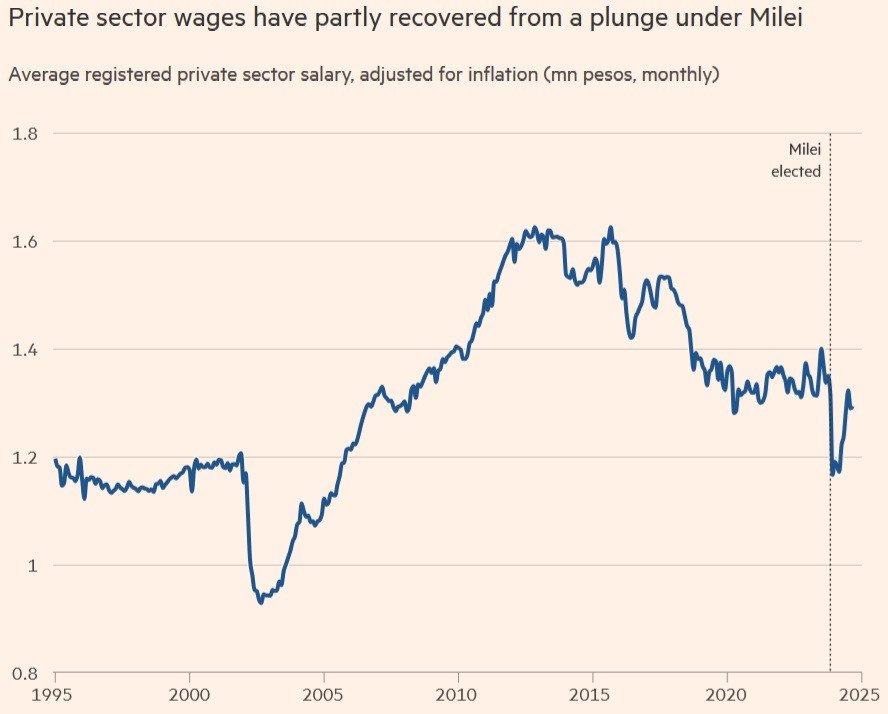
The good news is that there’s already evidence of economic improvement. As you can see from this chart, private-sector wages have begun to rebound after a lengthy period of decline.

The chart comes from a report in the Financial Times.

Here are some excerpts from that analysis.


Having taken over an economy on the brink of hyperinflation, Milei slashed the monthly inflation rate from 26 per cent last December to 2.7 per cent in October. The chronically depreciating peso — which Milei compared to “excrement” last year — has strengthened significantly against the black market dollar over the past six months.

Since his election, Argentina’s long-distressed sovereign bond prices have roughly tripled. …Milei has used executive powers to get around his lack of a majority in Congress, enacting hundreds of deregulation measures… He has also slashed public spending to deliver a primary fiscal surplus every month this year — after more than a decade of uninterrupted deficits… Milei has prioritised tackling Argentina’s inflation rate above all else. His main strategy has been “taking a chainsaw to the state”, as his catchphrase goes, cutting spending from 44 per cent to 32 per cent of GDP. …salaries in the public sector, which employs a fifth of workers, remain 17.5 per cent down. …

Investors are bullish… Argentina’s country risk — the premium over US Treasuries that investors demand to hold its bonds — has dropped from more than 2,000 basis points to about 750 since Milei took office.

Since the FT is a center-left establishment outlet, this is a remarkably positive summary of Milei’s achievements.

The people of Argentina seem to understand that things are getting better.

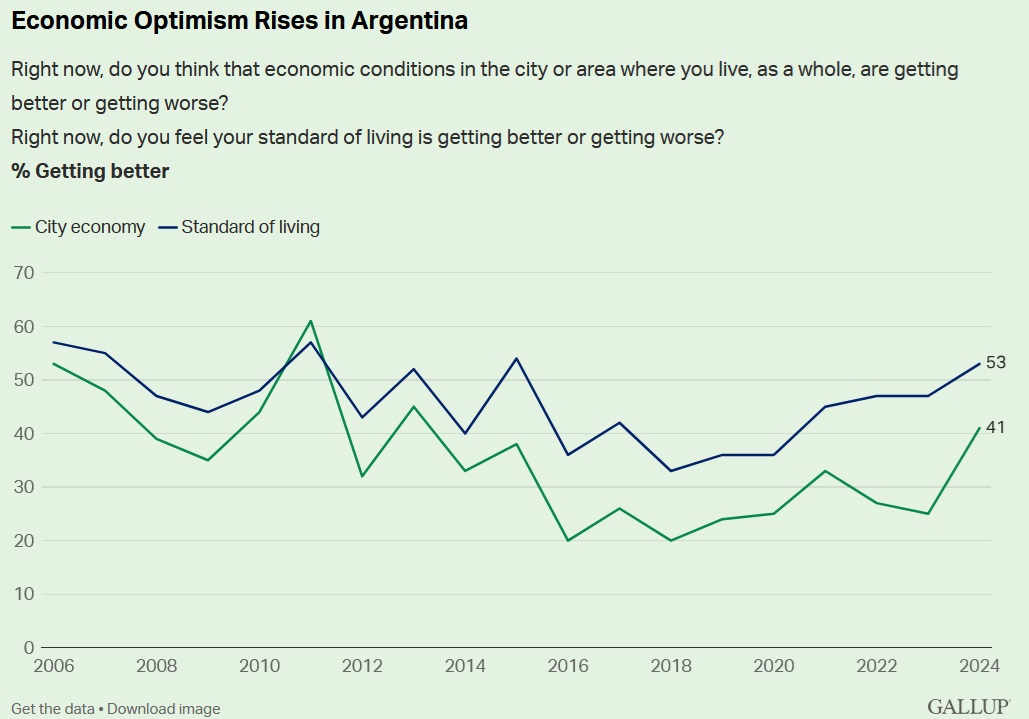
Here is some polling data from Gallup. Look at the uptick in optimism since Milei took over.

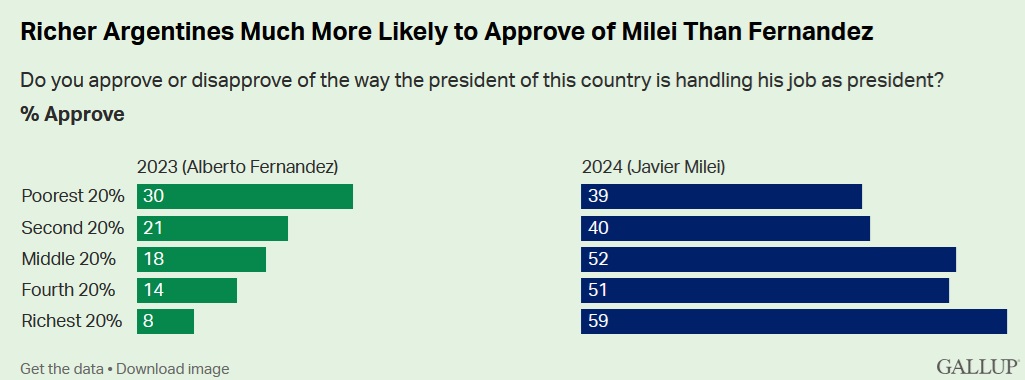
But here are the results that are even more impressive.

Even the poorest part of the population gives Milei higher approval rankings that his leftist predecessor.

Let’s conclude our one-year anniversary celebration with some passages from Mary Anastasia O’Grady’s recent column in the Wall Street Journal.


Mr. Milei begins his second year in office on Tuesday. He inherited a large fiscal deficit, swelling debt and a 2023 inflation rate of more than 200% from Peronist former President Alberto Fernández. At his inauguration Mr. Milei was careful to warn the nation that recovery would be painful. …Even so the president’s public approval is above 50%. He scores higher in public trust than any of the past three presidents after 12 months in office. …

The recession is probably over and next year the economy might grow 4% to 5%. Country risk has fallen sharply. Inflation still isn’t whipped…but relative to recent history it’s tame. For now he can boast a softer-than-expected landing and some stability, which a year ago seemed out of reach. …Where deregulation happens, prices decline in the range of 30%.

For his first year in office, Milei passes with flying colors. He is showing the world that free markets are the recipe for growth and prosperity.

P.S. Here are previous columns in this series.

  • In Part 1 of this series, I showed how Javier Milei has done a great job shrinking the burden of government spending.
  • In Part II, I investigated how much he might be able to improve Argentina’s ranking in Economic Freedom of the World.
  • In Part III, I shared central government spending data to reveal that Milei has been outstanding rather than merely  impressive.
  • In Part IV, I reviewed two of the major structural obstacles to Milei’s agenda of economic reform and national revival.
  • In Part V, I examined Milei’s efforts to reduce the suffocating impact of excessive regulation on Argentina’s economy.


Assessing Javier Milei, the World’s Best Leader: Part VII

December 19, 2024 by Dan Mitchell @ International Liberty

Argentina’s economy suffered a dramatic decline from 1946-2023 because of statist policy.

The economy became such a disaster that voters shocked the world in late 2023 by choosing Javier Milei, a hard-core libertarian, to be their next president.

Even though the Peronists still control the legislature, Milei has been somewhat successful in pushing his laissez-faire agenda. Over the past month, I’ve assessed his performance.

  • In Part 1 of this series, I showed how Javier Milei has done a great job shrinking the burden of government spending.
  • In Part II, I investigated how much he might be able to improve Argentina’s ranking in Economic Freedom of the World.
  • In Part III, I shared central government spending data to reveal that Milei has been outstanding rather than merely  impressive.
  • In Part IV, I reviewed two of the major structural obstacles to Milei’s agenda of economic reform and national revival.
  • In Part V, I examined Milei’s efforts to reduce the suffocating impact of excessive regulation on Argentina’s economy.
  • In Part VI, I shared a video on his impact as part of a look at the country on the one-year anniversary of his inauguration.

Today, let’s look at what has happened to the economic status of poor people since Milei took office.

This is supposed to be his weakness. A web search generates dozens and dozens of stories about Milei’s budget cuts ostensibly causing a big spike in poverty.

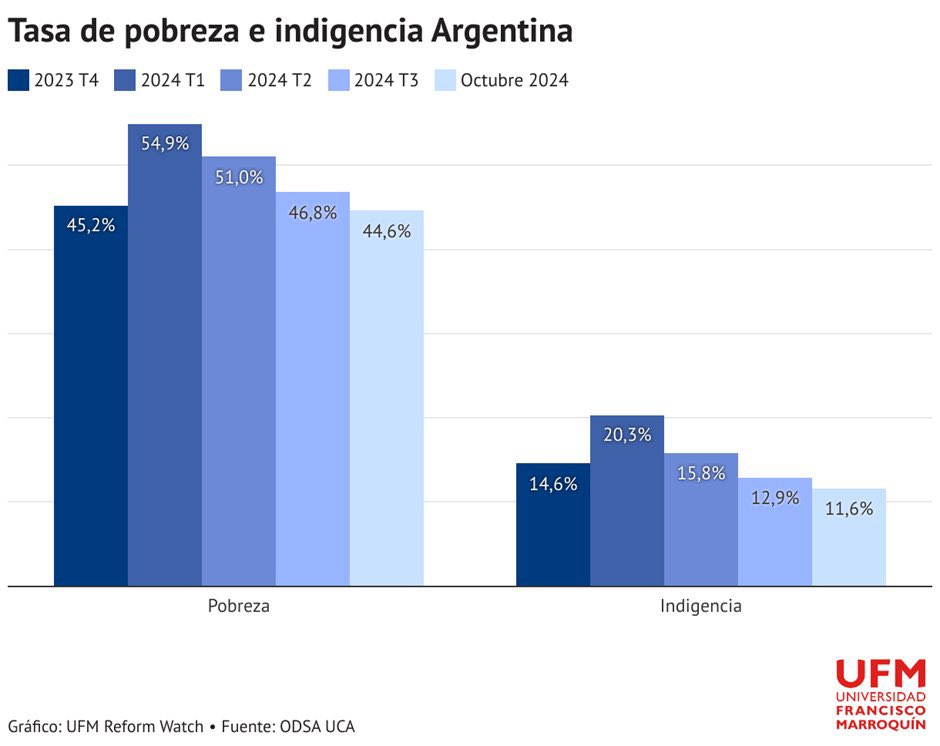
And poverty did jump at first, as shown in this chart based on data from the Universidad Catolica Argentina (UCA).  Especially between the final quarter of 2023 and the first quarter of 2024 (“pobreza” is regular poverty and “indigencia” is even worse).

Here’s some analysis of the data from Charles Lajoie.

…let’s see the UCA’s projections for the third trimester of 2024 (average of July, August and September) and the month of October 2024. …its microsimulations have projected a 46.8% poverty rate for the first period and a 44.6% poverty rate for October. We can also observe that the poverty rate for the fourth trimester of 2023 (average of October, November and December) was 45.2%, a higher rate than their latest projection.

However, even this number is a bit misleading if used as the pre-Milei data point, since the poverty rate of the month Milei took office stood at 49.5%, according to the same university… Therefore, if these projections are accurate, the poverty rate was already 5.3 percentage points lower 2 months ago than at the beginning of Javier Milei’s presidency.

I’m not a big believer in drawing sweeping conclusions based on less than a year’s worth of data, but I will say that these numbers are much better than I would have predicted.

Milei is making radical changes and people losing government jobs and/or welfare benefits won’t necessarily have immediate success transitioning to the productive sector of the economy.

Especially since there’s also usually some short-run pain when an economy is weaned off the sugar high of easy money and inflation.

So I expected at least one year of bad economic news from Argentina before a rebound. Yet it seems the good news is already beginning to materialize.

Let’s now dig into some more numbers, this time from the Universidad Torcuato Di Tella.

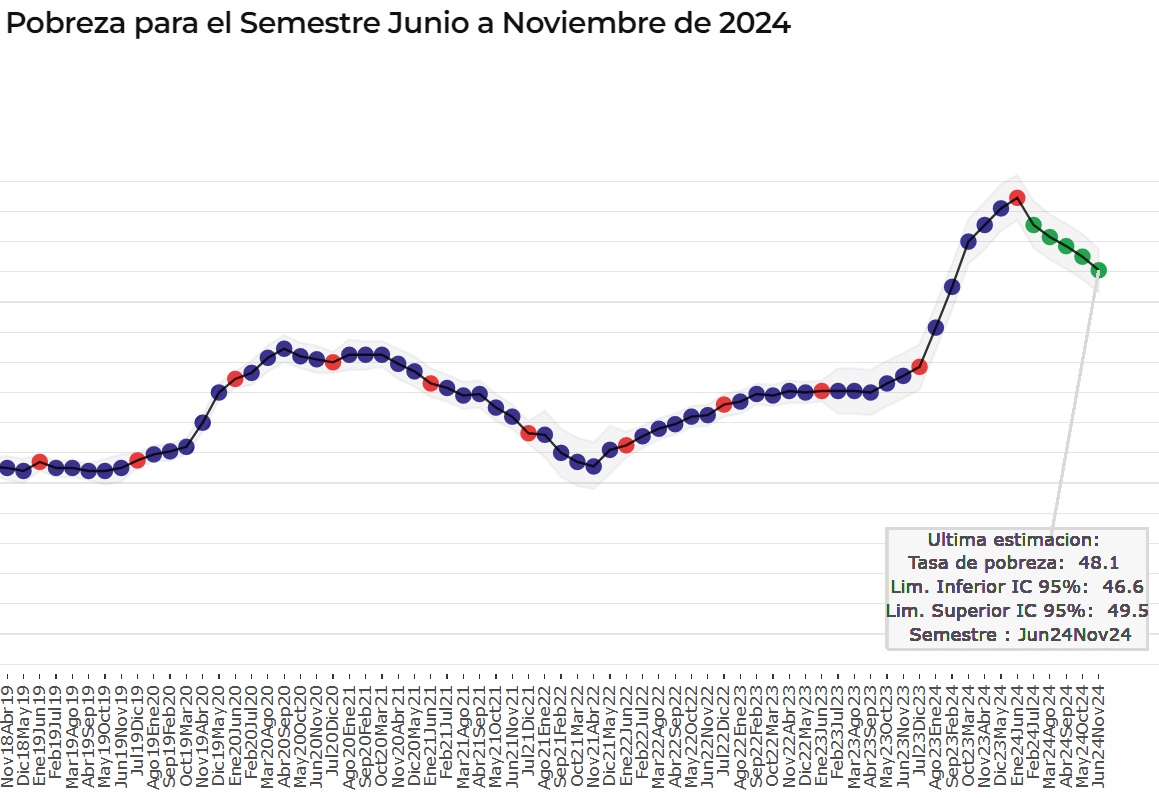
Once again, there was an increase in poverty immediately after Milei took office. But now the trend is very positive.

Now let’s look at some more analysis from Charles Lajoie.

The Universidad Torcuato Di Tella has also projected a reduction of the poverty rate since December of 2023, their latest number indicating that the poverty rate for the bimester of October and November stood at 45.7%… Putting this together with the findings of the UCA, taking into account the fact that the latest estimate we have is a bimester starting 2 months ago and considering that nominal wage growth has outpaced inflation every single month from April to September according to official INDEC data (likely during the last 2-3 months as well since inflation has hit record lows and the economy is growing substantially again), I think it’s fair to say that it would be a quasi-impossibility for poverty to be higher than 49.5% at the moment. Poverty is almost undoubtedly lower today than when Milei first entered the Casa Rosada.

I’ll conclude with two observations.

First, Lagoie makes a persuasive case that poverty is lower today that when Milei took office. That’s very impressive, but what really matters is that he has changed the direction. Poverty was on an upward trajectory when he took office and now it’s declining.

Here’s an analogy that I used in an e-mail exchange about Milei with some leftist friends yesterday, I asked, “If you’re a copilot in a plane and the pilot has you hurtling toward a crash landing at 300 miles per hour and you decide to take the controls, will you instantaneously be climbing? Or will it take some time to arrest the fall and begin to ascend (especially if the pilot is still trying to crash the plane)?”

Just in case my point isn’t obvious, the Peronists (who still control the legislature and used to hold the presidency as well) are the suicidal pilot and Milei is the copilot trying to avert disaster.

My second observation is that we obviously will be able to more confidently assess Milei’s performance when we’re looking at several years of data. I hope he is able to make the changes Argentina needs. And if that happens, there’s no question we’ll have great results.