Search This Blog

De Omnibus Dubitandum - Lux Veritas

Showing posts with label Switzerland. Show all posts

Wednesday, October 22, 2025

Part III: Is Switzerland the World’s Best Nation?

October 21, 2025 by Dan Mitchell @ International Liberty

Building on yesterday’s column, let’s look at some more data about the “improbable success” of Switzerland.

We’ll start with a comparison of per-capita GDP, showing Switzerland out-performing other nations (I’ve shared similar charts in previous columns).

The chart comes from Simon Grimm, who shared some thoughts after his recent trip to Switzerland.

As you read these excerpts, keep in mind that he is using “liberal” in the European sense, meaning free markets.


Switzerland is far wealthier than most of Europe. The country has a median household income higher than that of the United States…and the world’s highest share of Fortune 500 companies relative to its GDP. …But the country is rarely discussed… Given Europe’s stagnant economies and increasing debt burden, this seems like an oversight… 

Switzerland differs from most of Europe: its economic governance is far more liberal. All else being equal, this should explain a large part of Switzerland’s economic success. …The country has low corporate taxes, flexible labor laws, and a large number of free trade agreements. 

Unlike France or Germany, income taxes are mostly levied on the state level, incentivizing local administrations to run efficiently for fear that citizens will move to low-tax states. This provides the country both with a debt-to-GDP-ratio of only 38% and some of the lowest income taxes in Europe… 

Relatively liberal parties always make up a majority of the government… Voters reject nearly all ballot initiatives that might threaten Switzerland’s economic position: a 2012 referendum increasing the number of mandatory holidays was rejected by 66% of voters. …overall, Switzerland…seems like a good example of what a century-long attachment to liberalism can yield.

Professor John Cochrane of the Hoover Institution also wrote about Switzerland after a recent trip.

He’s particularly impressed by Switzerland’s fiscal policy.


Swiss inflation barely exceeded 3% in the post-pandemic surge, and is back to zero. …Here is recent Swiss fiscal policy. The worst deficit in the pandemic was under 20 billion, or about 3% of GDP. The US by contrast hit 25% of GDP deficit. The budget went quickly back to balance — total balance not just primary balance. Debt is a tiny 16.8% of GDP. Yes, 16.8, not 168. … 

Balance is not just accidental. Switzerland has a constitutional “debt brake,” passed by referendum, that requires cyclical budget balance. …adding it all up, it’s if anything a puzzle that the Swiss had any inflation at all. The deficit was very small. The debt was tiny. And, most of all, the “debt brake” assures people that the debt will be repaid.

Here’s a chart from his analysis.

It’s in French, but all you need to know is that the blue line is revenue and the green line is spending. The purple bars are surpluses or deficits.

Cochrane is certainly correct that Switzerland has far less debt than its neighbors.

And I’m obviously a fan of the Swiss debt brake (which actually functions as a spending cap).

But I think he’s missing the most important fact, which is that Switzerland has a much lower burden of government spending.

This is what allows the nation to have low taxes. This is what enables prosperity since the government is not diverting as many resources from the productive sector of the economy.

Tuesday, October 21, 2025

Part II: Is Switzerland the World’s Best Nation?

October 20, 2025 by Dan Mitchell @ International Liberty 

I’ve shared a two-part video series (here and here) on the “improbable success” of Switzerland.

Building on that, here’s a report from CNBC about the “world’s best nation.”

There are many reasons to admire Switzerland.


Today, let’s heap more praise on the Alpine Republic.

Some of it, surprisingly, from an article in the New York Times by Ruchir Sharma.

Here are some excerpts.


There is…a country far richer and just as fair as any in the Scandinavian trio of Sweden, Denmark and Norway. But no one talks about it. This $700 billion European economy is among the world’s 20 largest, significantly bigger than any in Scandinavia. It delivers…lighter taxes, smaller government, and a more open and stable economy. Steady growth recently made it the second richest nation in the world, …with an average income of $84,000, or $20,000 more than the Scandinavian average. … 

This less socialist but more successful utopia is Switzerland. …Capitalist to its core, Switzerland imposes lighter taxes on individuals, consumers and corporations than the Scandinavian countries do. In 2018 its top income tax rate was the lowest in Western Europe at 36 percent, well below the Scandinavian average of 52 percent. Government spending amounts to a third of gross domestic product, compared with half in Scandinavia. …The Swiss have become the world’s richest nation by getting it right.

I’m not sure why the author wrote that Switzerland is “less socialist” while then soon after noting that the country is “capitalist to its core.”

That seems like “not socialist” to me, but overall, a fair article.

The Swiss also got some positive attention from the U.K.-based Economist, which ranked Switzerland as having the world’s most innovative economy.

And the OECD ranks Switzerland as having the best combination of political efficiency and democracy satisfaction.

Since I occasionally compare Switzerland and France, I think this visual is very compelling.

By the way, I’m assuming the slender Swiss document is in multiple languages, so the above image actually understates Switzerland’s advantage.

Last but not least, here’s a potential explanation for why Switzerland is so far ahead of its neighbors.

There are some versions of “right” that I don’t particularly like, so the most important part of the above visual is the last sentence.

In my simple way of thinking about the world, Switzerland is a case study for why “classical liberalism” is the best role model. Though nowadays it would be called small-government conservatism (or Reaganism) in the United States and “neoliberalism” in Europe.

P.S. As I wrote in 2011, I nonetheless prefer the United States over Switzerland.

Friday, August 29, 2025

Switzerland’s Superior Fiscal Discipline

August 28, 2025 by Dan Mitchell @ International Liberty

When I wrote yesterday about Germany, I could imagine readers shrugging their shoulders and thinking it was just another column about European decline. Indeed, I’ve written similar columns about other welfare states such as France, Italy, Spain, and the United Kingdom. Though not all European nations are the same. I wrote back in May, for instance, about Denmark moving in the right direction.

For purposes of today’s column, however, I want to look at Switzerland.

More specifically, I want to compare Switzerland’s prudence and Germany’s decline. Here’s a chart, based on the IMF’s database, comparing annual growth of overall government spending in the two nations. As you can see, Germany has increased the fiscal burden of government at a much faster rate than Switzerland since 2015.

From an economic perspective, the best way of measuring the burden of government is to see what share of a nation’s economic output is being consumed by the public sector.

Switzerland is much better than Germany in that regard, with 32.1 percent of GDP diverted to government compared to 49.9 percent of GDP going to government in Germany.

But trends also are important, and this next chart shows that the economic burden of government spending has dramatically increased in Germany (and fallen slightly in Switzerland).

I’m tempted to highlight the critical role of Switzerland’s spending cap and conclude this column. But since the majority of my readers are from the U.S., let’s expand today’s analysis by including data on what has happened to government spending in America over the same time period. Lo and behold, we see that politicians in the United States have been even worse than German politicians.

However, since the United States has enjoyed faster economic growth, the government/GDP ratio has not deteriorated as much. Here’s a chart showing how the burden of government spending has increased in the U.S., but fortunately not as much as it has expanded in Germany.

The should-be-obvious takeaway is that lawmakers should strive for both spending restraint and faster growth. That’s the recipe for shrinking the burden of government spending. At this point, I could wrap up with another endorsement of Switzerland’s spending cap. But I want to make one final point.

I recently saw on Twitter this analysis of interest rates in six key nations, including Germany, Switzerland, and the United States. Notice that interest rates are trending higher in every country other than Switzerland. Why? Because investors can look at Swiss fiscal policy and feel confident that there won’t be a future crisis.

Yes, Switzerland did make the mistake of spending more money during the pandemic, and that pushed up interest. But not nearly as much as spending increased and interest rates rose in the other five nations.

The moral of the story is that investors obviously are much less concerned about a potential default (or some other type of fiscal crisis) in Switzerland. And they obviously are much less worried about politicians using the printing press to finance budget deficits (which also would push up interest rates).

So now I’ll conclude by saying that the United States (as well as Germany, Australia, Canada, and the United Kingdom) should copy Switzerland’s spending cap.

You can click here to learn more about that much-needed reform.

Monday, June 30, 2025

What’s the Most Important Election of 2025?

June 24, 2025 by Dan Mitchell @ International Liberty

Today, voters in New York City may elect a lunatic leftist as Mayor, following Chicago into the toilet of statism. Is that the most important election of 2025?

Later this year, voters in Argentina will decide in mid-term elections whether to give Javier Milei a governing majority in the legislature. Is that the most important election of 2025?

In November, Swiss voters will be voting whether to adopt a class-warfare nationwide tax on inheritances. Is that the most important election of 2025?

I’m not sure if there is a correct answer to these questions. For purposes of today’s column, though, let’s focus on the Swiss referendum. The good news is that the Swiss have a very good track record of making sensible decisions.

Heck, even the French-speaking regions of Switzerland are sensible.

But good voting habits in the past are no guarantee of good voting habits in the future. Based on excerpts from this report by Mercedes Ruehl for the Financial Times, people are worried.


The Alpine nation is due to hold a popular vote in November on the introduction of a federal tax on inheritances and gifts worth more than CHF50 million ($61 million). …the proposal does not include an exemption for spouses or direct descendants. The looming vote comes after the UK sparked a rush for the exit among wealthy foreigners by making the global assets of non-domiciled residents liable to inheritance tax – a move it is now considering reversing. Meanwhile, jurisdictions such as Dubai and Italy have stepped up efforts to lure the rich. … 

The new tax was proposed by the far-left Young Socialists party in 2022 as a way of raising money to tackle the climate crisis. Under Swiss law, such proposals go to a public vote if they are backed by 100,000 signatures. …The proposed tax would also affect those running the thousands of small- and medium-sized businesses, as well as entrepreneurial families, spread across the country, many of whom have their money tied up in the business…  

The new levy would place Switzerland above other jurisdictions such as Italy where inheritance taxes range between 4% and 8%, or Dubai and Hong Kong which have no inheritance or gift tax. Business lobby group Economiesuisse said this week that the initiative “endangers Switzerland’s position as a reliable and stable business location internationally”. …The federal council, the country’s executive branch, has rejected the initiative, as have the two houses of parliament.

Sadly, some damage already is occurring.

Lombard Odier had “seen Swiss-based families that have decided not to take any risk and to relocate ahead of the vote taking place”, while overseas clients had decided not to move to the country… Another Zurich-based private banker said a top client had relocated to Liechtenstein ahead of the vote.

 Since Liechtenstein is also a sensible nation, I certainly can understand why successful people think it’s a good place to live.

But hopefully Swiss voters will avert any possible exodus by delivering a crushing defeat to the class-warfare referendum.

There are very few countries in the world with good public policy. Switzerland is one of them (see here and here), and it would be great if it continued to be a role model.

It has a wide range of good policies, such as low taxesprivate retirement savings, and federalism.

My personal favorite is the country’s spending cap, which has been incredibly successful.

Let’s hope November’s vote doesn’t put the nation on a downward spiral.

Tuesday, May 6, 2025

Part II: What’s the Better Role Model, France or Switzerland?

May 2, 2025 by Dan Mitchell @ International Liberty

Editor's Note: First, the term "economic freedom" should never appear in an article with any European nation unless it describes the lack thereof in my view.  All of Europe has been socialist forever in lesser or greater degrees and recent decades the green movement has worsened their economic viability.  As for being good on trade, libertarians have a disturbing mental block about the reality of trade agreements and tariffs.  Having said that, I published this anyway. RK

Switzerland is a role model (the freest nation, the most-sensible nation, etc) and France is suffering from statism (biggest spending burden, confiscatory taxes, etc).

As such, nobody should be surprised to learn that Switzerland is more prosperous. But even I was surprised to see data from the World Bank showing that per-capita GDP is more than two times higher than it is in France.

That’s a jaw-dropping difference, especially since the two countries were almost equal 50 years ago. So we definitely have another entry for our anti-convergence club.

I first compared France and Switzerland back in 2013.

All that has happened in the past dozen years is that Switzerland has maintained much better policy and widened its economic advantage.

I normally highlight fiscal policy differences when comparing nations, but here’s a tweet from Michael Arouet showing the difference between Swiss labor law and French labor law.

What makes the comparison even more dramatic is that the the Swiss labor law pamphlet would be much smaller if it was just printed in one language like the French book.

But the Swiss version includes separate sections show their labor law in French, German, Italian, and Romansh.

The obvious takeaway, as Mr. Arouet notes, is that it obviously is much simpler to create jobs in Switzerland.

I’ll close by showing how both nations rank according to the latest edition of the Fraser Institute’s Economic Freedom of the World.

Give France credit for being better on trade, but Switzerland wins the other four categories.

P.S. Looking at specific issue areas, Switzerland has better policy on health care, retirement, and many different ways of measuring fiscal policy. And it goes without saying that the Swiss are better on gun rights.

Tuesday, December 24, 2024

HFI24: Switzerland Stays Number One

December 18, 2024 by Dan Mitchell @ International Liberty

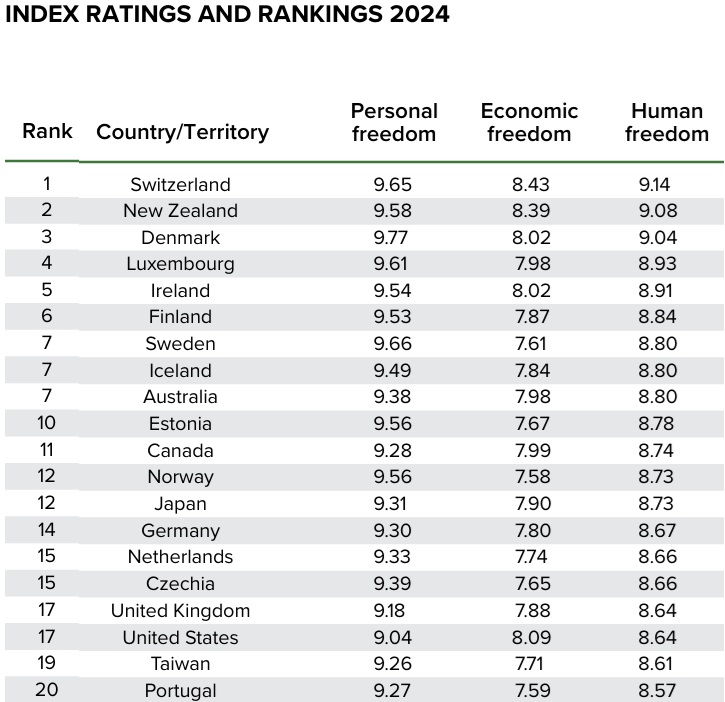
The new Human Freedom Index has been released and – just like last year – the “sensible nation” of Switzerland wins the gold medal as the jurisdiction with the highest level of economic and personal freedom.

Here are the world’s 20-freest nations (out of a total of 165 jurisdictions), with New Zealand and Denmark winning the silver and bronze medals. The United States ranks #17, tied with the United Kingdom, which is decent but not great.

The three worst nations for human freedom are all in the Middle East. Syria is last, followed by Yemen and Iran. Though hellholes such as Cuba and North Korea almost surely are worse, but they are not in the rankings because of inadequate data.

Before offering my observations on some of the findings, here are some passages from the report’s executive summary.


Human freedom deteriorated severely in the wake of the coronavirus pandemic. Most areas of freedom fell, including significant declines through 2022 in freedom of movement, expression, and association and assembly; and in sound money. After having fallen significantly in 2020 and further in 2021, human freedom increased in 2022 but remained well below its pre-pandemic level… On a scale of 0 to 10, where 10 represents more freedom, the average human freedom rating for 165 jurisdictions fell from 6.98 in 2019 to 6.76 in 2020 and to 6.73 in 2021, and then increased in 2022 to 6.82. On the basis of that coverage, 87.4 percent of the world’s population saw a fall in human freedom from 2019 to 2022, with many more jurisdictions decreasing (130) than increasing (28) their ratings and 7 remaining unchanged. …Jurisdictions in the top quartile of freedom enjoy a significantly higher average per capita income ($56,366) than those in other quartiles; the average per capita income in the least free quartile is $15,826. The HFI also finds a strong, positive relationship between human freedom and democracy, and between human freedom and a range of human well-being indicators including tolerance, charitable giving, life expectancy, and environmental health, among other measures.

I’ll now draw attention to three things from the report, two of them depressing.

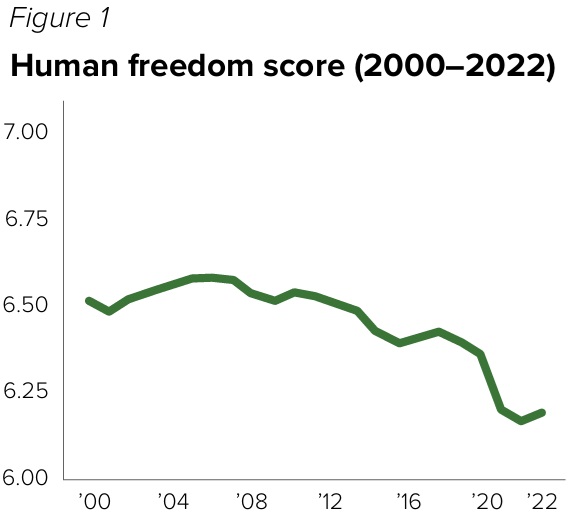
The first depressing observation is that overall human freedom has declined in recent decades, as depicted by Figure 1 from the report.

For what it’s worth, the decline is due to an erosion in personal freedom. Average economic freedom scores have increased over time (to be more specific, declines in the western world have been more than offset by improvements in less-developed countries).

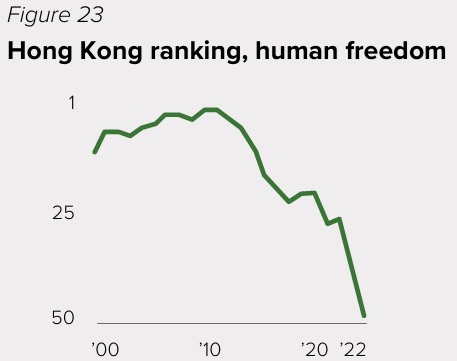
The second depressing observation is about Hong Kong.

As you can see from this next chart, that jurisdiction’s relative ranking has precipitously declined. It used to rank in the top 10 and now it has fallen to #50. Some of the decline is economic policy, but the big problem is a decline in personal liberty.

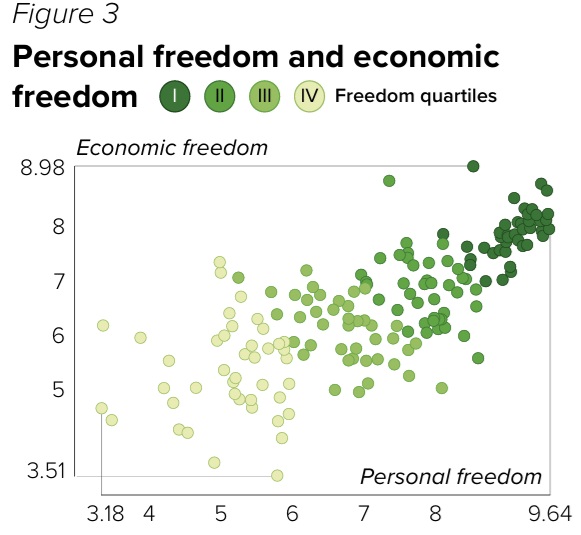
Now for an observation that is neither cheerful nor depressing. Here’s what the report said about how governments normally having a similar approach to both personal and economic liberty.

But normally is not always.

The correlation between the personal and economic freedom ratings is high (0.73). …Some countries ranked consistently high in both personal and economic freedom. …By contrast, some countries that ranked high on personal freedom ranked significantly lower in economic freedom. For example, Suriname ranked 41st in personal freedom but fell to 141st in economic freedom, and Argentina ranked 40th in personal freedom but 159th in economic freedom. Similarly, some countries that ranked high in economic freedom found themselves significantly lower in personal freedom. For example, Singapore ranked 2nd in economic freedom while ranking 79th in personal freedom; Bahrain ranked 34th in economic freedom but 156th in personal freedom.

Figure 3 shows the relationship between the two types of freedom.

P.S. I wrote last month that I’m looking forward to seeing Argentina enjoy a stunning increase in its future rankings for economic liberty. That will naturally boost its ranking for overall liberty as well.

P.P.S. I’m not expecting any meaningful changes in the score for the United States following Trump’s election. There may be positive changes in some areas, but those improvements will be offset by restrictions on freedom in other areas.

Sunday, June 30, 2024

Defending Tax Competition

June 29, 2024 by Dan Mitchell @ International Liberty

At the risk of understatement, I don’t admire very many politicians.  Among leaders who have passed away, I obviously was a fan of Thatcher and Reagan. Among those still alive, my obvious favorite is Javier Milei of Argentina.


Because of my support for tax competition, however, I may have to add Hans-Rudolf Merz to my list.  He’s certainly not famous. Especially now. But at one point, he was the Finance Minister of Switzerland.

My admiration for Merz is not simply because he is from a well-governed nation. Instead, I want to praise him for openly (and correctly) defending tax competition.  Though we’re going to have to dig into the archives. Here are some excerpts from a 2005 article that I recently discovered.


Finance Minister Hans-Rudolf Merz has defended the Swiss tax system after the European Commission questioned low corporate tax rates in some cantons. …“For Switzerland, tax competition is not only a theoretical concept. It represents one of the constitutive elements of our system of state and self-understanding,”

Merz said on Friday. “Competition ensures diversity and quality of supply, innovative entrepreneurship, and low prices for consumers. “This forces the policies and administration of competing locations to offer an attractive combination of public services and a tax burden that is as low as possible.” …“The realpolitik alternative to tax competition is a tax cartel. Cartels, however, are seldom advantageous for the citizen.”

Very well stated. And several winners of the Nobel Prize in Economics would agree.  Unfortunately, Merz’s position has not prevailed over time.  Switzerland has been bullied into being part of the global corporate tax cartel that has been pushed by the OECD and the Biden Administration.  But thanks to people like Merz, Switzerland almost always is on the right side, even if it doesn’t always prevail.

P.S. Some British politicians also have defended tax competition (see here, here, and here).

P.P.S. Another former Swiss Finance Minster also deserves praise, in his case for being the father of his country’s very successful spending cap.


Monday, October 30, 2023

Anti-Immigration Party Wins Big in Swiss Elections.

Jack Montgomery October 24, 2023 

The Swiss People’s Party (SVP) has taken a clear first place in Switzerland’s federal elections, performing even better than pollsters had predicted and coming close to equalling their best-ever election result. Increasing its share of the vote from 25.6 percent to 28.6 percent – close to 29.4 percent it scored in 2015 – the SVP ran on a strong anti-mass migration platform, running an ad campaign with the strapline ‘New normal?’ highlighting deadly stabbings and other crimes committed by migrants in recent years.

The SVP also stressed the importance of Switzerland’s historic neutrality, suggesting this has been undermined as the country has given in to pressure to participate in the sanctions war on Russia led by Joe Biden and the European Union. (Switzerland is not an EU member, and the SVP is strongly opposed to joining.)  “Drag queens, antifas and climate activists are all going to vote! At the polls, they could ruin Switzerland and our society. We won’t let them!” the populist party had declared in a final rallying cry before the polls opened...........To Read More..

Wednesday, June 21, 2023

The Swiss Are Sensible…Even in the French-Speaking Cantons

June 20, 2023 by Dan Mitchell @ International Liberty

Last month (May), I wrote that Switzerland was the world’s best-governed nation, based on the latest Misery Index.

The month before that (April), I wrote about Switzerland ranking #1 in the Human Freedom Index.

And the month before that (March), I wrote about the ongoing success of the country’s spending cap.

This small country gets a lot of attention because it is a role model.

It has a wide range of good policies (low taxes, private retirement savings, federalism, etc), but it also has very sensible people.

The Swiss have opportunities to engage in direct democracy, and over and over and over again they make sensible choices.

And it just happened again. Voters in Geneva were just asked whether they wanted to increase the Canton’s wealth tax.

Bastian Benrath of Bloomberg reported on the conclusive rejection of the class-warfare scheme.


Geneva voters rejected a “solidarity” tax hike for the richest 1% living in Switzerland’s second-largest city. The measure failed with 55.12% of people voting against, according to final government results published on Sunday. The plan to temporarily lift the wealth tax from 1% to 1.5% for individuals with assets worth more than 3 million francs ($3.4 million) -— proposed by a coalition of leftist lawmakers, unions and activists… Business groups had also warned that the city’s richest inhabitants might move to neighboring states with lower rates. This had happened in Norway, where a wealth-tax increase to between 1% and 1.1% — notably lower than that proposed in Geneva — spurred millionaires to leave the country. Cantonal wealth-tax data show more than 19,000 of Geneva’s about 500,000 inhabitants reach the millionaire threshold. A smaller number, somewhere between 4,200 and 10,000, would have been affected by the proposal.

By the way, it’s not just Geneva voters that reject class warfare. The entire nation overwhelmingly voted against class-warfare proposals in 2010 and 2021.

Nonetheless, the French-speaking part of Switzerland leans to the left (at least by Swiss standards), so I was relieved that the people of Geneva made the right choice.

Maybe they did learn the right lesson from what happened in Norway. Too bad we can’t say the same about voters in Massachusetts.

P.S. Needless to say, it is disappointing that a wealth tax exists in such a sensible nation.

Wednesday, April 26, 2023

Is Switzerland the World’s Best Nation?

April 24, 2023 by Dan Mitchell @ International Liberty

In the past, I’ve referred to Switzerland as the world’s most sensible nation.

Does that make it also the world’s best nation?

I actually won’t try to answer that question, but we can say that Switzerland is the world’s most libertarian nation and a role model for others.

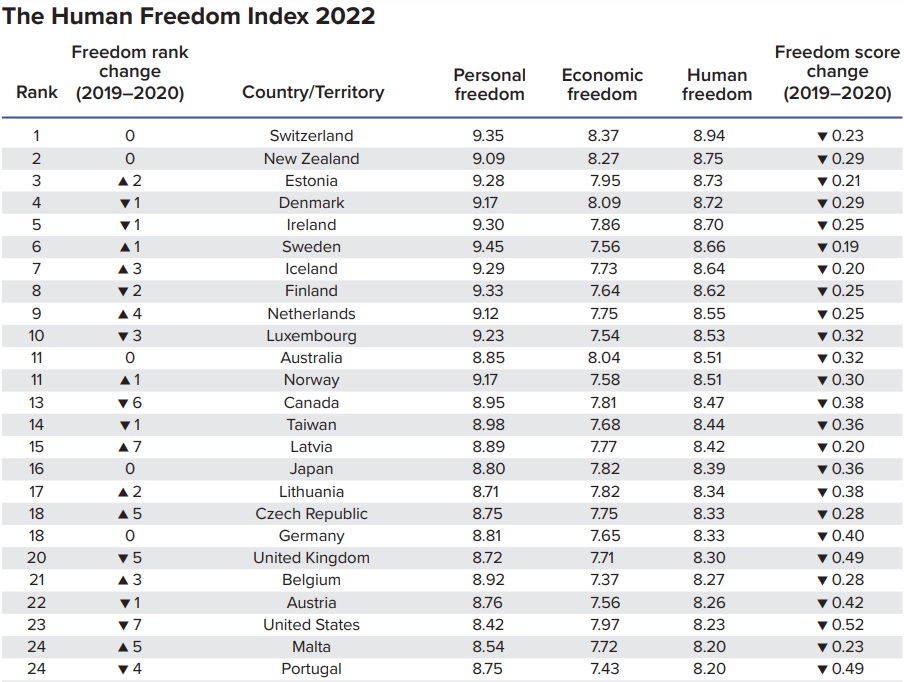
At least according to the Human Freedom Index, which ranks nations based on both economic and personal liberty.

Here are the 25 jurisdictions that lead the rankings.

For what it’s worth, Switzerland also was in first place the previous year.

New Zealand, which had been in first place in earlier years, still ranks very high. Estonia is in third place and several other European nations round out the top 10.

The United States, meanwhile, fell to #23, which is disappointing but predictable given the subpar politicians that have governed the nation this century.

But Hong Kong has suffered an even bigger fall. It’s now ranked #34, which is not good for a jurisdiction that used to lead the rankings as recently as 2016.

For those interested, here’s a description of how the Human Freedom Index is calculated, along with some of the grim findings.


The Human Freedom Index (HFI) presents a broad measure of human freedom, understood as the absence of coercive constraint. This eighth annual index uses 83 distinct indicators of personal and economic freedom… Human freedom deteriorated severely in the wake of the coronavirus pandemic. Most areas of freedom fell, including significant declines in the rule of law; freedom of movement, expression, association and assembly; and freedom to trade. On a scale of 0 to 10, where 10 represents more freedom, the average human freedom rating for 165 jurisdictions fell from 7.03 in 2019 to 6.81 in 2020. On the basis of that coverage, 94.3 percent of the world’s population saw a fall in human freedom from 2019 to 2020, with many more jurisdictions decreasing (148) than increasing (16) their ratings and 1 remaining unchanged. The sharp decline in freedom in 2020 comes after years of slow descent following a high point in 2007.

Here’s some additional analysis, most of it depressing.

The rating for France fell from 8.65 in 2007 to 7.8 in 2020, Brazil’s rating decreased from 7.61 to 6.86, the United States’ score dropped from 8.92 to 8.23, and Mexico’s rating fell from 7.27 to 6.6. … some countries that ranked high on personal freedom ranked significantly lower in economic freedom. For example, Sweden ranked 1st in personal freedom but fell to 33rd place in economic freedom, and Argentina ranked 29th in personal freedom but 161st in economic freedom. Similarly, some countries that ranked high in economic freedom found themselves significantly lower in personal freedom. For example, Singapore ranked 2nd in economic freedom while ranking 81st in personal freedom.

I’ll close by observing that Syria is the lowest-ranked nation, followed by Yemen, Venezuela, Iran, and Egypt.

P.S. Here are five more reasons to admire Switzerland.


Tuesday, April 25, 2023

Swiss government withdraws all recommendations for Covid vaccines

April 8, 2023
 
"[D]octors can only administer the controversial vaccines in individual cases under certain conditions - but then bear the risk of liability for vaccination damage.".............It is a big step backward, but IT still comes down on the side of benefit outweighing risk in the case of people especially at risk — which means that for ordinary people, that may not be the case.I expect that the USA, home of Big Pharma, will be the last nation to back off from the vaccine frenzy............To Read More 


Monday, October 31, 2022

European Fiscal Policy Week, Part VI: The Swiss Spending-Cap Solution

October 29, 2022 by Dan Mitchell @ International Liberty

As part of “European Fiscal Policy Week,” I’ve complained about bad Italian fiscal policy, bad Europe-wide fiscal policy, bad British fiscal policy, and also the unhelpful role of the European Union.

But I want to end the week on an optimistic note, so let’s take a look at Switzerland‘s spending cap.

Known as the “debt brake,” the rule was approved by 84.7 percent of voters back in 2001 and took effect with the 2003 fiscal year.

And if you want to know whether it has been successful, here’s a comparison of average spending increases before the debt brake and after the debt brake.
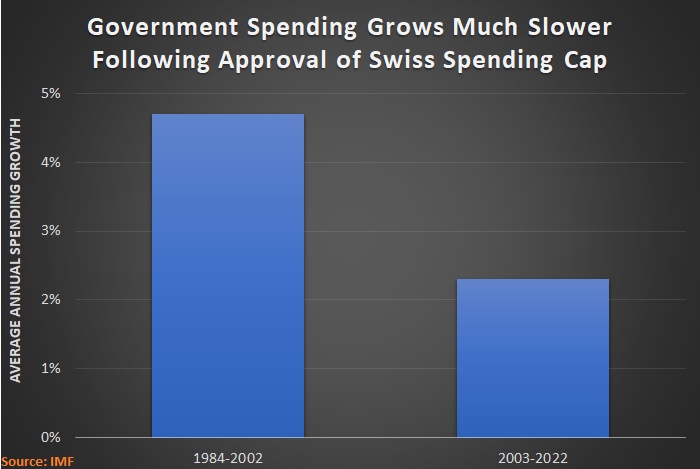
The above data comes directly from the database of the IMF’s World Economic Outlook.

There are some caveats, to be sure.

  • The IMF data cited above is not adjusted for inflation, though inflation has not been a problem in Switzerland.
  • The IMF numbers also show total government spending rather than just the outlays of the central government, but most cantons also have spending caps.

The bottom line is that Swiss fiscal policy dramatically approved after the spending cap took effect.

Switzerland’s Federal Finance Administration has a nice English-language description of the policy.

 

The debt brake is a simple mechanism for managing federal expenditure. …Expenditure is limited to the level of structural, i.e. cyclically adjusted, receipts. This allows for a steady expenditure trend and prevents a stop-and-go policy. …The debt brake has passed several tests since its introduction in 2003…

The binding guidelines of the debt brake helped to swiftly balance the federal budget when it was introduced. The debt brake prevented the high tax receipts from the pre-2009 economically strong years from being used for additional expenditure. Instead, it was possible to build up surpluses and reduce debt. …s public finances are well positioned when compared internationally. Aside from the Confederation, most of the cantons have a debt brake too.

Here’s a chart from the report. It shows that debt is on a downward trajectory, especially when measured as a share of economic output (the right axis).
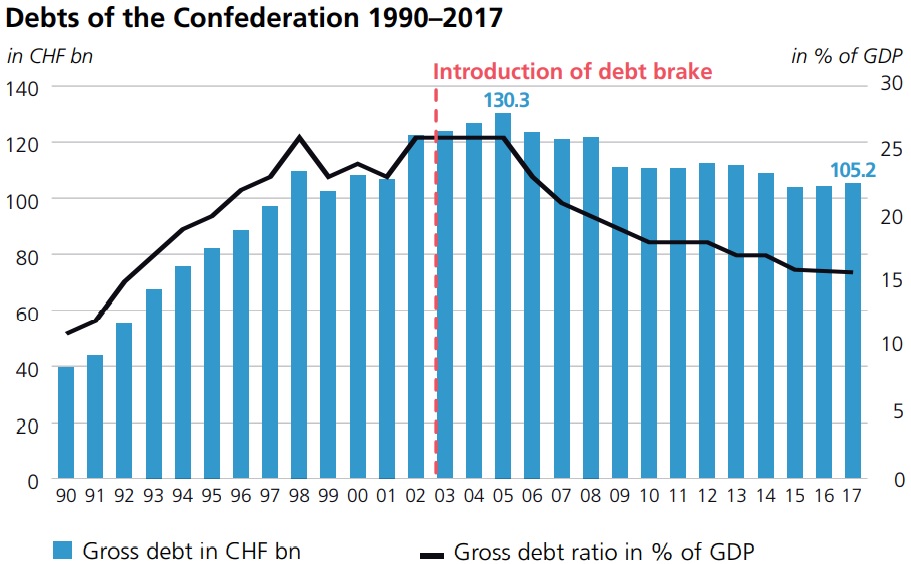
For what it’s worth, I’m glad the debt brake reduced debt, but I care more about controlling government spending. That being said, the Swiss spending cap also is a success on that basis.

The burden of spending as a share of GDP was increasing before the debt brake was approved. And since 2003, it’s been on a downward trajectory.

Here’s what Avenir Suisse, a Swiss think tank, wrote back in 2017.


Since the early 2000’s, Switzerland’s fiscal institutions have been successful in keeping the overall levels of taxation and spending at moderate levels. The country’s high fiscal strength is based on…Switzerland’s debt brake, a key institutional mechanism for managing public finances which subjects the Confederation’s fiscal policy to a binding rule…and contributes significantly to the country’s fiscal discipline. …

Switzerland’s spending cap has helped the country avoid the fiscal crisis affecting so many other European nations. …The Swiss debt brake is the ideal model for other countries lacking fiscal discipline to embrace. …

The Swiss debt brake’s most important contribution, however, cannot be measured in figures… In the early 1990s fiscal policy was oriented more towards the demands of the public sector…

Today, however, the administration, the government and the parliaments believe it is self-evident that expenditures must develop in the medium term in line with revenue. Fiscal federalism, as an important element in the cantons, protects against overcrowding access to the tax side.

That last sentence deserves some elaboration. The authors are noting (“overcrowding access to the tax side”) that it is possible to increase spending by increasing taxes, but that’s not an easy option in Switzerland because voters can use direct democracy to reject tax hikes (as they have in the past).

P.S. The Debt Brake has an opt-out clause that allows more spending in an emergency. And, during the pandemic, spending did jump by more than 12 percent in just one year. But there’s also a claw-back provision that requires lawmakers to be extra frugal in subsequent years. And that policy seems to be successful. The big spending surge in 2020 was followed by two years of zero spending growth (with another year of no spending growth projected for 2023).

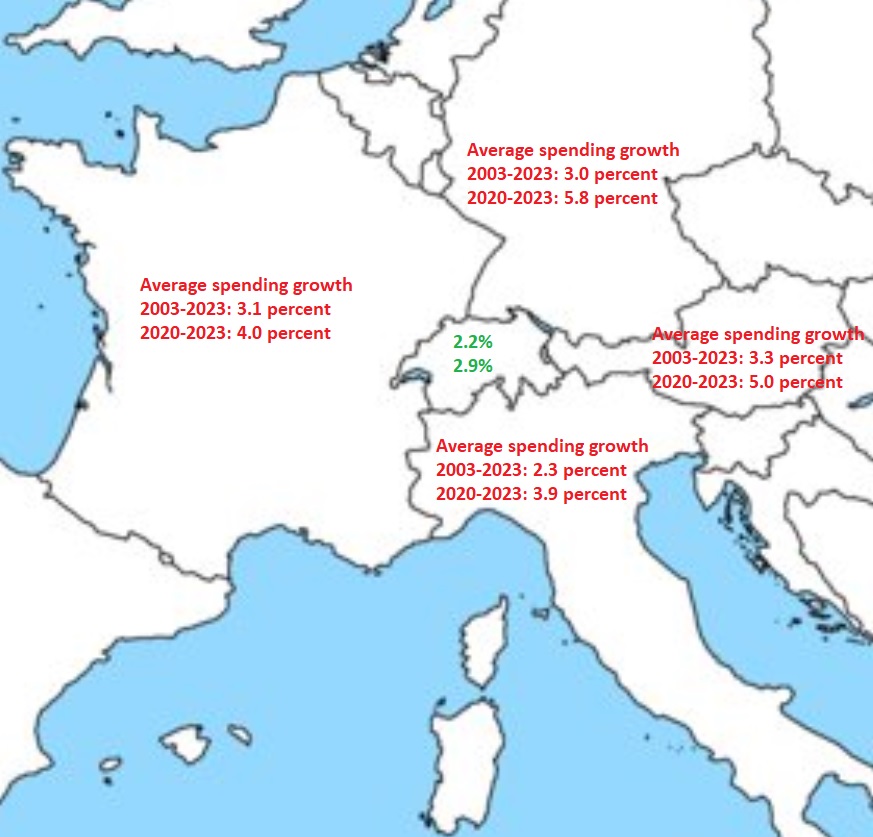
P.P.S. Look at this map if you want to see how much better Switzerland is than the rest of Europe.

P.P.P.S. Look at these charts if you want to see how Switzerland is doing better than the United States.


Wednesday, September 14, 2022

Least Surprising Headline. Ever.

September 12, 2022 by Dan Mitchell @ International Liberty

Last month, I wrote an article comparing Switzerland’s admirable fiscal policy with the profligate tendencies of other European nations.


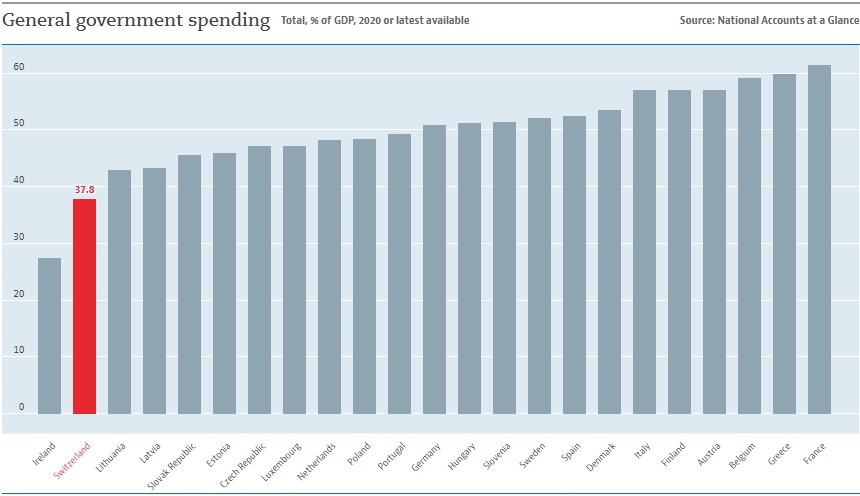
I included a chart showing that the burden of government spending in Switzerland is far below where it is in countries such as Belgium, Greece, and France – where the public sector consumes about 60 percent of economic output.

And then there are nations such as Germany, Spain, Sweden, Denmark, and Italy, where more than 50 percent of GDP is diverted to finance bloated budgets.

Given this background, I was not surprised to read an article in the New York Times about European politicians engaging in another spending binge.


Nationalizations. Subsidies. Cash handouts. Price caps. Profit taxes. …Governments are resorting to old-school solutions, …throwing vast amounts of money at the energy crisis engulfing the region… E.U. governments have already earmarked more than $350 billion to subsidize consumers, industry and utility companies; ministers met on Friday to narrow down their options for the bloc’s direct intervention in markets to grab excess profits, cap electricity prices and subsidize utilities companies. 
“Government intervention is back in vogue in a really big way,” said Mujtaba Rahman, Europe director at the consulting firm Eurasia. …The huge public spending is in addition to a nearly trillion-dollar stimulus package adopted over the past year to deal with the economic fallout from the pandemic, mostly through borrowing. …spending billions…may be the only way to keep voters on board with Europe’s strong support of Ukraine against Russia.

The fact that Europe “turns once again to big spending” surely must win a prize for least surprising headline.  What is surprising, though, is some of the mistakes in the article. The reporter, Matina Stevis-Gridneff, seems to think that Europe has been some sort of bastion of laissez-faire fiscal policy.

It’s back to 20th-century economics in Europe. …The standoff with Russia over Ukraine is upturning European economic orthodoxy at rapid speed with barely a peep of dissent at the European Union’s headquarters in Brussels, a bastion of neoliberalism that not so long ago imposed brutal austerity on its own members, most notably Greece, even after it became clear it was harmful. … 

The ballooning debt load would have normally caused an uproar in the bloc, where fiscal conservatism has dominated policy and politics for years. …Paolo Gentiloni, the top E.U. economic official, ..said that the E.U. would begin to consider changes to its stringent fiscal rules

I’m not sure which part of the above excerpt is most at odds with reality.

  • “A bastion of neoliberalism.” To be blunt, that’s wildly wrong.
  • “Brutal austerity.” To be blunt, that’s wildly wrong.
  • “Fiscal conservatism has dominated policy.” To be blunt, that’s wildly wrong.
  • “Stringent fiscal rules.” To be blunt, that’s wildly wrong.

Though, to be fair, Greece was forced to engage in real austerity for a few years last decade. Though that only happened after a lengthy period of profligacy.

And the Greek people suffered immensely because the government over-spent for so many years.

What’s tragic is that other European nations, led by Italy, almost surely will suffer Greek-style fiscal crises. And the European Central Bank is making a bad situation even worse.

P.S. My other “least surprising headline” columns can be found here, here, and here.

Monday, August 29, 2022

Visualizing the Difference Between Switzerland and Europe’s Welfare States

August 28, 2022 by Dan Mitchell @ International Liberty

What accounts for Switzerland’s “improbable success“? How did a small, land-locked nation with few natural resources become so successful?

Switzerland routinely ranks very high in international comparisons of economic liberty, so that means that there are many good policies.

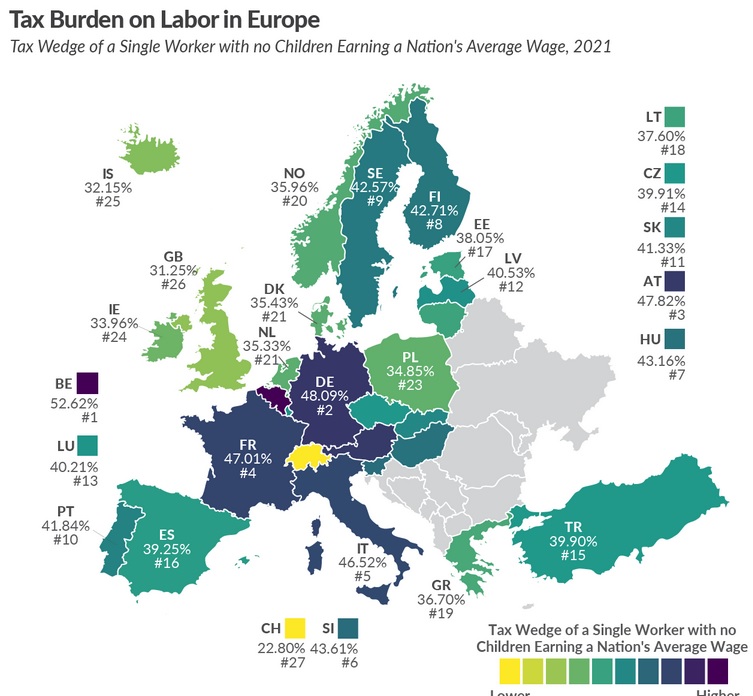
But since I’m a public finance economist, I think this map from the Tax Foundation helps to explain why Switzerland is a role model. As you can see, the tax burden on workers is dramatically lower than in other European nations. Indeed, Switzerland is almost 10 percentage points lower than the next-closest country.

The map shows the tax burden on a single worker with no dependents, but you find a similarly large gap when looking at the tax burden on a four-person household.

By the way, Switzerland’s value-added tax is far lower than any other European nation, so ordinary workers aren’t being indirectly pillaged (and tax “progressivity” is very low in Switzerland, so high-income workers are not being pillaged, either).

How does Switzerland succeed in maintaining a relatively low tax burden?

Well, it’s easy to keep taxes under control when there are limits on the burden of government spending.

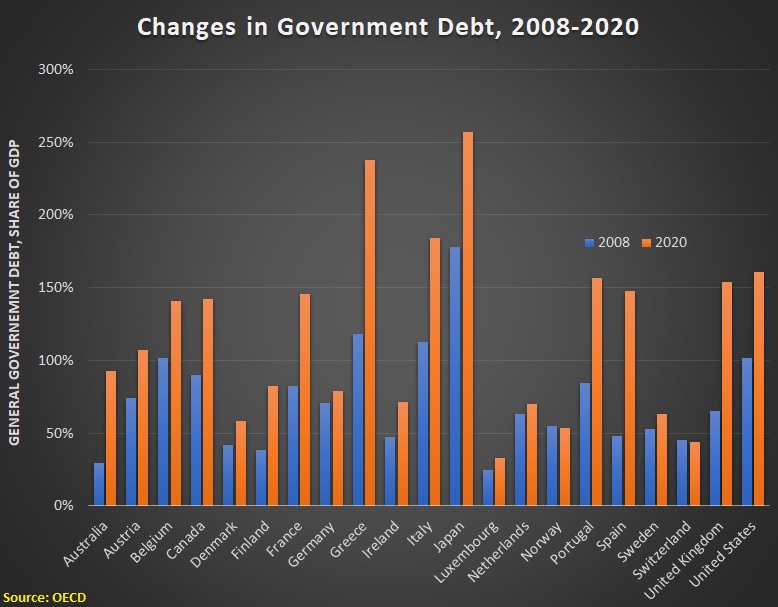
And, thanks to the nation’s very effective spending cap, you can see from this OECD chart that Switzerland is in a far stronger position than most European nations.

So kudos to Switzerland, which is sometimes thought to be the world’s most libertarian nation.

P.S. The Swiss also deserve praise for maintaining federalism, as well as their private retirement system.

P.P.S. Ireland also is a success story, but it’s not as good as suggested by the above chart.


Tuesday, December 7, 2021

The Role Model of Switzerland

November 28, 2021 by Dan Mitchell @ International Liberty

Back in 2016, I shared a television program about the “Improbable Success” of Switzerland. Today, here’s a follow-up look at that “sensible country.”


There are elements to this video that are outside my area of expertise, such as the role of the reformation.


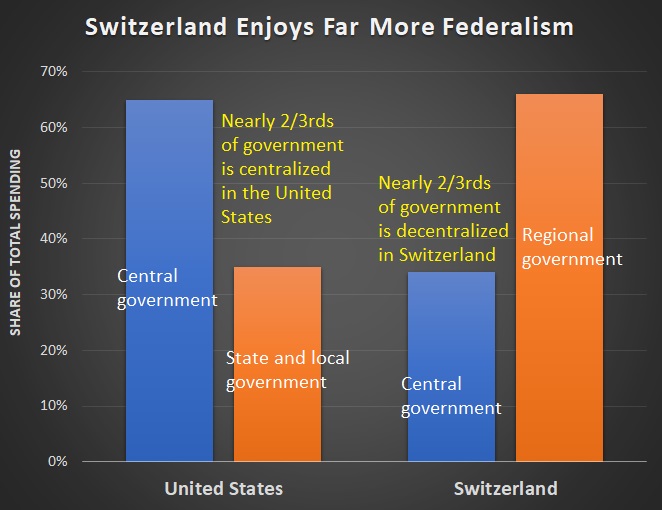
But the video mentions policies that I find very appealing, such as the country’s strong federalist system (unlike the United States, federalism hasn’t eroded).

This means jurisdictional competition, which has played a big role in curtailing bad policy.

And there was a brief indirect mention of the nation’s spending cap, which also has been a big success.

Interestingly, Switzerland’s strong track record is getting noticed in unusual places.

Here are some excerpts from a New York Times column by Ruchir Sharma.

There is…a country far richer and just as fair as any in the Scandinavian trio of Sweden, Denmark and Norway. ….with lighter taxes, smaller government, and a more open and stable economy. Steady growth recently made it the second richest nation in the world…with an average income of $84,000, or $20,000 more than the Scandinavian average. …surveys also rank this nation as one of the world’s 10 happiest. This less socialist but more successful utopia is Switzerland. …Wealth and income are distributed across the populace almost as equally as in Scandinavia, with the middle class holding about 70 percent of the nation’s assets. The big difference: The typical Swiss family has a net worth around $540,000, twice its Scandinavian peer. …Capitalist to its core, Switzerland imposes lighter taxes on individuals, consumers and corporations than the Scandinavian countries do. In 2018 its top income tax rate was the lowest in Western Europe at 36 percent, well below the Scandinavian average of 52 percent. Government spending amounts to a third of gross domestic product, compared with half in Scandinavia. And Switzerland is more open to trade, with a share of global exports around double that of any Scandinavian economy. …Only one in seven Swiss work for the government, about half the Scandinavian average. …The Swiss have become the world’s richest nation by getting it right, and their model is hiding in plain sight.

Kristian Niemietz of London’s Institute of Economic Affairs also pointed out that Switzerland is a role model.

Classical liberal ideas work. But they are usually counterintuitive, and often hard to explain. …It is therefore helpful for classical liberals if we can point to a practical example…it is Switzerland which, in many ways, represents such an example. Switzerland is not a libertarian paradise. But it is a country which, through its mere existence and its economic success, refutes a lot of…conventional wisdoms. …Take decentralisation. …the Swiss example shows that local autonomy and pluralism can be a recipe for success. In Switzerland, even tiny cantons like Glarus or Obwalden, which have far fewer inhabitants than a typical London borough, enjoy a degree of political autonomy that London, which has more inhabitants than the whole of Switzerland, can only dream of. …the Swiss system shows that a healthcare system based on choice and competition can work exceptionally well. The Swiss system offers ample choice between insurers, insurance plans, providers and delivery models. …Liberal market economists…can simply refer to the successful example of Switzerland. We can end a lot of tedious discussions by simply saying, “Of course it works – just look at Switzerland”.

Amen.

Switzerland is a great role model.

By the way, neither the video nor the two articles mentions Switzerland’s private pension system, which is another big advantage the country has over most other nations.

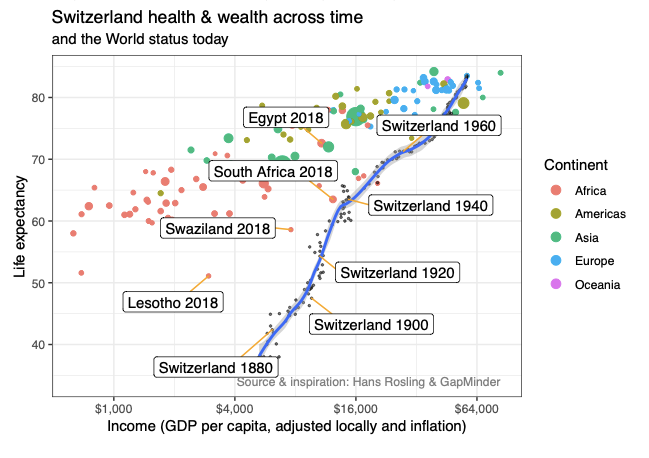
If you want to see a chart that illustrates Switzerland’s stunning success, this look at both life expectancy and per-capita economic output is very revealing.

The link between prosperity and longevity isn’t big news, but Switzerland’s rapid upward ascent is very remarkable.

To conclude, there are numerous reasons to rank Switzerland above the United States, at least with regard to public policy.

P.S. The video mentions that Switzerland is the closest example in the world of a direct democracy. I’m instinctively opposed to that approach, because of the dangers of majoritarianism.

That being said, Swiss voters usually vote the right way.

P.P.S. It wasn’t mentioned in the video, but I like that Switzerland is one of the few European nations with widespread gun ownership.

P.P.P.S. We should not be surprised that some folks in Sardinia would like to secede from Italy and join Switzerland.


Wednesday, September 29, 2021

Swiss Voters Reject Bidenomics

September 27, 2021 by Dan Mitchell @ International Liberty 

Biden wants lots of class-warfare tax increases to fund a big increase in the welfare state.

That would be bad news for the economy, but his acolytes claim that voters favor the president’s approach.

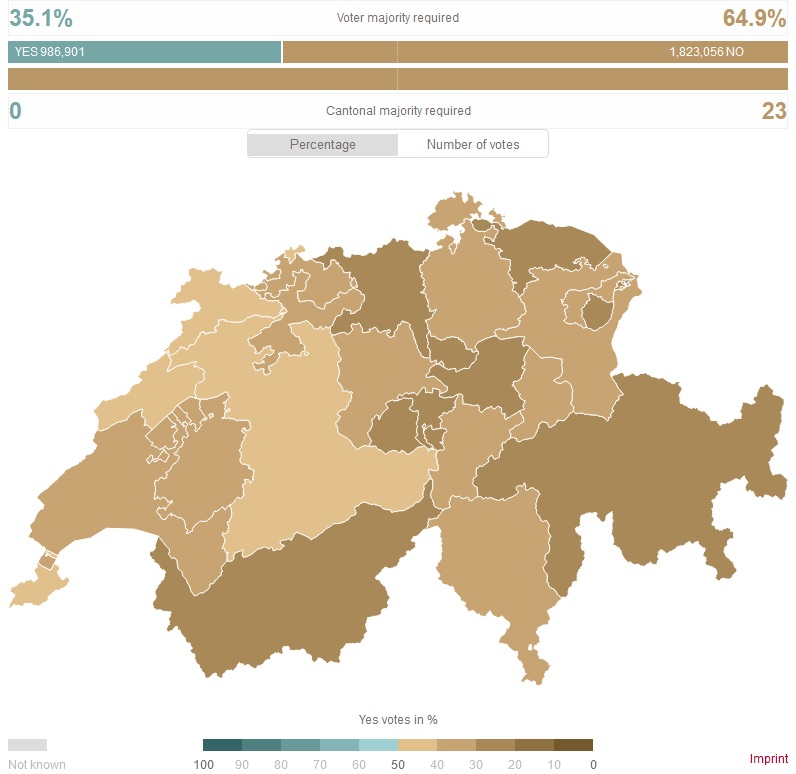
Maybe that’s true in the United States, but it’s definitely not the case in Switzerland. By a landslide margin, Swiss voters have rejected a plan to impose higher tax rates on capital.

It’s nice to see that every single canton rejected the class-warfare initiative.

In an article for Swissinfo.ch, Urs Geiser summarizes the results.


Voters in Switzerland have rejected a proposal to introduce a tax on gains from dividends, shares and rents. The left-wing people’s initiative targeted the wealthiest group in the country. Final results show 64.9% of voters and all of the country’s 26 cantons dismissing the proposed constitutional reform, in some cases with up to 77% of the vote. …The Young Socialists who had launched the proposal admitted defeat, accusing the political right and the business community of “scare mongering”…

The Young Socialists, supported by the Social Democrats, the Greens and the trade unions had hoped to increase tax on capital revenue by a factor of 1.5 compared with regular income tax. …Opponents argued approval of the initiative would jeopardise Switzerland’s prosperity and damage the sector of small and medium-sized companies, often described as the backbone of the country’s economy.

For what it’s worth, I’m not surprised that the Swiss rejected the proposal. Though I was pleasantly surprised by the margin.

Though perhaps I should have been more confident. After all, the Swiss have a good track record when asked to vote on fiscal and economic topics.

Though not every referendum produces the correct result. In 2018, Swiss voters rejected an opportunity to get rid of most of the taxes imposed by the central government.

P.S. Professor Garett Jones wrote a book, 10% Less Democracy, that makes a persuasive case about limiting the powers of ordinary voters (given my anti-majoritarian biases, I was bound to be sympathetic).

This implies that direct democracy is a bad idea. And when you look at some of the initiatives approved in places such as California and Oregon, Garett’s thesis makes a lot of sense. But the Swiss seem to be the exception that proves the rule.