Search This Blog

De Omnibus Dubitandum - Lux Veritas

Showing posts with label Welfare. Show all posts

Thursday, May 22, 2025

Decentralize the Welfare State

May 21, 2025 by Dan Mitchell @ International Liberty

Excessive government spending is America’s top fiscal problem.  To be more specific, poorly designed entitlement programs are leading to an ever-growing spending burden that ultimately will either lead to massive tax increases or a debt crisis.  To avoid either of those bad options, we need entitlement reform.

I’ve previously written about how to fix “social insurance” programs for older people, such as Social Security and Medicare.  Today, let’s look at the other category of entitlements, the “means tested” programs for low-income people, such as Medicaid and food stamps.

Let’s start by looking at two charts from the Economic Policy Innovation Center.

The first chart shows how fast spending on health programs is increasing, along with a line showing how fast spending increases if Republicans in Congress succeed with some reforms to the Medicaid program.

The second chart shows how food stamp spending dramatically spiked during the pandemic and has since stayed very high because Biden expanded the program.

Ideally, the way to deal with both programs is to copy Bill Clinton’s successful welfare reform by shifting the programs back to the states.

In the short run, this would mean giving states a “block grant” and giving them the flexibility to figure out the best ways of spending the money.

In the long run, the ideal policy would be to phase out the block grants so that states can decide both how to raise money and how to spend money.

Matt Weidinger of the American Enterprise Institute has a similar perspective. Here are some excerpts from a recent article.

The case for reform starts with the perverse incentives for excessive benefit collection embedded in current federal welfare policies. For example, under the Supplemental Nutrition Assistance Program (SNAP), commonly known as food stamps, federal taxpayers now cover 100 percent of benefit costs. That policy offers an open-ended stream of federal funding for bigger benefit caseloads than states might otherwise choose to maintain if they bore some of the benefit costs themselves. …

In a similar fashion, Medicaid “expansion” policies—which cover nearly all adults with incomes up to 138 percent of the federal poverty line—presently provide states “with an enhanced federal matching rate (FMAP) of 90% for their expansion populations.” That enhanced FMAP significantly exceeds the federal reimbursement rate for other Medicaid recipients, including children, pregnant women, seniors, and disabled individuals, which varies by state from 50 to 83 percent. …

To state the obvious, placing all, or nearly all, of the financial burden for benefit payments on federal taxpayers contributes to swollen caseloads, as it subsidizes state policy choices that promote greater benefit receipt. …in the long run federal policymakers will have no choice but to transition to greater state financial responsibility for programs like SNAP and Medicaid. …

Such improvements are not without precedent. When welfare reforms in the 1990s placed increased financial responsibility on states, states responded by implementing changes that increased work and reduced caseloads, yielding significant savings for both state and federal taxpayers.

As far as I’m concerned there should not be “greater state financial responsibility.” These programs should be the complete responsibility of states.

That will lead to competition and innovation, which presumably will inform us what approaches are good for both taxpayers and poor people.

I’ll close by sharing two charts from Weidinger’s article, both of which show that the current approach is a windfall for blue states.

Notice how it is mostly blue states (plus fiscally profligate Alaska) that lure more people into Medicaid dependency.

Similarly, it is blue states that produce the most food stamp dependency.

As far as I’m concerned, blue states should have the freedom to adopt bad policy (which I’ll then be happy to write about, as you can see here, hereherehere, and here).

But if they want to create more welfare dependency, they should be willing to pay for it themselves.

Monday, May 19, 2025

Medicaid: End It, Don’t Mend It

I & I Editorial Board May 19, 2025

As soon as Republicans mentioned cutting spending on Medicaid as part of their “reconciliation” bill, the usual suspects started rolling out their standard talking points. They’re cutting health care for the poor to pay for tax cuts for the rich! Millions will lose coverage! The disabled will suffer! Oh, the humanity!

Well, if the GOP is going to be accused of destroying Medicaid when all they are proposing is a minor haircut, why not go all out and scrap this hopelessly flawed, fraud-riddled, budget-busting disaster of a program and start over from scratch?............To Read More....

My Take: This is a problem throughout the system, as ‘Significant’ Welfare Fraud Uncovered During Covid-19 Aid Investigation - In a new investigation, a federal committee tasked with tracking COVID-19 assistance fraud found tens of thousands of dishonest or erroneous Paycheck Protection Program applications.........

Tuesday, February 25, 2025

Advice for DOGE: Curtail Record Welfare Spending in Washington

February 23, 2025 by Dan Mitchell @ International Liberty

At the start of the year, I pointed out how politicians used the pandemic as an excuse to increase the long-run trend line of government spending.

Today, let’s look at how one component of the federal budget has contributed to America’s perilous fiscal state.

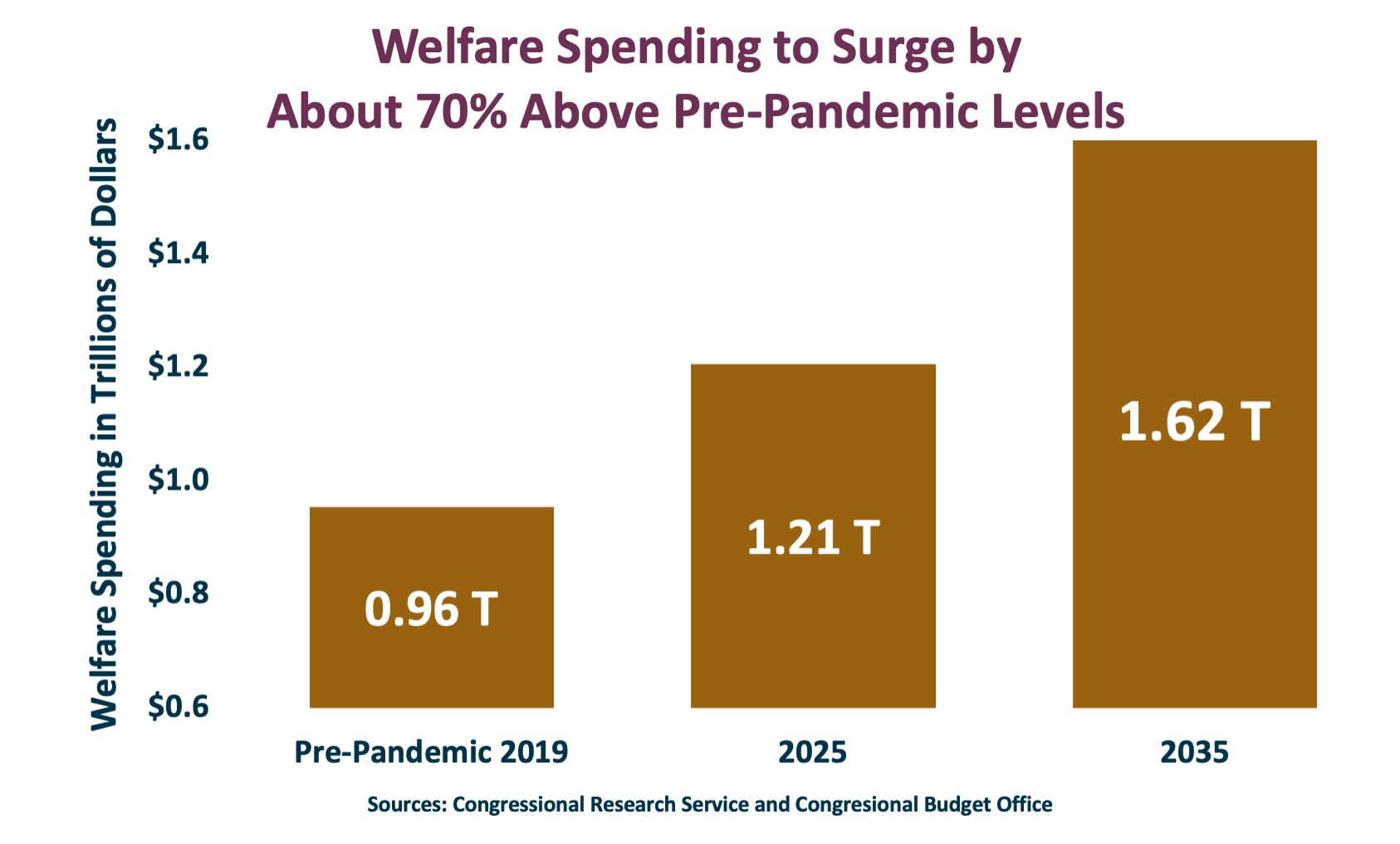
Here’s a chart from the Economic Policy Innovation Center (EPIC) showing how the burden of redistribution spending has expanded since the pandemic, as well how much the budget for those programs is projected to increase over the next 10 years.

In large part, the growth of redistribution outlays is associated with inflation, so we have an unsavory combination of bad monetary policy and bad fiscal policy.

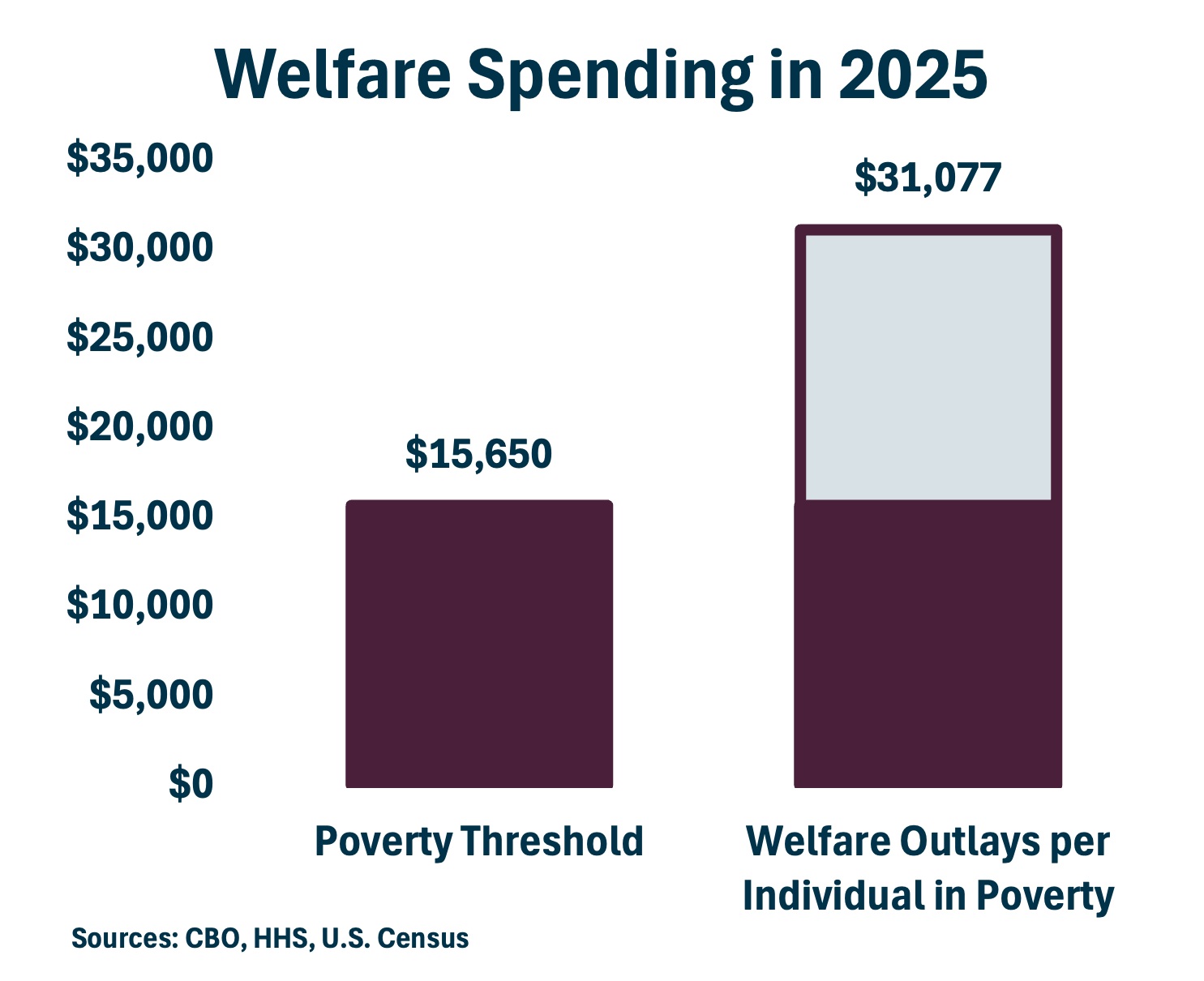
But here’s another chart from EPIC that is an even bigger indictment of the welfare state. If you divide total spending on so-called means-tested programs by the number of people in poverty, you get more than $31,000.

That’s nearly twice as much money as the poverty level!

By the way, some people look at these numbers and say it would be more efficient to get rid of the programs and simply give every poor $16,650.

After all that would save money, eliminate poverty, and get rid of bureaucracy.

But that simple analysis overlooks the fact that all l0w-income people in the country would then have an incentive to lose their jobs and become wards of the state.

Heck, that perverse incentive is already there. So the last thing we need is for politicians to make a bad situation even worse.

Guided by the 14th Theorem of Government, there’s several takeaways from the above charts.

  • The fiscal burden of welfare spending is enormous.
  • The welfare state is grotesquely inefficient.
  • Poor people are being trapped in government dependency.

The right solution is to get rid of the Washington welfare state.

Take all the money currently being spending on redistribution, turn it into a block grant, and give the money to the states and let them figure out the best way of dealing with poverty.

But the block grant should shrink over time and eventually disappear. As I wrote two days ago, “states should have full control – and full responsibility – for designing and funding their income redistribution programs.”

Tuesday, November 5, 2024

The Five Most Important Ballot Initiatives of 2024

One of my traditions is that I highlight the most important ballot initiatives every year (see 2023, 2022, 2021, 2020, 2019, 2018, etc).

Unlike contests between flawed and deceptive politicians, these initiatives often provide clear-cut choices between more freedom and more statism.

That’s true in America and true in other nations.

For 2024, my pick for the most important referendum is Measure 118 in Oregon. As described by the Tax Foundation, it is a very harmful revenue grab.


The all-in Oregon state and local tax rate on large businesses could exceed 56 percent under a proposed ballot measure that purports to impose only a small tax increase on large businesses. …Under Measure 118, Oregon’s corporate income tax will contain a gross receipts-based minimum of 3.0 percent—which is like imposing a 42.9 percent corporate income tax if profits ran 7 percent! Add in the calculated equivalent rate of the existing gross receipts tax and you’re at 49.6.

Then, of course, there’s the federal income tax of 21 percent, and if in Portland, another 6.6 percent in other business income taxes. Suddenly, for a business with 7 percent profit margins, the all-in rate on net income for sales into Portland would be about 77.2 percent for large businesses (federal, state, and local combined).

To make matters worse, supporters want to use the money to create a universal handout. Here’s some of what’s been reported by (should be privatized) Oregon Public Broadcasting.


With its pledge to redistribute money…, the measure offers a simple pitch…slap a 3% tax on a business’s Oregon sales above $25 million, then divvy up the money raised among Oregon’s more than 4 million residents, no matter their age. …The measure could…send around $1,600 a year to every Oregonian beginning in 2026… At its most basic level, the measure would institute a form of universal basic income…

Proponents say that yearly checks will slash poverty for the state’s poorest residents, give children and seniors more stable footing, and infuse the economy with new spending. …“I see this as a massive redistribution of wealth…,” said Stacey Rutland, founder of the Portland-based nonprofit Income Movement, which advocates for basic income policies.

For those of us who don’t like the idea of a “massive redistribution of wealth,” let’s hope the normally left-wing voters of Oregon show a bit of common sense.

For the year’s second-most important ballot initiative, let’s travel up the Pacific coast.

In Washington, voters have a chance to repeal the state’s capital gains tax. Here are some excerpts from a local news report.


Initiative 2109 aims to repeal the state capital gains tax, which is imposed annually on the sale or exchange of long-term Washington capital assets. The state capital gains tax applies to an individual with an adjusted annual Washington capital gain above $250,000. …The money goes to measures like childcare subsidies for qualifying families, bonuses for childcare centers offering hard-to-cover hours, and school construction. The tax went to the state Supreme Court and was ruled constitutional. Most property owned by an individual for personal purposes is considered a “capital asset.” This includes houses, furniture, cars, stocks and bonds. Selling these items could result in a capital loss or a capital gain.

Now let’s shift to Illinois, where there is another effort to kill the state’s flat tax.

The good news is that’s it’s only an advisory referendum. The bad news is that it will encourage the pro-spending lobbies if voters say yes.

Here are some excerpts from a Wirepoints report.


Illinois’ Nov. 5 ballot will ask state residents..the next multi-billion-dollar tax hike proposal from Gov. J.B. Pritzker and the General Assembly’s Democratic supermajority. The $4.5 billion tax hike has been dubbed the millionaires tax because it proposes to hit Illinoisans that make a million dollars or more with an additional 3% surcharge on any amount they make above one million. To entice more Illinoisans to support the referendum, the proposal is sugar coated with legislators saying they’ll dedicate “funds to property tax relief.”

To be clear, it’s only an advisory referendum, meaning the result will be nonbinding. But Illinois politicians and the public sector unions, in particular the Chicago Teachers Union, are desperate for more money to fund their big, expensive budgets and contracts. They need this referendum to tell them whether the framing of a progressive tax hike sweetened with property tax “relief” will work as a proposed constitutional amendment in 2026. If it does, look for them to try again to end Illinois’ flat tax structure.

Now let’s head back to the Pacific coast.

California voters are being asked to decide whether to have more rent control. Here are some excerpts from a Reason column by


California voters will be asked for the third time in six years whether they want to give local governments a freer hand in adopting rent control. “The state may not limit the right of any city, county, or city and county to maintain, enact or expand residential rent control,” reads the succinct but potentially far-reaching text of Proposition 33. …

By repealing all existing state-level limits on rent control and forbidding the state Legislature from adopting future restrictions, Prop. 33 is…most radical. …there’s evidence that California’s rent control policies have reduced the supply of rental housing.

A landmark 2019 study on rent control in San Francisco found that the city’s rent stabilization ordinance encouraged landlords to convert rental units into owner-occupied condominiums (which could be sold at any price). …rent control cannot solve a housing affordability crisis caused by decades of underbuilding. Only significant liberalization of land use regulation will do that. …States like Texas that prohibit rent control in all its forms are doing a much better job of adding new housing supply to keep up with demand.

For our fifth ballot initiative, let’s travel to Kentucky where there’s an important referendum about school choice.

Here are some excerpts from House Speaker David Osborne’s supportive column in the Louisville Courier-Journal.


Amendment 2…would amend the Kentucky Constitution to allow lawmakers to debate meaningful alternatives to our current approach to education. …This proposal is not an attack on public education. …we can both offer additional opportunities to educate our students and support our public schools — but we can’t afford to leave another generation behind, trapped in a system that does not meet their needs. …some say we already have school choice and parents should just pay tuition.

In reality, it is only an option if parents can afford it. Otherwise, they are stuck in a system that cannot meet the needs of their child. Is it not the ultimate hypocrisy and elitism to say the single mother working two jobs in the West End of Louisville to pay for her child’s tutoring has a choice? …all seven neighboring states…have some form of school choice, and study after study shows that increasing choice helps students. …

Amendment 2 is…a declaration of war on the persistent acceptance of failure because it only impacts children marginalized by how much their parents make or where they live.

Let’s hope Kentucky voters choose what’s best for children rather than what’s best for the education bureaucracy.

I’ve picked five important ballot initiative to highlight, but if you want more contests to follow on election night, here are some other initiatives identified by the National Association of State Budget Officers.

We’ll start with another referendum on school choice.

Nebraska Referendum 435
Asks voters to approve or reject a bill that authorizes the state to implement a scholarship program for students attending private elementary or secondary schools.

California’s big spenders want to make it easier to expand government.

California Proposition 5
Lowers the vote threshold from 66.67 percent to 55 percent for local special taxes and bond measures to fund housing projects and public infrastructure.

South Dakota voters will decide whether welfare recipients have any obligation to be productive.

South Dakota Amendment F
Allows the state to impose a work requirement on individuals who are eligible to receive Medicaid and have not been diagnosed with a mental or physical disability.

California voters will choose whether marginally skilled workers should lose their jobs.

California Proposition 32
Increases the minimum wage to $18 per hour by 2026.

Last but not least, Arizonans will decide if major expansions of red tape need legislative approval.

Arizona Proposition 315
Prohibits a proposed rule from becoming effective if that rule is estimated to increase regulatory costs by more than $500,000 within five years after implementation, until the legislature enacts legislation drafting the proposed rule.

Since this is an election-related post, I’ll remind readers that I’m predicting Harris will win the electoral college by a 284-254 margin. That being said, taxpayers will lose regardless of which big spender prevails.


Tuesday, October 22, 2024

The Ongoing Erosion Of Welfare Reform In New York

@ Manhattan Contrarian

When I started this blog back in 2012, we were just coming to the end of 20 years of Republican, or quasi-Republican, New York City mayors (Giuliani and Bloomberg), who also had support from a newly-Republican Congress elected in 1994. One of the great triumphs of that era was welfare reform. The new Republican Congress made reform of welfare a priority, and after their first efforts were vetoed by President Clinton, in August 1996 he signed a compromise bill called the Personal Responsibility and Work Reconciliation Act. Among the reforms contained in that Act were time limits and work requirements for welfare recipients.

With the combination of the federal welfare reform and the Giuliani mayoralty, the ranks of welfare recipients in New York City started to fall rapidly; and the decline continued during Bloomberg’s three terms from 2002-2013. In this post from April 2019, I collected statistics on various metrics of New York City’s progress during the 20 years under Giuliani and Bloomberg, from 1994 to 2013. The decline in crime was certainly impressive (murders went from 1946 in 1993 to 332 in 2013), but the decline in the welfare rolls was a close second: from “nearly 1.2 million” in 1993 (out of a population of 7.3 million) to 357,000 in 2013 (out of a greatly increased population of 8.5 million). As a proportion of the population, those receiving welfare had gone from nearly 1 out of 6 to barely 1 out of 25. It was a remarkable transformation.

It’s now nearly 11 years since Bloomberg left office, and the goal of minimizing welfare dependency is long gone and forgotten. As the number of welfare recipients creeps ever upward, somehow this issue rarely makes the news. However, the New York Post has an important article on the subject today. The headline is “Nearly 800,000 New Yorkers collected welfare checks last fiscal year — most in decades.”

The Post provides this helpful graphic of mileposts along the road to welfare reform and its subsequent undoing:

https://images.squarespace-cdn.com/content/v1/503a5bade4b0b543ed240317/29bdcc34-ac4a-4c6e-a177-f1910d287864/Screenshot+2024-10-20+at+10.26.48%E2%80%AFPM.png?format=2500w

The Post queries the City bureaucrats on the reasons for the increase, and particularly the recent surge. The bureaucrats deny that the recent influx of illegal immigrants has much to do with it:

[T]he city claims only “a very small percentage” [of the new welfare recipients] are illegal border crossers who’ve arrived since spring 2022. In March, the agency estimated 1.3% of that month’s 535,184 recipients were non-citizens, or nearly 7,000.

So what then accounts for the sudden surge? The City’s spokesperson quoted by the Post tries to put the blame on the pandemic:

The city’s Department of Social Services attributes the huge hike to an “unprecedented” challenge of trying to help New Yorkers get back on their feet after many — especially people of color — were hit hard in the pocket during the pandemic.

That’s rather lame, especially considering that most of the recent surge has taken place after the pandemic was already basically over in 2022.

A far more likely explanation is that as soon as nobody is looking the functionaries revert to their natural state of encouraging dependency. After all, the more people who are dependent on the programs, the more will be the budget and staff of the agencies administering the programs. Increasing budget and staff is the inexorable goal of all bureaucracies.

Likely the functionaries who are facilitating the increases in welfare rolls think of themselves as doing good. They are “helping struggling families,” or something like that. They don’t see how it is demeaning to make dependents out of people capable of self-sufficiency.

While Mayor Adams currently faces corruption charges (about which I have expressed my doubts), a more important criticism of the Mayor is that he is detached from the details of the City’s governance. He enjoys going to clubs and getting treated like a bigshot, while letting the bureaucracy substantially run itself. A bureaucracy left to run itself just keeps finding new ways to grow its mission and increase its budget and staff. And thus we have the return of mushrooming welfare dependency.

Wednesday, October 16, 2024

The Issue is the Revolution

By @ Sultan Knish Blog 

“There is only one solution, intifada revolution,” mobs of college students chant at terror rallies.

What is there to ‘revolt’ against in New York City, Los Angeles or Chicago? The Hamas rallies like the BLM, environmentalist and other radical rallies take place in cities run by mayors and city councils who support their efforts and sometimes even show up to their events.

Even before New York City and other municipalities paid out millions in voluntary settlements to the BLM rioters who had assaulted police officers, the dirty secret of the radical mobs was that the authorities were on their side. And will continue to be on their side no matter what they do.

The revolution is also the thing that it’s revolting against.

Democrats secured control of the country’s major cities only to be faced with the timeless leftist challenge of making the intensification of their rule look like revolution rather than totalitarianism. The USSR and Cuba directed the ‘revolution’ outward by invading, conquering and intervening in other countries. Democrat cities nationalized their politics, building entire campaigns around Trump, abortion and (to their eventual regret) declaring themselves to be sanctuary cities.

As long as Republicans existed anywhere, urban Democrats could not sleep soundly at night.

Democrat control of cities and states didn’t end bipartisan politics, just turned it into a somewhat real and somewhat fake grudge match between the party’s really crazy and less crazy wings. Craziness was a variable like ‘X’ that was defined not by the common sense brakes of intellectual diversity, but by how far the really crazy wing could push the less crazy wing.

In 2010, open borders, freeing all the criminals, men pretending to be women and support for Hamas were fringe positions of the really crazy wing. By 2024, they’re Democrat positions.

The difference between the really crazy wing and the merely crazy wing is not that they have fundamentally different beliefs, but different tactics and comfort zones. It didn’t take long for the next generation to come home for winter breaks and win over the Democrat moms and dads to police defunding, drag queen story hour and the mass murder of Jews. But first the cultural establishment had to make these horrifying things seem respectable and normal.

Had to fit banning cars and Hamas on a lawn sign right under “in this house, love is love”.

What will the really crazy wing of the party normalize next? Check the academic calendar for the next year, social media for the year after and then the protest calendar for the next five years.

The ‘revolution’ is just about the radicals running the streets getting the feckless ex-liberals running the actual show to adopt some horrendous policy derived from the ravings of a 19th century philosopher and then given a glow up by activist academics and public intellectuals.

Classic town hall politics, limited constitutional government, and checks and balances in a bipartisan system would have prevented American cities from turning into the Paris Commune, but urban politics had made a rapid transition from Tammany Hall political machines to corporate consultants to Marxist struggle sessions with little democracy to be found in any of it.

Cities aren’t run by voters but by ‘stakeholders’. Lifelong community activists and their community groups, municipal unions and their members, and a few political clubs harvest ballots, turn out votes and then end up running cities. That 1% actually runs our lives.

A new generation of young radical activists with dot com money backing and social media savvy like AOC found it easy enough to harness the power of hipster grad students living in $3K a month walkups to disrupt the system and carve out their own extremist slice of the pie.

The new red guard, like the old, however had to find something to do besides stealing money.

The lofty promises of universal health care require more money than is available even if the wings of the old crazy party and the new really crazy party stopped stealing all the money. Defunding the police by moving money from law enforcement to their leftist activist social allies is easier. And a good pogrom against Jewish stores and synagogues is a great distraction.

The revolution isn’t about killing Jews (or not just about killing Jews) but wiping out entire classes of people, reactionaries, shopkeepers and whoever else ended up in the killing fields of Siberia, Guangxi and Choeung Ek for the power and profit of a rising new political elite.

The less crazy party thinks it will never have to come to that, but as with its views on men showering with girls or exposing schoolchildren to violent pornography, this is subject to change.

Life as an urban/suburban bourgeoise with regular stops at Starbucks, Crate and Barrel, and Whole Foods before charging the Tesla in the driveway is pretty comfortable, but being a pol commissar with a dacha in the Outer Banks and the power to gulag your enemies might just be better. All of that will require not just one revolution but a cycle of intermittent revolutions.

The causes matter less than the trajectory. One day it’s the police, the next day it’s car owners and then it’s the Jews. (Say what you will, but the Jews are always a popular one.) The issue, as a certain Marxist once said, is never the issue, the issue is always the revolution.

Causes provide narratives. Berkeley professors and Wall Street personal assistants who have no idea where the river or the sea may be are chanting for the destruction of Israel because it’s a nice change of pace. Like all of us, leftists like to feel that they’re growing as people by embracing new murderous causes. Freeing all the criminals didn’t work so well, but freeing all the terrorists to kill Jewish people thousands of miles away feels both heroic and safe.

But the exoticism of chanting for an “intifada” boils down to a call for revolution here and now.

Students for Justice in Palestine tweeted that the ultimate purpose of the anti-Israel BDS movement is “eradicate America as we know it.” Eradicating America as we know it might seem a bit off-putting to the suburban soy dads and wine moms who make up the middle class base of the party, but they’ll come around just like they did on turning Tim into Tammy and Tammy into Tim. What else are they going to do anyway: become Republicans and have people sneer at them in Whole Foods and risk their kids refusing to come home for the holidays?

The revolution is about eradicating America as we know it. A lot of it’s gone already, but there’s still plenty of work of destruction to be done until we’re all on the right side of history. Or dead.

Revolution is all about being on the right side of history. And the revolution consists of old liberals who are terrified of being on the wrong side of it, stammering their way through pronouns and handling popular critical race theory texts like they were the sacred scriptures of a religion they don’t believe in, and young radicals certain that they are on the right side of it.

But ‘revolution’ is also just dictatorship misspelled. As George Orwell wrote in 1984, “One does not establish a dictatorship in order to safeguard a revolution; one makes the revolution in order to establish the dictatorship.” The dictatorship in urban and sub Democrat areas is already here.

The stream of monthly revolutions make the deepening totalitarianism, the higher confiscatory taxes, the daily government scrutiny of everything from trash content to social media posts (in cities where violent muggings earn thugs no more than a free therapy session) and the ideology tests for employment, seem like liberation. But that’s what the Russians called it too.

Each revolution makes us more enslaved and less free. We are not free to walk the streets, not free to think for ourselves and not free to even work for a living. We are however free to protest.

But only as long as it’s for the revolution of the political machine taking away all our freedoms.

The issue isn’t drug dealers shot while assaulting police officers. It’s not Israel. It’s not oil or illegals. Those are just the levers which make the dictatorships running our lives more extreme. They are also how those dictatorships pretend that there’s a vibrant system of political dissent.

The issue is not the issue. The issue is that the fake revolutions are a tyranny. The issue is that we have become the slaves of a system that keeps promising to liberate us from our freedoms.

The issue is that we cannot go on living this way.

Daniel Greenfield is a Shillman Journalism Fellow at the David Horowitz Freedom Center. This article previously appeared at the Center's Front Page Magazine.  Click here to subscribe to my articles. And click here to support my work with a donation. Thank you for reading.


Thursday, October 3, 2024

Dependency Nation

October 2, 2024 by Dan Mitchell @ International Liberty, Tags:  , , | 2 Comments 

 https://danieljmitchell.wordpress.com/wp-content/uploads/2020/05/cropped-sowell.jpg

One of Margaret Thatcher’s famous observations was that socialist governments fail because they inevitably run out of other people’s money.

If I’m in a pedantic mood, I will nit-pick that statement by pointing out that she should have said redistributionist governments.

For today’s column, though, let’s not get bogged down in a debate over how socialism is defined.

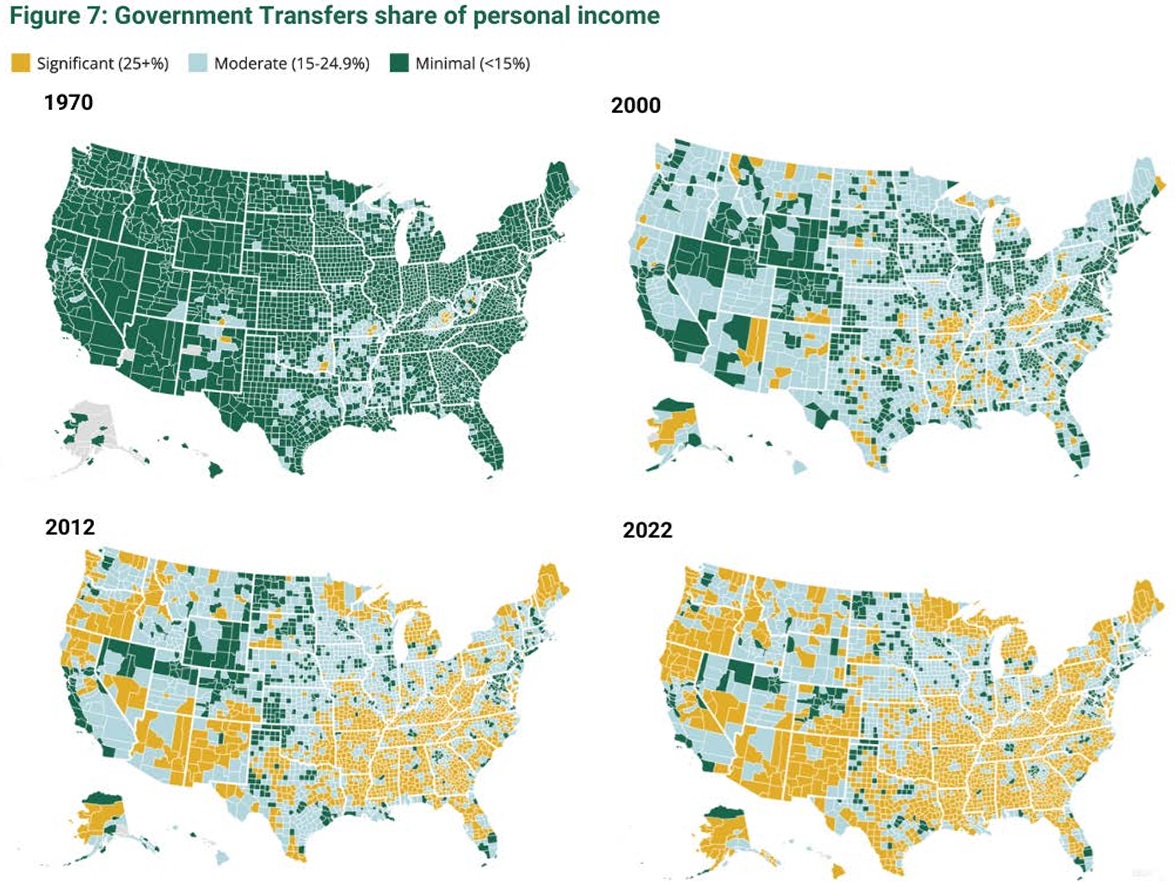
Instead, I want to share a very depressing set of maps from a report by the Economic Innovation Group. As you can see, the United States went from being a mostly green nation in 1970 to being a mostly tan nation in 2022.

And since green signifies self-reliance (government transfers representing less than 15 percent of personal income) and tan suggests dependency (transfers equaling more than 25 percent of personal income), this is a very worrisome trend.

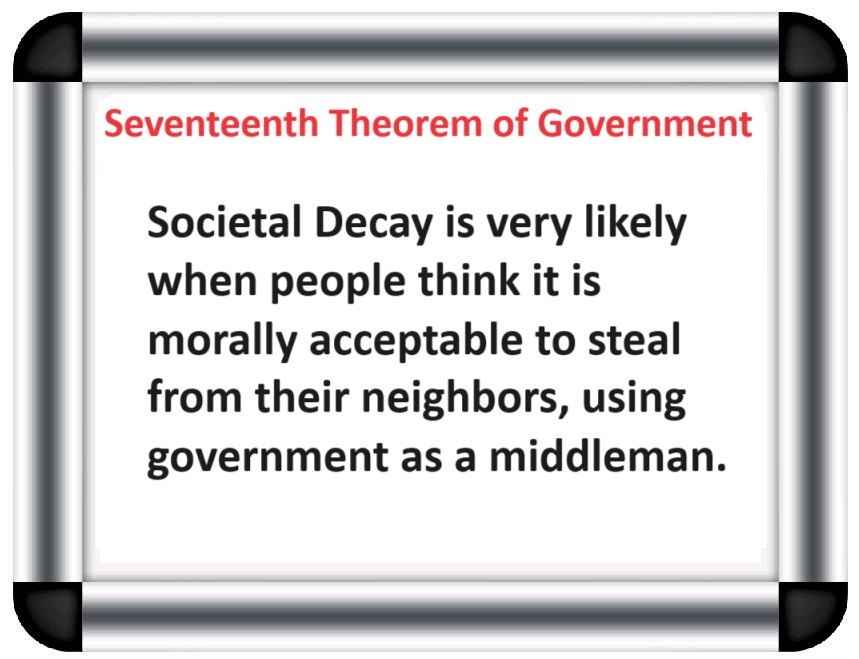
These maps are depressing because I worry about the implications of the 17th Theorem of Government.

I don’t want societal capital being eroded as more and more people think it’s okay to be wards of the state.


And when you combine that with demographic change (more elderly recipients of government goodies and fewer young people to pay the bills), that is a recipe for an ever-expanding burden of government. In America, Japan, and Europe.

But my first concern is the United States. Sadly, there is little reason for short-run hope given the statist inclinations of both Trump and Harris.

Related

COMMENTS:

  1. The 2022 map is wrong. The area in and around DC (northern VA and southern Maryland) are depicted in dark green? The entire region is 100% on taxing the other parts of the country; that area should be tan or really dark brown.

    Military contractors are 100% on the government dole. They are not private entities. They have only one customer – government. They cannot buy or sell anything except to government, and only with government permission. There is zero difference between military contractors and China’s state owned enterprises.

    The absurd “consulting companies”, the think tanks, the law firms that mostly or entirely focus on lobbying, that SAIC corporation which facilitates higher than government pay for doing government work. The whole place is one big transfer payment from taxpayers to federal employees


  2. on October 2, 2024 at 5:52 pm John Michael Wagner

    One significant change from 1970 to 2022 is demographics. There are many more retirees in 2022, so transfer payments have naturally become a higher percentage of income (Social Security).

    HOWEVER, there are too many transfer payments of all types, so fear is still warranted. Just not as much as those maps suggest.

Thursday, September 19, 2024

Welfare is a Jealous Polygamist

A young mother prepares a meal for her child.

Nearly ten years ago, I wrote what I thought was a provocative essay about polygamy and the state. Specifically, I claimed that the state acts like a polygamist, enforcing a cruel and explicitly patriarchal regime on single mothers. Perversely, the justification for this repressive regime is compassion, even “social justice.”  

One of the most corrosive aspects of patriarchy is that it treats women as objects, rather than active moral agents in their own right. It is certainly true that, given the weak bargaining position women are often placed in, in traditional societies, women appear to accept inferior roles. But as Gerry Mackie famously argued, even the worst institutions — footbinding and infibulation, for example — have a “rational element” from the perspective of women trapped in these systems. Lisa Tessman has a theory of contingency and virtue, about the struggle of women to preserve a space for virtue in lives circumscribed by sexist rules.

In the years since I wrote the first version, the performance and repression of our welfare system has, if anything, gotten worse. The “privilege” of being raised in a two-parent household is being denied to more and more children. We can’t ignore the truth: the state is a small-minded polygamist, outlawing marriage to anyone except the welfare system and — worse — insisting that the women stay at home rather than finding jobs.

About eight million US families are headed by single mothers, and of those nearly three million live below the poverty line defined by the government. Many sustain this tenuous existence with “assistance,” ranging from subsidies on housing and food to childcare and education grants. The state is no Puritan, and does not enforce a rule of exclusivity on the sex lives of these women. But it has an iron-clad rule that if a woman gets married, or gets a job, she loses her benefits. 

This so-called “benefits trap” has been commented on by both the left and right as an odd policy. Brittany Birken, director of community and economic development at the Federal Reserve Bank of Atlanta, testified before a joint oversight committee here in North Carolina about a proposed consolidation of welfare programs known as the “One Door” policy.

Birken used an anecdote to illustrate the problem: she had talked to a single mother in Florida who had been offered a 10-cent per hour raise, and more hours, in her part-time job. The woman said (according to her calculations) if she accepted the promotion she would lose her benefits through the childcare subsidy program.

“We confirmed her math. For that $200 a year increase, she was going to lose access to $9,000 in childcare subsidies,” Birken said. “The real dilemma that families can face is advancing in their career or making financial ends meet.”  Women who find themselves in this no-win situation are not lazy; they are rational, because they have to accept the situation as it is.

Of course, that’s not how the architects of the welfare system think about it. These program heads no doubt see the system protecting women who are otherwise defenseless, with no other means of raising their children. The problem is that these “benefits” are contingent, and the contingencies — no jobs, no marriage — are detrimental to women long term, and disturbingly similar to the restrictions a polygamist would impose.

Some people in the US are poor. They aren’t poor by world standards, perhaps — a minimum wage job in the US puts you in the top 30 percent of the world income distribution — but by US standards, they are poor. Welfare state logic insists that if you are a good person, you care about people who are (especially through no fault of their own) poor. Therefore, we (the state) should do something. 

Passing those programs requires some political compromises, and intentionally creating obstacles to access, or means testing. Contingencies and guard rails are erected to limit fraud, and direct money only to those “who really need it.”  But those conditions trap recipients in a cycle of poverty from which escape is very difficult. Get a job, lose your benefits. Get married, lose your benefits. 

Astonishingly, the effective marginal tax rates for poor people with children can approach, or in some cases exceed, 100 percent. As the Center for Hunger Free Communities put it:

Families that successfully increase their earnings should not find themselves worse off due to the consequent loss of benefits…. While a higher income can be an important step in a family’s progress towards self-sufficiency, the increased child food insecurity in this group suggests they may be experiencing the ‘cliff effect.’ This occurs when an increase in income causes an overall reduction in total resources due to a loss of benefits or increased tax liability.

Welfare policies are, for the most part, well-intentioned. But their perverse effect is real. Our welfare system traps women in hopeless lives, depending on a state that — like a small-minded polygamist — doesn’t really want them, but is too jealous to let them go.

Michael Munger  
 
Michael Munger is a Professor of Political Science, Economics, and Public Policy at Duke University and Senior Fellow of the American Institute for Economic Research. His degrees are from Davidson College, Washingon University in St. Louis, and Washington University. Munger’s research interests include regulation, political institutions, and political economy.

Books by Michael Munger

 Is Capitalism Sustainable?

Get notified of new articles from Michael Munger and AIER. SUBSCRIBE

Thursday, September 5, 2024

Kamala Harris’ Dishonest Proposal for Per-Child Handouts

In my two-part series on how best to reduce poverty (see here and here), I argued that the goal should be to help poor people climb the economic ladder, not to make indolence a comfortable way of life. 


Unfortunately, many Republicans and Democrats prefer the latter approach. For instance, Senators Mitt Romney and J.D. Vance have both put forth proposals to send money to families based on the number of kids in each household.

But when there’s a bidding war to spend other people’s money, Kamala Harris has lots of experience. So it is hardly surprising that she is proposing even-bigger per-child handouts. And these giveaways would be very harmful, reducing incentives for lower-income people to work and gain independence.

Adding insult to injury, Matt Weidinger of the American Enterprise Institute explains Harris is being dishonest.


The policies in question are called refundable tax credits, which originated in the 1970s and have grown in number and scope ever since. The name suggests recipients are merely getting a refund of taxes they already paid Uncle Sam. Instead, in a lexical sleight of hand that would make George Orwell blush, refundable tax credits provide benefit checks to those who don’t owe federal income taxes — in effect, refunding them someone else’s taxes.

Harris’s proposals call for expanding refundable tax credits in all directions at once. Parents would collect expanded child tax credit, or CTC, payments, which a campaign summary calls “critical tax relief.” But that’s merely the revival of the Biden-Harris administration’s expanded CTC paid in 2021, plus an even bigger $6,000 payout in a child’s first year. …Harris’s latest agenda doubles down on her longtime zeal to turn the tax code into a mammoth ATM redistributing income. It’s perfectly fine for her and other liberals to argue for enlarging the welfare state, but they shouldn’t get away with suggesting that this amounts to “cutting taxes.”

Amen.

Harris is being utterly disingenuous. If you give money to someone who doesn’t pay taxes, it’s absurd to call that a tax cut.  Simply stated, refundability is just another word for redistribution.  Moreover, we should be getting Washington out of that racket, not making America more like Europe with a bigger welfare state.

Tuesday, August 6, 2024

What Should Be Done with Lazy and Ungrateful Migrants?

August 4, 2024 by Dan Mitchell @ International Liberty 

I have conventionally libertarian views on immigration, but with a couple of caveats.


In short, I want people with high levels of societal capital (work ethic, spirit of self-reliance, western values, etc).

Which is why a story about Germany caught my attention. James Jackson reported for the U.K.-based Telegraph that a German district is cutting handouts for migrants who refuse to help their community.


Germany has cut the benefits of asylum seekers who refused to pick rubbish in the aftermath of heavy flooding in east Germany… Local authorities in the state of Saxony-Anhalt wrote to a group of 64 asylum seekers, demanding they help clear debris and erect dykes for a fee of 80 cents (68p) an hour....... Only 39 went to help…

Now the district council has ruled that the 15 who had no excuse not to take part will have their asylum benefits cut in half to €232 (£195) a month for three months. Mamad Mohamad, from the migrant network Lamsa, criticised the court’s decision, suggesting the work order was exploitative. …

Opposition politicians said those who refuse work should be sent back home.

At the risk of sounding Trumpian, I agree with the opposition politicians. Migrants who come to a country should not be getting any handouts in the first place.

And if they refuse to do something in exchange for handouts, their freebies should be taken away and they should be put on the first-available plane to their home nations.

P.S. There’s compelling evidence from Sweden that government handouts for migrants are a recipe for government dependency.

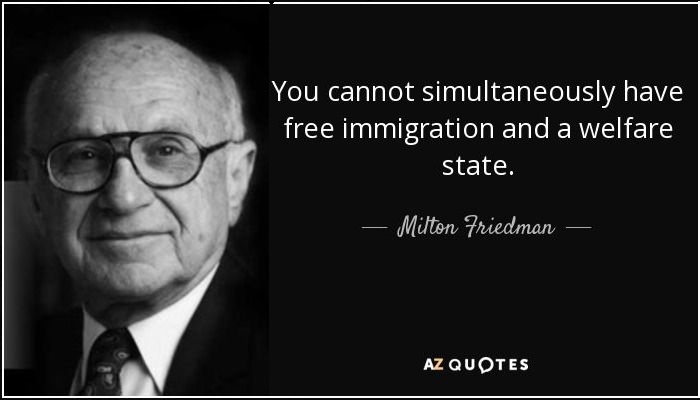
P.P.S. It’s probably a very safe idea to allow free immigration from nations with very generous welfare states.

P.P.P.S. If you want some immigration-themed humor, click here, here, and here.


Tuesday, June 11, 2024

The Government is Creating Jobs. Literally.

By Daniel Greenfield @ Sultan Knish Blog

“Today’s report marks a milestone in America’s comeback,” Joe Biden bragged in March. “With today’s report of 303,000 new jobs in March, we have passed the milestone of 15 million jobs created since I took office.” Milestone or a millstone though might be a matter of opinion.

Politicians like to brag about “creating jobs” and for once it was literally true.

Of those 300,000 jobs, 71,000 or 1 in 4 were government jobs. Another 72,000 jobs came out of the healthcare industry which is heavily government funded. And 9,000 came from “employment in social assistance” or welfare. About 1 in 2 of Biden’s jobs were funded by taxpayers in one form or another. The only non-government industry showing significant job growth was the hospitality industry which was prepping temporary employment for vacation season.

An even more absurd story of government job growth came out of New York City where city officials boasted of having recovered all the jobs lost during the pandemic. But a Bloomberg article revealed that “virtually all of the jobs added in the 12 months ended in March were in home health care, a low-paying but rapidly swelling field. It’s technically classified as private employment, but home health care is actually paid for primarily through publicly funded health programs like Medicaid.” Meanwhile actual private sector jobs were vanishing in New York.

“It’s giving us this sense that our economy is growing when in fact it’s really just Medicaid that’s growing,” Bill Hammond, a senior fellow for health policy at the Empire Center for Public Policy, pointed out.

While the Education and Health and the Government job sectors boomed in New York, mostly everything else was contracting or struggling.

And it’s not just New York City.


The Bureau of Labor Statistics report for the nation in April noted 175,000 new jobs of which the majority, 95,000, were in Private Education and Health Services. This was once again the only category that showed any significant growth.

The BLS’s Occupational Outlook Handbook estimated a massive 804,000 increase in Home Health and Personal Care Aides that far outweighed any other job categories. Around 1.4 million of its projected new jobs were in the healthcare arena far outweighing any other group like construction (61,000) or accountants (67,400).

While America’s population is aging, everyone didn’t suddenly get much older and sicker in a matter of a few years, but we have been spending a whole lot more money on healthcare.

One of the disastrous COVID-19 boondoggles was the Families First Coronavirus Response Act which forced states to keep everyone on Medicaid. And as a result, Medicaid enrollment has gone on rising each year by sizable numbers with no definitive decline in enrollment until 2024. The move wiped out all of the Republican congressional reforms during the Obama era and the sharp decline in enrollment under Trump.

The latest New York State budget spends $100 billion on Medicaid. In a state with a population of 19 million, 7.6 million or 40% are on Medicaid.

How did New York City create its massive jobs boom in the “home health industry”?

The answer, discovered by Bloomberg, is that the city began paying family members to take care of Medicaid recipients while treating them as “private sector” workers. The number of people being listed as workers because they provided some care for family members shot up from less than 20,000 in 2016 to 247,538 in 2023. The cost to taxpayers for this program rose to $9 billion and federal funding of New York’s Medicaid program comes out to $66 billion.

The added advantage is that the government was creating jobs without creating any new jobs. It had simply begun paying people for what they were doing already while taking all the credit.

The Biden administration’s Centers for Medicare & Medicaid Services had begun aggressively promoting an expansion in home health care workers last year and it’s paying off. Last year, HHS Secretary Xavier Becerra boasted of having handed out $37 billion from the badly misnamed ‘American Rescue Plan’ for home based services and enhanced Medicaid funding.

Democrat states took advantage of COVID measures and Biden funding to increase their workforces. The home health care workforce more than doubled in Illinois, increased vastly in California, and Wisconsin used pandemic funding to expand its home health care program.

Health care spending and other forms of welfare are a vital part of Biden’s fake jobs boom.

Front Page Investigates (FCI) revealed earlier this year that 10% of new January jobs had come from “employment in social assistance”. The current BLS report shows that “employment in social assistance increased by 31,000 in April” out of a total of 175,000 jobs.

Employment in social assistance has been gaining an average of 22,000 jobs a month.

Along with health care, welfare continues to be the leading source of Biden’s job growth. These are not the signs of a healthy economy, but a faltering socialist economy faking its job growth.

Rather than creating private sector jobs, Biden and the Democrats are creating government funded private sector jobs some of which, like those in New York City, are not even jobs at all.

By boosting Medicaid spending and other forms of welfare assistance, Biden and the Democrats faked a jobs boom and an economic expansion that doesn’t actually exist.


With total Medicaid spending of over $800 billion and overall welfare spending that is too vast to even capture, the Biden administration, along with state and city governments, took us deep into debt to manufacture a recovery without actually doing anything more than padding out the union and welfare rolls that provide them with their voting base.

And it’s not an original idea. Health care employment has risen at a far more dramatic rate than regular employment since the Clinton administration. Health care employment increased 100% since 1990 while other forms of employment have struggled to reach 40%. And where other jobs have not recovered, health care continues to grow. 10% of all jobs are now in the health care sector. And while health care is a necessary service, much of that job increase has been ‘padded out’ by union mandated jobs that don’t actually provide vital and needful services.

The Biden administration’s formula for job gains is government spending. But government spending provides nothing but a temporary boost in the market-based private sector. However creating entitlements and boosting union rolls does create jobs. Unfortunately those jobs tend to be a net loss and a severe drain on the economy. That is what Biden and New York did.

And we’re all paying the price.


Rather than rebuilding a healthy economy, Biden and the Democrats built a health care economy. Instead of creating manufacturing jobs, they manufactured jobs. And so we’re stuck in recession with persistent inflation and the only thing that’s actually booming is the explosive rate of government spending on propping up a fake economy that only benefits the government.


Daniel Greenfield is a Shillman Journalism Fellow at the David Horowitz Freedom Center. This article previously appeared at the Center's Front Page Magazine. Click here to subscribe to my articles. And click here to support my work with a donation.

Tuesday, May 28, 2024

India, Dependency, and the 17th Theorem of Government

May 27, 2024 by Dan Mitchell @ International Liberty

I released my First Theorem of Government in 2015 and today I’m going to unveil the 17th iteration in the series.

But I’ll confess upfront that I’m doing a bit of recycling. My latest Theorem is very similar to something I shared back in 2014.

I decided to upgrade my 2014 column to a Theorem because of a story in the New York Times.

Authored by Suhasini Raj and , it discusses how India’s government is engaged in naked bribery.


…handouts are among the most distinctive parts of Mr. Modi’s mass appeal. …Mr. Modi’s party is organized to make the most of them in the national election that ends early next month. …India’s welfare programs are vast in reach and scope. Under the biggest, 821 million Indians are entitled to five-kilogram (11-pound) sacks of free rice or wheat every month.

The government …has…committed $142 billion to the program. Mr. Modi’s face began appearing on the sacks in January. …These transfers grew to $76 billion in the last fiscal year. …In a country where 80 percent of the population is either rural or poor, people are dead serious about getting something in exchange for their votes… Mr. Modi…told party workers to gather information about voters who had not received their benefits and to “assure them that it’s the Modi guarantee — they will get it in my third term.”

This is the bad part of democracy – two wolves and a sheep voting what to have for lunch.

And it can lead to very bad fiscal outcomes if the sheep decide to leave.

Which is a point made in a column for the Wall Street Journal  by Sadanand Dhume. He also shares the very depressing observation that the upcoming election will be a contest between two parties that want more dependency. 

Indeed, the Congress Party promises even more goodies than Modi’s BJP party.


If you get queasy seeing politicians try to buy voters with promises of freebies, avert your eyes from India’s current elections. Handouts dominate the economic message of both the ruling Bharatiya Janata Party and the opposition Congress Party. …no Indian politician is willing to point out hard economic truths—such as that an estimated 0.3% of people pay 80% of income taxes, or that at least 30,000 millionaires have left India since 2016 for friendlier climes. …

Congress’s redistributionist fantasy goes much further than promising every poor woman a monthly stipend. The party’s platform…promises, among other things, to double the amount of free grain the federal government provides poor families, immediately hire three million new government workers…

The alternative to this subcontinental Hugo Chávez isn’t exactly an Indian Margaret Thatcher. The BJP platform emphasizes the party’s record of delivering handouts to the poor and “Modi’s guarantee” that this will continue. …Finance Minister Nirmala Sitharaman proudly imposed steep new taxes on the so-called superrich.

No wonder rich Indians are escaping. There’s academic evidence that government already is far too big in India and both parties want to make a bad situation even worse.

I’ll close with the general observation that policy in India today is better than it was 40 years ago.

That’s the good news. The bad news is that policy has been drifting in the wrong direction in recent years.

P.S. The government in India has some very unconventional freebies and some very perverse freebies.

P.P.S. India’s war on cash has produced predictably bad results.

P.P.P.S. India’s government schools are so terrible that private schooling is now ubiquitous.


Tuesday, March 19, 2024

America’s Destructive Welfare State

March 18, 2024 by Dan Mitchell @ International Liberty

If I want to education someone about the harmful impact of America’s counterproductive welfare state, there are several items I like to share.

I augment those visuals with other analysis, such as my two-part series (here and here) on the right and wrong way to reduce poverty (Hint: the ultimate goal should be reducing dependency).

And I just read a sobering article by John Goodman that I’ll add to my list. Here are two shocking/depressing findings that he shared.

First, in many cases, households that mooch get more money than households that work.


…the bottom fifth of households in 2017 had an average (after tax and after transfer) income of $33,653 per person. …The per capita income of second fifth in 2017 was $29,497; and for the middle fifth it was $32,574. Those with the least earned income had more actual total income than those in the next two higher quintiles! The average household in the bottom fifth received 14 percent more income than the average second-fifth household and 3.3 percent more than the average middle-income household.

As you might predict, people respond to incentives. John reports that the excessive welfare state has greatly undermined incentives to be productive.

Since the War on Poverty started in 1965, the labor force participation of the bottom one-fifth of households has dropped from 70 percent to 36 percent. As a group, this one-fifth now receive more than 90 percent of their income from government. For this group, our welfare system has substituted in-kind benefits for labor market income.

These two sets of numbers are horrific. We basically have a system that tells people they are chumps if they work. Their reward for work is to pay taxes.

But if they become wards of the state, they can play video games all day and get lots of freebies.

That’s a recipe to destroy societal capital.

P.S. For readers who want some international evidence, I have a three-part series (here, here, and here) on how the welfare state is hurting European nations.

P.P.S. The Biden Administration wants to lie about the definition of poverty. Which may or may not be worse than their celebration of dependency.

P.P.P.S. Here’s a ranking of which states exacerbate the problem of redistribution.