Search This Blog

De Omnibus Dubitandum - Lux Veritas

Showing posts with label Capitalism. Show all posts

Monday, July 7, 2025

Its Defenders Need To Understand That "Capitalism" Is Not An "Ism"

July 3, 2025 By Francis Menton,  @ Manhattan Contrarian

Writing in the Wall Street Journal on June 30 (July 1 in the print edition), editorialist Matthew Hennessey advocates that “Capitalism Needs Champions.” Reacting to the victory of avowed socialist Zohran Mamdani in New York City’s mayoral primary, Hennessey says that the electoral result indicates that the defenders of capitalism are doing a poor job, and need to step up their game:

Let Zohran Mamdani’s victory in last week’s Democratic mayoral primary in New York serve as your periodic reminder that capitalism is in dire need of able defenders. Socialism has more cheerleaders than it deserves, considering its record of consistent failure. Markets need champions too. This is always true, especially now. . . . [T]he problem isn’t capitalism. The problem is complacency.

I don’t disagree. But there’s another problem for defenders of what its enemies call “capitalism.” The problem is that capitalism is not an “ism.”

Think about it. In every instance other than the word “capitalism,” the suffix “ism” is used to designate something as a system of beliefs. The implication of the “ism” suffix is that there are adherents who have adopted these beliefs, and who think that these beliefs are the correct and moral ones that should be adopted by everybody. Such, they think, is the way to a better world. Thus religions are clearly all “isms”: Catholicism, Protestantism, Mohammedism, Judaism, Buddhism, Hinduism, Taoism, even Paganism. 

In the political realm, most any organized system of beliefs with advocates on its behalf gets the “ism” suffix: not just socialism and communism, but fascism, anarchism, liberalism, conservatism, environmentalism, and plenty more. Even sets of policy prescriptions associated with a particular politician can become an “ism”: think Reaganism, Obamaism, or Trumpism.

But “capitalism”? It’s just a fundamentally different thing. Capitalism is not a belief system. Nobody “believes” in capitalism per se. The word “capitalism” is better understood as a descriptive term for the natural order that arises in the presence of private property and free exchange. The natural order is full of warts and flaws, as are all human institutions. The combination of private property and free exchange could perhaps make a good case for being designated an “ism,” but it turns out that we don’t have that concept in a single word.

The system of private property and free exchange has demonstrated its ability to provide for every human want and need in remarkable abundance: necessities like food, clothing and shelter in incredible quantities and variety; refined art, music, entertainment and other culture; services to provide for every human comfort; and at the same time also every kind of dubious product and service, from drugs to the sex trade to loan sharking to cryptocurrencies to guns, and on and on. Even murder for hire! Some people achieve wild success and wealth, while others struggle to survive no matter how much abundance is created.

It’s all a jumbled mess. Who wants to advocate for this? Certainly not an idealistic young person looking for purpose in life by helping to create a perfect world.

There are no such warts and flaws in the fantasy world of socialism. In socialism we have a true belief system that offers an imaginary path to a world of perfect justice and fairness if only we will follow its creed. And the path is claimed to be an easy one — basically, just have the government take greater control of the economy and allocate all the wealth in a fair manner. Unfortunately, socialism has been proven time and again not to work. In short order, it will bring about economic decline, followed ultimately by near universal poverty and deprivation (with the exception of a few privileged persons who get to run the socialist state machinery).

So yes, we do need champions for “capitalism,” or at least for the system of private property and free exchange. But we also need to recognize what we are advocating for. We cannot claim to have a set of beliefs and prescriptions that, if followed, are the key to achieving a perfect world, or a completely fair world. Our system will always be full of warts and flaws. But it does offer the opportunity for everyone to have the freedom and the dignity to make their own decisions in life, to seek their own success in life, without need for the consent and meddling of government busybodies.

Maybe there is a large group of the “idealistic” to whom capitalism will never appeal. If that group is large enough, then the lesson of the economic failure of socialism will need to be re-learned in bitter experience in every generation from now to the end of time. But we can certainly keep pointing out that the world of perfection offered by socialism is an illusion, and that the actual world that will emerge from socialist prescriptions is far worse than the one we get from private property and free exchange. I’m actually optimistic that there can continue to be a critical mass of voters to keep the advance of socialism at bay, but it’s a much closer horse race than I ever would have thought.

Friday, May 30, 2025

World’s Best Tweet about Communism and Capitalism

May 28, 2025 by Dan Mitchell @ International Liberty

I shared a very clever tweet back in 2018 that highlighted the huge gap between “almost capitalism” and “almost socialism.”

That column was entitled the “World’s Best Tweet about Socialism and Capitalism.” And capitalism won the comparison (needless to say).

Let’s do the same thing today, but we’ll replace socialism with communism. And our “Best Tweet” comes from Youseef Kazembe, who shared this gem.

I don’t know this person, but the profile lists Austrian economics and bitcoin, so obviously a sensible libertarian.

And the assertions in the tweet almost certainly are correct.

Here’s a chart, based on the Maddison database, showing inflation-adjusted per-capita GDP in the world’s most capitalist nations and the world’s most communist nations.

Compared to Cuba and North Korea, there’s probably no genuine poverty in Switzerland and Singapore.

But those two rich nations do have some redistribution spending. And they definitely are rich enough to have private charity. So Youseef Kazembe is basically right.

And there is hunger (and even starvation) in Cuba and North Korea, as well as a fear of murder-by-government. So Youseef Kazembe once again is basically right.

My two cents, after looking at this data, is that the dupes and apologists for communism are terrible people.

P.S. Technically, communism is socialist economics (government ownership, central planning, and price controls) combined with political dictatorship.

Monday, May 26, 2025

2025’s Counter-Tweet of the Year?

May 24, 2025 by Dan Mitchell @ International Liberty

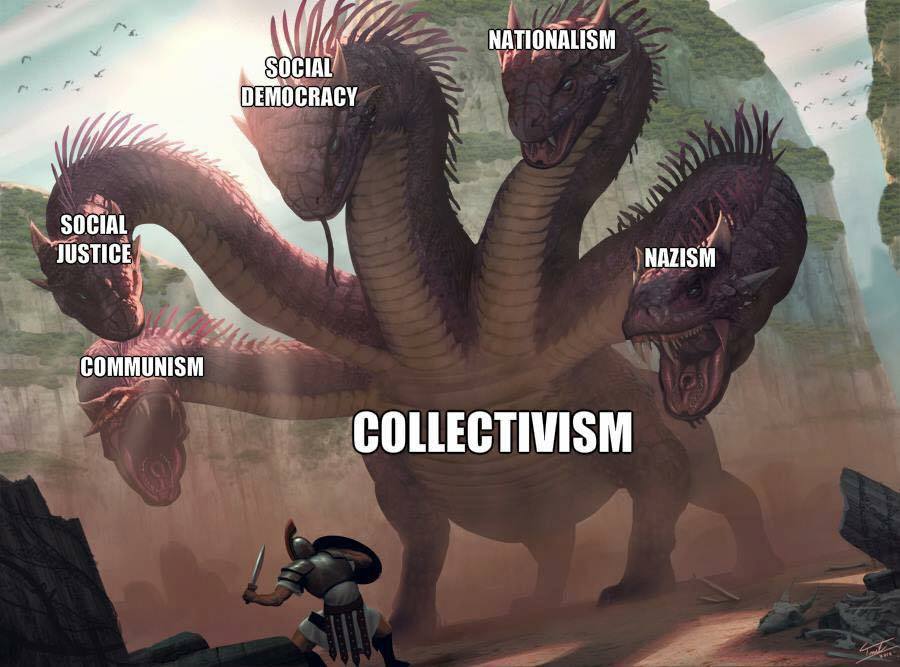
I’m baffled that anybody who is both knowledgeable and well-meaning can choose some strain of collectivism (socialism, fascism, communism, etc) over capitalism.

It should be a slam dunk for free enterprise, assuming the goal is better lives for ordinary people.

Indeed, both entries for my 2025 Counter-Tweet of the Year contest involve the superiority of capitalism over statism.

  • Chris Freiman’s response to someone praising China’s economic approach over the U.S. approach.
  • Jeremy Horpedahl’s response to someone making the absurd claim that capitalism produces poverty.

Today, I’m going to add a third contestant for counter-tweet of the year. And it happens to be another entry from Chris Freiman.

Here’s his response to someone who shared a quote about the supposed superiority of socialism.

The map comparing South Korea and North Korea is one of the strongest arguments for the superiority of free markets.  But I can’t resist a brief diversion to make a different point.  The quote is from Deng Xiaoping, who actually deserves credit for the the partial liberalization of the Chinese economy.

So I’ve always wondered whether his theory of “socialism with Chinese characteristics” was simply a way of pretending to be a good communist while moving his nation in the right direction.

The bad news is that his nation only went about one-fourth of the way as far as was/is needed for China to become a rich nation. So maybe an explicit rejection of socialism is needed for China to make the next big step in the right direction.

But I’m digressing. The main focus of today’s column is all about debunking the silly notion that socialism can produce better results than capitalism.


Thursday, May 8, 2025

Estonia’s Transition from Socialist Misery to Free-Market Prosperity, Part III

May 7, 2025 by Dan Mitchell @ International Freedom 

I’m in Estonia as part of the Free Market Road Show, so this is a good opportunity for Part III of my series on that country’s rebound from communism.

To follow up on Part I and Part II, let’s start with this Fraser Institute video.

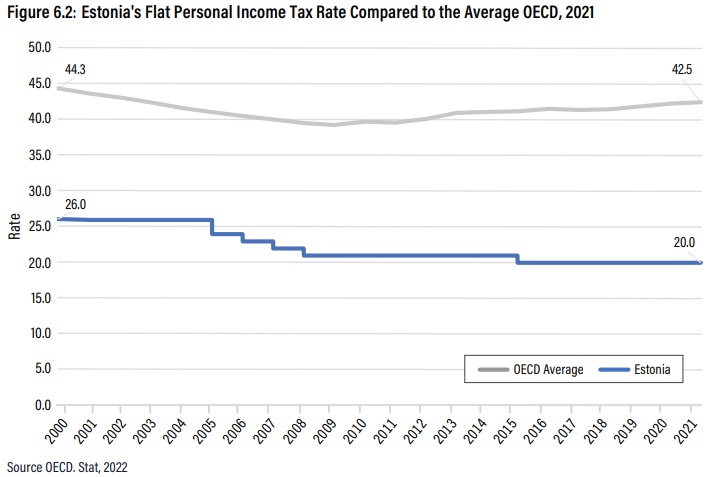
I’ve always been a fan of Estonia, going all the way back to the 1990s when Mart Laar, a history professor, became the nation’s first post-communist leader and copied the ideas of Milton Friedman with reforms such as the flat tax.


  • The good news is that the rate of the flat tax has declined from where it started at 26 percent.
  • The bad news is that rate just increased from 20 percent in 2024 to 22 percent in 2025.

But that’s still much better than income tax rates in other European nations. And Estonia’s overall tax system ranks as the best among all OECD nations.

Another way of gauging Estonia’s success is to review how well it is doing compared to other nations that emerged when the Soviet Union collapsed.

I’ve already shared data showing Estonia being a star performer, so let’s look at excerpts from Matt Mitchell’s column comparing market-oriented Estonia with statist Russia.


Estonia is…an uncomfortable reminder to Russians of what could have been. …Since leaving the Soviet Union in 1991, Estonia has grown faster than any former Soviet state. Today, the typical Estonian earns nearly 40 percent more than the typical Russian.

The share of Estonians living in poverty is one-sixth that in Russia. Relative to its population, Estonia has 50 times (!) as many business startups as Russia… An Estonian can expect to live eight years longer than a Russian. Estonian infants die at less than half the rate of Russian infants. Estonians are far more likely to report satisfaction with their lives (ranking 38 slots ahead of Russia) and government services. Estonia has one of the lowest perceptions of corruption globally (tied with Canada, Iceland and Uruguay at 14th; Russia ranks 137th out of 180 countries). …How did this happen? …

Once Estonia left the Soviet Union, it embarked on a seemingly radical plan to free its people and economy. …Estonia’s leaders privatized every business they could. They reduced government spending and consistently balanced the budget. They introduced the world’s first flat personal income tax at half the rate of other industrialized countries. They stabilized the growth rate of their money supply to bring inflation under control. They reduced regulations and made it easier to start businesses.

Almost unprecedented in the modern era, they unilaterally eliminated all tariffs and barriers to trade, giving their people proper access to the global marketplace.

All that is very impressive. The country is moving in the right direction.

Indeed, Estonia should be a role model for other post-Soviet nations, as Andy Kessler explained last year for the Wall Street Journal.


“You can’t bribe a computer,” Estonian Prime Minister Kaja Kallas told me. When it’s time to rebuild, Ukrainian President Volodymyr Zelensky should heed these words. …Ms. Kallas noted her government uses these digital tools “to decrease, diminish bureaucracy.” That’s how to create small government. “It’s cheaper and our debt is much lower as well.” Though it’s rising, Estonia still has the lowest ratio of government debt to gross domestic product in the EU. …the Reagan playbook is working. …Estonia is working to increase everyone’s equity value. Purchasing power is up 400% since Soviet occupation… Free trade, low taxes, small government, e-services, educated workers, low debt and negligible corruption. Ukraine—and the U.S.—can learn a lot from Estonia.

I’ll close by shifting to pessimism.

Estonia has not made much progress on further liberalization in the past 10-15 years, and it’s overall ranking for economic freedom has dropped to #20. Not bad by global standards, but Estonia should strive to be at Swiss levels (#3 in the world) of economic liberty.

And there are other challenges, such as the demographic decline that I wrote about back in 2016.

P.S. In Estonia’s defense, the main reason for the recent decline in economic freedom is bad monetary policy, but that’s the fault of the European Central Bank (and it’s grossly incompetent head bureaucrat) in Frankfurt.

Friday, February 28, 2025

The Case Against Socialism, Part IV

February 28, 2025 by Dan Mitchell @ International Liberty

Building on Part I, Part II, and Part III of this series, here’s a video debunking some online socialists who are inexplicably popular.

As you can see, the video cites real socialists – i.e., people who defend policies such as government ownership of the means of production.

What’s amusing – though predictable – is that none of those economic illiterates were willing to be interviewed by John Stossel.

I suspect their cowardice is mostly due to the fact that they are trying to defend the indefensible.

It’s easy to spout nonsense to a friendly audience of acolytes, but it’s entirely different to defend preposterous beliefs when being grilled by someone – like Stossel – who actually knows something.

As you can see in the video, all of the specific socialist talking points got debunked (such as socialists taking credit for advances in China and Vietnam that were only possible because of partial economic liberalization).

So my contribution to today’s discussion will be to cite data from the most-recent edition of Economic Freedom of the World.

I already wrote about that report, but primarily to bemoan the global decline in economic freedom and to highlight the world’s freest and more repressive economies.

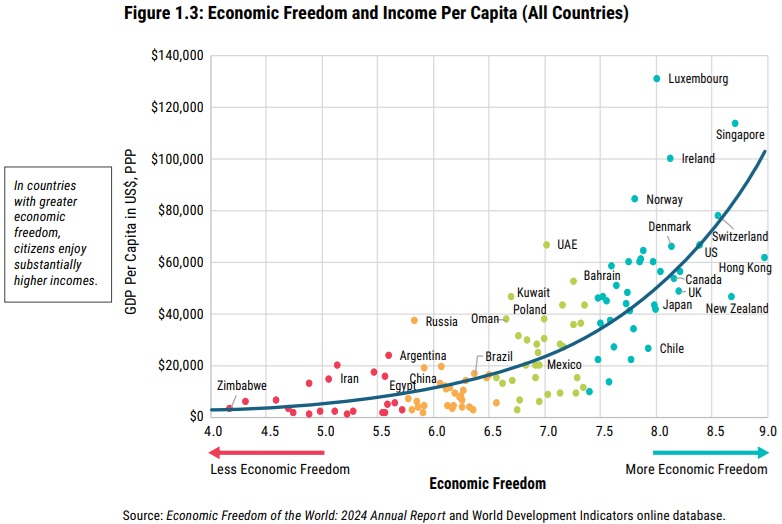
But I did include this graph, which is (or at least should be) a slam-dunk argument for more economic liberty and less socialism.

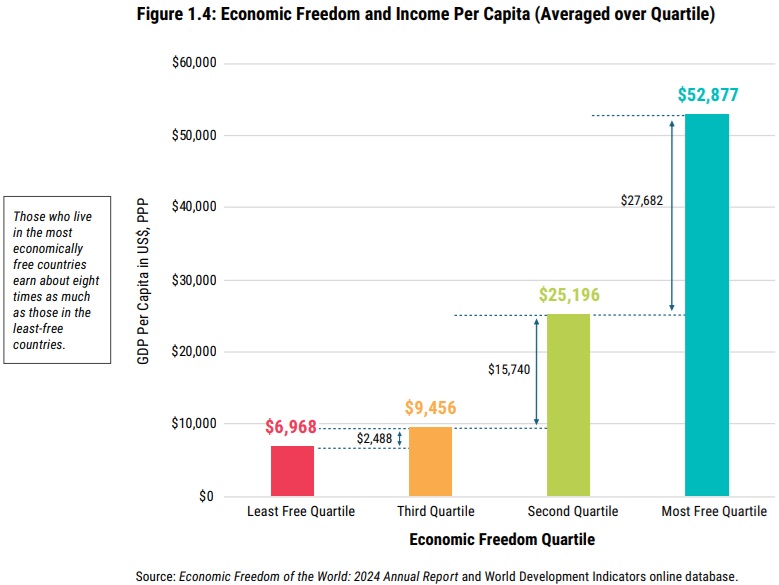
And here are two more graphs from EFW that are worth sharing.

Figure 1.4 looks at average per-capita economic output by quartile. As you can see, the world’s freest economies have more than seven times as much per-capita GDP.

Socialists claim to be concerned about the poor.

Many of them, I’m sure, are very sincere.

But they also are very wrong about their preferred economic system. That’s because Figure 1.9 reveals that material deprivation is almost non-existent if free economies, but is very common in statist economies.

I’ll close by noting that there are different strains of statism, so not every lowly ranked country is socialist. But the flip side of that statement is that every socialist country is lowly ranked. Which is a statement that belongs in the not-surprising file.

Saturday, January 18, 2025

Will Vietnam Become the Next Asian Tiger?

January 17, 2025 by Dan Mitchell @ International Liberty

Vietnam’s economic trajectory is similar to China’s.

  • Horrible poverty and even starvation (in the case of China) during the days of hard-core communism.
  • Less poverty today thanks to a few pro-market reforms starting in the 1980s.
  • Still low-to-middle income jurisdictions because they’re stuck in the third circle of “statist hell.”

This chart from the Fraser Institute’s Economic Freedom of the World shows that Vietnam and China both rank way below Singapore and Hong Kong.

Since China used to have scores below 4, being above 6 is a lot of progress. And something similar presumably happened with Vietnam (though it only produced enough data to get scores starting in 2000).

The interesting question is what happens to these countries in the future. Will there be a new round of pro-market reform, allowing them to start converging with rich nations? Or will they tread water, doomed to be – at best – middle-income countries because of inadequate economic liberty?

I’ve written many times (here, here, here, here, here, here, here, here, here, here, here, here, here, and here) that I’m worried about China.

But let’s focus today on Vietnam. I wrote last year about that country’s partial liberalization, noting that “Vietnam has take the first steps in what hopefully will be a long journey.”

Well, “hopefully” may turn into “actually.”

Why am I now more optimistic?

Because of a report last week in Bloomberg. Authored by Francesca Stevens, Nguyen Dieu Tu Uyen, and Nguyen Xuan Quynh, it described how Vietnam may be copying Javier Milei’s radical pro-market reforms.

Here are some excerpts.


As Elon Musk and Argentina’s Javier Milei champion ambitious plans to dramatically slash the size of government, a similar effort is getting underway across the globe from political leaders with a completely different ideology: Vietnam’s Communist Party.

In what amounts to the biggest overhaul of the state since adopting pro-market reforms in the 1980s, Vietnamese officials are targeting a roughly 20% reduction in the size of ministries, government agencies, and civil service workforce. It’s being pitched as essential medicine to remedy a bloated bureaucracy, reduce red-tape and cut unnecessary costs from local governments on up. The plans would see five ministries abolished…

Four government agencies, including the State Capital Management Committee, will be eliminated. Five state television channels, 10 newspapers and 19 magazines will be scrapped. …“This is a very urgent issue which must be done,” Lam said in a speech posted on the Communist Party’s website in December.

“Sometimes we have to take bitter medicine, endure pain and cut out tumors in order to have a healthy and strong body,” he said. …civil servants are clearly stressed — one deputy prime minister said 100,000 jobs would be affected… “reforms…are necessary to achieve their goal of high-income status by 2045,” ISEAS-Yusof Ishak Institute’s Giang said.

This report is very exciting, though time will tell whether the nominal communists running Vietnam genuinely intend to shrink the burden of government.

In other words, I want to see actual evidence of smaller government, not just rhetoric. As the great Ronald Reagan said, “trust but verify.”

That being said, I’ll close with two optimistic comments.

Incidentally, if I’m right on the second point, then the Fourth Theorem of Government kicks in.

Reforms continue and Vietnam joins the club of Asian Tigers.

P.S. This column illustrates why Milei’s importance extends way beyond Argentina. Yes, it will be great if he turns Argentina from a statist disaster to a free-market success. But I’m even more excited about him showing the rest of the world that dramatic free-market reforms are the way to go. Sort of the Washington Consensus, but on steroids.

Monday, December 30, 2024

Americans Are Getting Richer, Part II

December 28, 2024 by Dan Mitchell @ International Liberty

Two years ago, I expressed guarded optimism about the economy and government policy.

…we don’t need perfect policy to get more prosperity. The economy simply needs “breathing room,” which will exist so long as politicians don’t get too crazy about over-taxing, over-spending, and over-regulating. After all, even small differences in annual economic growth compound into big changes in living standards.

I followed last year with my Sixteenth Theorem of Government, which said the same thing but hopefully in a more pithy and memorable way.

Today, I want to show that the economy actually is innovating faster than government is suffocating. I already did this in 2021, but let’s look at some new data.

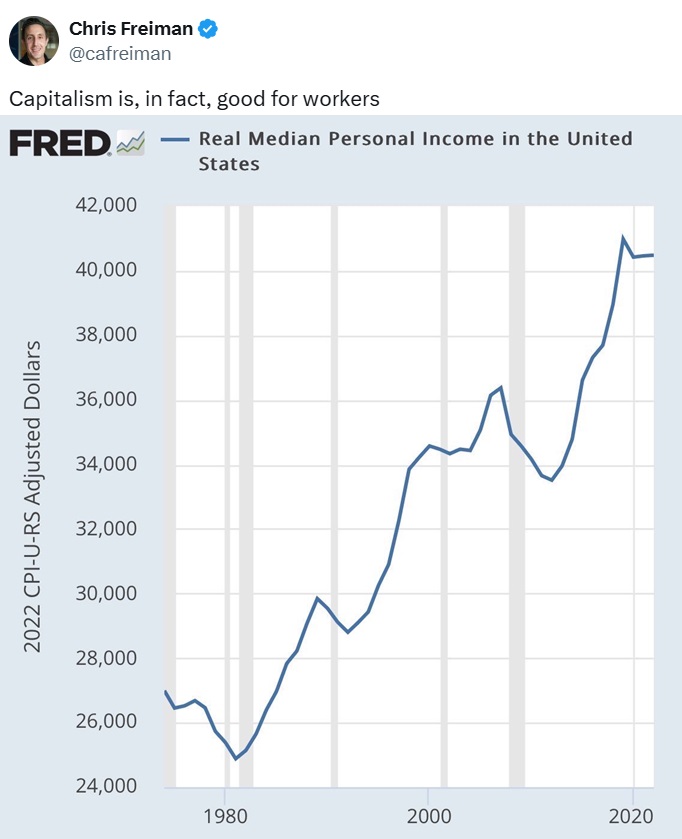
We’ll start with this chart from Professor Chris Freiman of West Virginia University. As you can see, data from the St. Louis Federal Reserve shows that average inflation-adjusted income in the United States has been rising over time.

In other words, the hockey stick is still heading in the right direction.

Could income be growing faster? Of course. That’s why I’m always complaining about bad policies (punitive taxes, wasteful spending, excessive red tape, cronyism, protectionism, etc).

By the way, the above chart shows “median” income rather than “mean” income, which means the numbers are not influenced by very high incomes for a handful of rich people.

Now that we’ve looked at income, let’s shift to wealth.

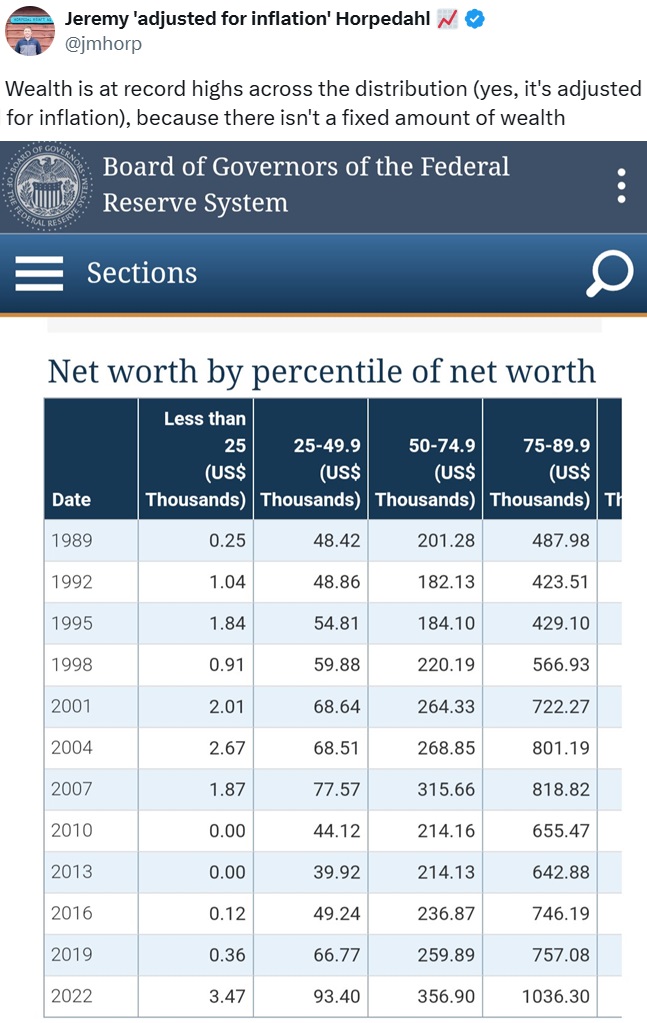
Here’s a chart from Professor Jeremy Horpedahl at the University of Central Arkansas. He uses Federal Reserve data to show that average net worth has reached record levels for every segment of the population.

All of this data confirms that the economy is not a fixed pie. Our friends on the left who think that poverty is caused by rich people being rich suffer from the zero-sum fallacy.

  • The first chart today shows that it is possible for everyone to earn more income at the same time.
  • And the second one shows it is possible for everyone to accumulate more wealth at the same time.

At this point, folks on the left sometimes shift their argument. They’ll grudgingly admit that a growing economic pie enables everyone to have a bigger slice, but they’ll complain that it’s somehow wrong for a segment of the population to have a lot of income or a lot of wealth.

In other words, they’re motivated by resentment. And oftentimes that resentment leads them to support policies designed to punish success.

All I ask is that they acknowledge and admit that the policies that they want will reduce economic performance.

Interestingly, honest leftists in the tradition of Arthur Okun admit this tradeoff. But what they don’t seem to understand is that their approach will lead to lower incomes for everyone, not just rich people.

That’s something that Margaret Thatcher certainly understood.

P.S. I try to convince my lefty friends (see herehere, here, and here) that they should focus on helping poor people rather than hurting rich people.

Thursday, December 19, 2024

The Case for Capitalism, Part VII

December 15, 2024 by Dan Mitchell @ International Liberty

Every previous column in this series (Part IPart IIPart IIIPart IV, Part V, and Part VI) has featured a video.

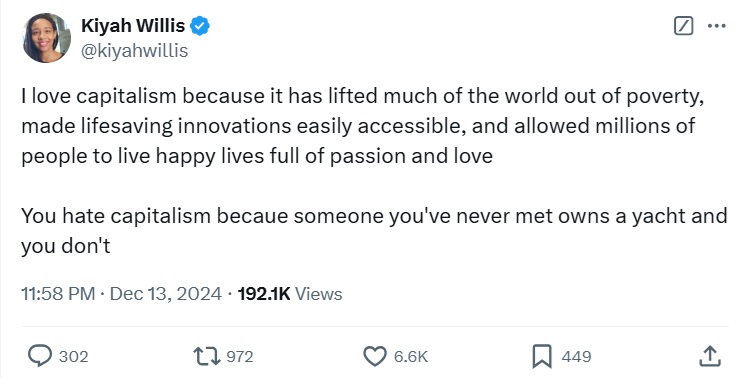
I’m going to break that pattern today and instead start with this profoundly important tweet.

The first part of the tweet is supported by straightforward empirical data.

The nations that have more capitalism grow faster and generate broadly shared prosperity. The nations that have more government languish.

But I want to focus on the second part of the tweet, which gives one of the possible reasons for why some people reject free enterprise.

Is it true that the haters of capitalism are merely resentful?

That’s obviously the case for some folks on the left, but let’s explore why.

In a column for Law & Liberty, Dominic Pino cites Friedrich Hayek’s hypothesis (which I also wrote about back in 2010) that a preference for redistribution may be a legacy of how human societies evolved.


The better explanation for the seemingly irrational rejection of capitalism comes from Friedrich Hayek, in what he calls the “atavism of social justice.” Hayek said that he spent ten years trying to figure out what “social justice” means and concluded it is “nothing more than an empty formula, conventionally used to assert that a particular claim is justified without giving any reason.”

He traces the instinct towards social justice and against the market system to earlier stages of civilizational development, when humans lived in small bands of a few dozen people. In that context, “a unitary purpose, or a common hierarchy of ends, and a deliberate sharing of means according to a common view of individual merits” are beneficial characteristics to survival.

In a modern commercial town of thousands of people, to say nothing of a globalized market economy, those characteristics are largely impossible to obtain, given the diversity of human wants and needs and the specialization of production.

Commercial society has improved our standard of living far beyond what our ancestors could have ever imagined, but that instinct from primitive societies is still hardwired in us, Hayek argues.

That seems compelling and I’m sure it’s part of the answer.

However, envy is also part of the answer. I think people like Bernie Sanders simply resent success. So I agree with @kiyahwillis.

But I’ll elaborate in a way that maybe links her explanation to Hayek’s explanation. Based on my countless discussions for statists, the big problem is that folks on the left believe in the zero-sum fallacy.

To understand, here’s a video I shared about three years ago.

In primitive societies, the zero-sum fallacy wasn’t a fallacy. If the chief took a bigger share of mammoth meat, it did mean less for everyone else.

So maybe there are “hardwired” reasons for people to feel hostility toward people with a lot of wealth. But as explained in the video (and by Hayek), that mentality is wildly wrong in a market economy based on voluntary exchange and wealth creation.

The pilgrims figured that out 400 years ago. Is there any hope for today’s class-warfare crowd?

Saturday, October 26, 2024

Understanding the Anti-Market Ideology of Fascism

October 25, 2024 by Dan Mitchell @ International Liberty 

Other than noting that it is a form of collectivism, coercion, and interventionism, I have not paid much attention to fascism.

Today, we’ll take a closer look at this statist ideology, and we’ll start with this video from Matt Kibbe. And since I’ll be focusing on the economics of fascism, I urge people to pay close attention to the part of the video starting at 9:25.

As you can see from the video, there are several components of fascism, including a poisonous type of ethnic solidarity and a twisted version of nationalism.


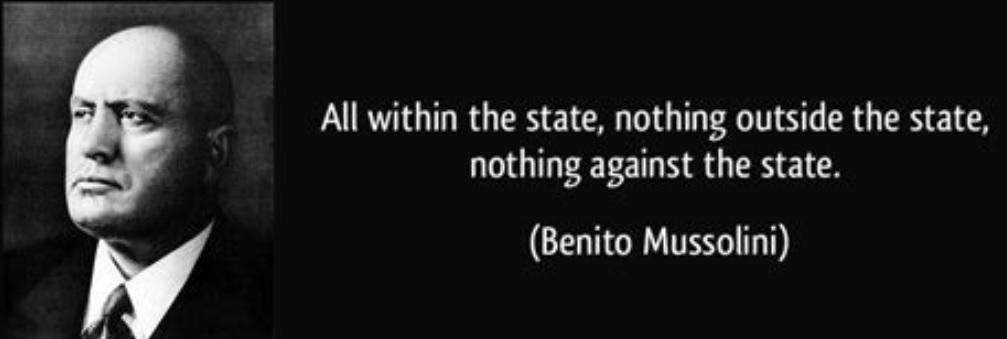
The part I’ll focus on, though, is the statism. As illustrated by the Mussolini quote, government is the all-important entity for fascists.

Individual liberty is suppressed, often with violence.

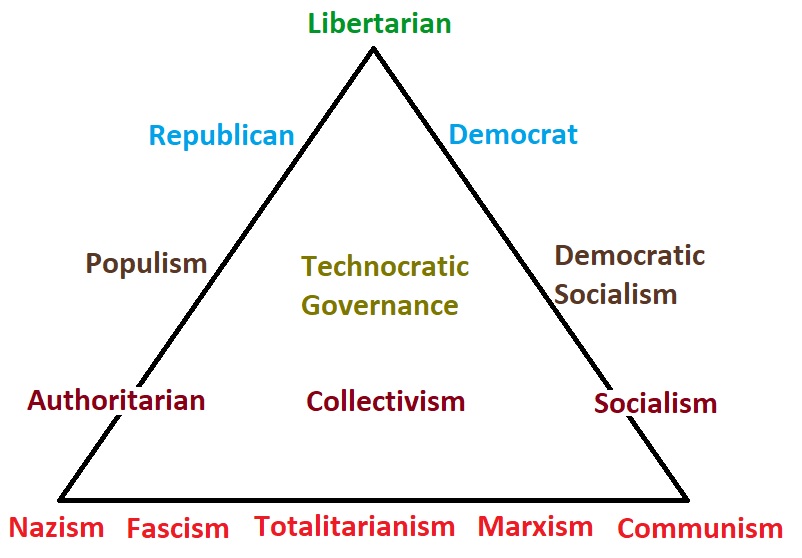
Which is why I don’t think a left-right spectrum is a good way of describing political and philosophical divisions.

I prefer this triangle, which shows libertarianism at the top of the triangle and competing strains of authoritarianism at the lower points.

Now let’s look at what others have written about fascism.

The Foundation for Economic Education has several must-read articles.

We’ll start with some of the highlights from Larry Reed’s column.


…on July 29, 1921…Adolf Hitler assumed the leadership of the National Socialist German Workers Party… Note the formal, official name of the party. It was not the National Capitalist German Workers Party. It was not the National Free Market German Workers Party. Nor was it the National Christian German Workers Party.…

The lie that Nazism was capitalist instead of what the Nazis themselves said it was (namely, socialist) derives from the fact that the Hitler regime did not engage in wholesale or widespread nationalization of businesses. In the Third Reich, you might retain legal title to a factory but if you did not do as the Nazis ordered, you would be, shall we say, dispatched. …Lenin, Mao, Pol Pot, Castro, Hitler, Mussolini were all anti-capitalist peas in the same socialist, collectivist pod.

Here’s some of what Rainer Zitelmann wrote about Hitler’s anti-market views.


How important Hitler considered the question of state-controlled planning of the economy to be can be seen from the fact that in August 1936 he personally wrote a “Memorandum on the Four-Year Plan 1936.” In this memorandum his admiration and fear of the Soviet system of planned economy were expressed… Hitler was convinced of the superiority of the Soviet planned economy system over the capitalist economic system. This must be regarded as an essential reason why he so vehemently demanded and enforced the extension of state control of the economy in Germany as well. …Hitler…emphasized in his last radio address on January, 30, 1945, “that the age of unrestricted economic liberalism had outlived itself.”

Now let’s look at some excerpts from Jon Miltimore’s column.


…the word is right there in the name: National Socialism. If you read the speeches and private conversations of the Nazi hierarchy, it’s clear they loved socialism and despised individualism and capitalism. …there is no question they saw socialism as the future and despised bourgeoisie capitalism. …So what sets National Socialism apart from Marxism?

There are two primary differences.

The first is that Hitler and Goebbels fused their socialism with race and German nationalism… The second difference is that National Socialists were less concerned with directly controlling the means of production. …the Nazis never initiated a widespread nationalization of industry, but…this was a distinction without a difference. …European fascism was simply a different shade of socialism… Like Marx, the Nazis loathed capitalism and saw the individual will and individual rights as subordinate to the interests of the state.

And here are some passages from Emmanuel Rincón’s column.


…a deep discussion about the ideological roots of fascism…is necessary to know in depth the life, beliefs, and principles of both its political leaders (such as Benito Mussolini) and its philosophical leaders (such as Giovanni Gentile). Mussolini was a…member of the Italian Socialist Party for 14 years. In 1910, he was appointed editor of the weekly La Lotta di Classe (The Class Struggle)…

Giovanni Gentile…was the intellectual author of the “doctrine of fascism,” which he wrote in conjunction with Benito Mussolini. …Gentile went so far as to declare “Fascism is a form of socialism, in fact, it is its most viable form.” One of the most common reflections on this is that fascism is itself socialism based on national identity. …unlike traditional socialism, it did not consider that the state should own all the means of production, but more that it should dominate them. The owners of industries could “keep” their businesses, as long as they served the directives of the state.

Let’s close by shifting from economic theory to politics.

Kamala Harris and others have accused Donald Trump of being a fascist, in large part based on his perceived willingness to use the power of government to go after his enemies and trample constitutional norms.

Since I’m not a Trump fan, I’m willing to believe just about any negative charge against him, but I also believe that sauce for the goose should be sauce for the gander.

If some of Trump’s actions have been bad (and they have), then we also should recognize and condemn similar misbehavior on the other side.

P.S. I can’t resist making a final observation about the economics of fascism. The main difference between socialism and fascism is that the former features government ownership and government control while the latter features private ownership and government control. 

We do have a few small sectors of our economy run by the government (Postal Serviceair traffic control, etc), but it’s far more common to have big sectors that are heavily regulated and indirectly controlled by government (health care, agriculture, banking, trade, etc). So you could argue that one of America’s main economic problems is fascism. But since that term has all sorts of other negative connotations, it’s better to say that the problem is cronyism or interventionism.

Thursday, September 19, 2024

How to Really End ESG

Russell Greene September 13, 2024 @AIER, Tags: Daily Economy, Environmentalism, Capitalism, Books


Eleanor Roosevelt holds a poster of the Universal Declaration of Human Rights. Lake Success, NY. 1949. Courtesy FDR Presidential Library & Museum.

ESG investing poses a grave threat to the principles that lifted billions out of poverty. It neither does much good nor performs very well. Therefore, it must end.  

So asserts Ending ESG, a collection of essays edited by Phil Gramm and Terrence Keeley. Gramm, a former Republican senator and economics professor, and Keeley, a former managing director at Blackrock, are well-suited to make the case. The book’s lengthy introduction is co-authored by Gramm and Keeley. It traces the Environmental, Social and Government (ESG) investment movement back to the United Nations. Not to the Kofi Annan era of the late 90s and early 2000s, that is, but all the way back to the 1948 Universal Declaration of Human Rights.  

The authors do not dwell upon this early history, but it is worth briefly unpacking. Eleanor Roosevelt chaired the drafting committee of the UN Declaration. She explained that many of its members “thought that lack of standards for human rights the world over was one of the greatest causes of friction among the nations, and that recognition of human rights might become one of the cornerstones on which peace could eventually be based.” This was a pressing priority in the wake of World War II.

Jacques Maritain, a French Philosopher who provided intellectual inspiration for the document, explained how consensus was achieved: “we agree on these rights provided we are not asked why. With the ‘why’ the dispute begins.” History has since tested the stability of agreeing not to ask why.

Over the next 75 years, the UN’s declaration of rights eventually led to ESG. Inspired by the declaration, the UN launched development goals (eradicating poverty, gender equality, environmental sustainability, etc.). Then, the UN released investment principles based on these goals, to be adopted by major asset managers, banks, public pensions, and regulatory bodies. To the shock of anyone familiar with other UN efforts, the UN’s work on ESG has paid off.  

ESG has been adopted by major institutions over the world, in word if not always in deed. The result is that “the private economy is increasingly being coerced into meeting a growing number of environmental and social goals that Congress never mandated.”  

The cost of such coercion is high. For one, it undermines the legal and ethical basis of economic progress. Whereas the economic Enlightenment was “founded on the principle that people own the fruits of their own labor and thrift,” ESG is a “throwback to the medieval concept of communal property.” Throughout 14 essays, mostly penned by Gramm and/or Keeley, Ending ESG argues against such an ESG-inspired return to medieval economics.

ESG might seem high-minded and noble compared to the hard-nosed alternatives of fiduciary responsibility and shareholder primacy. But appearances are deceiving. When it comes to results, the economic enlightenment enabled 128,000 individuals to escape abject poverty every single day. In contrast, it’s not clear if the ESG movement has accomplished anything of note, other than lowering the popularity of Wall Street and Corporate America among conservatives, contributing to the anti-business turn on the right.

And though the ESG movement claims to care about eradicating poverty and protecting the environment, we should not take these claims too seriously. Keeley cites a research finding that there is “no evidence that socially responsible investment funds improve corporate behavior.” Moreover, it’s difficult to even assess the impact of ESG strategies since “ESG scores among leading rating agencies correlated only 54 percent of the time.”  

The evidence is compelling, but it raises a puzzling question: if ESG does “neither much good nor very well,” why do so many people seem to believe it does both? Where did ESG critics go wrong? Why did it take nearly two decades for ESG to face substantial backlash?  

One problem is that the defenders of fiduciary responsibility failed to provide adequate moral foundations for their view. Keeley cites Milton Friedman’s classic 1970 New York Times piece, “The Social Responsibility of Business is to Increase Its Profits.” There, Friedman argued:

In a free‐enterprise, private‐property system, a corporate executive is an employee of the owners of the business. He has direct responsibility to his employers. That responsibility is to conduct the business in accordance with their desires, which generally will be to make as much money as possible while conforming to the basic rules of the society, both those embodied in law and those embodied in ethical custom.

Friedman, a committed positivist, did not found his concept of social responsibility on a universal ethical standard, other than the need for business executives to defer to shareholder desires. And, in his view, this will usually mean to seek profits while conforming to existing laws and customs. These laws and customs will vary from time to time, and from place to place. And so, apparently, will the social responsibilities of businesses.

In his essay “How Conservatives Can Get ESG Right”, Keeley endorses Friedman’s analysis. Yet it suffers from two major flaws, flaws that also weaken Keeley’s arguments. First, businesses and investors are not just passive recipients of laws and ethical customs. Business leaders are norm-makers, not just norm-takers.  

The most successful business leaders are able to cast a compelling long-term vision, one that includes but goes beyond making money, and to persuade their investors to remain focused on the long-term. That is, business leaders lead their investors, they don’t merely respond to investor preferences. Further, policymakers depend on the counsel of industry to respond to technological innovations, as we are now seeing with artificial intelligence. And business leaders seek to influence both the law and public opinion, such as through lobbying, public relations, media, and publishing their own thoughts.  

This is understandable. To survive, businesses cannot merely conform to the basic rules of society — they must influence them. But how, and in which direction? For example, should they oppose crony subsidies and regulations, which may help their profits, at least in the short term, but undermine economic dynamism and the very legitimacy of their businesses? Friedman’s positivism does not provide much guidance here.  

After all, the ethical customs and laws of a society may grow increasingly hostile to private enterprise. Indeed, they seem to be doing so now. Business leaders cannot be expected to stand by as activists assault the legal and ethical foundations of economic progress, or as government agencies violate their constitutional rights. While Ending ESG recommends that business leaders “keep politics out of the boardroom,” this is no longer an option for major corporations, if it ever was.

Moreover, activist shareholders increasingly are advancing shareholder proposals that are harmful to the long-term interests of the very corporations in which they own shares. This means businesses increasingly have to defend themselves against their own shareholders. Complicating matters further, the nature of business ownership has radically changed since 1970, with the rise of passive index investors and pension-fund activism. It’s no longer safe to assume that major investors will all agree on maximizing the long-term value of a particular firm, especially if that firm is engaged in ESG-unfriendly lines of business. What most investors do, and should, prioritize is very much up for debate.

Keeley claims “there is no practical alternative to shareholder primacy.” But clearly, there is. For one, many American states now have the option of “benefit corporation,” an option that replaces shareholder primacy with responsibilities to an array of stakeholders. And in Europe, the concepts of double materiality and co-determination override any commitment to shareholder primacy.  

Now, it’s true that such stakeholder governance often comes at a cost. On the other hand, stakeholder advocates will claim the cost is worth it, whether to save the planet, or to advance “equity.” It’s incumbent, therefore, upon ESG critics to advocate an alternative vision, not merely to fall in line with convention.

Without casting a bold vision for the future of free enterprise, there is no hope of ending ESG. Keeley himself recommends that “Republicans need a road map that would enable society to get all the good out of ESG without the bad.” He also refers approvingly to “growing numbers of shareowner resolutions seeking lower carbon emissions or increased workforce diversity.” But why defer to the United Nations, of all institutions, as a moral authority? Why grant any moral worth to counterproductive Western divestment from fossil fuels? Why pay even lip service to skin-deep diversity metrics?  

Just as Friedman recommended business leaders “conform” with convention, Keeley accepts ESG’s goals, while challenging its methods on pragmatic grounds. This is not a sustainable division of labor. It makes no sense for capitalists to legitimize the NGOs, global institutions, and academics working to delegitimize capitalism and advance the “religion of humanity.”

In the words of Argentine President Javier Milei,

Milton Friedman used to say that the social role of an entrepreneur is to make money. But that’s not enough. Part of their investment must include investing in those who defend the ideals of freedom, so the socialists can make no further advances. And if they don’t do it, they [the socialists] will get into the State, and use the State to impose a long term agenda that will destroy everything it touches. So we need a commitment from all of those who create wealth, to fight against socialism, to fight against statism, and to understand that if they fail to do so, the socialists will keep coming.

Fortunately, there are reasons for hope. 

Some business leaders are taking a more active role in advocating for the principles of economic enlightenment. In 2023, prominent Silicon Valley investor Marc Andreesen published the Techno-Optimist Manifesto. Andreesen’s manifesto defended free markets and attacked ESG as part of a “mass demoralization campaign.” Tech founder Brendan McCord launched the Cosmos Institute. Cosmos is bringing together philosophers with technologists in an Oxford University seminar, to discuss how technology can promote human flourishing. Elon Musk, of course, been scathingly critical of ESG, calling it a scam. And Liberty Energy CEO Chris Wright releases an annual Bettering Human Lives report that argues for prioritizing the elimination of energy poverty over ESG goals.

Beyond business leaders themselves, the Alliance Defending Freedom recently released a “Statement of Principles on the Purpose of a Corporation.” The statement declares that “the proper purpose of business is to advance human flourishing by creating economic value through excellence in the provision of goods and services.” And the Abundance Institute has been making the case for “long-term tech optimism.”

To be sure, no particular one of these efforts is definitive. Nor, combined, will they be sufficient to defend the “economic enlightenment” against illiberal assaults. Yet if more affirmative visions for free enterprise are paired with reasonable, evidence-based critiques of ESG, such as those offered by Gramm and Keeley, ESG’s days might, indeed, be numbered. 


Russell Greene is a Senior Fellow for the Economy at Stand Together Trust, where he manages a grant making portfolio focused on federal regulatory affairs and strategic litigation. Prior, he worked for CrossFit Inc., directing the company’s brand defense and government affairs efforts. He has a BS in International Politics from Georgetown University’s Walsh School of Foreign Service, where he learned both Classical and Modern Standard Arabic. He studies Ancient Greek and Latin in his spare time. Russ has published a number of articles on classical liberalism, ESG and related issues. 
 
Get notified of new articles from Russell Greene and AIER. SUBSCRIBE

Wednesday, May 15, 2024

Defending “Neoliberalism”

May 14, 2024 by Dan Mitchell @ International Freedom

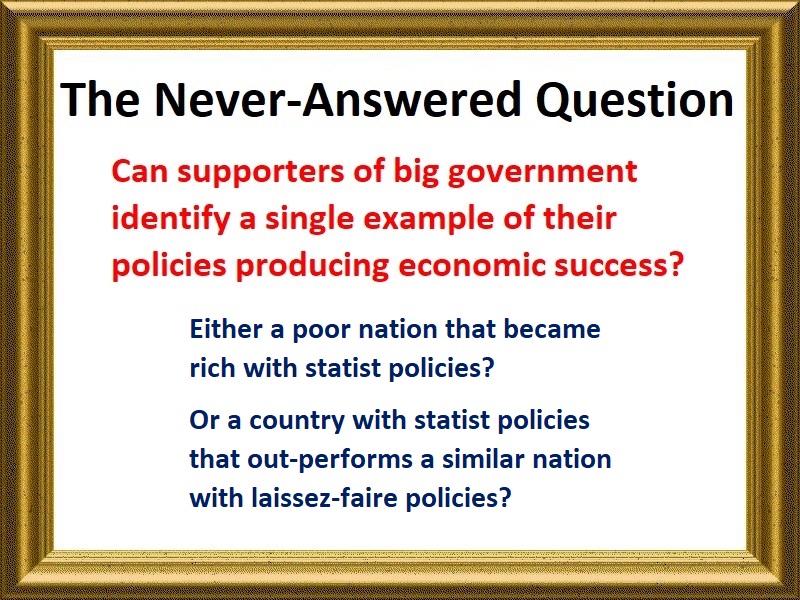
Whenever I’m part of a debate about the merits of free markets, I ask my leftist opponent to respond to my never-answered question.


Cite an example, I beg them, of big government producing prosperity.

Inevitably, that person either dodges the question or gives an inaccurate answer.

Based on his new column in the Washington Post, I’m guessing that Joe Stiglitz would dodge the question.

As you can see from these excerpts, he makes lots of assertions about the supposed superiority of big government, but he offers no evidence for that proposition.


We’ve now had four decades of the neoliberal “experiment,” beginning with Ronald Reagan and Margaret Thatcher. The results are clear. Neoliberalism expanded the freedom of corporations and billionaires to do as they will and amass huge fortunes, but it also exacted a steep price: the well-being and freedom of the rest of society. …there are two kinds, positive and negative; freedom to do and freedom from harm.

“Free markets” alone fail to provide economic stability or security against the economic vagaries they create… Government is needed to deliver both. …Neoliberal capitalism has thus failed in its own economic terms: It has not delivered growth, let alone shared prosperity. …and it has instead set us on a populist route raising the prospects of a 21st-century fascism. …

There is an alternative. …I call this new set of economic arrangements “progressive capitalism.” Central are government regulations and public investments, financed by taxation.

Before giving my response, I’ll make two points to help readers understand Stiglitz’s points.

  1. It may seem odd to Americans, but “neoliberal” often is a term for laissez-faire, especially in other nations (and usually intended as a slur). The same thing is true when folks on the left use terms like “free-market fundamentalist” or “zombie Reaganite.”
  2. The “two kinds of freedom” refer to the right to be left alone (negative liberty) and the supposed right to taxpayer-financed goodies (positive liberty). President Franklin Roosevelt’s so-called Second Bill of Rights would be an example of positive liberty.

With those definitional issues out of the way, I already noted that my main criticism is that Stiglitz offers no evidence to back up his assertions.

But there are a couple of other points worth making.

First, Stiglitz claims that capitalism “has not delivered growth, let alone shared prosperity.” Nonsense. There is a very strong correlation become market friendly policies and national prosperity.

And it’s worth noting that free markets have produced mass prosperity. Indeed, capitalism is the only system in the world to ever deliver that result.

Second, Stiglitz refers to “the four decades of the neoliberal experiment” that started with Reagan and Thatcher.

He is right about the starting point. There was an era, starting around 1980, known as the “Washington Consensus” when governments liberalized their economies. But the evidence clearly shows that the drift to statism resumed around the turn of the century.

P.S. I can’t resist sharing one final excerpt from Stiglitz’s column.

Freeing bankers from what they claimed to be excessively burdensome regulations put the rest of us at risk…when the banking system imploded in 2008.

This also is nonsense. Bad government policy (specifically easy money and Fannie/Freddie subsidies) gave us the 2008 crisis.

P.P.S. I also can’t resist pointing out that Stiglitz has cheered the policies that produced terrible outcomes in Greece and Venezuela.

Wednesday, January 31, 2024

Everything You Need to Know about the Difference Between Free Enterprise and Socialism

January 31, 2024 by Dan Mitchell @ International Liberty

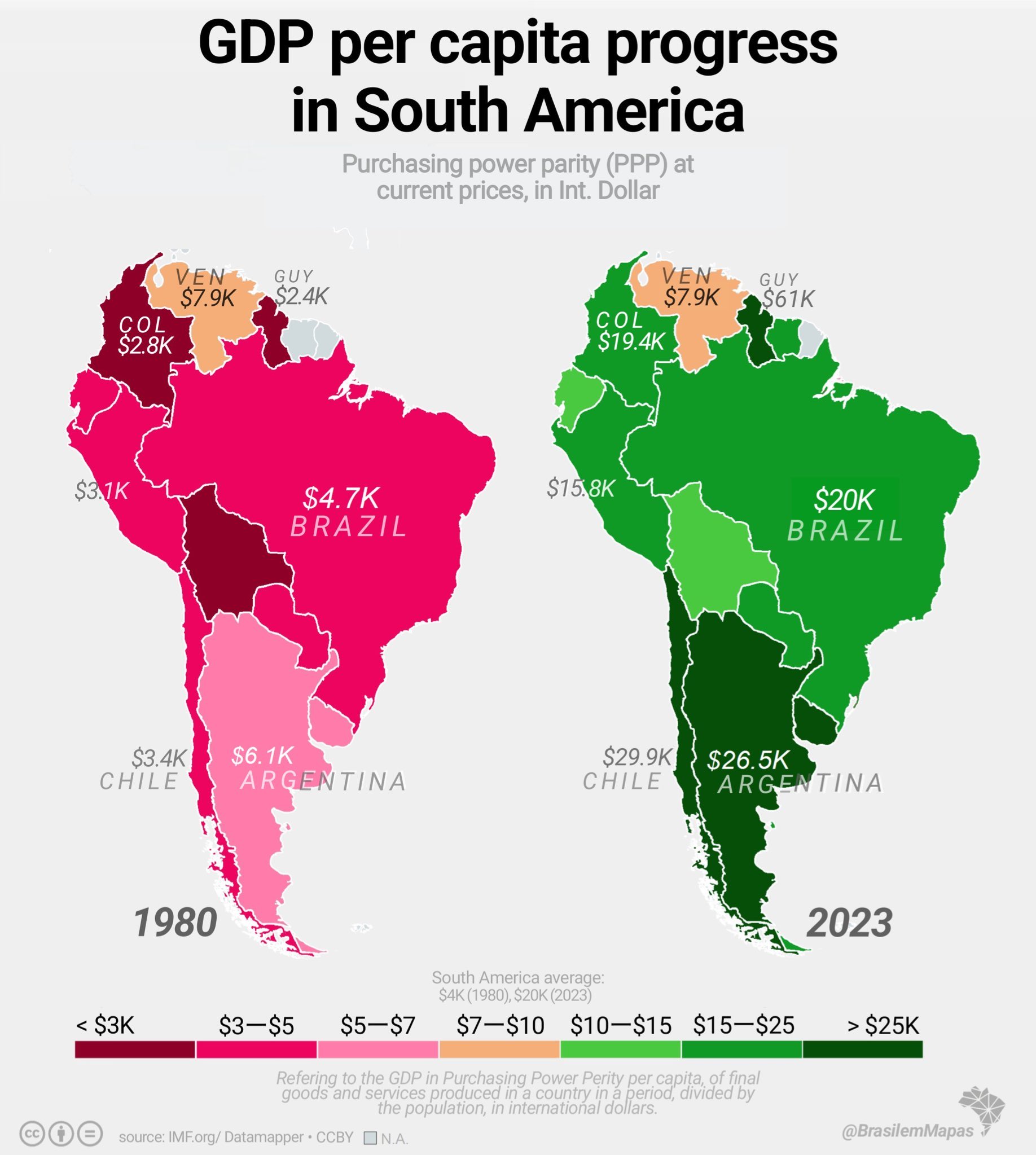
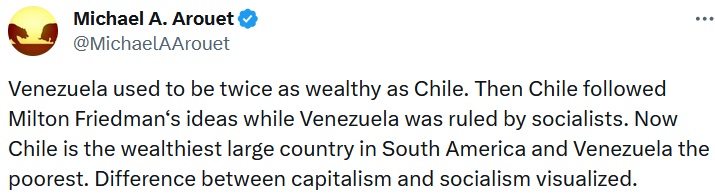
I’ve written critical columns about the failure of Venezuelan socialism and I’ve written laudatory columns about the success of Chile’s free markets reforms.

Today, let’s compare and contrast what has happened to these two countries.

Here are two maps of South America showing per-capita economic output. Amazingly, Venezuela was more than twice as rich as Chile in 1980 but now Chile is more than three times as rich as Venezuela.

At this point, I normally would pontificate about the meaning of these two maps.

But there’s no need for me to write anything because the person who shared them on Twitter (X) nailed the obvious takeaway.

Game, set, and match. Economic liberty trounces statism.

The same message that you see in this chart.

P.S. If you want to learn about Milton Friedman and Chile, click here.

Saturday, January 20, 2024

China Versus Argentina: Place Your Bets

@ Manhattan Contrarian

In a world of now close to 200 countries, every day provides an updated report card as to what works and what doesn’t in economic policy. As reported by the IMF, World Bank, and UN, some countries have per capita GDP as much as 300 times more than the per capita GDP of other countries. What are the poor ones doing wrong?

Most countries largely stick with the same collection of economic policies for long periods of time, with only small changes. Unsurprisingly, the rich get richer, because what they are doing is working. The poor may or may not get poorer, but at best they stagnate, unless they are ready to try the things that have made the rich rich.

But every once in a while you get a country that makes a relatively significant change. Two that are doing that now are China and Argentina. Which one is more likely to be successful going forward?

Consider first China. In the late 1970s, after almost 30 years of effectively one-man rule by Mao Zedong, China was left dirt poor. A series of stupid centrally-planned economic schemes by people who had no idea what they were doing (a steel-making furnace in every back yard!) had led to rounds of mass starvation. 

Then Deng Xiao-ping came to power in 1978, and opened China to private business and investment. Over the next 30+ years, as profit-seeking investors set the direction of the economy, China experienced a true economic miracle. And then in 2013, it became the turn of Xi Jinping. At first, not much changed under Xi; but gradually, the clamp-down took hold. Little by little, owners of opposition press outlets have been imprisoned, surveillance has become pervasive, and investment discretion has been taken away from private actors and given back to the state. The economy slowed, and then slowed more. The state now seeks to set a new economic direction.

For the latest, we turn to a big front-page piece in today’s Wall Street Journal, headline “China Goes All In on Green Industry to Jolt Ailing Economy.” (probably behind pay wall). The backdrop is that China’s economy, which has been gradually slowing for years, continued that process in 2023:

[F]igures show[] the world’s second-largest economy expanded in 2023 at its weakest rate in decades, aside from the three years when China was closed to the outside world during the Covid-19 pandemic. A drawn-out property crunch means Beijing can no longer rely on debt-fueled real-estate investment to power the economy, and officials have shown little appetite to shift activity decisively toward consumer spending.

So what will they do to change direction? One idea might be to let private entrepreneurs take back initiative over investment and see what they might come up with. But freedom is anathema to the Xi government, and they think they have a better idea. So instead the new direction will be that the state will direct investment into what they call the “New Three” industries. From the WSJ:

Capital is pouring into factories as Beijing tries to nudge China’s supertanker economy onto what it hopes will be a healthier trajectory. Central to that ambition is a plan to dominate global markets in emerging industries, such as electric vehicles, batteries and renewable-energy gear. Chinese companies such as automotive giant BYD, battery maker CATL and solar manufacturer Longi Green Energy Technology are already among the world’s most prominent players in those markets. The hope is that growth in what Chinese officials refer to as the “New Three” industries and other favored sectors will help China’s economy banish the specters of deflation and Japan-style stagnation. . . .

Under the benevolent guidance of the all-knowing state, China is placing its big bets on EVs, batteries, and renewable-energy gear. It’s the “New Three”! Presumably, all or almost all of this stuff is to be sold to the idiotic West.

Are you left with an optimistic view of China’s economic prospects? If so, you will place your bet on that country.

Or consider Argentina. Their new Libertarian President Javier Milei was elected on November 19, 2023, and sworn in on December 10. Today he showed up at the World Economic Forum in Davos, Switzerland, and delivered an address that was, let us say, not the usual for that statist-dominated forum. Eurasia Review published a transcript of his remarks (translated into English). Here are a few excerpts:

Unfortunately, in recent decades, the main leaders of the Western world have abandoned the model of freedom for different versions of what we call collectivism. . . . We’re here to tell you that collectivist experiments are never the solution to the problems that afflict the citizens of the world. Rather, they are the root cause. Do believe me: no one is in better place than us, Argentines, to testify to these two points. . . . The case of Argentina is an empirical demonstration that no matter how rich you may be, how much you may have in terms of natural resources, how skilled your population may be, how educated, or how many bars of gold you may have in the central bank – if measures are adopted that hinder the free functioning of markets, competition, price systems, trade and ownership of private property, the only possible fate is poverty. 

Back in Argentina, Milei began on his first days in office with the project of cutting government spending. From the New York Times, December 12, 2023:

Mr. Milei’s government said it would halt new infrastructure projects; lay off recently hired government workers; reduce energy and transportation subsidies for residents; cut payments to Argentina’s 23 provinces; and halve the number of federal ministries, from 18 to nine.

Within days, mainstream press sources were reporting that Argentina was entering a recession, and somehow already blaming that on Milei’s election. From Reuters, December 14:

Argentina, which ushered in a new government last week, is battling likely stagflation on the horizon, a toxic mix of triple-digit inflation and recession that will likely squeeze people and push up the poverty rate, already at over 40%. The economic picture also likely darkened further at the end of the year, analysts said, with the political uncertainty that surrounded the October-November elections and recent sharp devaluations of the peso currency.

Since economists’ convention dictates that government spending gets counted one hundred cents on the dollar as an addition to GDP, and cuts as a comparable subtraction, expect to see imminently that Argentina’s economy has “shrunk” dramatically as a result of the cuts to government spending. I haven’t seen it yet, but it is coming.

But the question is, which country will be in a better position a year from now, or two, or five? I don’t think it is a difficult bet to make.