Search This Blog

De Omnibus Dubitandum - Lux Veritas

Showing posts with label Big Government. Show all posts

Friday, June 27, 2025

Another Honest – but Economically Illiterate – Leftist

June 25, 2025 by Dan Mitchell @ International Liberty

Which leftists are worse, the ones who pontificate in favor of higher taxes but aggressively and hypocritically seek to protect their own money?

Or the ones who genuinely worship government and sincerely believe that the government should have first claim to everyone’s money?

In other words, is it worse to be evil and calculating or to be zealous and stupid?

Today’s column will be about the second category.

Let’s look at some excerpts from a column in the U.K.-based Guardian by Abi Wilkinson.


The idea that we should be able to pass on our life’s accumulated wealth to descendants is deeply embedded. …but it’s time this conventional wisdom was held up to proper scrutiny. …Social progress has frequently depended on our ability to transcend individualistic urges and work together for the common good. …Morally speaking, people who stand to inherit large sums haven’t done anything to earn that money. …It’s sometimes claimed that the prospect of leaving an inheritance motivates people to work harder… 

Honestly, if people did decide to retire earlier and enjoy their later years, instead of slaving away for as long as possible, would that be such a bad thing? …what if the desires of the dead directly damage the wellbeing of the living? …around £77bn is passed on in inheritance each year… 

That’s money that no living being has a moral claim to, according to standard justifications of wealth inequality… Were that money redistributed by the state…. It could provide the kind of comprehensive welfare state that meant nobody had to worry… There’s some value in respecting the wishes of the dead, yes, but why is that more important than social housing, healthcare or any number of other possible uses for the money? … 

A 100% estate tax (perhaps with a small allowance for objects of sentimental value) is…well outside the current spectrum of mainstream political opinion. …all kinds of major social changes seemed impossible until suddenly they weren’t.

From an economic perspective, the worst part of her column was the statement that it wouldn’t be “a bad thing” for people to “retire earlier.”

I assume she doesn’t grasp that this means less income for society.

And her column doesn’t even mention anything about saving and investment.

I’m guessing she is totally unaware that every economic theory agrees that capital formation is a key to long-run growth and higher living standards. And there’s no question that a 100 percent death tax would severely undermine incentives to save and invest.

As I wrote 10 years ago, this is akin to chopping down an apple tree to harvest the fruit.

In my opinion, however, her greatest sin isn’t economic ignorance. It’s her immoral view that politicians should be able to steal 100 percent of a family’s assets when someone dies.

Benito and Chris may appreciate her statolatry, but count me out.

P.S. To be fair, Ms. Wilkinson graciously says the kids might be allowed to retain a few “objects of sentimental value,” an act of mercy that surely would impress Francois Hollande.

Tuesday, June 10, 2025

Everything You Need to Know about Government, in a Single Story

June 7, 2025 by Dan Mitchell @ International Liberty

I commonly use “everything you need to know” when sharing a story that summarizes the buffoonery of a government (either international, national, regional, or local).

I even occasionally claim that a story (see here, here, and here) tells you “everything you need to know” about government, period.

Today’s column will follow that second approach.

Why? Because I just read a story in the Washington Post that perfectly captures the inherent waste and inefficiency of the public sector.

Here are some excerpts.


In the heart of D.C., along a narrow street in the affluent Adams Morgan neighborhood, a scaffolding rises above the sidewalk… The 52-unit building under construction will house people making far below the area’s median income. Half will be newly released from incarceration. 

But the building’s development cost is enough to make the neighborhood’s wealthier residents blink: $1.2 million per apartment. That tab will be picked up in large part by taxpayers… 

The D.C. building, called Ontario Place, will include a rooftop aquaponics farm to produce fresh fruits and vegetables for its tenants, whose rents will be capped at well below market rates. Two nearby buildings by the same developer, D.C. nonprofit Jubilee Housing, have run up a development price tag of $1.3 million for each of 50 apartments, city records show. …the average D.C. home value is $616,567, according to Zillow.

By the way, it’s just just D.C. that is a cesspool of waste.

This is quite common in big cities controlled by the left. The article cites absurd projects in Chicago and San Francisco.

It’s an example of a trend in expensive cities across the nation, including San Francisco and Chicago, where costs to house the poor are approaching and at times exceeding $1 million per unit. …it has also become commonplace for government-subsidized housing to cost much more to build than that of the private market, housing experts say. In Chicago, a 43-unit building in East Garfield Park is projected to cost about $900,000 per apartment, city records show. In San Francisco, several buildings have exceeded the $1-million-per-unit mark.

Why are these cities wasting money in such an absurd way?

Part of the answer is that these are corrupt localities, but the bigger problem is that the federal tax code makes such projects profitable for certain developers. Here are some of the relevant passages.

Among key drivers of such high prices are the financing costs associated with using Low-Income Housing Tax Credits, which over the past few decades has become the low-income housing industry’s primary funding source — …about $10.5 billion per year…according to the U.S. Department of Housing and Urban Development. …To make use of the credits, which lower a company’s tax liability dollar-for-dollar, developers typically partner with big companies, such as banks, that have tax liabilities big enough to benefit from them. …affordable housing developers and advocates privately acknowledge the program’s inefficiencies.

Yet another reason to rip up the tax code and replace it with a simple and fair flat tax.


But don’t hold your breath waiting for that to happen. Various interest groups want to keep this scam going because they reap the benefits. And they donate to politicians who don’t care about the national interest and thus vote to perpetuate the scam.

The net result is massive waste and inefficiency. 

In an ideal world, the answer is not only to have a flat tax, but also to get government out of the housing sector. That includes shutting down the Department of Housing and Urban Development.  Too bad there’s not a party in Washington that cares about the country.

Tuesday, June 3, 2025

Denmark and the Golden Rule Club

May 31, 2025 by Dan Mitchell @ International Liberty 

Ten years ago, I asked whether Denmark was going to be “a Shining Example of Mitchell’s Golden Rule.”

To achieve that distinction, a nation needs to have a multi-year period where there is fiscal restraint so that the private sector grows faster than the government.

I showed in 2019 that the answer to my question is yes.

But now the answer is an emphatic yes. Here’s a chart based on IMF data. As you can see, Denmark did a great job at spending restraint from 2013-2019 and a good job of limiting government from 2013-2023.

The spending restraint during the 2013-2023 period is particularly impressive since that included the pandemic years. Danish politicians allowed spending to expand when COVID hit, but only for one year (2020) and by a far lesser amount (8.2 percent) than most other nations.

And the spending restraint was so good before and after the pandemic that overall spending grew by an average of only 1.7 percent during the 2013-2023 period.

The most impressive achievement in the graph is that the overall burden of spending dropped by 11 percentage points of GDP.


Government consumed nearly 58 percent of the economy’s output in 2012, the year before spending restraint began. By 2023, the spending burden was less than 47 percent of GDP.

Unsurprisingly, spending restraint meant the nation also went from having large budget deficits to having large budget surpluses. The obvious takeaway is that when you address the disease of excessive spending growth, you automatically fix the symptom of red ink.

Back in 2014, I showed a list of nations that had multi-year periods of spending restraint, with government growing by an average of less than 2 percent annually.

I need to update that table and include Denmark.

The bottom line is that Denmark’s government made a lot of progress. However, the public sector is still far too big (and spending is growing far too fast this year, so some of the 2013-2023 progress is being eroded).

P.S. Denmark is a good role model for Social Security reform, which makes me wonder why some conservatives seem to prefer Hungary.

Friday, February 28, 2025

We Do Need to Return to the Past

By Rich Kozlovich 

Editor's Note: I originally published this on Sep 30, 2022, and it's been hit lately so given what's happening, I thought it worthwhile to republish it now with some updated points.  RK

On Steven Hayward posted this article and video, Thought for the Day: Populism Galls Galston saying:

William Galston, the liberal columnist for the Wall Street Journal‘s editorial page (they always like to have one around) writing every so gently yesterday on the need for Democrats to pay attention to the legitimate grievances of populism lest they get buried in a populist electoral tide:

“Powerful forces in the Democratic coalition oppose crafting the sort of moderate policies that could win back these [working class] voters. But if Democrats refuse to compromise, the alternative may be something like the recent right-wing populist surges in Europe.”

Good luck with that compromising, Bill. The progressives own the Democratic Party now, and are in no mood to compromise.  (start video at the 25 second mark):

His argument about returning government back to 1920 levels is a logical fallacy. No one is suggesting that so it's a non sequitur, simply a distraction to avoid attacking the outrageous size of large government and it's abuses of the Constitution, which have been massive, corrupt, and so often fraudulent in nature. 

But the fact is there's no reason why the federal government should have over two million employees, and that doesn't include all the contractors or grant recipients, especially in the scientific community where government grant money has made scientific integrity an oxymoron. 

If the Departments of Commerce, Labor, Energy, Housing and Urban Development, Transportation and especially the Department of Education were totally eliminated that would only amount to about 52,500 employees.   So, please don't tell me the remaining 1,947,463 employees are really all that necessary, especially since the vast majority work in the defense/intelligence community, and we're seeing the consequences of that, as noted in this piece by Dan Mitchell of an out of control FBI and Department of Justice.   

We're now finding the FBI is deliberately hiding documents the new AG Pam Bondi has ordered released, and whistle blowers are claiming the FBI is destroying evidence!   Not to mention the abuses of the and , all of which has led to a massive levels of

That doesn't count those actually serving in the military, about another million and a half, along with another eight hundred thousand reservists.

Maybe we should be demanding 1920 levels of government, and those reductions should include local and state governments, which currently employs another 16 million people, then maybe we can return to the past and get a 1950 level of government as a compromise.

Wednesday, January 1, 2025

The Best and Worst News of 2024

December 31, 2024 by Dan Mitchell @ International Liberty 

Sticking with tradition (2023, 2022, 2021, 2020, 2019, etc), it’s time for my annual column summarizing the best and worst things that happened during the year. Let’s start with the good developments. And it should be obvious what will be my first item.

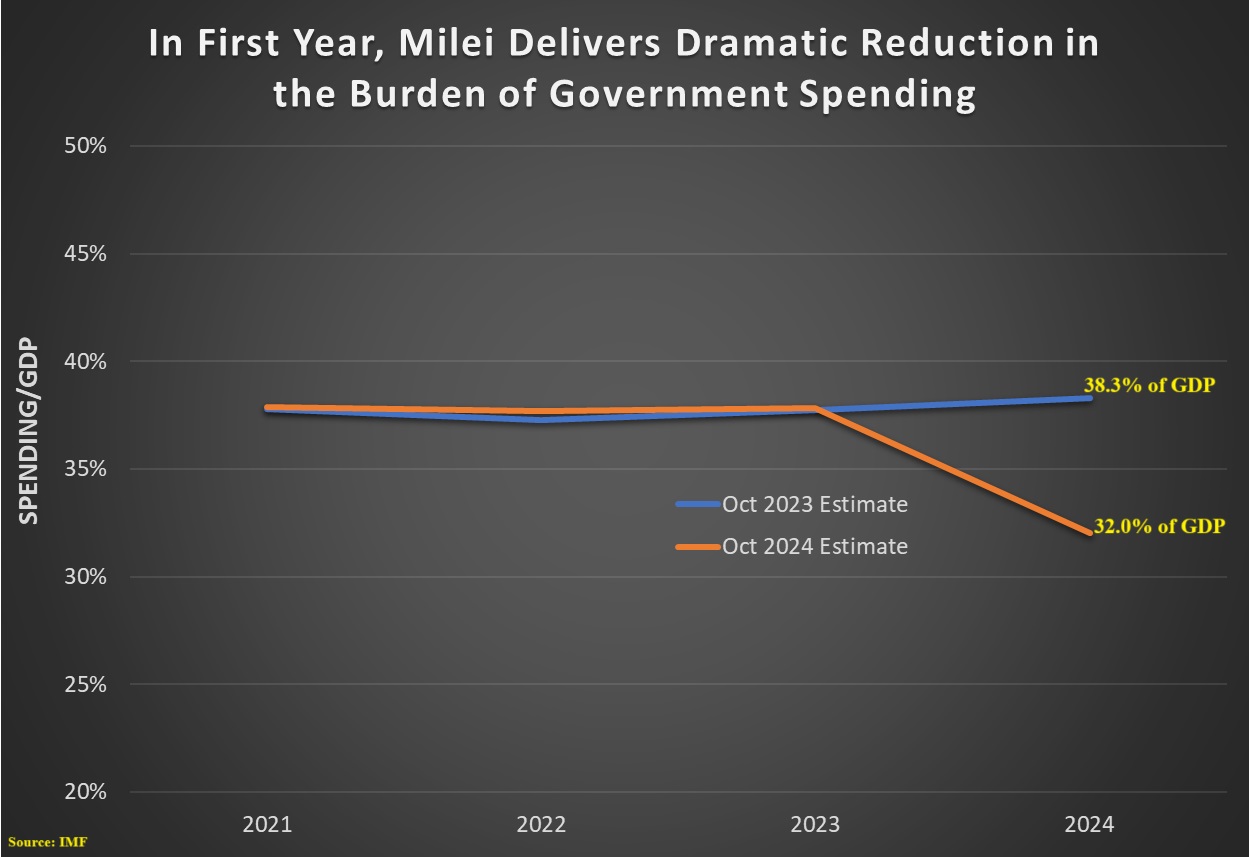
Milei’s policy and economic success – The election of Javier Milei as president of Argentina was shocking. Sort of like if New York elected Rand Paul as governor.


What’s not shocking, though, is that President Milei’s policies have been successful.

Thanks to radical reductions in the burden of government and other pro-market reforms, he has quickly balanced the budget, conquered inflation, restored growth, and lowered poverty.

The reason this is great news is that everyone (including me) surely thought a few years ago that Argentina was a hopeless case. After all, voters had been hopelessly corrupted by decades of statism, making the country an example of the 17th Theorem of Government.

Instead, Argentina is now going to be a role model for reformers in other nations.

Kamala Harris lost – I don’t know if the Vice President is actually a lightweight and I don’t care.

What I do know is that she is a doctrinaire statist with a terrible policy agenda. If she has won last month and Democrats won control of Congress, we may have been victimized by her version of Biden’s awful Build Back Better agenda. Or worse, such as her absurd plan to tax unrealized capital gains. The country was spared.

Louisiana flat tax – In recent years, we’ve had very good news at the state level with regards to school choice. We’ve also had good news regarding lower tax rates and tax reform at the state level. Regarding tax policy, we can celebrate that Louisiana is now part of the flat tax club. Hopefully just a first step. Now let’s shift to the bad things that happened in 2024.

Social Security expansion – Given America’s horrible fiscal outlook, which is driven by poorly designed entitlement programs, you might think that politicians in Washington would at least understand that it’s not a good idea to make those programs even bigger.

But you would be wrong. The clowns on Capitol Hill recently voted to expand Social Security benefits for state and local bureaucrats, thus allowing that group to have a special ability to double-dip at taxpayer expense. Sadly, plenty of callow Republicans joined Democrats in hastening America’s fiscal decline. Many countries are moving in the right direction on this issue. In America, we’re digging the hole deeper.

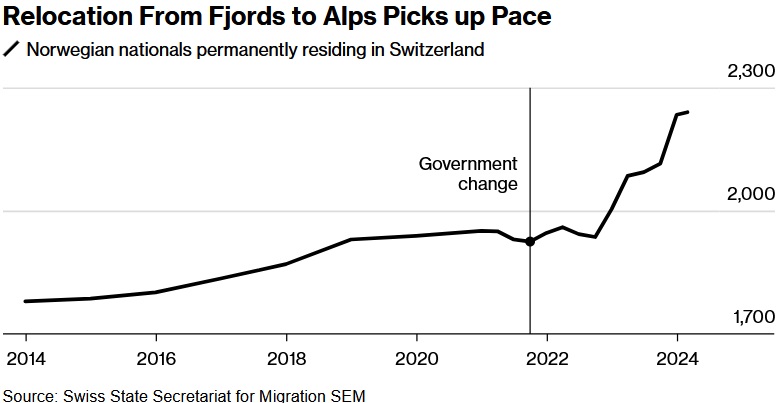
Norway’s wealth tax – I’ve explained repeatedly that wealth taxation is a very foolish and self-destructive idea.


So I suppose I should be grateful that Norway’s politicians are helping to confirm my arguments. They imposed a big increase in their wealth tax that is backfiring in a spectacular fashion. I’m sort of cheating with this item. The wealth tax increase was not enacted this year. Instead, what we’ve seen is the disastrous impact of that change. The terrible policy even led to an entertaining song.

Donald Trump won – While I’m glad Kamala Harris lost (see above), I’m not happy that Donald Trump won. His fiscal profligacy and self-destructive protectionism hurt America before and those policies will hurt America again. But what really irks me is that he opposes entitlement reform, which means massive future tax increases are almost certain to happen.

Moreover, his chaotic (but admittedly somewhat entertaining) governing style may lead to big Democratic gains in 2026 and a Democratic sweep in 2028. But even if that doesn’t happen, that probably means J.D. Vance will be president. And he seems to share Trump’s big-government views.

Not exactly encouraging news for libertarians, classical liberals, and small-government conservatives. But maybe, just maybe, there’s another Reagan in our future (or a Javier Milei).

Tuesday, December 24, 2024

Is Big Government Popular?

December 13, 2024 by Dan Mitchell @ International Liberty

Big government and socialism are bad for prosperity, but are such policies nonetheless popular? Do people want a bigger welfare state?

This great video from the Fraser Institute provides the answers (if you’re pressed for time, start watching at 4:15).

And if you don’t have time to even watch the last few minutes of the video, the big takeaway is that a majority of people tell pollsters that they want a bigger welfare state, but only if somebody else is paying for it.


This is very consistent with polling data I shared back in 2016.

Supporters of Bernie Sanders wanted (and presumably still want) to massively expand the welfare state. But only a tiny fraction of them were willing to pay significantly more taxes.

What they want, of course, is class-warfare taxes.

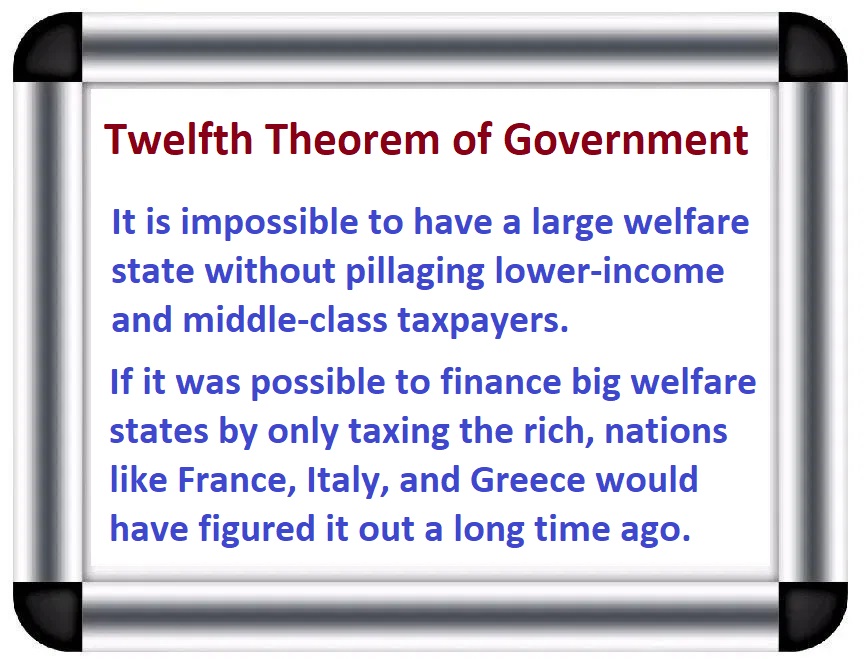
But there’s a tiny, itsy-bitsy, teeny-weeny problem with that approach. Simply stated, there are not enough rich people to finance big government. Not even close to enough.

There are two reason why I know this is true.

  • First, Brian Riedl’s should-be famous Chartbook has all the detailed numbers showing that this is the case.
  • Second, if it was possible to finance big government by taxing the rich, some left-leaning country would have already done it.

Indeed, I specifically put together my Twelfth Theorem of Government in hopes of educating folks on the left on this point.

The bottom line is that every nation with a big welfare state also imposes massive tax burdens on lower-income and middle-class households.

Every. Single. One.

P.S. This knowledge has important political implications. In order to have any chance of electing another Ronald Reagan (or, even better, someone like Javier Milei), that candidate will need to frame the debate so that people are choosing between the high-tax/high-spend agenda or the low-tax/low-spend agenda.

Interestingly, we already know the answer.

Thursday, November 7, 2024

Government: Bloated but Fixable

November 4, 2024 by Dan Mitchell @ International Liberty

To augment my four-part series on the economics of government spending, here’s a video from Prager University explaining how big government doesn’t work.

The video, narrated by Professor Joshua6 Rauh of Stanford, highlights three major types of spending and finds that bigger government has produced bad results.

Education: Per-pupil spending has increased enormously but there have been no improvements in student performance. Indeed, the video shows that huge spending increases in places such as California and Chicago have led to declining test scores. Not that any of this should be a surprise. Just a couple of days ago, I wrote about how Florida is getting great results while spending less.

Medicaid: Taxpayers finance an enormously expensive Medicaid program ($800 billion and counting), yet research shows that all that money does not produce better health outcomes. Though it does produce record levels of waste and fraud, so I guess that counts for something.

Welfare: There are dozens of redistribution program, the net effect of which is to discourage work and mobility. As Thomas Sowell wisely observed, “We have all heard the old saying that giving a man a fish feeds him only for a day, while teaching him to fish feeds him for a lifetime. Redistributionists give him a fish and leave him dependent on the government for more fish in the future.”

The video is a grim assessment of how big government has weakened America. But it actually understates the problem. As I wrote earlier this year, the burden of spending is going to significantly increase over the next couple of decades because of demographic change and poorly designed entitlement programs.

In other words, America has a major fiscal problem!

The video concludes by observing that America would be better off if more people understood Reagan’s wisdom about government being the problem rather than the solution.

I obviously agree. And I also agree with the message that the economy would perform better with much smaller government, like we had before FDR’s failed New Deal.

Fortunately, we know how to fix the problems. The video highlighted three major types of government spending, so let’s show the best way of addressing these problems.

Education: The simple answer is school choice. Good for students and good for taxpayers (though bad for teacher unions).

Medicaid: Block grant the program and let states learn from each other on the best way of providing health care to the indigent.

Welfare: Building on the success of Bill Clinton’s welfare reform, get Washington out of the business of redistribution.

Fixing these three problems would be a big step toward more growth and more freedom. As we also know how to fix Social Security, Medicare, agriculture, housing, and transportation.

So a much smaller government (which would be consistent with the vision of America’s Founders) is conceivable. But I fear we’ll have to wait another four years before we can even begin to think about it.

Saturday, October 26, 2024

Understanding the Anti-Market Ideology of Fascism

October 25, 2024 by Dan Mitchell @ International Liberty 

Other than noting that it is a form of collectivism, coercion, and interventionism, I have not paid much attention to fascism.

Today, we’ll take a closer look at this statist ideology, and we’ll start with this video from Matt Kibbe. And since I’ll be focusing on the economics of fascism, I urge people to pay close attention to the part of the video starting at 9:25.

As you can see from the video, there are several components of fascism, including a poisonous type of ethnic solidarity and a twisted version of nationalism.
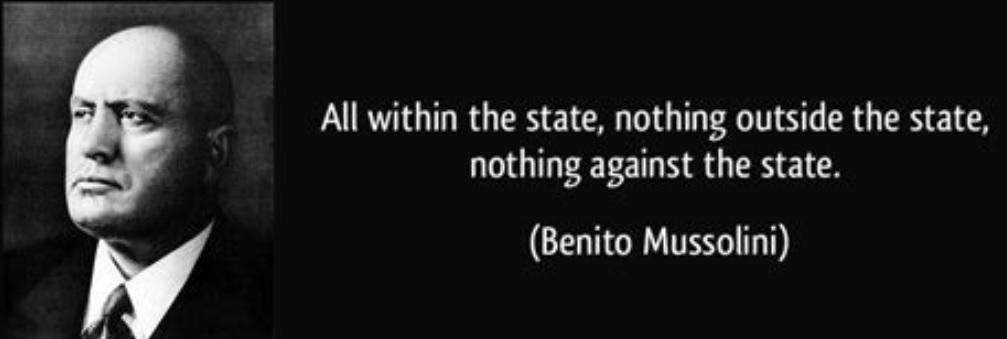
 

The part I’ll focus on, though, is the statism. As illustrated by the Mussolini quote, government is the all-important entity for fascists.

Individual liberty is suppressed, often with violence.

Which is why I don’t think a left-right spectrum is a good way of describing political and philosophical divisions.

I prefer this triangle, which shows libertarianism at the top of the triangle and competing strains of authoritarianism at the lower points.
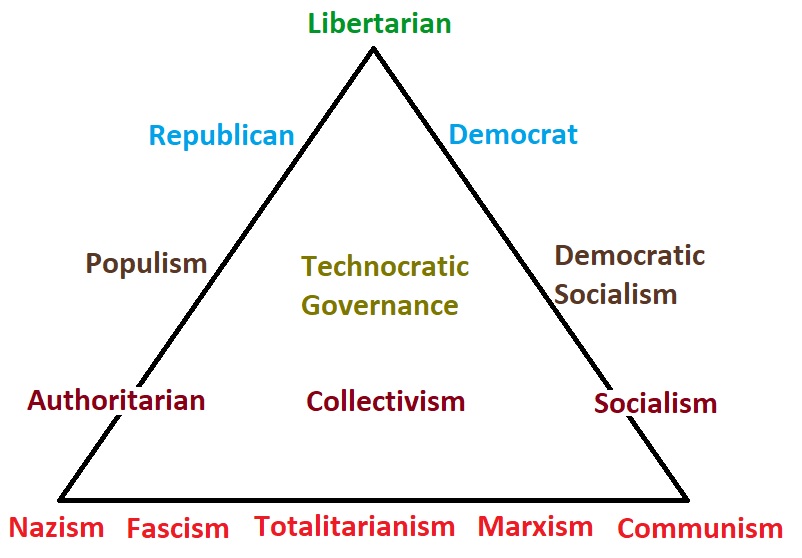
Now let’s look at what others have written about fascism.

The Foundation for Economic Education has several must-read articles.

We’ll start with some of the highlights from Larry Reed’s column.


…on July 29, 1921…Adolf Hitler assumed the leadership of the National Socialist German Workers Party… Note the formal, official name of the party. It was not the National Capitalist German Workers Party. It was not the National Free Market German Workers Party. Nor was it the National Christian German Workers Party.…

The lie that Nazism was capitalist instead of what the Nazis themselves said it was (namely, socialist) derives from the fact that the Hitler regime did not engage in wholesale or widespread nationalization of businesses. In the Third Reich, you might retain legal title to a factory but if you did not do as the Nazis ordered, you would be, shall we say, dispatched. …Lenin, Mao, Pol Pot, Castro, Hitler, Mussolini were all anti-capitalist peas in the same socialist, collectivist pod.

Here’s some of what Rainer Zitelmann wrote about Hitler’s anti-market views.


How important Hitler considered the question of state-controlled planning of the economy to be can be seen from the fact that in August 1936 he personally wrote a “Memorandum on the Four-Year Plan 1936.” In this memorandum his admiration and fear of the Soviet system of planned economy were expressed… Hitler was convinced of the superiority of the Soviet planned economy system over the capitalist economic system. This must be regarded as an essential reason why he so vehemently demanded and enforced the extension of state control of the economy in Germany as well. …Hitler…emphasized in his last radio address on January, 30, 1945, “that the age of unrestricted economic liberalism had outlived itself.”

Now let’s look at some excerpts from Jon Miltimore’s column.


…the word is right there in the name: National Socialism. If you read the speeches and private conversations of the Nazi hierarchy, it’s clear they loved socialism and despised individualism and capitalism. …there is no question they saw socialism as the future and despised bourgeoisie capitalism. …So what sets National Socialism apart from Marxism?

There are two primary differences.

The first is that Hitler and Goebbels fused their socialism with race and German nationalism… The second difference is that National Socialists were less concerned with directly controlling the means of production. …the Nazis never initiated a widespread nationalization of industry, but…this was a distinction without a difference. …European fascism was simply a different shade of socialism… Like Marx, the Nazis loathed capitalism and saw the individual will and individual rights as subordinate to the interests of the state.

And here are some passages from Emmanuel Rincón’s column.


…a deep discussion about the ideological roots of fascism…is necessary to know in depth the life, beliefs, and principles of both its political leaders (such as Benito Mussolini) and its philosophical leaders (such as Giovanni Gentile). Mussolini was a…member of the Italian Socialist Party for 14 years. In 1910, he was appointed editor of the weekly La Lotta di Classe (The Class Struggle)…

Giovanni Gentile…was the intellectual author of the “doctrine of fascism,” which he wrote in conjunction with Benito Mussolini. …Gentile went so far as to declare “Fascism is a form of socialism, in fact, it is its most viable form.” One of the most common reflections on this is that fascism is itself socialism based on national identity. …unlike traditional socialism, it did not consider that the state should own all the means of production, but more that it should dominate them. The owners of industries could “keep” their businesses, as long as they served the directives of the state.

Let’s close by shifting from economic theory to politics.

Kamala Harris and others have accused Donald Trump of being a fascist, in large part based on his perceived willingness to use the power of government to go after his enemies and trample constitutional norms.

Since I’m not a Trump fan, I’m willing to believe just about any negative charge against him, but I also believe that sauce for the goose should be sauce for the gander.

If some of Trump’s actions have been bad (and they have), then we also should recognize and condemn similar misbehavior on the other side.

P.S. I can’t resist making a final observation about the economics of fascism. The main difference between socialism and fascism is that the former features government ownership and government control while the latter features private ownership and government control. 

We do have a few small sectors of our economy run by the government (Postal Serviceair traffic control, etc), but it’s far more common to have big sectors that are heavily regulated and indirectly controlled by government (health care, agriculture, banking, trade, etc). So you could argue that one of America’s main economic problems is fascism. But since that term has all sorts of other negative connotations, it’s better to say that the problem is cronyism or interventionism.

Thursday, September 26, 2024

What’s the Tipping Point for Too Much Government Debt?

September 25, 2024 by Dan Mitchell @ International Liberty 

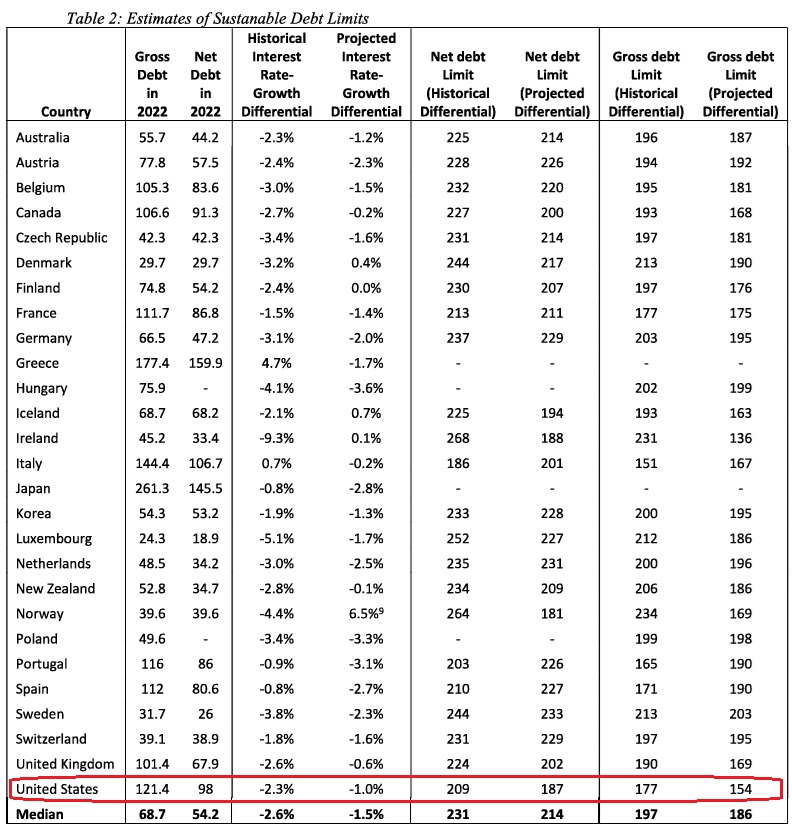
In 2018, I shared a study that gave people a way to predict when a country would suffer a fiscal crisis. I liked the findings because the authors concluded that spending restraint was the best way of staying out of trouble. Now there’s a new study by Mark Warshawsky and Giorgi Bokhua of the American Enterprise Institute.

Here’s the part that will grab everyone’s attention. It’s a chart showing estimates of the amount of debt developed nations can incur before they hit a tipping point and are vulnerable to a fiscal crisis (for American readers, the United States is highlighted in red).

Here’s some of the authors’ analysis.

Sadly, the United States is among the countries that are running out of “fiscal space.”


Prudent policymakers and worried market participants…want to know…when in the future will the federal government face an economic limit to its issuance of debt. This would be manifest in substantial incrreases in interest rates on is debt, difficulties  in marketing bonds, and existing bondholders experiencing losses through runaway inflation or financial restrictions. …Knowing actual figures of net and gross debt in 2022, allows us to gauge how far countries are away from their sustainable debt limits. When looking at net debt, figures indication that most countries have a relatively flexible fiscal space… Gross debt limits give more concerning picture. For example, the United States, Italy, and France have tight sustainable debt limits and modest remaining fiscal space using both historical and projected differentials, while the United Kingdom and Canada have limited fiscal spaces when using projected differentials. …these countries appear to have limited flexibility to accumulate additional debt, particularly if an economic or financial crisis or war were to occur.

Here’s some of the U.S.-specific analysis.

…our model gives a sustainable gross debt limit of 154 percent using OECD interest rate and economic growth projections. Combining long-term projections of net debt…from the CBO…, that sustainable debt limit will be reached in 2034.

Ten years does not give America a lot of time.

The bad news is that both Trump and Harris are big spenders, so the day of reckoning in the study (gross debt reaching 154 percent of GDP) will probably happen before 2034.

The good news is that I expect the United States has more leeway than the study suggests, in part because the dollar is the world’s reserve currency.

But it will be very bad news, whether we have a fiscal crisis in 2030, 2034, or 2049. I still expect that a few European nations will have a crisis before one happens in the United States. Probably starting with Italy. If that’s the case, let’s cross our fingers that American politicians finally sober up and enact much-needed entitlement reform.

P.S. Always remember that red ink is the symptom. The underlying disease is too much spending.

Monday, July 8, 2024

Excessive Growth of Government Spending = Recipe for Economic Chaos

July 7, 2024 by Dan Mitchell @ International Liberty

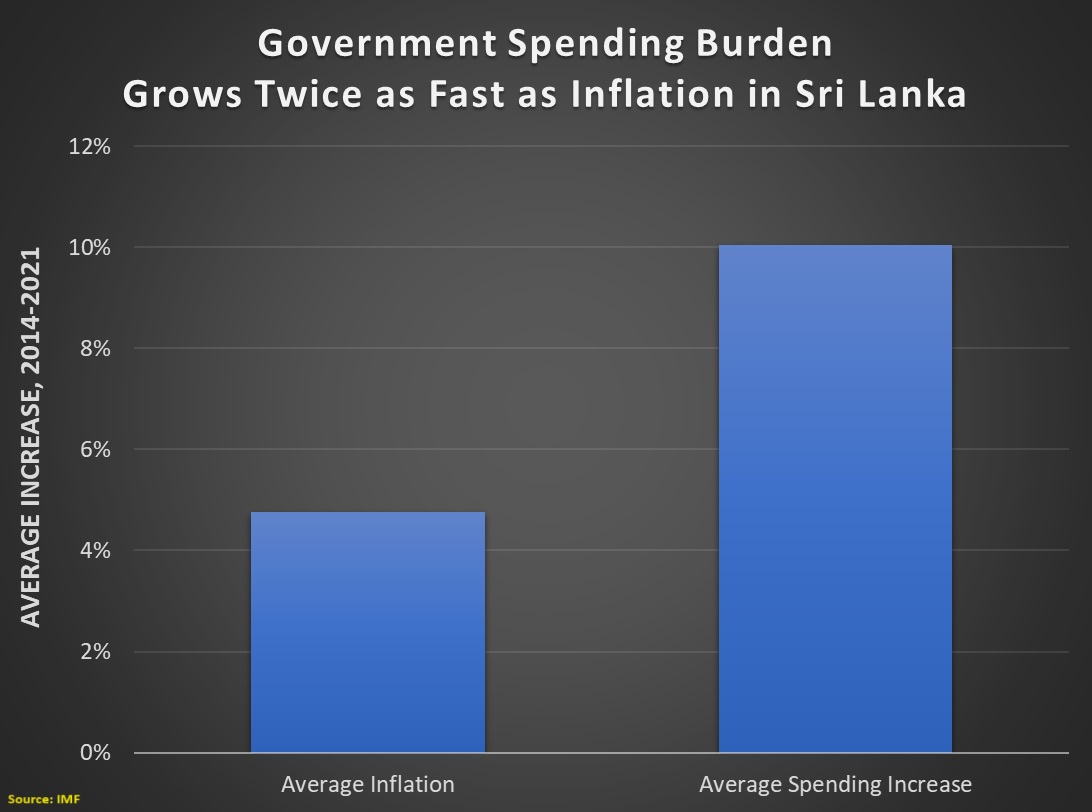
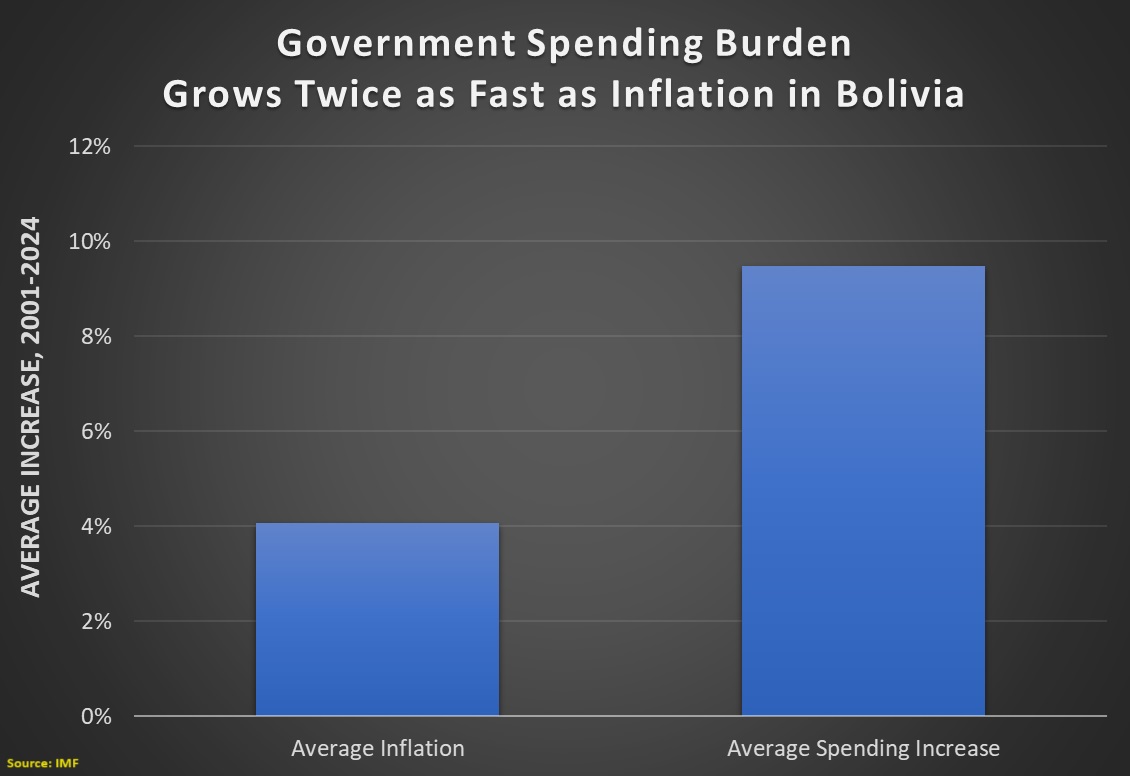
I’ve written previously about Pakistan getting into trouble because government spending grew too fast over a multi-year period.

And I also wrote about Kenya suffering economic problems for the same reason.

Today, let’s look at the fiscal data for two more nations.

First, we have Sri Lanka.

Next we have Bolivia.

So why am I linking Pakistan, Kenya, Bolivia, and Sri Lanka?

Because those four nations are prominently featured in a report for the New York Times by Patricia Cohen and Jack Nicas.

The reporters discuss political and economic turmoil in those nations and have lots of interesting details in their story.

But, as these excerpts illustrate, the one sin of omission is that there’s never a mention of how excessive spending by governments deserves blame for creating the underlying economic instability.


Like a globe-spanning tornado that touches down with little predictability, deep economic anxieties are leaving a trail of political turmoil and violence… In Kenya, a nation buckling under debt, protests over a proposed tax increase last week resulted in dozens of deaths…

At the same time in Bolivia, where residents have lined up for gas because of shortages, a military general led a failed coup attempt, saying the president, a former economist, must “stop impoverishing our country”… In Sri Lanka, stuck under $37 billion in debt, “the people are just broken,” said Jayati Ghosh, an economist at the University of Massachusetts Amherst…and a million people have lost access to electricity over the past year because of unaffordable price and tax increases, she said. …

In Pakistan, the rising costs of flour and electricity set off a wave of demonstrations that started in Kashmir and spread this week to nearly every major city. …Pakistan is deep in debt…and it wants to increase tax revenues by 40 percent to try to win a bailout of up to $8 billion from the International Monetary Fund

Indeed, the reporters want readers to believe the economic unrest is caused by other factors.

The causes, context and conditions underlying these disruptions vary widely from country to country. But a common thread is clear: rising inequality, diminished purchasing power and growing anxiety that the next generation will be worse off than this one.

No, the common problem is excessive spending growth. The things that they mention are consequences or symptoms of too much government.

P.S. I can’t resist sharing one additional passage from the story. The authors cite the economic challenges facing Argentina.

That’s certainly appropriate. I’ve repeatedly written about that nation’s problems.

But I was galled that the reporters imply that inflation has gotten worse this year.

Decades of economic mismanagement by a succession of Argentine leaders, including printing money to pay bills, has made inflation a constant struggle. Prices have nearly quadrupled this year compared with 2023.

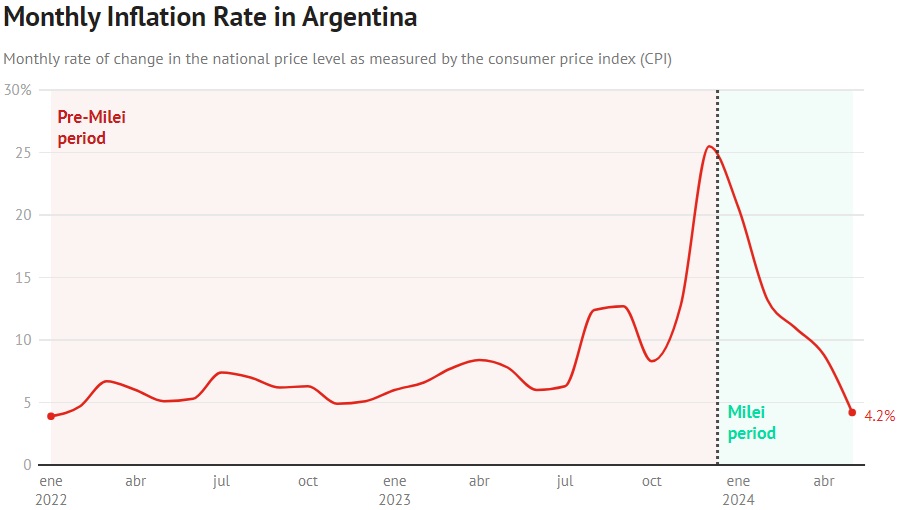
It is true that prices are higher this year than last year, but that misses the real story, which is that the policies of the relatively new libertarian president have been incredibly successful in reducing inflation.

As shown by this chart.

And it’s worth noting that Argentina is moving in the right direction because the spending burden is being reduced (a degree of fiscal restraint akin to a $1 trillion spending cut in the United States).

Too bad very few governments (or journalists) are learning the right lesson. Or  focusing on the right solution.

Wednesday, May 1, 2024

A New Member of the Poverty Huckster Club

May 1, 2024 by Dan Mitchell @ International Liberty

Genuine material deprivation is almost nonexistent in rich nations such as the United States. This is a huge improvement compared to how people lived just 100 or 20o years ago.  Yet public policy fights about poverty will probably never end for the simple reason that people have different goals.


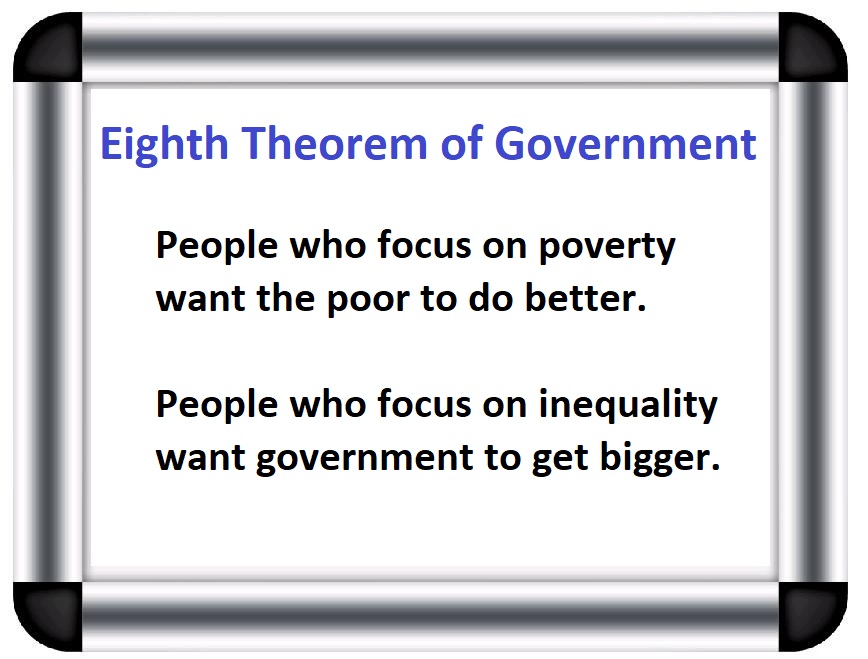
The cartoon is a good illustration of the first question.  And my Eighth Theorem of Government summarizes the second question. To elaborate on the second question, some of our friends on the left have blurred the distinction between poverty and inequality.  Let’s look at some excerpts from a Project Syndicate article by Teresa Ghilarducci of the New School for Social Research.


America’s retirement system isn’t working. It is failing older workers, pensioners, and would-be retirees, and if we don’t fix it soon, it will also fail future generations, lowering living standards and increasing the risk of poverty. …

Already, America’s elderly suffer a far higher rate of poverty – defined as half the median income or lower – than their peers in other high-income countries. …the old-age poverty rate in the US is 23%, compared to about 15% in the United Kingdom, 12% in Canada, 4.4% in France, and just 3.1% in the Netherlands.

Since there are massive problems with Social Security, I agree with Ms. Ghilarducci that America’s retirement system isn’t working.  But her numbers on old-age poverty seem very strange. How can the poverty rate be much higher in the United States when the other countries she mentions have much lower living standards?


Notice, though, that she wrote that poverty is “defined as half the median income or lower.”

So if you were a millionaire and lived in a house with Jeff Bezos, Elon Musk, and Bill Gates, you would be poor based on this definition. Needless to say, that’s crazy. Poverty should be a concrete number. And it usually is. The World Bank (which is concerned about genuine material deprivation) measures poverty based on whether people are subsisting at very low levels, such as $1.90 per day. In the United States, the poverty rate is a specific calculation of what a household needs to subsist at a modest level.

Ms. Ghilarducci’s numbers, however, come from the left-leaning bureaucrats at the Paris-based Organization for Economic Cooperation and Development. And they have a make-believe measure of poverty based on the distribution of income.  I’m not joking, if you go to their website, you will find these crazy numbers.

  • There’s supposedly more old-age poverty in the United States than there is in countries such as Costa Rica, Greece, Italy, Poland, and Turkey.
  • There’s supposedly more overall poverty in the United States than there is in countries such as Hungary, Mexico, Portugal, Slovenia, and Turkey.

These are garbage numbers, at least for the purpose of measuring poverty. The average senior (or average person) in the United States is much better off than their counterparts in other countries.  So congratulations to Ms. Ghilarducci, who is now a member of the Poverty Hucksters Club.

P.S. In fairness to Ms. Ghilarducci, her article does make some good points about overall retirement policy. I’m sure we disagree on many things, but she favorably cites nations with private Social Security systems, such as Denmark and the Netherlands.

Monday, January 22, 2024

The American Nomenklatura is Destroying the Country

Mark Lewis  |  Jan 20, 2024

Washington, D.C. is slowly strangling America.  Big government always razes a country because government never stops growing, soaks up increasing amounts of a country’s resources to spend on its own (mostly) useless interests, and thereby gradually impoverishes its people through taxation, inflation, and oppression.  Expanding government robs the people of their freedoms, and the free spirit of man will eventually rebel.  Our Founders warned us incessantly about this, but we never pay any attention to them, and truly, it is in the vested interest of Washington (the Uniparty) NOT to pay attention to them.  The people must be vigilant to protect their freedoms, but sadly, too many people aren’t vigilant, don’t even know what the word means, and thus freedom is ultimately lost.........To Read More...

Why Is Someone at AEI Proposing a Massive Tax Increase to Finance Ever-Growing Government, Part II?

January 20, 2024 by Dan Mitchell @ International Liberty

I wrote yesterday to criticize Andrew Biggs of the American Enterprise Institute and Alicia Munnell of Boston College for suggesting a $3 trillion 10-year tax increase on IRAs and 401(k)s.

My column explained that more double taxation was a bad idea, and I also pointed out that shifting to a savings-based system was the right way of addressing Social Security’s long-run fiscal problems.

But I committed a sin of omission, which needs to be rectified.


I did not challenge the Biggs-Munnell assumption that a big tax increase would deal with Social Security’s huge funding shortfall.

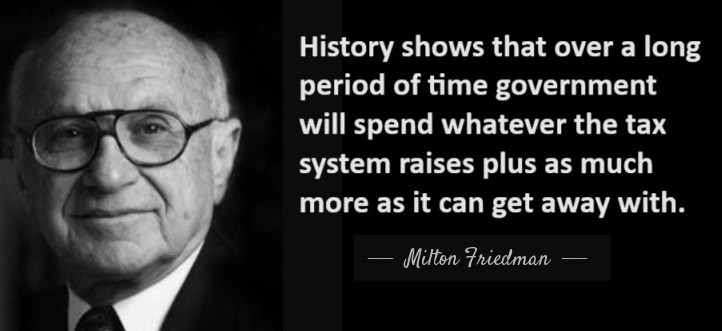
That was a mistake on my part. We have lots of evidence, as Milton Friedman wisely observed, that tax increases “feed the beast.”

In other words, politicians will increase the burden of spending when they get more revenue.

And this point is especially relevant because today’s column is going to analyze another giant tax increase being advocated by someone at the American Enterprise Institute.

Just last month, Alan Viard testified to a subommittee in Congress in favor of an add-on value-added tax. Here are some excerpts from his testimony.


A value-added tax (VAT) is an essential component… The United States should follow the lead of 170 other countries and territories by adding a VAT… We should act sooner rather than later to limit the debt buildup and ease the fiscal burden on future generations. …there is no viable way to fully address the fiscal imbalance without middle-class tax increases. …The European Union, the International Monetary Fund, and the World Bank have promoted the VAT. …To be sure, the VAT is not as economically efficient as entitlement benefit cuts. Notably, a VAT (or a retail sales tax) creates work disincentives similar to those created by income taxes. …When addressing the fiscal imbalance, time is not on our side. To promote long-term economic growth and ease the fiscal burden on future generations, we should adopt a VAT sooner rather than later.

I’m not sure why Viard thinks copying bad policies of other countries is a good idea. Especially since the United States is much richer than about 98 percent of those nations. Seems like they should be copying us.

But the main point I want to get across is that it is utterly naive to think that giving politicians a huge source of additional revenue will lead to less debt.

Why do I say that?

For the simple reason that the nations most similar to the United States tried Viard’s approach and the results were horrible.

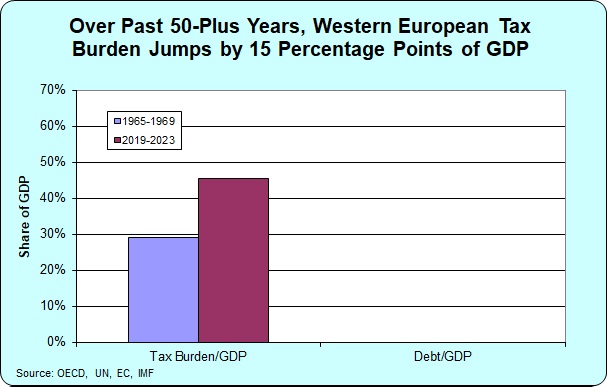
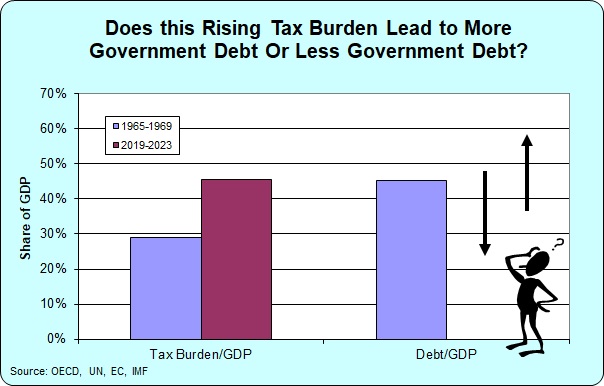
I’m going to recycle three charts from last year. The first one shows that the tax burden increased dramatically in Western Europe over the past 50-plus years – in large part because all those nations adopted big value-added taxes.

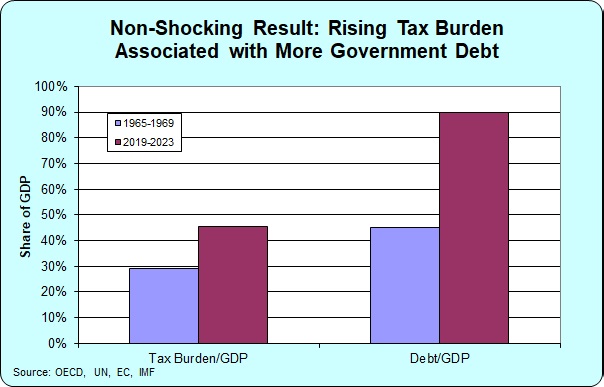
My second chart than asked whether those massive tax increases in Europe reduced the debt, which averaged about 45 percent of GDP in the late 1960s.

The answer, unsurprisingly, is that debt increased. Dramatically.

Politicians spent every single penny of the additional revenue. And then spent even more.

So much more spending that debt in Western Europe now averages 90 percent of GDP, two times higher than it was before value-added taxes were imposed.

Needless to say, Viard did not address that point in his testimony.

But someone did touch on that issue when testifying to many years ago.

Here’s what that charming and lovable person said.

P.S. In the above charts, I used averages for five-year periods so that nobody could accuse me of cherry-picking a single year that might not be representative of actual trends.

P.P.S. Some readers may be wondering if debt skyrocketed in Europe because of emergency pandemic spending instead of the value-added tax. Nope. I also did similar sets of charts in 2012 and 2016 and you see the same pattern. All that has changed is that taxes, spending, and debt get higher every time I update the numbers.

Saturday, January 20, 2024

Why Is Someone at AEI Proposing a Massive Tax Increase to Finance Ever-Growing Government, Part I?

 January 19, 2024 by Dan Mitchell @ International Liberty

 Serious and responsible people (in other words, not Trump or Biden) know that Social Security has a massive long-run problem.

A fast-growing number of seniors are expecting future benefits but only a slow-growing number of workers will be paying into the system.


But even if this demographic problem didn’t exist, there is the underlying flaw of a retirement system based on tax-and-spend (or debt-and-spend) rather than wealth accumulation.

The solution is obvious.

We need to shift to a system based on personal retirement accounts.

The transition to a modern system will be expensive, to be sure, but not nearly as costly as the $60 trillion-plus burden of propping up the current system.

But some people prefer the more-expensive option.

Andrew Biggs of the American Enterprise Institute and Alicia Munnell of Boston College want to divert a massive amount of money from the private sector to the government, and they want to do it by double-taxing the money Americans have in retirement accounts.

Here are excerpts from their new report.


The U.S. Treasury estimates that the tax preference for employer-sponsored retirement plans and IRAs reduced federal income taxes by about $185-$189 billion in 2020, equal to about 0.9 percent of gross domestic product. …it actually offers policymakers an opportunity to strengthen the nation’s retirement income system. Revenues saved from repealing the retirement saving tax preferences could be reallocated to address the majority of Social Security’s long-term funding gap. …an opportunity to use taxpayer resources more productively. …the case is strong for eliminating the current tax expenditures on retirement plans, and using the increase in tax revenues to address Social Security’s long-term financing shortfall. …Tax expenditures for employer-sponsored retirement plans are expensive – costing about $185 billion in 2020. … reducing tax expenditures for retirement plans could be an effective way to help address other pressing demands on the federal budget, such as Social Security’s financing shortfall.

By the way, it is no exaggeration to say the authors “want to divert a massive amount of money” to politicians over the next decade. Based on the Congressional Budget Office’s latest 10-year forecast, 0.9 percent of GDP is about $3 trillion.

It’s not just that the authors want to prop up a system that needs reform.

They also want to undo provisions in the tax code (IRAs and 401(k)s) that allow people to protect themselves against two layers of tax on income that is saved and invested.

It’s also laughable that the report states that a huge tax increase will “use taxpayer resources more productively.” If higher taxes to fund bigger government was a good idea, Europe’s welfare states would be richer than the United States rather than way behind.

Even the title of the Biggs-Munnell study is offensive. It implies that taxpayers are getting a handout or favor if politicians don’t impose double taxation. At the risk of understatement, being taxed one time rather than two times is not a subsidy.

P.S. The better option is a shift to retirement systems based on private savings, like the ones in Australia, Chile, Switzerland, Hong Kong, Netherlands, the Faroe Islands, Denmark, Israel, and Sweden.

P.P.S. Biggs and Munnell are misguided for wanting a big tax increase to prop up a bankrupt system. That’s the bad news. The worse news is that some people want to expand the bankrupt system. And they are proposing tax increases that arguably would cause even more economic damage.


Monday, September 4, 2023

The International Monetary Fund, Negative-Sum Economics, and the Eighth Theorem of Government

April 25, 2020 by Dan Mitchell @ International Liberty
 
At the risk of understatement, I’m not a fan of the International Monetary Fund (IMF).

The international bureaucracy is the “Johnny Appleseed” of moral hazard, using bailouts to reward profligate governments and imprudent lenders.

The IMF also is infamous for encouraging higher tax burdens, which is especially outrageous since its cossetted employees are exempt from paying tax on their lavish salaries.

In recent years, the IMF has been using inequality as a justification for statist policies. Most recently, the lead bureaucrat at the IMF, Kristalina Georgieva, cited that issue as a reason for governments to impose higher taxes to fund bigger welfare states.
…inequality has become one of the most complex and vexing challenges in the global economy. Inequality of opportunity. Inequality across generations. Inequality between women and men. And, of course, inequality of income and wealth. …The good news is we have tools to address these issues… Progressive taxation is a key component of effective fiscal policy. At the top of the income distribution, our research shows that marginal tax rates can be raised without sacrificing economic growth. …Gender budgeting is another valuable fiscal tool in the fight to reduce inequality…. The ability to scale up social spending is also essential… A cornerstone of our approach to issues of economic inclusion is our social spending strategy.
What’s especially remarkable is that the IMF has claimed that the punitive policies actually will lead to more growth, in stark contrast to honest people on the left who have always acknowledged the equity-efficiency tradeoff.

The economics editor at the left-leaning Guardian, Larry Elliott, is predictably delighted with the IMF’s embrace of Greek-style fiscal policy.
Raising income tax on the wealthy will help close the growing gap between rich and poor and can be done without harming growth, the head of the International Monetary Fund has said. Kristalina Georgieva, the IMF’s managing director, said higher marginal tax rates for the better off were needed as part of a policy rethink to tackle inequality. …The IMF managing director, who succeeded Christine Lagarde last year, said higher taxes on the better off…would help fund government spending to expand opportunities for those “communities and individuals that have been falling behind.” …Georgieva said the IMF recognised that social spending policies are increasingly relevant in tackling inequality. …She added that many less well-off countries needed to scale up social spending.
Ironically, the IMF actually has admitted that this approach is bad for prosperity.

It has produced research on something called “equally distributed equivalent income” to justify lower levels of income so long as economic misery is broadly shared.

I’m not joking. You can click here to see another example of the IMF embracing poverty if it means the rich disproportionately suffer.

In other words, negative-sum economics. Though Margaret Thatcher was more eloquent in her description of this awful ideology.

At first, this column was going to be a run-of-the-mill anti-IMF diatribe.
But as I contemplated how the people fixated on inequality are willing to treat the poor like sacrificial lambs, it occurred to me that this is a perfect opportunity to unveil my Eighth Theorem of Government.


P.S. Here are my other theorems of government.
  • The “First Theorem” explains how Washington really operates.
  • The “Second Theorem” explains why it is so important to block the creation of new programs.
  • The “Third Theorem” explains why centralized programs inevitably waste money.
  • The “Fourth Theorem” explains that good policy can be good politics.
  • The “Fifth Theorem” explains how good ideas on paper become bad ideas in reality.
  • The “Sixth Theorem” explains an under-appreciated benefit of a flat tax.
  • The “Seventh Theorem” explains how bigger governments are less competent.