Search This Blog

De Omnibus Dubitandum - Lux Veritas

Showing posts with label IMF. Show all posts

Tuesday, November 19, 2024

A Sincerity Test for the United Nations

November 18, 2024 by Dan Mitchell @ International Liberty

I get annoyed by the virtue-signalling leftism from the United Nations. And it irks me when the U.N. peddles dishonest analysis. And I’m also nauseated by the bureaucracy’s pervasive corruption.
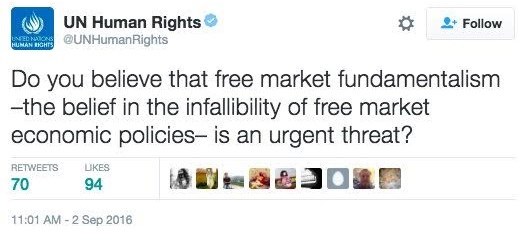
 

But, unlike the International Monetary Fund and Organization for Economic Cooperation and Development, the U.N. has very little ability to turn bad ideas into bad policy.

Which is why I rarely write about the United Nations. But rarely is not the same as never.

I’m going to pontificate about the U.N. today because Michael Rubin of the American Enterprise Institute has put forth a very good proposal. He wants the bureaucracy to act like it believes global warming is real.


More than 67,000 delegates are in Baku, Azerbaijan, to attend the United Nations’ annual climate summit. …The United Nations itself sent hundreds of “observers” on behalf of both U.N. Secretary-General Antonio Guterres and specialized agencies. …There is normal hypocrisy, and then there is John “[private jets are] the only choice for somebody like me,” Kerry hypocrisy — but all pale in comparison to U.N. hypocrisy. The private and jumbo jets ferrying delegates to Baku, the idling sedans and limousines, the steak dinners and caviar mock any pretense that their climate concern is real.

In reality, the annual environmental conference is glorified tourism under the guise of activism. Nothing occurs in Baku that the U.N. could not conduct online and in video breakout sessions at a tiny fraction of the cost and carbon footprint. The same is true for almost every other U.N. conference. U.N. employees often fly first or business class. If the U.N. went online, it could slash not only its travel expenses but administrative ones as well. …Moving environmental conferences online would end U.N. climate hypocrisy and could serve as a test to curtail U.N. jet-setting and shrink the administrative bureaucracy that supports that lifestyle.

Amen. This change would be good for taxpayers and good for the environment.
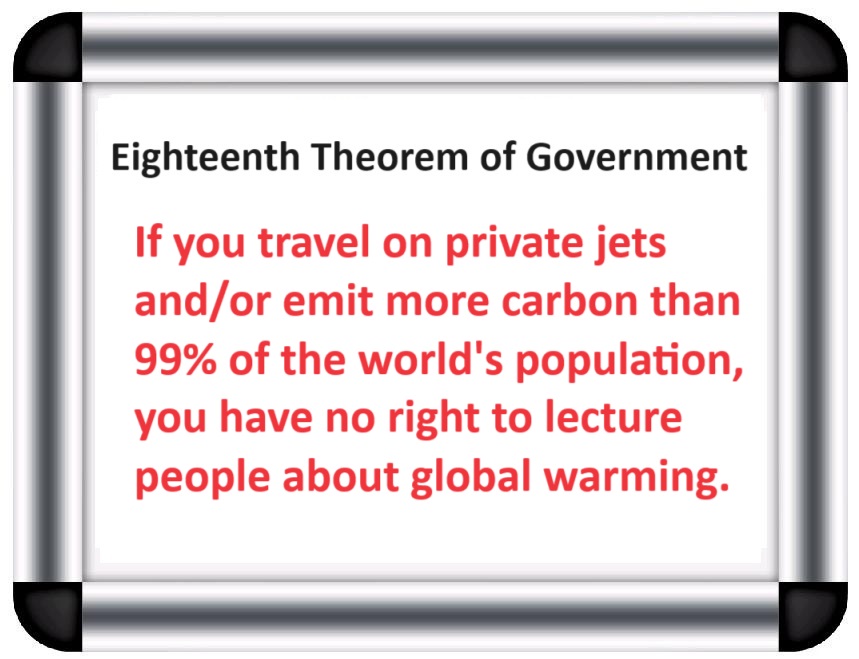
 

When I issued my Eighteenth Theorem of Government, I was mostly thinking about the preening nitwits in the British royal family and the hypocrites in who go to Davos.

But it obviously applies perfectly to the type of people who attend U.N. climate conferences.

P.S. I’ve participated in two conferences at the United Nations. Sadly, both were in New York City so I didn’t get to travel to some exotic location.

Saturday, November 16, 2024

The IMF’s Fairy-Dust Economic Policy

November 15, 2024 by Dan Mitchell @ International Liberty

I was going to continue my Second-Edition-of-Trump series (see here, here, here, and here) by writing about what to expect with regards to trade (pessimistic) and then taxes (optimistic).

But I’m shifting gears today because the bureaucrats at the International Monetary Fund are once again peddling their nonsensical claim that higher taxes and bigger government are a recipe for faster growth in poor nations.

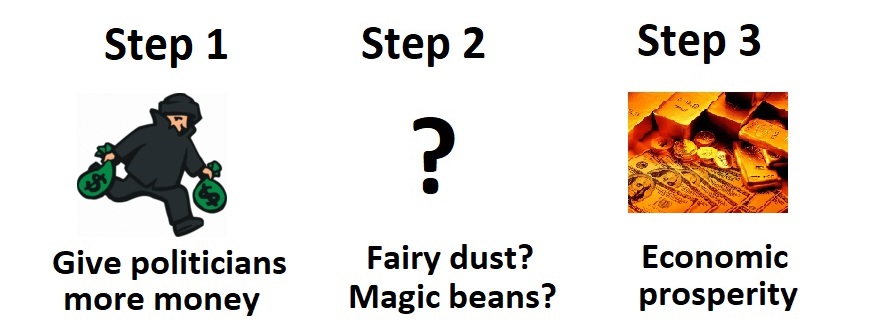
I’m not joking. Here’s the IMF’s hypothesis (which is also shared by the OECD and UN).

You may think I’m being sarcastic, but this is a completely accurate depiction of the IMF’s argument. The bureaucrats simply assert that bigger government will deliver more growth and that it is therefore good to raise taxes to enable more spending.

The latest example is an IMF report on property taxes. Here are some excerpts.


Property taxes are often under-exploited sources of local public revenues. A broad-based tax, raised at modest rates, can potentially generate significantly higher revenues in many countries…motivated by the resource mobilization needs of developing countries…design considerations are also pertinent for advanced and emerging market economies seeking to increase the revenue productivity of property taxes. …Significant scope exists for increasing revenues from property taxes, especially in developing countries. Total property taxes in Sub-Saharan Africa and Emerging Asia barely raised 0.1 percent of GDP in 2021… A reasonable target for property tax revenue-to-GDP is between 1 and 2 percent. …A well-designed and properly administered property tax can mobilize revenues.

By the way, the bulk of the report is a straightforward description and analysis of property taxes and how they operate in various countries.

But the authors (Martin Grote and Jean-François Wen) apparently couldn’t resist adding ideological – and wholly unsupported – comments such as “resource mobilization needs” and “increasing revenues” and “mobilize revenues.”


For what it’s worth, I would not have objected if the report mentioned higher property taxes in the context of revenue-neutral tax reform (to their credit, the authors did note that property taxes are “less distortive than taxes on labor because the relative immobility of real estate limits the behavioral responses to the tax”).

The bottom line is that developing countries do not need bigger government.

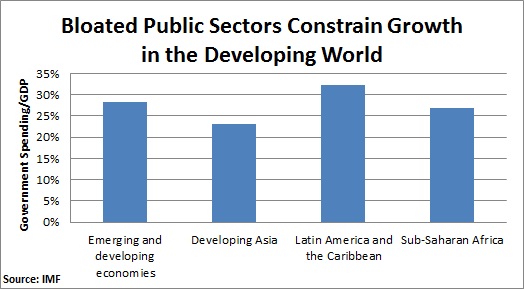
As I noted back in 2016, poor nations on average already have public sectors that are way above the growth-maximizing level. Especially when you consider that Western nations became rich in the 1800s and early 1900s when the burden of government spending only consumed about 10 percent of economic output.

P.S. In the grand scheme of things, the IMF report discussed today is only incidentally bad and therefore not nearly as bad as this nonsensical claim.

Friday, November 1, 2024

Fiscal Dishonesty or Fiscal Insanity?

I realize the election is just a few days away and there are many bad ideas to analyze from both candidates, but I can’t resist sharing this preposterous soundbite from a woman at the (horribly misnamed) International Growth Centre at the London School of Economics.

I have the video set to begin at the start of the soundbite and the relevant part only lasts about 10 seconds. For those who don’t want to bother clicking on a video, she says, “The big issue is that developing countries don’t collect enough tax. For example, in Zambia, where I’m from, we only collect a third of the revenue that we need.”

Those are two of the most absurd sentences ever uttered.

Let’s start with her second sentence about Zambia only collecting “a third of the revenue that we need.”

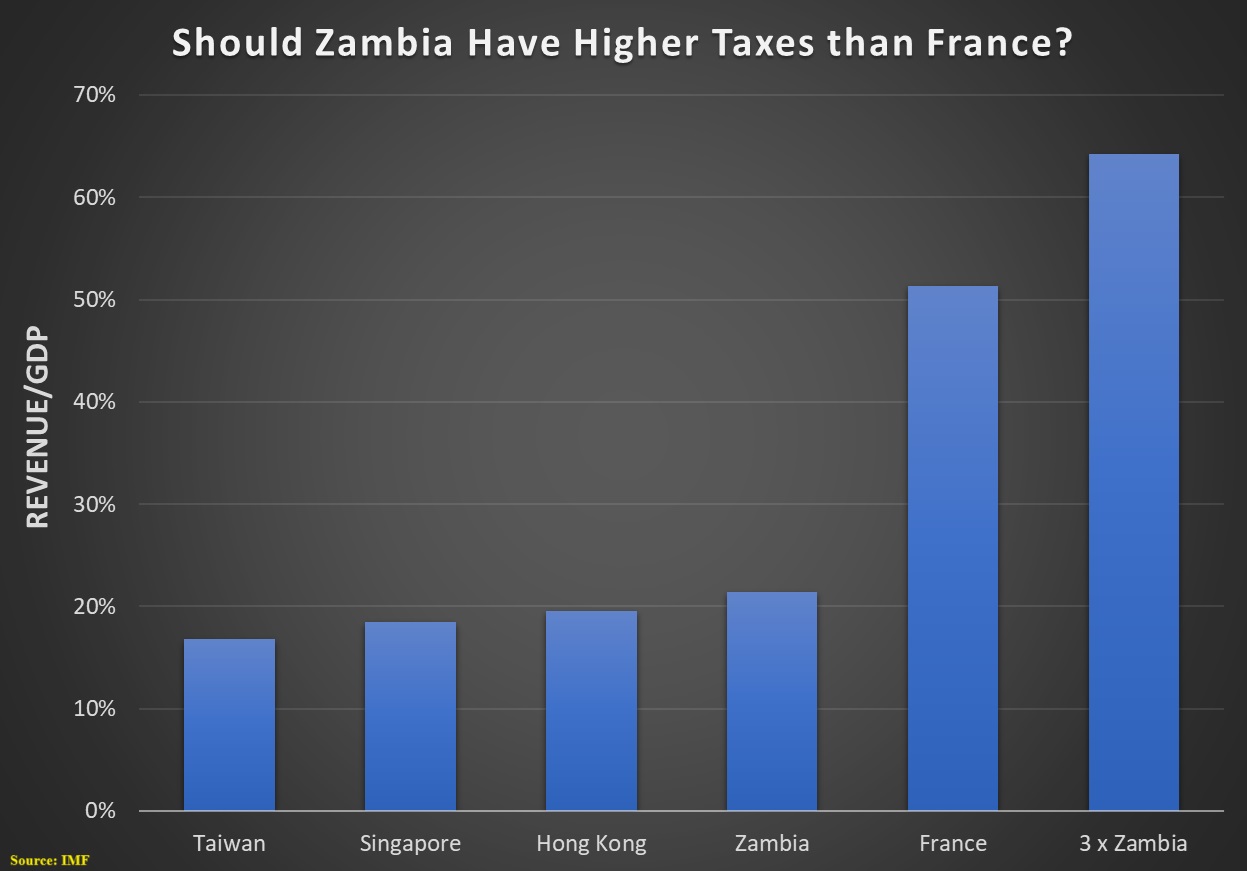
I went to the IMF’s World Economic Outlook database and found that government revenues are about 21.4 percent of GDP in Zambia. At which point three things came to mind.

  • The tax burden is already far higher than it was when North American and Western European nations became rich in the 1800s and early 1900s (when fiscal burdens averaged about 10 percent of GDP).
  • The very successful Asian Tigers of Taiwan, Singapore, and Hong Kong show that a government easily can finance things such as roads, education, and health care with revenues of less than 20 percent of GDP.
  • If Zambia tripled its tax burden, as the woman favors, the tax burden would be the highest in the world, diverting nearly 65 percent of the economy into the hands of politicians. Which is worse even than France.

Here’s a chart showing the numbers.

I realize that most readers don’t spend any time thinking about Zambian fiscal policy, so now let’s shift to the more important issues, which is her assertion the first sentence that “developing countries don’t collect enough tax.” 

Sadly, the woman is not alone. International bureaucracies such as the International Monetary Fund, United Nations, and Organization for Economic Cooperation and Development have also latched onto the bizarre theory that poor nations can grow faster if they raise taxes and increase the burden of government spending.

This isn’t April 1. I’m not joking.

To understand why this is nonsense, here’s a video from the Center for Freedom and Prosperity.

I highlighted two absurd sentences from the first video.

Here’s the sentence I want to highlight from the second video: “There’s no nation anywhere in the world that has become rich with big government.”

Indeed, when I debate folks on the left, I give them my “never-answered question.” I ask them to identify a country in recorded history that has successfully used higher taxes and more spending as a route to prosperity.

Not surprisingly, they never have a good response (they sometimes give bad responses because they misinterpret Wagner’s Law).

Sunday, August 11, 2024

The High Cost of Short-Run Political Decision-Making

August 10, 2024 by Dan Mitchell @ International Liberty

Why do politicians such as Donald Trump and Kamala Harris show no interest in fixing Social Security and other entitlement programs?

The answer is “public choice.” They are focused on maximizing votes and power in the short run rather than doing what’s best for the country in the long run.

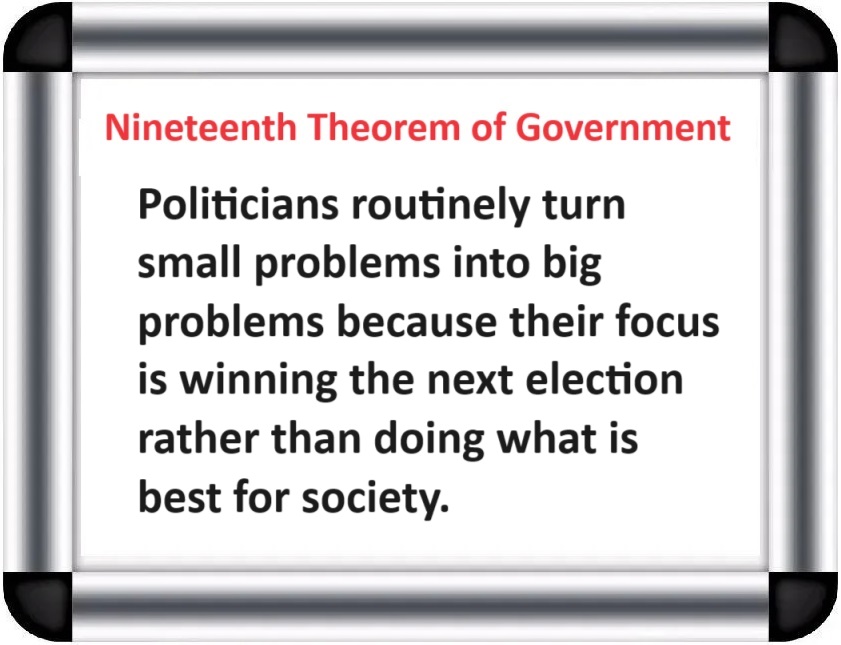
This is a pervasive problem and deserves its own theorem.

I’m motivated to share this new theorem because of a George Will column in the Washington Post.

But he’s not writing about fiscal policy. He has another example of how we get bigger problems because of short-term thinking by people in Washington.

With frequent references to Thomas Hoenig, the former head of the Kansas City Federal Reserve, he’s writing about bad monetary policy. Here are some excerpts.


How high will be the cost of interest rates, having been too low for too long? Events might be teaching a tutorial on the steep price of cheap money. …One purpose of the low rates was to send a flood of money into the increasingly frothy stock market… The Fed’s balance sheet of government and government-guaranteed assets, by which it nudges down interest rates, grew from $900 billion in 2007 to nearly $9 trillion in March 2022. …whenever the Fed has tried to “normalize its balance sheet and interest rates, the market has become unstable.” …

The question now…is will the Fed properly allow rates to come down only as inflation falls to the Fed’s 2 percent target, or will it aggressively try to fend off unwanted, but necessary, corrections — necessary for “better long-run outcomes?”

…Monday’s stock sell-off…ignited worried chatter about whether the Fed should have cut rates the week before, or might have to do so as an “emergency” measure before its scheduled meeting next month. This is not what panicky markets need: yet another government entity declaring yet another emergency.

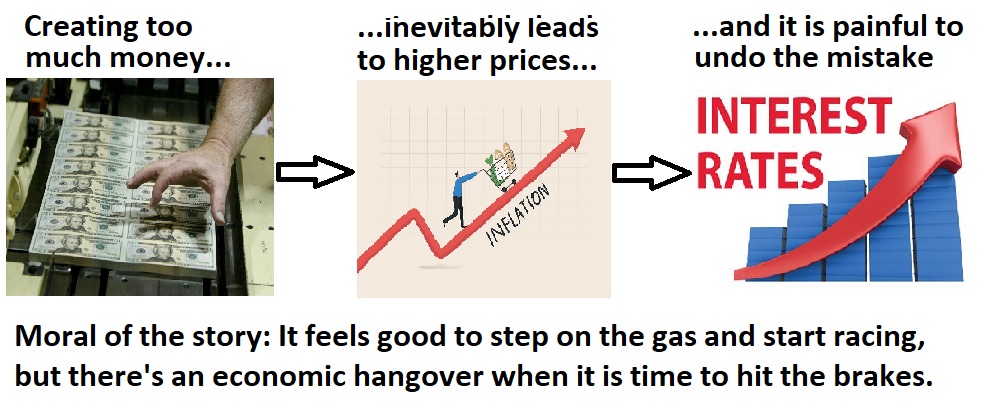
What Hoenig correctly worries about (and what George Will is writing about) is the problem of a boom-bust monetary policy.

Politicians like the sugar high the economy gets when the central bank creates excess money.


But that excess money creation inevitably causes bad things such as higher prices and asset bubbles.

The best thing is not to make the mistake in the first place. But if the mistake is made, the obvious solution is to “normalize” policy by withdrawing the excess money from the system.

However, this is painful in the short run, so politicians and the central bankers they appoint often don’t have the fortitude and integrity to do the right thing (Ronald Reagan was an exception to the rule).

I started this column with a fiscal policy example. I then cited a monetary policy example. Let’s now close with a bailout example.

Here’s a tweet making the point that propping up profligate nations is a recipe for more profligacy.

The tweet is about a central bank (the ECB) subsidizing bad behavior with bailouts, but it applies also to fiscal bailouts (like TARP) or international bureaucracy bailouts (like the IMF).

The bottom line is that bailouts produce moral hazard. Reward bad behavior and you get more bad behavior.

That make no sense, but politicians and their appointees are drawn to such policies because they want to minimize pain in the short run even though they are creating the conditions for far more pain in the long run.

P.S. Debt limit fights are an example of some people supporting short-run pain in order to reduce the likelihood of much greater long-run pain.

Friday, June 14, 2024

The IMF Wants to Make Canada’s Bad Tax System Even Worse

June 14, 2024 by Dan Mitchell @ International Liberty

Less than two months ago, I shared a chart looking at tax burdens on saving and investment in the industrialized world.

The nation with the lowest tax burden on capital was Lithuania (unsurprisingly, all of the Baltic countries scored well).

The country with the worst tax treatment of capital, by contrast, was Canada. As you can see, the average tax burden on saving and investment is 50 percent. That’s even worse than Denmark and France.  Assuming the goal is to boost prosperity and competitiveness, the logical response to this depressing data is for Canada to lower taxes on capital.

The International Monetary Fund, however, is not logical. That bureaucracy recently assessed the Canadian economy.  Not only did the bureaucrats recommend tax increases (the IMF’s reflexive answer to any question) and a bigger burden of spending, they actually endorsed higher taxes on capital.

I’m not joking, Here are some excerpts.


…further consolidation will put Canada in a stronger position to address…structural spending needs related to climate, defense, healthcare, and other critical areas.

Thus, while the spending initiatives in the federal budget are appropriate, they should have been offset through greater revenue mobilization. The increase in the capital gains inclusion rate improves the tax system… Consideration could be given to other changes—such as an increase in the GST (Goods and Service Tax) rate.

This is awful advice.

Canada’s fiscal situation is troubling for one simple reason. The current Prime Minister, Justin Trudeau, has been spending too much money (something I warned about shortly after he took office).

Indeed, according to the IMF’s own data, Trudeau has increased spending twice as fast as inflation since taking office. Reversing that mistake is the advice Canada needs (and it’s an approach that Liberal Party politicians have actually implemented in the past).  But don’t hold your breath waiting for fiscal prudence from Trudeau.

P.S. This is a bit of inside baseball, but the IMF generally tailors its recommendations to match the preferences of the politicians who control a country. This is not that surprising since IMF bureaucrats have very comfy jobs (with tax-free salaries!), so they have an incentive to curry favor with the national governments that have ultimate power over their lavish paychecks. So the IMF and Trudeau deserve joint blame for the latest IMF report.

P.P.S. Another flaw with the IMF report is that it praises Canada for reducing inflation but fails to point out that it was the Canadian government’s bad monetary policy that caused the inflation in the first place. Notwithstanding the vapid comments from one central banker, inflation doesn’t magically materialize out of thin air.


Wednesday, June 5, 2024

The IMF’s Destructive Advice for Germany

June 3, 2024 by Dan Mitchell @ International Liberty

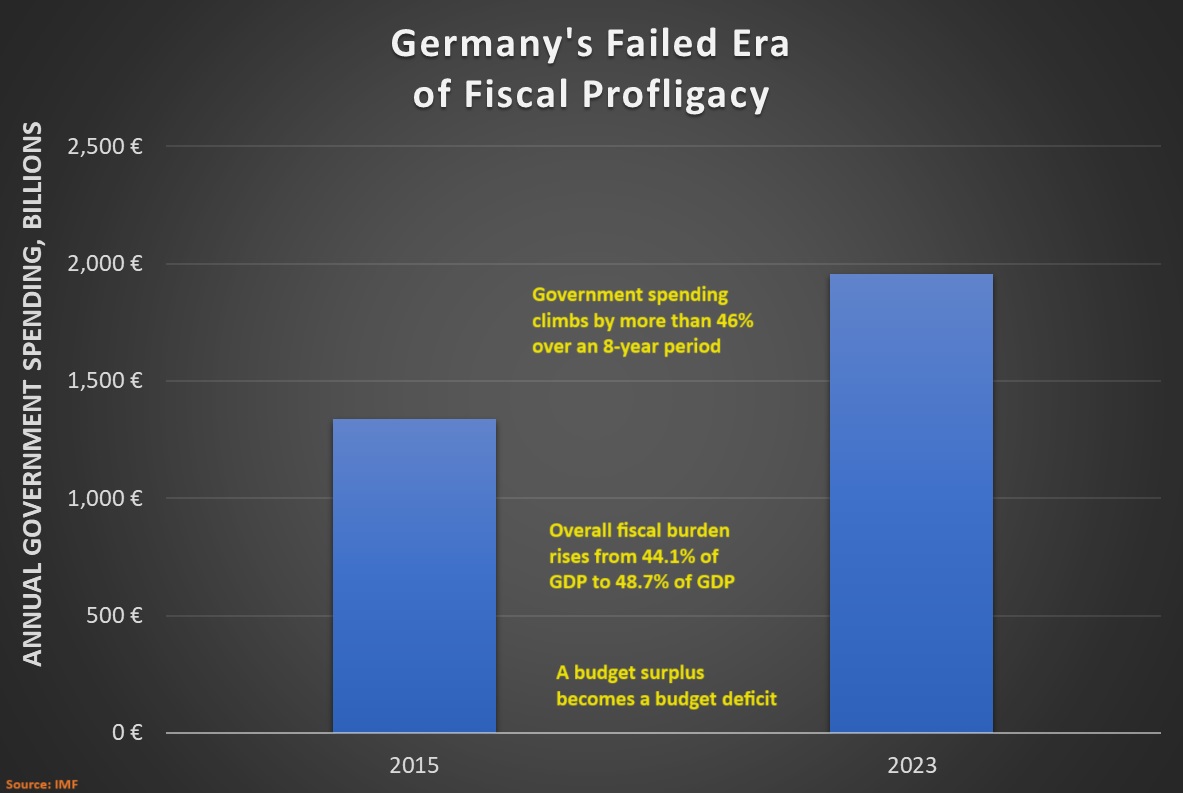
I wrote last November that Germany is in a period of fiscal decay.

Over the past eight-plus years, the burden of government spending has grown far too fast, violating the Golden Rule of fiscal policy.


As a result, the share of the economy being consumed by the public sector has jumped from 44 percent to nearly 49 percent.

That’s worse than Denmark!

So what should Germany do? A rational person, especially if that person had any knowledge of economics, would urge spending restraint.

But let’s instead look at what the Keystone Cops at the International Monetary Fund are recommending. They want Germany to weaken its fiscal rule to enable even more spending.


An aging population will also adversely affect public finances as tax revenue growth slows and spending on pensions and healthcare rises. …To accommodate rising spending needs, the authorities should consider moderately easing the debt brake. …Germany’s debt brake is set at a relatively tight level, such that the annual limit on net borrowing could be eased by about 1 percentage point of GDP while still keeping the debt-to-GDP ratio on a downward path. Such an easing would allow more room for much-needed public investment and other key priorities.

And, keeping with tradition, the bureaucrats at the IMF also want higher taxes in Germany.

Options that could be explored include eliminating environmentally harmful…tax expenditures, …raising taxes on real estate and on goods and services (as Germany’s revenue from such sources is below the advanced-economy average), and/or closing loopholes in inheritance taxes.

Adding more spending to Germany’s fiscal burden is bad news, but adding more taxes is equally offensive.

That part of the report merits two observations.

  1. If the IMF cared about growth, it would recommend lower tax rates in the many areas where Germany is above the advanced-economy average, not pushing for higher taxes in the few areas where the German government has demonstrated a bit of restraint.
  2. It is utterly hypocritical for IMF bureaucrats to push for higher taxes (in Germany or elsewhere) since their generous salaries are exempt from tax. Maybe if they had to pay taxes and live by the same rules as everyone else, they wouldn’t be so quick to urge bad policies.

P.S. I can’t resist citing one final bit of economic illiteracy from the IMF.

High energy prices following the shut-off of Russian gas contributed to surging inflation during 2022-23.

This is nonsense. Higher energy prices cause a shift in relative prices. Bad monetary policy (as we recently experienced in Europe, the United States, Canada, and the United Kingdom) is the reason for the increase in overall prices.

P.P.S. Given this statement by the previous head of the IMF (and current head of the ECB), you’ll understand why there’s a problem with economic literacy at that international bureaucracy.

Saturday, April 27, 2024

Leftist Governments (and the IMF) Pushing Global Wealth Tax

April 24, 2024 by Dan Mitchell @ International Liberty

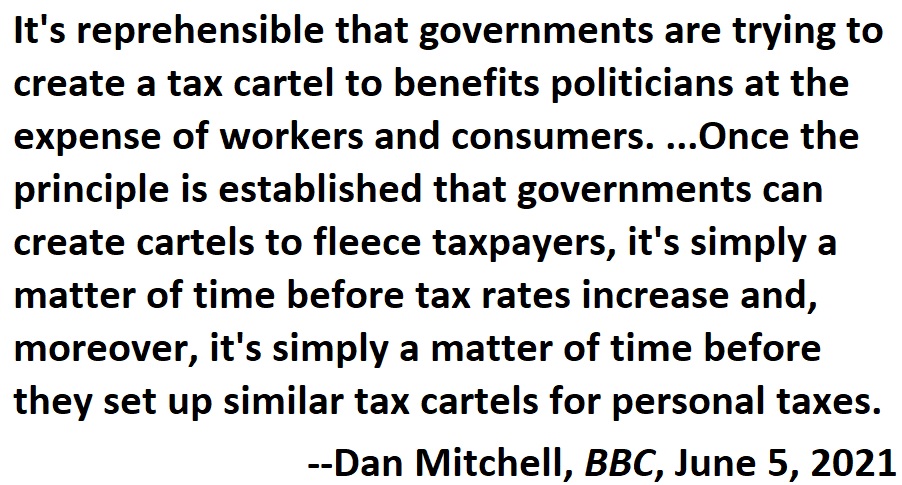
When Joe Biden began his push for a global corporate tax cartel back in 2021, I explained why the idea was very bad news for the world’s workers, consumers, and shareholders.


And I pointed out it was specifically bad news for developing nations since they would be prevented from using good tax policy to encourage rapid growth.

Most important, at least for purposes of today’s column, I also told the BBC that a corporate tax cartel would be very dangerous since politicians would quickly try to apply the same approach to other types of taxes.

Well, I was right.

As reported in Barron‘s, some of the world’s greediest governments are now pushing a global wealth tax cartel. Here are some excerpts from the story by Daniel Avis.


Brazil, which is chairing the G20 this year, has been pushing for the group of nations which together account for 80 percent of the world’s economy to adopt a shared stance…

“Fair international taxation is not just a topic of choice for progressive economists, but a key concern at the very heart of macroeconomic management today,” Brazilian finance minister Fernando Haddad said during an IMF event in Washington. “Without international cooperation, there is a limit to what states can do, both rich and developing ones,” he added.

…Sitting alongside Haddad at the IMF event, French finance minister Bruno Le Maire renewed his calls for a global minimum tax… “The future of the world cannot be a race to the bottom,” Le Maire said.

Haddad seems like a not-very-good person. He’s been a political science professor, according to Wikipedia, and he’s authored some publications that suggest he’s a leftist ideologue.

  • In Defense of Socialism
  • Theses on Karl Marx
  • Work and Language for the Renewal of Socialism

This crank is now trying to set tax policy for the entire world!

Marcela Ayres and Andrea Shalal of Reuters also reported on Haddad’s iniiative, and their article noted the predictably pernicious role of the International Monetary Fund.


Brazil’s proposal to tax the super-rich globally gained momentum among Group of Twenty members…with France’s finance minister and the head of the International Monetary Fund backing a coordinated push to generate new revenue… IMF chief Kristalina Georgieva said…ensuring that the richest paid their fair share would mobilize funds… She said IMF research…also estimated that setting a minimum floor for carbon pricing could boost revenue by $1.4 trillion a year. …Gabriel Zucman, director of the European Tax Observatory, …has proposed that very-high-net-worth individuals…pay at least the equivalent of 2% of their wealth in income tax each year. That would generate $250 billion per year.

I can’t resist pointing out that Ms. Georgieva (like all IMF bureaucrats) gets a very lavish salary that is exempt from taxation. Yet this hypocritical parasite agitates for higher taxes on everyone else.

Fortunately, at least one major government is skeptical of this money grab.

In a separate report from Reuters, Christian Kraemer and Maria Martinez note that Germany’s Finance Minister is not a fan.


German Finance Minister Christian Lindner rejected on Thursday Brazil’s proposal to tax the super-rich, indicating a challenging path for it to gain widespread G20 support. …Speaking after meeting U.S. Senator Bernie Sanders on Thursday, Brazil’s Finance Minister Fernando Haddad said of Lindner’s opposition to the proposal: “He will change (his mind).” Sanders said he “strongly” supports the proposal… But the Brazilian government is aware that other countries like Japan and Italy have shown resistance to the initiative, added the source. …Le Maire said that moving to tax the rich was the logical next step for a series of global taxation reforms launched in 2017, including agreement on a global corporate minimum tax.

Let’s hope Germany holds firm, and that Japan and Italy also are on the right side.

But I worry because the statist countries will be relentless.

Remember, the corporate tax cartel seemed crazy when it was first proposed about 10 years ago. But the left kept pushing and now it’s in the process of being implemented.

I worry the same thing will now happen with a global wealth tax cartel.

P.S. The corporate tax cartel seemed crazy because it is crazy (assuming one wants more prosperity)

P.P.S. It was nice of Monsieur Le Maire to confirm what I told the BBC about the corporate tax cartel being the first step on the path to other tax cartels.

P.P.P.S. I have not bothered to make the economic case against the wealth tax in this column, but feel free to click here, here, here, and here for that type of analysis.

Tuesday, December 5, 2023

The IMF’s Campaign to Keep Poor Countries Impoverished

December 4, 2023 by Dan Mitchell @ International Liberty

What’s the best way of helping poor countries achieve faster growth so they can converge with rich nations?

Sensible people respond with a range of good answers.

Unfortunately, the world has plenty of people who are not sensible (or who have a self-interested reason to make senseless arguments). And some of them have congregated at the International Monetary Fund.

That bureaucracy recently published its recipe for economic development and – keeping with long-standing IMF tradition – endorsed massive tax increases for poor nations. Here’s their main recommendation.

You may be wondering why IMF bureaucrats want to make life more difficult for people in developing nations.

Here’s some of what was written by Vitor Gaspar, Mario Mansour, and Charles Vellutini.


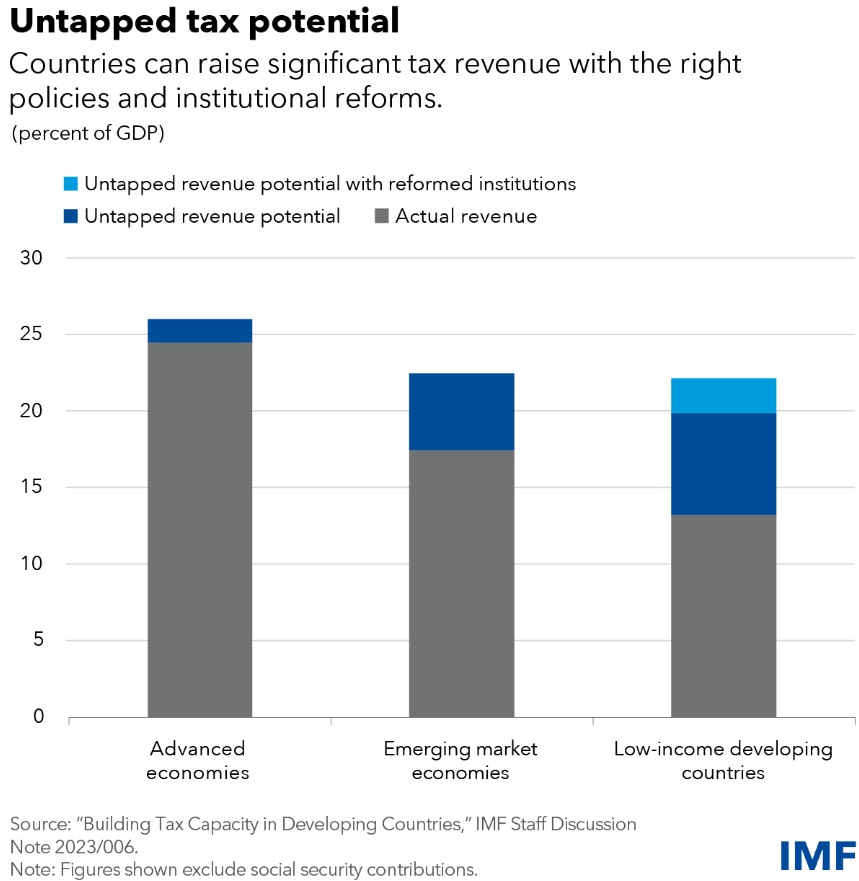
Emerging markets and developing economies need $3 trillion annually through 2030 to finance their development goals … That amounts to about 7 percent of these countries’ combined 2022 gross domestic product and poses a formidable challenge… Our new research finds that many countries have the potential to increase their tax-to-GDP ratios—enabling them to provide critical government services—by as much as 9 percentage points…

Countries have considerable room to collect more revenue based on their tax potential… We find that low-income countries could raise their tax-to-GDP ratio by as much as 6.7 percentage points on average. …The total revenue-raising potential, at 9 percentage points of GDP—a staggering two-thirds increase relative to their tax-to-GDP ratio in 2020… Similarly, emerging market economies can raise their tax-to-GDP ratio by 5 percentage points on average.

There are two things to address in the above excerpt.

First is it possible that developing nations, with sufficient “tax effort,” can increase their tax burdens by an average of 9 percentage points of GDP? Perhaps.


Second (and far more important), would that be a good idea? For people who care about empirical reality, definitely not.

Allow me to briefly elaborate on this second point. Bureaucrats at the IMF want readers to blindly accept the assertion that $3 trillion of additional tax revenue will help achieve development goals.

But notice that the IMF does not provide any supporting evidence. And neither do any of the other international bureaucracies making similar arguments.


Why don’t they offer any evidence? Why have not responded to my repeated requests to provide at least one example of a country that got rich by increasing fiscal burdens?

For the simple reason that every rich country in the world got rich when it had small government and low taxes.

In other words, the nations that achieved “development goals” took the opposite approach of what the IMF is recommending.

P.S. If the world truly is suffering from inadequate tax revenue, you would think that IMF bureaucrats would give up their special perk of tax-free salaries. But don’t hold your breath waiting for that to happen.

P.P.S. To give the IMF credit, the bureaucrats don’t discriminate. Yes, they push for bad fiscal policy in relatively poor parts of Africa, Asia, and Latin America, but they also argue for higher taxes and bigger government in relatively rich places, like Japan, Europe, and the United States.


Thursday, October 12, 2023

Sri Lanka

By Rich Kozlovich

I received the latest notice from RANE Worldview this morning, which is part of Statfor geopolitical news site, regarding Sri Lanka, and the economic mess they've gotten themselves into.  The IMF has:

........... failed to reach a staff-level agreement with Sri Lanka following a first review for the country's $2.9 billion Extended Fund Facility, delaying the release of a second tranche of approximately $330 million. An IMF mission team visited Sri Lanka from Sept. 14-27 and found that while the South Asian country's economy continues to gradually improve and stabilize, there remains ''continued uncertainty'' amid ''subdued'' economic growth and reform momentum....

This shouldn't be a surprise to anyone who has been paying attention to the foolish policies their leaders have implemented in that nation embracing all the folly of green agriculture and energy production:

Then there's their failed economic thinking.  

The IMF has outlined the things they're wanting fixed before they bail out Sri Lanka.  Fix their massive levels of corruption, and install diagnostic systems to identify the same.  Create a system of "checks and balances in governance institutions", fix their "disorganized regulatory infrastructures that oversee public resources, and insufficient transparency and fiscal discipline that impacts macroeconomic stability." 

Sri Lanka owes a lot of money to the IMF and China, and they're going to have to take more money from Sri Lankans in order to bring their house into fiscal order, and there will be kickback, massive kick back, and the Sri Lankan government may not survive. 

Do we really expect to see the very people that made incredibly stupid decisions regarding agriculture and energy, based on the greatest fraud to ever be imposed on humanity, the Global Warming scam, to be able to fix anything? 

I don't.  


Tuesday, September 12, 2023

Can Argentina Be Rescued, Part II

September 11, 2023 by Dan Mitchell @ International Liberty

Last month, a plurality of Argentinians voted for a libertarian in their nation’s presidential primary. This shocking result may be an sign that voters have sobered up and realized that they have “run out of other people’s money.”

This video from The Economist explains the country’s economic challenges

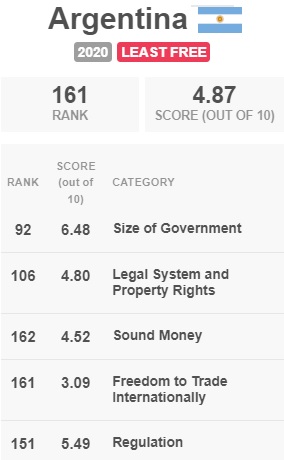
For what it’s worth, The Economist is not a libertarian-friendly publication. So it is especially remarkable and noteworthy that the video clearly explains that Argentina’s problems are the result of statism (the country has the world’s fifth-lowest score for economic liberty).


Argentina’s economic misery is not a surprise to anyone who has paid attention, as I explained in Part I of this series.

The situation is tragic. Argentina used to be one of the world’s richest nations. Unfortunately, it has suffered from varying degrees of Peronism since World War II (occasional right-of-center governments often are just as bad as the Peronists).

As a result, Argentina has suffered a massive decline in relative living standards.

One reason for decades of bad policy is that the bureaucrats at the International Monetary Fund have a terrible track record of rewarding Argentina when it gets in fiscal trouble (22 bailouts so far!).

The IMF’s bureaucrats seem to think that “moral hazard” is a good thing rather than a bad thing.

So what’s the main lesson to be learned? In part, it will be good if Argentinian voters reject Peronism later this year in their presidential election. But I worry that won’t be enough if international bureaucracies like the IMF continue to play a malignant role.

 Editor's Note:  Please take some time and review My Argentina File, which goes back to 2012.  RK

Monday, September 4, 2023

The International Monetary Fund, Negative-Sum Economics, and the Eighth Theorem of Government

April 25, 2020 by Dan Mitchell @ International Liberty
 
At the risk of understatement, I’m not a fan of the International Monetary Fund (IMF).

The international bureaucracy is the “Johnny Appleseed” of moral hazard, using bailouts to reward profligate governments and imprudent lenders.

The IMF also is infamous for encouraging higher tax burdens, which is especially outrageous since its cossetted employees are exempt from paying tax on their lavish salaries.

In recent years, the IMF has been using inequality as a justification for statist policies. Most recently, the lead bureaucrat at the IMF, Kristalina Georgieva, cited that issue as a reason for governments to impose higher taxes to fund bigger welfare states.
…inequality has become one of the most complex and vexing challenges in the global economy. Inequality of opportunity. Inequality across generations. Inequality between women and men. And, of course, inequality of income and wealth. …The good news is we have tools to address these issues… Progressive taxation is a key component of effective fiscal policy. At the top of the income distribution, our research shows that marginal tax rates can be raised without sacrificing economic growth. …Gender budgeting is another valuable fiscal tool in the fight to reduce inequality…. The ability to scale up social spending is also essential… A cornerstone of our approach to issues of economic inclusion is our social spending strategy.
What’s especially remarkable is that the IMF has claimed that the punitive policies actually will lead to more growth, in stark contrast to honest people on the left who have always acknowledged the equity-efficiency tradeoff.

The economics editor at the left-leaning Guardian, Larry Elliott, is predictably delighted with the IMF’s embrace of Greek-style fiscal policy.
Raising income tax on the wealthy will help close the growing gap between rich and poor and can be done without harming growth, the head of the International Monetary Fund has said. Kristalina Georgieva, the IMF’s managing director, said higher marginal tax rates for the better off were needed as part of a policy rethink to tackle inequality. …The IMF managing director, who succeeded Christine Lagarde last year, said higher taxes on the better off…would help fund government spending to expand opportunities for those “communities and individuals that have been falling behind.” …Georgieva said the IMF recognised that social spending policies are increasingly relevant in tackling inequality. …She added that many less well-off countries needed to scale up social spending.
Ironically, the IMF actually has admitted that this approach is bad for prosperity.

It has produced research on something called “equally distributed equivalent income” to justify lower levels of income so long as economic misery is broadly shared.

I’m not joking. You can click here to see another example of the IMF embracing poverty if it means the rich disproportionately suffer.

In other words, negative-sum economics. Though Margaret Thatcher was more eloquent in her description of this awful ideology.

At first, this column was going to be a run-of-the-mill anti-IMF diatribe.
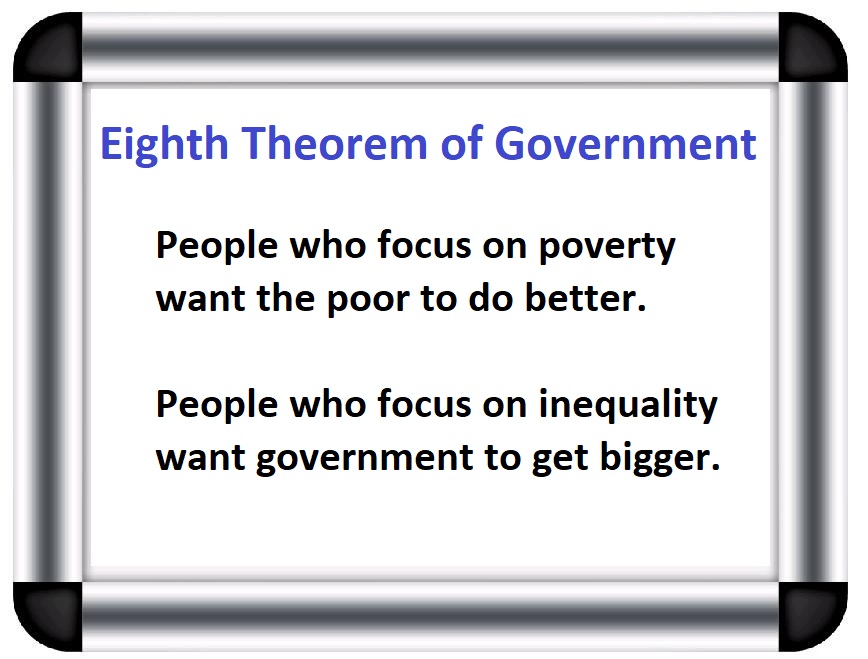
But as I contemplated how the people fixated on inequality are willing to treat the poor like sacrificial lambs, it occurred to me that this is a perfect opportunity to unveil my Eighth Theorem of Government.


P.S. Here are my other theorems of government.
  • The “First Theorem” explains how Washington really operates.
  • The “Second Theorem” explains why it is so important to block the creation of new programs.
  • The “Third Theorem” explains why centralized programs inevitably waste money.
  • The “Fourth Theorem” explains that good policy can be good politics.
  • The “Fifth Theorem” explains how good ideas on paper become bad ideas in reality.
  • The “Sixth Theorem” explains an under-appreciated benefit of a flat tax.
  • The “Seventh Theorem” explains how bigger governments are less competent.

Wednesday, August 2, 2023

Government Failure, Captured in One Tweet

July 28, 2023 by Dan Mitchell @ International Liberty

After eight years of being head of the International Monetary Fund, where she seemingly specialized in pushing for bailouts, bigger government, and higher taxes (conveniently, her lavish salary was tax exempt), Christine Lagarde was rewarded for her mistakes by being appointed president of the European Central Bank in 2019.

Amazingly, she may be an even bigger failure as a central banker. Within just a couple of years, inflation became a major problem in the eurozone (the various nations that use the euro currency).

Yet, as noted by this tweet, Ms. Lagarde apparently is mystified by what has happened while she’s been in charge.

For what it is worth, I think this tweet is much too kind.

It implies Lagarde deserves blame merely for being caught by surprise, for “missing” the signs that inflation was about to become a big problem.

Sort of like we might be upset with a park ranger who fell asleep in his tower and didn’t see the fire starting in the forest.

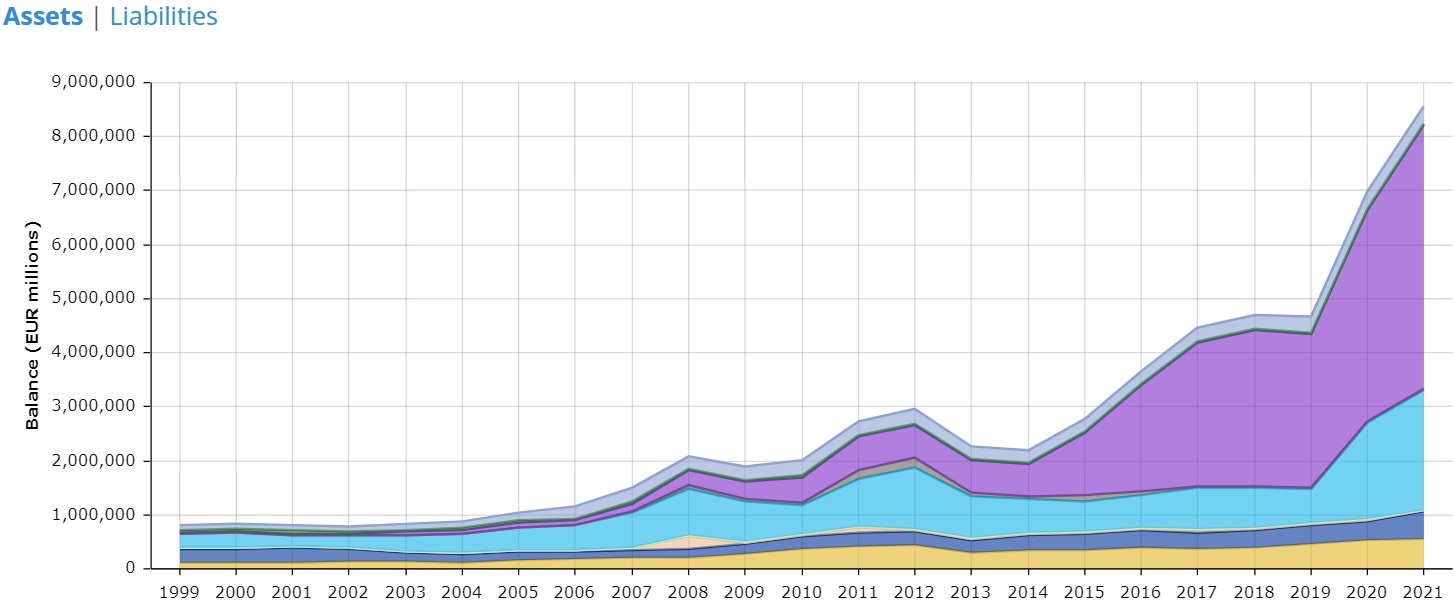
But Largarde is more akin to an arsonist. Check out this chart, which shows the European Central Bank’s balance sheet, which is a good measure for how much money is being created.

Lagarde was appointed in 2019, which is when the ECB pivoted to an easy-money policy.

Heck, she doubled the size of the ECB’s balance sheet. So she was an arsonist who first doused the forest with gasoline.

Milton Friedman must be spinning in his grave.

P.S. I was worried about the ECB’s easy-money approach about 10 years ago, but that episode was trivial compared to what’s happened during Lagarde’s reign.

P.P.S. But at least Ms. Lagarde can feel confident that the IMF is carrying on her legacy.

Tuesday, February 21, 2023

The IMF’s Dirigiste Tax Agenda, Part I

February 18, 2023 by Dan Mitchell @ International Liberty

Thanks in large part to the pro-growth agendas of Margaret Thatcher and Ronald Reagan, but also giving credit to policymakers in nations like Ireland and Switzerland, businesses (and their workers, consumers, and shareholders) have benefited from four decades of tax competition.

How much have they benefited?

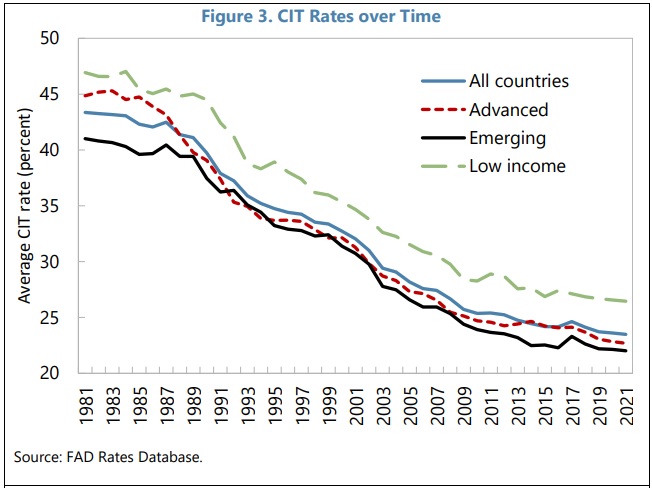
As shown by this chart, average corporate tax rates have dropped by about half since the early 1980s.

Not everybody is happy that corporate tax rates have declined.

Politicians in high-tax nations have always resented tax competition and they have been working through left-leaning international bureaucracies to push for various forms of tax harmonization.

Unfortunately, they have been partially successful.

Over the past 20 years, the human right of financial privacy has been substantially eroded so that uncompetitive governments can track – and tax – money that migrates to low-tax jurisdictions.

As a result, politicians recently have been raising personal income tax rates.

And they want to also raise corporate income tax rates, which is why many pro-tax politicians (including Joe Biden) are supporting a global tax cartel on business income.

The International Monetary Fund has a new report praising this effort. Authored by Ruud de Mooij, Alexander Klemm, and Christophe Waerzeggers, it celebrates the fact that politicians will be diverting more money from the productive sector of the economy


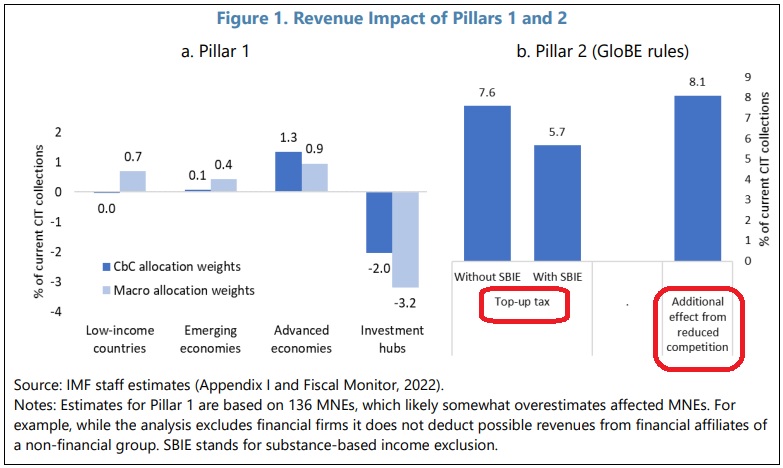
P1 is estimated to reallocate about 2 percent of total profits of MNEs, mainly from low-tax investment hubs to other countries, raising global Corporate Income Tax (CIT) revenue by $12 billion. …P2 would raise global CIT revenues by 5.7 percent, which is before any behavioral responses by firms (Figure 1b). According to staff simulations, 18.5 percent of global profit of MNEs is taxed below 15 percent ($1.47 trillion in 2019). On average, the current tax rate on these profits is 5 percent, so that profits exceeding the substance-based income exclusion would be subjected to a average top-up tax of 10 percent. …An additional positive revenue impact from P2 could come from reduced competition over corporate tax rates, which could boost global CIT revenues by an extra 8.1 percent. …a 1 percentage point increase in the world average CIT rate will, on average, induce a country to raise its own rate by 0.6 percentage points. By putting a floor of 15 percent, the simulations above suggest that 18.5 percent of MNE profit will indeed face a higher CIT burden, implying that countries will feel less pressure to keep their own tax rates low. Using simulations of the tax competition model, we find that the average CIT rate would rise from 22.2 to 24.3 percent due to the global minimum tax. The associated boost in global CIT revenues would be 8.1 percent, exceeding the direct effect on revenue.

By the way P1 is Pillar 1, which is the proposal to give powerful nations a bigger claim on the taxable income of big companies. By contrast, P2 is Pillar 2, which is the proposal for a mandatory minimum tax of at least 15 percent on corporate income.

In other words, a tax cartel.

As you can see from this next chart, most of the additional revenue is the result of the scheme for a 15 percent tax cartel.

I’ll close with two observations about this depressing data.

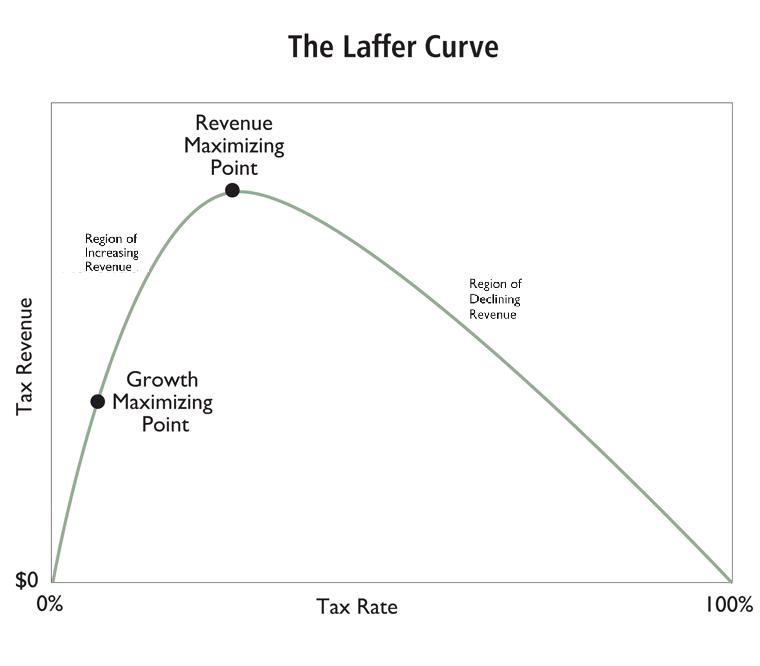
First, the IMF’s own research shows that reductions in corporate tax rates have not resulted in lower revenues. But I guess they now want to ignore the Laffer Curve since politicians want to grab more money.

Second, we should all be outraged that IMF bureaucrats (including the authors of the paper cited above) receive tax-free salaries while pushing for higher taxes on the rest of us.

Friday, December 2, 2022

The IMF, the Laffer Curve, and Supply-Side Economics

November 3, 2022 by Dan Mitchell @ International Liberty

The Laffer Curve is a very straightforward concept.

It graphically illustrates why politicians are wrong if they think you can double tax revenue by doubling tax rates (or that revenues will drop by 50 percent if tax rates are cut in half). Simply stated, you also have to look at what happens to taxable income.

 https://danieljmitchell.files.wordpress.com/2012/07/laffer-curve.jpg

In cases where taxpayers have a lot of control over the timing, level, and composition of their income, changes in tax rates may cause big changes in taxable income (or “tax base” in the jargon of economists).

None of this should be controversial. Even Paul Krugman agrees that the Laffer Curve exists.

Today, we are going to see that the pro-tax International Monetary Fund also admits there is a Laffer Curve.

Indeed, a new study authored by David Amaglobeli, Valerio Crispolti, and Xuguang Simon Sheng openly states that politicians should be very cognizant of the fact that some tax policy changes can have a big effect on the “tax base.”


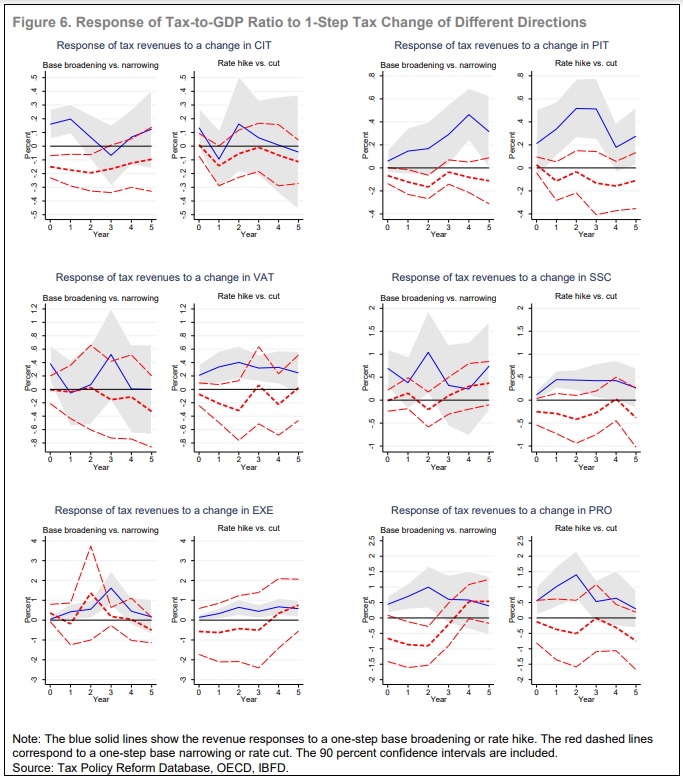
This paper investigates the potential revenue impact of different tax policy changes using the Tax Policy Reform Database (TPRD)… Revenue responses to tax policy changes depend on many factors… However, one of most important factors is the nature of the tax policy change itself. For example, while a tax rate cut will directly lower revenue intake, it could also encourage more economic activity, hence expand the tax base. Estimating the revenue response to a tax policy change, therefore, requires granular information on the nature of this change, including on the tax instrument used (e.g., VAT or personal income tax), the type of change adopted (e.g., tax base, tax rate), and its timing and size.

Here are some of the findings.

We assess the impact of tax policy changes on tax revenues using Jordà (2005)’s local projections method. Our baseline results are based on tax shocks identified in the year when a tax change is announced. Our main empirical findings suggest that the revenue yield of tax policy changes varies significantly across taxes and types of changes, with tax rate changes generally having a more transitory revenue impact than tax base changes for most taxes. Specifically, base broadening changes in PIT, CIT, EXE, and PRO have on average a more significant and long-lasting impact on tax collection than rate changes. At the same time, rate hikes have relatively more significant effects on taxes in the case of VAT and SSC measures.

Most notably, the report finds tax increases hurt prosperity, especially higher marginal tax rates.

Gechert and Groß (2019) conclude that measures to broaden the tax base are less harmful to economic growth than tax hikes. Dabla-Norris and Lima (2018) find that during fiscal consolidations, tax base-broadening measures lead to smaller output and employment declines compared to measures to increase tax rates.

And we learn that it is very foolish to raise corporate tax rates.

Mertens and Ravn (2013) find that…increases in CIT are approximately revenue neutral for the United States. …Announcements of CIT increases are associated with a somewhat transitory rise in tax collection, suggesting that companies have quickly adapted their business to reduce the tax burden.

For wonky readers, here’s a chart from the study. Note how, in many cases, there’s not much difference in revenue between tax increases (blue line) and tax cuts (red lines).

P.S. One big takeaway is that there is not a single Laffer Curve. There are multiple Laffer Curves depending on the tax that’s being changed and the ability of taxpayers to change their behavior.

P.P.S. A less-obvious takeaway is that class-warfare taxes cause the most economic damage, meaning the most harm to ordinary people.

P.P.P.S. You can call it the “Khaldun Curve” if you prefer.

P.P.P.P.S. I have trouble deciding what evidence is most powerful, the views of CPAs or the data from the OECD?


Friday, September 30, 2022

The International Monetary Fund’s Tax-Free Bureaucrats Trying to Sabotage Better Tax Policy in the United Kingdom

September 28, 2022 by Dan Mitchell @ International Liberty

It is disappointing that the bureaucrats at the International Monetary Fund routinely advocate for higher taxes and bigger government in nations from all parts of the world (for examples, see here, here, here, here, here, and here).


It is disturbing that the IMF engages in bailouts that encourage bad fiscal policy by governments and reckless lending policies by financial institutions.

And it is disgusting that those IMF bureaucrats get tax-free salaries and are thus exempt from the damaging consequences of those misguided policies.

One set of rules for the peasants and one set of rules for the elite.

The latest example of IMF misbehavior revolves around the bureaucracy’s criticism of recently announced tax cuts in the United Kingdom.

A BBC report by Natalie Sherman and Tom Espiner summarizes the controversy.


The International Monetary Fund has openly criticised the UK government over its plan for tax cuts…In an unusually outspoken statement, the IMF said the proposal was likely to increase inequality and add to pressures pushing up prices. …Chancellor Kwasi Kwarteng unveiled the country’s biggest tax package in 50 years on Friday. But the £45bn cut has sparked fears that government borrowing could surge along with interest rates. …Lord Frost, the former Brexit minister and close ally of Prime Minister Liz Truss, criticised the IMF’s statement. …”The IMF has consistently advocated highly conventional economic policies. It is following this approach that has produced years of slow growth and weak productivity. The only way forward for Britain is lower taxes, spending restraint, and significant economic reform.” …Moody’s credit rating agency said on Wednesday that the UK’s plan for “large unfunded tax cuts” was “credit negative” and would lead to higher, persistent deficits “amid rising borrowing costs [and] a weaker growth outlook”. Moody’s did not change the UK’s credit rating.

So what should be done about the IMF’s misguided interference?

Writing for the Spectator in the U.K., Kate Andrews has some observations about the underlying philosophical and ideological conflict..


…the International Monetary Fund has weighed in on the UK’s mini-Budget, offering a direct rebuke of Liz Truss and Kwasi Kwarteng’s tax cuts. …its spokesperson said…‘Given elevated inflation pressures in many countries, including the UK, we do not recommend large and untargeted fiscal packages at this juncture’… But this rebuke from the IMF is the kind of battle the Truss camp might be happy to have. …The IMF takes a political stance on inequality, viewing its reduction as a good thing in itself. Truss and Kwarteng reject this premise – summed up in the Chancellor’s statement last Friday when he called for the end of redistribution politics – and think it’s far more important to focus on ‘growing the size of the pie.’ The IMF’s ‘intervention’ is likely to become an example of the ‘Treasury orthodoxy’ that Truss was so vocal about during the leadership campaign: her belief that a left-wing economic consensus will not tolerate any meaningful shake-up of the tax code or supply-side reform.

Truss and Kwarteng are correct to reject the IMF’s foolish – and immoral – fixation on inequality.

All you really need to know is that the IMF publishes research implying it is okay to hurt poor people if rich people are hurt by a greater amount.

Let’s close by addressing whether tax cuts are bad for Britain’s currency and financial markets

Paul Marshall explained the interaction (and non-interaction) of fiscal and monetary policy in a column for the U.K.-based Financial Times.


Since 2010, the G7 policy framework has been one of tight fiscal and loose monetary policy. …This combination of fiscal austerity and monetary largesse has not been a success. Austerity has not prevented government debt ratios steadily climbing to historic highs. …Meanwhile quantitative easing has fuelled asset inflation for the super-rich and has more or less abolished risk pricing in financial markets. And…it has produced inflation which is still out of control. But now the global policy consensus is in the process of pivoting… A distinctive feature of the UK’s fiscal pivot is the emphasis on reducing the burden of tax on work and business. This is sensible. …the bigger problem for Liz Truss’s government is the Bank of England. It seems that the governor, Andrew Bailey, did not get the memo. Our central bank has been behind the curve since inflation first started to rise sharply in 2021. …The Bank of England effectively lost control of the UK bond market last Thursday when it raised interest rates by 50 basis points, instead of the 75bp that the US Federal Reserve and the European Central Bank raised by. Its timidity is now having an impact on both the gilt market and sterling. That is the essential context for the market reaction to the mini-Budget. Once you lose market confidence, it is doubly hard to win it back. …a more muscular stance from the BoE to underpin financial market confidence in the UK, even at the expense of some short-term pain.

He is right.

The Bank of England should be focused on trying to unwind its mistaken monetary policy that produced rising prices. That’s the approach that will strengthen the currency.

And Truss and Kwarteng should continue their efforts for better tax policy so the economy can grow faster.

But better tax policy needs to be accompanied by much-need spending restraint, which is what the United Kingdom enjoyed not only during the Thatcher years, but also under Prime Ministers Cameron and May.

P.S. The IMF also interfered in British politics when it tried to sabotage Brexit.

P.P.S. One obvious takeaway is that the IMF should be eliminated.