Search This Blog

De Omnibus Dubitandum - Lux Veritas

Showing posts with label Globalization. Show all posts

Friday, April 4, 2025

Trump Axes Globalization With Sweeping Tariffs

Happy Liberation Day to all who observed.

By | Apr 3, 2025 @ Liberty Nation News, Tags: Articles, Economic Affairs News, Opinion, Politics

In the classic 1924 Giacomo Puccini opera Turandot, the famous “Nessun Dorma” aria concludes, “At dawn, I will win! I will win! I will win!” It was not at dawn, but President Donald Trump did declare victory against the globalist machine when he unveiled the contours of his sweeping tariffs. At an April 2 White House Rose Garden event, the president released details of his long-awaited pursuit of reciprocity.

New Tariffs Are in Town

President Trump will impose a universal baseline tariff of 10% on all imports, effective April 5 at 12:01 a.m. Higher but discounted reciprocal tariff rates will be implemented on countries making the “worst offenders” list; those will go into effect on April 9 at 12:01 a.m. Soon after his speech, Trump signed an executive order to begin the process of enacting tariffs. “Reciprocal. That means they do it to us, and we do it to them. Very simple. Can’t get any simpler than that,” he said.

The trade measures go beyond just tariffs. Trump and senior administration officials emphasized that non-monetary trade barriers – currency manipulation, government subsidies, import restrictions, domestic tax policy, and other pillars restricting US goods – played a significant role in assigning rates to countries worldwide.

China uses third-party countries like Cambodia and Vietnam to avert tariffs. Brazil mandates licenses to import American agricultural products. Israel, according to White House officials, steals intellectual property for pharmaceutical manufacturing. Indonesia maintains local content requirements. India has burdensome and duplicative certification requirements for various sectors. The administration says this harms US businesses and workers trying to export American-made products.

The Trump team estimates that these barriers cost the US industry tens of billions of dollars annually. “Monetary tariffs and non-monetary tariffs are two distinct types of trade barriers that governments use to regulate imports and exports,” the White House said in a fact sheet. “President Trump is countering both through reciprocal tariffs to protect American workers and industries from these unfair practices.”

So, while the rest of the world will endure an across-the-board levy, major US trading partners will be hit with two-, three-, or four-times higher rates. The most notable ones were Cambodia (49%), Vietnam (46%), China (34%), India (26%), Japan (24%), and the European Union (20%). Of course, several small countries were dinged on the head with enormous reciprocal tariffs, including Lesotho (50%), Madagascar (47%), the Falkland Islands (41%), and Liechtenstein (37%).

Trump did follow through on previous comments that he would be “flexible” and “lenient” when designing this comprehensive tariff strategy. “We will charge them approximately half of what they are and have been charging us,” said the president at the press conference. “So, the tariffs will not be a full reciprocal.”

His latest round of tariffs was made possible by declaring a national emergency through the International Emergency Economic Powers Act (IEEPA). This 1977 law authorizes the chief executive to enact trade restrictions on foreign countries, primarily through tariffs. Trump invoked this act in February when he slapped import duties on Canada, Mexico, and China based on drug and illegal immigration issues. The US Senate passed a resolution to end the national emergency declared to imposed these tariffs hours after the president’s speech, with one Republican not voting and four others joining all the Democrats to achieve a 51-48 majority. It was, however, essentially a symbolic vote, as it’s unlikely the GOP-controlled House would follow suit.

Canada and Mexico were spared from the Liberation Day announcement. However, the country’s North American neighbors will still be punished under the previous 25% tariff regime due to illicit drug and illegal immigration flows. In addition, previous Section 232 measures, such as tariffs on foreign automobiles, car parts, steel, and aluminum, will not be subjected to these latest actions.

While the White House stopped short of providing revenue projections, one official was bullish on his expectations. In a recent Fox News interview, Peter Navarro, the president’s senior counselor for trade and manufacturing, predicted the US government would collect $6 trillion in tariff revenue over the next ten years. This assumes that current global trade flows remain the same.

Wall Street Panics

US stocks finished the April 2 trading session in positive territory. However, the leading benchmark averages started tanking minutes into Trump’s press conference. Following his announcement, the tech-driven Nasdaq Composite Index crashed as much as 4.5%. The blue-chip Dow Jones Industrial Average tanked 1,100 points, and the broader S&P 500 erased 3%.

Government bond yields plummeted, with the benchmark ten-year falling toward the 4% mark. The US Dollar Index (DXY) cratered 0.7%. US crude oil prices fell below $70. Bitcoin dropped about 2%. Gold was the only asset that extended its gains, as the precious metal inched toward $3,200 per ounce. However, in the metals market, silver and copper fell.

Liberty Nation depends on the support of our readers.

Investors were hoping for two things ahead of the blueprint’s unveiling: a better-than-expected plan and clarity. One analyst suggested that traders received neither. “What was delivered was as haphazard as anything this administration has done to date, and the level of complication on top of the ultimate level of new tariffs is worse than had been feared and not yet priced into the market,” said Art Hogan, the chief market strategist at B. Riley Wealth Management, to CNBC.

Treasury Secretary Scott Bessent shrugged off the after-hours trading results, uttering a terrific line that will grace the pages of business publications for weeks to come. “The Nasdaq peaked on DeepSeek day, so that’s a Mag 7 problem, not a MAGA problem,” he said. Nice.

The Reaction

Bessent delivered a message to the world: Don’t. In an interview with CNN, the seasoned hedge fund billionaire urged countries not to retaliate with countermeasures. “Let’s see where this goes because if you retaliate, that’s how we get escalation,” he said. “Doing anything rash would be unwise.”

It might be too early for nations to issue responses. Mexican President Claudia Sheinbaum Pardo confirmed earlier in the day that she would not reply with tit-for-tat retaliation. The Vietnamese government pre-emptively slashed tariffs across a diverse array of US goods. India said it is considering lowering tariffs on half of US products entering the South Asian country. Israel vowed to abolish remaining levies on US imports.

Play Video
For Discerning News Hounds

Conversely, China threatened resolute countermeasures. In a statement published by the Ministry of Commerce, officials said the government “expressed strong dissatisfaction and clear opposition” and that “China urges the U.S. to properly resolve differences with trading partners through equal dialogue.”

The White House later clarified to reporters that the 34% tariff rate on China is on top of the existing 20% import duties. So, if you do your calculations and carry the one, Beijing will be slammed with a true tariff rate of 54%.

Upending Global Trade

Canadian Prime Minister Mark Carney, who vowed countermeasures, conveyed to reporters that Trump’s reciprocal tariffs will “fundamentally change the global trading system.” This is what the 47th president of the United States is banking on.

Liberation Day was about more than tariffs. The much-anticipated date on the calendar was the US “declaring economic independence,” marking a turning point for decades-long globalization. Perhaps historians will examine the time as the start of transforming global trade and rekindling the flame of free trade.

“For decades, our country has been looted, pillaged, raped, and plundered by nations near and far, both friend and foe alike,” Trump said. “Foreign cheaters have ransacked our factories, and foreign scavengers have torn apart our once beautiful American dream. We had an American Dream that you don’t hear so much about.”

A key part of his remarks was about how the public will hear grievances from globalists, outsourcers, special interests, and the fake news over the coming days. He urged the American people to ignore their thoughts. Why? “They were wrong about NAFTA [North American Free Trade Agreement],” he said. “[T]hey were wrong about China. They were wrong about the Trans-Pacific Partnership, which would have been a disaster if I didn’t terminate it.” Economists will debate the veracity of these comments, but the Trump administration will point to towns destroyed by shuttered factories, plants, and mills.

Trumponomics

Trump has championed the same pro-tariff message since an appearance on Oprah Winfrey’s program nearly four decades ago, espousing that what has been going on is not free trade. Well, years later, the real estate billionaire mogul can declare victory against the elite. But will he usher in an oft-spouted “new golden age” that will create prosperity for all? It took many years for the United States to reach this point, so it could take as many years to eradicate the odor of globalization.

~

Liberty Nation does not endorse candidates, campaigns, or legislation, and this presentation is no endorsement.

Read More From Andrew Moran Economics Editor

Thursday, February 22, 2024

The Case for Mutual Recognition

February 21, 2024 by Dan Mitchell @ International Liberty

Almost exactly six years ago, I shared a column with this video of a member of the European Parliament explaining the principle of mutual recognition.

But that column was mostly about the benefits of jurisdictional competition and I only mentioned mutual recognition as a side issue.


So let’s examine today why mutual recognition is a good principle for cross-border economic relations.

Let’s start with a definition. Mutual recognition happens when two of more jurisdictions agree to have open trade and to respect each other’s laws.

So that means (as noted in the video) that, for example, Brits can buy food and other products from Germany and Germans can buy food and other products from the United Kingdom – regardless of the laws that govern production in the two nations.

For my American readers, here are three very real examples of why mutual recognition is a good idea.

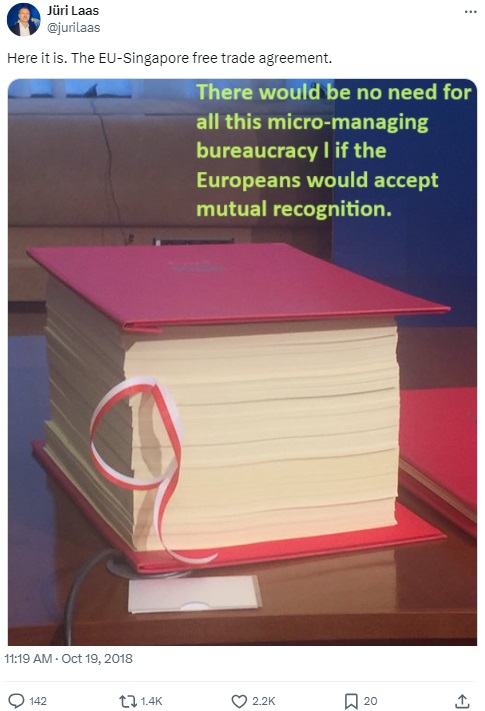
Another reason to support mutual recognition is that it would make trade agreements much simpler. I wrote in 2019 that the ideal free trade agreement is one simple sentence prohibiting trade barriers.

But that’s only possible with a system of mutual recognition. Ryan Young and Kent Lassman of the Competitive Enterprise Institute recently wrote on this issue for National Review.

Here are some excerpts.


The core concept behind a simple FTA is mutual recognition of one another’s regulations. Under mutual recognition, if American regulators approve a product, then it is automatically approved in partner countries, and vice versa. With that sort of regulatory trade barrier lowered, consumers can quickly benefit from wider selection, more affordable prices, and faster access to new innovations. Producers would benefit from faster approval times and lower regulatory costs for pharmaceuticals, appliances, agricultural products, electronics, and countless other industries, while gaining access to new markets and new customers. Regulators would benefit by avoiding redundant approvals in each partner country, saving agency resources. …Mutual recognition is appropriate for strong allies in developed countries… Our regulations may not be identical but will be similar enough for trade purposes. …A mutual-recognition agreement with Switzerland or another close ally could set a precedent that can lead to larger agreements that would boost economies around the world while strengthening alliances against Russia and China.

Amen.

Simple trade agreements with allied nations should be based on mutual recognition.

As you might expect, I also like this principle because it encourages jurisdictional competition.

I quoted Professor Michael Greve many years ago and he’s worth quoting again.


…the origin principle…is commonly called the principle of “mutual recognition.” …it is the only principle that is consistent with both a common economic market and political decentralization. Mutual recognition integrates member states without central intervention. …Mutual recognition, then, liberates commerce by eliminating the cost of complying with different, conflicting, and often incomprehensible rules. Beyond that, mutual recognition institutionalizes jurisdictional competition. …The ability of individuals and firms to vote with their feet, modems, and pocketbooks will liberate markets and discipline politicians. …Trade unions, environmental interests, and any other interest group whose agenda rests on redistribution consistently oppose mutual recognition: they cannot rob Peter to pay Paul if Peter is allowed to escape to more hospitable climes.

By the way, the United Kingdom seems to have some very sensible people with regards to mutual recognition, as illustrated by this Alex Tabarrok article and this tweet.

Sam Dumitriu @Sam_Dumitriu - The UK has announced unilateral recognition for medicines approved overseas. If Japan or the US approves a drug, you will be able to prescribe it in the UK. Aiming to create fastest route to market in the world for new medicines. 

9:16 AM · Mar 15, 2023 218.1K Views

And we have some sensible people in the United States.

P.S. The good news is that the European Union was founded in part on the principle of mutual recognition. The bad news is that politicians are increasingly replacing that sensible approach with the dirigiste model of harmonization. Bad globalism in action.

Monday, October 9, 2023

The Case for (non-China) Globalization

October 6, 2023 by Dan Mitchell @ International Liberty

Editor's Note:  I mostly like Dan's commentaries, but Libertarians all have the same problem making "free market" thinking fit reality.  While I'm all in favor of free markets, if for no other reason the protectionism ends up benefiting a handful of people at the expense of everyone else,  but, I'm not in favor of our market being free and everyone else practicing protectionism, at our expense.  I've yet to see a libertarian argument that fixes that.   Otherwise, he makes some good points here.  Also, libertarians don't seem to, or are unwilling, to see there's a difference between protectionist policies such as tariffs for geopolitical purposes versus economic purposes.  RK

I’m opposed to globalism (because global governance means bigger government), but I’m in favor of globalization (because free trade makes us richer).

So I largely approve of this video from the Economist.

This video is basically an endorsement of what is sometimes called the “Washington Consensus,” the late-1900s idea that free markets and limited government are the recipe to achieve prosperity.

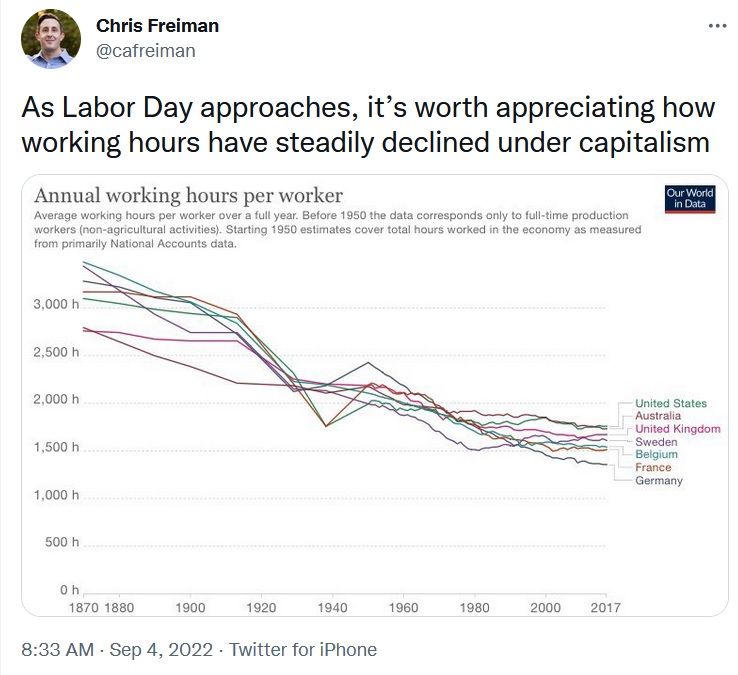
That recipe has a good track record in the developing world.

https://freedomandprosperity.org/wp-content/uploads/2022/09/Sep-6-22-Tweet.jpg

And those policies also helped make the United States and other western nations very wealthy .

Sadly, many politicians don’t like free markets. They are opposed to this good version of globalization.

Consider, for instance, the Trump-Biden hostility to trade, the Trump-Biden support for industrial policy, and the Trump-Biden opposition to entitlement reform.

And that’s just in the United States. Politicians in other nations also want government to have more power.

And that’s what the Economist focused on in an article accompanying the video, which uses “homeland economics” as a new term for statism.

…“homeland economics”, a protectionist, high-subsidy, intervention-heavy ideology administered by an ambitious state. …when you lump them all together, it becomes clear just how systematically the presumption of open markets and limited government has been left in the dust. …these classical liberal values are not only unpopular, they are increasingly absent from political debate. …if you argue for free trade in Washington, you will be scoffed at as hopelessly naive. In the emerging world, you will be painted as a neocolonial relic from the era when the West knew best. …protectionism goes along with extra government spending. Industry is gobbling up subsidies… And, inevitably, state handouts go along with extra regulation. …This mix of protection, spending and regulation comes at a heavy cost. …Governments are losing all restraint just when they need to curtail welfare spending. Ageing populations weigh down budgets with extra bills for pensions and health care.

That’s a grim summary of what’s happening.

But the rest of the article is even more pessimistic.

Despite its flaws, homeland economics will be tough to restrain. People enjoy spending other people’s money. As government budgets get bigger, the special interests that feed on them will grow in size and influence. It is harder to withdraw protection and handouts than to grant them… Anyone doe-eyed about the arc of history bending towards progress should remember that a century ago Argentina was about as rich as Switzerland.

I agree that promoting economic liberty is an uphill battle.

Fighting against protectionism is especially difficult, but I am genuinely curious whether that fight (as well as the battle against industrial policy) would be easier if China somehow was excluded.

In other words, are people now against trade in general, or are they simply against trade with China?

Similarly, are people in favor of industrial policy, or are they just in favor of business subsidies to counter Chinese business subsidies?

More broadly speaking, I wonder if the spat between national conservatives and freedom conservatives could be smoothed over if there was agreement on decoupling from China.

Monday, May 8, 2023

Debating the European Union

May 6, 2023 by Dan Mitchell @ International Liberty 

(Editor's Note:  Dan is a prolific writer, and I love much of what Dan publishes, but he ends this commentary saying: It’s good to favor globalization, but that does not imply support for global governance.  I posted this comment:  If you favor globalization it means favoring global governance, since that’s the intent behind globalization. Here’s reality. If you play straight with cheaters, you lose, whether it involves economics or politics. If countries aren’t playing straight, then don’t play. Because if you do, they get bigger, richer and more dangerous, and the straight shooters get poorer, smaller and defenseless.  Nixon and Kissinger opening China to the world is the perfect example. After Mao’s Cultural Revolution China’s economy, and the Chinese Communist Party was heading for the ash heap of history. Nixon prevented that and now we’re seeing the consequences. RK)

Most Americans pay little or no attention to the European Union and its various bureaucratic and political arms in Brussels. 

But that’s unwise. What happens in Europe can have an impact on policy in the United States.

For instance, I have been very critical of the European Union because the bureaucrats and politicians in Brussels push for dirigiste policies such as tax harmonization and climate protectionism.

And I was a huge fan of Brexit (the United Kingdom voting to leave the E.U.).

On the other hand, I have tepidly written that E.U. membership may make sense for nations from Eastern Europe.

It seems like I can’t make up my mind, but my views are simple and (I like to think) very rational.

  • If E.U. membership will push a nation in the right direction, I’m for it.
  • If E.U. membership will push a nation is the wrong direction, I’m against it.

Given my interest in Europe and the European Union, I was understandably interested when I saw that Reason published a pro-con article on the topic.

Dan Hannan, a former member of the European Parliament from the U.K., argues that the E.U. was a mistake.


Unlike NAFTA or the European Free Trade Association (EFTA), the EEC was not a free trade area but a customs union, controlling all commerce on behalf of its members and artificially redirecting trade away from the rest of the world. …it was a club of nations rather than a superstate. …That changed when the Maastricht Treaty came into force in 1993. …it stopped being the EEC and became the European Union. …A big polity can prosper, but only if it behaves like a confederation of statelets. The supreme exemplar is the U.S., the only large nation that gets anywhere near the top of those GDP rankings… I’m not wild about the direction the U.S. has been taking… But the U.S. is starting from a much better place. It was designed according to Jeffersonian principles. Power was dispersed, decentralized, and democratized. The E.U., by contrast, was designed to weld nations into a supranational bloc. …Where the Declaration of Independence promises life, liberty, and the pursuit of happiness, its European equivalent, the Charter of Fundamental Rights, entitles people to “strike action,” “affordable housing,” and “free healthcare.”

Dalibor Rohac of the American Enterprise has a more optimistic assessment.


The Brussels machinery is bureaucratic and largely insulated from accountability. When it comes to new markets and new technologies, European institutions regulate first and ask questions later. The E.U. controls a sizable budget, part of it wasteful—including generous agricultural subsidies and transfer programs… Yet the E.U.’s existence is infinitely preferable to its absence. …The relevant comparison is between the E.U. and the politically plausible alternatives. Those alternatives almost certainly involve protectionism, heavy-handed industrial policy and planning, or state aid to politically connected companies… If it weren’t for the pressure of the European Commission in the late 1980s, it is fanciful to think that Italy or France would have just given up state ownership of utilities, banks, or their industrial giants. …Conversely, the United Kingdom has not become a free market paradise after leaving the European Union. Quite the opposite. …the E.U.’s “single market” is far from perfect. …it often goes hand in hand with harmonized European rules rather than with simple mutual recognition of national standards. …Has the E.U. lived up fully to the ideals of Hayekian international federalism? Of course not. But it is blindingly obvious that it has performed better than the relevant alternatives.

What’s my two cents.

I’m on Dan Hannan’s side and I think he made good points, but I would have made different arguments. My main concerns with the E.U. is that it is not only a protectionist club, but it also is far too supportive of harmonization, centralization, and bureaucratization.

Simply stated, the culture in Brussels is dirigiste and “public choice” tells us that it will get worse over time.

Dalibor Rohac made good points, to be sure, and he is right that the E.U. has been a net plus on some issues. And he’s also right that some nations might be further to the left if the E.U. didn’t exist.

But, on net, I think it leads to more statism rather than more markets.

P.S. Here’s a description of why “mutual recognition” is a good framework for international economic relations.

P.P.S. It’s good to favor globalization, but that does not imply support for global governance.

P.P.P.S. Rohac is right that the U.K. has not prospered in the post-Brexit years, but leaving the E.U. was a way of creating the opportunity for a better approach. The fact that British politicians have been increasing fiscal burdens simply means that the U.K is not taking advantage of the opportunity.

Tuesday, February 21, 2023

The IMF’s Dirigiste Tax Agenda, Part I

February 18, 2023 by Dan Mitchell @ International Liberty

Thanks in large part to the pro-growth agendas of Margaret Thatcher and Ronald Reagan, but also giving credit to policymakers in nations like Ireland and Switzerland, businesses (and their workers, consumers, and shareholders) have benefited from four decades of tax competition.

How much have they benefited?

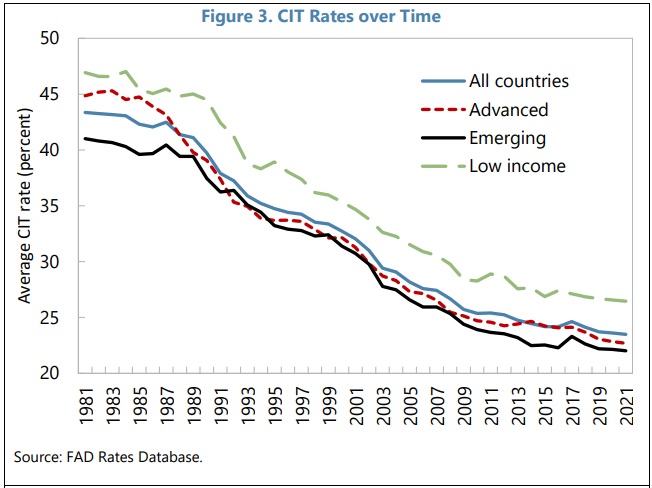
As shown by this chart, average corporate tax rates have dropped by about half since the early 1980s.

Not everybody is happy that corporate tax rates have declined.

Politicians in high-tax nations have always resented tax competition and they have been working through left-leaning international bureaucracies to push for various forms of tax harmonization.

Unfortunately, they have been partially successful.

Over the past 20 years, the human right of financial privacy has been substantially eroded so that uncompetitive governments can track – and tax – money that migrates to low-tax jurisdictions.

As a result, politicians recently have been raising personal income tax rates.

And they want to also raise corporate income tax rates, which is why many pro-tax politicians (including Joe Biden) are supporting a global tax cartel on business income.

The International Monetary Fund has a new report praising this effort. Authored by Ruud de Mooij, Alexander Klemm, and Christophe Waerzeggers, it celebrates the fact that politicians will be diverting more money from the productive sector of the economy


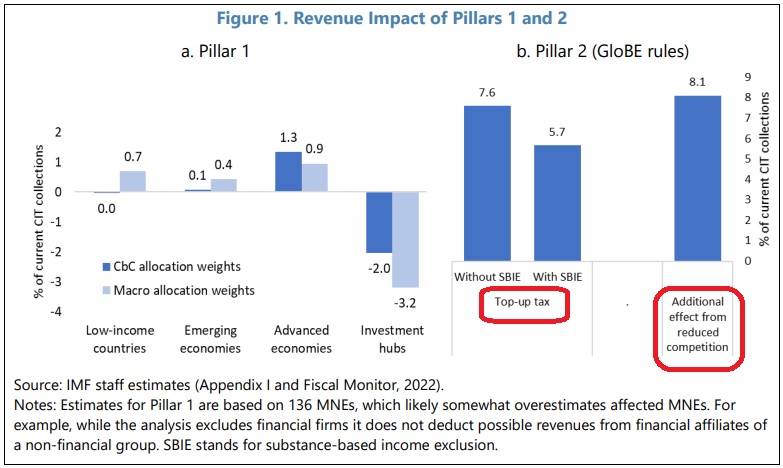
P1 is estimated to reallocate about 2 percent of total profits of MNEs, mainly from low-tax investment hubs to other countries, raising global Corporate Income Tax (CIT) revenue by $12 billion. …P2 would raise global CIT revenues by 5.7 percent, which is before any behavioral responses by firms (Figure 1b). According to staff simulations, 18.5 percent of global profit of MNEs is taxed below 15 percent ($1.47 trillion in 2019). On average, the current tax rate on these profits is 5 percent, so that profits exceeding the substance-based income exclusion would be subjected to a average top-up tax of 10 percent. …An additional positive revenue impact from P2 could come from reduced competition over corporate tax rates, which could boost global CIT revenues by an extra 8.1 percent. …a 1 percentage point increase in the world average CIT rate will, on average, induce a country to raise its own rate by 0.6 percentage points. By putting a floor of 15 percent, the simulations above suggest that 18.5 percent of MNE profit will indeed face a higher CIT burden, implying that countries will feel less pressure to keep their own tax rates low. Using simulations of the tax competition model, we find that the average CIT rate would rise from 22.2 to 24.3 percent due to the global minimum tax. The associated boost in global CIT revenues would be 8.1 percent, exceeding the direct effect on revenue.

By the way P1 is Pillar 1, which is the proposal to give powerful nations a bigger claim on the taxable income of big companies. By contrast, P2 is Pillar 2, which is the proposal for a mandatory minimum tax of at least 15 percent on corporate income.

In other words, a tax cartel.

As you can see from this next chart, most of the additional revenue is the result of the scheme for a 15 percent tax cartel.

I’ll close with two observations about this depressing data.

First, the IMF’s own research shows that reductions in corporate tax rates have not resulted in lower revenues. But I guess they now want to ignore the Laffer Curve since politicians want to grab more money.

Second, we should all be outraged that IMF bureaucrats (including the authors of the paper cited above) receive tax-free salaries while pushing for higher taxes on the rest of us.

Tuesday, February 7, 2023

Globalization is About to Collapse. Here's Why

By Rich Kozlovich

Good video, and much of what appears here I've addressed in the past, including the end of American protection of the world's seaways, which is another reason I've predicted the return of American industry back to America.  As screwed up as the Democrats have made America it remains the only stable  rule of law nation in the world, which is another reason the left is working so hard to destabilize America and destroy the Constitution.  Enjoy, Globalization is About to Collapse. Here's Why.

Wednesday, September 18, 2019

'Climate Change': A Leftist Excuse to Redistribute Wealth and Destroy the West

September 17, 2019 By Ferdinand Bardamu

The "Church of Climate Change" demands that Western nations impose restrictions on industrial CO2 emissions, encouraging them to squander billions on unreliable "green" technologies and renewable sources of energy. They continue to ignore the one policy that has significantly increased atmospheric CO2 levels in the last few decades, generating hundreds of millions of metric tons of the stuff annually: mass third-world immigration (see Kolankiewicz and Camarota, 2008).

If the IPCC were objective, it would demand an end to mass immigration instead of more carbon taxes and emissions trading. Such indifference in the face of the evidence shows that they care more about racially dispossessing whites than they do about "saving the planet."

So what is the ulterior motive? To further understand what this may be, we must examine the career of Canadian businessman Maurice Strong (1929–2015). Thanks to his tireless "lobbying behind the scenes," the U.N. has played a key role in forging a "consensus" on man-made global warming. In a sense, he was the right man at the right time. Besides his ability to manipulate others, Strong was aided by other factors, such as the collapse of Soviet communism in the early 1990s. This helped pave the way for the emergence of a new leftist orthodoxy: environmentalism.........To Read More....

Saturday, August 31, 2019

UN Youth: Ready to bypass democracy!

By | August 29th, 2019 | Environment | 3 Comments @ CFACT
 
The talk swirling around the UN “Civil Society Conference” in Salt Lake City has been radical throughout, with the youth contingent vowing to take to the streets if voters don’t give them their way.

“We are willing to make these demands known at the ballot-box, or, if necessary, in the streets.”

How civil.

That’s what it says in the working draft of the “Youth Compact” that was in use throughout the conference.  The UN sanitized the final version.  CFACT’s undercover operative witnessed a large group of youth turn their backs in protest as the slightly less radical version was released.

This little gem survived to the final version.  They took their demand for an end to single use plastics way beyond banning plastic straws, to banning plastic tampons and other female care products.  That should be interesting.

They also demand that we “shift our diets to plants…  reducing meat consumption.”

The working draft included a ban on genetically modified plant strains.  Reduced crop yields will certainly make the world more just.  Pity about the kids in developing countries who will be denied beta carotene intensive “Golden Rice.”  They can just go blind, a small price to pay for “sustainable” justice.

The UN’s outcome documents are littered with the kind of baseless alarmist rhetoric you would expect, labeling normal weather extreme and the rest, followed with demands for inefficient renewable energy, including burning biomass.  Biomass, you know, grinding wood and plants into pellets.  Which is more “sustainable,” saving trees or burning them?  It’s hard to keep up.
CFACT undercover captured video of U.S. Representative Barbara Lee proclaiming, “the children have been crying out, do we hear them?  Now even the rocks are crying out!”
Barbara Lee can hear rocks… 

Hope she can “sustain” that.

The main takeaway is this.  The Green-Left has captured the United Nations and is using “sustainability,” the way they used “climate change,” as pretext for obtaining every destructive item on their wish list.

The Left’s science, math and economics do not work out.  They never have.  They are a recipe for massive societal decline.  It is no accident they they never want to make their alterations to our lives voluntary.

The Left’s desire to shift power away from the individual to the “collective” is misguided.
Freedom is not only our unalienable right.  Freedom is the only way to organize society to yield the prosperity that can genuinely sustain people and our planet.
___________
 
Thank you to everyone who helped make CFACT’s undercover mission to the UN’s dangerous “sustainability” conference such a success.  If you’ve not yet had a chance to chip in, please click here and make your most generous gift today. Without you our work cannot continue.  Fortunately, CFACT’s friends are the best!
 

Author:

The UN’s cadre of misled youth

By | August 28th, 2019 | Environment | 5 Comments @ CFACT

The UN is employing a disturbing tactic to push its “sustainability” agenda at its Civil Society Conference in Salt Lake City.

CFACT’s undercover reporter is on the ground in Salt Lake City, exposing how the UN heavily indoctrinates young people with talking points, then presents them on stage to regurgitate them.  “Look at the wisdom these young people have come to impart,” the rest of us are supposed to conclude.

Disney Channel’s Luke Mullen, told us, “I do believe that [school] strikes for the climate are just as important as education. Why should we be studying and preparing for a future that might not come?” 

Mullen told CFACT that he is following in the wake of poor Greta Thunberg, the young Swedish girl who has been so traumatized by the narrative of impending doom she’s been fed, that she walked out of school to become a propaganda poster child.  She’s encouraging kids like Luke Mullen to walk out too.  Greta just arrived in New York City on a carbon fiber yacht sponsored by the royal family of Monaco.  That she is protesting fossil fuels on an elite yacht made from oil and propane is lost on her.  She lacks the education and context to know.

Skip learning and just repeat the line’s you’ve been fed — These poor, exploited young people.  Think the mainstream media will expose this shameless trick?  Fear not.  CFACT’s on the job.
We interviewed Nicolette Templier, aka “Miss New York Earth USA.”  Her answers are simply a regurgitation of UN climate change alarmist talking points on everything from polar ice to polar bears, that fall to pieces when confronted with the facts. 

The climate and “sustainability” crowd don’t like it when the facts are introduced into the UN proceedings one bit.  When the facts that debunk the UN’s dangerous agenda show up, the UN’s youth cadres drop their smiles and bare their claws.  You may remember CFACT’s coverage at UN COP 24 in Poland last fall.  The UN formally authorized an angry mob of left-wing youth to interrupt and shout down the Trump Administration’s energy presentation.  Shouting over instead of listening and responding?  How’s that for UN “civil society?”

CFACT is tackling this challenge on multiple fronts.  We expose the Green-Left’s exploitation of youth.  We inject facts into UN proceedings like the “sustainability” conference in Salt Lake.  We fairly present all sides of these important issues to thousands of young people through our CFACT Collegians program and challenge them  to think for themselves.

Thank you to everyone whose support makes this important work possible.

Facts and education are the antidote to propaganda and ignorance.


Author:   is a co-founder of CFACT and currently serves as its president.

Monday, December 31, 2018

It's For the Children!

By Rich Kozlovich

I've had the privilege of being part of the structural pest control industry for thirty seven years, and in over twenty five of those years I've been heavily involved in my industry's affairs serving on a number of industry association boards, in a number of leadership roles, defending us against the scurrilous claims about pesticides from activists.   During those years I've heard these activists demand the abolition of one pesticide after another accompanied by the claim, "It's for the children".

Well, that's a load of horsepucky!

Time and history has shown what they've promoted wasn't "for the children".  In reality, the outcome of their agendas has been "to the children".  It's the children who are the ones who've suffered the most from the green/left's insane anti pesticide agenda.   That's history and that history is incontestable.

When anyone starts spouting we need to adopt some agenda or other because "it's for the children" we have to recognize that's an emotional appeal, not a factual one. And at that point we need start asking why, and start looking much closer at their claims and demands. 

That pattern plays out in everything promoted by the left.

On December 27,. 2018 CNSNews.com Staff posted this article:  Pelosi: ‘We All Have Moral Responsibility to Ensure All Children of God Are Treated With Compassion’ saying:
House Minority Leader Nancy Pelosi (D.-Calif.) issued a statement on Wednesday, reminding Americans: “We all have a moral responsibility to ensure all children of God are treated with compassion and decency.” Pelosi was responding to the death of 8-year-old Felipe Alonzo-Gomez, who died on Christmas Eve in the custody of U.S Customs and Border Protection. Alzono-Gomez and his father, who were from Guatemala, had been intercepted by the Border Patrol along the U.S.-Mexico border near El Paso, Texas. “Democrats call on Homeland Security’s Inspector General to immediately open an investigation into Felipe Alzono-Gomez’s death,” Pelosi said
Pelosi is such a hypocrite, and a heretic.  Her embrace of God is now, and has always been, nothing more than political expediency.  If she can use God as a tool to promote her leftist agenda, that's what she'll do.  Her heresy and hypocrisy should be clear to the most casual observer.  If she really was concerned about the children, why is she so unconcerned about the millions of innocent unborn children who are murdered each year in abortion clinics.  Abortions she supports. 
 
However, we need to get back to this question: Who's responsible for this child's death? 

This child was brought here with at least one parent taking a trip that took months.  Now all of a sudden the U.S. is responsible for his death after being here only a few hours and having had better medical treatment in that short time period than he and his family have probably had their entire lives.  And I might add, based on events, it seems to me the Border Patrol people had shown more care for this child than did his father. 
 
This pattern of blame is constantly misplaced as one writer noted:
"When a seven-year-old girl died of dehydration and shock while in U.S. Customs and Border Protection custody after being brought here illegally by her father, Democrats and the liberal MSM immediately began blaming her death on President Trump's border and immigration policies. The fact that the little girl hadn't consumed food or water for several days and endured who knows what other physical and emotional trauma over the grueling and dangerous two-thousand-mile journey from her home in Guatemala didn't seem to affect the narrative of Democrats and the MSM that President Trump is somehow responsible for her tragic death".
This is an emotional attempt to sway the public based on misinformation attempting to guilt shame American society, and is part and parcel of what the left totally embraces regularly.  Facts are meaningless, emotion is everything. The fact of the matter is these parents and those who promoted this effort to force the border are responsible for what happens to these poor innocent children, not the U.S., not the Border Patrol and certainly not Donald Trump.

 "These children are being used as human shields".......So many of these children "are being exploited by smugglers and drug traffickers to enter the country. Over 600 convicted, hard-core criminals have already been discovered to be among the migrant caravan. The Northern Triangle is among the most corrupt in the world, trafficking in anything from drugs to people to human organs."  In Guatemala....... "sex trafficking of children is rampant, and many of these children are even being sold into the sex trade by their own mothers". 

Are we to believe Pelosi and her corrupt cabal aren't aware all of that? If she isn't aware of all of that, she's not only a hypocrite, she's incompetent.  If she is aware of all that, why isn't she calling the public's attention to it, which by any stretch of the imagination is a massive problem of child abuse, versus children dying at the border at no fault of the United States.

Because the left is not only aiding and abetting this crime of illegal immigration, they're deliberately ignoring "the real plight of the children and women among the caravan" and these child abuse horrors in order to destabilize "America, putting its citizens at risk."

And they accuse President Trump of being cold and uncaring? The hypocrisy of the left is astounding, and deadly.

Recently, it was reported that conservative journalist Bre Payton's died from H1N1 swine flu. Whose fault was that?  No one is a fault!  People contract life threatening diseases constantly, and very often medical science simply can't help them, especially if it involves viruses.  This woman was capable of getting the finest medical care in the world, and yet she died. 

These people were induced to come here in droves, being told they could force the border and get everything they desire out of life, including free medical care, free welfare and who knows what all.  All being done to promote a leftist agenda by wealthy left wing loons like George Soros.  An agenda that's meant to destroy the American identity, the American economy and overturn the Constitution.  The only things standing between freedom and a socialist world government.  

If we really need to point a finger of blame, it should start there, and then to Pelosi and her corrupt minions, and the Neocons and RINO's who've supported globalization.  And any appeals by Pelosi to God regarding the need to treat all children with compassion are hypocrisy in it's highest form by a heretic. 

Sunday, November 4, 2018

The UN’s Plan to End Civilization

Gregory Hood, American Renaissance, October 24, 2018

Open borders and “replacement migration.” Without borders, civilization would disappear.

According to a 2017 Gallup poll, 14 percent of the world’s adults, including almost a third of Africans, would emigrate if they could. That is about 710 million people—almost equal to the population of Europe. If everyone who wanted to leave could, the First World would be overwhelmed by the Third, and the end of white nations would smother the global engine of scientific advancement, economic growth and human progress.

The United Nations “Global Compact for Safe, Orderly, and Regular Migration” therefore menaces the West. It almost sounds like a threat:...........The United States has already pulled out of the compact; so has Hungary. Austria and Poland may follow, but most countries have signed up. It is non-binding, but it gives moral legitimacy to impossible demands. The only prosperous societies that survive will be those that defy the United Nations.........To Read More.....

Wednesday, September 26, 2018

What Motivates the Left, Disdain for the Rich or a Desire to Help the Poor?

September 25, 2018 by Dan Mitchell @ International Liberty

Editor's Note:  While I like the idea of open markets, the real world doesn't really work that way. Otherwise, why then to they need to make trade agreements?  RK)
 
I’m happy to discuss theory when debating economic policy, but I mostly focus on real-world evidence.

That’s because my friends on the left always have a hard time answering my two-question challenge, which simply asks them to name one success story for big government.

They usually point to Sweden and Denmark, but get discouraged when I point out that those nations became rich when government was relatively small.


And I’m embarrassed to admit that some of my fellow economists once thought that communist nations grew faster than capitalist nations.

But let’s not digress. I raise this topic because there are many critics of capitalism who admit that free markets generate more wealth, but they assert that society would be better off if incomes were lower so long as rich people suffered more than poor people.

This strikes me as morally poisonous. But it also gives me an opportunity to cite a new study from the International Monetary Fund that allows us to further analyze this issue.

The IMF report starts by noting that globalization (free trade, liberalization, etc) has been good for global prosperity.
Over the course of the last decades the world economy has witnessed rapid integration. Most countries have opened up their economies and experienced an unprecedented rise in the flow of goods and capital across borders. This phenomenon – now widely known as economic globalization – was coincident with rising living standards in a large number of countries. Many developing countries have experienced episodes of strong economic growth and substantial poverty reduction as they integrated their economies with the rest of the world.
Sounds like good news, right?

It is good news, but those who fixate on inequality are worried.
…while globalization might on average be good for growth, more might not always be better for all. …When we shift the analysis to how income gains from globalization are distributed within countries, we also find globalization to have different effects on different incomes…gains are, however, distributed unequally both across and within countries. …Within countries, income inequality increases as a consequence of globalization. The income gains resulting from globalization tend to go primarily to the top of the national income distributions.
In other words, rich people are getting richer at a faster pace.

This phenomenon is captured in these two charts, which show that globalization is associated with more growth and more inequality.


But what’s important is that poor people also are getting richer.
In the subsample of developing countries where the gains from globalization are generally larger, however, they also reach the bottom of the income distribution and reduce poverty. … We find…some evidence of a poverty reducing effect of globalization in developing countries.
Consider, for example, the remarkable data I shared about China. Income inequality increased at the same time that poverty dramatically declined.

And those results seem to hold for the rest of the world, especially in developing nations.

So now let’s look at the most important chart from the IMF study, which shows that all income groups enjoy more prosperity with globalization.


Yes, rich people benefit the most, so official inequality numbers will increase.

But put yourself in the shoes of a poor person. Would you be willing to forego your additional income in order to deny additional income for a rich person? I suspect the vast majority of poor people would think that’s a crazy question.

But, as Margaret Thatcher pointed out, there are plenty of folks on the left who think that’s a perfectly reasonable position. Including, incidentally, some of the people at the IMF.


Monday, October 30, 2017

The Global Failure of Globalization

Posted by Daniel Greenfield 0 Comments Saturday, October 28, 2017 @ Sultan Knish Blog

“We cannot allow to fall back into pre-globalization times,” German Chancellor Angela Merkel warned.

Merkel was welcoming Obama back to Berlin for the last time. The election had been fought and won nine days earlier. And Obama and Merkel were defending globalism against President-elect Trump.

To Merkel and Obama, returning to pre-globalization times was every bit as mad as going back to the caves. Globalization had become synonymous with civilization. And its prophets, like Thomas Friedman, traced back its rise to the fall of the Berlin Wall in the city where Merkel and Obama were chatting.

But globalization didn’t bring down the Berlin Wall. Nationalism did. The pro-democracy activists wanted a country where the people had a voice. That’s the opposite of globalization in which there are no nations and only the influential figures of various stripes have any kind of impact.

Globalization built the Berlin Wall to unite East Germany with a Communist bloc built around a set of political ideas that disregarded nations and individual peoples. Leftists had drawn a deeply misguided lesson from the fall of Communism. Rather than attributing the fall to the overreach of central governments and unaccountable bureaucrats, they developed a new postmodern historical materialism of globalism. The Communist bloc had fallen not because of too much globalization, but because there wasn’t enough of it. There were still too many borders and nations. And they all had to fall like the Wall.

Where Communism had failed by being too narrow, globalism would succeed in creating a new world.

By the time Merkel and Obama were mourning what Trump’s victory and Brexit meant for globalization, Berlin had become a wonderful laboratory for observing the end results of their philosophy. Haunted by the specter of national decline and falling birth rates, Merkel had opened her country’s borders to a million Muslim migrants who had flooded in from the Middle East and from as far away as Afghanistan.

The migrants were supposed to supplement the German workforce. Syrians would build the Mercedes coupes of tomorrow, Pakistanis would put together Siemens ultrasound devices and Somalis would produce Bayer’s pharmaceuticals. There would be no need for Germany to continue exploring the Japanese model of smarter automation to replace a falling population. Globalization would provide.

But the migrants weren’t coming to Germany to work. And they aren’t working. It’s still Germans and Eastern Europeans on the floor at Siemens, Mercedes and Bayer. The “refugees” came for Germany’s generous welfare programs. And they’ve wrecked enough of the country that Merkel wants to pay them to leave.

The welfare state so ubiquitous to Europe is there to compensate for the discrepancy between the expected standard of living and the declining options for earning that living. Globalization didn’t magically link together economies to create a new golden age. Its prophets, like Thomas Friedman, are being jeered as neo-liberals by a radicalized left looking more to East Germany than to Berlin.

Globalization moved jobs and production to countries with the lowest standards of living, the least human rights and the greatest government intervention in their economies. It’s no wonder that China thrived or that America declined in that environment. But at the same time it also moved immigrants with the lowest work ethic to America and Germany to benefit from the welfare programs that were meant to soften the economic impact of globalization on the native population.

The old immigrants had come to benefit from a booming economy. But if you want a booming economy with lots of entry level jobs, 21st century America is hardly the place to go. You can’t just walk off the street and get a manufacturing job that will take you up the ladder to the middle class.

The West gets two kinds of economic immigrants these days: scroungers and hustlers.

Hustlers can make their own opportunities. They’re the Koreans running local grocery stores and the Russian Jews starting revolutionary dot coms. But hustling demands creativity, smarts and an ambitious work ethic. Most immigrants are scroungers. They get by on some combination of welfare and semi-legal marginal jobs. If they have an ambition, it’s getting a comfortable government job.

Immigrants brought over as cheap labor quickly plug into the welfare state and become a net loss.

Globalization exports jobs and imports welfare scroungers making it a double blow to the West. The outbound jobs and the inbound migrant swarms punish countries with higher standards of living and human rights by depriving them of both. It’s hard to think of any better way to destroy a civilization.

The political and social gifts of globalization have been every bit as destructive as its economic effects.

Globalization doesn’t just make it possible for a million Muslims to show up in Germany, but for transnational Islamic terror organizations like Al Qaeda or ISIS to operate. It’s no coincidence that they took off with globalization. Or that globalized Islamic terror networks have used the machinery of globalization: jet planes, trains, human trafficking, the internet and multicultural cities to wreak havoc.

Instead of binding the world closer together, globalization financed a renewed wave of aggression by former failed Communist states and enabled Islamic terrorists to strike deep in the heart of the West.

Globalization finances China’s expansionism program in the South China Sea and a growing conflict that could lead to a regional war. It allowed the Russians to turn Americans against each other by pretending to be everyone from Black Lives Matter to Republicans on the internet. And it allows Islamic terrorists thousands of miles away to coordinate devastating attacks across America and Europe.

The internet, once the symbol of globalization, hasn’t brought us together. Instead it tore us apart into warring tribes living in separate bubbles. A generation raised on the internet has become the most intolerant of free speech in a century. And even the pro-globalization media is demanding new means of censoring social media and the internet to fight “fake news” from the political opposition.

The ambitious dreams of globalization that once appeared to unite big government advocates on the left with free marketers on the right have become a nightmare. Their failures have led to a renewed affinity for Socialism and even Communism on the left. The rise of Bernie Sanders and the growing comfort with Socialism among Democrats are road signs of the rejection of a free market. And on the right, populist nationalism is displacing an unquestioning commitment to a free market.

But globalization is also a global failure. It has driven China into a blind alley of economic bubbles, compulsive spending and colonialism. China is rapidly replicating a century’s worth of Western economic progress in a matter of decades. And it’s replicating the same problems and the same dead end. It won’t find the solutions by seeking cheap labor in Africa or by distracting its population with a new war.

Globalization interlinks economies and societies often more by their weaknesses than by their strengths. It exports instability more easily than stability and conflict more easily than progress.

Sophisticated systems are more vulnerable than primitive ones. It’s why Afghanistan and Iraq made more of an enduring mark on America than the other way around. In a globalized world, colonialism works in reverse with unstable societies exporting their instability to stable societies. The prophets of globalism marveled at the internationalization of culture. But culture in traditional societies goes far deeper than Marvel or Harry Potter. It’s only in the West, where culture, tradition and religion are being lost, that pop culture becomes culture. And that identity becomes equally shallow and unstable.

Globalization isn’t bringing us to a bright new golden age, but to an old age of iron. The new colonialism is being carried out by those cultures with a strong sense of identity against post-moderns who lack it. The decline of Western nations doesn’t open the door to a world government, but to the rising power of China, Russia and Iran. All our social progress has left us more intolerant and divided than ever.

Tearing down borders, physical, economic and cultural, hasn’t made us more open. Instead we live in hostile, divisive and unstable societies that pride themselves on their “openness” even as they unveil new schemes for censoring the internet, restraining free speech and punishing social dissent.

Globalization is a dead end. Open societies are open internally and mutually to people and ideas that share the premise of that ‘openness’. Not with those who hate them. Free markets are free when they interact with other free markets, not totalitarian slave labor camps that can always win on price.

As globalization falls, we can rebuild functional nation states or be swept away with the global flood.


Friday, November 28, 2014

The Gruberization of Environmental Policies

Paul Driessen Nov 28, 2014

Call it the Gruberization of America’s energy and environmental policies.

Former White House medical consultant Jonathan Gruber pocketed millions of taxpayer dollars before infamously explaining how ObamaCare was enacted. “Lack of transparency is a huge political advantage,” he said. “It was really, really critical to getting the bill passed.” At least one key provision was a “very clever basic exploitation of the lack of economic understanding of the American voter.”

The Barack Obama/Gina McCarthy Environmental Protection Agency is likewise exploiting its lack of transparency and most Americans’ lack of scientific understanding. EPA bureaucrats and their hired scientists, pressure groups and PR flacks are getting rich and powerful by implementing costly, punitive, dictatorial regulations “for our own good,” and pretending to be honest and publicly spirited.

EPA’s latest regulatory onslaught is its “Clean Power Plan.” The agency claims the CPP will control or prevent “dangerous manmade climate change,” by reducing carbon dioxide and “encouraging” greater use of renewable energy. In reality, as even EPA acknowledges, no commercial-scale technology exists that can remove CO2 from power plant emission streams. The real goal is forcing coal-fired power plants to reduce their operations significantly or (better still) shut down entirely.

The agency justifies this by deceitfully claiming major health benefits will result from eliminating coal in electricity generation – and deceptively ignoring the harmful effects that its regulations are having on people’s livelihoods, living standards, health and well-being. Its assertion that reducing the USA’s coal-related carbon dioxide emissions will make an iota of difference is just as disingenuous. China, India and other fast-developing nations must keep burning coal to generate electricity and lift people out of poverty, and CO2 plays only a tiny (if any) role in climate change and destructive weather events.

The new CPP amplifies Obama Administration diktats targeting coal use. Companion regulations cover mercury, particulates (soot), ozone, “cross-state” air pollution, sulfur and nitrogen oxides that contribute to haze in some areas, and water quality. Their real benefits are minimal to illusory … or fabricated.

American’s air is clean, thanks to scrubbers and other emission control systems that remove the vast majority of pollutants. Remaining pollutants pose few real health problems. To get the results it needs, EPA cherry picks often questionable research that supports its agenda and ignores all other studies. It low-balls costs, pays advisors and outside pressure groups millions of dollars to support its decisions, and ignores the cumulative effects of its regulations on energy costs and thus on businesses, jobs and families.

Now, for the first time, someone has tallied those costs. The results are sobering.

An exhaustive study by Energy Ventures Analysis, Inc. tallies the overall effects of EPA regulations on the electric power industry and provides state-by-state summaries of the rules’ impacts on residential, industrial and overall energy users. The study found that EPA rules and energy markets will inflict $284 billion per year in extra electricity and natural gas costs in 2020, compared to its 2012 baseline year.

The typical household’s annual electricity and natural gas bills will rise 35 percent or $680 by 2020, compared to 2012, and will climb every year after that, as EPA regulations get more and more stringent. Median family incomes are already $2,000 lower since President Obama took office, and electricity prices have soared 14-33 percent in states with the most wind power – so these extra costs will exact a heavy additional toll.

Manufacturing and other businesses will be hit even harder, the study concluded. Their electricity and natural gas costs will almost double between 2012 and 2020, increasing by nearly $200 billion annually over this short period. Energy-intensive industries like aluminum, steel and chemical manufacturing will find it increasingly hard to compete in global markets, but all businesses (and their employees) will suffer.

The EVA analysis calculates that industrial electricity rates will soar by 34 percent in West Virginia, 59 percent in Maryland and New York, and a whopping 74 percent in Ohio. Just imagine running a factory, school district or hospital – and having to factor skyrocketing costs like that into your budget. Where do you find that extra money? How many workers or teachers do you lay off, or patients do you turn away? Can you stay open?

The CPP will also force utility companies to spend billions building new generators (mostly gas-fired, plus wind turbines), and new transmission lines, gas lines and other infrastructure. But EPA does not factor those costs into its calculations; nor does it consider the many years it will take to design, permit, engineer, finance and build those systems – and battle Big Green lawsuits over them.

How “science-based” are EPA’s regulations, really? Its mercury rule is based on computer-generated risks to hypothetical American women who eat 296 pounds of fish a year that they catch themselves, a claim that its rule will prevent a theoretical reduction in IQ test scores by an undetectable “0.00209 points,” and similar absurdities. Its PM2.5 soot standard is equivalent to having one ounce of super-fine dust spread equally in a volume of air one-half mile long, one-half mile wide and one story tall.

No wonder EPA has paid its “independent” Clean Air Scientific Advisory Committee $181 million and the American Lung Association $25 million since 2000 to rubberstamp its secretive, phony “science.”

Rural America will really be walloped by the total weight of EPA’s anti-coal regulations. Nonprofit electricity cooperatives serve 42 million people in 47 states, across three-fourths of the nation’s land area. They own and maintain 42 percent of America’s electric distribution lines and depend heavily on coal. They have already invested countless billions retrofitting coal-fired generators with state-of-the-art emission control systems, and thus emit very few actual pollutants. (CO2 fertilizes plants; it is not a pollutant.)

EPA’s air and water rules will force these coal units to slash their electricity generation or close down long before their productive lives are over – and before replacement units and transmission lines can be built. Electricity rates in these rural areas are already higher than in urban areas, but will go much higher. Experts warn that these premature shutdowns will slash electricity “reserve margins” to almost zero in some areas, make large sections of the power grid unstable, and create high risks of rolling blackouts and cascading power outages, especially in the Texas panhandle, western Kansas and northern Arkansas.

The rules will thus put the cooperatives in violation of the Rural Electrification Act and 16 other laws that require reliable, affordable electricity for these far-flung communities. EPA’s actions are also putting rural hospitals in greater jeopardy, as they try to cope with “Affordable Care Act” rules and other burdens that have already caused numerous closings. As USA Today reported, the shuttered hospitals mean some of the nation’s poorest and sickest patients will be denied accessible, affordable care – and people suffering strokes, heart attacks and accidents will not reach emergency care during their “golden hour,” meaning many of them will die or be severely and permanently disabled.

EPA never bothered to consider any of these factors. Nor has it addressed the habitat, bird, bat and other environmental impacts that tens of thousands more wind turbines will have; the “human health hazards” that wind turbines have been shown to inflict on people living near them; or the high electricity costs, notorious unreliability, and increased power grid instability associated with the wind and solar installations that EPA seems to think can quickly and magically replace the coal-based electricity it is eliminating.

Congress, state legislators and attorneys general, governors and courts need to stop these secretive, duplicitous, dictatorial Executive Branch actions. Here’s one thought. Heartland Institute Science Director Jay Lehr helped organize the panel that called for establishing the Environmental Protection Agency. In a persuasive analysis, he says it’s time now to systematically dismantle the federal EPA and replace it with a “committee of the whole” of the 50 state environmental protection agencies.

The new organization would do a far better job of protecting our air and water quality, livelihoods, living standards, health and welfare. It will listen better to We the People – and less to eco-pressure groups.