Search This Blog

De Omnibus Dubitandum - Lux Veritas

Showing posts with label Leftist Failures. Show all posts

Friday, November 8, 2024

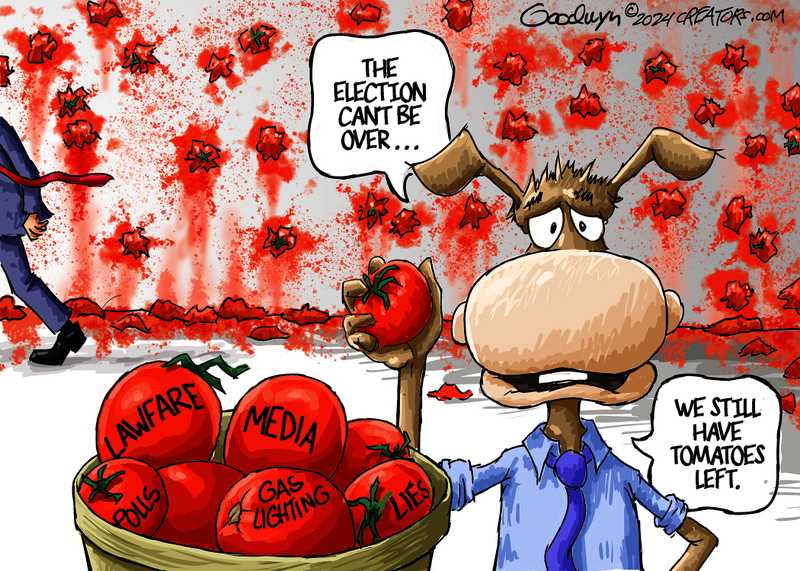
What Were the Real Reasons Kamala Failed?

By Rich Kozlovich

What was the real reason Kamala failed?  First, everything Kamala ever stood for decades was far to the left regarding race, gender, energy, taxes, and crime, all of which were unpopular.   To survive she would have had to embrace fracking, more drilling, more support for police, strong immigration policies and control of the border, end racial reparations, end the administration's goals for massive new taxes, end socialized medicine schemes, end the left's schemes to redistribute the nations wealth, end the left's efforts to confiscate the citizens guns, and invading American homes without warrant to search for them.  But Kamala Harris is a hate mongering Marxist, a racist, anti-American, and antisemitic.  Get over it!  As for her economic polices.... and I use the word policies loosely.... are blatantly stupid.  Rent control is always as disaster, but Marxists love eliminating property rights.   

Her lies, flip flops, and a complete failure to offer rational policies even lost her massive numbers of black and Hispanic voters.   For Kamala to renounce her historical policy positions would mean abandoning her base.  And the more she twisted and turned the more ridiculous she appeared.  Her polls were so bad they had to shove her out the door and do interviews, and even when she faced friendly and supportive interviewers she look like a halfwit.  When facing an adversarial interviewer, she demonstrated what ever wit she appeared to have didn't really exist.

She had no policies other than the policies she and Joe Biden promoted for four years, and they were all utter disasters, orchestrated by a President who was suffering from dementia or worse.  Which she never noticed because she, as well as a lot of prominent people, kept saying he was hale and hardy.  Imagine that. 

What did she have left?  Abortion, Trump's a Nazi, and Americans are nothing more than racists, misogynists, and fascists.  So her political strategy was to insult over half the voting population, and somehow she thought that was a really good idea.  Her base?  Well off leftists, criminals, and those who constantly have their hands out to feed at the government trough.  

Her pick of a seriously flawed, and seriously weird Vice Presidential running mate really didn't help, that pick merely amplified her own "mediocrity". He couldn’t even beat Trump in his home county in Minnesota, the state where he's governor.  And now it looks as if his history is drawing some attention by law enforcement.  After this, I'm betting there will be an investigation of his activity with China and regarding claims of personal illegal moral impropriety. 

The reasons she failed according supporters?  She didn't fail, it was America that failed. 
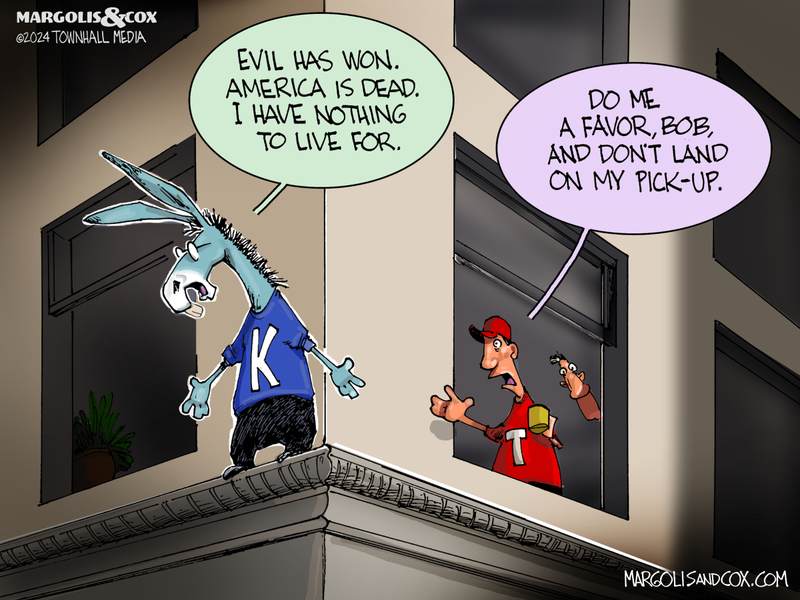
Jen Psaki went over the edge, proclaiming the usual lies about Trump.  The White House blames covid. Now you have to admit, that's unique.  Jimmy Kimmel says: 

“It was a terrible night for women, for children, for the hundreds of thousands of hard working immigrants who make this country great, for health care, for our climate, for science, for journalism, for justice, for free speech”.   

Thank you Jimmy, the more you talk the dumber you look.  

Then we have Bette Midler who deleted her X account after she promised to drink Drano if Trump was elected.  The stunningly stupid Rob Reiner, who claimed he'd “set himself on fire” if Trump won, declared that Kamala was the winner, just before Trump's landslide victory.   AOC's explanation? America is a sexist racist nation.  

Cardi B, whoever she is, brilliantly proclaimed her loss was the reason "why some of y’all states be getting hurricanes".    Joy Reid scolds male Latino Trump voters because their illegal migrant relatives will suffer, and she's supported by the communist President of Colombia.  Joy Reid is not only dumb, she's a historical ignoramus.  Two things.  

First, did it ever occur to her that, perhaps.... just perhaps.... they supported Trump because most of their relatives are here legally, and most of the criminals illegally coming over the border are hiding in their communities murdering, stealing, and pushing illegal drugs.  

Secondly, Hispanic groups supported mass deportations in the 1950's, and attitude was prevalent in the Hispanic communities of America going back to the 1930's. 

Joe Scarborough says black and Hispanic men have issues with race, and misogyny.  A position supported by Al Sharpton, which really lends credibility to that statement.......right?   Little Jimmy Carville is depressed.  Well good, as he's been the cause a lot depression in America for decades.   

Letitia James "vows to continue her lawfare against Trump", and I hope she does, as it's my belief she's committed election interference crimes and if there's massive election interference RICO investigation, or even a felony charge of "conspiracy against rights",  she could very well end up in jail.  Now that would be fun to watch them have a swat team at her door at 5:00 AM, handcuffed, and perp walked to a waiting van while being filmed by the media,  alerted ahead of time of course, just as they did with Roger Stone.


The Era of corp media dominance is over.   

What followed was a brutal, ten-year, house-to-house fight. Backed by Hollywood, academia, the Deep State’s grotesque alphabet agencies, the legal system, a shameless Democrat Party, and hundreds of billions of corporate dollars, the media committed itself to destroying one man, and the inevitable third-act climax arrived during this year’s presidential campaign........ 

In the preceding years, Trump had been battered, bruised, and covered in the flaming arrows of the left’s naked corruption and unquenchable thirst for power: two impeachments, 91 indictments, and 34 felony convictions, all at the hands of a federal special prosecutor, two local Democrat prosecutors, and a Democrat state attorney general. The feds raided his home. Lawfare sought to bankrupt his business. He was literally shot in the face. He was almost literally gunned down on a golf course.

 Backing all of this was a relentless corporate media cacophony of lies, hoaxes, slander, misinformation, disinformation, and desperate distractions.

The Pravda media is filled with liars with big egos, bad attitudes, and a non existent moral foundation, and they absolutely lost it when it was declared Trump was the victor, and heads exploded at the Woke "UK-based Economist magazine  when it was announced of Donald Trump’s blowout victory, insisting this means '“huge” damage to America’s economy, institutions, and the world."   Well I think we should thank the editor's at the Economist for their input.  Now we know of another publication that needs to be ignored.  Here's the reality about economists.  Most of them have no idea what they're talking about.  

Talking about the nitwits who don't know what they're talking about, here's how the "ladies of the View" handled Kamala's massive defeat.

However, and I find Chris Cuomo's recent transformation on so many issues confusing,  saying Trump Won Because of “Wokeism Run Amok”.  Go figure, that's not the  

Alex Soros, delusional as ever, says failed Democrat policies aren't to blame for Kamala's loss, it was  ‘unstoppable’ global trends.  Does he mean unstoppable because they're sick and tired of leftist tyranny that he, his father, the Democrat party and others are trying to impose on humanity?   

And after spending billions and still losing, Kamala's team blames Biden, and Biden's team blames Kamala.  George Clooney for pushing Biden out, ‘It’s All His Fault’.  Ya just gotta love that.  

You may find this article by Andrea Widburg a really interesting analysis of how leftism must be a mental disorder.  

As for all those Hollywood celebrity endorsements, no one is impressed, and no one cares what they think.  When will these egotistical nitwits get that?  And when are they going to do what they promised over and over again, which many in America sincerely hoped they would do, that is, leave the country.  In recapping the slimy ‘celebs’ who said they’d off themselves or flee America with a Trump victory, Olivia Murray says: "Well have at it—time to get going! Also, where can I tune in to watch?"

Well this is a long piece, and there's a lot more, but it's time to cut it off.  I've listed all the finger pointing and Trump Derangement Syndrome stuff here today. In Monday's edition we'll take in other view points.  

America’s Progressive Era Comes Crashing Down – Who’s to Blame?

In their search for culprits, will the left look in the mirror? 

By | Nov 7, 2024 @ Liberty Nation News, Tags:  Articles, Opinion, Politics

 America’s Progressive Era Comes Crashing Down – Who’s to Blame?

The recriminations and finger-pointing by those on the progressive left began shortly after Georgia and North Carolina showed durable and ultimately irreversible leads for Donald Trump. And when the “blue wall” states began falling like dominoes, and Trump was on his way to a resounding victory in the Electoral College and becoming the first Republican in 20 years to win the popular vote, their exhaustion was accompanied by deep depression. There was no litigating their way out of this one.

Both sides agreed on one thing about this election: It promised existential consequences, a winner-take-all race like few contests in presidential history. If Kamala Harris had prevailed, officials on the right would be engaged in fear and trembling just as much as so many on the left are now. And as is usually the case on the losing side, a circular firing squad quickly formed. Who is to blame for this disastrous outcome? Harris, Joe Biden, campaign strategists, DEI, defund the police, border policies, all of the above?

But before the inevitably long and painful internal discussions among Democrats commence in the days and weeks ahead, stricken progressives in legacy media put the bull’s eye on – who else? – the voters. On MSNBC, famed race hustler Al Sharpton, ignoring the two election victories of Barack Obama, blamed systemic racism and then, for good measure, asserted that many black and Hispanic men are misogynists. His colleagues nodded in agreement, discussing how voters ignored their “better angels” and surrendered to panic ginned up by the soon-to-be 47th president.

The Ultimate Culprit for Ending the Progressive Era

When political analysts and historians reflect on the 2024 election, they will – or should – ultimately pin the blame for the crash and burn of progressive politics on one person. It is not Harris, who raised a billion dollars and did the best she could in a severely truncated campaign given her stunning lack of political skill. It is not those who managed her campaign, who recognized their candidate’s inability to articulate anything beyond confusing word salads and vague policy prescriptions and ability to dodge serious inquiry. And it is not the celebrity surrogates, from BeyoncĂ© to Oprah Winfrey, who raised her flag as high as they could.

New banner Memo - From the Desk of Senior Political Analyst Tim Donner 1 

No, the blame falls squarely on the 46th president – and those who surrounded him. When Joe Biden managed to eke out a narrow victory in 2020, he did so by promising to be a trantional figure who would lower the political temperature, bring the country together, and return it to a state of “normalcy.” He invoked the words “unity” or “unify” more than a dozen times in his inaugural speech. And then he proceeded to demonize not only his predecessor but also the 74 million voters who supported the 45th president. His speech before a haunting, blood-red background warned of the dangers of MAGA Republicans, which he then repeated frequently, culminating in his characterization of Trump supporters as garbage.

Despite his narrow win – by about 50,000 votes in three states – he developed visions of grandeur, intent on governing as if he had scored a gigantic mandate for radical change. His agenda made Obama look like a conservative. No radical cultural policies in response to the cataclysmic George Floyd affair were off the table. The gates to the southern border were flung wide open, and millions of illegals flooded the zone. A massive and unnecessary recovery bill was signed, triggering the worst inflation in 40 years. Efforts to grant statehood to liberal DC and Puerto Rico and attempts to pack the Supreme Court to assure near-permanent Democratic control of the Senate and the high court came frighteningly close to reality.

Biden’s Justice Department and like-minded blue state prosecutors launched arguably the most ill-conceived political strategy in memory, indicting Trump on a total of 91 felony counts in four venues. Instead of burying their mortal enemy, it actually vaulted Trump into the lead in a race few thought he had a chance of winning.

The Thing That Wouldn’t Leave

In spite of all that and Biden’s sinking approval, the Dobbs decision reversing Roe v. Wade triggered a surprisingly strong showing by the Democrats in the 2022 midterm elections. Having defeated Trump, the ultimate feather in his cap, and after seeing his party make unexpected gains in Congress two years later, Biden should have declared victory and called it a day. That was the perfect time to announce he would not seek a second term. It would have opened the floodgates for a competitive primary process, where progressives such as Harris and California Gov. Gavin Newsom and centrist Democrats such as Govs. Josh Shapiro of Pennsylvania and Andy Beshear of Kentucky could battle it out for the cherished presidential nomination.

Play Video
Ditch the Diatribe – Try This!

But Biden was unwilling to part with the perks of the presidency and carried on, believing that since he beat Trump once, he was uniquely qualified to take him down again. He had repeatedly stated that he was going to sit out the 2020 election until Trump uttered the infamous “very fine people” line – allegedly referring to the KKK-style protesters in Charlottesville – which even liberal fact-checkers like Snopes found to be false. Despite missing his moment, Biden would have many months to change his mind and pass the baton. However, as the election moved ever closer and even his most faithful allies realized his cognitive tank was emptying, Biden hung on like a stubborn virus. His wife and close associates witnessed his decline up close and personal but refused to convince him it was time to leave. It all collapsed like a house of cards in the infamous debate in June when Biden’s incapacity was visible for all the world to see.

When he ignored many public hints by Democratic powerbrokers such as Nancy Pelosi and Barack Obama to reconsider his stubborn refusal to let go, he was finally threatened with a boycott by big donors and then unwillingly stepped aside with three months to go before Election Day. By then, the damage had been done. The party was forced to pivot on a dime to the vice president, who had demonstrated her lack of electability during the 2020 campaign and now would be forced to renounce the far-left policies she had eagerly supported four years earlier. It proved too high a mountain to climb, culminating in a sweeping victory for Trump.

Bolstered by a once-in-a-century pandemic and raging violence in the streets, Biden managed to land in the Oval Office after seeking that big prize for more than three decades. If he had delivered on his promise to heal a bitterly divided nation and pursued sensible policies that would have attracted bipartisan support, Democrats just might be celebrating instead of drowning in regret. If he had stepped aside when he should have, his party might have nominated an electable successor. His failure to understand his limited mandate, his embrace of wildly unpopular left-wing policies, and his refusal to step aside before he became an embarrassment to himself and his party will be examined for years to come. Biden disgraced himself and the Democratic Party, becoming the linchpin for both the end of a progressive era and the ascendancy of what he was intent on extinguishing: Trump and the era of America First.

~

Liberty Nation does not endorse candidates, campaigns, or legislation, and this presentation is no endorsement.

 
Read More From Tim Donner

Thursday, September 19, 2024

How to Really End ESG

Russell Greene September 13, 2024 @AIER, Tags: Daily Economy, Environmentalism, Capitalism, Books


Eleanor Roosevelt holds a poster of the Universal Declaration of Human Rights. Lake Success, NY. 1949. Courtesy FDR Presidential Library & Museum.

ESG investing poses a grave threat to the principles that lifted billions out of poverty. It neither does much good nor performs very well. Therefore, it must end.  

So asserts Ending ESG, a collection of essays edited by Phil Gramm and Terrence Keeley. Gramm, a former Republican senator and economics professor, and Keeley, a former managing director at Blackrock, are well-suited to make the case. The book’s lengthy introduction is co-authored by Gramm and Keeley. It traces the Environmental, Social and Government (ESG) investment movement back to the United Nations. Not to the Kofi Annan era of the late 90s and early 2000s, that is, but all the way back to the 1948 Universal Declaration of Human Rights.  

The authors do not dwell upon this early history, but it is worth briefly unpacking. Eleanor Roosevelt chaired the drafting committee of the UN Declaration. She explained that many of its members “thought that lack of standards for human rights the world over was one of the greatest causes of friction among the nations, and that recognition of human rights might become one of the cornerstones on which peace could eventually be based.” This was a pressing priority in the wake of World War II.

Jacques Maritain, a French Philosopher who provided intellectual inspiration for the document, explained how consensus was achieved: “we agree on these rights provided we are not asked why. With the ‘why’ the dispute begins.” History has since tested the stability of agreeing not to ask why.

Over the next 75 years, the UN’s declaration of rights eventually led to ESG. Inspired by the declaration, the UN launched development goals (eradicating poverty, gender equality, environmental sustainability, etc.). Then, the UN released investment principles based on these goals, to be adopted by major asset managers, banks, public pensions, and regulatory bodies. To the shock of anyone familiar with other UN efforts, the UN’s work on ESG has paid off.  

ESG has been adopted by major institutions over the world, in word if not always in deed. The result is that “the private economy is increasingly being coerced into meeting a growing number of environmental and social goals that Congress never mandated.”  

The cost of such coercion is high. For one, it undermines the legal and ethical basis of economic progress. Whereas the economic Enlightenment was “founded on the principle that people own the fruits of their own labor and thrift,” ESG is a “throwback to the medieval concept of communal property.” Throughout 14 essays, mostly penned by Gramm and/or Keeley, Ending ESG argues against such an ESG-inspired return to medieval economics.

ESG might seem high-minded and noble compared to the hard-nosed alternatives of fiduciary responsibility and shareholder primacy. But appearances are deceiving. When it comes to results, the economic enlightenment enabled 128,000 individuals to escape abject poverty every single day. In contrast, it’s not clear if the ESG movement has accomplished anything of note, other than lowering the popularity of Wall Street and Corporate America among conservatives, contributing to the anti-business turn on the right.

And though the ESG movement claims to care about eradicating poverty and protecting the environment, we should not take these claims too seriously. Keeley cites a research finding that there is “no evidence that socially responsible investment funds improve corporate behavior.” Moreover, it’s difficult to even assess the impact of ESG strategies since “ESG scores among leading rating agencies correlated only 54 percent of the time.”  

The evidence is compelling, but it raises a puzzling question: if ESG does “neither much good nor very well,” why do so many people seem to believe it does both? Where did ESG critics go wrong? Why did it take nearly two decades for ESG to face substantial backlash?  

One problem is that the defenders of fiduciary responsibility failed to provide adequate moral foundations for their view. Keeley cites Milton Friedman’s classic 1970 New York Times piece, “The Social Responsibility of Business is to Increase Its Profits.” There, Friedman argued:

In a free‐enterprise, private‐property system, a corporate executive is an employee of the owners of the business. He has direct responsibility to his employers. That responsibility is to conduct the business in accordance with their desires, which generally will be to make as much money as possible while conforming to the basic rules of the society, both those embodied in law and those embodied in ethical custom.

Friedman, a committed positivist, did not found his concept of social responsibility on a universal ethical standard, other than the need for business executives to defer to shareholder desires. And, in his view, this will usually mean to seek profits while conforming to existing laws and customs. These laws and customs will vary from time to time, and from place to place. And so, apparently, will the social responsibilities of businesses.

In his essay “How Conservatives Can Get ESG Right”, Keeley endorses Friedman’s analysis. Yet it suffers from two major flaws, flaws that also weaken Keeley’s arguments. First, businesses and investors are not just passive recipients of laws and ethical customs. Business leaders are norm-makers, not just norm-takers.  

The most successful business leaders are able to cast a compelling long-term vision, one that includes but goes beyond making money, and to persuade their investors to remain focused on the long-term. That is, business leaders lead their investors, they don’t merely respond to investor preferences. Further, policymakers depend on the counsel of industry to respond to technological innovations, as we are now seeing with artificial intelligence. And business leaders seek to influence both the law and public opinion, such as through lobbying, public relations, media, and publishing their own thoughts.  

This is understandable. To survive, businesses cannot merely conform to the basic rules of society — they must influence them. But how, and in which direction? For example, should they oppose crony subsidies and regulations, which may help their profits, at least in the short term, but undermine economic dynamism and the very legitimacy of their businesses? Friedman’s positivism does not provide much guidance here.  

After all, the ethical customs and laws of a society may grow increasingly hostile to private enterprise. Indeed, they seem to be doing so now. Business leaders cannot be expected to stand by as activists assault the legal and ethical foundations of economic progress, or as government agencies violate their constitutional rights. While Ending ESG recommends that business leaders “keep politics out of the boardroom,” this is no longer an option for major corporations, if it ever was.

Moreover, activist shareholders increasingly are advancing shareholder proposals that are harmful to the long-term interests of the very corporations in which they own shares. This means businesses increasingly have to defend themselves against their own shareholders. Complicating matters further, the nature of business ownership has radically changed since 1970, with the rise of passive index investors and pension-fund activism. It’s no longer safe to assume that major investors will all agree on maximizing the long-term value of a particular firm, especially if that firm is engaged in ESG-unfriendly lines of business. What most investors do, and should, prioritize is very much up for debate.

Keeley claims “there is no practical alternative to shareholder primacy.” But clearly, there is. For one, many American states now have the option of “benefit corporation,” an option that replaces shareholder primacy with responsibilities to an array of stakeholders. And in Europe, the concepts of double materiality and co-determination override any commitment to shareholder primacy.  

Now, it’s true that such stakeholder governance often comes at a cost. On the other hand, stakeholder advocates will claim the cost is worth it, whether to save the planet, or to advance “equity.” It’s incumbent, therefore, upon ESG critics to advocate an alternative vision, not merely to fall in line with convention.

Without casting a bold vision for the future of free enterprise, there is no hope of ending ESG. Keeley himself recommends that “Republicans need a road map that would enable society to get all the good out of ESG without the bad.” He also refers approvingly to “growing numbers of shareowner resolutions seeking lower carbon emissions or increased workforce diversity.” But why defer to the United Nations, of all institutions, as a moral authority? Why grant any moral worth to counterproductive Western divestment from fossil fuels? Why pay even lip service to skin-deep diversity metrics?  

Just as Friedman recommended business leaders “conform” with convention, Keeley accepts ESG’s goals, while challenging its methods on pragmatic grounds. This is not a sustainable division of labor. It makes no sense for capitalists to legitimize the NGOs, global institutions, and academics working to delegitimize capitalism and advance the “religion of humanity.”

In the words of Argentine President Javier Milei,

Milton Friedman used to say that the social role of an entrepreneur is to make money. But that’s not enough. Part of their investment must include investing in those who defend the ideals of freedom, so the socialists can make no further advances. And if they don’t do it, they [the socialists] will get into the State, and use the State to impose a long term agenda that will destroy everything it touches. So we need a commitment from all of those who create wealth, to fight against socialism, to fight against statism, and to understand that if they fail to do so, the socialists will keep coming.

Fortunately, there are reasons for hope. 

Some business leaders are taking a more active role in advocating for the principles of economic enlightenment. In 2023, prominent Silicon Valley investor Marc Andreesen published the Techno-Optimist Manifesto. Andreesen’s manifesto defended free markets and attacked ESG as part of a “mass demoralization campaign.” Tech founder Brendan McCord launched the Cosmos Institute. Cosmos is bringing together philosophers with technologists in an Oxford University seminar, to discuss how technology can promote human flourishing. Elon Musk, of course, been scathingly critical of ESG, calling it a scam. And Liberty Energy CEO Chris Wright releases an annual Bettering Human Lives report that argues for prioritizing the elimination of energy poverty over ESG goals.

Beyond business leaders themselves, the Alliance Defending Freedom recently released a “Statement of Principles on the Purpose of a Corporation.” The statement declares that “the proper purpose of business is to advance human flourishing by creating economic value through excellence in the provision of goods and services.” And the Abundance Institute has been making the case for “long-term tech optimism.”

To be sure, no particular one of these efforts is definitive. Nor, combined, will they be sufficient to defend the “economic enlightenment” against illiberal assaults. Yet if more affirmative visions for free enterprise are paired with reasonable, evidence-based critiques of ESG, such as those offered by Gramm and Keeley, ESG’s days might, indeed, be numbered. 


Russell Greene is a Senior Fellow for the Economy at Stand Together Trust, where he manages a grant making portfolio focused on federal regulatory affairs and strategic litigation. Prior, he worked for CrossFit Inc., directing the company’s brand defense and government affairs efforts. He has a BS in International Politics from Georgetown University’s Walsh School of Foreign Service, where he learned both Classical and Modern Standard Arabic. He studies Ancient Greek and Latin in his spare time. Russ has published a number of articles on classical liberalism, ESG and related issues. 
 
Get notified of new articles from Russell Greene and AIER. SUBSCRIBE

Monday, December 18, 2023

DEI And The Reality Of Failing Democrat-Run Unionized Public Schools

February 17, 2023 @ Manhattan Contrarian

Diversity, Equity and Inclusion (DEI) — it’s the mantra repeated endlessly by virtually every significant institution in our country except, very recently, for the governments of a few red states. But with that sole exception, every institution you can think of, from universities, to major corporations, law firms, art museums, symphony orchestras, Hollywood, charitable NGOs, etc., etc., not to mention the federal government and all of the blue state governments — all of them are on fully on board. While the DEI concept might have a few nuances here and there, stripped to its basics it means one simple thing: we commit to having 13% or more of our high status positions (high paying jobs, executives, board of directors) be African Americans.

Let’s put aside for the moment whether such a commitment can be accomplished consistent with the law prohibiting discrimination in employment, and consider an even more basic question: Is it even physically possible for every significant institution in the country to accomplish this result at the same time? Where are the people going to come from to fill all the positions?

The problem is that there is a fundamental disconnect between two main planks in the progressive platform for our utopian future. In that platform, DEI is plank A. But plank B is that the black children must be forced to attend failing Democrat-run unionized public schools in big cities.

This disconnect sprang onto the front pages in the past few days when something called Project Baltimore analyzed some data from the Maryland Department of Education, and reported that there were 23 schools in the Baltimore City district where not a single student tested at the “proficient” level on the state math exam. From the Daily Caller, February 10:

In 23 Baltimore City Schools, zero students tested proficient in math in 2022, according to a report by Project Baltimore. Through an analysis of 150 Baltimore City Schools, 23 of them, including 10 high schools, eight elementary schools, three high schools and two middle schools, no students met math grade-level expectations, according to a report by Project Baltimore.

And it wasn’t just that 23 schools had not a single student testing proficient in math. More generally, only about 7% of the students from all of the schools met state math proficiency standards:

Approximately 7% of third through eighth graders at Baltimore City School met grade level expectations in Math in 2022, according to the Maryland State Department of Education.

And the results in reading were not much better. In many articles that I have found discussing this subject, absolutely nobody dares mention the race of the students. But here is a racial breakdown on the Baltimore City public schools from U.S. News: 75.7% black, 14.2% Hispanic, 7.5% white, and a tiny smattering of others. It’s completely obvious from the data that the Baltimore City schools are completely failing to get the black kids to learn basic reading and arithmetic.

Is it just Baltimore? Absolutely not. Throughout the country, the African American kids are heavily concentrated in Democrat-run cities with unionized public schools, and in every single case the schools are failing to teach the kids. Consider just a few examples:

  • Detroit. From Public School Review, September 15, 2022: “Detroit Schools: District Is Failing Its Students According To Test Scores. Dismal test scores have been released for Detroit public schools. The numbers show that not only are few Detroit students considered proficient in math and reading, but the improvement has also been nearly non-existent over the past decade in the city. . . . CNS News reports that according to the U.S. Department of Education, only seven percent of the eighth-graders in Detroit are considered proficient in reading. This figure comes from recent scores on the National Assessment of Educational Progress test from 2011. To make matters worse, math scores for Detroit were even lower, with just four percent of Detroit eighth-graders scoring proficient on the national math examinations.” Detroit public school enrolment is 82% black, 13.6% Hispanic, and 2.4% white, with a handful of others.

  • Chicago. From the Daily Caller, February 14, 2023: “In 55 Chicago Public Schools, not one student met grade level expectations in either math or reading during the 2021-2022 school year, according to a Wirepoints report. Out of 649 Chicago Public Schools, 22 schools have zero students who met grade level expectations for reading while no students were proficient in math in 33 schools during the 2021-2022 school year, according to a Wirepoints report.” Chicago schools are 35.8% black, 46.5% Hispanic, and 11% white.

    You can check out the data for essentially any big city school system, and the results will be the same.

    In its article on Chicago, the Daily Caller found a comment from American Federation of Teachers President Randi Weingarten. She came up with the preposterous explanation of “Covid”:

    “The bottom line is everyone suffered in the pandemic.. because of the pandemic,” Randi Weingarten, president of the American Federation of Teachers, said in October. “The disruption was everywhere, and it was bad regardless of whether schools were remote or in person. We are focused now on the urgent need to help kids recover and thrive.”

As long as these schools are the only option for most black kids, the odds that thousands of institutions professing their deep commitments to DEI can all meet their goals at the same time are about zero.

Wednesday, December 13, 2023

California, the Great Destroyer

The current disaster has many parents 

 By October 2, 2023

In 1996, the California legislature created the high speed rail authority. In 2008, voters passed an initial nearly $10 billion bond to build an envisioned 800 mile, $33 billion project eventually to link Sacramento with San Diego. Fifteen years later, a scaled-down plan from Bakersfield to Merced remains not even half finished.............Total costs for the entire project are now estimated at nearly $130 billion. Many expect that figure to double in the next quarter-century...............

Nine years ago voters amid drought and water shortages also passed a state water bond, authorizing $7.5 billion in new water projects and initiatives..............So far not a single dam or new reservoir has been built..................

In 2017, a $15 billion bond authorized a complete remodeling of Los Angeles International Airport—recognized as one of the more congested, disorganized, and unpleasant airports in America. Now the cost to complete the project has grown to an estimated $30 billion, with a proposed finish date of 2028—11 years after the project was authorized.........

.In 2002, California began construction on the eastern span replacement of the iconic San Francisco–Oakland Bay Bridge..........The job in fact took 11 years. And it cost $6.5 billion—a 2,500 percent increase over the estimate. In contrast, original construction of the entire Bay Bridge began in 1933, at the height of the Great Depression. Yet the job was completed in a little  more than three years.....................There is one thing, however, that California does quite well: demolition. 

And what is next? We await the 2024 national elections, when a few California politicians may run for our highest offices, no doubt with the campaign promise, “I can do to America what I did to California.”..............To Read More....

Wednesday, November 29, 2023

A Great Moment from the Education Establishment

November 28, 2023 by Dan Mitchell @ International Liberty

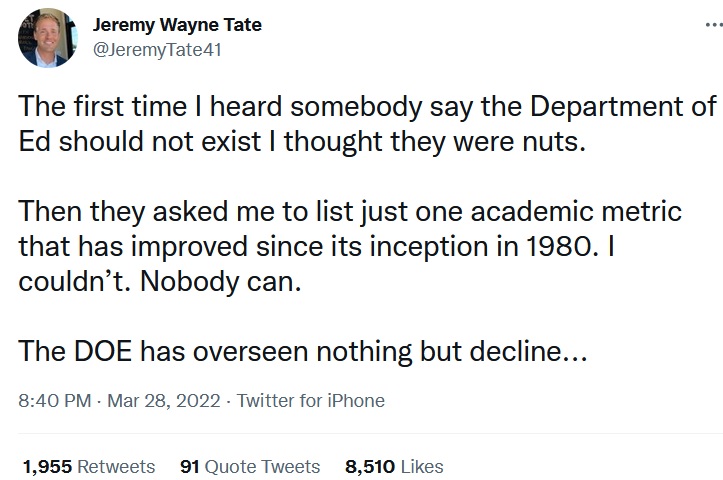
Of all the useless and counterproductive bureaucracies in Washington, the Department of Education may be at the top of the list.


It certainly hasn’t produced good results, at least if we care about student performance.

Though it does keep a bunch of bureaucrats on a gravy train, so there are some (undeserving) beneficiaries.

Speaking of which, the top bureaucrat at the DOE, Secretary Miguel Cardona, recently showed that he skipped some history lessons.

As shown in this amusing little video, he completely botched Reagan’s famous warning about getting “help” from government.

To be fair, Reagan’s quote was about government and help, so even though he turned the quote upside down, he was referring to something real.

Moreover, I recall that President George W. Bush said something that libertarians didn’t like about it being government’s role to help when someone is hurting. So I wouldn’t be surprised if Secretary Cardona simply mixed up a good Republican president with a not-so-good Republican president.

Since I once made a $16 trillion mistake on a national TV program, I won’t be overly critical of his misstatement.

But I am glad that his goof has drawn attention to Reagan’s very apt warning.

Saturday, November 18, 2023

Why Marxism/Communism Fails, Part One

“Marxism wasn’t a bad idea that went wrong.  It was a bad idea.”—Richard Pipes, Communism.

Communism failed everywhere, and oceans of blood were the result.  Though dozens of attempts worldwide were made to establish societies and governments based on the ideas of the 19th-century German economist/philosopher Karl Marx, they all went down in flames.  Only four such societies survive—China, North Korea, Vietnam, and Cuba—and all of them (except North Korea) exist solely because they made significant compromises with capitalism.  And North Korea is probably the number one hellhole on earth today.  There is no such thing as “communism” now, even in “communist” countries.   

It is also interesting to note that nearly every Marxist-based country in the past 100 years has ended up with a dictator or some kind of one-man despotism.  This is the very antithesis of Marx’s theory, which saw communism as driven by impersonal economic forces, with the end being the ultimate abolition of government and boundless freedom for all.  When I recently asked a CCP member in China if he could possibly even imagine the CCP voluntarily giving up power as Marx predicted, he kinda chuckled and said, “Maybe in 500 years.”  Yeah.  When none of us will be around to see it.  Well, given enough time, anything is supposed to be able to happen............To Read More....

Thursday, November 16, 2023

Why Mr. Beast Is Under Fire for Bringing Clean Water to 500,000 Africans

Jon Miltimore November 15, 2023 @ American Institute for Economic Research

James Stephen “Jimmy” Donaldson, better known by his professional moniker “Mr. Beast,” has made a name for himself — and hundreds of millions of dollars for humanitarian causes — by leveraging his social media platform. 

He’s cleaned up our oceans, planted 20 million trees, and fought hunger by feeding needy people in communities across the US. In his latest effort, Mr. Beast built 100 wells in Africa, bringing clean drinking water to an estimated 500,000 people in countries from Kenya to Cameroon to Zimbabwe.

Not everyone is happy with Mr. Beast’s latest campaign, however, or his broader philanthropic efforts. 

One Kenyan politician told CNN Mr. Beast’s well campaign fed the perception that African countries are “dependent on handouts,” while the founder of a charity complained that “a white male figure with a huge platform…gets all of the attention.”

While this might sound simply like sour grapes — and some of it likely is — the criticisms against Mr. Beast are much broader than many might suspect. For years, many have complained that Mr. Beast’s “philanthro-tainment’ strategy — combining philanthropy with online entertainment — is exploitative. 

For example, in February when Mr. Beast partnered with a non-profit organization to provide sight-restoring surgery — procedures Mr. Beast personally paid for — he was accused of “poverty porn.” 

“…it is all in the service of enriching himself,” one person tweeted.

“He cares about poor people and disabled people because they make him money,” another one said. 

“Doctors/nurses don’t exploit their patient’s dignity for profit.”

‘The Stranglehold of the Profit-Seekers’

The last word is key: profit

Profit has become a dirty word over the last century. Ayn Rand explored the growing distaste for profit at length in her classic work Atlas Shrugged, a dystopian novel that depicts a society in which the titans of industry who produce the goods and services of society are viewed with contempt by many — particularly moochers — for pursuing profit. 

James Taggart, a villain in the novel, talks of “breaking up the vicious tyranny of economic power” and setting “men free of the rule of the dollar.”

“We will liberate our culture from the stranglehold of the profit-seekers,” thunders Taggart.

Rand was conscious of the fact that our modern world was turning the idea of profits into a sin, even though economist Adam Smith long ago observed that self-interest is the source of economic prosperity in society. 

“It is not from the benevolence of the butcher, the brewer, or the baker, that we expect our dinner, but from their regard to their own interest,” Smith famously wrote in The Wealth of Nations

Smith understood that self-interest isn’t just healthy and rational; it’s the economic engine of society. In pursuit of his own desires, the butcher provides an essential service to others, just as the brewer and baker do.

Yet profit is anathema to many today, particularly those who’ve been inundated with social justice tropes at universities. The Marxist notion that profits are mere exploitation has been adopted by many, even by people who likely would never consider themselves Marxists. 

Like the failed businessman in Atlas Shrugged who defends himself by saying “I can proudly say that in all of my life I have never made a profit,” many young people now see profit as synonymous with exploitation. 

“Inspiring people to help others is great, but encouraging young [people] to exploit vulnerable communities for content which they can then profit off of enormously, is the issue,” tweeted the Washington Post’s grievance correspondent Taylor Lorenz.

In other words, the scorn heaped on Mr. Beast stems from the fact that he has accrued an estimated $500 million fortune while pulling off his remarkable humanitarian achievements. 

And it’s worth noting that the criticism he’s received is in notable contrast to the (initial) widespread praise of Sam Bankman-Fried, the FTX founder who built an empire singing a song of effective altruism and rejecting the importance of profits.

“It’s okay to do a deal that is moderately bad, in bailing out a place,” SBF said during a 2022 talk with Bloomberg

SBF let it be known he wasn’t very concerned about crass profits; he was far more focused on helping others. (A closer inspection of SBF’s private rhetoric and business shows he was far more concerned with making money for himself than he let on.)  

The difference is that Mr. Beast’s humanitarian efforts actually worked, whereas SBF’s “altruistic” efforts failed miserably (and he’s now facing more than 100 years in prison).

This is the real reason Mr. Beast is taking so much heat. He’s showing the power of voluntary action and the miraculous power of the profit motive. This isn’t just a stark contrast to SBF’s altruistic efforts, however. 

‘It’s Embarrassing’

One of the best quotes you’ll find on Mr. Beast’s humanitarian work in Africa comes from Kenyan journalist Ferdinand Omond.

“[I]t’s embarrassing that a YouTuber jetted into Kenya on a charity tour to perform tasks our taxes should have completed ages ago,” said Omond.

These words have to sting, in large part because they ring so true. 

Is this an embarrassment for the Kenyan government, which has long been plagued by inefficiency and corruption? Undoubtedly. But it’s also an embarrassment to every public intellectual who insists profits are evil and that government-led efforts are the solution to poverty, despite their dismal track record.

And it should be pointed out that the Kenyan government is not the only one that has proven utterly inept at fighting poverty. 

In 1964, President Lyndon B. Johnson famously declared “war” on poverty. Over the next five decades, the average wealth transfer, in real terms, to a low-income family increased from $3,070 per capita (1965) to $34,093 (2016). Economist Vance Gill last year estimated the federal government has spent a total of $25 trillion in its nearly 60-year War on Poverty.

What do we have to show for this fortune in federal spending? 

According to the United States Census, in 1966, the percentage of American families living in poverty was 12.4 percent. Today, according to new data from the US Census, the percentage of Americans living in poverty is … 12.4 percent.

That’s right. Since 1964, despite tens of trillions of dollars in spending at the federal level alone, the poverty rate in America has not budged; it has merely bobbed around the same level since the Beatles arrived in the British Invasion. 

Some could argue that poverty in America could be much worse if we hadn’t spent $25 trillion fighting it, but this ignores an inconvenient truth. In the two decades before the War on Poverty, poverty had fallen from 32.1 percent to 12.4 percent.

All of this helps explain why Mr. Beast is being attacked despite all the good work he is doing.

Milton Friedman famously said that one of the biggest mistakes humans make “is to judge policies and programs by their intentions rather than their results.”

The results of Mr. Beast’s philanthropy, which is all voluntary and profit-driven, surpass government-led efforts by miles. And that’s what his critics can’t handle. 

READ MORE 

Tags:  Leadership, International, Entrepreneurship, Art and Culture  


Jon Miltimore is the Managing Editor of FEE.org. His writing/reporting has been the subject of articles in TIME magazine, The Wall Street Journal, CNN, Forbes, Fox News, and the Star Tribune. Get notified of new articles from Jon Miltimore and AIER. SUBSCRIBE


Wednesday, September 27, 2023

Politicians Waking Up to Net Zero Madness

By Craig Rucker, President, CFACT

Catchy left-wing slogans lead to disastrous public policy results. Unfortunately, by the time the public begins to feel the oppressive weight of leftist policy, much of the damage is already done. "Net Zero" is a perfect example.  Sounds nice until you realize that you cannot quickly and dramatically reduce greenhouse gas emissions in this fashion without massive damage to society. 

When prices begin to rise and scarcities manifest themselves, people will not tolerate it and politicians are forced to backtrack. Witness the U-turn British Prime Minister Rishi Sunak made in his Net Zero press conference. We posted Rupert Darwall's excellent analysis to CFACT.org.  "Why the vehemence of the climate lobby's attacks on Sunak?" 

 Darwall writes. 

"In their eyes, Sunak has committed the worst crime of all: he has broken the net zero omerta , which enforces a pact of silence on discussing the policy's true costs. In public, net zero should only be spoken of as the growth opportunity of the century, something that's good for the economy as well as the planet. That it might inflict cost and hardship must never be said.....Sunak has destroyed this silent agreement." 

Similarly, check out David Wojick's excellent piece about a letter from East Coast Governors "crying uncle!  (in this case Uncle Sam) as they desperately seek any kind of bailout or relief from the massive costs of offshore wind turbines. The governors are demanding a cut of the take. The earlier bad policy is corrected, the less societal harm. 

When it comes to left-wing energy mistakes the peril is real, the price incredibly high, and ending them cannot come fast enough. For nature and people too,

Wednesday, September 20, 2023

Our Rulers: Wrong in Theory, Incompetent in Practice

September 19, 2023 By Christopher Chantrill

 The big takeaway from the western ruling class's war on the rising populist movement is ruling-class failure. Rulers typically don't feel the need to take out the opposition unless they have fluffed it. Or muffed it: I'm not sure which applies here. Hello Fluffy Joe Stalin in the 1930s and Muffy Mao in the 1960s. Frankly I'd prefer if Muffy and Buffy would stick to playing beach volleyball.

Experts agree that Stalin and Mao succumbed to The Totalitarian Temptation, courtesy of Jean-François Revel. But I think the experts are missing the point. The totalitarians weren't so much tempted to go political to the max as carefully taught to do so. That was the Thing in the 19th century: get the politics right and justice will ensue. Fundamental transformation, dontcha know.

Let's tell it like it is. First the educated ruling class was wrong on its theory that politics could lead to justice. Second, the educated ruling class failed when it put its theory of politics-with-everything into action.

The basic error in the Enlightenment was the absurd faith that politics could ever be more than a necessary evil. I get that the educated class needed a political philosophy to justify its overthrow of the old feudal and monarchical order. But I declare that, by 1850 at the latest after nearly a century of revolutions and constitutions, any educated-class thinker with half a brain should have admitted: politics is a very blunt instrument; use only in emergency....................To Read More....


Tuesday, July 18, 2023

The War On Poverty Hasn’t Just Failed, It’s Failed Abysmally

July 17, 2023 By Vince Coyner

Recently the Supreme Court put an end to Joe Biden’s efforts to give erstwhile college students almost a trillion dollars in “debt relief,” although the Biden administration is trying again. That’s a lot of money… But that’s actually a tiny fraction of the money the government has wasted on redistribution, aka social programs, over the last six decades.

Next year, the United States will commemorate the 60th anniversary of the War on Poverty, which President Lyndon B. Johnson initiated in 1964. The War’s programs initially started on a modest scale but have expanded almost parabolically since. By the War’s 50th anniversary, the government had spent more than $22 trillion on various welfare and redistribution programs.

A decade later, it spends $1 trillion a year on said programs, not including various “targeted” expenditures under Social Security or Medicare, which make the true total simply unknowable. To put that in perspective, $1 trillion is greater than the GDP of 194 of the world’s 213 countries......To Read More...

My Take - Twenty two trillion dollars and there are still poor people in America?  You have to ask, where in the world did all that money go?  It certainly didn't go to the poor. 

Monday, July 17, 2023

The Latest News On New York's Socialist-Model Public Housing Provider, NYCHA

July 15, 2023 @ Manhattan Contrarian 

There’s always something new to report on New York’s housing follies. The accepted housing paradigm here in blue-model New York is that elite public policy geniuses with access to infinite taxpayer funds will create housing solutions to provide perfect housing fairness and justice to all. Somehow, they keep falling short.

Nowhere is this more evident that with the New York City Housing Authority, or NYCHA. NYCHA is the ultimate socialist-model low income housing provider, by far the largest such housing authority in the country. It owns and manages about 180,000 apartments in what are known as The Projects, home to something in the range of 400,000-500,000 people, or about 5-6% of New York City’s population. (In most other American cities, HUD-supported projects house about 1-2% of the population.) For decades, as housing authorities in places like Chicago and St. Louis were forced to dynamite many of their failed low-income projects, NYCHA was held up as the great success story of the genre. But was the apparent success real, or was NYCHA just more artful than its compatriots in covering up its failures?

I last reported on NYCHA in a post in May that covered a new Report out from the Citizens Budget Commission. The CBC Report had one piece after another of disastrous financial news about NYCHA. During Covid, many NYCHA tenants just stopped paying rent, and when essentially nobody got evicted, many more followed suit. By February 2023, NYCHA was down to collecting only about 63% of (already deeply subsidized) rents on a monthly basis. Rent collections for 2022 were estimated to cover barely 25% of operating costs, with nothing for needed capital upgrades, let alone other things that normal citizens have to pay for, like property taxes.

NYCHA’s gigantic hole of needed capital improvements started to come to public attention in 2015, when Bill de Blasio was the Mayor. The City issued a big Report titled “Next Generation NYCHA,” supposedly outlining the strategy to take NYCHA forward for the next several decades. You only had to get to page 5 to find out that NYCHA was facing a looming financial crisis:

[T]he promise of NYCHA as decent, affordable housing is under serious threat as the Authority confronts the worst financial crisis in its history. Billions in underfunding by all levels of government, outdated and inefficient management models, and rapidly deteriorating buildings have severely weakened NYCHA as an organization and diminished the quality of its life of residents. Today, tenants shoulder the burden of nearly $17 billion in unmet capital needs across the Authority’s aging building stock, living with leaky roofs, mold, unreliable heating systems, broken elevators, and a host of other problems at any given time.

$17 billion in “unmet capital needs” for about 180,000 apartments is almost $100,000 per apartment — an enormous sum for apartments that rent for an average of only about $600 per month.

But the $17 billion was only the start. In February 2018, the Wall Street Journal reported on a City Council hearing where NYCHA officials testified that the amount of unmet capital needs had then reached $25 billion. And then things really got going:

  • Just a few months later, the figure had jumped to $32 billion. From the Gothamist, July 3, 2018: “A new capital assessment report from the City shows that the authority [NYCHA] requires $32 billion in repairs and replacements over the next five years.”
  • By January 2020, the figure had become $40 billion. From The Real Deal, January 14, 2020: “Two years ago, the New York City Housing Authority said it needed $32 billion to repair its housing stock. That estimate has soared to $40 billion.”
  • On December 30, 2021, NYCHA issued another new “Capital Plan,” now giving a range for its capital needs of $42.7 to 68.6 billion: The capital needs are projected to grow anywhere from $42.7 billion to $68.6 billion over the next ten years depending on the estimated rate of deterioration. Of NYCHA’s 2,351 residential buildings, 77% are more than 40 years old.”

Which brings us to the New York Times on July 12, 2023, headline “Almost $80 Billion Needed for Repairs to New York City’s Public Housing.” Excerpt:

New York City’s public housing agency now needs more than $78 billion to repair or renovate aging kitchens, leaky pipes, faulty elevators and other problems over the next 20 years, officials revealed on Wednesday. . . . The new estimate . . . underscores the staggering challenge facing city officials and the New York City Housing Authority, which runs the system of more than 2,100 buildings.

$78 billion for NYCHA is a truly staggering sum — well over $400,000 per apartment, which is more than the median price of a single family home in the U.S. This is a hole so deep that it can probably never be dug out of. The answer of our elected leadership seems to be to go forward with business as usual, as if nothing were wrong. On July 6 Mayor Adams held a news conference appointing new leadership for NYCHA (the prior leadership having accomplished nothing other than putting out larger and larger numbers for capital needs). Key quote:

"We have been clear since day one that NYCHA residents deserve the same quality of life as every New Yorker, and this administration has embraced the responsibility and the opportunity to deliver that," said Mayor Adams.

OK, but is there any real plan to get out of this mess? I have repeatedly proposed that the best answer would be to give the projects to the residents, free of charge and without debt, with the proviso that property taxes start to kick in after a few years of grace period. Likely, most residents put in this position would quickly figure out that their best option would be to sell the buildings to the highest bidder, take the money, and move somewhere else that is cheaper. Many residents of the best-located projects could become millionaires in this process, and the City would get a large new source of revenue from the prospective property taxes on long-exempt land. Of course, this option is not under consideration as far as I can tell.

In late June we got an idea of where the City may be going, when NYCHA announced a plan to demolish and re-build two large public housing complexes in the Chelsea neighborhood of Manhattan. A post about the plan appeared on June 26 on a website called New York YIMBY (“yes in my back yard”). The two projects in question are called Robert Fulton Houses and Chelsea-Elliott Houses. Here is a picture of Chelsea-Elliott from the YIMBY post:

Lovely. According to YIMBY, NYCHA has partnered with two private developers, Related Companies and Essence, for the redevelopment. The number of apartments on the sites will be vastly increased, with most of the new apartments market-rate, but a large percentage of income-restricted units, for which the existing tenants will be given priority.

The YIMBY post does not contain financial details of the deal done with Related and Essence. Likely, they are getting a lengthy real estate tax abatement to compensate them for the large number of income-restricted units they will be providing. If they think they can make money on this, then I say I wish them the best. However, this type of deal can only work at a handful of NYCHA sites located in the best neighborhoods, of which Chelsea is one today. The number of units in Fulton and Chelsea-Elliott houses is about 2000, or barely more than 1% of the NYCHA inventory. The remaining 99% of the NYCHA units have no solution in sight at the moment.

Thursday, May 25, 2023

NYCHA, Circling The Drain

  @ Manhattan Contrarian

From time to time I like to check in on the latest from the New York City Housing Authority. NYCHA (along with many other municipal housing authorities) is one of the purest examples in the U.S. today of socialist-model economic organization. The state owns the buildings; the residents pay deeply subsidized rents based on income; and the state takes full responsibility for maintenance and upkeep. Is there any reason why this might not work for the long pull?

When we last looked back in 2018, NYCHA had just been sued by the U.S. Attorney for the Southern District of New York for failing to maintain “decent, safe and sanitary” conditions, including failing to remediate lead paint, failing to control mold and vermin, and failing to provide consistent heat, hot water., and elevator service. NYCHA had promptly settled that lawsuit with a Consent Decree in which it promised to spend some $4 billion of New York City taxpayer money to fix the identified problems.

In the intervening close to 5 years, NYCHA has been mostly out of the news. Surely, the large infusion of funds has turned things around, and all is now going smoothly? Sorry — that is not how socialism works.

On May 19 a civic organization called the Citizens Budget Commission has come out with a big Report on NYCHA with the title “Uncertain Future, Urgent Priority.” The Report is chock full of data and statistics on how things are going. The summary is, things have gone from bad to worse, and then still worse. Most importantly, nobody here cares about running a financially sustainable operation, so revenue dwindles while costs explode out of control. One can only conclude that the game plan is to engineer a real crisis to more effectively shake down the taxpayers for the really big bucks in the next round.

In privately-run rental housing, the rents must cover all of the costs — operating costs, taxes, debt service, and also capital improvements as they are needed — as well as profit to the owner, if any. At NYCHA, rents, such as they are, cover an ever smaller and smaller share of the operating costs, with nothing whatsoever for taxes, debt service, or capital improvements. Here is CBC’s chart of NYCHA revenues versus operating expenses:

Rent collections reached a peak in 2019, and then started shrinking in 2020 with the pandemic, and have continued to shrink at an accelerating rate through 2022. Federal subsidies increase, but don’t nearly keep up with rising costs.

At this point, collected rents cover barely a third of operating costs. It seems that the stated rent is now treated as merely a suggestion, with no effective penalty for non-payment:

Collections hit a new low of 63 percent in February 2023, down from 70 percent in February 2022 and 90 percent prior to the pandemic. . . . As of December 2022, 46 percent of NYCHA households were in arrears, having accrued $466 million in unpaid rent. . . .

Although the pandemic has ended, the new policy is to forget about evictions, even as nearly half of tenants have stopped paying rent:

Under the Transformation Plan, NYCHA has de-emphasized non-payment evictions in favor of working with residents to get on payment plans and to secure one-time hardship funding. Since then, NYCHA has followed through on its promise to avoid evictions. Between February 2022, when the eviction moratorium expired, and January 2023, NYCHA filed only 427 non-payment eviction notices, and 0 warrants for non-payment evictions have been executed.

Thus, with some 80,000 tenants in arrears, there have been only 427 non-payment proceedings. That is a sure-fire recipe for continued erosion of rent collections. Why would anybody pay in these circumstances?

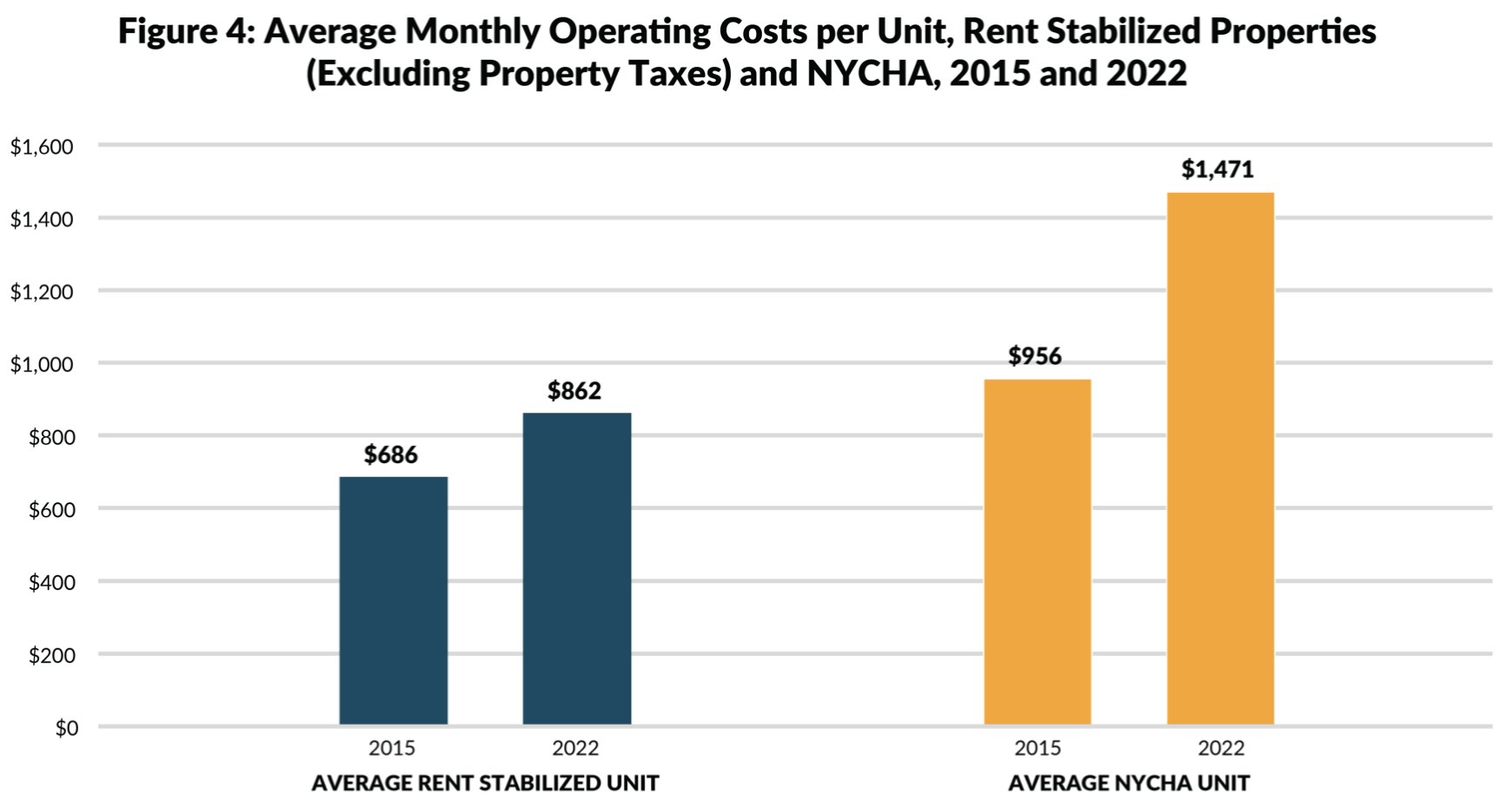
Over on the cost side, it seems that NYCHA’s costs of operating a unit are about double those of private landlords on a per-unit basis:

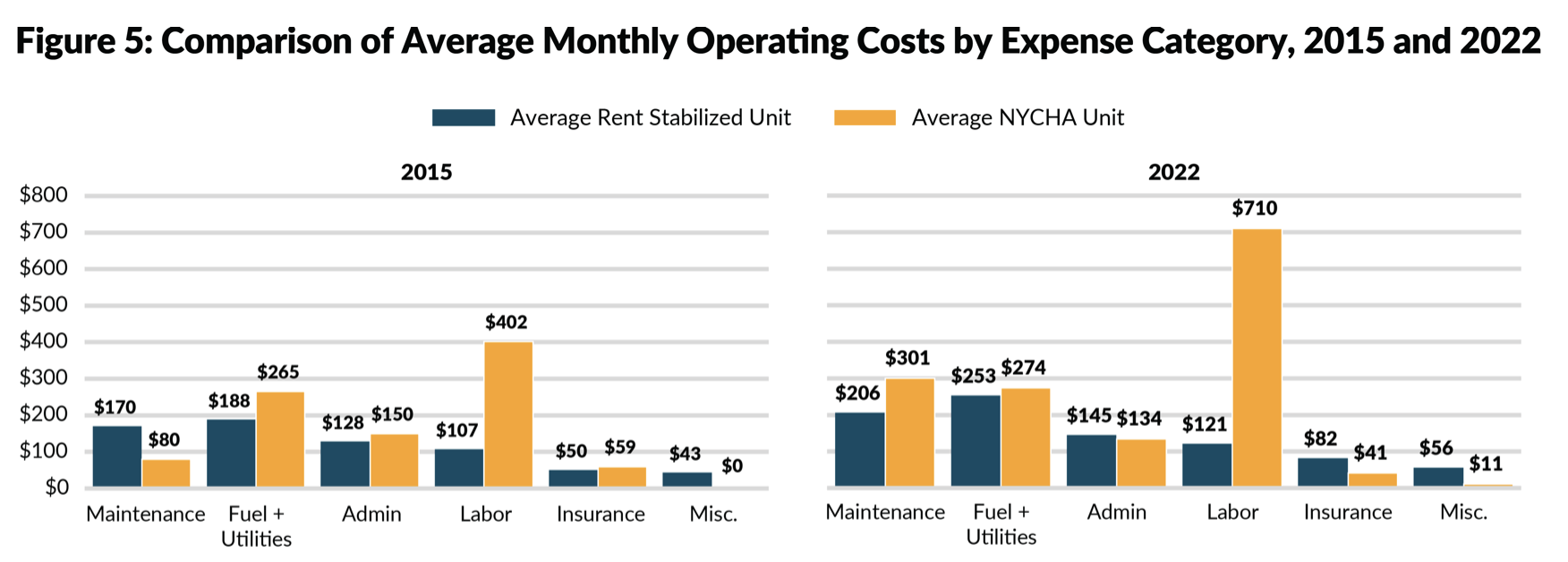
Nearly all of the cost differential is in the category of labor costs, where NYCHA’s expenses per unit are about six times those of its private counterparts:

The CBC concludes that the large majority of NYCHA’s units are rapidly approaching a “moment of reckoning,” where “redevelopment would be more cost effective than repair.”

Once again, a seemingly well-intentioned government program has ended up leaving large numbers of the intended beneficiaries in a completely untenable situation. At this point, it’s only a question of how and when this situation comes to its final collapse.