Search This Blog

De Omnibus Dubitandum - Lux Veritas

Showing posts with label Equality. Show all posts

Thursday, September 19, 2024

How to Really End ESG

Russell Greene September 13, 2024 @AIER, Tags: Daily Economy, Environmentalism, Capitalism, Books


Eleanor Roosevelt holds a poster of the Universal Declaration of Human Rights. Lake Success, NY. 1949. Courtesy FDR Presidential Library & Museum.

ESG investing poses a grave threat to the principles that lifted billions out of poverty. It neither does much good nor performs very well. Therefore, it must end.  

So asserts Ending ESG, a collection of essays edited by Phil Gramm and Terrence Keeley. Gramm, a former Republican senator and economics professor, and Keeley, a former managing director at Blackrock, are well-suited to make the case. The book’s lengthy introduction is co-authored by Gramm and Keeley. It traces the Environmental, Social and Government (ESG) investment movement back to the United Nations. Not to the Kofi Annan era of the late 90s and early 2000s, that is, but all the way back to the 1948 Universal Declaration of Human Rights.  

The authors do not dwell upon this early history, but it is worth briefly unpacking. Eleanor Roosevelt chaired the drafting committee of the UN Declaration. She explained that many of its members “thought that lack of standards for human rights the world over was one of the greatest causes of friction among the nations, and that recognition of human rights might become one of the cornerstones on which peace could eventually be based.” This was a pressing priority in the wake of World War II.

Jacques Maritain, a French Philosopher who provided intellectual inspiration for the document, explained how consensus was achieved: “we agree on these rights provided we are not asked why. With the ‘why’ the dispute begins.” History has since tested the stability of agreeing not to ask why.

Over the next 75 years, the UN’s declaration of rights eventually led to ESG. Inspired by the declaration, the UN launched development goals (eradicating poverty, gender equality, environmental sustainability, etc.). Then, the UN released investment principles based on these goals, to be adopted by major asset managers, banks, public pensions, and regulatory bodies. To the shock of anyone familiar with other UN efforts, the UN’s work on ESG has paid off.  

ESG has been adopted by major institutions over the world, in word if not always in deed. The result is that “the private economy is increasingly being coerced into meeting a growing number of environmental and social goals that Congress never mandated.”  

The cost of such coercion is high. For one, it undermines the legal and ethical basis of economic progress. Whereas the economic Enlightenment was “founded on the principle that people own the fruits of their own labor and thrift,” ESG is a “throwback to the medieval concept of communal property.” Throughout 14 essays, mostly penned by Gramm and/or Keeley, Ending ESG argues against such an ESG-inspired return to medieval economics.

ESG might seem high-minded and noble compared to the hard-nosed alternatives of fiduciary responsibility and shareholder primacy. But appearances are deceiving. When it comes to results, the economic enlightenment enabled 128,000 individuals to escape abject poverty every single day. In contrast, it’s not clear if the ESG movement has accomplished anything of note, other than lowering the popularity of Wall Street and Corporate America among conservatives, contributing to the anti-business turn on the right.

And though the ESG movement claims to care about eradicating poverty and protecting the environment, we should not take these claims too seriously. Keeley cites a research finding that there is “no evidence that socially responsible investment funds improve corporate behavior.” Moreover, it’s difficult to even assess the impact of ESG strategies since “ESG scores among leading rating agencies correlated only 54 percent of the time.”  

The evidence is compelling, but it raises a puzzling question: if ESG does “neither much good nor very well,” why do so many people seem to believe it does both? Where did ESG critics go wrong? Why did it take nearly two decades for ESG to face substantial backlash?  

One problem is that the defenders of fiduciary responsibility failed to provide adequate moral foundations for their view. Keeley cites Milton Friedman’s classic 1970 New York Times piece, “The Social Responsibility of Business is to Increase Its Profits.” There, Friedman argued:

In a free‐enterprise, private‐property system, a corporate executive is an employee of the owners of the business. He has direct responsibility to his employers. That responsibility is to conduct the business in accordance with their desires, which generally will be to make as much money as possible while conforming to the basic rules of the society, both those embodied in law and those embodied in ethical custom.

Friedman, a committed positivist, did not found his concept of social responsibility on a universal ethical standard, other than the need for business executives to defer to shareholder desires. And, in his view, this will usually mean to seek profits while conforming to existing laws and customs. These laws and customs will vary from time to time, and from place to place. And so, apparently, will the social responsibilities of businesses.

In his essay “How Conservatives Can Get ESG Right”, Keeley endorses Friedman’s analysis. Yet it suffers from two major flaws, flaws that also weaken Keeley’s arguments. First, businesses and investors are not just passive recipients of laws and ethical customs. Business leaders are norm-makers, not just norm-takers.  

The most successful business leaders are able to cast a compelling long-term vision, one that includes but goes beyond making money, and to persuade their investors to remain focused on the long-term. That is, business leaders lead their investors, they don’t merely respond to investor preferences. Further, policymakers depend on the counsel of industry to respond to technological innovations, as we are now seeing with artificial intelligence. And business leaders seek to influence both the law and public opinion, such as through lobbying, public relations, media, and publishing their own thoughts.  

This is understandable. To survive, businesses cannot merely conform to the basic rules of society — they must influence them. But how, and in which direction? For example, should they oppose crony subsidies and regulations, which may help their profits, at least in the short term, but undermine economic dynamism and the very legitimacy of their businesses? Friedman’s positivism does not provide much guidance here.  

After all, the ethical customs and laws of a society may grow increasingly hostile to private enterprise. Indeed, they seem to be doing so now. Business leaders cannot be expected to stand by as activists assault the legal and ethical foundations of economic progress, or as government agencies violate their constitutional rights. While Ending ESG recommends that business leaders “keep politics out of the boardroom,” this is no longer an option for major corporations, if it ever was.

Moreover, activist shareholders increasingly are advancing shareholder proposals that are harmful to the long-term interests of the very corporations in which they own shares. This means businesses increasingly have to defend themselves against their own shareholders. Complicating matters further, the nature of business ownership has radically changed since 1970, with the rise of passive index investors and pension-fund activism. It’s no longer safe to assume that major investors will all agree on maximizing the long-term value of a particular firm, especially if that firm is engaged in ESG-unfriendly lines of business. What most investors do, and should, prioritize is very much up for debate.

Keeley claims “there is no practical alternative to shareholder primacy.” But clearly, there is. For one, many American states now have the option of “benefit corporation,” an option that replaces shareholder primacy with responsibilities to an array of stakeholders. And in Europe, the concepts of double materiality and co-determination override any commitment to shareholder primacy.  

Now, it’s true that such stakeholder governance often comes at a cost. On the other hand, stakeholder advocates will claim the cost is worth it, whether to save the planet, or to advance “equity.” It’s incumbent, therefore, upon ESG critics to advocate an alternative vision, not merely to fall in line with convention.

Without casting a bold vision for the future of free enterprise, there is no hope of ending ESG. Keeley himself recommends that “Republicans need a road map that would enable society to get all the good out of ESG without the bad.” He also refers approvingly to “growing numbers of shareowner resolutions seeking lower carbon emissions or increased workforce diversity.” But why defer to the United Nations, of all institutions, as a moral authority? Why grant any moral worth to counterproductive Western divestment from fossil fuels? Why pay even lip service to skin-deep diversity metrics?  

Just as Friedman recommended business leaders “conform” with convention, Keeley accepts ESG’s goals, while challenging its methods on pragmatic grounds. This is not a sustainable division of labor. It makes no sense for capitalists to legitimize the NGOs, global institutions, and academics working to delegitimize capitalism and advance the “religion of humanity.”

In the words of Argentine President Javier Milei,

Milton Friedman used to say that the social role of an entrepreneur is to make money. But that’s not enough. Part of their investment must include investing in those who defend the ideals of freedom, so the socialists can make no further advances. And if they don’t do it, they [the socialists] will get into the State, and use the State to impose a long term agenda that will destroy everything it touches. So we need a commitment from all of those who create wealth, to fight against socialism, to fight against statism, and to understand that if they fail to do so, the socialists will keep coming.

Fortunately, there are reasons for hope. 

Some business leaders are taking a more active role in advocating for the principles of economic enlightenment. In 2023, prominent Silicon Valley investor Marc Andreesen published the Techno-Optimist Manifesto. Andreesen’s manifesto defended free markets and attacked ESG as part of a “mass demoralization campaign.” Tech founder Brendan McCord launched the Cosmos Institute. Cosmos is bringing together philosophers with technologists in an Oxford University seminar, to discuss how technology can promote human flourishing. Elon Musk, of course, been scathingly critical of ESG, calling it a scam. And Liberty Energy CEO Chris Wright releases an annual Bettering Human Lives report that argues for prioritizing the elimination of energy poverty over ESG goals.

Beyond business leaders themselves, the Alliance Defending Freedom recently released a “Statement of Principles on the Purpose of a Corporation.” The statement declares that “the proper purpose of business is to advance human flourishing by creating economic value through excellence in the provision of goods and services.” And the Abundance Institute has been making the case for “long-term tech optimism.”

To be sure, no particular one of these efforts is definitive. Nor, combined, will they be sufficient to defend the “economic enlightenment” against illiberal assaults. Yet if more affirmative visions for free enterprise are paired with reasonable, evidence-based critiques of ESG, such as those offered by Gramm and Keeley, ESG’s days might, indeed, be numbered. 


Russell Greene is a Senior Fellow for the Economy at Stand Together Trust, where he manages a grant making portfolio focused on federal regulatory affairs and strategic litigation. Prior, he worked for CrossFit Inc., directing the company’s brand defense and government affairs efforts. He has a BS in International Politics from Georgetown University’s Walsh School of Foreign Service, where he learned both Classical and Modern Standard Arabic. He studies Ancient Greek and Latin in his spare time. Russ has published a number of articles on classical liberalism, ESG and related issues. 
 
Get notified of new articles from Russell Greene and AIER. SUBSCRIBE

Wednesday, November 1, 2023

Free Enterprise and Social Mobility

October 31, 2023 by Dan Mitchell @ International Liberty

At the risk of understatement, our friends on the left are fixated on equality. 

If they were talking about equality of opportunity, or equality before the law, that would be great.

Unfortunately, they want equality of outcomes. Which means supporting bigger government, higher taxes, and other policies that are likely to shrink the economic pie.

In a just and sensible society, the goal should instead be upward mobility so that everyone can get richer.

That means enacting policies that expand the economic pie.

And what are those policies? We can answer that question by looking at a new study by Professors Justin Callais, Vincent Geloso, and Alicia Plemmons. Published by the Archbridge Institute, it investigates whether there is a link between limited government and social mobility.

…an increasing share of debates in economics have centered on the study of inequality… Intricately tied to these debates is the topic of social mobility. …Using the recent data of Chetty et al…on social capital and intergenerational income mobility in the United States at the subnational-level, we…ask…whether a) economic freedom does improve intergenerational mobility in a meaningful way when using higher quality data and; b) whether economic freedom complements or substitutes the different types of social capital.

Here’s what they found.

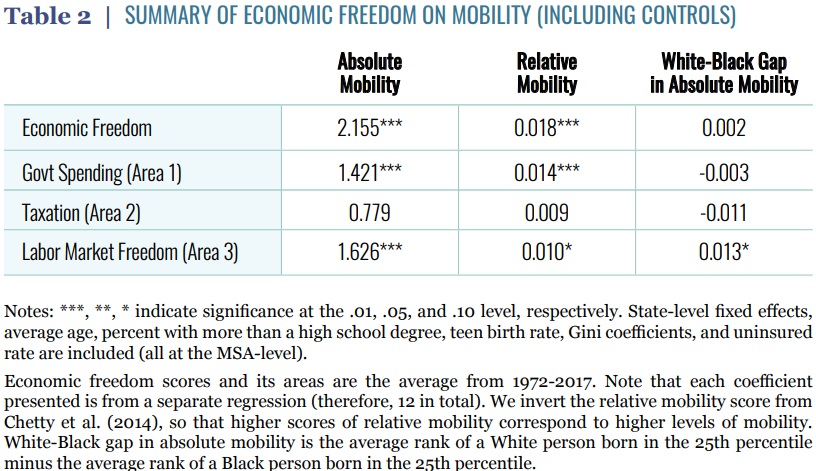
…we find that a) economic freedom (both in aggregate form and its components) is tied to greater absolute and relative mobility; b) we find that it has no association with the racial gap in mobility; c) we find that the effect of economic freedom generally outweighs that of inequality; d) the effect of economic freedom matches those of “bridging” social capital and overpowers that of other forms of social capital. …

Table 2 regresses the four economic freedom measures against absolute, relative, and gap mobility. Note, each cell within the table represents a separate regression of one measure of economic freedom against one measure of economic mobility, which results in twelve separate regressions. …we find that (low levels) of government spending and high values of labor market freedom are highly correlated with increases in both absolute and relative mobility.

Here is the aforementioned Table 2 for data geeks.

Looking at the conclusion of the study, here are some key takeaways.

While the literature is already clear on the fact that economic freedom increases incomes, this study is the first within the United States to show that the effect of economic freedom helps those at the bottom more relative to those at the top. …Policymakers should seriously consider laxer government regulations in the labor market, as well as lowering taxes and government spending as a way to positively impact those who wish to move up the income ladder.

Sounds like a familiar recipe.


Tuesday, March 28, 2023

Pursuit of the Green Dream Will Make Inequality a LOT Worse

March 26, 2023 @ Manhattan Contrarian 

There are different ways of looking at the issue of human inequality. The modern Left obsesses about inequality as measured in dollars of income.  But if one measures inequality based on quality-of-life, it quickly becomes clear that we have achieved great progress toward equality on the things that really count. Much of that progress is at risk of reversal from imposition of the green dream.

By the time I was born in the late twentieth century, comforts that had begun in the exclusive domain of the very wealthy had long since become widely available to most hard working people. I’m thinking of things like cars and personal travel, but also small scale conveniences like in-home washers, dryers and dishwashers. All of these things, of course, were brought to us by the widespread access and affordability of electricity and fossil fuels.

But even as the baseline human experience improved, the Left has continued to campaign on the moral abomination that is persistent “income inequality.” This is “inequality” as measured by dollars of income and ability to buy super luxuries.  The rich don’t just travel, they travel via yacht and private jet. And the cities where wealth accumulates, like New York and San Francisco, are, according to their own voters, the worst offenders. Former New York Mayor de Blasio campaigned, and won, on the theme of a “Tale of Two Cities,” the “inequality that increasingly divided New York along the fault lines of fabulous wealth and grinding poverty.”  Guilty New Yorkers fell for it hook, line, and sinker.

It is true that New York is home to some of the wealthiest people in the world.  But it is also true that the poorest people in the city still have widespread access to decent housing with heat, plumbing, food, and transportation — things that were out of reach to most poor Americans in the 19th or even well into the 20th century. They also have widespread access to electricity, and as a result many have televisions, telephones, and modern healthcare – things that did not even exist until the 20th century.

Throughout history, “poverty” once meant something very different from what it means in America today, and the difference in quality of life between the rich and the poor was stark. Being poor often meant living in one room shacks with inadequate access to food, while being rich meant living in mansions staffed with servants to attend to one’s every need.  That’s what “income inequality” once meant, and that’s what income inequality still means in many parts of the developing world. Quality of life in America only started to change dramatically after the industrial revolution and the introduction of widespread electricity and fossil fuels. And the number one thing that keeps the developing world under-developed is its limited access to those two things.

But the same politicians and voters who don’t seem to have noticed how much better the human condition has been in America in the 21st century also haven’t realized how much worse it will be if they achieve their goal of eliminating human use of fossil fuels. In fact, the dream of ending “inequality” directly conflicts with the dream of ending reliance on fossil fuels.

Laws that restrict or aim to eradicate the use of fossil fuels take direct aim at the quality of life for America’s middle and lower classes — that forgotten group existing between “fabulous wealth” and "grinding poverty.” Laws that restrict fossil fuel usage will automatically raise the cost of electricity, meaning people will have to pay more for the same level of use or immediately start cutting back. The first people to make cutbacks will be those who live on the tightest budgets, the types who will notice if their annual heating bill suddenly goes up by $500 or even $1000. This is the average American, not the 1%, and it’s already becoming a reality in Europe: a friend recently confessed to me that her extended family in Italy had moved from two apartments into one for the winter because collectively they could only afford to heat one apartment. My friend thought that was a reasonable sacrifice to make to protect the climate. Might communal housing soon become an economic necessity for many?

Here are just a few things that we currently take for granted that will quickly become difficult to afford as fossil fuels get restricted: heat and air-conditioning, driving for leisure or for any purpose outside of commuting for work, taking family vacations. If electricity becomes exorbitantly expensive, people will be forced to cut back on lighting their homes and using their appliances. Then there are even bigger questions that have yet to be addressed: how will we farm without fossil fuels? How will we run a hospital and provide life-saving care without reliable electricity? Who can say what that will do to our access to food and healthcare.

But the bottom line is: When the eggs go up to $10, the middle class notices, but the wealthy won’t. When gas goes from $2.95 to $4.05, the middle class notices, but the wealthy won’t. The lower, middle, and upper-middle classes will be making cut backs for a while before any of the rich have to do the same. 

It’s amazing how quickly we could find ourselves living in a world where the vast majority of people have become poorer, in the sense of struggling to meet their basic living standard, while only a few elites have access to the things we currently take for granted. We see that already in the celebrity poster-children for climate change, e.g. Leonardo DiCaprio, who continues to fly private and summer on a yacht in the Mediterranean, unaffected by the rising costs of fuel. This is not an outlandish claim or an impossibility, rather it would simply be returning to a meaning of “inequality” we had successfully left in the past. 

The beauty of our freedom-based economic order has been closing that quality of life gap between the rich and the poor, but all the progress we’ve made to lift the living standard for ordinary people could be undone with the wave of a politician’s pen. And when that day comes, the Bill de Blasios and Bernie Sanders of the world won’t be responsible for solving inequality, they’ll be responsible for creating it.


Tuesday, January 10, 2023

Should Government Anti-Poverty Programs Promote Independence or Dependence?

January 05, 2023 @ Manhattan Contrarian

Here’s a question where I’ll bet you think the answer ought to be completely obvious: Should the purpose of government “anti-poverty” programs be to help the beneficiaries rise from poverty and become successful and independent, or alternatively should the purpose of such programs be to entice the recipients of aid into a life of permanent dependency upon government handouts? From the earliest days of the anti-poverty programs back in the 1960s, the programs were sold to the public as being a temporary boost by which the poor could be helped to escape from poverty and achieve self-sufficiency. And yet, about six decades in, the rate of poverty never seems to go down, and the number of program beneficiaries grows inexorably. Did something change along the way?

The answer is yes. A new book I’ve just read documents a 180 degree reversal of our government’s policy on the purpose of the anti-poverty programs since the time they began. The book is “The Myth of American Inequality,” by authors Phil Gramm, Robert Ekelund and John Early, published in September 2022. You may recognize Gramm as having been a three-term Senator from Texas (1985-2002). Ekelund is an academic economist, currently at Auburn University, and Early has had a career largely in government statistical offices including the Bureau of Labor Statistics.

Not to overly flatter myself, but this book mostly covers subjects that I have been harping on for a decade or so, accumulated under my tags for Poverty and Income Inequality. However, these guys are much more knowledgeable than I am about the nitty-gritty of how the government statistics on poverty and income inequality are compiled, and I highly recommend their rendition if you want to really understand many of the machinations of our bureaucracy in producing statistics designed to gain support for further growth of the government.

The title of the book — “The Myth of American Inequality” — refers to the statistical legerdemain by which the government statistical bureaucrats (mainly in the Census Bureau and Bureau of Labor Statistics) are able to make poverty and “income inequality” in the U.S. appear far, far greater than they are in reality. From a summary statement in the first chapter, page 4:

The official measure of the poverty rate which uses the Census Bureau definition of income, does not count two-thirds of all transfer payments as income to the recipients. As a result, for more than fifty years, the measured income of low-income Americans has been substantially understated. As we will show, when you count all transfer payments as income to the households that receive the payments, the number of Americans living in poverty in 2017 plummets from 12.3 percent, the official Census number, to only 2.5 percent.

If I have one main criticism of the book, it is that the authors do not forcefully state that the statistics on poverty and income inequality as presented today are fundamentally fraudulent and deceptive, nor do the authors put any blame on anyone for allowing these statistics to become so distorted and misleading over time. It’s like it was just some naturally-occurring process, and things just turned out this way. My own many posts on these subjects do not give that kind of the benefit of the doubt to our self-serving bureaucrats.

The book comes closer to asserting intentional government wrongdoing in describing the inversion of the purpose of the anti-poverty programs from promoting independence to promoting dependence on government. At page 67, the authors quote from President Johnson in his March 16, 1964 address to Congress proposing the War on Poverty:

Johnson’s stated policy objective [was] “to allow them to develop and use their own capacities.”

But then, according to the authors, something big changed, around a time they identify as “the turn of the twenty-first century”:

It appears that both the objective and the method of outreach started to change around the turn of the twenty-first century. Government has not only raised benefits and lowered the eligibility standards, but also started actively to urge people to become more dependent on government. From 2000 through 2016, the US Department of Agriculture (USDA) conducted aggressive recruitment efforts that it claimed boosted food stamp enrollment by 157 percent. USDA spent $40 million annually on advertising to recruit beneficiaries, above and beyond the usual public service announcements concerning the availability of benefits. Seniors and Hispanics were targeted with the dramatized message that they were entitled to the benefits, had paid taxes for them, and should feel guilty because, by refusing to apply for them, they were hurting their families.

And it goes on and on from there. Examples:

  • “USDA . . . trained state and local social service agencies to encourage their public assistance clients to enroll in food stamps.”

  • “One [USDA] training module was titled ‘Overcome the Word “No,”’ which taught techniques for changing the attitudes and values of people preferring not to enroll in food stamps.”

  • “USDA rewarded and publicized state social service agencies for their success in overcoming the ‘mountain pride’ of potential beneficiaries ‘who wished not to rely on others.’”

The authors assert that these kinds of efforts to recruit people into dependency are largely to blame for the substantial disappearance over the last several decades of earned income among people in the bottom quintile of the income distribution, with the former earned income of people in this quintile now replaced with government transfers of various sorts. From pages 67-68:

In the fifty years after the funding for the War on Poverty ramped up in 1967, the bottom quintile’s share of the nation’s earned income fell by more than half. . . . Nevertheless, the standard of living among lower-income households improved substantially from massive government subsidies.

In placing the sea change in the purpose of the anti-poverty programs “after the turn of the twenty-first century,” the authors never attempt to put accountability on any particular administration, or on the bureaucracy or any particular part of it. Was this change brought about by George W. Bush? Or was Obama more responsible? Or was this the bureaucracy following its own internal imperatives with little or no direction or control from the elected leaders? These authors aren’t going to tell us.

My own take is that where we are now is the position that the bureaucratic imperative of growing staff and budget was always heading toward. It would take constant focus and pushback from the elected President and his administration to keep the programs from getting perverted into vehicles for permanent dependency. Obama certainly offered no such pushback, but rather overt encouragement. G.W. Bush may not have given full encouragement, but also never pushed back to the extent he should have.

Anyway, if you buy and read this book, as well as my 100 or so prior posts on these subjects, you will then be among the several dozen people in the country who are on to the statistical scams by which the bureaucracy manipulates the voters into supporting more and more government spending, none of which ever can or will reduce “poverty” or “income inequality” as the government measures them. These few dozen of us will then only need to bring around the tens of millions who have fallen for the scams in order to get some reforms going. Let’s get to it!

Thursday, July 22, 2021

The Economics of Inequality

July 21, 2021 by Dan Mitchell

In my four-part series on inequality (here, here, here, and here), I argue that that it is more important to instead focus on reducing poverty – especially since we know the policies needed to achieve that latter goal.

In this discussion, I contemplate why some folks don’t understand that message.  One reason is that some of them don’t care.  As explained by the Eighth Theorem of Government, they are motivated first and foremost by a desire for bigger government.

And it doesn’t matter whether they are driven by ideology or “public choice.” The bottom line is that helping people climb the economic ladder is – at best – a secondary concern.

But what about the well-meaning folks on the left? Is there a way of convincing them to channel their compassion in a better direction?

As mentioned in the interview, these are the people who generally believe that the economy is a fixed pie. As such when someone like Jeff Bezos is rich, they think it means other people are poor.


So it should be simple to show them that this isn’t true. There is a wealth of data showing how good (or even just decent) policies create more prosperity.

Looking specifically at the United States, we’re much richer today than we were in the past. And that’s true whether you go back 200 years or if you simply compared today’s economy with where America was after World War II.

And the same pattern exists in other market-based nations.

But here’s what frustrates me. When I share this data with my left-leaning friends, they seem to have some sort of mental block that prevents them from reaching the obvious conclusion.

A few of them will pivot, acknowledge that broad-based growth happens, but then argue that growth is unaffected by policy.

In other words, nations can become more prosperous whether government is big or government is small.

Needless to say, there’s also a wealth of data showing that this isn’t true.

At which point the honest and intelligent folks on the left will explicitly or implicitly embrace Arthur Okun’s argument that it’s okay to have less growth if there’s more equality.

That’s when I point out that even small differences in growth make a big difference to income levels over just a few decades. Which means poor people ultimately will be richer if there’s more economic liberty.

So if they really care about the well-being of the less fortunate, they should be the biggest advocates of free markets and limited government.

Thursday, June 17, 2021

Progressives against Civil Rights

As activists trade equality for “equity,” they jettison the principles of the civil rights movement.

Charles Love March 17, 2021 @ City Journal 

A new generation of “antiracist” intellectuals and activists is rewriting rules, canceling nonconformists, and making a grand attempt to rid America of what they consider its systemic racism. With the support of academia, media, and many major corporations, they seem well positioned to achieve their goals. They even have support in in the White House, as President Joe Biden stated in a press conference last month that he will make “racial equity” a priority for the “whole of government.” Yet these efforts may encounter a surprising obstacle: the Civil Rights Act of 1964.

The Civil Rights Act was passed to end decades of overt discrimination and disenfranchisement against blacks. It was the seminal step in moving the country toward the equality that civil rights leaders had spent years fighting to achieve, a realization of Martin Luther King Jr.’s dream that his children be judged by the content of their character, not the color of their skin. It seemed to be what the nation needed, what those fighting for equal rights wanted, and what the founding principles of the country demanded—however imperfectly they had been implemented over the years. But that was long ago.

Today’s advocates see things differently. What America needs now, they say, is not equality, but equity: a concept that trades the old notion of colorblindness for an obsessive focus on racial bean-counting and requires the race-conscious redistribution of power from whites to underrepresented minorities.

The two concepts are contradictory. Careful examination of progressive demands juxtaposed with the language of the Civil Rights Act leads to the conclusion that those demanding equity should demand the law’s repudiation.

Consider the actions of government officials during the Covid-19 pandemic. As the rollout of the vaccine unfolds, nearly half of U.S. states have stated openly that they want to prioritize the delivery of vaccines to “black and brown communities.” New York governor Andrew Cuomo chastised the federal government for not having a provision for outreach to minorities. Meantime, when civil rights leaders demanded that funding be allocated explicitly to black businesses, Oregon answered the call, establishing a fund that set aside $62 million in federal money for “black relief + resiliency.” All of this appears to violate Title VI of the Civil Rights Act, which states that no person on the ground of race, color, or national origin can be “denied the benefits of, or be subjected to, discrimination under any program or activity receiving federal financial assistance.”

Recently, New York mayor Bill de Blasio took steps to correct what he saw as systemic inequalities in the city’s selective-enrollment schools. Because the student body at these schools did not reflect the city’s racial makeup, de Blasio changed the admissions requirements from grades, attendance, and test scores to a lottery to increase the enrollment percentage of minority students. The move was heralded by equity advocates, with seemingly no regard for the provision in the Civil Rights Act that states, “desegregation shall not mean the assignment of students to public schools in order to overcome racial imbalance.”

Some “antiracists” have advocated the formation of racially segregated spaces—from black dorms and segregated graduations to the forcible reversal of gentrification in traditionally black neighborhoods—apparently unaware that Title II of the Civil Rights Act bans discrimination in public accommodations.

In the business world, progressives aim explicitly to elevate minorities at the expense of whites. Companies across the country have paid huge sums to “diversity trainers,” such as Robin DiAngelo, who ostensibly work to counteract bias in the workplace but actually further it by vilifying whites. Recently, a Coca-Cola employee leaked slides of a company diversity training session where employees were told to “be less white.” Yet Title VII of the Civil Rights Act bans attempts “to limit, segregate, or classify his employees in any way which would deprive or tend to deprive any individual of employment opportunities or otherwise adversely affect his status as an employee, because of such individual’s race, color, religion, sex, or national origin.”

Few employees are willing to risk pushing back against such treatment, and those who do can face additional discrimination. When Jodi Shaw, a former Smith College librarian, filed a complaint with the school’s institutional compliance officer over its mandatory diversity trainings and alleged hostile treatment, she was rebuffed—for a strange reason. In the words of the office of equity and inclusion representative, “The Civil Rights Act of 1964 was created to protect traditionally marginalized people.”

In fact, the Civil Rights Act protects all Americans from racial discrimination, a fact too many contemporary progressives have forgotten. How else to explain law professor Brandon Hasbrouck’s call for “vote reparations,” according to which the votes of black Americans should count twice? No matter how far-fetched Hasbrouck’s idea, it is telling that a law professor would advance a proposal so at odds with the law’s mandate that “no person shall apply any standard, practice, or procedure different from the standards, practices, or procedures applied under such law or laws to other individuals.”

Those demanding what I call “adjective justice”—social, racial, and so on—do not want equality. They justify discrimination on the basis of helping the oppressed. This approach lies at the heart of what I call progressive racism, a sort of kinder, gentler racism. Regardless of their intent, such an approach is irreconcilable with the letter of civil rights laws and the principles of the movement that led to their passage. If “antiracists” truly believe in their cause, it is only a matter of time before they decide that the Civil Rights Act of 1964 is an obstacle to the equity they seek and must be repealed for the greater good.


Thursday, April 15, 2021

Why Have Elites Abandoned Merit?

If you’re just a grubby striver, firm in your conviction that you deserve to succeed or fail based upon your own abilities and efforts, know well that elite institutions are now arrayed against you.

By

United Airlines tweeted last week that it “plan(s) for 50% of the 5,000 pilots we train in the next decade to be women or people of color.” While perhaps a worthy goal, left unmentioned are the relevance of gender or race to piloting a jet safely, and any support for the assertion that such groups previously had been excluded from consideration).

In higher education, two Ivy League academic institutions, Harvard and Yale, have been in the crosshairs of legal actions for disfavoring Asian Americans in college admissions, these applicants’ credentials notwithstanding (and this during a time when hate crimes against Americans of Asian heritage are on the rise). More broadly within higher education, this past year’s “test-optional” approach to admissions due to COVID-19 may be here to stay.

While few will give direct voice to the sentiment that “merit no longer matters,” our elites and institutions appear to have moved honest achievement well down the list of what is celebrated and are increasingly hostile to its promotion—a significant reversal of past practice.........To Read More....


Tuesday, April 13, 2021

Moral Inequality and Immoral Inequality

April 12, 2021 by Dan Mitchell @ International Liberty

While debunking OECD and IMF research on inequality, I explained that it’s important to distinguish between income that is earned honestly and loot that is obtained thanks to government cronyism.

That’s also the message of this video from the Hoover Institution.


In the video, David Henderson contrasts how our lives are improved when an entrepreneur develops a new product.

The entrepreneur almost surely gets richer faster than we get richer, but we all wind up better off. Indeed, there’s a clear relationship between the share of rich people in a society and overall prosperity.


And that’s a good description of what has actually happened in market-oriented nations such as the United States.  Heck, it even happened to some degree in China when there was partial reform. By contrast, government favoritism is a recipe for inefficiency and stagnation (and since LBJ was an awful president, I like that David used him for the example of corrupt cronyism). In a column for CapX, Andrew Lilico correctly differentiates between moral inequality and immoral inequality.


The only legitimate questions about the distribution of wealth concern whether it is truly the property of those that possess it, as opposed to having stolen or extorted it. …Wealth is property. If it has been innocently acquired, people should be able to enjoy their property without censure or the (quite incorrect) suggestion that their flourishing causes others harm.

Not only is it incorrect to suggest that one person’s flourishing causes harm to others, it is completely wrong.   As pointed out in the video, Nobel Prize-winning economist William Nordhaus calculated that entrepreneurs only capture a tiny fraction (2.2 percent) of the wealth they create for society. That means 97.8 percent for the rest of us.

Leftist Fairness

And other academic scholars have produced similar results. The bottom line is that the recipe for growth and prosperity is the same recipe for helping the less fortunate.

P.S. As you can see from his Wikipedia page, Professor Nordhaus is not a libertarian or conservative, so it should be clear he wasn’t trying to come up with a number to justify capitalism.

P.P.S. I also recommend my four-part series (see here, here, here, and here) on why we should care about poverty reduction rather than pushing for coerced equality, as well as my two-part series (here and here) on how statist policies produce the immoral type of inequality.

Tuesday, April 6, 2021

Test Anxiety

Asian-American parents mobilized to oppose the de Blasio administration’s specialized high school proposal. Now they’re fighting a larger battle. 

Rong Xiaoqing April 4, 2021 @ City Journal.  

On February 26, when former New York City schools chancellor Richard Carranza announced his resignation, the Asian-American parent groups who had been calling for his ouster for more than 18 months were wary celebrants. Carranza’s departure was a measure of vindication for these parents, who want the city to retain its current selective admissions systems for gifted children and for teenagers seeking entry into top public high schools. Carranza was determined to reduce what he called segregation in city schools and to create more opportunities for black and Hispanic students—an effort, the parents understood, that would come at the expense of Asian-American students who worked hard to do well under the current system. Even before the surge in attacks against Asians in the past year, the education issue had made many feel victimized by American society. But now that Carranza is gone, they aren’t popping champagne corks: New York City mayor Bill de Blasio still opposes the current admissions system, and his handpicked replacement, Meisha Ross Porter, is committed to keeping the issue on the front-burner. Next January, a new mayor will choose Porter’s successor.

The fundamental problem: under the current exam-based standards, white and Asian students perform well enough to earn the vast majority of spots in gifted-and-talented programs, and an even greater share in top high schools, yet 70 percent of the roughly 1 million children across the system’s 1,800 schools are black or Hispanic. Progressives say that these disparities amount to segregation and vow to ameliorate them. Many Asian parents, often of Chinese descent, say that abandoning the standardized-testing system will penalize Asian families, often poor, who have dedicated their limited resources to ensuring that their children can take advantage of every opportunity. De Blasio is unlikely to resolve the issue as his term expires, and his successor’s stance is anyone’s guess. But regardless of what happens over the next several months, the fight over who receives the best educational opportunities in the city—and why—isn’t going away.

Asian-American parents began mobilizing as a political force in June 2018, when de Blasio released a proposal to scrap the Specialized High School Admissions Test (SHSAT), an exam that tests verbal and mathematical ability and determines admissions to a special class of public high schools. As the issue persisted, so did the advocacy. Parents have formed activist groups and showed up en masse to Department of Education events; at forums held by John Liu, the state senator who heads the committee on city education; and, once lockdowns were imposed, on public Zoom calls. They have also signed on as plaintiffs to two ongoing lawsuits against the city.

Their objection is straightforward. The mayor’s proposal to reform specialized high schools would phase out the SHSAT and replace it with a system that admits students on various factors, including how well they perform on state assessments and where they rank in their own middle schools. According to an analysis by the New York City Independent Budget Office, the plan would keep the proportion of white students the same, boost the share of black and Hispanic students to 46 percent from its current 10 percent, and halve the percentage of Asian students, to 31 percent.

In opposing this proposal, the parents have become an emerging power in the city’s political scene, putting future city administrations on notice that they will fight back against any attempt to reduce opportunities for their kids. De Blasio postponed his plan and apologized in November to the Asian community, saying that he and Carranza “did not articulate well enough” the proposed reforms. The parents say that Carranza’s departure—officially for personal reasons but following a series of disagreements with the mayor—could be another sign that the city is softening its stance. A number of mayoral candidates had already committed to firing Carranza, partly under pressure from the Asian groups. “We helped move the needle,” says Chien Kwok, a parent activist.

But the victory could be short-lived as the debate shifts. What started as a fight over the SHSAT has become a broader struggle over segregation and diversity in public schools, implicating essentially any selective program in the city education system that uses tests for admissions. With the Black Lives Matter movement and the pandemic as backdrops, anti-test forces—pointing to racial disparities in results and logistical difficulties in administration—have gathered strength.

The dramatic reduction in in-person schooling is making it difficult to use tests or other performance-based criteria for admissions, at least for now. About 200 city middle schools that had used grades and attendance as admissions criteria will instead use a lottery this year. The gifted-and-talented (G&T) exam, the sole criterion to select children as young as four for enrichment programs, will not be administered this year after the city’s Panel for Educational Policy (PEP) voted in January to terminate a contract with the company that offers it. Instead, gifted programs will admit students based on teacher recommendations and a lottery.

At the same time, activists and officials are singling out schools over their racial composition. Consider Hunter College High School, an elite school that admits students based on a single test. In June 2020, a group of Hunter students demanded that the school change its system. Then, in January, 38 city and state elected officials—including the city’s public advocate, Jumaane Williams—sent letters to the leaders of the City University of New York (CUNY) and Hunter College, who have authority over the high school’s admissions policy, urging them to drop the entrance test and replace it with an “alternative, pro-diversity” system. At a city council hearing on February 23, some council members threatened to cut the budget of both institutions if they didn’t oblige.

The debate raises issues of both race and class. Aside from the racial disparities, some of these schools and gifted programs do not serve poorer parts of the community: only 9 percent of students at Hunter High, for example, come from low-income families. Yet top specialized high schools range from 42 percent to 59 percent low-income students, underscoring the extent to which the current admissions system can be an engine of social mobility for poorer (often Asian) families.

To the few black and Hispanic students receiving coveted spots in top schools, the environment can be distressing. In a recent Zoom meeting, Abigail Ramirez, a junior at Hunter High, said that she feels isolated as one of the few low-income Hispanic students at the school. Ramirez noted the embarrassment of seeking fee waivers and not being able to participate in ski trips, discussed the high pressure to excel, and said that she missed the middle school she once attended, which reflected the community in which she lives. “Every time I didn’t get an A or didn’t do that well on a test, I feel I didn’t deserve to be here,” she said. At the PEP meeting in January, which decided the fate of the G&T exam, Tajh Sutton, a member of the Community Education Councils (CEC), recalled her own experience of being “criminalized” and “tokenized” when she was a black student at the specialized Brooklyn Technical High School. Without systematic change, she said, “white supremacy” would continue to reign in the city’s public schools.

To many Asian parents, however, the fight is not about diversity but about retaining a merit-based system that rewards hard work—a system that, in their eyes, reflects the American dream. “I am not against admission reforms, but it has to be for improving students’ academic performance rather than reaching a racial balance,” says Ling Fei, a parent activist and WeChat blogger who came to the U.S. in 2000 to attend graduate school. “Even when I was in China, I was enchanted by Dr. Martin Luther King Jr.’s vision of a nation where people are not ‘judged by the color of their skin but by the content of their character.’ But now what they are doing is the opposite.”

Donghui Zang is one of these parents. When he took a few hours off from his work as a data analyst on Wall Street to join the June 2018 protests outside City Hall, he didn’t think he was embarking on a political journey. In fact, he had vowed to stay away from politics after participating in the Tiananmen Square protests of 1989. The father of two hadn’t attended a protest since coming to the U.S. in 1995 to pursue his Ph.D. He didn’t know who the governor of New York was, or what the city council did.

Now Zang is one of the leaders of the movement and a city council candidate, running in a Queens district that includes his neighborhood of Forest Hills. Zang and his fellow parents are surprised that the battle that started on that summer day has continued—and that it has widened. “Back then, we thought that after our protests, the city would soon take down the plan. And I would go back to my previous life, focusing on my career and family,” he says. “But challenges came one after another. We realized our job is not only protecting the SHSAT.” His reaction to Carranza’s departure is a qualified thumbs-up: “Let’s cross our fingers while keeping alert,” he says.

Zang was born in a small village in northern China’s Hebei province in 1969, seven years before the death of then-chairman Mao Zedong. Mao was no fan of exams: during the chaos of the Cultural Revolution, college entrance exams were largely halted, admissions were based on recommendations from “the people,” and students who could barely read and write were sent to college. That exceptional period aside, however, exams administered by the highest level of government have existed for more than 1,400 years in China. Many residents consider them the only incorruptible channel of upward mobility for people from poorer backgrounds.

Zang still remembers his childhood poverty, worsened by Mao’s policies, ostensibly designed to share wealth equally among all citizens. Families in the village couldn’t afford to buy shoes for their children. They often wore homemade shoes, made from torn clothes, which soaked through in rain and snow. Despite the obstacles, many families put their children’s education ahead of everything else. Children would climb to the roofs of their apartments to study in the twilight because they lacked electricity. His father, an elementary school teacher, spent most of his time off tutoring students for free. In 1987, Zang was admitted to Shanghai Jiao Tong University, one of the nation’s top universities, having competed with 2.28 million students on China’s rigid college entrance exams. “Education is nothing about money,” he says today, “and all about parents’ priorities.”

The market reforms instituted by later Chinese leaders have unleashed economic growth, but Chinese parents seeking a good education for their kids still face obstacles. The quality of schools in Zang’s home village has declined; many good teachers have left for urban schools, where the pay is higher. Still, Zang thinks that the solution is to provide more resources to underserved schools rather than to lower the bar of college admissions for everyone.

It’s a principle he also applies to the American situation. “Equality should be about equal opportunities, not equal outcomes,” said Zang. “The plans for school diversity in New York all focus on the outcome. They sound too much like Mao’s policies to me.”

Zang’s experience resonates with immigrant parents who have left countries where opportunities for children can depend on family wealth or connections. “Donghui is new to politics. But parents can identify with him. It’s like, ‘I am just like Donghui,’” says Linda Lam, a major supporter and former co-president of the parents association at Stuyvesant High School. Such parents believe that America offers the chance to obtain a better life through hard work and diligent studying. “Most Asians in these merit-based programs where an objective test is a core in the admissions are recent immigrants,” says Yiatin Chu, co-president of Parent Leaders for Accelerated Curriculum Education (PLACE) NYC, an advocacy group founded by parents in 2019 to preserve the gifted programs. “These parents depend on public schools because of their social economic status. If you had means, you’ve moved out to the suburbs,” she says.

City authorities failed to understand the vital role of public education in an immigrant community often considered “silent,” and they were caught off guard when the proposed reforms generated friction. Just ask Zikuo Zhang, who came to the U.S. from China’s Fujian province in 1980 and is now a grandfather—and a participant in many protests against the reforms. Most people from Zhang’s home village were smuggled into the U.S. in the 1980s and 1990s and worked in restaurants, himself included. His son and daughter joined him in the U.S. as high schoolers, following him into the restaurant trade. But when his three grandchildren were born, the whole family sprang into action: his daughter and daughter-in-law quit their jobs to take care of the children, he helped them financially, and the families rarely watched any TV, so that the children had quiet time to study. It paid off: they went to specialized high schools and now study at Cooper Union, Cornell, and Princeton.

Zhang is not alone. Over the years, the first-generation immigrants from his home village have sent more than 60 students to top ten U.S. universities, including 18 to Harvard. So when de Blasio said that the single-test admission ticket into the specialized high schools had created a “rich-get-richer” system by benefiting those who can afford to pay for extra classes, and when Carranza called specialized high schools the “epicenter of privilege,” Zhang was baffled. “Our village has a long tradition of respecting education,” he says. “In the U.S., we all work in restaurants. We just don’t want our kids to work in restaurants, too.”

https://media4.manhattan-institute.org/sites/cj/files/NYC-Schools-Chancellor-Richard-Carranza.jpg

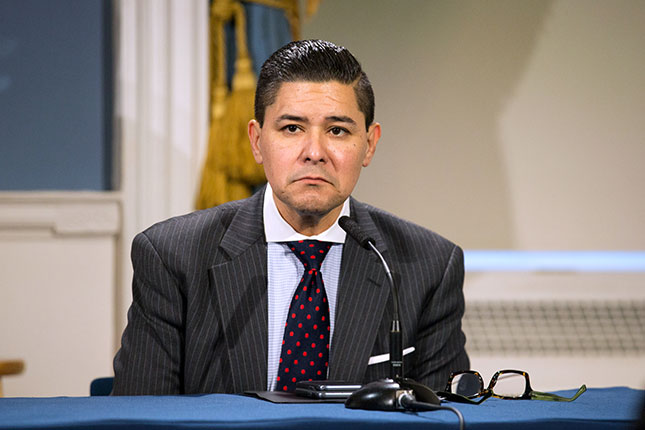
New York City Schools Chancellor Richard Carranza (Photo by William Farrington-Pool/Getty Images)

Simply put, these parents don’t believe that the city’s measures of fairness and equity recognize their sacrifices. “The mayor thinks there are too many Asians in the specialized high schools, but he never asked why there are so many Asians,” says blogger Ling Fei.

Without much understanding of American racial politics, new Asian immigrants defending merit-based admissions can find themselves vulnerable. Critics have charged that their traditional reverence for meritocracy renders them pawns, used by whites to defend their privilege.

State senator John Liu believes that de Blasio’s ham-fisted management of the issue created much of the turmoil. Pointing to the declining use of standardized tests in high schools and colleges, Liu says, “the high-stakes exams were steadily losing favor even before the pandemic.” He identifies a trade-off between equity and excellence but says that these measures are incompatible when viewed through the historical black–white prism of U.S. race relations. “Equity is about fairness, and excellence requires some human measurement which, in this country, has often been discriminatory against blacks,” he says. “For many Asian immigrant families, they have no part of that perspective. The perspective they have is a cultural one where people prepare their entire life to take exams.”

Of course, Asian Americans are far from monolithic. Sometimes the fiercest opposition they face is within their own households, from their American-educated, second-generation children. “When you look at critical race theory, you can see that Asian Americans have always been used as a wedge,” says Vanessa Leung, favorably citing the movement that advocates its version of social justice on racial, legal, and political issues. Leung, chairwoman of the PEP, joined the majority in voting to jettison the G&T test. “We cannot allow the system to sometimes use Asian Americans as a model, and other times vilify us,” she says.

Born in New York to a Hong Kong immigrant family, Leung says that she lived in a bubble until she took Asian-American studies courses in college. She doesn’t think her own parents fully understand the history of the Jim Crow South, or even of Chinese exclusion in the U.S. In her telling, immigrant parents realize that their children face racism in the U.S. and see educational achievement as a way to protect them. But instead of different ethnic groups fighting each other for limited resources, she says, the focus should be on building a fairer system for all. “When you say the kids who get into these schools, they test fine, they work hard, and they deserve it, it perpetuates the inequity for all sides,” said Leung. “It erases the struggle so many families face and makes them think, ‘it must be my fault,’ when the system is set against them in a lot of ways.”

Others familiar with the history have a different opinion, arguing that Asians have been persistently mistreated precisely because they excel. Wai Wah Chin, a former president of the Chinese American Citizens Alliance Greater New York (CACAGNY), a chapter of a group founded in 1895, says that the contemporary mindset that attacks Asian students and parents for working hard can be traced back to the circumstances that triggered the Chinese Exclusion Act 139 years ago. The notorious law was created, she says, because Chinese railroad workers worked faster than others and made white American workers feel threatened: “We were excluded because we did better than others. Does that sound familiar?”

Amid all the disagreement, it’s undeniable that Asian Americans have made their voice heard. On January 28, at a mayoral-candidates forum hosted by PLACE NYC and moderated by reporter Arthur Chi’en, five hopefuls—Eric Adams, Kathryn Garcia, Ray McGuire, Loree Sutton, and Andrew Yang—discussed education. All vowed to build more specialized high schools, expand G&T programs, and fire Carranza, though none seemed especially inclined to retain single-test-based admissions. Nearly 1,000 people watched live via Zoom and YouTube, and the organizers hired a professional interpreter for Chinese speakers.

The forum was a big moment for Yiatin Chu, the co-president of PLACE NYC. The Taiwan-born stay-at-home mother co-founded her group with other parents in the summer of 2019 and has mobilized it since. When the PEP decided to terminate the G&T exam, Chu’s group circulated a petition asking the mayor to hold a revote. PLACE NYC has met with candidates in borough-president and city council races and works to register voters. “We all learned that our public education is very much in the hands of elected officials, from funding and mayoral control to oversight,” says Chu. “It is very important that we connect with them and help them understand the issues from our standpoint.”

The use of critical race theory, or CRT, by those seeking to abolish testing has added to the debate’s intensity. CACAGNY, which has co-hosted seven forums for city council candidates, issued a statement calling CRT a “hateful fraud” and a “common source of anti-Asian racism.” Phil Wong, the president of the group and a plaintiff in a lawsuit against the SHSAT proposal, compares CRT with the darkest periods of recent Chinese history: “China’s Mao used to call the tools he adopted to push forward his Communist agenda the ‘three red flags,’” he says. “I think the CRT sounds like one of the Communist ‘red flags.’”

Even those disagreeing with that comparison concur that the political awareness raised by these fights could be a watershed for the Asian community. Chris Kwok, a professor at Hunter College and an early pioneer in the campaign to keep the SHSAT, supports critical race theory. He says that he sometimes feels frustrated working with new immigrant parents, who can grow more radical and less willing to hear other views. At the same time, though, Kwok is happy to see that 13 Chinese Americans, including five recent immigrants from mainland China, are running for city council this year—a record number. “This is a turning point for New York City,” says Kwok, who has shifted his focus to encouraging Asian political participation. “We are not going to be able to shape people left or right. But we want overall greater Asian representation and advocacy in the New York City government.”

Competing for a Queens seat against at least 12 other candidates is Donghui Zang. He sometimes feels besieged, aware that anti-test sentiment is gaining ground. But some old memories from China give him hope. “The Cultural Revolution in China suddenly ended in 1976, and the college entrance exams resumed in 1977,” he says. “A lot of historic trends that seem perpetual are like this. . . . When the turning point arrives, you need to be prepared.”

Top Photo by Peter Kramer/Getty Images

Saturday, March 27, 2021

The fall of Chile is a warning to America

Stephen Moore notes once-free nation has arrived at 'equality': 'Nearly everyone is suffering'

Wednesday, March 17, 2021

The Left’s New Constitution

A raft of new legislation seeks to enshrine racial preferences into American society.
 
Mike Gonzalez March 15, 2021 @ City Journal, published with permission.  I recommend subscribing, it's free.

The recently enacted Covid-19 relief law and other bills wending their way through Congress openly favor members of certain races or ethnic categories. It’s hard to see how any of this legislation—all part of the Biden-Harris administration’s new focus on racial “equity” at the expense of equality—passes constitutional muster.

That doesn’t mean that the courts will strike them down. We have today a new, unwritten constitution—a hodgepodge of executive orders, court decisions, legislation, and conventions. Of course, we already have a written Constitution, drafted in 1787 and amended since. The cognitive dissonance of living under these two constitutional regimes is thus causing friction across society.

Consider the Emergency Relief for Farmers of Color Act, a $5 billion monstrosity that Georgia Senator Raphael Warnock snuck into the $1.9 trillion American Rescue Plan Act of 2021. The bill aims to provide payments to “Black farmers, Indigenous farmers, and farmers of color.” It includes $1 billion to address “systemic racism” at the Department of Agriculture.

The bill never says explicitly that blacks, Native Americans, or farmers who are immigrants from Latin America or their descendants should receive benefits; instead, it uses the term “socially disadvantaged famers.” For example, it instructs the secretary of agriculture to “forgive the obligation of each socially disadvantaged farmer or rancher who is a borrower of a farm loan made by the Secretary to repay the principal and interest outstanding as of the date of enactment of this Act on the farm loan.”

Warnock’s bill explains that “the term ‘socially disadvantaged farmer or rancher’ has the meaning given the term in 19 section 2501(a) of the Food, Agriculture, Conservation, and Trade Act of 1990.” As that law explains, “The term ‘socially disadvantaged group’ means a group whose members have been subjected to racial or ethnic prejudice because of their identity as members of a group without regard to their individual qualities.” Department of Agriculture regulations also “define socially disadvantaged farmers and ranchers as belonging to the following groups: American Indians or Alaskan Natives, Asians, Blacks or African Americans, Native Hawaiians or other Pacific Islanders, Hispanics, and women.”

In other words, membership in any of these racial, ethnic, or gender categories automatically entitles a farmer to benefits, “without regard to individual qualities.” As University of Maryland professor George La Noue has written, “social disadvantage is, as a practical matter, established at birth, and cannot be challenged by evidence of a successful life.” These are the makings of a rigid caste system in America.

And Warnock’s bill is not the only farm bill explicitly channeling money to black Americans. There is also New Jersey senator Cory Booker’s Justice for Black Farmers Act. It creates a USDA agency that would buy land and grant it to eligible Black farmers. It also establishes a “Socially Disadvantaged Farmer and Rancher Bank.”

These and other bills in the works create entitlements based on race or ethnicity, not need. If the Duchess of Sussex, Meghan Markle, were to turn part of her California estate into farmland, she, too, would get federal money, as could former President Barack Obama, NBA legend Michael Jordan, and Senators Ted Cruz and Marco Rubio. It is that absurd.

It doesn’t stop with agriculture. Consider the George Floyd Justice in Policing Act, which calls for the end of racial profiling but will end up enshrining it. It does this by stating that “proof that the routine or spontaneous investigatory activities of law enforcement agents in a jurisdiction have had a disparate impact on individuals with a particular characteristic described in section 302(6) shall constitute prima facie evidence of a violation.” Those characteristics include “race, ethnicity, national origin, religion, gender, gender identity, or sexual orientation.” As former Department of Education official Hans Bader puts it, “The practical effect would be to encourage police departments to stop innocent women, Asians, and whites, just to meet quotas based on gender and race. If police departments don’t meet these quotas, they could be sued by the Justice Department or individuals they stop.”

The Biden administration is also considering setting up a commission to study reparations, perhaps the quintessential race-based policy. Reparations establish collective guilt and collective innocence and mete out collective punishment and collective rewards, nearly 160 years after the Civil War ended and the Thirteenth Amendment was ratified.

These are but the tip of the iceberg. Consider also the Recognizing People of African Descent and Black Europeans Act; the concurrent resolution urging the establishment of a United States Commission on Truth, Racial Healing, and Transformation; and the Anti-Racism in Public Health Act of 2021 (introduced by Ayanna Pressley of Massachusetts and drawing on Ibram X. Kendi’s ideas).

All of this is likely unconstitutional, violating the Fourteenth Amendment’s Equal Protection Clause, as well Titles VI and VII of the 1964 Civil Rights Act. The courts have already stated, for example, that it is unconstitutional to encourage racial quotas, which would put the Justice in Policing Act in jeopardy.

The woke Left understands that, as written and amended, the Constitution stands in the way of many of the things that it wants to do. This is why the Left has set about to cast the Constitution as illegitimate by, for example, purposely mischaracterizing the three-fifths compromise, pretending that the document perpetuated slavery, or calling it, as Kendi does, a “color-blind Constitution for a White-supremacist America.”

Will the courts strike down these laws? Or will they use them to build on the illegitimate new “constitution” of racial preferences? We will see.

Photo by Alex Wong/Getty Images