Asian-American parents mobilized to oppose the de Blasio administration’s specialized high school proposal. Now
they’re fighting a larger battle.
Rong Xiaoqing April 4, 2021 @ City Journal.
On February 26, when former New York City schools chancellor Richard
Carranza announced his resignation, the Asian-American parent groups who
had been calling for his ouster for more than 18 months were wary
celebrants. Carranza’s departure was a measure of vindication for these
parents, who want the city to retain its current selective admissions
systems for gifted children and for teenagers seeking entry into top
public high schools. Carranza was determined to reduce what he called
segregation in city schools and to create more opportunities for black
and Hispanic students—an effort, the parents understood, that would come
at the expense of Asian-American students who worked hard to do well
under the current system. Even before the surge in attacks against
Asians in the past year, the education issue had made many feel
victimized by American society. But now that Carranza is gone, they
aren’t popping champagne corks: New York City mayor Bill de Blasio still
opposes the current admissions system, and his handpicked replacement,
Meisha Ross Porter, is committed to keeping the issue on the
front-burner. Next January, a new mayor will choose Porter’s successor.
The fundamental problem: under the current exam-based standards,
white and Asian students perform well enough to earn the vast majority
of spots in gifted-and-talented programs, and an even greater share in
top high schools, yet 70 percent of the roughly 1 million children
across the system’s 1,800 schools are black or Hispanic. Progressives
say that these disparities amount to segregation and vow to ameliorate
them. Many Asian parents, often of Chinese descent, say that abandoning
the standardized-testing system will penalize Asian families, often
poor, who have dedicated their limited resources to ensuring that their
children can take advantage of every opportunity. De Blasio is unlikely
to resolve the issue as his term expires, and his successor’s stance is
anyone’s guess. But regardless of what happens over the next several
months, the fight over who receives the best educational opportunities
in the city—and why—isn’t going away.
Asian-American parents began mobilizing as a
political force in June 2018, when de Blasio released a proposal to
scrap the Specialized High School Admissions Test (SHSAT), an exam that
tests verbal and mathematical ability and determines admissions to a
special class of public high schools. As the issue persisted, so did the
advocacy. Parents have formed activist groups and showed up en masse to
Department of Education events; at forums held by John Liu, the state
senator who heads the committee on city education; and, once lockdowns
were imposed, on public Zoom calls. They have also signed on as
plaintiffs to two ongoing lawsuits against the city.
Their objection is straightforward. The mayor’s proposal to reform
specialized high schools would phase out the SHSAT and replace it with a
system that admits students on various factors, including how well they
perform on state assessments and where they rank in their own middle
schools. According to an analysis
by the New York City Independent Budget Office, the plan would keep the
proportion of white students the same, boost the share of black and
Hispanic students to 46 percent from its current 10 percent, and halve
the percentage of Asian students, to 31 percent.
In opposing this proposal, the parents have become an emerging power
in the city’s political scene, putting future city administrations on
notice that they will fight back against any attempt to reduce
opportunities for their kids. De Blasio postponed his plan and
apologized in November to the Asian community, saying that he and
Carranza “did not articulate well enough” the proposed reforms. The
parents say that Carranza’s departure—officially for personal reasons
but following a series of disagreements with the mayor—could be another
sign that the city is softening its stance. A number of mayoral
candidates had already committed to firing Carranza, partly under
pressure from the Asian groups. “We helped move the needle,” says Chien
Kwok, a parent activist.
But the victory could be short-lived as the debate shifts. What
started as a fight over the SHSAT has become a broader struggle over
segregation and diversity in public schools, implicating essentially any
selective program in the city education system that uses tests for
admissions. With the Black Lives Matter movement and the pandemic as
backdrops, anti-test forces—pointing to racial disparities in results
and logistical difficulties in administration—have gathered strength.
The dramatic reduction in in-person schooling
is making it difficult to use tests or other performance-based criteria
for admissions, at least for now. About 200 city middle schools that
had used grades and attendance as admissions criteria will instead use a
lottery this year. The gifted-and-talented (G&T) exam, the sole
criterion to select children as young as four for enrichment programs,
will not be administered this year after the city’s Panel for
Educational Policy (PEP) voted in January to terminate a contract with
the company that offers it. Instead, gifted programs will admit students
based on teacher recommendations and a lottery.
At the same time, activists and officials are singling out schools
over their racial composition. Consider Hunter College High School, an
elite school that admits students based on a single test. In June 2020, a
group of Hunter students demanded that the school change its system.
Then, in January, 38 city and state elected officials—including the
city’s public advocate, Jumaane Williams—sent letters to the leaders of
the City University of New York (CUNY) and Hunter College, who have
authority over the high school’s admissions policy, urging them to drop
the entrance test and replace it with an “alternative, pro-diversity”
system. At a city council hearing on February 23, some council members
threatened to cut the budget of both institutions if they didn’t oblige.
The debate raises issues of both race and class. Aside from the
racial disparities, some of these schools and gifted programs do not
serve poorer parts of the community: only 9 percent of students at
Hunter High, for example, come from low-income families. Yet top
specialized high schools range from 42 percent to 59 percent low-income
students, underscoring the extent to which the current admissions system
can be an engine of social mobility for poorer (often Asian) families.
To the few black and Hispanic students receiving coveted spots in top
schools, the environment can be distressing. In a recent Zoom meeting,
Abigail Ramirez, a junior at Hunter High, said that she feels isolated
as one of the few low-income Hispanic students at the school. Ramirez
noted the embarrassment of seeking fee waivers and not being able to
participate in ski trips, discussed the high pressure to excel, and said
that she missed the middle school she once attended, which reflected
the community in which she lives. “Every time I didn’t get an A or
didn’t do that well on a test, I feel I didn’t deserve to be here,” she
said. At the PEP meeting in January, which decided the fate of the
G&T exam, Tajh Sutton, a member of the Community Education Councils
(CEC), recalled her own experience of being “criminalized” and
“tokenized” when she was a black student at the specialized Brooklyn
Technical High School. Without systematic change, she said, “white
supremacy” would continue to reign in the city’s public schools.
To many Asian parents, however, the fight is not about diversity but
about retaining a merit-based system that rewards hard work—a system
that, in their eyes, reflects the American dream. “I am not against
admission reforms, but it has to be for improving students’ academic
performance rather than reaching a racial balance,” says Ling Fei, a
parent activist and WeChat blogger who came to the U.S. in 2000 to
attend graduate school. “Even when I was in China, I was enchanted by
Dr. Martin Luther King Jr.’s vision of a nation where people are not
‘judged by the color of their skin but by the content of their
character.’ But now what they are doing is the opposite.”
Donghui Zang is one of these parents. When
he took a few hours off from his work as a data analyst on Wall Street
to join the June 2018 protests outside City Hall, he didn’t think he was
embarking on a political journey. In fact, he had vowed to stay away
from politics after participating in the Tiananmen Square protests of
1989. The father of two hadn’t attended a protest since coming to the
U.S. in 1995 to pursue his Ph.D. He didn’t know who the governor of New
York was, or what the city council did.
Now Zang is one of the leaders of the movement and a city council
candidate, running in a Queens district that includes his neighborhood
of Forest Hills. Zang and his fellow parents are surprised that the
battle that started on that summer day has continued—and that it has
widened. “Back then, we thought that after our protests, the city would
soon take down the plan. And I would go back to my previous life,
focusing on my career and family,” he says. “But challenges came one
after another. We realized our job is not only protecting the SHSAT.”
His reaction to Carranza’s departure is a qualified thumbs-up: “Let’s
cross our fingers while keeping alert,” he says.
Zang was born in a small village in northern China’s Hebei province
in 1969, seven years before the death of then-chairman Mao Zedong. Mao
was no fan of exams: during the chaos of the Cultural Revolution,
college entrance exams were largely halted, admissions were based on
recommendations from “the people,” and students who could barely read
and write were sent to college. That exceptional period aside, however,
exams administered by the highest level of government have existed for
more than 1,400 years in China. Many residents consider them the only
incorruptible channel of upward mobility for people from poorer
backgrounds.
Zang still remembers his childhood poverty, worsened by Mao’s
policies, ostensibly designed to share wealth equally among all
citizens. Families in the village couldn’t afford to buy shoes for their
children. They often wore homemade shoes, made from torn clothes, which
soaked through in rain and snow. Despite the obstacles, many families
put their children’s education ahead of everything else. Children would
climb to the roofs of their apartments to study in the twilight because
they lacked electricity. His father, an elementary school teacher, spent
most of his time off tutoring students for free. In 1987, Zang was
admitted to Shanghai Jiao Tong University, one of the nation’s top
universities, having competed with 2.28 million students on China’s
rigid college entrance exams. “Education is nothing about money,” he
says today, “and all about parents’ priorities.”
The market reforms instituted by later Chinese leaders have unleashed
economic growth, but Chinese parents seeking a good education for their
kids still face obstacles. The quality of schools in Zang’s home
village has declined; many good teachers have left for urban schools,
where the pay is higher. Still, Zang thinks that the solution is to
provide more resources to underserved schools rather than to lower the
bar of college admissions for everyone.
It’s a principle he also applies to the American situation. “Equality
should be about equal opportunities, not equal outcomes,” said Zang.
“The plans for school diversity in New York all focus on the outcome.
They sound too much like Mao’s policies to me.”
Zang’s experience resonates with immigrant parents who have left
countries where opportunities for children can depend on family wealth
or connections. “Donghui is new to politics. But parents can identify
with him. It’s like, ‘I am just like Donghui,’” says Linda Lam, a major
supporter and former co-president of the parents association at
Stuyvesant High School. Such parents believe that America offers the
chance to obtain a better life through hard work and diligent studying.
“Most Asians in these merit-based programs where an objective test is a
core in the admissions are recent immigrants,” says Yiatin Chu,
co-president of Parent Leaders for Accelerated Curriculum Education
(PLACE) NYC, an advocacy group founded by parents in 2019 to preserve
the gifted programs. “These parents depend on public schools because of
their social economic status. If you had means, you’ve moved out to the
suburbs,” she says.
City authorities failed to understand the
vital role of public education in an immigrant community often
considered “silent,” and they were caught off guard when the proposed
reforms generated friction. Just ask Zikuo Zhang, who came to the U.S.
from China’s Fujian province in 1980 and is now a grandfather—and a
participant in many protests against the reforms. Most people from
Zhang’s home village were smuggled into the U.S. in the 1980s and 1990s
and worked in restaurants, himself included. His son and daughter joined
him in the U.S. as high schoolers, following him into the restaurant
trade. But when his three grandchildren were born, the whole family
sprang into action: his daughter and daughter-in-law quit their jobs to
take care of the children, he helped them financially, and the families
rarely watched any TV, so that the children had quiet time to study. It
paid off: they went to specialized high schools and now study at Cooper
Union, Cornell, and Princeton.
Zhang is not alone. Over the years, the first-generation immigrants
from his home village have sent more than 60 students to top ten U.S.
universities, including 18 to Harvard. So when de Blasio said that the
single-test admission ticket into the specialized high schools had
created a “rich-get-richer” system by benefiting those who can afford to
pay for extra classes, and when Carranza called specialized high
schools the “epicenter of privilege,” Zhang was baffled. “Our village
has a long tradition of respecting education,” he says. “In the U.S., we
all work in restaurants. We just don’t want our kids to work in
restaurants, too.”
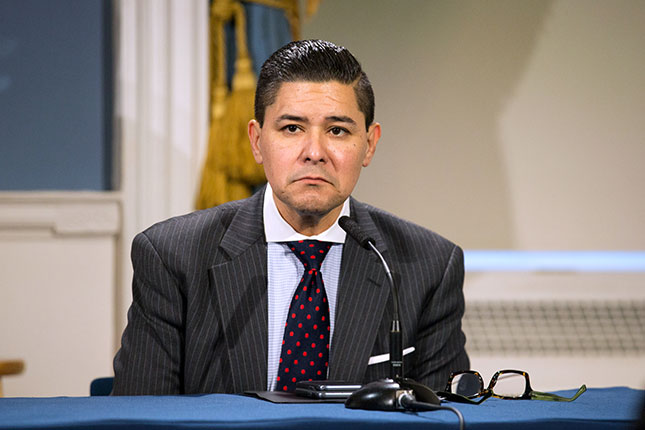
New York City Schools Chancellor Richard Carranza (Photo by William Farrington-Pool/Getty Images)
Simply put, these parents don’t believe that the city’s measures of
fairness and equity recognize their sacrifices. “The mayor thinks there
are too many Asians in the specialized high schools, but he never asked
why there are so many Asians,” says blogger Ling Fei.
Without much understanding of American
racial politics, new Asian immigrants defending merit-based admissions
can find themselves vulnerable. Critics have charged that their
traditional reverence for meritocracy renders them pawns, used by whites
to defend their privilege.
State senator John Liu believes that de Blasio’s ham-fisted
management of the issue created much of the turmoil. Pointing to the
declining use of standardized tests in high schools and colleges, Liu
says, “the high-stakes exams were steadily losing favor even before the
pandemic.” He identifies a trade-off between equity and excellence but
says that these measures are incompatible when viewed through the
historical black–white prism of U.S. race relations. “Equity is about
fairness, and excellence requires some human measurement which, in this
country, has often been discriminatory against blacks,” he says. “For
many Asian immigrant families, they have no part of that perspective.
The perspective they have is a cultural one where people prepare their
entire life to take exams.”
Of course, Asian Americans are far from monolithic. Sometimes the
fiercest opposition they face is within their own households, from their
American-educated, second-generation children. “When you look at
critical race theory, you can see that Asian Americans have always been
used as a wedge,” says Vanessa Leung, favorably citing the movement that
advocates its version of social justice on racial, legal, and political
issues. Leung, chairwoman of the PEP, joined the majority in voting to
jettison the G&T test. “We cannot allow the system to sometimes use
Asian Americans as a model, and other times vilify us,” she says.
Born in New York to a Hong Kong immigrant family, Leung says that she
lived in a bubble until she took Asian-American studies courses in
college. She doesn’t think her own parents fully understand the history
of the Jim Crow South, or even of Chinese exclusion in the U.S. In her
telling, immigrant parents realize that their children face racism in
the U.S. and see educational achievement as a way to protect them. But
instead of different ethnic groups fighting each other for limited
resources, she says, the focus should be on building a fairer system for
all. “When you say the kids who get into these schools, they test fine,
they work hard, and they deserve it, it perpetuates the inequity for
all sides,” said Leung. “It erases the struggle so many families face
and makes them think, ‘it must be my fault,’ when the system is set
against them in a lot of ways.”
Others familiar with the history have a different opinion, arguing
that Asians have been persistently mistreated precisely because they
excel. Wai Wah Chin, a former president of the Chinese American Citizens
Alliance Greater New York (CACAGNY), a chapter of a group founded in
1895, says that the contemporary mindset that attacks Asian students and
parents for working hard can be traced back to the circumstances that
triggered the Chinese Exclusion Act 139 years ago. The notorious law was
created, she says, because Chinese railroad workers worked faster than
others and made white American workers feel threatened: “We were
excluded because we did better than others. Does that sound familiar?”
Amid all the disagreement, it’s undeniable
that Asian Americans have made their voice heard. On January 28, at a
mayoral-candidates forum hosted by PLACE NYC and moderated by reporter
Arthur Chi’en, five hopefuls—Eric Adams, Kathryn Garcia, Ray McGuire,
Loree Sutton, and Andrew Yang—discussed education. All vowed to build
more specialized high schools, expand G&T programs, and fire
Carranza, though none seemed especially inclined to retain
single-test-based admissions. Nearly 1,000 people watched live via Zoom
and YouTube, and the organizers hired a professional interpreter for
Chinese speakers.
The forum was a big moment for Yiatin Chu, the co-president of PLACE
NYC. The Taiwan-born stay-at-home mother co-founded her group with other
parents in the summer of 2019 and has mobilized it since. When the PEP
decided to terminate the G&T exam, Chu’s group circulated a petition
asking the mayor to hold a revote. PLACE NYC has met with candidates in
borough-president and city council races and works to register voters.
“We all learned that our public education is very much in the hands of
elected officials, from funding and mayoral control to oversight,” says
Chu. “It is very important that we connect with them and help them
understand the issues from our standpoint.”
The use of critical race theory, or CRT, by those seeking to abolish
testing has added to the debate’s intensity. CACAGNY, which has
co-hosted seven forums for city council candidates, issued a statement
calling CRT a “hateful fraud” and a “common source of anti-Asian
racism.” Phil Wong, the president of the group and a plaintiff in a
lawsuit against the SHSAT proposal, compares CRT with the darkest
periods of recent Chinese history: “China’s Mao used to call the tools
he adopted to push forward his Communist agenda the ‘three red flags,’”
he says. “I think the CRT sounds like one of the Communist ‘red flags.’”
Even those disagreeing with that comparison concur that the political
awareness raised by these fights could be a watershed for the Asian
community. Chris Kwok, a professor at Hunter College and an early
pioneer in the campaign to keep the SHSAT, supports critical race
theory. He says that he sometimes feels frustrated working with new
immigrant parents, who can grow more radical and less willing to hear
other views. At the same time, though, Kwok is happy to see that 13
Chinese Americans, including five recent immigrants from mainland China,
are running for city council this year—a record number. “This is a
turning point for New York City,” says Kwok, who has shifted his focus
to encouraging Asian political participation. “We are not going to be
able to shape people left or right. But we want overall greater Asian
representation and advocacy in the New York City government.”
Competing for a Queens seat against at least 12 other candidates is
Donghui Zang. He sometimes feels besieged, aware that anti-test
sentiment is gaining ground. But some old memories from China give him
hope. “The Cultural Revolution in China suddenly ended in 1976, and the
college entrance exams resumed in 1977,” he says. “A lot of historic
trends that seem perpetual are like this. . . . When the turning point
arrives, you need to be prepared.”
Rong Xiaoqing is an award-winning journalist for Sing Tao Daily, a Pulitzer Center grantee, and an Alicia Patterson Fellow.
Top Photo by Peter Kramer/Getty Images
City Journal is a
publication of the Manhattan Institute for Policy Research (MI), a
leading free-market think tank. Are you interested in supporting the
magazine? As a 501(c)(3) nonprofit, donations in support of MI and City Journal are fully tax-deductible as provided by law (EIN #13-2912529). SUPPORT