Search This Blog

De Omnibus Dubitandum - Lux Veritas

Showing posts with label Quotas. Show all posts

Wednesday, July 5, 2023

The Constitution Versus Academia and Corrupt Government Mandates

   
The Supreme Court finally saw the light and decided racism is racism and racial set asides in universities are blatantly unconstitutional.  Well....duh!  
 
Unfortunately there are three of the justices, known dimwits, who find it impossible to grasp that simple and fundamental fact.   And we find the entire leftist nitwit brigade has joined them in their outrage, and many universities plan to ignore that ruling, because they know better, and simply don't care what the Supreme Court says. Isn't that amazing? 
  
When SCOTUS irrationally discovered abortion was a constitutional right, in spite of the obvious fact the Constitution never said any such thing, they were jubilant.  Except in order to "find" abortion in the Constitution, amazingly, the federal judiciary "discovered" there are penumbras and emanations that radiate  from the simple and understandable language of the Constitution.  Why?  Because the simple and understandable language didn't give them the right to impose legislation from the bench, so they had to develop language that did. 
 
The word penumbra originally was a scientific term "created to describe the shadows that occur during eclipses." And I think the word shadows is more than appropriate when its used in relationship with the Constitution.   The "penumbra" of the Constitution "implies" rights not actually written in the Constitution, and in fact the concept gives then the ability to define, redefine and even ignore the actual and simple language of the Constitution.  All of which has been done by the federal judiciary at every level. All in an effort to make the Constitution a "Living Document".  An open ended concept that allows for unending abuse, and the end to the rule of law!  And the left was jubilant beyond measure, because the SCOTUS was all great, and all wise beyond all imagination.
 
How quickly that can change.  
 
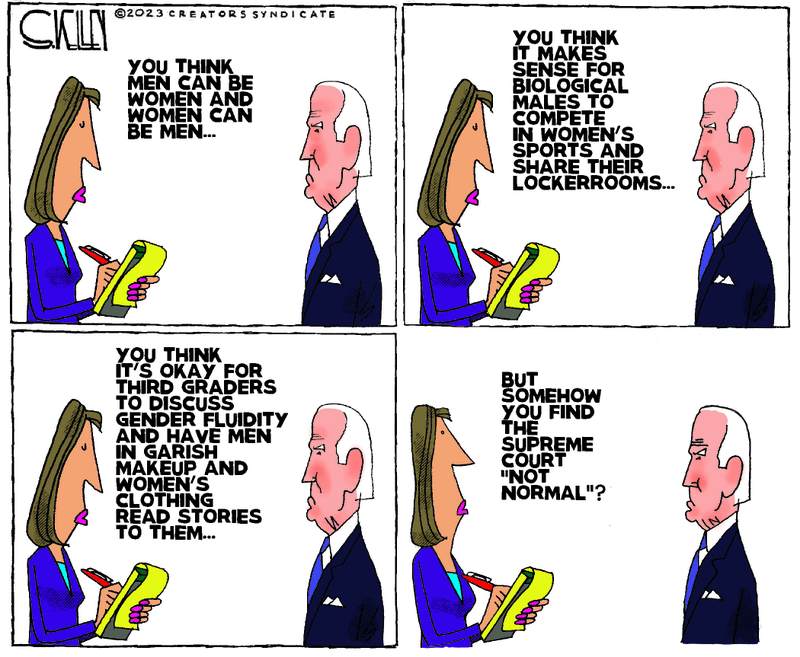
Now the Constitution is just an old dusty document, a racist document at that, and SCOTUS isn't all great, wise and knowing, and, according to Joe Biden, this SCOTUS isn't even a normal court.  Joe Biden defining normal?  Imagine that. 


The left also believes SCOTUS is in serious need of fixing with more justices, far left justices, and imposed restrictions by Congress.  And most importantly, SCOTUS needs to accept public opinion as the rule of law. Provided of course that public opinion is a leftest public opinion.   

Well, that's generated a massive red herring fallacy discussion regarding "fairness" and university admissions dealing with legacy admissions. 

Monica Showalter of America Thinker is one of my favorite writers.  I have a number of writers I regularly pay close attention to, and she's one of them.  Some even allow me to publish their work,    But I don't always agree with them.   Yesterday she published this piece entitled, Now it's legacy admissions' turn decrying the unfairness of legacy admissions to elite universities, many of whom wouldn't have been admitted if not for this preferential treatment.  And what about those kids who are admitted because their parents donated massive amounts of money to these universities?  Should the universities be forced to stop admitting the children of rich donors? 
 
What we're seeing here is family taking care of family.  Is that so terrible? Did anyone ever notice how many Hollywood stars had parents and/or grandparents who were Hollywood bigwigs?  Family taking care of family.  How many of the rich have inherited huge wealth because they descended from wealthy parents.  Isn't that a form of "legacy"?   As a result, should that be allowed? And who decides?   Should government bureaucrats, race baiters, insane leftists decide what's fair?    
 
Let's try an understand this properly. Legacy admittance was created by those who created these institutions in order to make sure the "right people" met the "right people" in order to perpetuate the "right people's" class and riches. 
 
Why is that so terrible? 
 
On a personal level, I despise all these elitist privileges, but so what?  Should that give me the right to strip them of these perfectly legal privileges.  Let me make it clear,  I’m not one of the “right people” and I don’t wish to be one of the “right people” because most of those of that class I’ve met, I didn’t like, and had no desire to associate with them. However, why shouldn’t people have the right to decide who they wish to associate with, or isolate themselves from?  

The left is filled with people who live in echo chambers of head nodding dunderheads, like Nikole Hannah-Jones, and yet, there’s no outrage over that from the media or so-called social justice warriors.

  • Is it so terribly immoral for rich people to want their children to marry the children of other rich people?
  • Is it so terribly immoral for people of a certain class to want their children to marry the children of parents of that class, or even race for that matter?
  • Is so terrible for those who share religious beliefs to want their children to marry those who share those religious beliefs?
  • Is it so terribly immoral for people of a certain political persuasion to want their children to marry the children whose parents share that political view?
  • Don't think it's fair? Okay, but please tell me who wrote the Book of Fair? Generally speaking, fair is often a matter of who’s ox is being gored.
  • Diversity, inclusion, equity, multiculturalism. Please explain to me how well that’s worked out for France.

The fact is these legacy admissions were created by these institutions, which they had every right to do, and were not imposed by the government.  That’s the difference, and it's a big difference!  Let's try and get this once and for all.   Fairness isn’t the issue here, government mandates based on race, religion or any other criteria is the issue here, and it's the only issue here.

Where in the Constitution does it say the government should be making these decisions? It’s not the government's job to decide who’s chosen by these institutions, and it's long overdue for these institutions to stop feeding at the government trough, and way long past time for government to stop funding education, at all levels.

Everything else are red herring fallacies playing into the hands of people who unending scream how terrible and racist is America. Many of them made wealthy by America.  What really needs to be done to fix all this is eliminate the Department of Education.

Now if we really want "fair", that's a really good start. 

Monday, July 3, 2023

Buckeye Institute Press Release


FOR IMMEDIATE RELEASE


June 30, 2023 Lisa Gates, Vice President of Communications, (614) 224-3255 


The Buckeye Institute Celebrates Victory in Student Loan Case


Columbus, OH – On Friday, the U.S. Supreme Court issued its decision in Biden v. Nebraska, ruling that President Biden’s student loan debt cancellation plan is unconstitutional, agreeing with arguments The Buckeye Institute made in its amicus brief and its case Latta v. U.S. Department of Education. In a 6-3 decision, the court said, “The text of the HEROES Act does not authorize the Secretary’s loan forgiveness program.”


“The Supreme Court’s ruling is a victory for the U.S. Constitution, taxpayers, and The Buckeye Institute’s client in Latta v. U.S. Department of Education,” said David C. Tryon, director of litigation at The Buckeye Institute. “It was obvious that President Biden didn’t have the authority to cancel nearly half a trillion dollars in debt, and the court’s decision a clear warning to future presidents that you cannot ignore the constitutional limitations of your office.”


Chief Justice Roberts, writing for the majority, agreed with Buckeye’s position when he explained that if Congress had intended to give the secretary of education the power to grant “a mass debt cancellation,” it would have made a “clear statement to that effect.” Congress did not do so, and Chief Justice Roberts noted that “In essence, the Secretary has drafted a new section of the Education Act from scratch by ‘waiving’ provisions root and branch and then filling the empty space with radically new text.”


Tryon continued, “As the court found, ‘the HEROES Act provide[ed] no authorization for the Secretary’s plan…let alone “clear congressional authorization” for such a program.’ This ruling protects our client and other borrowers from future financial liability and harm if future administrations demanded repayment of loans which this administration unlawfully tried to forgive.”


# # #

Founded in 1989, The Buckeye Institute is an independent research and educational institution a think tank whose mission is to advance free-market public policy in the states.

The Buckeye Institute is a non-partisan, non-profit, and tax-exempt organization, as defined by section 501(c)(3) of the Internal Revenue code. As such, it relies on support from individuals, corporations, and foundations that share a commitment to individual liberty, free enterprise, personal responsibility, and limited government. The Buckeye Institute does not seek or accept government funding.
Donate Today! Support The Buckeye Institute
Facebook  Twitter  Linkedin  Youtube  

Monday, November 7, 2022

The Supreme Court Confronts the Left’s Victimhood Consensus

Although the Civil Rights Act of 1964 reasserted the principle that no one should be discriminated against based on race, it has been clear that racial identity proponents led by our cultural elites have succeeded in dividing America into racial categories while allocating jobs and even elections based on race.  Two recent Supreme Court cases challenge this move.  The Court heard arguments regarding two critical cases brought by the Students for Fair Admissions Inc. (“SFFA.)” SFFA is “dedicated to defending the right to racial equality in college admissions.”   These related cases -- SFFA v. Harvard and SFFA v. the University of North Carolina -- are primarily driven by SFFA’s members, including Asian American students who were denied admission to Harvard and the University of North Carolina............To Read More....


Sunday, November 6, 2022

Some Thoughts On Affirmative Action

The Supreme Court arguments in the Harvard and University of North Carolina affirmative action cases took place on Monday. I listened to some substantial portion, although it was not possible for me to listen to the whole thing (some 5 hours in total). From what I heard, I agree with most commenters that affirmative action in the form currently practiced throughout academia is not likely to survive.

Affirmative action is one of those issues on which the opinions of our intellectual elites diverge almost completely from the opinions of normal people. In a piece on Tuesday (November 1) discussing the likely outcome of the Harvard/UNC case, the New York Times took note of the broad public opposition to affirmative action in college admissions, even extending to heavily Democratic constituencies:

[A] majority of Americans oppose the policy. Nearly three-quarters of U.S. adults said in March that race or ethnicity should not be a factor in college admissions, a Pew Research Center survey found. . . . Even in liberal states, most voters do not support affirmative action. In 2020, about 57 percent of Californians rejected an amendment to the state’s Constitution that would have let government and public institutions, including public universities, adopt affirmative-action policies.

According to the cited Pew survey, even majorities of blacks and Hispanics oppose affirmative action in college admissions:

A majority of Black, Hispanic and Asian respondents opposed the consideration of race or ethnicity.

Meanwhile, among the great and the good, affirmative action is one of the two principal pillars of today’s secular religion (the other being climate alarmism). Check out the list of amici curiae here at the Supreme Court docket supporting the Harvard/UNC position. It includes essentially all of elite academia and plenty of other high-browed institutions and individuals in the category of those that presume to instruct the little people on correct morality. Some readers may also remember my post back in November 2017 that covered the official declaration of fealty by Yale University to the catechism of “diversity, equity and inclusion.”

The principal claim of the plaintiffs in the cases at the Supreme Court appears to be that affirmative action as practiced operates to the disadvantage mostly of Asian American students. They definitely have evidence to back up their claim, in the form of statistical analyses showing that Asian American students must achieve much higher grades and test scores than members of other racial groups to have a comparable chance of admission to the defendant institutions. Plaintiffs must establish harm to themselves in order to have what is called “standing” to sue, and I have no doubt that this harm qualifies. 

On the other hand, this claimed harm is not the most important reason that affirmative action is a bad idea. If a highly qualified applicant to Harvard or UNC gets rejected in favor of a less-qualified applicant, it is very likely that the highly qualified candidate will be accepted into one or more schools with very nearly equivalent educational quality. Yes, it might have been nice to go to Harvard (the physical facility of the campus is remarkable), but the long-term damage to the person’s life and career are probably not substantial. In fact, the rejected applicant might even avoid some leftist indoctrination, which intellectual elites fall for in disproportionate numbers.

The more important reason that affirmative action is a bad idea is the effect on the supposed beneficiaries. This is something that I have had the occasion to observe personally.

As I have mentioned on this blog several times, I was involved for many years in the recruiting efforts of my law firm, including efforts to recruit more candidates from minority groups. One experience stands out in my memory, and I don’t believe that I have ever previously written about it here. It occurred in about 1981 or 1982, when I was asked to join a group of lawyers from our firm on a recruiting trip to Columbia Law School, which is in Northern Manhattan. About five of us went, to interview in excess of 100 students, about 25 interviews each for the day.

I was an associate at the time. The designated head of our group for the day was a relatively new woman partner who incidentally was active in Democratic Party politics and some years later became an important player in Bill Clinton’s campaigns for President. When we arrived, the Columbia recruiting office gave us the pile of 100+ resumes of the students that we would be interviewing. These resumes included transcripts of the students’ grades. Columbia had divided the resumes into five “schedules” for the five interviewers, but we were allowed to re-allocate the resumes among our team if we wanted. Our team leader then expressed the view that it might be best to have one of us interview all the black candidates, the reason given being that that would enable them to be compared among themselves, and we could select the best candidates to invite back to the firm. She asked me if I would take that job, and I said sure. So she went through the resumes and identified all the ones of black candidates, of which there were seven if I recall correctly, and she handed them to me.

So on that day I interviewed seven black candidates, as well as about 18 of other ethnicities (mostly but not entirely white). I saw the grades of all of them. This was a very eye-opening experience. The eighteen non-black candidates had grades in varying ranges. Some had mostly As, with perhaps a few Bs. Others had more Bs than As, although every one had at least one A-. Some had almost entirely Bs. Only a few had a C in any course, and none more than one or at most two. None had a D.

And then there were the seven black students. Their transcripts consisted of almost entirely Cs and Ds. Some had mostly Cs, and a couple had a least a B or two. But several had almost entirely Ds. The grades of every black student were worse than those of any non-black student, and by a wide margin.

Holy sh-t! Before this, I had had no idea that this was going on.

I quickly realized that these people were being humiliated at Columbia Law School. The school had intentionally set them up for humiliation in order to create a campus aesthetic that somehow made the people running the place feel morally superior. But at least to this point the humiliation had been relatively private — nobody knew about the grades other than the faculty members who gave them out and the students themselves. But now these students were being forced to go public with the humiliation. In the law firm environment, they would have to perform publicly, and sink or swim.

That was the only time that I had occasion to see all the resumes of the black candidates from a law school. I should mention that over the years we did see many black candidates with decent and even good resumes, and in those cases we generally put on big recruiting pushes to try to get those candidates to come to our firm. More often than not we failed, because the competition for the few good candidates was always intense. There are hundreds of major law firms in this country.

Obviously I came away from this experience understanding that affirmative action, at least as practiced at this and other schools, was no favor to the supposed beneficiaries. These were nice young kids, and they could have done well in a different environment. They had been lured here with the promise that the parchment from Columbia Law School would transform their lives. But it would not.

David Lat is the long-time proprietor of Above the Law, who now has a new Substack called Original Jurisdiction. He has a piece from yesterday echoing some of my sentiments, titled “Affirmative Action Is Going Down—And It’s A Good Thing Too.” Lat is an Asian American (I think Filipino). He tells this anecdote about a relative applying a kid to one of the elite New York City private schools:

[I]n preparing to send their oldest son through the gauntlet of Manhattan private-school admissions (for which I had to write a recommendation letter for a four-year-old!), my Asian-American cousin and her white husband talked to an “admissions consultant.” The consultant told them that elite preschools value “diversity.” My cousin excitedly told the consultant that she’s from the Philippines, her husband’s from Australia, and their son at his tender age had already lived in multiple countries and been exposed to many different cultures and languages. “I’m sorry,” the smiling consultant said to them about their white-looking son, “but that’s not what these schools are looking for. Your child does not offer visual diversity.”

Lat notes that Harvard and UNC (and for that matter the rest of academia) are no different:

So in the end, what Harvard and UNC are arguing is that visual diversity is a compelling state interest. Having classrooms and admissions brochures that look like Benetton ads can justify resorting to racial classifications that we have justifiably banned in pretty much every other area of American life. The idea would be laughable if it weren’t so wrong.

It’s all about keeping up appearances for the institutions, no matter how fake the appearances may be. They don’t care who gets thrown under the bus along the way, least of all the black students.

I’ve been looking for years to try to find data on the career success or average incomes of black graduates of elite institutions. If anybody knows where to find some, let me know. But I strongly suspect that nobody gathers this information because they don’t want to know what it would show.

Wednesday, August 3, 2022

Influential Medical Board Deliberately Injecting Racism into Medical Education

The Fightback Against Racial Quotas -  August 3, 2022 By Janet Levy - E pluribus unum, the traditional motto of the United States, means ‘Out of many, one.’ It asserts that our strength is in assimilation of shared values, goals, and vision. It unifies our diverse races, religions, and other groups by appealing to the ideals of a constitutional republic – freedom, equality, the pursuit of wealth, happiness and excellence through free market competition.  But the hackneyed shibboleth of the Left – Diversity is our strength – stands in direct contradiction to our original national motto. It serves their destructive aim of Balkanizing us by race, gender, sexual orientation, and other sub-groups du jour. Denigrating and rewriting our history, the Left aims to radically transform our culture: discounting merit, hard work, knowledge and experience, it wants to make identity the ubiquitous sine qua non of representation in American society.........


Saturday, January 22, 2022

The Corruption of Science by Money and Marxism

January 22, 2022 By Norman Rogers

 here are many shady methods of making money. There are frauds like Ponzi schemes or pump and dump stock schemes. A more subtle scheme is convincing naïve students to take out large loans to pay inflated tuition so that colleges can milk the taxpayer. The consequences of the student loan fraud are far reaching such as delaying family formation and childbearing.

Another academic scheme is to posit a future catastrophe based on “scientific” research. What follows is a vast flow of taxpayer money to the very academic specialty behind the fraud. After all, more research is needed to study the looming catastrophe. Rather than prevent the catastrophe that is imaginary anyway, real catastrophes are created. For example, a consequence of the global warming catastrophe scheme is spending billions on impactable and unaffordable wind and solar electricity...........

If a climate scientist were to announce to a class that global warming is a fraud it is likely that he would be denounced and investigated. Perhaps lefty students would throw eggs at him or dump buckets of water on his head. He might be denounced as a racist. This is the state of academic freedom at our taxpayer-financed universities. They are nearly all, in reality, taxpayer financed, even the supposedly private universities.

The paradox is that our scientific institutions are both cesspools of corruption and national assets. The solution is not to close them down and force the army of equity officers and administrators to get real jobs, as appealing as that idea might be. Reform is needed and I have some suggestions........To Read More.....

Sunday, May 9, 2021

Less Than Meets the Eye

How admissions officers could be setting up minority students for failure 

James Piereson Naomi Schaefer Riley May 4, 2021 @ City Journal. Published with permission.  I recommend subscribing, it's free. 

Admissions officers around the country can hardly contain themselves. With their schools seeing record numbers of applications and acceptances for minority students, they are taking a victory lap in the media.

“It is safe to say this is the most broadly diverse accepted class in the long history of Dartmouth,” Lee Coffin, vice provost for enrollment and dean of admissions and financial aid at the school, told the Wall Street Journal. At Dartmouth, 48 percent of accepted students identify as black, indigenous, or other people of color, and 17 percent are the first in their families to attend college.

At New York University, this year’s class is about 29 percent black or Hispanic, up from 27 percent last year; it also includes 20 percent first-generation students, up from 15 percent. MJ Knoll-Finn, NYU’s senior vice president for enrollment management, sees the situation as historic. She told the New York Times: “You could tell the story of America through the eyes of all these young people, and how they dealt with the times, Black Lives Matter, the wave of unemployment and the uncertainties of the political moment, wanting to make a difference.”

Applications at Harvard were up 43 percent over last year, and the percentage of black students admitted went from 14.3 percent to 18 percent. William R. Fitzsimmons, Harvard’s dean of admissions and financial aid, enthused: “We have the most diverse class in the history of Harvard this year, economically and ethnically. . . . This is an incoming group of students who’ve had experiences unlike any experiences first-year students have had in the history of Harvard or history of higher education.”

The celebrations may have come too early. Many of these admissions decisions, administrators say, happened because their schools went “test-optional.” Dropping the requirement that students submit SAT or ACT scores meant that admissions officers could rely only on grades, essays, and recommendations. Thus students with lower scores may have been more willing to apply to schools they otherwise would have considered a reach.

Despite the shift of public opinion against them, SAT scores remain fairly good predictors of not only how well students will perform in college but also the difficulty of the classes they’ll take. “Students with high test scores are more likely to take the challenging route through college,” University of Minnesota psychologists Nathan Kuncel and Paul Sackett maintain.

Too often, young people admitted to demanding colleges wind up switching to easier, less remunerative majors. According to researchers at the University of Texas–Austin, “More than a third of black (40%) and Latino (37%) [STEM] students switch majors before earning a degree, compared with 29% of white STEM students.” While the authors of that study suggest that the reasons for this discrepancy are social rather than academic, the truth, as Purdue University researcher Samuel Rohr discovered, is that “a higher aggregate score on the SAT helped predict the retention of science, technology, engineering, mathematics, and business students.” He concluded: “For every point increase in SAT, there was 0.3% increase in retention.”

In other words, admitting students with lower SAT scores to fulfill diversity quotas may prevent those students from achieving their academic and career goals—something they might have done at a lower-tier school. Indeed, it may prevent them from completing their degree at all. At the most elite schools, the likelihood is that students who didn’t perform as well as their peers on the SATs will simply be shunted into easier but less remunerative majors. For schools farther down on the academic ladder, these efforts could mean lower overall graduation rates.

When the University of California ended racial preferences in admissions, the results were lower levels of enrollment for black and Hispanic students at elite campuses—but higher overall graduation rates and a more than 50 percent increase in black and Hispanic students earning degrees in science, technology, engineering, and math.

All this may explain why faculty at the University of California did not support the decision to drop the SAT requirement. A task force of UC professors determined, according to Inside Higher Ed, that “dropping the tests without any other changes . . . would result in an average incoming student with a lower first-year GPA, lower probability of graduating within seven years and a lower GPA at graduation.” Either that, or professors would be forced to lower their grading standards.

The real results of this “test-optional” experiment will be found not in the composition of next year’s freshman class, but over the next five or ten years. Then we will see how many students admitted this spring are up to the challenges that their new schools and majors offer—and whether gaps in preparedness among groups can be made to disappear with the snap of an admissions officer’s fingers.

Photo: YinYang/iStock

Thursday, April 8, 2021

Princeton admits only 129 white American males

April 7, 2021 — Paul Mirengoff

Princeton has offered admission to its class of 2025 to 1,498 applicants. According to numbers provided by the University, fewer than nine percent of them (129 out of the 1498) are white American males. Of that small number many — perhaps most — are recruited athletes.  68 percent of the admitted applicants identify as “persons of color.” 14 percent identify as international students. 52 percent are female. 48 percent are male.

Putting these numbers together, we see that 82 percent of those admitted identify as “persons of color” or international students, while 18 percent are white Americans. Less than half of that small group are male.

In its announcement, Princeton lumps Asian-American together with Blacks and other minority group members as “persons of color.” Thus, we don’t yet know what percentage of those offered admission belong to which minority group.  We also don’t know how many of the small group of non-athlete white American males whom Princeton admitted denounced their white maleness in their “personal statement.” Even if that’s not a prerequisite, it’s probably a good strategy.

Princeton assures us that in the admissions process “the University remained committed to a holistic review process.” In the hope that Princeton is sued for what looks like racial discrimination, I say “tell it to judge.”...................To Read More....


Tuesday, April 6, 2021

Test Anxiety

Asian-American parents mobilized to oppose the de Blasio administration’s specialized high school proposal. Now they’re fighting a larger battle. 

Rong Xiaoqing April 4, 2021 @ City Journal.  

On February 26, when former New York City schools chancellor Richard Carranza announced his resignation, the Asian-American parent groups who had been calling for his ouster for more than 18 months were wary celebrants. Carranza’s departure was a measure of vindication for these parents, who want the city to retain its current selective admissions systems for gifted children and for teenagers seeking entry into top public high schools. Carranza was determined to reduce what he called segregation in city schools and to create more opportunities for black and Hispanic students—an effort, the parents understood, that would come at the expense of Asian-American students who worked hard to do well under the current system. Even before the surge in attacks against Asians in the past year, the education issue had made many feel victimized by American society. But now that Carranza is gone, they aren’t popping champagne corks: New York City mayor Bill de Blasio still opposes the current admissions system, and his handpicked replacement, Meisha Ross Porter, is committed to keeping the issue on the front-burner. Next January, a new mayor will choose Porter’s successor.

The fundamental problem: under the current exam-based standards, white and Asian students perform well enough to earn the vast majority of spots in gifted-and-talented programs, and an even greater share in top high schools, yet 70 percent of the roughly 1 million children across the system’s 1,800 schools are black or Hispanic. Progressives say that these disparities amount to segregation and vow to ameliorate them. Many Asian parents, often of Chinese descent, say that abandoning the standardized-testing system will penalize Asian families, often poor, who have dedicated their limited resources to ensuring that their children can take advantage of every opportunity. De Blasio is unlikely to resolve the issue as his term expires, and his successor’s stance is anyone’s guess. But regardless of what happens over the next several months, the fight over who receives the best educational opportunities in the city—and why—isn’t going away.

Asian-American parents began mobilizing as a political force in June 2018, when de Blasio released a proposal to scrap the Specialized High School Admissions Test (SHSAT), an exam that tests verbal and mathematical ability and determines admissions to a special class of public high schools. As the issue persisted, so did the advocacy. Parents have formed activist groups and showed up en masse to Department of Education events; at forums held by John Liu, the state senator who heads the committee on city education; and, once lockdowns were imposed, on public Zoom calls. They have also signed on as plaintiffs to two ongoing lawsuits against the city.

Their objection is straightforward. The mayor’s proposal to reform specialized high schools would phase out the SHSAT and replace it with a system that admits students on various factors, including how well they perform on state assessments and where they rank in their own middle schools. According to an analysis by the New York City Independent Budget Office, the plan would keep the proportion of white students the same, boost the share of black and Hispanic students to 46 percent from its current 10 percent, and halve the percentage of Asian students, to 31 percent.

In opposing this proposal, the parents have become an emerging power in the city’s political scene, putting future city administrations on notice that they will fight back against any attempt to reduce opportunities for their kids. De Blasio postponed his plan and apologized in November to the Asian community, saying that he and Carranza “did not articulate well enough” the proposed reforms. The parents say that Carranza’s departure—officially for personal reasons but following a series of disagreements with the mayor—could be another sign that the city is softening its stance. A number of mayoral candidates had already committed to firing Carranza, partly under pressure from the Asian groups. “We helped move the needle,” says Chien Kwok, a parent activist.

But the victory could be short-lived as the debate shifts. What started as a fight over the SHSAT has become a broader struggle over segregation and diversity in public schools, implicating essentially any selective program in the city education system that uses tests for admissions. With the Black Lives Matter movement and the pandemic as backdrops, anti-test forces—pointing to racial disparities in results and logistical difficulties in administration—have gathered strength.

The dramatic reduction in in-person schooling is making it difficult to use tests or other performance-based criteria for admissions, at least for now. About 200 city middle schools that had used grades and attendance as admissions criteria will instead use a lottery this year. The gifted-and-talented (G&T) exam, the sole criterion to select children as young as four for enrichment programs, will not be administered this year after the city’s Panel for Educational Policy (PEP) voted in January to terminate a contract with the company that offers it. Instead, gifted programs will admit students based on teacher recommendations and a lottery.

At the same time, activists and officials are singling out schools over their racial composition. Consider Hunter College High School, an elite school that admits students based on a single test. In June 2020, a group of Hunter students demanded that the school change its system. Then, in January, 38 city and state elected officials—including the city’s public advocate, Jumaane Williams—sent letters to the leaders of the City University of New York (CUNY) and Hunter College, who have authority over the high school’s admissions policy, urging them to drop the entrance test and replace it with an “alternative, pro-diversity” system. At a city council hearing on February 23, some council members threatened to cut the budget of both institutions if they didn’t oblige.

The debate raises issues of both race and class. Aside from the racial disparities, some of these schools and gifted programs do not serve poorer parts of the community: only 9 percent of students at Hunter High, for example, come from low-income families. Yet top specialized high schools range from 42 percent to 59 percent low-income students, underscoring the extent to which the current admissions system can be an engine of social mobility for poorer (often Asian) families.

To the few black and Hispanic students receiving coveted spots in top schools, the environment can be distressing. In a recent Zoom meeting, Abigail Ramirez, a junior at Hunter High, said that she feels isolated as one of the few low-income Hispanic students at the school. Ramirez noted the embarrassment of seeking fee waivers and not being able to participate in ski trips, discussed the high pressure to excel, and said that she missed the middle school she once attended, which reflected the community in which she lives. “Every time I didn’t get an A or didn’t do that well on a test, I feel I didn’t deserve to be here,” she said. At the PEP meeting in January, which decided the fate of the G&T exam, Tajh Sutton, a member of the Community Education Councils (CEC), recalled her own experience of being “criminalized” and “tokenized” when she was a black student at the specialized Brooklyn Technical High School. Without systematic change, she said, “white supremacy” would continue to reign in the city’s public schools.

To many Asian parents, however, the fight is not about diversity but about retaining a merit-based system that rewards hard work—a system that, in their eyes, reflects the American dream. “I am not against admission reforms, but it has to be for improving students’ academic performance rather than reaching a racial balance,” says Ling Fei, a parent activist and WeChat blogger who came to the U.S. in 2000 to attend graduate school. “Even when I was in China, I was enchanted by Dr. Martin Luther King Jr.’s vision of a nation where people are not ‘judged by the color of their skin but by the content of their character.’ But now what they are doing is the opposite.”

Donghui Zang is one of these parents. When he took a few hours off from his work as a data analyst on Wall Street to join the June 2018 protests outside City Hall, he didn’t think he was embarking on a political journey. In fact, he had vowed to stay away from politics after participating in the Tiananmen Square protests of 1989. The father of two hadn’t attended a protest since coming to the U.S. in 1995 to pursue his Ph.D. He didn’t know who the governor of New York was, or what the city council did.

Now Zang is one of the leaders of the movement and a city council candidate, running in a Queens district that includes his neighborhood of Forest Hills. Zang and his fellow parents are surprised that the battle that started on that summer day has continued—and that it has widened. “Back then, we thought that after our protests, the city would soon take down the plan. And I would go back to my previous life, focusing on my career and family,” he says. “But challenges came one after another. We realized our job is not only protecting the SHSAT.” His reaction to Carranza’s departure is a qualified thumbs-up: “Let’s cross our fingers while keeping alert,” he says.

Zang was born in a small village in northern China’s Hebei province in 1969, seven years before the death of then-chairman Mao Zedong. Mao was no fan of exams: during the chaos of the Cultural Revolution, college entrance exams were largely halted, admissions were based on recommendations from “the people,” and students who could barely read and write were sent to college. That exceptional period aside, however, exams administered by the highest level of government have existed for more than 1,400 years in China. Many residents consider them the only incorruptible channel of upward mobility for people from poorer backgrounds.

Zang still remembers his childhood poverty, worsened by Mao’s policies, ostensibly designed to share wealth equally among all citizens. Families in the village couldn’t afford to buy shoes for their children. They often wore homemade shoes, made from torn clothes, which soaked through in rain and snow. Despite the obstacles, many families put their children’s education ahead of everything else. Children would climb to the roofs of their apartments to study in the twilight because they lacked electricity. His father, an elementary school teacher, spent most of his time off tutoring students for free. In 1987, Zang was admitted to Shanghai Jiao Tong University, one of the nation’s top universities, having competed with 2.28 million students on China’s rigid college entrance exams. “Education is nothing about money,” he says today, “and all about parents’ priorities.”

The market reforms instituted by later Chinese leaders have unleashed economic growth, but Chinese parents seeking a good education for their kids still face obstacles. The quality of schools in Zang’s home village has declined; many good teachers have left for urban schools, where the pay is higher. Still, Zang thinks that the solution is to provide more resources to underserved schools rather than to lower the bar of college admissions for everyone.

It’s a principle he also applies to the American situation. “Equality should be about equal opportunities, not equal outcomes,” said Zang. “The plans for school diversity in New York all focus on the outcome. They sound too much like Mao’s policies to me.”

Zang’s experience resonates with immigrant parents who have left countries where opportunities for children can depend on family wealth or connections. “Donghui is new to politics. But parents can identify with him. It’s like, ‘I am just like Donghui,’” says Linda Lam, a major supporter and former co-president of the parents association at Stuyvesant High School. Such parents believe that America offers the chance to obtain a better life through hard work and diligent studying. “Most Asians in these merit-based programs where an objective test is a core in the admissions are recent immigrants,” says Yiatin Chu, co-president of Parent Leaders for Accelerated Curriculum Education (PLACE) NYC, an advocacy group founded by parents in 2019 to preserve the gifted programs. “These parents depend on public schools because of their social economic status. If you had means, you’ve moved out to the suburbs,” she says.

City authorities failed to understand the vital role of public education in an immigrant community often considered “silent,” and they were caught off guard when the proposed reforms generated friction. Just ask Zikuo Zhang, who came to the U.S. from China’s Fujian province in 1980 and is now a grandfather—and a participant in many protests against the reforms. Most people from Zhang’s home village were smuggled into the U.S. in the 1980s and 1990s and worked in restaurants, himself included. His son and daughter joined him in the U.S. as high schoolers, following him into the restaurant trade. But when his three grandchildren were born, the whole family sprang into action: his daughter and daughter-in-law quit their jobs to take care of the children, he helped them financially, and the families rarely watched any TV, so that the children had quiet time to study. It paid off: they went to specialized high schools and now study at Cooper Union, Cornell, and Princeton.

Zhang is not alone. Over the years, the first-generation immigrants from his home village have sent more than 60 students to top ten U.S. universities, including 18 to Harvard. So when de Blasio said that the single-test admission ticket into the specialized high schools had created a “rich-get-richer” system by benefiting those who can afford to pay for extra classes, and when Carranza called specialized high schools the “epicenter of privilege,” Zhang was baffled. “Our village has a long tradition of respecting education,” he says. “In the U.S., we all work in restaurants. We just don’t want our kids to work in restaurants, too.”

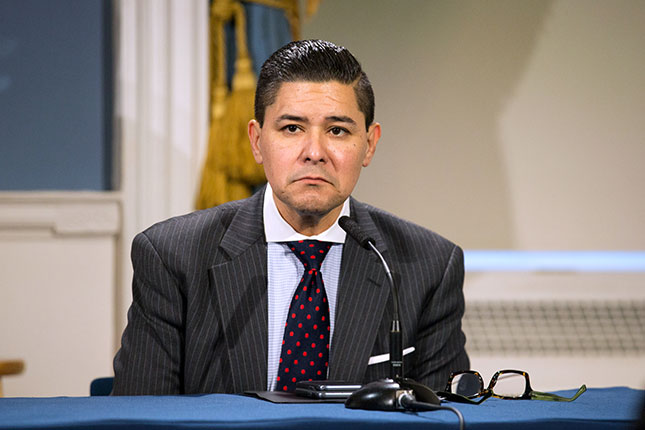
https://media4.manhattan-institute.org/sites/cj/files/NYC-Schools-Chancellor-Richard-Carranza.jpg

New York City Schools Chancellor Richard Carranza (Photo by William Farrington-Pool/Getty Images)

Simply put, these parents don’t believe that the city’s measures of fairness and equity recognize their sacrifices. “The mayor thinks there are too many Asians in the specialized high schools, but he never asked why there are so many Asians,” says blogger Ling Fei.

Without much understanding of American racial politics, new Asian immigrants defending merit-based admissions can find themselves vulnerable. Critics have charged that their traditional reverence for meritocracy renders them pawns, used by whites to defend their privilege.

State senator John Liu believes that de Blasio’s ham-fisted management of the issue created much of the turmoil. Pointing to the declining use of standardized tests in high schools and colleges, Liu says, “the high-stakes exams were steadily losing favor even before the pandemic.” He identifies a trade-off between equity and excellence but says that these measures are incompatible when viewed through the historical black–white prism of U.S. race relations. “Equity is about fairness, and excellence requires some human measurement which, in this country, has often been discriminatory against blacks,” he says. “For many Asian immigrant families, they have no part of that perspective. The perspective they have is a cultural one where people prepare their entire life to take exams.”

Of course, Asian Americans are far from monolithic. Sometimes the fiercest opposition they face is within their own households, from their American-educated, second-generation children. “When you look at critical race theory, you can see that Asian Americans have always been used as a wedge,” says Vanessa Leung, favorably citing the movement that advocates its version of social justice on racial, legal, and political issues. Leung, chairwoman of the PEP, joined the majority in voting to jettison the G&T test. “We cannot allow the system to sometimes use Asian Americans as a model, and other times vilify us,” she says.

Born in New York to a Hong Kong immigrant family, Leung says that she lived in a bubble until she took Asian-American studies courses in college. She doesn’t think her own parents fully understand the history of the Jim Crow South, or even of Chinese exclusion in the U.S. In her telling, immigrant parents realize that their children face racism in the U.S. and see educational achievement as a way to protect them. But instead of different ethnic groups fighting each other for limited resources, she says, the focus should be on building a fairer system for all. “When you say the kids who get into these schools, they test fine, they work hard, and they deserve it, it perpetuates the inequity for all sides,” said Leung. “It erases the struggle so many families face and makes them think, ‘it must be my fault,’ when the system is set against them in a lot of ways.”

Others familiar with the history have a different opinion, arguing that Asians have been persistently mistreated precisely because they excel. Wai Wah Chin, a former president of the Chinese American Citizens Alliance Greater New York (CACAGNY), a chapter of a group founded in 1895, says that the contemporary mindset that attacks Asian students and parents for working hard can be traced back to the circumstances that triggered the Chinese Exclusion Act 139 years ago. The notorious law was created, she says, because Chinese railroad workers worked faster than others and made white American workers feel threatened: “We were excluded because we did better than others. Does that sound familiar?”

Amid all the disagreement, it’s undeniable that Asian Americans have made their voice heard. On January 28, at a mayoral-candidates forum hosted by PLACE NYC and moderated by reporter Arthur Chi’en, five hopefuls—Eric Adams, Kathryn Garcia, Ray McGuire, Loree Sutton, and Andrew Yang—discussed education. All vowed to build more specialized high schools, expand G&T programs, and fire Carranza, though none seemed especially inclined to retain single-test-based admissions. Nearly 1,000 people watched live via Zoom and YouTube, and the organizers hired a professional interpreter for Chinese speakers.

The forum was a big moment for Yiatin Chu, the co-president of PLACE NYC. The Taiwan-born stay-at-home mother co-founded her group with other parents in the summer of 2019 and has mobilized it since. When the PEP decided to terminate the G&T exam, Chu’s group circulated a petition asking the mayor to hold a revote. PLACE NYC has met with candidates in borough-president and city council races and works to register voters. “We all learned that our public education is very much in the hands of elected officials, from funding and mayoral control to oversight,” says Chu. “It is very important that we connect with them and help them understand the issues from our standpoint.”

The use of critical race theory, or CRT, by those seeking to abolish testing has added to the debate’s intensity. CACAGNY, which has co-hosted seven forums for city council candidates, issued a statement calling CRT a “hateful fraud” and a “common source of anti-Asian racism.” Phil Wong, the president of the group and a plaintiff in a lawsuit against the SHSAT proposal, compares CRT with the darkest periods of recent Chinese history: “China’s Mao used to call the tools he adopted to push forward his Communist agenda the ‘three red flags,’” he says. “I think the CRT sounds like one of the Communist ‘red flags.’”

Even those disagreeing with that comparison concur that the political awareness raised by these fights could be a watershed for the Asian community. Chris Kwok, a professor at Hunter College and an early pioneer in the campaign to keep the SHSAT, supports critical race theory. He says that he sometimes feels frustrated working with new immigrant parents, who can grow more radical and less willing to hear other views. At the same time, though, Kwok is happy to see that 13 Chinese Americans, including five recent immigrants from mainland China, are running for city council this year—a record number. “This is a turning point for New York City,” says Kwok, who has shifted his focus to encouraging Asian political participation. “We are not going to be able to shape people left or right. But we want overall greater Asian representation and advocacy in the New York City government.”

Competing for a Queens seat against at least 12 other candidates is Donghui Zang. He sometimes feels besieged, aware that anti-test sentiment is gaining ground. But some old memories from China give him hope. “The Cultural Revolution in China suddenly ended in 1976, and the college entrance exams resumed in 1977,” he says. “A lot of historic trends that seem perpetual are like this. . . . When the turning point arrives, you need to be prepared.”

Top Photo by Peter Kramer/Getty Images

Friday, February 23, 2018

Pocahontas speaks with a forked tongue

Wednesday, December 21, 2016

The 'Diversity' Fraud

Thomas Sowell Dec 20, 2016

Nothing so epitomizes the politically correct gullibility of our times as the magic word "diversity." The wonders of diversity are proclaimed from the media, extolled in the academy and confirmed in the august chambers of the Supreme Court of the United States. But have you ever seen one speck of hard evidence to support the lofty claims? .........It is common, at colleges and universities across the country, for the test scores of Asian American students who have been admitted to a given college to be higher than the test scores of whites or of blacks or Hispanics......In short, something very much like the quota limits that were applied to Jews in the past are now being applied to Asian Americans -- and, once again, are being justified by diversity.

But what justifies diversity? Nothing but unsupported assertions, repeated endlessly, piously and loudly.   Today, as in the past, diversity is essentially a fancy word for group quotas. It is one of a number of wholly subjective criteria -- such as "leadership" -- used to admit students to colleges and universities according to their group membership, rather than according to their individual qualifications......To Read More....


Tuesday, September 24, 2013

Labor Department Imposes Disability Hiring Quotas, Even in Divisions that Don’t Get Federal Contracts

by Hans Bader on September 23, 2013
The Obama Labor Department has just finalized rules that will effectively require businesses that get federal contracts to adopt a 7 percent hiring quota for the disabled. Much of the American workforce is employed by a federal contractor, since most large companies have federal contracts. So this will affect much of the economy, and impose massive new costs on American business.
Disturbingly, the new rules require a 7 percent quota not just for the division of the company that receives a federal contract, but for the company as a whole. And they require that the 7 percent quota be met not just for the company as a whole, but also in each line of business in the company. That means they effectively must be met even in job categories where the number of disabled people is lower than average, either because the qualified labor pool is disproportionately able-bodied (like those that require hard physical labor) or because the job is not compatible with certain mental or psychological impediments that qualify as disabilities.
As the Cato Institute’s Walter Olson notes, the rules impose quotas in all but name; the director of the Office of Federal Contract Compliance Programs….To Read More….

Monday, October 15, 2012

Awesome. Florida to adopt race based academic goals

posted at 5:01 pm on October 14, 2012 by Jazz Shaw
I would have brought this story up earlier, but the first couple of times I saw it mentioned on Twitter I’d assumed that it was either a joke, an article from The Onion, or some sort of intentional hoax. But as it turns out, at least according to the local news, the state of Florida’s Board of Education has decided to throw in the towel on education and will institute a new set of target goals for the percentages of students achieving academic success based on… their race.  To Read More.....

Friday, October 12, 2012

University Of Texas Violates Court Decisions On Use Of Race In Admissions

When journalists and commentators discuss the Fisher v. University of Texas case, they seem to grapple only with whether the University of Texas’s race-conscious admissions policy complies with the 2003 Grutter decision, which upheld a law school’s use of race in a 5-4 vote.  But they never discuss whether it complies with the restrictions on using race in many other Supreme Court decisions, such as another case decided the same day as the Grutter decision, the Supreme Court’s decision in Gratz v. Bollinger. Gratz laid down additional restrictions on using race, and struck down the University of Michigan’s undergraduate admissions policy. The Gratz decision says universities must prove their use of race is narrowly-tailored and used no more than necessary. This could be fatal to the University of Texas, which seems to assume those challenging its use of race bear the burden of proof on every issue, such as whether it could achieve a diverse class without using race, or without using race so heavily. The Gratz decision also is binding precedent, decided by a 6-3 vote (although only five justices joined in the majority opinion in that case).  To Read More…..   

Further reading....and I really do recommend reading both of these article in order to get a clear picture of just how insane this has become.

Unbridled Use of Race in School Admissions Must be Curtailed
Race-based student goals prompt controversy in South Florida
My Take – As you read this you can only come away with one conclusion.  Absolutely no one has a clue about what is right, wrong, legal, or illegal…including the Congress, the Supreme Court and the whole thing is a mess.  I have the answer.  Eliminate any quotas of any kind by any government, state, local or national.  Let the university regents set their own admission standards for whatever reason they please.  Eliminate government grant money to the colleges and universities.  Make all universities private self funding institutions. 
Wow!  Now that is a shocker isn’t it.  But that is what it will take.   

Will some institutions attempt to keep blacks out? Yes.  But there will be some that will keep Jews out, some that will keep Orientals out, etc.  So what?  This would be the perfect opportunity for every group that is being excluded unfairly based on race or ethnicity to form their own universities with their own standards, hopefully higher standards.  If they are unable for financial reasons or there isn’t sufficient numbers of a particular group, then other opportunities will have to be taken advantage of until those factors change.  If they are unwilling, then they should be allowed to go their own way. 

The most important group that ALL of these self funding institutions will keep out are those who are academically unworthy.  

Now…..”That’s a good thing”! RK