Search This Blog
De Omnibus Dubitandum - Lux Veritas
Tuesday, October 28, 2025
Carthage Must Be Destroyed!
Wednesday, June 18, 2025
EPA Gets Moving On Its Push For Energy Deregulation
/ Francis Menton @ International Liberty, Tags: Energy and the Environment, Trump, Federal Regulations, 12 Comments
Now coming into view are the specifics of EPA’s strategy to end the Obama/Biden efforts to strangle the energy sector of the economy in the name of “saving the planet” from climate change. A document released by EPA last week on June 11 lays out the plan for repeal of the absurd (and dangerous) regulation that would have ended use of fossil fuels to generate electricity by some time in the 2030s. This EPA document is particularly interesting for the way it treats — and effectively sidelines — the so-called Endangerment Finding, the 2009 regulatory action that is the basis for all of the Obama/Biden fossil fuel suppression efforts.
President Trump made it clear from the first day of his new administration that he intended to undo as many as possible of the Obama/Biden era burdens and restriction on American energy production and use. Among the Executive Orders that Trump signed on “Day 1” (January 20, 2025) was one titled “Unleashing American Energy.” All agency heads were directed to review existing energy regulations for potential rescission as being overly burdensome. Excerpt:
Sec. 3. . . . (a) The heads of all agencies shall review all existing regulations, orders, guidance documents, policies, settlements, consent orders, and any other agency actions . . . to identify those agency actions that impose an undue burden on the identification, development, or use of domestic energy resources — with particular attention to oil, natural gas, coal, hydropower, biofuels, critical mineral, and nuclear energy resources. . . .
On March 12, EPA followed through with an announcement of what it called the “biggest deregulatory action in U.S. history.” The announcement identified and listed some 31 EPA regulations and programs as unduly burdening the American economy, and therefore targeted for extinction. These ranged from rules designed to eliminate fossil fuel-fired power plants (called “Clean Power Plan 2.0,” or CPP 2.0), to rules restricting automobile emissions (and effectively mandating electric vehicles), to the massive “greenhouse gas reporting program,” and many, many more. The first item at the top of the list for elimination was CPP 2.0. However, at that time, the actual process for rescinding these various rules had not yet begun, and it remained unclear what approach EPA might take to effect the rescissions.
As regards CPP 2.0, that ambiguity ended on June 11, when there appeared on EPA’s website a “pre-publication” version of the document intended to initiate the rescission of CPP 2.0. The title is “Repeal of Greenhouse Gas Emissions Standards for Fossil Fuel-Fired Electric Generating Units” The actual regulatory rescission process formally begins when this document gets published in what is called the Federal Register. Apparently, that will occur tomorrow, June 17.
There are several notable things about this document. First, it signals that CPP 2.0 will be eliminated through a process of formal “notice and comment” rulemaking under the Administrative Procedure Act. Second, it lays out the schedule and procedures for the rescission, thus giving an indication of when the process will be concluded (and ripe for judicial review). Third, it provides the rationale for the rescission, grounding that rationale in the language of the relevant statute (here Clean Air Act Section 111). And fourth — and most significant in my view — it uses a rationale that implicitly undoes and undermines the Biden-era “Endangerment Finding” that underlies all of the government’s greenhouse gas regulations. And it does that without ever confronting the so-called “science” of greenhouse warming. I’ll take these points one at a time.
The first seven or so pages of EPA’s document set forth the procedure and schedule of the prospective rescission. There will be a virtual public hearing 15 days after Federal Register publication (thus, in early July). Comments will be due 45 days after Federal Register publication. That means that the comment period can be closed by some time in early August. After that, EPA must respond to the comments before finalizing its action. They will want to be careful in doing that. (Any slip-up can give an opening to a court to enjoin its action.) However, relative to other rule makings, there will be no occasion in this one to modify the rule’s language in response to comments, since the rule is being eliminated entirely. I highly doubt that any commenter is going to dissuade the current EPA from rescinding this rule. While this is somewhat speculative, I expect that the rescission can be finalized by early fall. And then, on to the litigation!
Note that EPA is not taking the alternative route of just asserting that CPP 2.0 is illegal as unauthorized by the Clean Air Act and beyond the powers of the executive branch pursuant to the Major Question Doctrine as articulated in West Virginia v. EPA. The administration may well use that theory as an alternative basis to support repeal of CPP 2.0 when their regulatory action gets challenged in court. However, I think they are wise to add a second rationale to support the repeal.
Now to the interesting part of EPA’s document. The basic approach to getting rid of CPP 2.0 is not to try to attack it on the basis of the badly flawed so-called “science” of greenhouse gases and global warming. Rather, the approach is to carefully parse the language of Clean Air Act Section 111 to emphasize words that were ignored or downplayed in the previous regulatory actions.
Many discussions of the Obama-era Endangerment Finding speak of EPA supporting its prior regulatory action by having made a determination that greenhouse gases constitute “a danger to public health and welfare.” That is a shorthand which I admit I have myself been guilty of using. But the actual words of the applicable statute are different. Here are the relevant words of Clean Air Act Section 111(b)(1)(A):
[The EPA Administrator] shall include a category of sources in such list [of sources of pollutants] if in his judgment it causes, or contributes significantly to, air pollution which may reasonably be anticipated to endanger public health or welfare.
Thus, it is not sufficient to satisfy the words of the statute that greenhouse gases in the aggregate or in general might be anticipated to endanger public health or welfare in some way. Rather, there must be a determination that emissions from this category of sources specifically (here, U.S. electric power plants) are reasonably anticipated to cause or contribute significantly to a danger to public health or welfare. And also, by the words of the statute, this determination is committed to the judgment of the EPA Administrator.
There is some endless discussion in the document of the impact of these semantic nuances. Here is a small sample from pages 52-53:
Consistent with its ordinary meaning, the term “significant[]” is defined as “having or likely to have influence or effect: important.” “Important” is similarly defined, in turn, as “marked by or indicative of significant worth or consequence : valuable in content or relationship.” Whether a source category’s contribution to air pollution should be considered “important” or “valuable” entails consideration of the influence, effect, or usefulness of finding such contribution. If regulating emissions of a particular pollutant from a source category would have little effect on dangerous air pollution, that source category’s contribution to the air pollution is not significant.
By the same token, if regulating emissions would not be useful, taking into account, inter alia, the impacts on, and the Administration’s policies concerning, the source category, that source category’s contribution to the air pollution is not significant. An inquiry into the effect of a finding of significance necessarily involves policy considerations that will inform any subsequent regulation when making the significance determination in the first instance.
The Biden administration’s CPP 2.0 had sought to eliminate fossil fuel-fired power plants by imposing an uneconomic requirement of carbon capture and storage on any such remaining plants. But this document explains that that approach cannot comply with the statutory text:
Thus, the control options available to reduce GHGs from fossil fuel-fired EGUs [Electricity Generating Units] are not permissible as BSER {Best System of Emissions Reduction], not adequately demonstrated, cost unreasonable, or potentially ineffective in reducing emissions. Because it is likely that the Agency may be unable to develop a BSER that would result in any meaningful, cost-reasonable GHG emission reductions, the contribution of this source category to GHG air pollution is not significant.
And the Trump EPA has also caught on that greenhouse gas emissions from the U.S. power plant sector have no “significance” when the broader international picture is considered. From page 63:
Unlike other air pollutants that can have a localized or regional impact and direct consequences to human health, GHGs are global pollutants. The share of GHG emissions from the U.S. power sector, including CO2, to global concentrations of GHGs in the atmosphere is relatively minor and has been declining over time. In 2005, U.S. electric power sector GHG emissions comprised 5.5 percent of total global GHG emissions.
This percentage has fallen steadily since then to 4.6 percent in 2010, to 3.7 percent in 2015, and comprising 3 percent of total global emissions by 2022. This relative decline is driven in part by increases in GHG emissions from developing countries that are rapidly electrifying and increasing their energy demands, including through the robust deployment of fossil fuel-fired EGUs —a trend that is likely to persist going forward. Further, many other countries burn much more coal than is utilized by the U.S. power sector. For example, in 2024, China used more than 13 times as much coal as the U.S. . . . Limiting the use of coal and other fossil fuels in U.S. EGUs does not significantly impact global GHG concentrations when other countries continue to increase their use of fossil fuels.
There is lots of other good stuff in this document — far more than I can quote here. To be fair, EPA is following the tried and true regulatory strategy of burying the public in verbiage as a way to make it as difficult as possible for a court to intervene.
As can be seen from the above, this proposed regulatory action relates to CPP 2.0 specifically, and not to the Endangerment Finding more generally. Nevertheless, the logic expressed in this document has the effect of undermining the EF and rendering it essentially ineffective.
The same arguments as to “significance” of U.S.-based emissions, and as to the EPA Administrator’s right to exercise his judgment under statutory language, will apply to all other sectors where the Obama/Biden administrations had sought to suppress the use of fossil fuels.
All the environmental groups that have been gearing up to defend the “science” of global warming are going to need to totally re-tool their arguments.
Monday, April 28, 2025
Red Tape, Part I: The Size of the Regulatory State
April 25, 2025 by Dan Mitchell @ International Liberty
I first started writing about the Competitive Enterprise Institute’s annual report about red tape back in 2010.
The newest edition was just released, so let’s take a depressing look at America’s regulatory burden.
We’ll start with the chart showing the enormous regulatory costs per household. More than food, clothing, transportation, or health care!
As you might expect, the burden or red tape has dramatically increased over time, with the 1970s being especially bad (I assume mostly the fault of Richard Nixon since Jimmy Carter actually oversaw some very successful deregulation).
Let’s look at some excerpts from the author, Clyde Wayne Crews.
While new spending programs show up in budget figures, new regulations requiring the private sector to do similar things at its own expense do not. Off-budget regulations have grown common… Off-budget or not, these regulatory costs drag down the economy, much as over-spending can. …regulatory compliance costs and mandates borne by businesses percolate through the economy and materialize as higher prices, lost jobs, and lower output. …
When the administrative state began its march over a century ago, few imagined the tangle of hundreds of thousands of rules and guidance documents it would produce… This 2025 edition sets a new mark of $2.155 trillion in regulatory costs. …US households pay on average $16,016 annually in a hidden regulatory tax, which consumes 16 percent of income and 21 percent of household expenses. …
The 10.5 billion hours Washington says it took to complete federal paperwork in 2023, according to the Information Collection Budget, translate to the equivalent of 14,983 human lifetimes.
By the way, 10.5 billion hours is also akin to more than 5 million people working full time for a year.
In other words, Americans are paying a lot for our red-tape obstacle course.
I’ll close with one more visual from the report.
This should be very disturbing.
We have far too many laws (I favor unproductive congressional sessions), but the number of new laws is dwarfed by the number of new rules and regulations.
P.S. Trump’s overall regulatory record during his first term was imperfect, but he did slow down the growth of red tape. This is one of the areas where I’m optimistic about how he will do during his second term (unlike trade, ahem). Heck, I’ve already written about his Liberation Day for shower heads. Since that step increased our freedom, it was the complete opposite from his Liberation Day for trade.
Friday, March 28, 2025
The Expensive Quicksand of Red Tap
I’ve shared Kite & Key videos about Social Security, comparative economics, free trade, the national debt, patriotism, and free markets.
Here’s their video on the under-appreciated problem of permitting and red tape.
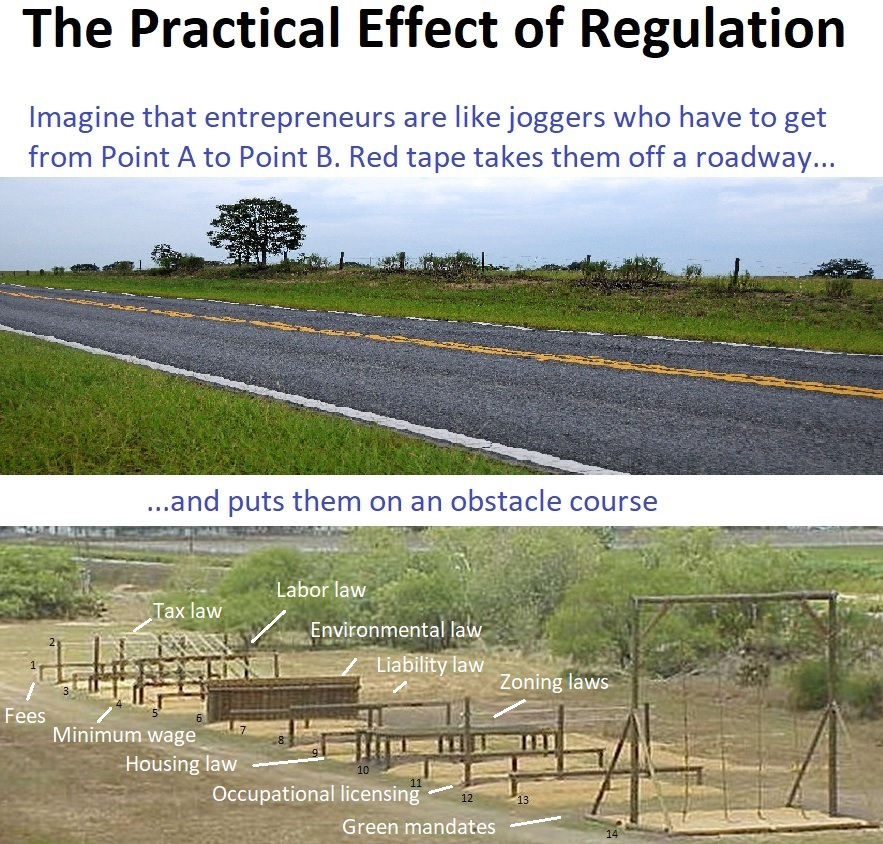
This video is tangible evidence for my proposition that red tape is akin to an obstacle course.
Not only does regulation make everything more expensive, it also means it takes much longer to go from Point A to Point B.
Or, in the examples cited in the video, to go from planning something to building something.
I’ve written about some of those examples, including the infamous 2nd Avenue Subway and California’s high-speed rail boondoggle.
These wasteful projects are great for insiders, who rack up massive fees, but they are very bad news for taxpayers and the economy.
Fortunately, we may get some relief from the Trump Administration, as reported in the Hill last month by Rachel Frazin and Zack Budryk. Here are some excerpts.
The Trump administration has tossed decades of environmental policy — laying the groundwork for an overhaul of how the federal government implements a bedrock environmental law. …the National Environmental Policy Act (NEPA)…requires the federal government to consider the environmental consequences before approving infrastructure projects ranging from roads and bridges to oil and gas pipelines to solar farms. …for decades, the federal government has relied on White House and agency regulations to spell out how to go about doing those environmental assessments.
This week, the Trump administration rescinded all White House regulations directing the implementation of the law, including some that go back to 1978. …Under the Trump administration, agencies are likely to take an approach that maximizes the speed of approving new projects and minimizes environmental considerations.
Kudos to Trump.
He was fairly good on regulation in his first term and it’s good to see him being aggressive to start his second term.
That being said, the federal government is not the only problem.
A story from last month by Rachel Siegel in the Washington Post reveals how red tape is creating a second tragedy for victims of wildfires.
Here are some relevant passages about some unfortunate residents in Hawaii.
Construction crews have hauled away toxic debris, but entire neighborhoods still sit empty. Only six homes have been rebuilt in the county. Much of the town sits in the purgatory… But the months since have given way to a different kind of crisis — of grinding bureaucracy, soaring housing costs and growing frustration. It’s also a forecast, experts say, for what is likely ahead in Los Angeles .........residents still say they are stuck in the slog.
Permits — a crucial step to constructing a house or business — take months or longer to come through. Only a handful of people have finished rebuilding, and many others aren’t sure if they can as they navigate a dizzying maze of zoning and construction rules. …
“We’re at the point now where we should have been a year ago,” said Warren Freeland, whose family lost the historic Pioneer Inn in Lahaina’s wildfires. …After a wildfire, there’s often a life cycle to recovery. That starts with an immediate emergency response… Full recovery can take five years or more… The permitting process has become a major roadblock for people eager to rebuild homes and businesses. The process can cost hundreds of thousands of dollars…A few local and state rules might smooth the process. One bill would let people rebuild properties that don’t conform to current codes but were legal when they were first built.
As you might suspect, the same problem exists in Los Angeles.
There are signs of a similar crisis in Los Angeles County… Immediately after the disaster, Gov. Gavin Newsom (D) promised to “cut red tape,” including by waiving certain regulatory and environmental laws so Los Angeles fire victims could rebuild faster.
Since Newsom wants to run for president, he has an incentive to show positive results, so maybe he’ll do something good.
Based on his track record, we can be skeptical. But political ambition often trumps ideology (as explained by “public choice“), so there’s some hope.
P.S. Here’s some evidence about the negative overall impact of red tape.
Wednesday, January 15, 2025
Europe Takes a Bite Out of America's Apple
Stephen Moore
|
Jan 15, 2025
Editor's Note: Some years ago I met Stephen Moore and asked for permission to publish his articles and he agreed. This appeared at Townhall.com RK
Envy is an ugly thing -- one of the seven deadly sins.
Europeans have long been dripping with jealousy that American firms dominate the tech sector -- cellphones, search engines, social media platforms, artificial intelligence and robotics. Our "magnificent seven" tech companies -- including Google, Nvidia, Apple and Amazon -- saw massive stocks market gains in 2024. Meanwhile, Europe has flatlined.
One reason for this success: The United States innovates while Europe regulates. Instead of fixing their economies, the European Union bureaucrats want to kneecap America's tech success stories with lawsuits and regulatory barbed wire fences to keep American firms from competing on a level playing field.
Their first target was Google, with a rash of expensive antitrust lawsuits against search engines.
Even worse, the EU bureaucrats are waging war against Apple with the "Digital Markets Act" -- a law that requires "contestable and fair markets in the digital sector."
They are also demanding of Apple something called "interoperability," which absurdly requires Apple to hand over access to its private operating systems to its competitors and will require iPhones to offer competitors' applications. This makes as much sense as requiring McDonald's to offer Burger King fries with their Happy Meals.
The iPhone's amenities and apps are part of a package deal that have made these devices the most popular in the world, with billions of customers. This hardly sounds like monopolistic behavior. If people don't like Apple's apps, there are many other cellphone products (such as the Galaxy) made by Samsung, Google or other companies, including some in China, that consumers can turn to.
For all the talk about Apple's monopoly, it now controls slightly less than 20% of the global cellphone market.
What is especially dangerous about interoperability is what it means for security and privacy. If third parties are given unfettered access to the Apple platform, this shield of privacy will be pierced.
Apple warns that outsiders could "read on a user's device all of their messages and emails, see every phone call they make or receive, track every app that they use, scan all of their photos, look at their files and calendar events, log all of their passwords, and more."
But the biggest danger of these kinds of raids on successful companies that spend billions of dollars innovating is that the incentive to innovate at all is stifled -- in which case everyone loses. Sharing patented information with competitors in the name of "fairness" is a socialist idea that has rusted the Eurozone economy.
If Europe wants to get back in the tech game, EU bureaucrats should focus on what made these companies so successful in the first place -- and then try to create a public policy environment that will foster innovative companies that can compete and win -- rather than run to the courts for protection. Punishing the winners is a good way to keep producing losers.
Thursday, January 9, 2025
A Parting Insult to American Households from Joe Biden
January 8, 2025 by Dan Mitchell @ International Liberty
Environmental zealots and meddling politicians are undermining our quality of life.
- They have given us substandard toilets
- They have saddled us with inadequate washing machines
- They have forced us to use dribbling showers
- They have endangered us with dysfunctional gas cans
- They have tormented us with crummy dishwashers
- They have moved to curtail and ban gas stoves
- They have compelled us to use inferior light bulbs
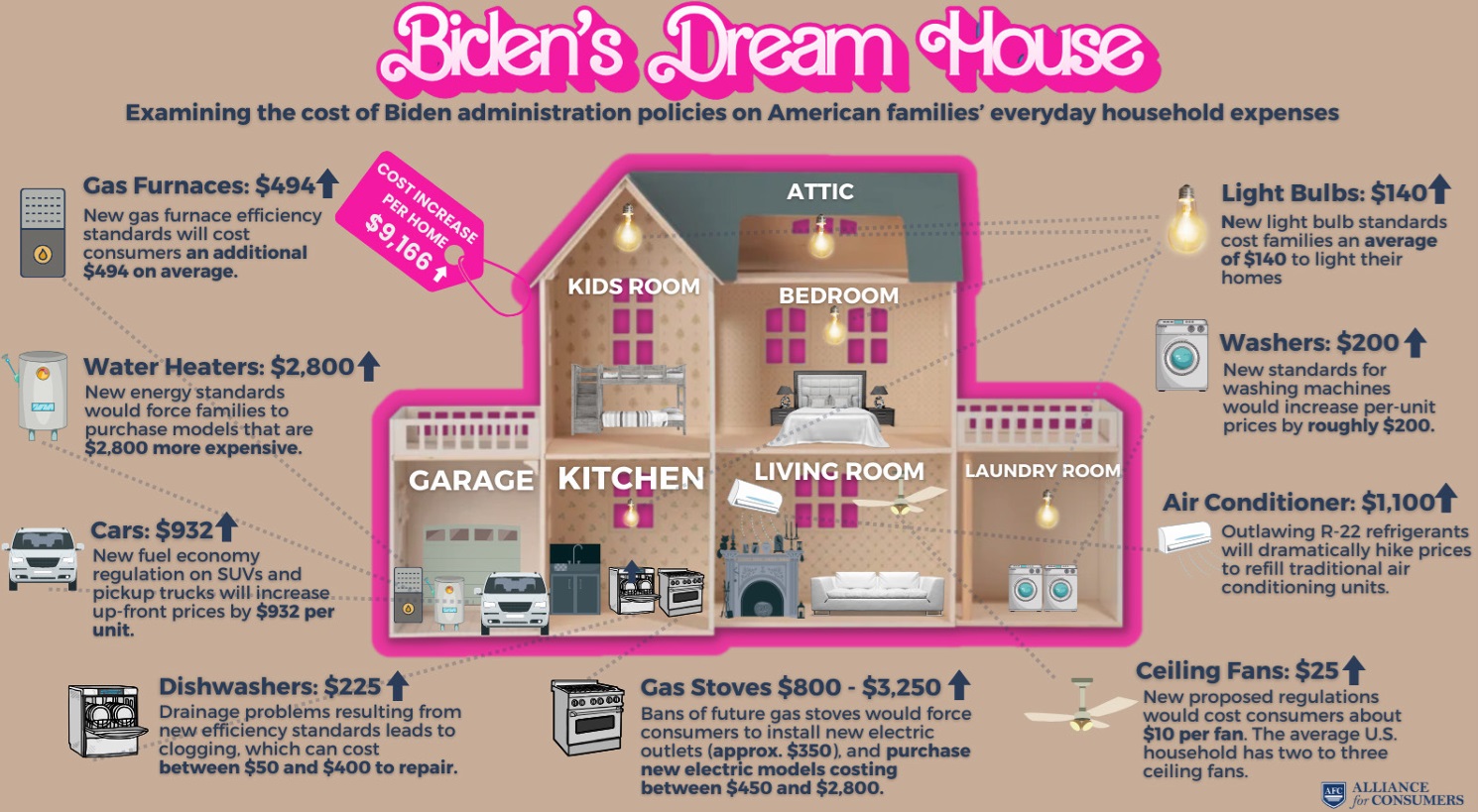
Courtesy of the Alliance for Consumers, here’s an amusing depiction of how these types of policies have increased the cost of living.
Unfortunately, Joe Biden is trying to make a bad situation even worse.
In the final days of his administration, federal bureaucrats want to make hot water heaters more expensive.
Here are some excerpts from a report in the New York Post by Ryan King.
A Biden administration ban on certain natural gas water heaters as part of the lame duck president’s climate agenda could send prices soaring for the elderly and the poor. Under the policy, new non-condensing, natural gas-fired water heaters will be prohibited for sale starting in 2029…
The policy comes during President Biden’s twilight days in the White House and was quietly announced without a press release. …Customers will be pushed towards buying models that are more expensive or lean on non-instantaneous storage tank water heaters, which are generally cheaper but tend to be less efficient than the ones that are facing a ban… “Forcing low-income and senior customers to pay far more upfront is particularly concerning. DOE’s decision to go ahead with a flawed final rule is deeply disappointing,” Matthew Agen, the American Gas Association’s chief counsel for energy, told the outlet. …President-elect Donald Trump is set to take office on Jan. 20 and has expressed interest in reversing some of Biden’s climate change policies.
Trump has a decent track record on regulatory issues, so my fingers are crossed that this policy (and others like it) will be reversed.
I’ll close by observing that our leftist friends generally have two motives when pushing these types of policies.
- The first motive, which is somewhat logical though overtly paternalistic, is that people should be forced to buy energy-efficient appliances that cost more to buy but are cheaper to operate, thus presumably saving them money in the long run.
- The second motive, which is ideological, is that energy consumption is bad and must be discouraged.
I can understand the first motive, even though I don’t believe in one group of people imposing their preferences on another group of people (even though I agree it’s smart to buy appliances that are cheaper over a lifetime of use).
However, I obviously disagree with the left’s religious-like hostility to energy consumption (which leads them laughably preposterous choices).
Wednesday, November 20, 2024
What Happens After Major Cuts In Government Spending? The Latest From Argentina
Francis Menton @ Manhattan Contrarian
If you believe the messaging of the Trump transition, big cuts in U.S. government spending are coming. Announced cabinet appointments include several who are opponents of the mission of the agencies they will soon be heading. A new Department of Government Efficiency is to be created, headed by Elon Musk and Vivek Ramaswamy, with instructions to take an ax to wasteful programs.
But, assuming that some big cuts actually get implemented, you know what inevitably comes next: Because all government spending is (foolishly) counted as a 100% addition to GDP, the cuts first get recorded as a decline in GDP. Economists on the left (e.g., Krugman) then immediately scream that the cuts have failed, the country has gone into recession, and the people are suffering. In recent U.S. experience, the Republicans have never had the political fortitude to stay the course.
But let’s look at the latest news from Argentina.
Argentine President Javier Milei was elected just over a year ago, on October 22, 2023. He then took office on December 10. The main thrust of his program was major cuts to government spending, and he immediately set to work to accomplish that. While I find it difficult to get comprehensive statistics in English, here are some notable data points:
- An April 23, 2024 article in the Buenos Aires Times reported that, according to the Argentine Institute of Fiscal Analysis (IARAF), for the first quarter of 2024, “primary [government] expenses fell by 28.6 percent year-to-year in real terms (deducting inflation).”
- From the same piece: “IARAF indicated that in the first three months of the year, 15 of 16 categories of spending were found to have declined in real terms, with the exception of universal social protection allowances (10.6 percent).”
- From a piece in Reason magazine, June 6, 2024: In March Milei had announced a cut of 70,000 employees from Argentina’s public sector workforce; and by June, 25,000 of those job cuts had been accomplished. Then, in early June, “Argentine President Javier Milei on Wednesday [June 5] announced the layoff of an additional 50,000 state employees, advancing his effort to "reduce the state in half."
- The result of the large spending cuts was that Argentina’s fiscal balance had swung from large deficit to surplus in the course of mere months. From IARAF via the Buenos Aires Times: “[For the first quarter of 2024] the primary deficit became a primary surplus of 625 billion pesos,” wrote the IARAF. “Interest expenses dropped by 31 percent in real terms from the same month last year. Consequently, a fiscal deficit turned into a 276-billion-peso fiscal surplus.”
The inevitable immediate result of the large cuts to government spending was an official recession, as the government spending was removed from the official GDP accounts. From BBVA Research, October 2, 2024:
[Argentine] GDP contracted by 3.4% in the first half of 2024.
Trading Economics shows similar figures for Argentine GDP: -2.49% for 4Q 2023, -2.57% for 1Q 2024, and -1.7% for 2Q 2024. Actually, those declines were remarkably small given the very large cuts to government spending. Perhaps unnoticed to the statisticians, some entrepreneurial spirits were beginning to awaken among the Argentine people.
And now, what’s the latest from Argentina? It looks like the economy is starting to take off. From Mario Nawfal on X, November 16:
ARGENTINA’S ECONOMIC SURGE: JP MORGAN HIKES GDP GROWTH FORECAST TO 8.5% UNDER MILEI’S POLICIES JP Morgan has raised Argentina’s GDP growth forecast to 8.5%, citing optimism around recent reforms by President Milei. Milei, known for his bold free-market agenda, is pushing plans to dollarize Argentina’s economy, slash public spending, and reduce government intervention — aiming to curb inflation and boost economic stability. This updated forecast signals rising confidence in Argentina’s potential for a turnaround. Source: Buenos Aires Times.
As of this writing it’s still just a forecast. However, all indications are positive. Milei has stayed the course through a first year of strenuous opposition from entrenched interests. The dead hand of government overspending, over-regulation, crony capitalism and handouts has been dramatically loosened.
Now it’s up to Trump, Musk, Ramaswamy, et al., to follow the same course. May they have every success.
Thursday, November 14, 2024
Ideas For An Incoming Trump Administration: Climate And Energy Edition
The arena of climate and energy is sufficiently large that it deserves its own post of ideas for the incoming Trump administration. The Biden people went so far off the rails in this area that there are far more topics than I can cover. I’ll have to stick to some highlights.
Communications.
As I noted in the previous post, changing the communications of the prior administration should be an easy and obvious first priority. However, the Trump people notably did a poor job on this subject the first time out.
The subject of climate and energy is pervasive through the websites of dozens of federal agencies. Let’s just note a few examples:
At the Department of Energy, a big section is devoted to “Combating the Climate Crisis.” From the intro:
There is no greater challenge facing our nation and our planet than the climate crisis. That’s why President Biden has laid out the boldest climate agenda in our nation’s history—one that will spur an equitable clean energy economy and cement America on a path to net-zero carbon emissions by 2050. . . . DOE has long been the nation’s powerhouse for scientific and innovative solutions to the challenges we face, including the climate emergency. Our program offices and 17 National Laboratories are working every single day to research, develop, and deploy the clean energy technologies of the future, including battery storage, renewable power, electric vehicles, carbon capture, and resilient grid infrastructure.
And don’t forget the subject of “Energy Justice,” otherwise known as the scam of justifying vast wasteful subsidies to useless energy sources as some kind of quasi-reparations to minority communities:
For far too long, communities of color and low-income communities have borne the brunt of pollution to the air, water, and soil they rely on to live and raise their families. The clean energy revolution must lift up these communities that have been left behind, and make sure those who have suffered the most are the first to benefit.
Over at EPA, the huge “Climate Change” section of the website pretends that the regulatory onslaught attacking hydrocarbon fuels has something to do with “human health.” Example:
Understanding and addressing climate change is critical to EPA's mission of protecting human health and the environment.
A massive section on “Climate Change Indicators” falsely claims that things like hurricanes, tornadoes, droughts and floods have been increasing and are proof of dangerous climate change. Example:
Tropical storm activity in the Atlantic Ocean, the Caribbean, and the Gulf of Mexico has increased during the past 30 years. Storm intensity, a measure of strength, duration, and frequency, is closely related to variations in sea surface temperature in the tropical Atlantic and has risen noticeably during that time.
At NOAA and NASA, an endless succession of press releases touts the claims that the most recent week, month or year was the “warmest on record.” They somehow never mention that the data set in question only goes back to the late 1800s, and that they lack any data for, for example, the Southern Hemisphere oceans, for almost all of the period in question.
There is no reason why all of this claptrap, and hundreds or thousands of other examples of same, cannot just be wiped away on January 20. Putting up something new can then begin, but is not necessarily a rush.
Executive Orders and Actions
From the day he entered office,President Biden took numerous executive actions and signed a series of Executive Orders directing an “all of government” approach to the climate/energy issue. Examples include:
- “Executive Order on Protecting Public Health and the Environment and Restoring Science To Tackle the Climate Crisis,” January 25, 2021;
- “Executive Order on Tackling the Climate Crisis at Home and Abroad,” January 27, 2021;
- “Executive Order on Rebuilding and Enhancing Programs to Resettle Refugees and Planning for the Impact of Climate Change on Migration,” February 4, 2021.
There are plenty more such. And yes, the official Biden administration line is that the main reason for the surge of illegal migrants across the Southern border is “climate change.”
Also in the executive action category are things like Biden administration efforts to restrict leasing of drilling rights on federal lands, to delay or refuse permits to pipelines and other energy-related projects, and the like.
All of these can be wiped away at the stroke of a pen on day one.
Paris Climate Agreement
Obama joined this Agreement by executive action. Trump exited by the same method. And Biden rejoined, again by executive action, right on January 20, 2021.
Trump could follow the previous method and just quit again. But my preferred suggestion would be to submit the Agreement to the Senate as a treaty. There is zero chance that the Senate would ratify. That would kill this thing much more securely than the other method.
Regulations
“Regulations” are different from mere Executive Orders and actions, in that in order to be adopted they have gone through some complex and time-consuming processes prescribed by the Administrative Procedure Act. The processes are designed to give these “regulations” some purported legitimacy and heft, to make them hard to undo, and to distract the gullible public from the fact that they have not gone through the only process that counts under the Constitution for valid legislative action, namely passage by both houses of Congress and signature by the President. The result of all the procedural rigamarole is that — if you buy the legitimacy of enactment of massive substantive regulations by administrative agencies in the first place — then the processes to eliminate the regulations are the same complex and time-consuming mess that it previously took to adopt them.
The Biden administration has seen a veritable blizzard of major regulations designed to restrict, hobble, and ultimately eliminate the use of hydrocarbon fuels. I have had numerous posts on multiple of these regulations, for example this one from May 1, 2024 on no fewer than four big new Rules from EPA, then-newly-adopted, intended to force the phase out of fossil fuel power plants, and this post from June 8, 2024 on two big new Rules, one from EPA and the other from NHTSA, intended to force the conversion to electric vehicles. These Rules in the aggregate are thousands of pages long. There are other comparable gigantic Regulations sprinkled around dozens of other federal agencies, for example a massive SEC Rule requiring burdensome disclosures of “carbon emissions” for all public companies.
All of these Rules had gone through the lengthy and difficult “notice and comment” process, which involves widely disseminating notices of the proposed rule-making, collecting comments from the public over the course of months (in these instances there were tens of thousands of such), responding to all of the comments, modifying the proposed Rule accordingly, and finally going public with a final Rule after many, many months. I should mention that all of these Rules were then promptly challenged by litigation brought by interested parties, which in this case include large numbers of the red states.
Do the Trump people really need to go through the same labyrinth to rescind these Rules? Here’s an approach I would take: First, announce that the legal opinion of the administration is that the Rules are invalid under Supreme Court precedent (i.e., the “major questions doctrine” of West Virginia v. EPA), and therefore they will not be enforced. Next, announce that permitting on power plant and other fossil fuel projects will take place as if these Rules did not exist. Finally, switch sides in the litigation, and join the red states and other plaintiffs seeking to have the Rules invalidated. Simultaneously, start the rescission process under the APA. It should be completed in about two years.
Cost and feasibility study of Net Zero
So far all of these ideas have been things that many others have thought of. But how about this one that I haven’t seen anywhere else: launch a cost and feasibility study of the plans to transition the U.S. economy to “net zero” carbon emissions by 2050.
It is truly incredible that our federal government has launched a supposed “energy transition,” with an announced goal of reaching “net zero” emissions by 2050, without any cost or feasibility study of whether this can possibly work. Somehow, the bureaucrats have the idea that their job is just to order up a multi-trillion dollar transformation that has never been done before, and then the little people will figure out the details. In the real world the chance that this energy transformation can actually be accomplished are about zero. Meanwhile, enormous damage is being inflicted.
There are plenty of people who understand the problems who could be used to staff the study commission. I’d be happy to volunteer!
Audit the NOAA and NASA surface temperature data
The record of what are called “global average surface temperatures” has been altered and manipulated to reduce earlier-year temperatures and increase more recent temperatures, the better to show a strong warming trend and to support the narrative of dangerous climate change. For more details than you will ever want, see my 33 part series “The Greatest Scientific Fraud Of All Time.”
As a first step, the incoming administration should replace the statements on the existing websites that the most recent month or year was “the warmest ever” with a statement that the surface temperature records have been altered and therefore are not to be used for any public policy purpose. Then start an audit process. As part of the audit, fully disclose the computer code that executes the “homogenization” process of temperature alteration, and disclose quantitatively how much the temperatures have been altered. Any discrediting of the crooks who have been doing the alterations is merely a side benefit.
Rescind the Endangerment Finding
Underlying all efforts of the bureaucracy to regulate CO2 emissions and “climate change” is a regulatory determination made by EPA in 2009, shortly after Barack Obama first took office, the CO2 and other “greenhouse gases” constitute a “threat to human health and safety.” What a crock. The first Trump administration never got around to rescinding this ridiculous regulatory overreach. The existence of the EF gives environmental litigants as evergreen basis to try to force more and more regulation from agencies that are often very willing to go along.
I recommend convening a commission of scientists to evaluate the EF. Key suggestion: anyone who gets any grants from the government for studying climate issues should be disqualified for conflict of interest. The CO2 Coalition should be able to come up with plenty of highly qualified and non-conflicted genuine scientists to study the matter. The EF will shortly be gone.
And finally — Repeal the “Inflation Reduction Act”
The fraudulently-named “Inflation Reduction Act” is the fount of trillions of dollars of subsidies for useless wind and solar energy generators. The subsidies are mostly in the form of tax credits and are uncapped, meaning that they could run into multiple trillions of dollars.
Unlike the other items on this to-do list, repeal of the IRA clearly requires Congressional action. However, note that this is a budgetary item and thus could be included in so-called “reconciliation,” thus requiring only a simple majority vote in the Senate, rather than the 60 votes needed to break a filibuster.
As I said, this topic is so broad that my list here is only a start. I can’t wait for them to get going.
Thursday, October 3, 2024
The Greater "Threat To Democracy", Part III -- Democrats Rule Even If Republicans Win
October 01, 2024 Francis Menton @ Manhattan Contrarian 49 Comments Tags: Biden, Harris, Federal Regulations
Back in July, I had a two posts (here and here) comparing the then candidates for President, Biden and Trump, on the issue of who is the greater “threat to democracy.” The posts reviewed actions of each candidate that may be viewed as such threats. For Trump, those things included J6, plus seeking legal advice and then bringing litigation as to what he claimed was fraudulent conduct in the 2020 election; for Biden, the things included having the prosecutors bring phony criminal charges against political adversaries, engaging in a systematic effort with social media platforms to suppress the opposition’s speech, extra-constitutional expansion of the regulatory state, hundreds of billions of federal dollars to fund the political Left, the student-loan-forgiveness vote buying program, and opening the southern border. Whew — quite a list! Obviously, the contest wasn’t close.
But now comes to my attention another whole category of threat to democracy emanating from the Biden-Harris Administration. This is one I have been somewhat aware of, but I have not been fully aware of the vast extent and systematic nature of the effort. Likely, this category is the worst of all the threats discussed in the extent to which it represents fundamental attack on the constitutional structure. The subject is systematic efforts within the bureaucracy to make it so that an incoming administration after an election is disabled from making changes to the policies or personnel of the outgoing administration.
If “our democracy” means one thing, it means that the people get to choose the President, who then gets to govern in accordance with the principles and policies that got him elected. The main constitutional provision is Article II, Section 1, which states that “The executive Power shall be vested in a President of the United States of America.” Every federal executive department employee must take an oath to “support and defend the Constitution of the United States.” For an executive branch employee, the most important meaning of the oath is that the employee must recognize that the “executive power” is held by the elected President, and the employee must follow the legal direction of the President. For every employee in the executive branch, the elected President is the boss.
And yet recent months have seen numerous reports — and by numerous I mean dozens — of members of the Biden-Harris Administration taking actions to undermine the authority of Trump should he get elected, and to insulate the bureaucracy from the policies that got him elected. In other words, these are steps to completely thwart the will of the voters. I’ll start with a couple of examples today, and will have more in days to come.
Here is a May 27 piece from Politico, with the headline “Biden’s got a plan to protect science from Trump.” Great spin, Politico. “Protect science from Trump” is code for making it such that unelected fascist pseudo-scientists like Fauci can impose their will on the people completely outside the control of voters or elections. From Politico:
The White House fears Trump could try to advance an ideological agenda at the National Institutes of Health, like the ones he’s suggested on everything from vaccines to diversity policies. In an effort to Trump-proof, NIH has designated an official to identify political meddling in the agency’s work and is tasking a soon-to-be-established scientific integrity council with reviewing those cases. . . . The NIH gives out . . . more than $40 billion a year — and, other than a Senate-confirmed director, has long been able to operate relatively free of politics.
The phrase “political meddling in the agency’s work” means any control whatsoever from the elected boss. $40 billion per year with no accountability of any kind. That’s bureaucratic nirvana!
But then, NIH is very small potatoes compared to the EPA. EPA claims the authority — not from any statute, mind you, but rather from their “scientific expertise” in environmental matters — to force a multi-trillion dollar transformation of the entire energy economy of the country. Recent extra-constitutional EPA initiatives include multiple rules finalized in May 2024 to force the closure of electric power plants using hydrocarbon fuels, and other final rules announced in April and June to force manufacturers to make and consumers to buy mostly electric vehicles within a few years. Trump clearly opposes these rules, and for good reason. If he gets elected by the voters, he intends to undo these rules. Can the bureaucracy actually stop him?
Check out this piece from the Huffington Post on May 29, headline “Preparing For A Trump Return, EPA Workers Secure 'Scientific Integrity' Protections.” Here’s the strategy: the EPA workers, via a labor union, have “negotiated” a collusive contract with the corrupt Biden-Harris Administration whereby workers can report “abuses” of “scientific integrity”:
The union representing 8,000 workers at the Environmental Protection Agency just bargained a contract that includes what it calls “groundbreaking” protections for “scientific integrity.” The agreement assures that workers can report any abuses without fear of “retribution, reprisal, or retaliation,” and sends related disputes to an independent arbitrator rather than a political appointee. . . . “The agency agreed the goal was to empower management and staff to prevent inappropriate interference in scientific work,” said Powell. . . . “Scientific Integrity was one of several articles the parties agreed to include in the new [contract] for the first time,” the spokesperson said in an email. “This new article clarifies for AFGE [union] employees EPA’s commitment to a culture of scientific integrity.”
Because after all, “The Science” requires EPA to force you to drive an electric vehicle and to get your electricity from intermittent wind and solar generators.
Do the voters get any say in these matters? Not if the Biden-Harris Administration and the bureaucrats can do anything about it. Could there be any more fundamental “threat to our democracy”? If so, I can’t think of what it is.
A suggestion to Trump for a counter-strategy should he get elected. For any bureaucrat (for example, at EPA) who resists direction from above, first transfer that bureaucrat to the Utah office; and then prosecute that bureaucrat criminally in Utah for violation of oath of office.
Sunday, August 11, 2024
Ranking Regulatory Burdens
August 9, 2024 by Dan Mitchell @ International Liberty
When I write about regulation, it’s usually to highlight how red tape is causing bad outcomes in specific sectors (banking, child care, dentistry, credit cards, the Internet, etc).
But I’m a big fan of jurisdictional competition as a way of limiting bad policy, so I also like when states or countries are ranked on the quality of their policies.
With this in mind, I was very interested to see that Patrick McLaughlin and Dustin Chambers have a new report from the Mercatus Center that assesses states based on the the number of regulatory restrictions.
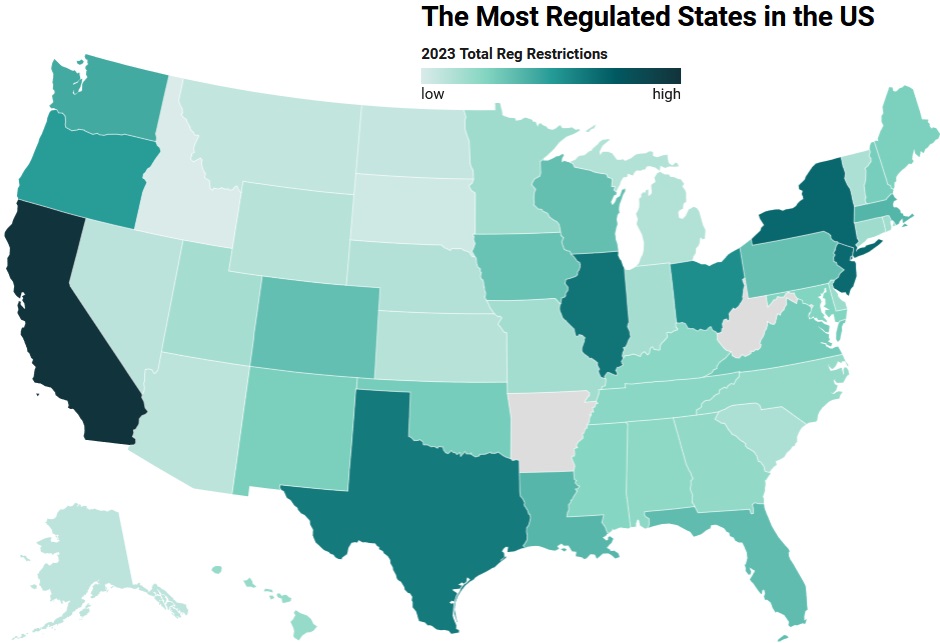
Here’s a map showing the states with the most red tape (dark green) and least red tape (light green).
Here’s how the authors categorize their research.
Mercatus research indicates that regulatory accumulation worsens economic conditions, inadvertently increasing poverty rates, destroying jobs, and raising prices. The path to reversing these trends is clear: Improve regulations by reducing their number. Our State RegData project has produced “snapshots” of state regulations that can help policymakers engage in that process. …Our analysis makes it abundantly clear that the states that have proactively tried to cut red tape have begun to see positive results. Interestingly, those same states that have been able to cut red tape have also enjoyed higher average annual economic growth rates.
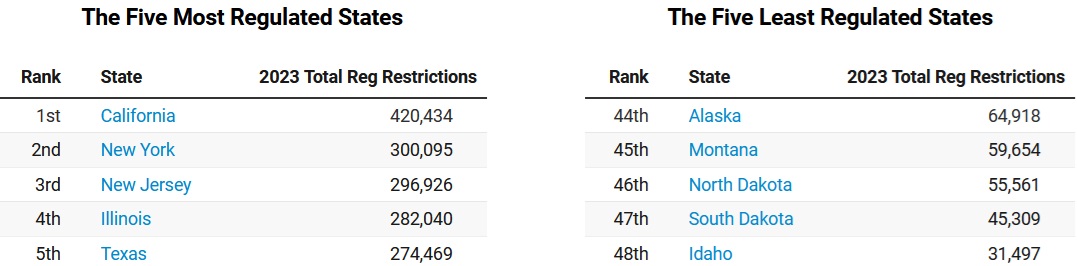
Many of the results are not a surprise. For instance, California is the nation’s worst state for red tape, followed by New York and New Jersey. And I’m not surprised to see that Idaho and the Dakotas are the most laissez-faire states.
But who would have guessed that Texas is the 5th-worst state in the nation?
By the way, traditionally red Ohio is the 6th-worst state and deep-blue Vermont is the 11th-best state, so there are a few other surprises.
P.S. If you want to see how states rank for overall economic policy, I recommend Economic Freedom of North America and Freedom in the 50 States.
Wednesday, July 31, 2024
In One Story, Everything You Need to Know about the Cost of Red Tape
Regulations can be theoretically justified. Proponents simply need to show that expected benefits will be greater than likely costs.
That’s the good news. The bad news is that very few examples of red tape pass this simple test. The net result is that we get lots of costly rules and regulations, but few if any benefits. Some sectors of the economy are especially disadvantaged by excessive red tape.
Today, we’re going to add housing to the list of sectors hurt by red tape. But we’re not going to focus on the cumulative impact of regulation. Instead, let’s look at how just one small slice of red tape is having a big negative effect.
Here are some excerpts from a New York Times column about elevator red tape by Stephen Jacob Smith.
Through my research on elevators, I got a glimpse into why so little new housing is built in America and why what is built is often of such low quality and at high cost. …These challenges are at the root of a mounting housing crisis that has spread to nearly every part of the country and is damaging our economic productivity… Special interests here have run wild with an outdated, inefficient, overregulated system. …
New elevators outside the U.S. are typically sized to accommodate a person in a large wheelchair plus somebody standing behind it. American elevators have ballooned to about twice that size, driven by a drip-drip-drip of regulations, each motivated by a slightly different concern — first accessibility, then accommodation for ambulance stretchers, then even bigger stretchers. …
Architects have dreamed of modular construction for decades, in which entire rooms are built in factories and then shipped on flatbed trucks to sites, for lower costs and greater precision. But we can’t even put elevators together in factories in America, because the elevator union’s contract forbids even basic forms of preassembly and prefabrication that have become standard in elevators in the rest of the world.
The most persuasive parts of his column involve comparisons with Europe.
Just like the U.S. pays far too much to build mass transit, we also pay far too much for elevators.
With around one million of them, the United States is tied for total installed devices with Italy and Spain. …Switzerland and New York City have roughly the same population, but the lower-rise alpine country has…twice as many passenger elevators. …
Behind the dearth of elevators in the country that birthed the skyscraper are eye-watering costs. A basic four-stop elevator costs about $158,000 in New York City, compared with about $36,000 in Switzerland. A six-stop model will set you back more than three times as much in Pennsylvania as in Belgium. Maintenance, repairs and inspections all cost more in America, too. …
America’s reputation for unbridled capitalism and a stereotype of Europe as a backwater of overregulation are often turned on their head in the construction sector. …Adopting the European elevator standard would open up the market to more competition and parts.
By the way, the solution is not to mandate the European regulatory approach, but rather to utilize “mutual recognition” so that builders can opt for that approach.
Though I think mutually reinforcing private regulation would be the best of all worlds.
Sadly, the United States suffers instead from the worst of all worlds. Absurdly expensive regulation combined with special favoritism for unions.
I’ll close by wondering why there are not states and cities in the United States showing how to fix this problem?
If both the Washington Post and Alexandria Ocasio-Cortez can be occasionally sensible on regulatory issues, surely a governor like DeSantis or Reynolds can take the lead on elevator deregulation?
Thursday, July 4, 2024
Chevron Yesterday, Chevron Today, and Anne Gorsuch Burford
By Rich Kozlovich
This article, Chevron is a big, big deal, by Jay Davidson was posted at American Thinker on July 3rd, fittingly as Independence day is drawing nigh, saying:
If you believe in limited government, or fear that government bureaucrats rule every decision, then you’re going to love the ramifications of the Supreme Court’s recent overturning of Chevron v. National Resources Defense Council. Conversely, some prefer not making decisions, or thinks a government employee is somehow better, smarter, less greedy. Those people will hate this decision. Regardless, elimination of the Chevron doctrine is momentous......
He went on to say:
In 1984, the Chevron doctrine (deferral) gave powers, that were supposed to reside with Judiciary and the Legislative Branch, to mere government bureaucrats and regulators across all administrative functions. Chevron was the culmination of a century-long effort to increase the power of one person, the president, through bureaucratic (administrative) control. .......
I addressed that in my article, 1984: The Book, The Court, and Chevron, noting the irony of the book about dystopian government tyranny and the unconstitutional SCOTUS ruling in 1984.
The author went on to say:
In 2024, we see that dictatorship ending. Thanks to SCOTUS, particularly Justice Gorsuch. And, giving him his due, thanks to President Trump for nominating his three justices
“Revenge is a dish best served from a lifetime gig,” write’s Esquire’s Charles Pierce. He refers to the defeat, some 40 years ago, of Burford’s heroic attempt to reform the EPA. Yet there’s no reason to doubt Justice Gorsuch’s capacity to decide objectively the dispute that is at the heart of the case before the court, West Virginia v. EPA. It asks the Nine to roll back the agency’s power to regulate smokestack emissions...........
In years gone by I considered myself an environmentalist, meaning having rational concern about the environment and wanted just laws governing how industry and communities conducted themselves. After so many years reading and writing about the corruption of the EPA I realize those were dark days intellectually. I, as was most of America, and mostly still is, were misinformed, uninformed, and thinking the EPA was a really good thing. It isn't!
One of my personal friends, who is now passed, was Dr.
Jay Lehr, one of the founders of EPA, who helped write their first five
foundational pieces of legislation. Jay said after 1980 they didn't
do anything worthwhile and needed to be dismantled, and in 2014 developed a five year plan on how to do it.
I read Anne Gorsuch
Burford's book, Are You Tough Enough? ", and the fact is she got caught
up in a backstabbing cabal of Deep Staters, environmental activists,
RINO's, Democrats and a corrupt media. When Harry Truman said "If you want a friend in Washington, get a dog", truer words were never spoken.
I remember those days and the media had everyone, including me, thinking she was corrupt, out of control, and had to go, and her supporters disappeared like a morning fog, and mostly because they weren't really supporters, any more than many of those who served in Trump's administration, taking the paycheck he provided and stabbing him in the back the whole time.
Doubts have been expressed that even with this ruling it will be impossible to get rid of the thousands of "entitled, nasty, sucking bureaucrats in these agencies". I don't think so.
These are bureaucrats who will no longer be necessary. I see this as a budgetary issue. In business they’re called involuntary layoffs, and I believe we can get rid of 80% of all the bureaucrats and bureaucracies of the Federal government via the budget, and there are at least 438 of them. Even paying unemployment benefits, the savings would be massive.
Chevron is a momentously big deal, and as time goes by the deal will get bigger, and better, if for no other reason the cost of regulations. All these regulations were, and are, a vanguard to George Orwell's book, 1984, a "dystopian novel and a cautionary tale" who wrote about government tyranny controlling every aspect of human life.
"According to a recent analysis from the Competitive Enterprise Institute U.S. regulatory costs in 2005 were approximately $1.13 trillion, equal to almost half of all of the government's discretionary, entitlement and interest spending ($2.47 trillion), and much larger than the sum of all corporate pre-tax profits -- $874 billion." The cost of Federal regulations ran to a whopping $2.028 trillion in 2012.
The cost of federal regulations to the nation's economy now? According to the National Association of Manufacturers, it's $3.079 trillion.
Worse yet, these regulatory spider webs can, and actually do, make criminals of innocent people just going about there lives. Much of that will now come to an end, but all these regulations will have to be addressed via lawsuits and forced off the books. These agencies won't do it on their own. Well, apparently that's what's happening.
“The era of ‘trust the experts’ is over,” Mandy Gunasekara, who served as EPA chief of staff during the Trump administration, previously told the Daily Caller News Foundation. “There’s no doubt that crafty administrative lawyers will try to find an end run around this ruling. But overturning Chevron deference, alongside the ‘major questions’ doctrine decision in West Virginia v. EPA, has defanged the deep state. This is a huge win for checks and balances and putting the faceless bureaucrats in their place.”


As many know I owned a pest control company for many years and was heavily involved with my industry’s affairs, and Chevron was at the heart of so many issues we dealt with, and I can honestly say I’ve been disappointed in Gorsuch in the past, but certainly not this time.
I don’t know if most are aware that his mother was Anne Gorsuch Burford, the head of EPA under Reagan, and who tried to stop this insanity. She was destroyed by a cabal of bureaucrats, the media, and the green/left, as is discussed in, The Ghost of Anne Gorsuch Burford. (Editor's Note: The link to the original article no longer works. RK) I have no doubt that impacted his thinking from a very young age, and I’m glad he acted on it.
In that 2022 article the author claimed:
With the Supreme Court now set to hear in February a major case over the regulatory powers of the Environmental Protection Agency, some are already suggesting Justice Gorsuch might lack objectivity. The justice’s “tangled history with the EPA” is, Bloomberg reports, a “concern.” It’s a reference to the justice’s mother, Anne Gorsuch Burford, whom, as Esquire retails it, President Ronald Reagan tasked with “running the EPA into the ground.”