Search This Blog

De Omnibus Dubitandum - Lux Veritas

Showing posts with label Michael Fumento. Show all posts

Tuesday, August 9, 2022

“Omicron” Means Enough!

Editor's Note: This was lost in my draft file, but it's as timely now as it was in December 2021, along with a piece that's a composite list of articles from my draft file dealing with this false pandemic hysteria to make sure we don't forget what happened, why it happened, and how it's going to happen again if we forget and fail to be forearmed.  Time and truth are on the same side.  RK 

Michael Fumento Michael Fumento  – December 8, 2021 @ American Institute for Economic Research

We don’t know much about it yet, but Omicron is already prompting many governments to reimpose travel bans – a useless gesture. By the time these bans are in place, the variant is likely already past national borders. Like most of what we’ve done in the “fight against Covid,” travel bans are theater.

The real issue here is how long will we allow variants to be exploited to maintain a permanent Covidocracy?

Omicron does appear to be highly unstable, which is bad. But instability is part and parcel to Covid, much more so than even flu, and vastly more so than most pathogenic viruses from smallpox to measles that appear never to mutate in any appreciable sense.

The apparent good news is that the pharmaceutical companies can deploy a new vaccine to deal with new variants in just 100 days. That’s a fantastic leap in medical science.

And it looks like 100 days is going to be enough for Omicron, and for pretty much any other variant that spreads worldwide. But keep in mind that after 11 months of vaccinating, far less than half the world’s population is fully covered. And many of the unvaccinated simply don’t trust their governments and Big Pharma, and see this as a way to control and jab them forever. Pfizer expects an incredible $36 billion this year alone in pre-tax revenue from its Covid vaccine. The unvaccinated will doubtlessly view further rounds of injections suspiciously.

So in the meantime what can be done? Many will want the same old same old – the “15 days to flatten the curve” routine that scientists and politicians gave us in the early days of Covid. This even as some European countries that promised a return to normalcy were reinstating pre-Omicron lockdowns.

No matter how many times it’s pointed out that we can’t just keep doing this, we just seem to keep right on doing it. It’s like being in the movie “Groundhog Day,” except without any of the fun parts.

We need to accept that a virus that mutates at the rate Covid does is going to have “spin-offs” that are more or less virulent. Evolution favors those that spread most easily, as we saw with Delta. Therefore, regardless of how Omicron turns out, we can expect strains that are more transmissible. Yes, evolution also favors pathogens that are milder because a germ that kills its host reproduces less efficiently. But considering Covid is already so comparatively weak (around a 99% recovery rate even in poor countries), there’s no evolutionary pressure to become weaker yet.

We basically have two sensible ways of dealing with the new variants. One would be a vaccine that targets a portion of the virus that doesn’t mutate so we’re not forever playing catch-up. That’s long been The Holy Grail of flu vaccines, but it doesn’t mean it can’t be done. With both Covid and flu. Governments can offer a prize to the first company that can do this.

Second, as with influenza, we need to learn to live with it. That means precautions become voluntary. The argument against that heretofore has been that health care systems are seemingly always on the verge of being overrun. Star Trek fans will recall that episode after episode the chief engineer Mister Scott said the ship was on the verge of “shaking apart.” But somehow it never did. Likewise, repeatedly we were told health care systems were collapsing but, as with the Starship Enterprise, they somehow “miraculously” survived Covid spikes. It’s just an exciting plot device.

You don’t need to be a conspiracy theorist to see that a lot of people have gained a lot from a perpetual pandemic and therefore want it to continue. No. It’s time for this to end. We need to give this variant a new Greek alphabet name: Omega. As in “The last.”

Michael Fumento

Michael Fumento

Michael Fumento is a lawyer, author, and journalist who has been writing on epidemic hysterias for 35 years.

His Website is www.fumento.com.

Get notified of new articles from Michael Fumento and AIER.

Wednesday, July 27, 2022

At a Glance

By Michael Fumento July 2, 2020

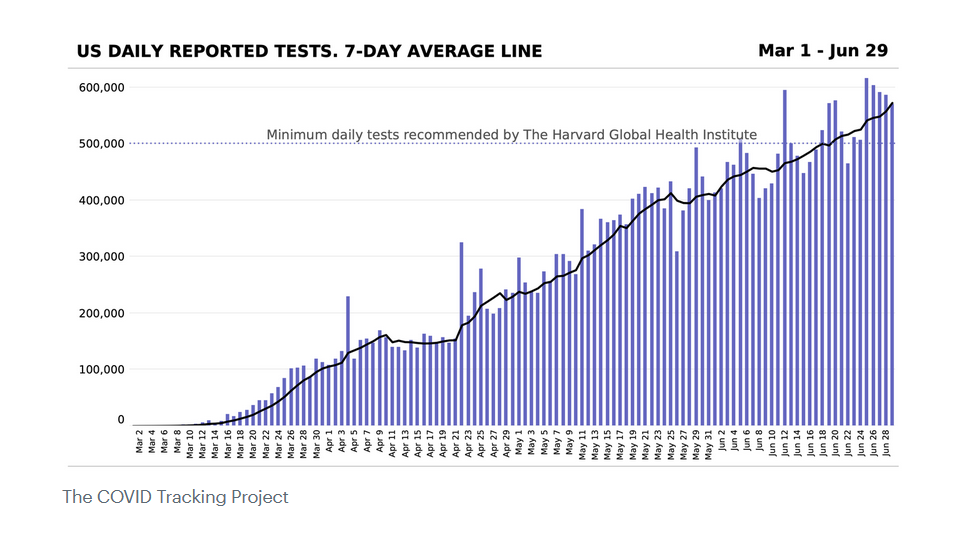
US Daily reported COVID-19 tests through June 29

At a glance, why U.S. Covid-19 "cases" are increasing. With C19 a "test" is labeled a case, notwithstanding that the vast majority of positives have absolutely no symptoms. So the more you test, the more "cases" you get. Yet "curiously" deaths continue to drop. 

No, the epidemic is not getting worse; it's improving.  Media coverage, on the other hand.....

My Take - This observation is two years old, and while there are those who test positive and actually are sick, the vast majority are not, and we have to finally get this.....we will have people get sick from this virus from now on, just like we have people getting sick from the flu every year and tens of thousands dying.  

This virus has a 99.7% recovery rate.  If that's true, and it is, why did the world's governments turn this into a international health crisis with destructive mandates, false vaccines and tyranny? 


Saturday, October 9, 2021

“Green” Europe Looks to Coal Again

Michael Fumento Michael Fumento  – October 7, 2021 @ American Institute for Economic Research

In 1862 we got the Gettysburg Address, in 1941 it was Roosevelt’s Day of Infamy and in 1983 it was Ronald Reagan’s Evil Empire speech. This year it appears we’ll have to settle for Greta Thunberg’s “Blah, Blah, Blah!” keynote speech at the youth climate summit in Milan.

As bad as it was on the merits, it certainly suffers from bad timing. Europe has just started paying a huge price in part for caving in on the sorts of environmentalist demands that Miss Thunberg says are being ignored. Indeed, Europe is suddenly stocking up on all three fossil fuels, and paying exorbitant prices to do so. In turn, so-called “greenhouse gas emissions” (GHGs) will jump. And none of it was necessary, except that her fan base made it so.

“Net zero, blah, blah, blah. Climate neutral, blah, blah, blah. This is all we hear from our so-called leaders – words, words that sound great but so far, have led to no action or hopes and dreams. Empty words and promises.” So said the sour Swede.

In between her blahs and references to “bunny hugging,” she made fun of slogans used by British Prime Minister Boris Johnson and American President Joe Biden. Biden, though, has not been in office even a year, and thus had no chance to implement climate change legislation (for better or worse). The US has been steadily reducing its GHG emissions nationally (down 13% since the 2007 peak) and per capita. UK emissions have also plummeted nationally and per capita, and with apologies to Eliza Doolittle, it’s kicking the EU’s bloomin’ arse.

In fact, the real “culprits” of increased warming are China’s Xi Jinping and (ready for this?) outgoing German Chancellor Angela Merkel.

Thunberg provided little (albeit some) data, so here you go. Yes, GHG emissions have increased since the Kyoto Accord was signed in 1997, and again since the Paris Agreement was signed in 2015. Ambient C02 is the highest measured. But neither accord was meant to stop, much less reduce overall emissions, merely to slow the rate of new emissions.

By this standard, the accords have apparently had a serious impact. GHG “emissions have increased, on average, by 1.1% per year, from 2012 to 2019, which is a markedly lower growth rate than those seen in the first decade of this century (2.6%, on average),” according to PBL Netherlands Environmental Assessment Agency.

The biggest problem is China, which already accounts for 30% of global GHG emissions and twice the amount of the US, which is in second place. Further, China’s emissions are accelerating: its current carbon dioxide (CO2) emissions have grown at their fastest pace in more than a decade, increasing by 15% year-on-year in the first quarter of 2021. China has made some truly spectacular promises, but they appear to be in the same category as their pledge to maintain Hong Kong’s freedoms.

“Yes, China is still categorized as a developing nation by WTO, they manufacture a lot of our products and so on,” as Thurnberg noted in May. “But that of course is no excuse for ruining future and present living conditions. We can’t solve the climate crisis unless China drastically changes course.” (China deftly countered by calling her a Western puppet, suggesting she was overweight (she’s not) and also therefore not really a vegetarian, whatever that means.

The rest of the world cannot compensate for China without drastic steps. We could revert to pre-industrial age economies. Or we could use technology to suck GHGs out of the atmosphere, a technology which does exist, but is ridiculously expensive. Or we could plant more trees, along with grasslands and rangelands that are more efficient CO2 sequesters, which is all well and good but again we just can’t keep up with China.

In fairness, China just wants to provide for its middle class the way the West has provided for its people. But it can be done, as I have argued elsewhere, without forcing the rest of the world back to oxen-drawn plows. Currently China gets 69 percent of its electricity from coal. But China obviously has the latest nuclear technology (begged, bought, or stolen). And while Bill Gates likes to point out that most of the world’s nuclear plants were designed with slide rules and adapted from naval reactors, China has some of the world’s most powerful supercomputers.

The Middle Kingdom already has 49 nuclear reactors in operation, third only to the US and France. It could launch a massive nuclear program imitating the French model of the 1970s and 1980s, a model that essentially eliminated French use of fossil fuels for electricity generation and made it a net exporter. Three-fourths of France’s nuclear infrastructure was built in just seven years, meaning China could likely do the same in five, which is about how long it takes to build a nuclear plant today. 

As for Chancellor Merkel, she has led Europe in exactly the opposite direction. In 2000, nuclear energy from 36 plants provided almost a third of Germany’s electricity. That included the world’s most productive plant. Demand hasn’t risen much since then, so given other carbon-free sources such as hydroelectric and geothermal, it’s entirely conceivable that Deutschland could have phased out not just coal but oil and gas as well.

That’s especially true when we see that nuclear plants in the US have been able to wring ever more power out of the same plants, essentially doubling production. That’s called “nameplate capacity factor.” Capacity factors for US nuclear power plants are currently 92.5 percent, compared to only 55.9 percent in 1975. This improvement is one of the unsung successes of nuclear power, such that generating costs have dropped by about a third just since 2012.

But first the Chernobyl disaster hit in 1986, with perhaps 50 people quickly killed (almost all first responders) and maybe 4,000 more in the future with lower-dose radiation exposure according to a U.N. report.

But that plant was built by the same “who cares?” Soviets who apparently starved 3.9 million Ukrainians to death. That’s as opposed to American Three Mile Island technology, in which the 1979 meltdown led to no measurable health effects. But Chernobyl also prompted a German novel based on a fictitious local nuke plant disaster that may have become the most influential fiction in the country since Mein Kampf.

And then came the Fukushima, Japan disaster in 2011. A 9.0 magnitude earthquake resulted in a massive tsunami that caused meltdowns in a nuclear facility on the coast. Around 18,500 people died or disappeared in the quake and tsunami, with so far only one death attributed to radiation leakage. But we should expect a certain inaccuracy in the reporting given the nature of the events in question.

All countries have their particular angst. Never mind that Germany ranks quite low in seismic activity and doesn’t get a lot of tsunamis. But Germany’s powerful greens saw their opening, and Merkel, despite being a scientist, caved to their pressure. Now all German nuclear plants but six have closed, and they are scheduled to shut down next year. (Thunberg, for the record, has called nuclear energy “extremely dangerous, expensive and time consuming.”)

If Germany had kept building, it could have been fully nuclear with cheap energy to spare, which it could have exported to its neighbors. Instead, about a fourth of Germany’s electricity comes from coal, the overwhelming majority being lignite, the soft brown variety that produces the least energy, and creates the most air pollution and GHGs of any fossil fuel. 

Yet about 44 percent of the lignite burned in the EU is consumed in Germany. Germany likes to boast of its high “renewable energy” use, yet as a country it’s the biggest emitter of GHGs in Europe. (In fairness, it also has the biggest population and isn’t the biggest emitter per capita.) It also doesn’t boast that its electricity prices including taxes are the highest in the world. They’re over double what Americans pay. Germans also pay over twice what Americans do per unit of heating gas.

In fact, all of Western Europe and maybe even Eastern Europe could be nuclear powered now. Yet Germany plays leader, and now even France has pledged to begin reducing reliance on nuclear power, albeit with a 14-year timeline.

So now Europe has made itself dependent on Russian energy. Close to half of extra-EU gas imports are from Russia, as is all of its extra-EU petroleum. That bolsters Putin’s Leadership for Life, Russia’s war on Ukraine, and its menacing military. It also makes the EU susceptible to blackmail and simple price-gouging.

Now winter is coming, and thanks to factors such as pent-up demand from lockdown recovery, low reservoirs at hydroelectric facilities, a low “wind season” in Europe and elsewhere, along with an inability to scale up other “renewables” above current levels, Europe (and China for that matter) finds itself in a bad way. American natural gas prices may increase 30 percent over last year’s price, but Europeans could be paying five times as much this winter. 

So Europe is rediscovering coal and paying a fortune for the privilege, in no small part because of those not so blah, blah, blah carbon permits. Europe is even importing petroleum for its electrical grid. Coal prices are at their highest in nearly 13 years. 

Now throw in overdependence on intermittent “renewables,” recovery from the lockdown economy, and any number of smaller problems, and Europe is suddenly experiencing an energy shortage. It’s buying up coal, gas, and oil to fill the shortfall. 

And it’s not just for lighting and heat. UK supermarkets could face shortages of meat and other fresh food this month because soaring gas prices have caused a major US fertilizer manufacturer to suspend production, in turn switching off most of Britain’s source of carbon dioxide to the food and drink industry. 

None of this makes for a clever slogan, so we can expect Ms. Thunberg to overlook just about all of it. But here in the real world, where real answers to real problems are essential, that’s probably for the best anyway. It’s difficult enough to figure these things out without the posturing of a self-important teenager sucking the oxygen out of the room.
Michael Fumento

Michael Fumento

Michael Fumento is a lawyer, author, and journalist who has been writing on epidemic hysterias for 35 years.

His Website is www.fumento.com.

Get notified of new articles from Michael Fumento and AIER.

Monday, September 27, 2021

Remdesivir and Lessons in Pandemic Drug Approvals

Michael Fumento Michael Fumento  – September 25, 2021 @ American Institute for Economic Research

Call it the result of the Covid pandemic attitude of “Do something, anything!” That’s alongside the lockdowns, exhortations to wear ever more masks at one time, bizarre travel restrictions, and all sorts of goofy alleged remedies like wearing face shields on top of the head, alcohol mats to prevent transmission through shoe soles, and “air purifiers” that somehow through dangling around the neck kill the virus before it can enter olfactory orifices. (The blue LED seems the crucial component.)

Gilead Sciences’ antiviral drug remdesivir (brand name Veklury) is a potent inhibitor of viral RNA replication in the lab. It was originally investigated to treat hepatitis C, then later Ebola and Marburg virus. It failed at all of them; it was a treatment in search of a disease. Finally it has hit paydirt. Having already established that it was safe enough for use, Gilead was able to quickly conduct late-stage clinical studies for Covid, and last October, relying on three such trials, the FDA approved the intravenous drug for treatment of hospitalized Covid-positive patients aged 12 and above. Since then about 50 countries have followed suit.

Dr. Anthony Fauci, head of the National Institute of Allergies and Infectious Diseases, recommended its use to treat Covid-19 patients, saying it’s “proven” that it “can block this virus,” (meaning, but not saying, in the lab) that it appeared to lead to faster recovery, and there were indications the drug led to fewer deaths, while adding that this part of the analysis is still under review.

It remains the only Covid drug with full FDA approval, which has been very good for Gilead. It announced a price of $390 per vial for developed countries, with the expected course of treatment being six vials over five days for a total cost of $2,340. It would be $520 for U.S. private health insurance companies, or $3,120. The minimum production cost is about 93 cents per day so aside from the upfront costs it’s almost pure profit. Even as sales of Gilead’s other drugs are down because people have been avoiding their doctors during the pandemic, remdesivir brought in $2.8 billion in 2020 and the company is forecasting 2021 sales of up to $3 billion for the drug.

All of which would be just swell except for one problem: Studies keep showing the drug doesn’t work. In fact, they were showing that before the FDA approval.

The latest, published in the September 14th issue of The Lancet Infectious Diseases, enrolled people at 48 sites in five European countries who had shown symptoms for seven days and required oxygen. The 429 patients who received remdesivir in addition to standard care fared no better than the 428 patients who received standard care only. This came just a month after a meta-analysis (combination) of studies by the famed Cochrane Library, ubiquitously referred to as “the gold standard” in study reviews. It found “ . . . we are moderately certain that remdesivir probably has little or no effect on all-cause mortality at up to day 28 in hospitalized adults with” Covid infection. “We are uncertain about the effects of remdesivir on clinical improvement and worsening.”

In fact, the World Health Organization (WHO) has never sanctioned use of the drug. A month after the FDA approval, the agency expressed its disapproval saying, “The evidence [from WHO’s Solidarity trial of 5,000-plus patients] suggested no important effect on mortality, need for mechanical ventilation, time to clinical improvement, and other patient-important outcomes.” Gilead’s bold rejoinder was that the study hadn’t been peer-reviewed, but it was, and it was published in America’s most prestigious medical publication, the New England Journal of Medicine.

Relying on the same WHO study, “Remdesivir is now classified as a drug you should not use routinely in Covid-19 patients,” the President of the European Society of Intensive Care Medicine, Jozef Kesecioglu, told Reuters.

Even before FDA approval, a July 2020 review in the British Medical Journal (BMJ) found “The impact of remdesivir on mortality and most other outcomes is uncertain.” But given there was nothing else available, remdesivir is worth prescribing for patients with severe Covid-19, according to a panel of international experts convened by the BMJ. Nevertheless, they said, use of a costly drug like remdesivir may divert funds, time, attention and workforce away from other potentially worthwhile treatments.

Yet people needed hope in what was being portrayed as the worst pandemic of modern times, including people in the market. Earlier in the year the drug was given a boost by TV’s most famous stock guru. “Remdesivir sounds like something that can get people out of hospitals quickly,” Jim Cramer tweeted in April 2020. “That allows our economy to have a fighting chance…. I think that remdesivir would cut the morbidity … which would change how quickly we can open… and what we can do.” If you can’t trust the manic host of Mad Money on disease morbidity, who can you trust?

Point is, we needed something to counter the pandemic. So lots of stuff was thrown at the wall and it was (and is) generally claimed to have stuck regardless of empirical evidence. Not just lockdowns generally, but those of certain rigidity, length, and so on. Not just masking, but masking where and when, with little attention paid to the type of mask. Social distancing varied from one to several meters. Curfews were set and moved, then removed and set again. Sometimes liquor spread Covid; sometimes not. Auckland, New Zealand is currently in the midst of a terribly harsh lockdown in the apparent belief that a highly-contagious human respiratory disease can be eliminated from an island as has been done with rabies.

There’s nothing wrong with the concept of antivirals. In fact a combination of two such has converted HIV from a death sentence to more of a nuisance. Monthly injections can both prevent the disease from progressing to AIDS and prevent the recipient from transmitting the disease. Three different antivirals can reduce the number and severity of herpes outbreaks while reducing risk of transmission. A course of tablets taken for 8-12 weeks can wipe out Hepatitis C in over 90% of patients. By the standards of just a short time ago that’s miraculous. It’s a very exciting field.

But it will be difficult for any antiviral or any drug to show a strong correlation to reduced Covid mortality because despite all the hype (It’s now being claimed it killed more than the “Spanish Flu” in 1918), Covid mortality is already quite low. Even presuming dying with the virus is the same as dying from the virus, almost nobody succumbs who isn’t already near maximum life expectancy (the mean Italian age at death is 79.5) and has several comorbidities. How do you significantly lower such a low death rate?

All of this smacks of another scandal involving earlier antivirals, that of the flu neuraminidase inhibitors Tamiflu (oseltamivir) and Relenza (zanamivir). In 1999 the FDA approved Hoffmann-La Roche’s Tamiflu, while in 2002 the European Medicines Agency (EMA) followed suit. This notwithstanding a host of potentially severe side effects. Four years later, the FDA approved Roche’s Relenza not just for treatment of flu but for prophylaxis. That means you could reasonably expect some people to skip the flu vaccine, counting on Relenza to be there for them if needed.

Many countries amassed huge stockpiles of Tamiflu during the H5N1 avian influenza outbreak  in Southeast Asia in 2005 in preparation for a pandemic that never came. (I exposed it at the time of yet another pandemic with such articles as “Fuss & Feathers.) Nevertheless, the panic caused worldwide shortages that drove up the price of Tamiflu, with Roche reaping almost $3 billion in one year alone, not from use but from stockpiling.

Both Tamiflu and Relenza took advantage of another scare in 2009 with H1N1 (swine flu) that again at the time I exposed as mere panic. H1N1 from the beginning appeared to be much milder than previous strains of influenza yet more contagious, so it actually saved lives. But the WHO used it to change the definition of “influenza pandemic” such that severity was no longer part of the equation. (Interestingly, my article in Forbes about this changing of definitions was selectively deleted during the current pandemic, hence the Wayback Machine link is provided.)

But neither Tamiflu nor Relenza appear to have any significant impact on the course of the flu. From 2010 to 2012, the Cochrane Library requested Roche’s full clinical study reports of their Tamiflu trials. Roche initially refused, only giving in years later and after a freedom of information request to the European Medicines Agency. Finally, Cochrane was able to publish a damning updated review in 2014.

An accompanying 2014 BMJ editorial described a “multisystem failure,” for the series of decisions based on flawed evidence made by the EMA, CDC, and WHO – though the WHO to its credit downgraded the drug’s alleged efficacy, while the CDC has not. These include “the failure to publish all available evidence, to make the data available at the individual patient level, and to recognize the limitations of observational data.”

“It was only once we looked at the whole thing that we found the benefits of Tamiflu were the shortening of the duration of illness by a few hours,” said Tom Jefferson, an epidemiologist and Cochrane reviewer who is currently suing Roche under the U.S. False Claims Act. “There was nothing credible on deaths, transmission, or hospitalization.”

Jefferson’s suit claims Hoffmann-La Roche falsified scientific conclusions and mounted a high-powered marketing and lobbying campaign to deceive the government about the effectiveness of Tamiflu, seeking to recover more than $1.4 billion of taxpayer dollars that the federal government spent on acquiring the drug.

Yet Tamiflu still had its defenders, sometimes with bizarre responses. “Given the possibility that next time things might be worse,” Professor Peter Openshaw, Director of the Center for Respiratory Infection, Imperial College in London said, “we have to ask ourselves: would we prefer to have no reserves of antivirals, when we have nothing else available with which to treat a novel pandemic flu virus?” Well then just approve crystal therapy for flu treatment and you’ll still have your precious reserves, along with a medicine that has no expiration date. And yes, Imperial College is home of “Dr. Lockdown” Neil Ferguson, not exactly renowned for requiring empirical evidence.

So Tamiflu as well as Relenza remain part of the world’s “arsenal,” though with competing generics now that the companies are no longer Scrooge McDuck rolling in his lucre.

As to remdesivir, technically the FDA can withdraw a label either for safety or efficacy reasons. But in reality it does so only for safety. Any withdrawal embarrasses the agency and it doesn’t need that. Besides, as the good Professor Openshaw said of Tamiflu, “There’s nothing else available” in the antiviral arsenal. The public won’t want to hear that.

Further, there’s the law of inertia. Everyone knows remdesivir exists, and the protocols are all in place. Just as doctors long felt pressure to write prescriptions for antibiotics to those who obviously didn’t suffer bacterial infections, there will be continued pressure to prescribe the only FDA-approved antiviral, and indeed the only fully-approved drug at all. Gilead isn’t sweating over this.

At best, this can be a lesson to us all about pandemic drug approvals. But as noted we’ve had those lessons and they didn’t stick. Don’t expect this to have any impact, either.

Michael Fumento

Michael Fumento

Michael Fumento is a lawyer, author, and journalist who has been writing on epidemic hysterias for 35 years.

His Website is www.fumento.com.

Get notified of new articles from Michael Fumento and AIER.


Sunday, June 6, 2021

Fish, Rice and What the Green Movement Really Stands For

Michael Fumento Michael Fumento  – June 4, 2021 @ American Institute for Economic Research 

A long, long time ago in a galaxy, well, our galaxy, I wrote of the wonders of a genetically modified salmon from the company AquaBounty. It uses much less food and grows far faster than the old-fashioned fish, and thus is terrific to help overcome a true environmental problem. The world population continues to grow and more importantly grow wealthy such that it consumes ever-greater amounts of tasty and nutritious food like salmon. Thus, the natural supply just can’t keep up.

I first wrote about the super salmon in 2003 and the fish was actually developed in 1989, but only now has it finally become available in America. It was delayed mostly by green reactionaries who oppose anything made with gene splicing. You know, the same ones who constantly declare that we are running out of resources. 

Yet far from being an Island of Dr. Moreau beast, all AquaBounty did was insert a gene each from two different fish to allow the new salmon to grow year-round instead of only seasonally. But the greens just tossed hurdles for decades. People who watched the unintended consequences of playing with nature in Jurassic Park were naturally scared. (That’s only partly a joke.)

You see, there’s a strong element of the green movement that says that either the earth’s population must be artificially restricted, perhaps à la China’s (loosening) restrictions on children, or that those allowed to exist must use far less of everything. Or preferably both. You see that quite powerfully in the Michael Moore executive-produced documentary Planet of the Humans, viewable on YouTube. The film made a mockery of so-called ‘renewable fuels’ such as wind, solar and “biomass” — in the U.S., essentially ethanol and burning chips from green trees with tires thrown in to raise the temperature. Those tires release numerous toxic pollutants including carbon monoxide, cyanide, sulphur dioxide, butadiene, and styrene.

It also showed how the green movement has been co-opted by those seeking another form of green, whether individuals like Al Gore or huge corporations engaged in what’s called “greenwashing,” falsely presenting products as being more environmentally friendly. (If nothing else, fast forward to 1:19 minutes where Gore is caught flat-footed defending the destruction of Brazilian rainforests in order to grow more sugar cane for converting to that sham fuel called ethanol.)

Sadly, the film does so by saying essentially that technology can’t deal with what’s generally called “overconsumption” and sometimes, as with fish, it’s an accurate descriptor. There are only so many ocean fisheries in the world, and nothing is going to replace those fish in the sense that kerosene from petroleum saved the whales.

That’s the kind of environmentalist we can see objecting to genetically modified salmon, just as they object to anything genetically modified whether to reduce insect or weed damage, allow greater heat tolerance (a plus with or without global climate change), or even put more vitamins into staples. Beta-carotene, which the body converts to Vitamin A, has many health benefits for adults. It’s an especially crucial micronutrient for pregnant women and their fetuses and lack thereof has been estimated to cause 2.2 million deaths just among children younger than five. (For the purposes of comparison, Covid-19 causes approximately zero deaths in that age range.) Yet it’s severely lacking in countries where rice is the staple food. “Golden Rice,” was made to fix that. It was created by splicing in two daffodil genes and one from a bacterium, and provides as much as 23 times the beta-carotene. First announced in the medical literature in 2000, it finally got approval in one nation, the Philippines, in 2020 but still faces opposition and apparently nobody is growing it. 

These are the people who oppose nuclear energy, not really because of the possibility of harmful radiation leaks but precisely because it has such a lower carbon footprint. Thus they saddled both new construction and refurbishment with so many layers of safety regulations that they became essentially non-competitive with fossil fuel-fired plants. 

As Paul Ehrlich, one of the documentary’s few heroes, once put it, super-cheap and clean energy would be “like giving an idiot child a machine gun.” The response was tied to the debunked “discovery” of cold fusion, so he got himself into a huff for nothing. But point made.
The greens thus represented aren’t worried about the failures of technology, but rather its success. 

Meanwhile, they essentially killed nuclear energy expansion although the only greenhouse gases they produce are during the initial construction. Germany is even in the process of shutting down 22 incredibly well-engineered nuclear plants (C’mon, they’re German!) while replacing the shortfall by burning the dirtiest form of coal, lignite, and importing more natural gas from Vladimir Putin’s new evil empire. Take that, global warming! 

Given that France in just 15 years using 1970s technology not only built enough nuke plants to replace its fossil fuel-fired plants but became a net electricity exporter, there’s no advanced country on earth that couldn’t have zero “carbon footprint” from the grid. Except, that is, for the greens closing plants, opposing new plants, or simply pricing the technology out of existence even to refurbish new plants as they are doing in America.  

That’s one way you inherently know that when most greens support a new technology, it’s not going to be a good one; it’s going to be a limiting one – like turbines that are restrained by lack of wind or solar panels that don’t work very well in northern climes and are even more “unreliable” at night.

The idea is always to lock us down both in terms of population and consumption and woe to anyone or anything that allows more consumption with equal or fewer resources. Don’t fall for the safety arguments. The argument is against capitalism and humanity. That’s no fish story.

Michael Fumento

Michael Fumento

Michael Fumento is a lawyer, author, and journalist who has been writing on epidemic hysterias for 35 years.

His Website is www.fumento.com.

Get notified of new articles from Michael Fumento and AIER.


Sunday, May 16, 2021

Liberals Turning Against the Lockdown Left

Michael FumentoMichael Fumento  – May 14, 2021 @ American Institute for Economic Research

Science issues unfortunately sometimes become political issues, the most prominent example of which, as polls show, is “global climate change.” It’s not a flat “I believe; I don’t believe,” as the mainstream media would have you think, but distinctions are clear. Likewise, aspects of Covid-19 have also become politicized, including vaccines but most especially lockdowns and the various mechanisms of anti-social distancing. 

The left, including the U.S. mainstream media, has always pushed a hysterical approach to both Covid spread and severity. But chinks in the armor are now appearing as it becomes clear that many want a permanent Covidocracy – lockdown forever and ever, amen.

Writing in the May 4, 2021 Atlantic, “The Liberals Who Can’t Quit Lockdown,” Emma Green admits what many of us suspected, including anti-Trumpers, that “For many progressives, extreme vigilance was in part about opposing Donald Trump.” Indeed, a survey that Bill Maher would later cite of American media coverage of the pandemic showed a significant fall-off of the “We’re all gonna die” articles right after the election.

She also gently chides some of her fellow liberals stating, “Even as scientific knowledge of Covid-19 has increased, some progressives have continued to embrace policies and behaviors that aren’t supported by evidence, such as banning access to playgrounds, closing beaches, and refusing to reopen schools for in-person learning.”

Green says this may actually be encouraging a sort of backlash on the right. “Those who are vaccinated on the left seem to think overcaution now is the way to go, which is making people on the right question the effectiveness of the vaccines.” Maybe you and I don’t think that way, but there is a logic to it.

She also takes a swipe at the National Institutes of Allergies and Infectious Diseases director, who regardless of his personal politics, has become quite the liberal Covid guru. “Anthony Fauci recently said he wouldn’t travel or eat at restaurants even though he’s fully vaccinated, despite CDC guidance that these activities can be safe for vaccinated people who take precautions.” He’s giving ammo to those reaching into their pouches.

Citing a poll this spring from the University of North Carolina’s Marc Hetherington, Green notes that “43 percent of very liberal respondents believed that getting the coronavirus would have a ‘very bad’ effect on their life,” compared to a third of those identifying as liberals and moderates.” This is not a political question and therefore it appears that those on the far left are simply more afraid of… something. That is, perhaps Covid-19 specifically, viruses generally, germs generally – or maybe of life. Maybe that could help explain their apparent eagerness to forfeit freedoms for safety or the perception of safety.

Indeed, “For this subset, diligence against Covid-19 remains an expression of political identity—even when that means overestimating the disease’s risks or setting limits far more strict than what public-health guidelines permit,” she says. She goes on to show polling data indicating that liberals apparently aren’t just acting more scared, they truly are. Fear is in the liberal makeup, as it were. 

And she does acknowledge that, quoting a liberal analyst, “Some progressives believe that the pandemic has created an opening for ambitious policy proposals. “Among progressive political leaders around here, there’s a lot of talk around: We’re not going back to normal, because normal wasn’t good enough.”

Too bad she didn’t use this quote that’s been making the rounds, courtesy of “award-winning poet, activist, author & leader” Sonya Renee Taylor: “We will not go back to normal. Normal never was. Our pre-corona existence was not normal other than we normalized greed, inequity, exhaustion, depletion, extraction, disconnection, confusion, rage, hoarding, hate and lack.” So yes, support for another “right-wing conspiracy theory” that at least some on the left see in the pandemic as the equivalent of the resignation of the Czar during the dark days of World War I and therefore it serves their purpose to exaggerate the threat. 

But fortunately Sonya Renee Taylor is no Lenin, nor has a Trotsky at her right hand. Meanwhile, “the empire” might be a bit shaken but it’s not collapsing, so it’s hard to say that such sentiments are either widespread or influential. Only that, yes, they certainly exist and yes, as I have noted elsewhere, public health groups and authorities often have a Marxist bent. Heck, the Director-General of the WHO is a Marxist, and his predecessor was almost certainly a member of the CCP.

Meanwhile Bill Maher, who often plays the role of the anti-left liberal, struck somewhat harder than The Atlantic’s Green. Last August he concluded his HBO show, Real Time with Bill Maher, with a swipe at those ignoring the Covid-19 and obesity connection, out of a sense of political correctness. He specifically criticized Fauci, National Institutes of Health Director Francis Collins, then surgeon general Jerome Adams, Deborah Birx, and CDC Director Robert Redfield.

But it wasn’t until his April segment, “Give it to Me Straight, Doc,” that he unlimbered his formidable big guns. He said the pandemic was being presented as “World War Z,” and railed against the “scared straight approach,” which he also characterized as “You can’t handle the truth!” a la Jack Nicholson’s famous line in A Few Good Men. “If you lie to people even for a very good cause, you lose their trust,” Maher observed.

But he said that was hardly the only motive, citing the American media’s “If it bleeds it leads” mentality. “The more they can get you inside to watch their panic porn, the higher their ratings,” he said. 

He noted (as I observed above) that a recent analysis by the National Bureau of Economic Research showed that while other countries had a mix of Covid news (specifically as high as 60 percent early last year to less than 40% this year), the U.S. national media reported more than 90 percent bad news for most of the pandemic, falling somewhat to 80% after. 

“When all of our sources have an agenda to spin us, yeah, you wind up with a badly misinformed population,” he said, and while he mocked some extreme conservative views he lashed out hardest on liberals as supposedly the “high information, by the science people.” He noted that a December Franklin-Templeton Gallup survey showed Democrats fared much worse with the question “What are the chances that a person infected with Covid must be hospitalized?” declaring “Almost 70% of Democrats are wildly off on this key question.” He added, “Shouldn’t the liberal media have to answer for ‘Why did your audience wind up believing such a load of crap about Covid?’” (Republicans also overguessed the risk, but not by nearly as much.)

“I don’t want politics mixed in with my medical decisions,” he said. 

The media’s two favorite Covid-19 demons are the Texas and Florida governors, but Maher pointed out “Texas lifted their Covid restrictions recently and their infection rates went down, in part because of people getting outside … letting the sun and wind do their thing.” (Emphasis his.) I have written on the apparent protective effect of Vitamin D against Covid. He also lauded Florida’s governor as obviously highly knowledgeable about Covid-19 and that GOP governors generally “protected the elderly way better than the governor of New York,” alluding to Andrew Cuomo ordering that Covid patients be put into long-term health care facilities.

He then returned to the obesity-Covid connection that I had just addressed in another publication as “The Third Rail of Covid,” using the same expression. It not only shows that overweight and obese people are more likely to be hospitalized or die with Covid, but – this just in! – research shows they’re also more likely to contract the virus – meaning they’re not just suffering, they’re spreading the suffering. Endangering others takes this to a whole new level.

“I think a lot of people died because talking about obesity has become a third rail in America,” he said. “Imagine how many lives would have been saved if there had been a national campaign,” encouraging weight loss as a defense against Covid he said. “But we’ll never know because the last thing we want to do is say something insensitive.” 

He concludes by repeating his message about the Covid-obesity connection being essentially ignored: “Instead, we were told to lock down. Unfortunately, the killer was already in the house. Her name was Little Debbie.”

Still, as Maher noted, there’s been a good amount of Covid kookiness on the right, and indeed some on the right have embraced pandemic hysteria. An influential right-wing writer friend promotes the view of “Global Cosmopolitans,” a self-described group of “elites,” urging a rapid campaign to vaccinate the entire world against Covid-19. Never mind that it took 25 years to eradicate smallpox, a rather more serious disease, and The Polio Eradication Program is now in its 33rd year. Decades behind schedule, it’s now been set back even further by, yes, the Covid focus.

No political persuasion has a monopoly on pushing an agenda or on the mass psychogenic illness (mass hysteria) we’ve been seeing over the last 14 months and unfortunately, that will continue to plague us.

Michael Fumento

Michael Fumento

Michael Fumento is a lawyer, author, and journalist who has been writing on epidemic hysterias for 35 years.

His Website is www.fumento.com.

Get notified of new articles from Michael Fumento and AIER.


Sunday, February 28, 2021

How to Beat the Permanent Covidocracy

Michael Fumento Michael Fumento  – February 25, 2021 @ American Institute for Economic Research

 https://www.aier.org/wp-content/uploads/2021/02/escape-800x508.jpg

Many in government and public health would like the Covidocracy to continue indefinitely, perhaps forever. And they would probably be encouraged by a survey showing that “nearly three-quarters (72%) of Americans plan to continue to wear masks in public, four out of five (80%) will still avoid crowds and 90% plan to keep up frequent handwashing and sanitizer use after COVID-19.”

Granted, that’s nonsense. Respondents are telling pollsters what they think are the “right” or “responsible” answers,” as when during the energy crisis pollsters added the check or trick question, “Have you installed a thermidor in your car to improve mileage?” Most respondents answered yes. Actually “thermidor” is either a way of cooking lobster or “a moderate counterrevolutionary stage following an extremist stage of a revolution.” Um, with people, not lobsters…

Here we know respondents are fudging from the “look around you” factor. Even now if you look at a crowd of Americans in a place where masks aren’t required, it’s doubtful you’ll find three-fourths wearing masks and you yourself almost certainly don’t wash your hands or use sanitizer as often as you did, say, 10 months ago. We’re all suffering from pandemic fatigue and as time goes on, as more of the population is vaccinated, and as more drugs are discovered to lessen severity and mortality these numbers will further decline.

Still, it is important that people are so cowed that they believe they should lie to anonymous pollsters and engage in virtue signaling (whether at Tom Cruise decibel level or lower) and theater. And we know that even now the media and public health community are actually ramping up their efforts, insisting on first two masks and then three masks, then four layers of masks. Which would mean that if both the sender and receiver followed protocol, there would be eight layers of masks. Where does it stop? Even razor manufacturers quit at five blades. And never mind that none of these masks can stop aerosolized virus that are so tiny it would be like slapping one chain link fence atop another to keep out a mosquito.

The “masks are magic” purveyors also claim that masking and anti-social distancing have dramatically reduced flu transmission.

Indeed, consider one advocate of the permanent Covidocracy, the chief quality and patient safety officer at The Ohio State Wexner Medical Center who conducted the aforementioned self-serving poll.

“Masks and physical distancing are still our best weapons for limiting spread and, now that we have a vaccine, will make those precautions even more effective and will drive new cases way down if we stay the course,” said Dr. Iahn Gonsenhauser. (With a name like that, if he’s not an authority who is?) Further, “Flu cases and hospitalizations are way down compared to recent years,” he said. “A lot of that is likely because precautions like masking, physical distancing and hand hygiene are working to prevent the flu” and “I think a lot of people realize what we’ve learned from COVID-19 can be applied more generally to keep our population healthy.”

Hmm… so even though we had two diseases that spread in the same way, one was dramatically decreasing (at least allegedly) because of certain measures while the other was sharply increasing? There’s a lot more to the Great Flu Disappearance than we’re being told.)

But it’s hard to deny the cruel logic that if you keep visitors at long care health facilities at least six feet away from visitors from October until March and add in 8 layers of mask between them, while you will increase the rates of depression and presumably what’s popularly called “broken heart” mortality from stress, you will also presumably reduce transmission of flu and other airborne pathogens. And people like the good Dr. Gonsenhauser, or for that matter Dr. Anthony Fauci and all the other media darlings suffer from tunnel vision that’s about a pinhole wide.

They don’t care about economic impacts, including those that cause health problems such as malnutrition and therefore are associated with the myriad pathogens that prey on the weak. It’s just Covid-19, Covid-19, and Covid-19. (Or flu, when convenient.) They also receive their training from and are locked in a feedback loop with people who, frankly, have the totalitarian mindset that people cannot be trusted to make their own decisions whether economic or health and we need an iron hand, even if wrapped in a velvet surgical glove, to make them do what’s best for them. No, it’s not a coincidence that the current WHO head is a Marxist and presumably his predecessor was a member of the Chinese Communist Party. Commies are attracted to public health.

Even applying the libertarian dictum that “your freedom ends where my nose begins” can be used to argue, “What right have you to do anything to send your virus into my olfactory system?” So it’s not enough to say “If you’re worried, stay masked, stay at home, wear a plastic bag over your damned face, but leave me alone!” 

Some ignorami also claim mask-wearing is part of “Asian culture” and can just as well become part of that in the West. No, as I have personally seen and others have written, actually in just some Asian countries those who believe themselves infected with an airborne pathogen often wear a mask out of politeness, not fear of others or government mandates. They never wore them as shields, except outside in heavy air pollution common to some Asian cities. Nor did they engage in anti-social distancing. Indeed, massive overcrowding in the big cities means their “comfort zones” regarding other people have traditionally been much smaller than what you find in the West. If you’ve ever seen professional “subway” packers in Japan, you would know that. Sardines get more breathing room.

So, how can you reason with people besieged with post-apocalyptic horror stories from the media, trusted public health agencies, and power-hungry politicians? Well, being the eternal optimist I am I’d say right now you really can’t. During a mass hysteria (mass psychogenic illness), just as horses sometimes run into the flames of a barn fire, people don’t think very clearly. That’s. Why. It’s. Called. Hysteria.

But yes, the alleged infections and deaths are indeed plummeting, the vaccine programs in many countries are indeed underway, and we keep hearing about new (albeit mostly untested) treatments that could reduce mortality.

Maybe very soon will be the time to start appealing to the masses using the same formula we use for other causes of death and illness or injury. That means choosing between one of the two major Covid-19 shibboleths. Either, “All lives matter” or “Even if it saves just one life.” And since it’s impossible to apply the second, we must apply the first. We must make hard choices because we cannot extend all lives indefinitely. As it happens, with novel coronavirus being essentially a disease of the old and infirmed (Yes, the media scour the world for exceptions and sometimes invent them) it can be rather easier here than with other causes of death and illness or injury.

Consider the 55 mile-per-hour speed limit I discussed in my last article here. First adapted as a fuel-saving measure and when fuel was no longer scarce kept on as a safety measure, it was maintained as long as Newton’s Law of Inertia allowed but eventually gave way to 65 mph and then to reason, returning the setting of speed limits to the states. Yet there is some evidence that the national speed limit saved some lives even if not in the direct manner you might expect.

Problem is, that being the case, why stop at 65 or 55? Cut the 55 in half and you would definitely see a reduction in highway carnage. And mind, highway death victims are demographically almost opposite of Covid-19 ones. They cut across the age and health spectrum, rather than picking out the oldest and most infirm.

Incidentally, an alternative would be to demand that even the cheapest new cars sold have all the safety devices available in even the most expensive cars. After all, remember Ford’s infamous Pinto calculation? The response is that safety is a scarce commodity with a price tag. Automatic braking found on some luxury cars could well put the price of that new Hyundai you’re eying out of reach. Then you will keep driving an older car that doesn’t even have the safety mechanisms of the new Hyundai.

But historically we have made our peace with certain activities that can be dangerous and in modern times turned not to extreme measures but reasonable ones. Hence alcohol is truly a monster drug in terms of damage to yourself through disease and accidents, damage to others through accidents, and a wonderful way to end marriages and other relationships. But prohibition in the U.S. didn’t work. It doesn’t really work in Muslim countries, being selectively enforced against the poor and disenfranchised. (The same is true of homosexual acts; ahem!)

Likewise that nicotine rush from tobacco can be wonderful, but if you smoke or chew long enough you’re almost bound to suffer disease. So in the U.S. we have used a moderate approach of taxes, warnings (admittedly probably worthless), and such to tremendously reduce the number of smokers and chewers.

Health economists are hardly the only ones who place a value on premature years of lost life (YLL) although many of them have shown the tremendous net damage that lockdowns have caused, especially when (again) Covid-19 tends to reap those already near death while the negative impact of the lockdowns appears to slam hardest the youngest who statistically had many years of life ahead of them.

The problem with all this is that, well, unfortunately, it’s too damned reasonable. It doesn’t lend itself to clickbait or accolades. Spouting reason doesn’t make you America’s highest paid government employee (Fauci got that position by warning AIDS could be transmissible through casual contact) or get you million-dollar awards from Israel. America and the world are not yet ready for reasonable. Despite the declines in alleged infections and deaths, vaccine rollouts, and continued progress in finding possible treatments for Covid-19, the pandemic panic remains at high pitch. Until there’s some restoration of reason, we’re shooting BBs at a bull elephant. And as Charles MacKay observed in his 1852 classic Extraordinary Popular Delusions and the Madness of Crowds, people “go mad in herds, while they only recover their senses slowly, one by one.”

Michael Fumento

Michael Fumento

Michael Fumento is a lawyer, author, and journalist who has been writing on epidemic hysterias for 35 years.

Get notified of new articles from Michael Fumento and AIER.
 
His Website is www.fumento.com. and below are some pandemic pieces he's recently published.
 

Sunday, October 26, 2014

Slimed by Naomi Oreskes – In Defense of Dr. Fred Singer

Ron Arnold October 20, 2014

The Oreskes documentary calling Dr. Fred Singer a “Liar for Hire” is a repeat of a nearly identical attack on him twenty years ago. An honorable newsman at that time debunked the attack and my research subsequently uncovered a genuine conspiracy of Big Green money and malice. While we consider legal action against the present vicious attack on Dr. Singer, I submit this short section from my book EcoTerror: The Violent Agenda to Save Nature for your information along with the advice of DeepThroat: Follow The Money.  The excerpt is found in Chapter 5, “Radicals” in the middle of page 183 forward for about 3 pages…..To Read More……

This appeared on October 24 (Australian time) on Jon Ray's Greenie Watch.  Fred Singer has decided not to sue over the grievous libel directed at him by Naomi Oreskes & Co. but he has suggested that his supporters reprint two articles from a few years back wherein both he and another writer have critiqued her work. What she says now is more shrill than in the past but her accusations are basically now old ones so the effort of composing a new reply would be superfluous.The two articles follow the backgrounder below:

 Naomi Oreskes is the environmentalist Noam Chomsky. She thinks that anyone who questions environmentalist doctrine is evil. Her crusade is to expose the presumed ulterior motives of the critics. According to Oreskes, if you question the dubious studies concerning secondhand tobacco smoke, you must be in the pay of tobacco companies. If you question global warming, you must be working for a fossil fuel company. If you question the DDT ban, you must part of a right wing conspiracy to weaken faith in government regulators.  Oreskes is the author of one of the silliest articles ever to appear in the journal Science. She claimed that she analyzed 928 peer-reviewed papers on global warming and 100% agreed with the Intergovernmental Panel on Climate Change (IPCC) concerning global warming. If you go to the website of the Nongovernmental International Panel on Climate Change (NIPCC) you can find hundreds of peer reviewed papers that disagree with the IPCC in one way or another…. Oreskes is a professor and an important administrator at the University of California. Like Chomsky, she cloaks her endless conspiracy theories in the machinery of scholarship. Her 343 page book has 64 pages of notes. A pig with lipstick is still a pig. Neither Oreskes nor her co-author have strong scientific educations and it shows......To Read More…..
 
Professor Naomi Oreskes, of the University of California in San Diego, claims to be a science historian. One can readily demonstrate that she is neither a credible scientist nor a credible historian; the best evidence is right there in her recent book, "Merchants of Doubt: How a Handful of Scientists Obscured the Truth on Issues from Tobacco Smoke to Global Warming," coauthored with Eric Conway. Her science is faulty; her historical procedures are thoroughly unprofessional. She is, however, an accomplished polemicist, who has found time for world lecture tours, promoting her book and her ideological views, while being paid by the citizens of California. Her book tries to smear four senior physicists -- of whom I am the only surviving one. I view it as my obligation to defend the reputations of my late colleagues and good friends against her libelous charges..... We have established so far that Oreskes is neither a scientist of any sort nor a careful professional historian. She is, however, a "pop-psychologist." It seems she has figured out what motivates the four senior physicists she libels in her book; it is "anti-communism." Really! This is not only stated explicitly but she also identifies them throughout as "Cold Warriors." ......To Read More......
 
Editor's Note:  One more thing.  I wish to address this issue that's constantly thrown up to Singer - and others who have spoken up about EPA's minipulation of science regarding second hand tobacco smoke.  The issue wasn't whether or not so these scientists who spoke up support smoking or tobacco companies.  The issue for them was the junk science the EPA used to reach it's conclusions.  There was serious concern was that if this was allowed to stand it would become a serious slippery slope to justify more regulations involving more things the environmental activists at EPA were against.  The tobacco companies sued, but the stakes in the suit were far more reaching than profits for tobacco companies or the rights of smokers.  As Glenn Lammi, chief counsel of the legal studies division at the Washington Legal Foundation, said that amounts to "moving the goal posts during the game." "It's a very definite slippery slope, and we think this is very dangerous for the whole community," he said, noting that a huge number of chemicals have been accused of being cancer-causing on evidence similar to that used in the second-hand smoke analysis. That concern has turned out to be justified.

One more, one more thing.  Fred Singer commented on these attacks against him over this by saying:
 
"I am certainly no expert on lung cancer or on epidemiology. My only 'offense' was to quote an official report by our Congressional Research Service and the extensive documentation by a federal judge that exposed the dubious way in which EPA cooked the data to come up with its claim of 3000 cancer deaths from SHS. I have never smoked and am on the advisory board of ACSH, a well-known anti-smoking organization. Personally, I hate SHS; but that does not affect my science". 
 
Here are two articles by Michael Fumento worth exploring that deal with this issue