Search This Blog

De Omnibus Dubitandum - Lux Veritas

Showing posts with label GMO. Show all posts

Tuesday, May 2, 2023

America Out Loud

America Out Loud is a regular feature on P&D, so be sure to follow the link for all the featured articles.  

By Rich Kozlovich

Here are today's articles and podcasts as posted by 10:20 AM.  I've been impressed with so much of what appears here, but as usual, I don't always agree with authors.  I've taken exception with "My Take", on one article dealing with GMO's, and while I've read this author's pieces in the past and agreed, I put this article on the same par as Robert F. Kennedy Jr. and his absolutely correct views on the Covid vaccines.  And that's the problem.  He's been an irrational anti-vax nut for years, and this gives inappropriate, and undeserved credibility to the rest of his nutty views.  Since these false vaccines are genetic manipulators, it gives the anti-GMO nitwits inappropriate and underserved credibility on all genetically manipulated products.  I address that below, and with sources, since I've been writing about these immoral GMO misfits for many years. 

ARTICLES

President Trump Must Expose Operation Warp Speed by - May 1, 2023 = Surely Klaus Schwab, Bill Gates, and all their genocide cohorts are smiling broadly. Recent projections suggest they may ultimately achieve their global depopulation goals. But before we lynch President Trump, we must answer a few questions. First, are we truly justified to align President Trump with the likes of eugenics maniacs and sociopaths? Second, how do we construe Trump’s silence on the vaccine issue?........

CCP’s Spider Web-Like United Front Network & Its Rampant Violations of US Sovereignty - by | May 1, 2023 - Dr. Li-Meng Yan w/ The Voice of Dr. Yan – The House select committee on CCP issued a letter to the FBI and DOJ, seeking answers about the FBI’s strategy and efforts in investigating and combating CCP’s secret police stations on American soil. As pointed out at the end of the letter, “US law enforcement agencies must hold these perpetrators to account and better protect the U.S. from further threats.”.............

Genetically Modified Organisms and Your Diet, by | May 1, 2023 - We dedicate this issue of the Report to information about how plants in the food chain are being directly modified to survive herbicide which is widely applied to get rid of competing weeds. Our guest, Steve Smith, will take us through this complicated set of terminology and help us understand what it all means. With his permission, I have adapted this information from his website Institute for Responsible Technology. What is a GMO? GMO stands for Genetically Modified Organism. We can also use genetically modified or genetically engineered..............

My Take -  I've been writing about GMO's for many years and this piece is simply wrong. He claims there is "as usual collateral damage" for the use of BT, but fails to say what that damage is. However, there has been very real documentation regarding damage perpetrated on humanity by these green misfits due to their resistance to GMO's, especially Golden Rice, which could have saved millions of lives in Asia by adding Vitamin A to their diet.

"It’s one of the world’s most preventable tragedies. Every year, as many as 500,000 children go blind because their diet contains an insufficient amount of vitamin A. Half of these children will die prematurely, typically from diarrhea and measles. Many more will have stunted growth." - 

The author needs to seriously re-evaluate his views.  While I agree these false vaccines, which are nothing more than gene altering compounds that haven't been property tested, are clearly dangerous and even deadly, but compounds when properly tested have created grand advances in medicine by gene editing. GMO's Are Not the Problem. They're the Answer! - Not only is GMO resistance unscientific and irrational, it's immoral.

PODCASTS

Grand Jury Updates & Microbiome Screening for the Recovering - by | May 1, 2023 - In this episode of Energetic Health Radio, Dr. H gives the audience an update on what’s going on with his team’s Grand Jury case. You can learn more about this pursuit of justice at www.BeyondTheCon.com. Dr. H also discusses the latest findings in helping people recover from injuries caused by the damn shots. Listen in as he shares his team’s latest work with Microbiome Screening and how impactful killing infections can be for the brave people doing all they can to heal themselves............

From Child Trafficking To Veteran Suicides: America’s Broken Promise - by | May 2, 2023 -   “Children are growing, maturing people, dependent upon their elders for moral, spiritual, ethical, and practical guidance. They are not something to be shaped, fabricated, or spent in the manufacturing, production, or political process.. Children are individualistic souls with the ability to exercise their own free will. In formative years, when they are subjected to the wisdom, or lack thereof, of parents and others, their judgment likely will reflect immaturity.”........... Liberty-OVE founder Michael Murphy joins the conversation. As a retired Marine and combat veteran, Michael has faced PTSD demons, and he shares his story and vision to help America’s warriors.............

Minnesota Has Become Trans Health Refuge State for Children  -by | May 2, 2023 -  Nurses Out Loud with April Snipes RNFA, BSN, CNOR – Minnesota has joined California in becoming a sanctuary state for minors seeking gender-affirming healthcare. If your child seeks care in Minnesota, you will not be able to get access to them, nor have them extradited and brought back home due to new laws that have been passed. State Rep Leigh Fink is the chief author of HF 1655, a bill that seeks to establish gender identity as a protected category and aims to remove existing legislation that allows for discrimination based on sexual orientation. This includes those who have a sexual attachment to minors. What does this mean for parents?.........


Friday, October 29, 2021

Viewpoint: Greenpeace continues campaign to scuttle Philippines' vitamin A-enriched Golden Rice approval, but government holds firm

By , | October 26, 2021 

  COVID-19 has caused untold suffering throughout the world, but particularly in developing countries. So why is Greenpeace continuing a yearslong campaign against a food product that could deliver dramatic health benefits to children in some of the poorest parts of the world? 

That’s the question we’ve been asked several times since the group recently announced its opposition to a decision by regulators in the Philippines to approve a permit for farmers to grow a breed of rice that’s fortified with vitamin A. The battle is emblematic of the way in which baseless fears about technology are used as a cudgel to deny people — most of them poor — opportunities to realize better health and higher living standards. 

More than 140 million children throughout the world experience vitamin A deficiency. The result is blindness for as many as 500,000 of these children each year, while countless others are afflicted with measles, severe diarrhea, and stunting. A lack of vitamin A is also a threat for millions of pregnant women, potentially causing night blindness and other maladies. Families in the countries where vitamin A deficiency is greatest have minimal access to foods that could otherwise supply it, such as carrots and spinach.......To Read More......

Sunday, June 6, 2021

Fish, Rice and What the Green Movement Really Stands For

Michael Fumento Michael Fumento  – June 4, 2021 @ American Institute for Economic Research 

A long, long time ago in a galaxy, well, our galaxy, I wrote of the wonders of a genetically modified salmon from the company AquaBounty. It uses much less food and grows far faster than the old-fashioned fish, and thus is terrific to help overcome a true environmental problem. The world population continues to grow and more importantly grow wealthy such that it consumes ever-greater amounts of tasty and nutritious food like salmon. Thus, the natural supply just can’t keep up.

I first wrote about the super salmon in 2003 and the fish was actually developed in 1989, but only now has it finally become available in America. It was delayed mostly by green reactionaries who oppose anything made with gene splicing. You know, the same ones who constantly declare that we are running out of resources. 

Yet far from being an Island of Dr. Moreau beast, all AquaBounty did was insert a gene each from two different fish to allow the new salmon to grow year-round instead of only seasonally. But the greens just tossed hurdles for decades. People who watched the unintended consequences of playing with nature in Jurassic Park were naturally scared. (That’s only partly a joke.)

You see, there’s a strong element of the green movement that says that either the earth’s population must be artificially restricted, perhaps à la China’s (loosening) restrictions on children, or that those allowed to exist must use far less of everything. Or preferably both. You see that quite powerfully in the Michael Moore executive-produced documentary Planet of the Humans, viewable on YouTube. The film made a mockery of so-called ‘renewable fuels’ such as wind, solar and “biomass” — in the U.S., essentially ethanol and burning chips from green trees with tires thrown in to raise the temperature. Those tires release numerous toxic pollutants including carbon monoxide, cyanide, sulphur dioxide, butadiene, and styrene.

It also showed how the green movement has been co-opted by those seeking another form of green, whether individuals like Al Gore or huge corporations engaged in what’s called “greenwashing,” falsely presenting products as being more environmentally friendly. (If nothing else, fast forward to 1:19 minutes where Gore is caught flat-footed defending the destruction of Brazilian rainforests in order to grow more sugar cane for converting to that sham fuel called ethanol.)

Sadly, the film does so by saying essentially that technology can’t deal with what’s generally called “overconsumption” and sometimes, as with fish, it’s an accurate descriptor. There are only so many ocean fisheries in the world, and nothing is going to replace those fish in the sense that kerosene from petroleum saved the whales.

That’s the kind of environmentalist we can see objecting to genetically modified salmon, just as they object to anything genetically modified whether to reduce insect or weed damage, allow greater heat tolerance (a plus with or without global climate change), or even put more vitamins into staples. Beta-carotene, which the body converts to Vitamin A, has many health benefits for adults. It’s an especially crucial micronutrient for pregnant women and their fetuses and lack thereof has been estimated to cause 2.2 million deaths just among children younger than five. (For the purposes of comparison, Covid-19 causes approximately zero deaths in that age range.) Yet it’s severely lacking in countries where rice is the staple food. “Golden Rice,” was made to fix that. It was created by splicing in two daffodil genes and one from a bacterium, and provides as much as 23 times the beta-carotene. First announced in the medical literature in 2000, it finally got approval in one nation, the Philippines, in 2020 but still faces opposition and apparently nobody is growing it. 

These are the people who oppose nuclear energy, not really because of the possibility of harmful radiation leaks but precisely because it has such a lower carbon footprint. Thus they saddled both new construction and refurbishment with so many layers of safety regulations that they became essentially non-competitive with fossil fuel-fired plants. 

As Paul Ehrlich, one of the documentary’s few heroes, once put it, super-cheap and clean energy would be “like giving an idiot child a machine gun.” The response was tied to the debunked “discovery” of cold fusion, so he got himself into a huff for nothing. But point made.
The greens thus represented aren’t worried about the failures of technology, but rather its success. 

Meanwhile, they essentially killed nuclear energy expansion although the only greenhouse gases they produce are during the initial construction. Germany is even in the process of shutting down 22 incredibly well-engineered nuclear plants (C’mon, they’re German!) while replacing the shortfall by burning the dirtiest form of coal, lignite, and importing more natural gas from Vladimir Putin’s new evil empire. Take that, global warming! 

Given that France in just 15 years using 1970s technology not only built enough nuke plants to replace its fossil fuel-fired plants but became a net electricity exporter, there’s no advanced country on earth that couldn’t have zero “carbon footprint” from the grid. Except, that is, for the greens closing plants, opposing new plants, or simply pricing the technology out of existence even to refurbish new plants as they are doing in America.  

That’s one way you inherently know that when most greens support a new technology, it’s not going to be a good one; it’s going to be a limiting one – like turbines that are restrained by lack of wind or solar panels that don’t work very well in northern climes and are even more “unreliable” at night.

The idea is always to lock us down both in terms of population and consumption and woe to anyone or anything that allows more consumption with equal or fewer resources. Don’t fall for the safety arguments. The argument is against capitalism and humanity. That’s no fish story.

Michael Fumento

Michael Fumento

Michael Fumento is a lawyer, author, and journalist who has been writing on epidemic hysterias for 35 years.

His Website is www.fumento.com.

Get notified of new articles from Michael Fumento and AIER.


Monday, May 3, 2021

Organic farming has a sustainability problem — and now the EU is in a dilemma of their own making

| April 29, 2021

European Union (EU) agricultural scientists are in a bit of a pickle. I’m not sure to what extent it is one of their own making or how much it was imposed upon them by politics and public opinion, but they are now confronting a dilemma they at least ignored if not helped to create. The question is – how best to achieve sustainable agriculture in a world with a growing population? This problem is made more difficult by the fact that we already tapped the most efficient arable land, so any extension of agricultural land will necessarily push into less and less efficient land with greater displacements of populations and natural ecosystems.

The dilemma stems from the EU’s regulatory support for organic farming. The core problem is actually the very concept of organic farming itself, which is rooted historically and ideologically in pseudoscience. Organic farming is philosophy-based rather than science-based farming – it is a manifestation of the appeal to nature fallacy. The result is a set of specific rules in order to qualify as “organic” that mostly represent a rejection of modern agricultural technology. There are some good things in there as well. Sometimes low tech methods are best. But organic farming does not use the best most sustainable methods. It uses the most “natural” methods, by some vague, arbitrary, gut-feeling criteria. So, for example, you can use pesticides, but only if they are derived from natural sources, even if they are less effective and more toxic. You also can’t irradiate food, because irradiation seems scary (even though it safely reduces food spoilage thereby reducing waste and foodborne disease).  Copper sulfate is considered an acceptable organic pesticide — yet it is toxic to both humans and the environment................To Read More.....


Monday, March 22, 2021

Did you hear the story about the GMO that almost destroyed the world?

| March 19, 2021

Once upon a time, way back in 1990, a German company modified the genetics of a bacterium so it could efficiently ferment plant waste, turning the material into ethanol. There was, the story goes, just one problem: the bacteria, Klebsiella planticola, “almost killed the world with booze,” according to an article on Cracked.

Earth Island Journal took a less sarcastic tack, quoting retired genetics professor and now environmental activist David Suzuki:

Geneticist David Suzuki understands that what took place was truly ominous. “The genetically engineered Klebsiella,” he says, “could have ended all plant life on this continent. The implications of this single case are nothing short of terrifying.”

This story has become an occasionally arising myth, with articles that appear every few years bolstering anti-GMO activists’ views that anything transgenic or otherwise modified is at least bad for your health, bad for the environment, or perhaps fatal.............

So, what did happen? Scientists and engineers have been spending decades looking at new ways to handle plant waste, which can become rich material for soil amendments, or can be fermented into other chemicals, including ethanol, and turned into biofuels. In fact, the Klebsiella planticola bacterium (which is now called Raoultella planticola after scientists re-examined the members of Klebsiella), has been studied for its ability to create ethanol from decaying plant material.

As the story goes, a German company received U.S. Environmental Protection Agency permission to conduct field trials on the amended bacterium, called SDF20, which had a plasmid (a short loop of DNA) inserted into its genome. This plasmid contained a gene for an enzyme, pyruvate decarboxylase that allowed SDF20 to ferment plant waste to ethanol................

But problems with her and Holmes’ story began. In a rebuttal to Ingham’s testimony, Christian Walter, with Forest Research Institute in Rotorua, New Zealand, Michael Berridge, of the Malaghan Institute of Medical Research in Wellington, and David Tribe, of the University of Melbourne, Australia, wrote that:

  • The paper she and Holmes wrote with their results actually doesn’t exist (the volume and page numbers were false, and no other citation can be found).
  • Another paper, also by Holmes, Ingham and other colleagues, was cited later (after the rebuttal was published), but this paper reviewed the growth of spring wheat in poor, sandy soil that had been inoculated with the SDF20 strain of K. planticola. Not anything resembling grounds for worldwide plant Armageddon.
  • There was no evidence from the EPA or the US Department of Agriculture that any field trials for SDF20 were ever approved.
  • The SDF20 produced about 20 micrograms per milliliter of alcohol in the soil. “This concentration is several hundred times lower than that required to affect plant growth (10 milligrams per milliliter),” they wrote.
...........To Read More....

Tuesday, January 19, 2021

Viewpoint: Promoting CRISPR crops at the expense of GMOs to appease activists undermines both technologies

  | January 19, 2021

In the span of a few short years, gene editing has allowed scientists to begin rapidly and cheaply improving food production in ways that benefit farmers and consumers. Examples range from heart-healthy soybeans to chemical-free pesticide alternatives, and many more powerful applications have already been approved by regulators. Such important developments are poised to continue provided technophobic consumers and politicians can be convinced that CRISPR and other gene-editing tools ought to be regulated with a light touch.

With this in mind, many science advocates has resorted to defending the safety and efficacy of gene editing by distinguishing it from older transgenic (GM) genetic modification technology, which often involves transferring DNA between unrelated organisms and invites charges that scientists are “playing god” and breeding “Frankenfoods.” The logic is that gene editing can be spared the PR nightmare GMOs endured if the public can be convinced that the former is more natural—“it’s just plant breeding but much faster”—than the latter.

This is a well-meaning but ultimately misguided approach to advancing gene editing. The truth is that both GM and gene-editing technology have important roles to play in our efforts to make farming more sustainable. Promoting CRISPR at the expense of GM makes this sustainability goal harder to achieve and further solidifies the public’s unjustified fear of genetic engineering (GE) more generally...................

 https://content.geneticliteracyproject.org/wp-content/uploads/2021/01/gene-editing-image-new--1024x677.png

 To Read More......

Thursday, January 7, 2021

Golden Rice could fight deadly vitamin A deficiency now. Why do farmers have to wait another 3 years to grow it?

, | January 6, 2021 @ Genetic Literacy Project

It’s one of the world’s most preventable tragedies. Every year, as many as 500,000 children go blind because their diet contains an insufficient amount of vitamin A. Half of these children will die prematurely, typically from diarrhea and measles. Many more will have stunted growth.

A simple, safe, low-cost solution exists to combat vitamin A deficiency, in the form of a new breed of rice. But it has been held hostage for years by government regulators throughout the world, many of whom have been cowed by militant, anti-science forces who oppose the rice simply because it’s genetically modified. The episode is a tragic illustration of regulations blocking proven, life-altering remedies under the guise of “safety” and “precaution.”

Vitamin A deficiency is one of the great public health challenges of our time. It affects one third of the world’s under five population — more than 140 million children, making them vulnerable to a range of other childhood diseases.

Addressing vitamin-A deficiency (VAD) should be easy. It’s available through consumption of some fruits (such as cantaloupes) and vegetables (such as carrots and leafy greens). But there is limited access to such foods for families in developing countries. And while the vitamin can be distributed in other forms, such as capsules, doing so is costly and brings logistical challenges, which have been magnified in the current environment.

These obstacles, and the morbidity that comes with failing to overcome them, motivated scientists to look for other solutions. In the late 1990s, German plant scientists began developing a revolutionary form of rice. It is identical to conventional rice except for the addition of two genes that allow the plant to naturally produce beta-carotene, which in turn is converted into vitamin A. The tweak, along with natural yellow pigments known as xanthophylls, gives the kernels a golden tint.

With rice a low-cost dietary staple in most developing countries, especially in Asia, “Golden Rice” is an ideal delivery vehicle for vitamin A. It can produce as much as 100 percent of the vitamin A needs of preschool children and multiple independent studies show that it is better at transmitting vitamin A than many vegetables that are typically inaccessible to the poor..........To Read More @ Genetic Literacy Project


Wednesday, June 3, 2020

How to Make Money by Spreading Anti-GMO Propaganda

Anti-GMO activists routinely label scientists and biotech supporters "shills for Monsanto." However, a new study suggests that those who spread GMO disinformation are the ones who are actually motivated by money.

By Alex Berezow, PhD — December 3, 2019 @ American Council on Science and Health

The anti-GMO movement is bizarre in so many ways. The topic is essentially non-controversial in the scientific community, with 92% of Ph.D.-holding biomedical scientists agreeing that GMOs are safe to eat.

Yet, GMOs have become a perverse obsession among food and environmental activists, some of whom have gone so far as to accuse biotech scientists of committing "crimes against nature and humanity." Why? What's in it for them?

A new paper published by Dr. Cami Ryan and her colleagues in the European Management Journal examined this issue. They came to the conclusion that many of us had already suspected: It's all about the Benjamins, baby.

The Monetization of Disinformation: The Case of GMOs

The authors, who work for Bayer (which acquired Monsanto), begin by explaining the attention economy. Like most everything else, from money to coffee beans, human attention can be thought of in strictly economic terms. Attention is a scarce commodity; there is only so much of it to go around. Entire businesses, like social media, have developed a revenue model that relies on capturing as much of your attention as possible. In various ways, that attention can be monetized.

To quantify the attention that the topic of GMOs receives, the authors utilized BuzzSumo, a website that aggregates article engagement from all the major social media sites, such as Facebook and Twitter. The authors identified 94,993 unique articles from 2009 to 2019, and then whittled down the list to include only those domains that published at least 48 articles on GMOs (which is an average of one per month for four years). Thus, the researchers identified 263 unique websites.

And now, the depressing results. By far, the most shared articles on GMOs came from conspiracy, pseudoscience, and/or activist websites.

The image on the right depicts the top 25 websites based on median article shares. Of these, only two -- The Guardian and NPR (highlighted green) -- are widely considered to be mainstream news outlets. (It should be pointed out, however, that The Guardian is often not a reliable source of information on science, technology, and public health.)

It isn't a coincidence that many of these same websites also peddle snake oil. Mercola.com, for instance, is a website that sells everything from hydrogen-infused water to krill oil supplements for your pet. The website publishes anti-GMO and anti-vaccine articles, as well as a whole host of other fake health news, in order to drive traffic to itself. Then it sells the reader phony medicine.

If you're wondering how Mercola.com gets away with this, here's how: (1) It's not illegal to lie, and (2) It's not illegal to sell phony medicine, provided that there is a tiny disclaimer somewhere on the website admitting that the FDA hasn't evaluated any of the health claims. Here's Mercola's:


Perhaps Dr. Ryan's next research project should be how to put Mercola.com and its ilk out of business.

Source: Camille D. Ryan, Andrew Schaul, Ryan Butner, John Swarthout. "Monetizing Disinformation in the Attention Economy: the case of genetically modified organisms (GMOs)." European Management Journal. In press. 2019. doi: 10.1016/j.emj.2019.11.002

Year-Long Investigation Refutes Myth of 'Grassroots' Anti-GMO Activism

Anti-GMO groups present themselves to the public as independent truth seekers fighting to build a healthy food system and counter the machinations of "powerful" corporations. A detailed investigation of who funds these groups, and how they spend their massive donations, paints a very different picture.

By Cameron English — May 9, 2020

 For many years, the anti-GMO movement has advanced a compelling narrative about its struggle against the biotech industry—pejoratively referred to as 'Big Ag.' According to this story, organic food activists and environmental groups are independent, grassroots rebels taking on the corporations that seek to control the global food supply with their patented GMO seeds and pesticides. It's a Biblical struggle as far as the activists are concerned: they're David and the agro-chemical industry, led by Monsanto, is Goliath.

This Erin Brockovich-style narrative has undoubtedly convinced many Americans that the biotech industry is spending millions to promote its products, lobby Congress and silence its underdog critics. But as the Genetic Literacy Project (GLP) has documented in its just-released Anti-GMO Advocacy Funding Tracker, the David vs. Goliath framing is suspect at best.

Meet Big Organic

Based on a year-long investigation of tax records and annual reports from hundreds of anti-GMO advocacy groups and their donors, the GLP tracker reveals that, instead of underdogs taking on the corporate establishment, many activist groups are highly skilled public relations operations with big budgets working to demonize crop biotechnology. Over the five-year period 2012-2016, anti-GMO groups received $850,922,324 in donations from organic food companies and wealthy foundations.

 The tracker features an interactive network map illustrating the financial relationships between donors (yellow circles) and recipients (blue circles), as well as exportable financial data and detailed profiles of the top 50 organizations. All the data can be toggled by year and size of the organizations (top 10, 25, 50 etc.) (See this article for an in-depth explanation on how to use the tracker.)

 https://www.acsh.org/sites/default/files/screenshot-top-recipients-anti-gmo-advocacy-funding-tracker-1024x819.png
To Read More.....

Tuesday, March 3, 2020

Nothing's 'Impossible' When It Comes To Innovation

By Jeff Stier and Henry I. Miller @ Issues & Insights March 2, 2020

The Green New Dealers want us to think we have to either live more austere lives under coercive government policies or destroy the planet. Opponents of their plan, the theory goes, are willing to sacrifice the environment for short-term financial prosperity for the elite few.

Nothing could be further from the truth.

Meeting Americans' needs, especially those of the neediest, requires free markets that can realize and reward the benefits of technological innovations, big and small.

Big innovations are those such as the high-yielding grains created and made available by "Father of the Green Revolution" Norman Borlaug; small, incremental ones might be the introduction of disc brakes (a few decades ago) and the 5G networks soon to be widely available.

The authors of this piece have distinctly different diets, mainly because one is strictly kosher and the other is (emphatically) not, but we both enjoy eating red meat. And although we are sympathetic to concerns about the impacts of raising and consuming meat, some more valid than others, neither of us is inclined to become a vegetarian, nor do we support the sin tax on meat that some have proposed to fight climate change, spare animals, or whatever.

A remarkable innovation now enables us and other carnivores to enjoy something that tastes very much like meat, but is completely guilt-free. With seed funding from Bill Gates, Google and other innovation-oriented investors, a company called Impossible Foods has sought to address climate change by developing plant-based meat alternatives meant to appeal not to vegetarians, but to meat-lovers like us.

Despite the displeasure of cattle ranchers (because it's competition), opposition from environmental activists (it uses "GMOs"), and – improbably – outrage from People for the Ethical Treatment of Animals (requires food safety testing on rats to satisfy the Food and Drug Administration), the Impossible Burger is hoofing it into the U.S. market in a big way.

The FDA has confirmed the safety of Impossible Foods' plant-sourced leghemoglobin, a meat protein that is partly responsible for the taste, texture and appearance of meat. The burger even cleared another major regulatory hurdle when it was certified as kosher by the Orthodox Union.

Burnishing its high-tech chops, the company unveiled Impossible Burger 2.0 last year at the Consumer Electronics Show, where it created a sensation. These burgers create a win-win situation. They offer us the ability to reduce our consumption of (real) meat, should we wish to do so – and it's good news for those who think the world would be better off if we did.

The only side effects from the Impossible Burger are headaches, heartburn, and panic attacks in the self-designated food elite who demand that we eat "naturally" to protect the planet.
Improvements in agriculture are typically continual and incremental, but cumulatively they can make a big difference, especially to those at the bottom of the food chain – subsistence farmers. But there are always naysayers, such as the activists who reject farming with state-of-the-art pesticides and crops developed with the most precise and predictable genetic techniques. Why would anyone do that? Simple – they are mouthpieces for the purveyors of inferior, overpriced competing organic products, which are made with primitive practices that are wasteful of water and arable farmland.
How primitive is organic agriculture? Plant pathologist Steve Savage analyzed data from the U.S. Department of Agriculture's 2014 Organic Survey, which measures productivity from most of the nation's certified organic farms, and compared them with those at conventional farms, crop-by-crop and state-by-state. His findings are extraordinary: Of the 68 crops surveyed, organic farms showed a "yield gap" – poorer performance – in 59.

Many of the shortfalls were large: Organic strawberries yielded 61% less than conventional farms; fresh tomatoes, 61% less; tangerines, 58% less; cotton, 45% less; rice, 39% less; peanuts, 37% less.
"To have raised all U.S. crops as organic in 2014 would have required farming of 109 million more acres of land," Savage concludes. "That is an area equivalent to all the parkland and wild land areas in the lower 48 states, or 1.8 times as much as all the urban land in the nation."

Inexcusably, the federal government is heavily involved in setting standards for and promoting organic practices. The reason is something of a historical anomaly. When the organic standards were promulgated in 2000, Secretary of Agriculture Dan Glickman was unequivocal about the fundamental meaninglessness of the organic designation: "Let me be clear about one thing, the organic label is a marketing tool. It is not a statement about food safety. Nor is 'organic' a value judgment about nutrition or quality."

Truly disruptive innovation is not only rare, but as Impossible Foods is learning, bringing game-changing products to market requires overcoming resistance from entrenched interests that pretend to represent the public interest.

If we are to raise our standard of living, increase longevity, and protect the natural environment, new and innovative technologies will be essential. And we should let the marketplace decide their success or failure. In today's polarized environment, that's no nothing-burger.

Stier is a senior fellow at the Consumer Choice Center and a senior fellow at the Taxpayers Protection Alliance. Miller, a physician and molecular biologist, a senior fellow at the Pacific Research Institute. He was the founding director of the FDA's Office of Biotechnology.

Issues & Insights is a new site formed by the seasoned journalists behind the legendary IBD Editorials page. We're just getting started, and we'll be adding new features as time permits. We're doing this on a voluntary basis because we believe the nation needs the kind of cogent, rational, data-driven, fact-based commentary that we can provide.

Thursday, November 28, 2019

GROs - Genetically Rescued Organisms - Will Save Plant Species At Risk

By Hank Campbell | June 20th 2019 @ Science 2.0
            
In today's Wall Street Journal my article Science Saves an Old Chestnut discusses the potential benefit of President Trump's executive order requiring USDA, FDA, and EPA to modernize when it comes to biotechnology approval. They have to consider actual risk instead of treating every product like a new invention. They don't make flowers go through tens of millions of dollars and 20 years of regulatory stonewalling, why do it for anything else?

First to benefit could be the American chestnut tree, which has a blight tolerant version ready to go, but how can an academic nonprofit afford to get it approved when they intend to give it away for free?

In the last hundred years approximately four billion chestnut trees were lost due to blight, caused when the Cryphonectria parasitic fungus arrived with chestnut trees imported from Asia. The dominant species is now a rarity because old breeding techniques failed, as did chemicals. It is a repeat of what happened with the Rainbow papaya in Hawaii with the ringspot virus.


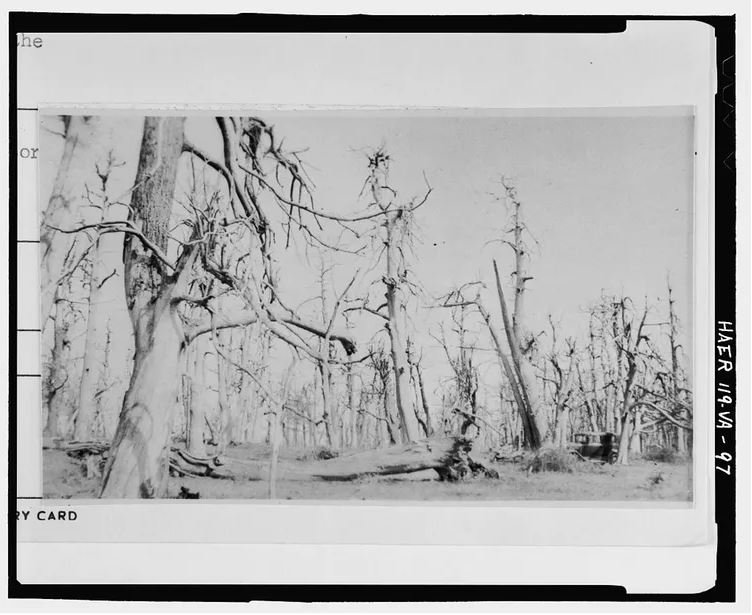
A ghost forest of decimated chestnut trees. Thanks, nature. Image: Library of Congress.

Genetic engineering can essentially give these at-risk plants a vaccine, but activists have to stop calling a boost to nature Frankenfood because it gets donations from organic industry trade groups. The GMO battle has already been won, they just don't accept it.

Bring on the GROs - Genetically Rescued Organisms

As part of a 28 year effort by the American Chestnut Research and Restoration Project there is a non-patented, blight-resistant American chestnut tree.(2) They use a gene from bread wheat that produces an enzyme which keeps the fungus from forming cankers. The enzyme is not just in all grain crops, it's in bananas, strawberries, and many other foods billions of people have eaten without issue.

Read: Genetically Engineered American Chestnut Will Help Restore The Decimated, Iconic Tree

What could be more natural than letting nature resist nature? It is 99.999 percent identical to wild American chestnuts, except four billion of these won't die.

Rather than being Genetically Modified Organisms these are examples of GROs, horizontal gene transfer that can save species. Horizontal gene transfer between species happens in nature all of the time, sometimes to disastrous effect. Ancient hybrid attempts have led to induced mutations and terrible outcomes plenty of times but we only track the successes. All the sweet potato varieties we eat today were genetically modified by the same bacterium 8,000 years ago.

Why not harness that?


Why would regulations make it impossible to get approved without a corporation that wants a patent paying a fortune for lawyers? There have been no unintended effects on the GRO trees and not even on other organisms, like beneficial fungi that coexist with them.

Will 'we don't hate science, we hate corporations' rationalizations by environmentalist allow this without a fundraising campaign to promote fear and doubt? Unlikely, if Golden Rice - which is engineered to produce beta carotene -  is an example.


The naturally fortified rice, which could prevent 500,000 cases of blindness per year, had no corporate interest so $2 billion in environmental groups were able to use the lack of company involvement to claim it was just mad scientists who don't know what they are doing, and the lack of corporate lawyers to keep efforts to provide solutions to the public from getting approved.

Thanks to government getting out of the way of science, the American chestnut has a new fighting chance.


AboutI founded Science 2.0® in 2006 and since then it has become the world's largest independent science communications site, with over 300,000,000 direct...


View Profile

Tuesday, October 22, 2019

Viewpoint: Documentary ‘Modified’ peddles falsehoods about GMOs, pesticides and ‘corporate control’ of food

, | October 21, 2019

Propaganda has been manufactured and promulgated through the ages, and in modern times it flourished during the Great Depression and World War II when useful lies became preferred to harmful truths.

That still rings true today, with the explosion of propaganda wars aided by the Internet, texting, social media, and the emergence of Internet-based trolls and bots. A U.S. Senate-commissioned analysis by a cybersecurity firm released last December found that Russia’s infamous troll factory, the Internet Research Agency (IRA), is conducting “relentless modern information warfare.” Renee DiResta, the research director of the firm, described the IRA’s battle plan as a “cross-platform attack that made use of numerous features on each social network and that spanned the entire social ecosystem.”

The targets of those attacks include not only certain political campaigns, but also products or technologies at which the U.S. is preeminent, such as fracking, genetic engineering, and vaccine development.

Often financed by the organic agriculture and food and “natural products” industries, activists in the West have been mobilized to sow suspicion about and aversion to modern genetic engineering in agriculture — the production of so-called “genetically modified organisms,” or “GMOs.” (See numerous examples here)..........To Read More....

Friday, October 11, 2019

‘Synthetic biology doesn’t have to be scary’: It could offer us new medicines, biofuels and everything in between

| | October 10, 2019

Though hacking organisms and rearranging genomes may sound scary, there is definitely a Light Side to this narrative (a balance, if you will). From medicines to biofuels and everything in between, there is incredible potential for cleverly redesigned biology to help us take on some of our world’s most pressing challenges in sustainability.

One of the first success stories in the field was engineering yeast to convert sugar into the precursor to artemisinin, the key molecule used in malaria treatments. It’s an expensive endeavor to grow a field of Chinese sweet wormwood plants, harvest the field, and extract the small traces of artemisinin found in the plant leaves. Now, we can more directly brew the malaria treatment in giant fermenters, concentrating most of our resources on producing the specific molecule we want rather than growing up all the other parts of a leafy plant..........To Read More....

Saturday, September 14, 2019

GMO's Are Not the Problem. They're the Answer!

By Rich Kozlovich

On September 13, 2019 posted the article, GMO, CRISPR-edited crops can cut pesticide use—if environmental activists do not block them saying:
In 2017, University of Florida plant geneticists Zhonglin Mou and Kevin Folta, along with their team of graduate students, announced a new method to fight common diseases in fruit plants. Their discovery could drastically reduce the use of fungicides if widely implemented by growers. 
Unfortunately, their methods may never be put to use thanks to the controversy surrounding crop biotechnology. 
The research confirms a point that cannot be stressed enough: scientists continue to make agriculture safer and more sustainable with the tools of modern genetics, but activists have waged such an effective scare campaign against crop biotechnology that it often remains unused by industry.
Luddite urban dwellers only consume, they don't produce, so they not only don't realize just how important this is, they don't want to know since environmentalism has become the neo-pagan religion of the urban atheist.  In their worship of the planet they self-righteously believe they're morally superior to the rest of us in their "all natural" views.  It would be nice if they had to take responsibility for the consequences in human suffering they're "all natural" views produced in preventing these major crop engineering advances.

Genetic engineering advances that would have brought Golden Rice to the dinner tables of those in Southeast Asia, whose diet lacks sufficient Vitamin A because rice is the primary carbohydrate source in this area of the world, and as The Golden Rice Project notes:
Rice does not contain any β-carotene (provitamin A), which their body could then convert into vitamin A. Dependence on rice as the predominant food source, therefore, necessarily leads to VAD, most severely affecting small children and pregnant women. In 2012 the World Health Organization reported that about 250 million preschool children are affected by VAD, and that providing those children with vitamin A could prevent about a third of all under-five deaths, which amounts to up to 2.7 million children that could be saved from dying unnecessarily. "
This picture is from the Golden Rice Project
The map shows the vast areas impacted by this problem, which gives you an idea of how many millions of people are suffering unnecessarily. 

 in his March 5, 2019 article Golden Rice is coming. Finally! Will it be the game-changer hinted at for almost 20 years? saying:
Comes the news that the government of Bangladesh is about to approve Golden Rice for commercial release some time in the next three months. 
First and foremost this is fantastic news for Southeast Asia for humanitarian and economic development reasons. On a less consequential level this is great news for the overall debate surrounding the use of biotech in agriculture. Golden Rice occupied a space in the debate as the Great Golden Hope of Biotech Crops, a wholly virtuous crop devoid of the grubby commercial concerns of intellectual property or profit motive. In this case, the IP had been donated, the rice was being developed by a non-profit NGO and the rice will be given freely to farmers and local breeding programs—a trait of value directly to consumers, among them some of the most vulnerable people on the planet. Because of this history, it is a crop not linked to so-called ‘industrial agriculture’ and its key trait is not tied to pesticide use.
Let's try to get this once and for all. Activists are constantly touting the idea what they do "is for the children".   That's a logical fallacy known as the appeal to emotion fallacy, and when someone uses it you need to start looking very closely at what they're really promoting.  Because what these activists have done isn't "for" the children, what they've done has been "to" the children.  From DDT to GMO's the green movement is now, and has always been, foundationally misanthropic. 

For twenty years this has been going on.  That means if we take the number 2.7 million at face value that comes to 54 million children whose lives would have been saved.  And untold millions more would have been saved from other afflictions as a result of Vitamin A deficiency. 

I would like for everyone to think about this.  If GMO techniques become common place here's what would happen. Agriculture would be able to produce food in an abundance that was never dreamt of.  It would be done with less land use, allowing for animal protection, less pesticides, less labor, less cost and in some cases less water would be needed, all of which makes agriculture amazingly "sustainable".  Isn't what they claim they want?   Isn't "sustainability" their ultimate goal?  Yet, these "all natural", "anti-pesticide", "sustainability" advocate Luddites are against it.  Why? 

Because they're not really against pesticides, land use, water use or GMO's, and they don't really care about "sustainability".  What they're against is humanity. 

The radicals among these activists think humanity is a plague on the planet that needs to be eradicated.  The "moderates" only want to eliminate between four and six billion people.

We are rightly outraged by the actions of the socialist monsters of the 20th century who killed over 100 million people, and they got started taking power in 1917.  But environmentalism has probably been responsible for the deaths of that many and more, and they didn't really get started until 1972 with the ban on DDT.  Where's our outrage over that? 

Definition leads to clarity.  Clarity leads to understanding.  We need to understand the green movement is irrational, misanthropic and morally defective.  That's history, and that history is incontestable.

You may wish to view my  file. 

Friday, August 23, 2019

Viewpoint: Produce is sugary, GMO ‘poison’? Scientific American embraces long-debunked food safety tropes

| August 22, 2019

The headline is not exaggeration or hyperbole. Scientific American just ran an article claiming that vegetables are becoming like sugary snacks and are toxic. And that’s not even the worst part.
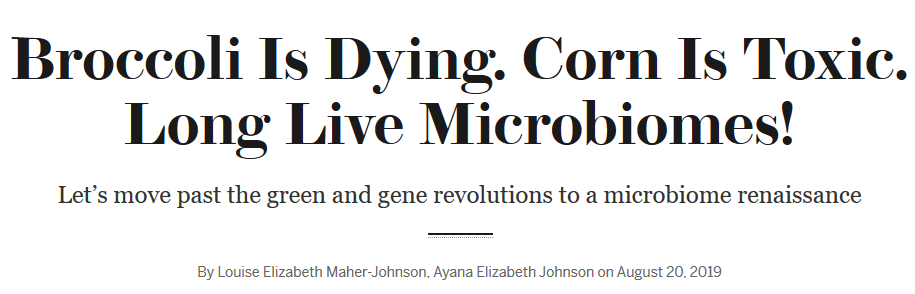
The article was given the ridiculous headline “Broccoli Is Dying. Corn Is Toxic. Long Live Microbiomes!” It was co-authored by a marine biologist and a retired English teacher. As one might expect from the headline, the article makes one outrageous, unscientific claim after another.

screenshot broccoli is dying corn is toxic long live microbiomes

The lies, distortions, and laugh-out-loud whoppers start early and often. Let’s dissect them:

As food writer Mark Bittman recently remarked, since food is defined as “a substance that provides nutrition and promotes growth” and poison is “a substance that promotes illness,” then “much of what is produced by industrial agriculture is, quite literally, not food but poison.”
This is the first sentence. Yes, that’s how this screed actually begins. Everything you eat is poison. How do we know? Because an organic food activist with no relevant scientific training or expertise says so..............To Read More.....

Related article:  How European-Based NGOs Block Crop Biotechnology Adoption In Africa, Margaret Karembu, Director of International Service for the Acquisition of Agri-biotech Applications, Africa regional office (ISAAA) AfriCenter based in Nairobi | February 23, 2017

Tuesday, August 20, 2019

Yes, We Have No Bananas. We Have No Bananas Today!

By Rich Kozlovich

On August 19, 2019 Steve Savage published an article on entitled, Viewpoint: Our favorite Cavendish banana may be heading towards extinction—Scientists say only a biotech solution, blocked by anti-GMO activists, can save it. Originally this article appeared at Forbes entitled, It’s Time To Build A Better Banana. Both titles are profound and provocative, but I like my choice better, which was inspired by the author as he mentioned it in the article as the title of a song popular in the early 1920's.

As I read this very excellent article by Steve Savage it reminded me of a 2014 series I published regarding claims about GMO's. Bananas was part of that ten part series rebutting claims by Mike Adams, who publishes Natural News and styles himself as the Health Ranger. On July 27 2014 he published this piece of scare mongering junk science entitled, The Agricultural Holocaust explained: the 10 worst ways GMOs threaten humanity and our natural world.

That month I started posting my rebuttals to Adams ten complaints against Genetically Modified Organisms in a ten part series. I later condensed all ten and republished them in this one article, GMO’s: Scare Mongering at Its Worst! Today, I will be updating Part VII from that article dealing with his seventh false claim about “GMOs collapse biodiversity”.

He claims:
"In an effort to monopolize the global seed supply, GMO companies are buying up smaller seed companies and shutting them down, collapsing their seed supplies. The following chart shows some of the seed consolidation activity that's concentrating ownership over seeds into the hands of a very small number of powerful, unethical corporations:"
He provides a chart (Editor’s Note: The link provided no longer works so I removed it. RK) however, there was no citation, or link, as to the chart’s origin. I can’t confirm anything the chart shows, except there seem to be an awful lot of seed companies - and based on everything else he’s said in this article – I have to wonder if he doesn’t want anyone to know its origin.
He goes on to claim:
"This consolidation of seed companies has caused an alarming collapse in seed diversity over the last decade, placing humanity at increased risk for catastrophic crop failures due to a loss of genetic diversity."  
"That's the problem with genetic conformity: it makes the crops far more susceptible to systemic diseases that can cause catastrophic crop failures. Precisely this scenario is happening right now with banana crops, as most commercial banana trees are genetically identical clones."  
"That's the problem with genetic conformity: it makes the crops far more susceptible to systemic diseases that can cause catastrophic crop failures. Precisely this scenario is happening right now with banana crops, as most commercial banana trees are genetically identical clones." 
"As a result, a fungus has attacked banana crops and is causing devastating destruction across the banana industry. The industry is responding by -- guess what? -- foolishly turning to genetically engineered bananas, which will suffer from the exact same weakness of genetic conformity, practically guaranteeing a future disease epidemic.”
Before I go on, let me state from the outset that the worst lies start with the truth. But once the truthful statements have been twisted with lies of omission and logical fallacies it’s perverted to generate erroneous conclusions. It’s a lot like snake oil salesmen and a fast hustle. It’s true that genetic diversity is important to continued health in seeds, but everything he says after that is seriously flawed.

Let’s start with this business of loss of genetic diversity he claims is being caused by “unethical” companies deliberately causing a “collapse” (what does that mean?) in the seed market. That’s a load of horsepucky! When I first read his claims I have to admit it took me by surprise because not once could I remember seeing any commentaries about a claim such as this, and there was nothing in my files, so I sent out a request for information to my net hoping someone out there could provide some information on this. People started responding back about what he portrays as a deliberate and nefarious effort to destroy biodiversity.

We have to understand that, just as in any industry, there are natural ebbs and flows. There is a constant ebb and flow regarding seed stock involving GMO’s, non-GMO’s, hybrids, self pollinators, and cross-pollinating plants. Just as there is in any business. Recently there’s a resurgence in non-GMO breeding efforts because it appears we’re in a growers market. This makes sense as ASTA (American Seed Trade Association) states on its web site:
“everything starts with the seed”.
One of my correspondents, who works for a large international trade association involved in Agriculture, stated the entire seed industry is very “robust….big and small companies alike”. All these so-called consolidations have actually strengthened the mid-sized and small companies because they’re more agile than the larger companies and can move more quickly into profitable situations.

As for these companies deliberately trying to “collapse” the seed market – I keep asking - what does that mean? Does he imply these companies are buying up smaller seed companies and destroying their seed stock? It seems to me that’s what he’s trying to convey – but he won’t dare say it because he knows it’s a lie. No company would deliberately destroy seed stock because these large science based companies know better than anyone how science is constantly moving forward and tomorrow they may suddenly discover a new tool to unlock some “genetic assets in a seed line”. “Self-interest alone would compel companies to preserve genetic resources.”

Is he trying to say these large companies are buying up all the small companies and hiding seed stock? Well, that’s loony. They’re buying seed stock to utilize it in some fashion, and they’re not ever going to eliminate the small and mid-size companies, and I doubt if they want to. It wouldn’t be worth the cost and it wouldn't prevent new companies from forming. GMO companies are not causing a loss in genetic diversity, they’re preserving genetic diversity and enhancing the genetic diversity that already exists.

About thirty years ago Waste Management Incorporated decided the pest control industry was a good fit for their corporation because they felt they had corporate expertise in the legislative and regulatory arena that was compatible with the pest control and lawn care industries. So, they went around the country and bought up a large number of quality regional pest control companies. Overnight they became the number three company in the nation.

A lot of prominent people in the pest control industry started covering themselves in sackcloth and ashes, wringing their hands, believing this was the end of the small pest control companies – the conglomerates were taking over – “it’s the end of the pest control industry as we know it!” A few old hands just chuckled, shook their heads and said, “that will never happen”; they were right, and the conglomerate “consolidation” scare ended.

Are bigger companies still buying smaller companies? Of course! That’s the nature of business! Are small companies still coming into existence? Of course! That’s the nature of business! Everything else is horsepucky!

There’s one more thing about his claim that large companies are deliberately “collapsing the seed market" that bothered me from the start. First of all, exactly what does “collapsing the seed market" mean?
  • He provides not one piece of evidence other than a chart without a source.
  • Not one link to a commentary explaining the information on the chart.
  • Not one commentary from anyone in the seed market, including any small companies warning us of these alleged abuses
  • Not one quote from an honest broker of information and
  • Not one news story!
Why?

He then asks us to take a leap of faith and believe that GMO’s are destroying the banana crops in the world. He now issues another really big lie of omission, claiming:
“This consolidation of seed companies has caused an alarming collapse in seed diversity. As a result, a fungus has attacked banana crops and is causing devastating destruction across the banana industry. The industry is responding by -- guess what? -- foolishly turning to genetically engineered bananas which will suffer from the exact same weakness of genetic conformity, practically guaranteeing a future disease epidemic.”
There’s a real problem with this Jeremiad he fails to include in his statement. The lack of bio-diversity is common in bananas because bananas are self pollinating. Bananas are not suffering from a lack of diversity due to GMO’s. There are wild species that are pollinated by bats, but those used in food production aren’t. I don’t know about anyone else, but somehow, I think that’s an important piece of information. Don’t you?

Currently the banana we’re most familiar with the a variety called the Cavendish, and it is under attack from something called the Black Sigatoka fungus, which is becoming resistant to fungicides. Did any kind of genetic engineering have anything to do with this. NO!

The variety that preceded the Cavendish was called the Gros Michal, also a self fertilizing banana. It became commercially “unviable” in the 1950’s due to the Panama Disease, which is caused by a fungus to which the Cavendish is immune. However, the Gros Michel isn’t extinct and can be used where the Panama disease isn’t found. But let’s understand this. The Gros Michel variety became commercially interesting in the 1820’s and it took about 130 years before this naturally occurring problem struck. All that happened long before GMO's.

Within the next 10 to 20 years it seems likely the Cavendish, which like almost all bananas lacks genetic diversity, will suffer attacks that can’t be thwarted with fungicides. This will have a serious impact on large commercial and small farm agriculture. However there are a very large number of varieties of bananas out there we’re not familiar with which could produce one or more replacements, although they would be substantially different that what we’re used to. But no matter what direction agriculture goes in this matter we must come to realize that this problem is a naturally occurring one that can’t be blamed on GMO’s.

In fact it seems rational that GMO’s will be the answer!

Scientists have made announcements about the complete sequencing of the banana genome, and by utilizing genes from wild species that reproduce via seeds they could potentially develop a non-seed variety that would be immune to fungi and even pathogens. Resistant genes from onions and dahlias were introduced into plantains –a member of the banana family used in cooking - which are demonstrating resistance to a greenhouse fungus.

Will they make it in the real world?

The only rational answer is yes - eventually!

Will this lead to high tasty high yield bananas at some point? The only rational answer must be a resounding YES, eventually!

But only if we abandon all this scare mongering about GMO’s. GMO’s will save commercial banana production and will end the need to make so many applications of fungicides, which is a very real financial burden for small farmers. That's why American Farmers Just Love Their GMOs and You Should Too.

The advances made by scientists in this arena over the last five years has been amazing, and we need to stop listening to these "all natural" misfit activists. "All natural" has become big business, and they're gong to do everything in their power to protect that business.

We really do need to get that!

Viewpoint: Our favorite Cavendish banana may be heading towards extinction—Scientists say only a biotech solution, blocked by anti-GMO activists, can save it

August 19, 2019


As I wrote for Forbes in 2018, we might lose bananas as an affordable part of our diet. A dreaded new strain of a soil-born fungal disease that has already severely hurt the industry in Australia and Africa has now been confirmed to have reached the Americas. Others have raised this alarm. This also happened in the mid 1900s when an earlier strain of this fungus wiped out the “Grand Nain” banana variety. That calamity made the 1923 song by Frank Silver and Irvin Cohn, “Yes, we have no bananas” sound prophetic. The great old Simon and Garfunkel song, “Slip-slidin Away” also comes to mind.

The current Cavendish banana of commerce has a colorful history traveling through England of all places, but by chance it was resistant to the first strain of the fungus. Unfortunately the new Tropical Race 4 strain has overcome that resistance. Once the fungus is introduced into a given plantation’s soil, there is no way to get rid of it. The industry tried really hard to keep the pest out, but all it takes to spread it is a bit of dirt on someone’s boot.

Now I’m sure some will say that this is all a problem because of “monoculture.” Yes, the whole commercial banana industry relies on very few varieties, but that isn’t something easily avoided, as I explained in that earlier article. No one can do conventional breeding of bananas with any efficiency because, in case you hadn’t noticed, the bananas we like don’t have the big black, hard seeds of wild bananas. Remember the old kid’s song, “I love bananas because they have no bones!”.........To Read More...  


Monday, June 24, 2019

Science Saves an Old Chestnut

Genetic engineering rescues a tree from a threatening fungus.

By Hank Campbell 


A forest of chestnut trees ravaged by blight in Luray, Va. Photo: Library of Congress
 
A blight-tolerant American chestnut tree is the latest example of what the science community has begun to call a GRO—a genetically rescued organism. In the past century approximately four billion chestnut trees have been lost in the U.S. due to blight that spread when the Cryphonectria parasitica fungus arrived with chestnut trees imported from Asia. A once-dominant hardwood species is now rare.


Nature can be fickle, but using science to engineer solutions allows precise methods to combat natural pathogens. Some species are resistant to the fungus, and that’s why it makes sense to use transgenic tools to help the chestnut tree utilize beneficial genes from other plants—essentially vaccinating against the fungus.

It’s all part of a 28-year effort by the nonprofit American Chestnut Research and Restoration Project, led by the State University of New York’s College of Environmental Science and Forestry. Scientists use a gene from bread wheat that produces an enzyme called oxalate oxidase, which prevents the fungus from forming cankers on plant stems. The enzyme is found in all grain crops, plus bananas, strawberries and more..........To Read More.....