Search This Blog

De Omnibus Dubitandum - Lux Veritas

Showing posts with label Alex Berezow. Show all posts

Saturday, January 9, 2021

Top 10 Junk Science and Bogus Health Claims ACSH Debunked in 2020

By Alex Berezow, PhD — December 30, 2020 @ American Council on Science and Health

Though we spent about nine months of the year focused almost exclusively on COVID, we did find time to debunk pseudoscientific nonsense. Here are the top 10 junk science and bogus health claims we debunked in 2020.
The ACSH mission statement is very clear: "To publicly support evidence-based science and medicine and to debunk junk science and exaggerated health scares." Basically, we were founded in 1978 to combat misinformation, long before the advent of "fake news" and "fact checkers."

This year was no different from any other year. Though we spent about nine months of it focused almost exclusively on the coronavirus, we did find time to debunk pseudoscientific nonsense. Here are the top 10 junk science and bogus health claims we debunked in 2020:

10. A team of researchers at Yale claimed a link between fracking and sexually transmitted diseases. In what has to be one of the worst articles we have ever seen, a group from Yale implausibly claims that fracking is linked to the spread of chlamydia and gonorrhea but not syphilis, and that fracking produces this effect in Texas but not Colorado or North Dakota. This is data dredging at its absolute worst, and the only real question is how something this embarrassingly awful could get published in the first place.

9. The Atlantic published an article called "America's Favorite Poison," which scolded us over the dangers of alcohol and waxed poetic for the Prohibition Era. This was before the COVID pandemic, so the media was searching hard for things to scare Americans about. The Atlantic focused on alcohol, using cherry-picked data to parrot the unsubstantiated claim that even moderate drinking is unsafe. The Atlantic went on to publish a series of articles on COVID denial, apparently oblivious to the fact that media sensationalism is one of the leading reasons why the public fails to take real threats like the coronavirus seriously.

8. AARP scares elderly people into eating organic food. If the coronavirus wasn't scary enough, AARP Magazine published an article by Mark Bittman, an organic food activist who once claimed that GMOs cause leukemia. Contrary to scientific evidence, Mr. Bittman encourages elderly people -- many of whom are on limited incomes -- to spend those precious dollars on overpriced organic food.

7. The journal "Science" accepted and then rejected an article on my career as a junk science debunker because I'm a "corporate shill." After nine revisions and two months of editing, a column I submitted to the prominent journal Science was spiked by a senior editor. Why? Because I'm a corporate shill, of course. The delicious irony is that the journal has a page on its website in which it literally begs corporations to send money. We have long known that the scientific publishing industry is thoroughly corrupt and increasingly useless, but it's quite another thing to experience it first-hand.

6. The healthcare system is financially benefiting from the coronavirus. When the pandemic hit the U.S., some people claimed that hospitals and doctors could illicitly benefit themselves by diagnosing a patient with COVID, even if he or she didn't actually have it. There is no merit to this allegation. Besides, any hospital caught doing something like that can get fined.

5. Environmentalists oppose the very policies they endorse. Pretty much every year, a story about how environmentalists are hypocrites usually makes the top 10 list. It's like shooting fish in a barrel. This year, electric car-loving environmentalists opposed the construction of an electric car manufacturing plant in Germany. The Union of Concerned Scientists opposed programs meant to conserve water and energy because it made labor unions mad.

4. Michael Shellenberger, a prominent environmentalist, was called a "white supremacist" for debunking myths about climate change. Mr. Shellenberger is an ecomodernist, a person who believes that technologically savvy humans can fix big problems, like climate change. As part of his mission, he debunks climate myths, such as the notion that wildfires are getting worse. For his evidence-based arguments, he was censored by Forbes and called a "white supremacist." Our society has learned that, when you're losing an argument, the best way to respond is to try to destroy the other person's character and career.

3. Politicians keep blaming the opioid crisis on prescription drugs. We know why people are dying from opioid overdoses: The drugs they are taking, such as heroin purchased from the neighborhood dealer, are laced with illegal fentanyl. Yet, politicians keep going after prescription opioids, as if they are the cause of our current problems. They are not. In the meantime, patients who need powerful painkillers are being forced to suffer due to cruel policies that restrict access to these vital medicines.

2. Anti-vaccine activists smell a coronavirus conspiracy. Children's Health Defense, the ironically named organization founded by anti-vaxxer RFK, Jr., believes that the COVID pandemic is little more than a conspiracy by elites to immunize the world and make Big Pharma wealthy. Since most of society has been begging the pharmaceutical and biotech industries to rescue us from the coronavirus, hopefully this renewed confidence will help bury anti-vaccine ideology for good.

1. COVID is caused by glyphosate or 5G. Of the many conspiracy theories out there regarding COVID-19, none are dumber than the notion that glyphosate (a pesticide) or 5G wireless technology caused it. Yet, one of the proponents of the former is an MIT senior research scientist. A different scientist claims that our cells are being poisoned by 5G, and in response, they produce viruses. Our fact checkers rated these claims as:

 

Wednesday, June 3, 2020

How to Make Money by Spreading Anti-GMO Propaganda

Anti-GMO activists routinely label scientists and biotech supporters "shills for Monsanto." However, a new study suggests that those who spread GMO disinformation are the ones who are actually motivated by money.

By Alex Berezow, PhD — December 3, 2019 @ American Council on Science and Health

The anti-GMO movement is bizarre in so many ways. The topic is essentially non-controversial in the scientific community, with 92% of Ph.D.-holding biomedical scientists agreeing that GMOs are safe to eat.

Yet, GMOs have become a perverse obsession among food and environmental activists, some of whom have gone so far as to accuse biotech scientists of committing "crimes against nature and humanity." Why? What's in it for them?

A new paper published by Dr. Cami Ryan and her colleagues in the European Management Journal examined this issue. They came to the conclusion that many of us had already suspected: It's all about the Benjamins, baby.

The Monetization of Disinformation: The Case of GMOs

The authors, who work for Bayer (which acquired Monsanto), begin by explaining the attention economy. Like most everything else, from money to coffee beans, human attention can be thought of in strictly economic terms. Attention is a scarce commodity; there is only so much of it to go around. Entire businesses, like social media, have developed a revenue model that relies on capturing as much of your attention as possible. In various ways, that attention can be monetized.

To quantify the attention that the topic of GMOs receives, the authors utilized BuzzSumo, a website that aggregates article engagement from all the major social media sites, such as Facebook and Twitter. The authors identified 94,993 unique articles from 2009 to 2019, and then whittled down the list to include only those domains that published at least 48 articles on GMOs (which is an average of one per month for four years). Thus, the researchers identified 263 unique websites.

And now, the depressing results. By far, the most shared articles on GMOs came from conspiracy, pseudoscience, and/or activist websites.

The image on the right depicts the top 25 websites based on median article shares. Of these, only two -- The Guardian and NPR (highlighted green) -- are widely considered to be mainstream news outlets. (It should be pointed out, however, that The Guardian is often not a reliable source of information on science, technology, and public health.)

It isn't a coincidence that many of these same websites also peddle snake oil. Mercola.com, for instance, is a website that sells everything from hydrogen-infused water to krill oil supplements for your pet. The website publishes anti-GMO and anti-vaccine articles, as well as a whole host of other fake health news, in order to drive traffic to itself. Then it sells the reader phony medicine.

If you're wondering how Mercola.com gets away with this, here's how: (1) It's not illegal to lie, and (2) It's not illegal to sell phony medicine, provided that there is a tiny disclaimer somewhere on the website admitting that the FDA hasn't evaluated any of the health claims. Here's Mercola's:


Perhaps Dr. Ryan's next research project should be how to put Mercola.com and its ilk out of business.

Source: Camille D. Ryan, Andrew Schaul, Ryan Butner, John Swarthout. "Monetizing Disinformation in the Attention Economy: the case of genetically modified organisms (GMOs)." European Management Journal. In press. 2019. doi: 10.1016/j.emj.2019.11.002

Tuesday, March 17, 2020

Most Important Coronavirus Question: Will I Get Sick and Die?

By Alex Berezow, PhD — March 11, 2020 @ American Council on Science and Health

 For epidemiologists, the most important unanswered question about the Wuhan coronavirus, or COVID-19, is the case-fatality rate. But for the general public, the question is much more personal: "Might I – or anyone I love – get sick and die?"

This article was originally published at Geopolitical Futures.

The first person to die from coronavirus on American soil passed away on Feb. 29 at a Seattle area hospital – incidentally, the same hospital where my daughter was born just ten and a half months ago.

For epidemiologists, the most important unanswered question about the Wuhan coronavirus, or COVID-19, is the case-fatality rate. But for the general public, the question is much more personal: “Might I – or anyone I love – get sick and die?” When faced with uncertainty, people make decisions cautiously, and they base them on emotion and personal experience instead of statistics. If enough people answer “Yes,” there could be major repercussions as panic sets in around the world. Small behavioral modifications, such as telecommuting or reducing factory activity to avoid spreading the disease, made by millions of people can have a large impact. The United Nations already estimated $50 billion worth of exports worldwide will be affected, excluding non-trade economic activities such as travel tourism, as manufacturing slows and governments impose measures like port restrictions. This is why it is necessary to develop a “risk of death” profile for COVID-19.

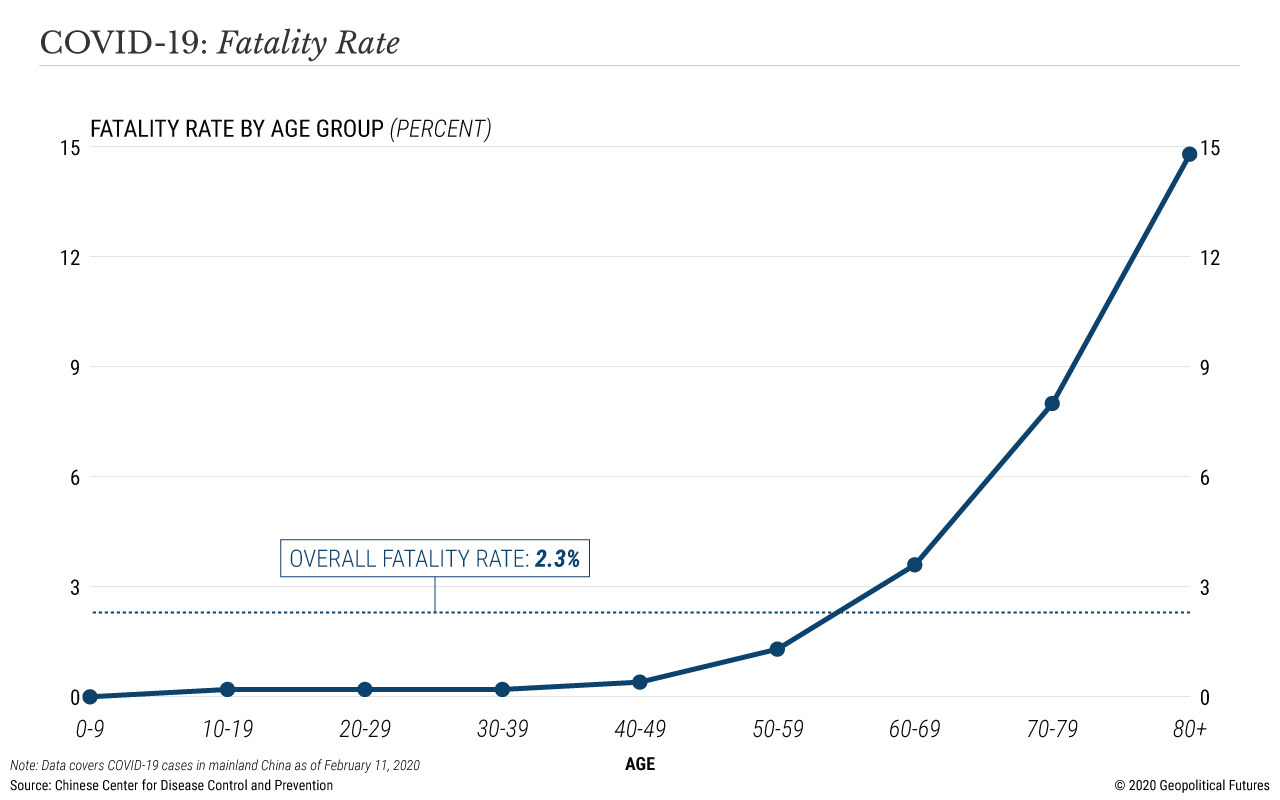
The first substantial effort to do just that was published by the Chinese Center for Disease Control and Prevention. Though these numbers should be thought of as preliminary (and perhaps specific to only China), they allow us to begin to comprehend the risk that our global society is facing. After analyzing 44,672 confirmed cases, Chinese health officials estimated the case-fatality rates by age group:


Of the 416 children aged 0 to 9 who contracted COVID-19, precisely zero died. This is unusual for most infectious diseases, but not for coronaviruses; the SARS coronavirus outbreak also had minimal impact on children. For patients aged 10 to 39, the case-fatality rate is 0.2 percent. The case-fatality rate doubles for people in their 40s, then triples again for people in their 50s, and nearly triples yet again for people in their 60s. A person who contracts COVID-19 in their 70s has an 8 percent chance of dying, and a person in their 80s a nearly 15 percent chance of dying.

The virus can be lethal in a variety of ways. Viral infections in the lungs can trigger an immune response so strong that it fatally damages the lungs. In others, a systemic immune response, called a “cytokine storm,” can cause multiple organ failure. This could explain why some young, healthy people are killed by the virus, such as Dr. Li Wenliang, the 34-year-old doctor who died shortly after alerting the world to this new strain of coronavirus. An older person’s immune system may not be able to fight a respiratory virus. Underlying conditions such as high blood pressure or diabetes can worsen outcomes.

The above statistics are no doubt frightening numbers. But there are at least three major mitigating factors. First, the number of mild or asymptomatic cases is unknown and probably substantial. Second, China is still a poor country with low-quality health care and, at the epicenter of the outbreak in Hubei province, was overwhelmed by the virus. (The case-fatality rate in Chinese provinces outside Hubei, where hospitals aren’t overloaded, is much lower.) Third, smoking is much more prevalent in China than America, especially among men (52 percent in China versus 16 percent in the U.S.), and smoking is a risk factor for poor responses to respiratory infections. Together, this means the case-fatality rate is likely inflated, and it would be a mistake to apply these figures to the United States or other advanced nations.

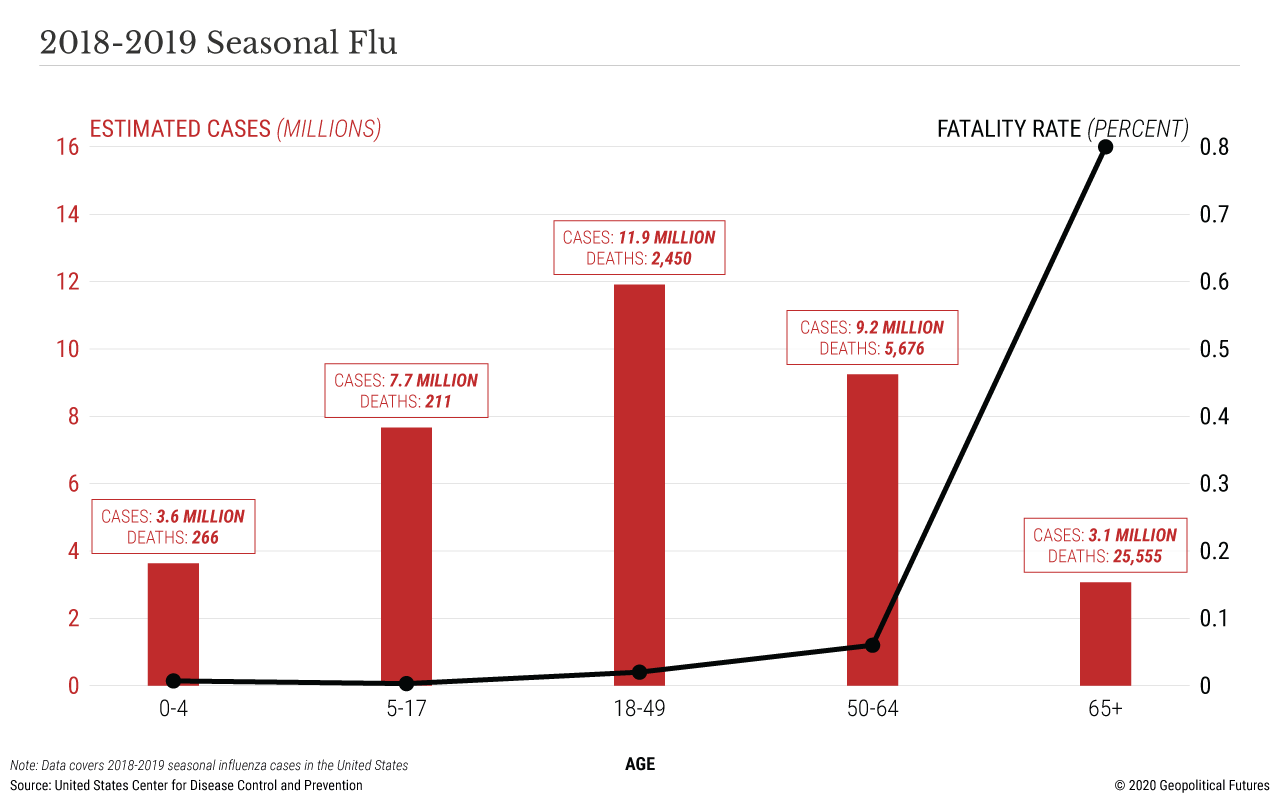
The real question, then, is how inflated the case-fatality rates are. At this point, it’s impossible to determine because scientists are still collecting data on how widespread the virus is. But to get a sense of how exaggerated these numbers might be, it is useful to examine the case-fatality rate for seasonal influenza. For the 2018-19 influenza season, the U.S. Center for Disease Control and Prevention provides estimates for the number of cases (defined here as “symptomatic illnesses”) and deaths. From these, we can derive case-fatality rate estimates by age group.


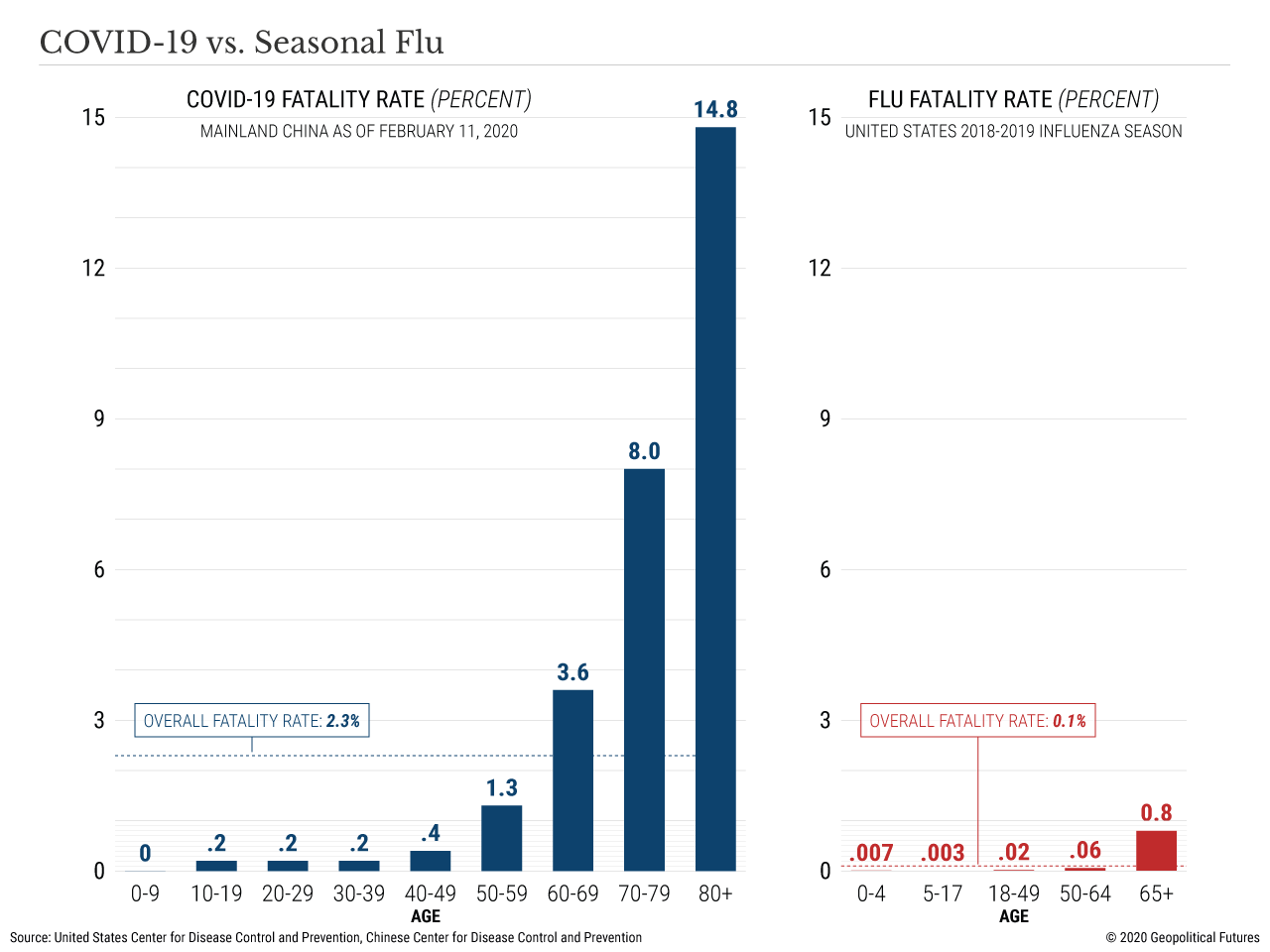
If COVID-19 ends up being similar to seasonal influenza, then the case-fatality rates for COVID-19 are inflated by a factor of 20 to 100. Dr. Anthony Fauci, head of the U.S. NIAID, co-authored an editorial for the New England Journal of Medicine in which he wrote:
“If one assumes that the number of asymptomatic or minimally symptomatic cases is several times as high as the number of reported cases, the case fatality rate may be considerably less than 1%. This suggests that the overall clinical consequences of Covid-19 may ultimately be more akin to those of a severe seasonal influenza (which has a case fatality rate of approximately 0.1%) or a pandemic influenza (similar to those in 1957 and 1968) rather than a disease similar to SARS or MERS, which have had case fatality rates of 9 to 10% and 36%, respectively." [Emphasis added]
We have reason to believe this view is closest to reality. In South Korea, public health officials screened about 100,000 people and detected over 7,300 cases. So far, the death toll is 50, which translates to a case-fatality rate of 0.7 percent. That’s still seven times worse than seasonal flu, but it’s far lower than the initial reports from China.

The Future of COVID-19

Stat News describes two possible scenarios that epidemiologists envision for the future of COVID-19. In the first, COVID-19 becomes just another cold virus, and possibly evolves to become less lethal as well. What we call the “common cold” is actually caused by roughly 200 different viruses. Each year, about 25 percent of common colds are due to four coronaviruses, and some scientists think COVID-19 could eventually join this group as its fifth member. In the second scenario, COVID-19 behaves more like a severe seasonal flu, vanishing in the summer and returning to hit us hard in the winter.

In neither scenario does COVID-19 resemble the Spanish flu of 1918, which disproportionately killed young people. In neither scenario does the virus mutate to become more lethal. Most likely, the opposite will be true. There is an inverse relationship between lethality and contagiousness; that is, the most contagious viruses tend to be less lethal. Evolutionary pressures – namely, the biological imperative to reproduce as far and wide as possible (which means not killing people) – may push COVID-19 down this path.

For now, influenza remains the far bigger global public health threat. Each year, about 1 billion people become infected with seasonal flu, killing some 300,000 to 500,000. This season alone (2019-20), about 20,000 Americans have died from flu, including 136 children. Yet, very few people fear the flu. Society has accepted it as part of reality, and people carry about their daily lives without excessive concern over influenza. This is the likely future for COVID-19.

Until then, perhaps the last word should be given to virologist Dr. Lisa Gralinski, who told The Scientist, “If you’re over fifty or sixty and you have some other health issues and if you’re unlucky enough to be exposed to this virus, it could be very bad.” While everyone else should remain vigilant and take proper precautions (e.g., washing hands and avoiding crowds) until more data comes in, from a scientific perspective the public alarm is disproportionate to the risk.

© 2020 Geopolitical Futures. Republished with permission. (The original is here.)


Sunday, November 17, 2019

Academic Bias Against Industry Is Toxic Hypocrisy

By Alex Berezow — November 5, 2019 @ American Council on Science and Health

There is a pervasive bias in academia against scientists who work in industry. It is often said that such individuals aren’t "real scientists." The less charitable describe them as having gone over to the "dark side." For at least two reasons, this is a shameful and hypocritical way to characterize industry.

First, academic-industry partnerships are often extremely productive. The former provides the basic discoveries and theoretical foundations that the latter can implement in the form of real-world technologies. Several universities now have technology transfer offices whose goal is to patent (and profit from!) academic research by identifying industry partners that can bring a product to market. The university collects royalties if a product is successful.

Second, industry provides nearly 2/3 of all research funding in the United States. According to R&D Magazine, in 2019, industry paid for $375.8 billion of the $581 billion spent on research and development in the United States. If industry research were to disappear, America's dominance in science and technology would evaporate along with it.
For these reasons, industry should be celebrated, not derided1. But that's not what we get. Instead, industry is routinely pilloried -- sometimes fairly, oftentimes unfairly -- both by academics and the media.

Writing in Forbes, astrophysicist Dr. Paul Sutter argues that Big Data is trouble for science. Why? He says:
As science becomes more and more data heavy and leans more and more on Big Data techniques, the students who are naturally gifted or most talented or most passionate about Big Data aren't going to end up in science, they're going to end up in the industry. [Emphasis added]
That statement reveals that Dr. Sutter believes that (1) industry scientists aren't real scientists, and (2) it's bad if too many smart people are attracted to industry. Therefore, Big Data itself is bad. That's a curious line of reasoning, but such pretzel-twisting logic isn't uncommon.

Dr. David Gorski (a.k.a. "Orac"), who blogs for Respectful Insolence and Science-Based Medicine, is also perpetually vigilant for corporate stooges2. While he agrees with us that vaccines are vital to public health, he claims that we only support vaccines because we're shills for Big Pharma, apparently notwithstanding the fact that our organization includes microbiologists, epidemiologists, and medical doctors, many of whom are academics.

This bizarre phenomenon of seeing shills everywhere one looks has also infected journalism. A team of journalists at NYU, led primarily by Charles Seife, routinely accuse others of malfeasance on behalf of industry. (One article written by Mr. Seife attacking plant geneticist Dr. Kevin Folta as an industry shill was so bad that it had to be retracted.) Yet, while Mr. Seife accuses all those around him of being industry shills, his employer NYU collected more than $1 billion in royalties for just a single drug that it patented and licensed to Big Pharma.

The fervor with which the "corporate shill" label is applied is akin to McCarthyist zeal. That's unfortunate. The truth is that if the science is accurate, then it doesn’t matter who paid for it — be it Monsanto, Vladimir Putin, or the Devil himself. Funding only matters if the science is inaccurate. That's when it's appropriate to ask, "Who funded this and why?"

Notes

(1) Yes, industry should be criticized when it behaves poorly.
(2) Dr. Gorski works for Wayne State University, which like many universities, has a technology transfer office. According to its website, "the University expects to receive a reasonable royalty" from industry if a technology it patents makes money. If Dr. Gorski's criteria apply equally to everyone, that would make his employer a corporate shill.


Wednesday, November 13, 2019

Steven Pinker Is Wrong. We Do Live in a Post-Truth Society

By Alex Berezow — October 31, 2019 @ American Council on Science and Health

Steven Pinker is an excellent writer and thinker. Perhaps his greatest contribution to our national dialogue is his insistence, backed up by considerable research, that life keeps getting better and better. Despite the substantial problems we read about in the news on a daily basis, we live in a world that has never been richer or safer than it is now. I believe he and others like Max Roser who emphasize the same theme are absolutely correct.

However, I think that Dr. Pinker misses the mark in a recent essay he wrote for Skeptic titled "Why We Are Not Living in a Post‑Truth Era." He begins by trying to show that it is illogical to believe in a post-truth era.
"Consider the statement 'We are living in a post-truth era.' Is it true? If so, it cannot be true."
Dr. Pinker is echoing a famous dialogue between Socrates and Protagoras. The latter was in favor of relativism (i.e., what is true for you is true for you and what is true for me is true for me). Socrates indicates that this is a self-defeating argument because claiming that relativism is true is in itself a truth claim. Therefore, relativism is self-contradictory and false.

The problem with Dr. Pinker's argument is that it's a straw man. Those who claim we live in a post-truth society are not saying that there is no such thing as truth. What they are saying is that truth doesn't matter to most people. When presented with information they do not like, many people respond by calling it "fake news." But Dr. Pinker says this about fake news:
"Another inspiration for the post-truth cliché is the recent prominence of 'fake news.' But this, too, is not a new development. The title of the James Cortada and William Aspray’s forthcoming 'Fake News Nation: The Long History of Lies and Misinterpretations in America,' is self-explanatory..."
Dr. Pinker is absolutely correct that fake news is not a recent development. Humans have been lying ever since we have been able to speak. What makes things different today, in my opinion, is that we have the internet. Nearly every human being on Earth has access to all the knowledge ever generated by mankind. Yet, instead of doing research and telling the truth, we prefer to spread lies and propaganda (and pictures of cats) at lightning speed around the globe. This takes the problem to an entirely new level. We have no excuse to be poorly informed, yet we choose to be.

Dr. Pinker goes on:
"And the belief that fake news is displacing the truth itself needs to be examined for its truth. In their analysis of fake news in the 2016 American presidential election, Andrew Guess, Brendan Nyhan, and Jason Reifler found that it took up a minuscule proportion of the online communications (far less than 1 percent) and was mainly directed at partisans who were impervious to persuasion."
Fair enough, but I think Dr. Pinker underestimates the scope of the problem. One study found that roughly half the viral stories we read on Facebook are misleading, exaggerated, or worse. Politics isn't the only arena within which we are inundated with fake news.
"But the main reason we should retire the posttruth cliché is that it’s corrosive, perhaps self-fulfilling. The implication is we may as well give up on reason and truth and just fight the bad guys’ lies and intimidation with lies and intimidation of our own."
Nobody is making that argument. On the contrary, there are serious efforts to understand how to reach people, which probably involves some combination of telling the truth while appealing to emotion. Dr. Pinker then makes this claim:
"When people are confronted with their own ignorance of the facts, they become more epistemically humble about their opinions."
I don't know who Dr. Pinker has been talking to, but that's certainly not my experience. In fact, quite the opposite. When people are confronted with their own ignorance, they double down and become even more insistent that they are right. As Dr. Michael Shermer discusses in Scientific American, this is known as the backfire effect.

On this, I am in 100% agreement with Dr. Pinker:
"Rationality, to be sure, is not increasing everywhere. In some arenas it appears to sinking fast. The most conspicuous is electoral politics, which is almost perversely designed to inhibit our capacity for rationality. Voters act on issues that don’t affect them personally, and are under no pressure to inform themselves or defend their positions. Practical issues like energy and healthcare are bundled with symbolic hot buttons like euthanasia and the teaching of evolution. These bundles are then strapped to regional, ethnic, or religious coalitions, encouraging group-affirming expressive cognition. People vote as if rooting for sports teams, encouraged by the media, which treat politics as a horse race, encouraging zero-sum competition rather than clarification of character and policy.
Ultimately, where I think Dr. Pinker is wrong is in his grasp of the scope of the "post-truth" problem. His view is too optimistic. We really are swimming in B.S.

Please Help Fund Our Work

If you follow our work, you know that we here at ACSH go after the fraudsters, the hucksters and the snake-oil peddlers. And when we're not debunking their misleading or dangerous junk science, we're always aiming to give you the most accurate and dependable health news. But we can only continue to do that with support from our readers and friends who value what we do. So if you can please donate. Thank you.

Saturday, November 9, 2019

Debunkers Debunked: Who Fact-Checks the Fact-Checkers?

By Alex Berezow — November 4, 2019 @ American Council on Science and Health

I gave a lecture recently on debunking junk science for a class at the University of Washington called "Calling Bullsh**." As its not-so-subtle title suggests, the class teaches students how to recognize misinformation in our digital age.

One of the topics I touched on was the role that fact-checkers play in our online debates. Certainly, they can and do play a very constructive role. There are so many lies swirling around that professional fact-checking seems to be a necessary public good.

But, who fact-checks the fact-checkers? While that might seem like a silly question, the objectivity of fact-checking websites has already been called into doubt and for good reason. For example, an in-depth analysis by Matt Shapiro at the Paradox Project revealed that PolitiFact (the site that famously uses "pants on fire" as one of its ratings) is biased in its fact-checking.

The analysis makes several different arguments, but one of the more compelling ones is that the articles that debunk Republicans are longer than those that debunk Democrats. Why? Well, it comes down to a bit of chicanery:
"We’ve found that PolitiFact often rates statements that are largely true but come from a GOP sources [sic] as 'mostly false' by focusing on sentence alterations, simple mis-statements, fact-checking the wrong fact, and even taking a statement, rewording it, and fact-checking the re-worded statement instead of the original quoted statement. 
"Doing this takes time and many, many words."
Another popular website, Snopes (which got its start by debunking urban legends), bizarrely decided to debunk satire. Snopes appeared to be aiming the majority of its wrath toward one satire site in particular, the Babylon Bee, which happens to be published by conservative Christians.

Can Something Really Be "Mostly True" or "Half True"?

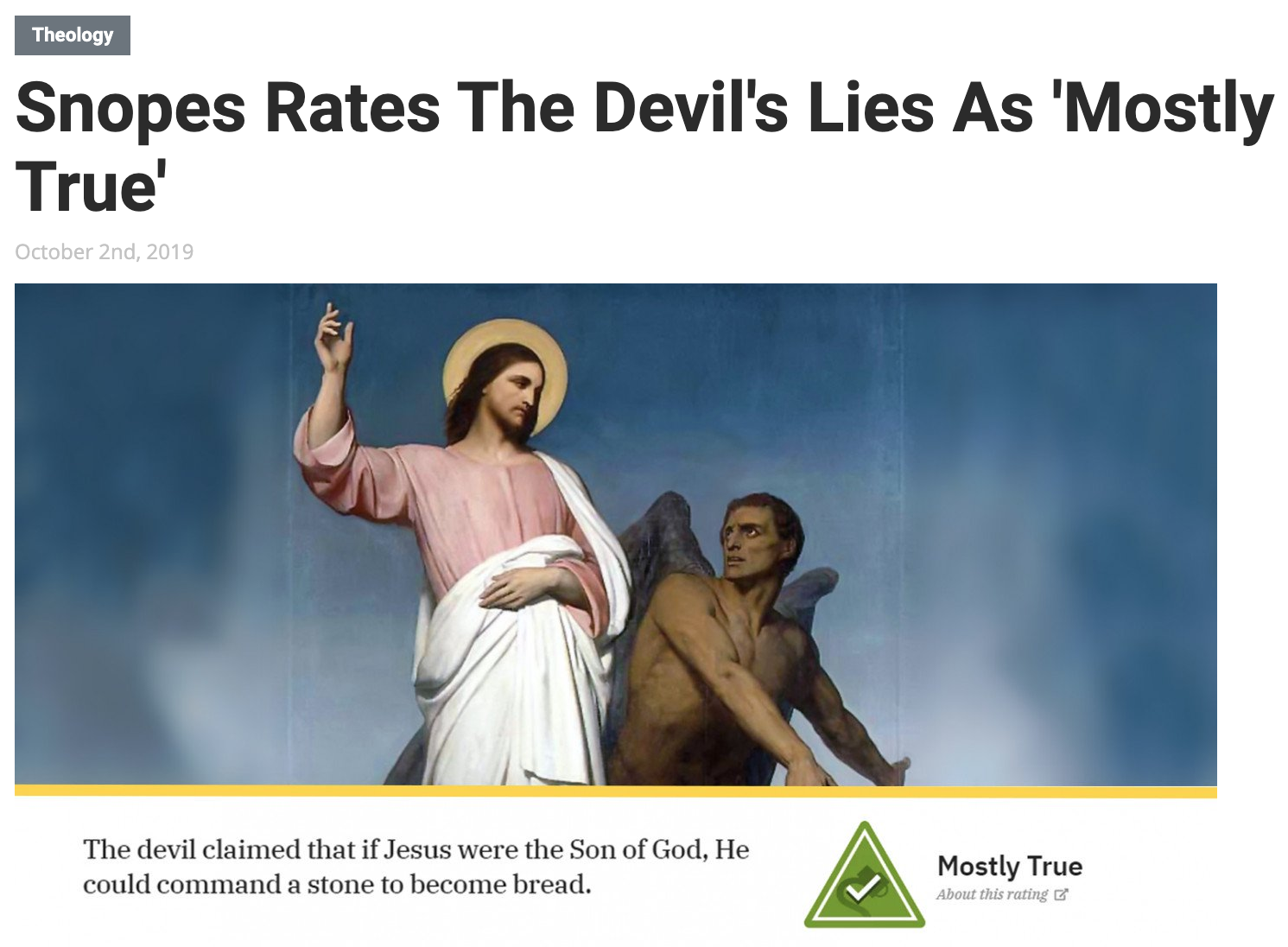
Another problem with fact-checking is the rating system. Fact-checkers like PolitiFact often conclude that statements are true, mostly true, half-true, mostly false, or false. But is such a classification even possible? In other words, can something really be "mostly true" or "half true"? The Babylon Bee captures this problem in a pretty funny headline:

If a politician said that the lost city of Atlantis has been discovered underneath Puget Sound, everybody would know he was lying. It's entirely absurd. But if a politician makes a false claim within a context that is mostly true, people are much more likely to believe it. In other words, the most effective lies are "mostly true."

Who Fact-Checks the Fact-Checkers?

Ultimately, fact-checking is a much more subjective enterprise than we would like it to be. Truth is real but sometimes difficult to ascertain, particularly when political ideologies and motivated reasoning are involved. To eschew these pitfalls, fact-checkers need to be keenly sensitive to such biases. Otherwise, fact-checkers will be seen as simply another manifestation of "fake news."

Thursday, October 3, 2019

No, Fluoride Doesn't Lower IQ. It Fails to Satisfy Hill's Criteria of Causality

By Alex Berezow — August 19, 2019 @ American Council on Science and Health

Because Americans have a conspiracy theory about everything, of course there's a conspiracy involving drinking water. Didn't you know that fluoride, which is added to our drinking water to keep our teeth healthy (and is considered one of the greatest public health triumphs of all time), is actually a nefarious mind control scheme?

Well, the media just handed these conspiracy theorists a gift on a giant silver platter: Multiple outlets are reporting that pregnant women who consume too much fluoride produce children with lower IQs. The reports are based on an extremely controversial study just published in JAMA Pediatrics. Are the study's conclusions true? It's doubtful.

To illustrate why, let's examine the authors' findings in the context of Hill's Criteria of Causality, a series of benchmarks devised by epidemiologist Austin Bradford Hill meant to tease apart correlation from causation. There are nine criteria:

(1) Strength of association;
(2) Consistency;
(3) Specificity;
(4) Temporality;
(5) Biological gradient (dose-response);
(6) Plausibility;
(7) Coherence;
 (8) Experiment;
 (9) Analogy.

(See this article for explanations of each criterion.)

While it is rarely possible for any claim to meet every single criterion, there shouldn't be any blatant violations. How does the "fluoride causes lower IQ" claim stack up? It violates several of Hill's Criteria:

Strength of association. The link between fluoride and IQ is not particularly strong. As Dr. John Ioannidis (a professional junk debunker who shook the world of biomedical science by showing why most published papers are wrong) told the Washington Post, "The results are very borderline in terms of statistical significance." Indeed, the reported drop in IQ for boys was about 4.5 points, but the confidence interval (-8.38 to -0.60) almost included zero. (In statistics, if a confidence interval includes zero, it means "nothing to see here.")

Consistency. The paper is not consistent with other data on the topic. While it is true that extremely high doses of fluoride harm the brain, people are not exposed to those levels by drinking water. Also, the American Academy of Pediatrics explains that as water fluoridation has become more widespread over the past several decades, Americans' IQ has increased. (This IQ increase is known as the Flynn effect, which is perhaps due to better nutrition, public health, and education.)

Coherence. While the authors conclude that a 1-mg increase in fluoride detected in the mother's urine is linked to an IQ drop of about 4.5 points in boys, there is no statistically significant IQ difference among girls. (Actually, it's worse than that. The point estimate shows an IQ increase of 2.4 points for girls.) Obviously, that is incoherent. There is no sensible biochemical reason for why fluoride would harm the brains of boys but not those of girls.

Finally, it's worth pointing out that the 4.5-point lower IQ score among boys is for every 1 mg increase in the mother's urine fluoride levels. But women didn't really have that much of a difference in fluoride levels. The expected difference between the "high fluoride" and "low fluoride" groups was 0.29 mg, which would translate into an IQ drop of 1.3 points. (That is, 4.5 x 0.29.)

So, are the authors wrong? Probably. To be certain, it wouldn't be a bad idea to do a larger study examining the issue, just in case.

Thankfully, the authors didn't make any grand, sweeping conclusions. They simply advise, "These findings indicate the possible need to reduce fluoride intake during pregnancy." Unfortunately, this sort of nuance will be lost on conspiracy theorists and much of the media.

I recommend reading The Fluoride Wars: How a Modest Public Health Measure Became America's Longest-Running Political Melodrama 1st Edition by R. Allan Freeze (Author), Jay H. Lehr (Author)

Friday, August 23, 2019

Viewpoint: Produce is sugary, GMO ‘poison’? Scientific American embraces long-debunked food safety tropes

| August 22, 2019

The headline is not exaggeration or hyperbole. Scientific American just ran an article claiming that vegetables are becoming like sugary snacks and are toxic. And that’s not even the worst part.
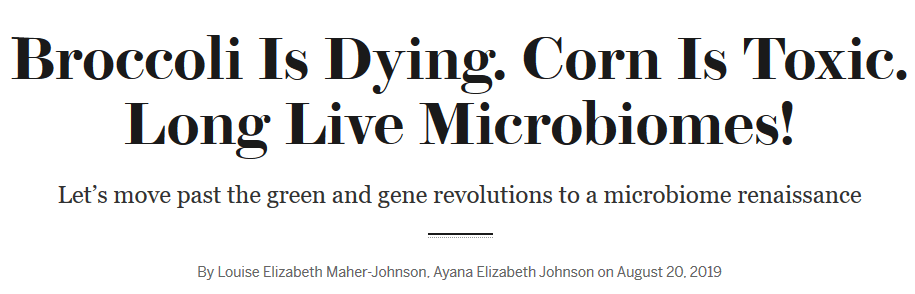
The article was given the ridiculous headline “Broccoli Is Dying. Corn Is Toxic. Long Live Microbiomes!” It was co-authored by a marine biologist and a retired English teacher. As one might expect from the headline, the article makes one outrageous, unscientific claim after another.

screenshot broccoli is dying corn is toxic long live microbiomes

The lies, distortions, and laugh-out-loud whoppers start early and often. Let’s dissect them:

As food writer Mark Bittman recently remarked, since food is defined as “a substance that provides nutrition and promotes growth” and poison is “a substance that promotes illness,” then “much of what is produced by industrial agriculture is, quite literally, not food but poison.”
This is the first sentence. Yes, that’s how this screed actually begins. Everything you eat is poison. How do we know? Because an organic food activist with no relevant scientific training or expertise says so..............To Read More.....

Related article:  How European-Based NGOs Block Crop Biotechnology Adoption In Africa, Margaret Karembu, Director of International Service for the Acquisition of Agri-biotech Applications, Africa regional office (ISAAA) AfriCenter based in Nairobi | February 23, 2017

Monday, August 19, 2019

'Harmless' Measles Kills a Flight Attendant. Anti-Vaxxers Are to Blame

By Alex Berezow — August 13, 2019 @ American Council on Science and Health

How many times have we heard in recent years that measles is no big deal? That it's just a harmless childhood disease (nicknamed "Mickey Mouse measles" following the Disneyland outbreak)? That people who are vaccinated shouldn't be afraid of it?

Well, those typical anti-vaxxer arguments have been proven decisively wrong in the most tragic way possible: A 43-year-old woman who was a flight attendant for the Israeli airline El Al has died after contracting measles and falling into a coma from encephalitis (brain swelling). She was vaccinated as a child, but as public health officials warn, vaccine protection can wear off over time.

The Tragic Truth About Measles

People in the developed world rarely die of measles. But that wasn't always the case. According to the CDC, before there was a vaccine against it, measles infected 3 to 4 million Americans each year, hospitalized 48,000, caused encephalitis in 1,000, and killed 400 to 500.

Thanks to vaccines and modern healthcare, these numbers are way down. But that still doesn't mean that measles is harmless. The CDC further reports that approximately:
  • 1 in 5 unvaccinated people who get measles are hospitalized
  • 1 in 20 children with measles get pneumonia (which can be lethal)
  • 1 in 1,000 children who get measles will develop encephalitis (which can cause deafness or intellectual disability)
  • 1 to 3 in 1,000 children who get measles will die from respiratory or neurologic complications
There is also evidence that measles wreaks havoc on the immune system, partially "erasing" its memory of past infections. Science News reported, "The resulting 'immune amnesia' leaves people vulnerable to other viruses and bacteria that cause pneumonia, ear infections and diarrhea."

The Way of a Fool Is Right in His Own Eyes

But scientific facts and pleas for personal responsibility to protect the most vulnerable among us (the immunocompromised, children too young to be vaccinated, and the unknown among us whose vaccine has worn off) do not matter to the selfish fools who continue to reject vaccines. They have blood on their hands, they don't care, and society has not chosen to hold them accountable.
So expect this tragedy to repeat. Again and again and again.

Sunday, August 11, 2019

7 Wonders of the Biotech World

By Alex Berezow — July 16, 2019 @ American Council on Science and Health

Though only one of them still exists, the Seven Wonders of the Ancient World -- such as the Colossus of Rhodes and the Hanging Gardens of Babylon -- transcend space and time.

What makes these structures so awe-inspiring is the fact that they were built without cranes or any piece of equipment we associate as being essential to modern construction. We could say that, though these ancient cultures were of relatively limited means, they displayed great architectural ingenuity and engineering ability. Archaeologists still don't know how the Great Pyramid was built.

Today, biomedical scientists stand in a position not dissimilar to that of our ancient ancestors. A thousand years from now, we will be viewed as naïve and of limited means. Yet, it is quite possible that historians of science will look back at the 20th and 21st Centuries as the years in which great marvels were accomplished. If there is ever a list called The Seven Wonders of the Biotech World, this is what should be on it:

Sequencing of the Human Genome. When a "rough draft" of the human genome was published in 2000, many assumed that groundbreaking therapies were right around the corner. Well, things didn't work out like that. As it turned out, the genome was much more complicated than we thought, thanks to phenomena such as epigenetics and other mechanisms of regulation of gene expression. However, the human genome sequence is still the ultimate "Rosetta Stone" of biotechnology. Personalized medicine, DNA testing (for ancestry, forensics, and disease), and other technologies forever will rely upon it.

The Cloning of Dolly the Sheep. Wouldn't it be great if you had a twin? Scientists first made a "twin" sheep called Dolly by removing the nucleus of an udder cell and placing it inside an egg with its nucleus removed. This new cell was then implanted into a mother, and eventually, Dolly was born. This same technique, called somatic cell nuclear transfer (SCNT), has been used to clone cats, dogs, mice, and monkeys. We could probably do it in humans, but it would be incredibly unethical.

Mass Production of Insulin in Bacteria. Before biotechnology, diabetes patients received insulin extracted from pigs and cows. According to the National Museum of American History, "more than two tons of pig parts were needed to extract just eight ounces of purified insulin." But then scientists found a better way. They inserted the human gene for insulin into bacteria, and the genetically modified bacteria were then grown in gigantic fermenters where they produced insulin. To this day, that is how insulin is produced worldwide.

Genetic Manipulation of Plants. Around the time that Paul Ehrlich was telling us that we were all going to die of mass starvation, Nobel Prize-winning plant geneticist (and ACSH co-founder) Norman Borlaug was breeding better crops. He eventually created a high-yield, disease-resistant variety of wheat that is credited with saving millions (perhaps up to a billion) lives. Since then, with the aid of modern biotechnology, scientists have further increased yields by creating plants that are resistant to insects, herbicides, and drought.

Mind Reading and Thought Control. "Wait a second," you may be thinking. "Isn't mind reading and thought control just a sci-fi fantasy?" Not anymore. Technology already exists that can reconstruct an image based solely on brain signals generated by a person looking at something. We can use brain scanners to communicate with patients in a persistent vegetative state. And, for the rock-bottom price of $159.99, you can control a cockroach with your iPhone. (Cockroaches sold separately.)

Gene Therapy. Patients born with certain genetic diseases can now have them cured -- not just managed or treated, but actually cured. A rare immunogenetic disease made famous by the "Bubble Boy" that causes children to be severely immunocompromised can now be cured with gene therapy. Zolgensma, the most expensive drug in the history of the world (with a price tag of $2.125 million), cures spinal muscular atrophy. Scientists are currently working on a cure for sickle-cell anemia.

Regeneration of Human Organs. Using a patient's own stem cells, we can regenerate simple organs such as skin, tracheas (windpipes), and bladders. Notably, this technology precludes organ rejection. It is not yet possible to regenerate more complex organs, like the heart or liver.

That's the list. And now a prediction:

The Eighth Wonder of the Biotech World: Resurrection of Species. No, dinosaurs aren't coming back. But other species almost certainly will. Within our lifetime, it is extremely likely that we will resurrect extinct species, such as the woolly mammoth. Achieving this will require the same sort of technology that allowed the cloning of Dolly, as well as the ability to piece together fragmented DNA sequences (because DNA decays over time) into artificial chromosomes. Zoos of the future could be quite interesting.


Saturday, August 3, 2019

Bernie Sanders, Don't Call Scientists in Pharmaceutical Industry 'Crooks'

By Alex Berezow — July 31, 2019

I've decided not to watch any of the presidential debates because I just can't take it. If a politician isn't saying something stupid, he or she is saying something insulting. Oftentimes, it's both.
Take Senator Bernie Sanders, for instance. Last night, he decided to call the hard-working scientists in the pharmaceutical industry a bunch of crooks. That's right, the same people who produce antibiotics, vaccines, HIV antiretrovirals, chemotherapies, and countless other lifesaving drugs are criminals. Why? Mr. Sanders said:
"I took 15 people with diabetes from Detroit a few miles into Canada, and we bought insulin for one-tenth the price being charged by the crooks who run the pharmaceutical industry in America today."
Yes, drug prices in the United States are very high. The reasons have less to do with ethics or criminality and more to do with our convoluted R&D and healthcare systems.

Why Are Drug Prices So High in the United States?

Before explaining why drug prices are so high, let's first acknowledge that there are some "crooks" in the pharmaceutical industry. Martin Shkreli comes to mind. That little dweeb jacked up the price of an HIV drug (Daraprim) from $13.50 per pill to $750. Why? Because he could. The company that manufactured the drug, Turing Pharmaceuticals, basically had no competition, so Shkreli could charge whatever he wanted.

It's worth pointing out that Daraprim is no longer protected by a patent and can be made generically. But if only one company manufactures it, they have a monopoly, even if other companies are allowed to make it. That is why encouraging the development of more generic drug manufacturers (as well as speeding up the approval process for generic drugs) is one key to lowering drug prices.

But crooks like Shkreli are the exceptions that give Big Pharma a bad name. High drug prices are due to some combination of the following:

(1) The exorbitant cost of R&D. Developing a drug can cost billions of dollars and take 10 or more years. Clinical trials (in which drugs are tested in humans) are particularly expensive. If a drug makes it to market, the company that developed it needs to recoup these costs. If the drug fails during clinical trials and does not make it to market, the company needs to make up for those losses by increasing the prices of other successful drugs.

(2) Insurance. If your company takes you out for dinner, do you care how much you spend on your meal? Probably not. Somebody else is paying for it. The same goes for drug prices (and healthcare as a whole). Because insurance companies often pay the bulk of our costs for us, we are not incentivized to seek out or demand lower prices.

(3) Patents. The protection of intellectual property is crucial to innovation. (An interview I conducted with Patrick Kilbride of the U.S. Chamber of Commerce goes into further detail.) R&D is simply unsustainable if a company spends billions of dollars developing a drug only to have another company steal all that knowledge. Patents allow a company to profit -- for a limited time -- from the extreme risk they took. The question is how to balance intellectual property protection with society's interest in low drug prices. That may involve preventing companies from gaming patents, as Dr. Josh Bloom explained in this article about Nexium.

(4) Desire to maximize revenues. Even if a drug is protected by a patent, a drug company can't set the price too high, otherwise few people would buy it. So a company charges as much as they think the market can tolerate. An article by Senior Fellow of Medicinal Chemistry Dr. Christopher Gerry explains further.

(5) Medicare can't negotiate prices with drug companies. By law, the Department of Health and Human Services is not allowed to negotiate drug prices for Medicare patients. Currently, there are efforts to change that.

(6) Other countries can negotiate drug prices, so they freeload off the United States. Canadians, for instance, are a bunch of freeloaders. Who says so? Some Canadians themselves admit it. This op-ed in Canada's Financial Post refers to its drug policy as "parasiti[c]." But it's not just Canadians. Japan and Western Europe are also freeloading off the U.S.

Bernie Sanders, Don't Call Scientists in Pharmaceutical Industry 'Crooks'
The problem of high drug prices is multifaceted and complex. Referring to the pharmaceutical industry as "crooks" might be good for some cheap applause, but it is insulting and demoralizing to the thousands of scientists who work for it. Bernie Sanders should apologize.
 
Tags: 
drug prices

Please Help Fund Our Work
If you follow our work, you know that we here at ACSH go after the fraudsters, the hucksters and the snake-oil peddlers. And when we're not debunking their misleading or dangerous junk science, we're always aiming to give you the most accurate and dependable health news. But we can only continue to do that with support from our readers and friends who value what we do. So if you can please donate. Thank you.

Tuesday, July 30, 2019

Environment: Getting Better All the Time

By Alex Berezow — July 23, 2019   @ American Council on Science and Health 

In 1967, the Beatles released Sgt. Pepper's Lonely Hearts Club Band, one of the best albums ever made. One of its hit songs was titled "Getting Better," and part of the chorus goes like this:

I've got to admit it's getting better
A little better all the time

The song was about life in general, but it could have been dedicated to the environment. Contrary to what you see reported in the news, the environment is, bit by bit, getting better.

The Environment: Getting Better All the Time

The latest evidence for this comes from France, which is becoming heavily re-forested. According to The Economist:
Since 1990, thanks to better protection as well as to a decline in farming, France’s overall wooded or forested areas have increased by nearly 7%. And France is far from being alone. Across the EU, between 1990 and 2015, the total forested and wooded area grew by 90,000 square kilometres—an area roughly the size of Portugal. Almost every country has seen its forests grow over the period.
Believe it or not, Europe is not an outlier. The United States has more trees now than it did 100 years ago. A study in Nature concluded that there is more tree cover on Earth now than 35 years ago1.

Why? Because of technology and wealth. Technology, including agricultural technology, helps decouple the economy from natural resources. In other words, we humans are becoming less reliant on Mother Nature for our well-being. We can grow more food on less land, for instance. Soon, using hydroponics, we may be able to grow food in skyscrapers.


Wealth is the other major driver. When a poor country becomes wealthier, it usually does so at the expense of the environment. (That's why China is belching out pollution and Brazil is destroying the Amazon rain forest.) The primary concern of these countries is to escape poverty. But as countries become even richer, they decide to use some of that wealth to benefit the environment. Green spaces and parks are often seen as a luxury that only the wealthy can afford.

This concept is neither new nor a myth propagated by industry. It's known as the environmental Kuznets curve. (Source: Govinddelhi via Wikipedia.) A textbook co-authored by Paul Krugman (yes, that Paul Krugman) called International Economics: Theory and Policy said that the relevance of the environmental Kuznets curve "has been confirmed by a great deal of further research."2

None of this is meant to suggest that there are no environmental problems. Poor regions really are doing some very bad things to the planet. Asia and Africa, for example, are primarily responsible for dumping plastic into the ocean3.

As is often the case, the cure is wealth. If we want these countries to treat the planet well, we should do whatever we can to help make them richer. Incidentally, they'll also have fewer kids.
Notes

(1) Naysayers, pessimists, and Debbie Downers will note that biodiversity is lower in new forests than in old-growth forests. That's probably true but have patience. Biodiversity will return. The Demilitarized Zone (DMZ) between North and South Korea has become a haven for wildlife, including endangered species.

(2) I once had a TV debate with Prof. Corey Bradshaw of Flinders University, who erroneously claimed (at 26:26) that, "There is no evidence for the environmental Kuznets curve ever in the history of humankind." Perhaps he should read more.

(3) Before anyone says that the United States and other rich countries are ultimately responsible because we outsource our pollution, note that in regard to "pollution havens," the aforementioned textbook says, "[T]here is not much evidence that 'dirty' industries move to countries with lax environmental regulation."
 
 
 Please Help Fund Our Work If you follow our work, you know that we here at ACSH go after the fraudsters, the hucksters and the snake-oil peddlers. And when we're not debunking their misleading or dangerous junk science, we're always aiming to give you the most accurate and dependable health news. But we can only continue to do that with support from our readers and friends who value what we do. So if you can please donate. Thank you.

Tuesday, July 9, 2019

Toxic America: The Guardian Spreads Chemophobia and Anti-Americanism

By Alex Berezow — July 1, 2019 @ American Council on Science and Health

When I was editor of RealClearScience, we considered The Guardian to be a daily must-read. The reason is because they had an excellent science section, featuring writers like Ian Sample and Mo Costandi, as well as a solid science blog.

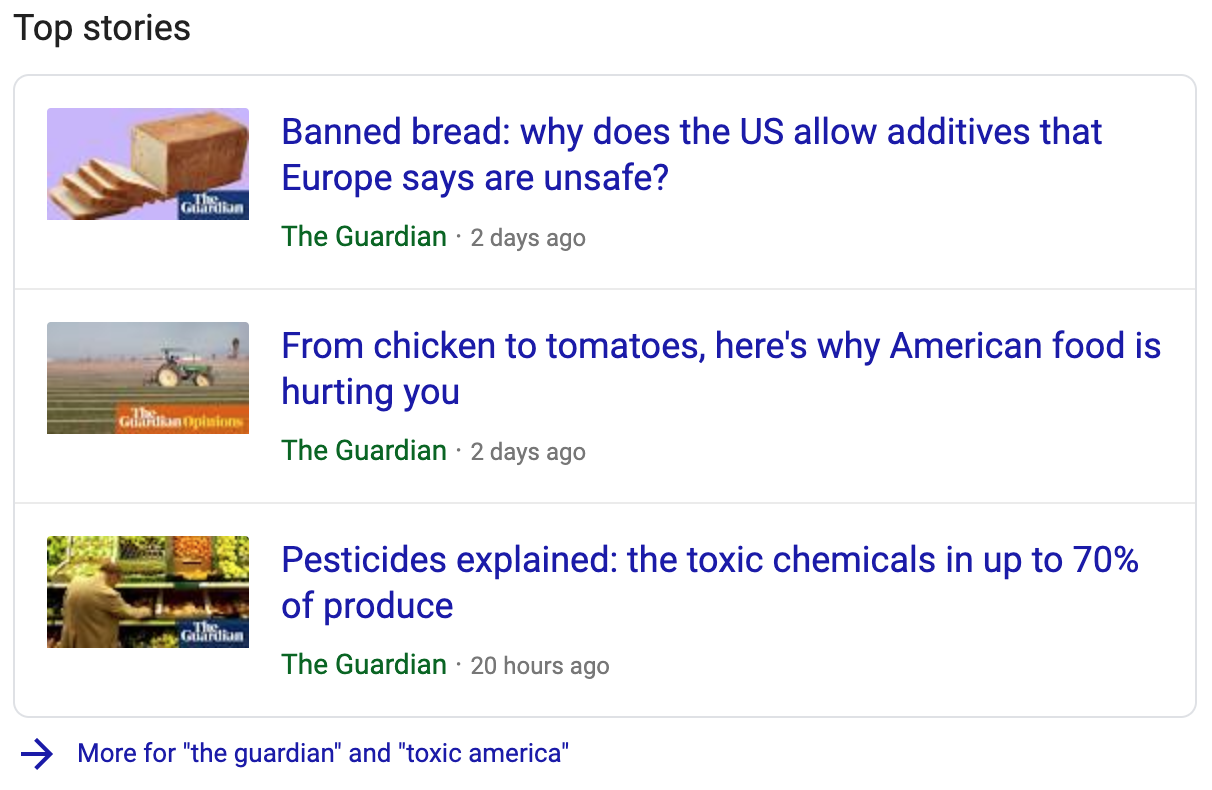
Well, times have changed. As is often the case with media outlets, when bills start to pile up, the science section is usually among the first to go. The Guardian axed its science blog in August 2018. Then, apparently, they found a new moneymaker in spreading chemophobia and anti-Americanism with a new series titled "Toxic America."

The section is every bit as dreadful as it sounds. Chemicals are everywhere, they're killing you, and gun-toting Americans are to blame. That's not hyperbole. Here's what The Guardian wrote in its inaugural article:
The American public is routinely exposed to toxic chemicals that have long been banned in countries such as the UK, Germany and France. If they’re deemed harmful in those countries, why not in the US? We will examine the power of the $640bn chemical industry – which has a lobby that’s currently better funded than the NRA.
After hinting at the corrupting power of money, The Guardian then unironically asks you to send them $150,000.

Toxic America: The Guardian Spreads Chemophobia and Anti-Americanism

It's not a big secret that the British far left is anti-American. That's been the case for a very long time. The following quote about potential prime minister and current Labour Party Leader Jeremy Corbyn comes not from an American conservative or Trump supporter, but from an editorial by the Washington Post in 2015:
"[Corbyn's leadership victory] validated a radically anti-American agenda that could accentuate Britain’s drift away from the trans-Atlantic partnership. Mr. Corbyn espouses a foreign policy whose guiding principle is to oppose the United States and Israel by all means."
We have no stake in the outcome of British politics. The point we are making is that The Guardian is preaching to a choir ready and willing to lap up whatever anti-American venom it plans to spew. Adding in conspiracy theories about chemical, biotech, and pharmaceutical companies simply makes the anti-Americanism that much tastier. It's a formula that has worked extremely well for RT, a Russian propaganda TV channel that also spreads anti-Americanism and disinformation about science.

Let's return to that inaugural article for Toxic America for an example of the sort of disinformation The Guardian is spreading. The author writes:
"It’s possible to find formaldehyde, a known carcinogen banned in cosmetics sold throughout the European Union, in US hair-straightening treatments and nail polish."
That's all true, but it's only half true (the worst kind of truth). What the author leaves out is that your very own body produces and disposes of more formaldehyde every single day than you are exposed to from outside sources. Why? Because formaldehyde is needed to make DNA, so you would be dead with out it, as chemist Dr. Josh Bloom explained.

Every other article in the Toxic America series is similarly full of egregious half-truths and distortions. One particularly bad one claims that chemicals are costing Americans IQ points, disregarding the well-known observation that IQ has been rising over time, a phenomenon known as the Flynn effect. Besides, even if trace amounts of chemicals are making us dumber (an unlikely hypothesis), the IQs of Americans still seem to be increasing.

Perhaps the worst article on the site encourages people to buy organic food to avoid "chemicals." It is written by Carey Gillam, an activist who is paid by the organic industry. Nowhere is that mentioned in the article. The article is literally an advertisement for the organic industry masquerading as journalism.

That's par for the course, according to the Genetic Literacy Project. In their essay exposing the lies behind Toxic America, Andrew Porterfield and Jon Entine write that The Guardian:
"...relied most heavily on freelancers, some of whom have little to no expertise on the subjects they opined about. Most critically, the series has so far included no articles written by independent scientists who have conducted primary research on chemical-related issues. Instead, the newspaper contracted with well-known activist organizations to write guest articles—in some cases groups whose viewpoints are controversial and often in conflict with the scientific mainstream. [Emphasis added]
The bottom line, as eloquently summarized by the Genetic Literacy Project, is this: "The Guardian recruited activist groups to author straight news pieces and did not disclose it." And to get extra clicks, they gave it an anti-American flavor, as well.
Such is the state of journalism in 2019.
 
Tags: 
 
Please Help Fund Our Work
If you follow our work, you know that we here at ACSH go after the fraudsters, the hucksters and the snake-oil peddlers. And when we're not debunking their misleading or dangerous junk science, we're always aiming to give you the most accurate and dependable health news. But we can only continue to do that with support from our readers and friends who value what we do. So if you can ... Please Donate. Thank you.


Sunday, July 7, 2019

Earth to Paul Ehrlich: UN Revises Population Projection Downward

By Alex Berezow — June 20, 2019 @ American Council on Science and Health

We aren't the sort of organization that likes to say, "We told you so." Okay, that was a lie. We totally are.

For reasons that we do not understand, the topic of world population makes some people foam at the mouth. Largely due to a book called The Population Bomb written by the thoroughly discredited (and strangely unrepentant) secular doomsday prophet Paul Ehrlich, there is a widespread belief that the world is overpopulated. It is not. Saying that, however, will get you called a lot of really bad names.
But facts don't care about feelings. Demographers routinely conduct computer simulations of the world population, and they do not predict runaway population growth. The broad consensus is that population will peak sometime during the 22nd Century and then decline.

It's not just that the concept of overpopulation is factually incorrect. It also encourages a misanthropic view of other (mostly black and brown) people in the developing world. If you think that humans are just a bunch of cockroaches, that doesn't encourage you to be helpful toward those in need. It's a toxic mindset.

It's also a worldview that causes people to say stupid things and waste money on non-existent problems, such as the ridiculous claim that the world will run out of food by 2027. Jeff Bezos wants to build space colonies for a trillion people, despite that we won't need them because there will never be a trillion of us.

On top of all that, some scholars who have studied the issue believe that world population will start shrinking this century, not next century. ACSH published an article by two such writers, Darrell Bricker and John Ibbitson, in February of this year. They argued, "We do not face the challenge of a population bomb but of a population bust—a relentless, generation-after-generation culling of the human herd. Nothing like this has ever happened before."

They may very well be right.

United Nations Revises Its Population Projection Downward

As reported in The Economist, the UN has revised its latest population projection downward. Specifically, it lowered its projection for 2050 by 37 million people (to 9.7 billion) and for 2100 by 309 million people (to 10.9 billion). Why? Because "[b]irth rates are falling faster than expected in some developing countries." That's precisely the argument made by Mr. Bricker and Mr. Ibbitson.
And it's why we feel completely justified in saying:

WE TOLD YOU SO!
 
Please Help Fund Our Work - If you follow our work, you know that we here at ACSH go after the fraudsters, the hucksters and the snake-oil peddlers. And when we're not debunking their misleading or dangerous junk science, we're always aiming to give you the most accurate and dependable health news. But we can only continue to do that with support from our readers and friends who value what we do. So if you can ... Please Donate. Thank you.

Thursday, June 13, 2019

New York Times Promotes Witchcraft, Condemns Itself in Op-Ed

By Alex Berezow — June 10, 2019 @ American Council on Science and Health

How much lower can the New York Times go?

Thanks to serial fabricator Jayson Blair, America's alleged newspaper of record was spreading fake news long before "fake news" became a household word. As I detailed for RealClearScience in 2015, the paper has a lengthy record of eagerly promoting junk science, such as fad diets, anti-GMO propaganda, chemophobia, and the debunked link between cell phones and cancer. Last year, one of its reporters was caught sleeping with a source.

Apparently, the NYT hasn't quite hit rock-bottom yet. Somebody at the Gray Lady said, "Hold my beer and watch this."

New York Times Promotes Witchcraft

In a bizarre article titled "Here’s What Being a Witch Really Means," author Pam Grossman explains, "My grandma Trudy used to tell us that she had 'healing hands.' I soon discovered that I did, too." What sort of healing? Well, Ms. Grossman says that her grandma could make her headaches vanish by simply touching her forehead. Apparently, she resurrected a dying horse, too.

Notwithstanding the Lazarus Horse, the headache "cure" has an easy explanation: The placebo effect.
Anyway, not to be outdone by her show-off grandmother, Ms. Grossman later discovered that she, too, had the power to heal... or at the very least, make horny teenagers kiss each other:
There was the spell I did for Rebecca, my older sister’s friend, who was hiding in my room during a house party, lusting after some guy who was downstairs. I lit some candles and did some incantations: “Oh kindle the fire of his heart!” I chanted, while trying not to kindle the fire of my suburban bedroom. 
Then I sprinkled her with some “love powder” that I’d bought at a New Age shop and sent her on her way. They made out an hour later.
Wow. If that isn't a slam-dunk case for witchcraft, then I don't know what is.


The New York Times Doesn't Understand Why Smart Women Fall for Pseudoscience

Entirely unironically, a few days later, the New York Times ran an op-ed by Jessica Knoll titled "Smash the Wellness Industry." The article begins by asking, "Why are so many smart women falling for its harmful, pseudoscientific claims?"

Gee, maybe it's because they read about the benefits of witchcraft in the very same newspaper? This is sort of like the Weekly World News running an op-ed denouncing fake news, while covering the latest antics of Bat Boy
.
The opinion piece is actually quite good, as it echoes many of ACSH's themes. Notably, the piece denounces the "poisonous relationship" Americans have with their food, namely, that they're supposed to be afraid of it. Ms. Knoll then hits a grand slam with this:
...I could recognize wellness culture for what it was — a dangerous con that seduces smart women with pseudoscientific claims of increasing energy, reducing inflammation, lowering the risk of cancer and healing skin, gut and fertility problems.
So, why oh why, does the New York Times still have an entire section dedicated to wellness? And why does the NYT continue to publish nonsense about "detoxing"? Answer: Because the NYT knows there is a lot of money to be made selling pseudoscience to its gullible Upper West Side clientele. While the op-ed page seems to support evidence-based science, the rest of the newspaper keeps peddling junk.

Very (witch)crafty.
 
Tags: 
New York Times, science journalism, junk science, pseudoscience, anti-science

Please Help Fund Our Work

If you follow our work, you know that we here at ACSH go after the fraudsters, the hucksters and the snake-oil peddlers. And when we're not debunking their misleading or dangerous junk science, we're always aiming to give you the most accurate and dependable health news. But we can only continue to do that with support from our readers and friends who value what we do. So if you can ... Please Donate. 

Thank you.