(Photo by Lori Van Buren/Albany Times Union via Getty Images)
A self-anointed coterie of journalists that has forfeited the
public’s trust with repeated, egregious displays of personal bias is
astounded that it can’t skate by on credentialism any longer. Where have
we seen that before? The gravy train for fact-checkers appears to be
grinding to a halt, and all the muttering in the world about “codes of
principles” and “identifying truth” won’t be able to save another
crumbling annex of the big-box media edifice from fading into
irrelevance on a CNN or MSNBC scale.
On Jan. 7, Meta CEO Mark Zuckerberg announced plans to end the
“fact-checking” programs at his company’s major social media sites,
which include Facebook and Instagram. The reaction of the fact-checkers
to this unexpected move reveals the full extent of their disconnect from
the vast majority of Americans who do not share the basic assumptions
of their urbanite progressive mindset.
Fact-Checkers Not Biased But ‘Why Does Trump Lie So Much?’
Writing about itself in a “why I’m important” manner, the woefully compromised Poynter Institute conveyed the deep distress felt by staffers at its International Fact-Checking Network (IFCN), which has partnered with Meta.
“The fact-checkers used by Meta follow a Code of Principles
requiring nonpartisanship and transparency,” IFCN Director Angie Drobnic
Holan is quoted by her employer as saying. “It’s unfortunate that this
decision comes in the wake of extreme political pressure from a new
administration and its supporters. Fact-checkers have not been biased in
their work – that attack line comes from those who feel they should be
able to exaggerate and lie without rebuttal or contradiction.”
She doesn’t even realize she’s doing it. Drobnic Holan, former
editor-in-chief of Poynter’s flagship PolitiFact fact-checking site,
couldn’t resist taking a loaded shot at President-elect Donald Trump
while earnestly stressing her professional evenhandedness.
It’s a question often asked of the Ivory Tower leftists: Do they not
realize that the plebes have access to the Internet now? We can
fact-check the fact-checkers. It’s quick, it’s easy, and the results
speak louder than the canned jargon of dominant media journalists.
Attempting to control online platforms only makes Americans more
determined to dig beyond the duplicitous surface.
“It’s astounding even now, two years into Donald Trump’s presidency,
how many things he says on a daily basis that just aren’t true.” That’s
the lead sentence of Drobnic Holan’s 2019 essay in progressive
establishment magazine The Atlantic titled “Why Trump Is the Most Fact-Checked President.”
“Why does Trump lie so much? Only he can answer that question, but
it’s certainly a long-standing behavior that dates back to his time in
luxury real estate and reality television,” the self-proclaimed
transparently nonpartisan Drobnic Holan continues.
She’s not an exception.
‘There’s a Lot More to Fact-Check on the Right’
“We heard the news [of being dropped by Facebook] just like everyone
else,” Alan Duke, co-founder and editor-in-chief of Lead Stories,
mournfully related to Wired.com. “No advance notice.” Lead Stories began fact-checking for Meta in 2019.
Locked into his pre-conceived biases, Duke never saw the ax coming.
“We don’t have anything against anybody. We don’t have an agenda. We
are looking for facts and we fact-check the right and the left,” Duke, a
former CNN employee, told the network in an article published Oct. 29,
2020, less than a week before the presidential election. “It just so
happens that there’s a lot more to fact check on the right. It’s just
mathematical.”
See how he assumes everyone would readily understand such faulty logic?
Science Feedback is another Meta fact-check partner about to lose its
sweet gig. It, too, was featured in multiple big-box media accounts of
Zuckerberg’s surprising move. “Science Feedback is a left-of-center
publishing organization that operates the blogs Climate Feedback and
Health Feedback,” watchdog website Influence Watch states. “Both
websites publish opinion articles claiming to assess the scientific
merit of popular media articles and scientific claims.”
Want a sample of their work? “Tire fires in Kuwait have a much
smaller climate influence than methane emissions from cows, contrary to
claims,” a Jan. 6 post on the group’s site proclaims.
Here’s another: “No, marine emissions study didn’t find that climate
change is ‘greatly overestimated,’ contrary to recent claims,” a Dec. 20
post reads.
This is what Facebook users will be missing out on now that Zuckerberg has pulled the rug from under the fact-checkers.
And what a cozy carpet it was.
“Meta has provided millions of dollars to fact checkers all over the
world that has enabled fact checkers not just to provide fact checking
for Facebook and Instagram, but also to raise the visibility of fact
checking and to enable fact checkers to hold public officials
accountable for what they say. That’s huge,” PolitiFact founder Bill
Adair sighed to a sympathetic NPR on Jan. 10.
For Discerning News Hounds
Poynter will manage to survive for some time. It receives funding
from several well-heeled sources, “including corporate partners,
philanthropic foundations, government agencies and individual donors.”
NPR is listed among those entities, “[p]artnering through the shared
values of truth and public accountability for a unique, multi-year
contract in which Poynter senior vice president Kelly McBride serves as
the NPR Public Editor,” as Poynter put it.
Fact-check: This relationship is not disclosed in the NPR article lamenting the demise of the Facebook fact-checkers.
“Fact checkers worry about the viability of their industry without
Meta’s support,” the NPR piece lamented. But are they worrying about the
right thing? Sugar daddies can be extremely valuable, but a tottering
big-box media is learning the hard way that integrity in the public eye,
once destroyed, is usually irretrievable.
~
Liberty Nation does not endorse candidates, campaigns, or legislation, and this presentation is no endorsement.
The information is the latest in a slew of “fact checker” stories which reveal dubiously credentialed individuals
working to remove anti-Big Pharma content from the internet at the
behest of big tech companies and their sponsors in the pharmaceutical
industry.
Floridian liberal Gabrielle Settles appears to have begun working for
Politifact in March 2021, bylining at least 70 stories for the
corporate-backed censor.
Settles, however, has no experience in dealing with any of this kind
of information, having performed the majority of her “fact checks”
simply by copying and pasting from the Centers for Disease Control
website, and even veering off into “fact checking” pictures of Christmas
cards and photos of singer ..........In fact, Settles’s journalistic contributions are extremely limited.
But naturally, her contributions to partisan rhetoric are not. The Politifact “reporter” – a job which includes no actual reporting –
has a history of pro-Democrat and anti-Trump tweets..........To Read More....
The advent of fact-checker journalism may be wearing out its welcome.
Perhaps the increasing politicization of American life is a contributor
to the downward spiral of the fact-checking profession that is
primarily run by politically engaged reporters, not expert specialists
in the subjects they assess by any sense of the imagination. Not that
any one group of experts should have the authority over the truth
either. Self-appointed media gatekeepers are a ticking time bomb of
political censorship, waiting to be unleashed when the temptations are
too great and the necessity for impartiality is even greater. With White
House Press Secretary Jen Psaki calling for collusion between social
media companies and the government to censor “misinformation”, this threat seems to be as close as ever.
Although fact checkers purport to be independent guardians of
accountability, recent events have exposed them as mere enforcers of
fashionable political positions. This brings us to a relatively new, but
powerful company known as NewsGuard,
which claims a partnership with Microsoft and gleaming spotlights in
major outlets. Its staff and board boast powerful connections to the
government, finance, and the media. According to an Op-ed in Politico
written by NewsGuards’ CEO, rather than simply being a fact-checking
company that can only debunk stories after they go viral, NewsGuard
rates entire websites’ trustworthiness. This new strategy is aimed at
discrediting the very source that alleged misinformation or
disinformation may come from. NewsGuard publishes lengthy “nutritional labels,”
rating websites on various criteria of journalistic importance and
outlining its reasons for giving certain ratings. Perhaps one day, these
ratings may be used to filter out certain websites, which is what
NewsGuard’s CEO alludes to by citing the great political scientist
Francis Fukuyama’s article in Foreign Affairs.
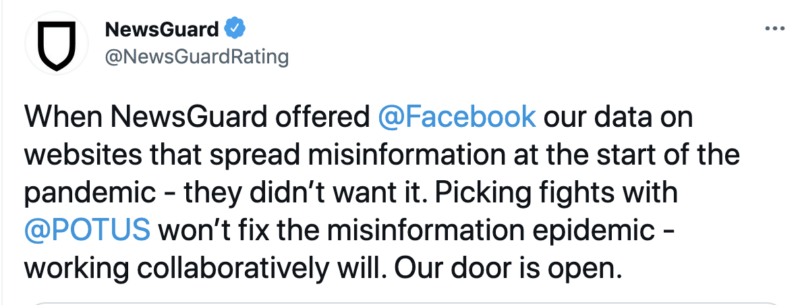
In fact, the company made the following tweet on July 17, 2021,
essentially siding with Psaki’s call for a government-media partnership
to censor internet content.
Phrases such as “working collaboratively” and “our door is open”
reveal that NewsGuard envisions itself as having a prominent role in any
collusive arrangement that arises from the White House’s recent
statements. Their posturing for influence, however, obscures a more
basic question: why should we trust a self-appointed fact checker?
Indeed, who fact checks the fact checkers?
After receiving a recent request for comments on a “fact-check”
article by NewsGuard regarding AIER and the Great Barrington
Declaration, we decided to investigate the rise of the fact-checking
phenomenon itself, including this strange new company’s own performance
in evaluating the content of other websites.
We soon discovered that NewsGuard falls far short of the very same
criteria for accuracy and transparency that it claims to apply to other
websites. Most of the company’s fact checkers lack basic qualifications
in the scientific and social-scientific fields that they purport to
arbitrate. NewsGuard’s own track record of commentary – particularly on
the Covid-19 pandemic – reveals a pattern of unreliable and misleading
claims that required subsequent corrections, and analysis that regularly
conflates fact with opinion journalism in rendering a judgement on a
website’s content. Furthermore, the company’s own practices fall far
short of the transparency and disclosure standards it regularly applies
to other websites.
How Accurate are Self-Appointed Fact Checkers?
The stated premise of fact-checking is to correct errors in claims
published by other websites and outlets. But what happens when the
organization doing the fact-checking has its own facts wrong?
A revealing example may be found in NewsGuard’s treatment of the “lab
leak” hypothesis for Covid-19’s origins. Media coverage of the lab leak
theory – which posits that the pandemic originated through the
accidental infection of workers at the Wuhan Institute of Virology who
were studying coronaviruses in bat populations – has changed
dramatically in recent months after a closer examination of evidence led several scientists to lend it credence.
Political figures including President Joe Biden and White House medical
adviser Anthony Fauci now consider the lab leak theory “plausible” and
have called for an investigation of the Wuhan facility.
For over a year prior to these recent developments however, NewsGuard
aggressively “fact checked” and penalized other websites for even
raising the possibility of a lab leak. Some of the most aggressive
attacks came from John Gregory, NewsGuard’s “Deputy Editor for Health”
policy and also the primary correspondent in AIER’s exchanges with the
company.
In March 2020, Gregory sent a separate inquiry
to another website charging it with promoting “unfounded conspiracy
theories about the virus’ origins,” and specifically what is known as
the lab leak hypothesis. “There is no evidence that the Wuhan Institute
of Virology was the source of the outbreak, and genomic evidence has
found that the virus is ‘96% percent identical at the whole-genome level
to a bat coronavirus,’” continued Gregory’s email, which also suggested
that NewsGuard would be flagging and downgrading the website for
publishing “misinformation” about this subject. While the website in
question – an “alternative medicine” blog – promoted other fringe claims
that warranted scrutiny and legitimate corrections, Gregory’s focus on
specifically discrediting the lab leak thesis suggests he was injecting
his own political opinions into the fact-checking exercise.
In another example from February 2020, Gregory announced by tweet
that he had contacted a medical news website after it ran a headline
suggesting “Coronavirus may have leaked from China’s highest biosafety
lab.” Gregory demanded a “formal correction or retraction” of the
headline. After we contacted Gregory by email to question him about the
practice of penalizing websites for discussing the lab leak hypothesis,
he responded, “My February 2020 tweet was also accurate,” asserting that
his position was justified on the grounds that “[t]he lab leak theory
remains unsubstantiated and under investigation.” NewsGuard has taken a
similar line in its reassessment of ratings on some 225 websites where
it docked the source for mentioning the lab leak hypothesis, stating
that “while not substantiated, [the lab leak theory] is also, as of now,
not provably false.”
Despite Gregory’s tendentious phrasing, he nonetheless quietly deleted the tweet
in the days following AIER’s inquiry. The company also found itself in
deeper trouble over its previous mischaracterizations of the lab leak
hypothesis as a “conspiracy theory” – a common refrain in Gregory’s
articles on the subject. In late June 2021, NewsGuard had to issue at
least 21 separate corrections to ratings where it docked websites for
reporting on the lab leak theory. According to a statement that the
company sent to AIER:
“NewsGuard either mischaracterized
the sites’ claims about the lab leak theory, referred to the lab leak
as a “conspiracy theory,” or wrongly grouped together unproven claims
about the lab leak with the separate, false claim that the COVID-19
virus was man-made without explaining that one claim was
unsubstantiated, and the other was false. NewsGuard apologizes for these
errors. We have made the appropriate correction on each of the 21
labels.”
NewsGuard has not published the full results of its audit, or a list
of the corrections it made, thereby precluding independent verification
of whether its corrections were sufficient to rectify the Covid
misinformation it had previously published. The company did not respond
to AIER’s request for this information.
While these corrections are a welcome development from the company,
they also reveal a deeper underlying hubris that characterizes
NewsGuard’s general approach to vetting Covid-19 content. Gregory and
other fact checkers at the site appear to have concluded as early as
February and March 2020 that the lab leak hypothesis was nothing more
than a fringe “conspiracy theory,” and began using this descriptor to
attack and downgrade almost any website that subsequently raised the
very possibility that it was investigation-worthy. This hubris persisted
until a reassessment of the claim led mainstream scientists, as well as
political figures such as Biden and Fauci, to deem the hypothesis
“plausible” and call for a comprehensive investigation into the Wuhan
Institute of Virology. Gregory and his colleagues appear to have simply
decided that their own premature dismissal of the lab leak hypothesis
equated to “fact” and proceeded to penalize other sites not for factual
errors, but rather for diverging from NewsGuard’s own editorial position
on the same subject. When this position turned out to be mistaken,
NewsGuard pivoted to remove the errors – albeit in non-transparent ways
that downplay the significance or pervasiveness of their mistake.
AIER’s own experience with NewsGuard revealed a similar pattern of
carelessness and misrepresentation by Gregory and other writers for the
company. Gregory contacted us on behalf of NewsGuard in early June 2021
requesting comments on several articles relating to Covid-19 pandemic
policy and the Great Barrington Declaration. AIER’s Phil Magness obliged
the request by offering to answer his questions in good faith, but
quickly discovered that they carried heavy political biases arising from
Gregory’s own personal beliefs about Covid-19, healthcare policy,
American politics, and related subjects.
In one such example, Gregory asked a prejudicial question that
attempted to implicate AIER with showing partisan political biases in
our publications:
“We also note that AIER.org refers
to itself as nonpartisan. Why then do its articles routinely criticize
Democrats, such as a June 2021 article that stated, “Biden has never
provided any evidence that he is more trustworthy on corruption than any
other career Washington politician,” or another recent article that
said Biden, Fauci, and House Speaker Nancy Pelosi “do not care if their
policies destroy the nuclear family, the educational system, and moral
and religious value systems, the very pillars of civil society?”
Gregory’s question, however, selectively cherry-picked only two
articles on our site where we criticized Democratic politicians. It made
no mention of themanyexampleswhereAIERhassimilarlycriticizedRepublicanssuch asformerpresidentDonaldTrump
over excessive spending, tariffs, support for lockdowns, and illiberal
political posturing. As Magness responded, “[T]he focus of [AIER’s]
criticism is also shaped by who happens to be in political power at the
time.” Gregory’s line of questioning about Democrats appears to have
intentionally ignored “numerous instances where we have similarly
criticized Republicans” when they were in power.
Gregory’s questions displayed a similar pattern of conflating
normative policy positions taken by individual authors on AIER’s website
– essentially opinion articles, and all properly identified as such –
for positive or empirical claims, which could then be “fact checked.” As
a result, his questions treated prescriptive policy opinions that
diverged from his own viewpoints as if they were “scientific claims” –
even when the normative nature of the argument was explicitly stated up
front (in one example, the authors of a “fact checked” argument prefaced
their opinions on how vaccines should be prioritized as their own
beliefs, including identifying it as “our views on this”
subject). Since AIER publishes a diversity of positions, including
arguments that diverge from the viewpoints of AIER’s full time research
faculty, it is fundamentally inaccurate to portray individual opinion
essays as “AIER.org’s claim,” as NewsGuard does. Indeed, Magness has written at length
in favor of expanding vaccination access despite FDA and CDC regulatory
obstacles, taking the exact opposite position of the viewpoint that
Gregory attributes to the organization. When Magness replied to Gregory
by calling attention to the difference between normative and positive
arguments as well as the editorial diversity of external contributors to
our daily publications, he ignored the distinction. Gregory’s
subsequent article proceeded to blur the two together, erroneously
depicting normative points of disagreement as positive scientific claims
that could then be “fact checked” against his own position.
Even more problematic was NewsGuard’s portrayal of the Great Barrington Declaration (GBD),
signed at AIER in October 2020. Gregory’s synopsis of the GBD contained
numerous false and misleading claims that were brought to the attention
of his company almost immediately after their publication.
Repeating a charge from another website, Gregory wrote that “none of
the three [GBD authors] had published peer-reviewed research about the
COVID-19 pandemic at the time they authored the declaration.” This claim
is false. GBD co-author Jay Bhattacharya was part of a team of
scientists from Stanford University that conducted one of the first
wide-scale seroprevalence studies of Covid-19 at the outset of the
pandemic. Their results appeared in the Journal of the American Medical Association in May 2020.
When contacted by AIER about this error in his article, Gregory
conceded that the claim “will require a correction on our part,” though
he appended it with a snide denigration of Bhattacharya for being
“listed as the seventh author” on the study (Bhattacharya was in fact a
principal co-author but was listed last, as per a convention with how
some medical journal articles identify senior ranked investigators. Bhattacharya was also a primary media contact about his study’s findings at the time of its release).
NewsGuard’s depiction of the GBD contained other clear
misrepresentations of its contents and positions. For example, Gregory
wrote that the GBD “argued that restrictions meant to reduce the spread
of the COVID-19 virus, such as face masks…should be eliminated for
people considered to be at lower risk of severe illness and death from
COVID-19.” The text of the GBD makes no mention of face mask policy
though – only lockdowns and similar restrictions on schools and
businesses. NewsGuard did not respond to multiple requests from AIER to
correct this erroneous characterization.
Gregory’s article also displayed a clear pattern of relying upon
dubious and unqualified secondary sources to evaluate the scientific
merits of the GBD. In an email to AIER, NewsGuard co-CEO Steven Brill
stated “when we make judgments about health care sites…we rely on – and
quote — sources who are the experts.” This is not the case with their
assessment of the GBD.
Rather than quoting scientific experts, NewsGuard’s review of the GBD relies primarily on a statement by former UK Health Secretary Matt Hancock
– a politician who has no formal scientific or medical training. In a
passage quoted by Gregory, Hancock stated that “the Great Barrington
declaration is underpinned by two central claims and both are
emphatically false. First, it says that if enough people get covid, we
will reach herd immunity. That is not true…we should have no confidence
that we would ever reach herd immunity to covid, even if everyone caught
it.”
Hancock’s statement, however, is at direct odds with mainstream
science on immunology. The World Health Organization specifically
defines herd immunity as the combined total of immunity acquired by
vaccination and by natural infection and recovery. Although it differs
from the GBD authors on how to most effectively reach this point, the
WHO does not dispute the existence or attainment of herd immunity
itself. Even among pro-lockdown sources, herd immunity is seen as a
reachable goal and a primary aim of mass vaccination, contrary to
Hancock’s claims. Dr. Anthony Fauci,
for example, has frequently stated that he anticipates reaching herd
immunity after between 70 and 85% of the U.S. population is vaccinated
or recovered from Covid-19. Most other public health scientists agree that herd immunity is attainable
through a combination of vaccination and natural immunity, even though
some of them differ from the Great Barrington Declaration authors about
the role of specific policy interventions in reaching this point.
Hancock’s statement, cited as authoritative by NewsGuard, further
contended, “The second central claim [of the GBD] is that we can
segregate the old and vulnerable on our way to herd immunity. That is
simply not possible.” This is not a scientific statement, but rather
Hancock’s own political opinion. A detailed plan arguing for the feasibility of focused protection
measures was published by the GBD authors to accompany the Declaration
itself. More importantly, the scientific literature on Covid-19
mitigation documents clear evidence that the success (or failure) of a
country to “shield” its nursing homes through a focused protection
strategy is a primary factor in its overall mortality rate. A study by John P.A. Ioannidis in the journal BMJ-Global Health
compared the nursing home shielding ratios of several countries,
concluding that they “varied markedly in the extent to which they
protected high-risk groups.” Contrary to Hancock’s political claims,
Ioannidis concluded: “Both effective precision shielding and detrimental
inverse protection can happen in real-life circumstances. COVID-19
interventions should seek to achieve maximal precision shielding.”
When asked by AIER about their continued reliance on Hancock as a
source despite the scientific misinformation contained in his assessment
of herd immunity as well as his overall lack of scientific
qualifications, Gregory responded that it “was and is relevant to
explaining the views of those who criticized the Declaration.” Neither
Gregory nor NewsGuard responded to follow-up questions about how they
reconciled this position, the political nature of Hancock’s comments, or
Hancock’s lack of scientific credentials with Brill’s assertion that
they “rely on – and quote — sources who are the experts” in the subject
matters they evaluate.
In addition to using non-expert assessments such as Hancock to attack
the GBD, Gregory included links to further readings about the
Declaration from an extremely dubious source: 9/11 Truther and conspiracy theory blogger Nafeez Ahmed of the Byline Times website. Between October 2020 and the present, Ahmed has promoted a flurry of increasingly bizarre conspiracy theories
about the GBD, including a false allegation that it was secretly
financed by libertarian billionaire Charles Koch in apparent
coordination with the British Ministry of Defence and – strangest of all
– the proprietor of a resort hotel located in Wales. Far from being
based in factual journalism, Ahmed’s theories display clear signs of its
author’s personal paranoias and political biases.
When asked about NewsGuard’s promotion of links to Ahmed’s blog,
Gregory backtracked by noting that “[NewsGuard] sometimes include
articles that we come across while researching a website but are not
referenced within the label itself.” He stated that Ahmed’s claims were
not used to calculate NewsGuard’s ratings and were only included to
provide a “history” of the GBD. It did not appear to concern Gregory
that Ahmed’s “history” was an unreliable conspiracy theory of his own
imagination.
As of this writing, NewsGuard has not altered or removed the links to
Ahmed’s allegations despite its promotion of documented falsehoods
about the origins and funding of the GBD. Even more astounding,
NewsGuard currently rates Ahmed’s blog with a score of 82.5/100, giving
it full credit for “gathering and presenting information responsibly.”
This pattern evinces a clear double standard in which NewsGuard promotes
sources that do not appear to meet their own published minimum
standards for reliability and uses them to denigrate the credibility of
AIER and the GBD.
In sharp contrast to the generally disparaging approach he took to
covering the GBD, Gregory holds other websites that attack the GBD in
high esteem. In one example, Gregory extended a score of 87.5/100 to
CovidFAQ.co, a website set up by a group of pro-lockdown activists in
the United Kingdom. CovidFAQ is a joint project of conservative member
of Parliament Neil O’Brien, “neoliberal” activist Sam Bowman, and academic Stuart Ritchie. Pro-lockdown UK political strategist Dominic Cummings recently referenced their work as part of a “decentralised” political campaign to discredit the anti-lockdown movement and the GBD,
which he proposed while serving as an advisor to Prime Minister Boris
Johnson. In his article for NewsGuard, Gregory credits CovidFAQ for “not
repeatedly publish[ing] false content.” The website’s track record is
at clear odds with Gregory’s assessment.
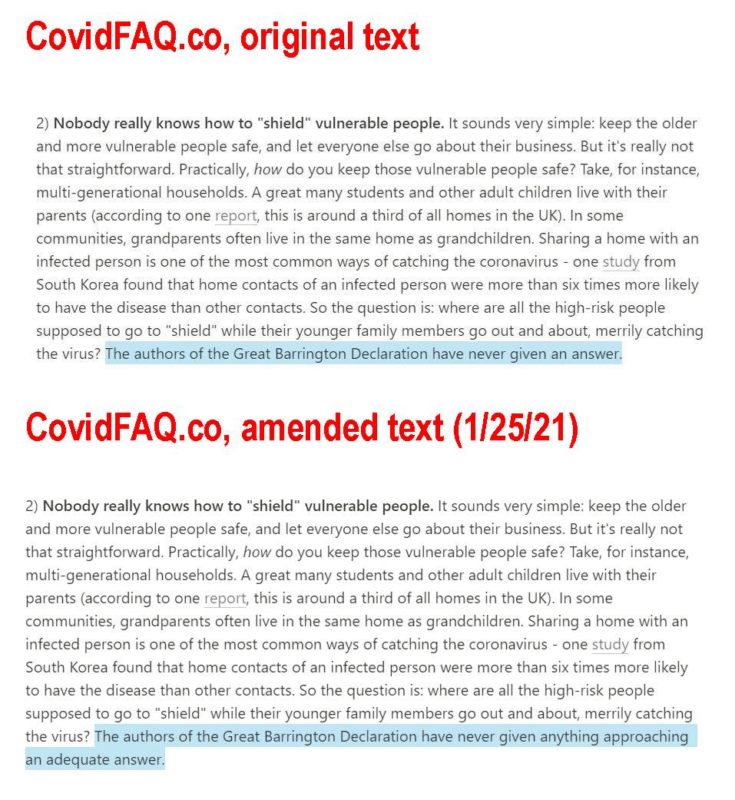
In January 2021, CovidFAQ published a lengthy attack on the GBD
that contained multiple errors and misrepresentations of the
Declaration’s contents. In one example, the authors of CovidFAQ claimed,
“The authors of the Great Barrington Declaration have never given an
answer” to how they would implement a focused protection strategy in
place of lockdowns. In reality, the GBD website contains a detailed 1,800 word plan for implementing focused protection.
When AIER’s Phil Magness alerted CovidFAQ co-owners Stuart Ritchie and
Sam Bowman to this error in January 2021, the website’s editors modified
the text to read, “The authors of the Great Barrington Declaration have
never given anything approaching an adequate answer” to how
they would implement focused protection (emphasis added). Rather than a
factual correction, CovidFAQ’s change inserted their own editorial
commentary expressing disagreement with the GBD’s published focus
protection strategy as a way of disguising CovidFAQ’s earlier
misrepresentations of the document. Gregory’s NewsGuard rating of the
CovidFAQ website specifically linked to CovidFAQ’s deceptive edit about
the GBD, and described it as having met “NewsGuard’s standards for
regularly issuing corrections.”
Figure II: Misleading edit on the CovidFAQ website, classified as an appropriate “correction” by NewsGuard
Typifying other slanted media coverage of the GBD, NewsGuard
concluded its assessment by repeating a false story from October 2020,
claiming that the GBD’s signature list contained fake names such as “Dr.
Johnny Bananas” to inflate its signature count. This story
misrepresents the products of an intentional hoax by pro-lockdown journalists including the aforementioned Nafeez Ahmed
to flood the website with false signatures. In reality, “Dr. Johnny
Bananas” and similar hoax submissions were removed from the GBD website
within a few hours of their discovery. An audit of signatures conducted by AIER
found that false names amounted to only 0.1% of total signatures on the
GBD prior to their removal, with the largest cluster of false names
deriving from Ahmed’s hoax campaign on October 9th. NewsGuard did not
include any of this context in its article, nor did Gregory permit AIER
an opportunity to comment on the misinformation contained in its account
of the false signatures.
To briefly summarize, NewsGuard’s coverage of Covid-19 policy and the
GBD in particular suffers from a recurring pattern of frequent errors
that warrant correction, reliance on fact checkers and other figures who
lack qualifications to make scientific assessments, biased depictions
designed to disparage or undermine the scientific credibility of the
petition, and the promotion of false information from dubious secondary
sources, rather than the “scientific experts” it claims to use. In sharp
contrast, NewsGuard writers such as John Gregory take a friendly and
non-scrutinizing stance toward pro-lockdown opponents of the GBD such as
CovidFAQ website – even when they spread factual misinformation about
the GBD’s contents and engage in duplicitous editing under the guise of
issuing a “correction.” The self-appointed fact checker, it would
appear, suffers from a biased and deficient internal fact-checking
process for its own work on Covid-19.
Is NewsGuard Qualified to Police Facts?
Although there should be no barriers to entry when it comes to how
qualified one should be to comment on an issue, it would help,
especially for credibility, to have some sort of relevant background in
the subjects being evaluated. Degrees in medicine and other hard
sciences are always great when it comes to Covid-related topics.
Advanced qualifications in social sciences like economics, policy,
government, and law are similarly pertinent, given the pandemic’s
wide-reaching public policy consequences. Several of these fields come
with advanced training in the gathering of evidence, statistical
analysis, and applying the scientific method – all necessary tools to
evaluate the performance of policies such as mask mandates, lockdowns,
programs to encourage and distribute vaccination, and the sort.
By contrast, NewsGuard’s staff primarily evaluates scientific claims by appealing to the authority of public figures
who they designate as “experts” on the subject in question. Their
approach generally avoids direct examination of the evidence surrounding
contested claims, and instead cherry-picks a figure to treat as an
authoritative final word. As their liberal use of Hancock to evaluate
the GBD illustrated, many of their preferred authorities are political
officeholders rather than persons trained in scientific or
social-scientific methods.
By selectively curating cherry-picked political authorities rather
than evaluating evidence directly, NewsGuard’s approach to fact-checking
effectively sidesteps the scientific method. This strategy is rendered
even more problematic by the general lack of scientific expertise within
NewsGuard’s team of writers.
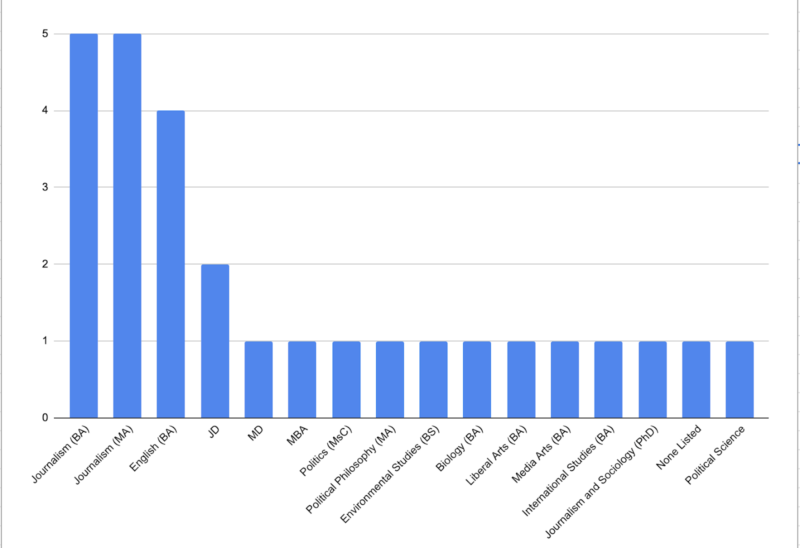
We examined the educational credentials, including the highest degree
listed, for 28 publicly identified staff members on NewsGuard’s
website. The company’s staff page reveals shockingly little expertise in
either the hard sciences such as medicine or social sciences such as
public policy, economics, and related fields. 12 of the 28 listed
staffers have primary degrees in journalism or media. The second-most
represented subject area is English literature, with 4 degrees. The
company’s only identifiable medical expert appears to serve NewsGuard in
an advisory capacity and seems to hold a separate full-time job
teaching science journalism in Italy. Other science and social science
qualifications are sparse, and seldom surpass the undergraduate level.
Most NewsGuard articles on Covid-19 topics and policies are written by
Gregory, whose only identified qualification is a bachelor’s degree in
Media Arts.
Noting the general deficit of scientific and social scientific
expertise, AIER asked NewsGuard’s co-CEO Steven Brill if his company
employed any individuals with advanced degrees in healthcare, medicine,
economics, public policy, or related scientific and social scientific
fields. Brill responded, “A lot of us have qualifications and graduate
degrees in some of the fields you mention.” However the chart below
belies his answer:
Figure III: NewsGuard Staff by Field and Highest Degree Attained:
For example, the aforementioned John Gregory would not qualify as an
expert in most of the fields he is responsible for fact-checking. Before
joining NewsGuard, his journalism background consisted primarily of
writing news articles about the Orlando, Florida theme park industry. He also previously worked as a writer for TriMed Media, a for-profit consulting and marketing firm
that publishes a series of newsletters targeted toward healthcare
industry executives. Although TriMed’s focus area is topical to
healthcare, it specifically promotes its newsletter products as trade
and marketing publications for its clientele within the industry.
Neither Gregory’s formal training nor his journalism experience appear
to convey a reasonable claim to scientific expertise in medicine,
healthcare policy, health economics, or related subject areas.
Of course, non-experts have every right to offer opinions on
scientific and social-scientific matters. Whether or not they should be
taken seriously as fact checkers or act as arbiters of scientific
disputes is another question entirely.
Would NewsGuard Even Pass Its Own Tests?
If we’re going to be on this topic, we might as well check to see if
NewsGuard is a reliable website by its own standards. Indeed, with its
partnership with Microsoft and its roster of accomplished staff, the
public should understand what kind of organization this is.
To test how NewsGuard holds up to its own rating system, we subjected its website and practices to the same criteria it uses to evaluate other sources.
The results reveal a website that preaches a very different standard
for others than it adheres to in its own work. The results are as
follows:
Credibility
“Does not repeatedly publish false content”
As documented, NewsGuard has an extensive track record of publishing
false and misleading content, particularly related to Covid-19. The site
admitted to making corrections to 21 separate articles where it had
inappropriately labeled the lab leak hypothesis – since described as
“plausible” and “warranting investigation” by mainstream scientists as
well as President Biden – as a conspiracy theory. While these
corrections are welcome, they are also ubiquitous and point to a pattern
of NewsGuard writers jumping the gun to “fact check” claims that are
not in error, but rather deviate from their own editorial positions. In
the case of AIER and the GBD, NewsGuard had to issue corrections to two
separate false claims within days of their article appearing. As of this
writing, NewsGuard’s coverage of the GBD still includes uncorrected
falsehoods about the GBD’s position on masks and misleading scientific
assessments of its content by non-expert sources such as Matt Hancock.
Although NewsGuard’s browser app subscription model precludes an
independent audit of their fact-checking on other websites and topics,
these problems suggest a wider pattern of errors that call into question
the reliability of the company’s content.
“Gathers and presents information responsibly”
As documented, NewsGuard’s staff of fact checkers generally lack
appropriate scientific and social-scientific qualifications to arbitrate
factual and interpretive disputes in these subject areas. Instead, the
company relies primarily on appeals to selectively curated external
figures that they deem to be authorities on the relevant subject. When
asked about how they select expert opinions, NewsGuard co-CEO Steven
Brill told AIER that they always “quote real experts” and again that “we
rely on – and quote — sources who are the experts.” Our review of
NewsGuard’s analysis of the GBD, however, found that this was not the
case. Instead of scientific experts, NewsGuard primarily relied on
political figures such as Matt Hancock, including statements by Hancock
that are well outside of the scientific consensus on the concept of herd
immunity. When asked if they would be willing to correct Hancock’s
erroneous statements, NewsGuard writer John Gregory defended his use of
this source and did not respond to further follow-up questions.
An additional concern appears with how NewsGuard affixes its “warning
label” system to published articles that its writers have not reviewed,
let alone identified as failing a fact check. In AIER’s own experience
with this company, we discovered that NewsGuard had affixed a “red”
warning label to several articles we published about factual errors in
the New York Times’s 1619 Project. NewsGuard and its writer
John Gregory made no effort to evaluate the contents of these articles,
and did not contact AIER for any comment on the application of this
label to any subject other than its above-noted disputes over Covid-19
and the GBD. At the same time, NewsGuard applied a “green” label to the New York Times 1619 Project’s own website, despite never evaluating the content contained therein (the 1619 Project, it should be noted, contains significant uncorrected factual errors, and engaged in clear acts of journalistic misconduct
to deflect criticism of its historical claims). This disparate
treatment of the 1619 Project provides an example of misleading and
inappropriate applications of rating labels to contents that are subject
to legitimate factual disputes, but that NewsGuard itself did not
examine or evaluate before attaching its label. As this example
illustrates, NewsGuard’s practice of affixing rating labels to websites
can create a false impression among its readers that the company has
conducted a fact check on articles that it has not even evaluated.
Figure IV: A Comparison of NewsGuard’s ratings of the 1619 Project and AIER’s content on the 1619 Project, July 2021
“Regularly corrects or clarifies errors”
As noted, NewsGuard periodically corrects certain errors found in its
published content. Recent corrections include the aforementioned edits
to 21 articles on other website coverage of the lab leak hypothesis, and
two corrections to factual misrepresentations about AIER and the GBD.
At the same time however, NewsGuard appears to issue its corrections on
an inconsistent basis. NewsGuard’s Gregory employed evasive wording to
justify his continued deprecation of the lab leak hypothesis in other
uncorrected articles, describing it as “not substantiated.” NewsGuard
does not appear to apply similar descriptors to figures such as
President Biden, Anthony Fauci, or mainstream journalism outlets such as
the New York Times – all of which have recently lent credence to the plausibility of the lab leak hypothesis.
In AIER’s own case, NewsGuard declined to make an appropriate
correction to misleading scientific claims about herd immunity by Matt
Hancock. The company did not respond to further requests for corrections
to its misrepresentation of the GBD, including the false claim that the
Declaration opposes the use of face masks.
NewsGuard’s corrections policy does not appear to meet common
standards for transparency. While NewsGuard claims to make timely and
warranted corrections to its articles, these corrections are not
independently verifiable without purchasing the company’s internet
browser app and searching individual websites one at a time.
Furthermore, the company does not appear to retain archived and
accessible copies of its uncorrected articles for independent
verification of the changes. NewsGuard did not respond to AIER’s
inquiries about the lack of transparency arising from these
unconventional practices.
“Handles the difference between news and opinion responsibly”
Despite imposing a strict standard for separating news from opinion
on the other websites it rates, NewsGuard’s internal practices
substantially blur these lines in its own content. The website claims that it has “no political axes to grind,” yet its affiliated personnel appear to be deeply involved in partisan and political causes. The company’s board of advisors
includes multiple former elected officeholders and political appointees
from the Bush and Obama administrations, as well as foreign
governments. When asked about this apparent contradiction, NewsGuard
co-CEO modified his descriptor of the company to “politically balanced.”
In reference to one of his advisory board members, Brill further
stated, “I’m curious what “ax” you think someone like Tom Ridge is
grinding.” Ridge is the former Republican governor of Pennsylvania and
Secretary of Homeland Security in the Bush administration (for
reference, AIER made no specific claim about Ridge’s beliefs save to
note that he is clearly a political figure, contrary to NewsGuard’s
depiction of itself as a non-political company).
Brill himself also has longstanding political interests as an opinion
commentator on healthcare policy, including the Affordable Care Act.
His advocacy work in this area includes a 2015 book
that proposes a “new vision of how we can fix American healthcare”
through further addenda to the Obamacare program. When asked about the
political connotations of his own writings on healthcare policy, Brill
told AIER, “I’m a journalist. I write magazine articles and books that
have offended people on both sides of an aisle.” This statement strongly
suggests that Brill does not differentiate between editorial commentary
and news reporting in his own work.
“Avoids deceptive headlines”
NewsGuard’s headline practices are responsible within the normal standards of journalism.
Transparency:
“Website discloses ownership and financing”
NewsGuard publishes a short list of “financial investors”
on its website, but offers no indication of how much money they
invested, what their budget is, what percentage of their financial
support comes from outside investors, the nature of the contracts they
maintain with companies such as Microsoft, or where their revenue comes
from. When asked about their policy for handling conflicts of interest
between investors and website ratings, NewsGuard co-CEO Steven Brill
told AIER that “If there are, they are always disclosed prominently in
our Nutrition Label” and offered an example of a disclosure of his
co-executive Gordon Crovitz’s previous affiliation with the Wall Street Journal.
A
review of NewsGuard’s ratings of several media websites reveals that
Brill’s statement does not accurately reflect how his company handles
several of its listed financial investors. NewsGuard lists former
Reuters CEO Thomas Glocer among its financiers; however as of July 2021,
Glocer’s investment in NewsGuard is not disclosed on the site’s rating
of Reuters news service. NewsGuard similarly reports receiving investments from Nicholas Penniman IV, the retired publisher of the St. Louis Post-Dispatch. As of July 2021, Penniman’s investment is not disclosed on NewsGuard’s rating of the St. Louis Post-Dispatch. A list of insufficiently disclosed potential conflicts of interests and NewsGuard’s ratings may be found below:
Figure V: NewsGuard ratings of websites with undisclosed connections to its own financial investors, July 2021
Website
NewsGuard Score
NewsGuard Investor with past affiliation
Disclosure on NewsGuard Rating Website (July 2021)
Huffington Post Investigative Fund
87.5
Nicholas Penniman V – Former Executive Director & Cofounder
No
The American Prospect
92.5
Nicholas Penniman V – Former Associate Editor
No
Washington Monthly
100
Nicholas Penniman V – Former Publisher
No
Lincoln Journal-Star
85
Nicholas Penniman V – Former Editor
No
Center for Responsive Politics
100
Nicholas Penniman V – Current Board of Directors
No
St. Louis Post-Dispatch
85
Nicholas Penniman IV – Former Publisher (retired)
No
Arizona Daily Star
85
Nicholas Penniman IV – Former Senior VP
No
Reuters
95
Thomas Glocer – Former CEO
No
C-Span
87.5
Leo Hindery – Former Chairman
No
“Clearly labels advertising”
NewsGuard does not currently advertise on its website, except for its own for-purchase website browser application.
“Reveals who’s in charge, including possible conflicts of interest”
NewsGuard generally discloses its staff of writers,
including the authors associated with individual articles. It does not
however disclose how specific website ratings are assigned to its staff
writers, or how NewsGuard decides whether a website will be subjected to
its rating system.
As noted, NewsGuard’s health policy writer John Gregory was
previously employed as a writer for TriMed Media, a for-profit industry
consulting firm that publishes newsletters geared toward healthcare
industry executives and offers a variety of website and marketing
services “to boost awareness and revenue”
for healthcare businesses. Gregory’s past affiliation with this company
is disclosed on NewsGuard’s website; however, he describes himself as a
“reporter” for this firm’s “news publications.” The potential for a
conflict of interest seems apparent not only in NewsGuard’s coverage of
healthcare topics, but also from a separate subscription-based “service” that NewsGuard offers to healthcare provider companies for the dissemination of its ratings.
When asked whether his previous connections to TriMed Media presented
a potential conflict of interest for his coverage of healthcare issues,
Gregory stated that TriMed Media’s consulting business was conducted by
“the company’s separate marketing department, and I worked entirely on
the editorial side of the operation.” He further stated, “They do not
bias my ability to do my work at NewsGuard, as I did not perform any of
those marketing department tasks when I worked at TriMed Media between
2016 and 2018.” At the time of this writing, TriMed Media’s website
content does not appear to differentiate its news, editorial, or
marketing/consulting departments or functions in the ways that Gregory
describes in his response. TriMed Media’s website for its newsletter
publications depicts their primary audience as for-profit healthcare
industry executives. Gregory did not respond to follow-up questions
asking him for elaboration on his relationship with and duties at TriMed
Media. While Gregory’s case does evince disclosure of a past employer
with potential conflicts of interest in his website ratings area, that
disclosure remains sparse on details and offers an incomplete picture of
the nature of TriMed Media’s business model. Furthermore, NewsGuard’s
own subscription platform for healthcare providers illustrates that the
company’s own business model operates in an overlapping area of the
medical industry. Details on this service or how its subscription
contracts operate are sparsely accounted for on NewsGuard’s website
“The site provides the names of content creators, along with either contact or biographical information”
NewsGuard’s articles generally list the identity of writers who
contributed to their contents, and accompanying biographies include
contact information for each writer.
Scorecard:
NewsGuard applies a 100-point scorecard to the websites it rates,
based on the above-listed criteria. Although their exact scoring rubric
is only summarized on their website, we applied their publicly disclosed
scoring system to each of the criteria above in light of our
investigation.
Figure VI: Our “Nutrition Label” for the NewsGuard Website
Category
Points Possible
Points Awarded to NewsGuard
Does not repeatedly publish false content
22
5
Gathers and presents information responsibly
18
0
Regularly corrects or clarifies errors
12.5
6.25
Handles the difference between news and opinion responsibly
12.5
0
Avoids deceptive headlines
10
10
Website discloses ownership and financing
7.5
0
Clearly labels advertising
7.5
7.5
Reveals who’s in charge, including possible conflicts of interest
5
2.5
The site provides the names of content creators
5
5
TOTAL
100
36.25
In light of all these considerations, it seems that NewsGuard fails
to pass a number of important journalistic standards. Furthermore, it is
concerning that NewsGuard cannot separate itself from its disagreement
with the content of AIER’s publications regarding public health, which
dominates its report. This is even more concerning when considering its
dubious track record to responsibly or reliably use its self-appointed
position of power to police the very information it purports to be the
arbiter of truth on. Furthermore, it is the supreme height of arrogance
to claim a monopoly on scientific truth, not just without a background
in science or really any field outside of journalism, but during a novel
issue with constantly evolving information.
Our Rating of NewsGuard: 36.25/100.
This website fails to adhere to several basic journalistic standards,
and should be used with extreme caution as a source for verifying the
reliability of the websites it purports to rate.
Key Takeaways
The truth is best sought through the marketplace of ideas where
reason and evidence are the weapons of choice. When we see fact checkers
like NewsGuard, who not only fail to uphold their high-sounding
principles but even publicly encourage working with the government to
suppress speech, we should raise red flags. NewsGuard’s behavior
illustrates the tired idea that, during events like Covid-19, we should
simply do as we’re told and not question the government or its experts.
On this matter, they have shown themselves to be either unable to
appropriately moderate public discourse or act as little more than
cheerleaders for favored political figures and their preferred policy
approaches to Covid-19. It wouldn’t be a stretch if they happen to be
both.
Phillip W. Magness is a Senior
Research Fellow at the American Institute for Economic Research. He
holds a PhD and MPP from George Mason University’s School of Public
Policy, and a BA from the University of St. Thomas (Houston).
Prior to joining AIER, Dr. Magness spent over a decade teaching
public policy, economics, and international trade at institutions
including American University, George Mason University, and Berry
College.
Magness’s work encompasses the economic history of the United States
and Atlantic world, with specializations in the economic dimensions of
slavery and racial discrimination, the history of taxation, and
measurements of economic inequality over time. He also maintains active
research interest in higher education policy and the history of economic
thought. In addition to his scholarship, Magness’s popular writings
have appeared in numerous venues including the Wall Street Journal, the
New York Times, Newsweek, Politico, Reason, National Review, and the
Chronicle of Higher Education.
I gave a lecture recently on debunking junk science for a class at the University of Washington called "Calling Bullsh**." As its not-so-subtle title suggests, the class teaches students how to recognize misinformation in our digital age.
One of the topics I touched on was the role that fact-checkers play in our online debates. Certainly, they can and do play a very constructive role. There are so many lies swirling around that professional fact-checking seems to be a necessary public good.
But, who fact-checks the fact-checkers? While that might seem like a silly question, the objectivity of fact-checking websites has already been called into doubt and for good reason. For example, an in-depth analysis by Matt Shapiro at the Paradox Project revealed that PolitiFact (the site that famously uses "pants on fire" as one of its ratings) is biased in its fact-checking.
The analysis makes several different arguments, but one of the more compelling ones is that the articles that debunk Republicans are longer than those that debunk Democrats. Why? Well, it comes down to a bit of chicanery:
"We’ve found that PolitiFact often rates statements that are largely true but come from a GOP sources [sic] as 'mostly false' by focusing on sentence alterations, simple mis-statements, fact-checking the wrong fact, and even taking a statement, rewording it, and fact-checking the re-worded statement instead of the original quoted statement.
"Doing this takes time and many, many words."
Another popular website, Snopes (which got its start by debunking urban legends), bizarrely decided to debunk satire. Snopes appeared to be aiming the majority of its wrath toward one satire site in particular, the Babylon Bee, which happens to be published by conservative Christians.
Can Something Really Be "Mostly True" or "Half True"?
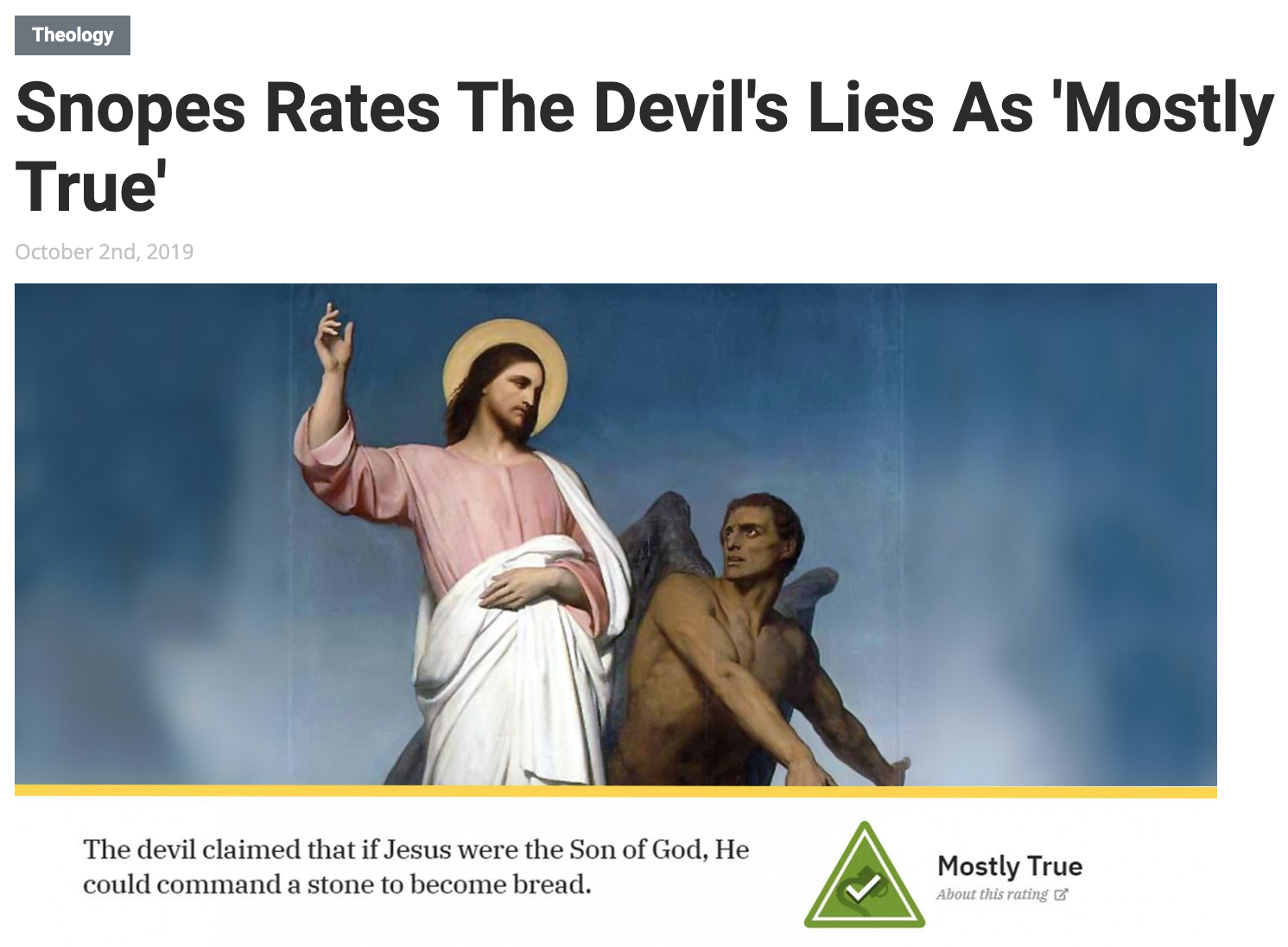
Another problem with fact-checking is the rating system. Fact-checkers like PolitiFact often conclude that statements are true, mostly true, half-true, mostly false, or false. But is such a classification even possible? In other words, can something really be "mostly true" or "half true"? The Babylon Bee captures this problem in a pretty funny headline:
If a politician said that the lost city of Atlantis has been discovered underneath Puget Sound, everybody would know he was lying. It's entirely absurd. But if a politician makes a false claim within a context that is mostly true, people are much more likely to believe it. In other words, the most effective lies are "mostly true."
Who Fact-Checks the Fact-Checkers?
Ultimately, fact-checking is a much more subjective enterprise than we would like it to be. Truth is real but sometimes difficult to ascertain, particularly when political ideologies and motivated reasoning are involved. To eschew these pitfalls, fact-checkers need to be keenly sensitive to such biases. Otherwise, fact-checkers will be seen as simply another manifestation of "fake news."
Suppose I told you that Santa Claus lives in Santa Barbara. Now suppose you reported in an article that I told you Santa Claus lives in Santa Barbara. Now suppose some "fact-checker" slammed you for falsely saying Santa Claus lives in Santa Barbara.
Would the "fact-checker" be right? Obviously not. You accurately reported what I told you.
Seems like a pretty simple and obvious difference. But maybe not if you're a "fact-checker" named Scott Johnson working with "Climate Feedback" and dedicated to stamping out every challenge to the "overwhelming scientific consensus" that human activity has brought global temperature to unprecedented heights and threatens catastrophe for humanity and the world...........To Read More....
My Take - A criminal who was being interviewed while in jail said when confronted by the police: "You deny, deny, deny. Never give up the con"
Well, he was in prison, so that apparently that must not work, so why do they keep doing it?
The same question should be applied to those touting that mankind is doooooomed, doooooomed I tell you, as a result of Climate Change. Amazing, it used to be Global Warming, but all the computer models, and all the predictions have failed or are failing and right now the world is in what they're calling "A Pause". In short, the warming that was taking place has stopped. In point of fact, since the sun plays such an important part in global temperatures, the lack of sunspots indicates we may be going into a global minnimum, where the world can get seriously cold, and history has shown warming periods were great for mankind, but cold is disastrous and people die.
Of course if it does turn seriously cold, that's a by product of global warming, or manmade CO2. So then, CO2 causes global warming and it causes global cooling? Did I get that right? That staement would have made George Orwell proud.
The same is true of those who refuse to acknowledge the foundational claims of anthropogenic global warming were based on fraudulent "science". Science these politicians and "scientists" had to know was fraudulent. McKitrick and McIntyre clearly demonstrated the Hockey Stick Graph was ridled with errors. Errors Michael Mann, who originated it, refused to acknowledge. Unrefuted errors that are readily avaible to everyone. Errors that give a clear impression the data must have been manipulated to eliminate any warming periods before now, and yet they still tout it.
The 97% claim has been so strongly debunked it's impossible to support that claim with any degree of integrity.
You may wish to view my Thursday, August 10, 2017 article How Many Constitute 97%? And view my file on this issue, 97%.
These misfits still "deny, deny, deny", and refuse to "give up the con". The only difference between them and the convict is ....he's in jail...... and hopefully they'll join him. They all took government money, and if it can be shown their work was fradulent, and I believe it can be, then they perpetrated a crime. Fraud. Fraud that's cost the world hundreds of billions of dollars. It seems to me that constitutes a felony! Furthermore, e-mails from the East Anglia group have made it clear there was collusion to perpetuate this criminal enterprise. It seems to me that makes it aRICOcrime.
American media have abandoned their primary job of reporting the news. Gone are the days of telling readers and viewers the who, what, where, when, and why. Now it's telling the audience what to think, after filtering the news story through layers of bias and activism.
The latest trick is "fact-checking" President Trump in "real time."
I don't recall any mainstream news networks fact-checking Barack Obama.
In anticipation of Trump's first Oval Office address, and immediately following, the anti-Trump resistance media went into fact-check mode.
There was this CNN headline: "Fact-checking Trump's immigration speech."
NPR jumped in with "FACT CHECK: Trump's Oval Office Pitch for A Border Wall," followed by the New York Times: "Trump's Speech to the Nation: Fact Checks and Background." And then Politico: "Fact check: Trump's speech on border crisis."
A CNN crank even encouraged fact-checkers to prepare for Trump's eight-minute speech as they would for a triathlon, with proper nutrition and rest...... Some degree of fact-checking is reasonable, if it's applied equally to leaders of both political parties, but not when it becomes the entire story.
Before President Trump even uttered a word, the fact-checkers were lined up, ready to provide real-time rebuttals to every word Trump uttered.
But who fact-checks the fact-checkers? ......Read more
If for some strange reason you didn't already know how much the liberal media hates President Trump, you found out this week. The Trump Hate Machine got revved up even before the president gave his national prime-time address Tuesday night about what he called "the growing humanitarian and security crisis at our southern border."
Some of the country's most desperate liberals in the media actually argued that the president's televised pitch to the country for congressional funding for a stronger border fence should not be carried live by the networks. Why? Because they said the president lies too much and they wanted to be able to fact-check his speech beforehand.
Of course, no one in the liberal media would have ever dreamed of showing such disrespect â?' and obvious bias - for one of Barrack Obama's nationally televised pontifications.
Obama's lies and false promises about the benefits of ObamaCare, like his misleading spinning about his administration's fiascoes in the Middle East, were not checked, challenged or ridiculed immediately afterwards by the pundits, commentators or biased fact-checkers of the Washington Post, CNN, CBS, MSNBC, NPR,etc., etc., et liberal cetera..............To Read More.....









 Print