A reporter who hasn’t dreamt of one day writing for the New York Times is
a rare bird. “I’ll start with my local newspaper,” they tell
themselves. “Then I’ll move on to a statewide paper, before making a
name for myself at something with a national readership. From there,
I’ll be drafted into service at the Gray Lady. If I play it right I can
be there in 15 years.”
It took Nikole Hannah-Jones 12, and that would hardly be the end of her story. She would exploit her position at the Times to
rewrite early American history and, later, to extort a significant
settlement from an American university that did its level best to hire
her.
But, then again, Nikole Hannah-Jones has always lived a bit of a
charmed life. She attended the University of Notre Dame, earning a BA in
history and African-American studies. She followed this with a master’s
degree from the University of North Carolina’s Hussman School of
Journalism and Media, where she was a Roy H. Park Fellow.
She began a career as a journalist in 2003, putting in three years with the News & Observer in Raleigh, NC, and then moving to Portland, OR, for six years with The Oregonian. In 2011, Hannah-Jones joined ProPublica in New York City. She finally came to rest as a staff reporter with the New York Times in 2015.
From there, her star rose. She was awarded a MacArthur Fellowship in
2017, and in 2020 she won the Pulitzer Prize for Commentary for her work
on the politically contentious 1619 Project. Her prize-winning essay
has been embroiled in a succession of controversies since it appeared in
print.
First, she got into a public spat with a group of academics who presented a long list of factual and interpretive errors in
her work, dismissing them at one point as “white historians” who were
not worth her time or attention. A few months later, Northwestern
University historian Leslie M. Harris revealed that she had been asked to fact-check Hannah-Jones’s essay by the Times. She
raised red flags about its factually erroneous attempt to place slavery
at the center of the American Revolution, only to be ignored by the
newspaper. The revelation forced Hannah-Jones’s editor to issue an
embarrassing correction, which the newspaper euphemized as an “update.”
Next came a revelation that called the project’s ethics into question. At some point during its Pulitzer bid, the Times ghost-edited a controversial line of text off of its web copy without disclosing the claim. The discovery was made after Hannah-Jones publicly denied ever using the line, when in fact she had done so dozens of times.
Despite stumbling through a continuous sequence of controversies, the
1619 Project succeeded in elevating Hannah-Jones’s profile in the
journalism world. It was this capstone to her resume that piqued the
interest of the University of North Carolina, which announced in 2021
that Hannah-Jones would come on board at the rank of full professor. She
would hold the Knight Chair in Race and Investigative Journalism in the
Hussman School of Journalism and Media less than 20 years after her
time there as a student.
But that announcement would prove to be a bit premature. While UNC
did, in fact, offer Nikole Hannah-Jones a position, which she did, in
fact, accept, there was a devil in the details. The job she accepted did
not come with tenure; it came with a five-year contract with an option
for tenure review. Whatever the interior machinations at the Hussman
School, this was not an unreasonable offer. Hannah-Jones, quite simply,
had not done the sort of academic work that tenure rewards. Journalism
and academia are two very different animals.
Nonetheless, she fomented a public campaign to be granted tenure,
alleging racial discrimination in the process. To no one’s real
surprise, the university gave in. That she did not hold a PhD, had no
peer-reviewed publications, and had no teaching experience seemed not to
matter much in the end. Nor would she have to go through the standard
processes wherein newly hired faculty earn tenure through an intensive
multi-year review of their scholarship, classroom instruction, and
service to the university. Hannah-Jones’s revised offer from UNC
included automatic tenure on her start date and an immediate appointment
as full professor.
There is no evidence that Hannah-Jones was wronged by this process in
any way—quite the contrary, she was benefiting from all sorts of
privilege that most academics do not have early in their careers,
privilege they need to earn instead. No regular faculty member walks
into a full tenured professorship as their very first academic job.
Indeed, in the glutted marketplace of academic job-seekers, Hannah-Jones
happened into an offer that almost any qualified applicant with actual
research outputs and teaching experience would have considered akin to
winning the lottery—even before tenure was appended to the offer.
Nonetheless, Hannah-Jones declined the job, instead accepting a
separate offer to become the inaugural Knight Chair in Race and
Journalism at the Howard University School of Communications, where she
also founded the Center for Journalism and Democracy.
You might think that would be the end of it, but you’d be wrong. What
followed could only have been the result of an easily panicked
University of North Carolina Board of Trustees coming into the gaze of a
litigious grifter. Hannah-Jones’s attorneys threatened to bring suit.
On what rational grounds? Who knows. But where in this story is
rationality to be found?
As a recently announced settlement reveals, she fleeced UNC out
of a healthy $75,000 payment. What did that buy the university? She
promised not to sue them. As if the short con wasn’t enough, she showed
up with two fistfuls of salt for UNC’s wounds.
It turns out the $75,000 wasn’t quite enough. As part of her
settlement, she somehow managed to secure a bunch of Diversity, Equity,
and Inclusion (DEI) sinecures for 20 university administrators. Per the
agreement, these bureaucrats will be attached to hiring committees for
new university employees. They will “receive a stipend to serve as
consultants or participants” in hiring searches.
The terms of
Hannah-Jones’s deal also direct UNC to make a new hire for something
called a “trauma-informed therapist within the Multicultural Health
Program,” as if to signal atonement for Hannah-Jones’s claims of mental
anguish over an insufficiently generous hiring offer in the initial
round. Another clause dedicates an annual payout of $5,000 to pay for
“meetings, events, and symposia” hosted by an activist organization for
university faculty and staff.
These are not minor expenditures for the university to absorb,
particularly given that Hannah-Jones incurred no recognizable harm from
her bid for a tenure commitment. These monetary outlays may be the price
of avoiding further litigation, but they must also come from somewhere.
In the end, the only people who are harmed by her self-serving
behavior, and the university’s cowardice, are students who must pay for
this nonsense as part of their tuition, and the taxpayers of North
Carolina, who had better get used to this sort of thing moving forward.
One last thing. UNC did the right thing in offering her the job
without tenure. There are many professors who are not academically
qualified but who nonetheless qualify for a teaching professorship on
the strength of a career of solid, interesting work. These faculty,
commonly called professors of practice, raise no eyebrows whatsoever.
Given her work history, such an offer would have been exactly the right
kind for UNC to make to Hannah-Jones. If at some point down the line her
demonstrated research output and classroom experience warranted a
merit-based promotion, she could have been given the opportunity to go
through the same tenure-review process as any other faculty member.
Instead, she demanded the privilege of sidestepping the normal rules and
procedures of academic promotion by threatening to unleash a lawsuit
and a Twitter mob against the university.
And as galling as it is to see Nikole Hannah-Jones try to weasel her
way into an unearned tenured professorship, there is one thing that is
even more galling: She hasn’t published a single piece of journalism in
the New York Times, her other full-time employer, in over two years. Maybe the Times is on to her. They claim to publish all the news that’s fit to print, after all.
Phillip W. Magness is Senior Research
Faculty and Research and Education Director at the American Institute
for Economic Research. He is also a Research Fellow at the Independent
Institute. He holds a PhD and MPP from George Mason University’s School
of Public Policy, and a BA from the University of St. Thomas (Houston).
Prior to joining AIER, Dr. Magness spent over a decade teaching
public policy, economics, and international trade at institutions
including American University, George Mason University, and Berry
College.
Magness’s work encompasses the economic history of the United States
and Atlantic world, with specializations in the economic dimensions of
slavery and racial discrimination, the history of taxation, and
measurements of economic inequality over time. He also maintains active
research interest in higher education policy and the history of economic
thought. In addition to his scholarship, Magness’s popular writings
have appeared in numerous venues including the Wall Street Journal, the
New York Times, Newsweek, Politico, Reason, National Review, and the
Chronicle of Higher Education.
Get notified of new articles from Phillip W. Magness and AIER.
James R. Harrigan is Senior Editor at AIER. He is also co-host of the Words & Numbers podcast.
Dr. Harrigan was previously Dean of the American University of
Iraq-Sulaimani, and later served as Director of Academic Programs at the
Institute for Humane Studies and Strata, where he was also a Senior
Research Fellow.
He has written extensively for the popular press, with articles
appearing in the Wall Street Journal, USA Today, U.S. News and World
Report, and a host of other outlets. He is also co-author of Cooperation
& Coercion. His current work focuses on the intersections between
political economy, public policy, and political philosophy.
Get notified of new articles from James R. Harrigan and AIER.
“AIER’s Research Director Phil Magness joins James R. Harrigan,
AIER’s Senior Editor, and Antony Davies, Professor of economics at
Duquesne University to discuss critical race theory.” ~ December 31, 2021 @ American Institute for Economic Research
From October 2-4, 2020, the American Institute for Economic Research
hosted a small conference for scientists to discuss the harms of the
Covid-19 lockdowns, and maybe hint at a path back to normal life.
Organized by Martin Kulldorff, Sunetra Gupta, and Jay Bhattacharya, the
conference made a scientific case
for shifting away from the heavy-handed lockdowns of the initial Spring
2020 outbreak. On their final day together in Great Barrington, the
scientists wrote a short statement of principles, calling it the Great
Barrington Declaration. This Declaration, their Declaration, touched a
nerve well beyond the scientific community, and well beyond anything
they or AIER could have expected. So here we are, a year later. Where do
we stand?
The aim that our guests had in offering the Great Barrington
Declaration was to spark scientific dialogue that had been missing from
the lockdown discussions until that point. It was AIER’s goal to
facilitate this dialogue. The Declaration was a success in bringing, for
the first time since the pandemic started, an anti-lockdown voice to
mainstream policy discussion. The signatories’ stance was generally in line with the pre-pandemic plans that many, if not most mainstream authorities, (the World Health Organization, the epidemiology center at Johns Hopkins University, and the Centers for Disease Control to name just three) held. People tend to forget what the pre-2020 conventional wisdom on pandemics even was.
As successful as we think the Great Barrington Declaration was, it
failed in a number of respects as well. We did not, for example,
anticipate the vilification the Declaration would receive from any
number of people, ranging from the progressive left to self-described
libertarians.
Immediately after the website launched, it was hit by a hoax signature campaign
instigated on Twitter by pro-lockdown journalist Nafeez Ahmed. Most of
the fake signatures were caught within hours and removed, but not before
a hostile news media used them to manufacture a false story about their own self-created controversy over signatures from “Dr. Johnny Bananas” and similar easily-caught pseudonyms.
Not to be outdone by his first stunt, Ahmed also let loose what can
only be called a flurry of increasingly unhinged conspiracy theories,
falsely alleging that the GBD was somehow financially orchestrated by
the Koch brothers, the British Ministry of Defence, and even a resort
hotel property in Wales. Although Ahmed has a long history of conspiracy
theorizing including the promotion of kooky claims about a controlled demolition bringing down the Twin Towers on 9/11, his ravings about the GBD were credulously adopted and shared
by prominent scientists, journalists, and any number of other people
who should have known better. (For the record, AIER received $68,000 in
Koch funding over the last ten years. And that sum was used entirely to
offset the costs of a single economics conference in 2017, with no links
whatsoever to the GBD). It’s much easier to demonize an opponent by
accusing them of being on the payroll of “dark money” than it is to
engage their arguments on a substantive and scientific evidentiary
basis.
The Declaration even came under attack from a targeted propaganda campaign at the highest levels of the British government.
Jeremy Farrar, the director of the Wellcome Trust and a pro-lockdown
advisor to the UK’s SAGE committee, revealed as much in a recent book
about the pandemic. Per Farrar’s account, Dominic Cummings – then
serving as chief advisor to UK Prime Minister Boris Johnson – announced
that he would orchestrate “an aggressive press campaign against those
behind the Great Barrington Declaration and to others opposed to blanket
Covid-19 restrictions,” seeking to discredit any scientist who
questioned the wisdom of his government’s lockdown strategy.
In a broader and more basic sense, the Declaration was written during
a period of deep uncertainty. No one really knew what the correct Covid
answers were, but the signatories followed the evidence as it emerged.
Most importantly, no one had any way of knowing that vaccines were so
close to being available to the public. And while the specific
strategies of last fall and winter might well have been different had
the signatories known what we know now, everything they wrote was
compatible with the anti-lockdown message at the heart of the
Declaration.
So how well did the lockdowns perform in practice? Given the intense
criticisms leveled at the GBD, one might be inclined to think they
worked rather well.
But they didn’t. Not by a long shot.
First consider how the lockdowners have continuously shifted their
accounts of the very same policies they advocated. In the weeks that
followed the GBD, its critics crafted a well-honed and widely repeated
message. Lockdowns, they insisted, were already a relic of the past –
perhaps a suitable strategy for the uncertainties of spring 2020’s
“first wave,” but no longer a serious consideration given what we came
to know about the virus. When the GBD questioned the efficacy of
lockdowns, they insisted, it was arguing against a “strawman.”
“The kind of lockdown that the Great Barrington Declaration seems to
be railing against hasn’t been in place in the UK since mid-June,” read one retort in UK Wired Magazine
only two days after the GBD website went live. “When the Great
Barrington Declaration authors declare their opposition to lockdowns,
they are quite literally arguing with the past.” Economist Tyler Cowen echoed the charge in a Bloomberg column
devoted to attacking the GBD on October 15, 2020: “The critics who
emphasize lockdowns are setting up a straw man,” he wrote. “What they’re
trying to do is talk us into something more dangerous than what we
ought to accept. The truth is that lockdowns are extremely unpopular,
and while they may have to be reimposed in extreme circumstances, they
are not the main alternative on the table in the U.S. right now.”
After a year and a half or so of lockdowns, we can safely dismiss
this response. Less than a month later, the UK returned to full
lockdown. Dozens of other countries around the world followed suit in
mid-November. When cases spiked again in the United States over the
winter, several states reimposed these very same “strawman” lockdown
policies that the GBD’s critics dismissed with a wave of their hands in
mid-October.
Not that any of them would ever admit as much now. Quite the
contrary, by early 2021 many of the same scientific commentators and
epidemiologists who deployed the “strawman” line against the GBD the
previous October had taken to revising the history of their own
arguments and claims. One new conspiracy theory even faulted the GBD’s authors
for allegedly delaying the reimposition of another UK lockdown by a few
weeks the previous fall. In October 2020, British epidemiologist Deepti
Gurdasani dismissed the GBD’s warnings about renewed lockdowns as “a
strawman that the science is not only not advocating for, but very keen
to avoid.” By January 2021 she not only claimed to have supported a
“circuit breaker” lockdown as early as the previous September – she also
blamed the GBD authors for impeding its adoption.
Yes, you read
that right. Lockdowns were just a “strawman” that nobody was seriously
pushing for at the time the GBD was signed, but the GBD was also somehow
responsible for delaying the reimposition of the very same lockdowns
that nobody – allegedly – wanted. Clearly, certain scientists were being
less-than-forthright about their intentions to lock down again in the
fall of 2020. But rather than admit these errors, they turned to
scapegoating the one document that correctly diagnosed their intentions.
More pro-lockdown epidemiologists seemed inclined to grasp the central theme of the badly misnamedJohn Snow Memorandum in the Lancet
– drafted in direct response to the GBD. This petition, co-organized by
Gurdasani and other pro-lockdown scientists, predictably claimed that
drastic nonpharmaceutical measures such as business closures and
shelter-in-place orders had a large effect on reducing Covid
transmission in the spring and summer of 2020. Recent data indicate that this statement is overblown,
and common sense should have researchers looking for the tradeoffs that
have to be made in these sorts of large-scale public policies. Be that
as it may, the Snow Memorandum was built upon unreliable pro-lockdown studies out of Imperial College-London that have since been discredited.
Another major claim of the Snow Memorandum – that naturally acquired
immunity was not robust and Covid-19 reinfections among recovered
patients could become widespread – turned out to be incorrect. The best
evidence we now have suggests that naturally acquired immunity is very robust. To date, neither the Snow Memorandum authors nor the Lancet have issued an appropriate correction to their erroneous claim.
Most importantly, the main epidemiology model driving the world’s Covid-19 responseperformed disastrously at predicting the actual course
of the disease. In March 2020, Neil Ferguson’s epidemiology team at
Imperial College-London published mortality projections for 189
different countries, based on an array of model scenarios. They missed
every single projection at the 1-year mark in 189 out of 189 countries,
in both their “do nothing” and “mitigation” scenarios, as well as in 170
out of 189 countries in their most extreme “suppression” scenario – a
policy response that no country on earth adopted.
Table I: Imperial College Covid-19 Mortality Projection Model – One-Year Performance Record (3/26/2020 – 3/26/2021)
ICL Model
Model Assumptions
# Countries Over-est.
# Countries Under-est.
Max Mortality Over-est. %
Min Mortality Over-est. %
Median Over-est. %
Unmitigated spread
No policy interventions taken
189
0
1,798,180%
137%
1,983%
Mitigation
Mandatory population-wide social distancing, assumed R0 = 2.4
189
0
937,020%
21%
1,041%
Suppression
75% reduction in contacts until full vaccination, assumed R0 = 3
170
19
360,610%
-57%
535%
That Ferguson’s model could be so completely wrong, and yet remain so
influential is itself astonishing. But when we learned that Neil
Ferguson himself was found to be violating the lockdown order that he
had a decisive hand in creating, everyone should have realized that
something fishy was afoot.
The last vestige of the lockdown policy, Zero Covid, has been an
unmitigated disaster. Indeed, New Zealand and Australia tried and failed
to stop the virus with extremely aggressive lockdowns in
August/September 2021, and are now set to abandon the ham-fisted
policies altogether. And while these terrible policies might well be
relegated to the ash heap of history, the memory of menacing, black-clad
stormtroopers marching through the streets of Melbourne, asking people
why they were out of doors, will remain.
So through it all, what have we learned and what should come next?
First, vaccines have been a game changer, and will continue to be so. A
forthcoming Covid-19 treatment pill from Merck might well be even
bigger. And there are certainly other treatments coming that we don’t
know about yet, that will only emerge through the innovative processes
of scientific discovery.
Also unknown at present are the costs of the lockdowns. These will be
felt for years, if not decades, and will go well beyond lost wages.
What will all those foregone cancer screenings mean, in the end? What
about all those people who suffered mental health crises as they were
confined to their homes alone? What about substance abuse costs? And
what of the various financial catastrophes that so many people suffered?
The benefits of the lockdowns are still ambiguous at best, this after
a year and a half. We still have no clear empirical evidence that they
delivered anything close to what they promised. But because science has
been so completely politicized, it will take years longer to arrive at
the truth than would have otherwise been the case. Here, we are left to
offer advice with a nearly 2,500-year track record: First, do no harm.
Phillip W. Magness is Senior Research
Faculty and Interim Research and Education Director at the American
Institute for Economic Research. He holds a PhD and MPP from George
Mason University’s School of Public Policy, and a BA from the University
of St. Thomas (Houston).
Prior to joining AIER, Dr. Magness spent over a decade teaching
public policy, economics, and international trade at institutions
including American University, George Mason University, and Berry
College.
Magness’s work encompasses the economic history of the United States
and Atlantic world, with specializations in the economic dimensions of
slavery and racial discrimination, the history of taxation, and
measurements of economic inequality over time. He also maintains active
research interest in higher education policy and the history of economic
thought. In addition to his scholarship, Magness’s popular writings
have appeared in numerous venues including the Wall Street Journal, the
New York Times, Newsweek, Politico, Reason, National Review, and the
Chronicle of Higher Education.
James R. Harrigan is Senior Editor at AIER. He is also co-host of the Words & Numbers podcast.
Dr. Harrigan was previously Dean of the American University of
Iraq-Sulaimani, and later served as Director of Academic Programs at the
Institute for Humane Studies and Strata, where he was also a Senior
Research Fellow.
He has written extensively for the popular press, with articles
appearing in the Wall Street Journal, USA Today, U.S. News and World
Report, and a host of other outlets. He is also co-author of Cooperation
& Coercion. His current work focuses on the intersections between
political economy, public policy, and political philosophy.
Get notified of new articles from James R. Harrigan and AIER.
The
reputation of academic publishing depends upon peer review – the
practice by which other experts vet submissions to scholarly journals. A
properly functioning peer review process flags potential problems
before they appear in print. An anonymous referee might notice
complications to a thesis that an author failed to account for,
prompting another round of revisions to improve the piece. If an author
misrepresents evidence for a claim, an anonymous referee might alert the
journal editor to the problem. Usually, the author will be asked to
address the issue in a revision. If the problem is severe or
intentional, the piece might be rejected outright.
But what happens when academic peer review breaks down? What if an
anonymous referee flags serious problems in an article such as
misrepresented evidence or basic errors of fact, but the journal’s
editor chooses to run the piece anyway? What happens when the same
problems are then noticed by other scholars after the article appears in
print? Surely a formal correction of some sort would be in order.
Factual corrections used to be a regular practice of most scholarly
journals, whether in the form of a short comment or a longer
point/counterpoint exchange over the disputed claim. In the
hyper-politicized state of academia today, a growing number of scholarly
venues no longer see a need to attend to basic standards of factual
accuracy in their pages. Factual errors – even egregious ones such as
misrepresented evidence and manipulated quotations – are now apparently
allowed to stand unchallenged, provided that the error aligns with a
politically fashionable viewpoint. This was my own experience after a
frustrating year and a half long effort to seek basic factual
corrections to an unambiguous error in an article in a journal published
by Cambridge University Press.
The saga started in 2019 when Wellesley College historian Quinn
Slobodian published a pair of articles in scholarly journals, containing
an explosive charge against Ludwig von Mises. Writing for the journal Cultural Politics,
Slobodian alleged that “race theory has an ambiguous place in Mises’s
work,” which in turn has allowed modern day racists to claim inspiration
from the free-market economist. Slobodian repeated and elaborated upon
the charge in an article for Contemporary European History(CEH),
stating that “libertarians who scour [Mises’s] writings to validate
their divergent positions on migration can claim fairly to find
confirmation of both sides of the argument.” One side of the story, he
continued, derived from Mises “the realist, who saw race as a
quasi-permanent category of global social organization. Despite his
liberal principles the Habsburg polyglot never became the radical
anti-racist.”
While Slobodian acknowledged in both articles that Mises adhered to a
broad liberal philosophy that clashed with the racist and imperialist
ideologies of his day, his argument held that Mises’s works contained a
“parenthetical opening to the possibility of race theory” – a reference
to pseudoscientific concepts that purport to link race and intelligence.
That posited “parenthetical opening,” in turn, allegedly establishes
Mises as a historical progenitor of later defenses of race theory and
imperialism.
In his subsequent writings,
Slobodian extends this argument into modern politics by crediting Mises
and so-called “neoliberals” in general for inspiring the
anti-immigration and race theory arguments that are found in the works
of economist Hans-Hermann Hoppe, which in turn attained popularity among
various Alt-Right and Trumpian political movements in the 2010s. By
implication, Mises and “neoliberalism” may be deemed blameworthy for
allegedly inspiring these causes.
A Thesis Built on Textual Misrepresentation
When I first encountered Slobodian’s thesis after reading drafts of his CEH article in late 2018, something seemed amiss. Mises had devoted substantial energy in his 1927 book Liberalism to attacking the then-popular field of eugenics. His later works such as 1944’s Omnipotent Government
contained a philosophical broadside against Nazism, singling out the
errors and evils of Nazi racial theory in particular. How, exactly, had
Slobodian discerned a parenthetical opening in Mises’s works for the
very concepts and positions that Mises condemned?
It did not take long to find an answer to that question. In both
articles, Slobodian displayed a habit of misrepresenting excerpted
passages from Mises’s works by either omitting directly pertinent
context from surrounding passages or, in some instances, directly
removing content from the quotes themselves to change their meaning. In
each case, the edits made Mises’s words appear sympathetic, or at least
open to, to a variety of racist and imperialist beliefs, when in fact he
was condemning them. I flagged several of these passages in my notes
when reading. In the months that followed their publication, other scholars began to notice the same patterns in Slobodian’s depictions of Mises as well as his use of quotations.
I’ll summarize a few of the more egregious examples as an illustration. In his CEH article, Slobodian writes:
“When necessary, the opening of
world markets had to be achieved through violence. Though ‘one can think
only with shudders and anger of the fearful mass murders that prepared
the basis for many of the colonial settlements flourishing today’,
[Mises] wrote in a book published the year after the First World War,
the net gain made it worthwhile; in the end, ‘all other pages of world history were also written in blood’.
Violence in the project of expanding the space of foreign investment,
wage labour and commercial exchange was not only acceptable, it was
necessary.”
Compare that same passage to Mises’s original text from his 1919 book Nation, State, and Economy. The quoted portion is underlined, but in Slobodian’s account the entire second half of the sentence is omitted:
“It is true that those colonies
were not taken with smooth talk, and one can think only with shudders
and anger of the fearful mass murders that prepared the basis for many
of the colonial settlements flourishing today. But all other pages of world history were also written in blood,
and nothing is more stupid than efforts to justify today’s imperialism,
with all of its brutalities, by reference to atrocities of generations
long since gone.”
In another example from Slobodian’s CEH article, he excerpts a descriptive passage from Mises’s 1944 book Omnipotent Government to once again ascribe him with a certain degree of toleration for racist beliefs:
“While [Mises]
distanced himself from people who opposed non-white immigration in
defence of ‘Western civilization,’ he conceded that:
“[W]e must
not close our eyes to the fact that such views meet with the consent of
the vast majority. It would be useless to deny that there exists a
repugnance to abandoning the geographical segregation of various races.
Even men who are fair in their appraisal of the qualities and cultural
achievements of the colored races and severely object to any
discrimination against those members of these races who are already
living in the midst of white populations, are opposed to a mass
immigration of colored people. There
are few white men who would not shudder at the picture of many millions
of black or yellow people living in their own countries.”
By the 1940s Mises partially legitimised closed borders for non-white migrants as a near permanent feature of the world order.”
Slobodian repeats this charge in the second article for Cultural Politics, citing both Mises and his own article in CEH:
“And yet, in his 1944 work, Mises
conceded the difficulties of racial integration, writing in a phrase,
often cited by latter-day Mises Institute Austrians, about immigration
barriers that “there are few
white men who would not shudder at the picture of many millions of black
or yellow people living in their own countries (1944: 107; Slobodian 2019)”
The problem with his claim may be clearly seen by turning to Mises’s
original passage. Once again, Slobodian deleted portions of the text
that disconfirmed his thesis. Rather than leaving an ambiguous opening
for racism, Mises was actually describing the racist position first and
then condemning it in no uncertain terms:
“We must not close our eyes to the
fact that such views meet with the consent of the vast majority. It
would be useless to deny that there exists a repugnance to abandoning
the geographical segregation of various races. Even men who are fair in
their appraisal of the qualities and cultural achievements of the
colored races and severely object to any discrimination against those
members of these races who are already living in the midst of white
populations are opposed to a mass immigration of colored people. There
are few white men who would not shudder at the picture of many millions
of black or yellow people living in their own countries. The
elaboration of a system making for harmonious coexistence and peaceful
economic and political coöperation among the various races is a task to
be accomplished by coming generations. But mankind will certainly fail
to solve this problem if it does not entirely discard etatism. Let us
not forget that the actual menace to our civilization does not originate
from a conflict between the white and colored races but from conflicts
among the various peoples of Europe and of European ancestry.”
Note that the omitted passage immediately after the underlined
section directly contradicts Slobodian’s claim that “Mises partially
legitimised closed borders for non-white migrants as a near permanent
feature of the world order.” Far from extending near permanent
legitimacy to the racist positions he described, Mises explicitly called
on the next generation to solve the problem of racism and pointed out
that, contrary to the race theorists’ recurring predictions of a
civilizational war between people of different skin colors, the present
war – World War II – originated from a white European state invading
other white European states.
As an added bonus, Slobodian’s claim that the passage was “often
cited by latter-day Mises Institute Austrians” to justify immigration
restrictions is itself without evidence. The passage appears nowhere on the Mises Institute website, save for a PDF of the original book.
Another egregious example of quote-editing may be found in Slobodian’s Cultural Politics
article, although it is more difficult to detect since it involves his
own English-language misrepresentations of an untranslated
German-language book by Mises from 1940. I present a textual comparison
of the passages side-by-side for consideration.
As may be seen from Slobodian’s depiction, he attempts to portray
Mises as making only a narrowly qualified objection to eugenic theory
based on its “misuse” by the Nazis. Such “misuse,” Slobodian claims, did
“not discredit it permanently” in Mises’s eyes. To reach this
conclusion, however, Slobodian engaged in substantial edits to Mises’s
text by rearranging the ordering of entire passages to make them fit his
thesis. Slobodian once again edited out text that disconfirmed his
claims, including a passage where Mises states that attempts to validate
eugenic theory had “failed because it is easy to prove that every
division of people into types of Verstehen thwarts the organization by
ethnicity. Never, however, has one dared to assign the types of
Verstehen to innate physical characteristics.”
(As a curious aside, Slobodian also appears to be unaware of Mises’s use of Verstehen, a Weberian sociological concept, and instead translates it literally as the German word for “understanding”)
In another example from the CEH article, Slobodian writes:
“Yet Mises proved incapable of
extending a similar cosmopolitan attitude to populations of colour. Even
as he argued emphatically that ‘there are today no pure stocks within
the class or race of white-skinned people’, he did so by pointing out
the difference with black populations. ‘Negroes and whites differ in
racial – i.e., bodily – features’, he wrote, ‘but it is impossible to
tell a Jewish German from a non-Jewish one by any racial
characteristic’. Mises’s rejection of anti-Semitism was premised on an
affirmation of white–black race difference.”
Slobodian’s strong insinuation here is that while Mises opposed white
discrimination against other white people, most notably seen in
anti-Semitism from the Nazi era, he drew a line of distinction between
this form of persecution and racism against black people. To make this
point, Slobodian presents several excerpted passages from Mises as if
they were sequential claims, even asserting that Mises’s objection to
anti-Semitism “was premised on” differentiating that form of
discrimination from white-against-black discrimination.
Turning to the original text of Mises’s Ominipotent Government,
however, we quickly find that Slobodian essentially manufactures this
claimed link by excerpting and combining quotations from distinct
passages.
The first quotation comes from a passage where Mises is dissecting
and rebutting the Nazi racial arguments that were used to justify the
persecution of Jewish people (including Mises himself, who was chased
out of Austria on account of being Jewish). Mises’s purpose in doing so
was to illustrate the falsehood of the Nazis’ own claim to come from
“pure” Aryan stock, whereas Jewish and other white Europeans were said
to be of “impure” stock
“For more than a hundred years
anthropologists have studied the bodily features of various races. The
undisputed outcome of these scientific investigations is that the
peoples of white skin, Europeans and non-European descendants of
emigrated European ancestors, represent a mixture of various bodily
characteristics. Men have tried to explain this fact as the result of
intermarriage between the members of pure primitive stocks. Whatever the
truth of this, it is certain that there are today no pure stocks within
the class or race of white-skinned people.
Further efforts have
been made to coordinate certain bodily features—racial
characteristics—with certain mental and moral characteristics. All these
endeavors have also failed.
Finally people have tried,
especially in Germany, to discover the physical characteristics of an
alleged Jewish or Semitic race as distinguished from the characteristics
of European non-Jews. These quests, too, have failed completely.”
Although Slobodian presents it as an adjacent sentence in his
excerpt, the second passage comes from several paragraphs later in
Mises’s text where he turns to the question of how Nazi racial ideology
differed from other forms of discrimination. One distinguishing factor
of the Nazis was their attempt to impose discrimination on the grounds
of establishing a genealogical link to Judaism.
“The Nazis have chosen a different
way. They say, it is true, that they want to discriminate not against
people professing the Jewish religion but against people belonging to
the Jewish race. Yet they define the members of the Jewish race as
people professing the Jewish religion or descended from people
professing the Jewish religion. The characteristic legal feature of the
Jewish race is, in the so-called racial legislation of Nuremberg, the
membership of the individual concerned or of his ancestors in the
religious community of Judaism.”
Mises then turns to the second excerpted passage as a point of
contrast for how discriminatory institutions operate. He uses the
example of the Jim Crow era in the United States, where discrimination
was based primarily on appearances and skin color:
“If Americans want to discriminate
against Negroes, they do not go to the archives in order to study the
racial affiliation of the people concerned; they search the individual’s
body for traces of Negro descent. Negroes and whites differ in
racial—i.e., bodily—features; but it is impossible to tell a Jewish
German from a non-Jewish one by any racial characteristic.”
Contrary to Slobodian’s insinuation, there is no evidence that Mises
condones discrimination against African-Americans. Quite the opposite –
he condemns discrimination itself. Neither does his objection to
anti-Semitism depend upon “an affirmation of white–black race
difference,” as Slobodian claims. Rather, he is simply analyzing how the
Nazi racial laws turned to characteristics other than skin color as a
means of affecting their persecution of Jewish people, focusing instead
upon tracing the genealogies of their victims. As Mises pointed out in
the very next paragraph though, “The Nazis have claimed that they were
fighting the decisive war between the Nordic master race and the human
underdogs,” yet the very existence of such a “master race” was itself a
myth that the Nazis selectively invoked to rationalize their persecution
of Jewish people and other disliked groups.
As with the German-language example in the Cultural Politics article, this depiction from the CEH
article relies on taking liberties with Mises’s quotes to rearrange
their order in a way that appears to support Slobodian’s preconceived
thesis.
These examples only represent some of the most egregious textual
edits in Slobodian’s articles. They are nonetheless sufficient to
illustrate a recurring pattern of misrepresentation, as opposed to
accidental sloppiness. In each case, Slobodian takes a passage from
Mises’s works and removes text so as to completely invert the meaning of
the passage. He then presents the edited text as a quasi-endorsement of
the very same things – racism, imperialism, eugenics – that Mises was
condemning in the unedited original.
An Attempted Correction
After first noticing some of the aforementioned textual
misrepresentations in Slobodian’s article, I attempted to bring them
directly to his attention and ask for a clarification or correction.
This occurred in late 2018 after Slobodian hinted at the Alt-Right
thesis on his Twitter feed. Whereas Slobodian identified Mises as a
source for Hoppe’s anti-immigration positions and with it the Alt-Right,
I suggested an alternative explanation for their intellectual origins.
Contrary to Slobodian’s insinuations, Hoppe did not appear to draw
any of his immigration claims out of Mises’s texts and certainly not the
passages that Slobodian misquoted. In fact, Hoppe identifies Mises as
an expositor of the “classical” economic argument for open immigration –
and then promptly rejects the same as an antiquated view from an
earlier time. As Hoppe writes in a 2001 text, “The problem with the
above argument is that it suffers from two interrelated shortcomings
which invalidate its unconditional pro-immigration conclusion and/or
which render the argument applicable only to a highly unrealistic-long
bygone-situation in human history.”
My alternative thesis, which I outlined to Slobodian in December
2018, called attention to Hoppe’s use of discursive philosophical
reasoning to build up a theory of property rights absolutism,
which he then used in turn to justify state action to exclude
immigrants from a country. As I noted at the time, the intellectual
genesis of Hoppe’s discursive approach did not come from Mises, but
rather out of Hoppe’s own academic training under the German
philosophers Juergen Habermas and Karl-Otto Apel. This realization may
seem strange at first as Habermas and Apel are generally associated with
Frankfurt School critical theory and the political far-left, whereas
Hoppe comes from the far right. Yet Hoppe wrote his dissertation
directly under Habermas, and at least in the earliest iterations of his
arguments, specifically claimed to be adapting their discursive analysis
in a rightward direction. No less a source than Murray Rothbard would
write in 1990 that “Hoppe is a libertarian extension” of “the
Habermas-Apel doctrine.”
Slobodian was naturally skeptical of my counter-thesis, and
maintained at the time that he had correctly represented Mises’s texts.
He nonetheless offered an interesting concession by inviting me to write
a rebuttal that explored the idea and laid out the evidence against his
soon-to-be-printed article in CEH.
Shortly thereafter I began working on a draft article that traced the
influence of Habermas and Apel on the Austrian economic debates of the
1980s, identifying their influence on Hoppe’s later work. In doing so, I
engaged Slobodian’s pair of articles where he proposed Mises as the
alternative origin. Naturally, this afforded an opportunity to explore
Slobodian’s misuse of Mises’s text, calling attention to several
examples of edited and misrepresented quotations in both articles. I
finished a working draft of this article in the fall of 2019 and
presented an early version of it at an economics conference. After incorporating feedback on the draft article, I submitted it to Contemporary European History for consideration on January 8, 2020.
The choice of this venue seemed obvious. Slobodian’s CEH article
had appeared in print a few months earlier, and my piece corrected
several clear textual misrepresentations in Slobodian’s work while also
presenting an alternative thesis for the events that he described. While
no journal is obliged to accept every submission it receives, debates
of this sort are the essence of scholarly exchange – particularly when
they involve a contested thesis that recently appeared in print in the
same journal.
What happened next took me by surprise.
Instead of considering my piece or responding to the revelations of
misrepresented Mises quotations in Slobodian’s article, the editor of CEH sent
me an extremely prejudicial desk rejection in a matter of days. My
article, she claimed, had “barely any primary source base or
methodology” even though it brought several previously unknown sources
to light, such as the aforementioned Rothbard material. Slobodian’s
article, by contrast, had no clear methodology and relied almost
entirely on quotations from secondary sources such as Mises’s published
books, which he then misrepresented. Furthermore, the editor objected
that I had uploaded an earlier working draft
of the paper for the aforementioned conference presentation – an
entirely common and accepted academic practice – and claimed that this
draft meant that my article had already been “published” in another
journal (by this same standard, almost any scholar who presented at an
online academic conference in 2020-21 due to Covid would be disqualified
from submitting those papers to scholarly journals on account of simply
sharing a draft for the other online participants to read).
Since my paper involved not only a competing thesis to a paper published in CEH a few months prior, but substantive factual corrections to the misrepresented quotations in that paper, I sent the editors of CEH the following inquiry on January 25, 2020:
Dear Editors,
Thank you for
your response below. While I am disappointed by your decision, I
understand that differences of focus and method carry limitations for a
venue such as yours.
Since my argument does contain specific factual corrections to claims made in a recently published article in Contemporary European History,
I am writing out of curiosity to ask what an appropriate corrective for
the readers of your venue (e.g. letter, comment, or note) might entail.
Sincerely,
Phil Magness
It was my hope at the time that, even if they declined to run a
lengthy response to Slobodian’s argument, the journal would at least
recognize the factual errors arising from his misrepresented Mises
quotations and permit a shorter correction or note acknowledging the
dispute over his claims.
I received a short reply from one of CEH’s editors, Victoria
Harris, on January 31, 2020, stating “Thanks for this. I sent your
first email on to the editor responsible for your piece.” I never
received another response, despite sending multiple follow-up inquiries
(After over a year of deflection, CEH’s editors eventually claimed that their unresponsiveness to email was caused by Covid-19).
The problems with Slobodian’s articles persisted as other scholars – relying on his account – began repeating and amplifying his allegations against Mises. Building upon the misrepresented quotations, one academic accused Mises of mounting a “racialized attack” on democracy. Another claimed
that Slobodian had shown that “many right-wing European founding
fathers” – her categorization of Mises and the Austrian school –
“basically had the same core beliefs as the Alt-Right supporters.”
Allegations of racism against Mises were clearly beginning to snowball,
including extending the charge beyond Slobodian’s original insinuations.
At the same time however, other scholars with backgrounds in the
history of economic thought began to notice the same problems with
Slobodian’s textual misrepresentations, including the passages I
documented above. David Gordon posted one such list
in early March 2021, comparing Slobodian’s article with Mises’s texts
and finding clear evidence of edits that altered the meaning of the
original passages. With this list of examples in hand and having never
received a response from CEH, I wrote the journal again on
March 15, 2021 to inquire about an appropriate correction to Slobodian’s
article. I received the following answer from the journal on March 24:
Dear Dr Magness,
Our
publication process involves a rigorous peer-review system of multiple
reviewers for each piece, a process which ensures the high-quality of
our research articles. Scholarship, of course, evolves, and
interpretations differ. This is why we host roundtables to discuss
different viewpoints on broad topics (the Spanish Civil War, most
recently).
However, in this specific case, we are confident about the academic rigour of Slobodian’s piece.
We hope you and yours are keeping well in these difficult times.
All Best,
Contemporary European History
The response not only failed to address any of the factual problems
with Slobodian’s misrepresented quotations, it also unintentionally
revealed a new and unforeseen twist to our now year-long exchange.
As I learned shortly thereafter, the problems I pointed out about the Mises quotation edits were not unknown to the editors of CEH
at the time I brought them to their attention. These issues had, in
fact, been flagged over a year prior during the original peer review of
Slobodian’s submission to the journal. Despite being aware of the
problematic quotations and claims, the editors of CEH decided
to accept Slobodian’s article as-is and published it without addressing
their own referee’s stated concerns over the same quotation issues.
In doing so, the editors of CEH overruled an explicit recommendation to reject Slobodian’s article over its misrepresentation of Mises’s texts.
Ignoring Peer Review
When Quinn Slobodian first submitted his article “Perfect Capitalism, Imperfect Humans” to Contemporary European History,
it contained a very different thesis than the final published version.
While his approach in the original draft exhibited a generally
adversarial stance toward Mises’s economics, echoing his 2018 book Globalists,
it did not charge Mises with harboring a qualified tolerance for racism
and imperialism. Instead, it advanced a comparatively temperate thesis:
Mises’s writings in the interwar era revealed his attempts to navigate
the tumultuous political realities of a post-Hapsburg central Europe as
they chafed with his philosophical commitments to open-borders
liberalism. Slobodian argued that Mises looked back to the prewar
Austro-Hungarian Empire as an institutional framework for a liberal
political order in matters of immigration. His interwar writings
maintained that normative liberal preference, but found it increasingly
intruded upon by post-World War I restrictions on movement and –
eventually – the rise of illiberal totalitarian regimes on the European
continent in the prelude to World War II.
During the first round of peer review – as I learned from an inquiry with CEH’s publisher
Cambridge University Press – Slobodian’s original article was sent to
four referees. Two referees recommended minor revisions to the piece, a
third recommended major revisions, and a fourth recommended rejection
(albeit on the grounds that the reviewer had mistaken it for a
repetition of Slobodian’s book Globalists, not realizing it was
the same author due to blind review). The journal’s editors accordingly
instructed Slobodian to revise-and-resubmit his article, attending to
the three referees who suggested revisions.
By all appearances, Slobodian then used the revise-and-resubmit
opportunity to make substantial changes to his article and thesis. Most
of the misrepresented Mises quotations were added to the article during
this time. Its argument was reworked to include the new contention that
Mises shifted to an ambiguous position on racism, imperialism, and
related matters during and after World War II. He worked this new thesis
into the article’s conclusion, even charging that Mises’s rejection of
Nazi Anti-semitism “was premised on an affirmation of white–black race
difference” as if to imply that the economist would not extend similar
objections to anti-black racism.
The editors of CEH then sent Slobodian’s substantially
revised article to two of the original four referees. At some point
during this second round, the basic mechanisms of peer review collapsed.
One of the referees recommended accepting the revised paper as-is. But
the other referee noticed the substantial additions to the article,
including its new and altered thesis. When investigating those
additions, the same referee observed the aforementioned pattern of
misrepresented quotations.
I quote directly from the Round #2 referee report, which flagged Slobodian’s changes and alerted the editors of CEH to a substantial problem with the revised submission:
“Having read the revised article
and then reread the original version, I am not sure what happened here.
It seems that the author has changed his mind on the fundamental meaning
of Mises’ work, which he now expresses in the introduction and
conclusion, while much of the body of the article is left intact. This
leads to an underdeveloped, but very serious accusation that Mises is a
racist, as well as a stretched attempt to make a link with contemporary
political developments. This makes the article substantially weaker than
it originally was, and makes one unsure about the central claim of the
article.”
At some point during the revise-and-resubmit process, Slobodian had
decided to take an initially impartial and scholarly argument and turn
it “openly political.” As the referee warned the editors, “[T]he article
is now weaker than in the original version, and based on dubious
historical scholarship: quoting out of context, partial reading of the
relevant material, and ascribing views to others that they did not
hold.”
The referee specifically called attention to an “out-of-context quote from Mises’ Omnipotent Government”
and alerted the editors to the surrounding passages, which stated
Mises’s objections to the racial dimensions of fascism. Anticipating my
own later criticisms of the published article, the referee also pointed
out that Slobodian was conflating Mises’s descriptions of his
adversaries’ positions (i.e. the Nazis) with his own personal stance,
and omitting adjacent paragraphs where Mises clearly laid out his own
opposite position. The report continues:
“In the book ‘Omnipotent
Government’ this passage comes after a paragraph that presents the views
of his opponents, with which he clearly disagrees, for he sees
political-economy causes where other’s see racial causes. But even from
this passage itself it is perfectly clear that he is making an argument
about political feasibility at that time (1944!), not a principled
argument. And Mises goes on to conclude that the wars of the past years
were not at all between races, but instead were conflicts within Europe
and Asia, caused by ‘etatism’. Yet the author feels confident enough to
conclude that Mises: “By the 1940s, Mises partially legitimized closed
borders for non-white migrants as a near permanent feature of the world
order.”. No, that is what others sought to do, and what Mises sought to
overcome, given the political reality of his time.”
In the concluding remarks, the referee “strongly suggest[ed] that the
article is not published in its revised form” and urged the author and
editors to attend to the problematic quotations. The referee then
recommended the rejection of the revised piece.
A Failure of Editorial Integrity
For reasons that are still not entirely clear, the editors of CEH
declined to act upon the Round #2 referee’s warnings. They proceeded to
accept the revised article as-is. They do not appear to have even asked
Slobodian to respond to the allegation that he misused Mises’s work.
To complicate matters even further, Slobodian himself was named as a new co-editor of CEH
in the Spring of 2020 – shortly after the start of my own exchanges
with the journal, asking them to investigate and permit a response to
the problematic quotations. Despite the obvious conflict of interest
that this situation now presented, the journal remained unresponsive and
ultimately refused to take any further action on the matter. Spanning
the course of a year of back and forth, every single one of my attempts
to bring specific instances of misrepresented passages to their
attention were either brushed aside with a generic form letter or
ignored entirely.
When I contacted Cambridge University Press’s publishing ethics
committee about this irregular process and outcome, I received little
more than a formulaic response. The committee declined to act, or to
even receive the evidence that I offered to provide them. After
unspecified consultation with the editors of CEH, they simply
stated that they “view these allegations as rooted in scholarly
disagreement rather than in problems of research integrity.” After I
registered my concerns about the lack of transparency in the process,
they simply responded that the editors of CEH “reached an
informed decision that the article had met the standards and criteria of
CEH and there was no need for further revision.” When pressed on the
specific matter of quotation-editing, the committee and/or editors
responded that the “quotations chosen do not seem to have been distorted
in the article, and the reading of Mises remains a matter of
interpretation.”
When reading that conclusion, it helps to once again revisit an
example that was brought to their attention. Here is what Mises wrote in
1944:
“But all other pages of world history were also written in blood,
and nothing is more stupid than efforts to justify today’s imperialism,
with all of its brutalities, by reference to atrocities of generations
long since gone.”
And here is how Slobodian depicted that same passage:
“[Mises] wrote in a book published the year after the First World War, the net gain made it worthwhile; in the end, ‘all other pages of world history were also written in blood’.
Violence in the project of expanding the space of foreign investment,
wage labour and commercial exchange was not only acceptable, it was
necessary.”
Apparently, deleting the second half of a sentence, then quoting the
first half to assign a viewpoint to Mises that is exactly opposite of
the one that he actually took is a simple “matter of interpretation” in
the eyes of this “scholarly” journal and its affiliated university
press.
But even their attempt to pass off the controversy as an interpretive dispute amounts to little more than a farce of a process.
As my own experience with the journal revealed, CEH’s
editors have made it abundantly clear over the last year that they are
only willing to promote one of those “interpretations” – the position
staked out in Slobodian’s article. Those same editors were entirely
uninterested in a differing “interpretation,” whether it was presented
in an original article arguing a different thesis or a shorter comment
focusing upon the problems with the way Slobodian manipulated the
aforementioned quotations. Nor did it matter that the differing
“interpretation” had a stronger factual basis in Mises’s original texts,
hence the objection to Slobodian’s quotation-editing. All efforts to
challenge the claims of Slobodian’s article through appropriate
scholarly channels were either refused or ignored by the journal’s editors. Indeed, CEH’s editors
even bypassed the clear recommendations of their own referee when the
same problems were independently flagged during the original peer review
process.
The result is a curious situation in which multiple documented
misrepresentations of Mises’s positions and even words are being
presented by CEH as factually true and accurate. The
misrepresentations show clear signs of a pattern, as opposed to careless
errors, and were brought to the attention of the journal’s editors by
independent parties at multiple points during and after the acceptance
of Slobodian’s article. Rather than afford even a fair hearing for the
complaints, the editors have adopted the position of shutting it out of
the journal entirely.
If these are the practices that Cambridge University Press is willing to tolerate from journals such as Contemporary European History, we may safely conclude that their“rigourous
peer-review system” is not so rigorous after all. Quite the opposite,
they appear to have chosen to protect the academic reputation of one of
their own editors at the expense of factual accuracy, editorial
transparency, and the integrity of the journal itself.
Phillip W. Magness is Senior Reseach
Faculty and Interim Research and Education Director at the American
Institute for Economic Research. He holds a PhD and MPP from George
Mason University’s School of Public Policy, and a BA from the University
of St. Thomas (Houston).
Prior to joining AIER, Dr. Magness spent over a decade teaching
public policy, economics, and international trade at institutions
including American University, George Mason University, and Berry
College.
Magness’s work encompasses the economic history of the United States
and Atlantic world, with specializations in the economic dimensions of
slavery and racial discrimination, the history of taxation, and
measurements of economic inequality over time. He also maintains active
research interest in higher education policy and the history of economic
thought. In addition to his scholarship, Magness’s popular writings
have appeared in numerous venues including the Wall Street Journal, the
New York Times, Newsweek, Politico, Reason, National Review, and the
Chronicle of Higher Education.
The advent of fact-checker journalism may be wearing out its welcome.
Perhaps the increasing politicization of American life is a contributor
to the downward spiral of the fact-checking profession that is
primarily run by politically engaged reporters, not expert specialists
in the subjects they assess by any sense of the imagination. Not that
any one group of experts should have the authority over the truth
either. Self-appointed media gatekeepers are a ticking time bomb of
political censorship, waiting to be unleashed when the temptations are
too great and the necessity for impartiality is even greater. With White
House Press Secretary Jen Psaki calling for collusion between social
media companies and the government to censor “misinformation”, this threat seems to be as close as ever.
Although fact checkers purport to be independent guardians of
accountability, recent events have exposed them as mere enforcers of
fashionable political positions. This brings us to a relatively new, but
powerful company known as NewsGuard,
which claims a partnership with Microsoft and gleaming spotlights in
major outlets. Its staff and board boast powerful connections to the
government, finance, and the media. According to an Op-ed in Politico
written by NewsGuards’ CEO, rather than simply being a fact-checking
company that can only debunk stories after they go viral, NewsGuard
rates entire websites’ trustworthiness. This new strategy is aimed at
discrediting the very source that alleged misinformation or
disinformation may come from. NewsGuard publishes lengthy “nutritional labels,”
rating websites on various criteria of journalistic importance and
outlining its reasons for giving certain ratings. Perhaps one day, these
ratings may be used to filter out certain websites, which is what
NewsGuard’s CEO alludes to by citing the great political scientist
Francis Fukuyama’s article in Foreign Affairs.
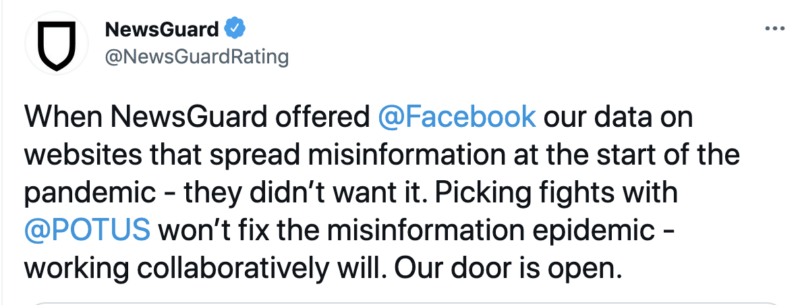
In fact, the company made the following tweet on July 17, 2021,
essentially siding with Psaki’s call for a government-media partnership
to censor internet content.
Phrases such as “working collaboratively” and “our door is open”
reveal that NewsGuard envisions itself as having a prominent role in any
collusive arrangement that arises from the White House’s recent
statements. Their posturing for influence, however, obscures a more
basic question: why should we trust a self-appointed fact checker?
Indeed, who fact checks the fact checkers?
After receiving a recent request for comments on a “fact-check”
article by NewsGuard regarding AIER and the Great Barrington
Declaration, we decided to investigate the rise of the fact-checking
phenomenon itself, including this strange new company’s own performance
in evaluating the content of other websites.
We soon discovered that NewsGuard falls far short of the very same
criteria for accuracy and transparency that it claims to apply to other
websites. Most of the company’s fact checkers lack basic qualifications
in the scientific and social-scientific fields that they purport to
arbitrate. NewsGuard’s own track record of commentary – particularly on
the Covid-19 pandemic – reveals a pattern of unreliable and misleading
claims that required subsequent corrections, and analysis that regularly
conflates fact with opinion journalism in rendering a judgement on a
website’s content. Furthermore, the company’s own practices fall far
short of the transparency and disclosure standards it regularly applies
to other websites.
How Accurate are Self-Appointed Fact Checkers?
The stated premise of fact-checking is to correct errors in claims
published by other websites and outlets. But what happens when the
organization doing the fact-checking has its own facts wrong?
A revealing example may be found in NewsGuard’s treatment of the “lab
leak” hypothesis for Covid-19’s origins. Media coverage of the lab leak
theory – which posits that the pandemic originated through the
accidental infection of workers at the Wuhan Institute of Virology who
were studying coronaviruses in bat populations – has changed
dramatically in recent months after a closer examination of evidence led several scientists to lend it credence.
Political figures including President Joe Biden and White House medical
adviser Anthony Fauci now consider the lab leak theory “plausible” and
have called for an investigation of the Wuhan facility.
For over a year prior to these recent developments however, NewsGuard
aggressively “fact checked” and penalized other websites for even
raising the possibility of a lab leak. Some of the most aggressive
attacks came from John Gregory, NewsGuard’s “Deputy Editor for Health”
policy and also the primary correspondent in AIER’s exchanges with the
company.
In March 2020, Gregory sent a separate inquiry
to another website charging it with promoting “unfounded conspiracy
theories about the virus’ origins,” and specifically what is known as
the lab leak hypothesis. “There is no evidence that the Wuhan Institute
of Virology was the source of the outbreak, and genomic evidence has
found that the virus is ‘96% percent identical at the whole-genome level
to a bat coronavirus,’” continued Gregory’s email, which also suggested
that NewsGuard would be flagging and downgrading the website for
publishing “misinformation” about this subject. While the website in
question – an “alternative medicine” blog – promoted other fringe claims
that warranted scrutiny and legitimate corrections, Gregory’s focus on
specifically discrediting the lab leak thesis suggests he was injecting
his own political opinions into the fact-checking exercise.
In another example from February 2020, Gregory announced by tweet
that he had contacted a medical news website after it ran a headline
suggesting “Coronavirus may have leaked from China’s highest biosafety
lab.” Gregory demanded a “formal correction or retraction” of the
headline. After we contacted Gregory by email to question him about the
practice of penalizing websites for discussing the lab leak hypothesis,
he responded, “My February 2020 tweet was also accurate,” asserting that
his position was justified on the grounds that “[t]he lab leak theory
remains unsubstantiated and under investigation.” NewsGuard has taken a
similar line in its reassessment of ratings on some 225 websites where
it docked the source for mentioning the lab leak hypothesis, stating
that “while not substantiated, [the lab leak theory] is also, as of now,
not provably false.”
Despite Gregory’s tendentious phrasing, he nonetheless quietly deleted the tweet
in the days following AIER’s inquiry. The company also found itself in
deeper trouble over its previous mischaracterizations of the lab leak
hypothesis as a “conspiracy theory” – a common refrain in Gregory’s
articles on the subject. In late June 2021, NewsGuard had to issue at
least 21 separate corrections to ratings where it docked websites for
reporting on the lab leak theory. According to a statement that the
company sent to AIER:
“NewsGuard either mischaracterized
the sites’ claims about the lab leak theory, referred to the lab leak
as a “conspiracy theory,” or wrongly grouped together unproven claims
about the lab leak with the separate, false claim that the COVID-19
virus was man-made without explaining that one claim was
unsubstantiated, and the other was false. NewsGuard apologizes for these
errors. We have made the appropriate correction on each of the 21
labels.”
NewsGuard has not published the full results of its audit, or a list
of the corrections it made, thereby precluding independent verification
of whether its corrections were sufficient to rectify the Covid
misinformation it had previously published. The company did not respond
to AIER’s request for this information.
While these corrections are a welcome development from the company,
they also reveal a deeper underlying hubris that characterizes
NewsGuard’s general approach to vetting Covid-19 content. Gregory and
other fact checkers at the site appear to have concluded as early as
February and March 2020 that the lab leak hypothesis was nothing more
than a fringe “conspiracy theory,” and began using this descriptor to
attack and downgrade almost any website that subsequently raised the
very possibility that it was investigation-worthy. This hubris persisted
until a reassessment of the claim led mainstream scientists, as well as
political figures such as Biden and Fauci, to deem the hypothesis
“plausible” and call for a comprehensive investigation into the Wuhan
Institute of Virology. Gregory and his colleagues appear to have simply
decided that their own premature dismissal of the lab leak hypothesis
equated to “fact” and proceeded to penalize other sites not for factual
errors, but rather for diverging from NewsGuard’s own editorial position
on the same subject. When this position turned out to be mistaken,
NewsGuard pivoted to remove the errors – albeit in non-transparent ways
that downplay the significance or pervasiveness of their mistake.
AIER’s own experience with NewsGuard revealed a similar pattern of
carelessness and misrepresentation by Gregory and other writers for the
company. Gregory contacted us on behalf of NewsGuard in early June 2021
requesting comments on several articles relating to Covid-19 pandemic
policy and the Great Barrington Declaration. AIER’s Phil Magness obliged
the request by offering to answer his questions in good faith, but
quickly discovered that they carried heavy political biases arising from
Gregory’s own personal beliefs about Covid-19, healthcare policy,
American politics, and related subjects.
In one such example, Gregory asked a prejudicial question that
attempted to implicate AIER with showing partisan political biases in
our publications:
“We also note that AIER.org refers
to itself as nonpartisan. Why then do its articles routinely criticize
Democrats, such as a June 2021 article that stated, “Biden has never
provided any evidence that he is more trustworthy on corruption than any
other career Washington politician,” or another recent article that
said Biden, Fauci, and House Speaker Nancy Pelosi “do not care if their
policies destroy the nuclear family, the educational system, and moral
and religious value systems, the very pillars of civil society?”
Gregory’s question, however, selectively cherry-picked only two
articles on our site where we criticized Democratic politicians. It made
no mention of themanyexampleswhereAIERhassimilarlycriticizedRepublicanssuch asformerpresidentDonaldTrump
over excessive spending, tariffs, support for lockdowns, and illiberal
political posturing. As Magness responded, “[T]he focus of [AIER’s]
criticism is also shaped by who happens to be in political power at the
time.” Gregory’s line of questioning about Democrats appears to have
intentionally ignored “numerous instances where we have similarly
criticized Republicans” when they were in power.
Gregory’s questions displayed a similar pattern of conflating
normative policy positions taken by individual authors on AIER’s website
– essentially opinion articles, and all properly identified as such –
for positive or empirical claims, which could then be “fact checked.” As
a result, his questions treated prescriptive policy opinions that
diverged from his own viewpoints as if they were “scientific claims” –
even when the normative nature of the argument was explicitly stated up
front (in one example, the authors of a “fact checked” argument prefaced
their opinions on how vaccines should be prioritized as their own
beliefs, including identifying it as “our views on this”
subject). Since AIER publishes a diversity of positions, including
arguments that diverge from the viewpoints of AIER’s full time research
faculty, it is fundamentally inaccurate to portray individual opinion
essays as “AIER.org’s claim,” as NewsGuard does. Indeed, Magness has written at length
in favor of expanding vaccination access despite FDA and CDC regulatory
obstacles, taking the exact opposite position of the viewpoint that
Gregory attributes to the organization. When Magness replied to Gregory
by calling attention to the difference between normative and positive
arguments as well as the editorial diversity of external contributors to
our daily publications, he ignored the distinction. Gregory’s
subsequent article proceeded to blur the two together, erroneously
depicting normative points of disagreement as positive scientific claims
that could then be “fact checked” against his own position.
Even more problematic was NewsGuard’s portrayal of the Great Barrington Declaration (GBD),
signed at AIER in October 2020. Gregory’s synopsis of the GBD contained
numerous false and misleading claims that were brought to the attention
of his company almost immediately after their publication.
Repeating a charge from another website, Gregory wrote that “none of
the three [GBD authors] had published peer-reviewed research about the
COVID-19 pandemic at the time they authored the declaration.” This claim
is false. GBD co-author Jay Bhattacharya was part of a team of
scientists from Stanford University that conducted one of the first
wide-scale seroprevalence studies of Covid-19 at the outset of the
pandemic. Their results appeared in the Journal of the American Medical Association in May 2020.
When contacted by AIER about this error in his article, Gregory
conceded that the claim “will require a correction on our part,” though
he appended it with a snide denigration of Bhattacharya for being
“listed as the seventh author” on the study (Bhattacharya was in fact a
principal co-author but was listed last, as per a convention with how
some medical journal articles identify senior ranked investigators. Bhattacharya was also a primary media contact about his study’s findings at the time of its release).
NewsGuard’s depiction of the GBD contained other clear
misrepresentations of its contents and positions. For example, Gregory
wrote that the GBD “argued that restrictions meant to reduce the spread
of the COVID-19 virus, such as face masks…should be eliminated for
people considered to be at lower risk of severe illness and death from
COVID-19.” The text of the GBD makes no mention of face mask policy
though – only lockdowns and similar restrictions on schools and
businesses. NewsGuard did not respond to multiple requests from AIER to
correct this erroneous characterization.
Gregory’s article also displayed a clear pattern of relying upon
dubious and unqualified secondary sources to evaluate the scientific
merits of the GBD. In an email to AIER, NewsGuard co-CEO Steven Brill
stated “when we make judgments about health care sites…we rely on – and
quote — sources who are the experts.” This is not the case with their
assessment of the GBD.
Rather than quoting scientific experts, NewsGuard’s review of the GBD relies primarily on a statement by former UK Health Secretary Matt Hancock
– a politician who has no formal scientific or medical training. In a
passage quoted by Gregory, Hancock stated that “the Great Barrington
declaration is underpinned by two central claims and both are
emphatically false. First, it says that if enough people get covid, we
will reach herd immunity. That is not true…we should have no confidence
that we would ever reach herd immunity to covid, even if everyone caught
it.”
Hancock’s statement, however, is at direct odds with mainstream
science on immunology. The World Health Organization specifically
defines herd immunity as the combined total of immunity acquired by
vaccination and by natural infection and recovery. Although it differs
from the GBD authors on how to most effectively reach this point, the
WHO does not dispute the existence or attainment of herd immunity
itself. Even among pro-lockdown sources, herd immunity is seen as a
reachable goal and a primary aim of mass vaccination, contrary to
Hancock’s claims. Dr. Anthony Fauci,
for example, has frequently stated that he anticipates reaching herd
immunity after between 70 and 85% of the U.S. population is vaccinated
or recovered from Covid-19. Most other public health scientists agree that herd immunity is attainable
through a combination of vaccination and natural immunity, even though
some of them differ from the Great Barrington Declaration authors about
the role of specific policy interventions in reaching this point.
Hancock’s statement, cited as authoritative by NewsGuard, further
contended, “The second central claim [of the GBD] is that we can
segregate the old and vulnerable on our way to herd immunity. That is
simply not possible.” This is not a scientific statement, but rather
Hancock’s own political opinion. A detailed plan arguing for the feasibility of focused protection
measures was published by the GBD authors to accompany the Declaration
itself. More importantly, the scientific literature on Covid-19
mitigation documents clear evidence that the success (or failure) of a
country to “shield” its nursing homes through a focused protection
strategy is a primary factor in its overall mortality rate. A study by John P.A. Ioannidis in the journal BMJ-Global Health
compared the nursing home shielding ratios of several countries,
concluding that they “varied markedly in the extent to which they
protected high-risk groups.” Contrary to Hancock’s political claims,
Ioannidis concluded: “Both effective precision shielding and detrimental
inverse protection can happen in real-life circumstances. COVID-19
interventions should seek to achieve maximal precision shielding.”
When asked by AIER about their continued reliance on Hancock as a
source despite the scientific misinformation contained in his assessment
of herd immunity as well as his overall lack of scientific
qualifications, Gregory responded that it “was and is relevant to
explaining the views of those who criticized the Declaration.” Neither
Gregory nor NewsGuard responded to follow-up questions about how they
reconciled this position, the political nature of Hancock’s comments, or
Hancock’s lack of scientific credentials with Brill’s assertion that
they “rely on – and quote — sources who are the experts” in the subject
matters they evaluate.
In addition to using non-expert assessments such as Hancock to attack
the GBD, Gregory included links to further readings about the
Declaration from an extremely dubious source: 9/11 Truther and conspiracy theory blogger Nafeez Ahmed of the Byline Times website. Between October 2020 and the present, Ahmed has promoted a flurry of increasingly bizarre conspiracy theories
about the GBD, including a false allegation that it was secretly
financed by libertarian billionaire Charles Koch in apparent
coordination with the British Ministry of Defence and – strangest of all
– the proprietor of a resort hotel located in Wales. Far from being
based in factual journalism, Ahmed’s theories display clear signs of its
author’s personal paranoias and political biases.
When asked about NewsGuard’s promotion of links to Ahmed’s blog,
Gregory backtracked by noting that “[NewsGuard] sometimes include
articles that we come across while researching a website but are not
referenced within the label itself.” He stated that Ahmed’s claims were
not used to calculate NewsGuard’s ratings and were only included to
provide a “history” of the GBD. It did not appear to concern Gregory
that Ahmed’s “history” was an unreliable conspiracy theory of his own
imagination.
As of this writing, NewsGuard has not altered or removed the links to
Ahmed’s allegations despite its promotion of documented falsehoods
about the origins and funding of the GBD. Even more astounding,
NewsGuard currently rates Ahmed’s blog with a score of 82.5/100, giving
it full credit for “gathering and presenting information responsibly.”
This pattern evinces a clear double standard in which NewsGuard promotes
sources that do not appear to meet their own published minimum
standards for reliability and uses them to denigrate the credibility of
AIER and the GBD.
In sharp contrast to the generally disparaging approach he took to
covering the GBD, Gregory holds other websites that attack the GBD in
high esteem. In one example, Gregory extended a score of 87.5/100 to
CovidFAQ.co, a website set up by a group of pro-lockdown activists in
the United Kingdom. CovidFAQ is a joint project of conservative member
of Parliament Neil O’Brien, “neoliberal” activist Sam Bowman, and academic Stuart Ritchie. Pro-lockdown UK political strategist Dominic Cummings recently referenced their work as part of a “decentralised” political campaign to discredit the anti-lockdown movement and the GBD,
which he proposed while serving as an advisor to Prime Minister Boris
Johnson. In his article for NewsGuard, Gregory credits CovidFAQ for “not
repeatedly publish[ing] false content.” The website’s track record is
at clear odds with Gregory’s assessment.
In January 2021, CovidFAQ published a lengthy attack on the GBD
that contained multiple errors and misrepresentations of the
Declaration’s contents. In one example, the authors of CovidFAQ claimed,
“The authors of the Great Barrington Declaration have never given an
answer” to how they would implement a focused protection strategy in
place of lockdowns. In reality, the GBD website contains a detailed 1,800 word plan for implementing focused protection.
When AIER’s Phil Magness alerted CovidFAQ co-owners Stuart Ritchie and
Sam Bowman to this error in January 2021, the website’s editors modified
the text to read, “The authors of the Great Barrington Declaration have
never given anything approaching an adequate answer” to how
they would implement focused protection (emphasis added). Rather than a
factual correction, CovidFAQ’s change inserted their own editorial
commentary expressing disagreement with the GBD’s published focus
protection strategy as a way of disguising CovidFAQ’s earlier
misrepresentations of the document. Gregory’s NewsGuard rating of the
CovidFAQ website specifically linked to CovidFAQ’s deceptive edit about
the GBD, and described it as having met “NewsGuard’s standards for
regularly issuing corrections.”
Figure II: Misleading edit on the CovidFAQ website, classified as an appropriate “correction” by NewsGuard
Typifying other slanted media coverage of the GBD, NewsGuard
concluded its assessment by repeating a false story from October 2020,
claiming that the GBD’s signature list contained fake names such as “Dr.
Johnny Bananas” to inflate its signature count. This story
misrepresents the products of an intentional hoax by pro-lockdown journalists including the aforementioned Nafeez Ahmed
to flood the website with false signatures. In reality, “Dr. Johnny
Bananas” and similar hoax submissions were removed from the GBD website
within a few hours of their discovery. An audit of signatures conducted by AIER
found that false names amounted to only 0.1% of total signatures on the
GBD prior to their removal, with the largest cluster of false names
deriving from Ahmed’s hoax campaign on October 9th. NewsGuard did not
include any of this context in its article, nor did Gregory permit AIER
an opportunity to comment on the misinformation contained in its account
of the false signatures.
To briefly summarize, NewsGuard’s coverage of Covid-19 policy and the
GBD in particular suffers from a recurring pattern of frequent errors
that warrant correction, reliance on fact checkers and other figures who
lack qualifications to make scientific assessments, biased depictions
designed to disparage or undermine the scientific credibility of the
petition, and the promotion of false information from dubious secondary
sources, rather than the “scientific experts” it claims to use. In sharp
contrast, NewsGuard writers such as John Gregory take a friendly and
non-scrutinizing stance toward pro-lockdown opponents of the GBD such as
CovidFAQ website – even when they spread factual misinformation about
the GBD’s contents and engage in duplicitous editing under the guise of
issuing a “correction.” The self-appointed fact checker, it would
appear, suffers from a biased and deficient internal fact-checking
process for its own work on Covid-19.
Is NewsGuard Qualified to Police Facts?
Although there should be no barriers to entry when it comes to how
qualified one should be to comment on an issue, it would help,
especially for credibility, to have some sort of relevant background in
the subjects being evaluated. Degrees in medicine and other hard
sciences are always great when it comes to Covid-related topics.
Advanced qualifications in social sciences like economics, policy,
government, and law are similarly pertinent, given the pandemic’s
wide-reaching public policy consequences. Several of these fields come
with advanced training in the gathering of evidence, statistical
analysis, and applying the scientific method – all necessary tools to
evaluate the performance of policies such as mask mandates, lockdowns,
programs to encourage and distribute vaccination, and the sort.
By contrast, NewsGuard’s staff primarily evaluates scientific claims by appealing to the authority of public figures
who they designate as “experts” on the subject in question. Their
approach generally avoids direct examination of the evidence surrounding
contested claims, and instead cherry-picks a figure to treat as an
authoritative final word. As their liberal use of Hancock to evaluate
the GBD illustrated, many of their preferred authorities are political
officeholders rather than persons trained in scientific or
social-scientific methods.
By selectively curating cherry-picked political authorities rather
than evaluating evidence directly, NewsGuard’s approach to fact-checking
effectively sidesteps the scientific method. This strategy is rendered
even more problematic by the general lack of scientific expertise within
NewsGuard’s team of writers.
We examined the educational credentials, including the highest degree
listed, for 28 publicly identified staff members on NewsGuard’s
website. The company’s staff page reveals shockingly little expertise in
either the hard sciences such as medicine or social sciences such as
public policy, economics, and related fields. 12 of the 28 listed
staffers have primary degrees in journalism or media. The second-most
represented subject area is English literature, with 4 degrees. The
company’s only identifiable medical expert appears to serve NewsGuard in
an advisory capacity and seems to hold a separate full-time job
teaching science journalism in Italy. Other science and social science
qualifications are sparse, and seldom surpass the undergraduate level.
Most NewsGuard articles on Covid-19 topics and policies are written by
Gregory, whose only identified qualification is a bachelor’s degree in
Media Arts.
Noting the general deficit of scientific and social scientific
expertise, AIER asked NewsGuard’s co-CEO Steven Brill if his company
employed any individuals with advanced degrees in healthcare, medicine,
economics, public policy, or related scientific and social scientific
fields. Brill responded, “A lot of us have qualifications and graduate
degrees in some of the fields you mention.” However the chart below
belies his answer:
Figure III: NewsGuard Staff by Field and Highest Degree Attained:
For example, the aforementioned John Gregory would not qualify as an
expert in most of the fields he is responsible for fact-checking. Before
joining NewsGuard, his journalism background consisted primarily of
writing news articles about the Orlando, Florida theme park industry. He also previously worked as a writer for TriMed Media, a for-profit consulting and marketing firm
that publishes a series of newsletters targeted toward healthcare
industry executives. Although TriMed’s focus area is topical to
healthcare, it specifically promotes its newsletter products as trade
and marketing publications for its clientele within the industry.
Neither Gregory’s formal training nor his journalism experience appear
to convey a reasonable claim to scientific expertise in medicine,
healthcare policy, health economics, or related subject areas.
Of course, non-experts have every right to offer opinions on
scientific and social-scientific matters. Whether or not they should be
taken seriously as fact checkers or act as arbiters of scientific
disputes is another question entirely.
Would NewsGuard Even Pass Its Own Tests?
If we’re going to be on this topic, we might as well check to see if
NewsGuard is a reliable website by its own standards. Indeed, with its
partnership with Microsoft and its roster of accomplished staff, the
public should understand what kind of organization this is.
To test how NewsGuard holds up to its own rating system, we subjected its website and practices to the same criteria it uses to evaluate other sources.
The results reveal a website that preaches a very different standard
for others than it adheres to in its own work. The results are as
follows:
Credibility
“Does not repeatedly publish false content”
As documented, NewsGuard has an extensive track record of publishing
false and misleading content, particularly related to Covid-19. The site
admitted to making corrections to 21 separate articles where it had
inappropriately labeled the lab leak hypothesis – since described as
“plausible” and “warranting investigation” by mainstream scientists as
well as President Biden – as a conspiracy theory. While these
corrections are welcome, they are also ubiquitous and point to a pattern
of NewsGuard writers jumping the gun to “fact check” claims that are
not in error, but rather deviate from their own editorial positions. In
the case of AIER and the GBD, NewsGuard had to issue corrections to two
separate false claims within days of their article appearing. As of this
writing, NewsGuard’s coverage of the GBD still includes uncorrected
falsehoods about the GBD’s position on masks and misleading scientific
assessments of its content by non-expert sources such as Matt Hancock.
Although NewsGuard’s browser app subscription model precludes an
independent audit of their fact-checking on other websites and topics,
these problems suggest a wider pattern of errors that call into question
the reliability of the company’s content.
“Gathers and presents information responsibly”
As documented, NewsGuard’s staff of fact checkers generally lack
appropriate scientific and social-scientific qualifications to arbitrate
factual and interpretive disputes in these subject areas. Instead, the
company relies primarily on appeals to selectively curated external
figures that they deem to be authorities on the relevant subject. When
asked about how they select expert opinions, NewsGuard co-CEO Steven
Brill told AIER that they always “quote real experts” and again that “we
rely on – and quote — sources who are the experts.” Our review of
NewsGuard’s analysis of the GBD, however, found that this was not the
case. Instead of scientific experts, NewsGuard primarily relied on
political figures such as Matt Hancock, including statements by Hancock
that are well outside of the scientific consensus on the concept of herd
immunity. When asked if they would be willing to correct Hancock’s
erroneous statements, NewsGuard writer John Gregory defended his use of
this source and did not respond to further follow-up questions.
An additional concern appears with how NewsGuard affixes its “warning
label” system to published articles that its writers have not reviewed,
let alone identified as failing a fact check. In AIER’s own experience
with this company, we discovered that NewsGuard had affixed a “red”
warning label to several articles we published about factual errors in
the New York Times’s 1619 Project. NewsGuard and its writer
John Gregory made no effort to evaluate the contents of these articles,
and did not contact AIER for any comment on the application of this
label to any subject other than its above-noted disputes over Covid-19
and the GBD. At the same time, NewsGuard applied a “green” label to the New York Times 1619 Project’s own website, despite never evaluating the content contained therein (the 1619 Project, it should be noted, contains significant uncorrected factual errors, and engaged in clear acts of journalistic misconduct
to deflect criticism of its historical claims). This disparate
treatment of the 1619 Project provides an example of misleading and
inappropriate applications of rating labels to contents that are subject
to legitimate factual disputes, but that NewsGuard itself did not
examine or evaluate before attaching its label. As this example
illustrates, NewsGuard’s practice of affixing rating labels to websites
can create a false impression among its readers that the company has
conducted a fact check on articles that it has not even evaluated.
Figure IV: A Comparison of NewsGuard’s ratings of the 1619 Project and AIER’s content on the 1619 Project, July 2021
“Regularly corrects or clarifies errors”
As noted, NewsGuard periodically corrects certain errors found in its
published content. Recent corrections include the aforementioned edits
to 21 articles on other website coverage of the lab leak hypothesis, and
two corrections to factual misrepresentations about AIER and the GBD.
At the same time however, NewsGuard appears to issue its corrections on
an inconsistent basis. NewsGuard’s Gregory employed evasive wording to
justify his continued deprecation of the lab leak hypothesis in other
uncorrected articles, describing it as “not substantiated.” NewsGuard
does not appear to apply similar descriptors to figures such as
President Biden, Anthony Fauci, or mainstream journalism outlets such as
the New York Times – all of which have recently lent credence to the plausibility of the lab leak hypothesis.
In AIER’s own case, NewsGuard declined to make an appropriate
correction to misleading scientific claims about herd immunity by Matt
Hancock. The company did not respond to further requests for corrections
to its misrepresentation of the GBD, including the false claim that the
Declaration opposes the use of face masks.
NewsGuard’s corrections policy does not appear to meet common
standards for transparency. While NewsGuard claims to make timely and
warranted corrections to its articles, these corrections are not
independently verifiable without purchasing the company’s internet
browser app and searching individual websites one at a time.
Furthermore, the company does not appear to retain archived and
accessible copies of its uncorrected articles for independent
verification of the changes. NewsGuard did not respond to AIER’s
inquiries about the lack of transparency arising from these
unconventional practices.
“Handles the difference between news and opinion responsibly”
Despite imposing a strict standard for separating news from opinion
on the other websites it rates, NewsGuard’s internal practices
substantially blur these lines in its own content. The website claims that it has “no political axes to grind,” yet its affiliated personnel appear to be deeply involved in partisan and political causes. The company’s board of advisors
includes multiple former elected officeholders and political appointees
from the Bush and Obama administrations, as well as foreign
governments. When asked about this apparent contradiction, NewsGuard
co-CEO modified his descriptor of the company to “politically balanced.”
In reference to one of his advisory board members, Brill further
stated, “I’m curious what “ax” you think someone like Tom Ridge is
grinding.” Ridge is the former Republican governor of Pennsylvania and
Secretary of Homeland Security in the Bush administration (for
reference, AIER made no specific claim about Ridge’s beliefs save to
note that he is clearly a political figure, contrary to NewsGuard’s
depiction of itself as a non-political company).
Brill himself also has longstanding political interests as an opinion
commentator on healthcare policy, including the Affordable Care Act.
His advocacy work in this area includes a 2015 book
that proposes a “new vision of how we can fix American healthcare”
through further addenda to the Obamacare program. When asked about the
political connotations of his own writings on healthcare policy, Brill
told AIER, “I’m a journalist. I write magazine articles and books that
have offended people on both sides of an aisle.” This statement strongly
suggests that Brill does not differentiate between editorial commentary
and news reporting in his own work.
“Avoids deceptive headlines”
NewsGuard’s headline practices are responsible within the normal standards of journalism.
Transparency:
“Website discloses ownership and financing”
NewsGuard publishes a short list of “financial investors”
on its website, but offers no indication of how much money they
invested, what their budget is, what percentage of their financial
support comes from outside investors, the nature of the contracts they
maintain with companies such as Microsoft, or where their revenue comes
from. When asked about their policy for handling conflicts of interest
between investors and website ratings, NewsGuard co-CEO Steven Brill
told AIER that “If there are, they are always disclosed prominently in
our Nutrition Label” and offered an example of a disclosure of his
co-executive Gordon Crovitz’s previous affiliation with the Wall Street Journal.
A
review of NewsGuard’s ratings of several media websites reveals that
Brill’s statement does not accurately reflect how his company handles
several of its listed financial investors. NewsGuard lists former
Reuters CEO Thomas Glocer among its financiers; however as of July 2021,
Glocer’s investment in NewsGuard is not disclosed on the site’s rating
of Reuters news service. NewsGuard similarly reports receiving investments from Nicholas Penniman IV, the retired publisher of the St. Louis Post-Dispatch. As of July 2021, Penniman’s investment is not disclosed on NewsGuard’s rating of the St. Louis Post-Dispatch. A list of insufficiently disclosed potential conflicts of interests and NewsGuard’s ratings may be found below:
Figure V: NewsGuard ratings of websites with undisclosed connections to its own financial investors, July 2021
Website
NewsGuard Score
NewsGuard Investor with past affiliation
Disclosure on NewsGuard Rating Website (July 2021)
Huffington Post Investigative Fund
87.5
Nicholas Penniman V – Former Executive Director & Cofounder
No
The American Prospect
92.5
Nicholas Penniman V – Former Associate Editor
No
Washington Monthly
100
Nicholas Penniman V – Former Publisher
No
Lincoln Journal-Star
85
Nicholas Penniman V – Former Editor
No
Center for Responsive Politics
100
Nicholas Penniman V – Current Board of Directors
No
St. Louis Post-Dispatch
85
Nicholas Penniman IV – Former Publisher (retired)
No
Arizona Daily Star
85
Nicholas Penniman IV – Former Senior VP
No
Reuters
95
Thomas Glocer – Former CEO
No
C-Span
87.5
Leo Hindery – Former Chairman
No
“Clearly labels advertising”
NewsGuard does not currently advertise on its website, except for its own for-purchase website browser application.
“Reveals who’s in charge, including possible conflicts of interest”
NewsGuard generally discloses its staff of writers,
including the authors associated with individual articles. It does not
however disclose how specific website ratings are assigned to its staff
writers, or how NewsGuard decides whether a website will be subjected to
its rating system.
As noted, NewsGuard’s health policy writer John Gregory was
previously employed as a writer for TriMed Media, a for-profit industry
consulting firm that publishes newsletters geared toward healthcare
industry executives and offers a variety of website and marketing
services “to boost awareness and revenue”
for healthcare businesses. Gregory’s past affiliation with this company
is disclosed on NewsGuard’s website; however, he describes himself as a
“reporter” for this firm’s “news publications.” The potential for a
conflict of interest seems apparent not only in NewsGuard’s coverage of
healthcare topics, but also from a separate subscription-based “service” that NewsGuard offers to healthcare provider companies for the dissemination of its ratings.
When asked whether his previous connections to TriMed Media presented
a potential conflict of interest for his coverage of healthcare issues,
Gregory stated that TriMed Media’s consulting business was conducted by
“the company’s separate marketing department, and I worked entirely on
the editorial side of the operation.” He further stated, “They do not
bias my ability to do my work at NewsGuard, as I did not perform any of
those marketing department tasks when I worked at TriMed Media between
2016 and 2018.” At the time of this writing, TriMed Media’s website
content does not appear to differentiate its news, editorial, or
marketing/consulting departments or functions in the ways that Gregory
describes in his response. TriMed Media’s website for its newsletter
publications depicts their primary audience as for-profit healthcare
industry executives. Gregory did not respond to follow-up questions
asking him for elaboration on his relationship with and duties at TriMed
Media. While Gregory’s case does evince disclosure of a past employer
with potential conflicts of interest in his website ratings area, that
disclosure remains sparse on details and offers an incomplete picture of
the nature of TriMed Media’s business model. Furthermore, NewsGuard’s
own subscription platform for healthcare providers illustrates that the
company’s own business model operates in an overlapping area of the
medical industry. Details on this service or how its subscription
contracts operate are sparsely accounted for on NewsGuard’s website
“The site provides the names of content creators, along with either contact or biographical information”
NewsGuard’s articles generally list the identity of writers who
contributed to their contents, and accompanying biographies include
contact information for each writer.
Scorecard:
NewsGuard applies a 100-point scorecard to the websites it rates,
based on the above-listed criteria. Although their exact scoring rubric
is only summarized on their website, we applied their publicly disclosed
scoring system to each of the criteria above in light of our
investigation.
Figure VI: Our “Nutrition Label” for the NewsGuard Website
Category
Points Possible
Points Awarded to NewsGuard
Does not repeatedly publish false content
22
5
Gathers and presents information responsibly
18
0
Regularly corrects or clarifies errors
12.5
6.25
Handles the difference between news and opinion responsibly
12.5
0
Avoids deceptive headlines
10
10
Website discloses ownership and financing
7.5
0
Clearly labels advertising
7.5
7.5
Reveals who’s in charge, including possible conflicts of interest
5
2.5
The site provides the names of content creators
5
5
TOTAL
100
36.25
In light of all these considerations, it seems that NewsGuard fails
to pass a number of important journalistic standards. Furthermore, it is
concerning that NewsGuard cannot separate itself from its disagreement
with the content of AIER’s publications regarding public health, which
dominates its report. This is even more concerning when considering its
dubious track record to responsibly or reliably use its self-appointed
position of power to police the very information it purports to be the
arbiter of truth on. Furthermore, it is the supreme height of arrogance
to claim a monopoly on scientific truth, not just without a background
in science or really any field outside of journalism, but during a novel
issue with constantly evolving information.
Our Rating of NewsGuard: 36.25/100.
This website fails to adhere to several basic journalistic standards,
and should be used with extreme caution as a source for verifying the
reliability of the websites it purports to rate.
Key Takeaways
The truth is best sought through the marketplace of ideas where
reason and evidence are the weapons of choice. When we see fact checkers
like NewsGuard, who not only fail to uphold their high-sounding
principles but even publicly encourage working with the government to
suppress speech, we should raise red flags. NewsGuard’s behavior
illustrates the tired idea that, during events like Covid-19, we should
simply do as we’re told and not question the government or its experts.
On this matter, they have shown themselves to be either unable to
appropriately moderate public discourse or act as little more than
cheerleaders for favored political figures and their preferred policy
approaches to Covid-19. It wouldn’t be a stretch if they happen to be
both.
Phillip W. Magness is a Senior
Research Fellow at the American Institute for Economic Research. He
holds a PhD and MPP from George Mason University’s School of Public
Policy, and a BA from the University of St. Thomas (Houston).
Prior to joining AIER, Dr. Magness spent over a decade teaching
public policy, economics, and international trade at institutions
including American University, George Mason University, and Berry
College.
Magness’s work encompasses the economic history of the United States
and Atlantic world, with specializations in the economic dimensions of
slavery and racial discrimination, the history of taxation, and
measurements of economic inequality over time. He also maintains active
research interest in higher education policy and the history of economic
thought. In addition to his scholarship, Magness’s popular writings
have appeared in numerous venues including the Wall Street Journal, the
New York Times, Newsweek, Politico, Reason, National Review, and the
Chronicle of Higher Education.
 Phillip W. Magness
 James R. Harrigan
– August 3, 2022 @ American Institute for Economic Research




 Print