Search This Blog

De Omnibus Dubitandum - Lux Veritas

Showing posts with label Nikole Hannah-Jones. Show all posts

Wednesday, July 5, 2023

Glutton for punishment: Nikole Hannah-Jones tweets out her loathing for the 4th

July 5, 2023 By Monica Showalter

The author of the much-debunked "1619 Project," Nikole Hannah-Jones, seems to be a glutton for punishment on Twitter. Rather than slink away from her pathetic, largely invented, and completely distorted history of America's founding gone stale, she's used the occasion of Independence Day to double down. It didn't go well for her..............To Read More....

My Take - Time is not on her side, much like Howard Zinn. Both of whom have been deconstructed by reality versus their narratives, and Mary Grabar has been in the forefront of that initiative.  Fighting 'The 1619 Project' Fake History: Lessons from Howard Zinn’s Fake History 

Please review my 1619/Nikole Hannah-Jones file.
Please review my Howard Zinn file.  

Truth is the sublime convergence of history and realty. Everything we're told has a historical foundation and context. Everything we're told should bear some resemblance to what we see going on in reality. If either fails, it's wrong. All that's left to do is develop the intellectual response to explain why it's wrong.   Time and truth are on the same side because, "truth will very patiently wait for us."

Wednesday, October 5, 2022

Namings!

By Rich Kozlovich

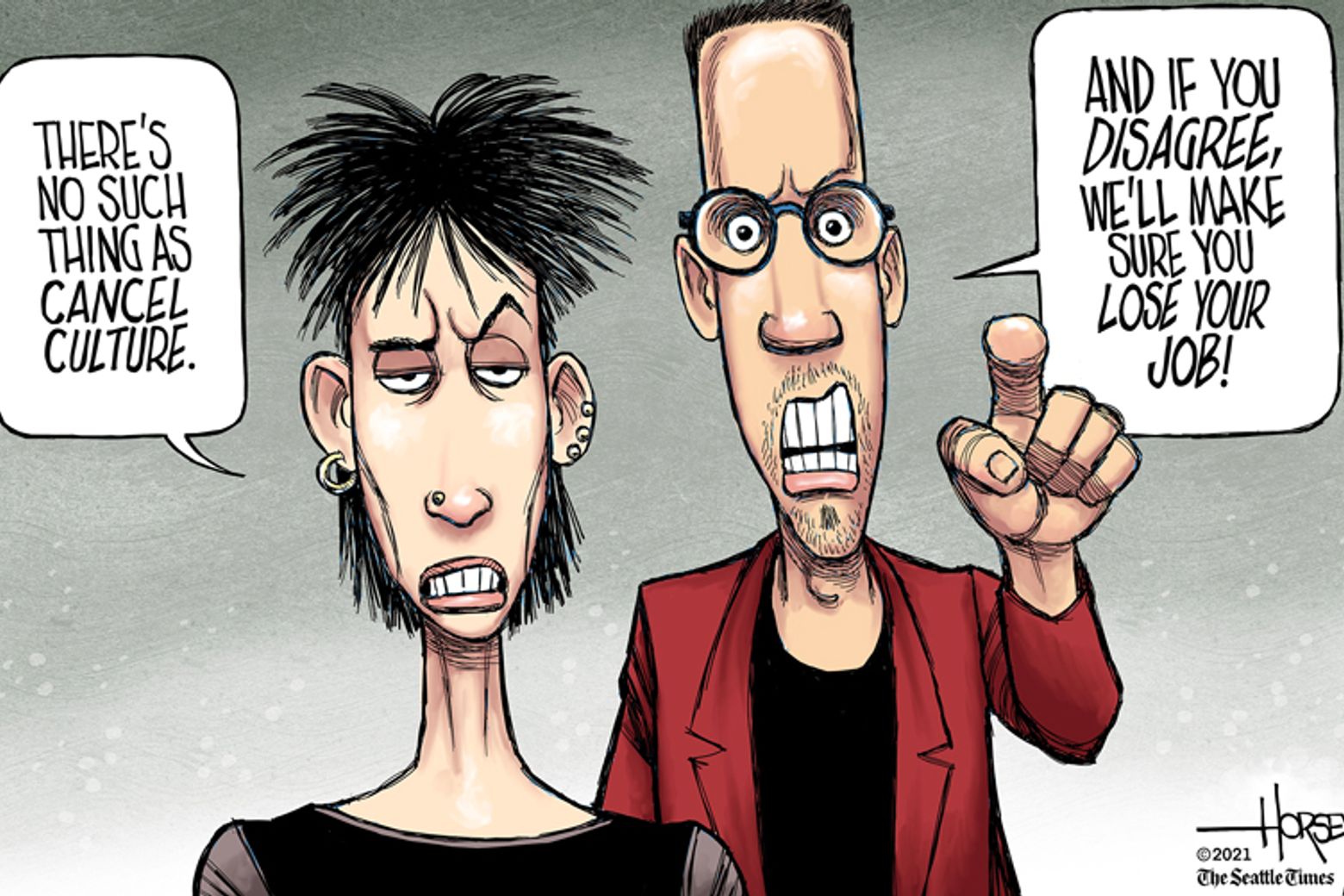
 https://images.seattletimes.com/wp-content/uploads/2021/03/Cancel-Culture-ONLINE-COLOR.jpg?d=1560x1040

In recent years we've seen a plague on American society.   And unlike this faux pandemic, this is a plague called the "", with a huge demand America rename just about everything in order to appease....welll... just about everyone, just so long as they're not white, straight, conservatives with traditional values, especially males, all whom may be either Christians or Jews.  They don't count! 

The Cleveland Indians are now the Cleveland Guardians, and the Atlanta Braves are discussing changing their name.  Writers go on the describe the difficulties with all this renaming clabber, such as how the term Indian came into being and the new world, how there's the effort to have preferred terms such as “Native American”, and the resulting logical issues:  Such as, if someone was born in England are they "native English" or "native Mexican", or "Native Chinese", etc.?  In Canada it's "First Nations", but these tribes were never united into a nation, anywhere in North or South America, and they happily butchered each other considering themselves to be "the people" and everyone else, not people. 

There's a reason the Tower of Babel became the foundation for the word "babble", and that's what I think of all this.  Does anyone really believe any tribe that conquered any other tribe would have allowed this kind of coprolite to be espoused?  The fact is these are conquered peoples and they need to get over it and be glad they were conquered by Americans, because it's unlikely this would have been tolerated elsewhere.  They wouldn't have been spared, they wouldn't be living on reservations, and they wouldn't have had any rights at all. 

All this divisional clabber is just another leftist ploy to de-legitimize the European conquest of much of the world, presented as if this was done by "bad" people, AKA, white people.  In reality, no matter how bad they may have been, and in some cases very bad, in the vast majority of cases they were better than those they replaced, and the Aztec "civilization", and the others conquered by Spain are an excellent example.

Now if you wish to criticize them for being bad Christians, well, you would have a valid argument there.  The Frankish kings and all the other European Kings were great churchmen, but they were lousy Christians, and the American settlers practices would certainly have to be categorized as un-Christian.  But that's not the argument is it?

The foundational argument is they were bad people, but the fact is they were playing by the same rules everyone else in the world was playing by, but they were just better at it than the rest.  But that's not the accepted narrative, so now all they did and accomplished must be diminished until it's destroyed with multiculturalism, in order to impose globalism in the form of global governance predicated on socialist tyranny, and we know how disastrous that will be.  Between the leftist monsters of the 20th century, who murdered over 100 million people, and the environmental activists, a scion of leftism, they've easily murdered over another 100 million people and that's most likely a conservative number.  That's history and that history is incontestable. 

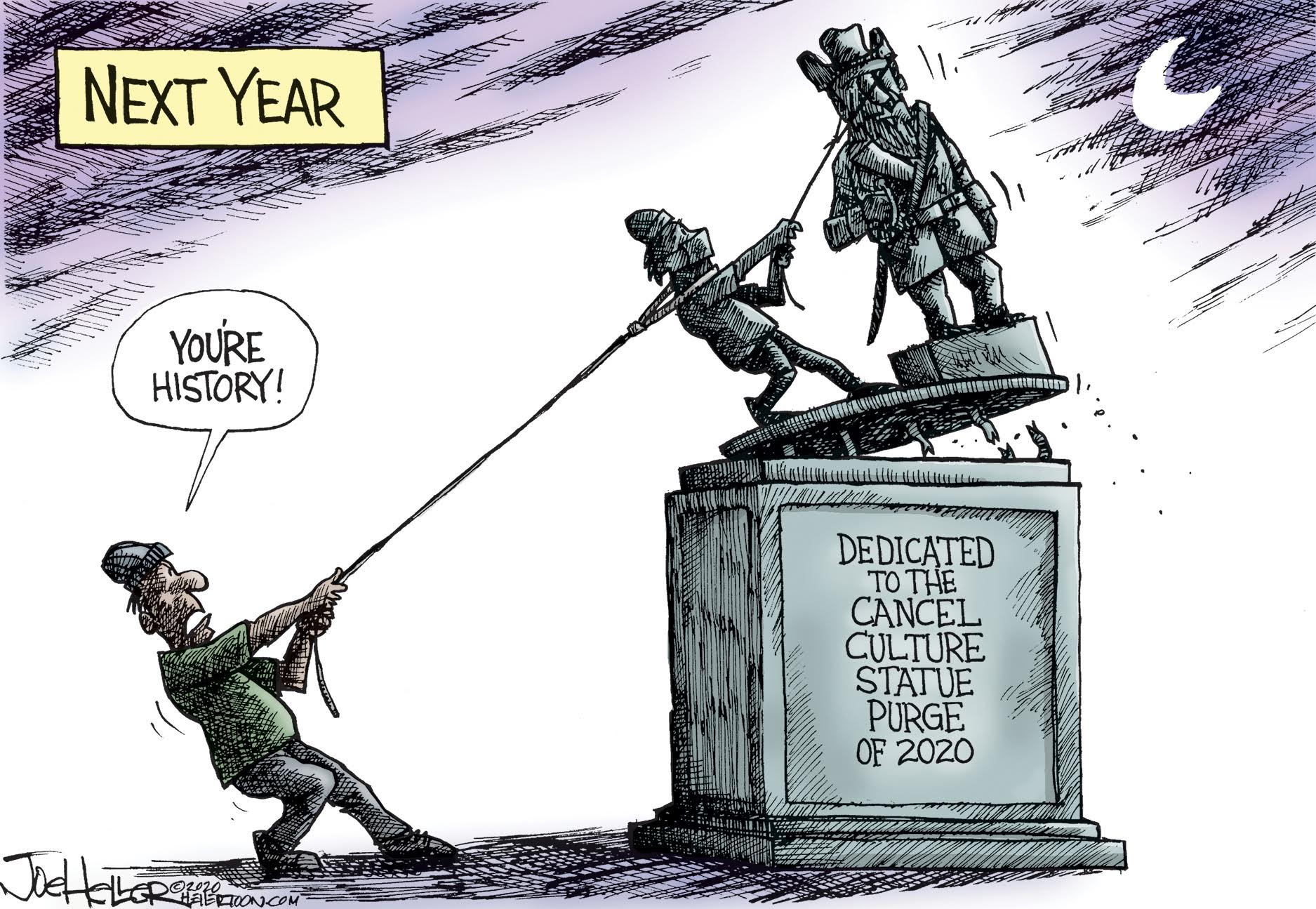
 Editorial Cartoon U.S. cancel culture statues

Definition leads to clarity and clarity leads to understanding, and all these writers have failed that test, because they fail to see this is a never ending story, as eventually the Cancel Culture cancels the Cancel Culture, and real history is lost in the melee to historical clabber such as is presented by Nikole Hannah-Jones and


Friday, August 5, 2022

Fit to Print? UNC’s Settlement with Nikole Hannah-Jones is Bad News

Phil Magness Phillip W. Magness  James R. HarriganJames R. Harrigan   – August 3, 2022 @ American Institute for Economic Research

A reporter who hasn’t dreamt of one day writing for the New York Times is a rare bird. “I’ll start with my local newspaper,” they tell themselves. “Then I’ll move on to a statewide paper, before making a name for myself at something with a national readership. From there, I’ll be drafted into service at the Gray Lady. If I play it right I can be there in 15 years.”

It took Nikole Hannah-Jones 12, and that would hardly be the end of her story. She would exploit her position at the Times to rewrite early American history and, later, to extort a significant settlement from an American university that did its level best to hire her.

But, then again, Nikole Hannah-Jones has always lived a bit of a charmed life. She attended the University of Notre Dame, earning a BA in history and African-American studies. She followed this with a master’s degree from the University of North Carolina’s Hussman School of Journalism and Media, where she was a Roy H. Park Fellow.

She began a career as a journalist in 2003, putting in three years with the News & Observer in Raleigh, NC, and then moving to Portland, OR, for six years with The Oregonian. In 2011, Hannah-Jones joined ProPublica in New York City. She finally came to rest as a staff reporter with the New York Times in 2015.

From there, her star rose. She was awarded a MacArthur Fellowship in 2017, and in 2020 she won the Pulitzer Prize for Commentary for her work on the politically contentious 1619 Project. Her prize-winning essay has been embroiled in a succession of controversies since it appeared in print.

First, she got into a public spat with a group of academics who presented a long list of factual and interpretive errors in her work, dismissing them at one point as “white historians” who were not worth her time or attention. A few months later, Northwestern University historian Leslie M. Harris revealed that she had been asked to fact-check Hannah-Jones’s essay by the Times. She raised red flags about its factually erroneous attempt to place slavery at the center of the American Revolution, only to be ignored by the newspaper. The revelation forced Hannah-Jones’s editor to issue an embarrassing correction, which the newspaper euphemized as an “update.” 

Next came a revelation that called the project’s ethics into question. At some point during its Pulitzer bid, the Times ghost-edited a controversial line of text off of its web copy without disclosing the claim. The discovery was made after Hannah-Jones publicly denied ever using the line, when in fact she had done so dozens of times.

Despite stumbling through a continuous sequence of controversies, the 1619 Project succeeded in elevating Hannah-Jones’s profile in the journalism world. It was this capstone to her resume that piqued the interest of the University of North Carolina, which announced in 2021 that Hannah-Jones would come on board at the rank of full professor. She would hold the Knight Chair in Race and Investigative Journalism in the Hussman School of Journalism and Media less than 20 years after her time there as a student.

But that announcement would prove to be a bit premature. While UNC did, in fact, offer Nikole Hannah-Jones a position, which she did, in fact, accept, there was a devil in the details. The job she accepted did not come with tenure; it came with a five-year contract with an option for tenure review. Whatever the interior machinations at the Hussman School, this was not an unreasonable offer. Hannah-Jones, quite simply, had not done the sort of academic work that tenure rewards. Journalism and academia are two very different animals.

Nonetheless, she fomented a public campaign to be granted tenure, alleging racial discrimination in the process. To no one’s real surprise, the university gave in. That she did not hold a PhD, had no peer-reviewed publications, and had no teaching experience seemed not to matter much in the end. Nor would she have to go through the standard processes wherein newly hired faculty earn tenure through an intensive multi-year review of their scholarship, classroom instruction, and service to the university. Hannah-Jones’s revised offer from UNC included automatic tenure on her start date and an immediate appointment as full professor.

There is no evidence that Hannah-Jones was wronged by this process in any way—quite the contrary, she was benefiting from all sorts of privilege that most academics do not have early in their careers, privilege they need to earn instead. No regular faculty member walks into a full tenured professorship as their very first academic job. Indeed, in the glutted marketplace of academic job-seekers, Hannah-Jones happened into an offer that almost any qualified applicant with actual research outputs and teaching experience would have considered akin to winning the lottery—even before tenure was appended to the offer.

Nonetheless, Hannah-Jones declined the job, instead accepting a separate offer to become the inaugural Knight Chair in Race and Journalism at the Howard University School of Communications, where she also founded the Center for Journalism and Democracy.

You might think that would be the end of it, but you’d be wrong. What followed could only have been the result of an easily panicked University of North Carolina Board of Trustees coming into the gaze of a litigious grifter. Hannah-Jones’s attorneys threatened to bring suit. On what rational grounds? Who knows. But where in this story is rationality to be found?

As a recently announced settlement reveals, she fleeced UNC out of a healthy $75,000 payment. What did that buy the university? She promised not to sue them. As if the short con wasn’t enough, she showed up with two fistfuls of salt for UNC’s wounds.

It turns out the $75,000 wasn’t quite enough. As part of her settlement, she somehow managed to secure a bunch of Diversity, Equity, and Inclusion (DEI) sinecures for 20 university administrators. Per the agreement, these bureaucrats will be attached to hiring committees for new university employees. They will “receive a stipend to serve as consultants or participants” in hiring searches. 

The terms of Hannah-Jones’s deal also direct UNC to make a new hire for something called a “trauma-informed therapist within the Multicultural Health Program,” as if to signal atonement for Hannah-Jones’s claims of mental anguish over an insufficiently generous hiring offer in the initial round. Another clause dedicates an annual payout of $5,000 to pay for “meetings, events, and symposia” hosted by an activist organization for university faculty and staff.

These are not minor expenditures for the university to absorb, particularly given that Hannah-Jones incurred no recognizable harm from her bid for a tenure commitment. These monetary outlays may be the price of avoiding further litigation, but they must also come from somewhere. In the end, the only people who are harmed by her self-serving behavior, and the university’s cowardice, are students who must pay for this nonsense as part of their tuition, and the taxpayers of North Carolina, who had better get used to this sort of thing moving forward.

One last thing. UNC did the right thing in offering her the job without tenure. There are many professors who are not academically qualified but who nonetheless qualify for a teaching professorship on the strength of a career of solid, interesting work. These faculty, commonly called professors of practice, raise no eyebrows whatsoever. Given her work history, such an offer would have been exactly the right kind for UNC to make to Hannah-Jones. If at some point down the line her demonstrated research output and classroom experience warranted a merit-based promotion, she could have been given the opportunity to go through the same tenure-review process as any other faculty member. Instead, she demanded the privilege of sidestepping the normal rules and procedures of academic promotion by threatening to unleash a lawsuit and a Twitter mob against the university.

And as galling as it is to see Nikole Hannah-Jones try to weasel her way into an unearned tenured professorship, there is one thing that is even more galling: She hasn’t published a single piece of journalism in the New York Times, her other full-time employer, in over two years. Maybe the Times is on to her. They claim to publish all the news that’s fit to print, after all.

Phillip W. Magness

Phil Magness

Phillip W. Magness is Senior Research Faculty and Research and Education Director at the American Institute for Economic Research. He is also a Research Fellow at the Independent Institute. He holds a PhD and MPP from George Mason University’s School of Public Policy, and a BA from the University of St. Thomas (Houston).

Prior to joining AIER, Dr. Magness spent over a decade teaching public policy, economics, and international trade at institutions including American University, George Mason University, and Berry College.

Magness’s work encompasses the economic history of the United States and Atlantic world, with specializations in the economic dimensions of slavery and racial discrimination, the history of taxation, and measurements of economic inequality over time. He also maintains active research interest in higher education policy and the history of economic thought. In addition to his scholarship, Magness’s popular writings have appeared in numerous venues including the Wall Street Journal, the New York Times, Newsweek, Politico, Reason, National Review, and the Chronicle of Higher Education.

 Get notified of new articles from Phillip W. Magness and AIER.

James R. Harrigan

James R. Harrigan

James R. Harrigan is Senior Editor at AIER. He is also co-host of the Words & Numbers podcast.

Dr. Harrigan was previously Dean of the American University of Iraq-Sulaimani, and later served as Director of Academic Programs at the Institute for Humane Studies and Strata, where he was also a Senior Research Fellow.

He has written extensively for the popular press, with articles appearing in the Wall Street Journal, USA Today, U.S. News and World Report, and a host of other outlets. He is also co-author of Cooperation & Coercion. His current work focuses on the intersections between political economy, public policy, and political philosophy.

Get notified of new articles from James R. Harrigan and AIER.

Selected Publications

“How pronounced is the U-curve? Revisiting income inequality in the United States, 1917-1960” Co-authored with Vincent Geloso, Philip Schlosser, and John Moore. The Economic Journal (March 2022)

“The Great Overestimation: Tax Data and Inequality Measurements in the United States, 1913-1943.” Co-authored with Vincent Geloso. Economic Inquiry (April 2020).

“The anti-discriminatory tradition in Virginia school public choice theory.” Public Choice. James M. Buchanan Centennial Issue. (March 2020).

“John Maynard Keynes, H.G. Wells, and a Problematic Utopia.” Co-authored with James Harrigan. History of Political Economy (Spring 2020)

“Detecting Historical Inequality Patterns: A Replication of Thomas Piketty’s Wealth Concentration Estimates for the United Kingdom.” Social Science Quarterly (Summer 2019)

“James M. Buchanan and the Political Economy of Desegregation,” Co-authored with Art Carden and Vincent Geloso. Southern Economic Journal (January 2019)

“Lincoln’s Swing State Strategy: Tariff Surrogates and the Pennsylvania Election of 1860” Pennsylvania Magazine of History and Biography, (January 2019)

“Are Adjuncts Exploited?: Some Grounds for Skepticism.” Co-authored with Jason Brennan. Journal of Business Ethics. (Spring 2017).

“Estimating the Cost of Adjunct Justice: A Case Study in University Business Ethics.” Co-authored with Jason Brennan. Journal of Business Ethics. (January, 2016)

“The American System and the Political Economy of Black Colonization.” Journal of the History of Economic Thought, (June 2015).

“The British Honduras Colony: Black Emigrationist Support for Colonization in the Lincoln Presidency.” Slavery & Abolition, 34-1 (March 2013)

“Morrill and the Missing Industries: Strategic Lobbying Behavior and the Tariff of 1861.” Journal of the Early Republic, 29 (Summer 2009).

Wednesday, May 11, 2022

I’ll Take America Over Africa Every Time

Imagine an urban area where the residents must endure political corruption including political violence, rampant inflation, high unemployment, substandard education, poverty, prostitution, drugs and crime.

No, I’m not talking about New York City, Detroit, Chicago, Philadelphia, New Orleans or Camden, New Jersey; I am talking about a place dominated by African Americans.  I am referencing the African nation of Liberia.

So-called black folks are infamous for their complaints and fallacious accusations of how bad they are treated in America.  The myths and outright lies of their origins and life in America are legion, the most recent and without question one of the most grotesque falsehoods pertaining to same being Nikole Hannah-Jones’, 1619 Project.

It would be remiss of me not to mention James H. Cone, the mouth of Belial whose chief claim to fame is his boasts to be the principle liberation theologist.

Cone insists: “Unlike Europeans who immigrated to this land to escape from tyranny, Africans came in chains to serve a nation of tyrants.” (God of the Oppressed)  Like the rest of the pernicious blowhards of false information used to inflate their standing, the truth differs greatly from Cone’s mythical Kunta Kinte fantasyland.

America was not responsible for the slave trade.  Africa was responsible in the context those like Cone, Hannah-Jones et al falsely claim for gain.  It is safe to say that without the Ashanti and Dahomey tribes the slave trade would have suffered.  The Alawite Dynasty in Morocco were also prolific participants in the slave trade.  With that said, these African Kingdoms did not make an economy of slavery because the Africans are today viewed having been a crayon color; they made an economy of it because that’s what those Kingdoms have done forever. Skin color is a lie asserted to paint the so-called white peoples as evil human traders.

But, I’m getting slightly ahead of myself.  There are none more prolific in art of baseless complaint than those who use melanin as a currency.  However, what goes unaddressed is the fact that these people should kiss the ground of America and thank their African slave-trappers, because if it weren’t for the indigenous African slave traders these complainers would amount to nothing today.

Marcus Garvey was the original Pan-Africanist in his back-to-Africa movement and the foundation of Liberia.  But, Liberia is one of the worst countries on earth in which to reside.

For all of the complaint by the Negro-illuminati pursuant to how bad they have it in America, in 2020 the top ten worst countries in the world to live in according to the United Nations Human Development Index were all in Africa.

It is safe to say that LeBron “low-brain’ James can shoot his mouth off in America about how evil the so-called white police officers are and how the white man is out to get the bra-tha.  But, it’s a safe bet African children in Chad, Niger, Burundi and the like wouldn’t be paying hundreds of dollars for sneakers and jerseys with his name on them if he lived in Sierra Leone and worked as a sheep herder.

Would Oprah Winfrey be a billionaire Negress publicly wishing all old white people would die if she lived in Burkina Faso or would she be housekeeper?  The Obama woman would no doubt still be boorish, gluttonous and common if she were native to South Sudan, but she wouldn’t being living in multi-million dollar estates.

One thing James Cone said that is true: “If [his kind] cannot recognize the truth, then it cannot liberate [them] from untruth.” (God of the Oppressed)  That is the most truth that ever came from his mouth in one sentence.

The truth is that those who are committed to making an industry of prostituting themselves as a crayon color would do well to recognize that the truth is: Nowhere on earth would they have it better than America.  America wasn’t responsible for the slave trade, but even if it were they have prospered beyond anything their ancestors could have hoped had they stayed in Africa.

If and when they embrace that reality, they will realize just how blessed they are to be the de facto modern day descendants of jungle dwellers captured by other jungle tribes and sold as part of their economy.

Mychal Massie

About the Author

Mychal Massie

Mychal S. Massie is an ordained minister who spent 13 years in full-time Christian Ministry. Today he serves as founder and Chairman of the Racial Policy Center (RPC), a think tank he officially founded in September 2015. RPC advocates for a colorblind society. He was founder and president of the non-profit “In His Name Ministries.” He is the former National Chairman of a conservative Capitol Hill think tank; and a former member of the think tank National Center for Public Policy Research. Read entire bio here


Tuesday, February 22, 2022

1619 Project Creator Nikole Hannah-Jones on Parental Rights: Transparency for Me, but Not for Thee

Mary Grabar Mary Grabar Feb 22, 2022 @ Townhall.com

In the preface to the recently published bestselling hardcover edition of The 1619 Project: A New Origin Story Project creator Nikole Hannah-Jones uses an incident from 2015 to demonstrate what she claims is a need for The 1619 Project.

The incident involved Roni Dean-Burren who was alerted by her teenage son to a caption in his geography textbook that read, “The Atlantic Slave Trade between the 1500s and 1800s brought millions of workers from Africa to the Southern United States to work on agricultural plantations.”

The number of Africans brought not only to the Southern United States but to all the British North American colonies, and then the states are grossly exaggerated here; it is not “millions” but about 400,000.

But that was not the concern. Dean-Burren opposed the choice of the word, “workers.” A Washington Post article cited by Hannah-Jones quoted Dean-Burren, who charged the publisher with “erasure” and “retelling” history in the way “the winners would like it told.” Reporter Yanan Wang explained, “In calling slaves ‘workers’ and their move to the United States ‘immigration,’ [Dean-Burren] noted in viral Facebook posts . . . the textbook suggests not only that her African American ancestors arrived on the continent willingly, but also that they were compensated for their labor.”

“‘Minimizing slavery,” said the Black Lives Matter hash-tagging mom, was “a way of saying those black lives, those black bodies, that black pain didn’t matter enough to give it a full description.’”

After two days of outrage on Facebook, McGraw-Hill Education announced that a review showed that “‘our language in that caption did not adequately convey that Africans were both forced into migration and to labor against their will as slaves.’”

“We believe we can do better,” the statement continued. They promised to update the caption in the textbook’s digital version and then in the next print run to “describe the arrival of African slaves in the U.S. as a forced migration and emphasize that their work was done as slave labor.” 

Dean-Burren gave the company a “thumbs up for listening,” but wanted them to go further, to recall the books and send out a supplement because few students used the digital version and another print version would not be coming out for another decade. 

This was for one word in a textbook. Since it was only on this page that the word choice was noted, we can assume that the other material in the textbook made it clear that these were enslaved “workers,” among other types of workers, indentured and free.

Without acknowledging the company’s response, Hannah-Jones presents the incident as an example of the alleged “confusing and obfuscatory (sic) way school curricula tend to address the institution of slavery.” Per The 1619 Project: A New Origin Story, McGraw-Hill remains guilty of referring to “African people brought to the Americas in the bowels of slave ships not as the victims of a forced migration who were violently coerced into labor but as ‘workers,’ a word that implies consensual and paid labor.” The incident stands as Exhibit A for the need for Hannah-Jones’s ostensibly corrective history.  

The 1619 Project when it was first published as a special issue of the New York Times Magazine on August 18, 2019, came with ready-made lessons that were injected immediately into 3,500 schools across the country—without the usual writing and review process that textbook publishers like McGraw-Hill undertake and certainly without any vetting by parents. Woke teachers eagerly adopted the lessons for the Project that displays American history in racially charged language, with the founders described as “enslavers,” plantations “forced-labor camps,” and this nation a “slavocracy.” Sweeping charges are made about “white Americans,” who “strung [black people] from trees, beat them and dumped their bodies in muddy rivers, assassinated them,” and on.

Some districts, such as Buffalo, New York, even began mandating it. Yet, today Hannah-Jones does not want parents “deciding what’s being taught,” as she said on Meet the Press, where she echoed failed Democratic candidate for Virginia governor, Terry McAuliffe. Today, Hannah-Jones wants decisions made by “people who have an expertise in the subject area.” She said she trusted her daughter’s teachers because she herself is “not a professional educator,” Yet, Hannah-Jones herself has conducted numerous teacher workshops on using her own creation, The 1619 Project, in classrooms.

She has continued the campaign against transparency laws on Twitter. On January 10, she responded to Christopher Rufo’s tweet advocating for “curriculum transparency” as a way to “deflate” the argument about “bans” and “bait the Left into opposing ‘transparency.’” Hannah-Jones stated, “I hope journalists do a better job reporting on this than they did the original CRT propaganda campaign.” On January 20, Hannah-Jones opined, “The anti-CRT propaganda campaign is being called out for what it is, so they’re changing the tactics to maintain a veneer of legitimacy by pretending all they want now is ‘transparency.’” Parents could just ask the teacher, she suggested rather flippantly. On January 23, she again commented on Rufo’s statement claiming that transparency bills would “force ideological actors to undergo public scrutiny.” We should just accept these bills at “face value,” she said, sarcastically.

For Hannah-Jones transparency laws, ironically, constitute “repression and suppression of truth,” as she told Chuck Todd. All efforts to scrutinize her demonstrably false history are part of a “Republican propaganda campaign” against “the teaching of more accurate history.” During “The AP Interview,” she charged that “powerful people” were seeking to “discredit” and “censor” her work. The charge of “censorship” has become a mantra for Hannah-Jones, even when it comes to parental rights, the same rights she championed for Dean-Burren. 

The question remains: if Dean-Burren was allowed to see her son’s textbook and get the publisher to make changes with more accurate language, why can’t other parents today? 

Saturday, January 22, 2022

Author of 1619 Project Nikole Hannah-Jones Decries 'Propaganda and Inaccurate History'

The author of the preposterous 1619 Project seems miffed by the growing grass-roots backlash against the force-feeding of her anti-historical rubbish and it’s offshoots to American schoolchildren. Over in Virginia, for example, Gov. Younkin kicked off his term with an executive order banning Critical Race Theory in Virginia’s public schools.  And down in Florida Gov. De Santis is pushing a bill to do much the same.

 “Many in mainstream media got caught up in the Republican propaganda campaign, which tried to conflate the teaching of a more accurate (italics mine) history, the teaching of structural racism, with trying to make white children feel badly about themselves or guilty,” whined  Nikole Hannah-Jones during a recent interview with the Associated Press.

Ms Hannah-Jones seems to imply that she’s a hard-nosed investigative historian who shrewdly and instantly detects propaganda and inaccuracy. Well: 

“Education is the cornerstone of the (Cuban) revolution. Nearly everywhere among the magnificent Havana architecture signs speak of equality and liberation through education," said a euphoric Nikole Hannah-Jones after a Potemkin tour of Stalinist Cuba. 

“Give me four years to teach the children and the seed I have sown will never be uprooted,” famously boasted Vladimir Lenin

Appropriately enough, Castroite Cuba’s most famous “elite” high school is named for Vladimir Lenin.  

“This summer (2008) I (Nikole Hannah-Jones) traveled to Cuba with six journalists, documenting the experiences of the African diaspora in the Western Hemisphere for the Institute for Advanced Journalism Studies in North Carolina. While there, I found a Cuba you may not know. A Cuba with a 99.8 percent literacy rate, the lowest HIV infection rate in the Western Hemisphere, free college and health care…When Castro took power, fewer than one-quarter of Cubans were literate. Many couldn't afford school. One of Castro's first acts was to universalize education…. Cuba's universal health care system is seen by many as a world model.”

Fact-Check: In fact, when Castro took power, which was barely 50 years after a devastating war of independence that cost Cuba almost a fifth of her population, Cuba boasted almost 80 percent literacy and budgeted the most (23 percent of national expenses) for public education of any Latin American country. 

Fact-Check: In 1958, Cuba had a higher standard of living than Ireland and Austria, almost double Spain and Japan’s per-capita income, more doctors and dentists per capita than Britain and lower infant mortality than France and Germany — the 13th lowest in the world, in fact. Today, Cuba’s infant-mortality rate — despite the hemisphere’s highest abortion rate, which favorably skews the figure -- is much lower from the top. So relative to the rest of the world, Cuba’s health care has worsened under the Castros and a nation with a formerly massive influx of European immigrants needs machine guns, water cannons and Tiger sharks to keep it’s people from fleeing, while half-starved Haitians a short 60 miles away turn up their nose at any thought of immigrating to Cuba. 

Without Castro, Cuba’s full literacy would have come about probably as quickly and without firing squads, mass graves and a political incarceration rate higher than Stalin’s. Most countries in Latin America with lower literacy rates than Cuba in 1958 have done just that. 

Better still, before the Castros and Che Guevara converted Cuba into an intellectual, moral and material sewer, Cubans were actually educated —not indoctrinated with worthless Marxist claptrap, as will many U.S. schoolchildren if Biden’s Education Department in cahoots with such as Nikole Hannah-Jones prevails. 

Instead of being force fed essentially the same Marxist imbecilities the 1619 Project and Critical Race Theory force-feed its hapless victims, children in pre-Castro Cuba were allowed (encouraged, actually) to read such as George Orwell and Thomas Jefferson not just the arresting wisdom and sparkling prose of Che Guevara. A specimen:

"To the extent that we achieve concrete successes on a theoretical plane — or, vice versa, to the extent that we draw theoretical conclusions of a broad character on the basis of our concrete research — we will have made a valuable contribution to Marxism-Leninism, and to the cause of humanity." 

I quote "this intellectual, this most complete human being of our time" (Jean Paul Sartre’s description of Che Guevara) exactly. Cuba’s prisons aren’t its only torture chambers. With such reading assignments Cuba’s classrooms amply qualify for an inspection by Amnesty International. 

“Black Cubans especially are wary of outsiders wishing to overthrow the Castro regime,” Nikole Hannah-Smith reported after her Potemkin Cuban tour. “They admit the revolution has been imperfect, but it also led to the end of codified racism and brought universal education and access to jobs to black Cubans. Without the revolution, they wonder, where would they be.”

They would have been spared the boot-heel, lash and slave-yoke of a totalitarian regime which jailed and tortured the longest-suffering black political prisoners in the modern history of the Western hemisphere, that’s where.  Many Cuban blacks suffered longer incarceration in the dungeons of Che and the Castros than Nelson Mandela suffered in South Africa’s. Eusebio Penalver, Ignacio Cuesta Valle, Antonio Lopez Munoz, Ricardo Valdes Cancio and many other Cuban blacks suffered almost 30 years in the Castros’ prisons. Bloodied in their fight against Hannah-Jones’ tour guides, they remained unbowed.

But have you ever heard any of their names mentioned by the U.S. media? Eusebio Penalver became a U.S. citizen and lived in Miami for almost 20 years. He would have been a cinch for the media to track down. Has CNN interviewed any of them? Have you ever see any of them on “60 Minutes,” or read about them in The New York Times? Have you ever heard of them on National Public Radio during Black History Month, seen them on the History channel or A&E? Has the NAACP or Congressional Black Caucus mentioned them?

As Ernesto “Che” Guevara wrote in his famous “Motorcycle Diaries” (but was “overlooked” in the famous movie), "The Negro is indolent and spends his money on frivolities and drink, whereas the European is forward-looking, organized and intelligent." And as he famously sneered at a black Cuban questioner during a press conference in early 1959 who asked him what the revolution planned for blacks: “We’ll do for Cuban blacks exactly what Cuban blacks did for the Cuban revolution. By which I mean: nothing!” 

Che was much too modest. “Nothing” is not at all an accurate description of Castroite treatment of Cuba’s blacks. In fact, these lily-white European soldiers' sons (Fidel and Raul) along with Che forcibly overthrew a Cuban government where Cuban blacks served as President of the Senate, Minister of Agriculture, Chief of Army, and Head of State (Fulgencio Batista, a grandson of slaves who was born in a palm-roofed shack). Not that you’ll learn any of this from the liberals’ exclusive educational source on pre-Castro Cuba: the Godfather II movie, or –gulp—if Biden’s Education Department gets its wish, from the writings and blathering of Nikole Hannah-Jones. 

In fact: “(Pre-Castro) Cuba had probably the nearest thing to perfect equality between whites and blacks in the world.”

“Aaaaw come ON, Humberto!” some amigos snort. “I mean, let’s not get carried away here! It’s one thing to correct the left’s historical exaggerations! But let’s not exaggerate in the other direction. Puh-leeeze!”

Fair enough, amigos. Fine, then don’t take it from me. Take it from Life Magazine (not exactly a bastion of “embittered- right-wing-Cuban-exiles-with-an-axe-to-grind), where the “perfect equality between races” statement formed the headline on an article they wrote about Cuba in November 1938.  


Wednesday, January 12, 2022

Democrat Party Created To Subjugate

  January 10, 2022 Mychal Massie @ Daily Rant

When I say the Democrat Party is the very personification of divisiveness, deprivation of God-given unalienable rights, and subjugation I speak the truth and I present facts to support the truth I speak.

They have been same from their very first party platform.  The Democrat Party was founded upon hatred, racism, and subjugation.  Practices that continue to this very moment under Biden – but I’m getting ahead of myself.  Let’s go back to their very beginning and what they represented.

A party platform is a document produced by a political party every four years (prior to each presidential election) that sets forth that party’s beliefs and values as well as its policy positions on important issues of the day. (“Democrats and Republicans: In Their Own Words – A 124 Year History of Major Civil Rights Efforts Based Upon a Side-by-Side Comparison of the Early Platforms of the Two Major Political Parties”)

The Democrats’ Platform in 1840, 1844, and 1848 all read: “All efforts by abolitionists … to interfere with questions of slavery … are calculated to lead to the most alarming and dangerous consequences and … have an inevitable tendency to diminish the happiness of the people and endanger the stability and permanency of the Union.”

The Democrat Party Platform in 1852 including language:  “The Democrat Party will resist all attempts at renewing  — in Congress or out of it – the agitation of the slavery question [i.e., will oppose all efforts to abolish slavery].”

In the years preceding this platform, numerous occasions had arisen in Congress in which pro- slavery forces sought to extend slavery and anti- slavery forces sought to prohibit it. For example, in 1820, the Democratic Congress passed the Missouri Compromise. 

That law first repealed the pro- visions of the original 1789 anti-slavery law for- bidding the extension of slavery into any federal territory, and then authorized the extension of slavery into new federal territories. Founding Fathers still alive at that time – including John Adams, Thomas Jefferson, and Rufus King – loudly denounced the Missouri Compromise and the expansion of slavery. Subsequently, John Quincy Adams and Daniel Webster became congressional leaders in opposing slavery while those such as John C. Calhoun fought aggressively to strengthen and expand it. 

This plank in the Democratic platform condemned the efforts of abolitionists such as John Quincy Adams (a member of Congress at that time, and titled the hell-hound of abolition for his efforts against slavery), asserting that the end of slavery would not only reduce the happiness of America but would also lead to its destruction.

This brings me to one of today’s most ghastly and hideously loathsome promoters the continued objectives of Democrats since their beginning.  Said person is Nikole Hannah-Jones.  She like others of her persuasion are born liars and wholly committed to the bastardization of factual history for the express purposes of advancing their demonic agenda of discord, division, and acrimony.

Jones doesn’t hide the fact that her so-called 1619 Project is based wholly on lies.  She Tweeted: “The fight over the 1619 Project is not about [factual] history.  It is about memory.  I’ve always said that the 1619 Project is not a history.  It is a work of journalism that explicitly seeks to challenge the national narrative and, therefore, the national memory.  The project has always been as much about the present as it is the past.”

In other words she admits to creating a fallacious construct for the purpose of creating dialogue debating the truth of fictional journalism that purposes at the end of the day to be recognized as truth based upon discussion of a falsehood.

An example would be that their kind are demanding the tearing down of statues of people who historically fought them on slavery.  And yet today, thanks “discussions” based upon lies the factual truth  that it was Democrats who yet today oppose freedom.

The pathetic excuses for professors fighting to have such outright lies and the fraudster who is responsible for inventing them to be granted full tenure proves the depth of their unworthiness in academia.

Democrats were calumniators and pernicious anti-freedom progressives from their inception.  They have always been about creating and maintaining discord.  The fact that they have so thoroughly blinded crayon color people to commit the destruction of their well-being, and the abolishment of their freedom and dignity is proof of the evil and insidious Satan machination of Satan.

If you have friends who are Democrat-progressives take a good hard look at them.  Ask yourself how easy it is to have cordial conversation unless it agrees with them?  Ask yourself how flexible and understanding they are of common sense family issues?

It is time people stopped trying to have polite conversations with the progeny of Satan and separated ourselves from them while there is still time before the Lord’s return. Democrats are minions of Satan but the Republican Party of today differs only in approach not desired outcome.

Take action and share this!
Mychal Massie

About the Author

Mychal Massie

Mychal S. Massie is an ordained minister who spent 13 years in full-time Christian Ministry. Today he serves as founder and Chairman of the Racial Policy Center (RPC), a think tank he officially founded in September 2015. RPC advocates for a colorblind society. He was founder and president of the non-profit “In His Name Ministries.” He is the former National Chairman of a conservative Capitol Hill think tank; and a former member of the think tank National Center for Public Policy Research. Read entire bio here


Wednesday, January 5, 2022

A Gift from the Mendacious Nikole Hannah-Jones to Conservative Lawmakers

The creator of The 1619 Project exposes herself on national television and Twitter. 

Tue Jan 4, 2022 Mary Grabar 54 comments


If political leaders across the country are looking for more evidence that they are justified in banning The 1619 Project curriculum in schools they can refer to comments made by the Project’s own creator, Nikole Hannah-Jones, on December 26, during the Sunday show line-up, on NBC’s Meet the Press.

In her comments to Chuck Todd, she revealed herself to be a dissembler regarding her role in promoting 1619 Project classroom lessons. Then in tweets that insisted that all critics henceforth engage only with her new book The 1619 Project: A New Origin Story, a 600-page expansion, she admitted that the original project, upon which the lessons are based, is flawed.

Shortly after the program aired, at 10:21 a.m., Hannah-Jones tweeted, “It is revealing when critics of the 1619 Project, 2 yrs later, refuse to critique the book & instead keep rehashing arguments abt the magazine. That’s because we responded to good-faith critique, we revised in response, we included 1,000 endnotes, historians wrote half the essays.” Phil Magness, Senior Research Fellow at the American Institute for Economic Research, who has been among the earliest and most frequent critics of the economic claims promoted by The 1619 Project, and who had reached out to Hannah-Jones, commented, “I witnessed this process directly as one of those critics over the last 2 years. And there’s not a word of truth to what she is claiming.” Hannah-Jones, who refuses to engage in debate, in typical fashion, attacked the economic historian’s credentials.

Sixteen minutes later, at 10:37 a.m. she went after Victoria Bynum, one of the historians who early on requested corrections to the Project. In December 2019, Bynum had signed Princeton historian Sean Wilentz’s letter to the editor, which was also signed by historians James McPherson, Gordon Wood, and James Oakes. At 6:28 a.m. Bynum had commented on Oakes’s recent article in Catalyst magazine responding to New York Times Magazine editor Jake Silverstein’s November 12 defense of the Project—a promotional lead-up to the November 16 publication of the hardcover book, which is copyrighted by the Times. Bynum summarized it as a critique of the political agenda, specifically Black Nationalism, motivating the project. Hannah-Jones tweeted, with no reference to these points, “Is it common ‘very serious’ practice, 2.5 years later, to critique the unrevised work and to not engage the updated version? Asking for a friend.” Bynum politely replied that neither she nor Oakes was commenting on the new book. As revealed by her defensive response, Hannah-Jones was admitting that the original 1619 Project, the August 18, 2019, issue of the New York Times Magazine, was error-riddled. As Magness noted, “Nikole Hannah-Jones’s latest argument is to claim that the original 1619 Project—as published in the New York Times as part of a multimillion dollar advertising blitz—was just a rough draft, and the new book is the revised version by which it should be judged. Seriously.”

There was also an education blitz. Immediately upon the publication of the original in 2019 prepackaged lessons were shipped to 3,500 schools, a number which soon rose to 4,500. It is hard to know how many teachers are using these materials today. Hannah-Jones has many teachers among her hundreds of thousands of Twitter followers. And if one follows the nonprofit Pulitzer Center which developed the lessons, and pushed them into schools with contests, payments to teachers, and webinars—several of them featuring Hannah-Jones—it becomes apparent that teaching The 1619 Project has taken off like wildfire.

But that is not what Hannah-Jones indicated to Chuck Todd on December 26, as she repeated points from “The AP Interview” and elsewhere, about laws banning her work in schools evidencing a “backlash” against “a work of journalism”—but also part of a “Republican propaganda campaign” against “the teaching of more accurate history.”

Hannah-Jones told Todd that she was “concerned” because her “work of journalism” was being “banned by name in Georgia, Florida, in Texas.” She also referred to “efforts to ban the teaching of this history in Oklahoma, in South Dakota, in Tennessee.”

She then repeated what she had been saying about authoritarianism and fascism, points she gleans from reading anti-Trump polemics. A society that “bans books or bans ideas, that is not a free and tolerant democratic society,” she intoned, “is a society that is veering towards authoritarianism.” She predicted “a dark age of repression and suppression of the truth”—"unless people who believe in free speech, who believe in our children being intellectually challenged, begin to get organized and speak up.” The laws keeping her materials out of classrooms “are paving the way for the taking of other political rights like voting rights, like women's reproductive rights, like rights for LGBTQ people.”

Hannah-Jones also weighed in on the recent Virginia governor’s race. According to her, Republican Glenn Youngkin’s victory resulted from “a right-wing propaganda campaign that told white parents that they needed to fight against their children being indoctrinated” and “being called racists.” The black and Latino parents in Virginia, who wanted “more teaching about race . . . the history of racism,” she told Todd (but contradicted by surveys and 1776 Unites), “were not being featured in that coverage”

She then asserted that parents should not be deciding “what’s being taught” (except presumably the black and Latino parents she claimed wanted more “teaching about race”). She admitted that she is “not a professional educator. I don't have a degree in social studies or science. We send our children to school because we want them to be taught by people who have an expertise in the subject area. And that is not my job.” She expressed agreement with Democratic candidate, Terry McAuliffe, who had stated that parents should not “be telling schools what they should teach.” His statement, she said, was “just the fact. This is why we send our children to school and don’t homeschool.”

One wonders why the “not a professional educator” Hannah-Jones has felt qualified to conduct webinars for K-12 teachers with the Pulitzer Center. On February 18, 2021, alongside Randi Weingarten, President of the American Federation of Teachers, she was featured in a “Webinar for Educators: Examining Essays from The 1619 Project with Nikole Hannah-Jones.” A week later, on February 25, 2021, she participated in an event called “Panelists Give Advice on How to Teach Black History to Elementary and Middle School Students” with LaGarrett King, director, University of Missouri Carter Center for K-12 Black History Education. On March 10, 2021, she served as a panelist in a “conversation” about using The 1619 Project in law schools.

Most recently on December 13, Hannah-Jones was featured in a webinar called “Teaching the 1619 Project: A Virtual Event for Educators and Librarians.” The webinar offered tips for skirting laws and announced an event in February that would present student work and share information about “how teachers have protected themselves.” Calling the anti-1619 Project legislation “memory laws,” Hannah-Jones expressed gratitude to “the educators” for their courage and desire “to teach what is not easy to teach to your children, because you know that our children deserve to be taught a truer version of what this country is … We have choice and agency — all of us — in the country that we want to build” (emphases added).

The Pulitzer Center article about that webinar advertised the upcoming conference and bragged that “the first cohort of the Network has grown to 41 teams of four to 10 educators representing 21 states. There are now 170 teachers and administrators working on units utilizing 1619 materials that align to many subjects and grade levels.” Teachers were encouraged to use the lesson plans created by the Pulitzer Center and through the Network as an “entry point into the project.”

That’s a lot of material, not to mention the accompanying videos and podcasts. Will these be updated to reflect the second draft of the 1619 Project, the one historians should now consult, as Hannah-Jones demands?

And what about the new volumes that are promised in the book’s Acknowledgments? Caroline Que, of “the New York Times books division” is thanked for her help “as we sought to turn the 1619 Project into a series of books, of which this is the first.” Will more and more lessons be produced? Will Hannah-Jones demand that everyone scramble to keep up with the ever-shifting “work of journalism” that still insists at bottom that this nation, a slavocracy, was founded in 1619?

Hannah-Jones, who presumes to be more qualified to engage in such academic debates than accomplished historians and economists, rails on, propped up by corporate interests, such as the New York Times and its books division, the multinational publisher Penguin Random House, and the profiteering educational companies. We know (and she must know) that she is out of her depth.

She unwittingly exposed herself to a national audience on December 26. The revelation about her work-in-progress is a perfect Boxing Day gift for legislators concerned about education and the future of our country.

Mary Grabar, Ph.D., is a resident fellow at the Alexander Hamilton Institute for the Study of Western Civilization and the author of Debunking The 1619 Project: Exposing the Plan to Divide America and Debunking Howard Zinn: Exposing the Fake History That Turned a Generation against America.


Saturday, December 18, 2021

The 1619 Project Means Never Having to Say You’re Sorry

Phil MagnessPhillip W. Magness – December 11, 2021 @ America Institute for Economic Research


When Nikole Hannah-Jones published the 1619 Project in August 2019, it initially came under an unfair line of attack from historians who took issue with aspects of its discussion of Abraham Lincoln. Hannah-Jones had correctly identified Lincoln as a supporter of black colonization – a common 19th century “solution” to slavery that involved coupling emancipation with the resettlement of the freedmen abroad in locations such as Liberia or Central America.

Lincoln’s speeches and writings contain dozens of unambiguous endorsements of colonization, which he intended to subsidize through the US government, albeit on a voluntary basis for the freedmen colonists. Though misguided in its aims, Lincoln’s brand of colonization was also motivated by his antislavery beliefs and specifically the notion that resettlement abroad would permit African-Americans an opportunity to enjoy the rights and freedoms that were denied to them in the United States. Nonetheless, Lincoln’s colonizationism has long been a sore spot for Lincoln scholars due to the complexities it introduces to the “Great Emancipator” political iconography. Several generations of historians have put their pens to work seeking a way to give Honest Abe an out where colonization is concerned. Most contend that Lincoln abandoned the scheme mid-presidency, reading an active repudiation into his public silence on the measure in the final year of the Civil War. Others even put forth the theory that Lincoln only advocated colonization as a political ruse – a “lullaby” to coax public opinion closer to the Emancipation Proclamation.

Reality is much more straightforward. In addition to being a sincere antislavery man, Lincoln was also a sincere colonizationist who meant what he said when he espoused this position. A substantial body of my own work on the Civil War era investigates this exact question, conclusively showing that Lincoln continued to pursue colonization schemes through diplomatic channels well beyond the Emancipation Proclamation, and likely into the last months of his presidency. When Nikole Hannah-Jones made similar claims in 2019, she was drawing directly on my work as a historian of that subject.

In fact, Hannah-Jones stated as much in a series of now-deleted comments as some of the other historian-critics questioned her claims about Lincoln and colonization.

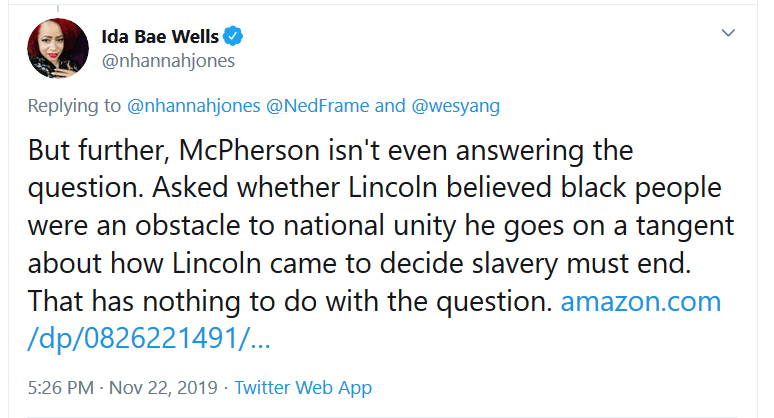
On November 22, 2019 she tweeted out a link to my co-authored 2011 book on the subject, Colonization After Emancipation: Lincoln and the Movement for Black Resettlement.

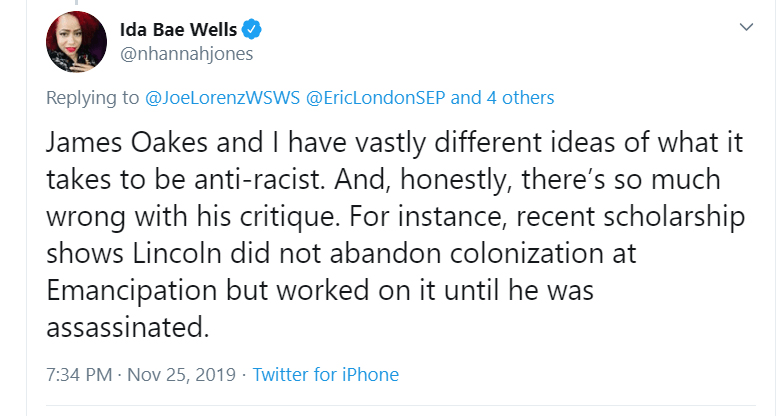
Three days later, Hannah-Jones wrote, “For instance, recent scholarship shows Lincoln did not abandon colonization at Emancipation but worked on it until he was assassinated.” In another comment, she criticized historian James McPherson’s “dated scholarship on Lincoln ending his efforts to colonize black people at Emancipation” (McPherson is one of the main proponents of the above-mentioned “lullaby” thesis). Quite the contrary, Hannah-Jones continued, “recent scholarship shows [Lincoln] continued these efforts until his death.”

In both cases, the “recent scholarship” that she referred to was my own work, which I summarized in a series of articles in 2012 and 2013 for Hannah-Jones’s own employer, the New York Times.

There were certain interpretive differences between my work and the 1619 Project on this point – for example, Hannah-Jones understated the extent to which antislavery motives shaped Lincoln’s support for the measure, which he saw as a pathway to wean the country away from the brutal plantation system. But the historical evidence of Lincoln’s deep connections to colonization was clear, and at least on that point the 1619 Project got it right.

That is, until Hannah-Jones realized that the historian she was citing was also an outspoken critic of other aspects of the 1619 Project.

“What are the credentials, exactly of Phil Magness?” Hannah-Jones fumed in another now-deleted comment after she realized that I had offered a less-than-favorable assessment of her project’s other historical claims, and particularly its error-riddled essay on the economics of slavery by Matthew Desmond. Her fury intensified in January 2020 after Alex Lichtenstein published a lengthy defense of the 1619 Project against his historian critics, attempting to invoke his authority as the editor of the American Historical Review to arbitrate the disputes over its claims about slavery in the Revolutionary through Civil War eras. At the time I pointed out that Lichtenstein – a 20th century historian – was not an expert in the antebellum United States, and was thus not qualified to assume the role of historical judge and jury on specialist claims about that era. Hannah-Jones snapped back, “Lol. You aren’t a specialist in that era either yet that didn’t stop you.”

Setting aside the fact that only a few weeks prior Hannah-Jones herself had been explicitly touting my work on Lincoln’s colonization projects to justify her own claims in the 1619 Project, I’ll simply note that I’ve authored over two dozen scholarly works on slavery and the Civil War era. This includes my aforementioned book, the chapter on colonization in the Essential Civil War Curriculum, as well as multiple peer-reviewed articles on slavery in the U.S. and broader Atlantic world. Hannah-Jones, by contrast, has no known original scholarship to her name of any kind on slavery or this period of American history.

At first, I chalked this bizarre exchange up to Hannah-Jones’s increasingly unprofessional approach to defending the 1619 Project. Instead of responding to substantive and factual critiques of her work, Hannah-Jones began directing personal abuse and insults at her critics.

When James McPherson offered his own less-than-flattering take on Hannah-Jones’s work in November 2019, she responded dismissively: “Who considers him preeminent? I don’t.” McPherson is a Pulitzer Prize-winning historian of the Civil War, and author of what is widely considered the standard single-volume treatment of the subject, Battle Cry of Freedom. In December 2019, McPherson joined distinguished scholars Gordon Wood, Sean Wilentz, Victoria Bynum, and James Oakes in questioning Hannah-Jones’s attempts to recast the American Revolution as a fight to preserve slavery. Rather than answer them, she dismissed the group as a whole by labeling them “white historians.”

Hannah-Jones saved her most brazenly abusive attacks though for African-American critics of the 1619 Project, such as Columbia University professor John McWhorter and journalist Coleman Hughes. When McWhorter, Hughes, and other African-American scholars launched a competitor 1776 Project in February 2020 through the Robert Woodson Center, Hannah-Jones lashed out on Twitter by posting photos of herself making derogatory gestures at her black interlocutors. Although she later deleted the tweets at the apparent request of her employer, Hannah-Jones made Hughes in particular a focus of her continued verbal abuse. “That Ivy League education certainly didn’t do you any favors,” she wrote in another comment to Hughes in August 2020. “Next time screenshot me and don’t quote text me because I’d rather not read your drivel. I tried to find something to quote tweet in that profoundly mediocre 1776 Project essay you wrote, but alas, nothing was worthy.”

It comes with little surprise, then, that my own experiences with Hannah-Jones followed a similar course after she realized that I was the author of the works on black colonization that she had previously been citing. Rather than engage with the evidence surrounding the disputed claims of her work, Hannah-Jones’s first impulse is to insult, attack, and dismiss the critic as “unqualified” to evaluate her work. Only historians that she cherry-picks to affirm her preconceived position, such as the University of South Carolina’s Woody Holton, are permitted under her credential-touting games.

Except in the case of Lincoln and colonization, Hannah-Jones even went so far as to modify her previous historical claims in order to avoid having to cite and credit a 1619 Project critic. As a result, I have the unusual distinction of having fallen from Hannah-Jones’ grace after she previously invoked my scholarship to support her work back in 2019. When an extended version of the 1619 Project came out in book form in November 2021, Hannah-Jones had not only excised substantial portions of her previous arguments about Lincoln – she cast about and found a new source to justify her revised interpretation on Lincoln.

The 1619 Project book now states only that Lincoln supported “colonization schemes as late as 1862,” and further implies that Lincoln abandoned the program after he issued the Emancipation Proclamation on January 1, 1863. Hannah-Jones’s new source for this revised claim appeared in footnote 38 of her essay: a 2016 popular press book entitled Stamped From the Beginning by Critical Race Theory activist Ibram X. Kendi.

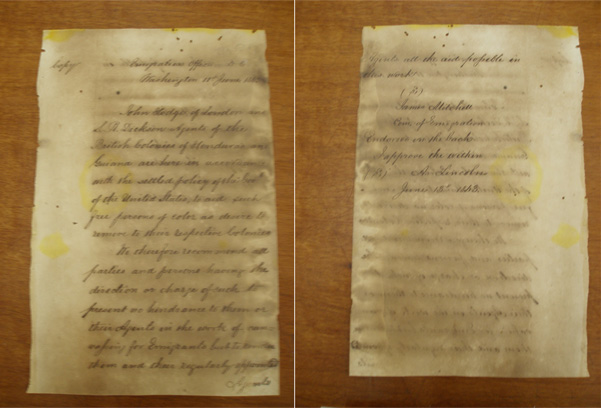
Hannah-Jones’s new version of Lincoln’s colonization initiative is unambiguously wrong as a matter of history. One of the many discoveries I made while researching this subject was a colonization agreement that Lincoln signed on June 15, 1863 with the colonial government of British Honduras, or modern-day Belize. This document resides in the National Archives of Belize where I discovered it in 2011, and was previously unknown to any historian.

But as a broader matter of principle, Hannah-Jones’s behavior illustrates the absence of basic scholarly integrity from her approach to writing history. Rather than following the evidence where it leads, Hannah-Jones picks and chooses bits and pieces of her arguments from a secondary literature based on whether it conforms to her preconceived political narrative. She approaches citations as a tool by which she can reward other scholars who affirm that narrative. And if a previously-cited scholar runs afoul of Hannah-Jones, she is perfectly willing to alter the “history” presented in the 1619 Project in ways that excise the offending work and replace it with a completely different narrative – provided that its author flatters Hannah-Jones’s own personal politics and ambitions in the process.

Phillip W. Magness

Phil Magness

Phillip W. Magness is Senior Research Faculty and Interim Research and Education Director at the American Institute for Economic Research. He holds a PhD and MPP from George Mason University’s School of Public Policy, and a BA from the University of St. Thomas (Houston).

Prior to joining AIER, Dr. Magness spent over a decade teaching public policy, economics, and international trade at institutions including American University, George Mason University, and Berry College.

Magness’s work encompasses the economic history of the United States and Atlantic world, with specializations in the economic dimensions of slavery and racial discrimination, the history of taxation, and measurements of economic inequality over time. He also maintains active research interest in higher education policy and the history of economic thought. In addition to his scholarship, Magness’s popular writings have appeared in numerous venues including the Wall Street Journal, the New York Times, Newsweek, Politico, Reason, National Review, and the Chronicle of Higher Education.


Books by Phillip W. Magness

Sunday, November 28, 2021

Replacing History with a 'Narrative'

The Left's vicious assault on America. 

Wed Nov 24, 2021 Mary Grabar 36 comments @ FRONTPAGE.com

Voters this election rejected the teaching of The 1619 Project and Critical Race Theory, as proven by the results of Virginia’s gubernatorial race and, less publicized but as equally telling in Egg Harbor Township, New Jersey, where nineteen-year-old, Nicholas Seppy won a seat on the school board. Seppy said he thought that the history of slavery should be taught in the classroom, but it should be taught objectively.

I agree with him. That’s why I wrote Debunking The 1619 Project and before that Debunking Howard Zinn.

So hats off to Christopher Rufo who exposed these toxic materials and to Seppy and Virginia governor-elect Glenn Youngkin who listened to parents who were rightfully outraged.

But we cannot rest. The radical “educrats” who believe they are the ones to remake your children never do.

Over the years I have seen how “educators” introduce a topic, put on a pretense of retreating, and then sneak back. This happened with the teaching of Ethnic Studies in California, which was withdrawn for about eighteen months after complaints about antisemitism. Then—surprise!—it was signed into law by the governor. Superficial changes had been made but the promotion of politicized ethnic identity—what the educrats wanted—will remain for all California high school graduates.

Similarly, the Common Core State Standards Initiative, which claims to “establish clear, consistent guidelines for what every student should know and be able to do in math and English language arts from kindergarten through 12th grade,” was rebranded under various names by states. But the damage remains as demonstrable knowledge of the subject matter was replaced by students’ ability to “collaborate” and accept “diversity.” As I pointed out back in 2012, Common Core broke down the distinctions between nonfiction and fiction. English teachers were tasked with having students read “cold” such historical materials as the Gettysburg Address.

This development, as well as that of Critical Race Theory’s assault on truth and replacement of objective history with “narrative,” has ushered in the use in classrooms of such materials as The 1619 Project, a hundred-page mishmash of polemical essays, “literary works'' contemplating “moments in history,” short biased articles, and profiles. Creator Nikole Hannah-Jones has insisted that her Project is truthful. But when accepting the Freedom of Speech award from the Roosevelt Institute on October 13, she called The 1619 Project a “narrative,” one pushing the “policy” of reparations. Students in grades K-12, however, are told that it is history.

But real history is not “narrative.” It is certainly not what Hannah-Jones presents: white Americans as uniquely and uniformly guilty of enslaving people. I testified about what it leaves out—such as black involvement in slavery in Africa and America—before the Michigan State Senate for a bill that would remove it from classrooms. A version was recently passed by the Michigan House. Fortunately, over half of the states have passed or introduced legislation to remove The 1619 Project from classroom material.

Still, we cannot rest.

Though it may be removed from the curriculum, a 600-page hardcover edition of The 1619 Project and a children’s picture book version, Born on the Water, were published by Penguin Random House on November 16. The picture book has a grandmother telling her grandchildren a fantastical history of white oppression of blacks. At the end she says, “This is why we say Black Lives Matter, why we celebrate Black Girl Magic.” The hardcover edition, intended for high school use, is an expansion of the original, with footnotes from Marxist historians and leftist organizations. The teachers guide offers a historian’s claim that history is a matter of “‘evolving interpretations, not facts’”—in support of Hannah-Jones’s claim that the “fights over the 1619 Project were never really about the facts.”

While young students have a grandmother promoting Black Lives Matter, high school students are instructed in advocating for reparations. They are directly asked to contemplate Hannah-Jones’s “arguments for reparations for Black Americans” and how this country “can make amends for the legacy of slavery, theft, violence, terror, and mass incarceration.”

Hannah-Jones’s 600,000-plus Twitter followers are eagerly “donating” copies via leftist bookstores to school libraries, where librarians, eager to “decolonize” libraries, are discarding classics to make room.           

Similarly, The Zinn Education Project, when a bill was proposed in Arkansas to forbid the use of Howard Zinn’s Marxist tract in publicly funded schools in 2017, used the opportunity to fundraise and send copies to teachers. Recently, it has enlisted teachers and students to defy current legislation.

Professors are pushing both of these fake histories. The 1619 Project became a “common read” on campuses across the country after the riots of 2020. It is being taught as a first-year seminar at Notre Dame University by English professor John Duffy.

The University of Georgia Press just published what is essentially a teacher’s manual, Rethinking America’s Past: Howard Zinn’s A People’s History of the United States in the Classroom and Beyond by history professor Robert Cohen and education professor Sonia E. Murrow. This book, by two credentialed professors, ignores Zinn’s falsification of evidence, misquotations, fabrications, and plagiarism and promotes a clearly Marxist history. It presents my book that documents it all as “mean-spirited” “polemic.”

Students, at the minimum, should have access to materials that do insist that facts matter and that provide alternatives to Zinn and The 1619 Project.

With this year’s election over, we should now insist that librarians at public schools and public libraries give such materials equal space on bookshelves. They are, after all, paid for by taxpayers.


Tuesday, October 26, 2021

Nikole Hannah-Jones Admits Her ‘1619 Project’ Is A Useful Political ‘Narrative’

 'The narrative allows for policy,' Hannah-Jones said, referring to how The New York Times' inaccurate advocacy journalism is used to push critical race theory and reparations.