Search This Blog

De Omnibus Dubitandum - Lux Veritas

Showing posts with label Howard Zinn. Show all posts

Wednesday, September 6, 2023

The Howard Zinn School of History Writing

September 5, 2023 By Mary Grabar

The Aha! Moment

On a cold January night in 2019 as I was checking the sources of Howard Zinn’s bestselling A People’s History of the United States while writing my book, Debunking Howard Zinn: Exposing the Fake History That Turned a Generation against America, I let out a little yell. I had found something to take down a Marxist historian whose America-hating bias had been arousing the ire of Americans since 1980, when it was first published.

I had taught college English for twenty years and I knew that being a leftist was a prerequisite to hiring, publication, and promotion in the humanities. Marxism infused literary theory.

But I had found that Zinn had done something for which my students had faced disciplinary action and possible expulsion.

I had caught an academic historian in the act of plagiarism, pages and pages of passages only slightly altered, lifted from a paperback screed about Christopher Columbus by radical novelist Hans Koning. He did the same with historian Gary Nash. Among Zinn’s papers at New York University, I found a letter from historian Edward Countryman complaining politely about using his essay without acknowledgement.

I had the goods on Zinn! Fake Indian Ward Churchill could not be fired from his position as ethnic studies professor at the University of Colorado, Boulder, for calling 9/11 victims “little Eichmanns.” But with assistance from the Board of Regents, he was fired in 2007 for research misconduct involving plagiarism, falsification, and fabrication.

Zinn had done the same. He had distorted what his sources said, for example, twisting Douglas Pike’s portrayal of the Viet Cong as guilty of “genocide” to being teachers of villagers about democracy. Although Zinn had died in 2010, I thought my exposé would take down his propagandistic “history.”

The Dirty Job

While I had been used to reading bizarre interpretations of literary “texts,” I thought that historians—even those on the left—would take note. Even if the profession had shifted towards investigating minutia of the lives of once overlooked groups, such as bisexual shoe cobblers in colonial Boston, instead of “great men,” the American Historical Association (AHA) still displayed the standards. Those on the left who had criticized Zinn, such as Michael Kammen and Michael Kazin, had criticized Zinn for failing to give progressives due credit for reforms—not for research misconduct.

No one had yet gone through A People’s History systematically to check Zinn’s scholarship. Historians had more important things to do. But they were grateful that I had done the “dirty job,” as I liked to say in my talks, alluding to the show by that name hosted by Mike Rowe. Someone has to pump out the septic tank. Someone had to uncover the lies in the noxious, odiferous swill of historical garbage of A People’s History. In the fall of 2019, at a conservative academic meeting when during our roundtable introductions I held up my just-published book, the professors applauded.

In Debunking Howard Zinn, I briefly described several historians who had been punished for research misconduct, such as Michael Bellesiles, David Irving, Stephen Ambrose, and Doris Kearns Goodwin.

On that January night I thought leftists who dismissed criticisms of Zinn’s biases and anti-Americanism as nothing more than disagreement about “perspective” might take notice.

The Leftist Non-Response and Response

After my book was released on August 20, 2019, the media requests for interviews streamed in from conservative outlets. But the only request from the left was by radio host Thom Hartmann. At the scheduled time, when no call came, I called the producer. Apologizing for the scheduling mix-up, she said that Hartmann would be in touch to reschedule. I am still waiting.

However, I would learn that leftists were aware of my book. They revealed themselves after I had served as a panelist at the White House Conference on American History at the National Archives on September 17, 2020, after a summer of coast-to-coast protests and riots over the death of George Floyd. In my five-minute statement I described Zinn’s “fake history” as “based on falsified evidence, misquotations with critical words left out, and plagiarized, disreputable sources.” President Trump, then in his speech, reiterated that “the left-wing rioting and mayhem,” were “the direct result of decades of left-wing indoctrination in our schools,” namely, “propaganda tracts like those of Howard Zinn. . . .”

On the train ride back to Clinton, New York, as I checked the news I was hit with the flood of attacks on the conference—and on me. The Zinn Education Project, which promotes Zinn’s work through downloadable classroom lessons and lobbying, accused me of traveling “the country attacking Zinn and the Zinn Education Project.” (How did they know I had been traveling?) Repeating the marketing slogans of four decades, they claimed that Zinn’s book helps students “understand the perspectives of workers, women, Black, Indigenous, and people of color.” They accused me of offering “no evidence” for my claim that “Zinn’s writing imposes the false idea that the United States is characterized by ‘systemic racism, wealth inequality, and police brutality.’” I had “fretted” that “’People reading [Zinn’s book] cry and get angry, sometimes taking to the streets.’” However, they pleaded “guilty. Teaching ‘people’s history’ can elicit great emotion about oppression and injustice and may inspire people to move to action.”

Michael Leroy Oberg, who teaches history and Native American Studies at SUNY Geneseo, revealed that he knew that I was from nearby Rochester and dismissed me as a “think-tank denizen” among the mostly white men. The American Historical Association, which publishes the guidelines Zinn had violated, attacked the conference as a “campaign stunt” promoting an old “mythical view of the United States.”

Robert Cohen, a professor of history, social studies, and education at New York University, who had edited Zinn’s diaries, weighed in at History News Network. President Trump “without evidence” accused teachers of promoting a “‘twisted web of lies . . .’” that inspired “’left-wing mobs,’” Cohen charged and claimed that Black Lives Matter protests were “mostly nonviolent.” In contrast to most history instruction, which was “too conservative,” leaving students “bored,” Zinn’s “exciting” book “engages students in authentic historical thought.” Cohen promised that his forthcoming book, being published by the University of Georgia Press, would “show how [Zinn’s] book can be used in classrooms today.”

Ignoring my presentation and the book it was based on, Cohen said that it was “absurd” to think that President Trump had read Zinn’s 688-page book. In a chapter on Zinn’s biography, I revealed that Zinn was a one-time member of the CPUSA but continued as an agitator. I had found some of that information in Cohen’s Howard Zinn’s Southern Diary.

The day after his article appeared, I sent Cohen an email, stating,

You should know that I was a panelist at the White House conference and that in my allotted five minutes before the President spoke, I spoke about how Zinn’s book is based on “falsified evidence, misquotations with critical words left out, and plagiarized disreputable sources.”

These are all documented with over 900 end notes in my book. . . . I have researched Zinn’s papers, as well as documents at the Library of Congress, the Martin Luther King, Jr. Center in Atlanta, Emory University, and Syracuse University. I encourage you to read the book. . . .

In my book, I . . . explain the motivations behind Zinn’s falsification of history. . . .

So, let’s have an honest discussion–not about political views, but about honest history.

Cohen never replied.

One of the especially nasty retorts came from adjunct professor L.D. Burnett, who in Slate magazine attacked all the panelists and accused me of carrying “the old culture wars torch against ‘the left’ on college campuses by railing against the popular (not scholarly!) A People’s History of the United States. . . .” I had joined “such conservative thinkers as … Michael Kazin.” The sarcastic reference to Kazin, the avowed social democrat Georgetown University historian, added to what was intended to be a hilarious opening describing “doing shots of whiskey” and “binge-eating chocolate” while watching the spectacle on television. “Like most American historians,” she sniffed,” Kazin doesn’t regard Zinn’s book as an adequate or particularly reliable account of America’s past—which is why most American historians don’t assign this work to their students, and why we find it so singularly bizarre to see the book used as a cudgel against our field.”

That is not the opinion of Stanford history education professor Sam Wineburg. In 2012, in American Educator, he stated that Zinn’s book, once considered radical, had gone “mainstream.” It appeared on university reading lists in “economics, political science, anthropology, cultural studies, women’s studies, ethnic studies, Chicano studies, and African American studies, in addition to history.” It was “a perennial favorite in courses for future teachers, and in some . . . the only history book on the syllabus.”

Michael Kazin (referenced by Burnett), in 2010, noting sales of “close to 2 million copies,” called A People’s History “the most popular work of American history that a leftist has ever written,” exceeding all others as “a powerful and benign influence.” It had been assigned in “thousands of college and secondary-school courses.” I, too, had described, through numerous anecdotes, how popular Zinn’s book was in schools.

Zinnophobia

Wineburg also called Zinn’s book “educationally dangerous,” likely to extinguish “students’ ability to think,” even leading to “intellectual fascism.” The danger was especially great because “for many students, A People’s History will be the first full-length history book they read, and for some, it will be the only one.”

In 2004, Michael Kazin described A People’s History as “polemic disguised as history,” a “Manichean fable,” based on a premise “better suited to a conspiracy-monger’s Web site than to a work of scholarship.” Zinn failed “to explain the weight and meaning of worldviews that are not his own and that, as an engaged citizen, he does not favor.”

But Kazin and Wineburg in 2013 defended Zinn when it was revealed that in 2010 then-Governor of Indiana Mitch Daniels asked state school officials to look into the use of Zinn’s materials in public schools, and in colleges of education and continuing education courses. “How do we get rid of it?” he asked, calling A People’s History “a truly execrable, anti-factual piece of disinformation.” His emails were uncovered in 2013 by a reporter during another investigation, by which time Daniels was president of Purdue University.

A firestorm arose among the professoriate—including those who previously had had harsh words for Zinn and whom Daniels had quoted in his criticisms. Wineburg and Kazin joined ninety Purdue professors in publicly condemning Daniels. Wineburg accused Daniels of “censor[ing] free speech,” and Kazin charged Daniels with ignorance about “how history is now written and has always been written.”

In 2018, Purdue University Northwest philosophy professor David Detmer in his tendentious Zinnophobia: The Battle over History in Education, Politics, and Scholarship (Zero Books, Hampshire, UK), which utilized dictionary definitions, and textbooks, books, articles, and blogposts of dubious provenance, attacked me for a blogpost and a conference report on Zinn. He went after two dozen others ranging from Sean Wilentz and Arthur Schlesinger to Robert Paquette and Oscar Handlin.

Handlin, an award-winning Harvard University historian and trailblazer in ethnic and immigrant history, reviewed Zinn’s book in American Scholar in 1980. But Detmer took Zinn’s own distorted presentation of Pike’s claims about the Viet Cong as the kind of reputable “evidence” that Handlin failed to provide. Detmer praised Zinn for “giv[ing] us not only Columbus, the Spanish murderer and enslaver of Indians, but also of Bartolomé de las Casas, the Spanish chronicler and enslaver of Indians of such cruel and immoral conduct.” Of course, Columbus was not Spanish, but from Genoa, in present-day Italy. That is a starter for the Zinn version that Detmer took as accurate history about Columbus. Misreading my report, Detmer accused me of failing to provide historical evidence. He ignored my book when it came out.

Detmer’s book, true to the name of the publisher, seems to have had “zero” impact. But a September 22, 2021, Nation article by conference critic Robert Cohen and Sonia Murrow promoted their forthcoming book, Rethinking America’s Past: Howard Zinn’s A People’s History of the United States in the Classroom and Beyond. The article, titled, ironically, “Debate and Controversy Make History Education Better,” attacked “book-banners,” who “claim that exposing students to critical history will teach them to hate America,” promote “divisive[ness],” and disrupt “the educational process.” They pointed to “a mountain of evidence in Zinn’s papers, housed at New York University’s Tamiment Library [showing] that both students and teachers found that exposure to critical history enhances the historical teaching and learning process.” Yes, I saw those papers too. They indicate that students and ill-educated graduates of education colleges become emotionally embroiled when reading Zinn’s “exciting” history—as is agit-prop’s purpose.

Rethinking America’s Past (promoted by the Zinn Education Project to educators) revisits the Constitution Day conference. In the Introduction, Cohen and Murrow claim that “the emphasis of A People’s History on inclusive democratic politics, people’s movements, and progressive change from below is the polar opposite of Trumpian authoritarianism”—the first of at least eight references to “Trump,” including the Acknowledgments, where Cohen thanks family and friends for keeping him “productive and reasonably sane through the insane time of pandemic and Trumpism.”

Continuing in the unprofessional vein, Cohen and Murrow call my book a “polemic” and an example of “anti-Zinn fervor” that has carried over from efforts by Accuracy in Academia in the 1980s. My charge that “A People’s History was ‘designed to destroy Americans’ patriotism and turn them into radical leftists’” and that Zinn “’falsified American history to promote Communist revolution’” is “mean-spirited.” They call David Horowitz’s blurb one of many “ideological attacks” that “reflect intolerance of dissent and promote the chauvinistic notion that a historical narrative highlighting the flaws in American politics and society is inherently un-American” (thus admitting Zinn’s book lacks balance).

Cohen and Murrow quote at length Zinn’s own “rebuttal” to Accuracy in Academia’s charge: that AIA had “confused criticism of government with being anti-American.” They quote Zinn’s oft-repeated claim that his aim was “to present history and heroes who are ignored in traditional textbooks” (really famous radicals or anonymous mouthpieces spouting Marxist slogans).

While writing, “There is no evidence that A People’s History ‘turned a generation against America,’ as Grabar claims in her book’s subtitle,” Cohen and Murrow ignore how Zinn himself bragged about the transformation of his students, especially young men who were inspired to dodge the draft. Zinn “delighted in” the anti-Columbus protests that his book had inspired, according to one biography.

In a lengthy endnote taking issue with my “charge that Zinn sought to ‘promote Communist revolution,’” citing Zinn’s 1969 essay, “Marxism and the New Left” (which I also cite), they claim that “Zinn argued against the notion that ‘the traditional Marxian ideal’ of the overthrow of capitalism by an (sic) ‘an organized class conscious proletariat’ was tenable in modern America.” True. Zinn, like Stalin, saw that in the United States workers liked capitalism. A Popular Front, for infiltration and propaganda, was therefore instituted. Zinn’s view that “’the overwhelming power of the state will permit only tactics that fall short of violent revolution’” describes a realist who used his classrooms at Spelman College and Boston University to groom protesters for “civil rights” (wealth redistribution) and “peace” (a Communist victory in Viet Nam).

Thinking “Historically”

Zinn had scrubbed his papers, many having to do with his numerous extramarital affairs, but left the hundreds of fan letters from students and teachers. Cohen and Murrow make a pedagogical case for using Zinn’s book in high schools by quoting extensively from the correspondence from teacher Bill Patterson and twenty-two of his students between the mid-1980s and late 1990s. These letters, they claim, provide “an evidence-based history of the impact of A People’s History in high school classrooms with a mind toward teaching students to think historically.” Patterson said he taught Zinn’s book along with the assigned textbook, “’for the sake of exposure to a variety of interpretations’” and “’to nurture independent thought.’” It “’provoked spirited (sometimes rowdy) discussions in class.’”

Zinn’s history does promote divisiveness. Teenagers lacking historical knowledge and maturity, either get swept up by Zinn’s rhetoric about such things as how historian Samuel Eliot Morison had spun “a grand romance” and “buried the facts about Columbus’s genocide,” or get angry about being taught anti-American propaganda.

Cohen and Murrow also go after Oscar Handlin, calling his review “belligerent,” but list not one of Zinn’s errors of historical fact that Handlin corrects, including about the 1954 Geneva assembly on Vietnam. Cohen and Murrow (like Detmer) repeat Zinn’s accusation that Handlin was “a Nixon enthusiast and Vietnam War hawk.” They sarcastically note Handlin’s opening sentence, writing, “’This is a book about Arawaks,’ as if it was absurd for an American history to center on Indigenous people.” They absurdly accuse Handlin of being unable to “entertain seriously the idea that such people in the Americas or Africa merited historical study in ways that foregrounded their views of Europeans who conquered and enslaved them”!

Other reviewers, who charged Zinn with reducing American history to “’simply the Marxist class struggle played out for 200 years,’” and, similarly, “’an attempt to indict capitalism and the notion of private property as the fundamental evils of American life,’” are accused of “red-baiting” and failing to look at what is laughably called Zinn’s “evidence.”

While conservatives seethe with anger “over what they see as his hatchet job on American capitalism,” Zinn provided “elaborate evidence and eloquence” to “[indict] the inequality and the presence of poverty amid plenty that has always marked the American capitalist system. . . .,” Cohen and Murrow insist. However, Zinn’s only “evidence” is presented in an endnote: “When attacked by a right-wing organization for his anticapitalism in A People’s History, Zinn replied [in 1986], ‘American capitalism has been a failure. Having so many homeless people and poor is a failure. . . .’”—as if this could compare to the over 100 million executed and starved to death by Communist regimes in the twentieth century.

As to the plagiarism charge, they write in an endnote that Zinn did not use footnotes because he wanted to make the book “more accessible to general readers. Nonetheless, he would credit by name many historians whose scholarship he drew on, and he included them in the book’s bibliography.” They do not mention that Zinn composed his first five pages by slightly altering Koning’s words and then mentioned his name only once, on page 17—and of similar borrowings from Nash, as well as the presentation of Nash’s research as his own.

As I chronicle in my book, when caught by Countryman, of borrowing his “ideas” and “wording” without listing his essay in the bibliography, Zinn grudgingly admitted that he had “roughly” paraphrased Countryman’s essay. He promised to give him credit in a future edition, which he did by listing Countryman’s essay in the bibliography and inserting a parenthetical note directing the reader to Countryman’s essay. But Zinn never let on how much he relied on Countryman’s work.

Cohen and Murrow, however, present Zinn’s plagiarism of Countryman’s essay as a one-off slip: “In the first edition . . . Zinn neglected to cite historian Edward Countryman for his work on land rioters in early America. After Countryman complained to Zinn [he actually said he did not want to be “’un-comradely’”] that his ideas and wording had been used without crediting him, Zinn apologized [no, Zinn never said “sorry”] and pledged to credit Countryman in future editions, which he did in both the text and the bibliography” [inadequately]. Outrageously, they write, “Despite this slip, there is no pattern of plagiarism in A People’s History.”

As of August 13, 2023, according to World Cat, 792 libraries carry Rethinking America’s Past. My book is carried in 272 libraries. Rethinking America’s Past received the Critics’ Choice Book Award from the American Educational Studies Association and professors can request free desk copies. In a logically backwards manner the press calls Rethinking America’s Past “the first work to use archival and classroom evidence to assess the impact that Zinn’s classic work of American history has had on historical teaching and learning and on American culture. This evidence refutes Trump’s charges.” Their claim that Rethinking America’s Past “traces the origins and assesses the strengths and weaknesses of A People’s History in light of more recent historical scholarship” is false; Cohen and Murrow evade the book’s historical weaknesses by attacking the critics, myself included.

More recently, another book touting Zinn has been published by another university press (University of Chicago), Popularizing the Past: Historians, Publishers, and Readers in Postwar America by Nick Witham. The chapter on Zinn, appeared as “Howard Zinn and the Politics of Popular History” in the July 17, 2023, Chronicle of Higher Education, thus stamping it with presumed scholarly legitimacy.

Witham too elides the question of factual accuracy and ignores my book. He mentions Handlin’s criticism of Zinn’s book for displaying “only casual regard to factual accuracy” but ignores Handlin’s expositions. The question of truthfulness is not even an issue for Witham. A People’s History is presented as one work in a culture war of best-selling popular histories dominated by the likes of “Glenn Beck, Bill O’Reilly, and Bill Bryson.”

Popular history is not necessarily in conflict with historical accuracy as the late David McCullough illustrated (in spite of the charge that he “only focused on ‘men and power,’”). But Zinn’s book is used as a textbook, recommended by professors, widely adapted into lessons and spin-off books, and is now being promoted to educators in two books published by university presses.

Zinn’s Disciples

Just as my book was released in 2019, the fraudulent 1619 Project, a special issue of the New York Times Magazine containing essays and creative writing marking the four-hundredth anniversary (presumably) of the introduction of slavery in Virginia, came out and gave me the subject for my second book, Debunking The 1619 Project: Exposing the Plan to Divide America. Its historiography follows Zinn’s. The socialist historian Eric Foner, a Zinn admirer, was revealed in the hardcover edition (published in November 2021) to be a “a key source of information, insight, guidance, and support.” Several of the contributors and peer reviewers were Foner’s former students. In 1980, Foner had given A People’s History a mixed review, claiming that Zinn’s book presented a “circumscribed” portrayal of “anonymous Americans” and a “deeply pessimistic vision of the American experience,” but praised its “vivid descriptions of events that are usually ignored.” Foner’s own textbook Give Me Liberty! (published by Norton) used at colleges like Bakersfield and Mohawk Valley Community College, follows Zinn’s interpretive trajectory. The Communist threat, for example, even spying by Alger Hiss and Julius and Ethel Rosenberg, is presented as merely a “Red Scare.”

The 1619 Project’s creator, New York Times education and race reporter Nikole Hannah-Jones, has responded to criticism by attacking the critics and alternating between defending her project on Twitter as a “reframing of history,” which “explicitly denies objectivity,” and one that presents “historical facts,” such as that “race is embedded in the law and our nation’s institutions.” As I reveal in the paperback version of my book, Hannah-Jones knowingly presents historical falsehoods.

But the 1619 Project is taught in thousands of schools, thanks to premade lessons sent out for fall semester 2019 and more lessons and teacher workshops from the Pulitzer Center. The Zinn Education Project has enlisted teachers, students, and the public to fight state laws that prohibit its use.

The 1619 Project contributors, even the history Ph.D.’s, are as propagandistic as Hannah-Jones. Princeton University historian Kevin M. Kruse, who contributed an essay titled “Traffic” that argued that traffic congestion in Atlanta was related to slavery, is a serial plagiarist, beginning with his dissertation at Cornell University, as Phil Magness has documented.

In response to Magness’s revelations, Cornell argued that Kruse had corrected the errors of his dissertation in the book White Flight (Magness presents at least one “borrowed” passage that remained). Cornell refrained from punishing Kruse because the “citation errors were made without intent.” But according to Cornell’s Code of Academic Integrity, plagiarism is considered to be a “serious violation”—“whether intentional or not” (as it was at the community college where I taught).

Similarly, Princeton’s faculty ad hoc committee found that Kruse’s errors were “honest” and a result of “careless cutting and pasting”! The Dean of Faculty accepted on faith that Kruse would henceforth “reflect the best practices in historical research,” and the case was closed. Magness concluded, “Sadly, Princeton and Cornell Universities have chosen to conveniently overlook clear evidence of Kruse’s academic misconduct on account of his political beliefs and his Twitter celebrity status.”

In addition to tweeting and providing commentary on MSNBC, Kruse pushes his politics in a collection coedited with Princeton colleague Julian Zelizer, Myth America: Historians Take on The Biggest Legends and Lies about Our Past (2023). They allege, “Unlike past eras in which myths and misunderstandings have clouded our national debate, the current crisis stands apart both for the degree of disinformation and for the deliberateness with which it has been spread.” A “good deal of the blame,” they charge, should be “attributed to the political campaigns and presidency of Donald Trump.”

The contributors of essays on twenty topics, including “Founding Myths,” “American Socialism,” “Confederate Monuments,” “Police Violence,” “Voter Fraud,” and “Insurrection,” are Ph.D.’s, with all but two associated with such prestigious universities as Emory, Northwestern, Georgetown, Princeton, and Harvard. Trump’s name is mentioned 66 times, such as in the reference to “America First” as an “enduring ethno-nationalist dog whistle” favored by the “Trumpist” America First Caucus. Glenda Gilmore and Michael Kazin reprise their lifelong scholarship: Gilmore, in “The Good Protest,” continues her revisionism of the Communist Party as the original civil rights activists, with the tradition of “good protests” continuing in summer 2020; Kazin defends American socialism as a reform movement promoted by Democrats—not “a revolutionary overthrow of the capitalist system,” as “the Right” alleges.

Kruse is not the only historian to enjoy a sparkling career in spite of his repeated plagiarism.

Doris Kearns Goodwin who laid low for some years, taking a leave from PBS NewsHour and resigning her post at the Pulitzer Prize review board, has been rehabilitated. In 2018, she was on tour for her book on presidential leadership, which presents “good” presidents, such as Franklin Roosevelt, as contrast to Donald Trump. She was executive producer of the three-part History Channel miniseries, FDR. In a recent interview on MSNBC, Goodwin called for “organizing the country at all levels so that [Trump] cannot win [the 2024] election.”

When Conservatives Write Histories

As the catalogue for the University of Georgia Press illustrates, university presses and textbook publishers are usually hostile to non-leftist authors.

So, in 2019, Encounter Books published Land of Hope: An Invitation to the Great American Story by Wilfred McClay, then G. T. and Libby Blankenship Chair in the History of Liberty at the University of Oklahoma. Kazin, who went after Mitch Daniels (J.D.) for being an uncredentialed critic who knew nothing about “how history” is “written,” in his essay “Can Conservatives Write Good U.S. History?” called McClay “a rare conservative historian whose prior work is respected across the political trenches.”

Kazin admitted that in the “liberal and left-wing” dominated field, leftist scholars write “nearly all the respected monographs.” For him, this is justified because conservatives “want to persuade readers that the nation’s past supports their convictions about the present.”

McClay, as an example, “seeks to impart an uplifting message while still telling the story straight,” Kazin charges. The subtitle, “An Invitation to the Great American Story,” “appears pitched to acolytes of Trump.” McClay merely “nods to the dark side” and claims that lessons have been learned, part of the “hope” that America represents. (Were slavery, segregation, and child labor not ended, one asks.)

What galls Kazin (veteran of SDS and Weatherman) is the fact that McClay fails to give credit to abolitionists, feminists, LGBTQ activists, environmentalists, the Knights of Labor, the [Communist-dominated] CIO, and to W.E.B. Du Bois, Ida B. Wells, Marcus Garvey, and A. Philip Randolph. Plus, in the “glossy interview packaged with the book” McClay praised President Calvin Coolidge and condemned the New Deal, thus revealing his “true ideological colors.” In contrast, Kazin offers Eric Hobsbawm, a Marxist.

Kazin is guilty of doing what he had criticized Zinn for doing in 2004: failing “to explain the weight and meaning of worldviews that are not his own.”

Historians Policing Themselves?

In spite of the posturing, Kazin and the cabal of “liberal and left-wing” historians have proven themselves to be corrupt partisans willing to abandon fundamental standards in order to shoulder aside those who do not share their worldviews.

The idea that the profession, like the academy, will reform itself, therefore, is delusional. The professoriate circled the wagons around Ward Churchill. The American Association of University Professors, in a 2009 National Council statement, asserted that “the disputes over [Churchill’s] publications should have been allowed to work themselves out in traditional scholarly venues.” In spite of the findings of academic misconduct, they stated, “Churchill should be reinstated to his faculty position.” In the 1960s, AAUP had defended Zinn after his firing from Spelman College.

But thanks to outside influences, like public outcry, the Colorado Board of Regents, and the Colorado State Supreme Court, Ward Churchill has been banished from Colorado classrooms.

The same should be done with Howard Zinn’s fraudulent history. Sadly, though, it now enjoys the imprimatur of a university press of the flagship university of the University System of Georgia. If the Georgia Board of Regents needs evidence of Zinn’s research misconduct, I will be glad to send them my book.

Headshot of Mary Grabar

Mary Grabar was born in Slovenia when it was still part of the Communist Yugoslavia and grew up in Rochester, New York. She earned her Ph.D. in English from the University of Georgia in 2002 and taught at a number of colleges and universities in Georgia until 2013. While teaching, she wrote widely on political, cultural, and educational topics, and founded the Dissident Prof Education Project, a nonprofit reform initiative. In 2014, she moved to Clinton, New York, and became a resident fellow at The Alexander Hamilton Institute for the Study of Western Civilization. Her book Debunking Howard Zinn: Exposing the Fake History That Turned a Generation against America was published by Regnery in 2019. Her most recent book, Debunking the 1619 Project: Exposing the Plan to Divide America, was published by Regnery in 2021.

Friday, June 9, 2023

The Howard Zinn Industry

He may be dead, but his followers are legion.

His parents were peasants from Russia and the Ukraine. Had they stayed in that part of the world, any children they had would’ve grown up under Stalin – and, if they’d dared to say anything critical of Uncle Joe in public, they wouldn’t have made it to adulthood. In fact, both mom and dad emigrated to America, where their son, like so many other offspring of destitute immigrants, succeeded beyond their wildest dreams. He became rich and famous, in fact. And how did he become rich and famous? By celebrating Communism and savaging America.

That Howard Zinn (1922-2010) was a card-carrying Communist, a daily fixture at Party meetings in New York, an inveterate Soviet apologist, a member of a range of Kremlin front groups, a cheerleader for Mao’s “people’s government,” a supporter of Castro and Ho Chi Minh, a co-founder of the Student Nonviolent Coordinating Committee, and an associate of such groups as ACORN, the Democratic Socialists of America, and International ANSWER, is routinely dropped down the memory hole by the countless teachers and professors who enthusiastically use his 1980 book A People’s History of the United States as a classroom text. Those instructors don’t tell their students that they’re being taught to think like Marxists; rather, they tell them that they’re finally learning the real truth about America, not patriotic propaganda.............To Read More....

Wednesday, October 5, 2022

Namings!

By Rich Kozlovich

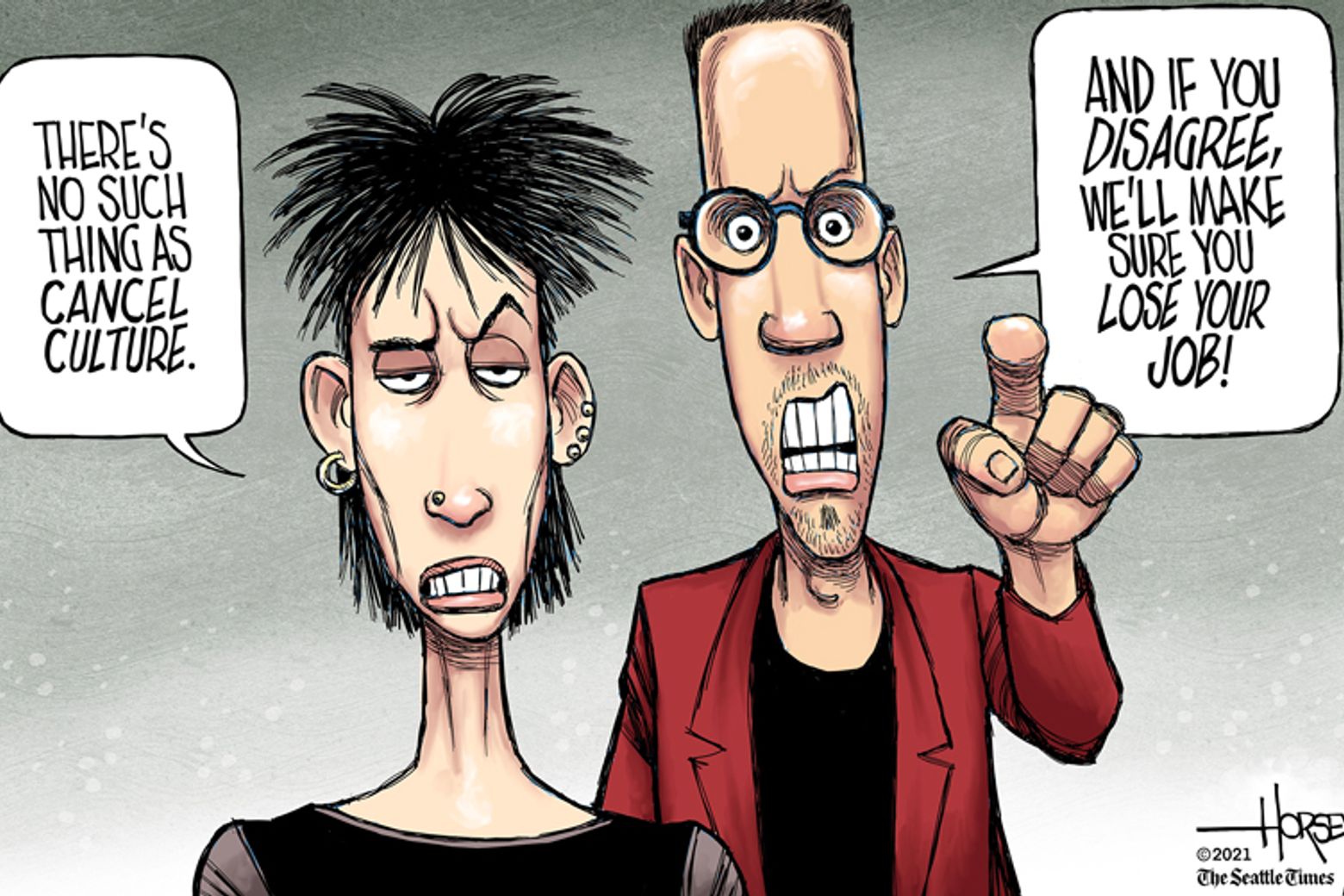
 https://images.seattletimes.com/wp-content/uploads/2021/03/Cancel-Culture-ONLINE-COLOR.jpg?d=1560x1040

In recent years we've seen a plague on American society.   And unlike this faux pandemic, this is a plague called the "", with a huge demand America rename just about everything in order to appease....welll... just about everyone, just so long as they're not white, straight, conservatives with traditional values, especially males, all whom may be either Christians or Jews.  They don't count! 

The Cleveland Indians are now the Cleveland Guardians, and the Atlanta Braves are discussing changing their name.  Writers go on the describe the difficulties with all this renaming clabber, such as how the term Indian came into being and the new world, how there's the effort to have preferred terms such as “Native American”, and the resulting logical issues:  Such as, if someone was born in England are they "native English" or "native Mexican", or "Native Chinese", etc.?  In Canada it's "First Nations", but these tribes were never united into a nation, anywhere in North or South America, and they happily butchered each other considering themselves to be "the people" and everyone else, not people. 

There's a reason the Tower of Babel became the foundation for the word "babble", and that's what I think of all this.  Does anyone really believe any tribe that conquered any other tribe would have allowed this kind of coprolite to be espoused?  The fact is these are conquered peoples and they need to get over it and be glad they were conquered by Americans, because it's unlikely this would have been tolerated elsewhere.  They wouldn't have been spared, they wouldn't be living on reservations, and they wouldn't have had any rights at all. 

All this divisional clabber is just another leftist ploy to de-legitimize the European conquest of much of the world, presented as if this was done by "bad" people, AKA, white people.  In reality, no matter how bad they may have been, and in some cases very bad, in the vast majority of cases they were better than those they replaced, and the Aztec "civilization", and the others conquered by Spain are an excellent example.

Now if you wish to criticize them for being bad Christians, well, you would have a valid argument there.  The Frankish kings and all the other European Kings were great churchmen, but they were lousy Christians, and the American settlers practices would certainly have to be categorized as un-Christian.  But that's not the argument is it?

The foundational argument is they were bad people, but the fact is they were playing by the same rules everyone else in the world was playing by, but they were just better at it than the rest.  But that's not the accepted narrative, so now all they did and accomplished must be diminished until it's destroyed with multiculturalism, in order to impose globalism in the form of global governance predicated on socialist tyranny, and we know how disastrous that will be.  Between the leftist monsters of the 20th century, who murdered over 100 million people, and the environmental activists, a scion of leftism, they've easily murdered over another 100 million people and that's most likely a conservative number.  That's history and that history is incontestable. 

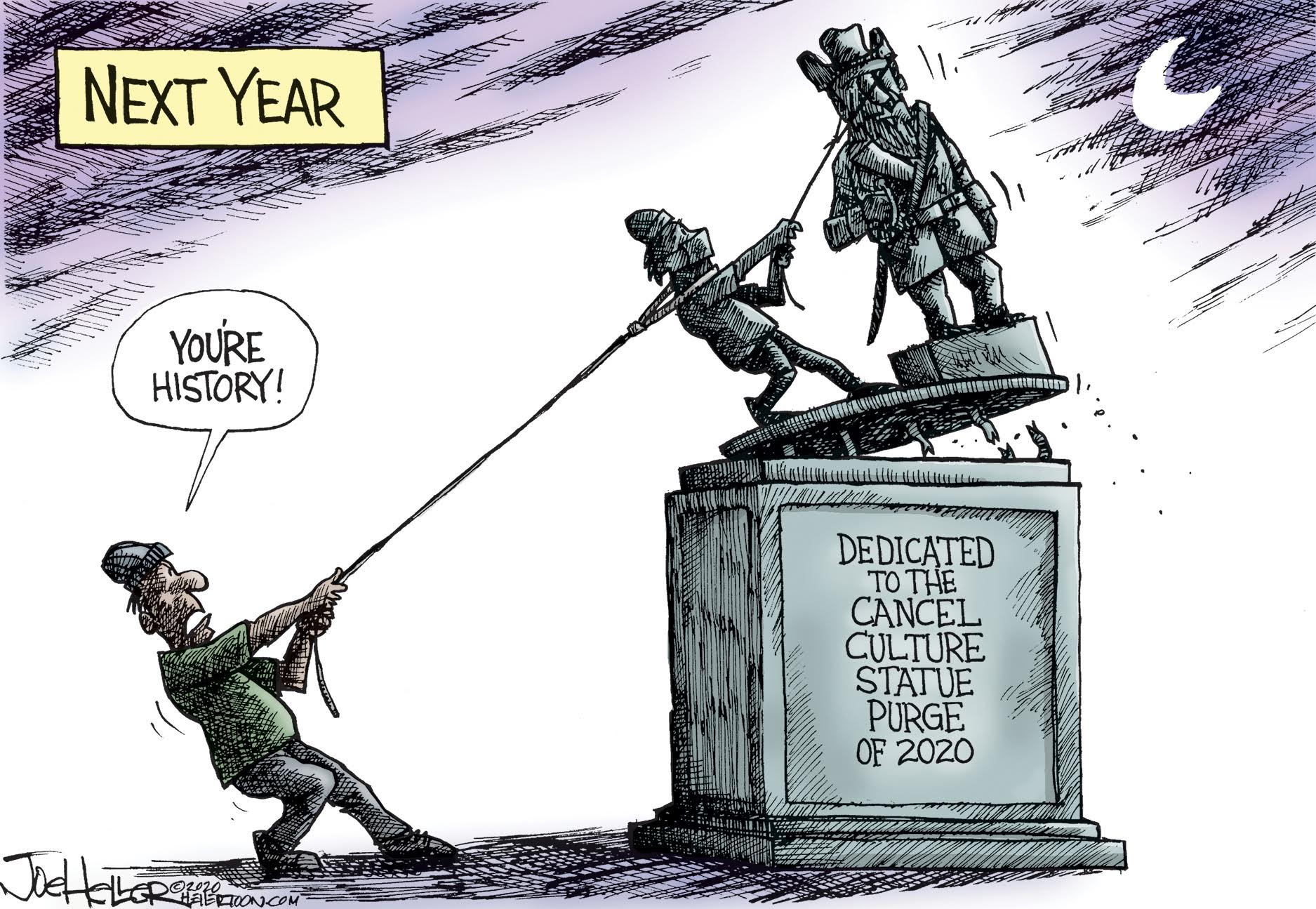
 Editorial Cartoon U.S. cancel culture statues

Definition leads to clarity and clarity leads to understanding, and all these writers have failed that test, because they fail to see this is a never ending story, as eventually the Cancel Culture cancels the Cancel Culture, and real history is lost in the melee to historical clabber such as is presented by Nikole Hannah-Jones and


Wednesday, August 10, 2022

Falsely Teaching Our Children That America is Evil

The corrosive influence of anti-American propagandist Howard Zinn.

Jerry Newcombe 4 comments

 For 42 years American school children have been subject to a barrage of misinformation about our American history. This has helped cause many of them to hate America. And virtually every day we read about the results.

For example, there’s a curriculum clash in one of our nation’s most conservative states. On Friday, Gary Bauer reported that the Oklahoma Board of Education decided to downgrade the Tulsa Public School District’s accreditation. This is because in Tulsa, they’re still teaching Marxist critical race theory---which is now against the law in the Sooner State.

Oklahoma’s Secretary of Education is Ryan Walters, who told Fox News: "What we've got to do is go back to teaching our history and ensuring that every young person has the ability to be successful and be inspired by our history."  He added, “We’re the greatest country in the history of the world, and our kids need to know that.”

But how will children in Oklahoma, and all the other states, learn to appreciate our country when so many have been brainwashed with a false view for so long?

“Howard Zinn died in 2010, but [his book] A People’s History of the United States lives on and carries the rhetoric of past decades of leftist politics forward with it.” So writes Dr. Mary Grabar, author of the book, Debunking Howard Zinn: Exposing the Fake History That Turned a Generation against America (2019)...........Falsely Teaching Our Children That America is Evil

Sunday, November 28, 2021

Dissident Prof, Mary Grabar

It's out: my Prager U video!

I am so proud of my Prager U video! I'll tell you, Dennis Prager has a team of professionals.

And today, at FrontPage Magazine, you can read my article about a Howard Zinn-lite history professor who is defending The 1619 Project.

Click on below:

From the road on my mini-Atlanta tour!


Replacing History with a 'Narrative'

The Left's vicious assault on America. 

Wed Nov 24, 2021 Mary Grabar 36 comments @ FRONTPAGE.com

Voters this election rejected the teaching of The 1619 Project and Critical Race Theory, as proven by the results of Virginia’s gubernatorial race and, less publicized but as equally telling in Egg Harbor Township, New Jersey, where nineteen-year-old, Nicholas Seppy won a seat on the school board. Seppy said he thought that the history of slavery should be taught in the classroom, but it should be taught objectively.

I agree with him. That’s why I wrote Debunking The 1619 Project and before that Debunking Howard Zinn.

So hats off to Christopher Rufo who exposed these toxic materials and to Seppy and Virginia governor-elect Glenn Youngkin who listened to parents who were rightfully outraged.

But we cannot rest. The radical “educrats” who believe they are the ones to remake your children never do.

Over the years I have seen how “educators” introduce a topic, put on a pretense of retreating, and then sneak back. This happened with the teaching of Ethnic Studies in California, which was withdrawn for about eighteen months after complaints about antisemitism. Then—surprise!—it was signed into law by the governor. Superficial changes had been made but the promotion of politicized ethnic identity—what the educrats wanted—will remain for all California high school graduates.

Similarly, the Common Core State Standards Initiative, which claims to “establish clear, consistent guidelines for what every student should know and be able to do in math and English language arts from kindergarten through 12th grade,” was rebranded under various names by states. But the damage remains as demonstrable knowledge of the subject matter was replaced by students’ ability to “collaborate” and accept “diversity.” As I pointed out back in 2012, Common Core broke down the distinctions between nonfiction and fiction. English teachers were tasked with having students read “cold” such historical materials as the Gettysburg Address.

This development, as well as that of Critical Race Theory’s assault on truth and replacement of objective history with “narrative,” has ushered in the use in classrooms of such materials as The 1619 Project, a hundred-page mishmash of polemical essays, “literary works'' contemplating “moments in history,” short biased articles, and profiles. Creator Nikole Hannah-Jones has insisted that her Project is truthful. But when accepting the Freedom of Speech award from the Roosevelt Institute on October 13, she called The 1619 Project a “narrative,” one pushing the “policy” of reparations. Students in grades K-12, however, are told that it is history.

But real history is not “narrative.” It is certainly not what Hannah-Jones presents: white Americans as uniquely and uniformly guilty of enslaving people. I testified about what it leaves out—such as black involvement in slavery in Africa and America—before the Michigan State Senate for a bill that would remove it from classrooms. A version was recently passed by the Michigan House. Fortunately, over half of the states have passed or introduced legislation to remove The 1619 Project from classroom material.

Still, we cannot rest.

Though it may be removed from the curriculum, a 600-page hardcover edition of The 1619 Project and a children’s picture book version, Born on the Water, were published by Penguin Random House on November 16. The picture book has a grandmother telling her grandchildren a fantastical history of white oppression of blacks. At the end she says, “This is why we say Black Lives Matter, why we celebrate Black Girl Magic.” The hardcover edition, intended for high school use, is an expansion of the original, with footnotes from Marxist historians and leftist organizations. The teachers guide offers a historian’s claim that history is a matter of “‘evolving interpretations, not facts’”—in support of Hannah-Jones’s claim that the “fights over the 1619 Project were never really about the facts.”

While young students have a grandmother promoting Black Lives Matter, high school students are instructed in advocating for reparations. They are directly asked to contemplate Hannah-Jones’s “arguments for reparations for Black Americans” and how this country “can make amends for the legacy of slavery, theft, violence, terror, and mass incarceration.”

Hannah-Jones’s 600,000-plus Twitter followers are eagerly “donating” copies via leftist bookstores to school libraries, where librarians, eager to “decolonize” libraries, are discarding classics to make room.           

Similarly, The Zinn Education Project, when a bill was proposed in Arkansas to forbid the use of Howard Zinn’s Marxist tract in publicly funded schools in 2017, used the opportunity to fundraise and send copies to teachers. Recently, it has enlisted teachers and students to defy current legislation.

Professors are pushing both of these fake histories. The 1619 Project became a “common read” on campuses across the country after the riots of 2020. It is being taught as a first-year seminar at Notre Dame University by English professor John Duffy.

The University of Georgia Press just published what is essentially a teacher’s manual, Rethinking America’s Past: Howard Zinn’s A People’s History of the United States in the Classroom and Beyond by history professor Robert Cohen and education professor Sonia E. Murrow. This book, by two credentialed professors, ignores Zinn’s falsification of evidence, misquotations, fabrications, and plagiarism and promotes a clearly Marxist history. It presents my book that documents it all as “mean-spirited” “polemic.”

Students, at the minimum, should have access to materials that do insist that facts matter and that provide alternatives to Zinn and The 1619 Project.

With this year’s election over, we should now insist that librarians at public schools and public libraries give such materials equal space on bookshelves. They are, after all, paid for by taxpayers.


Monday, July 26, 2021

Historians Selling Out for Leftist Star, Nikole Hannah-Jones

The University of North Carolina’s decision on June 30 to offer tenure to Nikole Hannah-Jones came about through a torrent of threats (often tweeted), profanities, doxxings, and assaults—tactics that have become increasingly commonplace among professional activists and racial grievance-mongers.

Hannah-Jones, of course, is the Pulitzer Prize-winning opinion writer and architect of the New York Times’ notorious “1619 Project,” which claims that America’s true founding was not in 1776 but rather in 1619, when 20 or so African slaves arrived in Virginia. Hannah-Jones contends, moreover, that the American War of Independence was fought solely to preserve slavery. 

More than two-dozen credible historians, many of them political liberals and leftists, have debunked Hannah-Jones’ claims. Though, as we’ll see, some are less firm in their convictions than others. What’s clear, however, is that peer review is passé in the era of “diversity, equity, and inclusion.” Forget a stellar record of scholarly accomplishment—that’s a relic of “Eurocentrism.” Far more important these days is a candidate’s enthusiasm for social justice. It was Hannah-Jones’ celebrity activism and her “journalism,” not her scholarship, that formed the basis for the university’s initial offer of tenure earlier in the spring.

And so after a rancorous three-hour discussion on June 30, the university’s board of trustees voted 9-4 to give Hannah-Jones what she wanted. Later that day, she appeared to celebrate the vote on Twitter with a glass of whiskey

But after all the drama, which attracted national headlines, Hannah-Jones decided instead to decamp for Howard University in Washington, D.C., where she will launch a center on race and journalism with Ta-Nehesi Coates. With a straight face, she told CNN, “I don’t want to force myself into an institution that doesn’t seem to appreciate what I bring.” A statement from the UNC Hussman School of Journalism and Media blamed the reversal of fortune on “racism and reactionary politics.” What’s certain is that Hannah-Jones had done a masterful job of smearing an institution that dared question her qualifications.

Hannah-Jones had long campaigned for the UNC job on Twitter, arguing that the issue was much greater than just her employment. She alleged systemic discrimination, asserting that out of 622 tenured professors at UNC, only “eight were Black women.” She deftly employed the new standard of truth—namely, that the race of the person from which claims emanate determines their veracity. Any hint of “whiteness” is immediately suspect. For example, when J. D. Vance referred to “conservative Americans,” Hannah-Jones knew he was “really saying: White Americans.” Of Walter Hussman, Jr., the benefactor of the Chapel Hill campus’s journalism school who opposed the tenure offer, he “is a 74-year-old white man” while Hannah-Jones is a 45-year-old black woman. Obviously, his concerns as a longtime media executive and publisher about her journalistic ethics must be considered secondary in light of her accomplishments on social media and in the pages of the Times

Sourcing Her Sources 

Nikole Hannah-Jones’ go-to move is to accuse her detractors of racism. But she also tries to demonstrate the depth of her learning by posting pictures on Twitter of book pages with underlined passages and articles written by like-minded historians. 

In her campaign against state bills that would forbid the use of 1619 Project materials, along with critical race theory (CRT), in government schools, she tweeted: “Teaching that racism was embedded in the American legal system is not a ‘divisive’ concept, just historical fact.” Her source? Gloria Browne-Marshall’s Race, Law, and American Society: 1607-Present. “It is 496 pages long,” Hannah-Jones solemnly added. 

Browne-Marshall’s book presents the premises and precepts of CRT as unerring. Unlike the Bible, CRT allows no room for various interpretations of the history it attempts to frame. In her very first chapter, an “Overview of Race and the Law in America,” Browne-Marshall asserts, among other things, that Africans were considered (by whom? Early Americans? Europeans? All whites? It’s unclear.) to be “nonhuman.” The “commercialized” character of slavery had not existed on the African continent, and the Africans captured in battle by other Africans were merely “servants.” (Such claims are false, as I demonstrate in my forthcoming book, Debunking The 1619 Project.)

Hannah-Jones appears to be ignorant of much of this. Yet she now has $20 million in donations—$5 million each from the left-leaning Ford, MacArthur, and Knight Foundations, with the remaining $5 million coming from an anonymous donor—to establish a major center in race-based journalism at one of the most important historically black colleges in the United States. So goes the “long march through the institutions.” 

Hannah-Jones’s comrades point to her accomplishments (which they have bestowed on her): a Pulitzer Prize for the 1619 Project (as commentary); induction into the American Academy of Arts and Sciences; entrée into Oprah Winfrey’s media empire; sundry honorary degrees; speaking engagements on campuses and educators’ and librarians’ events; lucrative commentator gigs on MSNBC and CNN; a Peabody Award; a MacArthur Foundation “genius grant”; recognition in 2019 as a UNC-Chapel Hill distinguished alumna and induction into the North Carolina Media and Journalism Hall of Fame. Unfortunately, the historians who hoist her up are themselves activists or are willing to compromise their own scholarship in order to maintain their standing on the Left. 

Hannah-Jones likes to brag that she has the support of numerous professors—which is indisputably true. Most notable are the UNC academics who signed the letter of support for her tenure bid. Another letter of “solidarity” was signed by star athletes, Hollywood stars, and academics, including Donna Brazile, Black Panther-turned-Communist politician-turned-UC Santa Cruz professor Angela Davis, and black power advocate Hasan Kwame Jeffries. The “solidarity” letter was penned by race polemicist Ta-Nehisi Coates and retired Yale University professor Glenda Gilmore. Gilmore, who as I described in the first installment of this series, had poetically lauded the death of the “First Black Communist,” Lovett Fort-Whiteman, in a Soviet gulag.

Another signer of that letter was Leslie M. Harris, a Northwestern University historian who was, ironically, one of the more compelling critics of the 1619 Project. Harris revealed in Politico that her advice as a consulting historian had been ignored by the New York Times. Yet, ultimately, she supported Hannah-Jones in her tenure bid at UNC.

So did Sean Wilentz, another major critic of the 1619 Project. Wilentz did not sign the “solidarity” letter, but ultimately he came down on the side of giving Hannah-Jones tenure. Harris and Wilentz, both reputable historians, have allowed themselves to be compromised by their solidarity and sympathy with their political tribes.

To review, Wilentz along with four of his colleagues—Victoria Bynum, James M. McPherson, James Oakes, and Gordon S. Wood—sent a letter to the editor of the New York Times Magazine (published on December 29, 2019), which pointed out some errors in the 1619 Project, which read in part: 

On the American Revolution, pivotal to any account of our history, the project asserts that the founders declared the colonies’ independence of Britain ‘in order to ensure slavery would continue.’ This is not true. If supportable, the allegation would be astounding—yet every statement offered by the project to validate it is false.

Other distortions included claims about Abraham Lincoln and the suggestion that “‘for the most part,’ black Americans have fought their freedom struggles ‘alone.’” (Princeton historian Allen Guelzo, among a dozen specialists on Civil War history, similarly had written to the Times, pointing out errors, such as in attributing to Lincoln the stated belief that blacks were a “troublesome presence,” when he was actually referring to a statement by Henry Clay. That January 26, 2020, letter, however, perhaps because the signers were not on the Left, was not published in the Times.)

The five Wilentz-led historians asked that the Times “issue prominent corrections of all the errors and distortions presented in The 1619 Project,” remove “these mistakes from any materials destined for use in schools, as well as in all further publications, including books bearing the name of the New York Times,” and “reveal fully the process through which the historical materials were and continue to be assembled, checked and authenticated.

(Photo by Gary Gershoff/Getty Images for Peabody)

Editor Jake Silverstein replied dismissively:

[T]he project was intended to address the marginalization of African-American history in the telling of our national story and examine the legacy of slavery in contemporary American life. We are not ourselves historians, it is true. We are journalists, trained to look at current events and situations and ask the question: Why is this the way it is? In the case of the persistent racism and inequality that plague this country, the answer to that question led us inexorably into the past.

“Though we may not be historians,” he continued, “we take seriously the responsibility of accurately presenting history to readers. . . .” In response to the letter writers’ concerns about a “closed process” and an opaque “panel of historians,” he outlined “the steps we took,” which included: 

[C]onsult[ing] with numerous scholars of African-American history and related fields, in a group meeting at the Times as well as in a series of individual conversations. (Five of those who initially consulted with us—Mehrsa Baradaran of the University of California, Irvine; Matthew Desmond [a sociologist] and Kevin M. Kruse, both of Princeton University; and Tiya Miles and Khalil G. Muhammad, both of Harvard University—went on to publish articles in the issue.) After those consultations, writers conducted their own research, reading widely, examining primary documents and artifacts and interviewing historians. Finally, during the fact-checking process, our researchers carefully reviewed all the articles in the issue with subject-area experts. This is no different from what we do on any article.

Kruse, Miles, and Muhammad signed the letter of solidarity with Hannah-Jones.

In January 2020, Wilentz published a lengthy rebuttal to Silverstein and the Times, titled “A Matter of Facts,” The Atlantic.

Silverstein’s assertion that “researchers carefully reviewed all the articles . . . with subject-area experts” was exposed as false on March 6, 2020, when Harris published her Politico essay on the deep and abiding flaws of the 1619 Project. She revealed that on August 19 (the day after the 1619 Project was published in the New York Times Magazine) she had “listened in stunned silence as Nikole Hannah-Jones . . . repeated an idea that I had vigorously argued against with her fact-checker: that the patriots fought the American Revolution in large part to preserve slavery in North America.” Furthermore, the editor had ignored the answers she gave to “several questions probing the nature of slavery in the Colonial era” and published Hannah-Jones’ mischaracterization of “slavery in early America” as the kind more applicable to the antebellum era.

Sneaky edits on the Times’ web page on March 11 changed two vital words in Hannah-Jones’ claim about the protection of slavery being the reason for America declaring independence. She had written, “Conveniently left out of our founding mythology is the fact that one of the primary reasons the colonists decided to declare their independence from Britain was because they wanted to protect the institution of slavery.” Silverstein, without notice, added “some of” as in “some of the colonists,” which, technically, could mean two of them. But it was not a correction, only a “clarification,” Silverstein said, because “we stand behind the basic point.” Four decades of “early American historiography,” he claimed, “have scrutinized the role of slavery and the agency of enslaved people in driving events of the Revolutionary period.” Silverstein also let readers know that a bevy of historians had assisted in adding the two words. 

Harris had already indicated in her Politico article where her ultimate loyalties lay, as she veered from “vigorous” argument over substantive errors, to alarm “that critics would use the overstated claim to discredit the entire undertaking.” She had found, “So far, that’s exactly what has happened.” In the very same article that exploded the 1619 Project’s premise, she touted it as a “much-needed corrective to the blindly celebratory histories that once dominated our understanding of the past.”

The “blindly celebratory histories” may have been pushed in textbooks of the 1940s and 1950s by the Daughters of the Confederacy. But as I learned from examining major textbooks currently in use in high school history classes, undue attention is already given to slavery and the presumed villainy of Thomas Jefferson and, essentially, all white people.

Harris acknowledges that the historians in their letter to the New York Times Magazine editor stated, “We applaud all efforts to address the enduring centrality of slavery and racism to our history” (“as The 1619 Project does”).

Harris, however, bypassed the concern about errors of fact and “the closed process” that the historians next indicated. Instead, she accusingly pointed to the early scholarship of Wood and Wilentz. Early in their careers—even as “academic historians had begun, finally, to acknowledge African American history and slavery as a critical theme in American history”—they committed sins of omission. Wood’s The Creation of the American Republic (1969), Harris complains, contained “only one index listing for “‘Negroes,’ and none for slavery,” while his The Radicalism of the American Revolution (1991), neglected to present “the facts of slave-owning” as “central to that time” (even as he acknowledged “the new nation’s failure to end slavery, and even the brutality of some Founding Fathers who held people as property”). 

Wood also failed to include the inability of the founders to “eliminate slavery” or to “discuss how or why the Northern states did so” even as he investigated “the Founders’ ability to eliminate other forms of hierarchy.” She charged, “black people as historical actors shaping the ideas and lives of the Founders have no place in [Wood’s] work.” But black people did not shape “the ideas and lives of the Founders.” This fact may be unfortunate, but it is true. Since time immemorial leaders have not given a thought to what their slaves, servants, serfs, indentures, or wait staff thought. But these founders, admittedly elite white men, did put in process the ideas about property and natural rights, from which blacks, as slave-owning free blacks, and then manumitted slaves, would benefit.

The Historians’ Civil War

Harris strays beyond her worthy task of writing about a neglected aspect of history to artificially thrusting blacks into the center of power and decision-making. She faults Wilentz’s Chants Democratic (1984) for “largely ignor[ing] issues of race and black workers, even though New York had the largest population of enslaved black people in the Colonial North, while focusing on New York’s antebellum-era working class’s efforts to claim citizenship.” She quotes her own statement from In the Shadow of Slavery about Wilentz creating “‘a white hegemony more powerful than that which existed’ during the era he was studying.”

Wilentz, she claims, “has struggled publicly over how to understand the centrality of slavery to the nation’s founding era.” She cites a 2015 op-ed and his 2018 book No Property in Man, where Wilentz “argues that the Constitutional Convention specifically kept support for slavery defined as ‘property in man’ out of the Constitution, a key distinction that the Founders believed would eventually allow for ending slavery in the nation.” According to Harris, this argument “obscures the degree to which many Founding Fathers returned to a support of Southern slavery as the revolutionary fervor waned; by the early 19th century, as only one example, Thomas Jefferson established the University of Virginia in part as a pro-slavery bulwark against Northern anti-slavery ideologies.”

In her quest to make enslaved and free blacks “central,” Harris has overreached and erred. As Andrew O’Shaughnessy, vice president of the Thomas Jefferson Foundation and professor of history at the University of Virginia, explained to me, describing the central point of his forthcoming book, The Illimitable Freedom of the Human Mind: Thomas Jefferson’s Idea of a University, “Jefferson hoped that the university would train an elite who would tackle the issues that had defied his generation, including slavery. He never wavered from the view that the issue was urgent and would otherwise end in bloodshed.” Harris simply repeated the claims from the press, which come almost verbatim from the President’s Commission Report on Slavery at UVA that erroneously drew on Jefferson’s letters during the Missouri Crisis—a time when much of the university had already been built.

Harris, in her Politico article, then pointed favorably to Gary Nash, Ira Berlin, Alfred Young, and Edmund Morgan, whose “histories of the Colonial and Revolutionary eras” included “African Americans, slavery and race.” These historians were at the forefront of a new wave in undertaking the study of slavery and black history, specifically, and built on the work of black scholars such as Carter G. Woodson, Benjamin Quarles, and John Hope Franklin. Such studies are needed to understand American history fully. But the highly revisionist claim that slavery was “central” to the founding buttresses the more outrageous ones made by Hannah-Jones.   

Harris points to legal scholar Annette Gordon-Reed, who as I discovered, poisons the well when using white sources, implying that they are motivated by bias and racism as she makes the unproven claim that Thomas Jefferson fathered six of slave Sally Hemings’ children. Harris names three black historians as exemplars who uncovered how black people “challenged the patriots to live up to their own ideals of freedom for all . . . as the 1619 Project rightly points out.” But Harris betrays her own political motivations claiming that these ideals “only fully began to be realized at the close of the Civil War . . . and have still not been fulfilled.” 

How have they “not been fulfilled”? One wonders. 

Another exaggeration comes in Harris’ conclusion that “it is much harder to correct a worldview that consistently ignores and distorts the role of African Americans and race in our history in order to present white people as all powerful and solely in possession to the keys of equality, freedom and democracy.” 

As she shifts the terms, Harris herself presents a false “worldview”—in which “white people” are “all-powerful” and “solely in possession to the keys of equality, freedom and democracy” (emphases added). For her, “the 1619 Project is moving, if imperfectly” toward a “corrective” view of this history. But Harris’ own enviable position, and the position of thousands of scholars pursuing black history, gives the lie to her claim about a needed corrective, especially one as flawed as the 1619 Project.        

Harris repeated these points in a May 14, 2020 “roundtable” on “Morning Joe” with Hannah-Jones, columnist Clarence Page, and Eddie Glaude, Jr.. Glaude is a Ph.D. in religion who teaches in Princeton’s African American Studies department, and is described on his faculty page as an “intellectual who speaks on the complex dynamics of the American experience.” He is also the author of Democracy in Black: How Race Still Enslaves the American Soul.

The real purpose of the discussion was revealed by Joe Scarborough: to emphasize the importance of constitutional protections “checking” President Trump’s abominable personal behavior; and secondarily to allow Harris an opportunity to show support for Hannah-Jones. 

Harris literally put her hands together to applaud Hannah-Jones’s Pulitzer as her accomplishments were read and repeated her concern about critiques that focused “on small errors.” This was after Hannah-Jones made the charge about these “small errors” and whined about the “personal” nature of the criticism directed at her. To Page’s mild criticism of the Project’s ignoring of white people in the fight against slavery and segregation, Hannah-Jones shot back, “Did Mr. Page read my essay?” (It’s her standard challenge on Twitter. I have read her essay multiple times, and Page is correct.) 

Glaude chimed in to affirm the need to “tell a different story” about our history. Hannah-Jones took the cue from Scarborough, as he called for balance in our assessment of Abraham Lincoln. She claimed that she had presented a “complicated narrative” and a view of Lincoln and others as neither wholly good nor bad—as she told her daughter when she was asked about her “heroes.” She claimed that she acknowledged that Lincoln had changed from the beginning to the end of the Civil War. (She did no such thing.)

Politicizing History

Harris did not correct Hannah-Jones on this point and also contradicted her own initial claim about the willful disregard of historical corrections, errors that were far from “small.”

When President Trump announced his 1776 Commission on September 17, 2020, Harris penned with Karin Wulf, “What Trump Is Missing About American History” in Politico. “Conservative politicians,” Harris and Wulf charged, “have used The 1619 Project to open another front in the culture war that has long fixated on history.” This is a common tactic: claim that any criticisms coming from the Right are political in order to discount the claims, denying the notion a critic could have valid intellectual reasons.

Harris’ reverse course was put in the form of questions:

Both of us teach early American history and we still get asked who got it right and who got it wrong: ‘Was the New York Times right or wrong to write that the Revolutionary War was motivated in part by a desire to protect slavery?’ Other questions are ‘Did slavery have a ‘foundational’ role in the establishment of our nation? Did the Times’ eventual revision of its language about slavery and the Revolutionary War indicate that its work is fatally flawed?’

Some people just have an oversimplified view of history as “static and certain,” they charged. “The 1619 Project’s focus on slavery and racism, including its assertion and then revision about slavery and the Revolution, highlights how history is always in the process of revision through new information and new perspectives.” What they describe is the process of traditional scholarship—not what happened with the 1619 Project, when two words were added (with the help of Harris and Wulf) in the dead of the digital night. Harris and Wulf charge that criticisms of the project arise from a “basic misapprehension about how we know what we know about the past.” But this is as insulting as it is false. 

Yet it has become standard procedure. This tactic was used in 2013 to attack Purdue University President Mitch Daniels, when new reports revealed he had sought to get Howard Zinn’s Marxist history out of publicly funded schools while he was governor of Indiana. Zinn’s critics, such as Michael Kazin, turned the tables and charged Daniels with not “understand[ing] . . . how history is now written and has always been written.” A letter by 90 Purdue professors charged Daniels with ignorantly adhering to the “consensus school” of history.

Ironically, Sean Wilentz, who was accused of omitting the “centrality of slavery” by Harris in 2020, was charged also with the same crime of “consensus history” by William Hogeland in his January 2021 New Republic article, “Against the Consensus Approach to History.” Hannah-Jones smugly told her followers, “This is long, but quite satisfying, and for the casual but informed reader of history who wondered how the #1619Project could possibly push back against the ‘factual’ critiques of eminent Princeton historians such as @seanwilentz, here’s your answer.” She seems to have engaged in yet another twist, for in the thread she wrote, “It’s also just a good explanation of how historiography works and that objectivity, in historiography, in journalism, is rarely—maybe never—a real thing.” (On other days of the week she insists on the factual nature of her project.)     

Getty Images

I did follow Hannah-Jones’s directive in the next thread, “Please read the article before drawing conclusions from this tweet that are bereft of context. Thank you.”        

I don’t know if my analysis would meet her standards for reading comprehension, but it seems to me that Hogeland was using the 1619 Project and Wilentz’s criticisms to score in a fight against “consensus historians,” or against a respected critic of Hannah-Jones. Curiously, Hogeland’s criticism goes back to Edmund Morgan, a prime practitioner of “consensus history,” but also a historian that Harris had praised.        

Hogeland takes issue with Wilentz’s criticism of Hannah-Jones’s statement, “one of the primary reasons the colonists decided to declare their independence from Britain was because (sic) they wanted to protect the institution of slavery” (subsequently amended to “some of the colonists,” as discussed). She had buttressed this claim with the fictional one that “by 1776, Britain had grown deeply conflicted over its role in the barbaric institution. . . .” (Actually, England ruled the slave trade, and pushed it on the colonists, who sought to abolish it or at least stop the importation of slaves from Africa—facts that black historians were writing about 100 years ago.) Hannah-Jones does not mention the 1772 British Somerset decision (which determined that slaves once in England were free), nor has she ever indicated any knowledge of it. It was used by Silverstein in his response to the five historians.        

Hogeland does not have an academic position but has written several histories. In his New Republic article he tracks changes in the earlier “consensus” historian, Edmund S. Morgan. Hogeland observed that Wilentz’s Atlantic essay, “A Matter of Facts,” seemed to indicate that “objections to the 1619 Project were made not on the basis of a competing framework but on the basis of plain fact revealed by deep expertise”—a prime example of “how consensus history works.” Hogeland set out to first demonstrate Morgan’s factual sleight-of-hand, the model for Wilentz and other historians of that school (including Daniel Boorstin, Forrest McDonald, Bernard Bailyn, and Gordon Wood).

Consensus History for the Left

Hogeland pulled out the first brick Morgan had laid in 1948 to “the dominant postwar narrative of the American founding” in the first of the essays that culminated in The Stamp Act Crisis: Prologue to Revolution (1953). He then proceeded to demonstrate how these claims were changed to fit the patriotic, unified thesis of the book. Allegedly, Morgan conducted a “hidden war” with Charles Beard, who had claimed that the country was founded to preserve the economic interests of the founders, and with “British-friendly scholarship.” The misrepresentation of “objective fact,” Hogeland claims, served the “cultural and political imperatives” of the 1940s and 1950s, “to delegitimize any idea that was out of keeping with the notion of American principles of right as innate.” Morgan established “a new master narrative” in his “enduringly popular book, The Birth of the Republic 1763-1789.”        

Interestingly, Hogeland, after painstakingly presenting the “facts” he has unearthed, writes, “The consensus model has produced a vast and important body of history, based on a claim to superior objectivity that was never anything but attitude.” For him, Wilentz’s Atlantic article was a “classic of the early-Morgan genre: Wilentz places his criticism in the loftiest possible context. Fending off recent assaults on objective fact by President Trump and others, he takes up a mission to wield expertise and objectivity in defense of truth, liberalism, and democracy.”        

Hogeland recounts the 1619 Project’s original claim that “preserving racial slavery was a prime motivation for declaring American independence,” erroneously stating, “The 1619 Project claims that Somerset planted a fear in American slaveholders that the British government would abolish the institution in the colonies.” (It was Silverstein who referred to Somerset, as Wilentz made clear.) Wilentz’s response was to three major parts: “the American Revolution, the Civil War, and the long history of resistance to racism [by whites].” He corrected Hannah-Jones’s claim about Britain being “conflicted” over its role in slavery, the calls in London to allegedly abolish the slave trade, and Silverstein’s offering of the Somerset case—specifically Silverstein’s claim that Somerset caused a “sensation” as evidenced by coverage in newspapers. Wilentz’s counterclaim about the scantiness of newspaper coverage was what Hogeland set out to demolish as part of his assault on “consensus history.”

Drawing on a blog and a book by Framingham State University professor of history Joseph M. Adelman, Hogeland insists that Wilentz misinterprets the number of newspapers, their formatting, and the role they played in informing colonists about foreign events. Adelman’s “blog post based on deep research” has, in Hogeland’s opinion, “demolished not only Wilentz on Somerset but also, more importantly, an entire approach to so-called fact.” Presenting his facts, Hogeland condemns “bravura degrees of distortion” needed when the past is “invoked to stiffen the sinews of an epoch’s moods, bear out political imperatives, dominate the narratives of national heritage, and hold the center of middlebrow culture. . . .”        

One can almost hear applause from Hannah-Jones, as Hogeland concludes, “That’s what the 1619 Project wants, too: to own American exceptionalism, define a foundational national character, build a platform for determining public understanding of our history for generations to come—to develop, ultimately, a new consensus regarding what the project sees as the highest imperatives of learning history. Times have changed. The Morgan framing was launched at universities. The 1619 Project was launched at a legacy media brand. . . .” Hogeland points out the difference: “The project admits to being a framing, and to having politics.” (On some days.)        

The 1619 Project is not vindicated, as Hannah-Jones imagines. Hogeland’s call for a “usable history,” while casting himself as a belated peer reviewer of Morgan’s work, is self-contradictory. A lengthy paragraph blasts Morgan’s legacy as the “U.S. advanced its cause at home and abroad.” But instead of calling for a scholarly correction of the record, he cynically argues for giving a “turn at practicing the same tricks, for the same rewards” to “members of groups not overwhelmingly white and male.” They will have to be “warier than we were, and maybe more playful, too.”  

Hogeland is as slippery as Hannah-Jones as he switches from fact to framing and back. He contradicts his own 2010 book, Declaration: The Nine Tumultuous Weeks When America Became Independent, whose Amazon page declares, “As late as [May 1776] the Continental Congress had no plans to break away from England” even though fighting had been going on ‘for nearly a year.’” The book promises to reveal how “Samuel Adams of Massachusetts . . . assisted by his nervous cousin John—plotted to bring about American independence.” There is no mention of Somerset. Slavery is mentioned in reference to Thomas Paine and Benjamin Rush, an abolitionist who prompted Paine to write his pamphlet!

As Hogeland pointed out then, it was the anti-slavery Massachusetts Adamses who agitated for independence. Jefferson was recruited, as Dumas Malone noted, in part because his colony, Virginia, which had the largest number of slaves at the time, was on the fence.

Hogeland’s own book refutes the thesis of the 1619 Project, which he supported in his article.  

In spite of being charged with marginalizing blacks and writing (gasp!) “consensus history,” Wilentz, in a Chronicle of Higher Education article co-written with Princeton politics professor Keith Whittington, opposed the denial of tenure by the board of trustees. He and Whittington warned of the growing danger of “political tampering” in “the governance of modern American universities” and portended a return to the days before the “long fight for academic freedom” when boards of trustees were put in their proper ceremonial places.

Politicized History Comes From a Politicized Academy

What gets ignored, of course, is the politicization of the academy, as demonstrated by historians like Harris and Kazin who contradict themselves in order to preclude the possibility that anyone outside of the political Left—no matter the soundness of their scholarship—would have a seat at the table. Political litmus tests are required before the admission into tenured (or even adjunct) positions and in debates about public policy.

Wilentz and Whittington admit that concerns remain regarding “scholarship and qualifications” and Hannah-Jones’ “choice to sometimes dismiss and demean her critics instead of engaging with their arguments on the merit.” (Wilentz reiterated his insistence that the 1619 Project was factually flawed as recently as July 6.) They cite the American Association of University Professors’ “Declaration of Principles” that the “ability of university professors to perform their primary duty ‘to the wider public’—disseminating and advancing human knowledge—requires an ‘independence of thought and utterance’ that is incompatible with dependence on the approval of university trustees.” 

(Funny. A blog post at the AAUP, titled “Debunking Mary Grabar,” fails to engage with any of my arguments.)  

“The sharp polarization of our politics threatens the foundations of teaching and scholarship, especially in areas of civics and American history,” Wilentz and Whittington warn. Amazingly, they state that though they remained critical of the 1619 Project, they saw a greater danger in the “political intervention [of boards] in matters of faculty hiring”—a far cry from the demand put to Silverstein to remove “mistakes from any materials destined for use in schools.” Now Wilentz would rather have journalistic techniques used to write falsified history taught to college students than to allow a board of trustees, acting on the expert opinion of numerous historians, to intervene.        

Wilentz closed by stating that his correction of errors was intended to advance the “stated goal to educate widely on slavery and its long-term consequences,” thus echoing Harris. To let the errors stand makes “it easier for critics hostile to the overarching mission to malign it for their own ideological and partisan purposes, as some have already begun to do . . . ” He then continued, amazingly, to praise the New York Times for taking “a lead in combating the degradation of truth and assault on a free press propagated by Donald Trump’s White House, aided and abetted by Vladimir Putin’s Russia, and spun by the far right on social media.”        

In a final pandering move, Wilentz referred to “historian” W. E. B. Du Bois, who he claimed best expressed the point about “factual historical accuracy” in Black Reconstruction, where he refuted the Dunning School and marshaled “the facts.” But as David Levering Lewis admits in his biography, W.E.B. Du Bois, 1919-1963: The Fight for Equality and the American Century, Black Reconstruction, Du Bois’ “rationale” is “preeminently one of aggressive reinterpretation rather than of original research.” Lewis admiringly calls it “Analytical yet intuitive, densely researched but impressionistic, judicious and sweeping,” but he also acknowledges that “Black Reconstruction pushed the figurative beyond the bounds of the historically permissible in its determination to integrate black labor into a Marxian schematic of proletarian overcoming.”

And regarding “The Propaganda of History,” the last chapter (which Hannah-Jones praised on Twitter), Lewis writes, “Du Bois’s last chapter soared beyond an appeal to honest history into a realm where moral philosophy fused with the symbolism of the Creation. But if it was special pleading as biased in its own way as any white supremacist’s, he saw it as partisanship in the cause of justice and democracy . . . ”

Du Bois had been forced out of the NAACP, which he had helped found, for embracing racial separatism in the 1930s. Late in life, after devoting many years to promoting Communist causes, he was admitted to the Communist Party USA, won the Lenin Peace Prize, and gave up his American citizenship to move to Ghana as a pampered guest of Communist dictator Kwame Nkrumah.

David Levering Lewis is sympathetic to Du Bois and is a man of the Left. But he is able to distinguish between history and polemic. Being able to distinguish between history and polemic is the least we should be able to expect from historians discussing the 1619 Project.

In the next installment, the double standards of two historians, Nell Irvin Painter and Manisha Sinha, signers of the letter of solidarity, will be exposed.

About Mary Grabar

Mary Grabar, Ph.D., author of Debunking Howard Zinn: Exposing the Fake History That Turned a Generation Against America, is a resident fellow at the Alexander Hamilton Institute for the Study of Western Civilization. Her next book, Debunking “The 1619 Project,” will be released on September 7, 2021.