Search This Blog

De Omnibus Dubitandum - Lux Veritas

Showing posts with label Hank Campbell. Show all posts

Tuesday, April 6, 2021

With 'Hygiene Theater' Deep Cleaning

User pic. By Hank Campbell | April 5th 2021

The CDC has bad news for Purell.  “It is possible for people to be infected through contact with contaminated surfaces or objects (fomites), but the risk is generally considered to be low,” they write in their latest guidance.  How low? The chance of contracting coronavirus through surface transmission lower than 1 in 10,000, so all those hand sanitizers and wipes everywhere are a cultural placebo. 

It is simply “hygiene theater” like schools are engaging in when they do "deep cleaning" to reassure parents, who will then want to not have their taxes raised because schools are already paying teachers to give educational webinars while administrators are still being paid to do...well, there will be awkward questions after this is over about how the government education establishment let its high-priced bureaucracy get so out of control. And now must pay for super-duper cleaning of surfaces too........To Read More......

Latest Data Show Bees Are Still Thriving At An Alarming Rate

By Hank Campbell | March 18th 2021 @ Science 2.0| Print | E-mail

 The latest numbers on honeybee colonies have been released by the U.S. Department of Agriculture and they show that the Beepocalypse we keep being warned about has been postponed for another year.

Instead of going extinct, as activist fundraising campaigns assured us would happen unless efficient targeted seed treatments were replaced by mass spraying of plants with antiquated pesticides still certified "organic", bees are doing great. The only fluctuations are "statistical wobble" that can happen any time - or due to economics. Honey production was down in 2020, like every sector of the economy except government, and that could have impacted some businesses more than others. Alabama had 7,000 colonies in 2019 and 7,000 in 2020. California had 335,000 in 2019 and 320,000 in 2020, but many of those bees "travel" and there was a lot less of that last year.

Overall, the change was under 4 percent. That is what I mean about statistical wobble. There is no mass die-off, no colony collapse disorder, no beepocalypse yet again. While it could be just the usual variation in nature, more likely is that there was less demand for honey last year, and if bees are not making money, they cost money. So the ones that died each month may not have been replaced as companies went out of business like so many companies did. With 40 million pounds of honey just sitting around by the end of 2020, there was certainly no reason to increase bee numbers.

https://www.science20.com/files/images/051215_bees_hives.jpg

If your bee business is in decline the way nearly every business was in decline last year, you stop replacing bees. Every month millions die because they only live a few weeks. And in winter deaths due to natural causes will get even worse. Factor in natural pests like varroa mites and it is common to have whole colonies wiped out. Because of random variation, some years show higher than average deaths and some lower. Stuff happens in nature. And years ago stuff happened -another mass die-off of bees, just like those have been recorded since the first known record of bee numbers were kept, in 950 AD. "Colony collapse disorder" was coined to pretend this was a new phenomenon but it was as old as managed beehives.

Instead of dying out, there are now 10 honeybees for every human on the planet - more than 25 years ago. And that is just in one species. There are over 25,000 species of bees, we just don't try to count them all because the others are not part of a billion dollar industry, like sending honeybees around in trucks to pollinate almond farms.

It is entirely human to find or even create cause-and-effect, to want to fix a problem, but the last round of 'bees are dying' hysteria was instead mercenary. Activists whose annual revenue totals $2 billion turned on agricultural science yet again, but this time they turned on products that were created after the last round of bee hysteria - a class of pesticides called neonicotinoids.

If neonicotinoids sound like neo-nicotine, there is a reason. They are chemically similar to all-natural nicotine, which insects hate but are no problem for everything else. Because they can be applied to seeds, and in the early stages are when plants are most vulnerable to pests, they are more efficient at crop protection. That means less mass spraying or chance of insecticide drift.

But environmental activists are essentially Cultural Vampires. No one is born being anti-science, such vampires cannot reproduce, so they must groom and seduce the gullible to add to their ranks. That means they must constantly create new doomsday prophecies. Greenpeace is all about global warming and pesticides now because they'd be out of business if their focus was still opposing nuclear energy or hunting whales. 

The reality is bee numbers are hard to predict and yet in 2005 and since we let activists and their allies in journalism declare cause and effect despite the data. A neighbor of mine took up beekeeping last spring. I told him to be prepared to feed them for months but instead they took to their new home right away. He was getting lots of honey. He used science to prevent pests like the big killer of bees, varroa mites, he checked off the all boxes. Then suddenly this winter they were gone. They didn't die, at least not in the hive, they simply left.

Where did they go? I have no idea, but I know they are all dead now because that is nature. Yet colonies are healthier than they have been in decades. There are actually more than before neonicotinoids were invented.

That's an awkward fact for environmental lawyers but it is great for the rest of us.

Thursday, November 28, 2019

Here All The Certified Organic Foods With Carcinogens You Need To Avoid This Thanksgiving

By Hank Campbell | November 27th 2019 @ Science 2.0

Let's say your Generation Z child is concerned about chemicals in your Thanksgiving meal and you want to avoid that awkward moment when they don't look up from their phones while saying "OK Boomer" as you try to explain to them that all food has chemicals.

Maybe they just don't want scientific chemicals. Maybe they want the organic kind that are healthier, according to, well, organic industry trade groups and journalists at the Mother Jones company.

So you trudge off to Whole Foods or a store you read about on a Facebook page and buy the stuff on your menu, all certified expensive. I hate to alarm you but it all has chemicals that are known carcinogens. That's right, they cause cancer.

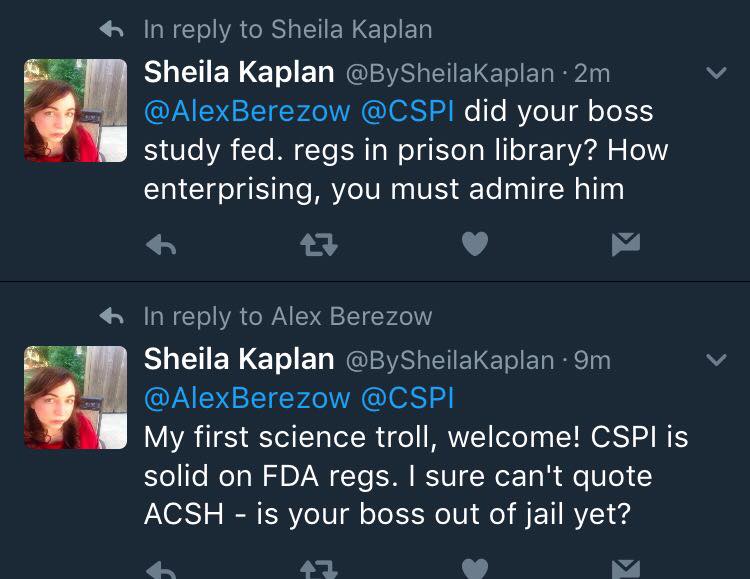
I don't want to make you ill, so I will note for you what scaremongers in activist groups and the trial lawyers supporting them for profit (Center for Science in the Public Interest, et al.) don't reveal. While these carcinogens are in your organic or regular-priced meal, except for alcohol, they only cause cancer in rats. And rats are not little people. Anyone who tries to claim otherwise is looking for coverage from Sheila Kaplan at the New York Times or someone else who only gets their science from lawyers at CSPI.(1)

Here is a sample menu and the toxic chemicals they contain. Again, you can relax. When it comes to France's IARC (International Agency for Research on Cancer) group or the U.S. National Institute of Environmental Health Sciences, rats are people and they only care about the presence of a chemical but chemists, toxicologists, and biologists know better. Those epidemiologists are not trying to do science, they are out to create a statistical correlation using a hazard. They don't consider risk, so they will use 5 orders of magnitude for dose. That's right, they consider one beer as the same as 10,000 beers all consumed at the same time. That's why you can't use their claims as anything more than exploratory, a lesson more journalists and California's Prop 65 panel should learn.

Here are the cancer-causing chemicals in even your organic Thanksgiving meal.

STARTERS

Organic Baby Greens - Nitrates and 3-O-(2’’-O-methylmalonnyl-β-D glucopyranoside)-4’-O-β-D-glucopyranoside
Roasted Golden and Red Beets - Caffeic acid
Crumbled Goat Cheese -Estrogen (endocrine disrupting chemical)
Grape Tomatoes - Solanine neurotoxin
Candied Walnuts - Aflatoxins
Dijon Dressing - Allyl isothiocyanate
Celery - Caffeic acid
Broccoli - Allyl isothiocyanate
Rolls with butter - Acetaldehyde, benzene, ethyl carbonate.

ENTREES

Potatoes - Dolanine, arsenic, chaconine, caffeic acid and ethyl alcohol, that last one is also a human carcinogen.
Turkey - Heterocyclic amines, rodent carcinogens and mutagens.  Even that $400 "Heritage" turkey from Williams-Sonoma.


Stuffing - Some of the ones mentioned above plus acrylamide, dihydrazines and more.
Tomato Risotto - Lycopene
Grilled Asparagus - Saponins
Grilled Pepper Crusted Filet of Beef - N-nitroso compounds
Bordelaise Sauce - Ethanol
Cranberry sauce - furan derivatives, which are mutagens (see the Great Cranberry Scare of 1959 for more)


DESSERT

Chocolate Cake - Polycyclic aromatic hydrocarbons
Vanilla Crème Anglaise - Benzene
Fresh Raspberries - Quercetin
Coffee - Freshly Brewed Acrylamide plus hydrogen peroxide, a mutagen and rodent carcinogen
Decaffeinated Coffee - Furan
Herbal and Caffeinated Teas - Variety of Benzo[A]pyran
Pumpkin pie - Benzo(a)pyrene, coumarin, methyl eugenol and safrole

NOTE:

(1) I am not kidding. In 2016 I was running ACSH and when Dr. Alex Berezow criticized her for using CSPI on a science issue instead of a scientist, in retaliation she tried to claim I was a ... felon. Now, I did have a speeding ticket one time, but that is not a felony, even in California. Still, attacking the science media community was enough to land her a job at the New York Times. Next up, a "visiting fellow" appointment to the New York University Arthur L. Carter Journalism Institute. It is where all journalists who undermine science get the call.


GROs - Genetically Rescued Organisms - Will Save Plant Species At Risk

By Hank Campbell | June 20th 2019 @ Science 2.0
            
In today's Wall Street Journal my article Science Saves an Old Chestnut discusses the potential benefit of President Trump's executive order requiring USDA, FDA, and EPA to modernize when it comes to biotechnology approval. They have to consider actual risk instead of treating every product like a new invention. They don't make flowers go through tens of millions of dollars and 20 years of regulatory stonewalling, why do it for anything else?

First to benefit could be the American chestnut tree, which has a blight tolerant version ready to go, but how can an academic nonprofit afford to get it approved when they intend to give it away for free?

In the last hundred years approximately four billion chestnut trees were lost due to blight, caused when the Cryphonectria parasitic fungus arrived with chestnut trees imported from Asia. The dominant species is now a rarity because old breeding techniques failed, as did chemicals. It is a repeat of what happened with the Rainbow papaya in Hawaii with the ringspot virus.


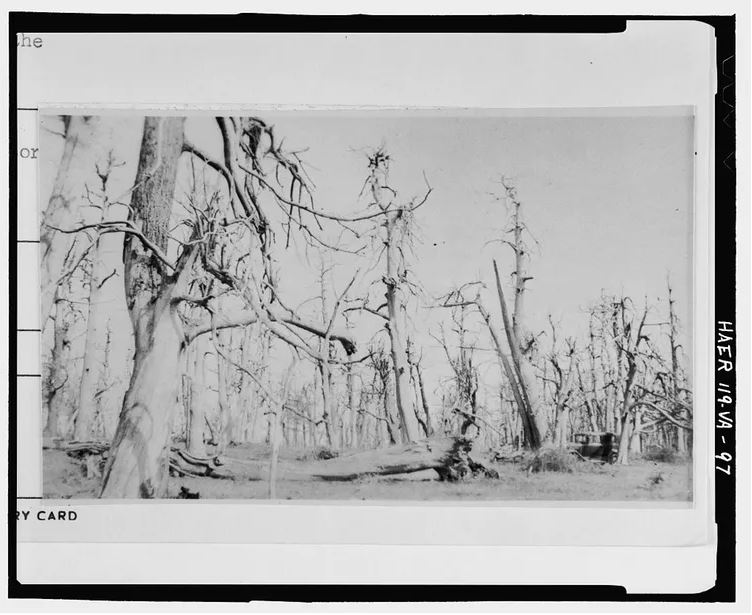
A ghost forest of decimated chestnut trees. Thanks, nature. Image: Library of Congress.

Genetic engineering can essentially give these at-risk plants a vaccine, but activists have to stop calling a boost to nature Frankenfood because it gets donations from organic industry trade groups. The GMO battle has already been won, they just don't accept it.

Bring on the GROs - Genetically Rescued Organisms

As part of a 28 year effort by the American Chestnut Research and Restoration Project there is a non-patented, blight-resistant American chestnut tree.(2) They use a gene from bread wheat that produces an enzyme which keeps the fungus from forming cankers. The enzyme is not just in all grain crops, it's in bananas, strawberries, and many other foods billions of people have eaten without issue.

Read: Genetically Engineered American Chestnut Will Help Restore The Decimated, Iconic Tree

What could be more natural than letting nature resist nature? It is 99.999 percent identical to wild American chestnuts, except four billion of these won't die.

Rather than being Genetically Modified Organisms these are examples of GROs, horizontal gene transfer that can save species. Horizontal gene transfer between species happens in nature all of the time, sometimes to disastrous effect. Ancient hybrid attempts have led to induced mutations and terrible outcomes plenty of times but we only track the successes. All the sweet potato varieties we eat today were genetically modified by the same bacterium 8,000 years ago.

Why not harness that?


Why would regulations make it impossible to get approved without a corporation that wants a patent paying a fortune for lawyers? There have been no unintended effects on the GRO trees and not even on other organisms, like beneficial fungi that coexist with them.

Will 'we don't hate science, we hate corporations' rationalizations by environmentalist allow this without a fundraising campaign to promote fear and doubt? Unlikely, if Golden Rice - which is engineered to produce beta carotene -  is an example.


The naturally fortified rice, which could prevent 500,000 cases of blindness per year, had no corporate interest so $2 billion in environmental groups were able to use the lack of company involvement to claim it was just mad scientists who don't know what they are doing, and the lack of corporate lawyers to keep efforts to provide solutions to the public from getting approved.

Thanks to government getting out of the way of science, the American chestnut has a new fighting chance.


AboutI founded Science 2.0® in 2006 and since then it has become the world's largest independent science communications site, with over 300,000,000 direct...


View Profile

Monday, October 7, 2019

One Of The Four Horsemen of The Alternative Doesn't Like Us, And More Media Links

By Hank Campbell

1. Dr. Gary Null, one of the Four Horsemen of the Alternative (along with Oz, Chopra and Weil), is now most famous for hosting a conspiracy theory radio program and producing straight-to-video movies funded by organic food groups.

Environmental Working Group has never produced a science study but they have overturned 500,000 biologists, according to Null, while the US EPA, which just cleared glyphosate of weird claims made by an IARC Working Group that was hijacked by an Environmental Defense Fund consultant, is secretly suppressing damaging data about Monsanto.

He makes even wackier claims, like that former FDA official and current ACSH friend Dr. Henry I Miller, has "a history of denying smoking’s association to cancer and heart disease" - his source for that specious claim, the website GMOSeralini.org, which is a puppet site created to support the known anti-GMO fraud Gilles-Eric Seralini. He gushes about the corporate mouthpiece US Right to Know, which he claims is "devoted to exposing what the food industry and Big Agriculture corporations such as Monsanto don’t want the public to know" - but leaves out that 97 percent of their funding is from the organic corporations they were created to support. What does Sourcewatch make of that fact? Nothing, because they are a political site devoted to undermining data and promoting the executive director's political party. She doesn't criticize US Right To Know because she serves on the board of US Right To Know. They are all Deniers For Hire, and the only people hiring them hate science.

Yet those two groups are his primary sources. Using that echo chamber, he further claims Genetic Literacy Project and University of California at Davis are secretly lobbying groups and that we are shills for Big Chemical, because we note there is nothing wrong with BPA - which the EPA also showed, along with every reputable science body. The only thing he left out of his random screed is that GMOs cause autism. There is no point in going on, Null is nuts. You can read his long-winded polemic against science on something called Center for Research on Globalization here.

2. You read last week about food activist Michael Pollan's unhinged, libelous jab at us. His lack of a clue is understandable, if slimy, because he hasn't learned anything in the last 25 years, however what is worse is another pseudo-journalist, this one at a site called Thrillist, doing the same thing while blatantly plagiarizing him. These people are paid little, they have to pump out a lot of volume and have pageview quotas. I get why stealing from the New York Times makes sense to companies like that, but it's still icky and will make it hard to get a job at a real media outlet.

3. Voice of America has joined in on calling on the corrupt UN to fix the mess it created in Haiti, citing our Dr. Julianna LeMieux.
Vaccinating all 10 million Haitians on the island would cost over $100 million, according to the American Council on Science and Health.
"That said, when you break something in a store, you have to buy it," Dr. Julianna LeMieux of ACSH wrote on their website. "It's time for the international body to give its health experts the financial support they need to correct the catastrophe it created."
Since VOA is syndicated, it was also on

Newsgram - http://www.newsgram.com/fighting-cholera-urgent-part-of-haitis-hurricane-recovery-say-doctors/?source=acsh.org
Citizen Digital - https://citizentv.co.ke/news/combating-cholera-urgent-part-of-haitis-hurricane-recovery-145153/?source=acsh.org

The National Memo - http://www.nationalmemo.com/cholera-outbreak-haiti/?source=acsh.org
Numerous other scientific studies also pointed toward the role of the peacekeepers. Julianna LeMieux, senior fellow in molecular biology at the American Council on Science and Health, recently wrote, “The scientific community has known for years that the U.N. brought cholera to Haiti.”
and other sites picked up the topic again:
AlterNet

How the U.S. and U.N. Set the Stage for a Major Cholera Outbreak in Haiti
Numerous other scientific studies also pointed toward the role of the peacekeepers. Julianna LeMieux, senior fellow in molecular biology at the American Council on Science and Health, recently wrote, “The scientific community has known for years that the U.N. brought cholera to Haiti.”

4. Want to read what other countries think about our food policy? You'd better learn Spanish.
La razón por la que Obama ya nunca habla de comida en sus discursos ("The reason why Obama would never talk about food in his speeches")

http://www.playgroundmag.net/food/razon-Obama-comida-discursos_0_1841815832.html?source=acsh.org

Sloppy translation: The best summary of President Obama's solution for food issues came from the American Council on Science and Health, who termed the Obama garden the work of "organic limousine liberals", which is the same as saying left-wing snobs.

5. Finally, Center for Inquiry covers what to us was the most interesting part of the Wikileaks release of John Podesta emails - his ongoing belief in magic, like that we are hiding a UFO conspiracy, that vaccines cause autism and GMOs cause everything else. Some people deny that certain science positions are held more strongly by one party - but the evidence is clear.
Also revealed, UFO enthusiast and Clinton campaign chair John Podesta is anti-GMO and holds some tiresome views about FDA and industry collusion to sidestep safety concerns. 
http://www.centerforinquiry.net/blogs/entry/10_13_16/?source=acsh.org


Monday, June 24, 2019

Science Saves an Old Chestnut

Genetic engineering rescues a tree from a threatening fungus.

By Hank Campbell 


A forest of chestnut trees ravaged by blight in Luray, Va. Photo: Library of Congress
 
A blight-tolerant American chestnut tree is the latest example of what the science community has begun to call a GRO—a genetically rescued organism. In the past century approximately four billion chestnut trees have been lost in the U.S. due to blight that spread when the Cryphonectria parasitica fungus arrived with chestnut trees imported from Asia. A once-dominant hardwood species is now rare.


Nature can be fickle, but using science to engineer solutions allows precise methods to combat natural pathogens. Some species are resistant to the fungus, and that’s why it makes sense to use transgenic tools to help the chestnut tree utilize beneficial genes from other plants—essentially vaccinating against the fungus.

It’s all part of a 28-year effort by the nonprofit American Chestnut Research and Restoration Project, led by the State University of New York’s College of Environmental Science and Forestry. Scientists use a gene from bread wheat that produces an enzyme called oxalate oxidase, which prevents the fungus from forming cankers on plant stems. The enzyme is found in all grain crops, plus bananas, strawberries and more..........To Read More.....

Monday, January 28, 2019

How To Hurt The Environment: Elect A Democratic President, Says Sociology Paper

By Hank Campbell | January 22nd 2019 08:49 AM | Print | E-mail

A team of sociologists say they know of a sure way to hurt environmental protection: Elect a Democratic president.

An analysis of over 20,000 people from the General Social Survey between 1973 and 2014 found that support for environmental spending consistently plummeted during the administrations of Presidents Jimmy Carter, Bill Clinton and Barack Obama. There are other known factors in regulatory support; the older people get the less they support more regulations, but it is a surprise to find that relative support for environmental regulation changes depending on which party is in the White House.

There are two reasons it could be so. Environmentalism could be a campaign issue but when victory is achieved, there is instead support for unions and other groups that spent heavily to get Democrats elected. Or it could be that Republicans are only opposed to regulation when a Democrat wants it.............To Read More....

Yawn: The Doomsday Clock Created By Anti-Nuclear Activists Is Still Close To Midnight

By Hank Campbell | January 24th 2019  | Print | E-mail

The Doomsday Clock, a public relations stunt created by Bulletin of the Atomic Scientists (1) remains stuck at two minutes until midnight. Just like it was in 1953, the height of the Cold War, when school kids did drills about hiding under desks and everyone built bomb shelters.

Today their worry is still nuclear bombs, they assure us, but also global warming and President Trump, and that is why they have solemnly announced that the Doomsday Clock is still at 2 until midnight, with midnight being the End Of The World.

Wow, we need to panic, right? Not really, they are activists, preaching doom is how they raise money. And two minutes is somewhat meaningless when you consider that it started at 7 in 1947. Though there are 1,440 minutes in a real day to these doomsday prophets 1,433 of them were gone by the time they created their gimmick. Ever after President Reagan ended the Cold War that brought the Doomsday Clock into existence they only gave his successor President George H. W. Bush 17 minutes until the apocalypse. To keep people paying for their newsletters it is not just about nuclear bombs or energy any more, now they use a vague "diplomacy" metric, pollution, and progress on climate change in their secret sauce..........To Read More.....

Saturday, January 26, 2019

A Flawed Science Journalism Article Provides Good Education On How We Can Do Better

By Hank Campbell | January 25th 2019 | Print | E-mail

Anti-science activists are having a field day on social media, happy that a poorly designed study can let them claim that human sperm is being damaged by modern pesticides, even though the study found nothing of the kind.

Nothing new there, it's how groups like US Right To Know and their parent, Organic Consumers Association, earn money from their clients. But the paper even made its way into a real article in a real paper in Australia, and since I was giving a private class for scientists who want to do outreach this week I used the article to show how journalists who don't understand science as well as scientists can be duped by an aggressive press release (from the University of Melbourne) and a corresponding author willing to sound truth-y, aided and abetted by a crash course at Google University. The journalist, Liam Mannix, is from Australia (Sydney Morning Herald) and I had never read his work before so it was easy to be more objective, even though it was on a topic that I have been writing on for years and so might be a psychological hot button. (1)

I did what I could to write my talk into an article, and I apologize in advance for my inability to be brief. Pictures tell a thousand words but in a class you use both and I did.........To Read More..


Friday, November 2, 2018

National Survey Finds 40% Believe Cancer Can Be Cured Without Medicine

By Hank Campbell — October 30, 2018 @ American Council on Science and Health

America may be the most science literate country in the world, we may be dominant in Nobel prizes and science output, and at least we are not France, but a new survey by Harris shows that we still have a long way to go.

The results reveal that 47 percent of those aged 18 to 37 have become convinced by efforts to promote alternatives to medicine and think they can cure cancer with food or supplements or ancient Chinese wisdom - and that population bump brings the average to 40 percent overall.

How did we get here?

Three ways.

First is that in 1994 President Clinton took alternatives to medicine away from U.S. Food and Drug Administration oversight by signing the Dietary Supplement Health and Education Act of 1994 - with a wave of the pen alternative companies could sell products making all kinds of suspect claims, as long as they noted that FDA had not evaluated their claims. Magic potions and useless placebos are now a $25 billion annual industry and an FDA which mandated that businesses spend an additional 14 million hours every year just to comply with new regulations on food labels for vending machines can't be bothered to tell companies to stop claiming turmeric will cure their disease.

Second is the manufactured belief promoted by trial lawyers and activist groups (and often the trial lawyers in activist groups) that companies are inherently evil. The recent judgment against Monsanto over a weedkiller that can't possibly harm humans is not a one-off, it was just a lucky case of a plaintiff arriving in a coastal city where the lawyer knew they'd have a friendly jury. Johnson & Johnson is routinely sued over baby powder and the belief that Teflon can be harmful and 3M knew it is still being perpetuated without evidence. (1)

Finally, the public are disenfranchised from critical thinking. America is the world's wealthiest country. Our poor people are often obese, have two televisions, and have more living space than a middle class country in France. Those are actually good things (yes, obesity is a public health problem, though it only requires cultural maturity to overcome the evolutionary inheritance of not knowing when our next meal would be, and therefore better than famine) but as a result of our success we have lost touch with science and technological reality. Today, only 2 percent of Americans are farmers and so people now know little about food and are easily scared by trial lawyers at Center for Food Safety or Center for Science in the Public Interest (insert Environmental Working Group or any of the others if you'd like) into believing our food supply is dangerous and evil "factory" farms are running small farmers into extinction (2) and growing science-y food that is less healthy than if a small farmer(!) grew it.

Food is food regardless of the process to grow it or the revenue of the grower, and our food is incredibly safe. We haven't had huge numbers of people die from organic foodborne illnesses like Europe has had. Not even at Chipotle, and they really tried. Our energy is affordable and clean. In 2003 while French young people protested American involvement in Iraq, 14,000 elderly people died in a heat wave because energy was too expensive to run air conditioning. In America, our energy emissions have dropped to such an extent we didn't even need a Clean Power Plan. The free market achieved what would have been the 2025 regulation target in 2017.

We don't know anyone with Polio in the U.S. today so some people think it was never a problem and that vaccines are a Big Pharma scam. No one remembers the 1918 Flu so people don't realize we only lose 50,000 people per year from the flu today because of vaccines and other advancements in public health.

But it isn't just people who want to believe the flu is a worse cold that undermine trust in science, 22 percent of cancer patients and survivors believe wacky stuff like that dietary changes, vitamins, or oxygen therapy will cure them, or did. The mortality rate among people who refuse to accept medical science over nonsense is 250 percent higher. See Steve Jobs who, like most believers in shamanism, was a wealthy coastal pseudo-intellectual.

Government does nothing to rein in the nonsense that these alternatives to medicine claim. We let doctors include alternatives as "adjuvants" to treatment, under the belief that positive thinking would help, and now almost half of young people believe the music therapy can replace the chemotherapy.

What has government done? Nothing good. While marijuana, "enzyme" therapy, and manipulating the chakras of patients is passed off as beneficial thanks to hands-off federal rules, they have demonized actual cancer patients who take opioids for pain. On the survey, commissioned by the American Society of Clinical Oncology, 40 percent of cancer patients reported having trouble getting pain medicine, while 73 percent said those restrictions were just fine, thanks to the government's high-profile war on pain patients.

NOTES:
(1) Even that is a problem for itself science created by being terrific. Thanks to advancements, we can now detect anything in anything, so it is trivial to "detect" some chemical in blood or urine or breast milk. Then lawyers just have to convince a jury it could be harmful. Given the survey results here, a critical thinking jury will become harder and harder to find.
(2) In reality, farming is dominated by 2.2 million small farms, nearly half of whom generate just enough revenue to pay their real estate taxes. If that is factory farming then having two children will get you called a "factory family."

Tuesday, October 30, 2018

IARC Retraction Watch Begins: They Faked Images In Controversial Claims

By Hank Campbell — October 25, 2018 @ American Council on Science and Health

The International Agency for Research on Cancer (IARC) has a new leader, an Old Guard insider named Dr. Elisabete Weiderpass, who promised not to change the status quo, which means they remain stuck with an old problem; credibility.

While for its first 20 years they were a much-needed voice of reason that stood up to activists claiming that some new chemical of the month was a carcinogen because it could kill rats, for the last 10 IARC have been the source of ridicule among the science community. And that is because the environmentalists whose hype they once exposed played the long game and wormed their way inside.(1) Today, thanks to letting them hijack that science body, we are told to believe that a weedkiller can cause cancer and deli meat is as bad for you as plutonium or mustard gas. Such claims are literally baloney.

But media who love centralized authoritarian bodies and veils of anti-corporate credibility have gleefully reported each more cosmic claim from the French organization during that time. They have even touted media press releases distributed prior to actual reports as fact. Though IARC decisions do not consider risk (to determine a hazard they allow papers that show 5 orders of magnitude, so one dose of a compound is the same as 10,000 to them) the WHO group will mention risk dozens of times in media claims in their press releases.

There is just one problem they face: Every few years, a new crop of journalists enters the field, and not only might they not be in the bag for your brand of activism, they might be neutral and wonder why no one turns their gaze on the manipulations of supplement hucksters, alternative to medicine purveyors, and environmental lawyers. And some scientists who engage in public outreach are critical thinkers about studies everywhere, like molecular biologist Leonid Schneider and microbiologist Dr. Elisabeth Bik, who have called out groups who do this and also journal editors who enable them with a desire to publish provocative claims that will bring international media links.

A recent analysis of both journals and IARC involvement, titled WHO Cures Cancer In Photoshop, went into detail about the cultural flaws that allowed IARC to lose its way but more broadly about how easy it is to duplicate or reuse or slightly change graphics to look original in a science study. Some of the inferences I don't agree with - the involvement of a private sector scientist does not sway results by default, that is Cui bono? conspiracy signaling - but the overall examination is sound. (2)

Schneider is not alone in being concerned that IARC is trapped in the past using a methodology that is easily exploited by activists with nefarious agendas and patience, like Professor Martyn Smyth of Council for Education and Research on Toxics (CERT) (3) or Dr. Chris Portier of Environmental Defense Fund. They used 21st century strategy to infect a stodgy 20th century institution, which creates ad hoc working groups based on having friends inside, refuses to be transparent, and has no rules for the study of each compound. It has become just statisticians finding things to correlate to cancer. As Dr. Angela Logomasini of Competitive Enterprise Institute notes in the Washington Times, "The working groups are free to focus on myriad small-scale studies with implausible results. That can lead to cherry-picking that serves the biases of working group members."

It certainly has. Look at two California court cases, on coffee and on weedkiller, and the first thing you will find are two IARC participants mentioned above, Chris Portier and Martyn Smith, who have been paid by attorneys to help them sue companies.

Is there hope? There certainly is. The American Council on Science and Health Board of Scientific Advisors was part of a group of four people called on to testify before the U.S. House Science, Space, and Technology Committee about IARC and we recommended Congress use its financial leverage, and the credibility U.S. backing grants, to rein the rogue statistical body in.

The only opposition we faced on that panel was Natural Resources Defense Council's Dr. Jennifer Sass, who argued IARC's closed door mentality and lack of transparency about its working groups should remain untouched. That was the opposite of what she claimed in 2002 and when that was noted she could only reply, "2002 was a long time ago."

In many ways, this is true, and IARC should consider shucking off the parts of our past that no longer have validity in 2018.

NOTE:

(1) If your career goal is to get a fat paycheck as an expert witness or as a consultant at an environmental NGO, today there is a clear roadmap. First, write provocative epidemiology papers linking harmless things to health effects - it can be miracle vegetables creating eternal life or scary chemicals taking years away. Second, become a Washington insider and get a title, any title, from the National Institute of Environmental Health Sciences (NIEHS). If you are good with media and share the correct political proclivities, use that title to get quoted frequently in the New York Times. Soon enough, a litigation group like Earthjustice or Environmental Defense Fund or Center for Biological Diversity will start offering you money. And if you are really good at political maneuvering, you will get a slot on an IARC Working Group, where you can get the chemical you wanted banned all along subjected to a review. Once that is complete, you can claim to be a U.N. expert on the chemical you want banned while signaling to trial lawyers you are ready to "play ball", and then the expert witness checks will start coming in.
(2) "Apparently, by re-using certain western blot bands, a potential prevention therapy for cervical cancer can be established. Amazing research, done by WHO scientists at IARC, with public support."
He pulls no punches. You should read it.
Attention @PNASNews @jbiolchem @J_Immunol @ASMicrobiology @PLOSPathogens @JExpMed @ACasadevall1 Look what @IARCWHO published in your journals. https://t.co/PhM33CET8l
— Leonid Schneider (@schneiderleonid) October 11, 2018
(3) Despite its lofty name, CERT is not a council at all, there is no 300-person Board of Scientific Advisors like we have, it was instead created by Metzger Law group to have a non-profit to act as a front for lawsuits against companies - if it exists outside paper at all it now it seems to be "run" by a politically

Wednesday, October 24, 2018

PNAS And Microbiomes: Will They Publish A 'Study' About Bee Chakras Next?

By Hank Campbell — October 18, 2018  @ American Council on Science and Health  
Over the last 15 years, PNAS, the Proceedings of the National Academy of Sciences, has gone into serious decline. An organization once so prestigious Carl Sagan, the most prominent scientist in America, was unqualified to be admitted, is now scrambling to stay relevant. They recently announced they are going to cease print publication, but austerity is not their problem, embrace of junk science is.

There is no other way to categorize a recent paper suggesting the microbiome of bees may be at risk due to science.

Want to believe that hurricanes with female names are more dangerous because men are sexist? That was PNAS. Want to believe that black people look "blacker" during bad economic times? PNAS again. When Facebook manipulated user news feeds as a social experiment PNAS had no issue publishing the results. Had those claims been in obscure journals, none of them would have made their way into the New York Times, Washington Post, or other popular political newspapers that dabble in science.(1) Yet they did get in, and PNAS has remained relevant thanks to journalists who love to write about provocative claims they want to believe.(2)
And then there is the microbiome. Over the last century, there were 3 articles per year about our natural gut flora. Starting in 2011 we began to see three per day despite there being little more known about what good or bad might be for an average individual. Yet journalists love it, and supplement companies love it, and yogurt companies love it, and therefore some academics are going to write about it.

And if you really want to get media attention, use the pop science microbiome fad, throw in bees and chemicals, and then get it in PNAS.

PNAS, microbiome, bees, and glyphosate: The recipe for a mainstream media feast

Despite spending a fortune on ad campaigns and email blasts to journalists, activists have been unable to convince the public that bees are in decline when data show they are fine.(3) A recent PNAS paper avoids that pitfall by suggesting they are only not in decline yet. And if you believe any change must be a bad thing, then you are certain to believe glyphosate, a key ingredient in the weedkiller Roundup, could be the cause of change. The compound is in fashion for media again because a jury in California recently said that if a company can't prove that a chemical didn't cause a man's cancer, then they must pay trial lawyers $289 million.(4)

That's a perfect storm for PNAS so they recently published a paper noting glyphosate is changing the bee microbiome. You read that right, get those bees some probiotic yogurt.

Or not. First, the levels of glyphosate they used are not real world. Bees are not diving into vats of chemicals and swimming for 12 hours. And if they did do that, the response to higher doses of a chemical should be more change, yet in this paper low doses had more change. That is homeopathy, not science. Second, how do they know change is bad? Even the foremost expert in the bee microbiome is scientifically equivalent to being the tallest person in a room full of leprechauns. No one really knows anything yet.

In reality, it would be worrisome if a chemical did not change the microbiome of bees. Or yours. Or mine. I ate some delicious cinnamon bread from Trader Joe's while I wrote this. My microbiome changed, my hormones changed. Food and drink do that. But if I want to scare you, I could say Trader Joe's cinnamon bread contains an Endocrine Disrupting Chemical. Which is what anti-science conspiracy theorists like Pete Myers and a tiny cabal of political journalists (weirdly centered in the New York University Arthur L. Carter Journalism Institute run by someone who should know better, Perri Klass, M.D.) do.

As Dr. Josh Bloom noted, "Although the relative composition of the bee gut biome may have changed, none of the eight bacteria measured was eliminated. And there was no difference in the total number of bacteria in either the high-dose, low-dose, or placebo groups."
What is most telling to biologists; Roundup can only affect the shikimate pathway in plants. It can't do anything to you or me. Believing it does is like embracing chemtrails or that government is out to get your precious bodily fluids.

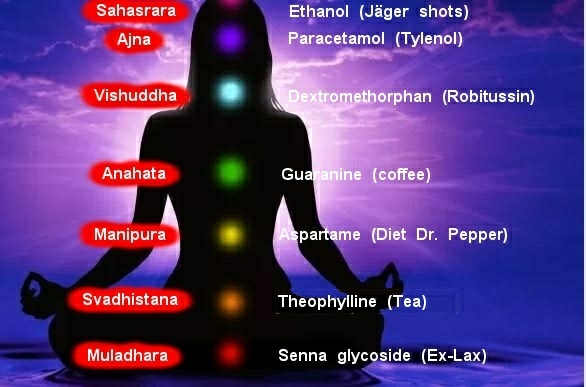
The next phase: Chemicals are changing human chakras (also available for bees and mice)

But I don't want activists to lose hope. Their efforts to claim insects birds bees wild bees bees are dying erratic changing is going to be aided as long as some academics want media attention. And activists can continue to move the goalposts to create media buzz some academics will want to capitalize on. If this latest stuff about a changing microbiome does not work, they can next contend GMOs neonics glyphosate are changing their chakras.

Or they can insert any popular chemical. I will make it easy for them with a simple chart showing which chakra will be changed by what common chemical. You are welcome, Greenpeace.


There is no question the woo contingent is where the money is at. A recent conference on "transcendental meditation" had Yogic Flying Instructors (though none have ever been filmed actually flying) but also Jerry Seinfeld, Hugh Jackman, and Katie Couric. The audience listened to militant anti-science cranks like John Fagan (5) spout nonsense such as "the rapid reversal of the U.S. food system from broad acceptance to widespread rejection of GMO foods correlates with a sharp increase in coherence in U.S. collective consciousness, when a large permanent group of TM practitioners was assembled in Iowa, USA.”(6)

That's right, he said they meditated in Iowa and more people nationwide bought organic food, $2 billion in activist groups promoting their corporate donors had nothing at all to do with it.
PNAS, you can do better.

NOTES:

(1) I have gone after them before. An article I wrote in the Wall Street Journal criticizing their policy that allowed Academy members to be pre-selected to do peer review for their friends and hand walk studies into publication forced them to change that policy. I first noticed it because of a 2002 paper by activist Tyrone Hayes, which claimed a weedkiller was essentially making male frogs more feminine. It got into the New York Times and thus got a special EPA panel called but the EPA wasn't able to use the study that got the panel called because the Berkeley professor refused to show his data. How did it get published if no peer review looked at data? The pre-selected reviewer was Hayes' friend and Academy member David Wake, whose wife chaired the department Hayes is in. No impartial reviewer ever saw it. And no one has been able to replicate the work of Hayes.
(2) Despite its decline, PNAS still has some cachet, the way Popular Science does even though they have become more of a lifestyle blog than a science magazine, Bonnier Corporation, the parent of Popular Science, Field & Stream, and numerous other publications, has to pay the bills but this is a bit much.
(3) Bees do have large periodic die-offs, those have been recorded for as long as records of bees have been kept (~1,000 years) and when one occurred in the 1990s, activists blamed sprayed pesticides. So science did something terrific; a seed treatment, when plants are most vulnerable to pests, based on a natural insecticide. Yet when another blip happened, activists blamed those. To no avail, bee numbers rebounded nicely. Then they claimed that wild bees were being harmed, which was at least clever, since there are ~25,000 species (we don't even know exactly how many) of bees and only 7 have hives so wild bees can't be counted, but even the staunchest supporters of environmental groups in the United States balked at that.
(4) The plaintiff will only get about $20 million of that $289 million, if it is not overturned. It's good to be a trial lawyer.
(5) Fagan created HRI Labs, which recently conducted a test that detected glyphosate in urine and then co-wrote a paper about it, with Paul Mills, who is a graduate of, you guessed it, the very same Maharishi University of Management in Iowa.
(6) Dear Mr. Seinfeld - you are a legendary comedian. Your job is to be skeptical and ridicule nonsense. Please tell me you were only there because the check cleared and you don't actually believe any of this nonsense.

Friday, September 28, 2018

RIP Jane Newton

By Hank Campbell — September 24, 2018
 
I am writing today about a woman you may never have heard of - but she was a hero of science, and I want to share her story.
Credit: OSU
Professor Mike Newton worked at Oregon State University for 58 years, published almost 400 papers, and was, in his words, a very healthy guinea pig after voluminous and nearly continuous exposure to compounds like Tetrachlorodibenzo-p-dioxin, which the science community calls TCDD and activists simply call "dioxin" in their fundraising campaigns.
 
I got to know him(1) after we published a piece on continual dioxin hype in our Priorities magazine and he read it and wrote me a nice email about his studies on human skin absorption of 2,4,5-T and the half-life of 2,4,5-T acid in the body (23 hours, I learned). He told me he evaluated the concentration of TCDD in wildlife (Aplodontia rufa, the mountain beaver, and Odocoileus hemionis, the blacktailed deer) whose habitats were sprayed at operational rates used in forest weed control. No symptoms from 2,4,5-T or TCDD were detected, he noted. All fine science, but that dioxin horse is not going back in the barn, statisticians beat scientists there.(2)

Then an email told me something really fascinating. In 1972, he was asked by the National Academy of Sciences to evaluate the effects of herbicides in Vietnam. Most of you know now they were talking about Agent Orange (and White - Picloram/2,4-D). He was the field guy and created hundreds of sprayed plots at various rates including the 3 gallons per acre rate of the undiluted defoliants. With a backpack sprayer connected to a spray boom, he experimented in vegetable gardens, rice paddies, mangrove wetlands, forests, inland and coastal areas, you name it, anything that might have been exposed to the chemicals.


He literally wrote the book on Agent Orange, I realized.(3) Why didn't he lead with that? That is the nature of scientists, of course. Most are too humble.(4)

But he was passionate about one thing. His wife Jane. In our correspondence and phone conversation she came up numerous times.

When he started out in academia in the 1950s, it was not the high-paying career it is now. While the average professor makes a very nice six-figure income these days, thanks to the Reagan boom in government funding of basic research starting in the 1980s, it was not so then. As a young grad student-professor at Oregon State University College of Forestry, he handled high-dioxin herbicides for 20 years. He spoke of his days with a leaky backpack sprayer and varied phenoxy herbicide esters in diesel fuel at dilutions from 25% down to 4%.

After a hard day of having chemical goop soaking his clothes, he came home and his wife Jane would launder them by hand, after her own long day of caring for the children. They couldn't afford a washing machine. No one used protective clothing then.(5)

I stopped him at one point during our talk and said, "Mike, I feel like Jane is the real science hero in the story. She didn't sign up for any of that."

He laughed and noted she was 87 and the picture of health.

That was in 2016. She passed away a short while ago, and it took me this long to write about it. But we are coming up on our 40th anniversary celebration and a lot of the people who we want to celebrate, or celebrate with us, have either passed on or don't feel well enough to travel.

And some don't get enough attention when they are with us. Mrs. Newton didn't just keep the Professor in clean clothes, she was a staunch advocate for responsible land management. As a founding member of Oregon Women in Timber, she educated the public and Congress about balancing the needs of natural resource industries. I can't say this is true but it is rumored that Doug Costle, one of the architects of the United States Environmental Protection Agency and Administrator from 1977 to 1981, learned to hide when she was around. Today the organization has evolved into the statewide Talk About Trees organization and they educate 150,000 students per year about forestry.

Just recently I wrote how Europe is going back to burning wood because it is renewable and under their legalese it doesn't cause smoke. They could sure use a Jane Newton to talk some sense into them right about now.

NOTES:
 
(1) He obviously loves the land, like me, but he started hunting at age 9, three years earlier than I did. He was also a military officer. But our similarities end there. He did science, I write about it. And my feet are a rather mediocre 11D.
 
(2) The linear no-threshold model (LNT) is also probably here to stay after 70 years, despite it being the worst form of junk science, and while our EPA has literally written the book on how to spray DDT inside the homes of people in developing nations where malaria runs rampant, it will not get re-registered here. Heck, we once exposed how Natural Resources Defense Council (NRDC) and their hand-picked PR outfit Fenton Communications manufactured the alar pesticide scare, and the product was cleared, but it is no longer made because scaremongering sticks around even if science debunks it.
 
(3) I chuckled when he talked about the airline losing his luggage and since they were on a strict time frame he had to spray the plots in bare feet. Viet Nam didn't have any size 15 EEEEEE boots. And when they duplicated the plots elsewhere he did the same thing. I asked him why he continued to endure the cuts and such in bare feet and he replied that the experiments had to be replicated exactly for him to feel they were valid. (!) 
 
(4) Activists win a lot of fights because they yell and when scientists are calm, it makes it look like they don't believe passionately in their work. Journalists love people who yell.
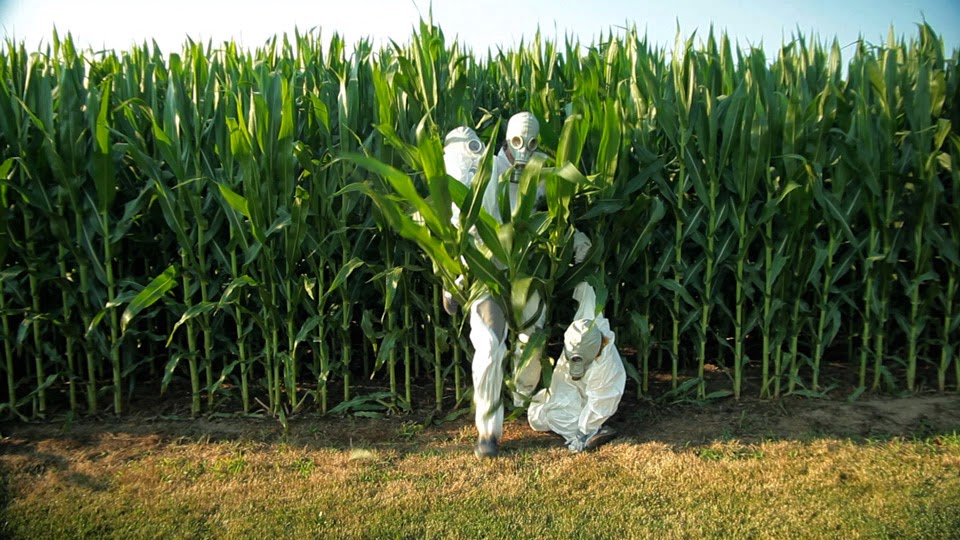
(5) Today, activists making movies about how scary evil science is put their kids in haz-mat suits to even look at GMO corn.
 

Sunday, September 16, 2018

If Computer Models Counted, 8,000 New Antibiotics Would Be In The Pipeline

By Hank Campbell — September 4, 2018 @ American Council on Science and Health

In the world of simulations, some things are relatively easy, In engineering, every graduate has written a computer program that may create a better widget, but if it has to be machined to 1.01236568 inches, it isn't much help in actual construction. If you have ever read the preprint site arXiv, you've seen mathematicians show how time travel should be possible. Math is a language and in language lots of things are possible.

Physics are another issue.

So it goes with drug development. As Dr. Josh Bloom, the Council's Senior Director of Chemical and Pharmaceutical Sciences, with over three decades of practical experience says, "On a computer, every disease has been cured 10,000 times."

So while media may be excited about a claim that combining four or five existing products could help slow antibiotic-resistant bacteria, scientists in the real world are more skeptical. Combining two might make sense but they still have to go through trials first, and that could quickly mean diminishing returns, while three would be susceptible to interactions you wouldn't know about before clinical trials. But in a very narrow simulation - eight antibiotics and E. coli,18,278 combinations - the academic scholars declare they were "startled by how many potent combinations they discovered."

Huzzah, all those corporate scientists can learn a thing or two from the Systems Biology and Applications journal, right? Not at all, that is what you do your first month on the job in a drug company, so no chemist is "startled" when it happens.

Creating a miracle drug is part of the learning process, to get the butterflies out of your system and learn how the world really works. Over time every drug development group predicts how well a compound, or in this case drug combination, might work. Then they do what they can to simulate it as accurately as possible. But there is a reason that for every 5,000 compounds that survive an academic part of development, perhaps one will make it to market. And that most researchers will never have a successful drug in their careers. It isn't for lack of knowing how to simulate on a computer, it's that a lot of things work on a computer.

What is really important occurs after the simulations are done, and that is why it's important that more journalists read beyond the press release.(1)

It's not a knock on the paper authors, they need to get their work out there and "startled" is the go-to cliché to get media attention so it was probably a university press liason writing it. It's great that 8,000 combinations might work on a computer, but that's still only the start. 
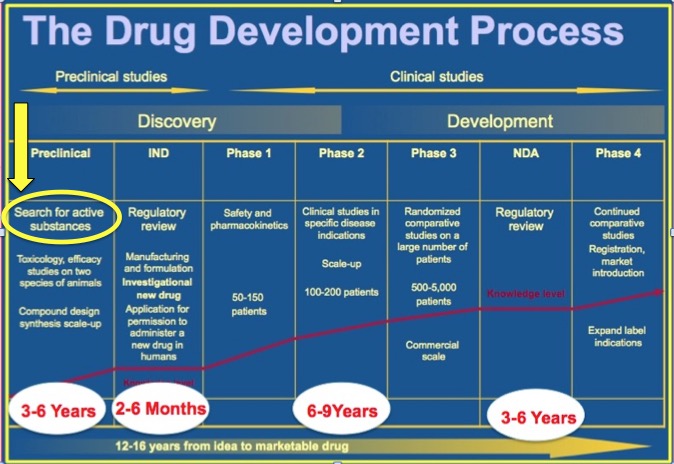
  • Next, scientists would have to agree they are practical and not that widget in paragraph one, then they would have to go into animal studies.
  • Whatever still seems to work in animals would go into a small clinical trial (Phase I), with a dozen or more people, to establish safety and dosing.
  • If it is safe, a Phase II trial would establish that it works in humans even though it worked on a computer and in rodents. That's another two years or so.
  • If it passes Phase II, it has to show in Phase III that it works well enough to be a benefit compared to other treatments.
  • Finally, a Phase IV trial would involve thousands of participants.
You can imagine why it costs an average of $1.5 billion to get a product to market, and why there is a chasm between what someone might find in a computer simulation and what people spending money believe about reality.

Courtesy of Steve Schow, Ph.D. 

Antibiotics are also a different market than other drugs. They are not chronic products, like for cancer, heart disease or musculoskeletal conditions, they are used for such a short period of time it is difficult to make a profit if the development costs are ridiculous. And they can be ridiculous. In the past statisticians in the FDA infectious disease advisory committee created absurd (bordering on impossible) requirements for clinical studies of antibiotics. Since they set out to do nothing but improve the statistical power of the trials they were prohibitively expensive and clinically meaningless. The result: the best companies abandoned the market.

Current FDA Commissioner Scott Gottlieb, M.D., has undone a lot of the mistakes made by previous administrations but statisticians in government are often career employees and created those policies because they believe in statistics and they want to translate that into trials.

Such culture is not easy to change, we won't convince epidemiologists that statistics don't lead to better drugs any more than we can convince mathematicians that time travel isn't possible.

Yet the process must be improved if we want the best scientists working on these issues. Sorry, haters, the best drug chemists means drug companies. Antibiotic resistance is inevitable, but responding to it takes people who are brilliant, and that means they have to get paid.

As Dr. Bloom said in 2013, "Anyone who thinks that this can be solved by government research hasn’t the wildest idea of the Sisyphean task of drug development" and "possibly the only way to deal with this would be major government financial incentives either through outright research subsidies or vastly extended patent coverage to drug companies something that is most likely politically impossible given the misdirected hatred toward drug companies."

Hatred that has only gotten worse since then.

NOTE:

(1) For decades, we have published a media guide for science journalists but it is relevant to anyone who cares about critical thinking, especially at a time when far too many journalist are so interested in being against corporations they will embrace anything from universities.

Tuesday, August 21, 2018

John Oliver Exposes Himself, CNN Uses Us To Debunk EWG, Newsweek And More Media Last Week

By Hank Campbell — August 20, 2018 @ American Council on Science and Health

1. If you don't have HBO, and if you have HBO but you don't watch John Oliver's "Last Week Tonight", and if you do ordinarily watch but missed the August 13th episode...well, you didn't miss much.

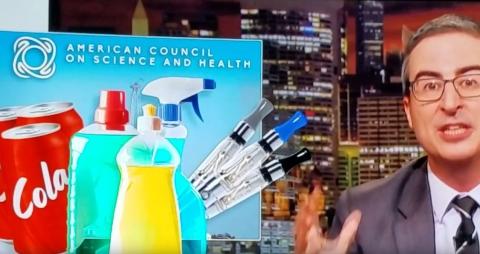
We're a science non-profit with $2 billion in activists lined up against us, we have had world-class hit pieces done against science at their bequest, in places like "60 Minutes" and "The Daily Show with Jon Stewart." John Oliver instead exposed himself as being a pretender in the science community, siding readily with trade group hacks out to undermine American expertise. By comparison, rather than being a humorous or at least sharp take, his attack was instead flaccid. It wasn't funny, it meandered all over the place, and it wasn't accurate enough to be interesting. Even the graphics were middle school; does Oliver hate clean dishes? Healthy teeth? Does he endorse cigarettes? Why was that generic stuff in there next to our logo?


Comedy works when you take reality and twist it out of phase a little. You make the believable a little ridiculous. If you just make up nonsense it is shrill conspiracy theory. Which is what he came across like to the science community. The only people defending him were the usual political suspects; partisan english majors who are tangentially in science journalism because they weren't skilled enough writers to make it in politics, like deniers for hire Charles Seife, Liza Gross and predictable other fellow travelers. What little credibility those types who wait around the activism community hoping for financial scraps had left was shattered when they sided with a group that collaborates with the anti-farming and the anti-vaccine movements, ans are entirely funded by corporations they happen to like.

Hey, even Elvis had bad albums and Oliver usually does better. If he needs some help in the writing room, I offered to pitch in. He would have to settle for me, because if we let Josh Bloom write their science humor, the Internet would collapse.

If you want to let him know what you think of his undermining science for activists opposed to it, on Twitter you can write him and tell him you don't like that he is using anti-science groups to undermine nonprofits. On Facebook, you can comment here. Or you can contact the producer, Charles Wilson, charles.wilson@lastweektonight.com or at (212) 975-8186

2. On a better science note, the lawyers at Environmental Working Group were hoping to capitalize on a California jury believing a weed killer could somehow cause human cancer, so they got a lab to "detect" glyphosate and rushed out a "report" saying cereal was unsafe. One media outlet, CNN, was wise enough to have their B.S. detector go off and spoke with our Dr. Alex Berezow, who assured them it was still safe to eat breakfast. The fact is that when their lawyers were disappointed the glyphosate levels were 1% of the safe level determined by EPA (the level you could eat every day for life and not be harmed) they fabricated a new safe level that was scientifically meaningless. But conveniently below the level they detected.

It's corporate media, CNN still had to chase pageviews by screaming about kids and chemicals in the headline, but they were the only mainstream outlet that looked pass the shameless lawsuit bait, so kudos to them. And it got coverage in lots of places because they sided with science over chemophobia.

You will note that down at the bottom we got an example of why scientists and doctors lose every day to activists - a guy who notes he is an epidemiologist and not a toxicologist knows the study is nonsense but won't say it is nonsense, because he demurs he is an epidemiologist and not a toxicologist. Even though an epidemiologist realizes 100 is more 100 times more than 1. On the side of the bad people, their epidemiologists have no problem at all babbling about endocrine disruption if their chemical fundraiser of the week won't cause harm at real-world levels.

Other places our sane commentary was syndicated:
3. In Canada Free Press, longtime journalist Jack Dini takes down Greenpeace, WWF, World Wildlife Fund, Natural Resources Defense Council, Environmental Working Group, Sierra Club, and Nature Conservancy, exposing their hypocrisy and of course their love of their own corporate money. As long as it gets branded for something meaningless like "sustainability."

4. Newsweek covered the news that Nebraska was forced to use fentanyl to execute a death row criminal - because drug companies don't want the bad press of having their products used that way in a Twitter world. Dr. Josh Bloom spoke with their journalist about why they did so, and why it was ironic that government wants to put fentanyl dealers on death row - when flawed government policies are what caused a lot of legitimate pain patients to be forced to deal with criminals who end up killing people. Now dealers can be executed with the products they sell, and pain patients just suffer.

5. Dr. Alex Berezow was on two radio programs last week. His recurring segment called Real Science With Dr. B. (starting at 19:06) and with David Boze filling in for John Carlson on his show.
 

Tuesday, August 14, 2018

The Grande Armee Of Big Organic May Be Marching Toward Its Waterloo

By Hank Campbell — August 10, 2018 @ American Council on Science and Health

If you were living in Austria, Russia, and Sweden in August of 1805, declaring war on France, led by the legendary tactician Napoleon Bonaparte, must have felt like a suicide mission. It basically was. He stomped through Europe and it was only seven years later, longer than all of World War II, when he finally made a mistake and tried to tough out a Moscow winter in the open.

Napoleon of 1805 is what fighting against the Grande Armee of Organic Food sometimes seems like. Nothing ever seems to go wrong for them. Numerous foodborne illness outbreaks are shrugged off - somehow people even continue to frequent Chipotle stores - and high prices are no deterrent. We've debunked their ridiculous claims about having no pesticides and being more nutritious and being able to feed the planet and being more ethical, but every time it seemed like they must collapse, they have turned certain defeat into Austerlitz. Except the Russians are on their side this time.

Yet Big Organic may be about to lose their Waterloo because, like Napoleon, they are wasting time at the agricultural equivalent of Chateau de Goumont (Hougomont) while the real enemy is about to come crashing down upon them.........To Read More.....