Eighteen months of COVID-related health data
show the numbers promulgated by public health officials and mainstream
media vastly overstate the risk of COVID and downplay the risk of
vaccines.
Editor's Note: It's clear Robert Kennedy Jr. has a large roll in this website, a man
for whom I hold in complete and utter contempt. He's an outright
antivaxxer, a purveyor of junk science, and I think he's a corrupt
liar. But as long as this site sticks to provable information, and it's
not available elsewhere, I will continue to share it with you. RK
From the beginning of the series of events branded as a global health emergency, many people have smelled a rat. Whether one looks at leaders’ willingness to engage in wanton economic destruction, or the rapidity with which billionaires have amassed new wealth or the multisectoral efforts to link and mine people’s intimate data, it is not hard to recognize that something much larger than a health crisis is afoot.
However, even if one restricts oneself to the narrow confines of the
health narrative, 18 months of data — emerging in spite of ferocious
censorship — have repeatedly illustrated that the official story is full
of lies and omissions. One of the biggest holes in the story is the trail of destruction that the experimentalCOVID vaccines are leaving in their wake, with hundreds of thousands of reported injuries in the U.S. alone and, according to some statisticians, as many as 150,000 dead Americans.
With this level of damage after just nine months, now is as good a
time as any to reexamine “COVID math” and highlight some of the embedded
falsehoods that cast serious doubt on official and corporate pronouncements about risks and benefits.............Until
people hit their seventies, all age groups have survival rates well over 99%:
0-19: 99.9973%
20-29: 99.986%
30-39: 99.969%
40-49: 99.918%
50-59: 99.73%
60-69: 99.41%
70+: 97.6% (non-institutionalized)
70+: 94.5% (institutionalized and non-institutionalized)...............To Read More....
The United States suffered
through two lethal waves of contagion in the past year and a half. The
first was a viral pandemic that killed about one in 500
Americans—typically, a person over 75 suffering from other serious
conditions. The second, and far more catastrophic, was a moral panic
that swept the nation’s guiding institutions.
Instead of keeping calm and carrying on, the American elite flouted
the norms of governance, journalism, academic freedom—and, worst of all,
science. They misled the public about the origins of the virus and the
true risk that it posed. Ignoring their own carefully prepared plans for
a pandemic, they claimed unprecedented powers to impose untested
strategies, with terrible collateral damage. As evidence of their
mistakes mounted, they stifled debate by vilifying dissenters, censoring
criticism, and suppressing scientific research.
If, as seems increasingly plausible, the coronavirus that causes
Covid-19 leaked out of a laboratory in Wuhan, it is the costliest
blunder ever committed by scientists. Whatever the pandemic’s origin,
the response to it is the worst mistake in the history of the
public-health profession. We still have no convincing evidence that the
lockdowns saved lives, but lots of evidence that they have already cost lives and will prove deadlier in the long run than the virus itself.
One in three people worldwide lost a job or a business during the lockdowns, and half saw their earnings drop, according to a Gallup poll. Children, never at risk from the virus, in many places essentially lost a year of school. The economic and health consequences were felt most acutely among the less affluent in America and in the rest of the world, where the World Bank estimates that more than 100 million have been pushed into extreme poverty.
The leaders responsible for these disasters continue to pretend that
their policies worked and assume that they can keep fooling the public.
They’ve promised to deploy these strategies again in the future, and
they might even succeed in doing so—unless we begin to understand what
went wrong.
The panic was started, as usual, by
journalists. As the virus spread early last year, they highlighted the
most alarming statistics and the scariest images: the estimates of a
fatality rate ten to 50 times higher than the flu, the chaotic scenes at
hospitals in Italy and New York City, the predictions that national
health-care systems were about to collapse. The full-scale panic was set
off by the release in March 2020
of a computer model at the Imperial College in London, which projected
that—unless drastic measures were taken—intensive-care units would have
30 Covid patients for every available bed and that America would see 2.2
million deaths by the end of the summer. The British researchers
announced that the “only viable strategy” was to impose draconian
restrictions on businesses, schools, and social gatherings until a
vaccine arrived.
This extraordinary project was swiftly declared the “consensus” among
public-health officials, politicians, journalists, and academics.
Anthony Fauci, director of the National Institute of Allergy and
Infectious Diseases, endorsed it and became the unassailable authority
for those purporting to “follow the science.” What had originally been a
limited lockdown—“15 days to slow the spread”—became long-term policy
across much of the United States and the world. A few scientists and
public-health experts objected, noting that an extended lockdown was a
novel strategy of unknown effectiveness that had been rejected in
previous plans for a pandemic. It was a dangerous experiment being
conducted without knowing the answer to the most basic question: Just
how lethal is this virus?
The most prominent early critic was John Ioannidis, an epidemiologist at Stanford, who published an essay for STAT
headlined “A Fiasco in the Making? As the Coronavirus Pandemic Takes
Hold, We Are Making Decisions Without Reliable Data.” While a short-term
lockdown made sense, he argued, an extended lockdown could prove worse
than the disease, and scientists needed to do more intensive testing to
determine the risk. The article offered common-sense advice from one of
the world’s most frequently cited authorities on the credibility of
medical research, but it provoked a furious backlash on Twitter from
scientists and journalists.
The fury intensified in April 2020, when Ioannidis followed his own
advice by joining with Jay Bhattacharya and other colleagues from
Stanford to gauge the spread of Covid in the surrounding area, Santa
Clara County. After testing for Covid antibodies in the blood of several
thousand volunteers, they estimated that the fatality rate among the
infected in the county was about 0.2 percent, twice as high as for the
flu but considerably lower than the assumptions of public-health
officials and computer modelers. The researchers acknowledged that the
fatality rate could be substantially higher in other places where the
virus spread extensively in nursing homes (which hadn’t yet occurred in
the Santa Clara area). But merely by reporting data that didn’t fit the
official panic narrative, they became targets.
Other scientists lambasted the researchers and claimed that
methodological weaknesses in the study made the results meaningless. A
statistician at Columbia wrote that the researchers “owe us all an
apology.” A biologist at the University of North Carolina said that the
study was “horrible science.” A Rutgers chemist called Ioannidis a
“mediocrity” who “cannot even formulate a simulacrum of a coherent,
rational argument.” A year later, Ioannidis still marvels at the attacks
on the study (which was eventually published
in a leading epidemiology journal). “Scientists whom I respect started
acting like warriors who had to subvert the enemy,” he says. “Every
paper I’ve written has errors—I’m a scientist, not the pope—but the main
conclusions of this one were correct and have withstood the criticism.”
Mainstream journalists piled on with hit pieces quoting critics and
accusing the researchers of endangering lives by questioning lockdowns. The Nation
called the research a “black mark” for Stanford. The cheapest shots
came from BuzzFeed, which devoted thousands of words to a series of
trivial objections and baseless accusations. The article that got the
most attention was BuzzFeed’s breathless revelation that an airline executive opposed to lockdowns had contributed $5,000—yes, five thousand dollars!—to an anonymized fund at Stanford that had helped finance the Santa Clara fieldwork.
The notion that a team of prominent academics, who were not paid for
their work in the study, would risk their reputations by skewing results
for the sake of a $5,000 donation was absurd on its face—and even more
ludicrous, given that Ioannidis, Bhattacharya, and the lead
investigator, Eran Bendavid, said that they weren’t even aware of the
donation while conducting the study. But Stanford University was so
cowed by the online uproar that it subjected the researchers to a
two-month fact-finding inquiry by an outside legal firm. The inquiry
found no evidence of conflict of interest, but the smear campaign
succeeded in sending a clear message to scientists everywhere: Don’t
question the lockdown narrative.
In a brief interlude of journalistic competence, two veteran science writers, Jeanne Lenzer and Shannon Brownlee, published an article in Scientific American
decrying the politicization of Covid research. They defended the
integrity and methodology of the Stanford researchers, noting that some
subsequent studies had found similar rates of fatality among the
infected. (In his latest review of the literature,
Ioannidis now estimates that the average fatality rate in Europe and
the Americas is 0.3 to 0.4 percent and about 0.2 percent among people
not living in institutions.) Lenzer and Brownlee lamented that the
unjust criticism and ad hominem vitriol had suppressed a legitimate
debate by intimidating the scientific community. Their editors then
proceeded to prove their point. Responding to more online fury, Scientific American repented by publishing an editor’s note
that essentially repudiated its own article. The editors printed
BuzzFeed’s accusations as the final word on the matter, refusing to
publish a rebuttal from the article’s authors or a supporting letter from Jeffrey Flier, former dean of Harvard Medical School. Scientific American, long the most venerable publication in its field, now bowed to the scientific authority of BuzzFeed.
Editors of research journals fell into line, too. When Thomas
Benfield, one of the researchers in Denmark conducting the first large
randomized controlled trial of mask efficacy against Covid, was asked
why they were taking so long to publish the much-anticipated findings,
he promised them as “as soon as a journal is brave enough to accept the
paper.” After being rejected by TheLancet, TheNew England Journal of Medicine, and JAMA, the study finally appeared in the Annals of Internal Medicine,
and the reason for the editors’ reluctance became clear: the study
showed that a mask did not protect the wearer, which contradicted claims
by the Centers for Disease Control and other health authorities.
Stefan Baral, an epidemiologist at Johns Hopkins with 350
publications to his name, submitted a critique of lockdowns to more than
ten journals and finally gave up—the “first time in my career that I
could not get a piece placed anywhere,” he said. Martin Kulldorff, an
epidemiologist at Harvard, had a similar experience with his article,
early in the pandemic, arguing that resources should be focused on
protecting the elderly. “Just as in war,” Kulldorff wrote, “we must
exploit the characteristics of the enemy in order to defeat it with the
minimum number of casualties. Since Covid-19 operates in a highly age
specific manner, mandated counter measures must also be age specific. If
not, lives will be unnecessarily lost.” It was a tragically accurate
prophecy from one of the leading experts on infectious disease, but
Kulldorff couldn’t find a scientific journal or media outlet to accept
the article, so he ended up posting it
on his own LinkedIn page. “There’s always a certain amount of herd
thinking in science,” Kulldorff says, “but I’ve never seen it reach this
level. Most of the epidemiologists and other scientists I’ve spoken to
in private are against lockdowns, but they’re afraid to speak up.”
To break the silence, Kulldorff joined with Stanford’s Bhattacharya
and Sunetra Gupta of Oxford to issue a plea for “focused protection,”
called the Great Barrington Declaration.
They urged officials to divert more resources to shield the elderly,
such as doing more tests of the staff at nursing homes and hospitals,
while reopening business and schools for younger people, which would
ultimately protect the vulnerable as herd immunity grew among the
low-risk population.
They managed to attract attention but not the kind they hoped for.
Though tens of thousands of other scientists and doctors went on to sign
the declaration, the press caricatured it as a deadly “let it rip”
strategy and an “ethical nightmare” from “Covid deniers” and “agents of
misinformation.” Google initially shadow-banned
it so that the first page of search results for “Great Barrington
Declaration” showed only criticism of it (like an article calling it
“the work of a climate denial network”) but not the declaration itself.
Facebook shut down the scientists’ page for a week for violating unspecified “community standards.”
The most reviled heretic was Scott Atlas, a medical doctor and health-policy analyst at Stanford’s Hoover Institution. He, too, urged focused protection on nursing homes and calculated
that the medical, social, and economic disruptions of the lockdowns
would cost more years of life than the coronavirus. When he joined the
White House coronavirus task force, Bill Gates derided
him as “this Stanford guy with no background” promoting “crackpot
theories.” Nearly 100 members of Stanford’s faculty signed a letter denouncing his “falsehoods and misrepresentations of science,” and an editorial in the Stanford Dailyurged the university to sever its ties to Hoover.
The Stanford faculty senate overwhelmingly voted
to condemn Atlas’s actions as “anathema to our community, our values
and our belief that we should use knowledge for good.” Several
professors from Stanford’s medical school demanded further punishment in a JAMA article, “When Physicians Engage in Practices That Threaten the Nation’s Health.” The article, which misrepresented Atlas’s
views as well as the evidence on the efficacy of lockdowns, urged
professional medical societies and medical-licensing boards to take
action against Atlas on the grounds that it was “ethically inappropriate
for physicians to publicly recommend behaviors or interventions that
are not scientifically well grounded.”
But if it was unethical to recommend “interventions that are not
scientifically well grounded,” how could anyone condone the lockdowns?
“It was utterly immoral to conduct this society-wide intervention
without the evidence to justify it,” Bhattacharya says. “The immediate
results have been disastrous, especially for the poor, and the long-term
effect will be to fundamentally undermine trust in public health and
science.” The traditional strategy for dealing with pandemics was to
isolate the infected and protect the most vulnerable, just as Atlas and
the Great Barrington scientists recommended. The CDC’s pre-pandemic planning scenarios
didn’t recommend extended school closures or any shutdown of businesses
even during a plague as deadly as the 1918 Spanish flu. Yet Fauci dismissed the
focused-protection strategy as “total nonsense” to “anybody who has any
experience in epidemiology and infectious diseases,” and his verdict
became “the science” to leaders in America and elsewhere.
Fortunately, a few leaders followed the
science in a different way. Instead of blindly trusting Fauci, they
listened to his critics and adopted the focused-protection strategy—most
notably, in Florida. Its governor, Ron DeSantis, began to doubt the
public-health establishment early in the pandemic, when computer models
projected that Covid patients would greatly outnumber hospital beds in
many states. Governors in New York, New Jersey, Pennsylvania, and
Michigan were so alarmed and so determined to free up hospital beds that
they directed nursing homes and other facilities to admit or readmit
Covid patients—with deadly results.
But DeSantis was skeptical of the hospital projections—for good reason, as no state
actually ran out of beds—and more worried about the risk of Covid
spreading in nursing homes. He forbade long-term-care centers to admit
anyone infected with Covid and ordered frequent testing of the staff at
senior-care centers. After locking down last spring, he reopened
businesses, schools, and restaurants early, rejected mask mandates, and
ignored protests from the press and the state’s Democratic leaders.
Fauci warned
that Florida was “asking for trouble,” but DeSantis went on seeking and
heeding advice from Atlas and the Great Barrington scientists, who were
astonished to speak with a politician already familiar with just about
every study they mentioned to him.
“DeSantis was an incredible outlier,” Atlas says. “He dug up the data
and read the scientific papers and analyzed it all himself. In our
discussions, he’d bounce ideas off me, but he was already on top of the
details of everything. He always had the perspective to see the larger
harms of lockdowns and the need to concentrate testing and other
resources on the elderly. And he has been proven correct.”
If Florida had simply done no worse than the rest of the country
during the pandemic, that would have been enough to discredit the
lockdown strategy. The state effectively served as the control group in a
natural experiment, and no medical treatment with dangerous side
effects would be approved if the control group fared no differently from
the treatment group. But the outcome of this experiment was even more
damning.
Florida’s mortality rate from Covid is lower than the national
average among those over 65 and also among younger people, so that the
state’s age-adjusted Covid mortality rate is lower than that of all but ten other states. And by the most important measure, the overall rate of “excess mortality”
(the number of deaths above normal), Florida has also done better than
the national average. Its rate of excess mortality is significantly
lower than that of the most restrictive state, California, particularly
among younger adults, many of whom died not from Covid but from causes
related to the lockdowns: cancer screenings and treatments were delayed,
and there were sharp increases in deaths from drug overdoses and from
heart attacks not treated promptly.
Chart by Jamie Meggas
If the treatment group in a clinical trial were dying off faster than
the control group, an ethical researcher would halt the experiment. But
the lockdown proponents were undeterred by the numbers in Florida, or
by similar results
elsewhere, including a comparable natural experiment involving European
countries with the least restrictive policies. Sweden, Finland, and
Norway rejected mask mandates and extended lockdowns, and they have each
suffered significantly less excess mortality than most other European countries during the pandemic.
A nationwide analysis in Sweden showed
that keeping schools open throughout the pandemic, without masks or
social distancing, had little effect on the spread of Covid, but school
closures and mask mandates for students continued elsewhere. Another
Swedish researcher, Jonas Ludvigsson, reported
that not a single schoolchild in the country died from Covid in Sweden
and that their teachers’ risk of serious illness was lower than for the
rest of the workforce—but these findings provoked so many online attacks
and threats that Ludvigsson decided to stop researching or discussing Covid.
Social-media platforms continued censoring scientists and journalists who questioned lockdowns and mask mandates. YouTube removed
a video discussion between DeSantis and the Great Barrington
scientists, on the grounds that it “contradicts the consensus” on the
efficacy of masks, and also took down
the Hoover Institution’s interview with Atlas. Twitter locked out Atlas
and Kulldorff for scientifically accurate challenges to mask orthodoxy.
A peer-reviewed German study reporting harms to children from mask-wearing was suppressed on Facebook (which labeled my City Journalarticle
“Partly False” because it cited the study) and also at ResearchGate,
one of the most widely used websites for scientists to post their
papers. ResearchGate refused to explain the censorship to the German
scientists, telling them only that the paper was removed from the
website in response to “reports from the community about the
subject-matter.”
The social-media censors and scientific establishment, aided by the
Chinese government, succeeded for a year in suppressing the lab-leak
theory, depriving vaccine developers of potentially valuable insights
into the virus’s evolution. It’s understandable, if deplorable, that the
researchers and officials involved in supporting the Wuhan lab research
would cover up the possibility that they’d unleashed a Frankenstein on
the world. What’s harder to explain is why journalists and the rest of
the scientific community so eagerly bought that story, along with the
rest of the Covid narrative.
Why the elite panic? Why did so many go so
wrong for so long? When journalists and scientists finally faced up to
their mistake in ruling out the lab-leak theory, they blamed their
favorite villain: Donald Trump. He had espoused the theory, so they
assumed it must be wrong. And since he disagreed at times with Fauci
about the danger of the virus and the need for lockdowns, then Fauci
must be right, and this was such a deadly plague that the norms of
journalism and science must be suspended. Millions would die unless
Fauci was obeyed and dissenters were silenced.
But neither the plague nor Trump explains the panic. Yes, the virus
was deadly, and Trump’s erratic pronouncements contributed to the
confusion and partisanship, but the panic was due to two preexisting
pathologies that afflicted other countries, too. The first is what I
have called
the Crisis Crisis, the incessant state of alarm fomented by journalists
and politicians. It’s a longstanding problem—humanity was supposedly
doomed in the last century by the “population crisis” and the “energy
crisis”—that has dramatically worsened with the cable and digital
competition for ratings, clicks, and retweets. To keep audiences
frightened around the clock, journalists seek out Cassandras with their
own incentives for fearmongering: politicians, bureaucrats, activists,
academics, and assorted experts who gain publicity, prestige, funding,
and power during a crisis.
Unlike many proclaimed crises, an epidemic is a genuine threat, but
the crisis industry can’t resist exaggerating the danger, and doomsaying
is rarely penalized. Early in the 1980s AIDS epidemic, the New York Times reported the terrifying possibility that the virus could spread to children through “routine close contact”—quoting from a study by Anthony Fauci. Life magazine wildly exaggerated the number of infections in a cover story,
headlined “Now No One Is Safe from AIDS.” It cited a study by Robert
Redfield, the future leader of the CDC during the Covid pandemic, predicting
that AIDS would soon spread as rapidly among heterosexuals as among
homosexuals. Both scientists were absolutely wrong, of course, but the
false alarms didn’t harm their careers or their credibility.
Journalists and politicians extend professional courtesy to fellow
crisis-mongers by ignoring their mistakes, such as the previous predictions by Neil Ferguson. His team at Imperial College projected
up to 65,000 deaths in the United Kingdom from swine flu and 200
million deaths worldwide from bird flu. The death toll each time was in
the hundreds, but never mind: when Ferguson’s team projected millions of
American deaths from Covid, that was considered reason enough to follow
its recommendation for extended lockdowns. And when the modelers’
assumption about the fatality rate proved too high, that mistake was
ignored, too.
Journalists kept highlighting the most alarming warnings, presented
without context. They needed to keep their audience scared, and they
succeeded. For Americans under 70, the probability of surviving a Covid
infection was about 99.9 percent, but fear of the virus was higher among the young than among the elderly, and polls showed that people of all ages vastly overestimated the risk of being hospitalized or dying.
The second pathology underlying the elite’s Covid panic is the politicization of research—what I have termed the Left’s war on science,
another long-standing problem that has gotten much worse. Just as the
progressives a century ago yearned for a nation directed by “expert
social engineers”—scientific high priests unconstrained by voters and
public opinion—today’s progressives want sweeping new powers for
politicians and bureaucrats who “believe in science,” meaning that they
use the Left’s version of science to justify their edicts. Now that so
many elite institutions are political monocultures, progressives have
more power than ever to enforce groupthink and suppress debate. Well
before the pandemic, they had mastered the tactics for demonizing and
silencing scientists whose findings challenged progressive orthodoxy on
issues such as IQ, sex differences, race, family structure,
transgenderism, and climate change.
“The
less educated lost jobs so that professionals at minimal risk could
feel safer as they kept working at home on their laptops.”
And then along came Covid—“God’s gift to the Left,” in Jane Fonda’s
words. Exaggerating the danger and deflecting blame from China to Trump
offered not only short-term political benefits, damaging his reelection
prospects, but also an extraordinary opportunity to empower social
engineers in Washington and state capitals. Early in the pandemic, Fauci
expressed doubt
that it was politically possible to lock down American cities, but he
underestimated the effectiveness of the crisis industry’s
scaremongering. Americans were so frightened that they surrendered their
freedoms to work, study, worship, dine, play, socialize, or even leave
their homes. Progressives celebrated this “paradigm shift,” calling it a
“blueprint” for dealing with climate change.
This experience should be a lesson in what
not to do, and whom not to trust. Do not assume that the media’s version
of a crisis resembles reality. Do not count on mainstream journalists
and their favorite doomsayers to put risks in perspective. Do not expect
those who follow “the science” to know what they’re talking about.
Science is a process of discovery and debate, not a faith to profess or a
dogma to live by. It provides a description of the world, not a
prescription for public policy, and specialists in one discipline do not
have the knowledge or perspective to guide society. They’re biased by
their own narrow focus and self-interest. Fauci and Deborah Birx, the
physician who allied with him against Atlas on the White House task
force, had to answer for the daily Covid death toll—that ever-present
chyron at the bottom of the television screen—so they focused on one
disease instead of the collateral damage of their panic-driven policies.
“The Fauci-Birx lockdowns were a sinful, unconscionable, heinous
mistake, and they will never admit they were wrong,” Atlas says. Neither
will the journalists and politicians who panicked along with them.
They’re still portraying lockdowns as not just a success but also a
precedent—proof that Americans can sacrifice for the common good when
directed by wise scientists and benevolent autocrats. But the sacrifice
did far more harm than good, and the burden was not shared equally. The
brunt was borne by the most vulnerable in America and the poorest
countries of the world. Students from disadvantaged families suffered
the most from school closures, and children everywhere spent a year
wearing masks solely to assuage the neurotic fears of adults. The less
educated lost jobs so that professionals at minimal risk could feel
safer as they kept working at home on their laptops. Silicon Valley (and
its censors) prospered from lockdowns that bankrupted local businesses.
Luminaries united on Zoom and YouTube to assure the public that
“we’re all in this together.” But we weren’t. When the panic infected
the nation’s elite—the modern gentry who profess such concern for the
downtrodden—it turned out that they weren’t so different from
aristocrats of the past. They were in it for themselves.
City Journal is a
publication of the Manhattan Institute for Policy Research (MI), a
leading free-market think tank. Are you interested in supporting the
magazine? As a 501(c)(3) nonprofit, donations in support of MI and City Journal are fully tax-deductible as provided by law (EIN #13-2912529).DONATE
The U.S. Intelligence Community (IC) and the Defense Department have a
persistent and annoying drumbeat of Biden administration’s climate
change talking points. Typical were Avril Haines’ and Defense Secretary
Austin’s remarks at the recent White House virtual summit on climate
change. As Liberty Nation explained in its report, the National Intelligence Committee’s (NIC) Global Trends 2040
echoed the preeminence of the narrative. For clarity, climate change is
a problem; a long-term problem, not an acute, near-term problem or
“crisis,” and minimizing real geopolitical and national security threats
is not useful.
The Hill’s coverage of the virtual two-day summit quoted Director Haines as saying:
“To
address climate change properly, it must be at the center of a
country’s national security and foreign policy, and as such, it needs to
be fully integrated with every aspect of our analysis in order to allow
us not only to monitor the threat but also critically think to ensure
that policymakers understand the implication of climate change on
seemingly unrelated policies, and then identifying opportunities to
mitigate the challenge that we face.”
Ignoring the Real Crisis?
“Unrelated
policies,” like a policy to address the threat that 100,000 Russian
troops represent on Ukraine’s border. For the Ukrainians, that is a real
crisis, and if left unattended, it will become one for NATO, and yes,
the U.S. This is just speculation, mind you, but the climate change
“crisis” was probably not uppermost on Vladimir Putin’s mind when he
deployed Russian forces to the Ukraine border.
And predictably,
U.S. Secretary of Defense Austin doubled down, warning climate change is
an “existential threat.” Austin told the summit:
“Today,
no nation can find lasting security without addressing the climate
crisis. We face all kinds of threats in our line of work, but few of
them truly deserve to be called existential. The climate crisis does.”
Austin
views climate change as “a profoundly destabilizing force in our
world.” How destabilizing is climate change? Austin says: “As the Arctic
melts, competition for resources and influence in the region
increases.” Wait a minute, in an article a year ago titled Russia And China Making Moves In The Arctic – Can The US Counter? Liberty Nation warned that competition for Arctic resources was a fait accompli. So, the competition is there with or without the Arctic ice cap melting.
But what if the Arctic ice cap did melt,
allowing for an actual northwest passage between the Atlantic and
Pacific Oceans. Wouldn’t that be good for maritime shipping? Finding a
year-round northwest passage has been a goal since the fifteenth
century. Climate change provided a solution without ice breakers or the
Army Corps of Engineers.
Skepticism or Reading the Data?
Austin
also raised the climate change bugaboos of “drought,” “heavy downpours”
(often referred to as rain), “flooding,” hurricanes, and “repeated
forest fires.” Should we worry? Bjorn Lomborg, president of the
Copenhagen Consensus and visiting fellow at the Hoover Institution, in a
Fox News opinion piece, readily admits: “Yes, climate change is a real
problem. However, it is typically vastly exaggerated.”
Regarding
forest fires, as an example, he countered the claim that “much of the
Australian continent” had been devoured by “climate-induced fire.”
Lomborg cited satellite measurements to point out that “while the fires
near population centers had severe impacts, the total land area burned
was 4% – one of the lowest-ever percentages, from an average this
century of 6.2% and last century of 10.1%.”
And when it comes to
the alarmist’s claims that “‘ countless lives are being lost to
climate-related disasters worldwide,” Lomborg provides factual data and
explains:
“…the International Disaster Database shows
that in the 2010s, 18,357 people died each year from climate-related
impacts such as floods, droughts, storms, wildfire, and extreme
temperatures. That is the lowest death count in the past century, a 96%
decline since the 1920s, despite a larger global population. And 2020
had an even lower death count at 8,086.”
Climate
change “believers” point out that Lomborg is a “climate change skeptic.”
Very, well, let’s turn to someone who would not fall into that
category: someone like physicist and former undersecretary for the
Department of Energy in the Obama administration, Steven Koonin. In a
recent interview, Fox News describes Koonin, “dissenting from the Biden
administration’s stance on the global ‘climate crisis,’ saying the data
do not support the ‘hysteria.” Koonin explained:
“What
I realized is that, although you hear people talking about ‘we’re going
to believe in the science, the science is settled, we’ve got an
existential crisis – when you actually read the science, it doesn’t
support that kind of hysteria at all."
The bottom line here is that climate change alarmists use the specter
of the “end of civilization” as we know it and trot out people in
positions of responsibility to convey that message. The purpose is to
establish a State of Fear,* so when they spend trillions of
dollars, you will believe that the Bidens of this world are keeping you
safe. And who gets the bill for assuaging this climate change hyperbole?
You, the taxpayer – that’s who.
If you doubt that, look at
Biden’s “new international climate finance plan” that doubles US
underwriting of climate change programs in developing nations. According
to the World Trade Organization, China qualifies as a developing
nation. Is the Biden administration going to finance China’s climate
change programs?
If it makes you any more secure while the Biden
administration is committing to spend your treasure, Russia and China
made no such commitments and voted present at the virtual summit. They
aren’t fools.
* “State of Fear” is a New York Times bestselling novel by Michael Crichton.
The views expressed are those of the author and not of any other affiliation.
I'm sitting at a bar in Texas, surrounded by maskless people, looking
at folks on the streets walking around like life is normal, talking with
nice and friendly faces, feeling like things in the world are
more-or-less normal. Cases and deaths attributed to Covid are, like
everywhere else, falling dramatically.
If you pay attention only to the media fear campaigns, you would find
this confusing. More than two weeks ago, the governor of Texas completely reversed
his devastating lockdown policies and repealed all his emergency
powers, along with the egregious attacks on rights and liberties.
There was something very un-Texan about those lockdowns. My hotel
room is festooned with pictures of cowboys on horses waving guns in the
air, along with other depictions of rugged individualism facing down the
elements. It’s a caricature but Texans embrace it. Then a new virus
came along – as if that had never happened before in Texas – and the new
Zoom class took the opposite path, not freedom but imposition and
control.
After nearly a year of nonsense, on March 2, 2021, the governor finally said enough is enough and repealed it all.
Towns and cities can still engage in Covid-related mischief but at
least they are no longer getting cover from the governor’s office.
At that moment, a friend remarked to me that this would be the test
we have been waiting for. A complete repeal of restrictions would lead
to mass death, they said. Would it? Did the lockdowns really control the
virus? We would soon find out, he theorized.
I knew better. The “test” of whether and to what extent lockdowns
control the virus or “suppress outbreaks” (in Anthony Fauci’s words) has
been tried all over the world. Every serious empirical examination has
shown that the answer is no.
The US has many examples of open states that have generally had
better performance in managing the disease than those states that are
closed. Georgia already opened on April 24, 2020. South Dakota never shut down. South Carolina opened in May. Florida ended
all restrictions in September. In every case, the press howled about
the coming slaughter that did not happen. Yes, each open state
experienced a seasonality wave in winter but so did the lockdown
states.
So it was in Texas. Thanks to this Twitter thread, and some of my own googling, we have a nice archive of predictions about what would happen if Texas opened.
California Governor Gavin Newsom said that opening Texas was “absolutely reckless.”
Gregg Popovich, head coach of the NBA San Antonio Spurs, said opening was “ridiculous” and “ignorant.”
CNN quoted an ICU nurse saying “I’m scared of what this is going to look like.”
Vanity Fair went over the top with this headline: “Republican Governors Celebrate COVID Anniversary With Bold Plan to Kill Another 500,000 Americans.”
There was the inevitable Dr. Fauci: “It just is inexplicable why you would want to pull back now.”
Robert Francis “Beto” O’Rourke of Texas revealed himself to be a full-blown lockdowner: It’s a “big mistake,” he said.
“It’s hard to escape the conclusion that it’s also a cult of death.” He
accused the governor of “sacrificing the lives of our fellow Texans …
for political gain.”
James Hamblin, a doctor and writer for the Atlantic, said
in a Tweet liked by 20K people: “Ending precautions now is like
entering the last miles of a marathon and taking off your shoes and
eating several hot dogs.”
Bestselling author Kurt Eichenwald flipped
out: “Goddamn. Texas already has FIVE variants that have turned up:
Britain, South Africa, Brazil, New York & CA. The NY and CA variants
could weaken vaccine effectiveness. And now idiot @GregAbbott_TX throws
open the state.” He further called the government “murderous.”
Epidemiologist Whitney Robinson wrote:
“I feel genuinely sad. There are people who are going to get sick and
die bc of avoidable infections they get in the next few weeks. It’s
demoralizing.”
Pundit Bill Kristol (I had no idea that he was a lockdowner) wrote:
“Gov. Abbott is going to be responsible for more avoidable COVID
hospitalizations and deaths than all the undocumented immigrants coming
across the Texas border put together.”
Health pundit Bob Wachter said the decision to open was “unforgivable.”
Virus guru Michael Osterholm told CNN: “We’re walking into the mouth of the monster. We simply are.”
Joe Biden famously said that the Texas decision to open reflected “Neanderthal thinking.”
Nutritionist Eric Feigl-Ding said that the decision makes him want to “vomit so bad.”
The chairman of the state’s Democratic Party said:
“What Abbott is doing is extraordinarily dangerous. This will kill
Texans. Our country’s infectious-disease specialists have warned that we
should not put our guard down, even as we make progress towards
vaccinations. Abbott doesn’t care.”
Other state Democrats said in a letter that the decision was “premature and harmful.”
The CDC’s Rochelle Walensky didn’t mince words:
“Please hear me clearly: At this level of cases with variants
spreading, we stand to completely lose the hard-earned ground we have
gained. I am really worried about reports that more states are rolling
back the exact public health measures we have recommended to protect
people from COVID-19.”
There are probably hundreds more such warnings, predictions, and
demands, all stated with absolute certainty that basic social and market
functioning is a terrible idea. The lockdown lobby was out in full
force. And yet what do we see now more than two weeks out (and arguably
the lockdowns died on March 2, when the government announced the
decision)?
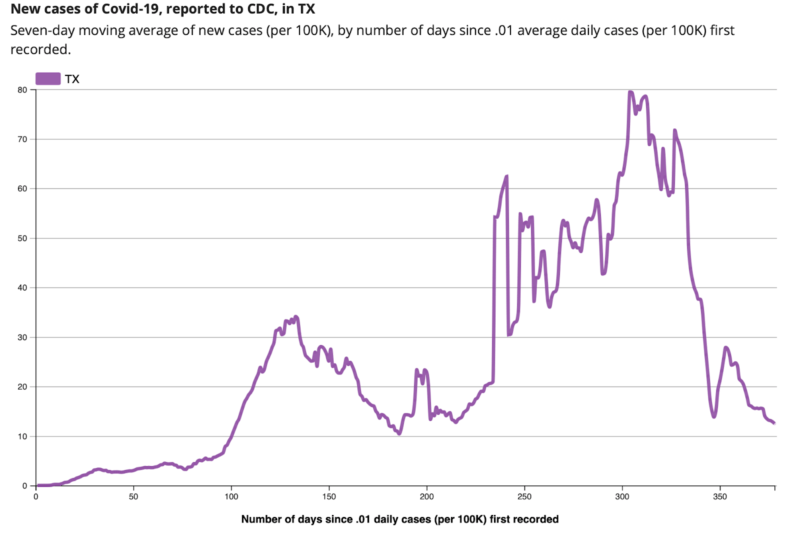
Here are the data.
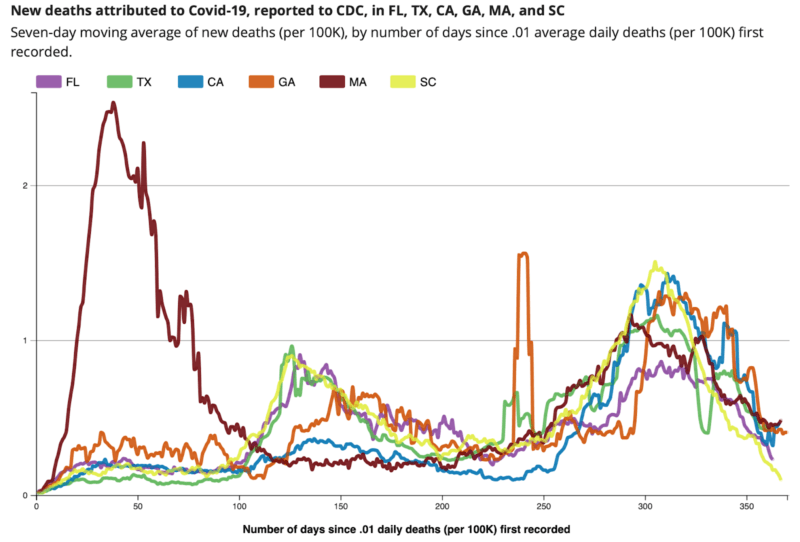
The CDC has a very helpful tool
that allows anyone to compare open vs closed states. The results are
devastating for those who believe that lockdowns are the way to control a
virus. In this chart we compare closed states Massachusetts and
California with open states Georgia, Florida, Texas, and South
Carolina.
What can we conclude from such a visualization? It suggests that the
lockdowns have had no statistically observable effect on the virus
trajectory and resulting severe outcomes. The open states have generally
performed better, perhaps not because they are open but simply for
reasons of demographics and seasonality. The closed states seem not to
have achieved anything in terms of mitigation.
On the other hand, the lockdowns destroyed industries, schools,
churches, liberties and lives, demoralizing the population and robbing
people of essential rights. All in the name of safety from a virus that
did its work in any case.
As for Texas, the results so far are in.
I’m making no predictions about the future path of the virus in
Texas. Indeed for a full year, AIER has been careful about not trying to
outguess this virus, which has its own ways, some predictable and some
mysterious. The experience has, or should have, humbled everyone.
Political arrangements seem to have no power to control it, much less
finally suppress it. The belief that it was possible to control people
in order to control a virus produced a calamity unprecedented in modern
times.
What’s striking about all the above predictions of infections and
deaths is not just that they were all wrong. It’s the arrogance and
confidence behind each of them. After a full year and directly observing
the inability of “nonpharmaceutical interventions” to manage the
pathogen, the experts are still wedded to their beloved lockdowns,
unable or unwilling to look at the data and learn anything from them.
The concept of lockdowns stemmed from a faulty premise: that you can
separate humans, like rats in cages, and therefore control and even
eradicate the virus. After a year, we unequivocally know this not to be
true, something that the best and wisest epidemiologists knew all along.
Essential workers still must work; they must go home to their families,
many in crowded living conditions. Lockdowns do not eliminate the
virus, they merely shift the burden onto the working class.
Now we can see the failure in black, white, and full color, daily
appearing on our screens courtesy of the CDC. Has that shaken the
pro-lockdown pundit class? Not that much. What an amazing testament to
the stubbornness of elite opinion and its bias against basic freedoms.
They might all echo the words of Groucho Marx: “Who are you going to
believe, me or your own eyes?”
Jeffrey A. Tucker is Editorial Director for the American Institute for Economic Research.
He is the author of many thousands of articles in the scholarly and popular press and nine books in 5 languages, most recently Liberty or Lockdown. He is also the editor of The Best of Mises. He speaks widely on topics of economics, technology, social philosophy, and culture.
Jeffrey is available for speaking and interviews via his email. Tw | FB | LinkedIn
From July 1997 until August 2001 I was president of the Foundation for Economic Education (“FEE”). Founded in 1946 by Leonard Read
(1898-1983), FEE joined with AIER (founded in 1933) in pioneering,
during post-war America, the nourishment and spread of the ideas and
ideals of classical liberalism.
My admiration for Read began twenty years before I became FEE’s
president. In 1977, as a college sophomore, I was introduced to his 1958
essay “I, Pencil.” The message was a thunderclap. To this day, Read’s classic essay remains one of my favorites of all things ever written.
But taking over FEE’s reins from the retiring Hans Sennholz inspired
me to dive more deeply into Read’s other, voluminous writings. One theme
that runs through these works is humility. Read never tired of
reminding his readers that the only person anyone really has any control
over is himself or herself. Leonard Read could share his knowledge and
wisdom with Sam and Sarah, but ultimately Sam and Sarah are each their
own stewards. Sam and Sarah can each choose to be taught by Read, but
the learning that each of these persons ultimately takes from Read is
determined by each of them.
Read’s deep understanding of individualism, and his equally deep
respect for individuals, prevented him from being judgmental. It was not
Read’s place to judge what other individuals do with whatever learning
they might take from him or from anyone else. As long as each of us
respects the rights and space of each of the rest of us, we should be
free to do – to use the title of what is perhaps Read’s most famous book
– anything that’s peaceful.
On the Covid-19 Experience
Read’s wisdom and humility were brought to my mind over the past few days by my own fear of the Covidocracy.
Hysteria over Covid-19 and governments’ correspondingly
disproportionate reaction to this disease are the greatest threats to
liberalism in my lifetime. By far. The quickness with which so many
people came to believe that avoiding Covid is worth any price was
stunning. The apparent failure – still – of most of my fellow human
beings to look for themselves at the actual data on Covid is
distressing. Ordinary people’s gullibility for mainstream “experts”
peddling tyranny is appalling. The widespread embrace of the
superstition that “the science” supplies an objective blueprint for how
human choices should be made is terrifying.
If one year ago I was accurately informed of all that governments
were to do from March 2020 through today – if one year ago I was shown
in a truthful crystal ball the manner in which the media were to portray
the disease and the many Covid restrictions – I would have predicted
that nearly every classical liberal and libertarian would have raised
his and her voice loudly, firmly, and unrelentingly against this tyranny
and madness. And if asked in March 2020 how confident I was in my
prediction, I would have answered, with the exclamation point,
“One-hundred percent!”
My prediction would have been proven wrong. Very wrong.
Of course, some notable liberals have been outspoken from the start
against Covid Derangement Syndrome and the Covidocracy. In the United
States, surely the most outspoken are the stable of writers at AIER. I’m
proud to be in their ranks.
But I’m shocked by how relatively quiet have been most prominent classical-liberal and libertarian voices.
This shock prompted me last week to write at my blog, Café Hayek, a post titled “Lockdown Tyranny.”
In that post, without naming names, I harshly decried the many
classical liberals and libertarians whose silence over the past year so
surprised and disappointed me.
In that post, I criticized people who did not do as I do. That criticism, alas, is inappropriate.
Also inappropriate was the smug sense of self-satisfaction that I
felt by issuing the post. A notion much like the following ran through
my mind: “I hope that I shame those who should know better about this
tyranny but who, for unknown reasons, are not publicly raising their
voices against it.”
But the one shamed was to be me.
Not long after the post went live, I received a telephone call from
one of my dearest and most trusted friends (who I will identify here
simply as “Friend” and with the admittedly ugly pronoun “s/he”). Friend
is the person in the world whose economics, ethics, politics, and
general understanding of humanity most closely match my own. S/he and I
agree on almost everything – including, fully, on the vastly over-hyped
dangers of Covid and on the underappreciated menace of lockdowns.
So when Friend said to me, in no uncertain terms, “You’re not going
to like my saying this, but your blog post is inappropriate,” I took
notice.
My initial impulse was to resist – to tell Friend that s/he doesn’t
understand what I’ve written. But Friend and I are too close for me to
have clung to that impulse for more than a nanosecond. If Friend is
critical, I’d better listen up.
Friend explained: “Don, you don’t know why any particular individuals
choose not to publicly speak out against the Covid panic and the
lockdowns. Those individuals might have good reasons. In fact, you
should assume that they do have good reasons. Maybe their
employers would punish them. Maybe the backlash from their families
would be too much to bear. Maybe many of them simply wish to keep in
their specialized lanes and not write or talk about a matter on which
they believe themselves to lack sufficient knowledge.”
“And finally,” Friend concluded, “maybe the persons you have in mind
assess the risks of Covid and of lockdowns differently than you do. Don,
you can challenge their understanding of the facts, but you’re wrong to
pass ethical judgment on these people for their failure to speak out.”
I sat, phone in hand, quietly thinking for a few seconds. That’s when
Leonard Read came to mind. “You’re right,” I replied sincerely to
Friend. I then wrote this follow-up blog post.
Humility and Tolerance
Liberalism has many facets. Especially important among these is
humility and the resulting tolerance. No matter how confident you are in
your knowledge about some matter, there’s always at least a slim chance
that you’re mistaken about that matter. There’s a slim chance that
those with dissenting views are correct.
To recognize this human reality is not to swear off pressing, even
vigorously so, a case for or against some policy if you have good reason
to be confident in the knowledge that leads you to press that case. But
you should resist leaping to the conclusion that those who disagree, or
who fail to express agreement, are failing either ethically or
intellectually. Giving others a capacious benefit of the doubt is
liberal, civilized, scientific.
This tolerance should not be unlimited. Some policies are so clearly
unethical as to justify confident, even harsh, criticism of those who
endorse these policies. To pick an obvious example, someone who calls
for a reinstitution of chattel slavery is so far beyond the pale as to
warrant harsh criticism and ridicule. (But always peacefully. Even such a
person retains the right to speak and write freely.) And the closer the
question comes to being one of objective ‘facts’ rather than one of
subjective values, the more justified is confident criticism of the case
made by someone who you believe to have his or her facts wrong. Also
more justified, therefore, is confident criticism of whatever normative
conclusions someone draws from his or her factually mistaken case.
But over a very wide range everyone deserves the benefit of the doubt
– both of that person’s interpretation of the facts, and of the
normative conclusions that he or she draws from that interpretation.
I Urge Others to Speak Up – But I Respect Their Right to Remain Silent
Again, I’m as confident as I can be that liberal civilization is now
in grave peril. Whether it’s called “safetyism” or “bioprotective
statism” or (as David Hart has named it) “hygiene socialism,”
the dangers are high and real of the sudden acceptance of the dual idea
that the worst fate that can befall a person is to come into contact
with a pathogen, and that the state must protect us from this fate by
imposing on us lockdowns, mask mandates, and other draconian
restrictions.
Civilization as we know it – liberal, free, dynamic, prosperous
civilization – cannot survive what I fear will be repeated rounds of
pathogen panic and the resulting Covidocracy-like tyranny.
And so I will continue with every sinew to publicly protest this madness – to play whatever role I can to persuade
people to temper their excessive fear of Covid – to warn whenever I can
of the many dangers of hygiene socialism – to urge in private my quiet
friends to break their public silence.
I cannot deny that I’ll feel much disappointment whenever I encounter
Mr. __’s or Ms. __’s refusal to add his or her voice to the protests
against lockdowns. Never will I understand how a classical liberal or
libertarian can behold what’s going on today in the name of fighting
Covid and not see misinformation and tyranny on such a scale as to
demand, from all of liberty’s friends, forthright public opposition.
But my failure to understand isn’t a sufficient warrant for me to
criticize those who remain silent. I will respect their choices. Showing
such respect is what Leonard Read would have done. It’s what my
ever-wise Friend does and will always do. The liberalism destroyed by
hygiene socialism need not have added to it the liberalism destroyed by
liberals’ own intolerance.
Donald J. Boudreaux is a senior
fellow with American Institute for Economic Research and with the F.A.
Hayek Program for Advanced Study in Philosophy, Politics, and Economics
at the Mercatus Center at George Mason University; a Mercatus Center
Board Member; and a professor of economics and former
economics-department chair at George Mason University. He is the author
of the books The Essential Hayek, Globalization, Hypocrites and Half-Wits, and his articles appear in such publications as the Wall Street Journal, New York Times, US News & World Report as well as numerous scholarly journals. He writes a blog called Cafe Hayek and a regular column on economics for the Pittsburgh Tribune-Review. Boudreaux earned a PhD in economics from Auburn University and a law degree from the University of Virginia.
Get notified of new articles from Donald J. Boudreaux and AIER.
here are probably multiple reasons why coronavirus cases in the US are down nearly 50% in the US in the last month.
Could be seasonal. Could be the vaccine. Could be herd immunity from natural infection.
Could be the post-holiday default to endemicity. Could be a change in
the cycle threshold of PCR that generates fewer positive cases. Could
be data tweaks in light of political changes.
Anyone who says he knows for sure which is dominant is pretending to know the unknowable.
The New York Times, which obliquely reports the case
decline, is still certain that you should still live in isolation, fear,
and disease panic. They offer every county in America a tool in
which you can discover what you should do to protect yourself from the
pathogen, as if the only way to deal with a respiratory virus is to
hide. Their tool is extremely manipulative.
For example, they have this category called “very high risk level.”
Red is in the text. Scary! But what is it? It means 11 or more people
per 100,000 have generated a positive PCR test for the coronavirus.
Not deaths. Not hospitalizations. Not even symptomatically sick. (Yes, I know the term “sick” is old fashioned.)
We are talking about 11 positive PCR tests. This is an infection rate of 0.01%. Consider too that the NYT reports that these tests in the past have generated up to 90% false positives. In addition, the infection fatality ratio for those under 70 could be as low as 0.03%.
Once you add all that up, you end up with a very long string of zeros
followed by some number (I’ll let someone else do the math; in any
case, all these data are mostly based on illusion). In any case, we are
talking about a vanishingly tiny chance of severe outcomes for the
population at large, depending almost entirely on demographics.
Still, the Times says you may not live a normal life. True,
people in Florida, Georgia, South Carolina, Texas, South Dakota, and
many others states are living happy normal lives. But they are all doing
it wrong, according to the New York Times.
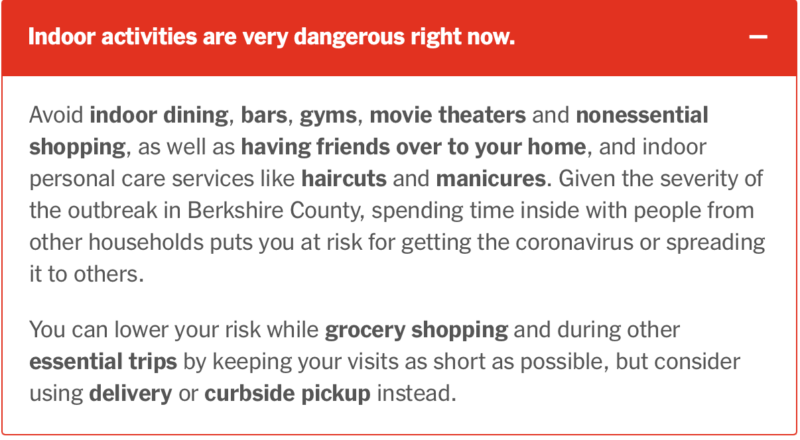
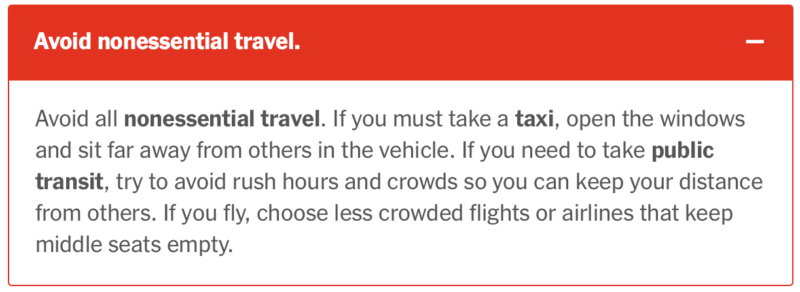
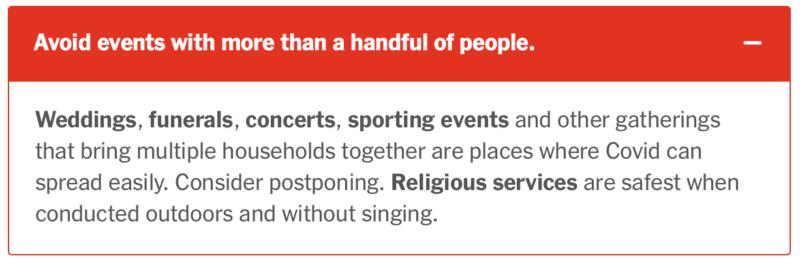
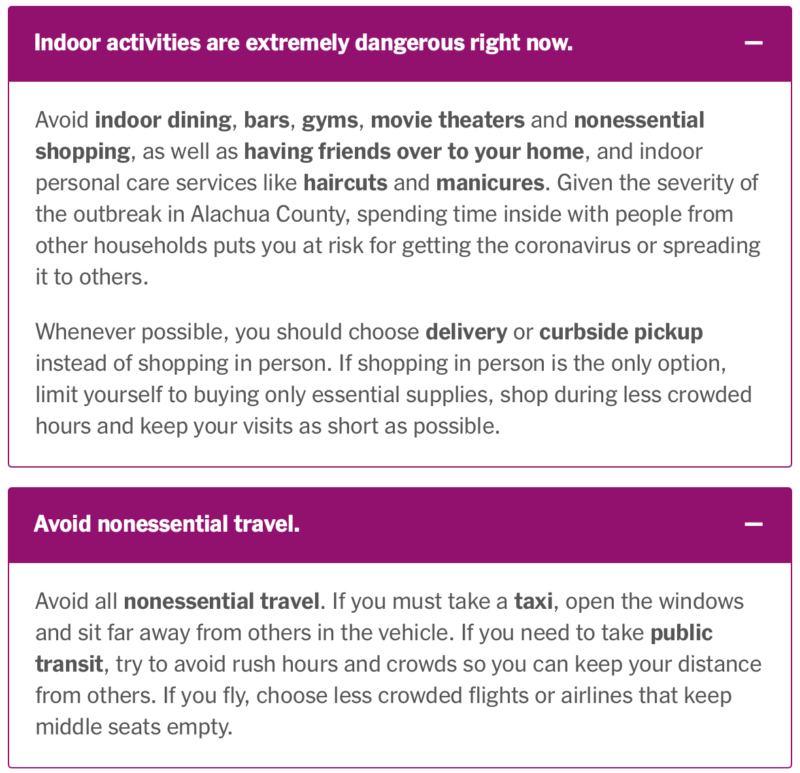
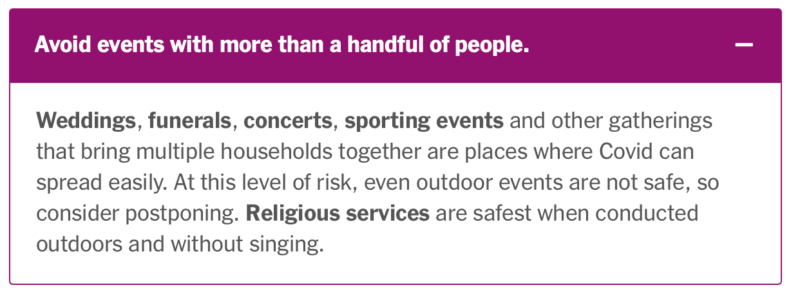
Let’s look at their life advice for anyone living in a “very high risk” area.
No haircuts, no manicures, no gatherings, no travel, no friends, no
bars, no restaurants, and no singing! BE VERY AFRAID…CONSTANTLY!
To me, all of this sounds like insanity defined. And look at how they
tip their ruling-class hand. People should not go to the store but
rather have their groceries delivered. Delivered by whom? Apparently not
readers of the New York Times.
To the Times, there is only us and them: the clean people
vs. the dirty people who get to travel to deliver to “us” our groceries
and essential services. Our job is to sit in a perpetual state of
disease avoidance while they operate as sandbags to create the herd
immunity from which we will benefit. It’s the new feudalism.
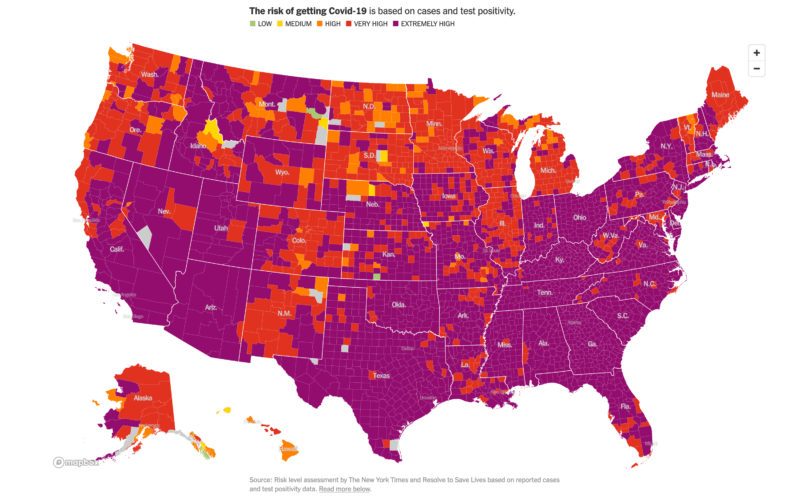
Now look what we must do for “extremely high risk” which pertains for as low as 20 PCR positives per 100,000 people.
Notice any difference between “serious” and “extreme” risk? That’s
right. There is none. They are identical. And if you look at the map
above you can see that right now most of the country is in extreme risk,
according to the Times. According to this preposterous map, there are
only two counties in the US at low risk.
Let’s look at Prairie County, Montana.
It’s one of the two places you can live without the terrifying prospect
of dropping dead from disease. There are 1,300 people living there. If
one person tests positive, that immediately shifts the entire county
into extreme risk. So the trajectory since November 1 looks utterly
hilarious, toggling between low and extreme risk with a total of 70
cases in three months with most daily cases at exactly 0.
So what according to the Times should the good people of
Prairie County do? They should be grateful to be relatively safe but try
to their best to stay put! Do not go anywhere near the scary places
elsewhere! They should stay in their bubble!
Look, at some point, the media is going to have to admit complicity
in the creation of this extremely unscientific, pathological,
unwarranted, and deeply destructive disease panic. They created it,
starting with the now-discredited Donald McNeil’s February 27, 2020, recommendation that we “go medieval” with the coronavirus.
This whole paradigm amounts to a rejection of public health, which is
always not just about one pathogen but all threats to human health and
not just for the short term but the long term. The defining mark of 20th
century public health as distinguished from the Middle Ages is that we
recognized that pathogens are all around us and need to be managed
rationally. Oh also the paradigm rejects human rights and freedom.
We do not need to destroy society, lock people in their homes, tear
down businesses, close schools, traumatize kids, drive people to
alcoholism and drug abuse, divide society between the clean ruling class
and the dirty working class, ban travel, close churches, abolish
choirs, close the arts, and whip up the population into a frenzied
psychological meltdown in order to deal with a new strain of a
respiratory virus. But tell that to the New York Times.
Jeffrey A. Tucker is Editorial Director for the American Institute for Economic Research.
He is the author of many thousands of articles in the scholarly and popular press and nine books in 5 languages, most recently Liberty or Lockdown. He is also the editor of The Best of Mises. He speaks widely on topics of economics, technology, social philosophy, and culture.
Jeffrey is available for speaking and interviews via his email. Tw | FB | LinkedIn
Covid19
has already passed through all 50 states as a single major contagious
wave in each state. There were 33 early states where the epidemic was
over by June, and 14 late states where the epidemic now is ending.
Every
week in America about 51,000 people die from all causes. This number
rises and falls during the winter due to flu-like illnesses and goes
back to baseline in the summer. No one panics about it, and most people
don’t even realize that it happens. This year was worse than normal,
but we’ve almost returned to baseline.
But this year -- everyone panicked! William Briggs has documented this in his Coronavirus Update series, and this article adds to his analysis by examining state level data.
As
Briggs has argued, the most important data is the data for deaths from
all causes. Covid19 attributed deaths are subject to interpretation as
either died from or died with Covid19, and death certificates can be
misleading because of the attribution of cause (here and here.) The bubble burst his week when the CDC reported that only 6% of the total Covid19 attributed deaths were from the virus alone..........Briggs also has argued in his Coronavirus Updates that massive public testing has contributed to panic about the virus. Nationally, we are performing about 5 million tests per week......
Nature controls the virus, not the politicians. The ignorant will always be with us, just like the virus. But the virus is not that hard to figure out. Don’t panic. Keep the big picture in mind. Quarantine the sick. Protect the elderly. Let the rest of us free breathing Americans live our lives.........To Read More....
Prager U is looking at the impact of lockdown on our mental health and asking, "Was it worth it?"
In the last 30 days, around 40% of people have reported mental or
behavioral health issues, 30% anxiety or depression, 26% trauma and
stress and 10.7% have considered suicide. You need to say it twice to stop yourself reading it like a shopping
list. During lockdowns, one in ten people have considered suicide in
the last 30 days. Look around you. One in ten...............4 in 5 U.S. workers live paycheck-to-paycheck. What do you say to a
father who no longer has an income to pay the rent? Or a mother made
redundant in March with no money to buy food? For many of us work is
about much more than satisfying bills, or a providing a home. There is
dignity in work, and indignity in the losing of it. This is not unique
to lower income homes................Our reaction to this virus has been far more aggressive and deadlier than the virus itself...........To Read More.....
COVID-19 can cause a fever, but nothing like the fever of hysteria gripping broadcast and social media over hydroxychloroquine, a potential treatment for the Wuhan flu. Ever since President Trump mentioned hydroxy as a possible therapeutic, the media have castigated it as worse than rat poison. They've criticized any use of it in a constant barrage of fear porn, telling everyone that this 60-year-old drug would kill anyone who dared take it.
When Trump mentioned he was taking hydroxychloroquine as a preventative, Fox News crank Neil Cavuto had a seizure, telling his audience, “I cannot stress enough. This will kill you.” Tell that to those Americans taking hydroxy to the tune of five million prescriptions written each year
Hydroxy was FDA-approved in 1955 and is taken for lupus and rheumatoid arthritis. FDA approval
means the approved drug is both efficacious and safe. All of a sudden, after 60 years, the FDA decided hydroxy is no longer safe because of, “serious heart rhythm problems and other safety issues, including blood and lymph system disorders, kidney injuries, and liver problems and failure.” If it is so unsafe,
why did the FDA not rescind its 60-year-old approval?...........To Read More...
Could the coronavirus that caused the outbreak of the COVID-19 pandemic evolve naturally? Based on what is publicly known at this time, it probably could, but there is no scientific evidence that it actually has. As of today, no animal has been found to carry the coronavirus that infected Chinese individuals in Wuhan with COVID-19 in the fall of 2019. Yet the mass media and their so-called "fact-checkers" keep propagating the unproven speculation that the virus did not leak from the Wuhan Institute of Virology, as if it were some kind of "settled science."
A Washington Post article titled "State Department releases cable that launched claims that coronavirus escaped from Chinese lab" is a recent example of this kind of sustained propaganda. It downplays the fact that, as reported by the State Department in 2018, the personnel at the Wuhan Institute of Virology were not properly trained to safely handle live samples of contagious coronaviruses. It ignores the fact that bio-safety concerns about the Institute's equipment and operations had been raised in the past by international experts (e.g., here [1]). It does not even mention that the Institute did have the capability, in terms of technology and personnel, to genetically engineer mutations of the existing coronaviruses in order to make them more contagious, and that research in that direction was actually carried on there. Above all, the said article fails to indicate that, following the first signs of the outbreak of COVID-19, the Chinese authorities systematically destroyed or removed virtually all the evidence that could possibly implicate the Institute as the actual origin of the pandemic.
Fear over the coronavirus has exploded in recent weeks. As the
mainstream media continues to fear monger and snowball healthy concern
into hysteria, Americans should view their reporting through a skeptical
lens. Keeping a level head and injecting a dose of nuance into the
conversation will help to prevent state and local governments from
overreacting and sliding into another broad lockdown.
A recent CNN headline reads, “Coronavirus cases in the US continue to surge, reaching nearly 1 out of every 100 American.” CBS News recently reported the pandemic to be “worse than ever in the U.S.” An NBC News headline referred to developments in the pandemic as an “explosion.”.............But does the science back-up the doomsday headlines? Statistics suggest no.........To Read More....