Search This Blog

De Omnibus Dubitandum - Lux Veritas

Showing posts with label Climate Change. Show all posts

Tuesday, January 21, 2025

Report: How Did The Biden Administration Do On Solving "Climate Change"?

We are now in the last hours of the Biden Administration. Today the Bidenauts complete four full years in office. And as we all know, their number one priority from the day they took office was to address what they called the “climate crisis” (or sometimes, the “profound climate crisis”). Famously, after lavishly promising on the campaign trail to address and solve the crisis, newly-installed President Biden then issued multiple Executive Orders on the subject in his early days in office, most notably this one from January 27, 2021. He promised an “all of government” approach, with every department and agency explicitly tasked to make addressing the climate crisis central to their mission. In the following years, Biden proposed and then pushed through Congress legislation containing hundreds of billions of dollars worth of subsidies and tax benefits for so-called “renewable energy,” said to be the solution to the climate crisis through replacing carbon-emitting fossil fuels with clean and green wind and solar substitutes.

To remind you of the level of the promises that were made, consider the preamble of that January 2021 EO, which had the title “Executive Order on Tackling the Climate Crisis at Home and Abroad”:

The United States and the world face a profound climate crisis.  We have a narrow moment to pursue action at home and abroad in order to avoid the most catastrophic impacts of that crisis and to seize the opportunity that tackling climate change presents.  Domestic action must go hand in hand with United States international leadership, aimed at significantly enhancing global action.  Together, we must listen to science and meet the moment.

With Biden now leaving office, this is an appropriate moment to take a look at exactly what “progress” has been made toward the promised reductions in emissions. The answer is, any emissions reductions have been so tiny as to be almost imperceptible.

In the big picture, whatever emission reduction have been achieved have mostly resulted from substitution of natural gas for coal in electricity generation. This substitution would likely have occurred by natural market processes without any of the government subsidies and credits for wind and solar power.

To help us in our review, the federal Energy Information Administration (EIA) puts out monthly data on energy production and consumption in the U.S. These data have been updated through September 2024. The EIA data on “primary energy” can be found at this link, and the data on electricity generation and consumption at this link.

Primary Energy

The term “primary energy” refers to all energy used in the economy in all sectors — not just electricity, but also transportation (cars, trucks, trains, planes), industry, agriculture, buildings, and everything else. In other words, this is the full picture.

Go to Table 1.1 at the primary energy link for the “Primary Energy Overview.” Here we find that in 2020 — the last year of the prior Trump administration — the U.S. consumed a total of 88,872 Quadrillion Btus of primary energy, of which 73,169 QBtus from fossil fuels, 8,251 QBtus from nuclear, and 7,290 QBtus from “renewable energy.” (Note that the “renewable” category is not just wind and solar, but also includes things like biomass and geothermal.). Anyway, doing some simple division, that would make 82.3% from fossil fuels, 9.3% from nuclear, and 8.3% from renewables.

The last full year of data are for 2023. Total primary energy consumption was 93,691 QBtus, of which 77,271 QBtus came from fossil fuels, 8,099 QBtus from nuclear, and 8,256 from renewables. The percentages are then 82.5% from fossil fuels, 8.6% from nuclear, and 8.8% from renewables. (Percentages may not add up to exactly 100% due to rounding.). The percent from fossil fuels actually increased slightly from 2020.

Only nine months of data are available for 2024, but those show little change in relative shares: 70,345 QBtus total primary energy consumption, of which 57,662 from fossil fuels, 6,168 QBtus from nuclear, and 6,478 QBtus from renewables. Thus 82.0% from fossil fuels, 8.8% from nuclear, and 9.2% from renewables.

With all the endless hype about the climate crisis and the hundreds of billions of dollars of federal largesse going into forcing an “energy transition,” would you ever have believed that these numbers would have moved so negligibly?

Electricity generation

The data on electricity generation by source are found in Table 7.2a at the electricity data link above. This time the data are not so helpfully grouped as in the last table, so some addition is necessary to get useful categories for our purposes. Fossil fuels are broken down into coal, oil, natural gas, and “other fossil fuels.” “Renewables” include not just solar and wind, but also “hydro,” and “wood, waste, and geothermal” (WWG), which are larger categories than you might think.

For 2020, the total generation is 4,009 terawatt hours, of which the fossil fuel categories add to 2,429 TWh, nuclear is 790 TWh, and the renewables total the remaining 790 TWh. But of the renewables, wind is 338 TWh, solar is 89 TWh, hydro is 280 TWh (net of some losses on pumped storage), and the remaining WWG renewables come to 70 TWh. So the percentages are 60.6% fossil fuels, 19.7% nuclear, 7.0% hydro, 1.7% WWG, 8.4% wind, and 2.2% solar.

Fast forward to 2023, and we find 4,183 TWh of total generation, of which 2509 TWh came from fossil fuels, 774 TWh from nuclear, 239 from hydro, 64 TWh from WWG, 166 TWh from solar, and 421 from wind. So now the percentages are 60.0% fossil fuels, 18.5% nuclear, 5.7% hydro, 10.0% from wind, 4.0% from solar, 1.5% from WWG.

Again, could you have imagined that the needle could possibly have moved so insignificantly? With all the vast subsidies and investments thrown at wind and solar, their percentage of the mix has just gone from 10.6% to 14% in three years, while fossil fuels have gone down from 60.6% to 60.0%, less than a 1% change.

For the first nine months of 2024, fossil fuels generated 59.5% of electricity, while wind generated 10.1% and solar generated 5.2%. Despite the billions upon billions of taxpayer subsidies, they creep upwards at an almost imperceptible pace.

Emissions

And has all the money lavished on buildout of wind and solar generators had any noticeable impact on carbon emissions? The two EIA pages linked above don’t have information on emissions, but here is another page with some useful information on that subject, titled “U.S. Energy-Related Carbon Dioxide Emissions, 2023.” Excerpt:

CO2 emissions from the electric power sector declined by 7% (115 MMmt) in 2023, making up 85% of net energy-related CO2 emissions reductions observed over the year. The reduction was due to both a slight decrease in electricity demand, which fell by around 1% in 2023, and a significant decrease in coal-fired electricity generation caused by reduced coal-fired generating capacity prompted by competition with other generation sources. Electric power generation from coal fell by 19%, or 155 terawatthours (TWh), in 2023. Most of this generation was displaced by natural gas which increased by 7% (113 TWh) and by solar which increased by 14% (21 TWh). Because coal-fired generation emits more CO2 per kilowatthour than natural gas when combusted, replacing coal-fired with natural gas-fired generation reduces CO2 emissions overall.

Thus by far most of the retired coal generation was replaced by natural gas, and a small percentage by solar.

In summary, in four years the Biden administration made almost no progress in reducing “emissions,” other than a small amount of reductions that came from substituting natural gas for coal in the production of electricity. That substitution came about through market forces (i.e., low natural gas prices) and was not even the subject of the vast energy transition subsidies made available by the government. Although renewables made some small inroads in electricity production, the increase in their share in primary energy production over the four Biden years was barely noticeable (less than 1%).

The attempt to transition our energy system via command from central planners has been one of the greatest wastes of taxpayer funds ever perpetrated by the government. It cannot be ended soon enough.

Thursday, December 21, 2023

Chinese Communist Party linked to funding climate activists in the U.S. and U.K.

December 21st, 2023 By Joanne Nova @ CFACT

The Chinese Communist Party just wants to save the Earth, right? Even though China is the largest single user of fossil fuels on Earth, for some reason The Energy Foundation China — an NGO dedicated to worrying about carbon emissions — spent nearly $4 million working on reducing US emissions instead of Sino ones. They also spent some  undisclosed amount helping the Grantham Research Institute in London last year. So we have donors in a developing country giving generously to the US and UK because the rich first world is too poor to fund their own environmental philanthropy groups, right?

 The Energy Foundation China (EFC) generously wants to help the US phase out coal and electrify their cars. But that’s just the nice political power that the CCP is (the kind that also builds fortified islands in shipping lanes):

CCP-Tied Group is Quietly Fueling US-Based Climate Initiatives: Tax Filings - By Thomas Catenacci , Joe Schoffstall Fox News

A climate-focused nonprofit with significant operations in Beijing has wired millions of dollars to fund climate initiatives and environmental groups in the U.S., according to tax filings first obtained by Fox News Digital.

While the Energy Foundation’s financial filings indicate that the group is technically headquartered in San Francisco, a Fox News Digital review determined that the majority of its operations are conducted in China with a staff that boasts extensive ties to the Chinese Communist Party (CCP). Its recently filed tax form show the group, which refers to itself as “Energy Foundation China,” contributed $3.8 million to initiatives in the U.S. like phasing out coal and electrifying the transportation sector.

The Fox authors list several examples of how the EFC spends their money on climate policy activism. For example, the Chinese group gave $375,000 to the Natural Resources Defence Council (NRDC) — a non-profit in the US that files legal challenges to stop oil pipelines, drilling, coal plants and other mining activities. The head of the NRDC says they get no money from China, and protests that the Energy Foundation is based in San Francisco, but the Fox authors explain that not only does the group lease office facilities in Beijing, but their CEO and President used to be the deputy director general of China’s National Centre for Climate Change Strategy. The program director of the EFC’s “industry program” spent eight years at the Chinese Academy of Sciences.

The US Energy Foundation gave birth to the Energy Foundation China

The Fox news article could have explained the relationship of the Energy Foundation with the Energy Foundation China. They are separate now, but for twenty years they were one and the same.

According to InfluenceWatch, the large, original Energy Foundation was set up in the US in 1991. Later, in 1999, the Packard Foundation would help to set up Energy Foundation China. In 2019 the Chinese branch officially split from the US larger group, except it based its headquarters in San Francisco too (which seems odd if they are trying to influence China?).

The parent US “Energy Foundation” is so huge it gave an amazing $52 million dollars (US) to groups around the world last year. Ponder that somehow the Energy Foundation China was fully enmeshed as a part of that giant machine from 1999 to 2019.

 A quintessential “pass through” for donors…’ InfluenceWatch notes that way back in 2014, a US Senate committee already felt the Energy Foundation was a conduit for donors to funnel money to left-wing activism without being easily traced:

A July 2014 report by the Senate Committee on Environment and Public Works’ Republicans called the Energy Foundation “a quintessential example of a pass through” for donors who want to fund left-wing environmentalist activism while avoiding accountability for traceable connections to activist groups. The report also stated that the foundation, which cannot support political campaigns directly, transfers money to other groups that can thanks to loopholes in the tax code.

More profits and power for China

China controls the rare metals market, builds the wind turbines and solar panels, and now also the EV’s. Obviously, on a pure self-serving business level, the CCP would be crazy if they weren’t amplifying Green fantasia in the West in order to sabotage the competition. And the idea of undermining energy security and the general industrial power base of the West might also appeal to CCP leaders. And hypothetically, if it did, what would stop it happening — investigative reporting from The ABC or the BBC? As if.

Related info: Energy Foundation (US) Recent Grants

This article originally appeared at JoNova


Monday, November 20, 2023

Climate Enron may be heading for a crash

By Duggan Flanakin  November 18th, 2023 @ CFACT

The modern American version of “the environmental emperor has no clothes” until now has been the rise and fall of Enron. As former Ken Lay speechwriter Robert Bradley, Jr., says, “(T)he cause of Enron’s financial bankruptcy were at root philosophical…. Enron’s leaders were certainly engaged in massive philosophical fraud – an attempt to cheat reality itself.”

For years, Enron was hailed as one of the most forward-thinking corporations, and Lay, its founder and CEO, was a man in great demand. During his 13-year tenure that ended with a bang in 2021, Lay collected over $220 million in cash and company stock, and just months before “the largest bankruptcy in America” (at that time), Lay gave five presentations at the 2001 World Economic Forum meeting in Davos.

As Bradley, now the CEO of the Institute for Economic Research, recounts, Lay was the salesman promoting a business model developed by Jeffrey Skilling, who Lay had brought on as chief operating officer. In Skilling’s “mark-to-market” accounting, anticipated future profits from any deal were accounted for by estimating their present value rather than historical cost. Thus, argued Skilling, Enron did not really need “assets.”

It just needed connections.

And that was Lay’s special skill. His idea was to embrace a “revolution always” business philosophy, which Bradley called “a perpetual search for the first-mover advantage.” To that end, he became all things to all people, winning favor from Republicans, Democrats, environmentalists, minorities, and business leaders. His “illusion-making,” in effect, created a smokescreen so strong that nearly everyone was caught by surprise when the bubble burst.

Today, the collapse of FTX and the recent criminal conviction of founder and CEO Sam Bankman-Fried (who is facing a lifetime behind bars) bring Enron, Skilling, and Lay to mind. But, despite the magnitude of SBF’s fraud, it pales in comparison to the ongoing fraud being perpetrated mostly on America and its Western allies in the name of “climate change.”

A bit like FTX, but unlike Enron, there are plenty of warning signs that the “Green Revolution” is about to come tumbling down and its loudest advocates brought to account. The main thing keeping the mirages afloat today is the massive egos and their investments in folly that may leave them going down with the ship.

While the “Green Revolution” has been underway for decades, it is the Biden Administration that has imposed mandates, attacked popular energy sources and transportation options, and waged war against traditional industrial development. Europeans and states like California had earlier imposed their own mandates with supposedly “hard” deadlines for abolishing the use of oil, natural gas, coal, and every tool or vehicle that uses them.

The green war on fossil fuels, as fleshed out in the “Net Zero” campaign, is perhaps history’s greatest example of philosophical fraud.

“To dream the impossible dream” and turn it into reality would mean sacrificing an estimated 6,000 useful products that rely on byproducts from crude oil refineries – products that range from asphalt for highways to fertilizers, cosmetics, synthetic rubber, medicines and medical devices, cleaning products, plastics, and so many more. The 3 billion who live without the benefits fossil fuels have provided are also the poorest, sickest, and most vulnerable humans on the planet.

Cracks are already developing in the “Net Zero” world, what with countries backing away from the mandates they so recently touted while marching around like peacocks in mating season. In March, the European Union reached an agreement with Germany to formally back away from its total ban on internal combustion engines in 2035.

Still, 30 countries are signatories to the Glasgow Declaration that would force all vehicles sold by 2040 to have zero carbon dioxide emissions, and 21 others have crafted plans to ban new ICE vehicle sales earlier than 2040. Dozens of major cities and states, most notably California and the California clone states, intend to disallow new ICE vehicles by 2035.

Several problems stand in the way of their utopian dream. Even EV advocates are now admitting the “EV-olution” has to overcome “serious issues” — like the use of child labor in lithium mining, the woefully inadequate EV charging infrastructure, and an unprepared power grid. Yet the biggest obstacle is that a majority of the Earth’s people object to having EVs – or heat pumps, or electric stoves, and so on — shoved down their throats.

EVs may be fine for short-trip urban travel but not for construction equipment, airplanes, or even urban buses, as evidenced by the recent horrific scene in San Francisco when a Google-operated electric bus lost power and slid backward downhill into nine vehicles. Today’s EVs are wholly impractical for mountain and prairie residents or others making long trips (worse with children).

Like Ken Lay with Enron, the Green Revolution has relied heavily on government subsidies and a “revolution always” business philosophy aimed at making pariahs of anyone who dares oppose the grandiose – but fatally flawed – plan.

During the Obama Administration, Solyndra went under despite a $535 million government-guaranteed loan, none of which was paid back. Forbes, citing OpenTheBooks.com, noted that taxpayers were left holding the notes for $400 million given to Abound Solar, $280 million wasted by CaliSolar, $193 million doled out to Fisker Automotive (with another $336 million canceled), and $132 million to A123 Systems (a failed battery maker).

Undaunted, the Biden Administration’s $2.3 trillion “jobs” package was rife with more subsidies for technologies that, by their own admission, are unsustainable. Yet despite all the free money, Ford, General Motors, and many other automakers are backing away from multibillion-dollar investments in new EV factories as new EV sales have slowed despite increased rebates.

Ford in March projected a loss of $3 billion on electric vehicles in 2023, offsetting profits of as much as $14 billion from its other divisions. Ford also admitted losses of $900 million in 2021 and $2.1 billion in 2022 in its EV division. Ford and GM believe their EV fortunes will turn around by 2025, but those rosy scenarios seem wholly dependent upon Biden (or an even “greener” Democrat) winning the White House next November.

Even with a Green win in 2024, reality will still bite the EV dream. China has been quietly moving toward total dominance in the global EV marketplace – largely because it controls the lithium battery market. Financial Times wrote in September that China is so far ahead in the EV market that its competitors are trailing in the dust.

Biden’s reliance on huge subsidies to underwrite the “Green Revolution” has brought soaring inflation to the U.S. that is taking away purchasing power faster than it can increase subsidies and Mafia-style “incentives” (you will buy what we want you to buy, or else!).

Lay died of a heart attack shortly after his trial, leaving behind “a legacy of shame” characterized by “mismanagement and dishonesty” that led Politico to rank him as the third-worst American CEO of all time.

America’s doddering President Biden, now facing pre-impeachment hearings for other alleged mistakes, may not live to see his name smeared as Lay’s once was. But does anyone truly believe Biden is calling all the shots here?

Who will, then, get the blame if America’s forced march to EV subservience to Xi’s China brings an end to America’s hegemony on the world stage?

This article originally appeared at Real Clear Energy

Friday, January 7, 2022

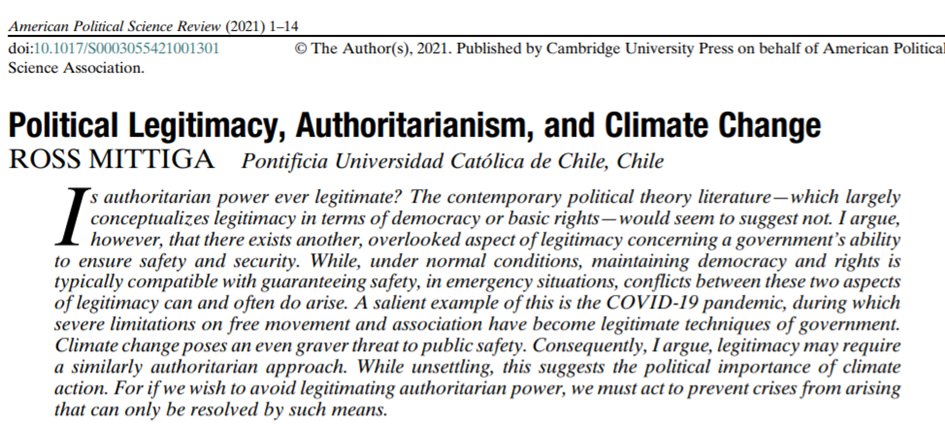
Climate lockdown: Paper published in prestigious journal laments ‘democracy’ & calls for ‘authoritarian environmentalism’ modeled after COVID lockdowns to fight climate ’emergency’

By Marc Morano

Political Legitimacy, Authoritarianism, and Climate Change - Published online by Cambridge University Press - American Political Science Review, December 6, 2021

Ross Mittiga, Professor Department of Politics at University of Virginia (Former Assistant Professor, Instituto de Ciencia Política, Pontificia Universidad Católica de Chile ross.mittiga@uc.cl )

Abstract Excerpt: Is authoritarian power ever legitimate? ... While, under normal conditions, maintaining democracy and rights is typically compatible with guaranteeing safety, in emergency situations, conflicts between these two aspects of legitimacy can and often do arise. A salient example of this is the COVID-19 pandemic, during which severe limitations on free movement and association have become legitimate techniques of government. Climate change poses an even graver threat to public safety. Consequently, I argue, legitimacy may require a similarly authoritarian approach." 

 Image

 Image

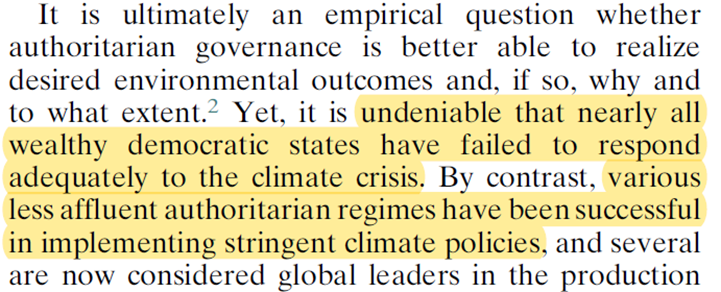
The paper's author Ross Mittaga, calls for "authoritarian environmentalism" to address the alleged climate "emergency." : "It is ultimately an empirical question whether authoritarian governance is better able to realize desired environmental outcomes and, if so why and to what extent? Yet, it is undeniable that nearly all wealthy democratic states have failed to respond adequately to the climate crisis. By contrast, various less affluent authoritarian regimes have been successful in implementing stringent climate policies..."............To Read More....

Watch: Morano’s full 25 min speech on Climate Lockdowns at Heartland Skeptic Conference in Las Vegas


Wednesday, April 28, 2021

Ever Deeper And Deeper Into "Climate" Fantasy

/

It never ceases to amaze me how the very mention of the word “climate” causes people to lose all touch with their rational faculties. And of course I’m not talking here just about the ordinary man on the street, but also, indeed especially, about our elected leaders and government functionaries.

The latest example is President Biden’s pledge, issued at his “World Climate Summit” on April 22, to reduce U.S. greenhouse gas (GHG) emissions by 50 - 52% from the levels of 2005, and to do so by 2030. In my last post a couple of days ago, I remarked that “Biden himself has absolutely no idea how this might be accomplished. And indeed it will not be accomplished.” Those things are certainly true, but also fail to do full justice to the extent to which our President and his handlers have now left the real world and gone off into total fantasy.

Back in 2016, when Barack Obama was President and it was time to go along (or not) with the Paris Climate Agreement, the idea still existed in the government that pledges to reduce GHG emissions ought to bear some relationship to reality. The pledge made by Obama on behalf of the U.S. in the Paris Agreement was to reduce GHG emissions by 26 - 28% from the 2005 level, and to do so by 2026. In 2016, U.S. GHG emissions were already down by more than 12% from the 2005 level, from 7,423.0 MMT CO2e in 2005 to 6520.3 MMT CO2e in 2016, according to the EPA’s Inventory of U.S. Greenhouse Gas Emissions and Sinks (see chart at pages ES 7-9); and that had been with very minimal coercive input from the government. If a 12% reduction could be achieved in the first 11 years, then a further 14% reduction in another 10 years would not be wildly out of line.

Indeed, it appeared that Obama’s people had the already-existing gradual pace of decline in mind when they made their commitment. Much of the decline in GHG emissions from 2005 to 2016 came about from the fracking revolution, and accompanying substitution of (lower emissions) natural gas for (higher emissions) coal; and most of the rest resulted from gradual efficiency improvements in energy usage throughout the economy. It would not have been crazy in 2016 to expect those things to continue at roughly the same pace.

But let’s consider where we are now. GHG emissions for 2019 were 6,558.3 MMT CO2e, which was actually up from 2016. Emissions for 2020 are said to have been down about 10% from 2019, but almost entirely due to steep declines in driving and air travel due to the pandemic. Those emissions from transport almost certainly will come back, perhaps not all right away, but almost all within a couple of years, if indeed there are not increases.

Even with the 10% decline in emissions in 2020, we’re down only about 20% from 2005. If you believe that travel will shortly come back to pre-pandemic levels, we will then be down only about 10% from 2005. Biden’s pledge is a 50% reduction from 2005, so something in the range of 30 - 40% additional in just nine years. And note that Biden is not just talking about the electricity sector (only about 30% of emissions), but about things like transportation (driving and flying), home heating, agriculture and industry that today almost completely depend on fossil fuels.

In a piece at Substack on April 22, Roger Pielke, Jr., gives an idea of what Biden’s pledge would mean in the real world.

Net greenhouse gas emissions were 6.635 gigatonnes (Gt) of carbon dioxide equivalent in 2005, so a 50% reduction target is 3.318 Gt in 2030. In 2019, there were 5.769 Gt of net emissions, meaning that by 2030, the U.S. will have to reduce its emissions by about 2.450 Gt, or more than 270 Gt per year. That equates to an annual rate of emissions reductions of about 6.3% to 2030.

Since we’re not likely to have solar-powered airplanes or steel mills any time soon, the main focus of emissions reductions of this magnitude can only be the electricity sector. And then, given that the entire electricity sector is only about 30% of emissions, the whole sector basically needs to go to zero emissions to meet the Biden target. What would that look like? Pielke:

In January 2021, according to the US Energy Information Agency in the United States there were 1,852 coal and natural gas power plants that generated electricity. By 2035, to hit President Biden’s target all of these power plants will have to be either shut down or converted into zero-emissions power plants (using carbon capture and storage technologies that presently do not exist).  There are 164 months until 2035. That means that more than 11 of the fossil fuel power plants operational in January 2021 will need to be closed every month, on average, starting today until 2035. 

And of course there is nothing out there remotely capable of filling the gap caused by shuttering those 1,852 plants. Wind and solar, even if you blanket the country with them, are next to useless without keeping the majority of the coal and natural gas plants as backup. Nuclear? Theoretically it could work, but given the lead times involved there would have to be hundreds of such plants already far along in planning and construction to try to meet this kind of goal. There aren’t. And the same environmentalists demanding an end to fossil fuels also oppose nuclear with equal fanaticism, and would be there to block you at every step of the process.

For a closer look at reality on the ground, let’s consider some recent developments in New York. New York fancies itself as the great climate messiah, leading the country and even the world into the future zero emissions utopia. In 2019 New York enacted something called the Climate Leadership and Community Protection Act, which they describe on their website as follows:

On July 18, 2019, Governor Andrew M. Cuomo signed into law the Climate Leadership and Community Protection Act (Climate Act). New York State’s Climate Act is the among the most ambitious climate laws in the world and requires New York to reduce economy-wide greenhouse gas emissions 40 percent by 2030 and no less than 85 percent by 2050 from 1990 levels.

Regulations to implement these drastic emissions reductions mandated by the law were finalized by the Governor in December 2020. Surely,, then, we are well off to a great start on our emissions reductions?

Actually, at the same time as we have adopted this noble-sounding Act and regulations, what we’ve really been doing is closing our big zero-emissions nuclear power plant and replacing it with brand-new natural gas facilities. Until last year, about 25 - 30% of the electricity for New York City came from a nuclear plant about 40 miles north of the City called Indian Point. Even as he has also talked endlessly about carbon emissions reductions, Governor Andrew Cuomo has made closing the Indian Point reactors a political priority. Of the two operating reactors at Indian Point, one closed in 2020, and the second is now scheduled to cease operations on April 30, 2021 — that is, at the end of the current week.

But they couldn’t close Indian Point without something to replace the power. And so, two big new natural gas-burning facilities have opened in the past few years. First, a 680 MW natural gas plant called CPV Valley Energy Center opened in Wawayanda, New York in February 2018; and then a 1000 MW natural gas plant called Cricket Valley Energy Center opened in Dover, New York, in April 2020.

Supposedly the big solution going forward is going to be vast amounts of offshore wind turbines to be built out in the Atlantic Ocean off Long Island. So far, it’s nothing but talk. One of the proposals to advance the farthest calls for a big 15 wind turbines off the Eastern tip of the island. But if the turbines are built, the power will need to come onshore by cable at some location. In January the Town of East Hampton granted an easement for the cable to come onshore in an area called Wainscott — and immediately a group of wealthy homeowners in the area brought a lawsuit to block it. We’ll see where that goes.

But it gets even worse. Just last week, something called the Bureau of Ocean Energy Management in the federal government canceled two of the wind energy development zones off Long Island. According to a report April 20 in the Wall Street Journal:

“Bureau of Ocean Energy Management officials said the zones off the island’s coast raised problems with maritime traffic, marine life feeding areas, and concerns over visibility from South Shore beaches. In short, they were a nuisance to fishermen, shippers and gentry with homes in the tony Hamptons area full of Manhattanites during the summer.”

In other words, despite the big talk, and lots of spending and subsidies, all the “progress” so far towards zero emissions has been negative. I guess it can be like the “anti-poverty” efforts of the government, where every year we have more and more programs and spend more and more money and the measured poverty never goes down.


Sunday, April 25, 2021

Climate Change Hysteria Driving National Security Priorities

  Articles, Climate Change @ Liberty Nation News

The U.S. Intelligence Community (IC) and the Defense Department have a persistent and annoying drumbeat of Biden administration’s climate change talking points. Typical were Avril Haines’ and Defense Secretary Austin’s remarks at the recent White House virtual summit on climate change. As Liberty Nation explained in its report, the National Intelligence Committee’s (NIC) Global Trends 2040 echoed the preeminence of the narrative. For clarity, climate change is a problem; a long-term problem, not an acute, near-term problem or “crisis,” and minimizing real geopolitical and national security threats is not useful.

The Hill’s coverage of the virtual two-day summit quoted Director Haines as saying:

“To address climate change properly, it must be at the center of a country’s national security and foreign policy, and as such, it needs to be fully integrated with every aspect of our analysis in order to allow us not only to monitor the threat but also critically think to ensure that policymakers understand the implication of climate change on seemingly unrelated policies, and then identifying opportunities to mitigate the challenge that we face.”

Ignoring the Real Crisis?

“Unrelated policies,” like a policy to address the threat that 100,000 Russian troops represent on Ukraine’s border. For the Ukrainians, that is a real crisis, and if left unattended, it will become one for NATO, and yes, the U.S. This is just speculation, mind you, but the climate change “crisis” was probably not uppermost on Vladimir Putin’s mind when he deployed Russian forces to the Ukraine border.

And predictably, U.S. Secretary of Defense Austin doubled down, warning climate change is an “existential threat.” Austin told the summit:

“Today, no nation can find lasting security without addressing the climate crisis. We face all kinds of threats in our line of work, but few of them truly deserve to be called existential. The climate crisis does.”

Austin views climate change as “a profoundly destabilizing force in our world.” How destabilizing is climate change? Austin says: “As the Arctic melts, competition for resources and influence in the region increases.” Wait a minute, in an article a year ago titled Russia And China Making Moves In The Arctic – Can The US Counter? Liberty Nation warned that competition for Arctic resources was a fait accompli. So, the competition is there with or without the Arctic ice cap melting.

But what if the Arctic ice cap did melt, allowing for an actual northwest passage between the Atlantic and Pacific Oceans. Wouldn’t that be good for maritime shipping? Finding a year-round northwest passage has been a goal since the fifteenth century. Climate change provided a solution without ice breakers or the Army Corps of Engineers.

Skepticism or Reading the Data?

Austin also raised the climate change bugaboos of “drought,” “heavy downpours” (often referred to as rain), “flooding,” hurricanes, and “repeated forest fires.” Should we worry?  Bjorn Lomborg, president of the Copenhagen Consensus and visiting fellow at the Hoover Institution, in a Fox News opinion piece, readily admits: “Yes, climate change is a real problem. However, it is typically vastly exaggerated.”

Regarding forest fires, as an example, he countered the claim that “much of the Australian continent” had been devoured by “climate-induced fire.” Lomborg cited satellite measurements to point out that “while the fires near population centers had severe impacts, the total land area burned was 4% – one of the lowest-ever percentages, from an average this century of 6.2% and last century of 10.1%.”

And when it comes to the alarmist’s claims that “‘ countless lives are being lost to climate-related disasters worldwide,” Lomborg provides factual data and explains:

“…the International Disaster Database shows that in the 2010s, 18,357 people died each year from climate-related impacts such as floods, droughts, storms, wildfire, and extreme temperatures. That is the lowest death count in the past century, a 96% decline since the 1920s, despite a larger global population. And 2020 had an even lower death count at 8,086.”

Climate change “believers” point out that Lomborg is a “climate change skeptic.” Very, well, let’s turn to someone who would not fall into that category: someone like physicist and former undersecretary for the Department of Energy in the Obama administration, Steven Koonin. In a recent interview, Fox News describes Koonin, “dissenting from the Biden administration’s stance on the global ‘climate crisis,’ saying the data do not support the ‘hysteria.” Koonin explained:

“What I realized is that, although you hear people talking about ‘we’re going to believe in the science, the science is settled, we’ve got an existential crisis – when you actually read the science, it doesn’t support that kind of hysteria at all."

The bottom line here is that climate change alarmists use the specter of the “end of civilization” as we know it and trot out people in positions of responsibility to convey that message. The purpose is to establish a State of Fear,* so when they spend trillions of dollars, you will believe that the Bidens of this world are keeping you safe. And who gets the bill for assuaging this climate change hyperbole? You, the taxpayer – that’s who.

If you doubt that, look at Biden’s “new international climate finance plan” that doubles US underwriting of climate change programs in developing nations. According to the World Trade Organization, China qualifies as a developing nation. Is the Biden administration going to finance China’s climate change programs?

If it makes you any more secure while the Biden administration is committing to spend your treasure, Russia and China made no such commitments and voted present at the virtual summit. They aren’t fools.

* “State of Fear” is a New York Times bestselling novel by Michael Crichton.

The views expressed are those of the author and not of any other affiliation.

~

Read more from Dave Patterson.

Wednesday, April 21, 2021

The Coming Modern Grand Solar Minimum

Monday, January 18, 2021

Biden Priorities in First 10 Days in Office Include ‘Systemic Racism’ and ‘Climate Crisis’

By Ivan Pentchoukov January 17, 2021  

A preview of the executive actions President-elect Joe Biden will take shortly after assuming the presidency shows that “the racial equity crisis” and the “climate crisis” are among his top four priorities for the first 10 days in office.  “We face four overlapping and compounding crises: the COVID-19 crisis, the resulting economic crisis, the climate crisis, and a racial equity crisis,” a Jan. 16 memo by incoming White House Chief of Staff Ron Klain states. “All of these crises demand urgent action.”.............In his first full week in office Biden will “will take significant early actions to advance equity and support communities of color and other underserved communities,”...........To Read More....


Monday, December 28, 2015

How the Post-Soviet Left Latched Onto Climate For its Crusade on Capitalism

By CONRAD BLACK

The opening of the Paris conference on climate change will be the occasion for the customary lamentations about the imminent demise of life on Earth if we do not pull up our socks as a species and reduce carbon emission levels, and thus avoid the toasting of the world. The adduced scientific evidence does not justify any such state of alarm.......At Copenhagen, the demand arose from developing countries that the economically advanced countries had permanently impaired the under-developed countries and that the $100 billion compensation fund that President Obama had promised to raise for the less-advanced countries was completely inadequate, mere reparations instead of a serious response to a moral debt that could only be quantified in trillions of dollars........What seems to have happened is that the international far left, having been decisively routed with the collapse of the Soviet Union and of international communism, has attached itself to the environmental movement, usurped the leading positions in it from the bird-watching, butterfly-collecting, and conservation organizations, and is carrying on its anti-capitalist and anarchist crusade behind the cover of eco-Armageddonism.

While this has been rather skillfully executed, many office-holders and aspirants, including Mr. Obama, have used dire environmental scenarios to distract their electorates from their own policy failures, much as Arab powers have long diluted anger at despotic misgovernment by harping on the red herring of Israel.....To Read More.....