Search This Blog

De Omnibus Dubitandum - Lux Veritas

Showing posts with label Emergency Mandates. Show all posts

Friday, December 8, 2023

Fraudulent Emergency Spending

December 8, 2023 by Dan Mitchell @ Intentional Liberty

For decades (literally), I’ve maintained that make-believe budget cuts are the biggest form of budgetary dishonesty in Washington. But this John Stossel video discusses another scam politicians use to squander more money.

So-called emergency spending is not a trivial problem.

Here’s a chart from Romina Boccia and Dominik Lett, which documents $12 trillion of supposed emergency spending over the past three decades.
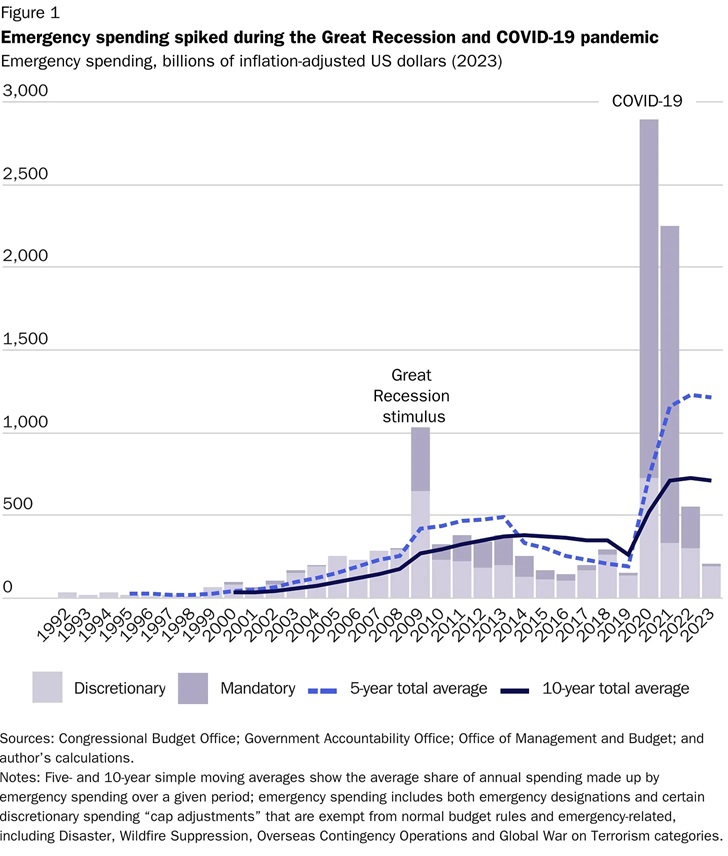
At the risk of understatement, that huge amount of money is a big reason Washington is a fiscal disaster.

Veronique de Rugy of the Mercatus Center wrote about the emergency scam in a column for the New York Sun. Here are some excerpts.


Remember…the debt-ceiling deal… Well, it took less than two months for politicians to start evading the caps with an old trick: emergency spending. …politicians shamelessly abuse the emergency label to push through non-emergency spending that would otherwise violate budget constraints. …

If legislators believe more is needed, they should debate and allocate that money through the regular budget process. …putting the “emergency” label on anything important — or not-so important — but not unforeseen makes a mockery of budget rules and the debt-ceiling caps and, indeed, of the very concept of emergency spending. …

There is always an excuse. …It’s time to fix the current process and stop an abuse that only further weakens the government’s fiscal condition. The best option would be to stop exempting emergency spending from budget rules. That would mean that supplemental spending, emergency or otherwise, must be offset with spending cuts on other programs.

Let’s look at a very recent example of the emergency-spending scam.

Kimberley Strassel of the Wall Street Journal opined two months ago about Biden playing this fraudulent game.

Congress is trickling back from summer recess, and Senate Majority Leader Chuck Schumer intends to move swiftly to pass a giant “supplemental aid” package that funds Ukraine assistance, disaster relief and border security (for starters). The goal is to jam House Speaker Kevin McCarthy, forcing him to forgo whatever spending restraint was negotiated in the June debt-ceiling agreement…

The White House bait—or cudgel—is “crisis” disaster-relief funding. The Federal Emergency Management Agency warned in April that its disaster fund could be out of money by July. Yet somehow the administration didn’t make a priority of this “critical” FEMA funding during the May debt ceiling talks, unwilling as it was then to cede any of its other domestic pork, such as green subsidies and its $80 billion IRS blowout. Only after next year’s spending levels were set did it cry poverty, asking for an “emergency” $16 billion for FEMA.

The bottom line is that the misuse of emergency spending is a serious problem. Politicians routinely slap an emergency label on things that are not emergencies. And, when there is an actual emergency, they use that as an excuse to include lots of non-emergency spending (as we saw during the Trump–Biden COVID spending spree).

But is there a solution? There are sometimes real emergencies, so banning supplemental spending bills presumably is not the answer.

The best answer is to adopt an American version of Switzerland’s spending cap.

Having a spending cap is good overall fiscal policy, of course, but a very relevant feature of the Swiss spending cap is that there is a provision for emergency spending, but any extra spending has to be offset by additional spending restraint in the future.

Which helps to explain why American politicians were nearly four times as profligate as Swiss politicians during the pandemic.

Sunday, April 10, 2022

Eighth Circuit Rules Eviction Moratoria are Likely to be Takings Requiring Compensation Under the Fifth Amendment

The court based its decision on the US Supreme Court's 2021 decision in Cedar Point Nursery v. Hassid.

April 9, 2022

On April 5, in Heights Apartments v. Walz, a unanimous panel of the US Court of Appeals for the Eighth Circuit ruled that a Minnesota state eviction moratorium (enacted for the purpose of mitigating the Covid pandemic) likely qualifies as a taking of private property requiring compensation under the Takings Clause of the Fifth Amendment. They based their ruling in large part on the Supreme Court's June 2021 decision in Cedar Point Nursery v. Hassid, which held that temporary physical occupations of property qualify as "per se" takings, that automatically require compensation. Before Cedar Point, conventional wisdom assumed that most temporary physical occupations are subject to the complicated Penn Central balancing test, under which the government usually prevails.

Here is the key passage from the Eighth Circuit ruling:.........To Read More....


Wednesday, February 9, 2022

Covid-19’s Ratchet Effect is Becoming Endemic

Raymond-J-March Raymond J. March  – February 7, 2022 @ American Institute for Economic Research


Covid-19 cases declined in November 2021, and concerns over the Delta variant began to subside. Many Americans hoped the end of the pandemic was near. They also anxiously braced themselves for what the “new normal” would bring.

Sadly, 2021 might be our “new normal.”

As the outlook improved, President Biden announced that student loan repayments would begin on January 31, 2022. Originally part of the CARES Act, student loan payments were suspended to assist millions of Americans with dealing with financial hardships from the pandemic and economic contraction. Although few were excited to resume paying off their loans, the President’s conviction signaled optimism and a return to pre-Covid life.

But as the year came to an end and Omicron cases began to surface across the country, President Biden signed another executive order extending the student loan moratorium until May 1, 2022. Since President Trump’s first extension in September 2020, loan repayments have been extended five additional times.

A few weeks before President Trump’s extension, the Centers for Disease Control and Prevention issued a national eviction moratorium, preventing many landlords from evicting tenants for non-payment of rent. From September 4, 2020 until June 30, 2021, the President and CDC Director would extend the moratorium four additional times. The fifth attempt failed after the Supreme Court struck down an effort to extend banning evictions for two additional months. Despite the ruling from the highest court in the country, nearly half of all renters remain protected by state and local legislation from being evicted (as the President urged).

Not only has our government gained the authority to prevent evictions and decide who does not have to pay back student loans, it’s also extended its power to do so multiple times in a little over a year.

The growth and reach of government power during the pandemic has been swift and startling in many ways. But it is not surprising.

In his pioneering (and deeply troubling) book Crisis and Leviathan, economist and historian Robert Higgs argues that governments expand their scope and size most easily during a crisis. A fearful public takes drastic measures, including sacrificing their freedoms, to governments that propose measures to end the crisis.

Crises end, but newly designated powers and increased budgets governments receive throughout seldom end with them. Instead, government power exhibits a ratchet effect, never diminishing to pre-crisis levels. Even when governments do not exercise new authorities after a crisis ends, it becomes easier to return to using them once they’re granted.

Suspending student loan payments and banning evicting tenants are two striking examples of the Covid-19 pandemic’s ratchet effect. But they are far from the only examples.

President Trump issued 76 executive orders during the pandemic. President Biden passed 77 in 2021. Both are records and dwarf previous annual totals. Some public schools continue to shut down or provide distance learning days multiple times a week without budgetary reductions. Once rare and contested, trillion-dollar federal spending bills are now proposed and supported. President Biden reenacted several travel restrictions for US citizens well before much was known about the Omicron variant with little pushback.

With multiple variants adapting to currently available vaccines, many medical professionals believe Covid-19 will eventually become endemic – becoming part of life with little hope of eradication. Sadly, government power gained during a crisis is similar, and there is no vaccine for the ratchet effect. 


Raymond J. March

Raymond-J-March

Raymond March is a faculty fellow at the NDSU Center for the Study of Public Choice and Private Enterprise (PCPE) and an assistant professor in the NDSU Department of Agribusiness and Applied Economics, and a contributor to Young Voices. His research has appeared in the Southern Economic Journal,  Public Choice, Journal of Institutional Economics, and Research Policy. He has published articles in National Interest, Washington Times, Washington Examiner, The Hill, RealClearHealth, and elsewhere.

Raymond is a research fellow at the Independent Institute and the director of FDAReview.org, an educational research and communications project on the U.S. Food and Drug Administration (FDA).

Get notified of new articles from Raymond J. March and AIER.
 
Editor's Note:  Please make sure to view my post: Pandemic Conspiracy Exposed: A Crime Against Humanity! RK

Tuesday, February 1, 2022

Even some on the left have had it with lockdowns

Yesterday, John wrote about a study (a study of studies, actually) that says lockdowns have had little to no effect in preventing deaths from covid. I remain unpersuaded of this proposition and will probably explain why before too long.

However, I agree that extended lockdowns have imposed significant costs that likely exceed any benefits. In addition, it’s clear to me that schools should have reopened for in-person learning no later than August 2020 and that, as a general matter, nearly all lockdown-type restrictions should be eschewed going forward during this pandemic.

These views seem to be gaining traction on the left. Today’s Washington Post has a frontpage story about how “public education is facing a crisis of epic proportions” due in large part to school closings and reliance on remote learning. It reports:...........To Read More.....

Friday, January 7, 2022

Climate lockdown: Paper published in prestigious journal laments ‘democracy’ & calls for ‘authoritarian environmentalism’ modeled after COVID lockdowns to fight climate ’emergency’

By Marc Morano

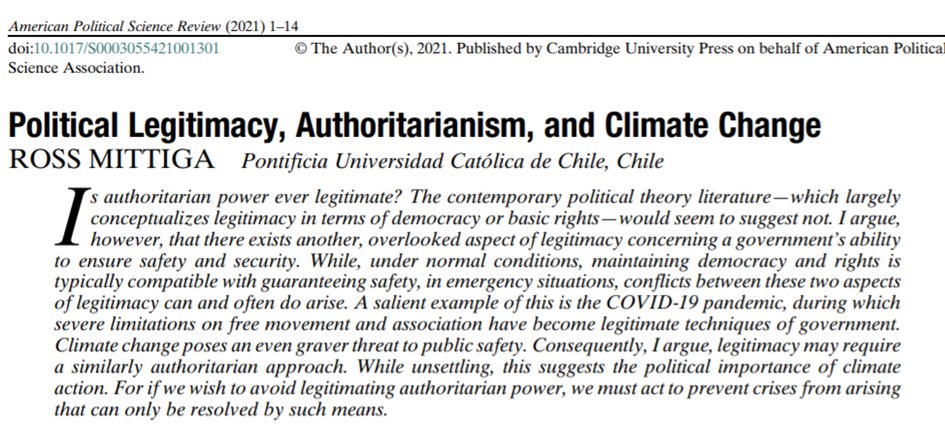
Political Legitimacy, Authoritarianism, and Climate Change - Published online by Cambridge University Press - American Political Science Review, December 6, 2021

Ross Mittiga, Professor Department of Politics at University of Virginia (Former Assistant Professor, Instituto de Ciencia Política, Pontificia Universidad Católica de Chile ross.mittiga@uc.cl )

Abstract Excerpt: Is authoritarian power ever legitimate? ... While, under normal conditions, maintaining democracy and rights is typically compatible with guaranteeing safety, in emergency situations, conflicts between these two aspects of legitimacy can and often do arise. A salient example of this is the COVID-19 pandemic, during which severe limitations on free movement and association have become legitimate techniques of government. Climate change poses an even graver threat to public safety. Consequently, I argue, legitimacy may require a similarly authoritarian approach." 

 Image

 Image

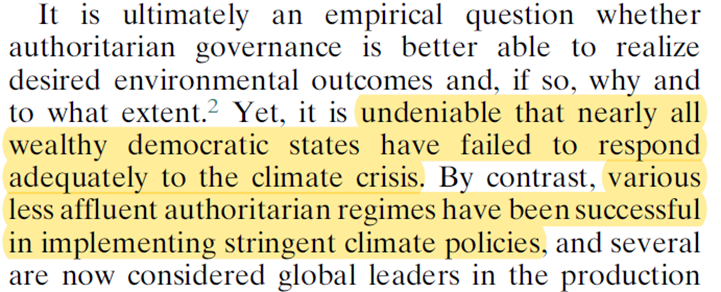
The paper's author Ross Mittaga, calls for "authoritarian environmentalism" to address the alleged climate "emergency." : "It is ultimately an empirical question whether authoritarian governance is better able to realize desired environmental outcomes and, if so why and to what extent? Yet, it is undeniable that nearly all wealthy democratic states have failed to respond adequately to the climate crisis. By contrast, various less affluent authoritarian regimes have been successful in implementing stringent climate policies..."............To Read More....

Watch: Morano’s full 25 min speech on Climate Lockdowns at Heartland Skeptic Conference in Las Vegas