Search This Blog

De Omnibus Dubitandum - Lux Veritas

Showing posts with label Eminent Domain. Show all posts

Monday, July 4, 2022

Jury rules city is liable for damages by SWAT team

Woman's home damaged by cops chasing fugitive

  Bob Unruh By Bob Unruh July 2, 2022

A jury has decided that a Texas city is liable for nearly $60,000 in damages its SWAT team did to a woman's home while they were chasing a fugitive. The Institute for Justice had fought the case on behalf of Vicki Baker after the SWAT commandos in McKinney, Texas, destroyed her home in July 2020. They were chasing a criminal suspect at the time, and smashed fences, destroyed doors and windows, launched tear gas canisters into the home, and more. Her insurance company refused to pay for the damages. So did the city. So the IJ joined forces with Baker to sue, which resulted in the jury decision recently at the city must pay her damages of $59,656.59.

"My priority has always been to make sure that cities like McKinney cannot treat other people the way I’ve been treated," Baker explained. "I expect today’s victory to send a message to governments across the country that they have to pay for what they break.”.........To Read More....


Sunday, April 10, 2022

Eighth Circuit Rules Eviction Moratoria are Likely to be Takings Requiring Compensation Under the Fifth Amendment

The court based its decision on the US Supreme Court's 2021 decision in Cedar Point Nursery v. Hassid.

April 9, 2022

On April 5, in Heights Apartments v. Walz, a unanimous panel of the US Court of Appeals for the Eighth Circuit ruled that a Minnesota state eviction moratorium (enacted for the purpose of mitigating the Covid pandemic) likely qualifies as a taking of private property requiring compensation under the Takings Clause of the Fifth Amendment. They based their ruling in large part on the Supreme Court's June 2021 decision in Cedar Point Nursery v. Hassid, which held that temporary physical occupations of property qualify as "per se" takings, that automatically require compensation. Before Cedar Point, conventional wisdom assumed that most temporary physical occupations are subject to the complicated Penn Central balancing test, under which the government usually prevails.

Here is the key passage from the Eighth Circuit ruling:.........To Read More....


Friday, July 23, 2021

Biden Stealing Land to Satisfy Climate Agenda

| Jul 20, 2021 |  

To erect tens of thousands of wind turbines and thousands of square miles of solar panels to fulfill his climate agenda, President Joe Biden is planning to steal vast amounts of America’s land. Otherwise, most states and property owners simply won’t give it to him.

If this sounds far-fetched, realize that the theft of land by the federal government has been going on for the past century and a half. Given that it is forbidden by the Constitution of the United States, and no amendments have made it legal, it has indeed been a form of grand larceny-theft, something the states must sue to stop.

Before examining Biden’s plans, let’s look at the history of the feds illegally expropriating land, an action that surely amounts to the greatest heist in American history.

Article 1, Section 8, clause 17 of the United States Constitution limits federal property to territories such as the District of Columbia and “Forts, Magazines, Arsenals, Dock-Yards and other needful Buildings.” To acquire land from the states for these four purposes (only), the Federal government must first obtain the consent of the relevant state governments. 

This is why only an average of about 4% of the land in the states east of the Mississippi is owned by the federal government. When new states joined the union, they were afforded the same rights as the original 13 colonies, and so, by law, the feds could only take over state land with agreement of the state governments and only for the four purposes laid out above. When a new state was created, all the land within that state comes under state jurisdiction. Period. No “ifs,” “ands,” or “buts.” That is the law as laid out in the Constitution. 

America’s Founders took the Biblical injunction literally that land and the products of the Earth were considered a gift of God to man and that man was commanded to cultivate, beautify, and subdue it and bring it under his dominion. They believed that no government official has the authority to interfere with this God-given, unalienable right and mandate. The Founders believed that the land belonged to the people, not the king, and this was the impetus for including the grievance in the Declaration of Independence that King George “has erected a multitude of New Offices, and sent hither swarms of Officers to harass our people, and eat out their substance.” The King also tried to stop colonists from possessing the new lands west of the Appalachian Mountains. The Founders totally rejected centralized control of land and determined to institute control at a local level which would be administered close to the people for their benefit. They did this to ensure that the tendency of power-hungry national governments to deprive the people of their God-given land would be forever banned in the new nation.

In the first half of the 19th century, most new states owned the majority of their land but quickly sold it off to private property owners. But things started to change when, in 1872, the first National Park, Yellowstone, in the Territories of Montana and Wyoming, was created by an act of Congress. They did not amend the Constitution. They simply violated it. 

Things got worse in the 20th century when environmental groups persuaded the federal government to retain land for its natural resources and scenic beauty. In 1906 President Theodore Roosevelt pushed through the American Antiquities Act, which designated 18 national monuments for the Federal government, again, in violation of the Constitution. Only President Obama has used the Antiquities Act to designate more–26 times. In 1976, under President Carter, the Land Policy and Management Act declared another 100 national monuments adding millions of acres to the Federal land portfolio, mostly in the Western states. While much of this land has made outdoor vacations more possible for the average American citizen, as much or more has made access for the public impossible and forest management a disaster. 

So, it is no surprise to most Americans that the federal government now owns vast areas of the western states. They own 85% of Nevada, 65% of Utah, 62% of Idaho, 61% of Alaska, 53% of Oregon, and 48% of Wyoming. And, it is largely all illegal. The Framers of our Constitution would have regarded Roosevelt, Carter, and later Obama, who designated more national monuments than any other President, as performing federal overreach.


And now, under President Biden, things are about to get a lot worse.

On January 27, just a few days after Biden’s inauguration, he signed Executive Order (EO) 14008, which calls for 30 percent of all the land and 30 percent of all the water in the United States to be placed under the control of the Federal government by 2030. The title of this draconian order is “Tackling the Climate Crisis at Home and Abroad,” and this has the support of all the environmental groups who clearly don’t care about the environment at all but only about reducing our freedoms by increasing the power of the federal government over our lives. Biden’s EO is being called “30 x 30” for short, especially by all those who oppose it. America’s two million farmers lead that resistance.

Nobody is more motivated to take better care of our nation’s land than the folks who work on the land day in and day out to feed the world. But President Biden seems to disagree, which is another example of the left’s disconnect with reality. Kansas native President Dwight D. Eisenhower hit the nail on the head while in office when he said, in regard to farm legislation, 

“Farming looks mighty easy when your plow is a pencil, and you are a thousand miles from a cornfield.”

Writing in the June 7, 2021 edition of High Plains Journal, Sen. Roger Marshall, R-KS, a member of the Senate Committee on Agriculture, Nutrition, and Forest, explained the impact of Biden’s EO:

“Imagine, if you will, taking 30% of agricultural land out of production. This means losing 30% of all agricultural-related employment, leaving 75,000 Kansans without jobs. As far as the Kansas economy goes, this means losing 30% of all direct, indirect, and induced agricultural production—that’s more than $21 billion in output for our state. 

“These dollars and jobs won’t just be lost on rural main streets—this impact would be felt by the farmer on a turn row as well as the Kansas City businessman making deals in an executive boardroom. It could cause rural hospitals to close, schools to consolidate, small county seats to cease to exist—absolutely devastating rural Main Street and the suburban kitchen table not long after. Imagine paying over a third more for your groceries or at a restaurant. Imagine having to drive even further to another town because staple stores on main street had to shut down.

“It’s a double whammy: less economic activity and higher cost of living. I need not remind folks that agriculture and its related businesses have roughly a $30 billion impact on the Kansas City region and support more than 100,000 jobs in the greater Kansas City area. Losing $10 billion and 34,000 jobs would devastate Kansas City, where our agricultural products routinely pass through on trucks, trains, and barges. Wichita could lose over 2,100 jobs and $600 million.”

In response to Biden’s wrong-headed thinking, Marshall introduced a 30 x 30 Termination Act to prevent even more excessive government over-reach. Additionally, 16 farm-state governors sent a letter to Biden on February 22 warning of his federal overreach. You can be sure that the Biden administration will covet no land in cities where they want to herd our population, meaning farmland will be the primary focus of their land grab.

Writing at thenationalpatriot.com on March 7, 2021, Craig Andresen, who co-authored a four-part series on government land grabs with Diane Sori at Right Side Patriots, said:

“If the federal government ends up owning 30 percent of farm and ranch land, and 30 percent of the water in this country, that leaves it up to the federal government what can be raised on that land, how much of what kind of livestock can be raised on that land, and eventually, what price those commodities bring which affects the farmers and ranchers as well as those who purchase said commodities.”

Or whether the Biden administration will take that land completely out of production so as to make room for the president’s green energy plans. 

Indeed, that appears to be Biden’s objective. His EO also asserts:

“The Secretary of the Interior shall review siting and permitting processes on public lands and in offshore waters to identify to the Task Force steps that can be taken, consistent with applicable law, to increase renewable energy production on those lands and in those waters, with the goal of doubling offshore wind by 2030 ….”

While also stating:

“… the Secretary … shall pause new oil and natural gas leases on public lands or in offshore waters pending completion of a comprehensive review and reconsideration of Federal oil and gas permitting and leasing practices in light of … potential climate … impacts.”

No state authorities will be consulted by the Secretary in completing that review. So, you can be sure the land taken over by the Feds will be used to follow through on the green new deal to build more wind turbines and solar collectors to further increase your electric bills. 

And, remember, America is already continuously losing productive farmland to urban sprawl. So, we continue to diminish our ability to feed an ever-growing world population while turning productive land into unproductive land, thereby decreasing the economic activity in agriculture. 

And, of course, taxes will have gone up to make up for the fact that so much land will be taken off the tax rolls. The federal government will give some of the money that local governments will no longer have back to the states to give to their schools. So, the feds will increasingly take over our schools as well.

Clearly, we must marshal sensible voices to throw this government out as soon as possible, starting by taking back the Congress in November of 2022. Otherwise, we can kiss vast tracts of America goodbye.

Avatar

Dr. Jay Lehr is a Senior Policy Analyst with the International Climate Science Coalition and former Science Director of The Heartland Institute. He is an internationally renowned scientist, author, and speaker who has testified before Congress on dozens of occasions on environmental issues and consulted with nearly every agency of the national government and many foreign countries. After graduating from Princeton University at the age of 20 with a degree in Geological Engineering, he received the nation’s first Ph.D. in Groundwater Hydrology from the University of Arizona. He later became executive director of the National Association of Groundwater Scientists and Engineers.

Tom Harris is Executive Director of the Ottawa, Canada-based International Climate Science Coalition, and a policy advisor to The Heartland Institute. He has 40 years experience as a mechanical engineer/project manager, science and technology communications professional, technical trainer, and S&T advisor to a former Opposition Senior Environment Critic in Canada’s Parliament.


Monday, July 5, 2021

Supreme Court Grants Rare Win For Economic Freedom

Ethan Yang Ethan Yang  – July 1, 2021 @ American Institute for Economic Research


Economic and civil liberties should not be seen as two ideals to be weighed separately but as one set of inalienable rights that are inherent to our humanity. What is economic prosperity worth if you can’t speak your mind? What value is there to having civil protections if everything else in your life is regulated into despair? Oftentimes civil and economic freedom are intertwined in such intimate ways that there really is no difference. Sadly, today economic rights have taken a second class status under the current judicial status quo, which is why policies that infringe on things like free speech receive plenty of scrutiny yet arbitrary regulations on business pass with almost no oversight. 

This is why a recent Supreme Court decision, Cedar Point Nursery v Hassid, is such an important win for those concerned with economic freedom, specifically property rights. The case was decided on June 23, 2021, and was split 6-3 on “expected ideological lines.” Although there was likely much nuance in the thinking of the various justices, the win is a much-welcomed departure from the Progressive status quo of deference to the will of the state. The case itself concerned an “access regulation” in California that allowed labor unions to enter a private property in this case, Cedar Point Nursery, provided that they dispense notice to the Agricultural Relations Board. After doing so, the owner of the property is mandated to allow access without contestation. Such a policy seems to have been clearly put in place at the behest of politically influential labor unions and to the expense of private citizens. 

A Rare But Important Victory

Ilya Shapiro and Sam Spiegleman from the Cato Institute weigh in on the matter by explaining:

Cedar Point will go down as a big and clean win for property rights. California’s law is no mere labor regulation: it grants a right to be on the owners’ land three hours per day for 120 days per year. Ending it respects the constitutional rights of both the property owners and union officials, who lose only the ability to trespass for a third of the year.

The Fifth Amendment’s Takings Clause provides, “nor shall private property be taken for public use, without just compensation.” Here, even though the state didn’t seize any property outright, the Supreme Court has long recognized that if a regulation “goes too far,” it’s functionally equivalent to the use of eminent domain.

The Court’s recognition here that state-sanctioned trespasses, even if not permanent and continuous, are compensable takings is a major victory for property‐​rights advocates who have toiled for decades to expand the universe of per se takings beyond the narrow scope of permanent physical invasions or total‐​value‐​loss regulations.

In particular, Cato’s Amicus Brief on the matter explains three basic points on why California’s labor regulation was unconstitutional and curtailed property rights, thus requiring at minimum, just compensation. 

The first being that allowing labor unions to simply enter private property with a permission slip from the government violated the right to exclude. If you cannot exclude people from your property, it has ceased to be private property. The fact that the government has given itself the power to grant that decision makes the use of such powers a per se taking of private property. 

The second argument is that the state of California has clearly not implemented the access regulation to make businesses safer, nor does the regulation confer reciprocal advantages, which would also make it a per se taking. Allowing labor unions to forcefully enter a private business and stir up commotion is by no means a necessity for safety nor is that benefiting the community as a whole.

The third point is that the state does not have the justification to use its police power because not allowing union trespassing on private land does not in any sense of the imagination pose a safety risk. 

For decades, the state and a deferential court system have allowed the gradual unraveling of property rights to the will of the regulatory state. This has justified the aforementioned relegation of economic freedoms and autonomy to second-class status, with the government being able to intervene in economic life provided that it can merely find a rational basis. In the case of Cedar Point Nursery, California’s law essentially allowed property rights to be confiscated by the state for union access, three hours a day, 120 days a year, without just compensation. This was justified as being a “labor regulation” and “necessary for public safety”.

The Supreme Court finally handed a rare, but hopefully, consequential victory to those who respect the institution of property rights. In this case, the Court ended what was an incoherent charade to skirt around the 5th Amendment’s Takings Clause. A charade that attempted to call a blatant appropriation of private property to bolster the power of unions at the expense of property owners an exercise in public safety. 

The Importance of Strong Property Rights

Our entire civilization is built on the foundation of private property. Such an institution not only creates strong economic incentive structures that lead to good practical outcomes but also has an important moral foundation. National Affairs recounts the rhetoric surrounding the Civil Rights Act of 1866 by writing:

Illinois Senator Lyman Trumbull, the leading champion of the legislation in the Senate, explained that the “first section of the bill defines what I understand to be civil rights: the right to make and enforce contracts, to sue and be sued, and to give evidence, to inherit, purchase, sell, lease, hold, and convey real and personal property.”… As a member of the House from Ohio argued, “It is idle to say that a citizen shall have the right to life, yet to deny him the right to labor, whereby alone he can live. It is a mockery to say that a citizen may have a right to live, and yet deny him the right to make a contract to secure the privilege and reward of labor.

The right to private property is the right to the products of your own labor. The right to your own labor and its products is the right to your body. Professor Emeritus at Vanderbilt University, James W. Ely, writes:

(T)here are few examples of free societies that do not respect the rights of property owners. One could persuasively maintain that without guarantee of property rights the enjoyment of other individual liberties, such as freedom of speech, would be meaningless. Put simply, the absence of a system of private property renders self-government unlikely. As Justice Joseph Story explained in 1829: “That government can scarcely be called free, where the rights of property are left solely dependent upon the will of a legislative body.

For much of American history, this admiration and recognition of property rights remained a cornerstone of political as well as legal thought. However, much with everything concerning the size and scale of American government, this drastically changed during the 20th century, most notably during the Progressive Era. Ely writes:

Like the Progressives, the New Dealers were impatient with constitutional restraints on governmental power. They quite openly set out to revise constitutional law and reduce private economic rights. Despite some initial judicial resistance, the New Dealers were remarkably successful in achieving their goals and fundamentally altering the legal landscape. Modern constitutional law bears only a faint resemblance to the original constitutional design.

Ely concludes by noting that although many of the judicial precedents have been unwound, the Progressive Era’s legacy on property rights is still salient. The new battle over the soul of constitutional interpretation has only begun and the end result is yet to be seen.

Key Takeaways

Cedar Point was a rare, well deserved, and sorely needed victory for private property rights, a once sacred institution that has all been desecrated over the years. In this case, the Supreme Court affirmed the right of individuals and dealt a blow to cronyist labor unions and their enablers in the government. The Court’s decision marks a step in the right direction towards a judicial regime that enforces the Constitution and does not view it as simply a welcome mat for the ambitions of state actors. Although it is only one decision, it should send a clear signal that in this country, under this constitution, the inalienable rights of individuals shall be protected from the mob as well as the Leviathan.

Ethan Yang

Ethan Yang

Ethan Yang is an Adjunct Research Fellow at AIER as well as the host of the AIER Authors Corner Podcast.

He holds a BA in Political Science with a concentration in International Relations with minors in legal studies and formal organizations from Trinity College in Hartford Connecticut. He is currently pursuing a JD from the Antonin Scalia Law School at George Mason University.

Ethan also serves as the director of the Mark Twain Center for the Study of Human Freedom at Trinity College and is also involved with Students for Liberty. He has also held research positions at the Cato Institute, the Connecticut State Senate, Cause of Action Institute and other organizations.

Ethan is currently based in Washington D.C and is a recipient of the 13th Annual International Vernon Smith Prize from the European Center of Austrian Economics Foundation. His work has been featured and cited in a variety of outlets from online media to radio broadcast.

Get notified of new articles from Ethan Yang and AIER.


Sunday, May 30, 2021

Texas homeowners protest state decision to make their land a public beach

Charge action violates due process

Homeowners in Galveston, Texas, have filed a legal action against the state government after Hurricane Laura and Tropical Storm Beta came through and altered the beachfront, prompting the state to demand that all land from the mean low tide line to 200 feet inland is public beach. As shorelines actually do change periodically, most times the designated public property is between the low tide and high tide lines, which leaves improved, and privately owned, properties further away from the water untouched.


Saturday, January 9, 2021

Scheme forcing homeowners to turn houses over to developer defeated

'The plan was as diabolical as it was unconstitutional'

Bob Unruh By Bob Unruh January 9, 2021

A judge has signed an order that permanently prevents officials in Charlestown, Indiana, from using their property maintenance code to levy huge fines against homeowners to coerce them to give their land to a private developer. The Institute for Justice announced a settlement that was approved by Judge Jason Mount, who signed the order Dec. 17.  The residents of the Pleasant Ridge neighborhood sued the city four years ago over the scheme by city officials.

"As part of the settlement and order, the city has agreed to three things: First, it will give homeowners a reasonable opportunity to fix their homes before the city levies any fines. Second, it will not target the Pleasant Ridge neighborhood with code enforcement more than any other neighborhood in Charlestown. Last, it will not penalize anyone if they demand a warrant before the city performs an inspection of rental property," IJ said..............Working behind the scenes with a private developer, the city weaponized its property code and targeted owners for immediate, daily fines for rental properties."

IJ said the city used $50-per-day fines for violations such as chipped paint, then applied multiple citations per property.  "Within weeks, Pleasant Ridge property owners had racked up millions of dollars in fines.........To Read More.....

Sunday, September 15, 2019

City retaliates against brothers who want to grow Christmas trees

Officials warned them not to talk to reporters about fine for taking out scrub brush

By WND Staff Published September 9, 2019

It began with what appeared to be an overly aggressive Michigan township attack on two brothers trying to start a Christmas tree farm.  A fine of $450,000 was announced by the township of Canton against Gary and Matt Percy, who allegedly without permission cleared garbage and scrub brush off their small parcel with plans to plant trees. 

Then township officials warned them not to talk to reporters about the dispute or there would be a "fight." The brothers went to court, and "Canton made good on its threat," according the Texas Public Policy Network, which is working on the brothers' case.  Now, in a separate civil lawsuit in federal court, the Percys charge the city's complaints and notices of violation are due "to retaliation for the plaintiffs exercising their First Amendment rights."............To Read More.....

My Take - What I would be interested in is why these officials were so hot to go after these people in the first place.  As this investigation continues I'm willing to bet there are underlying corrupt financial issues will become exposed.  Otherwise they're using a atomic bomb to swat a fly.  This just doesn't make sense unless their is some underlying motive. 

Monday, July 1, 2019

Supreme Court dishes property owners a Fifth Amendment victory

By @ CFACT

In a decision that sent chills down the spines of environmental groups and raised the spirits of property rights advocates, the U.S. Supreme Court June 21 removed a significant legal barrier that, for decades, had effectively barred aggrieved landowners from challenging local ordinances in federal court.

The court’s 5-4 ruling restores property rights to the full constitutional status the Framers envisioned when they included the Fifth Amendment’s Taking Clause in the Bill of Rights, opening federal courts to property owners seeking “just compensation” for the taking of their property by government.

Property owners’ access to federal courts had been effectively blocked since 1985, when the Supreme Court, in what is known as its Williamson precedent, ruled that landowners must first bring takings claims against local governments to state courts before proceeding to federal court. Williamson is short for Williamson County Regional Planning Commission v. Hamilton Bank of Johnson City.

Catch 22

Supreme Court ditches Clean Water Act conviction posthumouslyFor property owners, Williamson created a Catch-22 situation, because, under a subsequent Supreme Court ruling, a federal court generally must defer to a state court’s resolution of a claim for just compensation. Property owners caught in this Catch-22 were cast into a neverland of endless, bank-account-draining litigation in state courts, with little hope of ever receiving their day in court at the federal level.

“The takings plaintiff thus finds himself in a Catch-22. He cannot go to the federal court without going to the state court first; but if he goes to the state court and loses, his claim will be barred in federal court,” Chief Justice John Roberts wrote. “The federal claim dies aborning.”

In reversing the 34-year-old Williamson precedent, the Supreme Court will allow takings plaintiffs to bring their cases to federal court, where, if successful, they will receive the just compensation guaranteed them under the Constitution.

“We now conclude that the state-litigation requirement imposes an unjustifiable burden of takings plaintiffs, conflicts with the rest of our takings jurisprudence, and must be overruled,” Roberts said, speaking for the majority.

The case, Knick v. Township of Scott, that led to the reversal of Williamson involves Rose Mary Knick, owner of a 90-acre property in eastern Pennsylvania on which a cemetery is situated. Knick challenged an ordinance by Scott Township requiring that cemeteries “be kept open and accessible to the general public during daylight hours.” The ordinance, she and her attorney argued, constituted a taking of her property. Knick filed a takings claim in federal court, but the court, citing Williamson, said she could not bring the suit without going through state proceeding first. She was stuck in the Catch-22.

“This decision is a very long time coming for Rose and other property owners who have had federal court doors slammed shut in their face whenever they seek compensation for a government taking of their private property,” Pacific Legal Foundation (PLF) attorney Dave Breemer, who represented Knick in the case, said in a statement. “The Court’s decision sends a message that constitutionally-guaranteed property rights deserve federal protection just like other rights.”

Fracking Bans and Mineral Rights

Alston & Bird attorney Paul Beard believes the ruling will have a far-reaching effect on energy and environmental policy, especially at the local level.

“In the energy-regulation space, we can expect more – and more successful – challenges to statutes and ordinances that, to take examples from recent trends, destroy or significantly damage oil, gas, and mineral rights. Think fracking bans,” he told E&E News (June 21) in an email.

In fact, the ruling may deter policymakers from adopting such ordinances for fear of triggering litigation, he added.

The United States is unique in its protection of mineral rights. Landowners not only have surface rights – such as the right to grow crops on the surface of their land – but also mineral rights – such as the right to access oil or natural gas located beneath their property. Mineral rights enabled the fracking boom that, over the past decade, propelled the U.S. to the world’s top producer of oil and natural gas. Owners of property situated atop shale formations entered into voluntary agreements with oil and gas companies that allowed the latter to extract the hydrocarbons while generously compensating the former. The arrangement has completely upended global energy markets.
In a bid to derail America’s global energy ascendency, environmentalists and their political allies have enacted local fracking bans, and New York Gov. Andrew Cuomo has decreed a statewide fracking ban.

The Supreme Court’s reassertion of the Takings Clause raises, as attorney Paul Beard suggests, intriguing questions about the constitutionality of bans that deny landowners their mineral rights.

Author

Tuesday, June 4, 2019

Government Shouldn’t Have the Power to Take Private Property for Free

The Supreme Court must reverse the ruling of a lower court in Love Terminal Partners v. United States.

By

While public attention is riveted on Democrats with extravagant proposals for government expansion — a Green New Deal, single-payer health care, tuition-free college — few observers have noticed a recent federal court ruling that will, absent Supreme Court intervention, grant the government immense powers to confiscate private property in violation of the Fifth Amendment.

The Fifth Amendment to the U.S. Constitution mandates that private property cannot be taken for public use “without just compensation.” But this clause was eviscerated by U.S. Court of Appeals for the Federal Circuit in Love Terminal Partners v. United States, which held that any property not earning a current positive cash flow can be taken by the government without a dime of compensation. Unless this ruling is reversed on appeal, it will have a devastating impact on the value of millions of properties with excellent prospects for appreciation but no current tenants. And it will put all real-estate investments not earning money at risk of being stolen by the government..........To Read More.....

Thursday, November 29, 2018

Big property rights victory at the Supreme Court

Tuesday, November 27, 2018

When 'reasonable' burdens aren't

Saturday, August 11, 2018

Mirror, Mirror, on the Wall, What Nations Protect Property Rights Best of All?

August 8, 2018 by Dan Mitchell @ International Liberty
 
My favorite annual publication is the Fraser Institute’s Economic Freedom of the World, which measures the amount of economic liberty that exists in 159 nations. The rankings are based on five equally weighted categories, though I’ve always viewed “Legal System and Property Rights” as being the most important because even low taxes and light regulation won’t produce much growth if investors and entrepreneurs have no faith in the rule of law or the quality of governance.

This is why the annual International Property Rights Index is another one of my favorite publications. It provides a detailed look at why the right to own, utilize, and trade property is essential to a free society.
Property rights are accepted as a linchpin for human beings’ liberty, acting as a catalyst for economic and societal growth , and as a defense against authoritarian temptations. …Property is the basis of the freedom to contract, which is simply liberty in action. Without freedom to exchange, a third party, generally the government, intervenes through the political-bureaucratic ruling class. Freedom is more than the right to own property or the right to make transactions, to exchange, to buy and sell. Once citizens lose the right to own, they lose the ability to control their own lives. …This Index was developed to serve as a barometer of the state of property rights in all countries of the world.
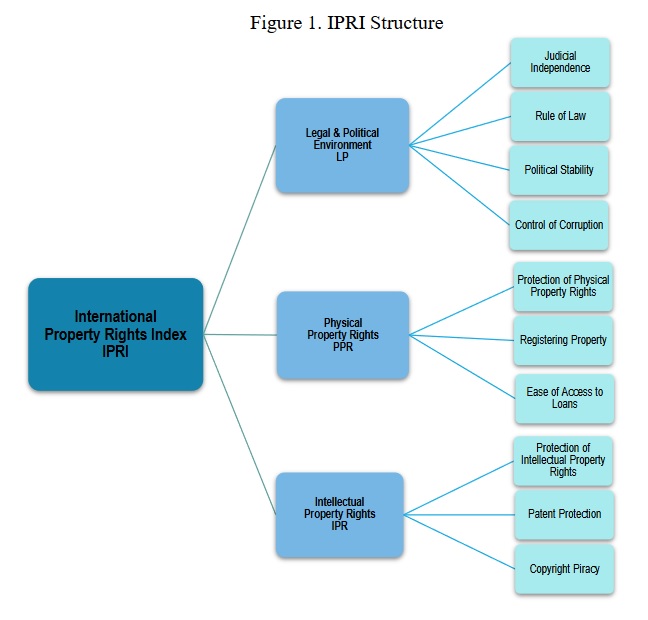
Here’s the methodology of the Index. There are three main categories, each of which is comprised of several indices.


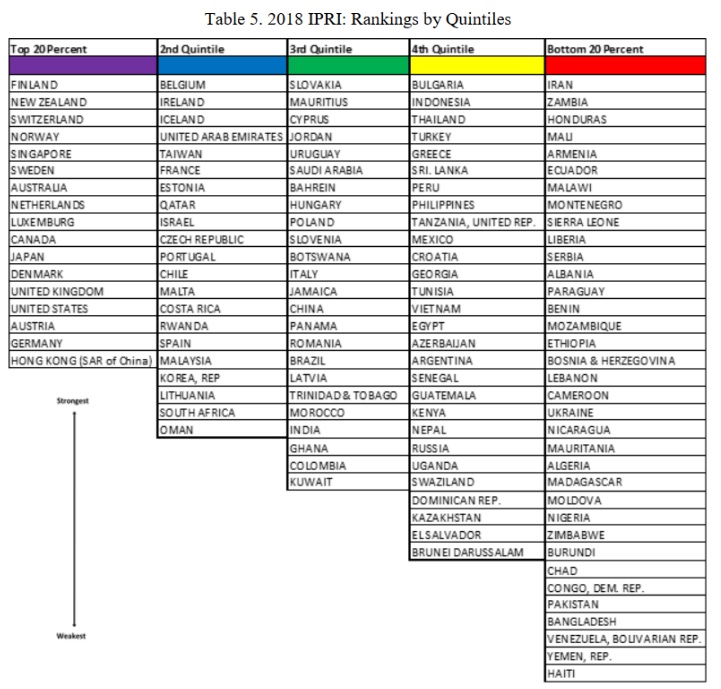
Now let’s get to the rankings.

As you might expect, Nordic nations and Anglosphere jurisdictions dominate, along with a smattering of other European countries.
…the top 15 countries for this year’s IPRI edition. Finland leads the 2018 IPRI (8.6924)… New Zealand ranks second (8.6322)… Next come Switzerland (8.6183), Norway (8.4504), Singapore (8.4049), Sweden (8.3970), Australia (8.3295), Netherlands (8.3252), Luxembourg (8.2978), Canada (8.2947), Japan (8.2315), Denmark (8.1640), United Kingdom (8.1413), United States of America (8.1243), and Austria (8.0050).
Congratulations to Finland, New Zealand, and Switzerland for winning the gold, silver, and bronze medals.

If you peruse the full rankings below, you’ll see that the United States is #14 (the same as last year).
Haiti is in last place, below even Venezuela.


It’s also worth noting that Chile is the highest-ranked Latin American nation.

Now let’s look at the nations with the biggest movement in the right direction and wrong direction. It’s easy to make a big jump for nations that are ranked very low, so Cyprus (which is now near the top of the 3rd quintile) probably deserves the most applause.
This year, five countries show the highest absolute improvement in their IPRI score: Azerbaijan (1.09), Ukraine (0.86), Russia (0.85), Moldova (0.82), and Cyprus (0.79); while the ones with highest decreases in their 2018 IPRI scores were South Africa (-0.65), Ethiopia (-0.3), Liberia (-0.27), Uganda (-0.25), and Uruguay (-0.22).
And South Africa’s decline is very tragic since it historically has been one of the best African nations.

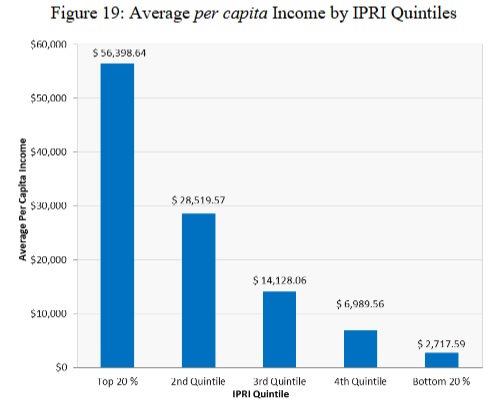
By the way, if you want to know why property rights are so important, this chart is all the evidence you need.


And we’ll close today’s column with a bit of good news.

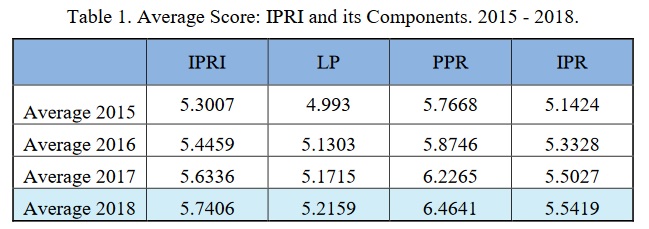
We don’t have decades of data, but the numbers that do exist show continuous improvement.


And since we also have evidence that overall global economic liberty is increasing, there are reasons for optimism.

Friday, August 10, 2018

Conservation Easements and Land Trusts, the Ultimate Faustian Marriage

By Aug7,  2018
“Whether the mask is labeled fascism, democracy, or dictatorship of the proletariat, our great adversary remains the apparatus—the bureaucracy, the police, the military. Not the one facing us across the frontier of the battle lines, which is not so much our enemy as our brothers’ enemy, but the one that calls itself our protector and makes us its slaves. No matter what the circumstances, the worst betrayal will always be to subordinate ourselves to this apparatus and to trample underfoot, in its service, all human values in ourselves and in others.”—Simone Weil, French philosopher and political activist
Tom DeWeese wrote in Sustainable, that there are thousands of non-governmental organizations (NGOs) working with the UN to subvert property rights. Of course, they don’t just announce that property rights are now null and void. That would create a stir. Instead, they use code words and language that sound innocent and helpful to our society. One such tool that is now being used to target rural lands for takings is the Conservation Easement, and its threat is growing.

There is one NGO Tom didn’t write about, yet it may be the worst of them all. It is a ‘stealth NGO’; like many others it masquerades as a quasi-governmental body. I will get to it, but first let me give you some background.

Background

The right to own property is one of the main pillars of freedom. Numerous Revolutionary patriots wrote about the necessity of property rights for freedom; without that right they could not own the printing presses to share their grievances and promote the rights of man and desires for self-ownership. There have been encroachments on private property over the past one hundred plus years, but now we are seeing a steady army of those who would take away our property rights. As Tom described in his book, the Conservation Easement is but one of the tools NGO destroyers are using to deprive us of our freedom.

Our founding fathers drafted the Constitution to form a limited federal government, designed to take care of only those duties that were truly national business. All other powers were left to the state governments or the people. Article One, Section 8, Clause 17, offers the only provision in the Constitution for federal ownership of land. It provides for the creation of Washington, D.C., as the seat of the federal government, and allows the federal government to purchase lands in a state with “…the Consent of the Legislature of the State in which the Same shall be, for the Erection of Forts, Magazines, Arsenals, dock-Yards, and other needful Buildings;”[i]

Most older Americans know the Magna Carta’s role in property rights law in the Constitution, but, since it is no longer taught in schools, here is a very short explanation:
“Americans of the founding generation’s .. . . views were strongly shaped by the English constitutional tradition. Colonial Americans revered Magna Carta (1215) as a safeguard against arbitrary government. Several provisions of this famous document protected the rights of property owners: 1) The king agreed not take, imprison, or disseize a person of property “except by the lawful judgment of his peers or by the law of the land”. The “law of the land “clause was the forerunner of the due process norm. 2) The king promised not to take provisions without immediate payment. This language acknowledged the principle that government must pay the owner when it acquires private property.”[ii]
From that also came the Rule against Perpetuities

Under the Common Law, the principle that no interest in property is valid unless it vests not later than twenty-one years, plus the periods of gestation, after some life or lives in being which exist at the time of the creation of the interest.

The courts developed the rule during the seventeenth century in order to restrict a person’s power to control perpetually the ownership and possession of his or her property after death and to endure the transferability of property. The rule includes the period of gestation to cover cases of posthumous birth.”[iii]

As I see read this, our founding fathers and their progeny felt strongly about the need for property rights and their protection. In fact, David Upham of FEE, says, . . . “insofar as the Founders made any distinction between property rights and other individual rights, they insisted that property rights were at least as important as personal rights. In Federalist 54, James Madison stated tersely: “Government is instituted no less for the protection of the property than of the persons of individuals.”[iv]

Gary Pecquet, also from FEE, notes, “The Founding Fathers upheld the economic view of property. They believed that private property ownership, as defined under common law, pre-existed government. The state and federal governments were the mere contractual agents of the people, not sovereign lords over them. All rights, not specifically delegated to the government, remained with the people –- including the common-law provisions of private property. Consequently, the constitutional rights regarding free speech, freedom of religion, the right of assembly, and private property rights are all claims that individuals may hold and exercise against the government itself. In brief, private property refers to the rights of owners to use their possessions which are enforceable against all non-owners – even the government.”[v]

Today

How does one assault property rights? Not directly. Like most other rights, long deemed to be natural rights and unassailable, property rights will have to be taken like the salami – one slice at a time. The attack on the essence of property rights has been going on for over 100 years. But only those waging this attack knew there was a war going on. It started as just a desire by one man to preserve green space and historic sites near Boston. His quest also bore the Land Trust.

The new version of Conservation Easements (CE) was brought slowly and gently into the picture, but they worked so well, you would think they were on steroids. Like other programs that produce mega-bucks and mega-power, Conservation Easements became a hot commodity – not for the landowner but for those who wanted to get rich quick on someone else’s land: Land Trusts.

“Conservation easement is a deeded transfer of an interest in real property to a qualified charity that results in a tax deduction in exchange for the contribution. The purpose is to conserve or protect the land or its resources for future generation. However, the conservative easement allows owners to retain other private property rights and to live on and use their land. A conservation easement is legally binding. The easement creates a legally enforceable land preservation agreement between a landowner and a government agency. The restrictions of the easement run with the land.

Conservation easements are binding on all future owners of the property.”[vi]

The first Land Trust was established in the Commonwealth of Massachusetts, in 1891, to preserve “beautiful and historic places” around Boston. Almost a half-decade after Charles Eliot, the New Englander who proposed the easement, conservation easements were next used by the National Park Service to purchase land along parkways. Those actions, another half-decade later, would be the grounds used to invalidate the Rule of Perpetuities. We cannot go back and watch how the Greens or, more likely, their lawyers conceived of the idea of using conservation easements to first tie up lands, then, when that became easy and was almost un-objected to, they kept ratcheting up the ‘taking’ without ever having to worry about the Rule of Perpetuities. But we can see exactly how it is being done.

In the chapter titled, “Attack of the NGOs in Sustainable, DeWeese wrote “One rarely hears of it. Few elected officials raise an eyebrow. The media makes no mention of it. Yet, power is slowly slipping away from our locally-elected representatives into the hands of private, non-elected people and organizations. They come equipped with their own agenda, enforced by thousands of dedicated activists — and armed with a bunch of money. In much the same way Mao Tse-tung had his Red Guards, so the forces for global transformation have their NGOs. They may well be our masters tomorrow, and most people don’t even know who or what they are.

“Influencing the UN and helping to write policy are thousands of non-governmental organizations (NGOs). These are private groups, each of which seeks to implement a specific political agenda according to its own charter. There are hundreds of these groups covering every issue of Sustainable Development. NGOs are also referred to a ‘Civil Society’ in UN documents. A quick look at local government planning policies will see them referred to as ‘Stakeholders’ for the community, even though they are seldom from that area. Through the UN infrastructure, particularly through the UNEP, they have great power.”

An NGO is not just any private group hoping to influence policy. True NGOs are officially sanctioned by the United Nations. That means they not only can sit in on international meetings, but can actively participate in creating policy, right along side government representatives and diplomats.[vii]

Conservations Easements and Land Trusts (LT) grew slowly. It wasn’t until Sustainable Development became the issue du jour that the power elite (or most likely, their Green minions in the NGOs) figured out that CEs could be goldmines for little financial outlay. Once it was discovered that, not only could Land Trusts gobble up land at very low prices, they could turn around and sell these to the government for full price or they could swap the land for preferential land belonging to the government. Oh, did I forget to mention, Land Trusts have to be NGOs.

The NGO that DeWeese didn’t mention in his book is the Conference of Commissioners on Uniform State Laws, (or Uniform Law Commission, ULC) which was established in 1892. It purportedly “provides states with non-partisan, well-conceived and well-drafted legislation that brings clarity and stability to critical areas of state statutory law.

“. . . the organization also utilizes input from legal experts, and advisors and observers representing the views of other legal organizations or interests that will be subject to the proposed laws.”[viii]
The ULC wrote the Uniform Conservation Easement Act (UCEA) in 1981, which did away with the Rule of Perpetuities — and no one said a word. One day we were secure in our property rights under the Rule, and the next it was gone. No one squawked that it would destroy property rights. Where were the legal scholars?

Cui Bono? The National Historic Preservation, National Association of Realtors, and the National Park Service, among others were advisors on the UCEA. Tom and I are asking each other why the National Association of Realtors would promote an act that removes the value of real estate. But, somehow, they are all benefitting (for now) in CEs.

The Law of Perpetuity says you do not get to control how your property is used after you die. But, somehow, the ULC with its CE Act:
•   enables durable restrictions and affirmative obligations to be attached to real property to protect natural and historic resources. Under the conditions spelled out in the Act, the restrictions and obligations are immune from certain common law impediments which might otherwise be raised. The Act maximizes the freedom of the creators of the transaction to impose restrictions on the use of land and improvements in order to protect them, and it allows a similar latitude to impose affirmative duties for the same purposes. In each instance, if the requirements of the Act are satisfied, the restrictions or affirmative duties are binding upon the successors and assigns of the original parties.
•   The Act does not itself impose restrictions or affirmative duties. It merely allows the parties to do so within a consensual arrangement freed from common law impediments, if the conditions of the Act are complied with.
•   These conditions are designed to assure that protected transactions serve defined protective purposes (Section 1(1)) and that the protected interest is in a “holder” which is either a governmental body or a charitable organization having an interest in the subject matter (Section 1(2)). The interest may be created in the same manner as other easements in land (Section 2(a)). The Act also enables the parties to establish a right in a third party to enforce the terms of the transaction (Section 3(a)(3)) if the possessor of that right is also a governmental unit or charity (Section 1(3)).
•   The easement alternative is favored in the Act for three reasons. First, lawyers and courts are most comfortable with easements and easement doctrine, less so with restrictive covenants and equitable servitudes, and can be expected to experience severe confusion if the Act opts for a hybrid fourth interest. Second, the easement is the basic less-than-fee interest at common law; the restrictive covenant and the equitable servitude appeared only because of then-current, but now outdated, limitations of easement doctrine. Finally, non-possessory interests satisfying the requirements of covenant real or equitable servitude doctrine will invariably meet the Act’s less demanding requirements as “easements.” Hence, the Act’s easement orientation should not prove prejudicial to instruments drafted as real covenants or equitable servitudes, although the converse would not be true.
•   There are both practical and philosophical reasons for not subjecting conservation easements to a public ordering system. The Act has the relatively narrow purpose of sweeping away certain common law impediments which might otherwise undermine the easements’ validity, (emphasis mine), particularly those held in gross. If it is the intention to facilitate private grants that serve the ends of land conservation and historic preservation, moreover, the requirement of public agency approval adds a layer of complexity which may discourage private actions. Organizations and property owners may be reluctant to become involved in the bureaucratic, and sometimes political, process which public agency participation entails. Placing such a requirement in the Act may dissuade a state from enacting it for the reason that the state does not wish to accept the administrative and fiscal responsibilities of such a program.[ix]

The Public/Private Partnership angle from the inside

Now add to this the public/private partnership between Land Trusts and the government. Watch how your tax dollars go to benefitting NGOs while they are working to take private property – and sell it to the government at a huge profit.

Role of Government

“Government must be an active participant. First, where necessary, it should use its police powers, through the exercise of planning and zoning, to regulate subdivision and thus stabilize rural land use.. . . Although private covenants, like those embodied in conservation easements, might theoretically provide stability, the process of negotiating with individual landowners is just too slow to be practical in the real world.. . .Only by permanently retiring the development rights to farmland can true conservation be achieved. Remuneration of landowners – whether in cash or tax reduction or by some other means – is a necessary inducement to this kind of land use restriction. The private conservation community in America recognizes the principle but quite simply lacks the resources to carry it out on the scale necessary to protect a critical mass of farmland.”[x]

Role of Private Partners

“If government is an essential participant in agricultural conservation, action by the private sector is also necessary. It is axiomatic that in acquiring land, private organizations are quicker to act, freer to structure creative conservation transactions, and in general more flexible and aggressive than government agencies. With enough expertise and venture capital, they can simply reach more landowners and nail down more deals virtually than any bureaucracy. These qualities are perhaps even more important in agricultural conservation than in the preservation of habitat and scenery.”[xi]
“. . . government agencies turned to land trusts for assistance. Land trusts were not constrained by regulatory procedures and had employees and members who were more familiar with the methods of natural open space protection. As noted by a member of the Alachua Conservation Land Trust of Gainesville, Florida: “Land trusts can operate with less public scrutiny than a government agency. Trusts don’t have to give public notice or hold hearings on their actions” (Thomas 1999, 15).  
When a private land trust buys land in advance of a government agency’s ability to attain it, then sells the land to that agency, it is called a pre-acquisition. Land trusts are said to “bring 13 agility to projects” (Endicott 1993, 4), because they are able to quickly purchase land by more flexible means, such as at auctions or through installments, than are available to government agencies.  
Pre-acquisition enables the land trust to quickly obtain the land, giving the public agency time to raise the funds to purchase the property and perform the necessary public hearings. The land trust assures the government agency that the land will not be sold in the interim. The practice of pre-acquisition also generates direct monetary benefits to the land trust involved. Because of the tax deductions available for individuals who sell or donate land or easements to land trusts, land trusts are able to acquire land or easements at below market prices.  
When a land trust acquires this land, the organization can then sell the entire property or easements to a government agency at market value, realizing the difference. Thus, for example, in 1989 the Bureau of Land Management (BLM) paid The Nature Conservancy (TNC) $1.4 million for land TNC had bought for $1.26 million. TNC was able to increase the amount of land protected from residential and commercial development while also increasing its funding. Transactions such as these have played a growing role in the spread of land trusts, but also mean that acreage held by a land trust is no longer always an accurate measure of its activity.”[xii]
Now, that is a win-win – for the government and the Land Trust. A lose-lose for the property owners and America. But the biggest loss is the abrogation of the Rule Against Perpetuities, thanks to the Uniform Conservation Easement Act. With this, on top of the change in the law for eminent domain from the Kelo case making the ‘takings clause’ in the Constitution null and void, the government can take our property any time it wishes. We no longer have a legal leg to stand on. We are SLAVES.
Without property rights, no other rights are possible. Since man has to sustain his life by his own efforts, the man who has no right to the product of his efforts has no means to sustain his life. The man, who produces while others dispose of his product, is a slave.” Ayn Rand

[i] U.S. Constitution, Archives.gov
[ii] Ely, James W.Jr., Vanderbilt University, “Property Rights in America”, Hillsdale.edu
[iii] Rules against Perpetuities, The Free Dictionary.com
[iv] Upham, David, “The Primacy of Property Rights and the American Founding”, Foundation for Economic Education, fee.org
[v] Pecquet, Gary, Private Property and Government under the Constitution, Foundation for Economic Education
[vi] US legal.com
[vii] UN Civil Society
[viii] Ibid.
[ix]  Uniform Conservation Easement Act,  Uniform Laws.org
[x] Endicott, Eve ed., Land Conservation Through Public/Private Partnerships, pp 44,45.
[xi] Ibid.
[xii]   Mulholland, et al, “The Growth of the Non-Profit Land Conservancy Movement, John E. Walker Dept. of Economics, Clemson University, and PERC
 
Kathleen Marquardt
KathleenMarquardt@americanpolicy.org

Kathleen Marquardt has been in the freedom movement since before it was called that. She was founder and chairman of Putting People First, a non-profit organization combatting the animal rights movement. Her book, AnimalScam: the Beastly Abuse of Human Rights, was published by Regnery in 1993. Kathleen has been Vice President of American Policy Center since 2000 and is the Agenda 21/Sustainable Development expert for Rocky Top Freedom Campaign. She was a contributing writer and researcher for Freedom Advocates.

Saturday, April 29, 2017

Yes, President Trump Can Undo Controversial National Monuments

Jonathan Wood

Yesterday, President Trump signed an executive order requiring a review of the large national monuments that have been created over the last 21 years. The president ran on a platform of reducing regulations to promote jobs and economic growth, but he inherited vast areas -- nearly a billion acres in total -- that have been shut off from productive use under the Antiquities Act.

His predecessor, Barack Obama, was the king of Antiquities Act abuse, designating more monuments covering more area than any prior president. He tripled the total area restricted, adding more than 500 million acres in new and expanded monuments. Most of this area was locked up during the last year of Obama's presidency, once he was no longer accountable to voters.

There's a reason presidents designate "midnight" monuments at the end of their terms: they can be extremely controversial when people depend on the use of areas being closed off to support their families.............  More

Tuesday, April 25, 2017

The Bundy verdict, the government, and American justice

The next big step in a long battle between David and Goliath.  How did the Bundys do against the Fed?


By Leesa K. Donner April 25, 2017

Perhaps it is not too much to say there is no other event in America today more polarizing than the standoff at Bunkerville. Liberty-minded folks who wish to dial back the reach and power of the federal government see Bunkerville as a touchstone. Others, however, see the case of the United States v. Cliven Bundy et al. as a bunch of vigilantes and a law-breaking cowboy out make their own rules and ignore those the rest must follow.

Yesterday, a jury in the first of several trials reached a partial verdict regarding six men who joined Mr. Bundy in his fight against the federal authorities in the 2014 standoff. Each defendant faced ten charges, including obstruction, extortion, weapon violations, threatening and assaulting a federal officer, and conspiracy. ........More


Monday, April 24, 2017

Texas Ranchers Score Victory for Private Property Rights

By Terri Hall

Most landowners simply cannot continue a protracted legal fight to defend their private property rights, especially against the government – even a powerful state government agency. Through an amazing turn of events, the Grahams have. All Texans will have them to thank when the next developer comes knocking to bully them into submission ............Read More


Monday, April 3, 2017

Secret Agreement Handed Private Toll Firm Control of Texas Public Roads

By Terri Hall March 27, 2017

While the politicians argued that eminent domain would only be used as a last resort, that’s just the club the Texas Turnpike Corporation’s CEO John Crew needs to beat landowners into submission to sign over their land in so-called negotiated settlements. We’ve seen it used prolifically — sign on the dotted line for the amount we’re offering or we’ll take it with eminent domain and pay you even less.........

Eminent domain for private gain

The city has agreed to use eminent domain to take land from its residents and confer it to a private entity for private gain, not for a legitimate public use. While the road is open to the public (so is a mall or restaurant) if they pay a toll, this arrangement is for a private toll road whose corporation will use the city’s police force to become its private toll collector and speed enforcer.
While the politicians argued that eminent domain would only be used as a last resort, that’s the club the TTC’s CEO John Crew needs to beat landowners into submission to sign over their land in so-called negotiated settlements. We’ve seen it used prolifically — sign on the dotted line for the amount we’re offering or we’ll take it with eminent domain and pay you even less........To Read More...

Thursday, October 20, 2016

Ohio Court: Eminent Domain for Private Pipelines Unconstitutional


1851 Logo
FOR IMMEDIATE RELEASE
October 13, 2016
MEDIA CONTACT  
Maurice A . Thompson
(614) 340-9817

Private ethane pipeline to Canada is not a "public use" or "public necessity," as required by Ohio Constitution 
Ruling will protect property rights of Ohio farmers and other rural property owners

Bowling Green, OH - An Ohio court ruled late yesterday that private pipeline companies cannot use eminent domain to forcibly seize Ohioans' private property for purely private pipeline projects.
The ruling protects the property rights of dozens of Ohioans represented by the 1851 Center for Constitutional Law and others along the pipeline route. However, given the escalation in private pipeline construction throughout Ohio and the nation, the decision is anticipated to have impact well beyond just the immediate parties or the Utopia Pipeline.
In April, Texas pipeline corporation Kinder Morgan, using an arcane Ohio statute, sued the farmers in an attempt to forcibly take their land for the benefit of its private ethane pipeline to Canada. In moving to dismiss the case, the 1851 Center argued that the Utopia Pipeline is not a "public use," as required by the Ohio Constitution. The 1851 Center explained that the pipeline is, for the sole benefit of one private Canadian corporation, shipping ethane (a by-product of fracking) underground throughout Ohio directly to that corporation's Canadian factory, where the ethane will be used to manufacture plastic products such as water bottles.
The 1851 Center further argued that taking Ohioans' land was not a "public necessity," since the pipeline's route was not set it stone by government, giving Kinder Morgan the freedom (unlike natural gas pipelines) to build its pipeline around objecting landowners.
In a decision extolling private property rights under the Ohio Constitution, Judge Robert Pollex of the Wood County Court of Common Pleas agreed. The Court explained why such attempted land-grabs by large private corporations, particularly those that are not public utilities or otherwise directly providing services to Ohioans, cannot be sustained:
  • "The fundamental principles in the Bill of Rights in our Constitution declare the inviolability of private property, and Ohio has always considered the right of property to be a fundamental right."
  • "'Economic development' alone is not sufficient to satisfy public use requirements.
  • "In this case Kinder Morgan is taking the private property for the purpose of transporting by pipeline petroleum products for the use of one private manufacturer. The manufacturer is not even a Unites States business, but rather, a Canadian business . . . there is no anticipated circumstances that would show a benefit to the citizens of Ohio or even for that matter, the United States."
  • "This project and appropriation is not necessary nor a public use. To the extent that the Ohio statutes authorize a common carrier of Kinder Morgan's type, the legislation is an unconstitutional infringement upon the property rights of the Defendants."
"The Court's ruling is a substantial victory for private property rights across Ohio, but above all else, this outcome safeguards the dignity and respect to which every Ohioan is entitled," explained Maurice Thompson, Executive Director of the 1851 Center.
"While we fully support the continued development of oil and gas reserves in eastern Ohio, profit margins related to private efforts should not be inflated at the expense of Ohioans' rights. Just like churches, gas stations, supermarkets, and other important private endeavors, pipeline construction can and must move forward without using the governmental power of eminent domain to redistribute land from average Ohioans to wealthy politically-connected cronies and elites."
The Court's ruling draws a distinction between takings for pipelines facilitating home heating or energy independence and pipelines for purely private commercial interests. While public utilities may exercise eminent domain to provide service to Ohioans' homes, and certain oil and gas pipelines may even possess eminent domain authority, the Utopia Pipeline remains submerged through the entire state, and provides no service to Ohioans. The ruling will not prevent governments or public utilities from acquiring land for legitimately public pipelines.
The ruling is also an important reminder that Ohioans enjoy greater property rights than those protected by the federal constitution, due to a stringent state constitution.

The 1851 Center's position was supported by an amicus brief from the Ohio Farm Bureau, as well as the efforts of the northwest Ohio law firm of Mayle, Ray & Mayle, LLC.
Read the Court's Order upholding property rights HERE.
Read the 1851 Center's full Motion to Dismiss HERE.

Our clients receive free legal representation thanks to the generosity of our donors.  If you support our efforts to advance liberty and limit government, please consider making a tax-deductible donation to the 1851 Center for Constitutional Law.