Search This Blog

De Omnibus Dubitandum - Lux Veritas

Showing posts with label Government Corruption. Show all posts

Thursday, November 16, 2023

Why Mr. Beast Is Under Fire for Bringing Clean Water to 500,000 Africans

Jon Miltimore November 15, 2023 @ American Institute for Economic Research

James Stephen “Jimmy” Donaldson, better known by his professional moniker “Mr. Beast,” has made a name for himself — and hundreds of millions of dollars for humanitarian causes — by leveraging his social media platform. 

He’s cleaned up our oceans, planted 20 million trees, and fought hunger by feeding needy people in communities across the US. In his latest effort, Mr. Beast built 100 wells in Africa, bringing clean drinking water to an estimated 500,000 people in countries from Kenya to Cameroon to Zimbabwe.

Not everyone is happy with Mr. Beast’s latest campaign, however, or his broader philanthropic efforts. 

One Kenyan politician told CNN Mr. Beast’s well campaign fed the perception that African countries are “dependent on handouts,” while the founder of a charity complained that “a white male figure with a huge platform…gets all of the attention.”

While this might sound simply like sour grapes — and some of it likely is — the criticisms against Mr. Beast are much broader than many might suspect. For years, many have complained that Mr. Beast’s “philanthro-tainment’ strategy — combining philanthropy with online entertainment — is exploitative. 

For example, in February when Mr. Beast partnered with a non-profit organization to provide sight-restoring surgery — procedures Mr. Beast personally paid for — he was accused of “poverty porn.” 

“…it is all in the service of enriching himself,” one person tweeted.

“He cares about poor people and disabled people because they make him money,” another one said. 

“Doctors/nurses don’t exploit their patient’s dignity for profit.”

‘The Stranglehold of the Profit-Seekers’

The last word is key: profit. 

Profit has become a dirty word over the last century. Ayn Rand explored the growing distaste for profit at length in her classic work Atlas Shrugged, a dystopian novel that depicts a society in which the titans of industry who produce the goods and services of society are viewed with contempt by many — particularly moochers — for pursuing profit. 

James Taggart, a villain in the novel, talks of “breaking up the vicious tyranny of economic power” and setting “men free of the rule of the dollar.”

“We will liberate our culture from the stranglehold of the profit-seekers,” thunders Taggart.

Rand was conscious of the fact that our modern world was turning the idea of profits into a sin, even though economist Adam Smith long ago observed that self-interest is the source of economic prosperity in society. 

“It is not from the benevolence of the butcher, the brewer, or the baker, that we expect our dinner, but from their regard to their own interest,” Smith famously wrote in The Wealth of Nations. 

Smith understood that self-interest isn’t just healthy and rational; it’s the economic engine of society. In pursuit of his own desires, the butcher provides an essential service to others, just as the brewer and baker do.

Yet profit is anathema to many today, particularly those who’ve been inundated with social justice tropes at universities. The Marxist notion that profits are mere exploitation has been adopted by many, even by people who likely would never consider themselves Marxists. 

Like the failed businessman in Atlas Shrugged who defends himself by saying “I can proudly say that in all of my life I have never made a profit,” many young people now see profit as synonymous with exploitation. 

“Inspiring people to help others is great, but encouraging young [people] to exploit vulnerable communities for content which they can then profit off of enormously, is the issue,” tweeted the Washington Post’s grievance correspondent Taylor Lorenz.

In other words, the scorn heaped on Mr. Beast stems from the fact that he has accrued an estimated $500 million fortune while pulling off his remarkable humanitarian achievements. 

And it’s worth noting that the criticism he’s received is in notable contrast to the (initial) widespread praise of Sam Bankman-Fried, the FTX founder who built an empire singing a song of effective altruism and rejecting the importance of profits.

“It’s okay to do a deal that is moderately bad, in bailing out a place,” SBF said during a 2022 talk with Bloomberg. 

SBF let it be known he wasn’t very concerned about crass profits; he was far more focused on helping others. (A closer inspection of SBF’s private rhetoric and business shows he was far more concerned with making money for himself than he let on.)  

The difference is that Mr. Beast’s humanitarian efforts actually worked, whereas SBF’s “altruistic” efforts failed miserably (and he’s now facing more than 100 years in prison).

This is the real reason Mr. Beast is taking so much heat. He’s showing the power of voluntary action and the miraculous power of the profit motive. This isn’t just a stark contrast to SBF’s altruistic efforts, however. 

‘It’s Embarrassing’

One of the best quotes you’ll find on Mr. Beast’s humanitarian work in Africa comes from Kenyan journalist Ferdinand Omond.

“[I]t’s embarrassing that a YouTuber jetted into Kenya on a charity tour to perform tasks our taxes should have completed ages ago,” said Omond.

These words have to sting, in large part because they ring so true. 

Is this an embarrassment for the Kenyan government, which has long been plagued by inefficiency and corruption? Undoubtedly. But it’s also an embarrassment to every public intellectual who insists profits are evil and that government-led efforts are the solution to poverty, despite their dismal track record.

And it should be pointed out that the Kenyan government is not the only one that has proven utterly inept at fighting poverty. 

In 1964, President Lyndon B. Johnson famously declared “war” on poverty. Over the next five decades, the average wealth transfer, in real terms, to a low-income family increased from $3,070 per capita (1965) to $34,093 (2016). Economist Vance Gill last year estimated the federal government has spent a total of $25 trillion in its nearly 60-year War on Poverty.

What do we have to show for this fortune in federal spending? 

According to the United States Census, in 1966, the percentage of American families living in poverty was 12.4 percent. Today, according to new data from the US Census, the percentage of Americans living in poverty is … 12.4 percent.

That’s right. Since 1964, despite tens of trillions of dollars in spending at the federal level alone, the poverty rate in America has not budged; it has merely bobbed around the same level since the Beatles arrived in the British Invasion. 

Some could argue that poverty in America could be much worse if we hadn’t spent $25 trillion fighting it, but this ignores an inconvenient truth. In the two decades before the War on Poverty, poverty had fallen from 32.1 percent to 12.4 percent.

All of this helps explain why Mr. Beast is being attacked despite all the good work he is doing.

Milton Friedman famously said that one of the biggest mistakes humans make “is to judge policies and programs by their intentions rather than their results.”

The results of Mr. Beast’s philanthropy, which is all voluntary and profit-driven, surpass government-led efforts by miles. And that’s what his critics can’t handle. 

READ MORE 

Tags:  Leadership, International, Entrepreneurship, Art and Culture  


Jon Miltimore is the Managing Editor of FEE.org. His writing/reporting has been the subject of articles in TIME magazine, The Wall Street Journal, CNN, Forbes, Fox News, and the Star Tribune. Get notified of new articles from Jon Miltimore and AIER. SUBSCRIBE


Friday, June 16, 2023

The more government there is, the more problems we have

April 21, 2023 By Mark Landsbaum

Have you noticed that the more government there is, the more problems we have? The government claims jurisdiction over everything you do.  Yet prosecutors refuse to prosecute violent criminals, and judges increasingly refuse to sentence those convicted. Columnist Doug Casey points to the obvious root of this evil: America has lost its knowledge of right and wrong.   Despite the USA's Leviathan of armed government authority, crime spirals out of control.  Major retailers are abandoning cities because they are being robbed and shoplifted into bankruptcy — while police do nothing about it.  The lawlessness that began with flash mobs shoplifting at dime stores has escalated to the ritziest retailers on a vast scale.  Security guards stand by and watch it happen.  Carjacking is epidemic in inner cities.  Violence for violence's sake is erupting on public streets, in private businesses, and on public transportation.  People who have never been slaves demand reparations from people who never owned slaves............To Read More...


Tuesday, January 25, 2022

KNIGHT: Taming the EPA monster

Supreme Court ruling strikes a blow in ongoing battle

By Robert Knight - - Friday, March 23, 2012

Slowly, inexorably, the monster is being driven back to its lair. Its days of terrorizing villagers may soon be over. I wish I were talking about the federal government, but it’s the Environmental Protection Agency (EPA), better known as the Environmental Protection-or-else Agency. At one time, it was a harmless little back-alley operation that stumbled upon a secret growth formula, downed the whole vat and began wreaking havoc. You won’t find this account on the EPA’s official website, but you will find ample evidence of the monster’s ambitions to control the world, such as its quest for “environmental justice.” On Wednesday, the U.S. Supreme Court slapped the monster right across the chops in Sackett v. EPA. An Idaho couple, Chantell and Mike Sackett, were building a home but fell victim to an EPA compliance order in 2005. Their building permit was revoked.......To Read More...

Thursday, September 16, 2021

Red Light Robberies Across America

James BovardJames Bovard  – September 14, 2021 @ American Institute for Economic Research


Crime is surging in American cities, but the official data leave out the most frequent source of highway robberies. More than 400 cities have set up red light cameras that are institutionalized racketeering that subverts public safety. Tens of thousands of American drivers have been injured and many people killed as a result of reckless revenue pursuit by local governments. 

Local governments have partnered with private companies to build, deploy, and maintain the cameras that bring bounty hunting to traffic intersections. Violations routinely hammer drivers for a hundred dollars a shot, and California skewers transgressors for up to $500. 

The evidence is clear

Red light cameras have proliferated despite overwhelming evidence of their perils. In 2004, a U.S. Department of Transportation–financed study examined hundreds of red light cameras around the nation and revealed that they were “associated with higher levels of many types and severity categories of crashes.” In 2005, six years after the District of Columbia set up a red light regime that generated more than 500,000 tickets, a Washington Post analysis revealed that “the number of crashes at locations with cameras more than doubled.” A 2007 Virginia Department of Transportation study concluded that cameras were associated with a 29 percent “increase in total crashes.” A 2013 report by the Pennsylvania Department of Transportation revealed “a 27 percent increase in the number of collisions involving an injury at red-light cameras intersections” in Philadelphia. 

With each passing year, more evidence has piled up proving the perils of red light cameras. The Florida Department of Highway Safety and Motor Vehicles analyzed traffic crash data and reported in 2016 that “fatalities from accidents doubled” at intersections with red light cameras. A Case Western Reserve University 2017 analysis predicted a 28 percent decrease in non-angle auto accidents if red light cameras were removed in Houston and Dallas. 

Chicago Tribune reporter David Kidwell, who exposed the chicanery behind his city’s red light regime, explained, “When you throw a red light camera up at an intersection, it creates a psychological problem because you’ve got all of these things going on in the driver’s mind. And one of them is, ‘Wow. If I don’t stop here and I go through on a short yellow at the very end, I’m gonna get nailed.’” Drivers slammed on the brakes — resulting in a “22 percent increase in rear-end accidents at these intersections that have red light cameras.”

Yellow lights can kill

Short yellow lights are also death warrants. Numerous federal studies have shown that the most effective and simplest step to reduce collisions at traffic lights is to lengthen the time of the yellow light to allow drivers more time to stop. A 2001 Congressional report found that the time for yellow lights had been sharply shortened since the 1970s and that “inadequate yellow times are the likely cause of almost 80 percent of red light” violations. A Federal Highway Administration report concluded that “a one second increase in yellow time results in 40 percent decrease in severe red light related crashes.” Denton, Texas, added one second to yellow lights and reduced red light camera violations by almost two-thirds. After Georgia mandated longer yellow lights in 2009, the revenue from red light cameras collapsed by up to 90 percent in many localities.

However, red light camera companies “often specify maximum yellow light times, and impose financial penalties if the city lengthens the yellow period,” as Digital Trends reported. Former San Diego mayor Roger Hedgecock testified to Congress that the city of Tempe, Arizona, “did a study which showed that simply increasing the yellow light interval cut photo enforcement citations by 50 percent. But the Lockheed Martin contract prevents the City of Tempe from extending the yellow light interval where Lockheed’s cameras are in place.” The Public Interest Research Group (PIRG), an activist group founded by Ralph Nader, reported that red light camera contracts for several California cities “potentially impose financial penalties on the city if traffic engineers extend the length of the yellow light … which would reduce the number of tickets the systems can issue.” In 2011, the Florida Department of Transportation revised official policy to shorten yellow light intervals. “A half-second reduction in the [yellow] interval can double the number of Red Light Camera citations — and the revenue they create,” an investigation by reporter Noah Pransky of WTSP-TV in Tampa revealed. In 2015, the state of Maryland suspended its mandate that yellow lights need to be at least three and a half seconds. Montgomery County, Maryland, reaped more than $300,000 in tickets after shortening one yellow light at a busy intersection to less than three seconds.

In 2014, Chicago began issuing red light violation tickets for yellow lights shorter than three seconds — the federal minimum safety guideline. The city hit the jackpot, issuing an extra 77,000 tickets and pilfering almost $8 million from drivers’ pockets. A Chicago Tribune investigation “found malfunctioning cameras, inconsistent enforcement and millions of dollars in tickets issued purposely by City Hall even after transportation officials knew that yellow light times were dropping below the federal minimum guidelines.” After the Tribune exposed the city government scheme and after an Inspector General report labeled the red light camera regime “fundamentally deficient,” Mayor Rahm Emanuel announced that the city would cease ticketing people for less-than-three-second yellow lights “because trust is the most important” thing. Three years later, after losing a class-action lawsuit, the city of Chicago grudgingly gave partial refunds to drivers who got shafted. Chicago activist and video camera expert Barnet Fagel said that “red light camera revenue is municipal crack cocaine. They’re hooked on it. They will go down fighting before they give up the revenue from the cameras.”

Right turns on red

The biggest cash cows for red light camera companies and local governments are drivers who make right turns on red without coming to a dead stop. A 2001 National Highway Traffic Safety Administration report concluded that zero fatalities occurred nationwide in 1998 “from an accident resulting from a right hand turn on red when the driver yielded to oncoming traffic.” Ron Ely of the Maryland Drivers Alliance wrote in September 2012, “One study showed that an average motorist could drive a billion miles, the distance from Earth to Jupiter and back, before being involved in a deadly accident that resulted from a motorist making a rolling stop on a right-hand turn.” John Townsend, spokesman for AAA Mid-Atlantic, observed, “Ninety percent of the tickets we’re seeing across the country … for running red lights, are actually because the driver made a so-called rolling right turn on red…. These cameras were designed for people who run the red light and barrel through the intersection.” Townsend labeled right-turn-on-red cameras as “the biggest scandal in automated traffic enforcement.” Yet, as the PIRG report noted, “Some contracts require municipalities to strictly issue tickets on all right turns that do not first come to a complete stop, or enable vendors to impose financial penalties on cities that choose to alter their enforcement standards.”

Some cities pilfer drivers for imaginary offenses created solely to fatten government treasuries. Rockville, Maryland boosted the number of red light camera tickets by more than 300 percent in 2012 after it began ticketing cars that failed to come to a complete stop before the white line at an intersection prior to turning right.

Arizona State Rep. Travis Grantham observed, “The practice of privatizing law enforcement actions is just wrong. When you add the equation of for-profit into the mix, it presents a lot of opportunity for fraud, for abuse.” According to the National Motorists Association, one of the largest manufacturers of red light cameras “included clauses in their contracts that prohibit city engineers from applying engineering practices that improve compliance and reduce accidents.” Some red light camera contracts “penalize municipalities if they do not approve enough tickets, effectively setting a ticket quota and undermining the authority of local officials to decide which violations warrant citations,” the PIRG report noted.

Red light corruption

Why would politicians impose traffic regimes that pointlessly penalize or kill hapless citizens? Bribery is often a good explanation. Chicago, home of “the most lucrative red light camera deal in the country,” has imposed more than $1 billion in fines since 2003. Because the cameras were ATMs for local politicians, most of the intersections where they were installed were already among the safest in the city. In 2016, a former city commissioner was sent to prison for 10 years for taking a $2 million bribe from Redflex Traffic systems. The company’s former top salesman testified that Redflex had “sent gifts and bribes to officials in at least 14 states.” (Redflex denied the salesman’s allegation.) 

Scandals have snowballed since the Chicago takedown. Former Redflex chief executive Karen Finley was sentenced to 14 months in prison in 2016 after being convicted of bribing Columbus, Ohio, government officials to deploy her company’s red light cameras. A Texas County judge was indicted for setting up a secret deal for a private company to set up speed cameras in 2016. Also in 2016, a former traffic light enforcement camera vendor was sentenced to prison for bribery and fraud in Arizona. In 2018, the Dallas County Schools superintendent was convicted for taking $3 million in bribes as part of a deal placing traffic cameras on school buses. Federal agents raided city halls in the Chicago suburbs in late 2019 as part of an investigation involving a red light camera contractor and its payoffs to local government officials. In 2019, the Illinois Comptroller office announced that it would no longer serve as a collection agency for red light tickets by reducing state income tax refunds to cover outstanding local tickets. Illinois Comptroller Susana Mendoza condemned red light ticket regimes as “a program that’s broken and morally corrupt” and recommended ending them across the state. 

Unnecessary and unjust tickets disrupt lives and destroy people’s ability to feed their families. A 2019 study by the Federal Reserve concluded that almost half of Americans “could not afford an unexpected expense of $400 or more.” The National Motorists Association warned, “The practical results for many poor people may be a lot like putting them in debtor prisons, unable to legally drive to work.” In 2018, the D.C. government created a “community service option” under which low-income red light and speed camera violators could pay off tickets by working unpaid for the city at the minimum wage rate. At least the city has not yet created chain gangs sweating to pay their automatic traffic debts.

Red light cameras epitomize how democracy provides no protection against politicians willing to force citizens to pay any price to boost government revenue. “Taxation by citation” is a license for bureaucratic tyranny. How much longer will local politicians be permitted to plunder drivers and subvert safety with impunity?

Reprinted from the Future of Freedom Foundation

James Bovard

James Bovard

James Bovard is the author of ten books, including Public Policy Hooligan, Attention Deficit Democracy, The Bush Betrayal, and Lost Rights: The Destruction of American Liberty. He has written for the New York Times, Wall Street Journal, Playboy, Washington Post, New Republic, Reader’s Digest, and many other publications. He is a member of the USA Today Board of Contributors, a frequent contributor to The Hill, and a contributing editor for American Conservative

Get notified of new articles from James Bovard and AIER.


Monday, September 6, 2021

Washington State’s Tax Revolt

Local municipalities balk at a new state levy they fear will hurt their economy.

Tax revolts are usually led by citizens, sometimes banding together into taxpayer groups. But in Washington State, the latest tax revolt is being engineered by cities and towns objecting to the Democratic-led state legislature’s attempt to impose a capital gains tax. Local officials fear that the new levy, which faces a court challenge, would be a prelude to a state income tax that could hamper economic growth and opportunity. Right now, the Evergreen State is one of only seven states without an income tax and one of just nine without taxes on capital gains.

Five Washington communities—Spokane, Yakima, Spokane Valley, Granger, and Battle Ground—have passed resolutions in recent weeks pledging to outlaw income taxes at the local level if the state adopts income or capital gains taxes. More jurisdictions are promising to follow suit. Local officials are intent on sending the state a message. “Small businesses are the backbone of our local, regional, state, and national economy and it is imperative that the city not put unnecessary hurdles in the way of their success,” Battle Ground’s resolution declared. “Citizens want good government that is fiscally responsible,” Republican state representative Chris Corry argued at a hearing in Yakima. “Putting an income tax ban locally shows a commitment to being fiscally responsible.”

Washington lacks an income tax thanks to a 1932 state Supreme Court ruling that interpreted the state constitution as prohibiting the levy. Over the years, voters have rejected ten attempts to amend the constitution to institute an income tax. The last vote was in 2010, when nearly 65 percent of voters gave a thumbs-down to a ballot initiative heavily supported by the state’s public-sector unions and Bill Gates Sr. (Then-Microsoft CEO Steve Ballmer and Amazon founder Jeff Bezos helped lead the opposition.) 

Undeterred by these failures, Washington Democrats narrowly approved the tax on capital gains in a straight party vote this past May, arguing that it is not an income tax, though capital gains taxes are typically levied as part of an income-tax system. Citizens and groups have already filed lawsuits against the tax; arguments in the case are scheduled to be heard later this month.

The tax, amounting to a 7 percent levy on capital gains from the sale of stocks, bonds, and other types of investments where the profit exceeds $250,000, is projected to raise $415 million annually. Critics argue that it is both unconstitutional and unnecessary. Like many states, Washington’s tax revenues have bounced back robustly from last year’s economic lockdowns, and the state government, as well as localities and school districts, received about $10 billion from the Biden administration’s stimulus bill. Earlier this year, Washington legislators passed a two-year budget that increases spending by 12 percent. “With strong revenue projections and operating budgets already leaping—up to around $59 billion in 2021-23 from $32 billion just a decade ago—it’s difficult to justify a brand-new tax,” the Seattle Times complained in an editorial.

Opponents also say that the lack of an income tax has long given Washington a competitive economic advantage. They point out that the state’s economic-development agency touts the tax-friendly environment in ads to out-of-state businesses. Washington has among the lowest tax bites of states governed entirely by Democrats. A 2018 study by the Federation of Tax Administrators ranked it 26th among states in taxes as a percentage of personal income. “We are an economic powerhouse,” former state treasurer Duane Davidson, a Republican, has observed in arguing against the new levy.

Backers of the capital gains tax, however, argue that wealthy residents have a “moral imperative” to pay more, regardless of the state’s strong fiscal position. “We are asking the wealthiest Washingtonians to share in the responsibility of funding the needs of our communities and putting money back in the pockets of low-income families,” Seattle state representative Noel Frame said. The new levy makes Washington the third Democratic-governed state seeking to raise taxes amid an unexpectedly strong rebound in revenue. Earlier this year, New York raised taxes by $4.3 billion, and Democrats in Massachusetts have put a referendum on the ballot to amend the state constitution so that they can pass a $2 billion tax increase. By contrast, 11 states, mostly Republican-governed, have cut taxes in the wake of the lockdown rebound.

States typically raise taxes most aggressively after economic slowdowns that reduce government revenues. After the 2008 recession, they boosted taxes collectively by $29 billion in 2009, the largest one-year increase in state taxes up to that point. A new generation of progressive Democratic state leaders is now intent on raising taxes during times of plentiful government resources. They’ve framed the debate as a moral crusade, arguing that it’s righteous to require those who have earned more to pay more.

That begs the question: Just how much more will these legislators ask for the next time government revenues take a hit? The sky’s the limit, it seems. Taxpayers beware.

Photo: wh1600/iStock


Tuesday, August 17, 2021

Exclusive: Erik Prince Blames Afghanistan Debacle on ‘Cosplay National Security Apparatus’ that Believes ‘Their Own BS’

The Founder of the Blackwater private security firm and the author of a comprehensive plan to save Afghanistan by shifting the country’s security to private contractors and away from the American military told The Star News Network on Sunday he warned U.S. diplomats the government of President Ashraf Ghani would fall before Labor Day.

“I told a number of ambassadors in the region there; they should expect a collapse of Kabul by Labor Day, and I said that back in April, based on when the U.S. air pressure, when the Air Force really stopped bombing, when that threat largely disappears, then the Taliban would be able to group and mass as they have done, and then they start blowing up cities,” said Erik Prince, the Navy SEAL veteran and national security entrepreneur.

“It’s a very predictable outcome that all these smart people in the military didn’t pass that kind of information off the chain of command so that the president even last month makes as dumb a statement as he does,” Prince said.

“We have a cosplay national security apparatus that sits and talks to itself into believing their own B.S., and sadly, the Taliban are feeding into us at the end of the bayonet right now,” he said. The term “cosplay” is defined by dictionary.com as “the art or practice of wearing costumes to portray characters from fiction, especially manga, animation, and science fiction.”

“This is not rocket science, but it’s a failure of imagination,” he said.

“It’s a failure to look at history to see what’s worked by our conventional military leadership and utter an abysmal failure,” he said. “The Afghan army has lasted a couple of weeks. The government built by the Soviet Union in Afghanistan lasted four years after the Russians pulled their forces out, four years not two weeks.”...............According to Politico, McMaster rehearsed his presentation with Pence while blocking Prince from meeting Trump to make his pitch...............

One of the reasons the regular Afghanistan soldier was under-motivated to fight was the lack of battlefield casualty care, he said. “To one year, three years, 10 years ago, you were seven times as likely to die if you’re an Afghan that got wounded,” Prince said.  “Afghan soldiers just lost confidence in the whole system because their supply wasn’t coming, their pay wouldn’t show up, they wouldn’t have food, and worst of all, they wouldn’t get the ammunition,” he said..........."They were slaughtered after running out of ammunition,” he said. “They begged and pleaded, calling for help, calling Kabul news media, T.V. stations, begging for someone to help them, and no one came. That’s how you destroy the morale of an army, and that’s why it collapsed so quickly. This is really basic stuff.”..........To Read More.....

Tuesday, August 10, 2021

Newly Released Jan. 6 Detainee Says D.C. Jail Did Not Allow Him to Shave or Get a Haircut Unless He Got Vaccinated

By Debra Heine  August 9, 2021

A January 6 political prisoner who was recently released from the D.C. jail, said that he was not allowed to shave or get a haircut unless he took the COVID vaccine.  Jerrod Sessler, a congressional candidate from Washington, and his teenage son were shooting a video outside the “Deplorable Jail” about the Jan. 6 political prisoners, when Karl Dresch, a Michigan man who was detained for “parading” with an American flag inside the Capitol, approached him and agreed to be interviewed.

Sessler began by asking Dresch about the vaccine coercion, which the newly released prisoner had apparently mentioned before camera started rolling.  “One of the things you said was that they wouldn’t let you get a shave or get a haircut unless you took the vaccine?”  Sessler asked.

“Yes sir,” the bearded Dresch replied............To Read More....


Friday, July 16, 2021

The FBI Further Proves It's an Irredeemable Dumpster Fire of Corruption

Sunday, July 11, 2021

Surviving In A World Gone Mad

What bothers government the most is that you’re living your life, STILL believing in God—WITHOUT THEM!

By ——--July 11, 2021

Cover Story | 0 Comments | Reader Friendly | Subscribe | Email Us

How to survive in a world gone mad? It starts with refusing to be duped by governments, their bureaucracies and the media. A virus, hyped as a pandemic—with a 99 percent recovery rate—isn’t going to kill off the world—no matter what ‘scientists’ a la Dr. Anthony Fauci predict. Fauci, his pal Bill Gates and their ilk need to spray lots of Windex on their smoggy crystal balls. The world that has long been home to the masses was not created as their play toy, or there for their sundry get-rich-quick schemes.

Their never-ending warnings notwithstanding, Global Warming/Climate Change is not going to wipe out the masses either.  Surviving in a world gone mad means not believing the words and dire warnings of self-serving politicians whose careers are kept sustainable by their many lies.

Ditto for Fake News propagated by the Internet.

Surviving in a world gone mad means seeing to it that when grandparents look down into the cradle of the family’s newest baby, they do not do so hiding their faces behind masks. Infants deserve the comfort of seeing their loving grandparents’ faces—smile lines and all—not the nightmarish spectre of someone staring down at them with faces hidden behind hideous and ghoulish masks.

Adults out and about walking alone on city streets or driving alone in their vehicles should dispense with the wearing of masks.  Otherwise they’re advertisements for scare-mongering health bureaucrats and Lockdown-advocating governments.

Scaremongers telling us in July that children returning to school in September must return wearing face masks are out and out liars.  It’s only July, so how could they know where Covid will be in September—unless, that is they are part of an organized scheme intended to hype the virus?

Folk should not be afraid to step out into their own backyards to take a deep breath of fresh air.  Fresh air, sunshine and peace of mind are better medicine than what any doctor can prescribe.

Don’t automatically fall for any idle threat governments pass on to society through an accommodating MSM.  Going door to door to force vaccines on the un-vaxxed would be all but impossible for any government.  With crimes at an all time high, people don’t answer their doors any more.  Breaking down the doors of private citizens would be a chargeable felony even for hirelings dispatched by governments.

Folk should avoid despondency and despair just as they would a real pandemic.  No Sunday church service has become ‘church through prayer at home’ where there are neither restrictions nor   distractions to keep believers from getting directly to their Creator.  Sanctimonious governments pushing for abortion, and doing diddly-squat for the billions-of-dollar-a-year children trafficking industry..............To Read More....


Friday, June 18, 2021

Everything You Need to Know about Bad Government in California

June 17, 2021 by Dan Mitchell @ International Liberty 

(Editor's Note:  The libertarian view and mine on illegal drugs are different, so, there are part of this in which I disagree but I've published this because it highlights the insanity of California, and leftist government.  RK)

California is a fascinating state for people who follow public policy. It has some immense advantages, such as climate, coastline, and natural resources.

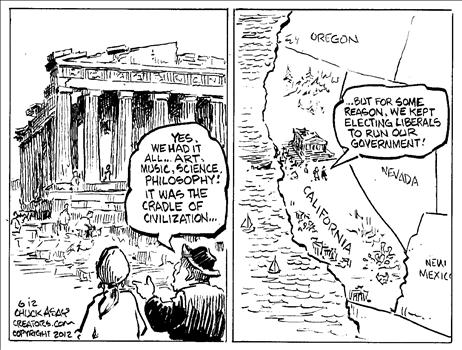
 https://danieljmitchell.files.wordpress.com/2012/06/california-greece.jpg

But it also has high taxes, absurd regulations, a bloated bureaucracy, and a costly welfare state. The net result of all these factors is mixed. There are some sectors that are still thriving, such as high tech, but there’s also evidence that the Golden State is losing ground.

And the comparative data will probably get worse over time because many taxpayers and businesses are now fleeing to lower-tax states.  Since I specialize in public finance, I’m tempted to say bad fiscal policy is California’s biggest problem. And that may actually be the case.  But if someone asks me for an example of what’s wrong with the Golden State, I’m going to direct them to this story in the Los Angeles Times.


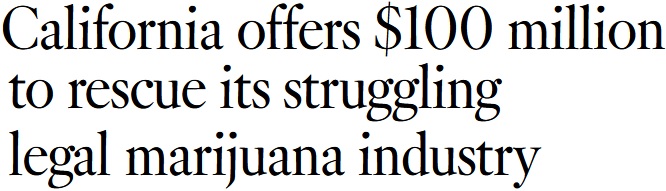
The California Legislature on Monday approved a $100-million plan to bolster California’s legal marijuana industry, which continues to struggle to compete with the large illicit pot market nearly five years after voters approved sales for recreational use. …

State officials initially expected to license as many as 6,000 cannabis shops in the first few years, but permits have been issued only for 1,086 retail and delivery firms. In 2019, industry officials estimated there were nearly three times as many unlicensed businesses as ones with state permits. …

The $100 million would go to local agencies with the most provisional licenses for growing, manufacturing, distribution, testing and retail operations. Some of the money can be used by cities offering equity funding to cannabis businesses owned by people of color.

Yes, you read correctly.

The state did a smart thing (removing legal prohibitions on marijuana), but did it in the worst possible way (burdening the sector with high taxes and red tape).  As a result, there’s still a very robust black market.  Here are some additional details about how politicians and bureaucrats have made it difficult to operate a legal business.

Many cannabis growers, retailers and manufacturers have struggled to make the transition from a provisional, temporary license to a permanent one renewed on an annual basis — a process that requires a costly, complicated and time-consuming review. …some face two to four years to get through the licensing process. Many would face the prospect of shutting down, at least temporarily, if they don’t get a regular license by current state deadlines, Kiloh said. …

Supporters of legalization blame the discrepancy on problems that they say include high taxes on licensed businesses, burdensome regulations… A key requirement to convert from a provisional license is to conduct a CEQA review to indicate how pot farms and other cannabis businesses will affect the surrounding water, air, plants and wildlife, and to propose ways to mitigate any harms.

However, Kiloh said, some cities are just setting up ordinances and staffing to process licenses, meaning many businesses cannot meet the looming deadline. …industry officials note the money will go to a small fraction of California cities, and only those that have already decided to allow cannabis businesses. …said Kiloh, owner of the Higher Path cannabis store in Sherman Oaks.

“The real problem is CEQA analysis is a very arduous process,” he added. “I think it would be good to have more reform of the licensing system instead of just putting money to it.”

Wow, provisional licenses, permanent licenses, CEQA analysis, taxes, regulations, reviews, and ordinances.  Sounds like my regulatory obstacle course. No wonder so many buyers and sellers of pot prefer the black market.  And Mr. Kiloh is correct. The solution is to deregulate, not to dump more money into the system.  No wonder California is a mess.

P.S. The late (and great) Walter Williams joking speculated whether California should set up East German-style border controls to prevent taxpayers from escaping.

P.P.S. There is a pro-secession group in California, though they should be careful what they wish for.


Wednesday, May 19, 2021

New Research on the Link between Government and Corruption

May 18, 2021 by Dan Mitchell @ International Liberty

Government breeds corruption by giving sleazy people a way of obtaining unearned wealth. Politicians and special interests are the winners and workers, consumers, and taxpayers are the losers.

http://freedomandprosperity.org/wp-content/uploads/2020/12/Dec-27-20-PJ-Quote.jpg

It’s easy to find examples. Simply look at tax policy, spending policy, regulatory policy, energy policy, industrial policy, agricultural policy, foreign policy, health policy, trade policy, drug policy, and bailout policy. Or anything else involving politicians and their cronies.

Hmmm…, I wonder if there’s a lesson to be learned from that list?

But just in case some people are slow learners, let’s consider some new scholarly research from the Federal Reserve.

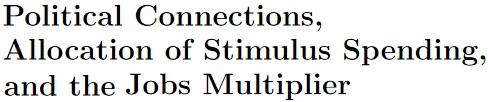
The study, authored by Joonkyu Choi, Veronika Penciakova, and Felipe Saffie, explores whether companies that give cash to politicians are then rewarded with cash from taxpayers.


The American Recovery and Reinvestment Act (ARRA) was enacted in the midst of the Great Recession, and over one-fourth of the funds were channeled directly to firms with the primary goal of saving and creating jobs. These stimulus funds were sizable and valuable to firms, with the average grant awarded exceeding $500,000. …With hundreds of thousands of dollars on the line, firms may have incentive to exert political influence… Are firms successful in influencing the allocation of stimulus spending? …This paper provides empirical answers… We find that firms’ campaign contributions to state politicians before the enactment of ARRA have a positive and significant impact on the probability of winning ARRA grants… We find that firms that contribute to winning candidates are 64 percent more likely to secure an ARRA grant and receive 10 percent larger grants. …The allocative distortion caused by political connections is sizable. Although only 6 percent of grant recipients contribute during local elections, they account for21 percent of total ARRA grants.

I feel like I need to take a shower after reading those results. Maybe I’m a political prude, but it galls me that politicians and interest groups have so much ability to fleece the rest of us.

And now you know what I refer to Washington as America’s “wretched hive of scum and villainy.”  The obvious takeaway from this research is that we’ll have less corruption if we have less government.  Which was my message in this video.


While I obviously like my video on the topic, I very much recommend this video interview with Andrew Ferguson.

P.S. Speaking of videos, here’s some satire about government corruption.

P.P.S. We shouldn’t be surprised that Obama’s so-called stimulus produced lots of corruption. The same was true with regards to Obamacare and green energy, which were his other main initiatives.

P.P.P.S. In the future, I’m sure we’ll see studies finding lots of corruption in Biden’s recent “stimulus” plan.

Saturday, April 17, 2021

Three Books on the Covid/Lockdown Catastrophe

In the early days of the lockdown, Amazon experimented with curating which books they would and would not publish on the crisis. Or call it what it really is, given our times: censorship. 

Among the first books hit was AIER’s own Coronavirus and Economic Crisis. The publication was delayed for weeks, then the Kindle edition was stopped for several more weeks. Still, the publication date is now listed as March 28, 2020, meaning that AIER had one of the first, if not the first, book out on the topic, just two weeks after the lockdowns began. 

In the meantime, Amazon has loosened up, perhaps because the sales of a different point of view were potentially too lucrative to pass up. Indeed, I see many dozens of such books out there, all taking issue with the CDC’s narrative and the lockdown policy agenda. I’m thrilled by this. For that matter, AIER has published an additional four books on the topic, including my own Liberty or Lockdown. 
 https://www.aier.org/wp-content/uploads/2021/04/5153bf5SS7L.jpg

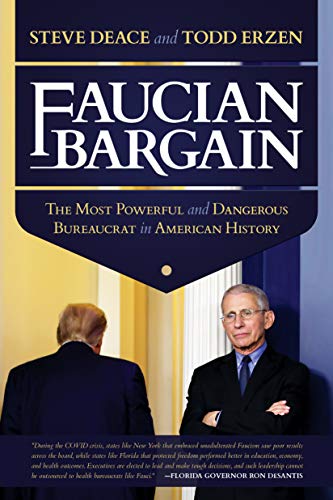
I’ve been waiting for a bestseller, and it has arrived: Faucian Bargain: The Most Powerful and Dangerous Bureaucrat in American History by Steven Deace and Todd Erzen, two media commentators in the tradition of Rush Limbaugh. 

This short book (it took me under an hour to read) is not strong on scientific rigor, but its sheer readability helps account for its huge seller status. Anyone who has lived and breathed the data, studies, and history pertaining to this terrible moment in history might find himself frustrated that the authors prioritize razzle-dazzle rhetoric and conservative-style talking points ahead of precision, citation, and calm exposition.

However, I don’t think our times permit that level of literary scrupulosity. The important point is that people are downloading and reading this in great numbers. This is good because the main storyline of the book is 100% correct. Not mincing words, they call this famous doctor “one of the most diabolical destroyers of self-governance and rugged individualism in all of American history.” It’s hard to disagree. 

Dr. Anthony Fauci has played an outsized role in pushing lockdowns, disease panic, and flagrantly bad science via his major means of communication: interviews with sympathetic media on TV. Among many, he has obtained a godlike status but the authors show that he acts more as a political performance artist. Artists improvise, play roles depending on the need, and seek approval above all else. That’s their main complaint against him – his fawning for the camera, his changing lines, his pseudo-scientific and imprecise but seemingly impressive blather, and it is correct. 

The authors draw attention to a huge mystery of his role early in the lockdowns. On February 28, he wrote in the New England Journal of Medicine that Covid-19 might “ultimately be more akin to those of a severe seasonal influenza.” On March 8, he told media that “there’s no reason to be walking around with a mask.” That was then, and, as they point out, he was mostly correct on these points in retrospect. 

I will let the authors continue the story:

And now, we come to March 11. The day the earth stood still. The day our way of life ended, with no definitive hope of when it might return. For that is the day Fauci testified before Congress that COVID-19 would be “10 times more lethal than the seasonal flu.” This is the statement that sent shockwaves across the country and launched us into lockdowns…. what changed in those eleven days? What new piece of evidence or data did Fauci acquire to inspire such an about-face?

This is the crucial question. To be sure, there was already panic in the air on March 8, when South by Southwest was summarily shut down by the Austin, Texas mayor. There was talk of locking down everywhere, with the New York Times whipping up a big panic on its main podcast and op-Ed page. Even then, hardly anyone believed it would happen. That Fauci testimony was indeed the turning point. His whole demeanor seemed to be warning the assembled politicians that many of them will die. It was crazy stuff. 

So what is our authors’ theory as to why he made the shift? They quote an anonymous White House employee who was there during the early days to the effect that Fauci became consumed by fame and celebrity. The more he called for lockdowns, the more panic he spread, the more he enjoyed the spotlight, and the more the media saw their ratings rise. 

And let’s be real, the media loved every minute of it. It’s not just media bias, but the media ratings matter, too. They have to blow this up, focus on the fight back and forth, and make the virus into the Malaysian flight that CNN kept on and on with. It has to be all catastrophic all of the time, or people will make their own decisions and go about their lives. And if there’s anything the media in Washington cannot handle, it’s the average American making decisions in their lives without the supposedly valuable input. So Fauci feeds off the media, and the media feeds off of Fauci. Both of them clinging to each other to make both of them more relevant.

That sounds plausible. There is an additional problem raised by 300 pages of emails discovered via FOIA that detail Fauci’s own relationship with China. Even our authors, who cover the released emails, don’t seem entirely aware of the implications of a US delegation having travelled to China in mid-February to learn from Beijing the art of virus suppression. I cannot account for this myself. Why would Fauci step up to volunteer as our own Manchurian public health official? Why carry water for the CCP? At the age of 80, he surely is beyond being paid off or bribed or whatever. Did he really come to believe that China had the only way out? It all seems hard to believe. 

Despite the pop feel, the obvious bias, the red meat from beginning to end, the authors are pointing to a dreadful scandal, and it is wholly understandable that this would inspire anger. Rightly so. 

 https://www.aier.org/wp-content/uploads/2021/04/51w0v8Ye4oL._SY346_.jpg

For a book with more data and evidence, in addition to a longer perspective on how free societies deal with pandemics, I would suggest Lockdowns on Trial by journalist Michael Betrus. The book came out in the summer but the 2nd edition came out in November 2020. The prose is elegant and mercifully calm. As I did in my book, he covers the policy response to previous lockdowns. He cites a huge amount of the literature showing a lack of any correlation between lockdown policies and disease mitigation. 

The main merit of this book, in my view, is that it shows that in terms of pathogens and disease, these times have not been without precedent. We’ve been here before. Indeed, humanity has never not been here, with germs and so on floating and swirling all around us, many of them mutations of previous pathogens, all the while with our immune systems adapting and scaling to absorb them and fight them. With the exception of a few American cities in 1918, and only then for a brief time, this country has always dealt with infectious disease as a normal event to be handled by medical professionals, not an exceptional catastrophe to be managed by politicians and bureaucrats. 

The burden of this book is to prove that these are in fact normal times or should have been regarded as normal times, which is to say that the mass panic was wholly unjustified. To that end, the book goes into some detail about the seemingly endless confusions over predictions, testing, data over infections and cases, and deals squarely with rampant issues of misclassification and exaggeration, the nursing home scandals, and also the details concerning demographic risk of SARS-CoV-2, the actual lethality of Covid-19 by age and comorbidities, and the deaths and how to count them. 

Insofar as I am in a position to judge based on my own knowledge, I find this book highly credible in addition to readable, with mercifully little in the way of politicized argumentation. Most impressive among these books, the author deals with the astonishing costs of lockdowns, which are not only economic but also social, cultural, and medical. Remarkably, lockdowns performed in the name of public health have in fact devastated public health. 

The book includes detailed debunkings of hundreds of media-touted myths of superspreader events, surges, outbreaks, spread in restaurants and bars, in addition to bringing all of this in focus with a proper emphasis on severe outcomes rather than cases as such. 

Other issues covered here: media bias, censorship, masks and their (lack of) effectiveness, the complete absence of evidence of some relationship between lockdowns and disease outcomes, and the outlying states around the world with no lockdowns and excellent outcomes. The chapters on suicides, drug overdoses, depression, learning loss, missed treatments, weight gain, business closures, and more terrible things, are enormously depressing and hard to read. Indeed, I’m hard-pressed to think of a single issue of note not covered in this book. 

The book has a conclusion I like: the lockdowns did not do what they were supposed to do, they caused unspeakable collateral damage, and therefore should be lifted everywhere immediately. 

I do have one argument with the author: I do not agree that stopping flights from China and Europe was a good idea, even with the information we had at the time. The presumption always should be about the freedom to travel. There are no ways to do counterfactuals here but the virus was already in the US, so I seriously doubt that these blocks achieved anything in terms of public health. Plus, they violate human rights. 

Day to day, my number one major annoyance in life – okay maybe not the whole of life but certainly my annoyance with the media – is the way in which terrible outcomes of lockdowns are frequently attributed to the “pandemic.” At the New York Times, this is daily prattle, almost assuredly imposed by editors. Writers can pen stories about depression, job loss, crisis in industries, disrupted supply chains, hunger and suffering, and everything else, so long as the causal agent is always named as the pandemic. The lockdowns, goes the implication, were just what one has to do in the presence of the new pathogen.
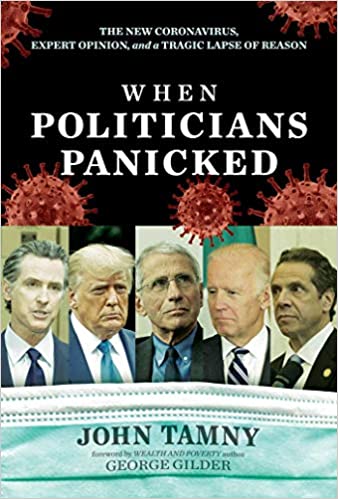
 

This is why I absolutely adore John Tamny’s fabulous book When Politicians Panicked. It doesn’t cover cell biology, death and case data, PCR testing scandals, hospitalizations, or virus trajectories at all. It keeps the focus on what really matters: how politicians smashed our economic lives out of a complete panic of what else to do. “To blame this on the coronavirus is to excuse ineptitude that is the normal when the combined, decentralized knowledge of millions and billions of humans is ignored in favor of the central and highly limited knowledge of a very few politicians, and even fewer experts.”

Tamny proves decisively that lockdowns were the cause of the crushed economy that was otherwise healthy, and this did not have to be. His fascinating spin on the China issue will challenge any reader. He points out that the market signals coming out of China even in the worst days of the pandemic were in fact not revealing anything terribly disruptive in terms of disease outcomes. US companies in China tested their employees and found few cases and no deaths. No American company with a deep stake in Wuhan was showing any level of market response to the pandemic. Tamny watches these markets carefully and concluded early on, by virtue of the information they were providing, that this virus itself represented minimal if any threat at all to social and economic functioning. Its severe outcomes were limited to the health and well-being of a small demographic and that would be treated medically and not politically. 

The reason this did not happen is the core thesis of the book. The politicians panicked. Lockdowns became the default response, though they had never been tried before, and a test of leadership grit. Real men and real women lock down to control the virus! That was the ethos stemming from panic. “What happened was an imposition of command-and-control that has always suffocated economic growth.” Tamny further shows that economic growth has always been a precondition for good health outcomes, so it makes no sense at all to shut it down. He will not call what resulted a recession, on grounds that this would be insulting to a very natural market process. It was pure destruction, and pointlessly so, since the virus should always have been treated as a medical matter. 

The book excels – and is thus far singular – in addressing the complete failure of the various stimulus packages intended to substitute for a functioning economy. It can never work. Whether the stimulus is fiscal or monetary, the government can only take from the private sector and redistribute it but it can never make up for losses associated with lockdowns. The author is right on target in associating this with Khrushchev-style economics (I thought that was my original insight; Tamny had it first). The Soviet dictator imagined that governments could outperform markets in a way that made markets irrelevant and unnecessary, exactly as the lockdowners thought that government could easily. 

Tamny’s book succeeds mightily in intellectually crushing the lockdown deniers (people who pretend like it never happened), and for that reason it is enormously satisfying. Somehow out of the three books mentioned here, this is the one that is most heartbreaking and most maddening since it shows decisively that none of this was necessary. None of it. The lockdowns were a monumental distraction from the job that needed to be done, and which always needs to be done, which is to promote good health outcomes. 

Tamny is willing to ask unaskable questions such as: what if the politicians had done nothing? His answer might shock anyone who has yet to rethink the tragic events of the last year. He says we would have been better off and the severe outcomes from the disease better because of the nursing home scandals and the collateral damage. In other words, the “mitigation” efforts not only wrecked the economy; they wrecked public health too. 

I’m so grateful to John Tamny for writing this book, which says exactly what needs to be said, and ends just the right way: it is time to reassert the primacy of freedom. 

These are three of what will be thousands of books that will be appearing in the coming years on these tragic times. I’m willing to wager that most of these books will severely condemn the policy decisions of the last year, just as these have done. There will be a reckoning. These books are an excellent start. 

Jeffrey A. Tucker

Jeffrey A. Tucker is Editorial Director for the American Institute for Economic Research.

He is the author of many thousands of articles in the scholarly and popular press and nine books in 5 languages, most recently Liberty or Lockdown. He is also the editor of The Best of Mises. He speaks widely on topics of economics, technology, social philosophy, and culture.

Jeffrey is available for speaking and interviews via his email.  Tw | FB | LinkedIn

Books by Jeffrey A. Tucker


Monday, March 29, 2021

More Stimulus Failure

March 28, 2021 by Dan Mitchell @ International Liberty 

According to data on jobs and growth, President Obama’s so-called stimulus was a failure.

But at least politicians and bureaucrats were able to concoct new and clever ways to waste money. Including research grants to interview people about their sexual histories and to study erectile dysfunction.  In other words, stimulus spending on stimulus (though at least we did get some clever humor in exchange for nearly $1 trillion of wasted money).

Now we’re wasting nearly $2 trillion on Biden’s spending spree.  And we’re getting more stimulus spending on stimulus.  But not the economic kind of stimulus. Paul Bedard of the Washington Examiner reports that people are using handout cash for interesting purchases.


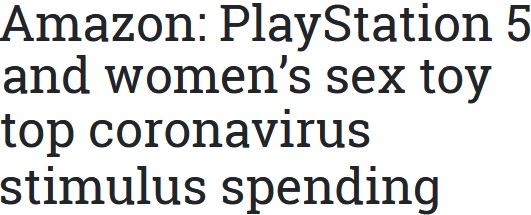
An analysis of spending on Amazon following the distribution of the latest coronavirus stimulus, a massive $1.9 trillion package, suggests that people are using it to let off some steam. The global e-commerce firm Pattern said that the biggest surges in sales were for the PlayStation 5 and a female sex toy called the “Rose Flower Sex Toy.” …Rose’s sales (check Amazon for the description) shot up 334%. …“Distribution of stimulus checks on Wednesday, March 17…may have represented an opportunity for some retail therapy,” said the company.

I’m sure there’s probably some interesting social commentary to make about guys playing video games and neglecting their wives and girlfriends. But I’m a policy nerd, so I’m focused on how we’re now saddled with a bigger burden of government spending. The problem is much bigger than the humorous/irritating example discussed above.

In a column for the Foundation for Economic Education, Brad Polumbo shares some big-picture data on how politicians have squandered our money.


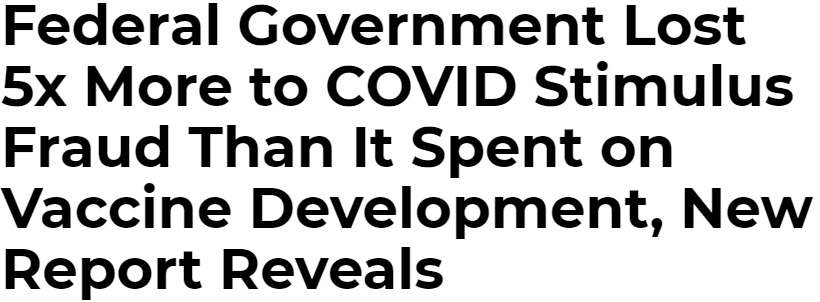
Whenever the government spends money, a significant portion is lost to bureaucracy, waste, and fraud. But the…unprecedented scope of federal spending in response to the COVID-19 pandemic—an astounding $6 trillion total—has led to truly unthinkable levels of fraud. Indeed, a new report shows that the feds potentially lost $200 billion in unemployment fraud alone. …More than $200 billion of unemployment benefits distributed in the pandemic may have been pocketed by thieves… To put that $200 billion figure in context, it is equivalent to $1,400 lost to fraud per federal taxpayer. (There goes your stimmy check!) Or, comparing it to the $37 billion the federal government spent on vaccine and treatment development, it’s more than five times more lost to fraud than went to arguably the most crucial COVID initiative of all. That’s just scratching the surface. According to the American Enterprise Institute, “unemployment fraud” now ranks as the 4th biggest federal COVID expenditure out of more than 17 different categories.

If you’re a taxpayer, hundreds of billions of dollars in fraud sounds like a bad outcome.  But if you’re a Keynesian economist, it’s not a problem. All they care about is having the government borrow and spend a bunch of money. They think that making government bigger automatically generates benefit for the economy, even if the money goes to thieves and crooks.

I’m not joking. This is why people like Paul Krugman said a fake attack by space aliens would be good for the economy because Washington would spend a bunch of money in response.  And it’s why Nancy Pelosi actually said the economy benefits if we subsidize joblessness.


Wednesday, December 9, 2020

Policing for Profit Is Morally Offensive

Since I’m an economist specializing in public finance, I get very upset about punitive tax policy and wasteful government spending.

But what really gets my blood boiling is reading about the horrific policy of civil asset forfeiture, which literally allows government to steal your property even if you haven’t been convicted of a criminal offense. Or, in many cases, even charged with any wrongdoing!

I’ve decided to revisit this issue because of a recent tweet reminding us that the people who are supposed to protect us actually take more of our property than burglars.

What’s particularly nauseating is that this policy gives law enforcement an incentive to misbehave.

Consider, for instance, these details from a 2014 story in the New York Times.


…civil asset forfeiture…allows the government, without ever securing a conviction or even filing a criminal charge, to seize property suspected of having ties to crime. The practice, expanded during the war on drugs in the 1980s, has become a staple of law enforcement agencies because it helps finance their work. …The practice…has come under fire…amid a spate of negative press reports and growing outrage among civil rights advocates, libertarians and members of Congress who have raised serious questions about the fairness of the practice, which critics say runs roughshod over due process rights. …Much of the nuts-and-bolts how-to of civil forfeiture is passed on in continuing education seminars for local prosecutors and law enforcement officials… In the sessions, officials share tips on maximizing profits, defeating the objections of so-called “innocent owners” who were not present when the suspected offense occurred, and keeping the proceeds in the hands of law enforcement…seized money has been used by the authorities, according to news reports, to pay for sports tickets, office parties, a home security system and a $90,000 sports car. …forfeitures were highly contingent on the needs of law enforcement. …Flat screen televisions…“are very popular with the police departments.”

This is why asset forfeiture is accurately described as “policing for profit.”

There was some good news on this issue last year in South Carolina, as reported by the Greenville News.


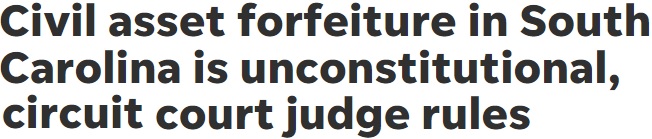
A South Carolina circuit court judge in Horry County has ruled the state’s civil asset forfeiture law unconstitutional, in violation of the U.S. Constitution’s Fourth, Fifth and 14th amendments. …Earlier this year The Greenville News published coverage from a two-year investigation into civil asset forfeiture in South Carolina. …Nearly 800 times when police seized money or property, no related criminal charge was filed. In another 800 cases, someone was charged with a crime but not convicted. …About 65% of the cases involved black men though black men make up just 13% of the state’s population. …John’s written decision found that South Carolina’s forfeiture laws violate both the federal and state constitutional protections against excessive fines by allowing the government to seize unlimited amounts of cash and property that aren’t proportionate to the alleged crime. …The judge’s ruling signals how he would approach forfeiture cases in his court in the future but doesn’t set precedent across the state.

What we really need, of course, is a ruling from the U.S. Supreme Court that civil asset forfeiture violates the Constitution (violates the presumption of innocence, excessive punishment, etc), and there are some reasons to hope that may soon happen.

It’s also good news that conservatives have joined with libertarians (such as the great people at the Institute for Justice) in opposing this egregious practice.

Here are some excerpts from a National Review article by Isaac Schorr.


The process is broken. …the government brings charges against the property itself without leveling any against the property owner. On a federal level, criminal behavior need not be proven for law enforcement to initiate civil-asset-forfeiture proceedings; mere suspicion is considered reason enough. It’s worth noting that as California’s attorney general, Democratic vice-presidential nominee Kamala Harris strongly supported handing this same power to local law enforcement — for the people, of course. …Why has civil-asset forfeiture, which flies in the face of American expectations of due process and the presumption of innocence, been allowed to persist in its current form? It’s all about the Benjamins. …This practice…provides local authorities with perverse incentives. …they can move to forfeit property under federal law and take up to 80 percent of what the property is worth,” which gives them “a direct financial stake in forfeiture encourag[ing] profiteering and not the pursuit of justice.” What police department would not take advantage of such a profitable opportunity, particularly when those profits are not subject to the same oversight as taxpayer dollars?

When cops lose access to this loot, they naturally complain.

Here are some passages from a story in the Mercury News.


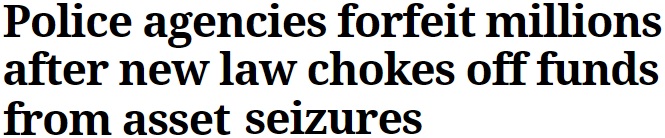
While the value of property seized in California has skyrocketed, the state’s share of the booty — which has traditionally helped fund local police agencies — has plunged. That’s largely because of a new state law seeking to protect personal property, allowing local agencies to keep proceeds from asset seizures only when people are convicted of a crime, rather than simply when they’re arrested. …California…passed laws — more stringent than the federal government — restricting when state and local police could seize private property. So local agencies worked around them by partnering directly with the U.S. Department of Justice in asset-forfeiture cases, bypassing the rules in state laws. SB 443 closes that loophole for state and local agencies — but not for the federal government, which can continue to seize property without criminal convictions. …The Golden State is trying to set a good example and do the principled thing, even as the federal government goes in the opposite direction, said Gregory Chris Brown, associate professor of criminal justice at Cal State Fullerton.

In other words, fixing this problem involves all levels of government.

Local law enforcement needs to stop policing for profit.

 https://cdn2.vox-cdn.com/thumbor/MyYVduXouRgBTX4DRZEkyG7POFk=/800x0/filters:no_upscale()/cdn0.vox-cdn.com/uploads/chorus_asset/file/3794308/forfeiture%20percent.png

State government needs to stop policing for profit.

And Uncle Sam needs to get out of the racket as well.

Speaking of the federal government, the Obama Administration took a tiny step in the right direction, but the Trump Administration has been very unhelpful.

And what about the incoming Biden Administration? I haven’t seen any indication, but I’m not brimming with optimism given Biden’s generic desire for Washington to have more money, as well as his unpalatable record as a booster of the failed War on Drugs.

But hopefully he’ll surprise me.

In the meantime, let’s keep our fingers crossed for further reforms at the state level.

Let’s close by recycling a great video on this issue from the folks at Reason. 

P.S. It’s worth noting that the first two people in charge of asset forfeiture for the federal government have since come out against this odious practice.

P.P.S. Here’s some sauce-for-the-goose-sauce-for-the-gander humor involving asset forfeiture.