Search This Blog

De Omnibus Dubitandum - Lux Veritas

Showing posts with label LBJ. Show all posts

Tuesday, May 6, 2025

Corruption In Politics: The Case Of Trump And Cryptocurrency

 M

In the New York Times from this past Thursday (May 1), the lead story was a scathing exposé of alleged corruption of our current President. The headline and sub-headline (print version) were “Trump Shapes the Policy On Crypto, and Cashes In. Hushed Deals and Foreign Investors Propel President’s Digital Money Start-Up.” The sub-headline in the online version was even more scathing: “World Liberty Financial has eviscerated the boundary between private enterprise and government policy in ways without precedent in modern American history.” The story fills the entire upper right-hand quadrant of the front page, plus another full page and a half in the interior of the paper.

So according to the Times, this is not just some ordinary, every day, run-of-the-mill political corruption. Rather, it is corruption that has “eviscerated” boundaries between business and government, and is “without precedented in modern American history.”

Is there any substance to these charges?

As readers here know, my view has long been that the game of politics is inherently corrupt. Politicians are in a position to use the powers of their offices in a thousand ways, large and small, to benefit themselves and their friends and supporters, and to disadvantage adversaries. Almost no human being is immune from the temptation to use those powers for such purposes at least a little. And thus there is no such thing as a politician against whom at least some charge of corruption cannot credibly be alleged.

And it is far worse with today’s massive and intrusive federal administrative state. Essentially every business is under the thumb of federal regulation — and even if a business is not currently regulated, it could be. Every business is also taxed, and the taxes for any given business could be either increased or decreased at any time. So if a President is involved in changing regulation in any way, or in changing taxation in any way, or even in not changing regulation or taxation when some people say that he should, did he do that to benefit the financial interests of himself or his family, or did he do it because he thought it was good public policy? And don’t forget, it could be both!

Because every politician does things that can credibly be charged as corruption, I think that by far the most important question about any allegation of political corruption is whether the action in question is at least arguably illegal, and if so, what is the theory of illegality? Beyond that, it is also completely fair to ask whether something might not be right or good, even if legal. Just because something isn’t even arguably illegal doesn’t make it immune from criticism. All allegations of self-dealing are fair game for criticism of a politician, and for the voters to take into account.

With that background, let’s give the Times their best shot to make their case. The subject of the big May 1 article is a crypto start-up by the name of World Liberty Financial. WLF was launched in September 2024, shortly before the recent election. The majority owner of WLF is The Trump Organization (which the Times calls a “Trump family corporate entity”). Since taking office for his second term, President Trump has significantly eased the federal regulation of the crypto industry, including ending SEC investigations and disbanding a Justice Department task force focused on the industry. The Times calls this a “broad unwinding of Biden-era scrutiny of the industry.” From the Times:

Mr. Trump’s return to the White House has opened lucrative new pathways for him to cash in on his power, whether through his social media company or new overseas real estate deals. But none of the Trump family’s other business endeavors pose conflicts of interest that compare to those that have emerged since the birth of World Liberty. The firm, largely owned by a Trump family corporate entity, has erased centuries-old presidential norms, eviscerating the boundary between private enterprise and government policy in a manner without precedent in modern American history. 

Mr. Trump is now not only a major crypto dealer; he is also the industry’s top policy maker. So far in his second term, Mr. Trump has leveraged his presidential powers in ways that have benefited the industry — and in some cases his own company — even though he had spent years deriding crypto as a haven for drug dealers and scammers.

The gist of the Times’s claims against Trump in the piece is summarized as a “range of conflicts of interest trailing the company.” Here is their list:

  • World Liberty has directly benefited from Mr. Trump’s official actions, such as his announcement of a federal crypto stockpile that would include a digital currency the firm has invested in. The president’s announcement caused a temporary jump in the value of World Liberty’s holdings.
  • World Liberty has sold its cryptocurrency to investors abroad, including in Israel and Hong Kong, according to interviews and data obtained by The Times, establishing a new avenue for foreign businesses to try to curry favor with Mr. Trump.
  • Several investors in World Liberty’s coin managed firms that the federal government accused of wrongdoing. They include an executive whose fraud case was suspended after he invested millions of dollars in World Liberty. Other investors and business partners, some of whom haven’t been publicly identified before, are looking to expand in ways that will require the Trump administration’s approval.
  • World Liberty proposed swapping cryptocurrencies with at least five start-ups, and often used the Trump name to solicit steep payments as part of the deals. Even in an industry with a disreputable history, the deals raised alarm among veteran executives.

My reaction is, is that the best you’ve got? The most serious of the allegations is the first one, that “World Liberty has directly benefited from Mr. Trump’s official actions.” And so have hundreds and hundreds of other businesses benefited from the broad de-regulatory agenda of the second Trump administration. Trump himself may be benefiting from the de-regulation of crypto, but everyone else also has the opportunity to do the same. And any gains could be undone by a crackdown in a subsequent administration. Meanwhile, despite the frequently over-heated language of the Times piece, it never makes any suggestion of illegality. If there is any basis under which this may be illegal, I am unaware of it. Perhaps some readers may have a theory.

Looking at this situation at a more general level, our recent Presidents (and other prominent politicians) can be divided into three big categories from the perspective of exposure to corruption. In Category One, we have people, like Trump, who have come to office with substantial business interests that they have retained while in office. In Category Two are the politicians who have served in public office for their entire careers, and have never held a significant private sector job or business interest. 

Category Three consists of those who had a career in the private sector, but substantially cashed out before entering public service, and now just have investment portfolios. Examples from Category One include Lyndon Johnson and Jimmie Carter. Also, if I might take one non-presidential example, Nancy Pelosi. Examples from Category Two include Bill Clinton and Joe Biden. Examples from Category Three include Ronald Reagan and the two Bushes.

From the point of view of potential corruption, it might be best to have all politicians come from Category Three. However, nothing in the Constitution requires that. And nothing about Category Three makes it completely free from temptation to corruption either. Plenty of political decisions affect the value of investment portfolios, even diversified ones.

As between Categories One and Two, I’ll take politicians from Category One any day. Someone from Category Two who advances to the high office of the Presidency has tremendous temptation to develop personal wealth by accepting large payments from third parties to influence government policy. 

Both Clinton and Biden are clear examples of this. 

Bill Clinton created the Clinton Foundation in 2001 after leaving office, and the Foundation then raised more than $2 billion over the next 15 years, during much of which time his wife was widely expected to become the next President. Large donors included foreign actors with clear interests in influencing U.S. policy. The overhead of the Foundation provided hundreds of millions of dollars to fund the Clintons’ lifestyles and staff. 

This enterprise skirted extremely close to the edge of quid pro quo bribery. In the case of Biden, between 2019 and 2023 I wrote an entire eleven-part series titled “Biden’s — Stone Cold Crooked,” explaining why the publicly available facts about the Bidens’ conduct in Ukraine and China made for a lay-down case of quid pro quo bribery. Somehow the Biden Justice Department was never interested in pursuing the case.

Over in Category One, consider the case of Lyndon Johnson. Josh Blackman at the Volokh Conspiracy has a summary in a post from January 1, 2025. The summary is largely derived from the Robert Caro biography of Johnson. Lyndon and Lady Bird Johnson owned television and radio stations in the Austin, Texas area. From Blackman:

As Mr. Johnson rose through the ranks in the House, and later the Senate, Robert Caro observed, there was a "twenty-year-long string of strikingly favorable rulings by the Federal Communications Commission" for KTBC. Caro at 286. Coincidentally, Austin was "one of the few metropolitan areas with only a single commercial television station."

When Johnson became President, he purported to put his holdings, including the broadcast stations, in a “blind trust”; but Blackman notes that the trustees were close personal friends and the trust would never meet the technical requirements for a true “blind trust.” Similarly, Jimmie Carter retained his heavily regulated (and subsidized) peanut farm business while President, while also creating a half-baked “blind trust.”

According to Reuters here on January 10, Trump has not created a “blind trust,” but has withdrawn from “daily management” of his business interests, and has turned that over to his sons. Reuters quotes a supposed “ethics expert” as saying that Trump’s arrangements are “not good enough.” Did that ethics expert ever criticize the arrangements of Johnson or Carter?

Is the insubstantial distinction between Trump’s arrangements and the Johnson/Carter “blind trusts” what the Times is referring to as “eviscerating the boundaries between business and government” and something “without precedent in modern American history”?

And then there’s Nancy Pelosi. Critics have noted multiple times over the years where Pelosi or her husband seemed to have done a profitable stock trade just before some Congressional action. This piece from Yahoo Finance on January 8 notes that Pelosi’s stock portfolio was up 54% in 2024, which beat the performance of every hedge fund in the country. At the same time, a bill to restrict stock trading by congresspeople somehow never advanced while Pelosi was Speaker.

Anyway, if you ask for my view of the biggest political corruption incidents of the past few years, numbers one and two would be:

  1. ) the multi-hundreds of billions of dollars of funding for the institutions of the Left from the government, and 
  2. ) the Censorship Industrial Complex put together by the Biden administration to suppress conservative speech. 

Those things don’t seem to draw big front-page articles from the Times.

Tuesday, January 7, 2025

Who Really is Donald Trump?

By Rich Kozlovich

Me and most of my conservative friends really don't like Trump on a personal level.  But we all thought he has the ability to be one of the greatest Presidents in the nation's history, and we believe that because what we want is less government (way less government), less taxes, less spending, the end of deficits and borrowing, start paying off the national debt, less regulations, and a President who will deliver that, and he's promised to be that deliverer .... sort of ... maybe. 

Well, America, we just might have a problem.

I keep wondering at the things Trump is doing and saying.  He's wanting to appoint some really strange people to important offices, like Bobby Kennedy, Jr., who is now, was in the past, and will be in the future a far left nitwit.  

He was the proverbial blind monkey who found a coconut because of his stand against the "vaccines" being forced on society for covid, which weren't real vaccines, since they didn't immunize the patient and didn't prevent transmission, which before this was the decades old definition for a chemical compound to be called a vaccine.   As for covid being a disaster, the only covid disaster was the tyrannous impositions governments all over the world put on their societies, and done so with a lot of lies and propaganda.  But the reality is he's against all vaccinations, so his stand against these covid shots that wasn't a strong moral stance against what was going on standing as a rock in the current.

Kennedy, if confirmed, will have control of the Centers for Disease Control and Prevention, the Food and Drug Administration, the National Institutes of Health and the Centers for Medicare and Medicaid Services, and, 'Kennedy has claimed Trump “promised” him “control of the public health agencies" and Trump delusionally claims:

"Kennedy will restore these Agencies to the traditions of Gold Standard Scientific Research, and beacons of Transparency, to end the Chronic Disease epidemic, and to Make America Great and Healthy Again!"  

Now that's pure delusion, and should scare the entire nation. Was this a deal Trump made to get Kennedy to support him?  If it was, it was a bad deal putting him in charge of the nation's health and how the nation grows and eats food in America?  Listen up Donny, that's nuts.    

We're facing a massive nation destroying national debt, and yet I'm reading how Trump wants to eliminate the debt ceiling.  Why?  It's inconvenient, and the arguments for eliminating it are horsepucky, and a failure of leadership.  What happens if you eliminate a debt ceiling in your life, and then spend like a drunker sailor?  You go broke!   Just because the government can print all the money they want to isn't leadership.  It's a failure in leadership, a failure to the taxpayers, and it's blatantly irresponsible.  In his last term he did a lot of good things, but cutting spending and borrowing wasn't among them, and it appears he might not be any good at it this term either.  I'm hoping that's not so.  

At this point I would like to feature this article by my now passed friend Alan Caruba, who discussed the disaster of Lyndon B. Johnson in his 2012 article Poverty Nation and Johnson's “War on Poverty” saying it was a "classic, liberal government program that to this day has not eliminated poverty in America", and goes on to show no matter how much is spent, poverty will always be with us.  That's history, and that history is incontestable. 

The leftist view is that poverty can be eliminated if we just spend more money.   Well that's historically delusional, it's stupid, and it's budget busting.  In short, the amount of spending, ineffectual spending, with lousy returns is massive, and that's so throughout the federal government.  If Trump really wants it all stopped he needs to put a cap on spending and borrowing, and he needs to do it now!

But this really takes the cake. Trump wants Canada to become the 51st state, which has generated a lot of CO2 and ink, and since Trudeau has resigned he's putting on the big push, and making big promises saying:

Many people in Canada love being the 51st state.  The United States can no longer suffer the massive trade deficits and subsidies that Canada needs to stay afloat.  Justin Trudeau knew this, and resigned. If Canada merged with the U.S., there would be no tariffs, taxes would go way down, and they would be totally secure from the threat of the Russian and Chinese Ships that are constantly surrounding them. Together, what a great nation it would be!!

Russian and Chinese ships are surrounding Canada?  Really, I've not read that anywhere else, and everything else he's saying here is... well... odd at best.

Let's understand this, the conservatives of Canada are like America's RINO's only more left.  So, if Canada were to become the 51st state there would be two more leftist Senators, and an untold number of leftist House members.  If the ten provinces of Canada became separate states that would bring in 20 more leftist Senators.   The Congress would be in the hands of anti-American far left lunatics forever.  If people liked the tyranny Trudeau imposed on Canada, they would love the tyranny they, along with their Democrat allies, would be able to impose on America, starting with the end of the First and Second Amendments.  

And Donny thinks that's a good idea? 

Thursday, February 15, 2024

How the Kennedy Family Caused Today’s Immigration Crisis

And brought Obama's father to America.

By Daniel Greenfield @ Sultan Knish Blog


When LBJ signed the 1965 Immigration and Nationality Act into law, JFK had been dead for two years, but it, more than the Cuban missile crisis or the race to the moon, was his real legacy which still impacts us today when there are no more Americans on the moon or nukes in Cuba.

At the signing, LBJ paid tribute to “the vision of the late beloved President John Fitzgerald Kennedy”. Little did the 36th president know that the 44th president, born to a radical Kenyan student, was already growing up in this country due to JFK’s personal intervention during his 1960 presidential campaign.

“This bill that we will sign today is not a revolutionary bill,” President Johnson argued. “It does not affect the lives of millions. It will not reshape the structure of our daily lives… Yet it is still one of the most important acts of this Congress and of this administration.” Only the last was true.

It affected not only millions, but tens of millions, and it reshaped our lives and our country.

At the signing ceremony, LBJ was flanked by the newly minted Senator Ted Kennedy and a grinning RFK to cement the bill which ended national quotas for immigrants as the Kennedy legacy. The bill would be described as Senator Ted Kennedy’s “first legislative victory” which “helped change the face of the country” and “fashioned the modern day immigration system.”

“The bill will not flood our cities with immigrants. It will not upset the ethnic mix of our society. It will not relax the standards of admission. It will not cause American workers to lose their jobs,” Senator Ted Kennedy had promised in the Senate. All of these promises proved to be false.

The 1965 bill was a sequel to a battle that Rep. John F. Kennedy had narrowly lost to Senator Richard Nixon over the Immigration and Nationality Act of 1952. President Truman had vetoed the 1952 bill because it imposed national restrictions on immigration, favoring Western European immigrants and drastically limiting immigration from the rest of the world.

Kennedy had upheld Truman’s veto in the House but Nixon cast a tie-breaking vote and the 1952 bill became law.

While Nixon won the battle, Kennedy won the war. In 1958, Kennedy published “A Nation of Immigrants” which argued that restricting immigration by national origin “violated the spirit expressed in the Declaration of Independence that ‘all men are created equal’”.He was preparing to relaunch it in 1963 for his big immigration push before his assassination.

During the 1960 presidential campaign, the Kennedy team focused its outreach on immigrant groups restricted by the bill. The 1952 bill, also known as the McCarran–Walter Act had been partly the work of Senator Pat McCarran: a powerful Senate Democrat who had wanted to keep out Poles, Ukranians and other Eastern Europeans, Jews, Greeks and everyone he did not like.

The Kennedy campaign turned to Eastern Europeans, who were prominent in Illinois, and Chinese-Americans, prominent in California, as part of its strategy to win the White House. And the strategy paid off with a narrow victory in Illinois that clinched the presidency. (Nixon narrowly won his native California, but by a far smaller margin than Eisenhower’s triumphant romp.)

That made the 1960 election into the first true multicultural presidential campaign that changed the face of American politics. And by 1968, Nixon would be cutting his own “black power” ads.

One of the more significant moments in the 1960 campaign took place at the Hyannis Inn Motel, just down the road from what is now the JFK Museum, when Kennedy met with a number of Ukrainian and Eastern European Democratic Party activists organized by Michigan Gov. Gerhard “Soapy” Williams, who headed the Democratic National Committee’s ‘Nationalities’ division to organize the support of different national groups (the term commonly used then to refer to immigrants from outside Western Europe) to rally support for the Democrats.

(As President Kennedy’s Secretary for African Affairs, ‘Soapy’ would play a key role in pulling away U.S. support from Rhodesia and South Africa while championing “Africa for Africans”.)

At the Hyannis Inn, Kennedy promised an end to national quotas and, almost as importantly, for “due process, right of appeal, and statutes of limitation” to “be extended to noncitizens” which would eventually turn immigration into the endless process of litigation that it now is.

Senator Ted Kennedy would describe immigration as a “very central part of President Kennedy’s administration.” “President Kennedy elected in 1960, one of the first pieces he introduced in the Congress of the United States was reform of our immigration laws. I remember being on the Judiciary Committee after being elected in 1962, and my brother Bob coming up and testifying for the Immigration Reform Program,” he later recalled.

Once in the White House, President John F. Kennedy could not immediately deliver on these promises, it would fall to LBJ’s dealmaking savvy and brute force politicking to do what the former pretty boy senator couldn’t and actually open up the immigration system to the world.

But what JFK could do was play on national opposition to Communism to open up the doors to refugees, which he did, ushering in the 1962 Migration and Refugee Assistance Act, initially meant to provide refuge to Cubans and Eastern Europeans fleeing Communism to come here, but which would become a key element in a virtually endless system of asylum migration.

Much as he had with the 1965 Immigration and Nationality Act, LBJ would once again do what JFK could not, by signing on to the UN Convention Relating to the Status of Refugees in 1968. This treaty is what forces us to process an asylum request by any migrant who walks up to the Mexican border. LBJ had promised the Senate that it would “not impinge adversely upon established practices under existing laws in the United States” and that “State laws are not superseded by the Convention or Protocol.” Those claims would also prove untrue.

States and cities have been swamped by masses of migrants crossing the border by making asylum claims and they are barred by the federal government from keeping them out.

A decade later, Senator Ted Kennedy would be hard at work codifying the UN treaty into immigration law with what would eventually become the Refugee Act of 1980. What had started out as an anti-Communist measure instead became a means of admitting Communists, Marxists, Islamists and an endless flood of migrants who could be persuaded to support them.

Refugee admissions led directly to the current border crisis, but there was another shadow immigration policy that may have been equally devastating, if not more so, which was also initially justified as a means of fighting Communism, but became a means of importing it.

The 1952 Immigration and Nationality Act, for all that it was denounced as racist and exclusionary, had actually increased immigration from Asia and had begun putting into place the student visa system that political elites wanted which would dramatically transform America.

While JFK had signed the Mutual Educational and Cultural Exchange Act into law to increase the number of foreign students in 1961, Barack Obama Sr and Shyamala Gopalan, the mother of Kamala Harris, had both moved to America in 1959: using the student visas that the McCarran–Walter Act had brought into being to subsidize American universities with a flood of foreign students.

When Donald J. Harris, Kamala’s father, arrived in 1963, it was likely as part of the growing number of foreign students benefiting from the Mutual Educational and Cultural Exchange Act.

But when Sayyid Qutb, the Muslim Brotherhood leader and godfather of Islamic terrorism, fled Egypt to study in Colorado in 1949, and came away loathing everything about America and calling for war against it, he was able to do it because of the lobbying by the Institute of International Education (IIE) headed by key university and foreign policy leaders which used their elite access to vastly increase the number of foreign students coming to America.

The IIE’s promotion of foreign students led not only to visits by Qutb and Obama Sr, but by a generation of radical Marxists and Islamists who soon set up operations in this country.

The only way to understand what happened to America beginning on September 11 is to study the wave of Third World radicals who came to study at American universities and stayed, or, like Barack Obama Sr and Donald J Harris left their children behind here, or, like Qutb, learned enough to figure out how to best wage war against the United States of America.

To understand why we have pro-Hamas riots in the streets of New York City, part of the answer begins with the arrival of Archibald Wickeramaraja Singham, a Sri Lankan Marxist to study in America. He became a powerful academic and his Maoist son, Neville Roy Singham, made a fortune, moved to Shanghai and directs anti-war groups from China. His story is far from unique.

Edward Said, the academic godfather of terrorism, was sent to study at an elite boarding-school in Massachusetts before moving through Princeton and Harvard. While the IIE and the open door to foreign students was supposed to ‘Americanize’ Third World elites, those elites actually ended up radicalizing and even ‘Islamizing’ America. They have already produced one two-term president and one vice-president who could end up becoming a president in her own right.

The IIE was primarily concerned with subsidizing Ivy League universities. And the foreign students they tended to attract were radical members of the elites in their own countries.

The Mutual Educational and Cultural Exchange Act was also known as the Fulbright–Hays Act of 1961 after Senator J. William Fulbright. Fulbright had pulled off nearly as great a coup under Truman with an act amending a bill dealing with surplus property left in Europe that allowed the State Department to use the sale of “surplus war properties” to fund foreign students to come to America also partly subsidized by the Rockefeller Foundation and the Carnegie Corporation.

Senator Fulbright was to foreign students what Senator Ted Kennedy was to immigration. And the IIE took the lead in making sure that colleges took full advantage of the Fulbright system.

JFK championed the Fulbright scholarships and the foreign students changing America.

“Do you know that we brought more foreign students to the United States ten years ago than we do today?” Senator John K. Kennedy had complained on the campaign trail at NYU in 1960.

Foreign students had been excluded from immigration quotas, but many did become immigrants, joining universities and firms as a new kind of intellectual cheap labor force. These men and women, engineers, doctors, bureaucrats, and academics, became the backbone of the Third World Marxist and Muslim Brotherhood presence that transformed America.

The elites who had been restrictionist eugenicists at the turn of the century were now eager to open up to the world. The Cold War as it played out in world capitals was less a matter of nuclear buildup and defense drills (which the elites dismissed as nonsense) but of a global influence operation playing out across cultural, political and academic battlefields.,

That led to everything from the CIA backing the colorful spatters of Jackson Pollock to “It’s a Wonderful Life” director Frank Capra being dispatched to India to report on Communist infiltration into Bollywood. Bringing foreign students to America was described as the ultimate influence operation. Moscow had the paltry Patrice Lumumba University while America had Harvard, Yale and Columbia, but the trouble with using the Ivy League to fight Communism was that universities were already leftist and the new students and future faculty even more so.

America’s elites did not change the world, instead the world changed them.

JFK may have been one of the best examples. During the 1960 presidential campaign, Kennedy held a press conference together with Kenyan nationalist leader Tom Mboya. The topic was Mboya’s efforts to bring members of his tribe to study in America. Hoping to appeal to black voters by embracing African nationalism, JFK tried to use his brother’s foundation to foot the bill.

Additional funding was provided by the Rockefeller Foundation.

A furious bidding war soon broke out between Nixon, inside the administration, and Kennedy over the opportunity to win over black voters by funding the airlift of Kenyan students. It was an image battle that JFK easily won with his press conference together with Mboya.

JFK’s political genius rebranded immigration, often viewed as a means of Communist infiltration, into the ultimate anti-Communist measure, turning a political weakness into a strength, and accusing the Republican administration, as it had once accused the Truman administration, of losing the world in the struggle against Communism. America could only defeat Communism, he argued, by being open to the world, taking in immigrants and students, forming the Peace Corps to go out to the world, and, as he had in Europe as a student, to learn about the world.

But what JFK really believed was that through exposure to the world, America would change, as he had been changed by his time in the United Kingdom and traveling across Europe. It was a message highly appealing to the elites who believed America was inferior to the world. Bringing Kenyan students to America was not so much about changing them, but about changing us.

JFK hoped to unify a new rising liberal coalition, fusing elites, urban and suburban Catholics and Jews, bringing in new voting blocks of black and Asian voters, and reinventing the Democratic Party and America for a new generation. He found inspiration in younger African leaders like Mboya more than anything that was happening in America and viewed them as the future.

One particular Kenyan student from Mboya’s circle would indeed become America’s future.

Mboya’s African American Students Foundation (AASF) would bring hundreds of students from Kenya to America. Among the Kenyan students receiving AASF grants was Barack Obama Sr.

“The Kennedys decided, we’re going to do an airlift. We’re going to go out to Africa. And we’re going to start bringing young Africans over to this country and bring them scholarships to study so that they can learn what a wonderful country America is. And this young man named Barack Obama got one of those tickets and came over to this country,” Barack Obama Jr. said in his speech at Selma. Like many of Obama’s stories, it wasn’t really true, but there was some truth to it.

Barack Obama Sr. had not qualified for the original Kennedy airlift, but as a personal friend of Mboya and a fellow member of his Luo tribe, the AASF paid his expenses in Hawaii anyway.

The Kennedy administration had pitched its immigration reform plans as a way of overcoming American tribalism, but instead opened the door to the tribalism of the Third World.

“Our beautiful America was built by a nation of strangers,” LBJ had declared at the signing of the 1965 immigration bill that ended the quotas and opened up immigration to the world.

America since has become more of a nation of strangers than ever, at odds with one another, angry, conspiratorial, resentful and lacking a common language of values or interests.

And there is little that is beautiful about the broken America that they have built.

Daniel Greenfield is a Shillman Journalism Fellow at the David Horowitz Freedom Center. This article previously appeared at the Center's Front Page Magazine. Click here to subscribe to my articles. And click here to support my work with a donation. Thank you for reading.

Thursday, November 16, 2023

Why Mr. Beast Is Under Fire for Bringing Clean Water to 500,000 Africans

Jon Miltimore November 15, 2023 @ American Institute for Economic Research

James Stephen “Jimmy” Donaldson, better known by his professional moniker “Mr. Beast,” has made a name for himself — and hundreds of millions of dollars for humanitarian causes — by leveraging his social media platform. 

He’s cleaned up our oceans, planted 20 million trees, and fought hunger by feeding needy people in communities across the US. In his latest effort, Mr. Beast built 100 wells in Africa, bringing clean drinking water to an estimated 500,000 people in countries from Kenya to Cameroon to Zimbabwe.

Not everyone is happy with Mr. Beast’s latest campaign, however, or his broader philanthropic efforts. 

One Kenyan politician told CNN Mr. Beast’s well campaign fed the perception that African countries are “dependent on handouts,” while the founder of a charity complained that “a white male figure with a huge platform…gets all of the attention.”

While this might sound simply like sour grapes — and some of it likely is — the criticisms against Mr. Beast are much broader than many might suspect. For years, many have complained that Mr. Beast’s “philanthro-tainment’ strategy — combining philanthropy with online entertainment — is exploitative. 

For example, in February when Mr. Beast partnered with a non-profit organization to provide sight-restoring surgery — procedures Mr. Beast personally paid for — he was accused of “poverty porn.” 

“…it is all in the service of enriching himself,” one person tweeted.

“He cares about poor people and disabled people because they make him money,” another one said. 

“Doctors/nurses don’t exploit their patient’s dignity for profit.”

‘The Stranglehold of the Profit-Seekers’

The last word is key: profit

Profit has become a dirty word over the last century. Ayn Rand explored the growing distaste for profit at length in her classic work Atlas Shrugged, a dystopian novel that depicts a society in which the titans of industry who produce the goods and services of society are viewed with contempt by many — particularly moochers — for pursuing profit. 

James Taggart, a villain in the novel, talks of “breaking up the vicious tyranny of economic power” and setting “men free of the rule of the dollar.”

“We will liberate our culture from the stranglehold of the profit-seekers,” thunders Taggart.

Rand was conscious of the fact that our modern world was turning the idea of profits into a sin, even though economist Adam Smith long ago observed that self-interest is the source of economic prosperity in society. 

“It is not from the benevolence of the butcher, the brewer, or the baker, that we expect our dinner, but from their regard to their own interest,” Smith famously wrote in The Wealth of Nations

Smith understood that self-interest isn’t just healthy and rational; it’s the economic engine of society. In pursuit of his own desires, the butcher provides an essential service to others, just as the brewer and baker do.

Yet profit is anathema to many today, particularly those who’ve been inundated with social justice tropes at universities. The Marxist notion that profits are mere exploitation has been adopted by many, even by people who likely would never consider themselves Marxists. 

Like the failed businessman in Atlas Shrugged who defends himself by saying “I can proudly say that in all of my life I have never made a profit,” many young people now see profit as synonymous with exploitation. 

“Inspiring people to help others is great, but encouraging young [people] to exploit vulnerable communities for content which they can then profit off of enormously, is the issue,” tweeted the Washington Post’s grievance correspondent Taylor Lorenz.

In other words, the scorn heaped on Mr. Beast stems from the fact that he has accrued an estimated $500 million fortune while pulling off his remarkable humanitarian achievements. 

And it’s worth noting that the criticism he’s received is in notable contrast to the (initial) widespread praise of Sam Bankman-Fried, the FTX founder who built an empire singing a song of effective altruism and rejecting the importance of profits.

“It’s okay to do a deal that is moderately bad, in bailing out a place,” SBF said during a 2022 talk with Bloomberg

SBF let it be known he wasn’t very concerned about crass profits; he was far more focused on helping others. (A closer inspection of SBF’s private rhetoric and business shows he was far more concerned with making money for himself than he let on.)  

The difference is that Mr. Beast’s humanitarian efforts actually worked, whereas SBF’s “altruistic” efforts failed miserably (and he’s now facing more than 100 years in prison).

This is the real reason Mr. Beast is taking so much heat. He’s showing the power of voluntary action and the miraculous power of the profit motive. This isn’t just a stark contrast to SBF’s altruistic efforts, however. 

‘It’s Embarrassing’

One of the best quotes you’ll find on Mr. Beast’s humanitarian work in Africa comes from Kenyan journalist Ferdinand Omond.

“[I]t’s embarrassing that a YouTuber jetted into Kenya on a charity tour to perform tasks our taxes should have completed ages ago,” said Omond.

These words have to sting, in large part because they ring so true. 

Is this an embarrassment for the Kenyan government, which has long been plagued by inefficiency and corruption? Undoubtedly. But it’s also an embarrassment to every public intellectual who insists profits are evil and that government-led efforts are the solution to poverty, despite their dismal track record.

And it should be pointed out that the Kenyan government is not the only one that has proven utterly inept at fighting poverty. 

In 1964, President Lyndon B. Johnson famously declared “war” on poverty. Over the next five decades, the average wealth transfer, in real terms, to a low-income family increased from $3,070 per capita (1965) to $34,093 (2016). Economist Vance Gill last year estimated the federal government has spent a total of $25 trillion in its nearly 60-year War on Poverty.

What do we have to show for this fortune in federal spending? 

According to the United States Census, in 1966, the percentage of American families living in poverty was 12.4 percent. Today, according to new data from the US Census, the percentage of Americans living in poverty is … 12.4 percent.

That’s right. Since 1964, despite tens of trillions of dollars in spending at the federal level alone, the poverty rate in America has not budged; it has merely bobbed around the same level since the Beatles arrived in the British Invasion. 

Some could argue that poverty in America could be much worse if we hadn’t spent $25 trillion fighting it, but this ignores an inconvenient truth. In the two decades before the War on Poverty, poverty had fallen from 32.1 percent to 12.4 percent.

All of this helps explain why Mr. Beast is being attacked despite all the good work he is doing.

Milton Friedman famously said that one of the biggest mistakes humans make “is to judge policies and programs by their intentions rather than their results.”

The results of Mr. Beast’s philanthropy, which is all voluntary and profit-driven, surpass government-led efforts by miles. And that’s what his critics can’t handle. 

READ MORE 

Tags:  Leadership, International, Entrepreneurship, Art and Culture  


Jon Miltimore is the Managing Editor of FEE.org. His writing/reporting has been the subject of articles in TIME magazine, The Wall Street Journal, CNN, Forbes, Fox News, and the Star Tribune. Get notified of new articles from Jon Miltimore and AIER. SUBSCRIBE


Tuesday, May 30, 2023

America’s Most Profligate President Is…?

May 29, 2023 by Dan Mitchell

Looking just at fiscal policy, who is the worst president in American history?

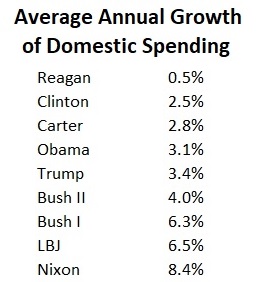
Based on historical data from the Office of Management and Budget, I calculated a few years ago that Richard Nixon was the biggest spender, followed by Lydon Johnson.

But I was only looking at the growth of inflation-adjusted spending during the fiscal years when various presidents were in office.

What about long-run estimates of how various presidents have changed America’s (depressing) fiscal trajectory.

Glenn Kessler of the Washington Post did something like this, though he focused on red ink rather than the spending burden.

That being said, he found somewhat similar results. Only he reports that LBJ was the worst with Nixon being the second worst.


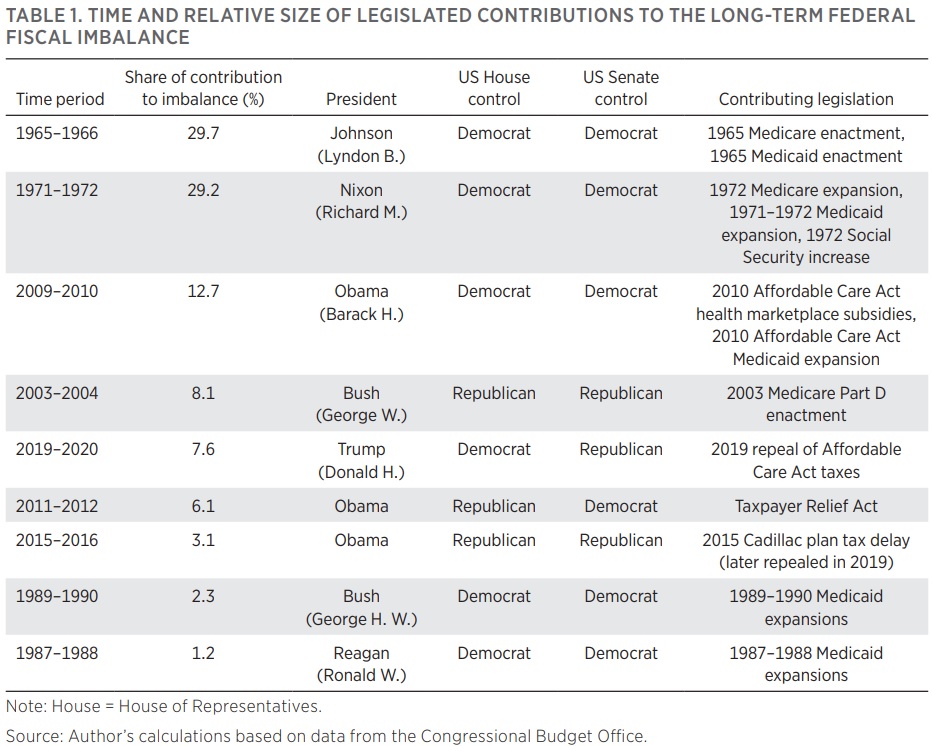
Policy choices made long ago are more responsible for the fiscal state of the nation. Assigning a particular president responsibility for a debt increase is rarely productive, because so much depends on factors beyond a president’s control — an economic crisis such as the Great Recession or the pandemic, for example. …Which president has contributed the most to the nation’s long-term fiscal imbalance? That would be Lyndon B. Johnson… Through an exhaustive study of Congressional Budget Office and Office of Management and Budget reports, …LBJ’s share of the fiscal imbalance is 29.7 percent. Close behind is Richard M. Nixon, with 29.2 percent. Johnson enacted Medicare and Medicaid in the mid-1960s, and then Nixon in the early 1970s expanded both programs and also enhanced Social Security so that benefits were indexed to inflation. …almost two-thirds of the nation’s long-term fiscal imbalance is a result of policy choices made more than 50 years ago.

I’m not surprised that Medicare and Medicaid get so much blame. They deserve it!

By the way, Kessler did not do his own calculations.

Instead, he relied on some research by Charles Blahous. Here’s the relevant table from that study, which was published in late 2021.

I’m not surprised that Reagan was the best president.

P.S. Biden was not included since he has just entered office when the research was conducted. If there is a similar study 10 years from now, I’m guessing he will be like Obama with bad but not horrible results. Yes, Biden has an awful fiscal agenda, but his failed stimulus and the watered-down (and absurdly misnamed) Inflation Reduction Act may wind up being the only significant damage he imposes.

Tuesday, April 25, 2023

LBJ Library releases tapes proving his first election to the Senate was stolen

April 7, 2023 By Thomas Lifson

Kudos to the LBJ Presidential Library in Austin for posting to the web copies of tapes that prove that Lyndon Baines Johnson stole his seat in the Senate when first running for it. Johnson went on to absolutely dominate the Senate as Majority Leader, and from there he managed to become president when JFK was assassinated in his home state of Texas while he was VP.

The stolen election was the Democrat primary, which back then was tantamount to election because Democrats dominated the segregated South of the era. Johnson defeated former Texas Governor Coke Stevenson by 87 votes, after a box of votes was “discovered.”   It is honorable of the Library, which after all is devoted to LBJ’s memory, to allow this blot on his record to be aired. They are more honest than the man whose presidency they commemorate. But the Associated Press, whose reporter made the tapes in 1977 and who wrote about them then, is less forthright in its article about the release.It does provide the basic information:..................To Read More.....

Saturday, April 23, 2022

The Bay of Pigs: The Sickening Truth Part III

Humberto Fontova Humberto Fontova Apr 23, 2022 @ Townhall.com  The Bay of Pigs: The Sickening Truth, Parts I and II
 
 
The Bay of Pigs: The Sickening Truth Part III

“This weekend marked the 61st Anniversary of the Bay of Pigs invasion. We honor the memory of the freedom-fighters who bravely faced the communist Cuban regime. Their legacy lives on today.” (Tweet by Fl Gov. Ron DeSantis April 17th.)

Outnumbered over ten to one by Soviet-led forces and betrayed by their sponsor, these mostly civilian volunteers fought till the last bullet. In three days of relentless close-quarter fighting they made monkeys of the Soviet commanders at the scene and cannon-fodder of their Cuban lackeys, inflicting losses of 20 to one.

Fidel, Raul, and Che were quite jittery there for awhile, urging caution in the counterattack. From the lethal fury of the attack and the horrendous casualties their troops and militia were taking, the two Soviets satraps assumed they faced at least 20,000 invading "mercenaries," as they called them. 

Yet it was a band of mostly civilian volunteers they outnumbered laughably. But to hear Castro's echo chamber (the D.C. beltway media and leftist academics), Fidel was the plucky David and the invaders the bumbling Goliath.

In fact, if JFK wanted some genuine profiles in courage he might have looked at the men he betrayed on that heroic beachhead. Some of most jaw-dropping heroics, however, came after the shooting ended, after they’d spent their last bullets and knew no more were coming from their ally, the most powerful nation on earth. The same one that enforced a "no-fly zone" half a country wide on another continent (Iraq) with half the U.S. Air Force for a decade but refused to provide one three miles across, 90 miles away, for half a day with two planes.

At any rate, the battle was over in three days, but the heroism was not.

Now came almost two years in Castro’s dungeons for the captured Brigada, complete with the physical and psychological torture that always comes with communist incarceration. During almost two years in Castro’s dungeons, the freedom fighters lived under a daily death sentence. 

Escaping that sentence would have been easy: simply sign the little paper confessing they were “mercenaries of the Yankee imperialists” or go on camera denouncing the U.S. Given these freedom-fighters' betrayal, you might think Fidel and Che Guevara had a cakewalk here.

Wrong. None of these men signed the document or uttered a peep against their “ally.” The freedom fighters stood tall, proud, defiant, even sparring with Castro himself during their televised Stalinist show trials. “We will die with dignity!” snapped their commander Erneido Oliva (a black Cuban, by the way, Ms. Maxine “VIVA FIDEL!”  Waters” and Jesse “VIVA FIDEL!” Jackson) at the furious Castroites again, and again, and again. To a Castroite, such an attitude not only enrages but also baffles.

Think about it, amigos: even after that betrayal, these men (and boys, some as young as 16 or 17 years old) refused to utter any anti-American slogan for Castro and Che Guevara’s cameras and propaganda mill. The very slogans that half-wit, grandstanding “woke” celebrities and politicians parrot daily for free publicity, these betrayed men refused to utter even while thinking it might save their lives.

The Castroites also staged a classic Soviet-style show trial attempting to showcase (for all the world to see) the Bay of Pigs prisoners admitting they were “mercenaries in the pay of the Yankee Imperialists.” And initially they thought they’d get the propaganda bonanza they so desperately desired.  

For this big production the prisoners were thoroughly interrogated beforehand (the KGB had been coaching Castro’s secret police for almost two years by then) to see who’d crack, who’d play along. Only these would get in front of the cameras.

Tomas Cruz, Felipe Rivero, Carlos Onetti and a few other Bay of Pigs freedom fighters gave every impression of having broken down. They whimpered to their Castroite “interrogators” that they’d be willing to go on camera and denounce the U.S. 

“AHA!” Fidel and Che snickered while rubbing their hands. “Now we got ‘em!” But Rivero and Cruz were also snickering.

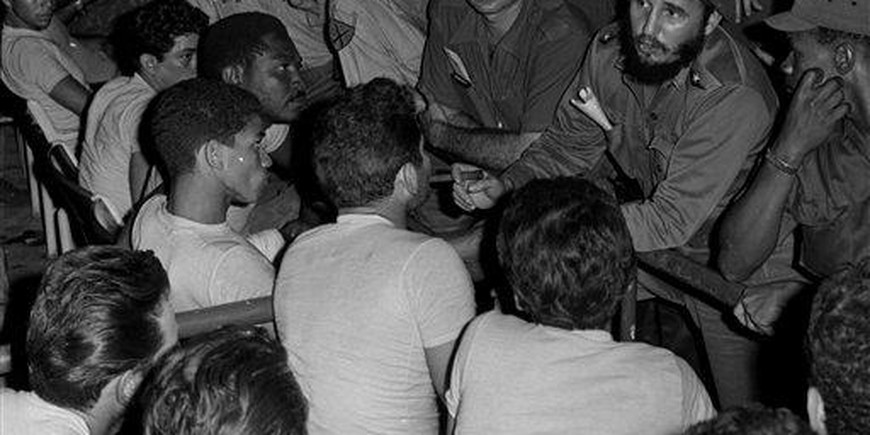
So the day came. The Stalinist stage was set at Havana’s Sports Arena and the communist cameras rolled. Castro and Che Guevara’s lackey vice President Carlos R. Rodriguez was the opening act. He put the microphone to Felipe Rivero.

"Nobody paid us to do a damn thing!" Rivero blurted. Whoops! The Castroites’ mouths dropped. They gaped nervously. They looked around. A rumble went through the crowd. 

"We came here to fight communism!" Rivero continued. "If you think I’m gonna denounce my freedom fighter brothers just because we’re all about to face a firing squad—forget it! Men from every class and race in Cuba volunteered to come here and FIGHT you!"

Holy s**t! What now?! The Castroites were frantic! The cameras were rolling but started shifting around nervously. Rodriguez’s lips trembled. He wiped his forehead. He stretched his collar. Some heads would (literally!) roll when the Maximum Leader saw this! The cameras didn’t know where to focus.

"And another thing!" Felipe shouted. "We outfought you!” The Castroites were frantic now, they looked from one to another aghast and cleared their throats. They looked like Democrats during the Ollie North hearings. 

Rodriguez finally caught his breath and with a trembling voice started with the usual commie mumbo-jumbo about "the masses" and "the people" blah, blah, blah.

"Ok, fine!” Rivero rolled his eyes and waved his hand. "You say you have the people with you? Then hold an election! That’ll really tell us, won’t it?!"

Complete pandemonium, amigos. Even the diehard commies in the crowd couldn’t restrain themselves. Che Guevara himself had to snicker. A rumble of laughter, a rustle of claps and hoots erupted from all corners. All this was on Cuban national TV, remember. 

And Cuba – that impoverished and squalid little Third World country Castro’s echo chamber (the mainstream media) always tells us about – besides having net immigration from Europe shortly before the glorious liberation, also had more TVs per capita than Canada or Germany. 

The very island almost shook with a collective roar.

Finally the Maximum Leader himself (Fidel Castro) pranced on the stage. Only he could straighten things out. He had it all figured out. He had an ace up his sleeve. So he approached the black parachutist prisoner Tomas Cruz. "We opened the beaches for you blacks," he sneered. (In 1958 Cuba had a private whites-only country club with a private beach.) "So what on earth are you doing with these Yankee mercenaries?"

Tell it to Obama and the Congressional Black Caucus, Fidel. Tell it to Maxine Waters and Jesse Jackson – they’ll swallow your BS and ask for seconds. But Cruz didn’t flinch. He looked Castro straight in the eye. "I didn’t come here to swim," he glowered. "I came here to fight communism. I came here with my Cuban brothers of every race to free my homeland from communism.”

Well, amigos, the Castroites decided to hold these "trials" behind closed doors and with the cameras off after that.

A guilt-stricken JFK finally ransomed the Brigade back from Castro's dungeon. The negotiations took almost two years while the men suffered the mental and physical tortures that always accompany Communist incarceration. One source claims that Castro had agreed to terms seven months earlier. But the Kennedy brothers (both President and Attorney General) feared the Bay of Pigs issue in the news for the November '62 congressional races. They feared the issue of how those men came to be prisoners in the first place might skew the races Republican. So the prisoners were conveniently released Christmas Eve of '62. A few died in prison during those intervening seven months. 

Outrageously, thanks to yet another Democrat administration, Castro might have gotten the last laugh with Rivero. In 1967 Felipe Rivero found himself in a U.S. federal prison. His crime? Organizing attacks from the U.S. trying to overthrow Castro.

You read that right. The same man accused and jailed by Castro for being a U.S. mercenary and lackey, of being bribed by the U.S. to overthrow communism in Cuba, was later jailed by the U.S. for trying to overthrow Communism in Cuba. LBJ had to honor that Kennedy-Khrushchev Missile Crisis swindle to safeguard Castro, you see.

"We ended up getting exactly what we'd wanted all along," snickered Nikita Khrushchev about the Missile Crisis in his diaries, “security for Fidel Castro’s regime and American missiles removed from Turkey and Italy. Until today the U.S. has complied with her promise not to interfere with Castro and not to allow anyone else to interfere with Castro. After Kennedy's death, his successor Lyndon Johnson assured us that he would keep the promise not to invade Cuba." 

The Brigadistas' ordeal was mostly over by late 1962. But when it came to JFK's lies I'll yield to Bachman Turner Overdrive: "You ain't seen nothing yet! B-ba-ba-ba-BY you just AIN'T seen nothing yet!" 

"I promise to deliver this Brigade banner to you in a free Havana!" That was JFK addressing the recently-ransomed Brigade and their families in Miami's Orange Bowl on December 29, 1962. I guess those people hadn't been subject to enough lies, to enough betrayal. They hadn't suffered enough. And the mothers, widows children — they hadn't been through enough either. In Camelot's eyes, they deserved more shameless lies. 

Kennedy’s secret deal with Khrushchev to safeguard Castro was made barely a month before JFK made his liberation promises in the Orange Bowl. Yet he addressed those men, their families, and compatriots with a straight face. 

Small wonder that these Brigadistas, their families, and most of their compatriots always refused to file meekly into the liberal plantation, like obedient little "hispanics," or “latinos,” with a nice pat on the head by the condescendingly smirking doyens of the Democrat-Media complex. 


Friday, October 1, 2021

The Failure of Lyndon Johnson’s Great Society

October 1, 2021 by Dan Mitchell @ International Liberty

When asked to list the worst presidents of the 20th century, Woodrow Wilson, Franklin Roosevelt, and Richard Nixon belong on the list.  But this Reason video with Amity Shlaes shows why Lyndon Johnson also is among the worst of the worst. 


You should watch every second of the video, but if you don’t have 33 minutes to spare, here’s a helpful summary.


Johnson declared war on poverty, jacked up federal spending on education, and pushed massive new entitlement programs, including Medicare and Medicaid, which promised to deliver high-quality, low-cost health care to the nation’s elderly and poor. …But did the Great Society achieve its goals of eradicating poverty, sheltering the homeless, and helping all citizens participate more fully in the American Dream? In Great Society: A New History, Amity Shlaes argues that Lyndon Johnson’s bold makeover of the government was a massive failure.

Massive failure may be an understatement.  LBJ’s two big entitlement programs, Medicare and Medicaid, are the biggest reason why America will suffer a future fiscal crisis.

And his so-called War on Poverty was a disaster for both taxpayers and poor people.  How much of a disaster?  Let’s augment Amity’s analysis with these excerpts from Jason Riley’s column in the Wall Street Journal.


Entitlement programs were dramatically expanded in the 1960s in the service of a war on poverty, yet poverty fell at a slower rate after the Great Society initiatives were implemented, and overall dependency on the government for food, shelter and other basic necessities increased. …

Liberals pitch these social programs in the name of helping underprivileged minority groups and reducing inequality, but the lesson of the 1960s is that government relief can put in place incentives that have the opposite effect. Between 1940 and 1960 the percentage of black families living in poverty declined by 40 points…

No welfare program has ever come close to replicating that rate of black advancement… Moreover, what we experienced in the wake of the Great Society interventions was slower progress or outright retrogression. Black labor-force participation rates fell, black unemployment rates rose, and the black nuclear family disintegrated. In 1960 fewer than 25% of black children were being raised by a single mother; within four decades, it was more than half. …

The welfare state is often discussed in relation to its effect on racial and ethnic minorities, yet crime, single parenting and drug abuse also increased among poor whites in the aftermath of the Great Society. When the government indulges and subsidizes counterproductive behavior, we tend to get more of it.

What’s depressing is that Biden wants to replicate LBJ’s mistakes. His new entitlements will mean slower growth and more dependency.

P.S. Amity Shlaes also has done great work to highlight the achievements of one of America’s best presidents.

Saturday, April 3, 2021

To Understand Why Racism Isn't the Problem, Look to South Africa's Pilanesberg Park

Will Alexander Will Alexander Apr 02, 2021 @ Townhall.com

“One father is more than a hundred schoolmasters.” – 17th Century English Proverb.

Years ago, South Africa’s Pilanesberg Park had big trouble. Tons of it. Someone went on a killing spree of its prized white rhinos. Thirty-nine of the 5-ton ungulates were mysteriously turning up dead around the park. That was 10 percent of the park’s endangered rhino population. The killers had to be stopped, so park rangers turned into homicide detectives. Who did it?  Poachers, perhaps? No. It couldn’t have been. The dead rhinos didn’t have bullet holes, and their horns were still intact. Who, then?

A break came in the case when staff saw a video of young elephants terrorizing tourists.  Others witnessed elephants taunting and bullying rhinos for hours.  After tracking the herds, chronicling their behavior, and developing rap sheets on the most aggressive ones, rangers found their killers: gangs of teen male elephants................Why?

The problem went back two decades. Kruger National Park, half the size of Switzerland, was dangerously overpopulated with elephants.  Adult males were too big to relocate, so the excruciating decision was made to shoot them and move the children and some of their mothers to other parks.

But what seemed like a good idea at the time severely disrupted the delicate balance of life in elephant society. It triggered a disaster. Young elephant herds, deprived of adult male leadership, were forced into an extremely destabilized childhood that turned deadly in their teens.

“Like juvenile delinquents from urban jungles, they’ve grown up without role models,” said journalist Bob Simon, who reported on the story for 60 Minutes in 1999.

 “What’s different is they don’t have a father,” said Dyk. “I think everyone needs a role model, and these elephants that left the herd had no role model and had no idea of what appropriate elephant behavior was.”

Something else triggered the aggressive behavior: the biochemistry in male elephants called musth.  During musth, male elephants secrete a hormone-rich substance from glands on the sides of their foreheads and they walk around dribbling urine.  They become sexually hyperactive, unpredictable, and possessed by the urge to dominate their peers.

“There’s no more dangerous animal on Earth, than a bull elephant in musth,”.............Without a father to “curb their youthful exuberance,” said Simon, the Pilanesberg elephants’ sexual development became premature.  They entered into musth too soon, and it left them “pumped up with testosterone; stressed out with sexual anxiety and looking for a fight.”............Something similar happened inside America’s urban jungles.  Gangs of angry young black males – without fathers or role models to teach them appropriate behavior – are wreaking havoc in their neighborhoods.

In 2005, blacks were the victims of 805,000 non-fatal violent crimes and about 8,000 murders, a 2007 DOJ study found.  In one-to-one murders, 93 percent of the perpetrators were black – mostly young and mostly male. In 2018, blacks were overrepresented among those arrested for violent crime, according to a January 2021 DOJ study.  All this was before George Floyd’s death, an event used to dignify deviancy.............

After some masterful detective work by the likes of Sowell, Walter Williams, Larry Elder, Bob Woodson, Shelby Steele and others, the perpetrator was found.  It was the perverse incentives created by Lyndon Johnson’s “War On Poverty” programs. What seemed like a good idea at the time severely disrupted the delicate balance of life in black urban society.  It triggered a disaster..............Young blacks, deprived of adult male leadership, were brought up into a severely destabilized childhood that turned destructive in their teens, and they grew up into troublemakers.

So, I have an idea for the Obamas, Oprah, Sharpton, LeBron, and all the BLMs of the world who have strong connections to troubled neighborhoods.  Instead of blaming “white folks” for problems that are impossible for them to solve, concentrate your immense wealth and influence to create a movement that would infuse these neighborhoods with adult males who can “kick butt” and establish a new hierarchy..........To Read More....


Monday, September 7, 2020

An example of how Democrats harvest votes

Democrats are pushing the notion of mail-in voting, hoping the unsuspecting will think it’s just an extension of absentee voting. It’s not.

By —— Bio and Archives--September 3, 2020

It’s a means to facilitate voter fraud—also known of “harvesting votes”.  It’s widely acknowledged that harvesting votes brought JFK into the win column in Illinois when thousands of Chicago votes magically appeared for Senator Kennedy, from vapor. Nixon, somewhat to his credit, did not dispute the count.  But, there’s an earlier example of Democrats harvesting votes in the 1947 Senatorial election in Texas between “a legend in Texas politics and a young congressman from Austin.  The legend, Coke Stevenson, had been the Speaker of the Texas House, Lieutenant Governor, and twice elected Governor.  The congressman was Lyndon Johnson.”  They were running for a U.S. Senate seat from Texas.  I wrote of it on November 27, 2007 for the American Thinker website:............To Read More....

Monday, November 20, 2017

Lyndon Johnson's Terrible Legacy

11/18/2017 Mises Wire

Recently my wife and I spent a morning at the Lyndon Baines Johnson Presidential Library in Austin, Texas. The damage done by this big bully is incalculable. His library reminds us of the start of the blizzard of government expansion during Johnson's presidential term, which lasted from the Kennedy assassination in October 1963 to his decision not to run for a full second term in 1968, which usually is attributed to his failure to end the war in Vietnam.

Johnson was an admirer of FDR and was determined to revive and complete what he believed should have been integral parts to FDR's New Deal. Johnson called his program The Great Society. As if ignorance of the consequences of this socialist expansion of domestic control by government was not enough, LBJ expanded the war in Vietnam, promising America both Guns and Butter. Even today we live with this expansion of government domestic programs and seemingly never-ending wars as the modern Welfare/Warfare state.

Johnson's political philosophy is alive and well today. The US government spends freely on welfare programs at home, and on unwinnable wars abroad...............To Read More