Search This Blog

De Omnibus Dubitandum - Lux Veritas

Showing posts with label Cryptocurrency. Show all posts

Tuesday, May 6, 2025

Corruption In Politics: The Case Of Trump And Cryptocurrency

 M

In the New York Times from this past Thursday (May 1), the lead story was a scathing exposé of alleged corruption of our current President. The headline and sub-headline (print version) were “Trump Shapes the Policy On Crypto, and Cashes In. Hushed Deals and Foreign Investors Propel President’s Digital Money Start-Up.” The sub-headline in the online version was even more scathing: “World Liberty Financial has eviscerated the boundary between private enterprise and government policy in ways without precedent in modern American history.” The story fills the entire upper right-hand quadrant of the front page, plus another full page and a half in the interior of the paper.

So according to the Times, this is not just some ordinary, every day, run-of-the-mill political corruption. Rather, it is corruption that has “eviscerated” boundaries between business and government, and is “without precedented in modern American history.”

Is there any substance to these charges?

As readers here know, my view has long been that the game of politics is inherently corrupt. Politicians are in a position to use the powers of their offices in a thousand ways, large and small, to benefit themselves and their friends and supporters, and to disadvantage adversaries. Almost no human being is immune from the temptation to use those powers for such purposes at least a little. And thus there is no such thing as a politician against whom at least some charge of corruption cannot credibly be alleged.

And it is far worse with today’s massive and intrusive federal administrative state. Essentially every business is under the thumb of federal regulation — and even if a business is not currently regulated, it could be. Every business is also taxed, and the taxes for any given business could be either increased or decreased at any time. So if a President is involved in changing regulation in any way, or in changing taxation in any way, or even in not changing regulation or taxation when some people say that he should, did he do that to benefit the financial interests of himself or his family, or did he do it because he thought it was good public policy? And don’t forget, it could be both!

Because every politician does things that can credibly be charged as corruption, I think that by far the most important question about any allegation of political corruption is whether the action in question is at least arguably illegal, and if so, what is the theory of illegality? Beyond that, it is also completely fair to ask whether something might not be right or good, even if legal. Just because something isn’t even arguably illegal doesn’t make it immune from criticism. All allegations of self-dealing are fair game for criticism of a politician, and for the voters to take into account.

With that background, let’s give the Times their best shot to make their case. The subject of the big May 1 article is a crypto start-up by the name of World Liberty Financial. WLF was launched in September 2024, shortly before the recent election. The majority owner of WLF is The Trump Organization (which the Times calls a “Trump family corporate entity”). Since taking office for his second term, President Trump has significantly eased the federal regulation of the crypto industry, including ending SEC investigations and disbanding a Justice Department task force focused on the industry. The Times calls this a “broad unwinding of Biden-era scrutiny of the industry.” From the Times:

Mr. Trump’s return to the White House has opened lucrative new pathways for him to cash in on his power, whether through his social media company or new overseas real estate deals. But none of the Trump family’s other business endeavors pose conflicts of interest that compare to those that have emerged since the birth of World Liberty. The firm, largely owned by a Trump family corporate entity, has erased centuries-old presidential norms, eviscerating the boundary between private enterprise and government policy in a manner without precedent in modern American history. 

Mr. Trump is now not only a major crypto dealer; he is also the industry’s top policy maker. So far in his second term, Mr. Trump has leveraged his presidential powers in ways that have benefited the industry — and in some cases his own company — even though he had spent years deriding crypto as a haven for drug dealers and scammers.

The gist of the Times’s claims against Trump in the piece is summarized as a “range of conflicts of interest trailing the company.” Here is their list:

  • World Liberty has directly benefited from Mr. Trump’s official actions, such as his announcement of a federal crypto stockpile that would include a digital currency the firm has invested in. The president’s announcement caused a temporary jump in the value of World Liberty’s holdings.
  • World Liberty has sold its cryptocurrency to investors abroad, including in Israel and Hong Kong, according to interviews and data obtained by The Times, establishing a new avenue for foreign businesses to try to curry favor with Mr. Trump.
  • Several investors in World Liberty’s coin managed firms that the federal government accused of wrongdoing. They include an executive whose fraud case was suspended after he invested millions of dollars in World Liberty. Other investors and business partners, some of whom haven’t been publicly identified before, are looking to expand in ways that will require the Trump administration’s approval.
  • World Liberty proposed swapping cryptocurrencies with at least five start-ups, and often used the Trump name to solicit steep payments as part of the deals. Even in an industry with a disreputable history, the deals raised alarm among veteran executives.

My reaction is, is that the best you’ve got? The most serious of the allegations is the first one, that “World Liberty has directly benefited from Mr. Trump’s official actions.” And so have hundreds and hundreds of other businesses benefited from the broad de-regulatory agenda of the second Trump administration. Trump himself may be benefiting from the de-regulation of crypto, but everyone else also has the opportunity to do the same. And any gains could be undone by a crackdown in a subsequent administration. Meanwhile, despite the frequently over-heated language of the Times piece, it never makes any suggestion of illegality. If there is any basis under which this may be illegal, I am unaware of it. Perhaps some readers may have a theory.

Looking at this situation at a more general level, our recent Presidents (and other prominent politicians) can be divided into three big categories from the perspective of exposure to corruption. In Category One, we have people, like Trump, who have come to office with substantial business interests that they have retained while in office. In Category Two are the politicians who have served in public office for their entire careers, and have never held a significant private sector job or business interest. 

Category Three consists of those who had a career in the private sector, but substantially cashed out before entering public service, and now just have investment portfolios. Examples from Category One include Lyndon Johnson and Jimmie Carter. Also, if I might take one non-presidential example, Nancy Pelosi. Examples from Category Two include Bill Clinton and Joe Biden. Examples from Category Three include Ronald Reagan and the two Bushes.

From the point of view of potential corruption, it might be best to have all politicians come from Category Three. However, nothing in the Constitution requires that. And nothing about Category Three makes it completely free from temptation to corruption either. Plenty of political decisions affect the value of investment portfolios, even diversified ones.

As between Categories One and Two, I’ll take politicians from Category One any day. Someone from Category Two who advances to the high office of the Presidency has tremendous temptation to develop personal wealth by accepting large payments from third parties to influence government policy. 

Both Clinton and Biden are clear examples of this. 

Bill Clinton created the Clinton Foundation in 2001 after leaving office, and the Foundation then raised more than $2 billion over the next 15 years, during much of which time his wife was widely expected to become the next President. Large donors included foreign actors with clear interests in influencing U.S. policy. The overhead of the Foundation provided hundreds of millions of dollars to fund the Clintons’ lifestyles and staff. 

This enterprise skirted extremely close to the edge of quid pro quo bribery. In the case of Biden, between 2019 and 2023 I wrote an entire eleven-part series titled “Biden’s — Stone Cold Crooked,” explaining why the publicly available facts about the Bidens’ conduct in Ukraine and China made for a lay-down case of quid pro quo bribery. Somehow the Biden Justice Department was never interested in pursuing the case.

Over in Category One, consider the case of Lyndon Johnson. Josh Blackman at the Volokh Conspiracy has a summary in a post from January 1, 2025. The summary is largely derived from the Robert Caro biography of Johnson. Lyndon and Lady Bird Johnson owned television and radio stations in the Austin, Texas area. From Blackman:

As Mr. Johnson rose through the ranks in the House, and later the Senate, Robert Caro observed, there was a "twenty-year-long string of strikingly favorable rulings by the Federal Communications Commission" for KTBC. Caro at 286. Coincidentally, Austin was "one of the few metropolitan areas with only a single commercial television station."

When Johnson became President, he purported to put his holdings, including the broadcast stations, in a “blind trust”; but Blackman notes that the trustees were close personal friends and the trust would never meet the technical requirements for a true “blind trust.” Similarly, Jimmie Carter retained his heavily regulated (and subsidized) peanut farm business while President, while also creating a half-baked “blind trust.”

According to Reuters here on January 10, Trump has not created a “blind trust,” but has withdrawn from “daily management” of his business interests, and has turned that over to his sons. Reuters quotes a supposed “ethics expert” as saying that Trump’s arrangements are “not good enough.” Did that ethics expert ever criticize the arrangements of Johnson or Carter?

Is the insubstantial distinction between Trump’s arrangements and the Johnson/Carter “blind trusts” what the Times is referring to as “eviscerating the boundaries between business and government” and something “without precedent in modern American history”?

And then there’s Nancy Pelosi. Critics have noted multiple times over the years where Pelosi or her husband seemed to have done a profitable stock trade just before some Congressional action. This piece from Yahoo Finance on January 8 notes that Pelosi’s stock portfolio was up 54% in 2024, which beat the performance of every hedge fund in the country. At the same time, a bill to restrict stock trading by congresspeople somehow never advanced while Pelosi was Speaker.

Anyway, if you ask for my view of the biggest political corruption incidents of the past few years, numbers one and two would be:

  1. ) the multi-hundreds of billions of dollars of funding for the institutions of the Left from the government, and 
  2. ) the Censorship Industrial Complex put together by the Biden administration to suppress conservative speech. 

Those things don’t seem to draw big front-page articles from the Times.

Wednesday, April 10, 2024

Pro and Con: The War on Cash

April 9, 2024 by Dan Mitchell @ International Liberty

To explain why the “war on cash” is misguided, I have a seven-part series (here, here, here, here, here, here, and here) explaining why it is dangerous to eliminate currency and rely solely on government-provided digital money.

Using the information in those columns, I gave a speech earlier today in Sweden as part of the Free Market Road Show.

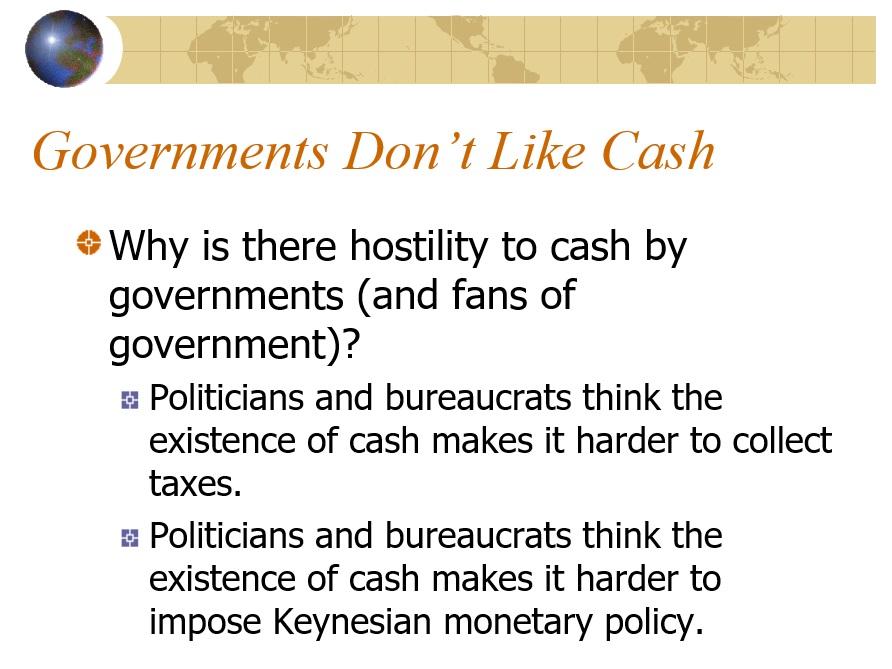
In this PowerPoint slide, I summarized (fairly, I think) the left’s arguments in favor of getting rid of cash.

Simply stated, they want the ability to impose a turbo-charged version of Keynesian monetary policy, and they also want the government to have a record of every transaction so that politicians can collect more tax.

But a ban on cash would enable politicians to go way beyond normal Keynesian monetary policy.

Instead of low (or zero) interest rates, the government could impose negative interest rates. In other words, financial repression.

In simpler terms, governments could – and would – confiscate part of your savings.

All for the purpose of coercing people into spending more, based on the mistaken Keynesian notion that consumer spending somehow stimulates growth.

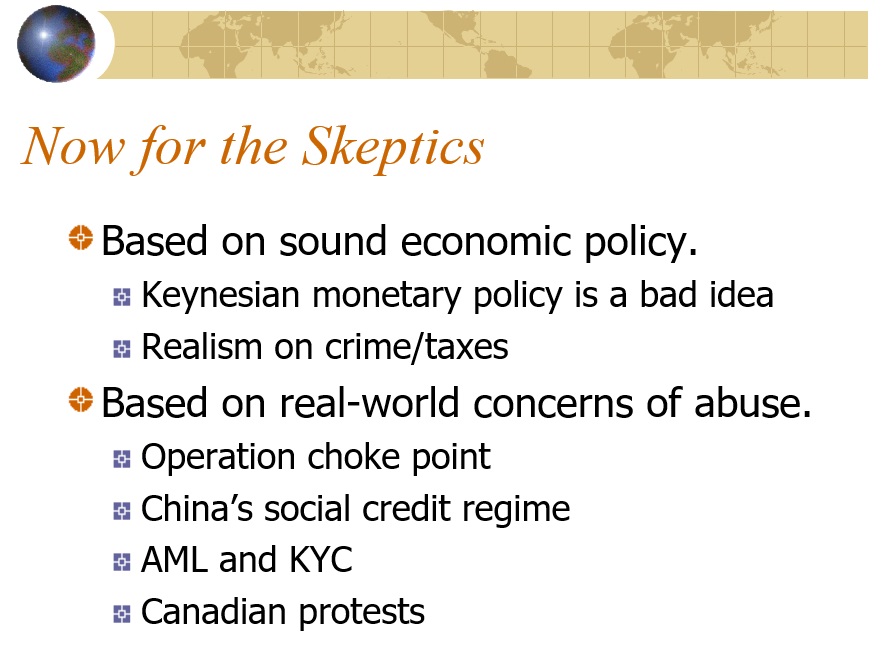
Later in my presentation, I also had a slide that summarized why it would be a bad idea if government forced us all to use a central bank digital currency.

Since I already debunked Keynesian monetary policy, I’ll conclude by reiterating something I said today in Stockholm, which is that not every government is equally untrustworthy.

China, for instance, already is monitoring purchases (and everything else) as part of its totalitarian social credit system.

I don’t think the folks in Washington are nearly that bad, but policies such as Operation Choke Point and various anti-money laundering rules show that our politicians and bureaucrats are willing to impose bad policy via the financial system.


Friday, September 1, 2023

Argentina and Dollarization

August 25, 2023 by Dan Mitchell @ International Liberty

I wrote earlier this month about the shocking first-place finish by a libertarian in Argentina’s presidential primary. Today, let’s take a close look at what is arguably Javier Milei’s most radical proposal, which is to eliminate his country’s central bank and instead adopt the US dollar as the national currency.

 http://freedomandprosperity.org/wp-content/uploads/2020/12/Dec-12-20-Currency-Map.jpg

The first thing to understand about “dollarization” is that it is not an untested theory. Panama has been using the dollar for more than 100 years. And Ecuador and El Salvador have been dollarized for more than 20 years. There are also nations that use the euro, as well as many nations that explicitly link (“peg”) their currencies to dollars or euros. So there is no debate about whether dollarization works. Instead, the issue is whether it would be appropriate for Argentina. At the risk of understatement, the answer is a resounding yes. Argentina has a chronic problem of bad monetary policy, mostly because the government uses the printing press to finance wasteful spending. Dollarization would end that possibility.

In a column for Bloomberg, Professor Tyler Cowen explains why Argentina will be better off without its own currency.


The case for dollarizing is straightforward: Since 1980, by one measure, Argentina has had an average annual inflation rate of more than 200%. Significant portions of the economy already have moved to the use of dollars, and for that matter crypto. Why not go all the way and give the economy a stable currency, one which its politicians cannot manipulate? Argentines would find it easier to safeguard their savings, economic calculations would be easier, and foreign investors would be encouraged.

…For whatever reasons, Argentina’s political economy has some features that are not conducive to monetary stability and fiscal responsibility, and so further fine-tuning is unlikely to fix the problem. A drastic step is necessary. Three Latin American economies — Panama, Ecuador and El Salvador — have already moved to explicit dollarization. …

They have all moved from regimes of very high periodic inflation to relative monetary stability. None appears likely to return to its national fiat currencies anytime soon. …Argentina…has been losing ground since the 1920s, when it was one of the richest nations in the world. …it needs dramatically better public policy. At this point, doing nothing, or continuing on the same path, is more risky than chancing some radical reforms.

Patrick Horan makes similar points in an article he wrote for National Review.


Perhaps Milei’s most controversial economic proposal is to abandon the Argentine peso, close the central bank, and adopt the U.S. dollar as the country’s new currency. …Embracing another country’s currency (the dollar being the most common) is a radical move, but it has been done before. Panama has used the dollar since 1904. Ecuador and El Salvador dollarized in 2000 and 2001. These are examples of official dollarization, in which the government formally adopts the dollar. …

Typically, an economy dollarizes because high inflation has seriously weakened the local currency. For example, economists have estimated that roughly half of all transactions in inflation-ravaged Venezuela and Lebanon in the past two years have been conducted in dollars. …Argentina suffers from severe inflation. Since February, the year-over-year inflation rate has exceeded 100 percent.

Also, …many Argentines already deal in dollars. …Dollarization would mean that the government would no longer be able to turn to monetary policy, a tool Argentine governments have repeatedly misused, to fund imprudent fiscal policy. …dollarization would bring an end to Argentina’s inflationary woes. Also, since monetizing deficits would no longer be an option, dollarization could also motivate policy-makers to pursue pro-market, pro-growth reforms.

In a column for the Wall Street Journal, Max Raskin focuses on the economic benefits that accrue when a government no longer has the ability to finance wasteful spending by printing money.


Mr. Milei has promised to close the central bank and dollarize the economy—a process that would essentially outsource the country’s monetary policy to the Federal Reserve. …my recent co-authored research in the Journal of Financial Stability and Brown Journal of World Affairs demonstrates the economic gains that can be had for a country that chooses to forgo its monetary prerogative. Currency competition, especially through liberalizing legal-tender laws, restrains the inflationary impulses of a central bank.

If foreign currencies are able to be used and not taxed or regulated disfavorably, then the central bank will have less power to inflate because of consumer choice. …Argentina used to be one of the most developed and wealthiest countries in the world, but a century of state intervention in the economy has shown how dangerous it is to disrupt the normal functioning of markets. Even a selfish government that’s keen on reaping increased tax revenue from growth should have an interest in making a commitment to monetary liberalization.

Let’s close with some excerpts from an article that Marcos Falcone authored for the Foundation for Economic Education.

This article was published back on May 5, well before Milei’s shocking first-place finish in Argentina’s presidential primary, and it has some good information on how Ecuador has benefited from dollarization.


Initially, those who supported the elimination of the peso were viewed as crazy: How could a nation deprive its 45 million inhabitants of their currency? But Argentina is a country with never-ending inflationary conditions: The current annual inflation rate is over 100 percent and rapidly accelerating, while many fear that hyperinflation—which the country experienced multiple times during the 20th century—is coming back.

… the use of dollars would not be an imposition by the government, but merely a recognition of the current state of affairs. Dollarization has, in some aspects, already occurred. …pesos lose value more rapidly than dollars, euros, or other currencies. This happens, in turn, because the government continues to print money to finance its deficit. …adoption of the dollar has helped other countries stabilize, like Ecuador. …inflation has ceased to be a problem in this country… not even a strong populist leader like Rafael Correa was able to overturn dollarization, as the dollar itself was always more popular than him.

By the way, the adoption of the euro currency has some parallels for dollarization. Consider the cases of Italy and Greece, which habitually suffered from high inflation. Joining the euro was a positive step for those nations because it meant their governments no longer could print money to finance wasteful spending. Sadly, this story does not have a happy ending. The European Central Bank has become politicized in recent years and is now indirectly printing money to subsidize wasteful spending by the Italian and Greek governments.

Fortunately, I don’t think the US Federal Reserve would adopt bad monetary policy to help Argentina (though the Fed certainly is capable of adopting bad monetary policy for other reasons).

P.S. One reason to support cryptocurrencies is that they provide an option for people in nations with terrible monetary policy (Sri Lanka being a recent example).

P.P.S. Nations are less likely to dollarize if the US government engages in global bullying.

 Editor's Note:  Please take some time and review My Argentina File, which goes back to 2012.  RK

Thursday, June 15, 2023

Your Federal Government In Action: The SEC

@ Manhattan Contrarian

The original idea of the “independent” administrative agencies was to place the details of governing a complex economy in the hands of wise experts. These experts would be removed from tawdry and corrupting political influences, and would straightforwardly apply neutral principles to achieve fairness and justice in our society.

In the real world, every federal administrative agency, with especial emphasis on the supposedly “independent” ones, becomes larger, more power-hungry, and more corrupt with every passing year. Somehow, it’s in the nature of the job as federal bureaucrat to believe that you can perfect the world by seizing ever more power unto yourself, imposing more and more rules whether or not authorized by statute, and crushing anyone who gets in your way. Biden’s presidency has accelerated these trends toward infinity.

Consider for today the SEC. Since April 2021, its Chair has been Biden appointee Gary Gensler. Gensler, now 65, spent the first half of his career at Goldman Sachs, but for the last 20+ years has mostly moved from one federal or state or Democratic Party job to another. In 2015-16 he was the CFO of Hillary Clinton’s campaign for President, which really tells you all you need to know about him. Here are a few developments on Gensler’s watch at the SEC:

SEC Enforcement Actions Before Its Own Administrative Law Judges

When the SEC claims that someone has violated the federal securities laws, they have a staff that can bring an “enforcement action” against the alleged perpetrator. These actions are civil rather than criminal, but can include very severe and even career-ending sanctions, like banishment from the securities industry. The SEC also has a staff of what they call Administrative Law Judges, who work for the Commission, and many of its enforcement actions have long been brought before these in-house judges. (To be fair, the ALJs are provided for by statute, and long pre-date Gensler.) The ALJ thing is part of the progressive vision of governance by “experts.” The poorly-reasoned thought is that the securities business and the securities laws are rather complex; so wouldn’t it be best to have these kinds of cases decided by people who are specialists in the subject matter? After all, these people are all perfectly fair and apolitical.

It turns out that if you should have the misfortune to have your case brought before one of these ALJs, you are facing a procedural morass. First, the cases can drag on for years, costing you a fortune. Then, the ALJs, not surprisingly (since they are not really independent fact-finders), almost always side with the Commission staff and against defendants. Then, your first appeal goes to the Commission itself, the opposite of a neutral party. By the time you can get to a District Court for review, you are probably several years and multiple million dollars of legal fees into this — and then, the review is on a highly deferential standard. How does all of that comport with due process of law and with Article III of the Constitution (that vests all the “judicial power” in the courts)?

Multiple litigants over the years have attempted to object to this treatment on the ground of incompatibility with due process and/or the Constitution’s Article III. But every attempt to short-circuit an enforcement action by removing the SEC into court got shot down. That is, until a case called Cochrane/Axon reached the Supreme Court in April of this year. The Cochrane case arose from an SEC enforcement action before one of its own ALJs; and the Axon case came from a comparable enforcement proceeding by the FTC before one of its ALJs. Defendants in the two cases attempted to assert their rights to have their cases heard in a District Court with an impartial judge and a jury. Axon lost on that assertion in the Ninth Circuit; but an en banc Fifth Circuit ruled in favor of Cochrane’s ability to present her constitutional claim to a District Court before having to submit to the SEC’s ALJ. The Supreme Court unanimously affirmed the Fifth Circuit and reversed the Ninth. From Justice Kagan’s unanimous opinion (page 15):

[H]ere, both parties object to the Commissions’ power generally, not to anything particular about how that power was wielded. The parties’ separation-of-powers claims do not relate to the subject of the enforcement actions—in the one case auditing practices, in the other a business merger. . . . Nor do the parties’ claims address the sorts of procedural or evidentiary matters an agency often resolves on its way to a merits decision. . . . The claims, in sum, have nothing to do with the enforcement-related matters the Commissions “regularly adjudicate[]”—and nothing to do with those they would adjudicate in assessing the charges against Axon and Cochran. . . . Because that is so, the parties’ claims are “ ‘collateral’ to any Commission orders or rules from which review might be sought.”

So far, this comes as a shock to the long-standing arrogance of the SEC that they are above having their procedures reviewed for constitutional compliance; but that issue long pre-dates Gensler. So let’s now get to the next step. The decision of the Supreme Court is only that a District Court should hear the constitutional challenge prior to the SEC’s ALJ enforcement action going forward; the Court did not actually itself rule on the issue of whether the SEC’s procedures are constitutional. So the case got remanded to the lower courts to consider the constitutional challenge. But then, instead of moving forward on that issue, the SEC suddenly, on June 5, voluntarily dismissed the Cochrane case — along with more than 40 other enforcement actions that were pending before its ALJs. The New Civil Liberties Alliance — which has represented Cochrane in her constitutional challenge — issued this press release on that date. Excerpt:

This landmark [Cochrane] ruling was a major victory for NCLA—and a major blow to SEC and to administrative adjudication generally. It freed Americans, many of whom had been trapped in interminable regulatory purgatory, to seek relief in federal court from these ersatz proceedings where the agency is prosecutor, judge, jury and first court of appeal. Now, rather than defend against allegations of unconstitutionality before real judges in real federal courtrooms, SEC has waved the white flag. This decision demonstrates just how significant the Cochran victory was. When forced to defend its unconstitutional conduct in front of Article III judges, SEC cannot. Indeed, it will not even try.

Was anything more going on here? Now we are talking about things going on on Gensler’s watch:

[The] SEC publicly admitted in April 2022 to the existence of a so-called control deficiency within its administrative adjudication system. It said the agency’s Chair had launched an internal review of the issue (using a contractor dependent on staying in SEC’s good graces for its other agency business). At that time, the agency specifically divulged that SEC Division of Enforcement personnel had accessed adjudication material in the SEC v. Cochran case, temporarily making the material available to everyone in the Division, including attorneys who prosecuted Ms. Cochran on SEC’s behalf. Now it turns out agency personnel had done the same thing in dozens more cases.

Aha! — no wonder the SEC seemed to win so often before its own ALJs. The SEC staff (i.e., prosecutors) were able to get sneak peaks at the legal analysis memos used by the ALJs in making their decisions. Here is a link to an SEC April 5 release admitting to its wrongdoing (and wildly trying to spin its gross misconduct as nothing really that important). You need to go back to the NCLA release to learn that NCLA had been trying to find out about the SEC’s cheating in the ALJ proceedings via FOIA requests, only to be met by SEC stonewalling. In November 2022 NCLA had filed a federal court complaint to pry loose the documents, which is likely what forced the SEC to finally fess up to its wrongdoing and dismiss the 40+ cases.

So will there now be any accountability for anyone at the SEC for this gross misconduct in these already-rigged proceedings? Don’t count on it.

SEC’s Lawless War on Cryptocurrencies

The Congressionally-authorized mission of the SEC — via the Securities Act of 1933 and the Securities Exchange Act of 1934 — is to regulate “securities” and “securities exchanges.” And then there are cryptocurrencies. Cryptocurrencies had not been invented back in 1933 and 1934, and nothing in those two statutes (and their many subsequent amendments) specifically addresses them. Are cryptocurrencies securities? Some academics have argued that at least some of them are, while others have argued that none of them are. And the latter position is not just held by a few right-wing kooks. 

Here is a piece from the Harvard Law School Forum on Corporate Governance from December 2022 taking the position that cryptocurrencies are not securities (although the piece does argue that initial coin offerings are securities). You might think that in the absence of a clear statutory mandate, the right thing for the SEC would be to keep out of this, or maybe at the most to offer a proposal to Congress to give them the authority to regulate in this area.

But that’s not the way a good progressive regulator operates. A good progressive regulator does not look to the substance of Congressionally-granted authority to determine the limits on his authority. Rather, he looks to use every “tool” at his disposal to achieve perfection in the world according to his own vision.

Gary Gensler does not like cryptocurrencies, nor does he like the people who seem to be making lots of money creating them and trading them. So the question is, what can he do to get his way? On June 5 the SEC filed a lawsuit against Binance, and on June 6 it filed a second lawsuit against Coinbase. These are the two largest exchanges for trading and doing other transactions involving cryptocurrencies.

Here is a copy of the Complaint against Coinbase. It’s about 100 pages long, but the basic theory is that Coinbase is operating an illegal “securities exchange” because it is not properly registered as such with the SEC and is engaged in trading securities. As you can see, the theory depends on the idea that cryptocurrencies are securities as defined in the SEC’s governing statutes.

But with or without statutory authority, the SEC has set out to play hardball. The prayer for relief in the Coinbase Complaint basically seeks to shut down this major business, plus forfeit all the money they have made to date and pay lots of penalties as well:

[T]he Commission respectfully requests that the Court enter a Final Judgment: . . . Permanently enjoining Defendants, . . . , from violating, directly or indirectly, [the sections of the statutes requiring “securities” and “securities exchanges” to be registered with the SEC]; Ordering Defendants to disgorge on a joint and several basis all ill-gotten gains resulting from their Exchange Act violations . . .; Ordering Defendants to pay civil money penalties. . . .

And so on and so forth. The Binance case is in DC, while the Coinbase case is in New York. Just today, the judge in the Binance case in DC declined an SEC request to freeze the exchange’s assets pending trial. Had that request been granted, it likely would have been the end of Binance right there, whether the SEC had any authority to do what it is doing or not. Sentence first, verdict afterwards, as the Red Queen said. But fortunately this cases is in the courts, rather than before an ALJ.

Back in March, at the time it received a Wells notice from the SEC, Coinbase put out a statement on the Commission’s case against it that makes for very interesting reading. The gist is that Coinbase has no way of complying with the SEC’s existing regulations, which don’t fit its business, and the SEC has flatly refused to provide Coinbase with any means to get into “compliance,” whatever that may mean. In other words, the SEC is just bent on a mission of destruction, whether it has authority for what it is doing or not. A few excerpts:

The SEC staff told us they have identified potential violations of securities law, but little more. We asked the SEC specifically to identify which assets on our platforms they believe may be securities, and they declined to do so. . . . [T]he SEC asked us to provide our views on what a registration path for Coinbase could look like – because there is no existing way for a crypto exchange to register. We developed and proposed two different registration models. We spent millions of dollars on legal support to build these proposals and repeatedly asked for the SEC’s feedback. We got none. We also reiterated that we stand by our listings process – we don’t list securities today – and repeatedly invited the SEC to raise any questions about any asset at all on our platform. They raised none. We met with the SEC more than 30 times over nine months, but we were doing all of the talking. In December 2022, we asked the SEC again for some feedback on our proposals. The SEC staff agreed to provide feedback in January 2023. In January, the day before our scheduled meeting, the SEC canceled on us and told us they would be shifting back to an enforcement investigation.

This one could easily go on for years. The term “jihad” would be an appropriate descriptor.

The SEC Seeks To Save the Planet

And then there the the Gensler SEC’s foray into the effort to “save the planet” by forcing enormous and costly disclosures relating to wholly imaginary “climate risks.”

The whole idea of these independent agencies was that they would be staffed by “experts” and specialists in the various subject matter areas. It’s hard to think of an area where the securities-law specialists at the SEC have less expertise than atmospheric physics, aka “climate science.” But hey, President Biden wants an all-of-government effort to “save the planet,” so why not use the occasion for another massive power grab?

So without anything in its statutes speaking to the subject, in March 2022 the SEC proposed a gigantic regulation requiring all public companies to disclose all kinds of information as to greenhouse gas emissions. Here is the proposed rule. It’s 490 pages long, because, you know, no self-respecting agency puts out a completely lawless regulation that is less than 400 pages. The proposed rule requires disclosure by issuers not only of their own greenhouse gas emissions, but also those of the suppliers and customers — known to the cognoscenti as “scope 2” and “scope 3” emissions. How are the companies supposed to figure that out? Who knows?

We’re now a year and three months on, and the proposed climate disclosure rule has still not taken effect. But why does that matter? By its terms (at least as currently proposed) it will be effective for mandatory disclosure statement beginning with the start of 2024 — so issuers have no practical choice other than to begin the onerous work of attempting to comply. From the Wall Street Journal, April 25:

A sweeping U.S. climate-disclosure rule isn’t yet in place, and it is sure to face legal challenges when it is, but many companies have begun assessing greenhouse-gas emissions from parties in their supply chain as if it were. 

It’s just another routine day in the operations of a government agency that has become completely unmoored from its stated mission and its statutory authorization. How much economic destruction will it bring about? That’s really none of its concern.

Anyway, those are a few highlights for today in what’s going on at the SEC. I’m sure that if I had a few more hours to look into this, I could find another five or ten equally upsetting power grabs. And that’s just at this one agency.

Wednesday, November 30, 2022

How Deep Is the Corruption?

Jeffrey A. Tucker  Jeffrey A. Tucker November 28, 2022

The collapse of FTX is not just another crypto scam gone bust due to changed market prices. In its brief life of three years, stretching from 2019 to 2022, it became the 2nd biggest crypto exchange on the planet with billions in venture funding and a million customers.

It also had enormous influence over the direction of American public life, backing and subsidizing the worst policy decisions of public health on record. They included lockdowns, vaccine mandates, and compliance passports that contradict every core principle of freedom.

You could say that all of this is coincidental. Sam Bankman-Fried (SBF) was just a geek with too much success too fast, and his philanthropy was entirely heartfelt. There is nothing strange going on here! And it’s true that one can be too conspiratorial.

On the other hand, we should not be naïve.

At some point, it is entirely possible that FTX became a money-laundering operation for pro-lockdown psyops. In fact, we cannot rule out that this was part of the raison d’être of the operation from the beginning. Perhaps it was intended to have a short shelf life, transferring billions and manipulating public opinion during the Great Reset, and then shutting down.

For these years, it’s been a mystery to me and to many millions of others why there wasn’t more opposition from intellectuals, public health officials, political figures, and nonprofit organizations, even those ostensibly dedicated to civil liberties and freedom. We locked down and there was this seeming silence. Those of us who wrote to object were isolated and disconnected. We were the extreme minority.

The elites, on the other hand, pretended that all of this was completely normal. Why are we objecting as churches and schools were closed? Why were we spreading disinformation that scrapping the Bill of Rights overnight is a bad idea? Why were we so obsessed with the idea of freedom that we fail to realize that these are all just common-sense health measures?

It took those of us among the dissidents months and even years to find each other. Our legacy communities failed to speak out and we were forced to wander alone and look for new allies. Meanwhile, the lockdowners and mandaters seemed to have it all together, with Big Media, Big Tech, and the whole of government on their side.

FTX might have played a central role in this, similar to the Gates Foundation except with fake money made through the crypto racket, even while its founder chose the disguise of working toward a more regulated industry.

The company and the founder/CEO Sam Bankman-Fried gave tens of millions to Democrat Party candidates and backed all associated causes from climate change to pandemic planning. They funded media outlets like ProPublica, Vox, Intercept, and Semafor, all of whom backed lockdowns and mandates. Even now, the New York Times is hosting SBF for an interview this week and charging $2,400 to attend.

Meanwhile, the corporate structure of the company had ballooned beyond belief, with some 300 different divisions and side companies, and it was the same in the philanthropic arm, a network of astonishing complexity. It’s extremely difficult to follow it all, exactly as one might expect from a money-laundering operation.

I’ve spent hours trying to trace it all out based on public records, which are thin but also breadcrumbs from podcasts, blogs, tweets, and listings of staff, scholars, and board members of various nonprofits that seem to come and go and enjoy mysterious funding sources. One gains a picture of a remarkable web of quid pro quo and dark scammery. It would take some serious and deep forensic accounting to figure it all out more clearly, which is something expensive and difficult.

One keeps seeing these strange overlaps of mutual connections between SBF, his brother’s nonprofit Guarding Against Pandemics, Protect Our Future, Center for Innovation in Global Health, Center for Health Security, Emergent Ventures/Fast Grants, Future Fund, Institute for Progress, and many other institutions that seem to share funding and priorities. Their podcasts with each other promote and protect, and their tweets tag each other and name specific accounts along the way as interested parties.

It’s all a huge thicket.

Meanwhile, the people associated with all these causes and institutions are all saying that they didn’t know and are as shocked as you and I. Oh, sure.

Another key to understanding influence is to realize that it is not just the money that is given but also that which is promised. On Feb. 28, 2022, FTX announced: “a philanthropic fund making grants and investments to ambitious projects in order to improve humanity’s long-term prospects. We plan to distribute at least $100M this year, and potentially a lot more, depending on how many outstanding opportunities we find. In principle, we’d be able to deploy up to $1B this year.”

These kinds of numbers make people in academia, media, and the nonprofit world lose their minds. They realize that they can be on the list for funding provided that they don’t screw up and start protesting the public health response, doubting the brilliance of Fauci, or advocating for the unvaccinated. The point is to play your cards right and get on the list.

In this way, the announcement of possible funding can be as effective a means of control as the funding itself. In light of this, I cannot shake the strong impression I have that FTX and its funding networks account for the massive distortion of the public conversation surrounding COVID controls. One of the major economic blogs touted FTX’s funding scam even while pushing for more lockdowns and smearing critics of lockdowns. It was hardly alone. Essentially, all these venues tended toward a China-style of pandemic control rather than a traditional public health response.

FTX and its networks are the very definition of dark money. Surely many recipients knew this or at least suspected that there might be something funny going on if millions of dollars suddenly arrives from a source that traces to a magic bean factory in the Bahamas as run by a 30-year old geek whose parents are law professors at Stanford. There is something implausible about the whole deal but when cash like that is waved around, it is easy to let go of one’s incredulity.

How deep does the corruption go? I do not know the answer but I’m willing to guess that the answer is: much deeper. Consider FTX’s connections to Ukraine. Of all exchanges in the world, why did the money managers of Ukraine pick FTX? We are told that Ukraine did not deposit money with FTX but rather only used them to exchange their crypto for dollars. But where exactly did Ukraine get all this crypto? Are we really supposed to believe that this was just philanthropy at work as millions of generous donors the world over were giving to the cause from the goodness of their own hearts?

The timing of the unraveling here also shakes me. Founded in 2019 just soon enough to enter into the public realm on the topic of pandemic controls and then it disappeared just following the midterm elections in 2022 over which its funding arm had huge influence especially in races that were in deep need.

One looks at all of this unfolding with a sense of amazement. We are being told it was all on the up and up, no real funny business, just a bright student having gotten carried away. Meanwhile, Bernie Madoff was arrested within hours after the revelations of his Ponzi scheme and Elizabeth Holmes is going to jail. It seems like FTX managed its payoffs pretty well because even as I type, Sam is refashioning himself as a public pundit.

Keep in mind, too, that FTX might only be the tip of the iceberg. During the pandemic years, governments of the world found the excuse to distribute billions and trillions from taxpayers to well-connected elites, and doing it all through the public treasury. Much of it was lost and stolen. Much of it ended up in the hands of people who were up to no good. FTX is thus a window into a world of scammery that is beyond what the worst cynic of 2019 would have thought possible.

A final note: the bandits absolutely do not want to be found out. The cover-ups have already begun. There simply are not enough investigators on this case. We need answers. Getting them is going to take years.

Views expressed in this article are the opinions of the author and do not necessarily reflect the views of The Epoch Times.

Monday, November 14, 2022

FTX + Ukraine = Money Laundering?

The details are beyond me, but the concept seems pretty simple. The legislature of a powerful government—call it ‘the US Congress’—authorizes payment of tens of billions of dollars to the Ukrainian government to help them fight Russia. Ukraine skims at least some of that money—remember, it’s tens of billions—and sends the skim to FTX, which is already active sending bitcoin to Ukraine. FTX, through its founder Sam Blankman-Fried, then becomes a major donor (second only to George Soros) to the dominant political party of that powerful foreign government (call the party ‘Dems’) that supported Ukraine. That’s a pretty tight, circular flow of money, and it’s popularly known as a kickback......To Read More....

Sunday, February 6, 2022

Don’t Despair: The Great Reset Will Lose

By Jay Lehr (This is Part Two of a Periodic Series on Optimism. Part I, There is Great Cause For Optimism

Ernst Wolf, a German economist in his speech in August of 2021 said “the current situation we find ourselves in is unique in human history. Never has the entire world been thrown under the rule of such a coercive regime.  Never have so many measures been taken which at first glance appear unintelligible, partly nonsensical, and in many cases contradictory.

If you desire to drench you selves in pessimism read Glenn Beck’s new book The Great Reset. It is the ultimate conspiracy theory threading together every evil selfish economic and political group you could name. It is not that his narrative is not mostly accurate but it is the threading of activities together into a hopefully unimaginable world cabal which yields his ultimate conspiracy theory. He will prove wrong though perhaps his intention is that of a Cautionary Tale. Unfortunately before reaching his final chapter on  what we can do to help stop the cabal, your pessimism may sap your energy to battle back. On the other hand my series of optimistic essays is intended to collect the many optimistic voices and current facts that tell a very different story.

For the present, as a consequence of lockdowns, we face huge economic problems including production disarray, logistical support, broken supply chains, food supply bottlenecks and inflation. They have the greatest impact on small business. These problems are not being addressed, but magnified purposely by powerful groups around the globe who hope to benefit monetarily by the disarray. Further they wish to  install  a socialist system that benefits the biggest movers and shakers including bankers, Wall Street and many Fortune 500 companies.

The biggest profiteers in the current crisis, Ernst Wolf tells us, are the important string pullers behind the scenes.   Both Wolf and Beck’s aforementioned book say the digital-financial complex deserves the center stage. There also exists a special interest community, with corporations having the largest IT programs and asset managers.  They included Apple, Google, Amazon , Microsoft and Facebook. These five companies have a market capitalization of $9.1 trillion (US dollars) while France, Italy and Germany have a combined gross GDP of only $8.6 trillion. In addition to these behemoths we have the large asset managers like Blackrock, Vanguard, and Fidelity. Their advantage accelerated in the last quarter of 2021 when they all reached record income.

The digital financial complex has grown so large that it has no other choice but to continue collecting more money and power lest it collapses under its own weight. While it looks ever more successful it’s present actions are unstable and an act of desperation. It all came close to collapse in the world financial crisis of 2007-8 had not government mobilized huge amounts of tax monies.

Currently the digital-financial complex finds itself with two choices. One to install a new financial system for us or collapse under the weight of hyper inflation destroying the value of our money. They have chosen since March 2020 to create a  new system after plundering the current one to  the benefit of the elites.

Their goal is the complete removal of cash and banks in their previous form and the introduction of digital money from central banks. The end goal says German economist Ernst Wolf is for us all to have a single account through which all transactions are run. This will not exist in a local bank but within a central bank.  

It is interesting that the goal of crypto-currency was to hide all our transactions from the government. The financial complex now wishes to head off such an uncontrollable system. Crypto currency does exist in many forms and appears to serve as an investment casino rather than the intended manner of secret transactions.

Wolf optimistically says “the whole thing has a snag. Namely, the expected resistance from the public. One can be very certain that a large proportion of people won’t  accept this form of disenfranchisement. So the introduction of digital central bank money would be expected to produce huge social unrest.”  They will not succeed but expect them to try and ram it down our throats swiftly. However,  it is a scheme too radical for us to sit silently by as we have done for decades.

They have been lead by the head of the World Economic Forum (WEF) Klaus Schwab whose book of the same title as Beck’s, The Great Reset, lays out a plan to use the Covid fiasco to take over the world. This is by no means a conspiracy theory.  It reflects the desire of various groups of rich evil people acting according to their nature much like the villains in the James Bond movies.

Schwab’s plan certainly is like it came from any of those villains. It can hardly be surpassed in evilness and deceitfulness as Wolf said in his speech.  Who after all would have believed that under the guise of protecting mankind from the effects of a disease, the world economy would be driven to a near collapse. To take away our freedom to travel, our rights of association and free speech, our freedom to express our opinions could not have been expected.

There is indeed a positive side to all of this as we can be pushed just so far until we at last wake up and begin to resist. The plan of the elites, the visions of Klaus Schwab, are condemned to fail.  There are several reasons for this.  The most important is the narrative of a deadly virus  considered an existential threat to humanity. This can not be sustained in the long run. We can already see how the pack of lies is collapsing in on all sides.

Front and center in support of my optimistic position was the Congressional hearing on Covid held on January 24 in DC by Wisconsin Senator Ron Johnson. Many of  the foremost scientists came to speak on behalf of real medical sciences rather than Marxist fear mongering. They provided alternative solutions to the pandemic on a panel called COVID 19: A Second Opinion.

The 3 hour long discussion was packed full of information the world needed to hear as the majority of the speakers have been attacked and silenced by the establishment. The speakers included Dr. Robert Malone, Dr. Peter McCullough, Dr. Bret Weinstein, Dr. Jay Bhattacharya, Dr. Ryan Cole, Dr. Harvey Rich, Dr. Georg Fareed, Dr. Pierre Kory, Dr. Richard Urso, Dr. Paul Marik, Dr. Aaron Kherity, and David Wiseman.

The opposition is making ever more absurd arguments and increasing defamation of character. The vehemence the media are displaying these days testifies not to their strength but to their weakness with ever more emphasis on amazing lies. They attack the unvaccinated  and healthy people desiring freedom from government mandates. They are doing this because they have run out of reasonable arguments and in desperation blindly lash out at many of us.

Indications of folks tiring of it all and fighting back are now occurring at an increasing pace. Bai Weiss, the writer who was forced to resign from the New York Times in 2020 when she refused to bow to the “woke” leftist culture there won wild applause when she appeared on Bill Maher’s HBO show on Friday January 21, saying it was time to move on from Covid restrictions and lockdowns. Is it not amazing that Maher’s ultra liberal audience agreed with her. The worm is turning when even liberal audiences are sick of being ordered around by government officials like Anthony Fauci. Maher himself took a shot at Fauci and called the

Democratic Party, “the party of no common sense”.

Another breakthrough is the decision by the World Health Organization to ask countries to lift or loosen travel restrictions. Britain immediately announced the end to vaccination requirements for passengers entering the country. WHO has concluded that restrictions are not an effective way to suppress the spread of COVID, but instead contribute to the economic   stress experienced by citizens. Airline experts are reporting a surge of new bookings and predict that International travel could reach 90% of pre-pandemic levels in just a few months.

In Ottawa Canada on Saturday January 29, more than 20,000 truckers moved through the city in a freedom demonstration objecting among other things to Ottawa’s effort to convert all its energy to wind and solar power.

Klaus Schwab says in his book that the globalists  have a unique window to reshape the world. Well there now exists a unique window of opportunity for us to soundly defeat them. The credibility of those who have lead us to this unparalleled time is being recognized every day by more and more of us. Our opportunity to share with our friends and colleagues what the real goal of the pandemic was, what the real balance of power is in the world, what the real threats we face are, gets better every day. 

The opposition gets entangled in ever bigger lies. 

We on the other hand hold an historic trump card as Ernst Wolf told us consisting of the fact “the other side does not act according to the rules of reason but strives out of motives of greed and power”. This brings them into ever great difficulty. While they have an insatiable desire for money and possessions and even weapons, their power relates to none of these. Their power is primarily based on the ignorance of the people to recognize what is going on. The majority does not recognize the evil game being played on them but are now at last waking up. You our readers are waking up.

Abraham Lincoln once said “you can fool some of the people all of the time, and all the people some of the time, but you cannot fool all the people all of the time” , and so it goes.

Finally Conrad Black writing in Epoch Times last August sounded a strong additional note for optimism “ as the media hedges its bets and stops trying to breathe air into the punctured Biden balloon, the Democrats will face the inexorably approaching elections like hunted outcasts who fear the peoples verdict…….they don’t like being used and now realize that their airtight facade of solidarity for the administration was the only strength that it had. Light is definitely appearing at the end of the tunnel.

Tuesday, June 1, 2021

You Cannot Eat Bitcoin

Joakim BookJoakim Book  – May 31, 2021 @ American Institute for Economic Research

As a once-devout environmentalist, I have a T-shirt with a slogan heavily used by activists. Often credited to the Abenaki Alanis Obomsawin, it speaks directly to our modernity-hating followers in the Church of Climate

When the last tree is cut, the last fish is caught, and the last river is polluted; when to breathe the air is sickening, you will realize, too late, that wealth is not in bank accounts and that you can’t eat money.

Only a little derogatory we might say: yes, it took monetary economics many centuries of hard work and laborious testing to figure out that we indeed cannot eat money. Though – and this is the Earth-shattering point – we can trade other things for stuff we can eat, and money is a civilizational-changing vehicle for that, as it moves value both across time and place. The political battles over Britain’s Corn Laws in the 1840s featured many debates over what today would be called “food sovereignty,” with the conclusion that crops can better be grown elsewhere – and ever since, Britannia has relied on the rest of the world to feed her, in exchange for the goods (but mostly services) that she provides them. 

The Exchange Rate Risk of Monetary Networks

It is hard to be a consistent fan of Nassim Nicholas Taleb, the author, public intellectual and former trader, as the quality of his written and spoken word fluctuates as much in value as the cryptocurrency he loves to lambast. He has written astonishing books, particularly the ones included in the Incerto series – of which The Black Swan and AntiFragile might be the most well-known. On the negative side, he has said a number of remarkably inane things about the pandemic, and like Elon Musk, he’s also done a one-eighty on bitcoin: from an eager fan and promoter, to a hostile critic.

Mixed bag, in other words. 

In a series of tweets and much-shared comments on social media, Taleb hit both Bitcoin and libertarians, insisting that mutually beneficial trade is of nobody else’s concern (I am unable to find references to them, as Taleb has long since blocked me, but I’m sure the reader is more than capable of finding some stark Taleb-rant on why bitcoin is terrible). He writes that for a person to purchase consumption goods with bitcoin, she must have an income in bitcoin; but for her to receive (parts of) her salary in bitcoin, the employer must receive at least some bitcoin in revenue; and the seller of consumption goods must obtain at least some raw materials in bitcoin. 

Of course, this is terribly wrong; yet, he’s also profoundly right – in an almost trivial way

Unless currencies are fixed against one another or redeemable in the same outside money, purchasing and selling items in a currency different from the one in which you pay your expenses or earn your incomes exposes you to exchange rate risk. This is trivial, and obvious to anyone who has ever spent time in another monetary network from their own (or tried to buy/sell something from those monetary networks). If my incomes are in dollars, but my regular expenses are in euros, the exchange rate between euros and dollars changes on a daily (or hourly) basis my real purchasing power. Most international travelers or multinational corporations don’t mind much since these fluctuations are usually quite small, can be insured against via efficient and deep financial markets, and often reverts themselves over time: companies pocket currency windfalls one quarter only to face currency headwinds another. 

In this sense, bitcoin is just another monetary network, with exchange rate risk to incomes or purchases of goods and services in other networks. Much to the ire of bitcoiners and libertarians alike, Taleb has a point: when you opt into any monetary network, you’re not just making an isolated transaction between yourself and whoever sold you the money, but a bet on the future exchange rate of that money vis-à-vis other items. 

Money, long known to monetary economists from Cantillon to Mises, has the strange property that it’s acquired not to be used and consumed, but to be given away later. That means when I give up valuable goods and services – electricity when I mine bitcoin, my time and labor when I work for it, my entries in another monetary network (dollar or euros) when I buy it on an exchange – for a place on the global ledger that is bitcoin, I am not just giving up these resources, but making a gamble on the future state of that network. 

I am acquiring a risk that, firstly, I won’t be able to use the token for something I desire, as the seller of that good or service must also accept my bitcoin; and secondly I don’t know at which exchange rate I will receive that good or service. (This holds even if I just trade it back for dollars later.)

The sneaky comment that underpins Taleb’s entire argument arrives at the end of his rant: for all of us to make transactions in bitcoin – be paid in bitcoin, or be able to pay others in bitcoin – “requires a parity bitcoin-USD of low enough volatility to be tolerable and for variations to remain inconsequential.” The key word is ‘tolerable,’ as every monetary network faces these same issues. As above, travelers to Mexico (pesos) or France (euros), or multinationals purchasing inventory from Brazil (reais) or China (yuan) accept the inherent current risk because they judge the benefits to outweigh those risks. 

Acquiring and holding bitcoin also exposes individuals and companies to exchange rate risks: between what you’re giving up for fiat currency today and what goods and services your future self wants. For the dollar, that risk is usually quite low and ostensibly at least quite predictable: at 2% inflation a year, you know that $100 will get you about $98 worth of goods this time next year and about $96 the next. But, says the monetarily conversant bitcoiner, you don’t actually know that: you’re entrusting that prediction to an increasingly aggressive and increasingly fickle board of Federal Reserve Governors. It also depends on what your future consumption bundle looks like: if you’re looking to buy a computer, cell service, or clothes, you’re probably fine just holding the $100 bill; if your future consumption includes college expenses, medical care, or a house, not so much. 

If we assign high enough probability that these Governors won’t deliver on their promise, and take into account their counterparties in an even more spending-prone Treasury, what a “tolerable” volatility is might be quite a lot. Lots of people who hold bitcoin indeed deem the risk of government mismanagement to be larger than the risk that their bitcoin holdings get them fewer goods and services when they finally convert them into consumption goods.

What’s so ironic here is that the very bitcoiners who detest being pushed into stocks or commodities for long-term monetary savings (the only vehicles left when cash holdings just slowly depreciate), don’t have a problem being pushed into even riskier exchange rate risk down the road. Bitcoin’s exchange rate is unanchored in the sense that we can’t make a decent prediction as to where it’s going to be forty years hence – in contrast to how an NGDP target would or the classical gold standard did. 

Sure enough, objects the still conversant bitcoin theorist, the supply is capped and the demand is infinite, so the price must go to the moon – but what ensures that? You need a very cynical view of government and an inability of creative markets and progress to overcome them for the argument to make sense. And you’re still making the goldbug’s mistake: For decades, goldbugs like Jim Rickards and Peter Schiff have said that gold is immutable and will keep its value, because in a hundred years’ time that gold coin will be exactly the same as it is now. Physically, yes, but not economically. What matters for the holder of gold is what gold gives him in that far-off future. What a risk-averse time-traveling saver is after isn’t something that is physically the same as what he put in, but economically the same – and that’s pretty impossible, as economies, values, and production technologies change. 

When bitcoiners rant against the horrors of forcing people into investment vehicles they are ill-equipped to manage or understand, they miss this fundamental aspect of our monetary economies: price risk and currency exchange risk does not disappear. By introducing a new outside monetary commodity (i.e. without counterparty risk, where your monetary surplus is nobody else’s liability) you ensure that – bar hacks and loss of private keys – the bitcoin saved away today remains the same number of sats when financing future consumption. But you do not ensure that those same number of sats will purchase the retiree the goods and services equal to, or above, the savings.

You cannot eat bitcoin, or dollars, or bank balances, which means that whatever vehicle you use to move value across time has an exchange rate risk. Many bitcoiners’ mistake is to think that their preferred asset avoids this; Taleb’s mistake is to think that others can have a different view of government than him. 

Joakim Book

Joakim Book

Joakim Book is a writer, researcher and editor on all things money, finance and financial history. He holds a masters degree from the University of Oxford and has been a visiting scholar at the American Institute for Economic Research in 2018 and 2019.

His work has been featured in the Financial Times, FT Alphaville, Neue Zürcher Zeitung, Svenska Dagbladet, Zero Hedge, The Property Chronicle and many other outlets. He is a regular contributor and co-founder of the Swedish liberty site Cospaia.se, and a frequent writer at CapXNotesOnLiberty, and HumanProgress.org.

Get notified of new articles from Joakim Book and AIER.

Saturday, May 22, 2021

Uncle Sam Gets Set To Dig into Your Bank Account

By Lawrence Kudlow, Special to the Sun | May 22, 2021

Get ready, folks. Uncle Sam wants you. The White House and the Treasury announced gleefully Friday new tax enforcement plans that would double the number of IRS employees and require banks, payment services, and cryptocurrency exchanges to provide the government more information about account flows.

Get it? Account flows. What does that mean? Well, here’s a guess. They want to dig into your bank account. Just like the Foreign Intelligence Surveillance Act wants to dig into your cell phone. Just like Amazon, Google, and the rest already know everything about you.

In my old age, I think I’m starting to become a libertarian. Everyone wants all my information all the time. Listen, I’ve been broadcasting for 25 years. I’m an open book. I have a paper trail a zillion miles long. I have television tapes that could circle the globe.

However, I do not want the IRS in my bank account.

That’s a step too far. First of all, my account isn’t that big, and second of all, I’m not hiding anything. And third of all, it has to be against the law or the Constitution or the Declaration of Independence — or something.

Big brother is watching. I get that. I still don’t want them to pry. If this weren’t such a serious matter, it would be funny. They’re going to give theIRS another $80 billion to hire tens of thousands of agents to chase so-called rich people all around the country and the globe. .........To Read More.....