Editor's Note: This was sent to me by Hillsdale University from their Imprimis publication, January 1978 | Volume 7, Issue 1. This speech, with highlights added by me, is in line with the rest of my posts today, and I think it fitting to publish President Reagan's speech, which should be foundational to every article dealing with government and economics written, and remember, this was in 1978. RK
Ronald Reagan Former President of the United States
During the presidential campaign last year, there was a great deal of
talk about the seeming inability of our economic system to solve the
problems of unemployment and inflation. Issues such as taxes and
government power and costs were discussed, but always these things were
discussed in the context of what government intended to do about it. May
I suggest for your consideration that government has already done too
much about it? That indeed, government, by going outside its proper
province, has caused many if not most of the problems that vex us.
How much are we to blame for what has happened? Beginning with the
traumatic experience of the Great Depression, we the people have turned
more and more to government for answers that government has neither the
right nor the capacity to provide. Unfortunately, government as an
institution always tends to increase in size and power, and so
government attempted to provide the answers.
The result is a fourth branch of government added to the traditional
three of executive, legislative and judicial: a vast federal bureaucracy
that’s now being imitated in too many states and too many cities, a
bureaucracy of enormous power which determines policy to a greater
extent than any of us realize, very possibly to a greater extent than
our own elected representatives. And it can’t be removed from office by
our votes.
To give you an illustration of how bureaucracy works in another
country, England in 1803 created a new civil service position. It called
for a man to stand on the cliffs of Dover with a spy glass and ring a
bell if he saw Napoleon coming. They didn’t eliminate that job until
1945. In our own country, there are only two government programs that
have been abolished. The government stopped making rum on the Virgin
Islands, and we’ve stopped breeding horses for the cavalry.
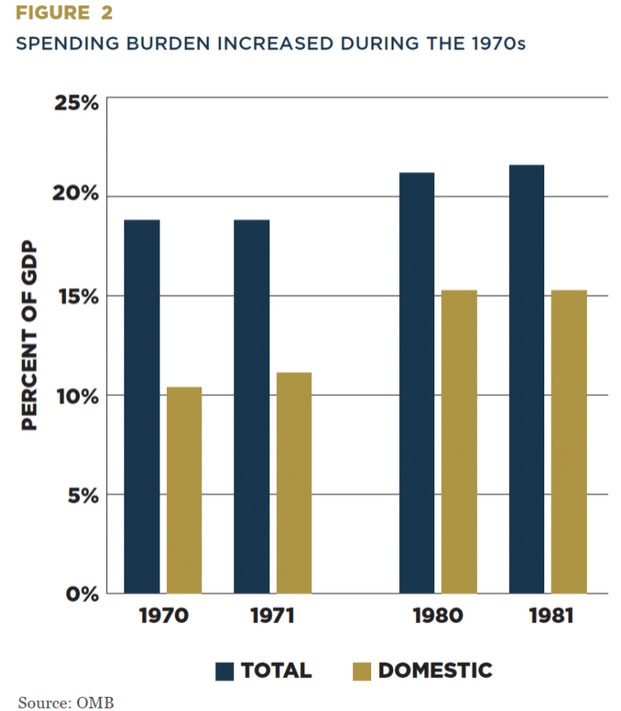
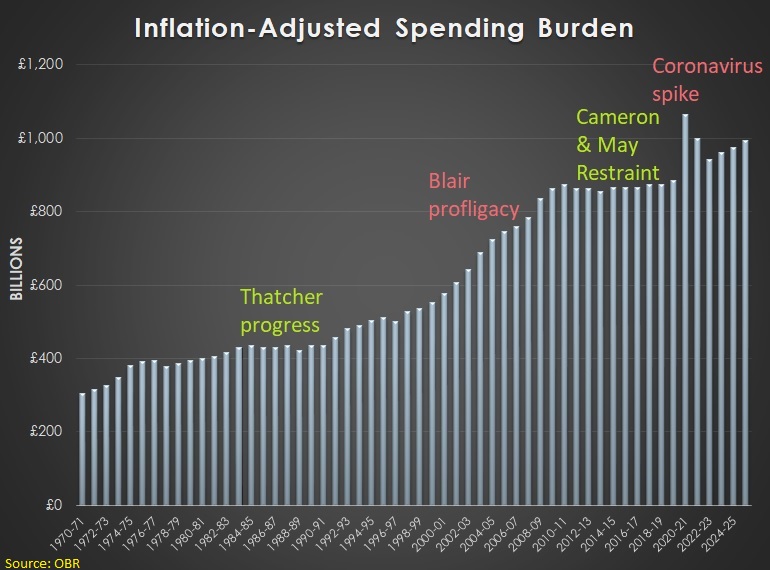
We bear a greater tax burden to support that permanent bureaucratic
structure than any of us would have believed possible just a few decades
ago. When I was in college, governments federal, state and local, were
taking a dime out of every dollar earned and less than a third of that
paid for the federal establishment. Today, governments, federal, state,
and local, are taking 44 cents out of every dollar earned, and
two-thirds of that supports Washington. It is the fastest growing item
in the average family budget, and yet it is not one of the factors used
in computing the cost of living index. It is the biggest single cost
item in the family budget, bigger than food, shelter and clothing all
put together.
When government tells us that in the last year the people in America
have increased their earnings 9 percent, and since the inflation is 6
percent, we’re still 3 percentage points better off, or richer than we
were the year before, government is being deceitful. That was before
taxes. After taxes, the people of America are 3 percentage points worse
off, poorer than they were before they got the 9 percent raise.
Government profits by inflation.
At the economic conference in London several months ago, one of our
American representatives there was talking to the press. He said you
have to recognize that inflation doesn’t have any single cause and
therefore has no single answer. Well, if he believed that, he had no
business being at an economic conference. Inflation is caused by one
thing, and it has one answer. It’s caused by government spending more
than government takes in, and it will go away when government stops
doing that, and not before.
Government has been trying to make all of us believe that somehow
inflation is like a plague, or the drought, or the locusts coming,
trying to make us believe that no one has any control over it and we
just have to bear it when it comes along and hope it will go away. No,
it’s simpler than that. From 1933 until the present, our country has
doubled the amount of goods and services that are available for
purchase. In that same period we have multiplied the money supply by 23
times. So $11.50 is chasing what one dollar used to chase. And that’s
all that inflation is: a depreciation of the value of money.
Ludwig von Mises once said, “Government is the only agency that can
take a perfectly useful commodity like paper, smear it with some ink,
and render it absolutely useless.”
There are 73 million of us working and earning by means of private
enterprise to support ourselves and our dependents. We support, in
addition, 81 million other Americans totally dependent on tax dollars
for their year-round living. Now it’s true that 15 million of those are
public employees and they also pay taxes, but their taxes are simply a
return to government of dollars that first had to be taken from the 73
million. I say this to emphasize that the people working and earning in
private business and industry are the only resource that government has.
In Defense of Free Enterprise
More than anything else, a new political economic mythology, widely
believed by too many people, has increased government’s ability to
interfere as it does in the marketplace. Profit is a dirty word, blamed
for most of our social ills. In the interest of something called
consumerism, free enterprise is becoming far less free. Property rights
are being reduced, and even eliminated, in the name of environmental
protection. It is time that a voice be raised on behalf of the 73
million independent wage earners in this country, pointing out that
profit, property rights and freedom are inseparable, and you cannot have
the third unless you continue to be entitled to the first two.
Even many of us who believe in free enterprise have fallen into the
habit of saying when something goes wrong: “There ought to be a law.”
Sometimes I think there ought to be a law against saying: “There ought
to be a law.” The German statesman Bismark said, “If you like sausages
and laws you should never watch either one of them being made.” It is
difficult to understand the ever-increasing number of intellectuals in
the groves of academe, present company excepted, who contend that our
system could be improved by the adoption of some of the features of
socialism.
In any comparison between the free market system and socialism,
nowhere is the miracle of capitalism more evident than in the production
and distribution of food. We eat better, for a lower percentage of
earnings, than any other people on earth. We spend about 17 percent of
the average family’s after-tax income for food. The American farmer is
producing two and one-half times as much as he did 60 years ago with
one-third of the man-hours on one-half of the land. If his counterparts
worldwide could reach his level of skill we could feed the entire world
population on one-tenth of the land that is now being farmed worldwide.
The biggest example comes, I think, when you compare the two
superpowers. I’m sure that most of you are aware that some years ago the
Soviet Union had such a morale problem with the workers on the
collective farms that they finally gave each worker a little plot of
ground and told him he could farm it for himself and sell in the open
market what he raised. Today, less than 4 percent of Russia’s
agricultural land is privately farmed in that way, and on that 4 percent
is raised 40 percent of all of Russia’s vegetables, and 60 percent of
all its meat.
Some of our scholars did some research on comparative food prices.
They had to take the prices in the Russian stores and our own stores and
translate them into minutes and hours of labor at the average income of
each country. With one exception they found that the Russians have to
work two to ten times as long to buy the various food items than do
their counterparts here in America. The one exception was potatoes.
There the price on their potato bins equaled less work time for them
than it did for us. There was one hitch though—they didn’t have any
potatoes.
In spite of all the evidence that points to the free market as the
most efficient system, we continue down a road that is bearing out the
prophecy of De Tocqueville, a Frenchman who came here 130 years ago. He
was attracted by the miracle that was America. Think of it: our country
was only 70 years old and already we had achieved such a miraculous
living standard, such productivity and prosperity, that the rest of the
world was amazed. So he came here and he looked at everything he could
see in our country trying to find the secret of our success, and then
went back and wrote a book about it. Even then, 130 years ago, he saw
signs prompting him to warn us that if we weren’t constantly on guard,
we would find ourselves covered by a network of regulations controlling
every activity. He said if that came to pass we would one day find
ourselves a nation of timid animals with government the shepherd.
Was De Tocqueville right? Well, today we are covered by tens of
thousands of regulations to which we add about 25,000 new ones each
year.
The Cost of Government Regulation
A study of 700 of the largest corporations has found that if we could
eliminate unnecessary regulation of business and industry, we would
instantly reduce the inflation rate by half. Other economists have found
that over-regulation of business and industry amounts to a hidden
five-cent sales tax for every consumer. The misdirection of capital
investment costs us a quarter of a million jobs. That’s half as many as
the president wants to create by spending $32 billion over the next two
years. And with all of this comes the burden of government-required
paperwork.
It affects education—all of you here are aware of the problems of
financing education, particularly at the private educational
institutions. I had the president of a university tell me the other day
that government-required paperwork on his campus alone has raised the
administrative costs from $65,000 to $600,000. That would underwrite a
pretty good faculty chair. Now the president of the Eli Lilly drug
company says his firm spends more man-hours on government-required
paperwork than they do today on heart and cancer research combined. He
told of submitting one ton of paper, 120,000 pages of scientific data
most of which he said were absolutely worthless for FDA’s purposes, in
triplicate, in order to get a license to market an arthritis medicine.
So, the United States is no longer first in the development of new
health-giving drugs and medicines. We’re producing 60 percent fewer than
we were 15 years ago.
And it’s not just the drug industry which is over-regulated. How
about the independent men and women of this country who spend $50
billion a year sending 10 billion pieces of paper to Washington where it
costs $20 billion each year in tax money to shuffle and store that
paper away. We’re so used to talking billions—does anyone realize how
much a single billion is? A billion minutes ago Christ was walking on
this earth. A billion hours ago our ancestors lived in caves, and it is
questionable as to whether they’d discovered the use of fire. A billion
dollars ago was 19 hours in Washington, D.C. And it will be another
billion in the next 19 hours, and every 19 hours until they adopt a new
budget at which time it’ll be almost a billion and a half.
It all comes down to this basic premise: if you lose your economic
freedom, you lose your political freedom and in fact all freedom.
Freedom is something that cannot be passed on genetically. It is never
more than one generation away from extinction. Every generation has to
learn how to protect and defend it. Once freedom is gone, it’s gone for a
long, long time. Already, too many of us, particularly those in
business and industry, have chosen to switch rather than fight.
We should take inventory and see how many things we can do ourselves
that we’ve come to believe only government can do. Let me take one that
I’m sure everyone thinks is a government monopoly and properly so. Do
you know that in Scottsdale, Ariz., there is no city fire department?
There, the per capita cost for fire protection and the per capita fire
loss are both one-third of what they are in cities of similar size. And
the insurance rates reflect this. Scottsdale employs a private,
profit-making, firefighting company, which now has about a dozen clients
out in the western states.
Sometimes I worry if the great corporations have abdicated their
responsibility to preserve the freedom of the marketplace out of a fear
of retaliation or a reluctance to rock the boat. If they have, they are
feeding the crocodile hoping he’ll eat them last. You can fight city
hall, and you don’t have to be a giant to do it. In New Mexico there’s a
little company owned by a husband and wife. The other day two OSHA
inspectors arrived at the door. They demanded to come in in order to go
on a hunting expedition to see if there were any violations of their
safety rules. The wife, who happens to be company president, said
“Where’s your warrant?” They said, “We don’t need one.” She said, “You
do to come in here,” and shut the door. Well, they went out and got a
warrant, and they came back, but this time she had her lawyer with her.
He looked at the warrant and said it does not show probable cause. A
federal court has since upheld her right to refuse OSHA entrance.
Why don’t more of us challenge what Cicero called the arrogance of
officialdom? Why don’t we set up communications between organizations
and trade associations? To rally others to come to the aid of an
individual like that, or to an industry or profession when they’re
threatened by the barons of bureaucracy, who have forgotten that we are
their employers. Government by the people works when the people work at
it. We can begin by turning the spotlight of truth on the widespread
political and economic mythology that I mentioned.
A recent poll of college and university students (they must have
skipped this campus) found that the students estimated that business
profits in America average 45 percent. That is nine times the average of
business profits in this country. It was understandable that the kids
made that mistake, because the professors in the same poll guessed that
the profits were even higher.
Then there is the fairy tale born of political demagoguery that the
tax structure imposes unfairly on the low earner with loopholes designed
for the more affluent. The truth is that at $23,000 of earnings you
become one of that exclusive band of 10 percent of the wage-earners in
America paying 50 percent of the income tax but only taking 5 percent of
all the deductions. The other 95 percent of the deductions are taken by
the 90 percent of the wage-earners below $23,000 who pay the other half
of the tax.
The most dangerous myth is that business can be made to pay a larger
share of taxes, thus relieving the individual. Politicians preaching
this are either deliberately dishonest, or economically illiterate, and
either one should scare us. Business doesn’t pay taxes, and who better
than business could make this message known? Only people pay taxes, and
people pay as consumers every tax that is assessed against a business.
Passing along their tax costs is the only way businesses can make a
profit and stay in operation.
The federal government has used its taxing power to redistribute
earnings to achieve a variety of social reforms. Politicians love those
indirect business taxes, because it hides the cost of government. During
the New Deal days, an under-secretary of the treasury wrote a book in
which he said that taxes can serve a higher purpose than just raising
revenue. He said they could be an instrument of social and economic
control to redistribute the wealth and income and to penalize particular
industries and economic groups.
We need to put an end to that kind of thinking. We need a
simplification of the tax structure. We need an indexing of the surtax
brackets, a halt to government’s illicit profiteering through inflation.
It’s as simple as this: every time the cost-of-living index goes up one
percent, the government’s revenue goes up one and one-half percent.
Above all we need an overall cut in the cost of government. Government
spending isn’t a stimulant to the economy; it’s a drag on the economy.
Only a decade ago, about 15 percent of corporate gross income was
required to pay the interest on corporate debt; now it’s 40 percent.
Individuals and families once spent about 8 percent of their disposable
income on interest on consumer debt, installment buying, mortgages, and
so forth. Today, it’s almost one-fourth of their total earnings. State
and local government in the last 15 years has gone from $70 billion to
$220 billion. The total private and public debt is growing four times as
fast as the output of goods and services.
Again, there is something we can do. Congressman Jack Kemp (R-N.Y.)
has a bill before the Congress designed to increase productivity and to
create jobs for people. Over a three-year period, it calls for reducing
the income tax for all of us by a full one-third. And also it would
reduce the corporate tax from 48 to 45 percent. The base income tax
would no longer be 20 percent but 14 percent, and the ceiling would be
50 percent instead of 70 percent. Finally, it would double the exemption
for smaller businesses before they get into the surtax bracket. It
would do all of the things that we need to provide investment capital,
increase productivity, and create jobs.
We can say this with assurance, because it has been done twice
before: in the ’20’s under Harding and Coolidge and again in the ’60’s
under John F. Kennedy. In the ’60’s the stimulant to the economy was so
immediate that even government’s revenues increased because of the
broadening base of the economy. Kemp’s bill is gaining support but
unfortunately the majority in Congress is concerned with further
restrictions on our freedom.
To win this battle against Big Government, we must communicate with
each other. We must support the doctor in his fight against socialized
medicine, the oil industry in its fight against crippling controls and
repressive taxes, and the farmer, who hurts more than most because of
government harassment and rule-changing in the middle of the game. All
of these issues concern each one of us, regardless of what our trade or
profession may be. Corporate America must begin to realize that it has
allies in the independent business men and women, the shopkeepers, the
craftsmen, the farmers, and the professions. All these men and women are
organized in a great variety of ways, but right now we only talk in our
own organizations about our own problems. What we need is a liaison
between these organizations to realize how much strength we as a people
still have if we’ll use that strength.
In regard to the oil industry, is there anyone who isn’t concerned
with the energy problem? Government caused that problem while we all
stood by unaware that we were involved. Unnecessary regulations and
prices and imposed price limits back in the ’50’s are the direct cause
of today’s crisis. Our crisis isn’t because of a shortage of fuel; it’s a
surplus of government. Now we have a new agency of enormous power, with
20,000 employees and a $10.5 billion budget. That’s more than the gross
earnings of the top seven oil companies in the United States. The
creation of the Department of Energy is nothing more than a first step
towards nationalization of the oil industry.
While I believe no one should waste a natural resource, the
conservationists act as if we have found all the oil and gas there is to
be found in this continent, if not the world. Do you know that 57 years
ago our government told us we only had enough for 15 years? Nineteen
years went by and they told us we only had enough left for 13 more
years, and we’ve done a lot of driving since then and we’ll do a lot
more if government will do one simple thing: get out of the way and let
the incentives of the marketplace urge the industry out to find the
sources of energy this country needs.
We’ve had enough of sideline kibitzers telling us the system they
themselves have disrupted with their social tinkering can be improved or
saved if we’ll only have more of that tinkering or even government
planning and management. They play fast and loose with a system that for
200 years made us the light of the world. The refuge for people all
over the world who just yearn to breathe free. It’s time we recognized
that the system, no matter what our problems are, has never failed us
once. Every time we have failed the system, usually by lacking faith in
it, usually by saying we have to change and do something else. A Supreme
Court Justice has said the time has come, is indeed long overdue, for
the wisdom, ingenuity, and resources of American business to be
marshalled against those who would destroy it.
What specifically should be done? The first essential for the
businessman is to confront the problem as a primary responsibility of
corporate management. It has been said that history is the patter of
silken slippers descending the stairs and the thunder of hobnail boots
coming up. Back through the years we have seen people fleeing the
thunder of those boots to seek refuge in this land. Now too many of them
have seen the signs, signs that were ignored in their homeland before
the end came, appearing here. They wonder if they’ll have to flee again,
but they know there is no place to run to. Will we, before it is too
late, use the vitality and the magic of the marketplace to save this way
of life, or will we one day face our children, and our children’s
children when they ask us where we were and what we were doing on the
day that freedom was lost?