Search This Blog

De Omnibus Dubitandum - Lux Veritas

Showing posts with label Margaret Thatcher. Show all posts

Tuesday, January 14, 2025

Margaret Thatcher, Michael Curley, and the 19th Theorem of Government

January 12, 2025 by Dan Mitchell @ International Liberty

In this 12-second video, Margaret Thatcher is talking about the Labour Party in the United Kingdom, but her warning has universal application.

And when I say her warning has universal application, I’m not joking.

Politicians generally can’t resist the temptation to buy votes. And I fear that this can and will happen at all levels of government.
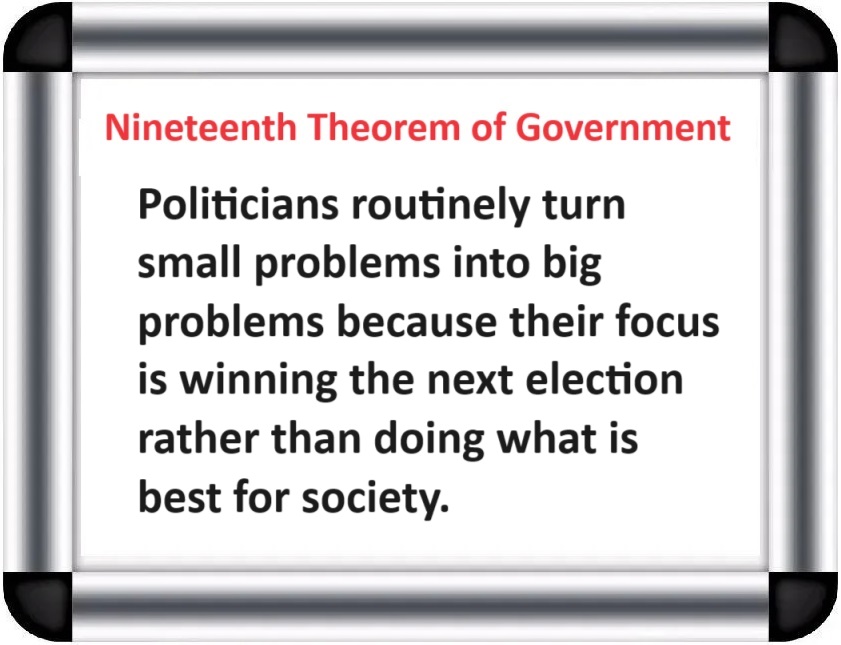
There are many potential explanations for why this happens, including demographic change, leftist ideology, and public choice (as described by the 19th Theorem of Government).

I’m sharing this analysis in order to set the stage for a discussion of why left-leaning politicians are being smart in the short run by foolish in the long run.

Regarding the short run, Steven Malanga writes, in an article for the Manhattan Institute’s City Journal, about how left-leaning politicians can enhance their long-run political power by driving away right-leaning voters.

He starts by describing the “Curley Effect.”


In 1973, Coleman Young, an African American former labor organizer with ties to the American Communist Party, ran for mayor of Detroit. Young narrowly beat the city’s police commissioner… Detroit’s crime exploded. Businesses and middle-class residents fled the city… Detroit’s economy and social order collapsed during Young’s two-decade mayoralty. …

Yet he kept getting reelected by larger margins… The arc of Young’s mayoral reign—a rapidly deteriorating city combined with ongoing political success—is a strange phenomenon that economists Edward Glaeser and Andrei Shleifer dubbed the Curley Effect, after the early-twentieth-century Boston mayor James Michael Curley. …he remained in power for more than four decades. As with Young years later, Curley’s political fortunes benefited because those most likely to vote against him had left the city.

He then explains that the Curley Effect is making blue states bluer.

…the new tribalism is producing a state version of the Curley Effect. The voters most likely to vote for change are leaving blue states like New York and California, making the Left more dominant in those places and reform increasingly improbable. On everything from energy to taxes and regulation to cultural controversies over illegal aliens and spiking crime, blue-state lawmakers are passing radical bills and voters are electing more progressive politicians. How far can some of these states go? Is a course correction possible? …

A UC Berkeley survey, taken just before the pandemic, found that 40 percent of Californians were thinking about leaving the state. That puts California among other strongly Democratic states—including New Jersey, Connecticut, Illinois, and New York—as places where the greatest percentage of the population is considering leaving, polls show.

The Berkeley poll quantified responses by political orientation. More than seven in ten Republicans, and 65 percent of the “somewhat conservative,” were considering exiting. …The migration is changing America’s political balance. Blue states are getting more Democratic, even as the party moves further left.

You may already have guessed why this approach is foolish in the long run.

Simply stated, blue states that drive away businesses and taxpayers are killing the geese with the golden eggs. They’re slowly but surely losing the people who pay for government.  The people who stay, meanwhile, are more likely to be the ones who mooch from government.

As illustrated by these two cartoons, that won’t end well.

Thursday, April 13, 2023

Thatcher, Lawson, and Pro-Growth Tax Policy

April 10, 2023 by Dan Mitchell

As documented in Commanding Heights: The Battle of Ideas, Margaret Thatcher and Ronald Reagan saved their nations from economic malaise and decline.


Today, let’s focus on what happened in the United Kingdom.

Economic liberty greatly increased during the Thatcher years.

She deserves the lion’s share of the credit for the U.K.’s economic rebirth and renaissance, but she also had the wisdom to appoint some very principled and very capable people to her cabinet.

Such as Nigel Lawson, who served as her Chancellor of the Exchequer (akin to a combined Treasury Secretary/OMB Director in the U.S.).

Lawson died last week, leading to many tributes to his role is resuscitating the U.K. economy.

The Wall Street Journal‘s editorial summarized his achievements.

…our problems are solvable, as they were a half century ago. One of those crucial problem solvers was British politician Nigel Lawson, who died this week at age 91. …the 1970s…was even more miserable in the United Kingdom than it was in the U.S. By the time Margaret Thatcher led the Tories into office in May 1979, inflation was raging and the country had been wracked by strikes in its “winter of discontent”… Lawson entered Thatcher’s administration… He made his historic mark as Chancellor of the Exchequer starting in 1983. He’s best known for his tax reforms, which reduced the top personal income-tax rate to 40% from 60% and brought the top corporate rate to 35% from a 1970s high of 52%. He also was a steward of the Thatcher administration’s privatizations of large state-owned firms and the “Big Bang” financial reforms that would transform London into a global financial center.

In a column for CapX, Madsen Pirie examines Lawson’s work.


Nigel Lawson left a huge legacy. Under his stewardship Britain went from being the sick man of Europe into becoming an economic powerhouse and one of the world’s leading economies. He is regarded by many as the finest Chancellor of the 20th century… Lord Lawson held the firm conviction that lower taxes created space for enterprise and opportunity, and made it his policy that in every Budget he would lower the burden of taxation and abolish at least one tax. …During his tenure, Britain was transformed from being an economy in which most major businesses and services were owned and run by the state, into one in which they became private businesses, paying taxes instead of receiving taxpayer subsidies. Failing and outdated state enterprises became modern, successful private ones. …His 1988 Budget…announced that all taxes above 40% would be abolished, and that the basic rate would be cut to 25%, its lowest for 50 years… Within a very short time, more money was coming into the Treasury from the lower rates than it had been taking in from the higher ones. It was a vindication of the Laffer Curve. …The top 10% of earners had been paying 35% of the total income tax take. Under Lawson’s lower rate that went up to 48%. In rough terms this meant that the top 10% went from paying just over a third to just under a half of total income taxes.

In other words, the lower tax rates in the U.K. had the same positive impact as the lower tax rates in the U.S., both in terms of encouraging growth and confirming the Laffer Curve.

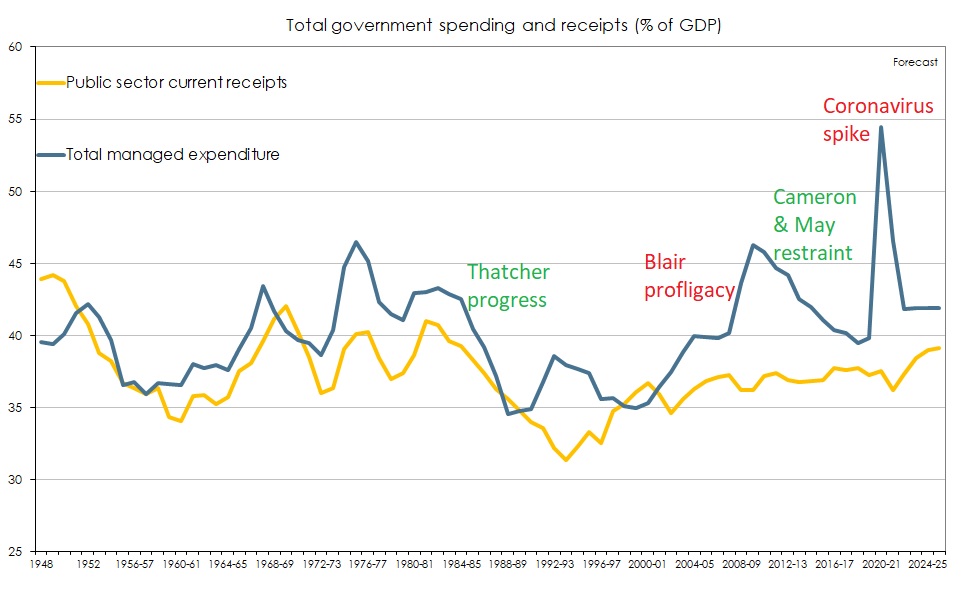
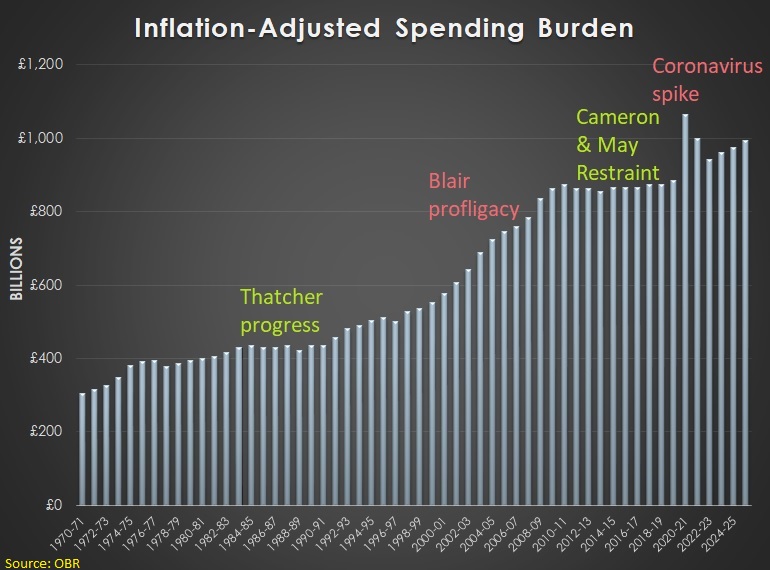
But let’s not forget that there also was spending restraint during the Thatcher years, particularly when Lawson was Chancellor of the Exchequer.

Just like we got spending restraint during the Reagan years.

The moral of the story is that it’s great to have good leaders, and it’s great when those leaders appoint good people.

P.S. If you want the U.S. equivalent of Nigel Lawson, the best historical example would be Andrew Mellon.


Tuesday, October 18, 2022

The Big Question for Tories (and Republicans): What’s the Alternative to “Free-Market Fundamentalism”?

October 15, 2022 by Dan Mitchell @ International Liberty

Because of her support for lower tax rates, I was excited when Liz Truss became Prime Minister of the United Kingdom.


Especially since her predecessor, Boris Johnson, turned out to be an empty-suit populist who supported higher taxes and a bigger burden of government spending.

But I’m not excited anymore.

Indeed, it’s more accurate to say that I’m despondent since the Prime Minister is abandoning (or is being pressured to abandon) key parts of her pro-growth agenda.

For details, check out this Bloomberg report, written by Julian Harris, about the (rapidly disappearing) tax-cutting agenda of the new British Prime Minister.


Westminster’s most hard-line advocates of free markets and lower taxes are looking on in despair as their agenda crumbles… When Liz Truss became prime minister just over five weeks ago, she promised to deliver a radical set of policies rooted in laissez-faire economics — an attempt to boost the UK‘s sluggish rate of growth.

Yet her chancellor of the exchequer, Kwasi Kwarteng, faced a quick reality check when his mini-budget, packed with unfunded tax cuts and unaccompanied by independent forecasts, …triggered mayhem…

Truss fired Kwarteng and replaced him with Jeremy Hunt as she was forced into a dramatic u-turn over her tax plans. …Truss conceded…and dropped her plan to freeze corporation tax. …Still, some believers are sticking by “Trussonomics”…Patrick Minford,..a professor at Cardiff University, said..

“Liz Truss’s policies for growth are absolutely right, and to be thrown off them by a bit of market turbulence is insane.” …Eamonn Butler, co-founder of the Adam Smith Institute, similarly insisted that Truss “is not the source of the problem — she’s trying to cure the problem.”

Eamonn is right.

The United Kingdom faces serious economic challenges. But the problems are the result of bad government policies that already exist rather than the possibility of some future tax cuts.

In a column for the Telegraph, Allister Heath says the U.K.’s central bank deserves a big chunk of the blame.

Liz Truss and Kwasi Kwarteng have been doubly unlucky. While almost everybody else in Britain remained in denial, they correctly identified this absurd game for the con-trick that it truly was, warned that it was about to implode and pledged to replace it with a more honest system.

Instead of a zombie economy based on rising asset prices and fake, debt-fuelled growth, their mission was to encourage Britain to produce more real goods and services, to work harder and invest more by reforming taxes and regulation. What happened next is dispiriting in the extreme. …

Truss and her Chancellor moved too quickly and, paradoxically, given their warnings about the rottenness of the system, ended up pulling out the last block from the Jenga tower, sending all of the pieces tumbling down. …they didn’t crash the economy – it was about to come tumbling down anyway – but they had the misfortune of precipitating and accelerating the day of reckoning. …

Andrew Bailey, the Governor of the Bank of England…, has been deeply unimpressive in all of this, helping to keep interest rates too low… The idea, now accepted so widely, that the price of money must be kept extremely low and quantitative easing deployed at every opportunity has undermined every aspect of the economy and society. …Too few people realise how terribly the easy money, high tax, high regulation orthodoxy has failed.

Allister closes with some speculation about possible alternatives. If the Tories in the U.K. decide to reject so-called “free-market fundamentalism,” what’s their alternative?

He thinks the Labour Party will take control, and with very bad results. Jeremy Corbyn will not be in charge, but his economic policies will get enacted.

If Truss is destroyed, the alternative won’t even be social democracy: it will be Labour, the hard Left, the full gamut of punitive taxation, including of wealth and housing, and even more spending, culminating rapidly in economic oblivion.

That is an awful scenario. Basically turning the United Kingdom into Greece.

I want to take a different approach, though, and contemplate what will happen if the Conservative Party rejects the Truss approach and embraces big-government conservatism.

Here are some questions I’d like them to answer:

  • Do you want improved competitiveness and more economic growth?
  • If you want more growth, which of your spending increases will lead to those outcomes?
  • Which of your tax increases will lead to more competitiveness or more prosperity?
  • Will you reform benefit programs to avert built-in spending increases caused by an aging population?
  • If you won’t reform entitlements, which taxes will you increase to keep debt under control?
  • If you don’t plan major tax increases, do you think the economy can absorb endless debt?

I’m asking these questions for two reasons. First, there are no good answers and I’d like to shame big-government Tories into doing the right thing.

Second, these questions are also very relevant in the United States. Even since the Reagan years, opponents of libertarian economic policies have flitted from one trendy idea to another (national conservatism, compassionate conservatism, kinder-and-gentler conservatismcommon-good capitalism, reform conservatism, etc).


To be fair, they usually don’t try to claim their dirigiste policies will produce higher living standards. Instead, they blindly assert that it will be easier to win elections if Republicans abandon Reaganism.

So I’ll close by observing that Ronald Reagan won two landslide elections and his legacy was strong enough that voters then elected another Republican (the same can’t be said for big-government GOPers like Nixon, Bush, Bush, or Trump).

Switching back to the United Kingdom, Margaret Thatcher repeatedly won election and her legacy was strong enough that voters then elected another Conservative.

The bottom line is that good policy can lead to good political outcomes, whereas bad policy generally leads to bad political outcomes.

P.S. To be sure, there were times when Reagan’s poll numbers were very bad. And the same is true for Thatcher. But because they pursued good policies, economic growth returned and they reaped political benefits. Sadly, it appears that Truss won’t have a chance to adopt good policy, so we will never know if she also would have benefited from a similar economic renaissance.

Monday, October 10, 2022

Margaret Thatcher and the Rise of the Climate Ruse

July 20, 2022 / / 2 Comments Contributed by William Walter Kay BA JD © 2022

Contrary to perception, largely sustained by opponents of the Climate Change campaign, this campaign was never the handiwork of some vast leftist conspiracy. Rather, the prime movers behind the Global Warming scare were a coterie of centre-right politicians such as: German Chancellor Helmut Kohl, US President George Bush Sr., Canadian Prime Minister Brian Mulroney and above all others, Britain’s Margaret Thatcher. This paper recounts Britain’s domestic war on coal, focussing on Thatcher’s formative role; and drawing on archival information released pursuant to the 30-year rule. The paper surveys Thatcher’s substantial exertions to take the fight against the Global Warming phantom into the global arena; and concludes with commentary on Thatcher’s legacy and revisionist final writings.

  • Background
  • The 1984-5 Miners’ Strike
  • Enter the Climate Ruse
  • The Strikers’ Defeat
  • Thatcher Expands the Climate Campaign
  • Thatcher’s Legacy
  • Conclusion
  • Background

Britain’s first public coal-fired electricity generator lit-up London’s Holborn Viaduct in 1882. By the late-1940s an electrified Britain drew 90% of its power from coal-fired plants. Britain’s first nuclear power plant came online in 1957. Its primary purpose was manufacturing bomb fuel...........To Read More....


Tuesday, July 6, 2021

How One Newspaper Called the Hong Kong Story Right From the Start

Wall Street Journal Figured It Out a Generation in Advance 

My Take - The Wall Street Journal may have been the only newspaper to have read the tea leaves correctly, but there were a great many who weren't in the information delivery business who did also.  I was one of them, this really was totally predictable.  As for writer's comment about Thatcher and Reagan; the question was then and still is this:  What exactly were they supposed to do?  The 100 year agreement was running out, and there was no way they could impose an independent Hong Kong on China, so what were their alternatives?   

There are times when leaders aren't left deciding between right and wrong.  They're left with deciding which wrong is the most right. While it's true that decision will eventually that comes back to haunt them, but that's the world as I see it, and a world that has to be dealt with.

Sunday, March 1, 2020

Trump’s Road Ahead Is Lit by Biography Of Margaret Thatcher

By , Special to the Sun | February 18, 2020

Tuesday, March 19, 2019

Maggie: Her Real Legacy!

Editor's Note:  I've been going back to tag my posts, something I should have been doing for the last eleven years and I came across this, which I originally posted this on January 14, 2012.  I decided this is as profound today as it was then.  RK


Tuesday, December 11, 2018

The Man Who Defeated Communism

Aleksandr Solzhenitsyn’s Centenary

Roger Kaplan for The American Spectator

At The American Spectator, we always agreed that it was quite fair and true to admonish our neighbors (and now our children and even grandchildren) to remember that the Soviet Union was defeated, and thus the Cold — often hot — War won by the Free World, largely thanks to three men: Ronald Reagan, Karol Jozef Wojtyla, and Lech Walesa.

We thought as well, however, that you could not beat the Soviet Union before communism was exposed for what it really was, and this required an inside job. It was done by a man who took almost everything communism could throw at him — we say almost because he did not get a bullet in the neck in the basement of the Lubyanka prison — and lived to write it down — it and much besides: the whole appalling story.

The 40th American president — ably aided by Lady Margaret Thatcher during those last dicey years of West vs. East, convinced the Soviet leaders that they would never conquer a coalition of free men living in free nations. The Polish Pope — John Paul II — showed them their lies and the cant with which their apologists in the West sought to cover them could not replace the faith carried by the eternal truths of the West’s great faiths. The Gdansk ironworker showed the working class they could break the chains communism put on them........To Read More....

Thursday, October 11, 2012

Today’s History Lesson

By Dr. Jack Wheeler
The second week of October offers a triad of heroic anniversaries worth celebrating by any admirer of Western Civilization.  Today, October 11, we celebrate the 1,280th anniversary of the Battle of Tours in 732 AD, when Charles Martel (686-741), forever known as The Hammer, and his 30,000 Christian soldiers crushed an invading horde of 200,000 Moslem Jihadis in what is now central France.  As Gibbon noted, had the Moslems won that day, all of Europe would have been Islamized and Western Civilization would have been extinguished.  

Saturday, October 13, is for celebrating the 87th birthday of the great Lady Champion of Liberty, the most heroic woman of the 20th century, Margaret Thatcher.  The story of how she, with Ronald Reagan and Pope John Paul II, saved Western Civilization from Soviet Communism is told in Now There Is One (April 2005). 

And we must also celebrate this October 13, for it was on this day 237 years ago, 1775 in Philadelphia, that the US Navy was founded. 

Saturday, January 14, 2012

Maggie: Her Real Legacy!

By Rich Kozlovich

Recently Hollywood released a movie about Margaret Thatcher that some have felt was demeaning to her. Since I haven't seen it, and I won't see it, I'll take their word for it. Especially since they are talking about Hollywood. However I think we might wish to review the real "Maggie" because when the left writes history - it's worse than propaganda.


Tuesday, September 6, 2011

Observations From the Back Row: 9-6-11

...
“De Omnibus Dubitandum”

Video with John Stossel and Richard Tren regarding DDT

Everything we are told should bear some resemblance to what we see going on in reality!
______________________________________


Thought For The Day
By Rich Kozlovich

Recently I linked an article about the efforts of activists in and out of government who want to stop the construction of a pipeline from Canada that would carry a substantial amount of crude oil into the country. Normal people would consider this to be a good thing. But of course that explains why the activists are against it claiming it will cause the potential demise of some beetle. One of the statements used by the bureaucrats at the U.S. Fish and Wildlife Service was that their decision was "based on science and not of policy".

Three things! First, they admitted that they didn’t really know what was causing this particular beetle’s slow demise. Second; their statement that this decision was based on science and not on policy makes me wonder why they would say that because how can policy be based on something else; and if so what that something else might be. Third; this statement reminded me of something Margaret Thatcher one said:
“Being powerful is like being a lady. If you have to tell people you are, you aren't.”
So if this decision was really based on science they shouldn’t have had to tell anyone; it should have been obvious. If it isn’t, then shouting it from the roof tops won’t help explain the stench of bad policy based on ideology.


Part 1 of this piece Sunday compared the cost of the Regional Desalination Project with the cost, in current dollars, of the New Los Padres Dam that was planned, but not built, 20 years ago.  The estimated construction cost for the desal project is $197 million more than for the dam, and annual operations and maintenance costs would be $8 million greater for the desal project. Under these circumstances, why in the world would we want to build the Regional Desalination Project?   That decision was based on the assumption that the dam could never be approved because of its adverse impact on the steelhead trout and California red-legged frog, threatened species under the federal Endangered Species Act. The dam would increase water flow below the dam, but it would block the steelhead migration to and from the steelhead spawning area above.


A furry little roadblock may stall the city's plans to extend State Street. And the 1.5-mile project to link the 210 Freeway to Fifth Street on the Westside could cost millions more because the federally protected San Bernardino kangaroo rat has been spotted in the area. "We could be really high (in) mitigation costs, depending on how much habitat we're impacting," City Engineer Robert Eisenbeisz said. The city has $2 million - mostly through Measure I funding, a half-cent sales tax passed by county voters in 1989 - allocated for environmental and design work, but the project may balloon to $40 million, with as much as $18 million going toward mitigating damage to the kangaroo rats' habitat. At the same time, Eisenbeisz said mitigation work could cost as little as $3 million to $5 million.


Money will protect Yamhill County habitat for Fender's blue. The U.S. Fish and Wildlife Service is coming to the rescue of the Fender’s Blue butterfly, an endangered species once thought to be extinct. The federal agency, which administers the Endangered Species Act, provided two grants totaling $767,000 to protect the butterfly’s habitat in Yamhill County. One grant provides $500,000 to acquire a permanent conservation easement on 284.6 acres of habitat in the Mount Richmond Conservation Opportunity Area, to benefit the Fender’s blue butterfly and the flower where it spends much of its life, the Kincaid’s lupine. The easement also will protect the Nelson’s checkermallow.

My Take - If the easement is 1/2 million dollars how much would the land sell for?   How much will it sell for after this easement.  Of course this merely allows for that amount to be spent, it doesn't mean anyone will actually get that kind of money.  Please follow the link on conservation easements.  You have all the obligations and no privileges, and in this case even if you sell it the new owners are stuck with it; which can really make it difficult to sell.  Of course you can just give it to the government if you prefer; I'm sure that is what they prefer.  There are some who seek to preserve their property after they are gone so they agree to such things, but these things aren't really as voluntary as it sounds in many cases.  It has been pointed out that in many cases this has merely been a way of depriving people of their rights. 

By Dr. Jy Lehr

Federal and state legislators have recently been focusing on eliminating duplication of government programs that could be combined or eliminated to save billions of taxpayer dollars. Yet the elimination of one colossal duplication could save billions of dollars but has not been mentioned: Essentially all of the work done by the U.S. Environmental Protection Agency is duplicated and in fact done far better by the collective wisdom of our 50 state environmental protection agencies….. EPA has become a wholly owned subsidiary of environmental advocacy groups and serves primarily as an obstacle course for economic growth…. Today these research laboratories too often do the bidding of overaggressive regulators merely seeking to cherry pick data to support their predisposition to regulate…..

It has become quite apparent that EPA is no longer acting for the benefit of society in general. It was a great idea in 1971, but the agency bears no resemblance to that fine organization of long ago. The current Congress is looking to make changes. This is a good place to start.


The butyl methyl sulphide molecule whips round an axis defined by its single sulphur atom. Researchers have created the smallest electric motor ever devised. The motor, made from a single molecule just a billionth of a metre across, is reported in Nature Nanotechnology. The minuscule motor could have applications in both nanotechnology and in medicine, where tiny amounts of work can be put to efficient use. Tiny rotors based on single molecules have been shown before, but this is the first that can be individually driven by an electric current.

My Take - The Luddite greenies are against nano-technology. 


"The time has come," the Walrus said,
"To talk of many things:
Of shoes, and ships, and sealing wax -
Of cabbages and kings,
And why the sea is boiling hot,
And whether pigs have wings."

###