Search This Blog

De Omnibus Dubitandum - Lux Veritas

Showing posts with label Daniel Mitchell. Show all posts

Friday, January 31, 2025

Russia and (Non-Existent) Shock Therapy

January 30, 2025 by Dan Mitchell @ International Liberty

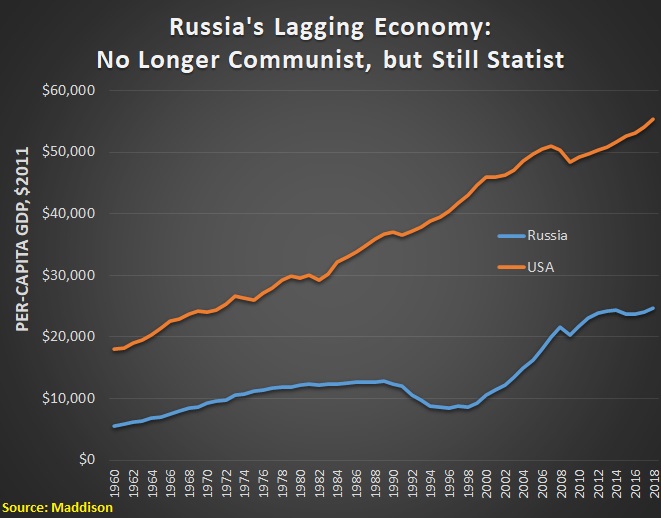
Last year, I mocked Tucker Carlson for trying to make it seem like Russia’s moribund economy was successful. Two years ago, I showed that Russia lagged behind other nations that emerged from the collapse of communism.


Three years ago, I shared a chart showing that Russia was an economic failure because of dirigiste economic policy.

Just in case it’s not obvious, I think Russia needs liberalization. More free markets and less statism.

With that in mind, let’s look at some not-too-distant history. Serge Schmemann has a very interesting column in the New York Times about how American officials had differing views of how to help Russia after the collapse of the Soviet Union.

Here are some excerpts.


It was March 1994…and the debates within the U.S. Embassy in Moscow were heated. Diplomats in the economic section, backed by the Treasury Department in Washington, argued ardently that radical free-market reforms were the only path for post-Soviet Russia, and that democracy would surely follow. Political advisers believed, equally passionately, that such “shock therapy” would only worsen the devastating dislocation Russians were already suffering with the collapse of the Soviet Union. …E. Wayne Merry, the top political analyst in the embassy and one of the most forceful critics of shock therapy, set out a detailed case against it in a long telegram… Attempts at market reforms had left much of the population destitute… Was America’s advocacy of “shock therapy” responsible for the rise of oligarchs and the ascent of Mr. Putin?

At the risk of over-simplifying, Schmemann’s column basically argues that the United States should not have pushed for radical economic liberalization after the Soviet Union fell apart. Instead, Americans should have let the Russians chart their own path.

That is a perfectly legitimate position. Indeed, many libertarians would agree that the crowd in Washington should not be cajoling or pressuring other nations to do good things or bad things.

But I have one niggling concern with the column, which is that Russia never had shock therapy. There was never a period of radical free-market reforms.

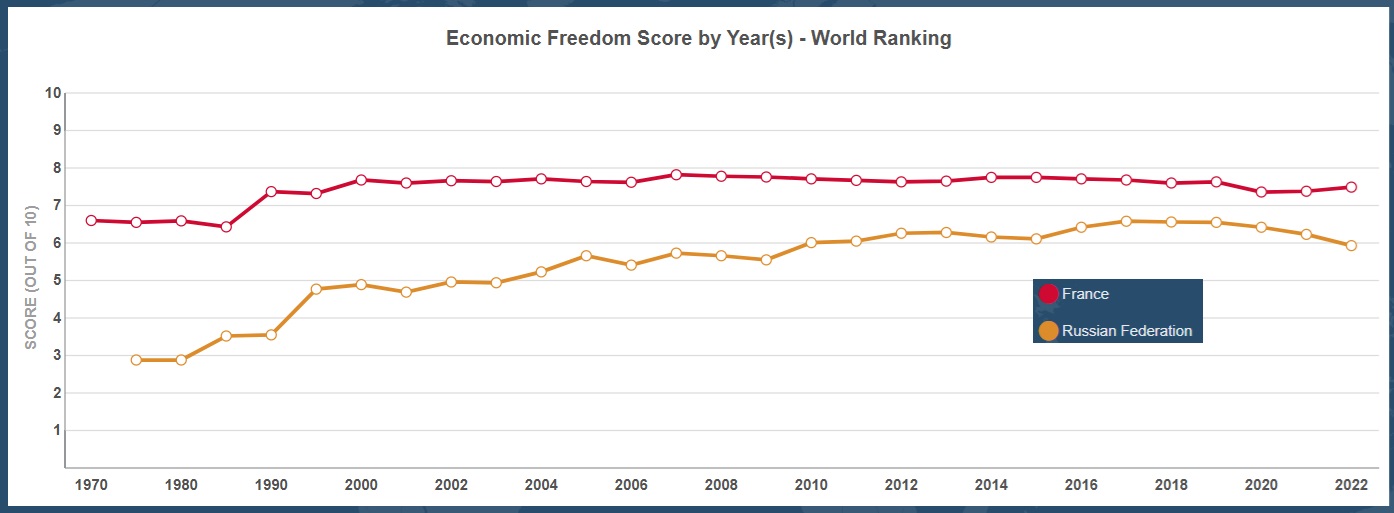
But don’t believe me. Here’s a chart from the Fraser Institute’s Economic Freedom of the World. As you can see, there was some improvement in economic policy after the collapse of communism, but Russia has never come close to having even French levels of economic liberty. And France is not exactly a pro-market paradise, to put it mildly.

If you want a real example of shock therapy, look at the amazing things Javier Milei is doing to rejuvenate Argentina.

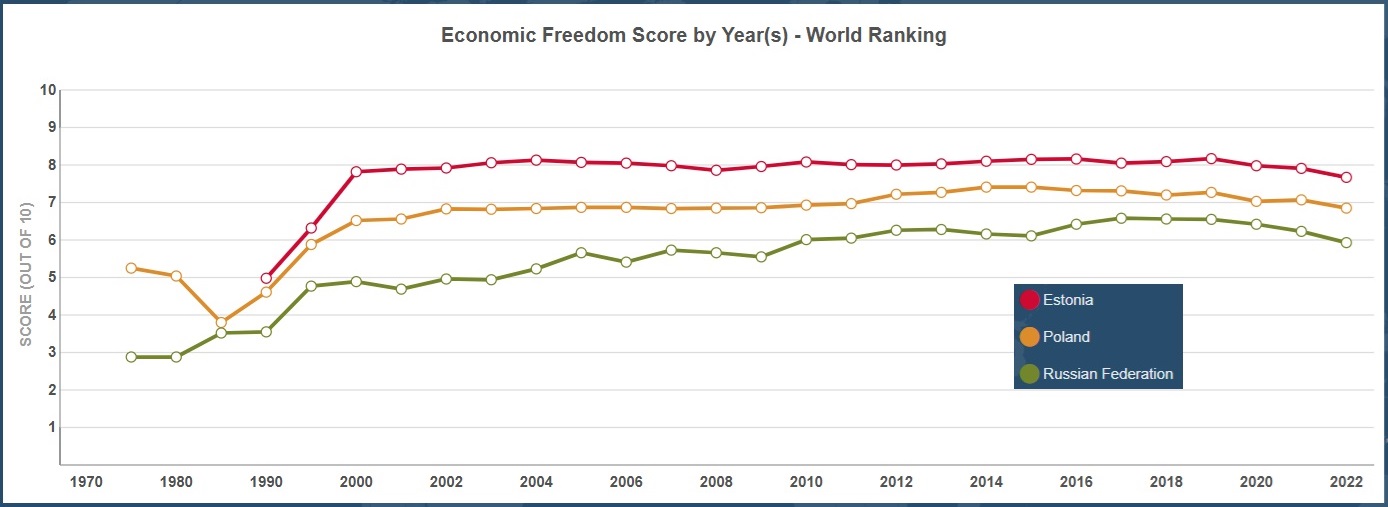
Or, if you prefer examples from the former Soviet Bloc, here’s another chart from the Fraser Institute, in this case showing economic liberty in Russia, Estonia, and Poland.

As you can see, Estonia did a lot of reform, Poland did a decent amount of reform, and Russia has been a bit of a laggard.

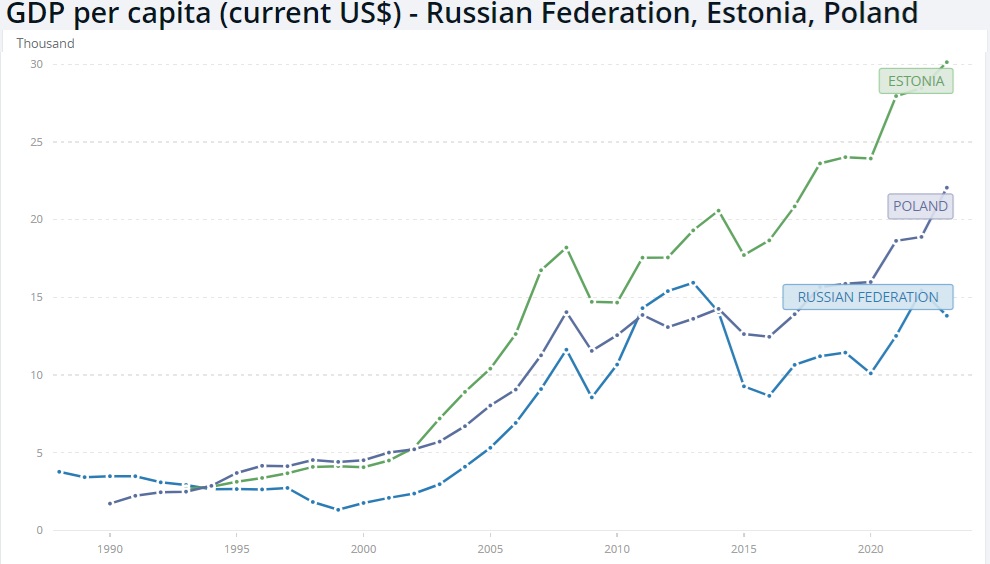
Now let’s examine one final graph, in this case from the World Bank.

Is anyone surprised to see that there is a clear relationship showing that the country with the most shock therapy is now the richest while the country that did the least liberalization is the poorest?

Gee, it’s almost as if there is a relationship between economic liberty and national prosperity.

P.S. Click here to learn more about Poland and Estonia.

Sunday, March 24, 2024

Washington’s Fiscal Ponzi Scheme

March 20, 2024 by Dan Mitchell @ International Liberty

My book on fiscal policy, co-authored with Les Rubin, is now officially published.

I wrote a sneak-peak column about The Greatest Ponzi Scheme on Earth last week.

There are three main takeaways from our book.

Okay, I’ll admit those bullet points are an oversimplification.

But there’s a reason for that.

Our book does show how we got into our current fiscal mess (because of too much spending).

And it shows why things will get worse in the future if we leave government on autopilot (because of too much spending).

Moreover, we have lots of evidence for the right way to avert a fiscal disaster. Richard Rahn wrote about our book in his Washington Times column.


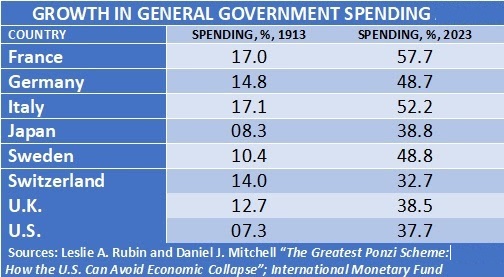
In a new book, “The Greatest Ponzi Scheme: How the U.S. Can Avoid Economic Collapse,” Leslie A. Rubin and Daniel J. Mitchell provide a well-written and informative history of how much of the world and particularly the United States managed to get into the current fiscal mess. …

British Prime Minister Margaret Thatcher said it best: “The problem with socialism is that you eventually run out of other people’s money.” Before World War I, government spending in almost every country was a small share of gross domestic product. …

In the United States, things began to change in the 1930s with the development of welfare programs… Mr. Rubin and Mr. Mitchell review many of the so-called entitlement programs that are the real budget busters. The payments from these programs consistently grow faster than the economy or tax revenue and now consume the bulk of the federal budget. Anyone who can do basic math can quickly understand the problem. When a country reaches the point where it is borrowing just to pay interest on the debt, game over.

That’s the bad news in the book. And Richard captures some of that bad news with this table showing how the burden of government spending has significantly increased over the past 100-plus years.

But our book also has good news, as Richard explains.

Fortunately, there are a number of success stories that serve as role models of what to do. …Switzerland is perhaps the best model for fiscal responsibility in a highly developed country, in that for the most part the Swiss keep government spending growing no more rapidly than the private sector.

As you might expect, I like his conclusion.

Mr. Rubin and Mr. Mitchell have done a great service in providing a highly understandable book, outlining the disaster about to engulf us if we do not change quickly, but equally important, a road map for getting out. Every policymaker and concerned citizen ought to buy this book and refer to it often — an economic bible of sin and salvation.

I want you to buy the book, but if you are a regular reader of this column, you already know the only practical way of averting a fiscal crisis in the United States. Simply follow the Golden Rule. And, because of its spending cap, Switzerland is a good role model.

Monday, August 7, 2023

Great Moments in Human Rights

August 3, 2023 by Dan Mitchell @ International Liberty

I’m a strong believer in rights, assuming they are defined properly (i.e., they don’t require trampling on the rights of others).

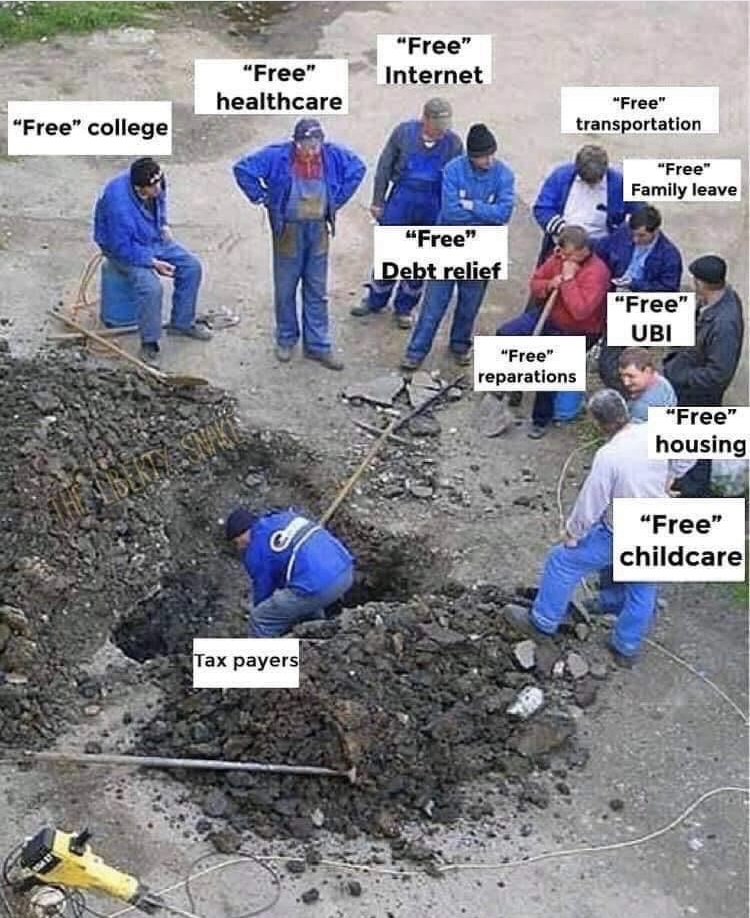
Unfortunately, many politicians assert people have “rights” that can only be fulfilled by exploiting others (usually taxpayers).

We now have lawmakers asserting that there are “rights” to housing, healthcare, jobs, and countless of other things that should be earned in the private sector rather than financed by other people.

Politicians love this game (at least until they run out of other people’s money).

But some politicians are more creative than others.

Today, we’re going to look at a somewhat unusual “right” that is being provided by Brazilian taxpayers.

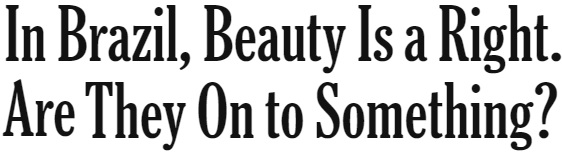
Sushma Subramanian, in a column for the New York Times, explains there is a right to beauty in Brazil.


Brazil…prides itself on its huge number of skilled plastic surgeons. The country recognizes a right to beauty, which in practical terms means subsidizing nearly half a million surgeries each year… In the 1950s, a famed plastic surgeon convinced the president that ugliness can cause painful psychological suffering and that treatment should be covered.

While at first he was referring to those with congenital deformities and burn victims, most procedures covered today are purely aesthetic. …In a public health system that’s strapped for resources, it’s certainly arguable that this is the wrong kind of spending. Everyday differences in bodies end up being pathologized by the medical establishment, defining attractiveness in a limiting way. Small breasts, for instance, might be diagnosed as hypotrophy of the mammary glands. …what Brazil’s policy creates is an acceptance that beauty is a form of self-care and that there’s nothing embarrassing about wanting to meet society’s standard for how we should look, no matter our social class.

Since I’ve written on the economics of “lookism,” I agree that physical appearance is important for people. Not just for their psychological well being, but also for their economic success.

But does that mean taxpayers should become involuntary participants in the process of beautification?

P.S. You probably won’t be surprised to learn that American taxpayers already are paying for cosmetic surgery. And Buffalo taxpayers are facing the same problem at the local level.

P.P.S. Here’s my list of other “great moments” in human rights.

Thursday, July 6, 2023

The Most Heartwarming Tweet of 2023

July 5, 2023 by Dan Mitchell @ International Liberty

For 2023, we have the IMF and CNN in a contest for the year’s most economically illiterate tweet and we have a strange entry for the year’s most half-right tweet.

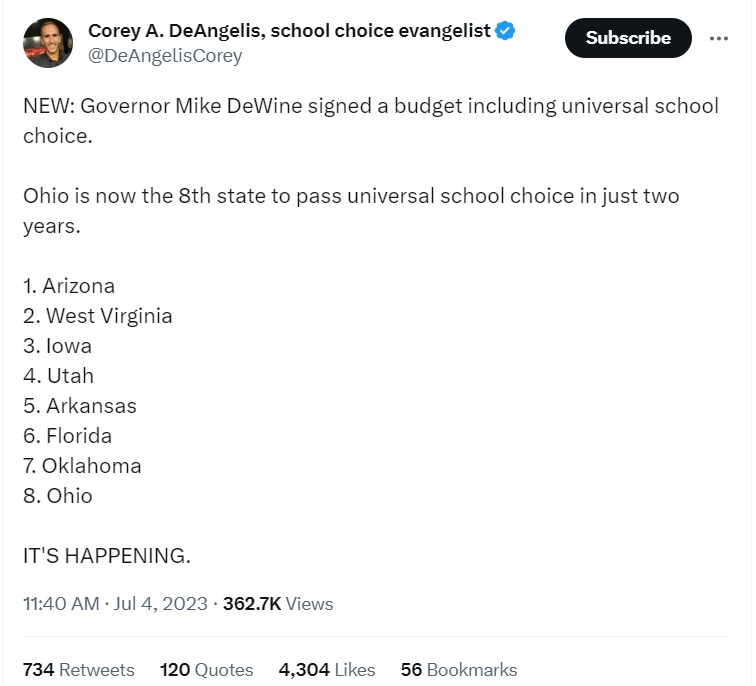
Today, let’s enjoy what will probably be the year’s most heartwarming tweet.

This is great news for the children of the Buckeye State.

Anna Staver of the Columbus Dispatch has a report on what happened.


Ohio lawmakers reached a deal on the state budget Friday… The deal included significant income tax cuts for people and businesses, universal vouchers for Ohio K-12 students… “I’m very happy about the way the school choice and universal voucher happened,” Senate President Matt Huffman, R-Lima, said. …All Ohio school children will be eligible for a school voucher, but how much those EdChoice scholarships are worth will depend on family income. Children whose families earn up 450% of federal poverty will be able to get a full EdChoice scholarship to help them cover the cost of attending private schools. Students whose families earn more will be able to get smaller scholarships.

The great news for children is also terrible news for the bosses of teacher unions. Which makes this a double victory for kids since teacher unions operate for the benefit of bureaucrats.

P.S. I’m a bit confused by Corey’s list of school choice states. I’ve written about what’s happened in West Virginia, Arizona, Iowa, Utah, Arkansas, Florida, and Oklahoma. But I wonder why he doesn’t include Indiana. Everything will become clear, I imagine, when this map is updated.

P.P.S. The Ohio budget also lowers tax rates, so I also look forward to an updated version of this map.

Monday, June 26, 2023

Monaco, Netherlands, and Tax Servitude

June 24, 2023 by Dan Mitchell @ International Liberty

Libertarians often make the claim that taxation is a form of robbery, and some of them (especially the anarcho-capitalists) even assert that it is a form of slavery.

Since I’m an economist, I stick to less flamboyant arguments about the adverse impact of high marginal tax rates and double taxation.

But, based on a controversy in the Netherlands, maybe the more radical libertarians have a point.

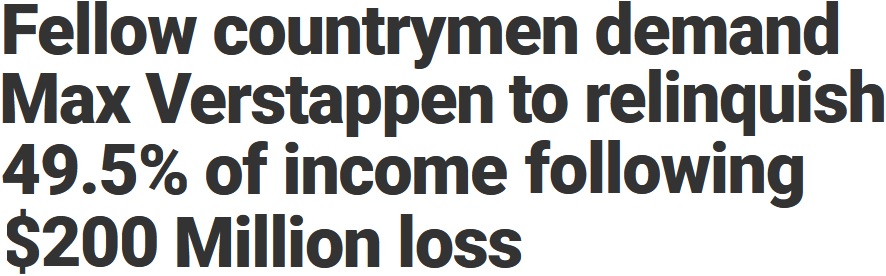
There are some people in that country who think a race car driver who left the Netherlands and now lives in Monaco has an obligation to surrender half his income to the Dutch government.

Here are some excerpts from a report published by a sports website.


Max Verstappen, ever since he turned 18 has been living in Monaco which is known to be a tax haven. Essentially, Max Verstappen has not paid any tax whatsoever to the Dutch government for his earnings which are estimated to be €200 million… a LinkedIn post by Rutger Bregman…accused Max Verstappen of stealing from his own country. In the post, he commented “People like Verstappen don’t work for their country. They only work for themselves.” …There is a solution to the accusation raised by Rutger. …Wouter Leenders and Vinzenz Zieseme…pointed out that the Dutch government do what the French government does to its uber-rich. The French Government…taxes French individuals living in Monaco since 1963. The problem with this arrangement is that there are 15 other Tax Havens in Europe that would happily favour the high-paid athletes.

Notice that Mr. Bregman is asserting that Verstappen has an obligation to work for somebody other than himself. Is that not – at least in part – the definition of slavery?

There’s actually a serious tax issue in this controversy. Bregman, Leenders, and Zieseme presumably think that the Netherlands should have a “worldwide” tax system, which means the Dutch government would tax people like Verstappen even if they permanently reside someplace else.

There is a major country that uses that approach, and I’m embarrassed to admit it’s the United States.

Fortunately, I don’t think Europe will copy that mistake.

P.S. Monaco is a great refuge for successful people. But, as noted the excerpt above, not if you’re French (and you can read the history of that by clicking here). Successful French people have to move to places such as Belgium (no capital gains tax) or Switzerland (low overall taxes).

Monday, May 22, 2023

A Spending Cap Amendment Is Far Better than a Balanced Budget Amendment

May 20, 2023 by Dan Mitchell @ International Liberty

The Swiss Debt Brake and Colorado’s TABOR work because they limit spending. Balanced budget requirements, by contrast, have a weak track record

My point in the above discussion with the Soul of Enterprise is mostly based on economics.

Our fiscal challenge in the United States is excessive government spending. And the problem is projected to worsen in coming decades because of demographic change and poorly designed entitlement programs.

So it makes sense to directly address the problem with a spending cap.

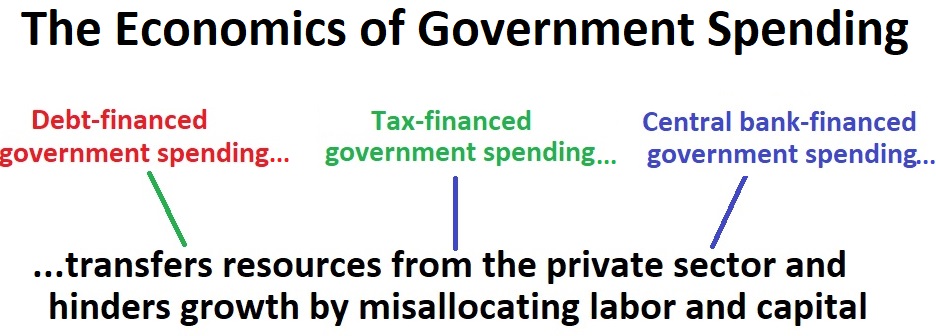
By contrast, a balanced budget amendment is merely designed to inhibit debt-financed spending. That’s a good goal, but it won’t lead to good results if politicians react by simply increasing tax-financed spending. Or if they finance spending with bad monetary policy.

As I point out in the video, balanced budget requirements and anti-deficit rules have not produced good results in American states or EU nations.

The takeaway is that good policymakers should push for spending caps for theoretical reasons and practical reasons.

P.S. I was very pleasantly surprised when the German government recently endorsed EU-wide spending caps.

P.P.S. Remarkably, there are pro-spending-cap studies from left-leaning bureaucracies such as the International Monetary Fund (here and here) and the Organization for Economic Cooperation and Development (here and here). There are also similar studies from the European Central Bank (here and here).

P.P.P.S. It should go without saying, but I’ll say it anyhow, that a spending cap should be set at a level that actually results in less government.

Tuesday, April 18, 2023

France, Taxes, and Math

March 27, 2023 by Dan Mitchell< @ International Liberty

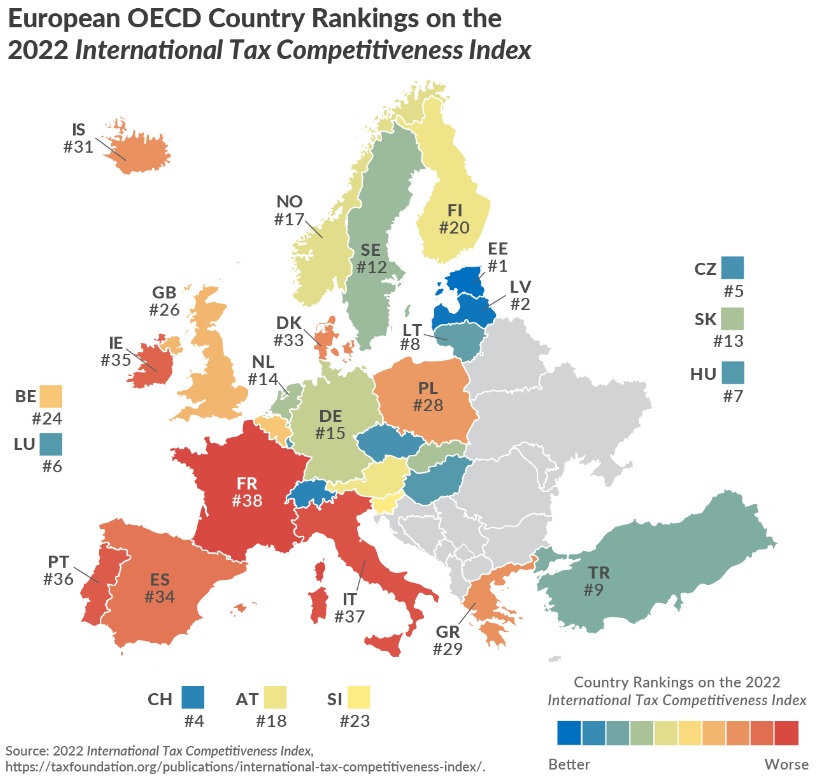
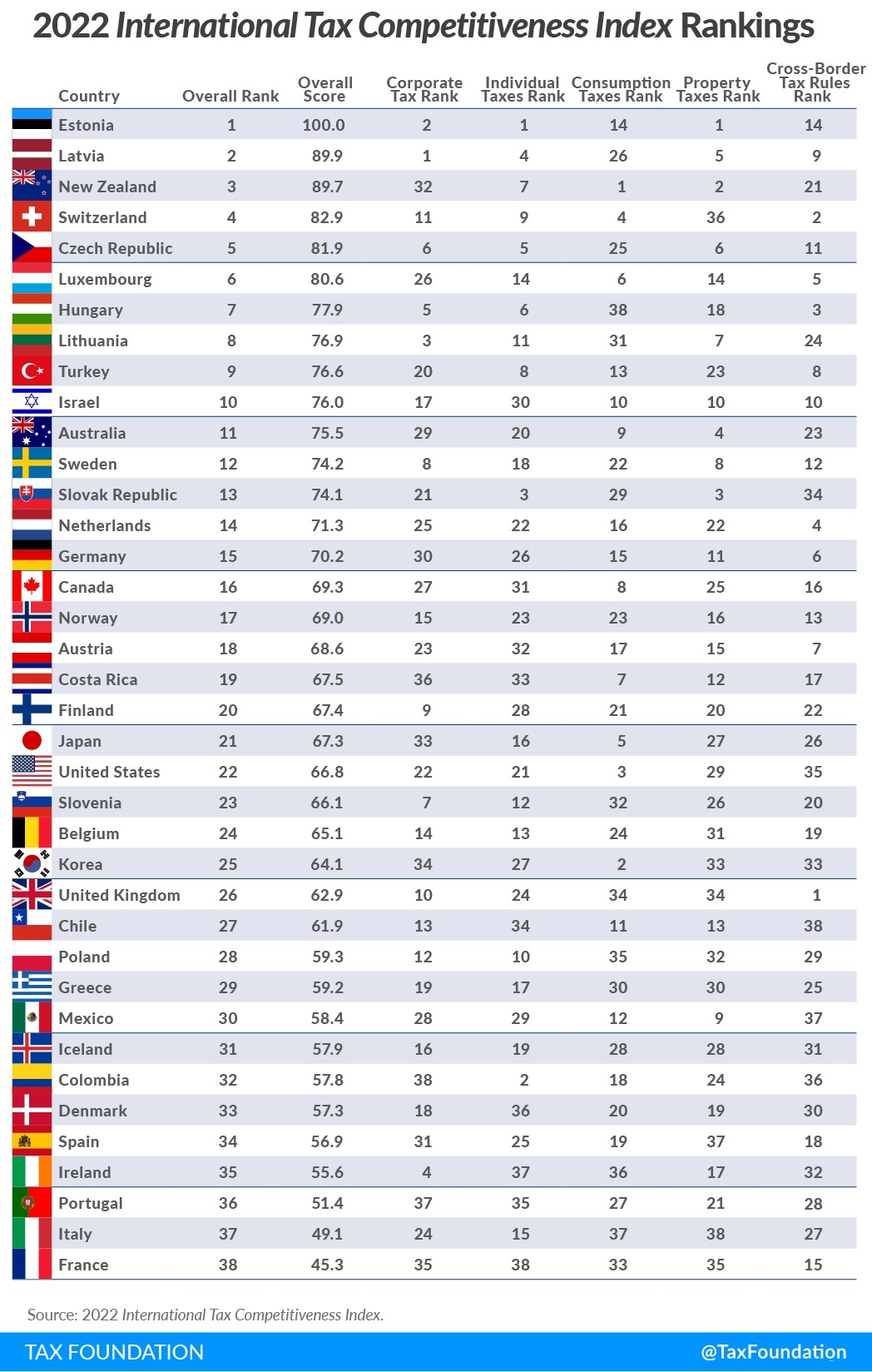
I normally write a column every year (2021, 2020, 2019, etc) when the Tax Foundation releases its International Tax Competitiveness Index, in part because I’m curious to see how the United States compares to other developed nations.

I somehow overlooked the 2022 version, but there’s a very good reason to cite the Index today. In the latest version, Estonia retains its #1 ranking, which is no surprise.

And, as you can see from the map, France is #38, giving it the worst tax system among industrialized nations.

I want to focus on France because the nation is in the midst of a massive political controversy over President Macron’s plan to increase the retirement age from 62 to 64.

That’s too little and too late from my perspective, given the country’s terrible fiscal outlook.

Some people, however, don’t understand this reality. In a column for the New York Review, Madeleine Schwartz writes that Macron’s plan “has few supporters among French economists.” Here are some excerpts.


Macron and his defenders have called the reform a necessity. …But one group of voices has been missing among the commentators advocating for the change. “You won’t find many economists defending this reform,” says the economist Mathieu Plane, who works at the French Observatory of Economic Indicators… Patrick Artus, a well-known economist who currently works as an advisor to the French bank Natixis, told me that the government has several tools at its disposal… They might increase taxes. “The government has a complete block on raising taxes,” he says. “And yet there are some tax increases that would be legitimate.” …Instead the government has forced forward a law that many economists consider both inequitable and ineffective. …“It’s a pretty brutal measure,” says Camille Landais, chairman of the French Council of Economic Advisers.

Wow, what an indictment of French economists. Are they really that clueless? Are they the ones who are bad at math?

It’s hard to answer those question.

But I can say with certainty that big tax increases are not the solution when France already has the developed world’s worst tax system, with terrible grades in all but one category.

What’s especially amazing is that some of the French economists inadvertently confirm my argument that Macron did not go far enough.

A number of economists have questioned whether the reform would do much to solve the larger issue, which is that the population is aging and productivity levels do not balance the cost of demographic change. By making older workers work longer, the reform will only raise the employment rate by about one point, says Artus, even though France’s employment rate is about nine points less than, for example, Germany’s.

Yet, amazingly, their view is to do nothing other than double down on the policies that have produced low levels of employment.

I’ve joked in the past that economists are untrustworthy, and perhaps even despicable and loathsome. In France, it appears that my satire is reality.

P.S. Today’s column focused on France. For those interested in other nations, here’s the full Index.

The United States ranked #22, which is bad but not as bad as it used to be. Kudos to the Baltic nations, as well as New Zealand and Switzerland. Sympathy for the mistreated taxpayers of Italy and Portugal (as well as Ireland, where the benefits of a low corporate rate are offset by very bad scores in other areas).

Friday, March 31, 2023

Time to (Finally) Defund the OECD?

March 28, 2023 by Dan Mitchell @ International Liberty

Nearly 13 years ago, I narrated this video about the Organization for Economic Cooperation and Development, a Paris-based international bureaucracy that uses American tax dollars to advocate for bigger government and higher taxes.


Everything I said in that video is still true, except now the federal budget is far bigger and the OECD has had about a dozen more years to push for dirigiste policies

It is particularly disgusting (and hypocritical) that the OECD is a big cheerleader for higher taxes, yet its bureaucrats get tax-free salaries.

Not only does the OECD urge higher taxes in countries all around the world (even poor countries!), it also lobbies to undermine tax competition by advocating for policies such as Joe Biden’s corporate tax cartel.

And it adds insult to injury that American taxpayers are subsidizing this nonsense.

But maybe that will come to an end. Reporting for Bloomberg Tax, Samantha Handler and Chris Cioffi explain that Republicans are threatening to end U.S. subsidies for the Paris-based bureaucracy.


Republicans are plotting ways to push back on the landmark global tax deal agreed to by nearly 140 countries, including by calling to pull US funding for the OECD that’s leading the negotiations. …“There’s concerns about the work product of the OECD,” said Rep. Adrian Smith (R-Neb.), the Ways and Means trade subcommittee chairman. …The US currently funds 19.1% of Part I of the OECD’s budget, according to the letter addressed to House Appropriations State, Foreign Operations, and Related Programs Chairman Mario Diaz-Balart (R-Fla.) and ranking member Rep. Barbara Lee (D-Calif.). …Chairman Jason Smith (R-Mo.) sent a letterlast month to the OECD Secretary-General Mathias Cormann, urging him to reject all proposals that would affect US jobs and tax revenue. Jason Smith called Pillar Two’s undertaxed profits rule “fundamentally flawed.”

Needless to say, Republicans should defund the OECD. Giving American tax dollars to the bureaucrats in Paris is a subsidy for the left.

For all intents and purposes, this is an IQ test for Republicans. Presumably, they are smart enough to understand that they should not send money to the Democratic National Committee or MSNBC. You would think they would also be smart enough not to subsidize a bureaucracy that advocates for the DNC/MSNBC agenda.

Unfortunately, Republicans have a well-deserved reputation for being the “stupid party.”

  • They had total control of Washington from 2002-2006 during the Bush year. Did they defund the OECD? No.
  • They had todal control of Washington from 2017-2018 during the Trump years. Did they defund the OECD? No.

To make matters worse, Republicans are sometimes so stupid that they actively help the OECD push for bad policy. Here’s another blurb from the article.

Momentum started building on the global tax talks under the Trump administration, with the US participating actively in the negotiations.

To be fair, the Trump Administration sort of proposed to defund the OECD back in 2017, but there was zero follow-through (hardly a surprise since Trump wound up being a big spender).

Instead, his dilettante Treasury Secretary actively supported the OECD.

The bottom line is that I’m happy that some Republicans are threatening to defund the OECD but I’m not overflowing with confidence that they will have the intelligence and diligence to make it happen. Even if they wind up back in power after the 2024 election.

P.S. There is at least one Republican who is very principled on the issue of the OECD.

P.P.S. The OECD sometimes resorts to grotesque dishonesty while pushing for bigger government.

P.P.P.S. I’ve been accused of “trading with the enemy” because I argue against the OECD. Heck, the bureaucrats even threatened to throw me in a Mexican jail.

Thursday, March 23, 2023

Bank Failures and the Federal Reserve’s Recipe for Hangover Economics

March 15, 2023 by Dan Mitchell @ International Liberty

Want to know who to blame for the failure of Silicon Valley Bank, Signature Bank, and the general turmoil in the banking sector?

Poor management is part of the answer, of course, but the Federal Reserve also should be castigated because of bad monetary policy.

Why?

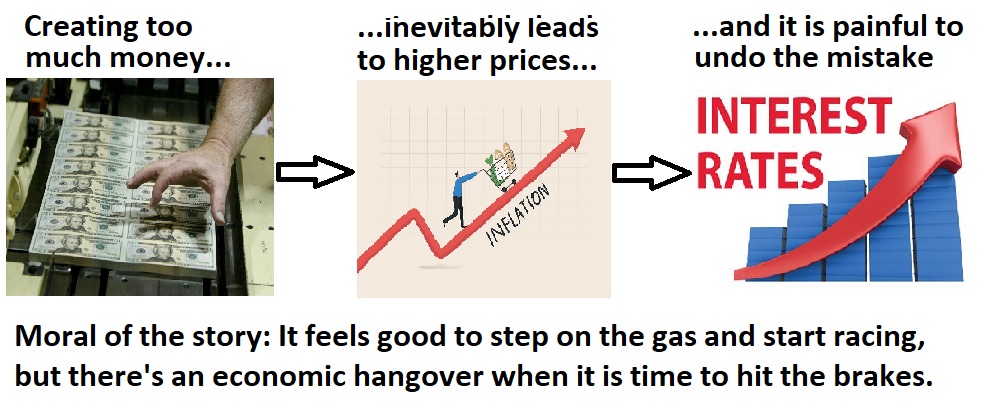
Because the central bank’s easy-money policy created artificially low interest rates, but those policies also produced high inflation, and now interest rates are going up as the Fed tries to undo its mistake.

Inspired by my “magic beans” visual, here’s a new one that shows the Fed’s boom-bust cycle.

By the way, the center box (higher prices) also includes asset bubble since bad monetary policy sometimes leads to financial bubbles instead of (or in addition to) higher consumer prices.

And higher interest rates can occur for two reasons. Most people focus on the Federal Reserve tightening monetary policy as it tries to reverse its original mistake of easy money. But don’t forget that interest rates also rise once lenders feel the pinch of inflation and insist on higher rates to compensate for the falling value of the dollar.

But let’s not digress too much. The focus of today’s column is that the Fed goofed by creating too much money in 2020 and 2021. That’s what set the stage for big price increases in 2022 and now economic instability in 2023.

Joakim Book of Reason shares my perspective. Here are excerpts from his article.


The Federal Reserve is in the unenviable position of achieving its mandate by crashing the economy. …it’s something that happens as an unavoidable outcome of slowing down an economy littered with excess money and inflation. …This hiking cycle, the fastest that the Fed has embarked upon in a generation, was always likely to break something. And break something they did over the weekend…Silicon Valley Bank (SVB), which faced the second-largest bank run in U.S. history. …this pushes the Fed into a very delicate position: risk systemic bank runs, or roll back the hikes and quantitative tightening that caused this mess, printing money for an even hotter inflation.

The Wall Street Journal also has the right perspective, editorializing that the current mess was largely caused by bad monetary policy.


Cracks in the financial system emerge whenever interest rates rise quickly after an easy-credit mania, and the surprise is that it took so long. …This week’s bank failures are another painful lesson in the costs of a credit mania fed by bad monetary policy. The reckoning always arrives when the Fed has to correct its mistakes. …We saw the first signs of panic in last year’s crypto crash and the liquidity squeeze at British pension funds. …nobody, least of all central bank oracles, should be surprised that there are now bodies washing up on shore as the tide goes out.

This tweet also notes that monetary policy is to blame.

Finally, I can’t resist sharing some excerpts from Tyler Cowen’s Bloomberg column. He pointed out last November that the Austrian School has some insights with regards to the current mess.


The Austrian theory…works something like this: Investors expected that very low real interest rates would hold. They committed resources accordingly, and now forthcoming rates are likely to be much higher. That means the economy is stuck with malinvestment and will need to reconfigure in a painful manner. …The basic story here fits with the work of two economists from Austria, Ludwig Mises and Nobel laureate Friedrich von Hayek, and thus it is called the Austrian theory of the business cycle. The Austrian theory stresses how mistaken expectations about interest rates, brought on by changes in the rate of inflation, will lead to bad and abandoned investment projects. The Austrian theory has often been attacked by Keynesians, but in one form or another it continues to resurface in the economic data.

Needless to say, proponents of the Austrian School are not big fans of central banking.

If you want to learn more about Austrian economics, click here and here.


Tuesday, February 21, 2023

Dan Mitchell on Economics

By Rich Kozlovich

I receive a lot of information from a lot of sources and, truth be told, I get overwhelmed far more than I like.  I've been purging my e-mail notices and my draft files, but I'm trying to do it in such a way the information isn't lost by either incorporating the pieces in one of my own commentaries, or listing them as I'm doing below with Dan Mitchell's articles.

For some years I've been publishing articles by Dan Mitchell, and he's absolutely prolific, he's a libertarian, and as a result, as much as I admire his work, I wonder at times what planet libertarians are from, as a result, I find I'm in total disagreement with some of the things he espouses, and don't publish those.  

His articles are complicated to duplicate, and permission to publish his work came with caveats, which I follow.  So, while I've published a lot of his articles, for whatever reason, I've failed to publish these listed below.  Any gaps in chronology are because those are the ones I published.  I've decided to go more the way of links versus full publication from now on.

There's a lot of good stuff here, I especially like the Bernie Sanders piece, which is presented in full, and why I didn't publish that one I will never know.  Bernie is a gift that keeps on giving.  

So, take you time, peruse what's here and ..... enjoy!

More Evidence of State Tax Progress, February 21, 2023 by Dan Mitchell - It usually is not fun writing about public policy, given my libertarian sentiments. After all, politicians have a natural tendency to expand their powers and diminish our liberties. So where there is occasional good news, I like to relish the moment. For instance, I’ve been getting immense enjoyment from the progress on school choice over the past couple of years. Particularly the enactment of state-wide choice programs in West Virginia, Arizona, Iowa, and Utah.  Another area were we’ve seen big progress is state tax rates. I’ve also written about that topic, showing earlier this month how average top personal income tax rates have declined in recent years.  Today, let’s let a couple of maps tell the same story.  Here’s the Tax Foundation’s new map showing top personal tax rates for 2023. At the risk of stating the obvious, it’s best to be grey. But if you’re not grey, it’s good to be a lighter color and bad to be a darker color..........

Lessons from the Texas Budget, February 20, 2023 by Dan Mitchell - I shared some data last month from the National Association of State Budget Officers to show that Texas lawmakers have been more fiscally responsible than California lawmakers over the past couple of years. California politicians were more profligate in 2021 when politicians in Washington were sending lots of money to states because of the pandemic. And California politicians also increased spending faster in 2022 when conditions (sort of) returned to normal.  These results are not a surprise given California’s reputation for profligacy. What may be a surprise, however, is that (relative) frugality in Texas has only existed for a handful of years. Here are some excerpts from a report written for the Texas Public Policy Foundation by Vance Ginn and Daniel Sánchez-Piñol............

The IMF’s Dirigiste Tax Agenda, Part II, February 19, 2023 by Dan Mitchell - Yesterday’s column reviewed a new report from the International Monetary Fund and criticized that bureaucracy for celebrating how the world’s most-powerful governments are going to take more money from the private sector thanks to a corporate tax cartel. But that’s not the worst part of the IMF document. The report also asserts that low-income countries (LICs) can grow faster if they increase their fiscal burdens. This is not April Fool’s Day. I’m not joking. The bureaucrats at the IMF apparently want readers to believe that higher taxes and more spending are a route to prosperity.  Let’s look at some excerpts from the report, which was authored by Ruud de Mooij, Alexander Klemm, and Christophe Waerzeggers...........

Should America Copy Estonia’s Pro-Growth Flat Tax?, February 17, 2023 by Dan Mitchell - he Baltic nation of Estonia is an improbable success. After breaking free from the horror of Soviet communism, leaders adopted pro-market reforms.

Is Estonia a laissez-faire paradise? No. But it ranks #8 in the world for economic liberty. And having decent policy means poverty has plummeted and it has been quickly closing the gap with European nations that did not suffer from decades of communist enslavement................

Michigan Shows the Wrong Way to Cut Taxes, February 14, 2023 by Dan Mitchell - The economics of tax policy is largely the economics of incentives. When governments impose high tax rates on something, you get less of that thing.  My left-leaning friends acknowledge this is true, but only selectively. They openly agitate for higher taxes on things like tobacco (or sugar, or energy) and they correctly argue that higher tax rates will lead to less smoking. As a libertarian, I don’t want to control other people’s lives, so I’m not a big fan of such taxes, but the underlying economic analysis is correct......
 
The Simple (but Definitely not Easy) Way to Avert America’s Fiscal Crisis, February 16, 2023 by Dan Mitchell - Every six months or so, the Congressional Budget Office produces a 10-year forecast and most fiscal experts focus on the projections for deficit and debt. Those are important (and worrisome) numbers, but I first look at the data showing what will happen to taxes and spending. And you can see from this chart that the fiscal burden of the federal government is projected to grow at a very rapid pace over the next decade..............Other fiscal experts fret that deficits and debt are increasing between now and 2033, but the above chart shows that the real problem is that the spending burden is rising faster than the tax burden..............
 
A New Member for the Bureaucrat Hall of Fame, February 13, 2023 by Dan Mitchell - My primary problem with bureaucrats is that they often work for agencies and departments that should not exist. My secondary problem is that they generally get overcompensated compared to workers in the economy’s productive sector. And my tertiary problem with government employees is that they have job protections that encourage bad behavior – everything from sloth to crime. When selecting new members for the Bureaucrat Hall of Fame, I usually pick from that final group. And that’s the purpose of today’s column. We have a bureaucrat from Washington, DC, who deserves to be honored. But he’s not a federal bureaucrat. He’s a cop with the DC metropolitan police. Here are some details of his misdeeds........
 
The Adverse Economic Consequences of Busting Social Security’s Wage Base Cap, February 7, 2023 by Dan Mitchell - Today we are going to look at proposals to expand the burden of Social Security payroll taxes, and let’s start by recycling this 2008 video...........All of the analysis in the video is still accurate, but two of the numbers need to be updated.
  • Social Security’s long-run deficit is now $56 trillion rather than $24.9 trillion as was the case back in 2008.
  • Social Security payroll taxes now apply to income up to $162K rather than $102K as was the case back in 2008.
If you don’t have time to watch a 9-minute video, I can summarize the issue by noting that Social Security was designed as an “earned benefit,” which means workers contribute to the system in exchange for future benefits. The more you earn, the more you pay, and the more benefits you receive.  But because Social Security is supposed to be akin to an insurance program, there’s a limit on both the amount of benefits any retiree can receive and the amount of taxes that any worker must pay (the same principle applies in many other nations).

Some politicians want to get rid of the limit (the “wage base cap”) on the amount of taxes workers must pay. Instead of applying the 12.4 percent Social Security payroll tax on the first $162,000 of income, they want to impose the tax on all income. In some cases, they want this big increase in marginal tax rates in order to prop up the Social Security system while in other cases they actually want to expand the program.  In either case, the economic consequences would be very bad.............

 
Donald Trump Supports Massive Tax Increases on Middle-Class Americans, Part I,  February 5, 2023 by Dan Mitchell - Regular readers know that I generally don’t get overly agitated about government debt (I get far more upset about counterproductive spending, regardless of how it is financed). But even I recognize that there is a point where debt becomes excessive. So let’s start today’s column with the simple observation that America’s current fiscal trajectory is unsustainable. The burden of federal spending is projected to jump over the next several decades up to 30 percent of GDP while taxes “only” increase to about 19 percent of GDP............
 
 The Political Argument for the Fair Tax, February 3, 2023 by Dan Mitchell -  I’m a long-time proponent of tax reform and I mostly focus on the flat tax, but as I wrote last month, a national sales tax also is a good option. Here’s some of what I said on the topic back in 2007..........

Bernie Sanders Humor February 1, 2023 by Dan Mitchell 

I’m going to start today’s column by admitting that I lied. That might be expected since much of my work takes place in the sleazy environment of Washington, DC.

But my lie was innocent. Back in 2020, when he was defeated by Joe Biden for the Democratic presidential nomination, I wrote what I thought would be a “Farewell-and-Good-Riddance Edition of Bernie Sanders Humor.”

I figured there would no longer be a need to mock Crazy Bernie (or is he Evil Bernie?).

But then I saw this tweet, highlighting how gullible idiots are being charged as much as $95 to attend Bernie’s lecture about the supposed evils of capitalism. And it included this amusing meme.

I don’t know if Bernie’s the one reaping the profits from this scam. But since he owns three homes and is part of the top-1 percent, I wouldn’t be surprised (sort of like this cartoon).

And since we’re kicking around Bernie one more time (or is this truly the last time?), here are a few other items.

Mao probably killed more people than anybody else in world history, so he’s definitely evil, whereas we can laugh our you-know-whats-off about Bernie.

(By the way, if we’re measuring evil by the percentage of the population that was butchered, than the communist dictator of Cambodia was worse than Mao.)

For our third item, the Babylon Bee put together an entirely plausible Bernie Sanders anti-poverty plan.

I am once again asking for your support in eradicating systemic poverty from the face of the earth. America can do it, but we won’t because America is immoral and Elon Musk has all the money. Horrible! I have a simple ten-step plan that is foolproof — and I should know because I’ve been to the Soviet Union and it’s a paradise over there, let me tell you!

The article lists 10 reasons, but 2-6 were the best in my opinion.

2. Tax rich people until they’re poor: If everyone is poor then no one will be.
3. Give everyone money until they become middle class: We cannot rest until Tom Hanks and John Doe are shopping at the same grocery store. Then maybe I can get an autograph.
4. Drop Elon Musk off the Empire State Building: This is how we win, America!
5. Print more money: Unexpected expenses can be paid for with a giant savings account everyone can access. The beauty of it is that if it’s overdrawn we can just print more money! Why haven’t we done this yet.
6. Offload our health care to Cuba: Sailing to Cuba for treatment will also build muscle, making you healthier overall! Is there anything Cuba can’t do?

This next one is basically a different version of a meme I shared in 2019.

As usual, I save the best for last. Here we have Bernie showing the socialist philosophy at a pot-luck dinner.

All take and no give. Sort of the mealtime version of this classic cartoon.

I’ll close by noting we mock Crazy Bernie for his overt hurry-up socialism. Well, the incremental version isn’t much better since you eventually wind up in the same bad place.

Protecting Individual Savings from Double Taxation, January 27, 2023 by Dan Mitchell - While speaking last year in Hawaii on the topic of good tax policy, I explained why it is misguided to impose extra layers of tax on saving and investment. Regarding the problem of double taxation, I’ve addressed how various features of the tax code need to be fixed. Today, we’re going to focus on the fixing the tax treatment of household savings. And the problem that needs fixing is that the federal government taxes you when you earn money and also taxes any interest you earn if you decide to save some of your after-tax income.............

Does America Have an Under-Taxation Problem?, January 26, 2023 by Dan Mitchell - When leftists (or misguided rightists) tell me that Americans are under-taxed and that the government has lots of red ink because of insufficient revenue, I sometimes will direct them to the Office of Management and Budget’s Historical Tables in hopes of changing their minds. I’ll specifically ask them to look at the data in Table 1-3 so they can see what’s happened to federal tax revenue over time. As you can see from this chart, nominal tax revenues have skyrocketed.........

Macron’s Pension Reform Is Necessary (but Inadequate), January 19, 2023 by Dan Mitchell -It is an understatement to declare that fiscal policy in France is terrible.

In recent years, France has had terrible presidents such as Nicolas Sarkozy and Francois Hollande..........

Statism, Captured in Five Images, January 14, 2023 by Dan Mitchell -  After five columns mocking statism in 2021 (here, here, here, here, and here), I only produced one in 2022. So let’s get an early start for 2023. This cartoon is a helpful reminder that government has done many wonderful things throughout history.

 https://freedomandprosperity.org/wp-content/uploads/2022/09/Screenshot-2022-09-23-at-6.59.25-PM.jpg

The Solution to Maine’s Fiscal Problems – and a Lesson for the Entire Nation, January 12, 2023 by Dan Mitchell - When I write about fiscal policy, there are two ever-present themes.

And both of these themes can be found in a comprehensive new report issued by the Maine Policy Institute..........

Control the Burden of Government Spending, January 4, 2023 by Dan Mitchell -  As part of my annual “Hopes and Fears” column, a rejuvenated interest in spending restraint was at the top of my list. This clip from a recent interview summarizes the economic issues...........

  1. Tax-financed spending is bad for prosperity.
  2. Debt-financed spending is bad for prosperity.
  3. Monetary-financed spending is bad for prosperity.

And if you understand those three things, then you realize that the real problem is spending...........

Understanding Biden and Red Ink, December 29, 2022 by Dan Mitchell - I don’t worry much about budget deficits. Simply stated, it is far more important to focus on the overall burden of government spending. To be sure, it is not a good idea to have too much debt-financed spending. But it’s also not a good idea to have too much tax-financed spending.  Or too much spending financed by printing money.Other people, however, do fixate on budget deficits.  And I get drawn into those debates. For instance, I wrote back in July that Biden was spouting nonsense when he claimed credit for a lower 2022 deficit. But some people may have been skeptical since I cited numbers from Brian Riedl and he works at the right-of-Center Manhattan Institute............

America’s Most Depressing Chart, December 28, 2022 by Dan Mitchell - I periodically use a “most depressing” theme when writing about charts or tweets with grim data. I’ve done that with regional data and also looked at depressing data from specific countries. Today, we’re going to look at some “most depressing” information about the United States. Here’s a tweet from Yale Professor Alice Evans about labor force participation for working-age men in developed nations..............

China, Poland, and Divergence, December 27, 2022 by Dan Mitchell - I created the Anti-Convergence Club so I could have concrete examples of how more economic liberty translates into higher living standards. In effect, it’s the data-driven version of my Never-Answered Question. Yesterday, I provided another example of anti-convergence by comparing Australia, Switzerland, and the United Kingdom. Today, let’s look at Poland and China. This tweet from Professor Noah Smith shows that Poland was richer than China 30 years ago and – contrary to convergence theory – has become even richer over time.................

Convergence and Divergence for the United Kingdom, December 26, 2022 by Dan Mitchell - I’m a big believer in looking at long-run trends, particularly whether countries are experiencing convergence of divergence with regards to per-capita economic output. Poor nations normally should grow faster than rich nations, so we can learn a lot when we see exceptions to this rule based on several decades of data.

I think the answer to these questions is obvious, for what it’s worth. Today, let’s consider another example. Mike Bird of the U.K.-based Economist tweeted about how the United Kingdom is diverging from Australia...............

The Tradeoff Between Government Dependency and Self-Sufficiency,  December 21, 2022 by Dan Mitchell 

When writing about employment and jobs, I often try to remind people about a handful of important observations.

  1. A nation’s economic output is determined in part by the number of people gainfully employed.
  2. The share of working-age people with jobs may be more important than the unemployment rate.
  3. Worker compensation is determined by productivity and productivity is driven by investment.
  4. Government redistribution programs can make joblessness more attractive than employment.........To Read More....