Search This Blog

De Omnibus Dubitandum - Lux Veritas

Showing posts with label Ponzi Scheme. Show all posts

Monday, June 23, 2025

Muffing a Gimme on Social Security

June 20, 2025 by Dan Mitchell @ International Liberty 

I was not a fan of George W. Bush’s economic policy. But he had one idea – personal retirement accounts – that would have been great news for the country. The Committee to Unleash Prosperity has calculated the nest eggs that average workers would have today if either Bush’s plan or the Ryan-Sununu plan had been enacted.

Sadly, since we just learned that the inflation-adjusted cash-flow deficit for Social Security is $65.8 trillion, we have a very grim comparison.

The above chart, however, is only part of the story. In addition to letting workers shift payroll taxes to personal accounts, there were also discussions during the Bush years about reforming the program to restrain spending so there was no longer a giant unfunded liability.

Andrew Biggs of the American Enterprise Institute (and former Deputy Commissioner of the Social Security Administration) authored a new report looking at what would have happened if workers had been allowed to have personal retirement accounts while the program was changed to slow the growth of benefits for people with above-average income.

Here are some excerpts that summarize his study.


Twenty years ago, in winter and spring 2005, President George W. Bush embarked on a nationwide tour to promote his plans for Social Security reform, which included slowing the growth of benefits for middle- and high-earning individuals and establishing voluntary personal accounts in which workers could invest part of their payroll taxes. Bush’s changes to traditional Social Security benefits, termed “progressive price indexing,” would have addressed about two-thirds of the program’s long-term funding gap. … 

I model total Social Security benefits for individuals retiring in 2025, incorporating Bush’s progressive benefit changes and personal account balances based on investment market returns. Workers with very low, low, and middle earnings would have received total Social Security benefits 3–8 percent above those scheduled in current law, while high-earning employees and those earning the maximum taxable wage and above would have received benefits 2–4 percent below scheduled levels.

And here’s the key table from the report. As you can see, lower-income and middle-class workers retiring today would be enjoying more retirement income.

And ordinary workers retiring in the future would benefit even more, with 11 percent-26 percent more retirement income.

For what it’s worth, I think the assumptions in the report (only 31 percent of personal accounts would be invested in stocks at age 65) were too cautious, so I think it’s quite possible everyone would wind up better off with the Bush approach.

But even if we stick with Biggs’ assumptions, it should be clear that the country would be much better off today if Bush’s approach had been adopted two decades ago.

What a huge missed opportunity. We had the economic version of a lay-up, and Congress didn’t even take a shot.

P.S. We also had a chance to reform Social Security during the 1990s. Unfortunately, the fight over impeaching Bill Clinton derailed that effort, leading me to write that his “sexual dalliance” with Monica Lewinsky “was the most expensive you-know-what in world history.”

P.P.S. Mike Tanner produced a report back in 2012 showing that workers would have been better off with personal retirement accounts even if they retired right after the 2008 financial crisis. The bottom line is that investing in financial markets is far safer than trusting empty promises from callow politicians.

P.P.P.S. For those who think personal retirement accounts are risky and untested, please see what I’ve written about Australia, Chile, Switzerland, Hong Kong, Netherlands, the Faroe Islands, Denmark, Israel, and Sweden.

Monday, March 3, 2025

Yes, Social Security Is a Ponzi Scheme

March 2, 2025 by Dan Mitchell @ International Liberty

When I write about Social Security, my main goal is to point out how Americans would be much richer if the United States had personal retirement accounts based on real savings (like workers in Australia, Chile, Switzerland, Hong Kong, Netherlands, the Faroe Islands, Denmark, Israel, and Sweden).

But I also point out that America’s current pay-as-you-go government system is a big fiscal burden with record levels of unfunded liabilities.

We are going to take a different approach today. Let’s start with this screenshot from Wikipedia on the definition of a Ponzi Scheme.  

"A Ponzi scheme is a form of fraud the lures investors and pays profits to earlier investors with funds from more recent investors".

Why are we looking at this definition? Because Elon Musk had the audacity to point out that Social Security is a Ponzi Scheme. And this has caused controversy, as illustrated by these excerpts from an article on the MSN site.

Musk created a furor by labelling social security in the United States ‘the biggest Ponzi scam of all time.’ He justified his remarks saying that over time, the obligations of social security will be “much worse,” as people are now “living longer than expected.” …

Musk said. “People pay into Social Security, and the money goes out of Social Security immediately, but the obligation for Social Security is your entire retirement career. So if you look at the future obligations of Social Security, it far exceeds the tax revenue. …

Basically, people are living way longer than expected, and there are fewer babies being born, so you have more people who are retired and that live for a long time and get retirement payments. So the future obligations, so however bad the financial situation is right now for the federal government, it will be much worse in the future.”

It is true that Musk’s remarks caused a “furor.” But it’s also the case that what he said is true.

Some defenders of the program claim that there is no problem. They admit that current tax payments get used to pay current benefits, but they assert that Social Security has a trust fund to pay benefits to future retirees.

There are two problems with this argument.

The first problem, as noted by the Congressional Budget Office, is that the so-called trust fund is depleted within 10 years.

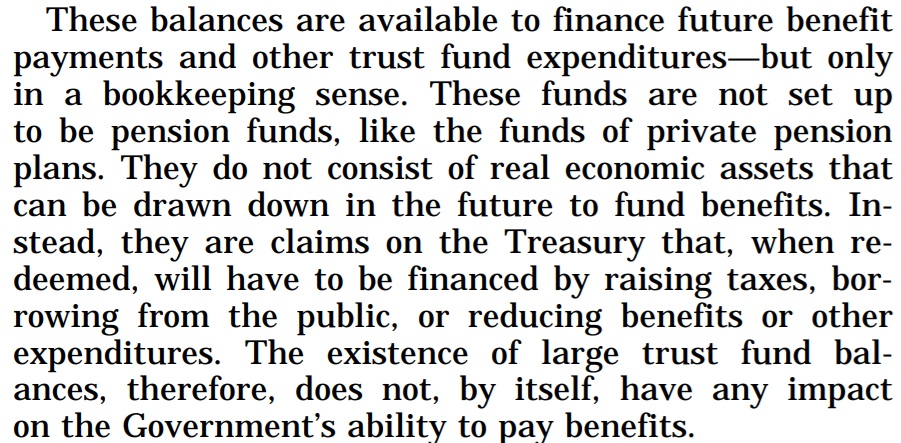
The second problem is that the Trust Fund is an accounting fiction. It’s nothing but money the government owes to itself.

You may find that hard to believe, but when Bill Clinton released his new budget in 1999, the Analytical Perspectives (on page 337, if you want to check) contained this important admission about the supposed Trust Fund.

To ensure that nobody wonders whether I’m quoting out of context, here’s a screenshot of the relevant paragraph.

In other words, Elon Musk was right. Social Security is a Ponzi Scheme.  But there is one important difference between a Bernie Madoff-style scheme and Social Security. Madoff had no ability to coerce people into his fraudulent fund.


By contrast, politicians can impose massive tax increases in hopes of propping up Social Security. Heck, they could pass a law adding lots of zeroes to the existing IOUs in the Trust Fund.  But neither of those supposed solutions addresses the real problem, which is that Social Security is a bad deal for the American economy and a bad deal for American workers.

P.S. One final note for my left-leaning friends. If you actually care about blacks and other minorities, you should support personal retirement accounts.

Sunday, March 24, 2024

Washington’s Fiscal Ponzi Scheme

March 20, 2024 by Dan Mitchell @ International Liberty

My book on fiscal policy, co-authored with Les Rubin, is now officially published.

I wrote a sneak-peak column about The Greatest Ponzi Scheme on Earth last week.

There are three main takeaways from our book.

Okay, I’ll admit those bullet points are an oversimplification.

But there’s a reason for that.

Our book does show how we got into our current fiscal mess (because of too much spending).

And it shows why things will get worse in the future if we leave government on autopilot (because of too much spending).

Moreover, we have lots of evidence for the right way to avert a fiscal disaster. Richard Rahn wrote about our book in his Washington Times column.


In a new book, “The Greatest Ponzi Scheme: How the U.S. Can Avoid Economic Collapse,” Leslie A. Rubin and Daniel J. Mitchell provide a well-written and informative history of how much of the world and particularly the United States managed to get into the current fiscal mess. …

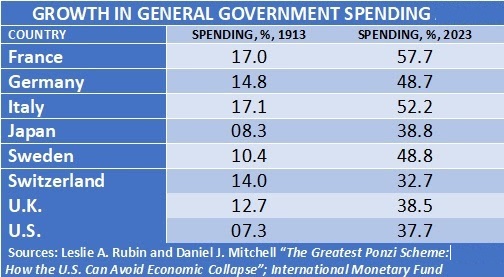
British Prime Minister Margaret Thatcher said it best: “The problem with socialism is that you eventually run out of other people’s money.” Before World War I, government spending in almost every country was a small share of gross domestic product. …

In the United States, things began to change in the 1930s with the development of welfare programs… Mr. Rubin and Mr. Mitchell review many of the so-called entitlement programs that are the real budget busters. The payments from these programs consistently grow faster than the economy or tax revenue and now consume the bulk of the federal budget. Anyone who can do basic math can quickly understand the problem. When a country reaches the point where it is borrowing just to pay interest on the debt, game over.

That’s the bad news in the book. And Richard captures some of that bad news with this table showing how the burden of government spending has significantly increased over the past 100-plus years.

But our book also has good news, as Richard explains.

Fortunately, there are a number of success stories that serve as role models of what to do. …Switzerland is perhaps the best model for fiscal responsibility in a highly developed country, in that for the most part the Swiss keep government spending growing no more rapidly than the private sector.

As you might expect, I like his conclusion.

Mr. Rubin and Mr. Mitchell have done a great service in providing a highly understandable book, outlining the disaster about to engulf us if we do not change quickly, but equally important, a road map for getting out. Every policymaker and concerned citizen ought to buy this book and refer to it often — an economic bible of sin and salvation.

I want you to buy the book, but if you are a regular reader of this column, you already know the only practical way of averting a fiscal crisis in the United States. Simply follow the Golden Rule. And, because of its spending cap, Switzerland is a good role model.

Wednesday, October 13, 2021

A Current Burden of Deficit Financing

Donald J. Boudreaux Donald J. Boudreaux  – October 11, 2021 @ American Institute for Economic Research

My late Nobel-laureate colleague James Buchanan made many important contributions. Among the most significant is his proof, first offered in 1958, that Adam Smith and other classical economists were correct to argue that government projects that are funded with debt are ultimately paid for by the future citizens whose taxes must be raised (or whose government benefits must be reduced) to get the funds necessary for repayment. (Randy Holcombe and I explain further here.) With deficit financing, today’s citizens-taxpayers impose costs on tomorrow’s citizens-taxpayers.

It’s possible, of course, that today’s citizens-taxpayers can use deficit financing also to bestow benefits on tomorrow’s citizens-taxpayers. If, for example, government borrows money today to build a hydroelectric dam that will operate successfully for decades, tomorrow’s citizens-taxpayers get not only the liability of having to pay for this dam but also an asset in the form of the dam’s capacity to generate electricity. But even if citizens-taxpayers tomorrow unanimously agree that the value to them of the dam is higher than is the amount of taxes they must pay for the dam, the inescapable reality is that these future citizens-taxpayers are the individuals who pay for the dam. The dam is not free, and no means of fancy financing or accounting shenanigans can make it so.

Yet those of us who today explain that deficit-financed government projects are paid for by tomorrow’s citizens-taxpayers too often lose sight of a real burden that deficit financing does often impose on today’s citizens-taxpayers. This burden is excessive growth of government that harms the current generation.

When Buchanan explained the dangers of deficit financing, he almost always assumed that all members of the current generation are united in their interests to live at the expense of future generations, and that the current generation pursues those interests knowledgeably. For example, the current generation of citizens-taxpayers might unanimously welcome a $50 billion increase in defense spending if it is paid for with borrowed funds – that is, paid for by future generations – but not if this spending must be financed out of current tax receipts. Because deficit financing is possible, however, the government uses this method of financing to expand the defense budget by $50 billion. Today’s citizens-taxpayers purchase, and enjoy, an excessive amount of national defense only because they get to pass the bill onto their children and grandchildren. In this example, deficit financing imposes no burdens on anyone in the current generation.

But examples such as this one mask an important feature of reality. Because today’s citizens-taxpayers are quite diverse in their interests, preferences, understandings, and economic positions, government projects undertaken today and funded with debt can impose real burdens on at least some of today’s citizens-taxpayers. This conclusion holds even though it remains true that the full burden of paying for such projects falls only on tomorrow’s citizens-taxpayers.

Suppose, for example, that a majority of today’s citizens-taxpayers in America conclude that it’s a good idea to nationalize the steel industry. Further suppose that a Supreme Court ruling prohibits government from simply seizing steel mills; the Court rules that if government wants to acquire steel mills it must pay market prices for these firms. Finally suppose that upon learning that the market price is $500 billion, Americans today are unwilling to have their taxes raised by this amount for this purpose. If deficit financing were unavailable, the steel industry would remain in private hands.

Deficit financing, however, is available. By borrowing the $500 billion to purchase steel firms, government enables that subset of Americans who support nationalization of the steel industry to achieve their policy goal without having to pay for it. The entire $500 billion will be repaid in the future by citizens-taxpayers not yet born.

But there is nevertheless a burden that emerges in the current period from this deficit-financed policy move – namely, the inefficiencies that immediately arise from the nationalization. The amount of resources consumed to produce each ton of steel rises inefficiently because government bureaucrats have fewer incentives than do private owners to ensure that mills operate efficiently. The costs of this excessive consumption of resources by government-owned steel mills ripple throughout the economy in the form of diminished outputs and higher prices of countless other goods and services.

In this example, nearly all Americans – and even some non-Americans – today suffer an immediate (and ongoing) burden as a consequence of this deficit-financed policy. Some Americans who are so ideologically enamored with the notion of industry nationalization might be content to bear this burden, while many other Americans might remain unaware that the higher prices they experience throughout the economy are a direct result of the nationalization. But the fact remains that, in this example, deficit financing imposes a real burden on the current generation despite the fact that full responsibility for repaying the loan falls only on future generations.

This example of a nationalized steel industry is, of course, hypothetical. But its lessons apply in the real world. For instance, to the extent that government subsidies of farmers and of aircraft producers are funded with borrowed money, similar burdens are created immediately: Resources are diverted from efficient to inefficient uses, causing even today’s citizens-taxpayers to suffer as a result of deficit-financed government programs.

Deficit financing – by enabling people today to free-ride on people tomorrow – allows government to expand its size and reach beyond that which would be obtained if government were required to fund all of its current expenses out of current revenues, with no opportunity for deficit financing. In short, deficit financing paves a path for the unwarranted and wasteful expansion of government activity. Only someone who is convinced that government will undertake only economically worthwhile projects regardless of the means of financing – or someone who doesn’t understand economics – can look favorably upon deficit financing by government.

Donald J. Boudreaux

Donald J. Boudreaux

Donald J. Boudreaux is a senior fellow with American Institute for Economic Research and with the F.A. Hayek Program for Advanced Study in Philosophy, Politics, and Economics at the Mercatus Center at George Mason University; a Mercatus Center Board Member; and a professor of economics and former economics-department chair at George Mason University. He is the author of the books The Essential Hayek, Globalization, Hypocrites and Half-Wits, and his articles appear in such publications as the Wall Street Journal, New York Times, US News & World Report as well as numerous scholarly journals. He writes a blog called Cafe Hayek and a regular column on economics for the Pittsburgh Tribune-Review. Boudreaux earned a PhD in economics from Auburn University and a law degree from the University of Virginia.

Get notified of new articles from Donald J. Boudreaux and AIER.