Search This Blog

De Omnibus Dubitandum - Lux Veritas

Showing posts with label FED. Show all posts

Tuesday, September 2, 2025

The Federal Reserve is a Symptom of a Much Bigger Problem

By Robin Itzler

Editor's Note:    This is a grouping from the commentaries in Robin's weekly newsletter Patriot Neighbors.  Any cartoons will have been added by me.   If you wish to get the full edition, E-mail her at PatriotNeighbors@yahoo.com to get on her list, it's free. RK 

1913 was a seminal year for America with passage of laws that became slow walking disaster for the nation.  In that year the 16th Amendment was passed giving the federal government the right to steal as much as they could from Americans.  It's called income tax.  The 17th Amendment was passed destroying the balance of power between the federal government and the states, pretty much making the 10th Amendment, states rights, fundamentally meaningless.  Originally Senators were chosen by their states to in effect be de facto ambassadors representing their state at the federal level in order to keep the federal government from getting out of control.  And we can see how ending that has worked out. 

In that same year Congress passed, and Democrat President Woodrow Wilson, America's first fascist President, signed the Federal Reserve Act to make sure the United States maintained a sound banking system and a healthy economy. Until then, any time there was a panic (real or imagined), people rushed to their bank to withdraw all their money. That, of course, had a domino effect.

There are 12 regional banks across the United States that make up “the Fed.” Since 1977, the Federal Reserve has been charged with making decisions that promote maximum employment and stable prices. As you know from the news, the Federal Reserve’s independence in setting interest rates frequently comes under attack. President Trump calls its current chairman Jerome “Too Late” Powell because he and many economic observers believe that interest rates should have been lowered months ago.

There were many who didn’t believe a Federal Reserve was needed. For instance, in 1932, Pennsylvania Congressman Louis T. McFadden, Chair of the House Banking Committee, said:

“We have, in this country, one of the most corrupt institutions the world has ever known. I refer to the Federal Reserve Board. This evil institution has impoverished the people of the United States and has practically bankrupted our government. It has done this through the corrupt practices of the moneyed vultures who control it.”

The disaster of 1913 didn't occur overnight. Just like socialism, it was a slow walk through the institutional structure of America, and now we're facing an out of control Deep State which has passed regulations that make the federal government the absolute moral authority upending parental rights and controlling every aspect of our lives, spending billions of dollars the nation doesn't have on insane and wasteful programs, a national debt that's around 37 trillion dollars, and a federal judiciary filled with radical political hacks destroying the rule of law. 

The FED is a symptom of a government that's out of control and is in serious need of adjustment. 

Friday, July 26, 2024

Federal Reserve Printing Press Running Wild Again

Eccles Building accelerates the money supply ahead of rate cuts.

by | Jul 25, 2024 @ Liberty Nation News, Tags: Articles, Business News, Opinion

Wednesday, January 24, 2024

Fed Forcing Banks to Take Emergency Loans – Swamponomics

Plus the Q4 GDP and Canada's coming basic income. 

By | Jan 24, 2024 @ Liberty Nation News Tags: Articles, Business News, Opinion

Can you believe it has been nearly a year since financial institutions received emergency loans to prevent a banking collapse? How time flies when the Federal Reserve gives bailouts like candy on Halloween. With the first anniversary of Silicon Valley Bank and Signature Bank’s failure on the horizon, more details are being learned about the Eccles Building’s eternal bailouts, including the latest goodie: forcing the industry to accept money from the central bank.

The Fed and Emergency Loans

What should have been headline news everywhere, Bloomberg reported on a government proposal to mandate that banks borrow from the Fed’s discount window at least once a year, whether they need to or not. The idea aims to mitigate any stigma and ensure that these companies are prepared for economic and market turbulence.

In partnership with the Federal Deposit Insurance Corporation (FDIC) and the Office of the Comptroller of the Currency, the Fed is drafting a proposal to force lenders to take out emergency loans, even if they have sufficient resources to deal with a situation whereby depositors demand their cash en masse. Michael Hsu, the acting comptroller of the currency, told Bloomberg:

“We want to make sure that banks have enough resources to meet any kind of outflows within five days — especially those related to uninsured deposits. It’s almost like doing a fire drill. If it’s required, when a real liquidity fire comes, then the banks can do it in real life. Operationally, banks would have to go borrow $1, $100 million, whatever it might be, just to ensure that the procedures, the systems, the people, everything is there and in place to access the discount window.”

The discount window is a central bank lending facility that allows banks to access funding if they face liquidity risks. So, even if a JPMorgan Chase or Bank of America does not have any challenges, it will be forced to borrow to make sure nobody’s feelings are hurt. Unless the Fed reduces costs, however, banks will end up losing money in the scheme, as today’s Fed interest rate is more than 5%, higher than the market rate. That’s because the discount window was supposed to be a last resort option – though now it will likely become the first port of call.

The banking sector is no longer a free-market system. But if the Fed and the rest of the US government are already prepared to bail out institutions, was the industry ever? If the marketplace is supposed to send signals to everyone about a prospering or failing firm, this policy proposal might be another glove to cover the invisible hand. Now that everyone is treated equally, from the strong to the weak, nobody will ever know anything.

The Coming Q4 Data

The fourth-quarter GDP data are coming! The fourth-quarter GDP data are coming! The Bureau of Economic Analysis (BEA) will publish the October-December gross domestic product numbers on Jan. 25. Economists anticipate that the report will show a growth rate of at least 2%, and the Atlanta Fed Bank’s GDPNow model estimate points to a 2.4% reading.

Once again, the economy will have averted a recession, thanks to debt-laden consumers and politicians ready to exploit taxpayer dollars. Remember, in the third quarter, government spending fueled about one-third of the expansion. The public can expect comparable numbers from the BEA.

As always, the business media, political pundits, and public officials will concentrate on the headline figures while ignoring the stuff underneath the hood. Still, the White House will laugh at all the naysayers who anticipated a downturn in an environment of high inflation, soaring borrowing costs, and a marketplace drowning in red ink. Who can blame anyone for dismissing the economic observers calling for a recession beginning in the first quarter?

Don’t worry, though. Perhaps if consumption slows down, the federal government, like the central bank, can force consumers to take out emergency loans to stimulate the economy.

Trudeau’s Basic Income Scheme

Cynics have warned that Canadian Prime Minister Justin Trudeau will unveil a basic income scheme ahead of next year’s election. Since Trudeaumania 2.0 is fading into the sunset and losing support, political pessimists believe the incumbent will attempt to resurrect his brand by handing out free money to all of Canada.

Legislatively, it is already in the making. The country’s Senate is examining Ontario Sen. Kim Pate’s Bill S-233, which aims to establish a national framework to offer everyone over 17 access to a “guaranteed livable basic income.” This would include permanent residents, refugee claimants, and temporary workers. Contrary to social media, the legislation does not install a basic income program but would require Finance Minister Chrystia Freeland to partner with the provinces and territories to outline a path to implementing the public policy.

So far, nobody has taken a clear position, with Liberals, Conservatives, and New Democrats providing a wide range of opinions. But for the Tories, it was concerning that Conservative Deputy Leader Melissa Lantsman said last year that a universal basic income is coming and is a conservative concept. Yikes. But it is not all land of burnt Double-Doubles and subzero temperatures as Kevin Milligan, an economics professor at the University of British Columbia, told the National Post: “No government could afford it. Any government who was wise would see that this is not a good way to work on the important issues of poverty.”

Indeed, the national debt in the Great White North is around $1.5 trillion, Ottawa is running an annual budget deficit of approximately $40 billion, and the federal and provincial governments will spend about $69 billion a year on interest payments. Not to mention, the country is experiencing a cost-of-living crisis – from out-of-control housing prices to rocketing food inflation.

 
Read More From Andrew Moran

Tuesday, July 18, 2023

What Were Once Vices Are Now Habits

July 18, 2023 By Richard C. Lyons

I caught a song on the radio yesterday, from one of my favorite vinyl efforts by the Doobie Brothers, What Were Once Vices Are Now Habits. A great album, fitting for a generation that took to the vices of drinking and smoking cigarettes among other things… The same generation found such habits are hazardous for one’s health, and are a lot harder to get rid of than they were to attain. Governments are like the people who compose them, they are subject to bad vice and habits

Our federal government has had a certain vice for over a century now, since Theodore Roosevelt broke Standard Oil and Woodrow Wilson created the Federal Reserve, our government has invaded our once “free enterprise” system with consistently disastrous results. For instance...... our federal government invaded the health care sector through the Social Security Act, creating Medicare and Medicaid; and has since been on the march to nationalize the whole industry. At every step of the takeover, government interference has meant skyrocketing healthcare costs. At every step, this takeover has meant much higher taxes for taxpayers.  Both higher prices and higher taxes are direct consequences of the growing government bureaucratic “control” of America’s healthcare sector.

As a matter of habit, the Administrative State formed Fanny and Freddie Mac, the mortgage giants which now underwrite 90% of all home mortgages in America. This government interference in our once free enterprise system first led to skyrocketing home prices, then it led to the housing and stock market crash of 2008.  Today, the government “commands and controls” 100% of the home mortgage market............To Read More...

Tuesday, June 13, 2023

The Most Economically Illiterate Tweet of 2023?

June 10, 2023 by Dan Mitchell @ International Liberty

I periodically write columns about “most ___ tweets.” Here are some recent examples.

Today, we will turn our attention to what may be the most economically illiterate tweet of 2023.

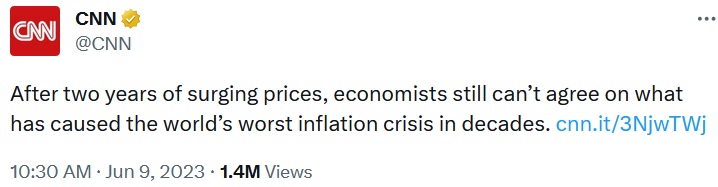
Check out this gem from CNN.

Needless to say, CNN‘s tweet is grotesquely wrong, or at least misleading. We know what caused inflation.

It was reckless and irresponsible monetary policy by the Federal Reserve in Washington.

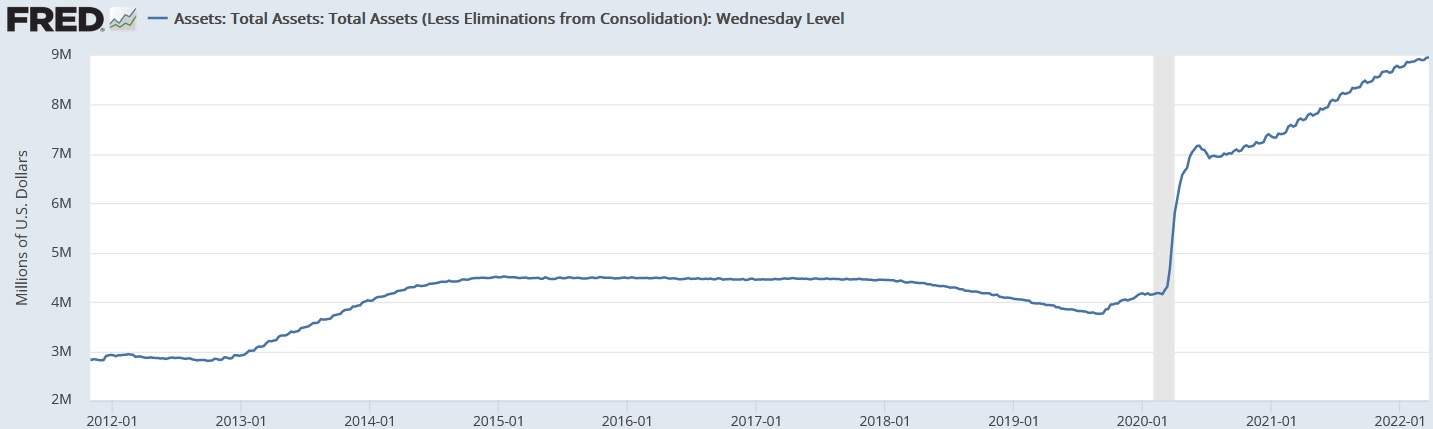
How reckless and irresponsible? Check out this chart showing the Fed’s balance sheet, which is a good way of showing changes in monetary policy. As you can see, the Fed dramatically shifted to an easy-money policy when the pandemic began.

At the risk of stating the obvious, we got inflation because the Fed flooded the economy with money.

By the way, I have never criticized the Fed for panicking when the pandemic began. Many people feared the economy would totally freeze up.

The Fed does deserve criticism, however, for continuing with an easy-money policy in the last half of 2020 and all through 2021. It was obvious at that point that the world was not going to collapse.

Here are five additional comments:

  1. Since the big mistakes were made starting in 2020, before Biden was elected or inaugurated, he doesn’t deserve blame (except to the extent that – like Trump – he supported the Fed’s bad policy).
  2. I am becoming more sympathetic to the argument that the Fed’s bad policy is motivated by “fiscal dominance.”
  3. Fortunately, I don’t think anyone at the Fed is crazy enough to believe in “modern monetary theory.”
  4. It is silly to blame inflation on “corporate greed” or “corporate profits” unless you bizarrely think that companies became greedy profit-maximizers in 2022 and didn’t care about money in the preceding years.
  5. It would be nice if officials from the Federal Reserve (and other central banks) acknowledged their mistakes. At the very least, don’t try to blame others.

I’ll close by pointing out that the title of this column ends with a question mark. That’s because the underlying CNN story isn’t really about the causes of inflation. Instead, the story references a study showing how businesses operate in a high-inflation environment.

So perhaps CNN is only guilty of a sloppily worded tweet (sort of like NBC being guilty of sloppiness when doing a poll on causes of inflation and not including the Federal Reserve as one of the potential answers).

P.S. If you have the time and interest, here’s a 40-minute video explaining the Federal Reserve’s track record of bad monetary policy.

P.P.S. If you’re constrained for time, I recommend this five-minute video on alternatives to the Federal Reserve and this six-minute video on how people can protect themselves from bad monetary policy.

Monday, May 22, 2023

How Congress Should Reform the Fed

Alexander W. SalterAlexander William Salter  – May 18, 2023 @ American Institute for Economic Research

It’s very difficult for elected officials to hold the Federal Reserve accountable. Is that a problem

There’s a strong counter-majoritarian tradition in American politics. The Constitution itself strictly limits what simple majorities, acting through their representatives, can accomplish. Contemporary central banking’s “democratic deficit” could be a feature, not a bug.

While we should always be wary of populist passions, the Fed’s insularity from the political process plausibly creates more problems than it solves. No less an economist than Milton Friedman thought that the Fed should be brought under the supervision of the Treasury or Congress. Friedman worried the central bank’s “independence” made it a law unto itself, sheltered from the consequences of its habitual mistakes. As the economy struggles with historic inflation and a wave of bank failures — both of which the Fed should have prevented — it’s worth considering alternatives.

Constitutionally, the Fed is a creature of Congress. The legislature created the Fed in 1913 not as a substitute for the gold standard and the National Banking System, but as a complement. The Fed was supposed to serve as a quasi-public clearinghouse to facilitate emergency liquidity transfers between banks to make the US system less panic-prone. But the onset of World War I spelled the end of this relatively limited mandate. The Fed began experimenting with monetary policy powers to support the market for government debt. Thus began a process of mission creep that resulted in the Fed becoming what its earliest proponents promised the public it never would: a central bank.

It’s time for the legislature to re-assert its control. The Fed’s recent dalliances with social and environmental policy have nothing to do with its legal grant of authority. Climate change and systemic inequality are valid policy areas for the United States Congress, but unless and until it says otherwise, not for the Fed. Hence Congress’s first order of business is passing legislation keeping the Fed within its legally prescribed lanes.

Second, Congress should separately crack down on the Fed’s experimentations with a central bank digital currency (CBDC). This is a dangerous technology that would give the government unprecedented access to and control over private financial transactions. CBDC would not meaningfully improve the operation of monetary policy or the pursuit of financial stability. All it would do is grant central bankers the power to redirect the flow of commerce by, for example, selectively processing payments, or debiting accounts to stimulate spending. Congress should pull the plug on the Fed’s pilot program and make it totally clear that CBDC is not permitted, absent enabling legislation.

It’s also time for the legislature to reconsider the dual mandate. There’s no need for the Fed to focus on full employment separately from price stability. In a fiat money economy, aggregate demand (nominal spending) stability is all a central bank can reasonably influence. And price stability is a consequence of aggregate demand stability. (Yes, the possibility of supply shocks complicates this. But such shocks are by nature temporary, and historically are much rarer than aggregate demand instability as a source of economic malaise.) Congress should accordingly narrow the Fed’s mandate to keeping the dollar’s purchasing power steady and predictable.

Finally, Congress needs to fix the Fed’s bank oversight and last-resort lending policies. The Fed is supposed to regulate banks and discount loans when the need arises. It’s very bad at both. Fed regulation has not made the banking system safer. If anything, it’s contributed to “too big to fail,” which results in recurrent crises. 

As for discounting, the Fed refuses to make any serious distinction between the illiquidity and insolvency of its counterparties. Making emergency funds available to the latter rewards the reckless bank behavior that gets us into trouble in the first place. Congress should narrow the Fed’s regulatory concerns to maintaining adequate bank capital. It should also consider abolishing the discount window entirely. Direct loans are unnecessary. Open-market operations can keep the financial system liquid.

Whether we like it or not, the Fed is one of the most important — if not the most important — economic institution in the country. It must be made to serve the public interest. The Fed should adhere to the rule of law. Right now, it only adheres to the rule of central bankers. A congressional course correction is long past due.

Alexander William Salter

Alexander W. Salter

Alexander William Salter is the Georgie G. Snyder Associate Professor of Economics in the Rawls College of Business and the Comparative Economics Research Fellow with the Free Market Institute, both at Texas Tech University. He is a co-author of Money and the Rule of Law: Generality and Predictability in Monetary Institutions, published by Cambridge University Press. In addition to his numerous scholarly articles, he has published nearly 300 opinion pieces in leading national outlets such as the Wall Street JournalNational ReviewFox News Opinion, and The Hill.

Salter earned his M.A. and Ph.D. in Economics at George Mason University and his B.A. in Economics at Occidental College. He was an AIER Summer Fellowship Program participant in 2011.

Get notified of new articles from Alexander William Salter and AIER.

Monday, May 1, 2023

The Federal Reserve and “Fiscal Dominance”

April 26, 2023 by Dan Mitchell @ International Liberty

Appearing on Vance Ginn’s Let People Prosper, I discussed spending caps, entitlement reform, past fiscal victories, and potential future defeats.

For today, I want to highlight what I said about monetary policy.

The above segment is less than three minutes, and I tried to make two points.

First, as I’ve previously explained, the Federal Reserve goofed by dramatically expanding its balance sheet (i.e., buying Treasury bonds and thus creating new money) in 2020 and 2021. That’s what produced the big uptick in consumer prices last year.

And it’s now why the Fed is raising interest rates. Part of the boom-bust cycle that you get with bad monetary policy.

Second, I speculate on why we got bad monetary policy.

I’ve always assumed that the Fed goofs because it wants to stimulate the economy (based on Keynesian monetary theory).

But I’m increasingly open to the idea that the Fed may be engaging in bad monetary policy in order to prop up bad fiscal policy.

To be more specific, what if the central bank is buying government bonds because of concerns that there otherwise won’t be enough buyers (which is the main reason why there’s bad monetary policy in places such as Argentina and Venezuela).

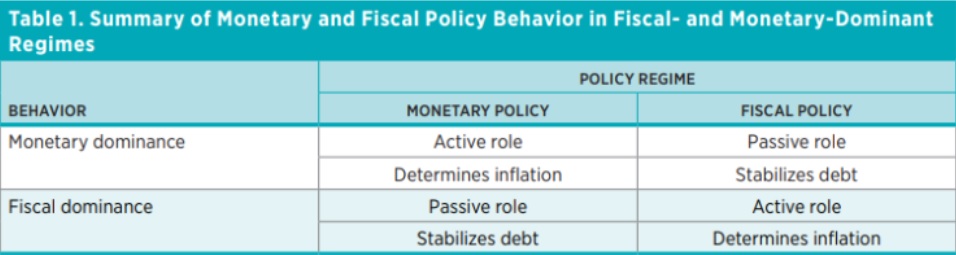
In the academic literature, this is part of the discussion about “fiscal dominance.” As shown in this visual, fiscal dominance exists when central banks decide (or are forced) to create money to finance government spending.

The visual is from a report by Eric Leeper for the Mercatus Center. Here’s some of what he wrote.


…a critical implication of fiscal dominance: it is a threat to central bank success. In each example, the central bank was free to choose not to react to the fiscal disturbance—central banks are operationally independent of fiscal policy. But that choice comes at the cost of not pursuing a central bank legislated mandate: financial stability or inflation control. Central banks are not economically independent of fiscal policy, a fact that makes fiscal dominance a recurring threat to the mission of central banks and to macroeconomic outcomes. …why does fiscal dominance strike fear in the hearts of economists and financial markets? Perhaps it does so because we can all point to extreme examples where fiscal policy runs the show and monetary policy is subjugated to fiscal needs. Outcomes are not pleasant. Germany’s hyperinflation in the early 1920s may leap to mind first. …The point of creating independent central banks tasked with controlling inflation…was to take money creation out of the hands of elected officials who may be tempted to use it for political gain instead of social wellbeing.

A working paper from the St. Louis Federal Reserve Bank, authored by Fernando Martin, also discusses fiscal dominance.


In recent decades, central banks around the world have gained independence from fiscal and political institutions. The proposition is that a disciplined monetary policy can put an effective brake on the excesses of political expediency. This is frequently achieved by endowing central banks with clear and simple goals (e.g., an inflation mandate or target), as well as sufficient control over specific policy instruments… Despite these institutional advances, the resolve of central banks is chronically put to the test. … the possibility of fiscal dominance arises only when the fiscal authority sets the debt level.

The bottom line is that budget deficits don’t necessarily lead to inflation. But if a government is untrustworthy, then it will have trouble issuing debt to private investors.

And that’s when politicians will have incentives to use the central bank as a printing press.

P.S. Pay attention to Italy. The European Central Bank has been subsidizing its debt. That bad policy supposedly is coming to an end and things could get interesting.

Thursday, March 23, 2023

Bank Failures and the Federal Reserve’s Recipe for Hangover Economics

March 15, 2023 by Dan Mitchell @ International Liberty

Want to know who to blame for the failure of Silicon Valley Bank, Signature Bank, and the general turmoil in the banking sector?

Poor management is part of the answer, of course, but the Federal Reserve also should be castigated because of bad monetary policy.

Why?

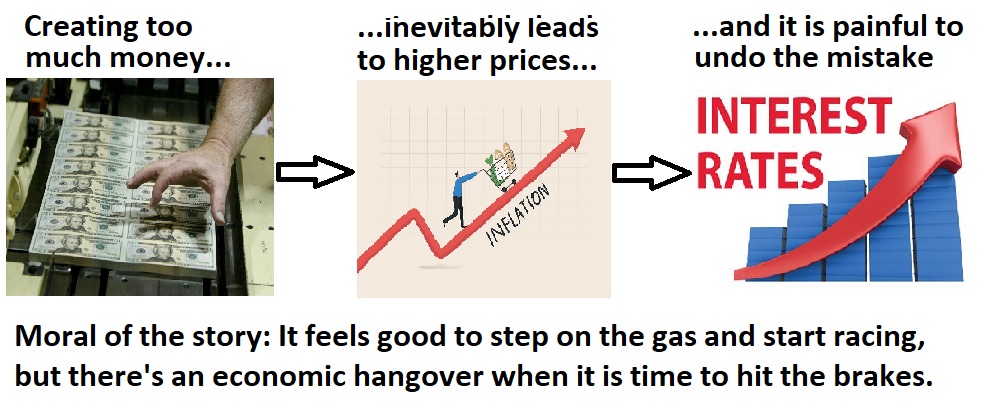
Because the central bank’s easy-money policy created artificially low interest rates, but those policies also produced high inflation, and now interest rates are going up as the Fed tries to undo its mistake.

Inspired by my “magic beans” visual, here’s a new one that shows the Fed’s boom-bust cycle.

By the way, the center box (higher prices) also includes asset bubble since bad monetary policy sometimes leads to financial bubbles instead of (or in addition to) higher consumer prices.

And higher interest rates can occur for two reasons. Most people focus on the Federal Reserve tightening monetary policy as it tries to reverse its original mistake of easy money. But don’t forget that interest rates also rise once lenders feel the pinch of inflation and insist on higher rates to compensate for the falling value of the dollar.

But let’s not digress too much. The focus of today’s column is that the Fed goofed by creating too much money in 2020 and 2021. That’s what set the stage for big price increases in 2022 and now economic instability in 2023.

Joakim Book of Reason shares my perspective. Here are excerpts from his article.


The Federal Reserve is in the unenviable position of achieving its mandate by crashing the economy. …it’s something that happens as an unavoidable outcome of slowing down an economy littered with excess money and inflation. …This hiking cycle, the fastest that the Fed has embarked upon in a generation, was always likely to break something. And break something they did over the weekend…Silicon Valley Bank (SVB), which faced the second-largest bank run in U.S. history. …this pushes the Fed into a very delicate position: risk systemic bank runs, or roll back the hikes and quantitative tightening that caused this mess, printing money for an even hotter inflation.

The Wall Street Journal also has the right perspective, editorializing that the current mess was largely caused by bad monetary policy.


Cracks in the financial system emerge whenever interest rates rise quickly after an easy-credit mania, and the surprise is that it took so long. …This week’s bank failures are another painful lesson in the costs of a credit mania fed by bad monetary policy. The reckoning always arrives when the Fed has to correct its mistakes. …We saw the first signs of panic in last year’s crypto crash and the liquidity squeeze at British pension funds. …nobody, least of all central bank oracles, should be surprised that there are now bodies washing up on shore as the tide goes out.

This tweet also notes that monetary policy is to blame.

Finally, I can’t resist sharing some excerpts from Tyler Cowen’s Bloomberg column. He pointed out last November that the Austrian School has some insights with regards to the current mess.


The Austrian theory…works something like this: Investors expected that very low real interest rates would hold. They committed resources accordingly, and now forthcoming rates are likely to be much higher. That means the economy is stuck with malinvestment and will need to reconfigure in a painful manner. …The basic story here fits with the work of two economists from Austria, Ludwig Mises and Nobel laureate Friedrich von Hayek, and thus it is called the Austrian theory of the business cycle. The Austrian theory stresses how mistaken expectations about interest rates, brought on by changes in the rate of inflation, will lead to bad and abandoned investment projects. The Austrian theory has often been attacked by Keynesians, but in one form or another it continues to resurface in the economic data.

Needless to say, proponents of the Austrian School are not big fans of central banking.

If you want to learn more about Austrian economics, click here and here.


Thursday, March 16, 2023

The Fed hasn't learned, and maybe never will

March 15, 2023 By Dann E. Kroeger

Treasury bonds, issued when interest rates were low, have only one way to move as the Fed increases interest rates.  Their face value must go down.

An aggressive big bank, making lots of money, may not be watching the balance sheet as closely as it should.  So it was with Silicon Valley Bank.  Suddenly, SVB realized that it was stuck with lots of Treasury bonds that had lost value.  So SVB set about to raise several billion dollars to make its balance sheet look more balanced.  Due to this action, unfortunately, some depositors decided that their money might be safer in another bank.  Thus, the historic "run on a bank" occurred once again.  Within several days, SVB was insolvent.  That was last Friday. 

As an aside, might I ask what federal agency is responsible for watching bank balance sheets? 

On Monday, just two days later, the Fed proposed, again, to ignore history, economics, and common sense.  Need I warn them that you can fool Mother Nature and the laws of economics for only so long before you must face the consequences? .................To Read More....

Tuesday, February 21, 2023

The Bright Line between Inflation and Spending

February 19, 2023  By Jay Davidson

Talk about a tale of two realities.  Certain Wall Street Journal articles quote two Federal Reserve presidents saying interest rates will remain high for a couple more years, until business activity eases.  In other words, that's until the central bank's handling of monetary policy puts our economy into recession. Then the Journal lists several stories about softening labor markets, which translates into lower wage pressure.  And a slowdown in shipping.  Both items indicate a slowing economy.  And isn't that the reason the Federal Reserve raised interest rates so rapidly, in so short a time? Then why are these Fed presidents, voting members of the Federal Open Market Committee (FOMC), touting higher rates for years?..............To Read More.... 

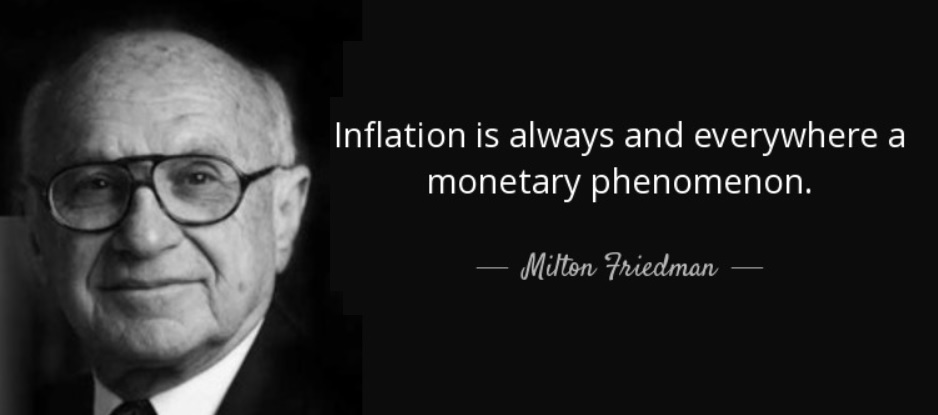
The Fed Continues to Ignore Basic Economics and We Will Pay the Price Desmond Lachman | New York Post - A sign of intelligence is learning from one’s mistakes. The Powell Federal Reserve does not display this kind of intelligence. Last year, it managed to produce multi-decade-high inflation by choosing to ignore Milton Friedman’s fundamental teaching that inflation is always and everywhere a monetary phenomenon. Yet this year, it risks producing an unnecessary recession and inflation below its 2% target by once again choosing to ignore the legendary economist’s lessons................

The Nightmare Scenario: Could America Really Default on Its Debt, By Desmond Lachman February 16, 2023 - Nero is said to have fiddled while Rome burned. Today, it seems that Washington’s politicians prefer to play games with the debt ceiling. They do so at a time when the country could soon default on its debt and when the country’s public finances seem to have gone from bad to worse. Yesterday, the non-partisan Congressional Budget Office (CBO) indicated that the United States could hit the debt ceiling anywhere between July and September. Failure to raise the debt ceiling by that time would result in the U.S. government, the world’s largest sovereign debtor, defaulting on its debt. That is the last thing that the U.S. and world economies need at a time when high-interest rates are already raising the risk of a U.S. and world economic recession and when U.S. and global financial markets are already on the back foot................. 

My Take - I keep coming  back over and over again.  All this is fixable!  Default isn't necessary, and here's the solution.   Get Out of Debt CardBut the point the author makes is a valid one.  Both parties are equally as guilty of this mess. 

Wednesday, May 18, 2022

Blame the Federal Reserve

May 6, 2022 by Dan Mitchell

Back in 2015, I explained to Neil Cavuto that easy money creates the conditions for a boom-bust cycle.

It’s now 2022 and my argument is even more relevant.

That’s because the Federal Reserve panicked at the start of the pandemic and dumped a massive amount of money into the economy (technically, the Fed increased its balance sheet by purchasing trillions of dollars of government bonds).


As the late, great Milton Friedman taught us, this easy-money, low-interest-rate approach produced the rising prices that are now plaguing the nation.

But that’s only part of the bad news.

The other bad news is that easy-money policy sets the stage for future hard times. In other words, the Fed causes a boom-bust cycle.

Desmond Lachman of the American Enterprise Institute explains how and why the Federal Reserve has put the country in a bad situation.


Better late than never. Today, the Federal Reserve finally took decisive monetary policy action to regain control over inflation that has been largely of its own making. …The Fed’s abrupt policy U-turn is good news in that it reduces the likelihood that we will return to the inflation of the 1970s. However, this does not mean that we will avoid paying a heavy price for the Fed’s past policy mistakes in lost output and employment. …One might well ask what the Fed was thinking last year when it kept interest rates at their zero lower bound and when it let the money supply balloon at its fastest pace in over fifty years at a time especially when the economy was recovering strongly… One might also ask what the Fed thought when it continued to buy $120 billion a month in Treasury bonds and mortgage-backed securities throughout most of last year when the equity and the housing markets were on fire?

The relevant question, he explains, is whether we have a hard landing…or a harder landing.

If the Fed sticks to its program of meaningful interest rate hikes and balance sheet reduction over the remainder of this year, there would seem to be an excellent chance that we do not return to the inflation of the 1970s. However, there is reason to doubt that the Fed will succeed in pushing the inflation genie to the bottle without precipitating a nasty economic recession. One reason for doubting that the Fed will succeed in engineering a soft economic landing is that there is no precedent for the Fed has done so when it has allowed itself to fall as far behind the inflation curve as it has done today. …there is a real risk that higher interest rates might be the trigger that bursts today’s asset and credit market bubbles. Should that indeed happen, we could be in for a tough landing. Milton Friedman was fond of saying that there is no such thing as a free lunch. This is a lesson that the Fed might soon relearn as last year’s economic party gives way to a painful economic slump.

Let’s hope we have a proverbial “soft landing,” but I’m not holding my breath.

Especially with Biden pursuing other bad policies (FWIW, I don’t blame him for today’s price spikes).

P.S. As explained in this video from the Fraser Institute, Friedrich Hayek understood a long time ago that feel-good government intervention leads to a feel-bad economic hangover.


P.P.S. Here’s my video on the Federal Reserve, which also explains that there might be a good alternative.

Tuesday, February 15, 2022

The Fed Nominees: Corks on the Water

Editorial of The New York Sun | February 14, 2022

The Senate Banking Committee is fixing to send to the full Senate tomorrow five nominees for governors of the Federal Reserve, including the chairman, Jerome Powell. The New York Sun opposes each of them (please see below). Yet our overriding concern is not the nominees themselves, but the failure of the senators to consider that the root of the problem in our economy lies with the system of fiat money itself.

We’ve been beating this drum in one orchestra or another since 1971, when America defaulted on its obligation under Bretton Woods to redeem at a 35th of an ounce of gold dollars presented to it by foreign governments. In the quarter-century of Bretton Woods, unemployment averaged 4.6 percent. Thomas Piketty’s inequality rate lurked at historic lows, as did the personal bankruptcy rate so closely watched by Senator Warren..............Sarah Bloom Raskin looks eager to take the Fed into the business of climate regulation for which it lacks a mandate. Senator McConnell has warned appointing her would make the Fed “a hyper-political super-legislature.” As for Lisa Cook, the Wall Street Journal this morning issued a devastating report on her hostility to open debate. Philip Jefferson appears to have been chosen more for his left-wing policy bona fides than any commitment to stable prices.........To Read More....

  “When a clown enters a castle, he does not become a king; rather the castle becomes a circus …” — Turkish Proverb

Monday, January 31, 2022

How Can People Protect Themselves from Bad Monetary Policy?

January 26, 2022 by Dan Mitchell @ International Liberty

In the libertarian fantasy world, we would have competing private currencies. In the real world, we have a government central bank.  And central banks have a track record of bad monetary policy, so here’s my two cents on how people can try to protect their household finances.


............I focused on explaining the risks of bad monetary policy, especially the way that central banks (and other government policies) create boom-bust cycles in the economy. If I had more time, I could have talked about additional threats, such as the crackpot idea of “modern monetary theory.”..........To Read More...


Saturday, January 22, 2022

When The Administrative State Slips Its Constitutional Bonds

,@ Manhattan Contrarian

For the past few weeks, everybody’s attention has been focused on the looming demise of President Biden’s legislative agenda. Both the massive social spending bill (going by the Orwellian name “Build Back Better”) and the anti-voter-integrity bill, have now conclusively failed, at least in their most recent forms. A major part of the Build Back Better monstrosity was the launching of the Green New Deal, with its attendant suppression of the use of carbon-based fuels.

So, at least for now, these things are dead in Congress. But what’s happening over in the Administrative State? That’s where, in Woodrow Wilson’s progressive vision, the “experts” from various fields of endeavor have gathered in the government, unconstrained by the Constitution’s separation of powers, to make the all-important rules for a smoothly running society. Today there are hundreds of thousands of these “experts” in the bureaucracy. To a person, they appear to believe that the most pressing issue of our era is saving the world from U.S. emissions of carbon dioxide. How do they know that? Obviously, they know it because they are the “experts.”

Under what legislative authority do these “experts” operate to impose their green agenda? Excellent question. Barack Obama had a big plan for “cap and trade” legislation to lower emissions by driving up the price of all fossil fuels. (“Under my plan of a cap and trade system, the price of electricity will necessarily skyrocket.”). The legislation failed in Congress. Biden’s Green New Deal also has so far failed in Congress. There has been no relevant amendment to the Clean Air Act further empowering the bureaucracy to regulate carbon emissions since such emissions first became a progressive obsession in the early 2000s.

Clearly then, the bureaucracy must be stymied in its goal to effect a fundamental transformation of the U.S. energy system by suppressing production and use of fossil fuels, while they await Congressional authorization to proceed. If you think that is true, you do not understand the extent to which the Administrative State has slipped its constitutional bonds.

For today, let me highlight just a few of the initiatives currently emanating from the Administrative State.

Biden Executive Order 13990. On January 20, 2021 — his first day in office — President Biden issued this Executive Order. From Section 1:

Our Nation has an abiding commitment to empower our workers and communities; promote and protect our public health and the environment; and conserve our national treasures and monuments, places that secure our national memory. . . . In carrying out this charge, the Federal Government must be guided by the best science and be protected by processes that ensure the integrity of Federal decision-making. It is, therefore, the policy of my Administration to listen to the science; to improve public health and protect our environment; . . . to reduce greenhouse gas emissions . . . .

You might note the lack of citation to any particular statute that might support the implementation of those lofty goals. “Reducing greenhouse gas emissions” means wiping out our existing, functioning energy system with no idea what might replace it or at what cost.

Social Cost of Carbon. Among many other things, EO 13990 established something called the “Interagency Working Group” to put a price on all CO2 emissions, which price would then be used in any cost/benefit analyses or considerations of permits to proceed with any project that might involve emissions of CO2 (in other words, all projects, since all human activities involve emissions of CO2). From the EO:

There is hereby established an Interagency Working Group on the Social Cost of Greenhouse Gases (the “Working Group”).  The Chair of the Council of Economic Advisers, Director of OMB, and Director of the Office of Science and Technology Policy  shall serve as Co-Chairs of the Working Group. . . . The Working Group shall also include the following other officers, or their designees:  the Secretary of the Treasury; the Secretary of the Interior; the Secretary of Agriculture; the Secretary of Commerce; the Secretary of Health and Human Services; the Secretary of Transportation; the Secretary of Energy; the Chair of the Council on Environmental Quality; the Administrator of the Environmental Protection Agency; the Assistant to the President and National Climate Advisor; and the Assistant to the President for Economic Policy and Director of the National Economic Council. . . . The Working Group shall, as appropriate and consistent with applicable law: . . .  publish an interim SCC [Social Cost of Carbon] . . . within 30 days of the date of this order, . . . [and] publish a final SCC . . . by no later than January 2022.

The IWG was promptly established (or more accurately, re-established after a previous Obama administration version) and, right on schedule, came out with its interim “SCC” on February 21, 2021. The newly announced SCC is $51/ton of CO2 emissions — a level sufficient to undermine many if not all significant projects relying in any way on use of fossil fuels. From the National Law Review, June 24, 2021:

With the resetting of the SCC to a significant value, it will begin to again influence federal decision-making, and courts and states will also begin considering it in evaluating environmental impacts. Industry actors will need to pay close attention to how the new administration applies SCC and quickly adapt their activities accordingly.

But wait a minute: This is a regulation explicitly designed and intended to effect a complete transformation of the U.S. energy economy. Did the Congress ever so much as authorize the creation of the IWG, or so much as suggest the creation of a “SCC” for such a purpose? Some seventeen states have brought litigation in the Western District of Louisiana (Louisiana v. Biden, No. 21-CV-01074, available at the government’s PACER website) seeking to enjoin the use of the SCC. From the States’ opposition to the government’s motion to dismiss:

[T]hese [SCC] Estimates are perhaps the most significant regulatory action in American history—yet Defendants cannot cite one statute authorizing them. Indeed, to avoid public and judicial accountability, the Administration has resorted to creating a new agency [the IWG] out of whole cloth, avoiding notice and comment procedures, and reviving a discredited methodology to justify unprecedented burdens on State sovereignty and individual liberty. This is the very definition of an APA violation and ultra vires action.

Remarkably, the “experts” in the government have calculated their social “cost” of carbon as being something entirely negative, with exactly zero accounting for the fact that carbon-based energy provides us with positive benefits like electricity and transportation that are low cost and that work. In other words, people who have no idea whatsoever what they are doing claim the mantle of “expertise” to completely refashion the U.S. economy without any hint of authorization from Congress.

Federal Reserve. Compared to other agencies whose Congressional mandate may be somewhat ambiguous, the Fed actually has two clearly specified goals: price stability, and full employment. One might quibble that those two goals may not be fully compatible at all times. But at least Congress has explicitly said that those are the goals, and has not named any others. Suppression of fossil fuels? There is no Congressional authorization for that.

But last week President Biden nominated one Sarah Bloom Raskin to be the Fed Vice Chair for Supervision — in other words, the person at the Fed in charge of overseeing the function of regulating the banking system. Who is Sarah Bloom Raskin? She is a former Deputy Secretary of the Treasury (Obama administration) and a former member of the Fed Board of Governors. She has also been outspoken in her view that the banking regulatory function needs to be co-opted in the service of the climate agenda and suppression of fossil fuels. For example, in June 2020 she contributed a Foreword to a Report for an organization called Ceres (the “Accelerator for Sustainable Capital Markets”). Excerpt:

If we want to create a sustainable climate, we need to transition to a net-zero carbon economy. This transition is not going to happen without guidance. Financial markets, themselves, are not going to be the first responders to keep us from the threats posed by a climate emergency. We are learning this the hard way. Thankfully, in many countries central banks and other financial regulators know that when it comes to curbing the effects that climate risk will have on the economy, particularly the heightened chance that such risks will bring about economic catastrophe, leadership must exist and concerted action must be taken.

Do the Republicans in the Senate have any chance of blocking this crazed lunatic from getting into a position to wreak havoc on the economy? I doubt it. I would also have no doubt that all the hundreds of minions working under Ms. Raskin will be fully and unanimously on board with the program of blocking bank lending to the fossil fuel industries. Hey, it’s to save the planet! With such important goals before us, what kind of impediment is the mere Constitution? And anyway, any dissenters will be fired.

And believe me, the above are just a couple of many, many such unauthorized and unconstitutional initiatives going on around the bureaucracy in the effort to “save the planet.” Expect future posts on some of the more significant and crazy among them.

Wednesday, August 18, 2021

Beyond Bretton Woods: The Constitutional Questions on Money Need To Be Answered

Edwin Vieira, in Part Nine of Our Series, Says the ‘Silence Is Deafening’ 

Any close observer of contemporary discussions of monetary policy must become disheartened by the tendency to treat that subject as a matter of politics, economics, and social effects, with little to no consideration of its necessary foundation in monetary law — and, even more to the point, of the dependence of monetary law on the Constitution of the United States.

Yet it would seem axiomatic that, to be taken seriously, any monetary policy must be based upon the legally (rather than merely politically) correct answers to certain salient questions, such as:...........To Read More....


Monday, August 9, 2021

A Gold Standard vs. the Federal Reserve’s Fiat Money

August 3, 2021 by Dan Mitchell @ International Liberty 

I’m not a big fan of the Federal Reserve, mostly because of its Keynesian monetary policy.


Incumbent politicians often applaud when the central bank intervenes to create excess liquidity and artificially low interest rates. That’s because the Keynesian approach produces a short-run “sugar high” that seems positive. But such policies also create boom-bust conditions. Indeed, the Federal Reserve deserves considerable blame for some of the economy’s worst episodes of the past 100-plus years – most notably the Great Depression, 1970s stagflation, and the 2008 financial crisis.

So what’s the solution?

I’ve previously pointed out that the classical gold standard has some attractive features but is not politically realistic. But perhaps it’s time to reassess.  In a column for today’s Wall Street Journal, Professors William Luther and Alexander Salter explain the differences between a gold standard and today’s system of fiat money (i.e., a monetary system with no constraints).


Under a genuine gold standard, …Competition among gold miners adjusts the money supply in response to changes in demand, making purchasing power stable and predictable over long periods. The threat of customers redeeming notes and deposits for gold discourages banks from overissuing… Fiat dollars aren’t constrained by the supply of gold or any other commodity. The Federal Reserve can expand the money supply as much or as little as it sees fit, regardless of changes in money demand. When the Fed expands the money supply too much, an unsustainable boom and costly inflation follow.

They then compare the track records of the two systems.

…nearly all economists believe the U.S. economy has performed better under fiat money than it would have with the gold standard. This conventional wisdom is wrong. The gold standard wasn’t perfect, but the fiat dollar has been even worse. …in practice, the Fed has failed to govern the money supply responsibly. Inflation averaged only 0.2% a year from 1790 to 1913, when the Federal Reserve Act passed. Inflation was higher under the Fed-managed gold standard, averaging 2.7% from 1914 to 1971.

It has been even higher without the constraint of gold. From 1972 to 2019, inflation averaged 4%. …the Fed…has also become less predictable. In a 2012 article published in the Journal of Macroeconomics, George Selgin, William D. Lastrapes and Lawrence H. White find “almost no persistence in the variance of inflation prior to the Fed’s establishment, and a very high degree of persistence afterwards.” …

One might be willing to accept the costs of higher inflation and a less predictable price level if a Fed-managed fiat dollar reduced undesirable macroeconomic fluctuation. But that hasn’t happened. Consider the past two decades. The early 2000s had an unsustainable boom, as the Fed held interest rates too low for too long.

There was also a column on this issue in the WSJ two years ago.  James Grant opined about (the awful) President Nixon’s decision to make Federal Reserve policy completely independent of the gold anchor.


Richard Nixon announced the suspension of the Treasury’s standing offer to foreign governments to exchange dollars for gold, or vice versa, at the unvarying rate of $35 an ounce. The date was Aug. 15, 1971. Ever since, the dollar has been undefined in law. …In the long sweep of monetary history, this is a new system. Not until relatively recently did any central bank attempt to promote full employment and what is called price stability (but is really a never-ending inflation) by issuing paper money and manipulating interest rates. …a world-wide monetary system based on the scientifically informed discretion of Ph.D. economists. The Fed alone employs 700 of them.

But Grant says the gold standard worked reasonably well.

A 20th-century scholar, reviewing the record of the gold standard from 1880-1914, was unabashedly admiring of it: “Only a trifling number of countries were forced off the gold standard, once adopted, and devaluations of gold currencies were highly exceptional. Yet all this was achieved in spite of a volume of international reserves that, for many of the countries at least, was amazingly small and in spite of a minimum of international cooperation . . . on monetary matters.” …Arthur I. Bloomfield wrote those words, and the Federal Reserve Bank of New York published them, in 1959.

The new approach, which Grant mockingly calls the “Ph.D. standard,” gives central bankers discretionary power to do all sorts of worrisome things.

The ideology of the gold standard was laissez-faire; that of the Ph.D. standard (let’s call it) is statism. Gold-standard central bankers bought few, if any, government securities. Today’s central bankers stuff their balance sheets with them. In the gold-standard era, the stockholders of a commercial bank were responsible for the solvency of the institution in which they held a fractional interest. The Ph.D. standard brought the age of the government bailout and too big to fail.

By the way, the purpose of today’s column isn’t to unreservedly endorse a gold standard.

Such as system is very stable in the long run but can lead to short-term inflation or deflation based on what’s happening with the market for gold. And those short-term fluctuations can be economically disruptive.

I was messaging earlier today with Robert O’Quinn, the former Chief Economist at the Department of Labor (who also worked at the Fed) and got this reaction to the Luther-Salter column.

Which is better matching the long-term growth of the economy and the demand for money? The profitability of gold mining or central bank decision-making? A good monetary rule may be better than a classical gold standard. The difficulty is sustaining a good rule.

The ;problem, of course, is that I don’t trust politicians (and their Fed appointees) to follow a good rule.


  • Especially in a world where many of them believe in Keynesian boom-bust monetary policy.
  • Especially in a world where many of them think the Fed should prop up or bailout Wall Street.
  • Especially in a world where many of them might use the central bank to finance big government.
  • Especially in a world where many of them support a “war against cash” to empower politicians.

The bottom line is that we have to choose between two imperfect options and decide which one has a bigger downside.

P.S. Since a return to a classical gold standard is highly unlikely (and because the libertarian dream of “free banking” is even more improbable), the best we can hope for is a president who 1) makes good appointments to the Fed, and 2) supports sound-money policies even when it means short-run political pain. We’ve had one president like that in my lifetime.


Monday, May 17, 2021

To Lean, Clean, or Reign Supreme

Joakim BookJoakim Book  – May 16, 2021 @ American Institute for Economic Research 

In the early 2000s, before the financial crisis, a debate dominated central banking: whether central bankers should try to reign in financial bubbles in what was called “lean against the wind.” That is, over and above their macroeconomic targets – keeping inflation at or around 2% and ensuring full employment – central banks should also take financial market manias into account. Since spillover from a financial debacle can greatly impact what us economists call the “real” economy (i.e., outside the financial sector), maybe positioning monetary policy accordingly could prevent the crisis altogether – or make the bursting of a bubble less painful. 

When stock market valuations or house prices were high and speculation ran rampant, the story goes, central bankers should lean against that by raising interest rates and making debt-fueled speculation a little more expensive. If done skillfully and with good timing, central banks could prick bubbles before they got out of control, at minimum cost to the real economy. In theory, anyway.  

The debate at the end of what economists call the Great Moderation (a time roughly between the 1980s and 2007 characterized by low inflation, stable unemployment, decent economic growth and only mild recessions), most central banks had landed in the “don’t lean” camp. It’s hard to spot a bubble, it’s costly to the economy to run with above-optimal interest rates, and the few recessions they encountered taught them that “cleaning up” after an implosion – flushing the banking system with liquidity – was cheap and easy. 

The financial crisis of 2007/8 was a painful wakeup call for this established intellectual consensus. The Global Financial Crisis, or GFC, was not easy to clean up; it caused a lot of pain; it was followed by years and years of sluggish growth. Its effects are still with us in terms of home-ownership ratios, government debt, people out of the labor force, and the size of the central bank’s balance sheet. With the eurozone crisis, insolvent governments in Europe’s periphery, and catastrophic economic performance even a decade later, most economists looking at the European Central Bank’s troubles quickly changed their minds. Christian Drescher at the German Bundesbank wrote that however unpleasant and inappropriate it may be to lean, it is “better to lean against the wind than to fight a hurricane.”

Drescher aptly summarized the debate to turn on the following questions: 

  1. Identification/Information: It is far from obvious that anyone can reliably spot asset bubbles, let alone that central bankers can do so better than market participants, to which leaners responded that central banks have private regulatory information and can see the bigger picture; 
  2. Destabilization: by pricking a bubble, you may cause panic, perverse incentives, and other unwanted market behavior. The leaners’ suggested solution was to prick a bubble only at an early stage (but that places even higher information demands on the central banker, as per above); 
  3. Costs: leaning causes “collateral damage” to the rest of the economy for reasons that, even if the central banker is correct (a big if) are going to look dubious to outsiders and policymakers (if you think it’s easy to convince others that your stern actions prevented something that didn’t happen, I have a pink-elephant repellant to sell you). Leaners objected that financial crises are much costlier than that minor damage.   
  4. Effectiveness: central banks have few precision tools at their disposal (shift in the money supply and interest rates hit everywhere in the economy) whereas leaners think they have outsized effects on bubble participants. 

These aren’t trivial problems. While quacks, anticapitalists, and those viewing history in hindsight confidently pronounce that they could spot a collapsing bubble before it happened, the evidence is much less convincing. We can use words and feel uneasy about the quick rise in some asset’s price but words and feelings are poor guides for something as important as an economy-wide monetary policy.

In 2015, even Markus Brunnermeier, a long-time scholar of bubbles, and Isabel Schnabel, then professor of financial economics at the University of Mainz and now on the ECB’s executive board, did not mince words in their extensive survey of historical bubbles and monetary policy: 

“First, bubbles cannot be identified with confidence. A deviation from the fundamental value of an asset could be detected only if the asset’s fundamental value was known.”

Policies that try to identify them and deflate them have “serious impediments,” the scholars conclude. 

What I often found odd in the argument was the hubris to presume that investors, asset managers, or households involved in a bubble would be much swayed by the central bank pushing up the Fed funds rate by a percentage point or two. If leaning works, it works by squeezing the least profitable firms in the economy and liquidating the least solvent and/or convinced investors in the mania. Serious bubbles promise lush and excessive returns in the tens or hundreds of percent – that’s the grand promises that leaning must rein in.

Fast-forward to today, there is an eerie consensus that something is off in financial markets and money more broadly. The GameStop debacle earlier this year was but a preview of what was brewing: retail investors, cheered on by TikTok videos, Reddit forums, and “the boredom hypothesis,” are throwing unfathomable amounts of money around various degrees of hopeful garbage – renewable energy firms, SPACs, dogecoin, colorful options on Robinhood, electric vehicle producers, and every commodity under the sun. Jemima Kelly in the Financial Times concludes that it is “hard to make sense of financial markets in 2021.”

On to the scene we have an op-ed in the Wall Street Journal on Monday, by Christian Broda and Stanley Druckenmiller, two well-established investors, resurrecting this never-ending debate over what central banks ought to do:  

“Fed policy has enabled financial-market excesses. Today’s high stock-market valuations, the crypto craze, and the frenzy over special-purpose acquisition companies, or SPACs, are just a few examples of the response to the Fed’s aggressive policies. The central bank should balance rather than fuel asset prices.

The long-term risks from asset bubbles and fiscal dominance dwarf the short-term risk of putting the brakes on a booming economy in 2022.”

After a decade or more of economic and financial events that put central banks under heavy strain – financial collapse, a slow and timid recovery, the pandemic – strange things are again amiss in financial markets.

Broda and Druckenmiller are right to say that “the Fed seems to be fighting the last battle.” Ironically, so are they: we’re back in the lean-or-clean debate of twenty years ago.

Joakim Book

Joakim Book

Joakim Book is a writer, researcher and editor on all things money, finance and financial history. He holds a masters degree from the University of Oxford and has been a visiting scholar at the American Institute for Economic Research in 2018 and 2019.

His work has been featured in the Financial Times, FT Alphaville, Neue Zürcher Zeitung, Svenska Dagbladet, Zero Hedge, The Property Chronicle and many other outlets. He is a regular contributor and co-founder of the Swedish liberty site Cospaia.se, and a frequent writer at CapXNotesOnLiberty, and HumanProgress.org.

Get notified of new articles from Joakim Book and AIER.