Search This Blog

De Omnibus Dubitandum - Lux Veritas

Showing posts with label Big Government Incompetence. Show all posts

Friday, October 25, 2024

The Adverse Economic Consequences of Big-Government Populism, Part II

October 24, 2024 by Dan Mitchell @ International Liberty

 n Part I of this series about six months ago, I wrote that “I favor ‘freedom conservatism‘ over ‘national conservatism‘ because the former is unambiguously based on liberty and the latter veers toward populism.”

And I defined a populist as “someone who exploits economic ignorance to push policies that sound appealing to voters in the short run (such as protectionism, industrial policy, or class warfare) but do economic damage in the long run.”

That column then looked at some academic research showing that populist policies lead to less economic growth.

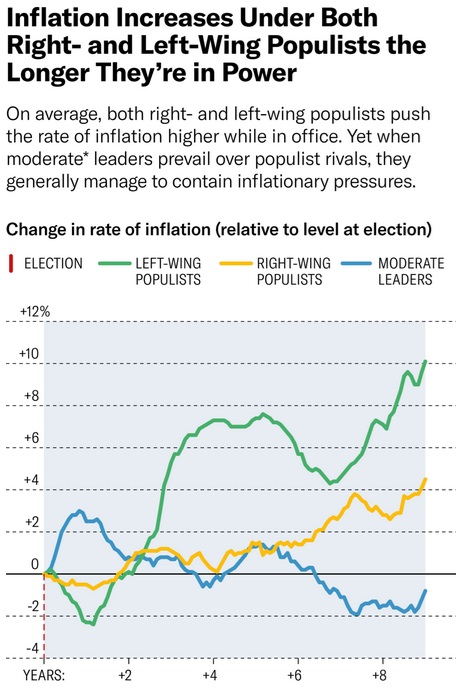
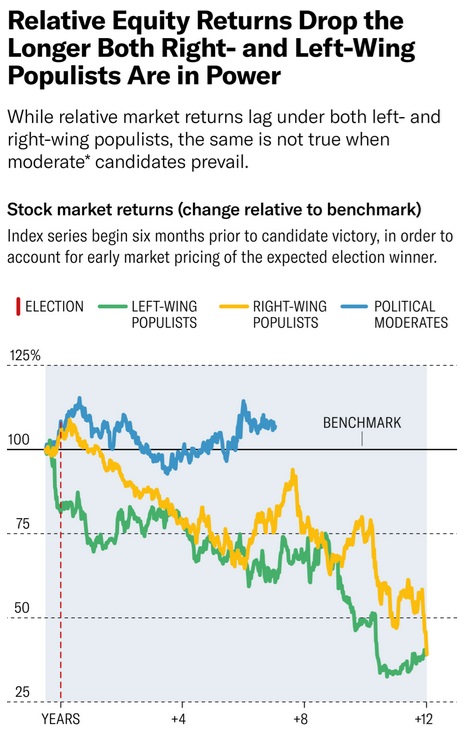
Today, let’s look at more evidence, starting with this chart showing that financial markets do worse under populist rule.

The chart comes from a study recently published by the Harvard Business Review. Authored by Roberto Stefan Foa and Rachel Kleinfeld, it measure the impact of populist policies on economic outcomes.

Here are some of the highlights.


…we reviewed daily stock market data from Refinitiv comparing total returns (in U.S. dollars, including dividends) for all countries for which we have data (developed and major emerging markets), to see how markets performed under left and right-wing populists… Beyond the headline effects on economic growth, the authors also estimate that 15 years of populist rule leaves national debt up to 10% higher than otherwise, with inflationary pressures as a result. We examined this effect using monthly consumer price data from the World Bank’s Global Database of Inflation to see how price indices change from the moment populists enter office up until 12 months after their departure, thereby capturing lagging effects. On average, left-wing populists see inflation rise within two to four years. Right-leaning populists start out better, but produce a similar result by the end of their second term.

Here are the aforementioned inflation results.

The unavoidable conclusion is that populists like printing money.

The study notes that populists represent “public choice” in action.

In other words, politicians who are motivated by personal ambition rather than national interest (as noted in my Nineteenth Theorem of Government).

Whether a populist claims to be of the left or the right, they tend to value short-term gains over long-term results. Taken together, the evidence suggests a common result: rising levels of debt and inflation, and sub-standard performance for markets and growth. …thinking of populists as left or right is a misunderstanding. Populists care little about ideology — what they want is power.

I’ll close by sharing the methodology the authors used to identify populist governments.

“Populists” were identified using criteria widespread in political science and based on external projects we have advised. Populists in this criteria are defined by three factors: 1) they center a political strategy that divides their population between a good and righteous “people” and an elite or undeserving minority; 2) they claim that they are the sole or best representative of “the people,” and 3), they define democracy as requiring that the government serve the will of “the people” and do not accept constraints from independent institutions, oversight, or inalienable rights.

The article does not list specific populist governments, but there is a link to another report that lists 46 different governments from 1990-2018.

As you might suspect, Trump is listed as a populist. I have no objection to that characterization, as you can see from this 2016 column, but I wonder why class-warfare politicians like Obama are not also on this list. Targeting a narrow slice of the population (the top 1 percent or top 10 percent) with political vitriol and reckless policy should be viewed as pure populism.

Same for Kamala Harris, especially when you consider her views on other issues such as price controls, entitlements, handouts, equality of outcomes, and rent subsidies.


Saturday, October 12, 2024

Ordinary People Lose with European-Sized Government

October 11, 2024 by Dan Mitchell @ International Liberty

There are three important things to understand about Western Europe.

Today, let’s further look at what we can learn from Europe.

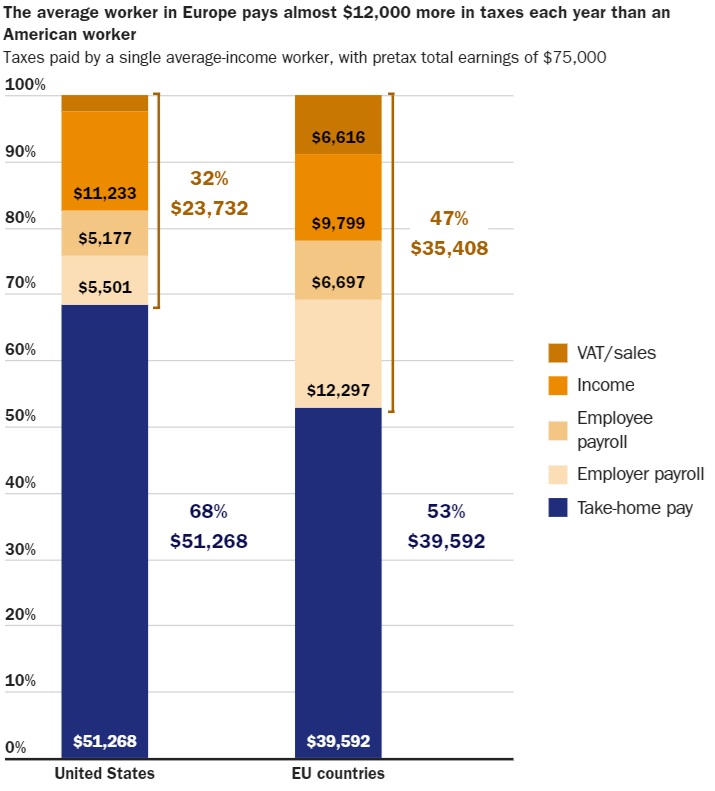
Adam Michel of the Cato Institute authored a new study that compares Europe and the United States.

As part of his report, he calculated that the a middle-class European pays nearly $12,000 more in taxes than an American at the same income level.

The huge gap is due mostly to Europe’s value-added taxes and employer payroll taxes (which companies pay on behalf of workers).

Needless to say, this is not good news for European households.

But that’s just part of the bad news. You also have to consider that Europeans are much less likely to earn as much money as their American counterparts.

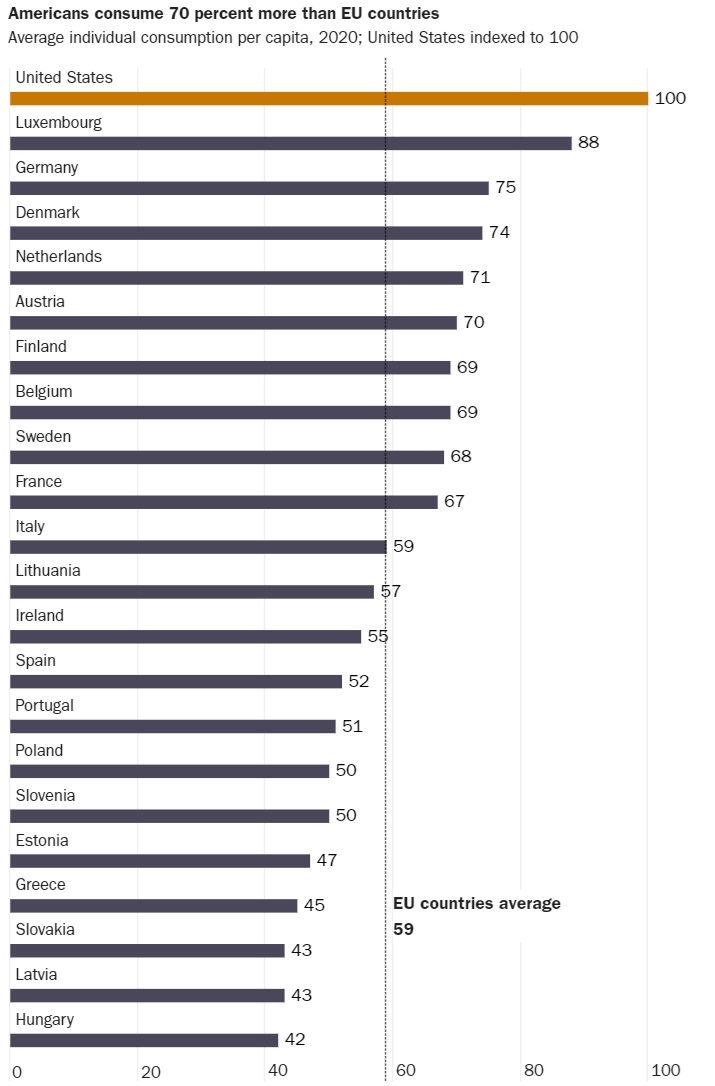
There’s an enormous gap between the U.S. and E.U. when looking at per-capita GDP. But GDP doesn’t directly translate into living standards, so let’s look at another chart from Adam’s paper.

Here’s a comparison of per-capita consumption (using the same AIC data I’ve shared in 2012201420172019, and 2022). Only the tiny tax haven of Luxembourg is close to the United States.

By the way, I don’t blame Eastern European nations for being way behind the United States. They still have to catch up after suffering from communist enslavement (though some of them are doing a much better job than others).

But I’m digressing. The main lesson to be learned from today’s column is that America should not become more like Europe. That’s a recipe for earning less income and paying higher taxes. I hope Trump and Harris are paying attention.

Tuesday, October 8, 2024

Further Confirmation of the 7th Theorem of Government

October 1, 2024 by Dan Mitchell @ International Liberty

When people (correctly) complain about Washington’s inefficiency and incompetence, I tell them that one of the problems is that the federal government is simply too big.

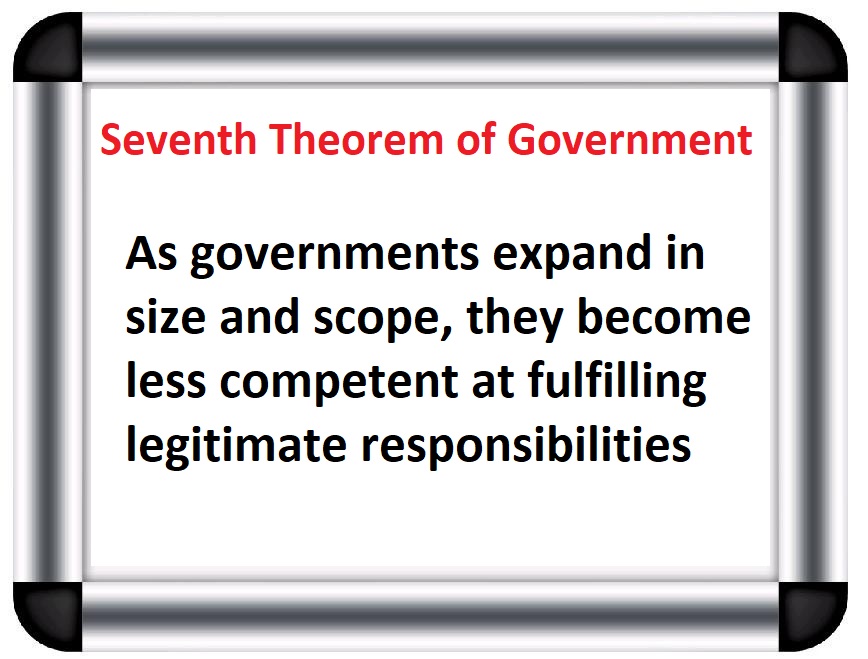
Indeed, this is the core message of my 7th Theorem of Government.

Simply stated, when politicians expand the size and scope of government, that increases the likelihood that there won’t be energy, expertise, or resources to address problems where government should play a role.

This is true in the United States. And it’s true in other nations.

That’s not merely me being an ideologue. There’s plenty of academic evidence showing that smaller governments are more competent.

Let’s expand on that argument. The U.K.-based Economist has an article that summarizes the insight of the 7th Theorem. Here are some excerpts.


You may sense that governments are not as competent as they once were. …A flagship plan to expand access to fast broadband for rural Americans has so far helped precisely no one. Britain’s National Health Service soaks up ever more money, and provides ever worse care. …

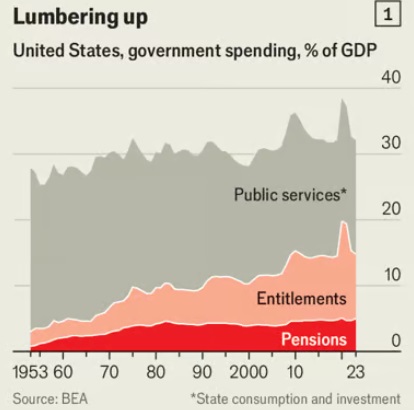
You may also have noticed that governments are bigger than they once were. Whereas in 1960 state spending across the rich world was equal to 30% of GDP, now it is above 40%. …All of which raises a paradox: if governments are so big, why are they so ineffective? The answer is that they have turned into what can be called “Lumbering Leviathans”. …governments have overseen an enormous expansion in spending on entitlements. …

On average across the OECD, social expenditure in countries with available data rose from 14% of GDP in 1980 to 21% in 2022. …Leviathans may not remain lumbering for ever. Running large deficits in order to fund transfer payments will, eventually, become too expensive—as countries such as Greece and Italy discovered in the 2010s.

I have two comments about the article.

First, I was initially tempted to simply write a column with a snarky title such as “Most Accurate Headline, Ever.”

Second, the article raises an important issue, but the Economist (as you might suspect) got some things wrong. It wants readers to think that the problem is that “redistribution is crowding out spending on other functions of government” and that politicians “fail to raise revenues.”


Since tax revenues are at or near record highs in almost all nations, there’s no need to waste any space on that issue.

With regards to the “crowding out” assertion, the Economist uses this chart of US data to claim that non-entitlement spending “has crashed” from 25 percent of GDP to 15 percent of GDP.

What the article doesn’t tell readers, however, is that this drop is mostly because defense budgets now consume a smaller share of economic output.

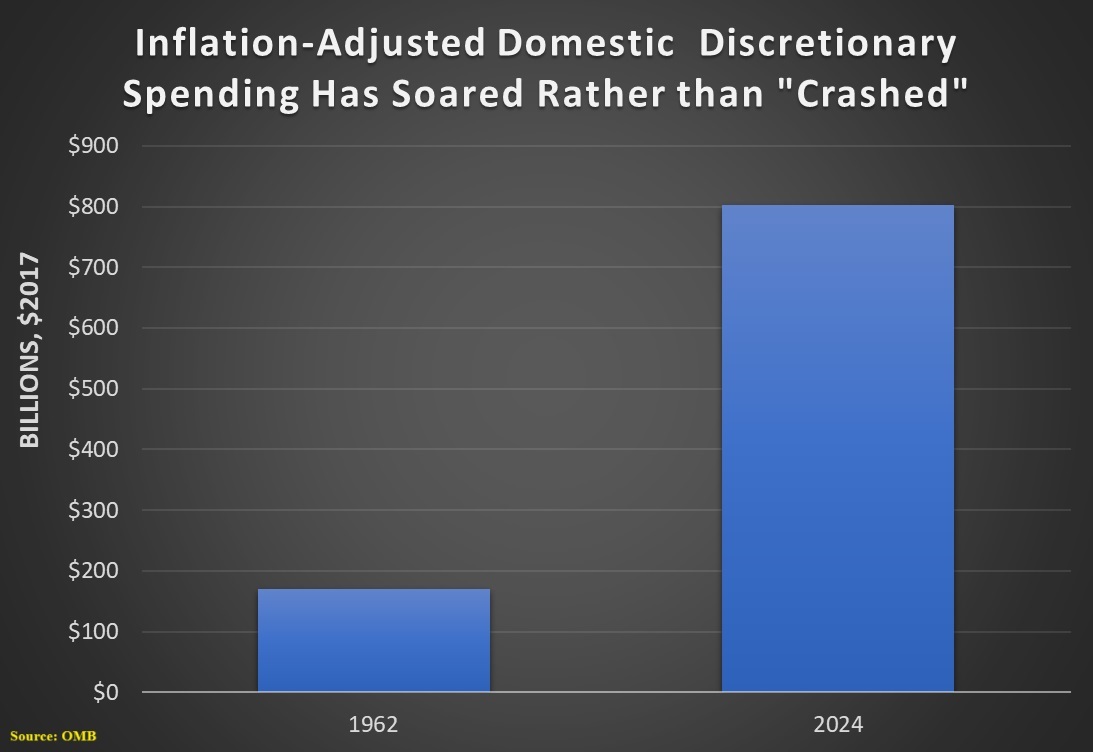
Moreover, the article fails to point out that inflation-adjusted non-entitlement spending has increased significantly.

The Office of Management and Budget has detailed data going back to 1962 for domestic discretionary spending. This is the type of spending (not Social Security or other entitlements) that has been slashed according to the article.

But here’s what actually happened. As you can see, outlays for this type of spending have jumped by more than 400 percent. And it would be an even bigger jump if we had data going back to the early 1950s.

If this is crashing, I hope my household budget crashes to the same degree.

On a more serious note, the article is correct in that United States (and other nations) have a major problem with entitlement spending.

But the Economist is wildly wrong when it argues that nations need more non-entitlement spending. What’s actually needed is rigorous spending caps.


Friday, June 14, 2024

A Preview On Some Of The New York Energy Impossibility

@ Manhattan Contrarian

Dr. Benny Peiser and I have now begun our 2024 GWPF U.S. speaking tour. Yesterday we appeared for an event at the Texas Public Policy Foundation in Austin, Texas. Between in person and online, we understand that over 400 people attended the event. (I believe that video of this event will be posted at some point on the TPPF website, but I don’t find it there yet.). Tonight we will be speaking at the 3 West Club, 3 West 51st St. in New York City, at 6 PM.

As mentioned previously in my post two weeks ago announcing tonight’s event, the title is “Europe’s Net Zero rebellion, European elections, and the coming U.S. reckoning.” Benny will cover the European piece of the subject matter, while I am taking on the “coming U.S. reckoning.” I’ll give you here a brief preview to whet your appetite.

The reason I use the term “reckoning” is that people in positions of authority, who have no idea what they are doing, in their zeal to eliminate “carbon emissions,” have set up mandates and goals that are completely irreconcilable. As a matter of physics or economics or both, the things that have been mandated to occur cannot all be accomplished at the same time, let alone within the time frames specified, or at anything close to affordable cost. Some time soon, a reckoning is inevitable.

Many examples of the irreconcilability can be cited, both at the federal level and among blue states that have eagerly sought the mantle of “climate leader” without ever doing even a cursory investigation of feasibility. For this preview I’ll focus on one particular example: the mandates in New York that dispatchable natural gas power plants be closed at the same time that demand on the grid dramatically increases from simultaneous mandates for electric cars and electric building heat.

New York has multiple agencies involved in the supposed energy transition. A Climate Action Council, plus an agency called NYSERDA (New York State Energy Research and Development Agency) actively promote the development of wind and solar generators as the wave of the future, without knowing or caring how it will all work. Then there is the New York Independent System Operator, NYISO, that is responsible for making sure that the grid works. NYISO knows full well that the various mandates cannot be achieved simultaneously, but they also recognize that that view is not in favor politically at the moment. So NYISO puts out documents that seem on their face to be saying that everything is fine; but if you read between the lines, you realize that they are sounding the alarm.

Here is NYISO’s document called the “2023-2032 Comprehensive Reliability Plan,” issued November 28, 2023. Read it without a skeptical eye, and you might come away at first thinking that all is well, or at least close to it. Phrases like “meets all currently applicable reliability criteria . . .” are sprinkled around. Yes, there are references to things like “a variety of risk factors to the long-term plan,” and the possible need to keep some natural gas peaker plants around longer than might be hoped, but that is only “as a last resort,” and only until some “permanent solution” is in place.

We then come to the following chart, presented at page 6 with little comment. Oh wait, it shows a big drop in “existing supply” in 2025 — next year — due to the forced closure of some of these natural gas plants, and expected demand then being right in the middle of a part of the bar labeled “deficiency.” That’s rather soon. Oh, it seems that (after this document was issued) they have just delayed the closure of those natural gas plants. Crisis averted, for the moment. Then in 2026 there is an addition to supply, shown in blue, representing the opening of a new transmission line to import hydro power from Quebec. But that’s only about 1 GW of additional capacity, out of 11+ GW of so of peak demand. By 2031, we are back to projected deficiency, which becomes more serious every year — and could be much larger depending on how fast demand grows with all those new mandates.


But the killer is the supposed “long term solution.” You have to get all the way to page 52 to find out that they have no idea what that might be, and even then it is written in code:

With high penetration of renewable intermittent resources, DEFRs are needed to balance intermittent supply with demand. Resources with these characteristics must be significant in capacity. . . .”

“DEFRs”? What are those? They are the elusive “Dispatchable Emissions-Free Resources.” Just like fossil fuel plants, they can be turned on and off on command to meet demand, but they make no carbon emissions. Voilà — problem solved! Oh, wait — if such a thing existed, wouldn’t we be using it already?

Although they never say it in quite these words, the entire plan post-2030 relies on something that has not yet been invented or deployed at scale. What might it be? Nuclear? That is completely blocked in New York by a hostile political and regulatory environment, and would take at least 15 years to deploy if we started on a crash program today. 

“Green” hydrogen? 

That costs something like 20 to 50 times what natural gas costs, and would require an entire new infrastructure of production facilities, pipelines, and power plants, none of which exists or is under construction or even in a serious planning stage. 

Batteries? 

Batteries just to get through one calm night (16 hours) would cost about the same as the entire New York State annual budget. Batteries to be sufficient to provide full back-up to a grid without fossil fuels (500 - 1000 hours of average usage) would cost a multiple of New York’s entire GDP.

So in fact, there is no real plan. You can see New York hitting the wall in that chart. The mandates are in place. We march forward, until we can’t any more.

Friday, April 5, 2024

In One Story, Everything You Need to Know About Washington Waste and Incompetence

March 30, 2024 by Dan Mitchell @ International Liberty

The burden of government is expanding because of Joe Biden’s three most-notable legislative “accomplishments.”


Today, let’s focus on the third item so we can remind ourselves that government is inefficient and incompetent.

And we’ll focus specifically on Biden’s push for more electric vehicles. The President wants to encourage consumers to transition away from the internal combustion engine, so his legislation has big subsidies for more electric charging stations.

How’s that working out?

Just as you might suspect. Here are some excerpts from Shannon Osaka’s report in the Washington Post.


President Biden has long vowed to build 500,000 electric vehicle charging stations in the United States by 2030. …But now, more than two years after Congress allocated $7.5 billion to help build out those stations, only 7 EV charging stations are operational across four states. …

$5 billion was allocated to individual states in so-called “formula funding” to build a network of fast chargers along major highways… But after two years, that program has only delivered 7 open charging stations with a total of 38 spots where drivers can charge their vehicles… requirements…slow down the build-out of the chargers. “This funding comes with dozens of rules and requirements,” Laska said.

Since the article does not specify how much money has been spent so far, we don’t know the per-station cost, but it surely will be enormous.

To be fair, the per-station cost presumably will decline over time, but I’m sure it won’t be anywhere as low as the cost of private charting stations.

And the article notes that Tesla is doing a much better job than the klutzes in Washington.

The United States currently has close to 10,000 “fast” charging stations in the country, of which over 2,000 are Tesla Superchargers, according to the Department of Energy. Tesla Superchargers — some of which have been opened to drivers of other vehicles — are the most reliable fast-charging systems in the country.

So what’s the moral of the story? Maybe, just maybe, we should let market forces rather than a “green new deal” determine the number of charging stations.

P.S. Absurdly expensive charging stations are bad, but the behavior of electric-vehicle-promoting politicians is worse.


Thursday, April 4, 2024

Blame Government, Not Free Enterprise

April 3, 2024 by Dan Mitchell @ International Liberty

In 2021, I shared a cartoon strip about a worker blaming capitalism after losing his job following an increase in the minimum wage.

One month ago, I shared a meme with a similar message. It showed the European Central Bank investigating supposedly mysterious price increases when the ECB’s bad monetary policy obviously deserves the blame.

(A similar meme was used in a different column in 2021 about higher minimum wages.)

Today, let’s look at another example of free enterprise being blamed for problems caused by government.

Heather Long of the Washington Post opines about young people not being big fans of free markets. Here’s some of what she wrote.


…why Americans under 40 are so disillusioned with capitalism. …Young people in America have come of age during the Great Recession, the sluggish recovery that followed and then the coronavirus pandemic. Unemployment has been 10 percent or higher twice in the past 15 years. …shore up Social Security. …Young people have seen the headlines that, if nothing changes, Social Security will start having to reduce benefits in 2034. …a better way to ensure that Social Security will be there for younger generations is to raise taxes slightly on corporations and the wealthy. …Young Americans have had a harsh introduction to capitalism. …a wise place to start would be to give workers a secure retirement again, starting with Social Security.

There are two major flaws in her analysis.

First, the 2008 financial crisis was not the fault of capitalism. It was bad monetary policy and foolish Fannie Mae/Freddie Mac subsidies. And while I don’t particularly blame government for the pandemic, it also would be absurd to blame capitalism for the accompanying economic troubles.

Second, it’s even more absurd to assert that Social Security is good for young people. Those are the people who are getting a terrible deal from the program. And even if young people aren’t directly hit by the author’s proposed tax increases, they will indirectly suffer as the economy gets weaker.

Since Ms. Long was writing an opinion column, I reckon we can’t say that her piece is an example of media bias. But she deserves a booby prize for poor analysis.

Thursday, March 14, 2024

The Difference Between Genius and Stupid is Genius Has it's Limits - Albert Einstein

By Rich Kozlovich

I'm not all that big a fan of videos discussing major social issues. I prefer written information for a couple of reason.   I read so much I have a good idea of what going to be said, and I scan really well, missing little.

As a result I can quickly find the gold nuggets of information easily and quickly.  With videos, I have to sit through the whole spiel to find a nugget of gold, and often times, there aren't any.  And, while I have watched some really excellent analysts, most of the time I find they're just boring time wasting entertainers pretending to be journalists and analysts.

But today I received a TikTok video via e-mail from a friend I thought was really worthwhile. This is a bit dated as it goes back to 2022, and some of the information is reflective of that time frame.  I'm not exactly sure who originated this but it appears this was on TikTok by the1sassynana Donna DeLong Matthews DDM, who seems to have a lot of these things, some of them "violating their community standards",  including this video, and removed. Imagine that!

So I can't link it, and I also don't how it could be reproduced and sent to me, but it has.  Also, I didn't research the information regarding Walmart, but I'm willing to bet most of that information, if not all, is correct. 

Here's my conversion from video to print, the cartoon was added in my monologue.

  • Americans spend 36 billion dollars at Walmart in every hour of every day. That works out to 29,929 dollars profit every minute.
  • Walmart will sell more from January one to St. Patrick’s Day on March 17th than Target sells all year.
  • Walmart is bigger than Home Depot, Kroger, Target, Sears, Costco, and Kmart combined.
  • Walmart employs 1.6 million people the world’s largest private employer and most speak English.
  • Walmart is the largest company in the history of the world.
  • Walmart sells more food than Kroger and Safeway. combined, and keep in mind, they did all this in only 15 years.
  • During this time 31 supermarket chains sought bankruptcy.
  • Walmart now sells more food than any other store in the world.
  • Walmart now has 3900 stores in the USA of which 1906 are super centers, this is one thousand more than they had five years ago.
  • This year 7.2 billion purchasing experiences will occur at Walmart, the Earth’s population is 6.5 billion.
  • Ninety percent of all Americans live within fifteen miles of Walmart.

You may think I’m complaining, but I’m merely laying the groundwork for suggesting we should hire the guys who run Walmart to fix the U.S. economy. This should be heard and understood by all Americans, Democrats, Republicans, and Independents, everyone! 

To all 435 members of Congress, and the 100 members of the Senate, the majority of you are corrupt morons. Consider your record and reflect on your performance:

  • The U.S. Postal Service was established in 1775. You’ve had 247 years to get it right and It’s broke. Stamps cost 53 cents and may be going up in November to 66.
  • Social Security established in 1935. You’ve had 87 years to get it right, and it’s broke.
  • Fannie Mae was established in 1938, and it’s broke.
  • The war on poverty started in 1964, you’ve had 58 years go get it right. It never went anywhere and you stole from our Social Security Fund as one trillion dollars of our money is confiscated every year to transfer to the poor, and you want more.
  • Medicare and Medicaid was established in 1965. You’ve had 57 years to get it right, and they’re broke.
  • Freddie Mac was established in 1970. You’ve had 52 years go get it right and it’s broke.
  • The Department of Energy was created in 1977 to lesson our independence on foreign oil. It has now ballooned to 16,000 employees, with a budget of 24 billion dollars a year and we’re importing more oil than ever. You’ve had 45 years to get it right and it’s an abysmal failure.
  • You have failed in every government service you’ve shoved down our thoughts while over spending our tax dollars. 

We have a President who has 36 years as a U.S. Senator, and eight years as Vice President. A President who promised to build back better. Our current President is the epitome of a corrupt career politician. We elected an immoral, unethical free loader that never had a plan except to live on the public dole. A scoundrel who bends to the wave of political whims, who can’t even finish a sentence without losing his train of thought. 

And you want Americans to believe you can be trusted with a government run anything. 

Folks, keep this circulating maybe it will end up in the e-mails of elected officials. They never read anything, but maybe their staff will clue them in on how Americans feel. If you don’t think we don’t need to drain the swamp then you just don’t think. And please try to understand just what’s wrong. We have lost our minds on career politicians and political correctness. Someone please tell me what the hell is wrong with the people who run this country. 

We’re out begging Venezuela for oil, we’re broke, we can’t help our own seniors, veterans, orphans, or homeless. While in the last months we have provided aid to Haiti, Chili, Turkey, and we’re funding the world climate change, and now NATO, Afghanistan, Ukraine, Pakistan, previous home of Osama bin Laden, literally billions of dollars. 

Our retired seniors living on a fixed income receive no aid as our Southern border is overrun by illegals. America, where we have homeless without shelter, children going to bed hungry, elderly going without needed meds and many go without treatment. We can’t take proper care of our citizens while our illegals get everything free. They’re put up in hotels, they have free meals, health care, cash. Imagine if the government gave us the same support they’re give to illegals and other countries. 

Albert Einstein once said the difference between genius and stupid is genius has it’s limits. 

Updates:  I thought it would be a good idea to add appropriate links:


Monday, November 27, 2023

The Dissident's Guide to Philanthropy

How to give money and keep your integrity in the 2020s.

Joe Lonsdale Apr 9, 2023 @ Joe Lonsdale 

The word philanthropy comes to English from the Greek φιλανθρωπία (philanthrōpía). The word has two roots: phil[os] — to have an affinity for or to love — and anthrōpos — mankind. Together, they form philanthropy, or “love of mankind.” And that’s what philanthropy is supposed to be about, as opposed to, say, Phillipos, phil-hippos (horses): Philip, a man who loves horses.

Today, most of the Phil's I know do not love horses; but more troubling, most “philanthropists” have inverted the meaning of philanthropy, from “love of mankind” to “loved by mankind.” In other words, in our culture a lot of philanthropy has become a virtue signal, a way to cynically seek attention and love from others, rather than to love others. Philanthropy-turned-virtue-signal lacks virtue. And further: because what is popular and trendy has many others working on it, and whatever is broken tends to be marred by special interests or taboos, this decayed form of charity tends to miss the biggest areas of need where philanthropy can make a real difference. 

The problem has been brewing for years, but feels especially acute in the 2020's: in the United States in the past, for example the mid-to-late 20th century, when many institutions were fundamentally sound, you could do basic philanthropy and sometimes fix things around the edges and be rightly applauded for it. When most institutions are aligned with society, you can give money to them, take the nameplate on a building or program, feel loved by your fellow man and have done some good, and call it a day.

But when there’s incontrovertible evidence that things are deeply broken in society, you have to fix the broken things. Anything else has a massive opportunity cost. Today, “around the edges” philanthropy or institutional vanity philanthropy — with some exceptions — have the simple and destructive effect of subsidizing dysfunction. 

We can call the two sides of this framework subsidy-philanthropy versus solution-philanthropy. Here are a few examples.

  • Instead of philanthropy that works to confront the conditions and policies that lead to drug addiction and street homelessness, people pay for the needles and tents. As the problem worsens, the charity costs more and more.

  • Instead of philanthropy that confronts the decadent leadership and thousands of unnecessary ideological administrators in our universities, people endow new scholarships to “help” the students as costs explode and results decline. 

  • Instead of philanthropy that upends bad public monopolies like in healthcare and prisons, people give money to nonprofits that cozy up to those monopolies, hoping for access and name-recognition.

Subsidy-philanthropy is based on the premise that more money going in will improve a system or process. For a broken system, this is totally incorrect.

Mackenzie Scott — the ex-wife of Amazon founder Jeff Bezos — has given away vast sums of her post-divorce fortune rather injudiciously. In 2020 and 2021, she became the nation’s main funder of so-called “racial equality” causes, to the tune of more than a billion dollars. In many cases, that meant giving huge checks to a bevy of organizations without commensurate scrutiny.

Peter Savodnik reported in The Free Press about the results of the dubiously-given check at a small college in the throes of the 2020 “racial reckoning.” 

Faculty say morale is at an all-time low. “It feels a little like a banana republic,” one professor said. Every faculty member I spoke to asked that their departments not be revealed. There are only 100 professors at the college and, as one put it, “there’s no trust.”

…As for the Scott gift, “that secured her against criticism, against the board pushing back,” one professor said. “But it had nothing to do with what she had done. It had to do with her skin color and her gender. That’s it.”

This isn’t to pick on Mackenzie Bezos. She has given away more money — and faster — than just about anyone. The speed and scale are unconventional. But where I object is the extreme conventionality of the giving itself. Where is the energy to pursue solutions, to go after these problems at the root, rather than throw money at people?

Compare that with solution-philanthropy: by measuring recidivism and employment after incarceration, rewarding success, and holding underperforming programs accountable, we could lift up hundreds of thousands of lives and have a hugely positive impact on many communities in need. This would be a high-effort, high-effect form of philanthropy. To most, that is less attractive than low-effort, low-effect alternatives we see from hundreds of criminal justice groups. Why?

Well, the prison guards' unions are powerful and take courage to confront. Taboos take courage to confront. In a similar vein, the education leaders won’t give you an honorary doctorate for cutting waste and nonsense. The homeless activists will call you inhumane if you fight homelessness at the root, make government spending accountable to results, and put the activists out of a job. Lacking courage, and seeking easy approval without controversy or hard work, our society has made “charity” synonymous with pouring money into the organizations that make up the non-profit industrial complex.

This is where you come in. Entrepreneurs getting into philanthropy must ignore the “experts” and embrace their own entrepreneurial instincts, if they expect to see entrepreneurial-level results. We need entrepreneurial-level results! 

In business, great entrepreneurs know that the way to maximize their impact is to find a gap in the world. You win by identifying something that's broken, surrounding yourself with the smartest and hardest working people you can find, and motivating them to see what's possible and to solve the problem with you, with persistence over time in the face of challenges. To succeed, you must be drastically better than existing competitors, or do something new altogether. This entrepreneurial instinct has served many people well; unfortunately, most give it up as soon as it’s philanthropy and no longer “business.” 

Treating philanthropic work as if it’s a totally separate endeavor than entrepreneurship is a huge mistake. In reality, good entrepreneurship and good philanthropy come from the same place: how could the world work differently tomorrow than it does today? Which conventional thinking is wrong, and why is it wrong?

It's as if the sharpest business minds lose 30-40 IQ points — and lose their courage — as soon as they wade into philanthropy. That’s a tragedy, because the odds are strong that these people, who already proved they could transform the world once, could do it again. They could pursue an outcome a hundred times more impactful than the existing projects. But vanity and praise are strong drugs, and at a time when culture vilifies extreme success it’s not difficult to see why many successful people take the path of philanthropy-as-virtue-signal. 

There is a typical playbook: the founders surround themselves with people with whom they would never build a business. An old friend they trust, senior government bureaucrats, various academic “experts” — these are the standard people who build charities, so they must know something, right? No! In many cases those hired just one level down in the philanthropic organizations are the sort of employees a great entrepreneur would know to actively avoid if they were trying to build a company — those who are obsessed with social pathologies and identity politics, among other things. 

Entrepreneurial frameworks are powerful tools, like Phil Knight’s rules at Nike, which exemplified his legendary leadership.

  1. Our business is change. 

  2. We’re on offense. All the time. 

  3. Perfect results count -- not a perfect process. 

    Break the rules: fight the law. 

  4. This is as much about battle as about business. 

  5. Assume nothing. 

    Make sure people keep their promises. 

    Push yourselves push others. 

    Stretch the possible. 

  6. Live off the land

  7. Your job isn’t done until the job is done. 

  8. Dangers:

    Bureaucracy

    Personal ambition

    Energy takers vs. energy givers

    Knowing our weaknesses

    Don’t get too many things on the platter

  9. It won’t be pretty. 

  10. If we do the right things we’ll make money damn near automatic. 

The intellectual challenge is to reconcile those values — strong and clearly stated — with Knight giving $500 million to Stanford. Where is the battle? Where is the rule breaking? Nowhere to be found; this is philanthropy, not business, so rules are to be followed. Adjusted for inflation, that $500 million is more than the total amount of money Leland Stanford Sr. gave to found his university in the late 19th century. Why have so few entrepreneur-philanthropists in the last century sought to create new institutions, rather than continue to endow the current ones? 

Based on dozens of examples I have seen, with a few notable exceptions, it appears to be very difficult for a person already in their late 70's or 80's to reorient themselves and their frameworks of how the world operates. This is problematic in part because a decent investor has tended to double their wealth every 5-7 years the past several decades; if you are 35 years older, you tend to have 32x to 128x as much wealth. And as the math suggests, this is the most influential demographic of philanthropists active today.

As challenges and institutional dysfunction mount, many entrepreneurs who formed their intellectual frameworks of the world in their youth — making up their minds in their 30's or 40's — struggle to challenge those assumptions about our institutions as they enter their 70's or 80's.  Those frameworks usually include things like giving to universities, to museums, to orchestras and operas, and the like. 

It is sadly the case that very few of the traditional institutions are safe giving targets, if you created wealth in your lifetime and your values mean anything to you. The universities are in many cases against independent thought; the museums have turned against our history; the musical institutions have embraced divisive racial politics.

Our philanthropists' frameworks and respect of these institutions were likely correct decades ago — when these institutions were more or less aligned with American values. But today many of these same cultural institutions are engaged in outright cultural destruction.

Elon Musk describes a similar problem: "If you care about the reality of doing good and not the perception of doing good, then it is very hard to give away money effectively. I care about reality. Perception be damned." My version of this dilemma would be the question: would you rather be liked, or fight for a better future?

Do you want the mainstream press to like you; or are you okay being "controversial", but achieving a meaningful impact on a huge number of lives?  To be loved, or to love mankind?

It sure seems like for many of the biggest money givers, the answer is to be loved. As noted above, Mackenzie Scott has given away more than just about anyone, and it resembles the giving of thousands of others. Does anyone believe that her giving will be memorable, say in a century, for its results? 

It might not make a difference to her whether her philanthropy has destructive cultural effects, given that the intent of the giving in the first place was likely to make a point – and to ride the wave of 2020 that saw all manner of people and organizations engage in extreme virtue signaling. At the height of that period in the summer of 2020, Scott herself wrote the following:

There’s no question in my mind that anyone’s personal wealth is the product of a collective effort, and of social structures which present opportunities to some people, and obstacles to countless others.

That seems to be the mindset: one of penance rather than altruism. And it seems to have "worked". The press doesn’t love Jeff Bezos, but they definitely love his ex-wife, who has given away more than ten billion dollars already and isn’t close to being done, all while implicitly apologizing for having come into the fortune. 

The sheer scale of this uncritical giving project is a tragedy, because philanthropy can and should be an important part of society, especially in helping the least well off. But the ideas promulgated by divisive, race-based charities are obviously not effective for advancing “racial justice.” And there isn’t any real discussion of the types of policy and cultural changes that would actually make lasting change for real people who are part of minority groups in the U.S.

On some level, if you actually believe that you’re fighting real problems, if you actually believe that a system is causing harm, then of course you’re going to be attacked. Of course the system's special interests will lash out at anyone who threatens to solve the problems. Those who are unaccountable or benefitting from dysfunction will hate you for doing the right thing. The simple corollary of this is that it should be hard to do real philanthropy while being lavishly praised for it. That the opposite is true speaks to just how far a lot of “Big Philanthropy” has fallen. It’s corporate, woke, mainstream, lame — and most of all, ineffective.

What we need is the courage to confront real problems; the courage to be disliked; and the courage to buck one’s own peer group, even when it stings — no, especially when it stings. That is the mark of the dissident philanthropist. And in today’s age, the dissident philanthropists tend to be the most effective.

If you want legacy institutions to praise you, try doing something worthless and status-quo instead. Don’t experiment at all. Don’t try things that are taboo and unacceptable to the people who define what counts as “philanthropy.”

The next generation of informed givers aren’t going to hand money over to far-left commissars running what should be neutral institutions like orchestras and universities as an activist organization. They will be assessing the real virtues of the philanthropies, and starting things themselves. So, my advice to the would-be philanthropists out there is as follows:

Be daring. Be entrepreneurial. Don’t obey arbitrary customs. Don’t work with people you wouldn’t have in your personal circle or your business. Let your values and integrity attract aligned allies. And when the special interests of the corrupt system show up to protest and scream at you, you might be onto something.

We don't create our top companies around political ideology, and it's also not a winning recipe for effective philanthropic organizations. Outside of religious groups and conservative intellectual outfits, the vast majority of people working full time in non-profits tend towards the left, which is not by itself a problem. But Michael Lind has written in Tablet about the fascinating anti-intellectual trend within much of the left-NGO complex. Why is it that every left-oriented charitable organization seems to have a full-blown political bent to it, indistinguishable from a party group?

“Who decides what is and is not permissible for American progressives to think or discuss or support? The answer is the Ford Foundation, the Open Society Institute, the Omidyar Network, and other donor foundations, an increasing number of which are funded by fortunes rooted in Silicon Valley. It is this donor elite, bound together by a set of common class prejudices and economic interests, on which most progressive media, think tanks, and advocacy groups depend for funding.”

Philanthropy certainly doesn’t need to be political in the opposite direction just because most left-wing philanthropy has abandoned intellectual freedom. But doing great work is very difficult in a poor intellectual environment dominated by rigid ideologies. Even many of my older friends who are moderates and believe in capitalism — people I respect — have generally let their foundations be conquered by ideologues from this class of people obsessed with identity politics and "the correct way to think". 

This creates a real opportunity for work that bucks trends and ignores the judgments of a stagnant political class. There is a huge gap of unexplored opportunity, and that should inspire us!  If we don't rely on "experts", and approach problems for ourselves, we can accomplish amazing things. The Ocean Cleanup is a fantastic example: built by engineers and entrepreneurs, backed by engineers and entrepreneurs, and immeasurably more effective than any environmental scheme dreamed up by an unimpressive bureaucrat or activist.

We can use the latest in technology to save thousands of children from trafficking and abuse. We can give directly to the poorest people in the world in effective ways. We can make sure that the poorest American children have the choice to go to better schools. Efforts like these bypass the “experts.”

Some of our thoughts on philanthropy are informed by our work with the Cicero Institute, which is having immense success making state governments more accountable — and dismantling the malign influence of crony businesses and NGOs. The rule that one must be willing to withstand vicious attacks from special interests and activists is one that my friends and I have learned from experience. But with strong values, an informed worldview, and a knowledge of what works, it is possible to use our wealth and influence to make a real difference and to help millions of people.

I hope you will take these frameworks and incorporate them into your own work. If it’s giving, think more critically; if it’s building an organization, be more entrepreneurial; and if you’re looking for efforts to work alongside and partner with, you know where to look.

So, the choice is up to you. What will you fight for? What are you willing to risk?  Each of us has to decide what we really care about and who we want to be. For me, believing in a higher power makes this choice easier, and I have always taken inspiration from the simple and beautiful Hebrew saying: תִּיקּוּן עוֹלָם — Tikkun Olam, ‘to repair the world.’ That is the mandate.
Monday, November 6, 2023

Another Italian Bureaucrat Joins the Hall of Fame

November 1, 2023 by Dan Mitchell @ International Liberty

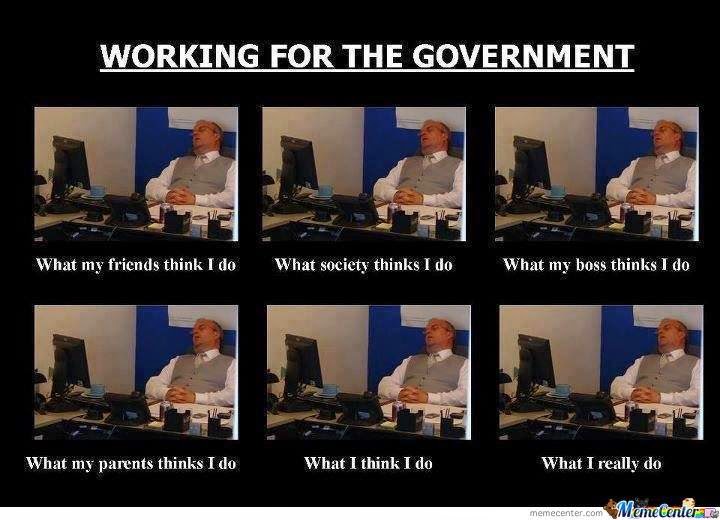
In 2014, I wrote about the Italian bureaucrat who worked only 15 days over a nine-year period.

 https://danieljmitchell.files.wordpress.com/2014/09/5828e-working2bfor2bthe2bgovt.jpg

Earlier this year, I wrote about the more industrious (relatively speaking, of course) Italian bureaucrat who worked four years over a 24-year period.

Both of these stellar public servants are now in my Bureaucrat Hall of Fame, which is an honor reserved for government employees who “have gone above and beyond the call of duty” to live “fat and happy at our expense.”

Today, we’re going to add another Italian to the Hall of Fame, meaning that Italy will be the first foreign nation with three representatives.

Congratulations to that nation’s lucky taxpayers!

Our recipient is Alberto Muraglia, who first became famous years ago for punching a time clock in his underwear and then heading home.

That’s remarkable, but not enough to become a member of the Hall of Fame. What makes Alberto special is that he then won two legal cases that confirmed his right to be a slacker.

I’m not joking. Here are some excerpts from a report in the U.K.-based Times.


Alberto Muraglia, 61, a police officer in Sanremo in northern Italy, became a symbol of Italy’s stereotypical skiving public servants in 2015 when he was caught in a corruption inquiry. After installing hidden cameras, investigators filmed him descending the steps from his service flat above his office in his Y-fronts and a T-shirt, clocking in, then returning home. …the police officer became an emblem of Italy’s battle against what it calls fannulloni, or good-for-nothing workers in council offices and government departments who are rarely at their desks. But when Muraglia was sacked, a court acquitted him in 2020 of the charge of defrauding the state of public funds, ruling that getting dressed in the morning is part and parcel of an employee’s official duties. …However, the town of Sanremo refused to give him his job back, prompting Muraglia to go back to court, where he won again this week. A judge ruled he should not only be re-employed but should receive back pay of €250,000, dating back to his sacking.

Way to go, Alberto!

Stories like this, as well as the many examples form the U.S. and other countries, should remind us that governments waste money wantonly and do not deserve even a single penny of additional tax revenue.

Especially since more revenue would simply encourage politicians to further increase the spending burden, meaning even more debt.


Monday, August 21, 2023

The Deadly Impact of Government Incompetence

August 21, 2023 by Dan Mitchell @ International Liberty

Mostly because politicians focus on the seen rather than the unseen , I’ve unfortunately had several reasons to write about government policies and premature death.


Today, we’re sadly going to add to this list.

Why? Because the Hawaii government’s short-sighted incompetence contributed to the deadly fire on the island of Maui.

The Wall Street Journal opined about its deadly blunders, most of which were driven by climate alarmism.


…one culprit that seems to be emerging is the tradeoff the local utility had to navigate between power grid safety and the government-mandated green energy transition. …If Hawaiian Electric’s lines did ignite the fires, it would echo the problems of PG&E, the California utility… What both utilities have in common is that they prioritized growing renewable power to meet government mandates over hardening their systems and reducing fire risk. In 2015 Hawaii lawmakers required that 100% of the state’s electricity come from renewable sources by 2045. …Every dollar the utility spent on subsidizing solar and connecting renewables to the grid was one less dollar available for strengthening equipment and removing combustible brush. …Not until last year did the utility seek state approval to raise rates for wildfire-safety improvements, which it still hasn’t received. …Grid upgrades to achieve the net-zero promised land will cost another $2.5 trillion by 2050, according to a Princeton University study. Something will invariably give. And as we’ve seen in California and Hawaii, it may be safety.

Politicians and bureaucrats also failed in other ways, as explained by Connor O’Keeffe in his column for the Mises Institute.


Human choices, land use, and government policies play a big role in how harmful hurricanes, tornadoes, earthquakes, flash floods, and wildfires are to the affected communities. …it’s becoming clear that government failure did much to make this disaster worse—and possibly even started it. While the so-called experts are blaming climate change—and in the process demanding that government grab even more power and authority ostensibly to someday give us better weather—the destructiveness of this fire was the product of an all-powerful and all-incompetent régime. …To review, a power company shielded from competition by the state placed electrical infrastructure among highly flammable state-owned grass fields above the historic city of Lahaina, which the government was twice warned were highly susceptible to fire. And once a fire broke out, a combination of defective water infrastructure, terrible communication by government officials, and only one escape route doomed the people of Lahaina to the worst wildfire experienced in this country in over a hundred years. This was government failure through and through.

In closing, government screwed up.

That being said, I’m not going to pretend to know what share of the blame should be assigned to politicians and bureaucrats.  After all, disasters happen and it may be impossible – or excessively costly – to preemptively deal with all contingencies.

But some humility and repentance by government officials would be a silver lining to this dark cloud. After all, I hope we can all agree that human lives matter more than the alarmism of left-environmentalists.


Tuesday, July 18, 2023

What Were Once Vices Are Now Habits

July 18, 2023 By Richard C. Lyons

I caught a song on the radio yesterday, from one of my favorite vinyl efforts by the Doobie Brothers, What Were Once Vices Are Now Habits. A great album, fitting for a generation that took to the vices of drinking and smoking cigarettes among other things… The same generation found such habits are hazardous for one’s health, and are a lot harder to get rid of than they were to attain. Governments are like the people who compose them, they are subject to bad vice and habits

Our federal government has had a certain vice for over a century now, since Theodore Roosevelt broke Standard Oil and Woodrow Wilson created the Federal Reserve, our government has invaded our once “free enterprise” system with consistently disastrous results. For instance...... our federal government invaded the health care sector through the Social Security Act, creating Medicare and Medicaid; and has since been on the march to nationalize the whole industry. At every step of the takeover, government interference has meant skyrocketing healthcare costs. At every step, this takeover has meant much higher taxes for taxpayers.  Both higher prices and higher taxes are direct consequences of the growing government bureaucratic “control” of America’s healthcare sector.

As a matter of habit, the Administrative State formed Fanny and Freddie Mac, the mortgage giants which now underwrite 90% of all home mortgages in America. This government interference in our once free enterprise system first led to skyrocketing home prices, then it led to the housing and stock market crash of 2008.  Today, the government “commands and controls” 100% of the home mortgage market............To Read More...

Monday, July 10, 2023

Great Moments in Foreign Government

 July 7, 2023 by Dan Mitchell @ International LIberty

I have a series of columns analyzing “Great Moments in Foreign Government” to show that other countries have politicians and bureaucrats who are just as foolish as their American counterparts.

I guess this is the policy version of “misery loves company.” And it’s also a source of horror and/or amusement.

So let’s update our collection.

An Italian man learned that good deeds get punished. At least they get punished when you expose the sloth and inefficiency that seems to be an inherent feature of government.

Here are some excerpts from a report in the U.K.-based Guardian.


Claudio Trenta was so frustrated by the local council’s failure to repair the 30cm pothole on a pedestrian crossing in Barlassina, a small town in Lombardy, that the 72-year-old decided to take action himself by filling it… This led to a fine of €882… He was fined for carrying out a potentially dangerous job in a public space without permission or the competence to do so. Trenta has been ordered to restore the hole to its original state. …Trenta, who says he reported the pothole to the local authority several times over three months, has received a wave of solidarity from across Italy.

Now let’s visit France, where the health care system is sometime bad for the living.

But, as the New York Times reports, it’s also sometimes bad for the dead.


…when Sandra Lambryczak’s 80-year-old mother died…in the predawn hours of a Saturday morning, the daughter suddenly discovered a growing problem in France’s medical system: By law, the body couldn’t be moved until the death was certified by a medical doctor, but a shortage of personnel can sometimes force families to keep their deceased loved ones at home for hours or even days. …She turned off the heaters and flung open the windows. …half a day later, after her mother’s nurse was able to locate her personal physician, was the body allowed to be taken to the funeral home. …Such agonizing waits have been occurring with increasing frequency… Exasperated, one town issued a bylaw forbidding its residents to die at home. …In France, the state’s role in regulating people’s daily lives — including in matters of health — remains strong.

Forbidding residents to die at home?!? Maybe the death penalty could act as a deterrent?

Last but not least, here’s a mind-boggling story from the Daily News about Canada.

The College of Dental Hygienists of Ontario stripped a hygienist of his license and labeled him a sex offender because he had a sexual relationship with a client. It didn’t matter that the client was his wife.


Alexandru Tanase, of Guelph, confessed to cleaning the teeth of Sandi Mullins when on several occasions between April 2015 and August 2016, according to the Canada’s CTV news. They were engaged when the treatments started and are now married. …The Canadian hygienist, who said he’s been licensed since 2000, claimed he began booking his wife for cleanings in 2015 after erroneously believing a bill allowing dentists to perform dental work on their significant others also applied to hygienists. …Tanase…wants to change the 26-year-old statute forbidding hygienists from providing oral hygiene services to their spouses.

I can’t resist wondering why there is a decades-old statute prohibiting hygienists from servicing their spouses? Most laws are enacted because some interest group gets in bed with a politician in hopes of obtaining undeserved benefits.

But I can’t figure out the “public choice” angle in this case.

Wednesday, May 31, 2023

Bureaucrats Completely Incapable Of Making Reasonable Trade-Offs

May 29, 2023 @ Manhattan Contrarian

In economic life, trade-offs are a constant issue for everybody. Maybe you want to buy some better clothes, so you decide to economize on groceries. Or you postpone upgrading the bathroom because the kitchen needs upgrading first. Or you skip a vacation this year in order to buy a new car. Everything you buy means something else you can’t buy, so every buying decision necessarily involves trade-offs. And the same principle applies to use of your time: every hour you spend on one thing you can’t spend on something else. Learn Spanish this year, or train for the marathon — you’ll never find time for both.

Government faces the same necessity for trade-offs, but unfortunately is subject to bad incentives that often render the making of reasonable trade-offs next to impossible. The government is divided into siloed bureaucracies, each of which thinks its own area is the most important. Nowhere is this phenomenon more pronounced than in the environmental bureaucracies, which include not only EPA but also big swaths of places like the Departments of Energy and the Interior. These bureaucracies are staffed by environmental zealots bent on saving the planet, and they find the whole concept of trade-offs abhorrent. How about things like the prosperity of the people, or human convenience, or comfort? Somehow those things don’t count for anything to the environmental functionary.

This phenomenon of inability to make remotely reasonable trade-offs has been on full display in some of the environmental news of the past couple of weeks.

Take as one example the new dishwasher rule, announced on May 5. This one comes from the Department of Energy. It imposes on dishwasher manufacturers what they call “new standards for water and energy efficiency.” In the press release, the main sales pitch to the people is that this is going to save you money — lots of money — along with reducing “carbon emissions” and “saving water.”:

DOE expects the new rule to save consumers nearly $3 billion in utility bill savings over the ensuing 30 years of shipments and reduce carbon dioxide emissions by 12.5 million metric tons—an amount roughly equivalent to the combined annual emissions of 1.6 million homes. DOE also expects the new rule to save 240 billion gallons of water, which is equivalent to the water in 360,000 Olympic-sized pools. 

$3 billion — that’s a lot of money! Actually, not. It’s $3 billion over 30 years, or $100 million per year. There are 123 million households in the U.S., so this is well less than one dollar per year per household. Similarly, the supposed CO2 emissions reductions are less than trivial: 12.5 million metric tons over 30 years is 417,000 metric tons per year. That compares to some 6.34 billion metric tons of emissions for the U.S. in 2021, and 37.12 billion metric tons for the world. So the reduction in CO2 emissions, if actually achieved, would be 0.0066% of U.S. emissions, or 0.0012% of world emissions. But wasn’t U.S. electricity production supposed to be carbon free by 10 years from now? If so most of the supposed emissions reductions from more efficient dishwashers will never happen.

Meanwhile, everyone has noticed that prior Department of Energy energy and water efficiency standards for dishwashers have had the effect of making them run much longer and not get the dishes clean. The new standards, requiring the use of even less water and electricity to wash the dishes, can only make things worse. All to save less than a dollar a year? Almost everybody would gladly pay an extra dollar per year — or maybe even five — for a dishwasher that actually worked. Why can’t we have that option? Because the environmental crazies at the DOE couldn’t care less about making you waste your time pre-washing dishes or waiting for an endless cycle to end before you have the dishes to cook dinner.

On a much grander scale, consider the rule with the title “Multi-Pollutant Emissions Standards for Model Years 2027 and Later Light-Duty and Medium-Duty Vehicles,” also published on May 5. This one comes from EPA. It is the rule that effectively requires the phase-out of gasoline-powered cars by about 2032, in favor of electric vehicles.

The success of gasoline-powered vehicles in the marketplace up to the present has been the result of multitudes of trade-offs made by the consumers for their own benefit. These trade-offs include things like: the initial cost of the new vehicle, the range of the vehicle on a single fueling, how long it takes to re-fuel, how easy and costly it is to repair the vehicle if damaged, how much value the vehicle retains for re-sale, how difficult or dangerous it is to store the vehicle, and many other such factors.

Well, now EPA has decided, on its own authority, that none of those things is as important as the one thing they focus on, which is CO2 emissions from the vehicle while in operation. Note that emissions from the vehicle while in operation is not at all the same thing as lifetime emissions from the vehicle, which include both emissions from the mining and manufacturing to make the vehicle, and also, in the case of EVs, emissions from the sources used to generate the electricity to run the vehicle, which are majority fossil fuels in most cases and will continue to be so for the foreseeable future.

Where in a sane world there are many important trade-offs to be made in deciding what type of vehicle to use, EPA never even gets to that issue. Their sole focus is reducing carbon emissions. If that means that you must spend double for a vehicle, or spend hours per day at a charging station, or risk having your vehicle spontaneously catch fire in the garage and burn down the house, that is not important to them.

What are the chances that an EPA or a Department of Energy could ever by regulation make trade-offs on important issues like these that actually make sense for consumers to advance their welfare? About zero. They’ve got a sole focus, and if that means destroying your lifestyle, they are only too glad to do it.

Wednesday, May 10, 2023

Get Government Out of Education

May 10, 2023 By Griff Hogan

Our public education system is failing in its two most important functions: giving children the basic academic skills they need in life, and fostering the common values that allow our country to continue as a civilized republic.  Students are underachieving at unprecedented levels.  Teachers are prohibited from teaching basic moral values, or covertly teaching values that are anathema to most Americans.   In Chicago, a recent study revealed that not a single student can read at their respective grade level in 30 district schools; in math no student is proficient in 53 schools.  In  23 Baltimore elementary schools, not one student was found to be proficient in math.  The problem is nationwide and the answer isn’t money.  Some of the most expensive school districts in the nation, such as Chicago, and Baltimore, are some of the worst..........To Read More....


Wednesday, April 26, 2023

Your Taxes At Work: ‘Eco-Anxiety’ Counseling For Federal Workers – OpEd

 By April 26, 2023

Climate doomsayers and cancel culture work to justify counseling for bureaucrats’ climate grief

US Fish and Wildlife Service employees are struggling to cope with feelings of trauma and loss over the world’s changing climates and imperiled environments. Their work repeatedly confronts them with ecological changes, but even a sense of “anticipated loss” perhaps decades from now requires compassionate help. Or so the FWS and American Psychological Association tell us.

The FWS is thus offering paid leave to employees who attend “eco-anxiety” and “climate grief” training. When the House Natural Resources Committee called the sessions a colossal waste of money, the agency downplayed their cost and scope. But naturally the “woke” programs don’t end there.

FWS Director Martha Williams is also pushing diversity-equity-inclusion-LBGTQ programs as the agency’s “number one priority” (or perhaps number two, after climate change). Employees can take as much paid time off as needed for DEI and “gay pride” programs and eco-anguish counseling.

There’s no word about programs to help employees deal with widespread habitat and wildlife destruction that will result from millions of wind turbines, billions of solar panels and tens of thousands of miles of new transmission lines, due to “net zero” policies implemented in the name of averting the “climate crisis.” Apparently no programs offer paid leave to participate in “conservative pride” campaigns or study Earth’s historic ice ages, warm periods, little ice ages and decades-long droughts.

That’s hardly surprising. The FWS and Interior Department were getting eco-centric and anti-fossil-fuel when I worked there 35 years ago. Like American and Western society in general, their culture has simply gotten more noticeably and intolerantly devoted to extreme environmentalist agendas since then.

Movies, television and news stories, constant instruction in what to think, rather than how to think, an absence of religion and ethics in many schools and homes, and incessant themes of inequality, victimhood and global doom foster widespread tension, anxiety and depression. They leave too many children, teens and adults unable to cope with life and setbacks, less respectful of authority and human life, inured to violence, and aggressively intolerant of opinions that differ from their own ideologies and agendas.

Even before they were forced to endure Covid-induced lockdowns, nearly 20% of Americans were taking antidepressants and other psychiatric drugs, some linked to precipitating acts of violence; a third of high school students experienced prolonged anxiety, depression and hopelessness; and almost one in five teenagers had contemplated suicide.

Social isolation, minimal physical and outdoor activity, video games and reading self-selected online media have amplified depression and “chronic incapacitating mental illness” in America and many Western countries. Also hardly surprising, the problems are increasingly blamed on climate change.

Climate grief is real,” self-proclaimed experts insist, and it’s spreading rapidly among young people. “The future is frightening,” 77% of 10,000 young people ages 16-25 from the USA and other countries told “climate anxiety” and “climate depression” investigators. Many children have climate nightmares.

“The climate mental health crisis” already affects people who have “lost everything in worsening climate infernos,” claims a NASA scientist and climate activist who’s certain we face “the end of life on Earth as we know it.” He’s not alone in being convinced that every extreme weather event and ecological calamity today is due to or made worse by fossil fuel and agricultural emissions.

“I don’t want to be alive anymore,” wailed a four-year-old who’s clearly been indoctrinated already. “The animals are all going to die, and I don’t want to be here when all the animals are dead.”

Parents fantasize about killing their children, over fears of a “climate-ravaged future.” Parents, teens and even children increasingly consider suicide.

At least one psychologist has based his entire practice on addressing climate psychoses. The Climate Psychology Alliance provides an online directory of “climate-aware therapists,” and a “peer support network” offers grief therapy modeled on twelve-step drug addiction programs.

There’s only one real solution to this epidemic, other “experts” insist: Governments must “take action now” to “end the climate crisis,” to eliminate “the death knell of climate chaos” that threatens us. Otherwise the epidemic of anxiety, depression, pills, climate grief and suicide will steadily worsen.

This is nonsense, insanity. We don’t have a climate crisis. We have a climate fear-mongering crisis.

We don’t need to “fix” exaggerated and over-hyped climate problems. We need to end the junk science, the indoctrination dominating news stories and classroom discussions about energy and climate change, the censorship that prevents alternative, reality-based facts and voices from being heard, the massive government funding of one side of this crucial debate.

Claims of “unprecedented” temperatures and extreme weather, floods and droughts have no basis in real-world evidence. The “climate crisis” exists in greenhouse-gas-focused computer models, headlines and hype, not in reality.

There is no unprecedented upward trend in the frequency of violent US tornados, or US landfalling hurricanes, for example – though the 12-year absence of Category 3-5 hurricanes hitting the United States between Wilma (October 2005) and Harvey (August 2017) is an all-time record.

Unfortunately, viewpoints, evidence and experts challenging climate crisis claims are too often banished from school curricula, news and social media, and government policy discussions.

President Biden’s “national climate advisor” worked closely with Big Tech and news organizations, to suppress facts about climate change, fossil fuels, and the acreage, raw materials and mining required for wind, solar and battery power. Meta (Facebook), YouTube, pre-Musk Twitter and other companies routinely help to deplatform, demonetize and censor anyone contesting crisis-promoting claims.

The Intergovernmental Panel on Climate Change “summaries for policy makers” often misrepresent scientific findings and advance frightening but unsupported scenarios about Earth’s future climate. The IPCC also ignores studies that demonstrate how increased atmospheric carbon dioxide improves plant growth and wildlife habitats, how climate has changed repeatedly throughout Earth’s history, and that eliminating fossil fuels would result in extensive ecological damage from wind, solar, battery and transmission line mining and installations.

ChinaIndia and other countries are rapidly expanding their oil, gas and coal use, to improve their economies and lift billions out of poverty. China dominates raw material and “green tech” supply chains, making the West increasingly reliant on China for energy, economy and national defense needs – via Chinese mines, processing plants and factories that operate under minimal standards for pollution control, habitat destruction, and slave and child labor. As a result:

  • Nothing the United States, Europe, Canada and Australia do will have any effect on global fossil fuel use or greenhouse gas emissions.
  • Western foreign and domestic policy options will be restricted by reliance on adversarial nations for pseudo-renewable energy materials and technologies.
  • Prices for energy, goods and services will skyrocket, because every megawatt of wind and solar must be duplicated with backup batteries or generators.
  • Politicians and bureaucrats – egged on by loud, often violent mobs – will increasingly dictate our energy consumption, living standards, home sizes, vacations, and what we can eat, drink, drive and buy.

These are the real existential threats to democracy, society, humanity and planet. Parents, voters, legislators and judges concerned about our future must take action now to stop this insanity.

Paul Driessen

Paul Driessen is a senior fellow with the Committee For A Constructive Tomorrow and Center for the Defense of Free Enterprise, nonprofit public policy institutes that focus on energy, the environment, economic development and international affairs. During a 25-year career that included staff tenures with the United States Senate, Department of the Interior and an energy trade association, he has spoken and written frequently on energy and environmental policy, global climate change, corporate social responsibility and other topics. He’s also written articles and professional papers on marine life associated with oil platforms off the coasts of California and Louisiana – and produced a video documentary on the subject.