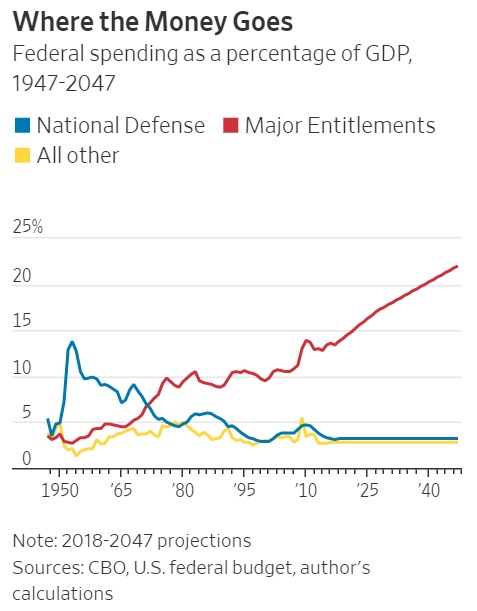
Search This Blog

De Omnibus Dubitandum - Lux Veritas

Showing posts with label SSI. Show all posts

Monday, October 21, 2024

Nation Has the Best Social Security/Pension System?

What nation has the world’s best tax policy?

There are relatively straightforward ways of answering that question, such as looking at the places (Cayman Islands, Bermuda, Monaco, etc) with no income tax.
https://freedomandprosperity.org/wp-content/uploads/2024/10/Oct-19-24-Ranking.jpg
If you focus on bigger nations, you can look at measures such as the Tax Foundation’s International Tax Competitiveness Index (in which case Estonia is in first place).

But what about picking the nation with the best pension system?

Nobody has ever tried to answer that question from a libertarian perspective. So when the Fraser Institute asked me to write a chapter for this year’s Economic Freedom of the World, I jumped at the opportunity to develop a methodology and then grade a sample of 20 nations.

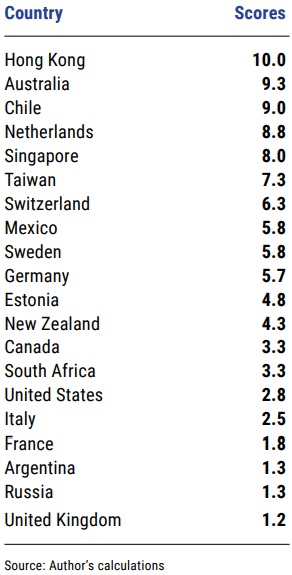
For readers who have faith in my analytical skills, I’ll lead with the headline results. As you can see, Hong Kong has the best system, followed by Australia and Chile.

None of those results are surprising, but how many people know that the Netherlands has a very good system? Or that Mexico has a decent approach?

Sadly, the United States is toward the bottom, though fortunately not in last place (interestingly, European nations generally score better than America).

So how did I put together this ranking? I open the chapter by explaining the problem and also what I wanted to accomplish.


Because of aging populations and falling birth rates, public pensions are an increasingly important policy issue. Most governments have some type of tax-and-transfer system, with payments to the elderly being financed by levies on workers. Such systems are mathematically feasible when there are lots of young people and relatively few retirees. But increasing lifespans and falling birthrates have changed that equation. As a result, many nations will soon face significant fiscal imbalances. Simply stated, current rates will not generate nearly enough revenue in the future to finance promised benefits.

Countries that figure out the best way of navigating this challenge will enjoy better economic outcomes compared to nations that either make bad policy choices or “kick the can down the road” and allow problems to fester. This chapter will analyze Social Security/pension-related systems, consider the costs and benefits of various policy options, and conclude by investigating the challenges of incorporating pension systems into the index published in the Economic Freedom of the World.

If you want a shortcut explanation of my methodology, here’s the pension spectrum I developed.

It shows different types of social Security systems, with the most statist approach on the left and the best approach is on the right, with various intermediate steps in the middle.
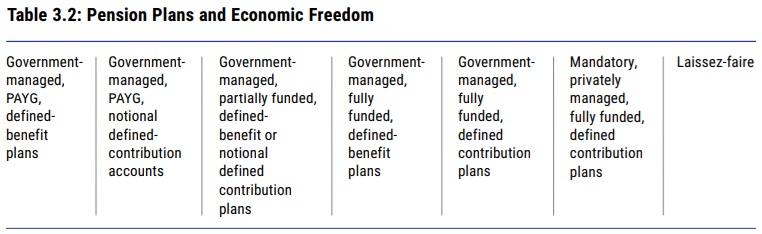
Here’s some of what I wrote about that methodology.

…a pure laissez-faire approach is the policy that maximizes economic freedom and thus would merit a perfect score. However, it seems that no nation is in this category. From a practical perspective, this means constructing a scoring system is an exercise in ranking options that range from second best to terrible. On this basis, the default option for the best score would then go to nations with retirement systems based on mandatory private savings. But there are many secondary questions that have to be answered. …A better score for nations that allow private management of investment rather than government control. …A better score for nations that choose defined contribution accounts rather than defined benefit accounts.

By the way, the chapter begins with an explanation of why we should care about pensions and Social Security. Since I’ve written on those issues many times, no need to belabor that point.

So I’ll simply share this chart showing the dramatic change in the age-dependency ratio between now and the end of the century.
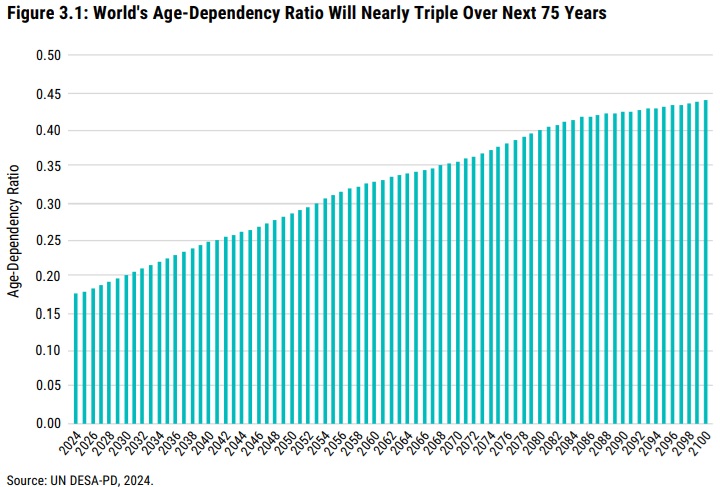
The bottom line is that America’s Social Security – and systems in other nations that also are based on the pay-as-you-go approach – are doomed.

The nations that figure out how to navigate the shift to a better system will be in a much stronger position than the ones that try to prop up government-run systems.

Wednesday, October 2, 2024

Social Security: Debunking the Debunking

May 13, 2024 by Dan Mitchell @ Intentional Freedom

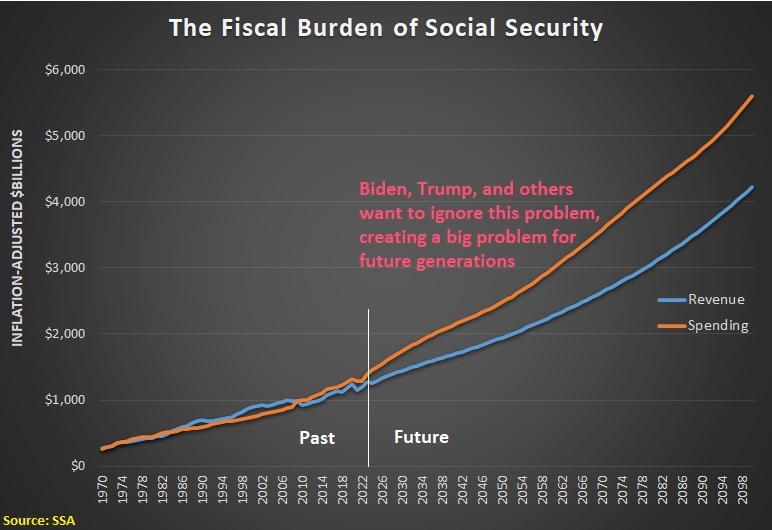
When the Social Security Administration released its annual Trustees’ Report last week, I crunched the numbers to show that the fiscal burden of the program is projected to dramatically increase.


Payroll taxes are going to climb rapidly, but spending will grow even faster. As a result, the program’s long-run shortfall is now $61.7 trillion.

That’s a lot of money, even by the standards of our fiscally incontinent masters in Washington.

The good news is that the program’s fiscal problems are getting some attention.

The bad news is that some of the analysis is sloppy.

For instance, Michelle Singletary, who writes about personal finance for the Washington Post, has a column about Social Security.


Social Security is a critical program for millions of Americans, yet there is so much that people don’t understand. …Without any change in current law, the Old-Age, Survivors and Disability Insurance (OASDI) trust funds combined are projected to have enough revenue — including current reserves — to pay 100 percent of scheduled benefits on a timely basis only until 2035. …This news rightly rattles a lot of people. It also leads to fearmongering. …As the retirement program faces a funding shortfall, it’s time to retire…five common myths.

Debunking myths is a good thing.

And what she wrote about two of the myths (dealing with when to retire and whether politicians are in the system) is accurate.

Unfortunately, the other three require elaboration/correction.

Here’s what she wrote, followed by my analysis.

Myth No. 1: Social Security is, or will be, ‘bankrupt’: Social Security will not run out of money. The program is financed by payroll taxes, so as long as workers pay into the system, money will always come in. …It’s the Social Security Trust Funds’ reserves that are projected to become depleted. …The Old-Age and Survivors Insurance (OASI) program, which pays retirement and survivor benefits, will be able to pay 100 percent of benefits until 2033.Even if Congress fails to act, there will be enough projected income coming in to cover 79 percent of scheduled benefits.

Reality: I’m baffled that she wrote that “Social Security will not run out of money” and then a few sentences later admitted that there will only be enough income “to cover 79 percent of scheduled benefits.” Makes me wonder about her definition of bankruptcy. I’ll simply note that if Social Security was a private pension system providing annuities, the government would shut it down and probably arrest the people in charge.

Myth No. 2: Young adults won’t benefit from Social Security: 42 percent of adults ages 18 to 29 are “extremely worried” that Social Security will not be available when they become eligible. …Some proposed changes to the program could affect younger workers, such as raising the age when full benefits kick in. For anyone born in 1960 or later, full retirement benefits are payable at age 67. Because so many Americans rely on Social Security, it’s not going anywhere.

Reality: Once again, the author must be using some strange definitions. Yes, today’s young people will receive money from Social Security, so we can consider that a benefit. But the real issue is whether they receive net benefits. The answer is no when you consider all their payroll taxes. And the answer is a very emphatic no if you compare what they are promised from Social Security compared to what they would get if they instead had private retirement accounts.

Myth No. 4: The federal government has raided the Social Security Trust Funds: Think of the Social Security Trust Funds like your savings account… By law, every dollar of income coming into the Social Security Trust Funds is invested in interest-bearing securities backed by the full faith and credit of the United States… Yes, that money has been spent for other government needs, but that does not mean Social Security gets worthless IOUs… The securities held by the trust funds have always been honored, as have all other Treasury securities.

Reality: Fortunately, I don’t need to debunk her analysis. I can simply cite what the Clinton Administration wrote about the so-called Trust Fund back in 1999 (see page 337).

These balances are available to finance future benefit payments and other trust fund expenditures–but only in a bookkeeping sense. …They do not consist of real economic assets that can be drawn down in the future to fund benefits. Instead, they are claims on the Treasury, that, when redeemed, will have to be financed by raising taxes, borrowing from the public, or reducing benefits or other expenditures.

As I noted back in 2016, “the Trust Fund is like putting IOUs to yourself in a college fund. When it’s time for junior to start his freshman year, you’ll have to find the money to cash those IOUs.”

Since Ms. Singletary writes about personal finance, she presumably understands that’s not a smart strategy for a family. So I’m puzzled why she thinks it’s a good approach for a government.

I’ll close by expressing disappointment that both Biden and Trump favor the status quo on Social Security, which is a recipe for massive future tax increases, massive future debt increases, and/or massive future money printing. Too bad they are unwilling to learn from AustraliaChileSwitzerlandHong KongNetherlands, the Faroe IslandsDenmarkIsrael, and Sweden, all of which show that it is possible to fully or partially replace debt-based systems with savings-based systems.

Monday, August 5, 2024

The Case for Social Security Reform

August 1, 2024 by Dan Mitchell @ International Liberty

Since both Kamala Harris and Donald Trump want government to be a bigger burden, there is zero chance of entitlement reform in the next four years.

But that doesn’t change the fact that personal retirement accounts would be an excellent idea, as explained in this clip from a discussion with Gene Tunny.

Depending on your mindset, there’s glass-half-full and a glass-half-empty case for Social Security reform.

If you’re an optimist, the case for personal retirement accounts revolves around having a system that will be much better.


If you’re a pessimist, the case for personal retirement accounts is based on avoiding some of the bad things that inevitably will happen with a program-wide $61.7 trillion shortfall over the next 75 years.

If personal retirement accounts produce very good results (and preclude very bad things), the obvious question to ask is why it hasn’t already happened? Shouldn’t this be a no-brainer?

The answer, as I explain in the video, is that the transition to a new system will be costly in the short run while producing benefits in the long run.

Unfortunately, politicians generally care only about their next election and that means they are loath to push for things that involve short-run pain. This doesn’t mean reform is impossible (as we see from some European nations), but it does mean we will need better-quality leaders than we have right now.

P.S. Amazingly, some politicians want to expand Social Security.

P.P.S. Too bad they are unwilling to learn from AustraliaChileSwitzerlandHong KongNetherlands, the Faroe IslandsDenmarkIsrael, and Sweden, all of which show that it is possible to fully or partially replace debt-based systems with savings-based systems.


Thursday, May 9, 2024

Social Security’s $61.7 Trillion Problem

May 7, 2024 by Dan Mitchell @ International Liberty

The Social Security Administration has released the yearly forecast of the program’s long-run finances. Jut like I did in 2023, 2022, 2021, 2020, etc, it’s time to see what to expect in the future.

Based on the annual fiscal data in Table VI.G9 (which is adjusted for inflation), we can see that the fiscal burden of Social Security is expanding rapidly.

The spending burden is growing faster than the tax burden, which means ever-growing levels of red ink.

As I show in this next chart, annual deficits eventually will climb above $1 trillion and the total shortfall over the next 75 years is more than $61.7 trillion.

Sadly, neither Joe Biden nor Donald Trump are willing to address the program’s huge fiscal problems.

This is a matter of math, not ideology. The Washington Post editorialized yesterday about their head-in-the-sand approach.


President Biden and former president Donald Trump don’t agree on much, but both have pledged not to touch Social Security benefits. …Financial reality, though, is that if the programs aren’t reformed, and run out of money to pay required benefits, cuts could become unavoidable. …The 2024 campaign is probably not going to feature much honest debate about this, but the conversation has to happen sooner or later. Saving Social Security and Medicare requires reform. …These won’t be popular or painless, but, as even dithering lawmakers often admit privately, the longer change is postponed, the more painful it will be in the end. Or, as the trustees’ report puts it, “significantly larger changes would be necessary if action is deferred.”

Kudos to the Washington Post for acknowledging the problem. That’s good news.

The bad news is that the editors think massive tax increases are the way to fix the problem.

My view is that we should not copy Europe. The right approach is entitlement reform, which would include shifting to a system of personal retirement accounts.

The transition to such a system would not be easy, especially since we have been kicking the can down the road. But AustraliaChileSwitzerlandHong KongNetherlands, the Faroe IslandsDenmarkIsrael, and Sweden show that it is possible to fully or partially replace debt-based systems with savings-based systems.

P.S. Amazingly, some politicians want to expand Social Security and make America’s fiscal problems even worse.

Friday, February 9, 2024

Time and Circumstance are Not on the Side of Social Security

We're being led by a kakistocracy.  A cabal of the least competent, least qualified, least intelligent, and quite probably the most corrupt leaders this nation has ever know.  What could possibly go wrong? 

By Rich Kozlovich 

Social Security was originally sold to the public as a mere aid to retirees so they would be able to afford basics, not as a way of life, which it now is.  It was also sold to the public that the money would be used exclusively for retirees, and all that money would be in a lock box that couldn't be touched.   That was FDR's promise to America.  But, as Harry Truman observed, "The President lies".  And he did constantly to everyone. What ever was convenient at the time was his narrative of the moment.  Yes, just as all leftists do today.

The age 65 was chosen for retirement because most people didn't live past 65 in those days.  But the first person to collect from SSI was a women, Ida May Fuller, and she lived to be 100 years old, and collected a total of $25,000 dollars over the next 35 years, but the clock is ticking on SSI.  

On February 9, 2024 Brenton Smith published this piece, The Social Security clock keeps ticking, saying:

Social Security has marched to a steady cadence of financial decline for the past 40 years. Every year, the size of the Social Security bomb gets bigger while the fuse becomes a little shorter. While that image might be a serious problem for you, it doesn’t seem to have captured the attention of anyone on Capitol Hill. 

At this point, the program has roughly $22.4 trillion in promises that it does not expect to keep to those who can vote today. Someone who turns 80 years old today expects, on average, to live long enough to feel the impact of legislative neglect, which stretches all the way back to 1983. It is interesting that Congress hasn't found time over the past few decades to address these worrisome prospects, but it has wasted an abundance of time on marginal proposals that have no material chance of consideration, much less passage. Where on earth do these highly-paid legislators find the time?

For years it's been known what year SSI will to go bankrupt.  In 2022 it was stated Social Security Trust Fund Will Be Exhausted in 12 Years. Now ten years, 2034, and here's a nice bit of reality, the True National Debt Exceeds $123 Trillion, or Nearly $800,000 per Taxpayer.   With that kind of debt how is it possible for any social service to survive, let along SSI? 

I posted this piece, Social Security: Dunn's First Law - With Enough Idiots, You Don't Need a Conspiracy, and I think it's clear, we're been led by twits, misfits, nitwits, and charlatans.  I like this piece, Liquidating Federal Assets: A Promising Tool for Ending the U.S. Debt Crisis, clearly demonstrating the solution to the National Debt, SSI, Medicare is federal asset liquidation.  

I demonstrated this in my article Get Out of Debt Card, which I've published a number of times.  The federal government in 2013 had 150 trillion dollars in assets, most of which could be liquidated, paying off the national debt, saving almost a trillion dollars a year in interest payments, and repay the trillions they stole from SSI to fund social programs that had nothing to do with retirement.   According to the Daily Caller citing the Congressional Budget Office, The Government Will Spend More on Interest This Year Than Defense or Medicare.

 I've been writing about and publishing articles about this for a lot of years, and if everyone is even been paying a modicum of attention, they must realize the danger ahead, yet I find ignorance of this is ubiquitous.  In spite of the fact neither the politicians responsible for all this, or their myrmidons in the nation media who refuse to make it a foundational issue that needs fixing, there's no excuse for ignorance.

So, with all this information available on the demise of SSI why hasn't that been part of the election debate questions?  Why has no one from the media, on the right or the left, asked candidates what their solution is? 

Along with the five articles I've already linked, here are 42 more dealing with this whole issue of national debt, social services, and the delusion all is well.  At some point we'll reach the "Inevitability Factor:  When Reality Reaches it's Apex", and when that day comes, it won't be pretty. 

  1. Why Is Someone at AEI Proposing a Massive Tax Increase to Finance Ever-Growing Government, Part I?  
  2. What Were Once Vices Are Now Habits
  3. Biden and Trump Should Learn from Sweden’s Social Security Reform
  4. Republicans Must Take the Lead in Reforming Social Security and Medicare
  5. Social Security, Medicare, and the State of the Union
  6. Why Cut Social Security and Medicare? Here’s Why
  7.  9 things to know about Social Security as it turns 80
  8.  The Unavoidable Choice: Entitlement Reform or Massive Middle-Class Tax Increases 
  9. NEW REPORT Spells Doom For Social Security Recipients
  10. Republican Warfare, Part IV: Will the GOP Get Serious about Spending
  11. Report highlights Social Security's looming insolvency, but White House doesn't
  12.  The Real (and Growing) Problem with Social Security
  13. Biden Turns Entire Government Into a Democrat Voter Machine 
  14. Swamponomics: The Long Dark Winter for Social Security 
  15. The Economic Consequences of Expanding Pay-as-You-Go Social Security Systems
  16. New Numbers Confirm Social Security’s Dismal Fiscal Outlook
  17. Michael Bloomberg and Entitlements: Rational (at Least in the Past), but not Right
  18. Elizabeth Warren’s Reckless Scheme to Expand the Social Security Burden and Undermine American Competitiveness
  19. Yes, Social Security is a Sinking Ship
  20. $240,000 – The Amount Each American Owns of US Debt and Unfunded Obligations
  21. Democrats didn't give up the plantation, they just moved the plantation to Washington DC.
  22. 4 Key Lessons from Latest Social Security Trustees’ Report
  23. New Book Presents Solutions for Financially Insolvent Entitlement Programs
  24. President Trump & Social Security vs. The Lying Media
  25. Retirement Isn’t Happening
  26. Our National Debt Is Our National Disgrace
  27. Dress Rehearsal for Fiscal Armageddon 
  28. Pyramids of Crisis
  29. Government Intervention and Parental Leave
  30. Saving America’s Retirement System and Providing Real Middle-Class Tax Relief
  31. Editorial: Who Cares about Entitlements? 
  32. Federal Government: By the Way, Medicare and Social Security Are Going Broke A Lot Faster Than We'd Thought
  33. The Ever-Expanding Fiscal Burden of Social Security
  34. Reforms to Sweden’s Retirement System and Lessons for the United States
  35. Will limousine liberals fix Social Security?
  36. Social Security’s Creeping Fiscal Crisis
  37. The Chilean Miracle Shows that Economic Liberty is the Best Way of of Helping Ordinary People 
  38. The Social Security Shell Game
  39. Boomers Beware SS BS 
  40. The Social Security Collection Agency
  41. Social Security Checks Are Being Reduced for Unpaid Student Debt
  42. Government Gave 4,317 Aliens 2 Social Security Numbers a Piece


Saturday, January 20, 2024

Why Is Someone at AEI Proposing a Massive Tax Increase to Finance Ever-Growing Government, Part I?

 January 19, 2024 by Dan Mitchell @ International Liberty

 Serious and responsible people (in other words, not Trump or Biden) know that Social Security has a massive long-run problem.

A fast-growing number of seniors are expecting future benefits but only a slow-growing number of workers will be paying into the system.


But even if this demographic problem didn’t exist, there is the underlying flaw of a retirement system based on tax-and-spend (or debt-and-spend) rather than wealth accumulation.

The solution is obvious.

We need to shift to a system based on personal retirement accounts.

The transition to a modern system will be expensive, to be sure, but not nearly as costly as the $60 trillion-plus burden of propping up the current system.

But some people prefer the more-expensive option.

Andrew Biggs of the American Enterprise Institute and Alicia Munnell of Boston College want to divert a massive amount of money from the private sector to the government, and they want to do it by double-taxing the money Americans have in retirement accounts.

Here are excerpts from their new report.


The U.S. Treasury estimates that the tax preference for employer-sponsored retirement plans and IRAs reduced federal income taxes by about $185-$189 billion in 2020, equal to about 0.9 percent of gross domestic product. …it actually offers policymakers an opportunity to strengthen the nation’s retirement income system. Revenues saved from repealing the retirement saving tax preferences could be reallocated to address the majority of Social Security’s long-term funding gap. …an opportunity to use taxpayer resources more productively. …the case is strong for eliminating the current tax expenditures on retirement plans, and using the increase in tax revenues to address Social Security’s long-term financing shortfall. …Tax expenditures for employer-sponsored retirement plans are expensive – costing about $185 billion in 2020. … reducing tax expenditures for retirement plans could be an effective way to help address other pressing demands on the federal budget, such as Social Security’s financing shortfall.

By the way, it is no exaggeration to say the authors “want to divert a massive amount of money” to politicians over the next decade. Based on the Congressional Budget Office’s latest 10-year forecast, 0.9 percent of GDP is about $3 trillion.

It’s not just that the authors want to prop up a system that needs reform.

They also want to undo provisions in the tax code (IRAs and 401(k)s) that allow people to protect themselves against two layers of tax on income that is saved and invested.

It’s also laughable that the report states that a huge tax increase will “use taxpayer resources more productively.” If higher taxes to fund bigger government was a good idea, Europe’s welfare states would be richer than the United States rather than way behind.

Even the title of the Biggs-Munnell study is offensive. It implies that taxpayers are getting a handout or favor if politicians don’t impose double taxation. At the risk of understatement, being taxed one time rather than two times is not a subsidy.

P.S. The better option is a shift to retirement systems based on private savings, like the ones in Australia, Chile, Switzerland, Hong Kong, Netherlands, the Faroe Islands, Denmark, Israel, and Sweden.

P.P.S. Biggs and Munnell are misguided for wanting a big tax increase to prop up a bankrupt system. That’s the bad news. The worse news is that some people want to expand the bankrupt system. And they are proposing tax increases that arguably would cause even more economic damage.


Tuesday, July 18, 2023

What Were Once Vices Are Now Habits

July 18, 2023 By Richard C. Lyons

I caught a song on the radio yesterday, from one of my favorite vinyl efforts by the Doobie Brothers, What Were Once Vices Are Now Habits. A great album, fitting for a generation that took to the vices of drinking and smoking cigarettes among other things… The same generation found such habits are hazardous for one’s health, and are a lot harder to get rid of than they were to attain. Governments are like the people who compose them, they are subject to bad vice and habits

Our federal government has had a certain vice for over a century now, since Theodore Roosevelt broke Standard Oil and Woodrow Wilson created the Federal Reserve, our government has invaded our once “free enterprise” system with consistently disastrous results. For instance...... our federal government invaded the health care sector through the Social Security Act, creating Medicare and Medicaid; and has since been on the march to nationalize the whole industry. At every step of the takeover, government interference has meant skyrocketing healthcare costs. At every step, this takeover has meant much higher taxes for taxpayers.  Both higher prices and higher taxes are direct consequences of the growing government bureaucratic “control” of America’s healthcare sector.

As a matter of habit, the Administrative State formed Fanny and Freddie Mac, the mortgage giants which now underwrite 90% of all home mortgages in America. This government interference in our once free enterprise system first led to skyrocketing home prices, then it led to the housing and stock market crash of 2008.  Today, the government “commands and controls” 100% of the home mortgage market............To Read More...

Thursday, February 23, 2023

Biden and Trump Should Learn from Sweden’s Social Security Reform

February 23, 2023 by Dan Mitchell

Some American politicians, such as Joe Biden and Donald Trump, are very much opposed to dealing with Social Security, even though the current system has a massive $56 trillion cash-flow deficit. For all intents and purposes, both the current president and his predecessor want to kick the can down the road, which surely is a recipe for massive future tax increases and may cause drastic changes to promised benefits.  Given their advanced ages, they probably won’t be around next decade when the you-know-what hits the fan.

But the rest of us will have to deal with a terrible situation thanks to their selfish approach. Other nations are more fortunate, with leaders who put the national interest above personal political ambition.  Johan Norberg has a new column in the Wall Street Journal about how Swedish lawmakers adopted personal retirement accounts and undertook other reforms to strengthen their pension system.......To Read More....

Social Security should be in the spotlight. February 22, 2023 By Brenton Smith -The mainstream media coverage concerning President Biden's remarks about Social Security during his State of the Union address and the Republican reaction has been remarkable in its ability to miss the point.  Pundits sparred over whether the Republicans or Democrats won, when the real story is who lost in this sideshow.  After all, it is the average, hardworking American who has paid into and therefore deserves Social Security. Unfortunately, everyday Americans who need to know whether or not they can rely on the trust fund received no worthy news coverage and likely won't for the next decade................

Social Security is Broke, but American Taxpayers Just Gave Ukrainian Pensioners a Double-Digit Raise By William Sullivan - As American taxpayers paying into Social Security today stare down the barrel toward substantial cuts to their own benefits, estimated to take place in 2034, they can at least take solace in knowing that all categories of Ukrainian pensioners will get a 20% raise in March 2023.  “As early as this March,” says Ukrainian Prime Minister Denys Shmyhal, “the government will index pensions by 20%” for about 10 million Ukrainians. Indexing the payments “is not mandatory according to the Law of Ukraine on the State Budget for 2023,” but benevolent President Zelensky has instructed them to reprice the benefits upwards anyway. And why wouldn’t he?  His government is swimming in American cash......................

Biden sued for injecting woke politics into retirement accounts - By Bob Unruh February 21 -Joe Biden is being sued for his scheming to inject politics into retirement accounts – the savings millions of Americans have set aside for their own senior years.The Wisconsin Institute for Law & Liberty, has confirmed it has filed a legal action on behalf of retirement account participants Rick Braun and Fred Luehrs against the government over a new rule created by the Biden administration.........
 
What Does Social Security Insolvency Mean?, By Andrew G. Biggs February 21, 2023 - The current controversy over cutting Social Security benefits is driven by a single fact: The Social Security program is projected to be insolvent in little more than a decade unless Congress takes remedial action. But what does insolvency mean for Social Security? Back in 1935, Social Security was set up to resemble a private pension plan. While the legal niceties are a bit complex, what Americans would see is that they pay taxes into Social Security while working, and in return they qualify for benefits in retirement or if they become disabled. President Franklin Roosevelt established this setup to differentiate Social Security as an “earned benefit” from what we today would refer to as “welfare,” which generally is funded from income taxes. 

Dedicated Social Security taxes, Roosevelt said, “are politics all the way through. We put those payroll contributions there so as to give the contributors a legal, moral, and political right to collect their pensions and their unemployment benefits. With those taxes in there, no damn politician can ever scrap my social security program. Those taxes aren’t a matter of economics, they’re straight politics.” President Franklin Delano Roosevelt was, if nothing else, a canny politician. Attempts to reduce Social Security are not countered merely with arguments based upon need, but upon the perceived unfairness of cutting benefits that Americans understandably believe they have paid for...............


Friday, February 10, 2023

Republicans Must Take the Lead in Reforming Social Security and Medicare

The last president to reform Social Security was Ronald Reagan.  He formed the Greenspan Commission to formulate solutions to problems the program faced.  Reagan then worked with speaker of the House Tip O'Neill to enact the solutions.  Social Security as we know it would have ended decades ago had he not been successful.

During the 2022 elections, Democrats claimed that Republicans would "end" Social Security and Medicare if elected.  On January 26, President Biden proclaimed, "Here's the deal: they want to cut your Social Security and Medicare."  At the State of the Union address, Biden doubled down, saying, "Republicans want Social Security and Medicare to sunset."  While Democrats spout malarkey, Social Security and Medicare are in peril.  Action must be taken to bolster these programs, as they are again in jeopardy............. When a family sitting around a kitchen table determines there is not enough money to cover expenses, it reduces spending to make ends meet.  Rarely would an overextended family purchase a new luxury car.  This is what the government does.  The government needs to find ways to live within its means.  Republicans should work to ensure that government spending is reduced and develop a plan to bolster Social Security and Medicare..............To Read More....

My Take - The answer to all this is in my article,  Let Me Tell You About Sisyphus, and Our National Debt.

Social Security, Medicare, and the State of the Union

Elections have consequences, especially dishonest elections

By ——--February 9, 2023

In his State of the Union address last night, dishonest Joe Biden took another disgraceful cheap shot at Republicans by deceitfully claiming that Republicans wanted to "sunset" Social Security and Medicare. The ensuing uproar led him to pause his speech and claim that only a few Republicans wanted to do that... no, actually only one... contact his office for a copy of the proposal. He then continued his presentation of lies and distortions misrepresented as an accurate picture of the state of our Union.

Most politicians recognize that the Social Security and Medicare programs are a "third rail" of politics, and those who seek to challenge or reform the programs do so at their peril. The sad fact, though, is that these programs will die on their own, unless something is done soon..........To Read More....

My Take - The answer to all this is in my article,  Let Me Tell You About Sisyphus, and Our National Debt.


Why Cut Social Security and Medicare? Here’s Why.

By Andrew G. Biggs Forbes February 09, 2023

Every election cycle, Democrats claims that Republicans would savagely cut or even end Social Security and Medicare. Today is no different. Yet Republicans continue to be elected, often controlling Congress or the White House. And not only are these programs not ended, but Republicans these days don’t attempt even to reform them...........

Last year Social Security cost $1.2 trillion while Medicare cost $726 billion, totaling 36% of the non-interest federal budget. The Congressional Budget Office projects that by 2050, combined spending will double to $4.7 trillion in today’s dollars, topping 53% of non-interest federal spending. Unless we increase federal taxes by about 56% by 2050 or cut every other federal program by 24%, rising entitlement benefits need to be curtailed. No one is arguing that Social Security and Medicare in the future should pay out less than they do today. What people do disagree about is how fast these programs should grow...............

Some people say that Social Security doesn’t contribute to the budget deficit and so there’s no reason to cut it. Not so. The Congressional Budget Office explicitly states that Social Security’s “contribution to the federal deficit” last year was nearly $100 billion, while Medicare added almost $400 billion more. Going forward, the federal budget is balanced if you leave out Social Security and Medicare.............

Some people say that Social Security and Medicare are self-financing – we paid our taxes and we’re only getting back what we paid. Again, not true. The Social Security Administration calculates that a typical couple retiring today will receive about 30% more in benefits than they paid in taxes. By the end of the decade, that rises to a 50% bonus. And those bonus benefits don’t come out of thin air; they come from additional taxes that their kids will have to pay. For Medicare, the bonus to current retirees – and the cost passed to our kids – is even more extreme.

Others say that we can’t possibly cut Social Security because it’s an essential safety net. In fact, members of both parties have proposed increasing benefits for low-income retirees. ...............

Everyone needs to start acting like adults. Being a good steward of entitlements isn’t accusing the other party of wanting to make benefit cuts that party neither wants nor has the capacity to make. Nor is it insisting you won’t cut benefits while also claiming you won’t raise taxes. Leaders take on the problems they are charged with solving, being upfront about the costs and benefits of each option while not forgetting that inaction isn’t one of them.

Now we just need to find some leaders............To Read More....

My Take - The answer to all this is in my article,  Let Me Tell You About Sisyphus, and Our National Debt.

Friday, January 13, 2023

9 things to know about Social Security as it turns 80

by Katie Lobosco  @KatieLobosco August 14, 2015

The program was signed into law by FDR 80 years ago Friday. At the time, most people had lost any savings they had during the Great Depression, leaving them with little for retirement. Some companies provided pensions, but they were a rare benefit.

The program was largely uncontroversial, said Eric Yellin, a history professor at the University of Richmond. It sailed through Congress and was hugely popular all the way into the 1970s, he said.

Things have changed. Now, Social Security is more of a political punching bag. As the presidential election heats up, reforming the program will undoubtedly be a hot topic.

Here's what you should know to keep up with the conversation.

1. The average retiree gets 12 more years of Social Security benefits than she did in 1940. It's not just because we're living longer, but we're also retiring early, said Gene Steuerle, an expert at the Urban Institute.

2. Current average retiree age: 64 Average retiree age in 1950: 68 That's because in 1959, Congress created the "early retirement age." In exchange for reduced benefits, you can retire as early as 62.

3. So what is the retirement age? You have to be at least 66 years old to retire today and get your full benefit. The age is already going up. If you're 55 or younger today, you'll have to wait until you're 67. The Social Security website can help you figure it out.

4. There are fewer than 3 workers for every retiree. In 1960, there were 5 workers paying into the system for every person collecting benefits. It dropped to 3 workers in 2009, according to the Social Security Administration. And now it's even less. Thank the Baby Boomers and the Great Recession.

5. 60 million retirees get Social Security checks. In 1940, the first year benefits were paid, just 220,000 Americans were signed up. Since then the program has expanded to give benefits to spouses, widows and widowers.

6. Social Security never had a huge trust fund. And it was never "raided," Steuerle said, as many people believe. It's a pay-as-you-go system, so today's workers are paying for today's retirees.

7. But it will still be around for Millennials. While most 20-somethings don't think they'll be getting anything when they retire, that's probably not true. Even if Congress doesn't reform the system at all, Social Security will be able to pay full benefits through 2034, and then three-quarters of scheduled benefits through 2089.

8. The tax rate was lower in 1940. Social Security has always been funded by the payroll tax, but back then it was only 2% and was split between you and your employer. You weren't taxed on any wages above $3,000 ($48,700 in 2015 dollars). Now it's a combined 12.4% on wages up to $118,500.

9. Today's average monthly Social Security check is $1,221 and one in three people depend on it to cover 90% of their expenses. Your benefit is not based on what you've paid in. Instead, it's based on your lifetime earnings.


Thursday, January 12, 2023

The Unavoidable Choice: Entitlement Reform or Massive Middle-Class Tax Increases

I worry about big tax increases because of America’s grim long-run fiscal outlook.


The video clip is less than two minutes (taken from this longer discussion with Fergus Hodgson), but I can summarize my key point in just one very important sentence

Anybody who opposes entitlement reform is unavoidably in favor of big tax increases on lower-income and middle-class Americans.

There are three reasons for this bold (and bolded) statement.

  1. The burden of spending in the United States is going to dramatically expand in coming decades because of demographic change combined with poorly designed entitlement programs.
  2. There presumably is a limit to how much of this future spending burden can be financed by borrowing from the private sector (or with printing money by the Federal Reserve).
  3. Many politicians claim that future spending on entitlements (as well spending on new entitlements!) can be financed with class-warfare taxes, but there are not enough rich people.

My left-leaning friends almost surely would agree with the first two points. But some of them (particularly the ones who don’t understand budget numbers) might argue with the third point.

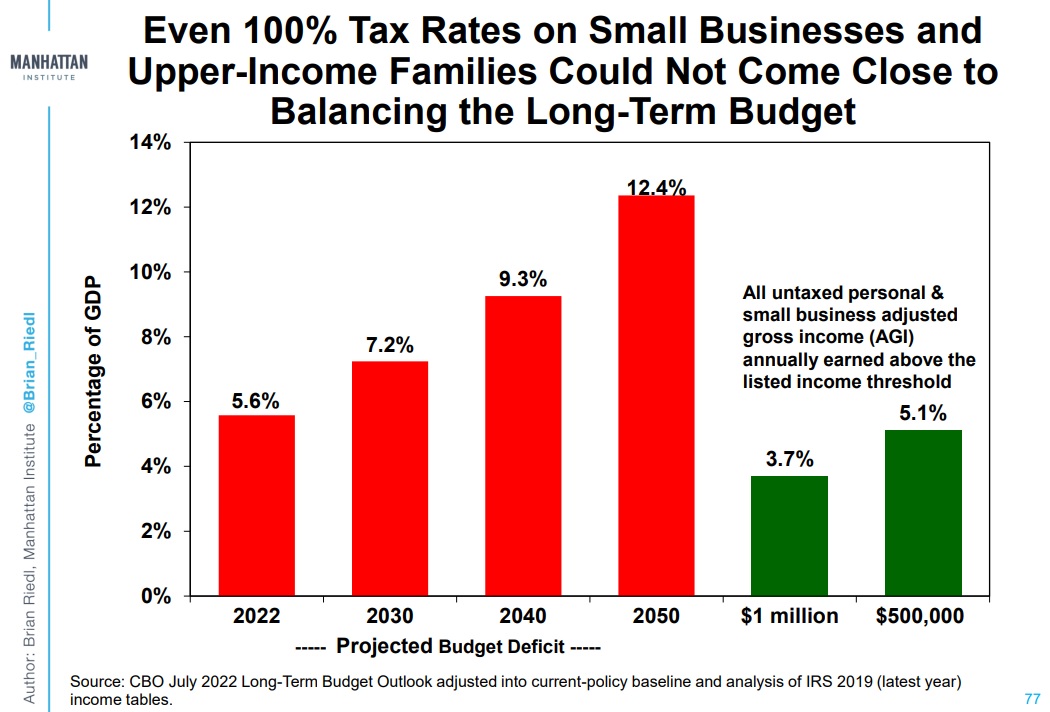
To confirm the accuracy of the argument, let’s look at this chart from Brian Riedl’s famous Chartbook.

As you can see, even confiscatory 100-percent taxes on the rich (which obviously would cripple the economy) would not be nearly enough to eliminate America’s medium-term fiscal gap.

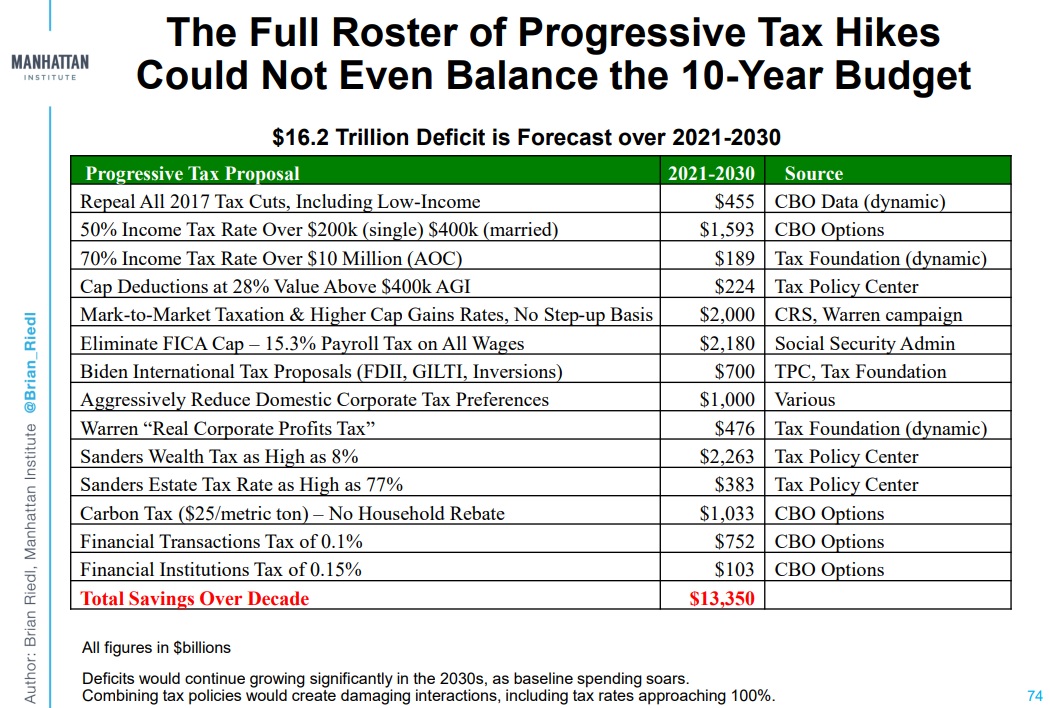
Heck, even if we look at just the next 10 years and include every possible tax hike, it’s obvious that a class-warfare agenda (which also would have negative economic effects) would not be enough to finance all the spending that is currently in the pipeline.

Here’s another Riedl chart (which even includes some proposals that would hit the middle class).

I’ll conclude with two further observations.

  • First, there are plenty of honest leftists (the ones who understand budget numbers, 
  • including Paul Krugman) who openly admit that big tax increases will be needed if the burden of government spending is allowed to increase.
  • Second, there are plenty of disingenuous (or perhaps naive) folks on the right who oppose entitlement reform while not admitting that their approach means massive tax increases on lower-income and middle-class taxpayers.


Needless to say, genuine entitlement reform would be far preferable to any type of tax increase.

P.S. In the absence of entitlement reform, politicians will first choose class warfare taxes, of course, but that simply will be a precursor to higher taxes on the rest of us.

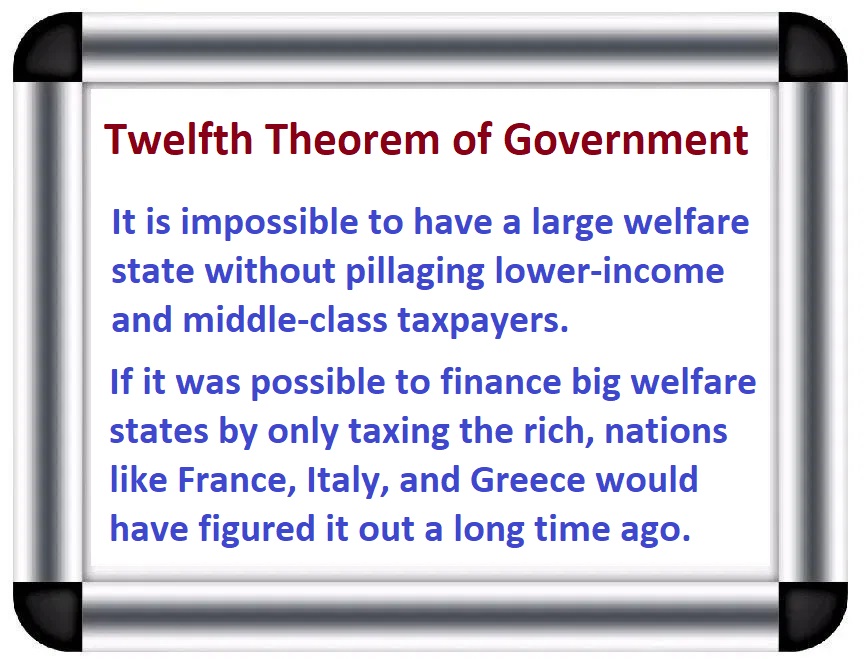
P.P.S. The bottom line is that you can’t have European-sized government without European-style taxes. Including a money-siphoning value-added tax.


Wednesday, January 4, 2023

NEW REPORT Spells Doom For Social Security Recipients

By

The Joe Biden Administration has been faced with sheer backlash from many of the decisions made since taking office but lately one of the most notable issues the administration is facing is their handling of Social Security…The Congressional Budget Office, a non-partisan group that analyzes congress has recently released a report detailing the issues that the federal government has carried out regarding Social Security including whopping cuts to benefits.Their specific report spells a more damning warning than other reports which could bring chaos if the course is not corrected sooner than later.

The Congressional Budget Office estimates that the Social Security Administration’s combination of both retirement and disability insurance programs will run out of money two year earlier than the annual report listed by the Social Security Administration’s Trustee’s.

That specific year estimated by the CBO lists that it will run out of money in 2033 instead of 2035. This more realistic estimation is spelling a dire warning that will require a distinct recourse of action that Biden’s Administration seems to not be going down..........

T

Thursday, November 17, 2022

Republican Warfare, Part IV: Will the GOP Get Serious about Spending?

November 16, 2022 by Dan Mitchell @ International Liberty

Last week, I explained that “supply siders” need to be ardent advocates of spending restraint. After all, there is no chance of good tax policy in the future if the burden of federal spending continues to expand.


I also wrote about “national conservatives” and pointed out that their opposition to entitlement reform means they implicitly embrace massive tax increases.

The bottom line is that the United States has a built-in spending crisis. Democrats are not serious about addressing the problem. So if Republicans bail as well, the nation is doomed to become a decrepit, European-style welfare state.

What does that mean? Nothing good, at least for people in the productive sector of the economy.

In an article for National Review, Philip Klein speculates whether there is any appetite for spending restraint, even among self-described conservatives.

For much of the history of the American conservative movement, limiting the size and scope of government has stood as one of its central goals. …In 2022, such messages were barely anywhere to be found on the campaign trail…conservatives have largely moved on from making the case for reducing the size and power of Washington. In some cases, this shift has been passive. …

It has become popular in some circles on the right to mock “zombie Reaganism” and insist that while it may have made sense back in the 1980s to argue for smaller government, such a message is now outdated. …the argument that the battle to limit government has already been lost also neglects to recognize that things could always get worse.

That is, even though the federal government has gone through extraordinary growth since the New Deal, it would have grown even larger had there been no conservative movement to push back. One need only look at Europe, where conservative parties long ago made their peace with the welfare state, to see how government agencies have crowded out civil society…

There is no way in which a nation with…a ballooning welfare state will be an accommodating place for conservatives in the long run, no matter how much some may fantasize about seizing the dragon and precisely aiming its fire at their enemies during the relatively brief windows in which Republicans have power. Conservatives…should not abandon the fight for limited government.

At the risk of understatement, I fully agree.

I wrote two days ago and also the previous week to make the case for spending restraint.

Those are easy columns to write since it is the same argument I’ve been making my entire life. But what is depressing now is that there is opposition from Republicans as well as Democrats.

Maybe they should all be forced to watch my video series on the economics of government spending.


Thursday, November 3, 2022

Social Security Trust Fund Will Be Exhausted in 12 Years

Barry W. Paulson and David M. Walker | October 27, 2022
 
 Social Security will soon be insolvent, and over the last three decades Congress has done nothing to fix the problem. From the outset, Social Security has been challenged by a “fiscal commitment problem," whereby solvency is a serious long-term problem without significant short-term consequences.

In 1983, a bipartisan agreement was reached in Congress on reforms to restore solvency to the Social Security System. This agreement was a political necessity since the Social Security Trust Fund was set to become insolvent within weeks..............To Read More....

Tuesday, June 7, 2022

Report highlights Social Security's looming insolvency, but White House doesn't

June 06, 2022Haisten Willis

A new report from the trustees of the Social Security and Medicare trust funds underscores that the programs are on the path to fiscal insolvency, but proposals to reform them remain the "third rail" of American politics as the White House emphasizes the positives.  While still dire overall, with Medicare expected to become insolvent in six years and Social Security in 13, the numbers were slightly improved from a year ago, a point underscored in a statement from President Joe Biden .

"The Social Security and Medicare Hospital Insurance Trust Funds will be able to pay benefits on a timely basis for longer than previously projected before the American Rescue Plan passed," said Biden. "The trustees' report says that those improvements are a result in part of a faster recovery in employment, earnings, and economic growth than previously projected."............To Read More.....


Monday, September 6, 2021

The Real (and Growing) Problem with Social Security

September 1, 2021 by Dan Mitchell @ International Liberty

In an ideal world, Americans would have personal retirement accounts, just like workers in Australia, Sweden, Chile, Hong Kong, Israel, Switzerland, and a few dozen other nations.


But we’re not in that ideal world. We are forced to participate in a Ponzi Scheme known as Social Security.

By the way, that’s not necessarily a disparaging description. A Ponzi Scheme can work if there are always enough new people in the system to pay off the old people.

But because of demographic changes (increasing lifespans and decreasing birthrates), that’s not what we have in the United States.

And this is why Social Security faces serious long-run problems.

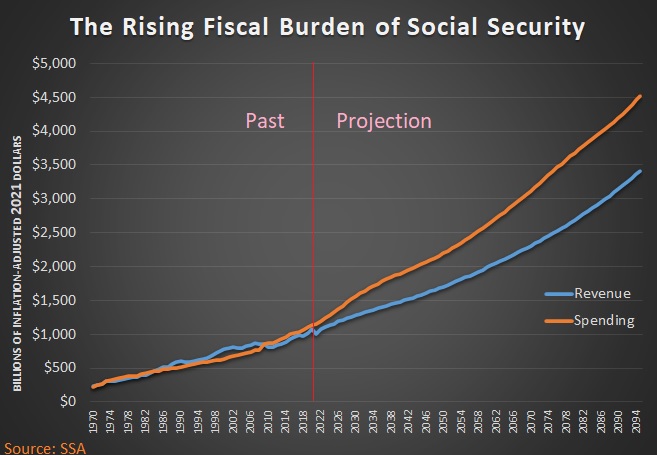
How serious? The Social Security Administration finally released the annual Trustees Report. This document has a wealth of data on the program’s financial condition, and Table VI.G9 is where the rubber meets the road.

As you can see from this chart, there will be an ever-increasing burden of Social Security taxes and spending over the next 75 years. And these numbers are adjusted for inflation!

The good news (relatively speaking) is that the economy also will be growing over the next 75 years, both in nominal terms and inflation-adjusted terms.

The bad news is that spending on Social Security will grow at a faster rate, so the program will consume a larger share of the economy’s output.

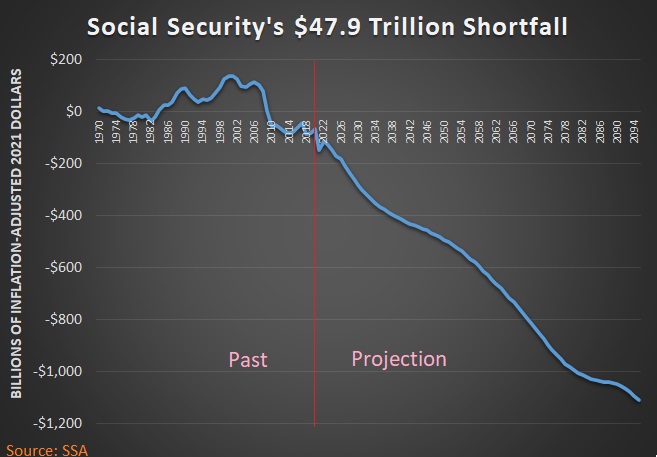
And because Social Security spending is growing faster than the economy (and also faster than tax revenue), this next chart shows there is going to be more and more red ink in the future. Once again, you’re looking at inflation-adjusted data.

As indicated by the chart’s title, the cumulative shortfall over the next 75 years is nearly $48 trillion. That’s a lot of money, even by Washington standards.

And with each passing year, the problem seems to worsen. The 75-year shortfall was $44.7 trillion according to the 2020 report and $42.1 trillion according to the 2019 report.


I’ll conclude by observing that today’s column focuses on the big-picture fiscal problems with Social Security.

But let’s not forget the program’s second crisis, which is the fact that Americans are deprived of the ability to enjoy much higher levels of retirement income.

Certain groups are particularly harmed by this aspect of the current program, including minorities, women, older workers, and low-income workers.

P.S. Our friends on the left argue that the program’s fiscal problems (the first crisis) can be solved with tax increases. Perhaps that is true, but it will mean a weaker economy and it will exacerbate the second crisis by forcing workers to pay more to get less.

P.P.S. I once made a $16 trillion dollar mistake on national TV when discussing Social Security’s shaky finances.

P.P.P.S. Much of the news coverage about the Trustees Report has focused on the year the Social Security Trust Fund supposedly runs out of money. But this is sloppy journalism since the Trust Fund has nothing but IOUs (as illustrated by this joke).

I’ve done a handful of TV debates on Social Security, including the time I said that I wished Republicans had a secret plan for personal retirement accounts. So I thought I was well prepared for this duel with a defender of the status quo on Fox Business Network. I generally think the debate went well, but I confess that I didn’t have the updated numbers on the program’s long-run deficit. I knew the long-run fiscal gap in past Trustees’ Reports was around $30 trillion, but I wanted to make sure I didn’t exaggerate. And since perhaps the economy’s modest improvement has impacted the long-run outlook, I decided to throw out a number that surely would be on the low side.

So I said $20 trillion.

Well, nobody can accuse me of exaggeration. Here’s a chart showing the program’s dismal long-run deficit, which is compiled from Table VI.F9 and Table V.B1 of the recently released Trustees Report. If you add up the annual deficits, you get $36 trillion. And that’s in today’s dollars!

Social Security Deficit

So I made a $16 trillion mistake. That’s a big number even by Washington standards.  But it doesn’t really matter since everything I said about policy was correct, regardless of whether the long-run deficit was $5 trillion, $50 trillion, or somewhere in between. If you want to know more about right way to do Social Security reform, click here to see my video on personal retirement accounts. And if you want to learn more about the wrong way to deal with the program’s huge long-run fiscal gap, click here to get the sobering details on the big tax increase that both President Obama and my debating opponent would like to impose..................