Search This Blog

De Omnibus Dubitandum - Lux Veritas

Showing posts with label Entitlements. Show all posts

Monday, August 4, 2025

A Small But Important Victory for Taxpayers

August 2, 2025 by Dan Mitchell @ International Liberty

Regular readers know I’m not a Trumpie. Some of his policies are terrible (protectionism), while others are irresponsible (punting on entitlements) or misguided (new tax loopholes).

But I have to give credit where credit is due.

Unlike every other Republican president over the past six decades – including the great Ronald Reagan – Donald Trump successfully eliminated subsidies for the Corporation for Public Broadcasting.

This is the feel-good story of 2025.

Here are some excerpts from a Washington Post report by Scott Nover.


The Corporation for Public Broadcasting said it will close following Congress’s decision to strip its current funding and foreclose on future appropriations. CPB…is a nonprofit set up to dole out congressionally appropriated funds to NPR, PBS, and public radio and TV stations around the United States. President Donald Trump launched a successful campaign to claw back the $1.1 billion allocated for the organization for the next two years, a measure he signed into law last month. …The closure was announced one day after the Senate Appropriations Committee released a bill that would zero out funding for CPB.

The “claw back” mentioned above refers to the rescission bill, which was another victory for taxpayers.

And Republicans (for once) were smart. Instead of simply making cuts that easily could be reversed in the future, they actually got rid of the entire bureaucracy.

The Post then quotes officials from NPR and PBS, who are predictably disappointed they can no longer be moochers.

Katherine Maher, CEO of NPR, wrote in a statement. “We will continue to respond to this crisis by stepping up to support locally owned, nonprofit public radio stations and local journalism across the country…” PBS also suggested it would step up to fill the void. “As this remarkable institution winds down, PBS is committed to building on CPB’s legacy and maintaining our service to the American people for years to come,” a spokesperson said.

For what it’s worth, NPR and PBS will continue for the simple reason that they never needed handouts to begin with. Those radio and TV stations can (indeed, they already do) raise money privately.

That’s the good news.

The bad news is that I’m sure politicians in some blue states will pillage their taxpayers to compensate for the loss of federal funds.

But at least the problem is then localized rather than national.

I’ll close with the observation that this victory is heartwarming, but also largely irrelevant. America is sleep-walking toward a fiscal crisis because of entitlement programs that are multi-trillion dollar burdens on the U.S. economy. Donald Trump has cured a hangnail, but he’s ignoring the cancer that will kill the patient.

Wednesday, February 5, 2025

America's Looming Fiscal Crisis

February 4, 2025 by Dan Mitchell @ International Liberty

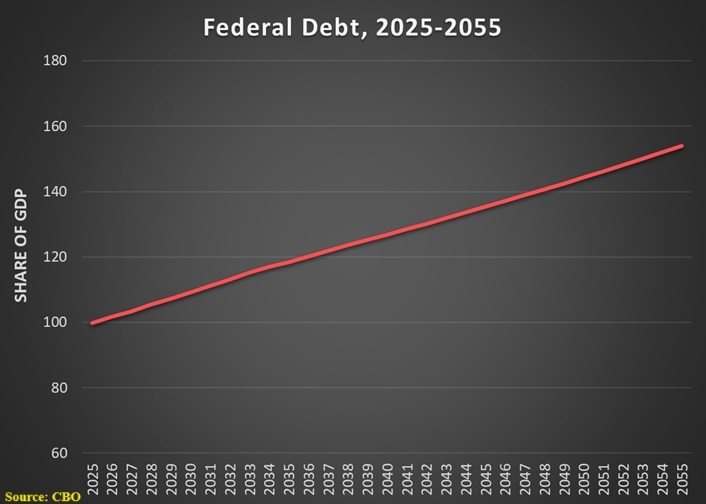
When thinking about fiscal policy, most Americans think the country’s biggest problem is rising levels of government debt.

So this chart, based on the Congressional Budget Office’s most-recent 30-year forecast, is what worries them most.

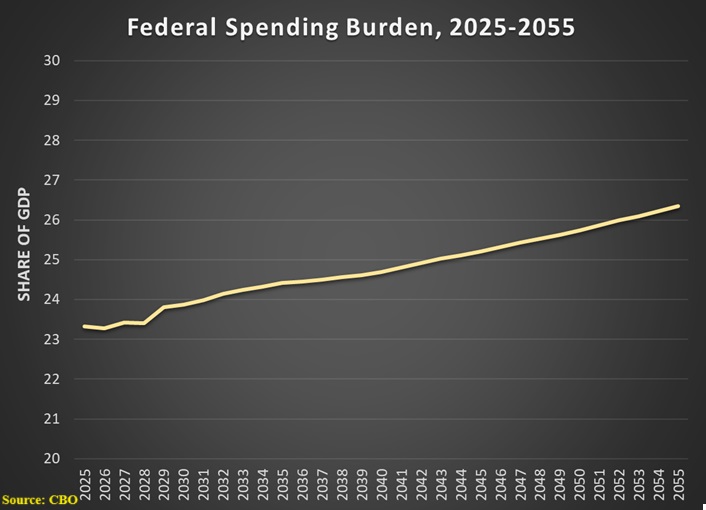
I have a different perspective. Debt is the symptom. The underlying disease is excessive government. So here’s the chart, also based on CBO data, that worries me most.

Let’s take one more step in the analysis. The most important thing to understand is that the problem in the first chart would go away if we could fix the problem in the second chart.

In other words, long-overdue fiscal restraint would lead to a shrinking burden of government spending. And, if that happens, then debt stops climbing and eventually begins to decline.

The need for spending restraint was the focus of my column published yesterday by the U.K.-based Telegraph. Here are the most relevant excerpts.


Donald Trump’s…success will probably be determined by the economy. And that means he needs to deal with…fiscal policy. …federal government spending is now consuming more than 23 per cent of America’s economic output, up from less than 21 per cent of GDP before the pandemic. …there will be a big automatic tax increase at the end of this year if the 2017 tax cuts are not made permanent, or at least extended. …the growing burden of government spending has led to $2 trillion annual deficits and record levels of government debt.

The good news, relatively speaking, is that spending restraint is the best way of addressing all three. That’s because revenues are projected to grow by an average of 4.5 per cent annually over the next few years. Progress can be made merely by ensuring that spending grows at a slower rate. …

That sounds simple, but it’s not easy. Spending restraint means saying no to special interest groups. To meet their fiscal targets, Republicans probably need to impose a hard freeze on domestic discretionary spending, as well as making many more of the cuts that Elon Musk claims to be finding via DOGE.

But that’s just the start. Most federal spending today is for so-called entitlements (everything from Social Security to health programmes to redistribution outlays). Trump and his allies will need to reform these programmes if they hope to limit the overall growth of government. …For what it’s worth, Republicans did the right thing during the “Tea Party” era.

They managed to freeze overall government spending between 2009 and 2014. If they can do the same thing today, they can make considerable progress on Trump’s three big fiscal challenges. The pessimistic scenario is that the White House and congressional Republicans get squeamish and fail to control spending… At some point, this do-nothing approach will mean a massive fiscal crisis, which presumably will include a big spike in interest rates and lots of turmoil in financial markets.

By the way, I did not pick the title. If I did, I would not have said the United States is “suddenly” in trouble.

We’ve known for a long time about the problem of entitlement spending and demographic change. Heck, my three-part video series was released almost 15 years ago.

But I am fearful that kicking the can down the road for the past 15 years means we are now closer to “big trouble.” Not just America. Other countries as well.


Monday, April 17, 2023

Another Honest Leftist Admits that Middle-Class Taxpayers Are in the Crosshairs

April 16, 2023 by Dan Mitchell @ International Liberty

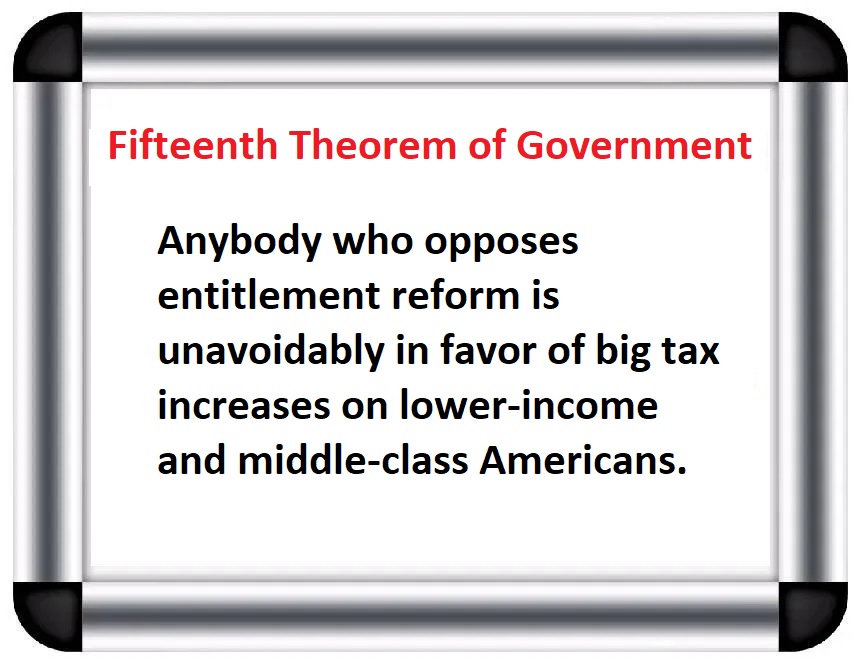
I have repeatedly pointed out that opponents of entitlement reform support big tax increases. And, as I explain in this segment from a recent presentation, they specifically support tax increases on lower-income and middle-class households.

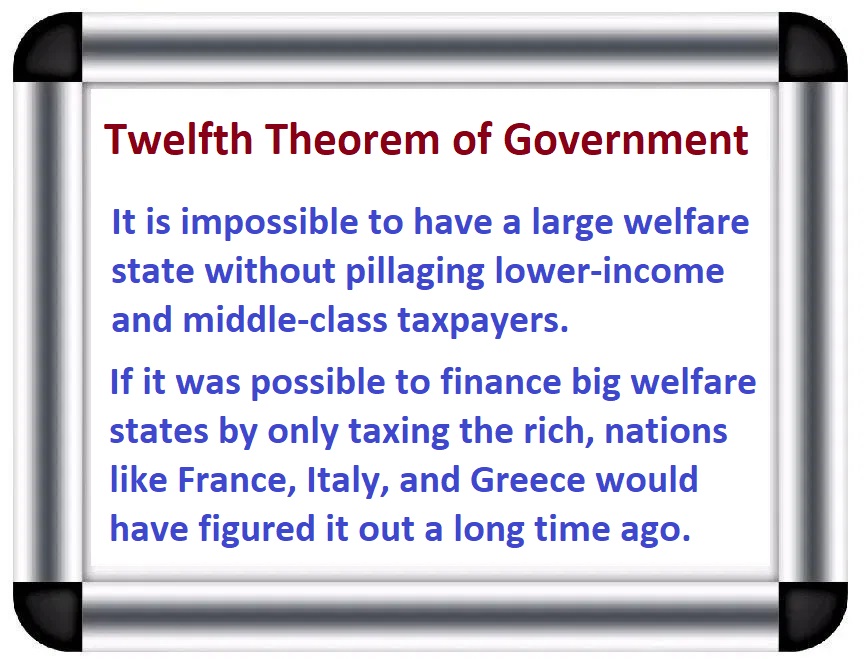
Why do I assert that they support higher taxes on ordinary people? For the simple reason that there are not enough rich people to finance big government.

So this means, inevitably, that they support higher taxes on the rest of us (they probably support lots of debt-financed spending and central bank-financed spending as well).

https://freedomandprosperity.org/wp-content/uploads/2023/01/Jan-21-23-15th-Theorem.jpg
Depending on where and how I make this argument, some people accuse me of being anti-Trump. Or anti-Biden.

Do Actually, I’m pro-math.

And there are some folks on the left who also understand this reality.

I’ve disagreed with many of her columns in the Washington Post, but Catherine Rampell deserves credit for honesty because her most-recent piece tells the truth about who will pay higher taxes as the burden of government increases. Here are some excerpts.


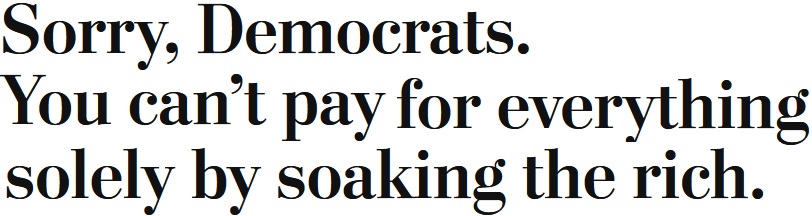
Democrats…wish to expand the social safety net, however, which requires — you guessed it! — more tax revenue. Democrats…claim…that all those safety-net expansions can be paid for solely by soaking “the rich.” …Alas, there’s not remotely enough money on those would-be money trees to pay for all the things that Democrats want. Or even the things that past Congresses have already committed to: Recall that the United States already has large fiscal deficits in the years ahead, even without creating new programs. …By all means, raise taxes on the ultrawealthy. …But if we really want a more robust welfare state, or even to sustain the welfare state we’ve already promised, that probably requires higher taxes from most of the rest of us, too.

At this point, I normally would state that Ms. Rampell deserves membership in my club of honest liberals. But she already is a member, thanks to a column she wrote two years ago.

I’ll close with the should-be-obvious point that any tax increases would be a bad idea, whether imposed on upper-income households or anybody else.

Which is why sensible people should resuscitate support for genuine entitlement reform.


Thursday, January 12, 2023

The Unavoidable Choice: Entitlement Reform or Massive Middle-Class Tax Increases

I worry about big tax increases because of America’s grim long-run fiscal outlook.


The video clip is less than two minutes (taken from this longer discussion with Fergus Hodgson), but I can summarize my key point in just one very important sentence

Anybody who opposes entitlement reform is unavoidably in favor of big tax increases on lower-income and middle-class Americans.

There are three reasons for this bold (and bolded) statement.

  1. The burden of spending in the United States is going to dramatically expand in coming decades because of demographic change combined with poorly designed entitlement programs.
  2. There presumably is a limit to how much of this future spending burden can be financed by borrowing from the private sector (or with printing money by the Federal Reserve).
  3. Many politicians claim that future spending on entitlements (as well spending on new entitlements!) can be financed with class-warfare taxes, but there are not enough rich people.

My left-leaning friends almost surely would agree with the first two points. But some of them (particularly the ones who don’t understand budget numbers) might argue with the third point.

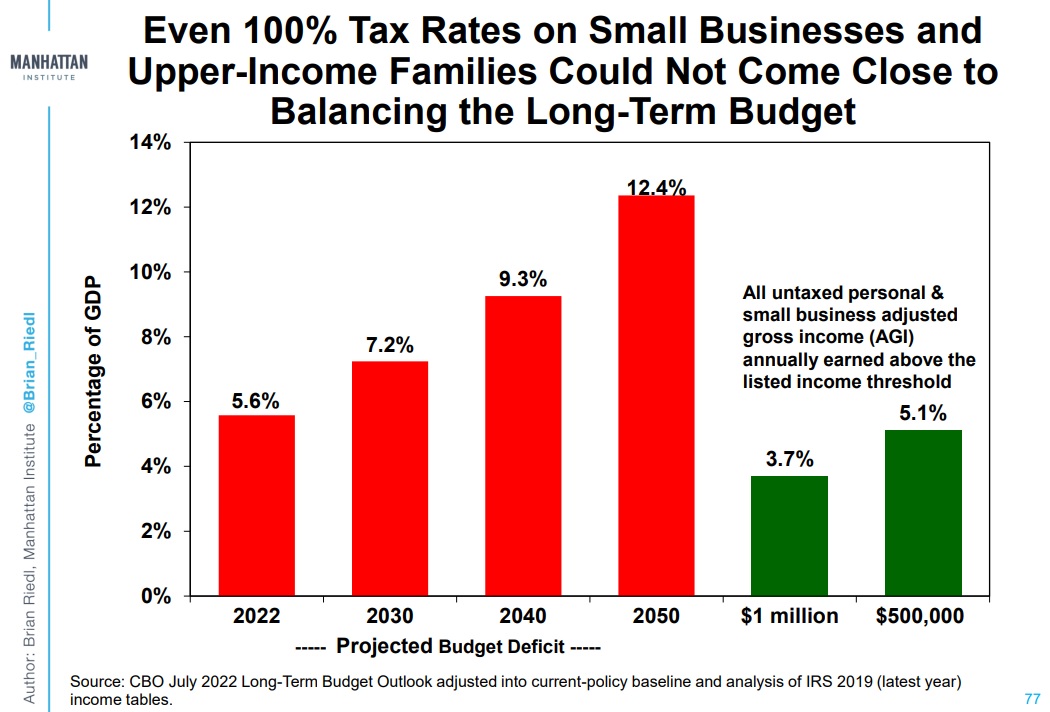
To confirm the accuracy of the argument, let’s look at this chart from Brian Riedl’s famous Chartbook.

As you can see, even confiscatory 100-percent taxes on the rich (which obviously would cripple the economy) would not be nearly enough to eliminate America’s medium-term fiscal gap.

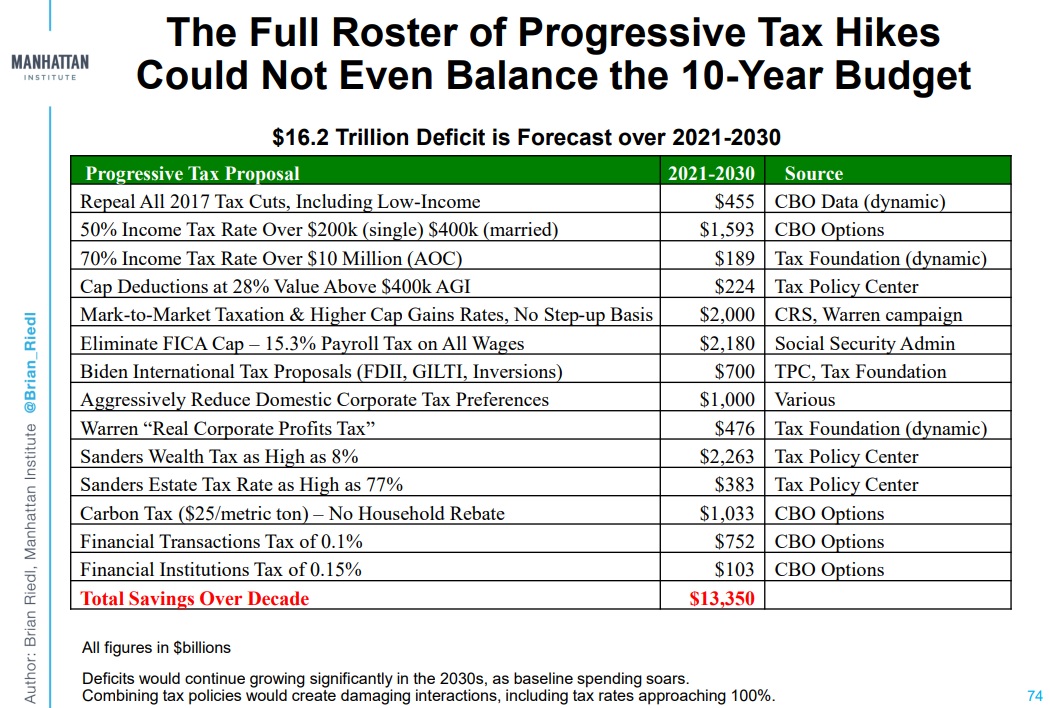
Heck, even if we look at just the next 10 years and include every possible tax hike, it’s obvious that a class-warfare agenda (which also would have negative economic effects) would not be enough to finance all the spending that is currently in the pipeline.

Here’s another Riedl chart (which even includes some proposals that would hit the middle class).

I’ll conclude with two further observations.

  • First, there are plenty of honest leftists (the ones who understand budget numbers, 
  • including Paul Krugman) who openly admit that big tax increases will be needed if the burden of government spending is allowed to increase.
  • Second, there are plenty of disingenuous (or perhaps naive) folks on the right who oppose entitlement reform while not admitting that their approach means massive tax increases on lower-income and middle-class taxpayers.


Needless to say, genuine entitlement reform would be far preferable to any type of tax increase.

P.S. In the absence of entitlement reform, politicians will first choose class warfare taxes, of course, but that simply will be a precursor to higher taxes on the rest of us.

P.P.S. The bottom line is that you can’t have European-sized government without European-style taxes. Including a money-siphoning value-added tax.


Tuesday, November 29, 2022

America’s Looming Entitlement Crisis

November 28, 2022 by Dan Mitchell @ International Liberty

Back in July, I made the case for the right kind of entitlement reform in a discussion with the folks at Live and Let Live.

Today, I want to underscore why it is important to focus on “the right kind” of reform.

On paper, you can save money with “means testing” of benefits, but that creates an indirect penalty on work, saving, and investment.


You can also, on paper, save money by imposing price controls on health care, but that policy has a long track record of failure.

At the risk of understatement, either of those approaches represents “the wrong kind” of entitlement reform. Indeed, those policies are not really reform. Instead, they are tinkering with systems that are fundamentally broken.

For what it is worth, most politicians do not support good reform or bad reform.

As predicted by “public choice,” their preferred approach is kicking the can down the road.

Which is what Greek politicians did for many years.

But they learned in Greece that ignoring a problem does not make it disappear. Instead, it is a recipe for fiscal crisis (and we will probably have to re-learn that lesson in Italy).

So my other goal today is to show why something needs to be done.

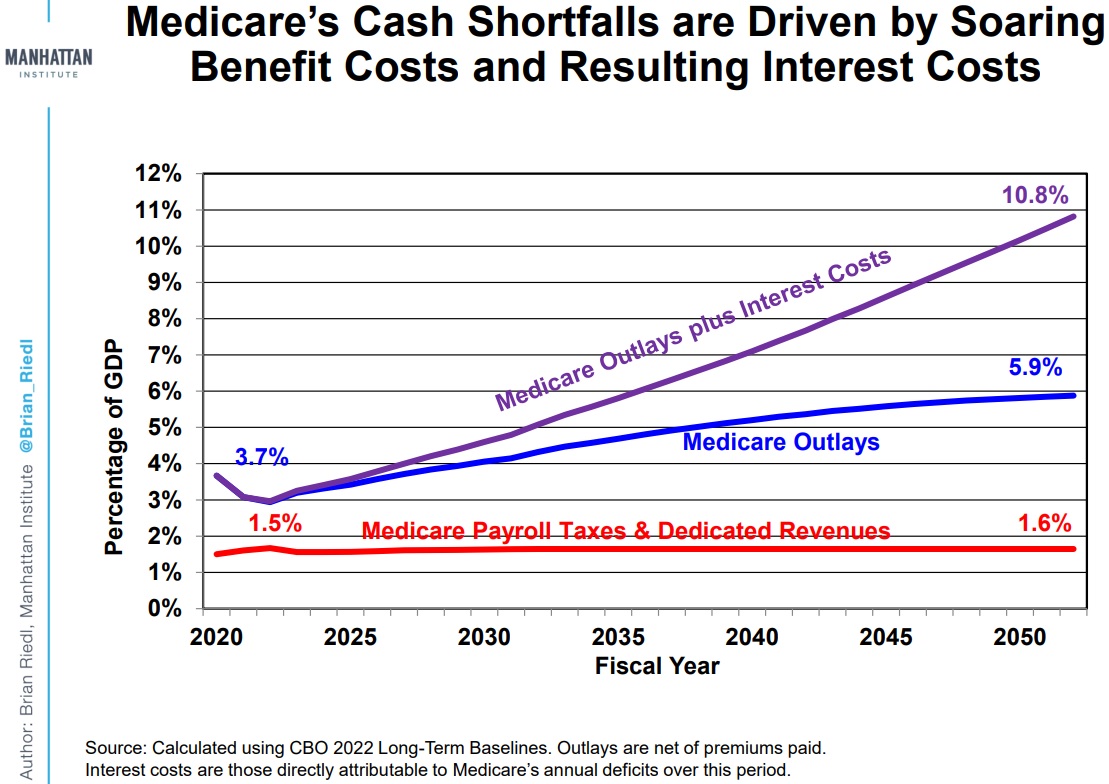
We’ll start with a look at Medicare from Brian Riedl’s chartbook.

That’s a very sobering image, so now I’ll share some very sobering words.

James Capretta of the American Enterprise Institute summarizes America’s grim fiscal future.


In 2001, the Treasury estimated the government’s net unfunded liabilities, in present value terms, at $6.5 trillion, or 61 percent of GDP, with federal debt accounting for $3.3 trillion of the measured obligations. …By 2021, the government’s net position had deteriorated to minus $29.9 trillion, or 128 percent of GDP, with federal debt accounting for $22.3 trillion of the liabilities. The government’s unfunded commitments beyond public debt had grown by $2.9 trillion over ten years. …The financial hole is actually deeper than these numbers reveal because they exclude the dramatic effects of Social Security and Medicare. …with Social Security and Medicare included in the assessment, the federal government’s unfunded liabilities in 2021 are $93.1 trillion, or nearly 400 percent of annual GDP. That compares with $11.1 trillion as calculated in the 2001 Treasury report, which was 105 percent of GDP. …The problem posed by unfunded public liabilities is a relatively new one in U.S. history. It has only been over the past half century that the combination of an aging population and the modern entitlement system has pushed the federal government toward a financial crisis.

Having shared all this depressing data, I’ll now close with a couple of observations.

As I said in the above video, we need the right kind of entitlement reform so that we save money and have better policy for old people and poor people.

P.S. Entitlements are a ubiquitous problem in developed nations.

Thursday, November 17, 2022

Republican Warfare, Part IV: Will the GOP Get Serious about Spending?

November 16, 2022 by Dan Mitchell @ International Liberty

Last week, I explained that “supply siders” need to be ardent advocates of spending restraint. After all, there is no chance of good tax policy in the future if the burden of federal spending continues to expand.


I also wrote about “national conservatives” and pointed out that their opposition to entitlement reform means they implicitly embrace massive tax increases.

The bottom line is that the United States has a built-in spending crisis. Democrats are not serious about addressing the problem. So if Republicans bail as well, the nation is doomed to become a decrepit, European-style welfare state.

What does that mean? Nothing good, at least for people in the productive sector of the economy.

In an article for National Review, Philip Klein speculates whether there is any appetite for spending restraint, even among self-described conservatives.

For much of the history of the American conservative movement, limiting the size and scope of government has stood as one of its central goals. …In 2022, such messages were barely anywhere to be found on the campaign trail…conservatives have largely moved on from making the case for reducing the size and power of Washington. In some cases, this shift has been passive. …

It has become popular in some circles on the right to mock “zombie Reaganism” and insist that while it may have made sense back in the 1980s to argue for smaller government, such a message is now outdated. …the argument that the battle to limit government has already been lost also neglects to recognize that things could always get worse.

That is, even though the federal government has gone through extraordinary growth since the New Deal, it would have grown even larger had there been no conservative movement to push back. One need only look at Europe, where conservative parties long ago made their peace with the welfare state, to see how government agencies have crowded out civil society…

There is no way in which a nation with…a ballooning welfare state will be an accommodating place for conservatives in the long run, no matter how much some may fantasize about seizing the dragon and precisely aiming its fire at their enemies during the relatively brief windows in which Republicans have power. Conservatives…should not abandon the fight for limited government.

At the risk of understatement, I fully agree.

I wrote two days ago and also the previous week to make the case for spending restraint.

Those are easy columns to write since it is the same argument I’ve been making my entire life. But what is depressing now is that there is opposition from Republicans as well as Democrats.

Maybe they should all be forced to watch my video series on the economics of government spending.


Thursday, July 21, 2022

The Case for Entitlement Reform

July 20, 2022 by Dan Mitchell

If Joe Biden’s bungled economic policy is any indication, the GOP may wind up controlling Washington in the not-too-distant future.

If so, I hope Republicans rekindle their interest in the kind of genuine entitlement reform discussed in this interview.


But I’m not sure whether to be optimistic or pessimistic


On the plus side, the GOP supported pro-growth entitlement reform during the Obama years.

On the minus side, the party largely punted on the issue once Trump took over.

To be sure, punting is the easy route from a “public choice” perspective. Politicians like offering freebies to voters and many voters like getting handouts.

However, that approach means America’s economy is weakened by an ever-growing burden of federal spending and eventually is plunged into fiscal crisis.

And that’s based on the programs that already exist. Joe Biden wants to expand the welfare state with even more entitlements!

The Wall Street Journal editorialized about the downside of making America more like Europe last October.


The result of…expanded entitlements is likely to be reduced incentives to work and invest, slower economic growth, lower living standards, and less fiscal space for essential public goods like national defense. That’s the lesson from Europe’s cradle-to-grave welfare states… Europe’s little-discussed secret is that its cradle-to-grave welfare states are financed by the middle class via value-added and payroll taxes. The combined employer-employee social security tax rate is 36% in Spain, 40% in Italy and 65% in France. Value-added taxes in most European economies are around 20%. There simply aren’t enough rich to finance their entitlements.

Amen. I’ve repeatedly warned that a European-sized welfare state would mean European-sized taxes on lower-income and middle-class Americans.

And what’s remarkable (and discouraging) is that some politicians in the U.S. want to expand entitlements even though many European governments now realize they made big mistakes and need to scale back.

The irony is that some European governments have tried to reform their tax and welfare systems to become more competitive. Germany and Sweden over two decades reformed their welfare and labor policies. …Other European governments are also pushing welfare-state reforms. French President Emmanuel Macron has passed pension reform and cut the corporate tax rate to 26.5% from 33% in 2017… Greece is pulling out of its debt trap with Prime Minister Kyriakos Mitsotakis’s tax, pension and regulatory reforms.

For what it’s worth, I’m happy about these reforms, but I fear many European nations are in the too-little-too-late category.


Why? Because the demographic outlook is deteriorating faster than reform is happening. In other words, most of them are probably destined to suffer Greek-style fiscal crises.

But if (or when) that happens, maybe American politicians will finally wake up and realize we need good reforms to prevent Social Security, Medicare, and Medicaid from causing a similar collapse on this side of the Atlantic Ocean..

Hopefully that epiphany will take place before it is too late for the United States.

P.S. For those who are interested in the history of fiscal policy, John Cogan of the Hoover Institution wrote about pre-20th-century entitlements earlier this year.

Here are excerpts from his column in the Wall Street Journal.


The history of U.S. entitlements is a 230-year record of continuous expansion… The first major entitlement, Revolutionary War disability benefits, was initially restricted to members of the Continental Army and Navy who were injured in battle and survivors of those killed in wartime. Eligibility was then expanded, first to state militia soldiers, then to veterans whose disabilities were unrelated to wartime service, and eventually to virtually all people who served during the war regardless of disability. Civil War disability pensions followed the same…process, except on a far grander scale. Pensions were initially confined to U.S servicemen who suffered wartime injuries and survivors of those killed in battle. Eventually they were extended to virtually all union Civil War veterans regardless of disability. …Congress followed the same liberalizing process with 20th-century entitlements.

If this excerpt doesn’t satisfy your curiosity, here’s Cogan discussing the topic for 46 minutes.

P.P.S. Not all entitlement reform is created equal.

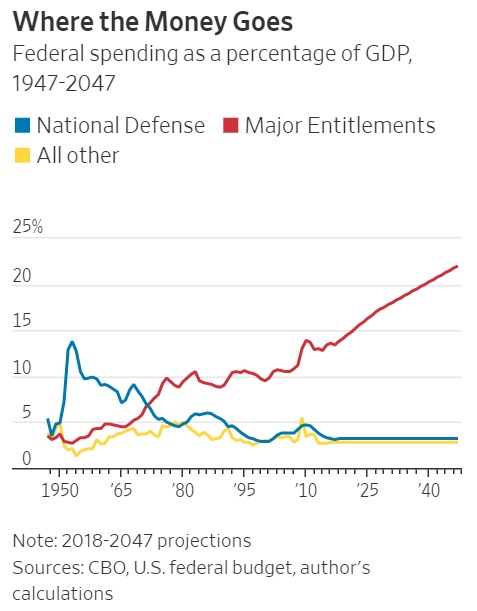
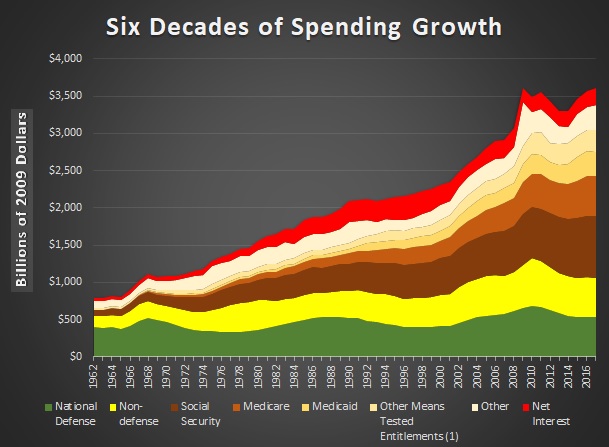
P.P.P.S. Here an informative chart if you want to know whether to blame defense spending or entitlement spending.

P.P.P.P.S. I always argue in favor of a Swiss-style spending cap, which presumably would force politicians to address America’s entitlement problem.


Sunday, November 28, 2021

A Dependency Lesson from Argentina

November 8, 2021 by Dan Mitchell @ International Liberty 

Back in 2017, I shared my Second Theorem of Government to warn why it is so important to resist new government giveaway programs.

And I used Obamacare as a costly example.


Simply stated, it’s much easier to block new handouts than it is to take away goodies once people have been conditioned to think they can and should rely on government. In some sense, this is not just about economics. It’s also about preserving societal capital. All of which helps to explain why it is so important to resist some of Biden’s proposed giveaways, such as parental leave and per-child handouts.  And if you want some extra evidence, look at places where people have become accustomed to living off others.

In her column for the Wall Street Journal, Mary Anastasia O’Grady writes about the basket case of Argentina.

Socialist ideologues know that the welfare state is addictive. New entitlements create dependencies that, once born, demand to be fed and to grow no matter the party in power. Argentina proves the rule. The Argentine electorate may be about to throw out the hard-left Peronists… The bad news is that even if peronismo loses its unchecked power in Argentina’s National Congress, it’s probably too late to avoid another fiscal and monetary crisis. …Both legislative chambers are likely to remain heavily populated by advocates of European socialism.

She shares some history about Argentina’s descent from prosperity to dependency, and points out how the entitlement mindset makes much-needed reforms very difficult.  Even when supposedly right-of-center governments win elections.

One hundred years ago Argentina was one of the world’s most prosperous nations. But as the roaring ’20s wound down, continental fascism gained cachet. …Gen. Juan Perón, who ruled from 1946 through 1955 and again briefly in 1973-74, was especially fond of Benito Mussolini’s Italy. …statism sticks once it’s in place. …fiscal profligacy endured and support for rigid labor laws remained intransigent. …even with Argentine inflation above 50%, widespread price controls and the economy sputtering for a decade, a viable alternative to populism hasn’t emerged.

For more information about the economic tragedy of Argentina, you can click here, here, and here.

To be frank, however, I’m not overly concerned about that country. Like Greece, I view it as a lost cause. What worries me is that the United States may wind up on a slippery slope if more entitlements are added to our already-creaky and burdensome welfare state.

P.S. Argentina probably wouldn’t be such a basket case if the IMF didn’t provide endless bailouts.

P.P.S. It wasn’t too long ago that Biden seemed to understand the importance of societal capital.

  Editor's Note:  Please take some time and review My Argentina File, which goes back to 2012.  RK


Monday, February 22, 2021

The Looming Crisis of Demographic Decline and Entitlement Expansion

February 21, 2021 by Dan Mitchell @ International Liberty  

There are many compelling economic arguments against entitlement programs.

Since I’m a libertarian, I also have moral concerns about tax-and-transfer programs.

Today, though, let’s address the big problem of entitlements and demographics, especially with regards to social insurance programs that transfer money from young people to old people (most notably Social Security and Medicare).

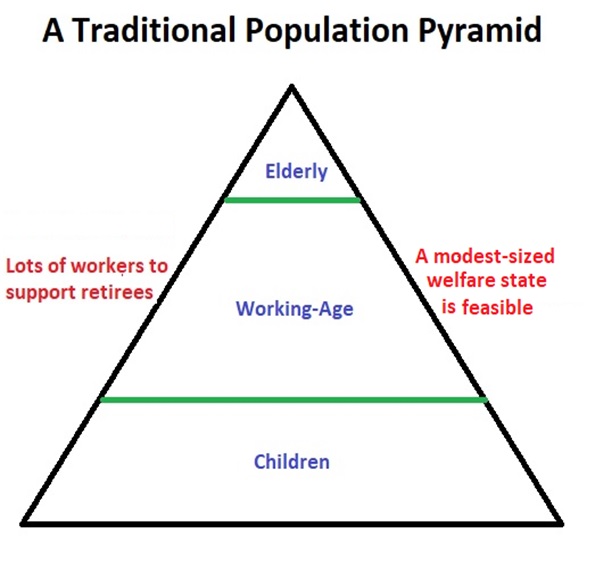
But I’ll start by acknowledging that demographics doesn’t have to be a problem. When nations first created such programs, they generally had “population pyramids” featuring a few old people, lots of working-age people (i.e., taxpayers), and then an even greater number of children (future workers and taxpayers).

As illustrated by this image, entitlement programs can be sustainable with that type of demographic profile.

But there’s been a big shift in demographics in developed nations.


Simply stated, we’re living longer and having fewer kids. In some sense, population pyramids are becoming population cylinders.

And this creates major challenges for entitlement programs because instead of there being many workers supporting just a few retirees, you wind up with “old-age dependency ratios” that require very onerous tax burdens (or very high levels of government borrowing).


I’ve already written how this is a big problem for the United States.  Indeed, I periodically cite long-run forecasts from the Congressional Budget Office to warn about the worrisome fiscal implications.  And I’ve also noted that Japan is in serious trouble.

Today, let’s look at some recent data to show that Europe is another part of the world where this problem is acute. The European Commission published its 2021 Ageing Report late last year and there are three visuals that deserve attention.  First, here’s a look at the European Union’s population cylinder (or maybe an upside-down pyramid).

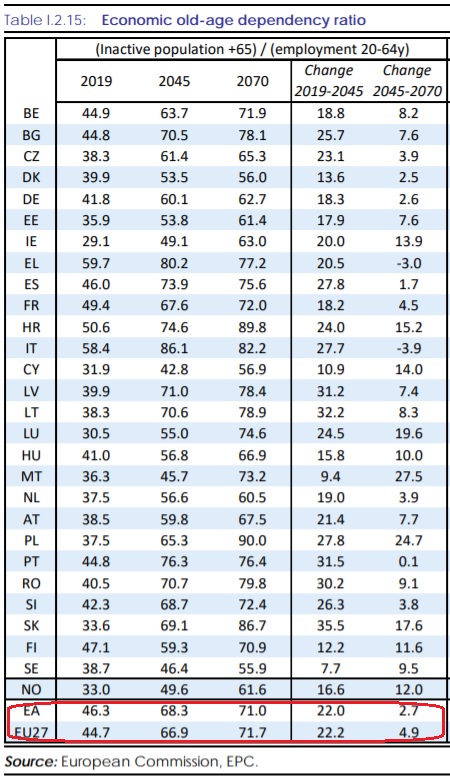
And here’s a table that compares the number of old people with the working-age population in 2019, 2045, and 2070.

At the bottom of the table, I’ve circled in red the averages for the eurozone (nations using the single currency) and the entire European Union. From the perspective of fiscal policy, these are horrific numbers.

But there are numbers that are even worse.

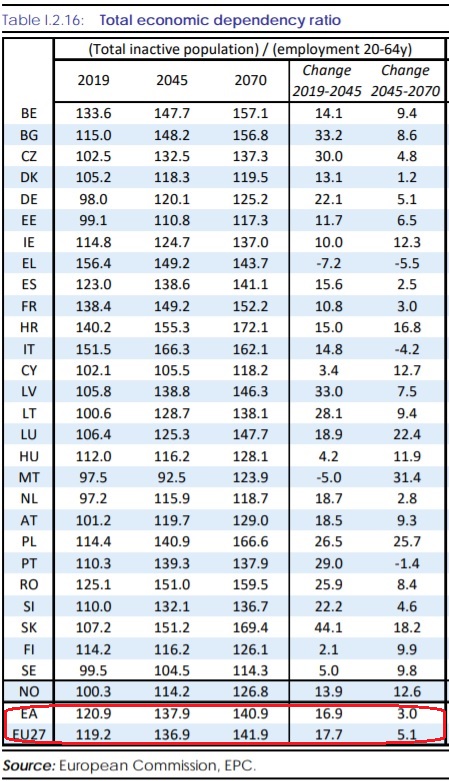
Our final visual is a table showing the economic dependency ratio, which the European Commission defines as “… the ratio between the total inactive population and employment. It gives a measure of the average number of individuals that each employed person ‘supports’ economically.”

Once again, I’ve circled the averages at the bottom of the table.

The bottom line is that most European nations already have a stifling fiscal burden, yet it’s all but certain that there will be even higher taxes and more government spending in the near future.  Which means more economic stagnation for Europe (and those of us in America face that possibility as well).  At the risk of stating the obvious, there is a solution to both Europe’s woes and America’s woes. Simply stated, there needs to be genuine entitlement reform.  That means “pre-funding,” which is the jargon for mandatory private savings, presumably augmented by some form of safety net.

Singapore is probably the world’s leading example for mandatory savings, while Australia, Denmark, Chile, SwitzerlandHong Kong, Netherlands, Faroe Islands, and Sweden are a few of the many other jurisdictions that have fully or partially shifted to systems based on real savings.

Friday, January 22, 2021

The Destabilizing Mix of Demography and Entitlements, Part II

January 22, 2021 by Dan Mitchell @ International Liberty 

A few days ago, I shared some slides from a presentation to an e-symposium organized by Trends Research in Abu Dhabi.

Here’s a video of my presentation, which includes 16 visuals to drive home the point that the world is facing a demographic/entitlement crisis.

Today, I want to share five more visuals to underscore the severity and magnitude of this catastrophe.

But before we look at the charts, I’ll start by saying this isn’t a fast-developing problem. It’s taken several decades to get where we are now and most nations probably have several decades before an actual crisis materializes.

Though what’s already happened in Greece (and what’s presumably about to happen in Italy) should underscore the seriousness of this issue.

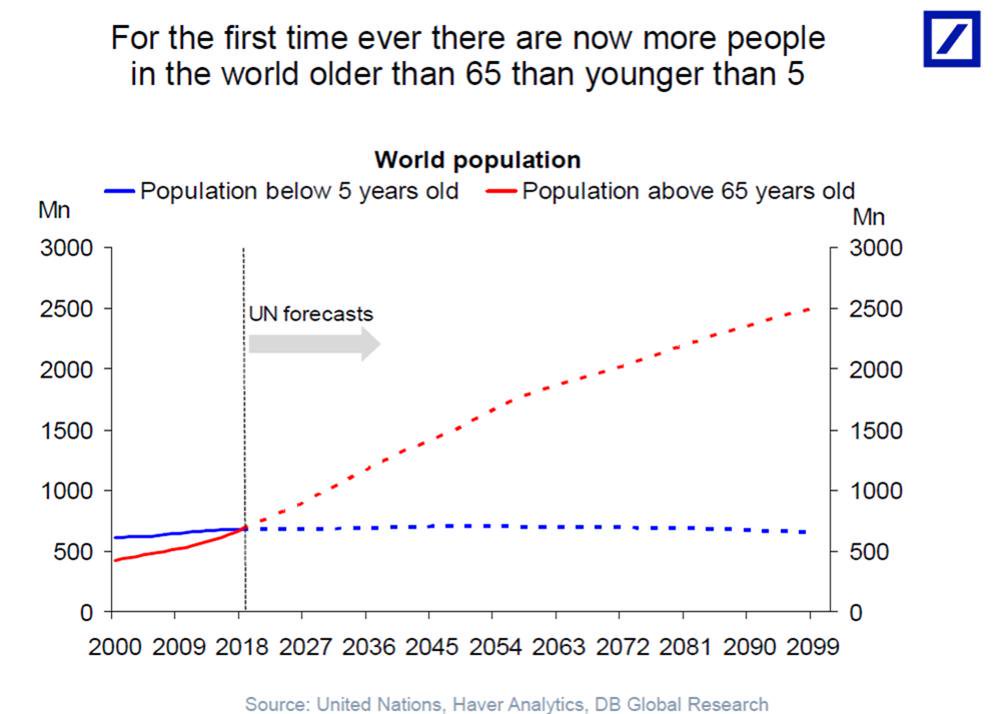
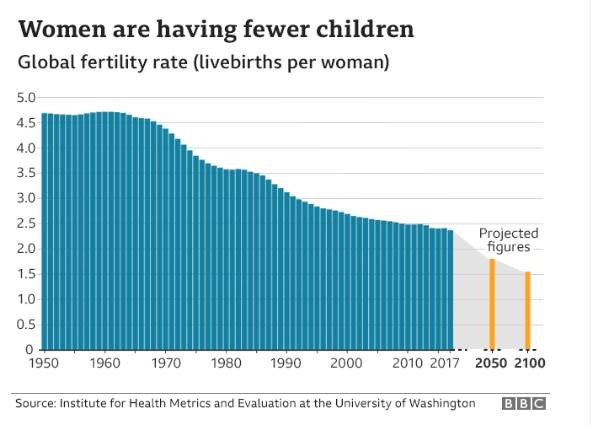
This issue is global, as illustrated by this chart showing the staggering shift that will happen to the world’s population. Simply stated, there are going to be lots and lots of old people, but no concomitant increase in the number of children.

It’s not just that there’s not a corresponding increase in the number of children.

The real story is that birthrates are plummeting.

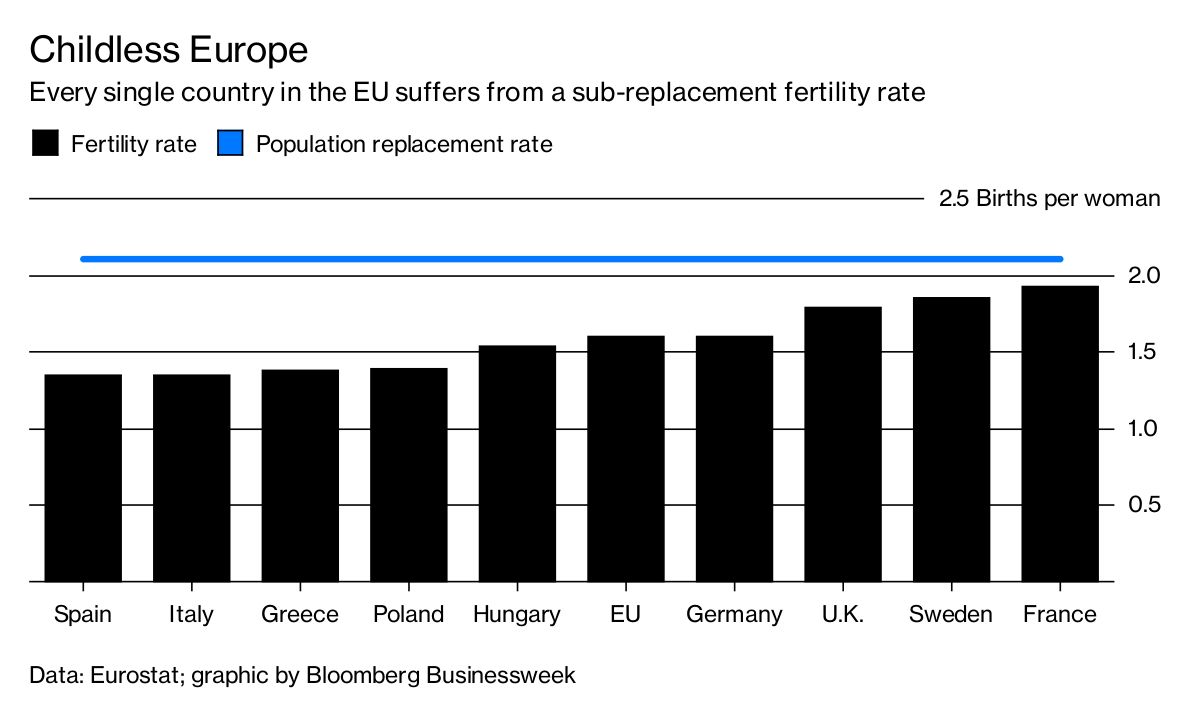
The data for Europe is particularly sobering.

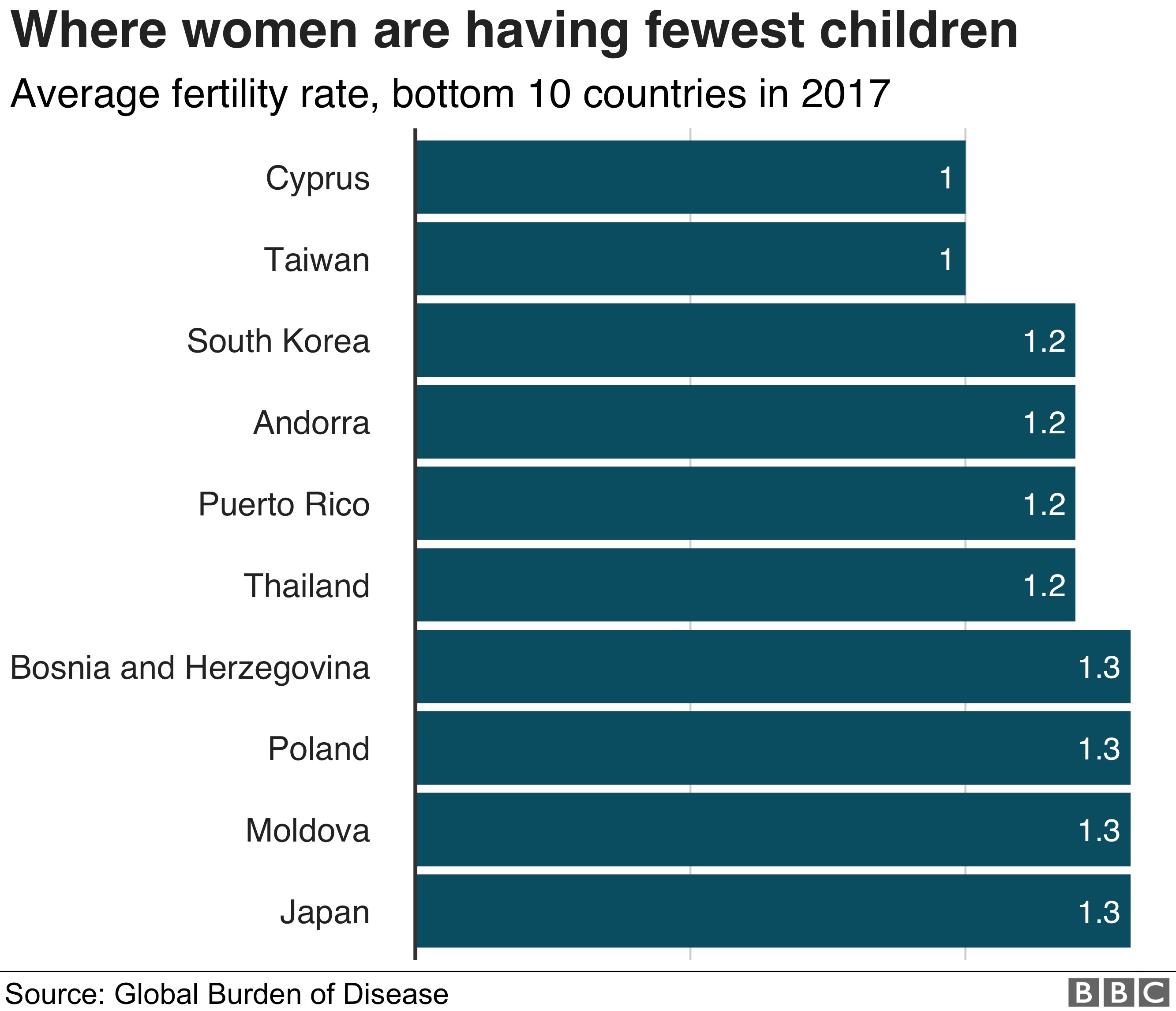
Here’s a look at some other nations that face big fertility declines.

By the way, there’s absolutely nothing wrong with families deciding they want fewer children.

But it does create a big fiscal problem because governments have tax-and-transfer entitlement programs that were created when everyone thought there would always be ever-larger generations.

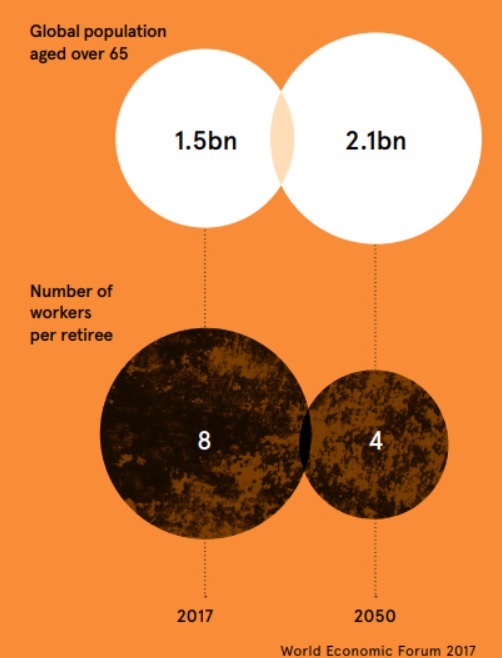
But that’s not happening now, which explains why the world is going from eight workers per retiree to four workers per retiree.

That’s the global data. For many developed regions, such as Europe, the situation is far more challenging.

And the United States isn’t far behind.

I’ll close by observing that there’s actually a very simple solution to this problem. We need genuine entitlement reform.

Sadly, that definitely didn’t happen in the past four years in the United States. And it also won’t be happening in the next four years.

P.S. Hong Kong and Singapore have very low birth rates and very long lifespans, but those jurisdictions are in reasonably good shape because they didn’t make the mistake of imposing western-style welfare states.

P.P.S. Some have argued that the demographic problem can be solved by having government-created incentives for fertility. At the risk of understatement, I’m skeptical of that approach.


Wednesday, January 20, 2021

The Destabilizing Mix of Demography and Entitlements, Part I »

I’ve written many times about demographic change and the implications for public policy – both in the United States and around the world.

Simply stated, it will be increasingly difficult to maintain tax-and-transfer entitlement programs in societies where people are having fewer children and people are living longer.

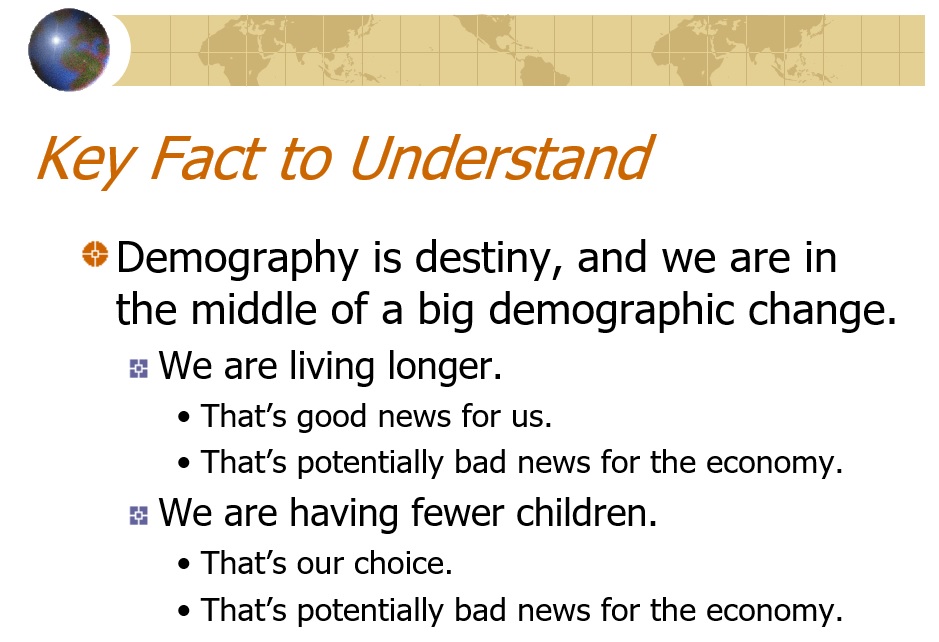
I’m raising this issue because I spoke on this topic earlier today at an e-symposium organized by Trends Research in Abu Dhabi, UAE. Here’s a slide with my main message.

Why is it bad news from an economic perspective?

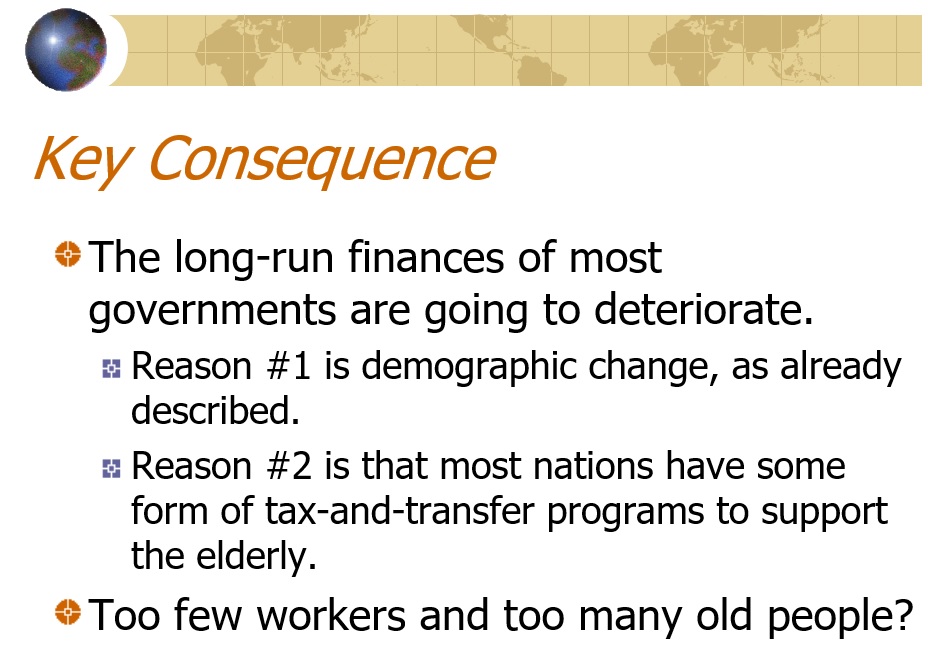
As I noted in the next slide, tax-and-transfer entitlement programs for the elderly (most notably Social Security and Medicare in the United States) become harder to finance when there are lots of beneficiaries and too few taxpayers to support them.

So what’s going to happen in various nations when the irresistible force of more beneficiaries meets the immovable object of fewer taxpayers?

In my presentation, I pointed out that there are only three potential solutions.

I explained that higher tax burdens and higher debt levels would not be economically prudent.

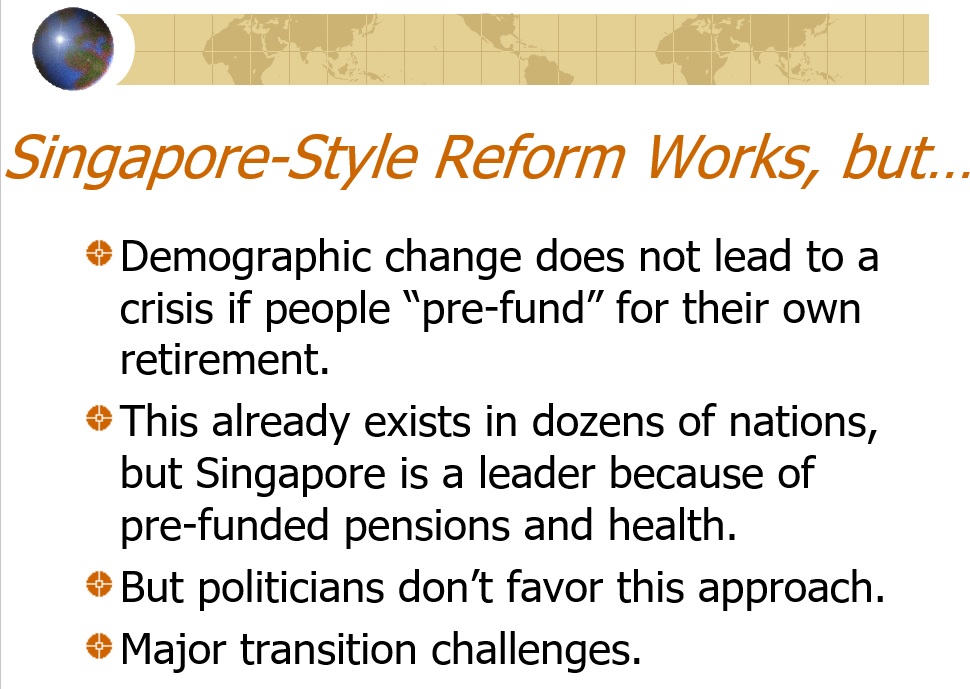
The right approach is genuine entitlement reform, but I freely admitted that this “pre-funding” model probably won’t happen.

Here’s the relevant slide.

By the way, Singapore is the role model for pre-funding, but many other nations have adopted that approach for retirement income (such as IsraelDenmarkSwitzerlandHong KongNetherlandsFaroe Islands, and Sweden).

Unfortunately, most nations are heading for a demographic iceberg (including the U.S.) but I fear few of them will enact the reforms that are needed to avert a bad outcome.


Saturday, December 12, 2020

Time to Surrender on Entitlement Reform?

December 10, 2020 by Dan Mitchell @ International Liberty 

Back in 2015, just five years ago, it seemed like entitlement reform might happen.

Republicans in the House and Senate voted for budgets based on much-needed changes to Medicare and Medicaid. That was only a symbolic step with Obama in the White House, to be sure, 


but the presumption was that actual reform would be possible if Republicans controlled both the White House and Congress after the 2016 election.

The good news is that the GOP did wind up in control of Washington.

The bad news is that Donald Trump was in the White House.

Given his unfortunate views on government spending, that killed entitlement reform for the past four years.

And now Biden will be in the White House, and he wants to expand those programs, so that presumably kills reform for the next four years.

But does that change the fact that the programs should be reformed?

In a column for National Review, Fred Bauer asserts that Republicans should give up on trying to control big government.


Republicans…risk being lured toward a pivot back to 2010s-style austerity politics during the Biden administration, with a renewed focus on the federal deficit and entitlement reform. …Trying to push party-line entitlement reform has backfired on the GOP again and again in the recent past. George W. Bush’s 2005 Social Security–privatization proposal kneecapped his second term from the start. In 2012, Republicans got bogged down defending their position on Medicare reform… retreating to austerity politics could cost Republicans a chance to promote other kinds of reforms that would strengthen workers and families: fixing the medical marketplace (by reducing cartelization, revising medical licensing, etc.), passing a 21st-century infrastructure program, trying to secure a strategic industrial base, enacting smarter regulation of Big Tech that addresses market concerns and serves the public welfare, offering Americans family tax credits, and so on.

Also writing for National Review, Yuval Levin of the American Enterprise Institute explains that we have no choice but to grapple with entitlements.


The Republican Party has styled itself the party of fiscal restraint for the better part of a century… But there hasn’t been much action, or much willingness to expend political capital or make some painful deals to achieve a meaningful change in the trajectory of the government’s finances. …the willful blindness of the Trump era…means the underlying fiscal problems have grown worse… the costs of fiscal irresponsibility have more to do with constraints on future growth… Fiscal reform will need to involve changes to these programs.

Levin even suggests that entitlement reform is so important that it might be worth ceding ground in other areas.

Repub­licans should be willing to make bargains that involve leaving discretionary spending untouched, or even on a path of modest growth, if that allows for some reforms of entitlements. They should also be willing to contemplate tax increases and reforms that move the burden of federal revenue upward on the income scale, provided such changes do not unduly undermine growth.

My two cents is that Levin is right and Bauer is wrong.

To be sure, I don’t agree with everything Levin wrote (it’s theoretically possible to make a tax increase acceptable, for instance, but that won’t happen in the real world). But at least he recognizes the long-run spending outlook is so dour that entitlement reform is absolutely necessary.

Bauer, by contrast, argues that we should throw in the towel because reform is politically difficult.

I think he misreads the evidence.

Regarding Social Security, Bush got elected twice while supporting personal accounts, but the issue never went anywhere in his second term in large part because the White House never proposed a plan.


Moreover, the public continued to be supportive of the idea of personal accounts, even after Bush left office.

Likewise, I think Bauer is wrong on Medicare and Medicaid. Republicans easily maintained control of the House in 2012, 2014 and 2016, notwithstanding Democratic attacks that they wanted to “push granny off a cliff.” And they still control the Senate after years of similar attacks.

But even if Bauer was right about the politics, he’s wrong about policy.

America will become another Greece if we don’t reform entitlements. That will be bad for the nation. It will be bad for our economy. It will be bad for our children and grandchildren. It will be bad for the fabric of our society.

The bottom line is that entitlement reform is the patriotic thing to do.


Thursday, July 2, 2020

Everything You Need to Know about America’s Future Entitlement Crisis


July 1, 2020 by Dan Mitchell  @ International Liberty

Before our depressing discussion today about the fiscal impact of entitlement programs (Social SecurityMedicareMedicaidEITCFood Stampswelfare, and Obamacare, etc), here’s a video of how it all began.

I think this is a great introduction to the issue, particularly since you learn how “public choice” (i.e., politicians engaging in self-serving behavior) played a key role in the development of today’s welfare state.

But if you don’t have the time to watch a long video, here are four key things to understand.

Entitlements (budget geeks sometimes use the term “mandatory spending”) are programs that automatically give people money if they meet certain requirements (such as reaching a certain age or having income below a certain level).

Since these programs automatically give people money, they are not part of the annual appropriations process (the “discretionary spending” parts of the budget that are determined on a yearly basis).


Some entitlement programs are “means tested” and designed to funnel money to low-income individuals. This type of spending is sometimes referred to as “unearned benefits.”

Some entitlement programs are “social insurance” since people pay specific tax in exchange for specific benefits. This type of spending is sometimes referred to as “earned benefits” (though in many cases recipient receive much more than they paid).

By the way, there’s one additional thing to understand.

Indeed, it may be the most important thing to understand if you care about America’s fiscal and economic future.

5.  Entitlement programs are a slow-motion fiscal train wreck.

Let’s look at a new study authored by James Capretta of the America Enterprise Institute. He also has some sobering observations on the history of entitlement programs.
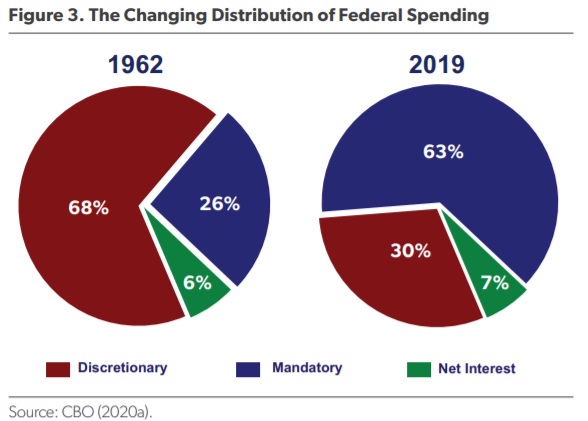
The growing expense of entitlement programs has occurred steadily for more than a half century and is reflected in the shifting distribution of federal spending activity. …by the early 1960s, two-thirds of all spending continued to require approval by the House and Senate appropriations committees each year, and less than a third was spent on entitlement programs. … By 2019, nearly two-thirds of all spending in the budget was for entitlement programs, and less than a third went to annually appropriated accounts.
If you prefer this information visually, here are a couple of pie charts from the study.


While there are dozens of entitlement programs, the big three are Social SecurityMedicare, and Medicaid.
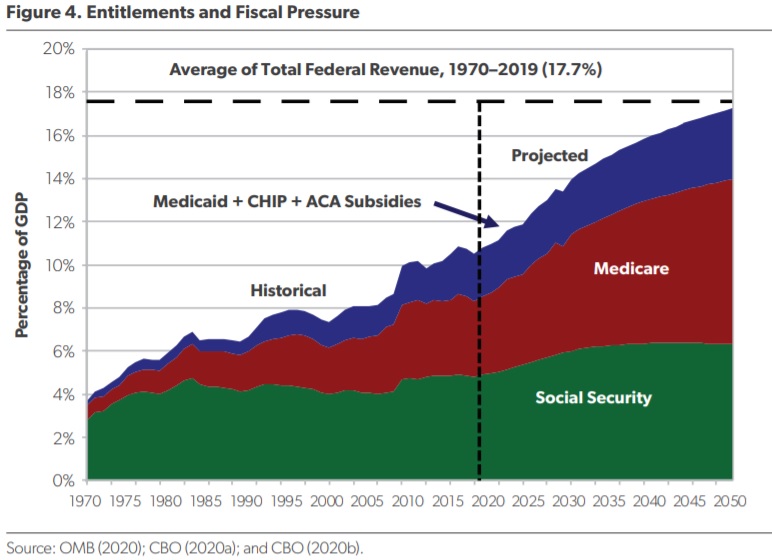
The largest entitlement programs are Social Security, Medicare, and Medicaid. Together, they now make up nearly half of all federal spending. Their combined growth over the past half century is the primary source of intensifying fiscal pressure. …In 2019, combined federal spending on them was 9.8 percent of GDP, up from 3.7 percent in 1970. CBO expects them to cost 17.2 percent of GDP in 2050, which is almost equal to the average annual revenue collected by the federal government from 1970 to 2019.
And here’s how they’ve been consuming ever-larger shares of America’s economic output.


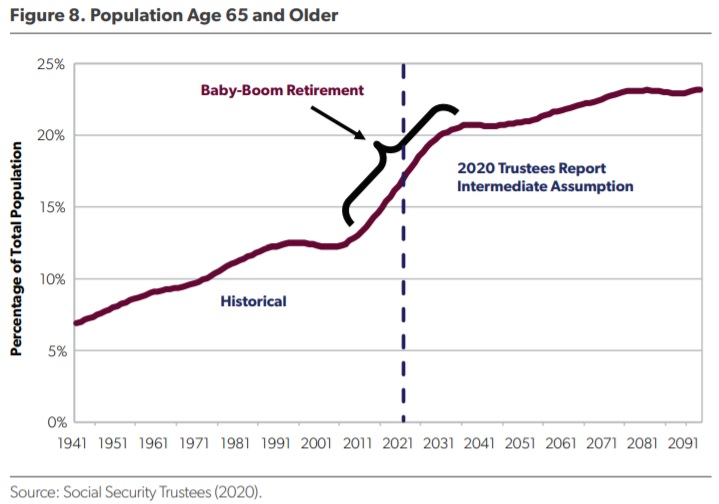
What’s driving this ever-increasing fiscal burden? In part, it’s because we have more and more old people and they are living longer.


So what does all this mean?

Capretta points out that uncontrolled entitlement spending may lead to a debt crisis.
I don’t disagree, but I think that’s a secondary concern. The real problem is that government spending will become an ever-larger economic burden. And that will hinder growth whether it’s financed by borrowing or taxes.

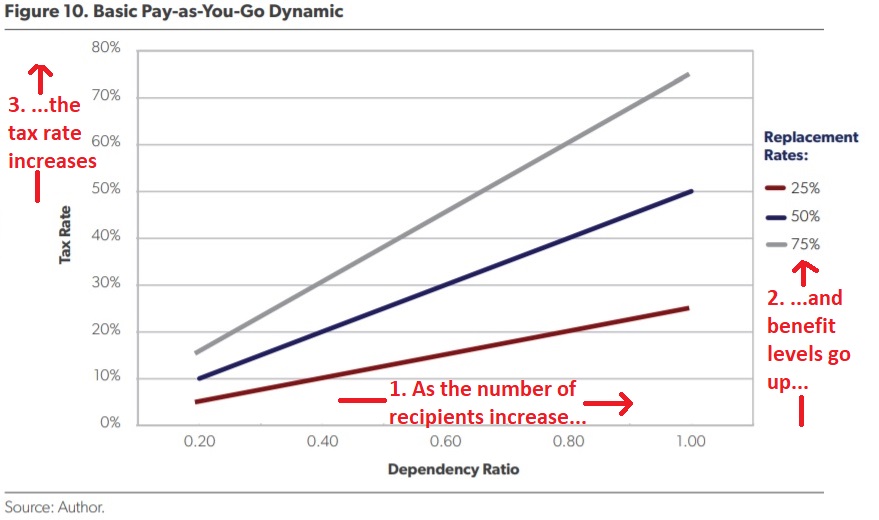
Speaking of taxes, here’s the chart from the study that deserves our close attention. It shows the relationship between demographics, benefit generosity, and tax burdens.


Here’s how Capretta describes the relationship.
…for each of the stipulated replacement rates (25, 50, and 75 percent), the tax rate necessary to keep the program solvent rises with increases in the aged dependency ratio. This explains why social insurance taxes in many aging societies have been increased to high levels in recent decades.
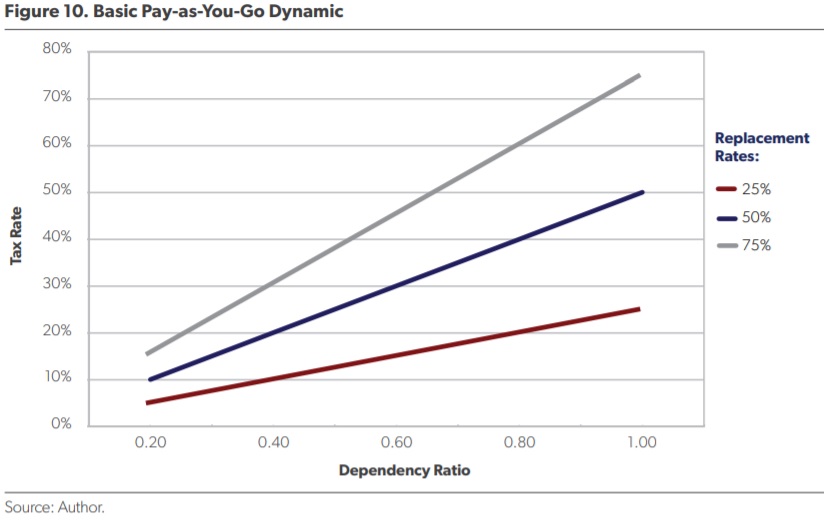
I’ve taken the liberty of augmenting the chart to show how these factors interact (though the order of #1 and #2 doesn’t matter).


The bottom line is that the United States is on track to become a high-taxEuropean-style welfare state if fiscal policy is left on autopilot.

In other words, unless there’s genuine entitlement reform, future Americans will be condemned to lower living standards.

P.S. Here’s some more history. In a column for the American Institute for Economic Research, Richard Ebeling looked at British history to explain how the private sector played a role in social insurance before being displaced by government.
Throughout the 19th century, a primary means for the provision of what today we call the “social safety nets” was by the private sector outside of government. The British Friendly Societies were mutual assistance associations that emerged to provide death benefits for the wives and children of the breadwinner who had passed away. But they soon offered a wide array of other mutual insurance services, including health care coverage, retirement pension programs, unemployment insurance, savings clubs to purchase a family house, and a variety of others. …by the end of the 19th century around two-thirds to three-quarters of the entire British population was covered by one or more of their programs and insurances. The research also discovered that a large majority of the subscribers were in the lower income brackets of the time… What stands out is that these were all private and voluntary associations and exchanges, in which the government paid little or no role.
On a related note, here’s an excellent short video on the English “poor laws” from the 1800s.

P.P.S. In addition to the fiscal burden of entitlement programs, there’s also a major problem in the way these programs discourage work.