Search This Blog

De Omnibus Dubitandum - Lux Veritas

Showing posts with label Government Waste. Show all posts

Wednesday, April 26, 2023

Your Taxes At Work: ‘Eco-Anxiety’ Counseling For Federal Workers – OpEd

 By April 26, 2023

Climate doomsayers and cancel culture work to justify counseling for bureaucrats’ climate grief

US Fish and Wildlife Service employees are struggling to cope with feelings of trauma and loss over the world’s changing climates and imperiled environments. Their work repeatedly confronts them with ecological changes, but even a sense of “anticipated loss” perhaps decades from now requires compassionate help. Or so the FWS and American Psychological Association tell us.

The FWS is thus offering paid leave to employees who attend “eco-anxiety” and “climate grief” training. When the House Natural Resources Committee called the sessions a colossal waste of money, the agency downplayed their cost and scope. But naturally the “woke” programs don’t end there.

FWS Director Martha Williams is also pushing diversity-equity-inclusion-LBGTQ programs as the agency’s “number one priority” (or perhaps number two, after climate change). Employees can take as much paid time off as needed for DEI and “gay pride” programs and eco-anguish counseling.

There’s no word about programs to help employees deal with widespread habitat and wildlife destruction that will result from millions of wind turbines, billions of solar panels and tens of thousands of miles of new transmission lines, due to “net zero” policies implemented in the name of averting the “climate crisis.” Apparently no programs offer paid leave to participate in “conservative pride” campaigns or study Earth’s historic ice ages, warm periods, little ice ages and decades-long droughts.

That’s hardly surprising. The FWS and Interior Department were getting eco-centric and anti-fossil-fuel when I worked there 35 years ago. Like American and Western society in general, their culture has simply gotten more noticeably and intolerantly devoted to extreme environmentalist agendas since then.

Movies, television and news stories, constant instruction in what to think, rather than how to think, an absence of religion and ethics in many schools and homes, and incessant themes of inequality, victimhood and global doom foster widespread tension, anxiety and depression. They leave too many children, teens and adults unable to cope with life and setbacks, less respectful of authority and human life, inured to violence, and aggressively intolerant of opinions that differ from their own ideologies and agendas.

Even before they were forced to endure Covid-induced lockdowns, nearly 20% of Americans were taking antidepressants and other psychiatric drugs, some linked to precipitating acts of violence; a third of high school students experienced prolonged anxiety, depression and hopelessness; and almost one in five teenagers had contemplated suicide.

Social isolation, minimal physical and outdoor activity, video games and reading self-selected online media have amplified depression and “chronic incapacitating mental illness” in America and many Western countries. Also hardly surprising, the problems are increasingly blamed on climate change.

Climate grief is real,” self-proclaimed experts insist, and it’s spreading rapidly among young people. “The future is frightening,” 77% of 10,000 young people ages 16-25 from the USA and other countries told “climate anxiety” and “climate depression” investigators. Many children have climate nightmares.

“The climate mental health crisis” already affects people who have “lost everything in worsening climate infernos,” claims a NASA scientist and climate activist who’s certain we face “the end of life on Earth as we know it.” He’s not alone in being convinced that every extreme weather event and ecological calamity today is due to or made worse by fossil fuel and agricultural emissions.

“I don’t want to be alive anymore,” wailed a four-year-old who’s clearly been indoctrinated already. “The animals are all going to die, and I don’t want to be here when all the animals are dead.”

Parents fantasize about killing their children, over fears of a “climate-ravaged future.” Parents, teens and even children increasingly consider suicide.

At least one psychologist has based his entire practice on addressing climate psychoses. The Climate Psychology Alliance provides an online directory of “climate-aware therapists,” and a “peer support network” offers grief therapy modeled on twelve-step drug addiction programs.

There’s only one real solution to this epidemic, other “experts” insist: Governments must “take action now” to “end the climate crisis,” to eliminate “the death knell of climate chaos” that threatens us. Otherwise the epidemic of anxiety, depression, pills, climate grief and suicide will steadily worsen.

This is nonsense, insanity. We don’t have a climate crisis. We have a climate fear-mongering crisis.

We don’t need to “fix” exaggerated and over-hyped climate problems. We need to end the junk science, the indoctrination dominating news stories and classroom discussions about energy and climate change, the censorship that prevents alternative, reality-based facts and voices from being heard, the massive government funding of one side of this crucial debate.

Claims of “unprecedented” temperatures and extreme weather, floods and droughts have no basis in real-world evidence. The “climate crisis” exists in greenhouse-gas-focused computer models, headlines and hype, not in reality.

There is no unprecedented upward trend in the frequency of violent US tornados, or US landfalling hurricanes, for example – though the 12-year absence of Category 3-5 hurricanes hitting the United States between Wilma (October 2005) and Harvey (August 2017) is an all-time record.

Unfortunately, viewpoints, evidence and experts challenging climate crisis claims are too often banished from school curricula, news and social media, and government policy discussions.

President Biden’s “national climate advisor” worked closely with Big Tech and news organizations, to suppress facts about climate change, fossil fuels, and the acreage, raw materials and mining required for wind, solar and battery power. Meta (Facebook), YouTube, pre-Musk Twitter and other companies routinely help to deplatform, demonetize and censor anyone contesting crisis-promoting claims.

The Intergovernmental Panel on Climate Change “summaries for policy makers” often misrepresent scientific findings and advance frightening but unsupported scenarios about Earth’s future climate. The IPCC also ignores studies that demonstrate how increased atmospheric carbon dioxide improves plant growth and wildlife habitats, how climate has changed repeatedly throughout Earth’s history, and that eliminating fossil fuels would result in extensive ecological damage from wind, solar, battery and transmission line mining and installations.

ChinaIndia and other countries are rapidly expanding their oil, gas and coal use, to improve their economies and lift billions out of poverty. China dominates raw material and “green tech” supply chains, making the West increasingly reliant on China for energy, economy and national defense needs – via Chinese mines, processing plants and factories that operate under minimal standards for pollution control, habitat destruction, and slave and child labor. As a result:

  • Nothing the United States, Europe, Canada and Australia do will have any effect on global fossil fuel use or greenhouse gas emissions.
  • Western foreign and domestic policy options will be restricted by reliance on adversarial nations for pseudo-renewable energy materials and technologies.
  • Prices for energy, goods and services will skyrocket, because every megawatt of wind and solar must be duplicated with backup batteries or generators.
  • Politicians and bureaucrats – egged on by loud, often violent mobs – will increasingly dictate our energy consumption, living standards, home sizes, vacations, and what we can eat, drink, drive and buy.

These are the real existential threats to democracy, society, humanity and planet. Parents, voters, legislators and judges concerned about our future must take action now to stop this insanity.

Paul Driessen

Paul Driessen is a senior fellow with the Committee For A Constructive Tomorrow and Center for the Defense of Free Enterprise, nonprofit public policy institutes that focus on energy, the environment, economic development and international affairs. During a 25-year career that included staff tenures with the United States Senate, Department of the Interior and an energy trade association, he has spoken and written frequently on energy and environmental policy, global climate change, corporate social responsibility and other topics. He’s also written articles and professional papers on marine life associated with oil platforms off the coasts of California and Louisiana – and produced a video documentary on the subject.

Saturday, April 22, 2023

2023 is a budget year in Ohio, and lawmakers are busy debating the state’s next biennial budget. Our policy team here at Buckeye is equally occupied working to ensure the next budget includes a tax cut for Ohioans, spends money transparently and wisely, expands school choice, and improves the state’s higher education system. Let’s face it, trying to talk the government in to adopting our perspective takes time, money, and relentless effort.


Our legal team still has its foot on the gas pedal and has filed several lawsuits and amicus briefs, including cases against the city of Columbus, the city of Akron, government unions, and Columbus City Schools. And our fearless leader, Robert Alt, presented oral arguments before the Ohio Supreme Court in our local income tax case Schaad v. Alder (read more on that below).


PLEASE NOTE: We are proactively looking for even more good people to join our merry band in Columbus. Specifically, we are seeking a fundraiser who loves the work we do and cannot wait to help us secure the resources necessary to underwrite the same. If you (or someone you know) fits that bill, please apply via our website to be considered. Do not worry if you have not sold the idea of liberty and sound economic and legal public policy before and/or have limited to no real background with asking for money. We can and will train the right person. We value a positive attitude, enthusiasm, philosophical alignment, and a diligent work ethic much more than formal credentials and experience in this role. Even if you have retired from another career or are interested in doing some work that matters within a part-time situation, we are open to different configurations. Reach out and try. You might be surprised to find that perhaps you are just the match we need.

News from Buckeye’s Legal Team

Buckeye’s President and CEO Robert Alt Delivered Oral Arguments Before Ohio Supreme Court (as pictured above addressing the seven Justices from the lectern).

In February, Robert Alt personally presented oral argument before the Ohio Supreme Court in Schaad v. Alder (one of Buckeye’s six municipal income tax cases), and we await the decision in this high profile case that impacts millions of Ohioans. If you missed the live oral argument, you can watch the recording at OhioChannel.org


Buckeye Sues Columbus to Protect Constitutional Rights of Gun Owners

The Buckeye Institute filed Doe v. Columbus against the city of Columbus to protect the rights of Ohioans to keep and bear arms after the Columbus City Council passed an ordinance outlawing certain firearms magazines in violation of Ohio law and the U.S. and Ohio constitutions.


Buckeye Takes City of Akron to Court

The Buckeye Institute filed Kresevic v. Chittok on behalf of Karen Kresevic, who had municipal income taxes taken from a settlement package by the city of Akron. This is the sixth case Buckeye has filed challenging the constitutionality of Ohio House Bill 197. The other cases are: Buckeye v. Kilgore, Morsy v. Dumas, Curcio v. Hufford, Schaad v. Alder, and Denison v. Kilgore.


In “Bacon” Case, California Tries to Impose its Laws on Other States

In Bloomberg Law, Buckeye’s Robert Alt explains why California’s position in National Pork Producers Council v. Ross is unconstitutional and contradicts America’s founding principles of balance among states.


Read about other cases Buckeye’s Legal Center is working on.

News from Buckeye’s Policy Team

Buckeye Releases World Famous 2023 Piglet Book


The Buckeye Institute released its now world-famous 2023 Piglet Book, which identified more than $2.7 billion in savings for Ohio taxpayers and analyzes Ohio’s proposed biennial budget to offer specific savings for lawmakers to consider as they debate the state’s two-year budget.


Buckeye’s Research Informs Debate on Comprehensive Tax Reform


Economists and policy experts with The Buckeye Institute’s Economic Research Center conducted the research and analysis for Tax Reform in Ohio: An Economic Analysis, a report released by Americans for Prosperity that examines the need for tax reform to reverse years of economic stagnation and decline in Ohio.


Buckeye Offers Policy Solutions to Make Ohio a More Prosperous State


In a policy brief, Budget Priorities for a More Prosperous Ohio, The Buckeye Institute outlines specific tax and education reforms lawmakers should pursue to improve Ohio’s economy and workforce as our team continues to testify frequently in the legislature about what makes for sound tax policy and sensible budgeting.


Read about other research Buckeye’s policy experts are working on.

Buckeye In The News Highlights


Revived Clean Air Plan would shock customers with higher energy bills!

The Boxer Show, 610 WTVN-AM (Columbus), Segment starts at 5:43


California's Cautionary Clean Energy

By Rea S. Hederman Jr. & Will Swaim, RealClearPolicy


Buckeye’s Rea Hederman Joins Scott Sloan to Discuss How A new Clear Power Plan will Affect Customer Energy Bills in Ohio

Scott Sloan Show, 700 WLW-AM (Cincinnati)


Report: Biden’s energy plan costs jobs, ratepayers

The Center Square


AFSCME to repay dues withholdings for 3 Lucas County employees who sued

The Blade


How will Ohio's bill to flatten income tax impact local governments?

Cincinnati Edition, 91.7 WVXU-FM (Cincinnati)


Ohio needs responsible, comprehensive tax reform

The Boxer Show, 610 WTVN-AM (Columbus)


Iowa Should Look to Ohio in Advancing Pro-Growth Regulatory Reform

By Rea S. Hederman Jr. & John Hendrickson, RealClearPolicy


Ohio jobs market nearly back to pre-pandemic peak!

The Boxer Show, 610 WTVN-AM (Columbus), Segment starts at 5:40


In Pork Case, California Tries to Impose its Laws on Other States

Bloomberg Law


Public-private partnerships can help stretch infrastructure funds

By Rea S. Hederman Jr., Crain’s Cleveland Business


Columbus gun owners wary of city's new ammunition restriction

The Columbus Dispatch


Do cities owe commuters tax refunds for 2020 shutdowns? Ohio Supreme Court hears case

The Cincinnati Enquirer


Getting Ohioans Back to Work Means Battling Obesity

By Rea S. Hederman, Jr., RealClearPolicy


Buckeye’s Jay Carson Joins Brian Thomas to Discusses Buckeye’s Cincinnati Tax Case

The Brian Thomas Show, 55 KRC-AM (Cincinnati)


Buckeye’s Dave Tryon Joins Brian Thomas to Discuss New Gun Rights Case

The Brian Thomas Show, 55KRC-AM (Cincinnati)


Buckeye’s Greg Lawson Joins Karen Kasler to Discuss the Pros and Cons of Governor DeWine’s Budget

The State of Ohio, Ohio Public Television, Segment starts at 5:25


Buckeye Institute files lawsuit against Columbus City Schools over public records

The Columbus Dispatch


Buckeye’s Greg Lawson Joins Brandon Boxer to Discuss Governor DeWine’s State of the State Speech and Budget

The Boxer Show, 610 WTVN-AM (Columbus)


How Ohio is making it easier for new residents to get licensed for work

NBC4i.com


Buckeye’s Rea Hederman Joins Brandon Boxer to Discuss the Benefits of Universal Occupational License Recognition

The Boxer Show, 610 WTVN-AM (Columbus)

Founded in 1989, The Buckeye Institute is an independent research and educational institution a think tank whose mission is to advance free-market public policy in the states.

The Buckeye Institute is a non-partisan, non-profit, and tax-exempt organization, as defined by section 501(c)(3) of the Internal Revenue code. As such, it relies on support from individuals, corporations, and foundations that share a commitment to individual liberty, free enterprise, personal responsibility, and limited government. The Buckeye Institute does not seek or accept government funding.


Sunday, April 4, 2021

The Boondoggle of Long-Distance Passenger Rail

April 3, 2021 by Dan Mitchell @ International Liberty 

Infrastructure often is a good thing. Government-financed infrastructure is a questionable thing. Infrastructure financed by Uncle Sam is a bad thing. Those three rules guide my thinking and make for a perfect introduction to this must-watch video from Reason on high-speed rail.  

The core message from the video is that Californian’s disastrous experience with high-speed rail should be a warning for the entire nation.  Simply stated, the government is incapable of doing infrastructure without jaw-dropping cost overruns.

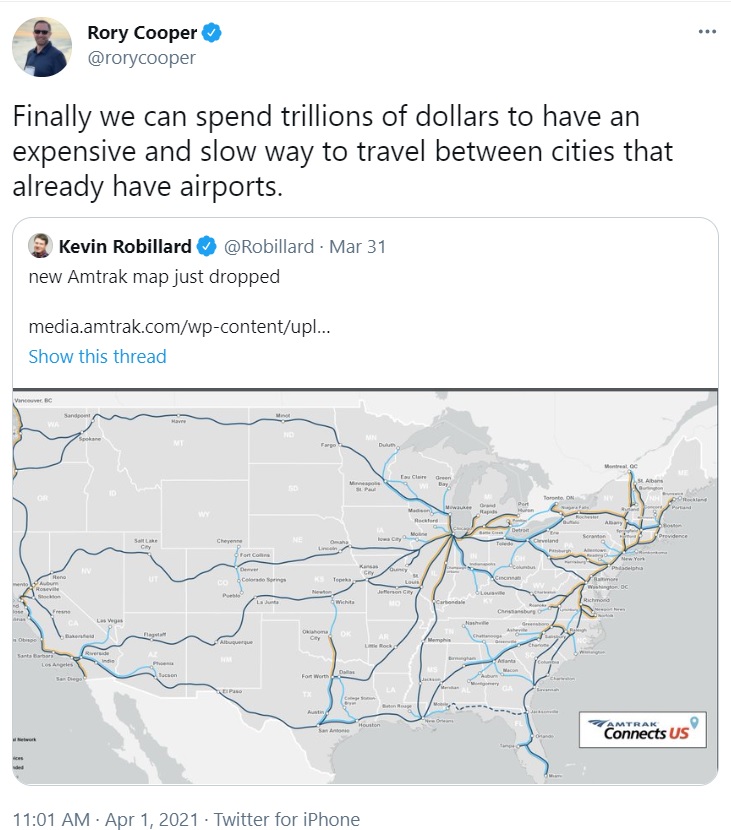
But even if – by some impossible miracle – the government spent the money wisely and efficiently, long-distance rail doesn’t make sense. Why? Well, if I do a tweet-of-the-year contest for 2021, this entry from Rory Cooper would be an early favorite to win the prize.

Instead of expanding the federal government role, it’s time to end Washington’s involvement.  That means shutting down the entire Department of Transportation.  But let’s focus specifically on Amtrak. Chris Edwards wrote wisely on the topic for the Foundation for Economic Education.


The federal government does a lot of things poorly… After the government helped ruin private passenger rail in the post-WWII years, it took over the remaining passenger rail routes in the 1970s under the Amtrak brand. Amtrak was supposed to become self-supporting, but it has consumed tens of billions of taxpayer dollars over the years.

…Amtrak operates 44 routes on 21,000 miles of track in 46 states. Amtrak owns the trains, but freight rail companies own nearly all the track. A Pew analysis found that Amtrak loses money on 41 of its 44 routes…

The few routes that earn positive returns are in the Northeast, and the biggest money losers are the long-distance routes. …the best fit for the future would be a privatized Amtrak. Privatization would allow for innovation and cost-cutting to improve service and make rail more financially viable. A private rail company (or companies) could…end harmful union rules. It would be able to close the routes that are losing the most money and shift resources to the core routes to improve service quality.  Congress should get out of the passenger rail business and give rail the private-sector flexibility it needs to better compete against other transportation modes.

Amen. If inter-city rail travel makes sense, it can and will attract funding from the private sector.  Sadly, 

 https://c2.staticflickr.com/2/1005/998657665_3ef556dc63.jpg

President Biden wants to move in the opposite direction. His so-called infrastructure plan makes taxpayers foot the bill. The White House wants $80 billion for rail, though it’s unclear how much money would be allocated specifically to Amtrak compared to other rail projects.  What is clear, by contrast, is that the money will be wasted and America’s economy will be harmed.

P.S. Biden’s “stimulus” boondoggle included a bailout for mass transit, but no funds for intercity rail travel.

P.P.S. If you’re transportation wonk, here’s a very informative 45-minute video on rail and highway transportation.

Thursday, August 29, 2019

Bernie’s $16 trillion Green New Deal — $150,000 per household

By   | August 28th, 2019 | General Information | 2 Comments

Democratic presidential candidate Bernie Sanders has announced a Green New Deal proposal he says will cost $16.3 trillion. Divided among America’s 120 million households, that equates to nearly $150,000 per household. And that is in the unlikely event that Bernie’s plan comes in on budget. We all know how badly government fares at coming in on budget for major projects, particularly regarding energy and the environment. Don’t believe us? Just ask California regarding its high-speed rail plan. Or check out how Solyndra is doing these days.

True, Bernie will implement his plan over the next 10 years, so American households can prorate their costs at approximately $15,000 per household per year. That’s still a huge amount of extra money to demand out of every household each year..........To Read More.....

Saturday, May 18, 2019

Great Moments in Washington Waste

May 17, 2019 by Dan Mitchell @ International Liberty
 
Every so often, I’ll see a story (or sometimes even just a photo, a court decision, or a phrase) that sums up the essence of government – a unseemly combination of venality and incompetence.
Today, we’re going to review three examples that make my point.
We’ll lead with a story that is a perfect case study of Washington.

It starts with Trump imposing tax increases on imports. That’s bad.
Then Trump says we have to subsidize sectors of the economy hurt by retaliatory tariffs. That’s one bad policy leading to another bad policy (hmmm…., there’s a name for that).

And that second bad policy leads to something else bad, at least according to the New York Daily News.
The Department of Agriculture cut a contract in January to purchase $22.3 million worth of pork from plants operated by JBS USA, a Colorado-based subsidiary of Brazil’s JBS SA, which ranks as the largest meatpacker in the world. …The bailout raised eyebrows from industry insiders at the time, as it was sourced from a $12 billion program meant for American farmers harmed by President Trump’s escalating trade war with China and other countries. …previously undisclosed purchase reports…reveal the administration has since issued at least two more bailouts to JBS, even as Trump’s own Justice Department began investigating the meatpacker, whose owners are Joesley and Wesley Batista — two wealthy brothers who have confessed to bribing hundreds of top officials in Brazil. Both brothers have spent time in jail over the sweeping corruption scandal. …Nonetheless, Trump’s Agriculture Department issued $14.5 million in bailout cash for pork products from JBS in February and another $25.6 million earlier this month, totaling more than $62.4 million, according to the purchase reports. …Including the JBS bailouts, the administration doled out $11 billion in relief payments to farmers hurt in the trade war last year.
Wow. I don’t know if this is better or worse than the Administration spending $13.6 million to hire two agents for the border patrol.

And I don’t know whether it’s better or worse than this next example of government foolishness.
A report published by Quartz estimates the amount of many Washington has wasted on abstinence programs.
Between 1982 and 2017, Congress spent over $2 billion on programs which teach teens that the best way to address their desire to have sex is to wait until they get married, according to a new study… Called abstinence only until marriage (AOUM), these programs accurately explain that the best way to avoid pregnancy and sexually transmitted diseases is to not have sex. …From 1995 to 2011–2013, the share of US adolescents who received instruction on abstinence but no instruction about birth control methods, increased from 8% to 28% of females and from 9% to 35% of males, according to the report. …Scientific evidence shows the approach doesn’t actually delay teens having sex, or engaging in risky sexual behaviors.
Just like the money spent to encourage marriage is a waste.

By the way, I’m also sure that the money spent on regular sex education and birth control education hasn’t worked, either.

Indeed, I wonder if such spending actually makes things worse (such as the Indiana driver education program that turned kids into worse drivers).

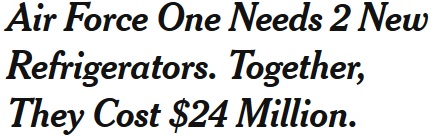
For our third example, here’s some of what the New York Times wrote about refrigerators on Air Force One.
…two of the refrigerators on the president’s plane need to be upgraded, and these specially designed “chillers” aren’t cheap. The Boeing Company was awarded a nearly $24 million contract in December to engineer the refrigerators for Air Force One, the Defense Department said. …Perhaps in anticipation of taxpayer sticker shock, the Air Force also said “the engineering required to design, manufacture, conduct environmental testing and obtain Federal Aviation Administration certification” were all included in the cost. …Air Force One must be able to feed passengers and crew for weeks without resupplying, according to the news website Defense One. …Two galleys can provide up to 100 meals at one sitting, according to the Air Force.
This story presumably involves two common features of government contracting.

First, pay too much for what is ordered (and this doesn’t even count the seemingly inevitable cost overruns).

Second, ask for something excessive in the first place. What’s the point, for instance, of storing several weeks of food when the longest-possible trips are maybe 20 hours? Yes, I watched Independence Day and I realize that Air Force One may become the mobile White House in an emergency, but wouldn’t MREs be acceptable for our pampered politicians and senior staff if there was a real crisis?

I’ll conclude by observing that these three stories reminded me of this satirical version of The Candyman.

P.S. There’s also an Obamaman version of Candyman.

Thursday, April 26, 2018

Feel the Bern: Government Job-Training Programs Are a Recipe for Waste, Fraud, Duplication, and Failure

April 24, 2018 by Dan Mitchell @ International Liberty
 
A few years ago, John Stossel did an undercover investigation of a government job-training program and he found that the operation was basically a scam.

Not that we should be surprised. Back in 2014, I explained to a C-Span audience that a healthy private sector was the only sure-fire way of producing a good job market. Which is why politicians (assuming they actually want job creation) should simply “get out of the way.”

Let’s now take a fresh look at the issue. The Wall Street Journal editorialized on this topic a few days ago.
…a new report from the Labor Department’s inspector general shows that the $1.7 billion federal Job Corps training program is a flop. …Nearly 50,000 people enrolled in 2017…the Job Corps provides meals, medical care, books, clothing and supplies, as well as an allowance for child care and living expenses. Such comprehensive support doesn’t come cheap—the taxpayer cost per student last year was $33,990—and the IG suggests that the investment often doesn’t pay off. …in 27 of 50 cases where full employment data existed, graduates were working the same sort of low-wage, low-skill jobs they held before training.
But there are beneficiaries of the program. The bureaucrats and contractors involved in the program make out like bandits.
The new report suggests that Job Corps’ biggest beneficiaries may be government contractors, not rookie job seekers. Job Corps spent more than $100 million between 2010 and 2011 on transition-service specialists to place students in a job after training. But among 324 sampled Job Corps alumni, the IG found evidence that contractors had helped a mere 18 find work. The contractors often claimed credit for success even though they provided no referrals or résumé and interview help.
Once again, this should not be surprising. It’s what we find over and over and over again.
Here are some excerpts from a report prepared a few years ago by then-Senator Tom Coburn.
…the government has taken on a role for which it was never intended, pouring billions of taxpayer dollars into a broken web of job training and employment programs that are rife with waste, fraud and abuse and lacking demonstrable effectiveness. …In FY 2009, nine federal agencies spent approximately $18 billion to administer 47 separate employment and job training programs, according to the U.S. Government Accountability Office (GAO). GAO identified another 51 federal programs that could be categorized as federal job training programs… The GAO found all but three of the 47 programs overlap with at least one other program in that they provide similar services to similar populations – yet maintain separate administrative structures.
All that bureaucracy and duplication might be an acceptable price to pay to get good results.
Except the programs are a miserable flop.
GAO finds ―little is known about the effectiveness of most programs. …impact studies that were conducted ―generally found the effects of participation were not consistent across programs, with only some demonstrating positive impacts that tended to be small, inconclusive or restricted to short-term impacts.
The report then lists 25 separate examples of wasteful and fraudulent spending.

It’s difficult to pick the most egregious example, but #14 caught my attention.
…a Department of Labor official was found to be taking bribes from a Job Corps contractor, even approving contracts that billed for ghost employees. …the government provided Job Corps with $1.68 billion in fiscal year 2009 and $1.7 billion in FY 2010. Job Corps also received $250 million in stimulus funding in addition to regular annual appropriations. …As part of the Inspector General‘s investigation, a search warrant was executed at the contractor‘s home. The contractor said that Brevard assisted in getting him contracts in exchange for payments. The contractor paid Brevard because if he did not do so, she would not process his invoices. When asked by law enforcement, Brevard admitted to receiving payments from the contractor paid her, and that she approved contracts – of which she knew were false.
Let’s look at a recent real-world example of failure.

The Daily Signal has done some solid reporting on this topic, including this look at the high cost and low benefits of job-training programs.
A government-funded job training program that promised to turn hundreds of residents of Kentucky’s coal country into computer coders so far has spent $2 million to place 17 people in tech jobs and may have left others worse off… The job training program, budgeted for a total of $4.5 million, was supposed to last through 2019 and train up to 200 people from an economically depressed region of Kentucky for middle- to high-skill careers in information technology. …But less than a year later, workers have torn down signs at Big Sandy Community and Technical College, where the program was based, and are closing shop on what appears to be a government-funded program run amok. A total of 32 of the 49 Kentuckians who originally enrolled in the TechHire program in Eastern Kentucky, known as TEKY, have not obtained jobs in the tech industry, according to government figures.
Predictably, the contractors were beneficiaries.
EKCEP spent $1.98 million on the partnership with Interapt. That total includes payments of $861,612 to Interapt for staff salaries and management fees, $706,146 for program service fees, and $115,287 for travel. In one case, Interapt billed EKCEP $5,200 a month for rental of a five-bedroom, five-bathroom house in Paintsville, complete with swimming pool, for Interapt staffers working on the training program. But Gopal, Interapt’s CEO, submitted as an expense and was reimbursed $1,022.40 in December alone for staying at a Ramada Inn in Paintsville, which is about 200 miles east of Louisville. …“Companies like Interapt can rely on the federal government as a crutch because the government has traditionally funded these job training programs, and it creates this vicious circle where industry supports it, politicians support it, but the results don’t bear out the intentions of the programs,” said Nick Loris, an economist who researches and writes about energy policy at The Heritage Foundation.
Let’s close with a meaty excerpt from an overview of job-training programs by Chris Edwards and Daniel Murphy.
The most thorough assessment of federal job training programs was a $25 million National JTPA study in 1994, which was commissioned by the Department of Labor. It tracked 20,000 people over a four-year period who used various training services, and compared them to control groups who did not. The study found that for most participants, federal programs had no significant benefits. …(Labor experts James Heckman and Jeffrey Smith note: “For youth, the record of government training programs for the disadvantaged is almost uniformly negative.”) All in all, the National JTPA study found that the modest benefits of the program were outweighed by the program’s costs. A 2002 book, The Job Training Charade, examines the failures of federal job training programs over the decades. The author, Gordon Lafer of the University of Oregon, is very liberal in his politics… But based on his detailed review, he finds that federal job training programs have provided very small or insignificant benefits. He argues that these programs exist for political reasons alone. Politicians have championed these programs in order to be seen as “doing something” to help workers, and whether they actually work or not is less important. Lafer argues that “as successive generations of job training programs fail to produce the hoped for results, policymakers have cycled through a stock repertoire of procedural fixes that promise to solve the problem.” CETA was supposed to fix problems of the 1960’s training programs. JTPA was supposed to fix CETA, and the WIA was supposed to fix JTPA. Lafer notes that “repeated reports of [JTPA’s] failure seem to have little impact on its political popularity… JTPA was succeeded by the Workforce Investment Act which . . . largely repeats the same strategies found to have failed under JTPA.” Job training legislation is little more than “political symbolism,” he says.
Unfortunately, empty “political symbolism” is the specialty of Washington.

Politicians don’t see the “unseen” and they don’t understand “creative destruction.”

So their efforts at job creation hinder rather than help.

Tuesday, February 27, 2018

California Has Many Natural Advantages, but How Long Can It Survive Big Government?

February 26, 2018 by Dan Mitchell @ International Liberty

(Editor's Note:  I recommend taking a look at the video later in this article.  It's not only eye opening, it's frightening.  RK)
 
In 2016, here’s some of what I wrote about the economic outlook in Illinois.
There’s a somewhat famous quote from Adam Smith (“there is a great deal of ruin in a nation“) about the ability of a country to survive and withstand lots of bad public policy. I’ve tried to get across the same point by explaining that you don’t need perfect policy, or even good policy. A nation can enjoy a bit of growth so long as policy is merely adequate. Just give the private sector some “breathing room,” I’ve argued.
I subsequently pointed out that politicians in Illinois were doing their best to suffocate the private sector, and also warned that a tax hike would push the state even closer to a day of reckoning.
Let’s apply this same analysis to California.

So here are some excerpts from a column I wrote about the Golden State in 2016

Something doesn’t add up. People like me have been explaining that California is an example of policies to avoid. Depending on my mood, I’ll refer to the state as the France, Italy, or Greece of the United States. But folks on the left are making the opposite argument. … statists…do have a semi-accurate point. There are some statistics showing that California has out-performed many other states over the past couple of years. … California may have enjoyed some decent growth in recent years as it got a bit of a bounce from its deep recession, but it appears that the benefits of that growth have mostly gone to the Hollywood crowd and the Silicon Valley folks. I guess this is the left-wing version of “trickle down” economics.
So what’s happened in California since I wrote that article?
Well, lots of California-type policies.
And where does that leave the state? Is California heading in the wrong direction faster or slower than Illinois?

Victor Davis Hanson’s column in Investor’s Business Daily has a grim assessment. He explains that California residents pay a lot for lousy government.
Some 62% of state roads have been rated poor or mediocre. There were more predictions of huge cost overruns and yearly losses on high-speed rail — before the first mile of track has been laid. One-third of Bay Area residents were polled as hoping to leave the area soon. Such pessimism is daily fare, and for good reason. The basket of California state taxes — sales, income and gasoline — rates among the highest in the U.S. Yet California roads and K-12 education rank near the bottom. …One in three American welfare recipients resides in California. Almost a quarter of the state population lives below or near the poverty line. Yet the state’s gas and electricity prices are among the nation’s highest. One in four state residents was not born in the U.S. Current state-funded pension programs are not sustainable. California depends on a tiny elite class for about half of its income tax revenue. Yet many of these wealthy taxpayers are fleeing the 40-million-person state, angry over paying 12% of their income for lousy public services.
In effect, statist policies have created two states, one for the rich and the other for the poor.
…two antithetical Californias. One is an elite, out-of-touch caste along the fashionable Pacific Ocean corridor that runs the state and has the money to escape the real-life consequences of its own unworkable agendas. The other is a huge underclass in central, rural and foothill California that cannot flee to the coast and suffers the bulk of the fallout from Byzantine state regulations, poor schools and the failure to assimilate recent immigrants from some of the poorest areas in the world. The result is Connecticut and Alabama combined in one state.
Jonah Goldberg is not quite as pessimistic. He opines that the state has certain natural advantages that help it survive bad policy.
California attracts an enormous number of rich people who think it’s worth the high taxes, awful traffic, and even the threat of tectonic annihilation to live there — for reasons that literally have nothing to do with the state’s liberal policies. Indeed, most of the Californians I know live there despite those policies, not because of them. No offense to South Dakota, but if it adopted the California model of heavy regulation, high taxes, and politically correct social engineering, there’d be a caravan of refugees heading to states such as Wyoming and Minnesota. …Wealthy liberal Californians can be quite smug about how they can afford their strict land-use policies, draconian environmental regulations, and high taxes. And wealthy Californians can afford them — but poor Californians are paying the price.
Regarding the state’s outlook, I’m probably in the middle. Goldberg is right that California is a wonderful place to live, at least if you have plenty of money. But Hanson is right about the deteriorating quality of life for the non-rich.

Which may explain why a lot of ordinary people are packing up and leaving.

A columnist from the northern part of the state writes about the exodus of the middle class.
The number of people packing up and moving out of the Bay Area just hit its highest level in more than a decade. …Operators of a San Jose U-Haul business say one of their biggest problems is getting its rental moving vans back because so many are on a one-way ticket out of town. …Nationwide, the cities with the highest inflows, according to Redfin are Phoenix, Las Vegas, Atlanta, and Nashville.
And a columnist from the southern part of the state also is concerned about the middle-class exodus.
All around you, young and old alike are saying goodbye to California. …2016 census figures showed an uptick in the number of people who fled…the state altogether. …Las Vegas is one of the most popular destinations for those who leave California. It’s close, it’s a job center, and the cost of living is much cheaper, with plenty of brand-new houses going for between $200,000 and $300,000. …”There’s no corporate income tax, no personal income tax…and the regulatory environment is much easier to work with,” said Peterson. …Nevada’s gain, our loss.
What could immediately cripple state finances, though, is out-migration by the state’s sliver of rich taxpayers. Especially now that there’s a limit on how much the federal tax system subsidizes California’s profligacy.

Here are some worrisome numbers, as reported by the Sacramento Bee.
Will high taxes lead the state’s wealthiest residents to flee the Golden State for the comparable tax havens of Florida, Nevada and Texas? Republicans reliably raise that alarm when Democrats advocate for tax increases, like the 2012 and 2016 ballot initiatives that levied a new income tax on very high-earning residents. But now, with the federal tax bill cutting off deductions that benefited well-off Californians, the state’s Democrats suddenly are singing the GOP song about a potential millionaire exodus. …Democratic state lawmakers are worried because California relies so heavily on the income taxes it collects from high earners to fund government services. The state’s wealthiest 1 percent, for instance, pay 48 percent of its income tax, and the departure of just a few families could lead to a noticeable hit to state general fund revenue. …Among high-income brackets, about 38 percent of Californians who earn more than $877,560 – the top 1 percent – would see a tax hike. About 25 percent of Californians earning between $130,820 and $304,630, also would see a tax increase… “The new tax law is kind of like icing on the cake for some who were thinking about moving out of the state,” said Fiona Ma, a Democrat on the tax-collecting Board of Equalization who is running for state treasurer. …Joseph Vranich, who leads an Orange County business that advises people on where to locate their businesses, called the tax law “one more nail in the coffin” that would cause small- and middle-size entrepreneurs to leave California.
Politicians and tax collectors get resentful when the sheep move away so they no longer can be fleeced.

This powerful video from Reason should be widely shared. Thankfully it has a (mostly) happy ending.


One of the reasons the state has awful tax policy is that interest groups have stranglehold on the political system. And that leads to ever-higher levels of spending.

Writing for Forbes, for example, Josh Archambault examines the surge of Medicaid spending in the state.
Over the past ten years, Medicaid spending in California has almost tripled, growing from $37 billion per year to a whopping $103 billion per year—including both state and federal funding. And things have only accelerated since the state expanded Medicaid to a new group of able-bodied adults. …nearly 4 million able-bodied adults are now collecting Medicaid, which was once considered a last-resort safety net for poor children, seniors, and individuals with disabilities. …California initially predicted that its ObamaCare expansion would cost roughly $11.6 billion in the first three fiscal years of the program. The actual cost during that time? An astounding $43.7 billion. …Though California represents only 12 percent of the total U.S. population, it receives more than 30 percent of all Medicaid expansion spending.
And the Orange County Register recently opined about the ever-escalating expenses for a gilded class of state bureaucrats.
California’s annual state payroll grew by 6 percent in 2017, an increase of $1 billion and twice the rate of growth of the previous year. …Employee compensation is one of the largest components of the General Fund budget. In 2015-16, salaries and benefits accounted for about 12 percent of expenditures from the General Fund, a total of over $13 billion. …pay increases drive up pension costs. …The administration estimated that the annual cost to the state for the pay raises would be $2 billion by 2020-21, but the LAO said that didn’t take into account the higher overtime costs that would result from higher base pay, or the extra pension costs from that overtime. …if an economic downturn caused state revenues to decline, taxpayers would still have to pay the high and rising salaries for the full length of the contract.
The last sentence is key. I’ve previously pointed out that California has a very unstable boom-bust fiscal cycle. The state looks like it’s in good shape right now, but it’s going to blow up when the next recession hits.

Let’s close by acknowledging that poor residents also pay a harsh price.

Kerry Jackson’s article in National Review is rather depressing.
California — not Mississippi, New Mexico, or West Virginia — has the highest poverty rate in the United States. According to the Census Bureau’s Supplemental Poverty Measure — which accounts for the cost of housing, food, utilities, and clothing, and which includes non-cash government assistance as a form of income — nearly one out of four Californians is poor. …the question arises as to why California has so many poor people… It’s not as if California policymakers have neglected to wage war on poverty. Sacramento and local governments have spent massive amounts in the cause, for decades now. Myriad state and municipal benefit programs overlap with one another; in some cases, individuals with incomes 200 percent above the poverty line receive benefits, according to the California Policy Center. California state and local governments spent nearly $958 billion from 1992 through 2015 on public welfare programs.
That’s probably a partial answer to the question. There’s a lot of poverty in the state because politicians subsidize idleness. In effect, poor people get trapped.

The author agrees.
…welfare reform passed California by, leaving a dependency trap in place. Immigrants are falling into it: Fifty-five percent of immigrant families in the state get some kind of means-tested benefits… Self-interest in the social-services community may be at work here. If California’s poverty rate should ever be substantially reduced by getting the typical welfare client back into the work force, many bureaucrats could lose their jobs. …With 883,000 full-time-equivalent state and local employees in 2014, according to Governing, California has an enormous bureaucracy — a unionized, public-sector work force that exercises tremendous power through voting and lobbying. Many work in social services. …With a permanent majority in the state senate and the assembly, a prolonged dominance in the executive branch, and a weak opposition, California Democrats have long been free to indulge blue-state ideology.
And one consequences of California’s anti-market ideology is that poor people are falling further and further behind.

P.S. If Golden State leftists really do convince their neighbors to secede, I suspect the country would benefit and the state would suffer.

P.P.S. And if California actually chooses to move forward with secession, the good news is that we already have a template (albeit satirical) for a national divorce in the United States.

P.P.P.S. Closing with some California-specific humor, this Chuck Asay cartoon speculates on how future archaeologists will view the state. This Michael Ramirez cartoon looks at the impact of the state’s class-warfare tax policy. And this joke about Texas, California, and a coyote is among my most-viewed blog posts.