Search This Blog

De Omnibus Dubitandum - Lux Veritas

Showing posts with label Government Incompetence. Show all posts

Friday, June 16, 2023

The more government there is, the more problems we have

April 21, 2023 By Mark Landsbaum

Have you noticed that the more government there is, the more problems we have? The government claims jurisdiction over everything you do.  Yet prosecutors refuse to prosecute violent criminals, and judges increasingly refuse to sentence those convicted. Columnist Doug Casey points to the obvious root of this evil: America has lost its knowledge of right and wrong.   Despite the USA's Leviathan of armed government authority, crime spirals out of control.  Major retailers are abandoning cities because they are being robbed and shoplifted into bankruptcy — while police do nothing about it.  The lawlessness that began with flash mobs shoplifting at dime stores has escalated to the ritziest retailers on a vast scale.  Security guards stand by and watch it happen.  Carjacking is epidemic in inner cities.  Violence for violence's sake is erupting on public streets, in private businesses, and on public transportation.  People who have never been slaves demand reparations from people who never owned slaves............To Read More...


Friday, June 18, 2021

Everything You Need to Know about Bad Government in California

June 17, 2021 by Dan Mitchell @ International Liberty 

(Editor's Note:  The libertarian view and mine on illegal drugs are different, so, there are part of this in which I disagree but I've published this because it highlights the insanity of California, and leftist government.  RK)

California is a fascinating state for people who follow public policy. It has some immense advantages, such as climate, coastline, and natural resources.

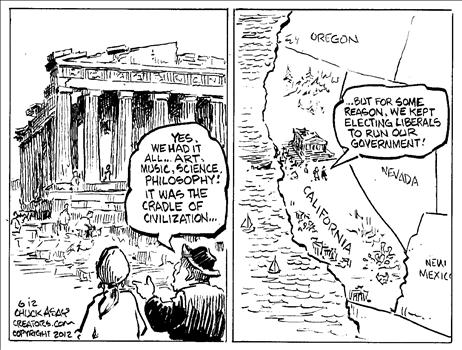
 https://danieljmitchell.files.wordpress.com/2012/06/california-greece.jpg

But it also has high taxes, absurd regulations, a bloated bureaucracy, and a costly welfare state. The net result of all these factors is mixed. There are some sectors that are still thriving, such as high tech, but there’s also evidence that the Golden State is losing ground.

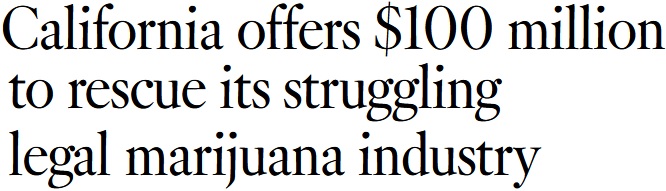
And the comparative data will probably get worse over time because many taxpayers and businesses are now fleeing to lower-tax states.  Since I specialize in public finance, I’m tempted to say bad fiscal policy is California’s biggest problem. And that may actually be the case.  But if someone asks me for an example of what’s wrong with the Golden State, I’m going to direct them to this story in the Los Angeles Times.


The California Legislature on Monday approved a $100-million plan to bolster California’s legal marijuana industry, which continues to struggle to compete with the large illicit pot market nearly five years after voters approved sales for recreational use. …

State officials initially expected to license as many as 6,000 cannabis shops in the first few years, but permits have been issued only for 1,086 retail and delivery firms. In 2019, industry officials estimated there were nearly three times as many unlicensed businesses as ones with state permits. …

The $100 million would go to local agencies with the most provisional licenses for growing, manufacturing, distribution, testing and retail operations. Some of the money can be used by cities offering equity funding to cannabis businesses owned by people of color.

Yes, you read correctly.

The state did a smart thing (removing legal prohibitions on marijuana), but did it in the worst possible way (burdening the sector with high taxes and red tape).  As a result, there’s still a very robust black market.  Here are some additional details about how politicians and bureaucrats have made it difficult to operate a legal business.

Many cannabis growers, retailers and manufacturers have struggled to make the transition from a provisional, temporary license to a permanent one renewed on an annual basis — a process that requires a costly, complicated and time-consuming review. …some face two to four years to get through the licensing process. Many would face the prospect of shutting down, at least temporarily, if they don’t get a regular license by current state deadlines, Kiloh said. …

Supporters of legalization blame the discrepancy on problems that they say include high taxes on licensed businesses, burdensome regulations… A key requirement to convert from a provisional license is to conduct a CEQA review to indicate how pot farms and other cannabis businesses will affect the surrounding water, air, plants and wildlife, and to propose ways to mitigate any harms.

However, Kiloh said, some cities are just setting up ordinances and staffing to process licenses, meaning many businesses cannot meet the looming deadline. …industry officials note the money will go to a small fraction of California cities, and only those that have already decided to allow cannabis businesses. …said Kiloh, owner of the Higher Path cannabis store in Sherman Oaks.

“The real problem is CEQA analysis is a very arduous process,” he added. “I think it would be good to have more reform of the licensing system instead of just putting money to it.”

Wow, provisional licenses, permanent licenses, CEQA analysis, taxes, regulations, reviews, and ordinances.  Sounds like my regulatory obstacle course. No wonder so many buyers and sellers of pot prefer the black market.  And Mr. Kiloh is correct. The solution is to deregulate, not to dump more money into the system.  No wonder California is a mess.

P.S. The late (and great) Walter Williams joking speculated whether California should set up East German-style border controls to prevent taxpayers from escaping.

P.P.S. There is a pro-secession group in California, though they should be careful what they wish for.


Wednesday, June 16, 2021

The Labor Shortage Is a Government-Contrived Scarcity

Richard M. Ebeling Richard M. Ebeling  – June 14, 2021 @ American Institute for Economic Research 

Not long ago, my wife and I decided to go out to our favorite Thai restaurant not far from our home in the Charleston, South Carolina area, which we had not been to for well over a year. With so many retail businesses having returned to a no-mask, no-distancing “normality,” we were looking forward to a tasty inside, sit-down meal. But when we arrived we discovered they were still only doing takeout orders because the management had not been able to find enough willing waiters to rehire. America is suffering from an apparent “labor shortage,” in spite of unemployment levels being significantly above what they were before the government-imposed lockdowns and stay-at-home orders in early 2020. 

Before these shutdown orders and restrictions on freedom of shopping were imposed by, especially, the state governments and reinforced by federal policies in March of last year, the economy-wide average unemployment rate hit a low of about 3.5 percent of the labor force in February 2020, according to the Bureau of Labor Statistics (BLS), something not experienced for several decades. Plus, this unemployment low had its counterpart under the subgroups of men and women, whites and blacks and Hispanics, and for adults and youths. Indeed, if the coronavirus crisis had not occurred with the accompanying government-created collapse of much of the economy, 2020 might have turned out to be an exceptionally good year in terms of many of the standard economic benchmarks. 

The BLS June 2021 report on “The Employment Situation” for the month of May showed that the overall unemployment rate stood at 5.8 percent of the labor force, or still about 35 percent higher than in February 2020. And, comparably, each subgroup remains noticeably above their, respective, unemployment rates of 15 months ago. 

At the same time, the BLS’s June 2021 report on “Job Openings and Labor Turnover” stated that at the end of April, job openings for which employers were willing and able to hire stood at 9.3 million positions. But hires to fill employment slots in April totaled 6.1 million. The number of people quitting or not willing to accept work increased, especially in the food service and retail sectors, while the number of workers let go or laid off remained low. 

Unemployment Due to Government Paying People Not to Work

Clearly, to use Keynesian terms, employment in the United States is not suffering from an “aggregate demand” failure. There are plenty of job openings; it is a failure of a good number of employable people not being interested in filling the slots employers would like to fill. Why?

A number of commentators have suggested that many are still concerned about and fearful of returning to the workplace due to the potential of still catching the coronavirus and the risk of serious illness or death. Some have argued it’s because employers are too cheap; that is, they are unwilling to pay a wage high enough to draw unemployed workers back into the active labor force. The problem with this latter explanation is that it does not make clear why wage “x” at which some of these workers were willingly employed 15 months ago is now unacceptable just a little bit more than a year later, given the lost income experienced during all that time. 

However, suppose that before the coronavirus lockdowns and lost employment, a low-skilled employee was making, say, $500 a week. But now let us suppose that during the last 15 months, due to extended unemployment insurance payments and supplementary federal emergency transfers introduced during the coronavirus crisis, this person was continuing to have a government-supplied weekly income of $500, or maybe even more, say, $600. For as long as this continues, what is the incentive for him to return to the workplace for the previous salary when, instead, this individual can stay at home and be no worse or maybe even better off than working his old 40-hour week as before March of 2020? 

A few weeks ago, the Foundation for Government Accountability (FGA) issued a report based on work and wages versus government income-transfer programs (state unemployment insurance, supplemental federal emergency insurance bonus, child care credits, earned income tax credit, and food stamps) in, for instance, the state of Florida. A person could receive up to the equivalent of a $20-an-hour wage by staying home rather than accepting available employment. 

Government Created Artificial Benefits to Not Take a Job

This, obviously, has nothing to do with a “failure of the market” in not providing jobs or from employer stinginess in the salary being offered. Government redistributive benefits have priced some workers out of the labor market by giving them more received income by not working than from accepting the employment available at more market-based wages reflecting employer estimates of those workers’ value-added contribution in various lines of production, including in the service industry.

What has been created by these government programs is a false “opportunity cost” for those in these labor categories in terms of their trade-off between work and non-work. I say “false” due to the fact that if these redistributive programs were not present, lower-skilled workers would have to weigh differently the income forgone by not accepting gainful employment versus perhaps not earning anything. Instead, for as long as these types of programs are in effect, they, basically, establish a “floor” below which more is lost by working than taking a job. 

Even if the government transfers are slightly less than the salary that would be received from working, the trade-off can still be in favor of not taking a job. Suppose someone could earn a weekly salary of that $500 versus unemployment insurance plus some of these other government redistributions that give him the equivalent of, say, $475 or $450 per week. Would it always be in every such worker’s personal interest to give up the $475 or $450 of government-supplied income to, instead, work 40 hours a week to make an extra $25 or $50 for that total of $500 of earned weekly income? Surely, for most people an extra $25 or $50 a week would not be worth foregoing the 40 hours of free time the government money enables him to enjoy. 

Limited Means to Serve Our Many Ends Require Trade-Offs

We can see, therefore, that the current “shortage” of labor is, in fact, “contrived” and not “natural.” I am using this particular terminological distinction because the cause and nature of market-based scarcity versus government-created scarcity was explained with great cogency a long time ago by the British economist, William H. Hutt (1899-1988) in a neglected essay of his on “Natural and Contrived Scarcities” (South African Journal of Economics, September 1935). (See my article, “William H. Hutt: A Centenary Appreciation”.)

Hutt reminded us that man cannot escape from the fact that he is always confronted with the need and necessity to make choices, to accept trade-offs between alternatives, and decide what he values more highly and what he values less highly. The inescapable reason for this is the scarcity of means available in their quantities and/or qualities to serve and satisfy fully all the ends, goals and purposes for which we would like to apply them.

Our time is scarce, with only twenty-four hours in a day. Our mental and physical strength is limited with which to pursue our purposes. The resources and raw materials around us that we identify as “useful things” to make the finished goods and services that we desire are limited in their amounts to produce all the consumer items for which we think them usable. 

In the free market economy, the relative scarcities of both finished consumer goods and the resources, labor and capital equipment out of which those consumer goods can be made are all registered in the form of the competitive prices at which they may be bought and sold.

If we, as consumers, demand more automobiles we may offer to pay higher prices for the greater number of cars we wish to purchase. But to produce more automobiles off the assembly line means that fewer of the scarce resources that go into the manufacture of cars – workers and their labor time, resources, raw materials, component parts, and the machinery needed – will now be available to produce other, alternative goods that could have been produced with those same means of production, instead.

The prices paid to attract those greater quantities of scarce means into the auto industry (including the additional wages to draw more workers into this sector of the market) are what economists call their “opportunity costs.” That is, the prices that need to be offered and paid that are just sufficient to attract them from an alternative employment in which they also have value in producing something else that consumers also want, but not as intensely. 

This is the reality of a world in which we are not able to have everything we want, where we want it, in the full amounts we desire. This is why, no matter how hard we try, we can never “have it all.” Trade-offs are an inescapable part of virtually every aspect of our life. 

Even when through savings, investment, innovation, and industry we succeed over time in increasing our ability to produce more of the things we wish to have, we still never have it all. It is part of the human make-up that as soon as we have successfully reached some desired goals our mind and imagination run ahead to new and different things that are, once again, not fully within our reach.  

It is like walking towards the horizon; no matter how far we go and how fast we try to get there, the horizon remains in front of us, and out of our reach. This is man’s frustration but also the stimulus for all the material and cultural achievements that we call “civilization,” which have raised humanity up from primitive subsistence existence. (See my articles, “Preserved Primitivism versus Freedom and Prosperity” and “Has Modernity Made Us Indecent?”)

The “Natural Scarcity” of Limited Means is Inescapable

In the competitive free market, the limits on how much of goods in general and the relative amounts of each within that total is possible of being produced is limited and constrained by what William H. Hutt defined as the “natural scarcities” existing in any society within any period of time. Said Hutt: 

We must conceive of a society in which there are no restrictions on the free movement, adjustment and full utilization of the productive resources in response to the dictates of consumers’ will [as expressed in their market demands for various goods and services].

Under the “natural scarcity” of things in a free market, some people may wish that more hospitals were built for the sick or more research undertaken for a cure for cancer, or more wildlife areas set aside for peaceful contemplation of the beauty of nature. But the critic has no one to blame but the free choices of his fellow citizens and even himself in actually demanding more of other things in the marketplace that prevents the necessary scarce resources and labor from being available to do more of these other desired things as well. Our own market choices and demands, and that of all of our fellow consumers in society, determine what goods will be profitable to manufacture with what combination of those “naturally” scarce resources, and, therefore, available in which relative quantities in their finished forms as purchasable goods and services. 

“Contrived Scarcities” and “Contrived Plentitudes” Caused by Government

However, the critic may not be satisfied with his own failed attempts to persuade enough of his fellow citizens to demand and spend less on these other things so more scarce resources can be freed up and used for more hospitals, medical research, and nature preserves. He may then turn to the government and its political power to get what he wants without the agreement and voluntary participation of his “preference-misguided” fellows in society. 

Hutt argued that when various individuals and special interest groups turn to the State to get what they want it brings about what he called “contrived scarcities” and “contrived plenitudes.” If the government increases taxes on the citizenry to fund the supplying of more hospitals, cancer research and wildlife areas, it creates a “contrived plenitude.” That is, an amount of these things is supplied in excess of what the market would have found profitable to supply if production had been guided by what consumers would have wanted and demanded if more of their earned income had remained in their own pockets and not been taxed away.

The amount of such “good things” as hospitals, medical research facilities, and nature areas are, in fact, out of balance – over supplied – with what a free market would have supplied of them if the determination of production in society had been left more fully to be guided by the wishes and desires of the income-earning consumers, themselves. 

On behalf of those not satisfied with the free choices of their fellow citizens and who are willing to use political compulsion to get what they want, government has intruded into and violated the “sovereignty of the consumer” to peacefully, honestly, and voluntarily decide what he wants based on his values, beliefs and desires, and to make it profitable on the competitive market for others to provide him with what he wants out of the income he has peacefully, honestly and voluntarily earned in his own role as a producer.  

But the other side of this coin is that there are “contrived scarcities” – a reduced availability – of the goods and services that those sovereign consumers would have been able to have if the greater taxes collected and spent by the government had not resulted in scarce resources and labor being drawn away from producing the goods and services those consumer/taxpayers would have spent their income on if it had not been reduced due to those higher taxes.

“Contrived Scarcities” from Import Tariffs and Price Subsidies

Such contrived scarcities take on various forms, as well, other than only the direct taxing away of people’s income. If the government imposes an import tariff or an import quota on foreign goods entering the domestic economy, the available supplies of those goods will be less; and the prices of these goods that consumers will now have to pay will be higher, as a result, than if free trade was practiced and consumers had had a wider free market choice of domestic and foreign suppliers. 

Suppose that the government starts to guarantee dairy farmers minimum prices for their produce (as the U.S. government does under its farm price-support programs). With a higher guaranteed price than the market-established price, dairy farmers would find it profitable to expand their dairy cowherds; a “contrived plentitude.” But this requires more grazing land for the increased number of cows.

The expanded grazing land will have to come from somewhere. Suppose that this land comes out of wheat growing. The wheat crops will tend to decrease, an essential ingredient in bread baking will be reduced in quantity, and the supply of wheat bread available in groceries may be less, with a resulting higher price per loaf that consumers now must pay; a “contrived scarcity.” 

Thus, government interventions such as these would abridge the market-based sovereignty of the consumers, bringing about too much of some goods being produced and too little of others being supplied. 

Difficulty of Seeing Government’s Hand in Contrived Scarcities

But the perversity from these types of “contrived scarcity” policies is that consumers often find it difficult to know whether and to what extent the supplies available and the prices paid for goods are due to market-determined “natural scarcities” and how much is due to government manipulation of quantities produced and offered on the market.

In the case of the farm price-support programs, consumers in the market end up paying no less than the government guaranteed price for dairy products, for example, since dairy farmers have no incentive to offer it for a lower price on the market since they know that any unsold surpluses at the guaranteed price will be bought up by the government at taxpayers’ expense. 

At the same time, the possible reduced wheat crops that negatively impact the supply of wheat bread and raise its price, for instance, is so many steps away from the immediate vision and understanding of the consumers of bread that it is nearly impossible for ordinary citizens to appreciate the links in the chains of government intervention that has made bread costlier and less available. Thus, the “free market” gets blamed for high or rising prices for various goods because of the apparent businessman’s “greedy profit motive” that makes him fail to produce more of what people want and desire. 

Consumers seem to be unrestricted in their choices concerning how to spend whatever after-tax income may remain in their pockets; market interactions of supply and demand seem to determine the prices that those consumers pay; and, thus, the reason for any frustrating scarcities and expensiveness of desired goods gets placed at the doorstep of “selfish” acts of profit-motivated capitalists and businessmen, in general. 

But behind the scenes the incentive, profitability and opportunity to produce goods guided by the actual demands of the consuming public have been thwarted by government taxing, pricing and regulatory policy manipulations bringing about contrived or artificial scarcities of some goods on the supply-side of the market or wasteful overproduction, or “contrived plentitudes,” of other goods not reflecting what those consumers would really want produced if the market was left free of the intervening and distorting hand of those in political power serving particular special interest groups.

Getting Government Out of the Market Can End Contrived Scarcities

While “natural scarcities” can only be reduced in the longer run through savings, investment, innovation and industry that increase the supply and improve the qualities of desired goods, in principle, “contrived scarcities” and artificial “plentitudes” can be corrected much sooner.

Or as Hutt expressed it, “Contrived scarcities, unlike natural scarcities, are not beyond the power of change by individuals and hence of a different degree of permanence: restrictions can be overcome . . . Contrived scarcities involve, then the frustration of consumers’ sovereignty; and what is usually meant when the removal of restrictions on competition is recommended is that such contrivances shall be eliminated.”

This is the current situation in the American labor market. The government’s income transfer programs such as unemployment insurance payments in general, and the “emergency” income supplements mentioned earlier, have all created a contrived scarcity that the media and others refer to as a “labor shortage.” Yes, labor in a variety of occupations and employments is in short supply, but there is nothing “natural” about it in the manner that Hutt explained a natural scarcity of limited means to serve consumer ends in a free market. 

It is “contrived” shortage of labor due to the government’s manipulation of the trade-off and opportunities costs offered to segments of the labor force through the artificial income supports that have been made available. The other side of this coin is that there has been a government-created “unemployment plentitude;” that is, an amount and level of unemployment in various occupations and lines of work more than would “naturally” exist due to ordinary and ever-occurring dynamic changes in competitive supply and demand conditions. 

A growing number of state governments have announced their decision to opt out of some of these federal “emergency” income transfer programs, meaning the financial benefit of being unemployed will decrease, and the income gains from accepting offered work in the marketplace will seem more attractive. There will remain in place enough government programs that will continue to “contrive” artificial labor scarcities and unnecessary unemployment, including minimum wage laws, small business regulations, occupational licensing restrictions, as well as others. But the type of contrived scarcities of labor created by these particular Covid-related transfers can all be gone practically overnight by simply ending them, and making market-based employment more attractive again, in comparison.  

Educating Others on Natural versus Contrived Scarcities

Finally, in more general terms, one of the tasks of friends of competitive free markets is to explain to our fellow citizens that while a “natural scarcity” of useful means to achieve our various ends is inescapable in the reality of the human circumstance, there are some scarcities of resources and desired goods that are artificial, “contrived scarcities,” precisely due to government and its interventions in the market process. 

Such contrived scarcities, in principle, could be gone tomorrow if the government’s economic policies fostering, creating and sustaining them were abolished and eliminated. The individual’s freedom of choice and action as both consumer and producer will have been more fully restored with a less intervening government. 

Free men in free markets would then be at liberty to improve their conditions without the disrupting and distorting hand of political power and special interest politicking that invariably makes many things less available and more expensive than if competitive markets were unshackled from the government policies that only succeed in making us poorer and far less free than we need to be. 

Richard M. Ebeling

Richard M. Ebeling

Richard M. Ebeling, an AIER Senior Fellow, is the BB&T Distinguished Professor of Ethics and Free Enterprise Leadership at The Citadel, in Charleston, South Carolina.

Ebeling lived on AIER’s campus from 2008 to 2009.

Books by Richard M. Ebeling


Sunday, May 30, 2021

The Twilight Zone, Hogan’s Heroes, and the Emotional Support Mask


“Only two things are infinite, the universe and human stupidity, and I’m not sure about the former.”-Albert Einstein

Two of our favorite TV shows are The Twilight Zone and Hogan’s Heroes. These shows provide lessons as we tentatively emerge from the herd stupidity (see Einstein’s quote) that led to the establishment of our state-run Covid religion in March 2020. An episode of The Twilight Zone comes to mind when contemplating the Covidians who cling to their emotional support masks and other revolting, pseudo-scientific “nonpharmaceutical interventions,” supported by the public health police state and the coronavirus lockdown chorus in the media.

In The Twilight Zone episode titled “Eye of the Beholder,” Janet Tyler undergoes plastic surgery to correct her “deformity.” The plot centers on Janet waiting in the hospital to see if her plastic surgery is “successful.” This is her 11th trip to the hospital for treatment and she is desperate to look like everyone else. 

During the entire episode, Janet’s face is not shown, but we are constantly told how hideously ugly she is. The nurses, doctor, and other people who attend to her in the hospital also have their faces shielded. When the bandages are finally removed from Janet’s face, we see that, in fact, Janet is beautiful, while the self-declared “normal” doctors and nurses are mutilated, deformed monstrosities. 

The lesson to be learned from this episode is that those of us who choose to be maskless are normal, while those who make our children wear masks for seven hours a day and keep them from playing with their friends are grotesque and deformed, both mentally and physically. Infectious disease experts, working with teachers’ union bosses and supine politicians, continue to maim and deform parents and children in the name of protecting public health. We must be saved by these enlightened priests, rather than relying on our own sound judgment.

Several days ago, one the country’s most prominent Covidians, Mayor Bill de Blasio, announced that New York City public schools will “fully reopen” for in-person learning in September. Of course, he also stated that students and teachers will still be required to wear masks, even though almost all teachers and many students will be vaccinated by that date. Of course, anti-social distancing will also apply, along with other Covid mitigation policies to prevent normal childhood development. It seems that the unethical and deviant child experiment must continue for the indefinite future. 

The second lesson from TV history comes from Hogan’s Heroes. You may recall that a key character in this show was Colonel Wilhelm Klink, the bungling, vain, cowardly, and self-serving Commandant of Stalag 13. In every episode, Colonel Klink proudly states that “no one has ever escaped from Stalag 13.” Klink’s maniacal and myopic focus on this one statistic makes him oblivious to the fact that Colonel Robert Hogan of the U.S. Air Force and his fellow prisoners of war are engaging in major sabotage and rescue operations against the Third Reich. Klink is even considered a “success” by his superiors in Berlin, even though he is clearly an abject failure. 

Klink’s obsession with a single statistic brings to mind another source of government failure in the “war” on the coronavirus: policy myopia, exhibited by our new bureaucratic masters, infectious disease experts, and their staunch supporters, politicians, who enthusiastically implement their “recommendations” and “guidelines.” Infectious disease experts have fully captured government in a clever coup d’etat, armed with faulty epidemiological models that have repeatedly shown themselves to be wildly inaccurate and “scientifically” designed lockdowns and “reopening” strategies that always “succeed.” They work well with virtue-signaling politicians, who look for short-term fixes with instant and visible results to “solve” problems. Like Colonel Klink, the infectious disease experts have a maniacal obsession with “cases,” while simultaneously ignoring all the collateral damage – the death and destruction created by the quarantines, lockdowns, and reopenings themselves. 

The end result is that infectious disease experts and the politicians who implemented their draconian policies have succeeded in doing more damage to our economy and society, and yes, even to public health, than all the recent enemies of Western civilization combined. These officials also seem to have a single goal in mind, reducing the number of individuals who contract the virus. Such a single-minded approach is not consistent with an appropriate cost/benefit analysis of the consequences of their proposed actions.

Dr. Jay Bhattacharya, a professor of medicine at Stanford University, who is also a health economist and therefore familiar with the concept of trade-offs in decision-making (unlike infectious disease experts), notes that studies repeatedly show that children who wear masks completely undermine the very limited benefit masks provide by touching them and repeatedly taking them on and off. Moreover, there are serious repercussions to child social development when children are masked that go beyond “simple” physical irritation and difficulty breathing. Bhattacharya emphasizes that the development needs of young children require them to see other people’s faces. For example, learning to speak requires seeing a person’s lips move. Older children also need to see the face to learn body language and how to appropriately interact socially.

Despite the strong scientific evidence on the ineffectiveness of masks for adults, and the harms inflicted by masking children, it’s a puzzle as to why so many individuals continue to insist on their usefulness. Perhaps masks simply provide an emotional support mechanism for people who have been unfortunately frightened out of their wits by the pseudo-scientists and the profit-maximizing media. It’s time to ditch the emotional support mask and those who advocate its use.

Donald Siegel

Donald Siegel

Dr. Donald Siegel is Foundation Professor of Public Policy and Management and Director of the School of Public Affairs (SPA) at Arizona State University.

He received his bachelor’s degree in economics and his master’s and doctoral degrees in business economics from Columbia University. He then served as a Sloan Foundation post-doctoral fellow at the National Bureau of Economic Research.

Get notified of new articles from Donald Siegel and AIER.

Robert M. Sauer

Robert M. Sauer

Robert Sauer is Professor of Economics at the University of London, Royal Holloway College, and Editor-in-Chief of the European Economic Review, the European Economic Review Plus and the Journal of Economics, Management and Religion.

Robert’s research focuses on labour force dynamics, volunteerism and entrepreneurship. He has published papers in Econometrica, the Journal of Political Economy, the Review of Economic Studies, the International Economic Review and the Journal of Labor Economics.

Get notified of new articles from Robert M. Sauer and AIER.

Saturday, April 17, 2021

Three Books on the Covid/Lockdown Catastrophe

In the early days of the lockdown, Amazon experimented with curating which books they would and would not publish on the crisis. Or call it what it really is, given our times: censorship. 

Among the first books hit was AIER’s own Coronavirus and Economic Crisis. The publication was delayed for weeks, then the Kindle edition was stopped for several more weeks. Still, the publication date is now listed as March 28, 2020, meaning that AIER had one of the first, if not the first, book out on the topic, just two weeks after the lockdowns began. 

In the meantime, Amazon has loosened up, perhaps because the sales of a different point of view were potentially too lucrative to pass up. Indeed, I see many dozens of such books out there, all taking issue with the CDC’s narrative and the lockdown policy agenda. I’m thrilled by this. For that matter, AIER has published an additional four books on the topic, including my own Liberty or Lockdown

 https://www.aier.org/wp-content/uploads/2021/04/5153bf5SS7L.jpg

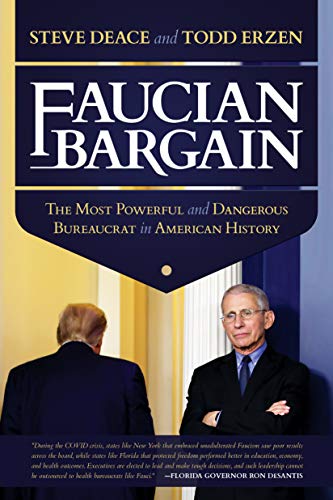
I’ve been waiting for a bestseller, and it has arrived: Faucian Bargain: The Most Powerful and Dangerous Bureaucrat in American History by Steven Deace and Todd Erzen, two media commentators in the tradition of Rush Limbaugh. 

This short book (it took me under an hour to read) is not strong on scientific rigor, but its sheer readability helps account for its huge seller status. Anyone who has lived and breathed the data, studies, and history pertaining to this terrible moment in history might find himself frustrated that the authors prioritize razzle-dazzle rhetoric and conservative-style talking points ahead of precision, citation, and calm exposition.

However, I don’t think our times permit that level of literary scrupulosity. The important point is that people are downloading and reading this in great numbers. This is good because the main storyline of the book is 100% correct. Not mincing words, they call this famous doctor “one of the most diabolical destroyers of self-governance and rugged individualism in all of American history.” It’s hard to disagree. 

Dr. Anthony Fauci has played an outsized role in pushing lockdowns, disease panic, and flagrantly bad science via his major means of communication: interviews with sympathetic media on TV. Among many, he has obtained a godlike status but the authors show that he acts more as a political performance artist. Artists improvise, play roles depending on the need, and seek approval above all else. That’s their main complaint against him – his fawning for the camera, his changing lines, his pseudo-scientific and imprecise but seemingly impressive blather, and it is correct. 

The authors draw attention to a huge mystery of his role early in the lockdowns. On February 28, he wrote in the New England Journal of Medicine that Covid-19 might “ultimately be more akin to those of a severe seasonal influenza.” On March 8, he told media that “there’s no reason to be walking around with a mask.” That was then, and, as they point out, he was mostly correct on these points in retrospect. 

I will let the authors continue the story:

And now, we come to March 11. The day the earth stood still. The day our way of life ended, with no definitive hope of when it might return. For that is the day Fauci testified before Congress that COVID-19 would be “10 times more lethal than the seasonal flu.” This is the statement that sent shockwaves across the country and launched us into lockdowns…. what changed in those eleven days? What new piece of evidence or data did Fauci acquire to inspire such an about-face?

This is the crucial question. To be sure, there was already panic in the air on March 8, when South by Southwest was summarily shut down by the Austin, Texas mayor. There was talk of locking down everywhere, with the New York Times whipping up a big panic on its main podcast and op-Ed page. Even then, hardly anyone believed it would happen. That Fauci testimony was indeed the turning point. His whole demeanor seemed to be warning the assembled politicians that many of them will die. It was crazy stuff. 

So what is our authors’ theory as to why he made the shift? They quote an anonymous White House employee who was there during the early days to the effect that Fauci became consumed by fame and celebrity. The more he called for lockdowns, the more panic he spread, the more he enjoyed the spotlight, and the more the media saw their ratings rise. 

And let’s be real, the media loved every minute of it. It’s not just media bias, but the media ratings matter, too. They have to blow this up, focus on the fight back and forth, and make the virus into the Malaysian flight that CNN kept on and on with. It has to be all catastrophic all of the time, or people will make their own decisions and go about their lives. And if there’s anything the media in Washington cannot handle, it’s the average American making decisions in their lives without the supposedly valuable input. So Fauci feeds off the media, and the media feeds off of Fauci. Both of them clinging to each other to make both of them more relevant.

That sounds plausible. There is an additional problem raised by 300 pages of emails discovered via FOIA that detail Fauci’s own relationship with China. Even our authors, who cover the released emails, don’t seem entirely aware of the implications of a US delegation having travelled to China in mid-February to learn from Beijing the art of virus suppression. I cannot account for this myself. Why would Fauci step up to volunteer as our own Manchurian public health official? Why carry water for the CCP? At the age of 80, he surely is beyond being paid off or bribed or whatever. Did he really come to believe that China had the only way out? It all seems hard to believe. 

Despite the pop feel, the obvious bias, the red meat from beginning to end, the authors are pointing to a dreadful scandal, and it is wholly understandable that this would inspire anger. Rightly so. 

 https://www.aier.org/wp-content/uploads/2021/04/51w0v8Ye4oL._SY346_.jpg

For a book with more data and evidence, in addition to a longer perspective on how free societies deal with pandemics, I would suggest Lockdowns on Trial by journalist Michael Betrus. The book came out in the summer but the 2nd edition came out in November 2020. The prose is elegant and mercifully calm. As I did in my book, he covers the policy response to previous lockdowns. He cites a huge amount of the literature showing a lack of any correlation between lockdown policies and disease mitigation. 

The main merit of this book, in my view, is that it shows that in terms of pathogens and disease, these times have not been without precedent. We’ve been here before. Indeed, humanity has never not been here, with germs and so on floating and swirling all around us, many of them mutations of previous pathogens, all the while with our immune systems adapting and scaling to absorb them and fight them. With the exception of a few American cities in 1918, and only then for a brief time, this country has always dealt with infectious disease as a normal event to be handled by medical professionals, not an exceptional catastrophe to be managed by politicians and bureaucrats. 

The burden of this book is to prove that these are in fact normal times or should have been regarded as normal times, which is to say that the mass panic was wholly unjustified. To that end, the book goes into some detail about the seemingly endless confusions over predictions, testing, data over infections and cases, and deals squarely with rampant issues of misclassification and exaggeration, the nursing home scandals, and also the details concerning demographic risk of SARS-CoV-2, the actual lethality of Covid-19 by age and comorbidities, and the deaths and how to count them. 

Insofar as I am in a position to judge based on my own knowledge, I find this book highly credible in addition to readable, with mercifully little in the way of politicized argumentation. Most impressive among these books, the author deals with the astonishing costs of lockdowns, which are not only economic but also social, cultural, and medical. Remarkably, lockdowns performed in the name of public health have in fact devastated public health. 

The book includes detailed debunkings of hundreds of media-touted myths of superspreader events, surges, outbreaks, spread in restaurants and bars, in addition to bringing all of this in focus with a proper emphasis on severe outcomes rather than cases as such. 

Other issues covered here: media bias, censorship, masks and their (lack of) effectiveness, the complete absence of evidence of some relationship between lockdowns and disease outcomes, and the outlying states around the world with no lockdowns and excellent outcomes. The chapters on suicides, drug overdoses, depression, learning loss, missed treatments, weight gain, business closures, and more terrible things, are enormously depressing and hard to read. Indeed, I’m hard-pressed to think of a single issue of note not covered in this book. 

The book has a conclusion I like: the lockdowns did not do what they were supposed to do, they caused unspeakable collateral damage, and therefore should be lifted everywhere immediately. 

I do have one argument with the author: I do not agree that stopping flights from China and Europe was a good idea, even with the information we had at the time. The presumption always should be about the freedom to travel. There are no ways to do counterfactuals here but the virus was already in the US, so I seriously doubt that these blocks achieved anything in terms of public health. Plus, they violate human rights. 

Day to day, my number one major annoyance in life – okay maybe not the whole of life but certainly my annoyance with the media – is the way in which terrible outcomes of lockdowns are frequently attributed to the “pandemic.” At the New York Times, this is daily prattle, almost assuredly imposed by editors. Writers can pen stories about depression, job loss, crisis in industries, disrupted supply chains, hunger and suffering, and everything else, so long as the causal agent is always named as the pandemic. The lockdowns, goes the implication, were just what one has to do in the presence of the new pathogen.


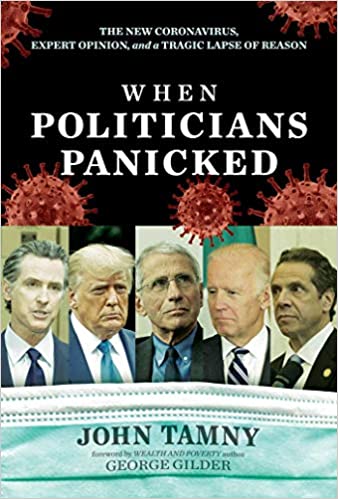
This is why I absolutely adore John Tamny’s fabulous book When Politicians Panicked. It doesn’t cover cell biology, death and case data, PCR testing scandals, hospitalizations, or virus trajectories at all. It keeps the focus on what really matters: how politicians smashed our economic lives out of a complete panic of what else to do. “To blame this on the coronavirus is to excuse ineptitude that is the normal when the combined, decentralized knowledge of millions and billions of humans is ignored in favor of the central and highly limited knowledge of a very few politicians, and even fewer experts.”

Tamny proves decisively that lockdowns were the cause of the crushed economy that was otherwise healthy, and this did not have to be. His fascinating spin on the China issue will challenge any reader. He points out that the market signals coming out of China even in the worst days of the pandemic were in fact not revealing anything terribly disruptive in terms of disease outcomes. US companies in China tested their employees and found few cases and no deaths. No American company with a deep stake in Wuhan was showing any level of market response to the pandemic. Tamny watches these markets carefully and concluded early on, by virtue of the information they were providing, that this virus itself represented minimal if any threat at all to social and economic functioning. Its severe outcomes were limited to the health and well-being of a small demographic and that would be treated medically and not politically. 

The reason this did not happen is the core thesis of the book. The politicians panicked. Lockdowns became the default response, though they had never been tried before, and a test of leadership grit. Real men and real women lock down to control the virus! That was the ethos stemming from panic. “What happened was an imposition of command-and-control that has always suffocated economic growth.” Tamny further shows that economic growth has always been a precondition for good health outcomes, so it makes no sense at all to shut it down. He will not call what resulted a recession, on grounds that this would be insulting to a very natural market process. It was pure destruction, and pointlessly so, since the virus should always have been treated as a medical matter. 

The book excels – and is thus far singular – in addressing the complete failure of the various stimulus packages intended to substitute for a functioning economy. It can never work. Whether the stimulus is fiscal or monetary, the government can only take from the private sector and redistribute it but it can never make up for losses associated with lockdowns. The author is right on target in associating this with Khrushchev-style economics (I thought that was my original insight; Tamny had it first). The Soviet dictator imagined that governments could outperform markets in a way that made markets irrelevant and unnecessary, exactly as the lockdowners thought that government could easily. 

Tamny’s book succeeds mightily in intellectually crushing the lockdown deniers (people who pretend like it never happened), and for that reason it is enormously satisfying. Somehow out of the three books mentioned here, this is the one that is most heartbreaking and most maddening since it shows decisively that none of this was necessary. None of it. The lockdowns were a monumental distraction from the job that needed to be done, and which always needs to be done, which is to promote good health outcomes. 

Tamny is willing to ask unaskable questions such as: what if the politicians had done nothing? His answer might shock anyone who has yet to rethink the tragic events of the last year. He says we would have been better off and the severe outcomes from the disease better because of the nursing home scandals and the collateral damage. In other words, the “mitigation” efforts not only wrecked the economy; they wrecked public health too. 

I’m so grateful to John Tamny for writing this book, which says exactly what needs to be said, and ends just the right way: it is time to reassert the primacy of freedom. 

These are three of what will be thousands of books that will be appearing in the coming years on these tragic times. I’m willing to wager that most of these books will severely condemn the policy decisions of the last year, just as these have done. There will be a reckoning. These books are an excellent start. 

Jeffrey A. Tucker

Jeffrey A. Tucker is Editorial Director for the American Institute for Economic Research.

He is the author of many thousands of articles in the scholarly and popular press and nine books in 5 languages, most recently Liberty or Lockdown. He is also the editor of The Best of Mises. He speaks widely on topics of economics, technology, social philosophy, and culture.

Jeffrey is available for speaking and interviews via his emailTw | FB | LinkedIn

Books by Jeffrey A. Tucker


Friday, March 26, 2021

Death Rates Plummeting

In my opinion, the covid lockdowns in Europe, the U.S. and some other countries have been one of the worst public health fiascos in recent history. I don’t know whether the true story will ever be written, but we have devastated the lives of our young people and destroyed countless businesses–in other words, people’s lives–in a vain attempt to reduce the death rate among the elderly and frail. The Wuhan bug is a disease, and as such a bad thing. But its fatality is concentrated, to an even greater extent than a typical seasonal flu, among those who are not only elderly but are already sick.

This implies that a large majority of those who died from covid in 2020 or 2021 in all likelihood would have died relatively soon in any event–later in 2020 or 2021, or in 2022, and so on. In the U.S. and Europe, overall death rates have in fact been elevated over the past year. But if this hypothesis is correct, we should see lower than normal death rates over the next couple of years. If that happens, it will put the Wuhan epidemic in quite a different light.

The U.K. is ahead of the U.S. on the covid time line, and now, for the first time, total death rates there are falling below the historic average:............To Reads More.....


Thursday, February 4, 2021

Young Not Stupid: The California unemployment department put an estimated $31 billion in the hands of criminals

By Cameron Arcand, The Western Journal February 2, 2021

The Golden State has become the gold standard for government inefficiency, as California is reeling from a massive unemployment scandal.  The Employment Development Department determined that there was an estimated $31 billion paid out by the state as a result of fraudulent claims, KABC-TV reported.  EDD admitted to $11 billion, but it expected that there was also $20 billion more given to scammers.

Thankfully, the California State Auditor Elaine Howle slammed the incident, which put cash into the hands of criminals as opposed to people who rightfully needed the benefits since the coronavirus restrictions began last March............To Read More....


Tuesday, January 19, 2021

Lockdowns Do Not Control the Coronavirus: The Evidence

AIER Staff – December 19, 2020
 
https://www.aier.org/wp-content/uploads/2020/12/shutterstock_1368896930-800x508.jpg

The use of universal lockdowns in the event of the appearance of a new pathogen has no precedent. It has been a science experiment in real time, with most of the human population used as lab rats. The costs are legion. 

The question is whether lockdowns worked to control the virus in a way that is scientifically verifiable. Based on the following studies, the answer is no and for a variety of reasons: bad data, no correlations, no causal demonstration, anomalous exceptions, and so on. There is no relationship between lockdowns (or whatever else people want to call them to mask their true nature) and virus control. 

Perhaps this is a shocking revelation, given that universal social and economic controls are becoming the new orthodoxy. In a saner world, the burden of proof really should belong to the lockdowners, since it is they who overthrew 100 years of public-health wisdom and replaced it with an untested, top-down imposition on freedom and human rights. They never accepted that burden. They took it as axiomatic that a virus could be intimidated and frightened by credentials, edicts, speeches, and masked gendarmes.

The pro-lockdown evidence is shockingly thin, and based largely on comparing real-world outcomes against dire computer-generated forecasts derived from empirically untested models, and then merely positing that stringencies and “nonpharmaceutical interventions” account for the difference between the fictionalized vs. the real outcome. The anti-lockdown studies, on the other hand, are evidence-based, robust, and thorough, grappling with the data we have (with all its flaws) and looking at the results in light of controls on the population.

Much of the following list has been put together by data engineer Ivor Cummins, who has waged a year-long educational effort to upend intellectual support for lockdowns. AIER has added its own and the summaries. The upshot is that the virus is going to do as viruses do, same as always in the history of infectious disease. We have extremely limited control over them, and that which we do have is bound up with time and place. Fear, panic, and coercion are not ideal strategies for managing viruses. Intelligence and medical therapeutics fare much better. 

(These studies are focused only on lockdown and their relationship to virus control. They do not get into the myriad associated issues that have vexed the world such as mask mandates, PCR-testing issues, death misclassification problem, or any particular issues associated with travel restrictions, restaurant closures, and hundreds of other particulars about which whole libraries will be written in the future.) 

  1. A country level analysis measuring the impact of government actions, country preparedness and socioeconomic factors on COVID-19 mortality and related health outcomes”.....
  2. Was Germany’s Corona Lockdown Necessary?””.....
  3. Estimation of the current development of the SARS-CoV-2 epidemic in Germany”.....
  4. Did COVID-19 infections decline before UK lockdown?.....
  5. Comment on Flaxman et al. (2020): The illusory effects of non-pharmaceutical interventions on COVID-19 in Europe”.....
  6. Professor Ben Israel’s Analysis of virus transmission......
  7. Impact of non-pharmaceutical interventions against COVID-19 in Europe: a quasi-experimental study”.....
  8. Full lockdown policies in Western Europe countries have no evident impacts on the COVID-19 epidemic”.....
  9. Trajectory of COVID-19 epidemic in Europe”.....
  10. Effect of school closures on mortality from coronavirus disease 2019: old and new predictions”.....
  11. Modeling social distancing strategies to prevent SARS-CoV2 spread in Israel- A Cost-effectiveness analysis”.....
  12. Too Little of a Good Thing A Paradox of Moderate Infection Control,.....
  13. “Smart Thinking, Lockdown and COVID-19: Implications for Public Policy”.....
  14. SARS-CoV-2 waves in Europe: A 2-stratum SEIRS model solution”.....
  15. Did Lockdown Work? An Economist’s Cross-Country Comparison”.....
  16. Four Stylized Facts about COVID-19” (alt-link).....
  17. How does Belarus have one of the lowest death rates in Europe?.....
  18. Association between living with children and outcomes from COVID-19: an OpenSAFELY cohort study of 12 million adults in England””.....
  19. Exploring inter-country coronavirus mortality“.....
  20. Covid-19 Mortality: A Matter of Vulnerability Among Nations Facing Limited Margins of Adaptation”.....
  21. States with the Fewest Coronavirus Restrictions”.....
  22. The Mystery of Taiwan: .....
  23. Predicting the Trajectory of Any COVID19 Epidemic From the Best Straight Line”  .....
  24. Government mandated lockdowns do not reduce Covid-19 deaths: implications for evaluating the stringent New Zealand response”.....
  25. Lockdowns and Closures vs COVID – 19: COVID Wins”..............
  26. Effects of non-pharmaceutical interventions on COVID-19: A Tale of Three Models”...........
  27. Assessing Mandatory Stay‐at‐Home and Business Closure Effects on the Spread of COVID‐19” ...........”
  28. Lockdown Effects on Sars-CoV-2 Transmission – The evidence from Northern Jutland”................
  29.  “A First Literature Review: Lockdowns Only Had a Small Effect on COVID-19”.............
To Read More.....

Sunday, January 17, 2021

Pandemic Security Theate

James BovardJames Bovard – January 15, 2021

After the start of the Covid pandemic, my local Harris Teeter grocery store in Montgomery County, Maryland made extensive changes, including placing eight-foot high plexiglass screens between every one of its nine self-service checkout stations. However, a few months ago, one panicky customer complained to the local health department that he felt unsafe at the store. A health inspector swooped in and threatened to shut down the grocery store unless they blocked access to a third of their self-service checkouts. As a result, the store now sometimes has long lines of people waiting to check out and presumably increasing their exposure to Covid while tarrying.

The inspector also forced the store to designate one of its two eight-foot wide entrances, each with a sequence of two automatic opening doors, as an “exit only.” The store initially taped a few little “exit only” signs to the exterior. A few weeks later, a county inspector returned to the scene (maybe sparked by another local resident who forgot to take their Xanax before shopping?) and issued new commands to the store. The result: now the doors are plastered with at least four “exit signs” as well as a three-foot high folding “exit” sign close enough to trip people who weren’t paying attention.

This is pure Pandemic Security Theater.  

If people could catch the virus from passing momentarily in a wide doorway, then all the grocery store clerks as well as most subway and bus passengers would have been struck down by Covid long ago........To Read More....


Saturday, January 16, 2021

Coronavirus and the Failure of Big Government, Part V

January 16, 2021 by Dan Mitchell @ International Liberty 

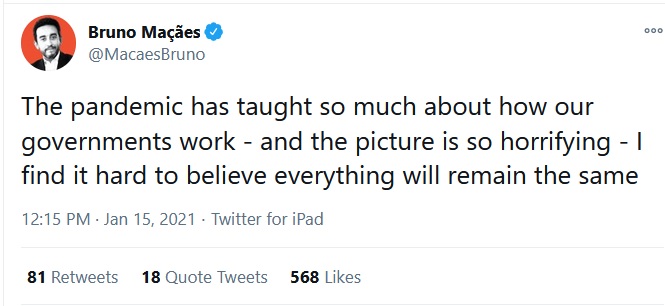
I wrote a four-part series last year about coronavirus and big government (here, here, here, and here), so it goes without saying that the first two lines of this tweet deserve some sort of accuracy award for hitting the nail on the head.

But the sentiment expressed in the last line of the tweet also deserves some sort of award.

I don’t know if the award should be for false hope or naive expectation, but I am sadly confident that everything will stay the same. Or perhaps get even worse.

Simply stated, instead of the deregulation that’s needed, here are some more likely outcomes.

  • The World Health Organization will get rewarded with a bigger budget and more power, notwithstanding its failures.
  • The Centers for Disease Control will get rewarded with a bigger budget and more power, notwithstanding its failures.
  • The Food and Drug Administration will get rewarded with a bigger budget and more power, notwithstanding its failures.

Why am I so pessimistic? Because I understand “public choice,” which is the application of micro-economic analysis (things like incentives) to the behavior of politicians and bureaucrats. In other words, people in Washington act in ways to advance their own interests.

Just in case all this isn’t clear, here are a few headlines and tweets to drive the point home.

We’ll start with an understatement.

And here are examples of that failure.

Starting with a column in the Wall Street Journal.

And this tweet.

There are many more headlines that tell tragic stories.

From the Houston Chronicle.

Here’s a very sad and succinct headline.

Government intervention also hurt in little ways.

This tweet tells us the lesson we should learn.

As does this tweet as well.

One of Trump’s great failures was protectionism.

So we shouldn’t be surprised that trade barriers also hurt the fight against the pandemic.

And here’s a tweet about the FDA’s bungling.

Don’t forget that bureaucracy and big government also caused problems in other nations.

Such as the United Kingdom.

Sounds like the bureaucrats in the U.K. want to compete with the FDA and CDC for some sort of incompetence award.

There was a better response in Germany because the private sector played a much bigger role.

And the German approach was better than the United States as well.

Needless to say, the WHO also deserves some negative attention.

Indeed, it should come with this warning label.

And we’ll close by shifting back to the failure of government in the United States.

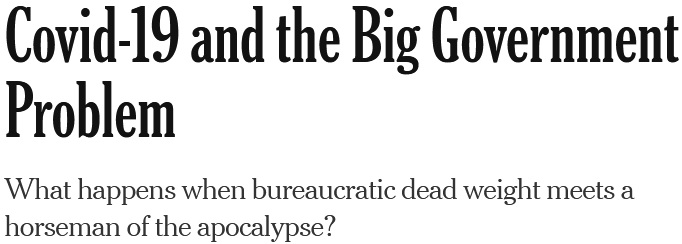
This column from the New York Times captures the real lesson of the past 12 months.

P.S. At the risk of outing myself as a libertarian, this image tells us everything we need to know. As does this collection of cartoons.


Sunday, August 16, 2020

Chicago Spent $66 Million on Hospital That Treated 38 Coronavirus Patients

-
Chicago mayor Lori Lightfoot's (D.) decision to renovate a local convention center into a makeshift coronavirus hospital cost taxpayers nearly $66 million—though only 38 patients received treatment at the facility, the Chicago Sun-Times reported on Friday.

The Metropolitan Pier and Exposition Authority, the agency Lightfoot tasked with overseeing the project, overlooked a bid from a construction company that offered to waive fees or donate them to coronavirus pandemic relief organizations. Instead, officials gave the bid to Walsh Construction, a politically connected contractor, which billed the city $65.9 million to renovate the McCormick Place convention center.

The decision cost taxpayers more than $1.7 million per patient. In contrast, the city spent $50 million total to equip three other centers in the Chicago area...........To Read More....

Friday, August 14, 2020

Wisconsin State Agency Requiring Employees Wear Masks During Online Meetings

(Editor's Note:  You just can't make this kind of stuff up. RK)

By Zachary Stieber August 13, 2020

A state agency in Wisconsin is requiring employees wear masks during virtual meetings.

“Wear your mask, even if you are home, to participate in a virtual meeting that involves being seen—such as on Zoom or another video-conferencing platform—by non-DNR staff,” Preston Cole, head of the Department of Natural Resources, wrote in an email to employees last month, an agency spokeswoman confirmed to The Epoch Times.

“Set the safety example which shows you as a DNR public service employee care about the safety and health of others,” Cole added.

Asked to point to public health guidance that would lead to such a recommendation, the spokeswoman said in an email: “We’ve asked of our employees to wear a mask while video conferencing with external partners to set a good example during this pandemic. Wisconsin is a state with significant community spread. By making the effort to wear a mask when publicly conferencing with our external partners we are creating a very visual reminder to all that wearing a mask in a public setting helps prevent the spread of COVID-19.”.........To Read More...