Richard M. Ebeling
– June 14, 2021 @ American Institute for Economic Research
Richard M. Ebeling
– June 14, 2021 @ American Institute for Economic Research
Not long ago, my wife and I decided to go out to our favorite Thai
restaurant not far from our home in the Charleston, South Carolina area,
which we had not been to for well over a year. With so many retail
businesses having returned to a no-mask, no-distancing “normality,” we
were looking forward to a tasty inside, sit-down meal. But when we
arrived we discovered they were still only doing takeout orders because
the management had not been able to find enough willing waiters to
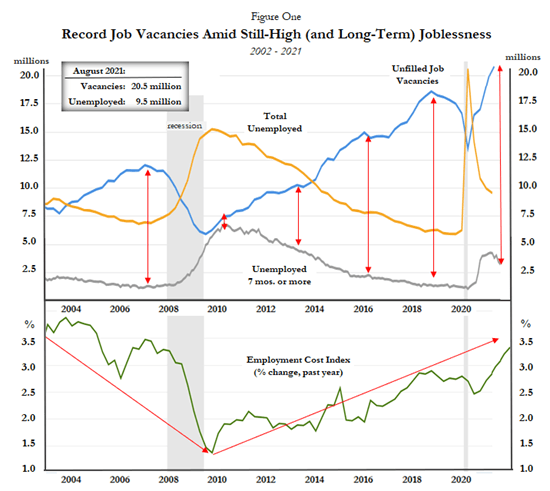
rehire. America is suffering from an apparent “labor shortage,” in spite
of unemployment levels being significantly above what they were before
the government-imposed lockdowns and stay-at-home orders in early 2020.
Before these shutdown orders and restrictions on freedom of shopping
were imposed by, especially, the state governments and reinforced by
federal policies in March of last year, the economy-wide average
unemployment rate hit a low of about 3.5 percent of the labor force in February 2020,
according to the Bureau of Labor Statistics (BLS), something not
experienced for several decades. Plus, this unemployment low had its
counterpart under the subgroups of men and women, whites and blacks and
Hispanics, and for adults and youths. Indeed, if the coronavirus crisis
had not occurred with the accompanying government-created collapse of
much of the economy, 2020 might have turned out to be an exceptionally
good year in terms of many of the standard economic benchmarks.
The BLS June 2021
report on “The Employment Situation” for the month of May showed that
the overall unemployment rate stood at 5.8 percent of the labor force,
or still about 35 percent higher than in February 2020. And, comparably,
each subgroup remains noticeably above their, respective, unemployment
rates of 15 months ago.
At the same time, the BLS’s June 2021
report on “Job Openings and Labor Turnover” stated that at the end of
April, job openings for which employers were willing and able to hire
stood at 9.3 million positions. But hires to fill employment slots in
April totaled 6.1 million. The number of people quitting or not willing
to accept work increased, especially in the food service and retail
sectors, while the number of workers let go or laid off remained low.
Unemployment Due to Government Paying People Not to Work
Clearly, to use Keynesian terms, employment in the United States is
not suffering from an “aggregate demand” failure. There are plenty of
job openings; it is a failure of a good number of employable people not
being interested in filling the slots employers would like to fill. Why?
A number of commentators have suggested that many are still concerned
about and fearful of returning to the workplace due to the potential of
still catching the coronavirus and the risk of serious illness or
death. Some have argued it’s because employers are too cheap; that is,
they are unwilling to pay a wage high enough to draw unemployed workers
back into the active labor force. The problem with this latter
explanation is that it does not make clear why wage “x” at which some of
these workers were willingly employed 15 months ago is now unacceptable
just a little bit more than a year later, given the lost income
experienced during all that time.
However, suppose that before the coronavirus lockdowns and lost
employment, a low-skilled employee was making, say, $500 a week. But now
let us suppose that during the last 15 months, due to extended
unemployment insurance payments and supplementary federal emergency
transfers introduced during the coronavirus crisis, this person was
continuing to have a government-supplied weekly income of $500, or maybe
even more, say, $600. For as long as this continues, what is the
incentive for him to return to the workplace for the previous salary
when, instead, this individual can stay at home and be no worse or maybe
even better off than working his old 40-hour week as before March of
2020?
A few weeks ago, the Foundation for Government Accountability (FGA) issued a report
based on work and wages versus government income-transfer programs
(state unemployment insurance, supplemental federal emergency insurance
bonus, child care credits, earned income tax credit, and food stamps)
in, for instance, the state of Florida. A person could receive up to the
equivalent of a $20-an-hour wage by staying home rather than accepting
available employment.
Government Created Artificial Benefits to Not Take a Job
This, obviously, has nothing to do with a “failure of the market” in
not providing jobs or from employer stinginess in the salary being
offered. Government redistributive benefits have priced some workers out
of the labor market by giving them more received income by not working
than from accepting the employment available at more market-based wages
reflecting employer estimates of those workers’ value-added contribution
in various lines of production, including in the service industry.
What has been created by these government programs is a false
“opportunity cost” for those in these labor categories in terms of their
trade-off between work and non-work. I say “false” due to the fact that
if these redistributive programs were not present, lower-skilled
workers would have to weigh differently the income forgone by not
accepting gainful employment versus perhaps not earning anything.
Instead, for as long as these types of programs are in effect, they,
basically, establish a “floor” below which more is lost by working than
taking a job.
Even if the government transfers are slightly less than the salary
that would be received from working, the trade-off can still be in favor
of not taking a job. Suppose someone could earn a weekly salary of that
$500 versus unemployment insurance plus some of these other government
redistributions that give him the equivalent of, say, $475 or $450 per
week. Would it always be in every such worker’s personal interest to
give up the $475 or $450 of government-supplied income to, instead, work
40 hours a week to make an extra $25 or $50 for that total of $500 of
earned weekly income? Surely, for most people an extra $25 or $50 a week
would not be worth foregoing the 40 hours of free time the government
money enables him to enjoy.
Limited Means to Serve Our Many Ends Require Trade-Offs
We can see, therefore, that the current “shortage” of labor is, in
fact, “contrived” and not “natural.” I am using this particular
terminological distinction because the cause and nature of market-based
scarcity versus government-created scarcity was explained with great
cogency a long time ago by the British economist, William H. Hutt
(1899-1988) in a neglected essay of his on “Natural and Contrived
Scarcities” (South African Journal of Economics, September 1935). (See my article, “William H. Hutt: A Centenary Appreciation”.)
Hutt reminded us that man cannot escape from the fact that he is
always confronted with the need and necessity to make choices, to accept
trade-offs between alternatives, and decide what he values more highly
and what he values less highly. The inescapable reason for this is the
scarcity of means available in their quantities and/or qualities to
serve and satisfy fully all the ends, goals and purposes for which we
would like to apply them.
Our time is scarce, with only twenty-four hours in a day. Our mental
and physical strength is limited with which to pursue our purposes. The
resources and raw materials around us that we identify as “useful
things” to make the finished goods and services that we desire are
limited in their amounts to produce all the consumer items for which we
think them usable.
In the free market economy, the relative scarcities of both finished
consumer goods and the resources, labor and capital equipment out of
which those consumer goods can be made are all registered in the form of
the competitive prices at which they may be bought and sold.
If we, as consumers, demand more automobiles we may offer to pay
higher prices for the greater number of cars we wish to purchase. But to
produce more automobiles off the assembly line means that fewer of the
scarce resources that go into the manufacture of cars – workers and
their labor time, resources, raw materials, component parts, and the
machinery needed – will now be available to produce other, alternative
goods that could have been produced with those same means of production,
instead.
The prices paid to attract those greater quantities of scarce means
into the auto industry (including the additional wages to draw more
workers into this sector of the market) are what economists call their
“opportunity costs.” That is, the prices that need to be offered and
paid that are just sufficient to attract them from an alternative
employment in which they also have value in producing something else
that consumers also want, but not as intensely.
This is the reality of a world in which we are not able to have
everything we want, where we want it, in the full amounts we desire.
This is why, no matter how hard we try, we can never “have it all.”
Trade-offs are an inescapable part of virtually every aspect of our
life.
Even when through savings, investment, innovation, and industry we
succeed over time in increasing our ability to produce more of the
things we wish to have, we still never have it all. It is part of the
human make-up that as soon as we have successfully reached some desired
goals our mind and imagination run ahead to new and different things
that are, once again, not fully within our reach.
It is like walking towards the horizon; no matter how far we go and
how fast we try to get there, the horizon remains in front of us, and
out of our reach. This is man’s frustration but also the stimulus for
all the material and cultural achievements that we call “civilization,”
which have raised humanity up from primitive subsistence existence. (See
my articles, “Preserved Primitivism versus Freedom and Prosperity” and “Has Modernity Made Us Indecent?”)
The “Natural Scarcity” of Limited Means is Inescapable
In the competitive free market, the limits on how much of goods in
general and the relative amounts of each within that total is possible
of being produced is limited and constrained by what William H. Hutt
defined as the “natural scarcities” existing in any society within any
period of time. Said Hutt:
We must conceive of a society in
which there are no restrictions on the free movement, adjustment and
full utilization of the productive resources in response to the dictates
of consumers’ will [as expressed in their market demands for various
goods and services].
Under the “natural scarcity” of things in a free market, some people
may wish that more hospitals were built for the sick or more research
undertaken for a cure for cancer, or more wildlife areas set aside for
peaceful contemplation of the beauty of nature. But the critic has no
one to blame but the free choices of his fellow citizens and even
himself in actually demanding more of other things in the marketplace
that prevents the necessary scarce resources and labor from being
available to do more of these other desired things as well. Our own
market choices and demands, and that of all of our fellow consumers in
society, determine what goods will be profitable to manufacture with
what combination of those “naturally” scarce resources, and, therefore,
available in which relative quantities in their finished forms as
purchasable goods and services.
“Contrived Scarcities” and “Contrived Plentitudes” Caused by Government
However, the critic may not be satisfied with his own failed attempts
to persuade enough of his fellow citizens to demand and spend less on
these other things so more scarce resources can be freed up and used for
more hospitals, medical research, and nature preserves. He may then
turn to the government and its political power to get what he wants
without the agreement and voluntary participation of his
“preference-misguided” fellows in society.
Hutt argued that when various individuals and special interest groups
turn to the State to get what they want it brings about what he called
“contrived scarcities” and “contrived plenitudes.” If the government
increases taxes on the citizenry to fund the supplying of more
hospitals, cancer research and wildlife areas, it creates a “contrived
plenitude.” That is, an amount of these things is supplied in excess of
what the market would have found profitable to supply if production had
been guided by what consumers would have wanted and demanded if more of
their earned income had remained in their own pockets and not been taxed
away.
The amount of such “good things” as hospitals, medical research
facilities, and nature areas are, in fact, out of balance – over
supplied – with what a free market would have supplied of them if the
determination of production in society had been left more fully to be
guided by the wishes and desires of the income-earning consumers,
themselves.
On behalf of those not satisfied with the free choices of their
fellow citizens and who are willing to use political compulsion to get
what they want, government has intruded into and violated the
“sovereignty of the consumer” to peacefully, honestly, and voluntarily
decide what he wants based on his values, beliefs and desires, and to
make it profitable on the competitive market for others to provide him
with what he wants out of the income he has peacefully, honestly and
voluntarily earned in his own role as a producer.
But the other side of this coin is that there are “contrived
scarcities” – a reduced availability – of the goods and services that
those sovereign consumers would have been able to have if the greater
taxes collected and spent by the government had not resulted in scarce
resources and labor being drawn away from producing the goods and
services those consumer/taxpayers would have spent their income on if it
had not been reduced due to those higher taxes.
“Contrived Scarcities” from Import Tariffs and Price Subsidies
Such contrived scarcities take on various forms, as well, other than
only the direct taxing away of people’s income. If the government
imposes an import tariff or an import quota on foreign goods entering
the domestic economy, the available supplies of those goods will be
less; and the prices of these goods that consumers will now have to pay
will be higher, as a result, than if free trade was practiced and
consumers had had a wider free market choice of domestic and foreign
suppliers.
Suppose that the government starts to guarantee dairy farmers minimum
prices for their produce (as the U.S. government does under its farm
price-support programs). With a higher guaranteed price than the
market-established price, dairy farmers would find it profitable to
expand their dairy cowherds; a “contrived plentitude.” But this requires
more grazing land for the increased number of cows.
The expanded grazing land will have to come from somewhere. Suppose
that this land comes out of wheat growing. The wheat crops will tend to
decrease, an essential ingredient in bread baking will be reduced in
quantity, and the supply of wheat bread available in groceries may be
less, with a resulting higher price per loaf that consumers now must
pay; a “contrived scarcity.”
Thus, government interventions such as these would abridge the
market-based sovereignty of the consumers, bringing about too much of
some goods being produced and too little of others being supplied.
Difficulty of Seeing Government’s Hand in Contrived Scarcities
But the perversity from these types of “contrived scarcity” policies
is that consumers often find it difficult to know whether and to what
extent the supplies available and the prices paid for goods are due to
market-determined “natural scarcities” and how much is due to government
manipulation of quantities produced and offered on the market.
In the case of the farm price-support programs, consumers in the
market end up paying no less than the government guaranteed price for
dairy products, for example, since dairy farmers have no incentive to
offer it for a lower price on the market since they know that any unsold
surpluses at the guaranteed price will be bought up by the government
at taxpayers’ expense.
At the same time, the possible reduced wheat crops that negatively
impact the supply of wheat bread and raise its price, for instance, is
so many steps away from the immediate vision and understanding of the
consumers of bread that it is nearly impossible for ordinary citizens to
appreciate the links in the chains of government intervention that has
made bread costlier and less available. Thus, the “free market” gets
blamed for high or rising prices for various goods because of the
apparent businessman’s “greedy profit motive” that makes him fail to
produce more of what people want and desire.
Consumers seem to be unrestricted in their choices concerning how to
spend whatever after-tax income may remain in their pockets; market
interactions of supply and demand seem to determine the prices that
those consumers pay; and, thus, the reason for any frustrating
scarcities and expensiveness of desired goods gets placed at the
doorstep of “selfish” acts of profit-motivated capitalists and
businessmen, in general.
But behind the scenes the incentive, profitability and opportunity to
produce goods guided by the actual demands of the consuming public have
been thwarted by government taxing, pricing and regulatory policy
manipulations bringing about contrived or artificial scarcities of some
goods on the supply-side of the market or wasteful overproduction, or
“contrived plentitudes,” of other goods not reflecting what those
consumers would really want produced if the market was left free of the
intervening and distorting hand of those in political power serving
particular special interest groups.
Getting Government Out of the Market Can End Contrived Scarcities
While “natural scarcities” can only be reduced in the longer run
through savings, investment, innovation and industry that increase the
supply and improve the qualities of desired goods, in principle,
“contrived scarcities” and artificial “plentitudes” can be corrected
much sooner.
Or as Hutt expressed it, “Contrived scarcities, unlike natural
scarcities, are not beyond the power of change by individuals and hence
of a different degree of permanence: restrictions can be overcome . . .
Contrived scarcities involve, then the frustration of consumers’
sovereignty; and what is usually meant when the removal of restrictions
on competition is recommended is that such contrivances shall be
eliminated.”
This is the current situation in the American labor market. The
government’s income transfer programs such as unemployment insurance
payments in general, and the “emergency” income supplements mentioned
earlier, have all created a contrived scarcity that the media and others
refer to as a “labor shortage.” Yes, labor in a variety of occupations
and employments is in short supply, but there is nothing “natural” about
it in the manner that Hutt explained a natural scarcity of limited
means to serve consumer ends in a free market.
It is “contrived” shortage of labor due to the government’s
manipulation of the trade-off and opportunities costs offered to
segments of the labor force through the artificial income supports that
have been made available. The other side of this coin is that there has
been a government-created “unemployment plentitude;” that is, an amount
and level of unemployment in various occupations and lines of work more
than would “naturally” exist due to ordinary and ever-occurring dynamic
changes in competitive supply and demand conditions.
A growing number of state governments have announced their decision to opt out
of some of these federal “emergency” income transfer programs, meaning
the financial benefit of being unemployed will decrease, and the income
gains from accepting offered work in the marketplace will seem more
attractive. There will remain in place enough government programs that
will continue to “contrive” artificial labor scarcities and unnecessary
unemployment, including minimum wage laws, small business regulations,
occupational licensing restrictions, as well as others. But the type of
contrived scarcities of labor created by these particular Covid-related
transfers can all be gone practically overnight by simply ending them,
and making market-based employment more attractive again, in
comparison.
Educating Others on Natural versus Contrived Scarcities
Finally, in more general terms, one of the tasks of friends of
competitive free markets is to explain to our fellow citizens that while
a “natural scarcity” of useful means to achieve our various ends is
inescapable in the reality of the human circumstance, there are some
scarcities of resources and desired goods that are artificial,
“contrived scarcities,” precisely due to government and its
interventions in the market process.
Such contrived scarcities, in principle, could be gone tomorrow if
the government’s economic policies fostering, creating and sustaining
them were abolished and eliminated. The individual’s freedom of choice
and action as both consumer and producer will have been more fully
restored with a less intervening government.
Free men in free markets would then be at liberty to improve their
conditions without the disrupting and distorting hand of political power
and special interest politicking that invariably makes many things less
available and more expensive than if competitive markets were
unshackled from the government policies that only succeed in making us
poorer and far less free than we need to be.

Richard M. Ebeling, an AIER Senior
Fellow, is the BB&T Distinguished Professor of Ethics and Free
Enterprise Leadership at The Citadel, in Charleston, South Carolina.
Ebeling lived on AIER’s campus from 2008 to 2009.
 Peter C. Earle
– October 2, 2021 @ American Institute for Economic Research
Peter C. Earle
– October 2, 2021 @ American Institute for Economic Research

 Print
Print