Despite numerous personal shortcomings, Jim Morrison of The Doors regularly evinced considerable writing talents. In the poem-song Horse Latitudes,
he describes the conditions under which stalled galleons would,
drifting listlessly at certain latitudes, jettison cargo so as to make
their craft more susceptible to the slightest winds............Cargo vessels no longer raise sails or require wind to fill them, but doldrum-like conditions are rapidly manifesting near ports all over the world. Last week,
[s]ixty-one vessels were anchored
offshore on Thursday [September 23rd] waiting to unload cargo as the
Port of Los Angeles and the Port of Long Beach…In addition to the
anchored ships, 29 were adrift up to 20 miles offshore, meaning they
were so far from the coast that their anchors could not reach the ocean
floor.
[The] Port of New York and New
Jersey appears to be facing similar issues as West coast ports…Around 24
cargo ships and oil tankers [were] stuck waiting to dock off the coast
of Long Island, New York…As of 9pm local time Saturday, the ships
appeared to have been stuck in place for hours.
Explanations for the increasing delays include slow loading/unloading
times, rising costs of shipping, and capital shortages. All of those
explanations are correct but incomplete and insufficiently descriptive.
To uncover the root causes and trace their evolution, we must go back to
the very beginning.
Nominal Rigidities
First, the foundations. While bottlenecks are occurring everywhere,
at present US ports are disproportionately affected. Docking locations
along US coasts are among the slowest in the world: not because of size
or technological capacity but collective bargaining hindrances. As Dominic Pino recently wrote,
Why are our ports so far behind?
Not because we don’t spend enough on infrastructure, as the Biden
administration would have you believe. The federal government could
spend a quadrillion dollars on ports, and it wouldn’t change the
contracts with the longshoreman unions that prevent ports from operating
24/7 (as they do in Asia) and send labor costs through the roof.
(Lincicome finds that union dockworkers on the West Coast make an
average of $171,000 a year plus free healthcare.) The unions also fight
automation at American ports today, “just as they fought containerized
shipping and computers decades before that.”
Before the public hysterics, lockdowns, and stay-at-home orders, and
even before the first offloading was delayed, nominal rigidities had
ossified US port operations and made them particularly vulnerable to
even the slightest kinks in supply chains.
Where It Began
As is well documented by now, the effects of nonpharmaceutical
interventions sent measures of economic activity plummeting throughout
the second quarter of 2020. Unemployment skyrocketed to levels not seen
since the Great Depression. The US government countered with stimulus
payments via the CARES Act (March 2020), the Consolidated Appropriations
Act (December 2020), and the American Rescue Plan (March 2021).
Although state governors adopted independent pandemic postures, the
spectrum of stringency ran a gambit from less to more binding as
exemplified by Florida and North Dakota versus Hawaii and California.
The sudden strangulation of in-person commercial activity, coupled
with weeks to months of veritable isolation at home, with trillions of
dollars being mailed out led to a consumption binge. This was both well
documented and empirically verifiable. Where in normal circumstances
modern US consumers tend to purchase services more than goods, the
circumstances arising of isolation at home for prolonged periods led to a
decisive shift toward purchasing goods: electronics, furniture,
exercise equipment, home improvement items, and so on...........To Read More.....
The May 11 jobs report took many economic data watchers by surprise. Predictions
of over one million new jobs in April 2020 were dashed, with only
266,000 created and the unemployment rate ticking up from 6.0 percent to
6.1 percent. It’s a bit difficult to understand why the incredible
shortfall was surprising to many economists: Prices are rising, and for
several months there have been widespread reports of labor shortages.
Individuals respond to incentives, and the likely outcome of paying
people more not to work than they earn working seems straightforward.
AIER Sound Money Project Director and Florida Atlantic University professor Will Luther predicted as much, and laid it out clearly
in April 2020, 13 months ago. Since federal unemployment bonuses are
guaranteed through September, one can expect the economic drag of
underemployment to continue into the summer. Teachers unions have
successfully lobbied to keep many school districts closed until the
fall, also preventing many parents from returning to work through the
end of the 2020-2021 school year at a minimum.
At the same time as work is being discouraged by government programs,
the so-called infrastructure plan is rolling forward, bringing with it a
wide swath of new taxes thanks to its $2 trillion price tag. The most
recent version of the Biden tax plan seeks to target under 1 percent of
all taxpayers: single filers earning (adjusted gross income) more than
$452,000 per year and married couples earning more than $509,000 per
year.
If it seems odd that the recent explosion in calls for inclusivity in
every community and group in society somehow passed over a tiny sliver
of Americans, it isn’t. Envy is now among the primary marketing tools
for public policy buy-in. Americans, for three generations, have been
blithely unaware of the wellsprings of prosperity.
But worse still are plans to increase corporate tax rates to levels
exceeding those of some nations with notoriously anti-business policy
histories. At Biden’s proposed rate of 28 percent, the U.S. would have
higher corporate tax rates than China (25 percent), Italy (24 percent),
and Greece (24 percent). France is planning to cut its corporate tax
rates down to 25.8 percent, which will undercut the new U.S. rate.
In 2019, 99.4 percent of all C corporations had 500 or fewer
employees: they will be hit by the Biden tax increase. (For the
innumerate: employees numbering two hundred fifty, one hundred,
seventeen, ten, two, and one are all less than 500.) Further, many of
the owners of small companies set up with the subchapter S election––as
pass-through entities––will be hit by higher income taxes.
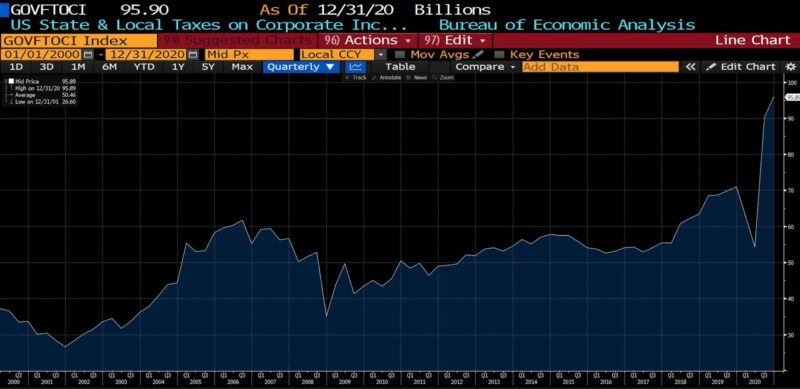
BEA: US state and local taxes on corporate income (SAAR, 2000 – present)
(Source: Bloomberg Finance, LP)
It’s not that taxes merely deprive firms of the means to expand by
reducing their capacity to create more jobs and invest in additional
capital. Increases in government takings create distortions in the
economy: to minimize or altogether avoid the impact of higher taxes,
owners of firms alter their business models or operations. Entrepreneurs
and established business managers will relocate, shift production,
reduce headcount, and engage various other means to maximize revenue and
reduce the rake. A global minimum tax on wealth, such as the one
currently under discussion between U.S. Treasury Secretary Janet Yellen and other world leaders, will leave fewer places for producers to flee to.
It’s worth mentioning that the programs being proposed are, although
undoubtedly what the Biden administration wants, an opening bid. There
will be some horse trading. And reliably, Republicans won’t fight the
increases in government spending, new and higher taxes, or increased
U.S. debt so much as they will ensure that their constituencies receive
some portion of the spoils. Higher prices, fewer market-created jobs;
higher taxes, less private, commercial investment. More dependence, more
redistribution, muted incentives, and worst of all, more policy
precedence. Records are, after all, made to be broken––or at least
invite attempts to do so.
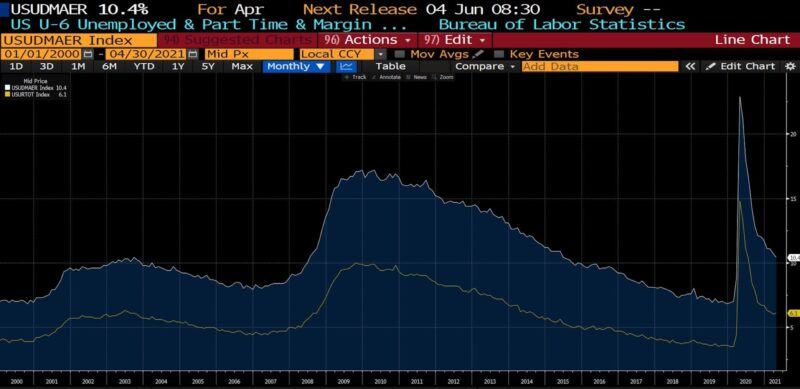
BLS: U3 (yellow) and U6 (white) measures of labor force participation (2000 – present)
(Source: Bloomberg Finance, LP)
The more that individuals and firms are stripmined, with the fruit of
their creativity and labor reallocated according to political whims,
the less resilience families, communities, and the nation as a whole
will have in the face of unanticipated adversity. Taxes blunt the forces
of creative destruction, leaving great ideas to struggle for
realization and ossifying commercial vibrance.
Albert Einstein once said––paraphrased––that he couldn’t predict how
World War III would be fought, but World War IV would be probably fought
with sticks and stones. Covid-19 struck in a period with employment at
record levels, GDP growing rapidly, and recently lowered taxes. The
opportunistic, inexpedient policy responses to the Covid-19 pandemic
ensure that when the next nasty bug––let’s call it “Covid-X”––or some
other calamity reaches our shores, an economically weaker, poorer US
will be waiting for it.
Peter C. Earle is an economist and
writer who joined AIER in 2018 and prior to that spent over 20 years as a
trader and analyst in global financial markets on Wall Street.
His research focuses on financial markets, monetary issues, and
economic history. He has been quoted in the Wall Street Journal,
Reuters, NPR, and in numerous other publications.
Pete holds an MA in Applied Economics from American University, an
MBA (Finance), and a BS in Engineering from the United States Military
Academy at West Point. Follow him on Twitter.
In a market economy, consumers vote with their dollars. The survival
and growth of a business depends pivotally upon how effectively they
convince customers to buy their products over those of their
competitors. But recently, consumers seem to expect a new product in
addition to what they were already purchasing from firms: corporate
consciousness. In particular, a decidedly left-leaning consciousness.
But it’s not entirely accurate to claim that consumers have compelled
businesses to “get with the times;” more precisely, the sensibilities
of the public, have mostly through the media and polling, bled into
corporate board rooms. Big businesses have in turn doled out value
statements; some are praised, others pilloried. It’s a chicken-or-egg
case: did the consumer demand woke capital, or has the corporatist,
desperate to maintain market share and boost public perception of their
firm, made woke capital the law of the American economy?
A New Twist on an Old Saw
In reality, woke capital is nothing new––though it has undergone many
transformations and changes of name over the years. On the individual
level, early industrialists like Andrew Carnegie and John D. Rockefeller
engaged in corporate philanthropy, donating large shares of their fortunes to charity. In the 1940s, businesses themselves started supporting charitable causes.
The idea of corporate social responsibility entered
the mainstream in the 1970s when the Committee for Economic Development
pushed the “social contract” model, stating that businesses function as
a result of public “consent,” thus leading to an obligation to serve
societal needs. (This also ties to the rise and spread of stakeholder theories, which today no MBA program would dare omit.) That same model outlined
three duties of businesses: providing jobs and economic growth, fair
and honest treatment of workers and customers, and improving the
conditions of the surrounding community.
The present ascendance of woke capital, then, has been less of a rise
and more of a continuation––a twist, really––on existing tendencies.
The contemporary culture war has only served as a catalyst. A 2020 Spectator piece reads,
As the Democratic party and
cultural elites have lurched left on cultural issues, corporate America
has lurched along with them. America’s ‘reckoning with racial injustice’
in the past three months was enthusiastically endorsed by major
corporations, often even as their physical outlets were plundered
by the ‘mostly peaceful’ activists on the street….As capital aligns
with the cultural left, it is now extracting its concessions.
It wouldn’t be so unpalatable if it weren’t rife with hypocrisy.
This, ultimately, is the cardinal sin of woke capital: lofty moral
standards, selectively applied. In one of the earlier discussions of the
woke capital phenomenon, which appeared in The New York Times back in 2018, columnist Ross Douthat pointed out the folly in Apple’s value statements:
It’s worth noting, for instance,
how Tim Cook’s willingness to play the social justice warrior when the
target is a few random Indiana restaurants that might not want to host
hypothetical same-sex weddings does not extend to reconsidering Apple’s
relationship with the many countries around the world where human rights
are rather more in jeopardy than they are in the American Midwest.
Douthat’s concerns proved prescient as the turmoil of last
summer––largely centered on the deaths of George Floyd and Breonna
Taylor and the ensuing Black Lives Matter protests––came to a head. In
2020, no less than two-thirds of S&P 500 companies released statements of solidarity with the movement; a smaller share, 36 percent, contributed funds to racial justice organizations.
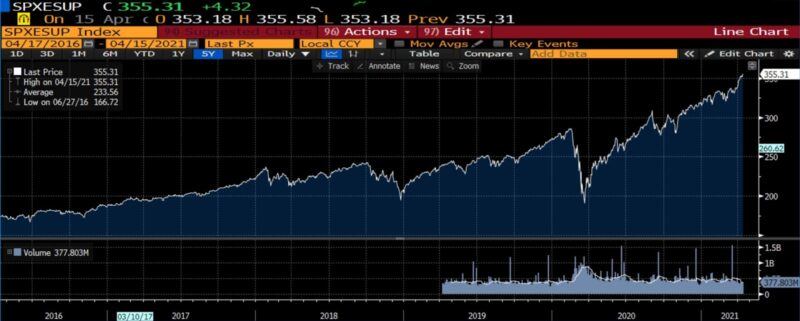
S&P 500 ESG Index (5 yrs)
(Source: Bloomberg Finance, LP)
Nike and The Washington Post, among other employers, gave workers Juneteenth off as a paid holiday. Companies participated in #BlackOutTuesday, posting just a black square to their social media accounts. Managers assigned left-wing political texts to employees. JPMorgan Chase CEO Jamie Dimon dropped by
a Chase branch to take a knee with staff in support of racial justice
protests (and, it seems, could not resist taking advantage of the photo
opportunity).
The immediate aftermath of these actions was characterized by
confusion and skepticism alike. Black employees of many companies that
had sprung into activist action found the messaging inconsistent
with their personal experiences, speaking to poor racial climates and
difficulty in climbing the career ladder. Nearly one year later,
investor groups are still pressuring
banks and industry giants to support shareholder resolutions that will
hold them to proof of progress measures. Though Fairness & Accuracy
in Reporting (FAIR) disagrees with the premise of “woke capital,” it
nonetheless concedes
that “many corporate overtures to diversity, racial justice and
progress are marketing gimmicks that don’t actually address structural
economic inequality, and, at worst, are meant to distract from any kind
of class reckoning.”
Stunts and Missteps
One such blunder came in the form of the McCann ad agency’s Black Lives Matter blunder.
In early June, the firm asked artist Shantell Martin to paint a BLM
mural on the storefront of McCann’s client Microsoft. The email
specifically requested that Martin finish the piece within a few days,
“while the protests are still relevant.” Martin teamed up with other
black artists who had been approached by McCann, eviscerating the agency in a letter that decried the disingenuity of activism with an expiration date.
With all that in mind, it must be said that not every business simply
postures for the sake of posturing. In the early days of corporate
social responsibility, Milton Hershey of The Hershey Company built
far more than just production facilities in Hershey, Pennsylvania; he
built civic centers and cultural institutions that continue to support
the community to this day. And in the woke capital era, plenty of
organizations have taken up the helm of well-intentioned, effective
societal change. Chobani, a leading Greek yogurt brand, has made tangible steps
toward social responsibility––from actively seeking to hire refugees to
investing in social entrepreneurs in order to encourage innovating for
the greater good, Chobani’s impact statements are far more than just platitudes.
Yet these examples are, in many ways, the exceptions rather than the
rule. Far-reaching social and political turmoil has prompted businesses
to feel as though they must comment on current issues, but that talk has
hardly translated into any meaningful change. Social change is
expensive––and woke capital is difficult to back––and as such, few
businesses have put their money where their mouth is. That voluntary,
cooperative commercial engagement is a center of gravity for
civilization itself has not occurred to them, or doesn’t make for a
flashy enough campaign.
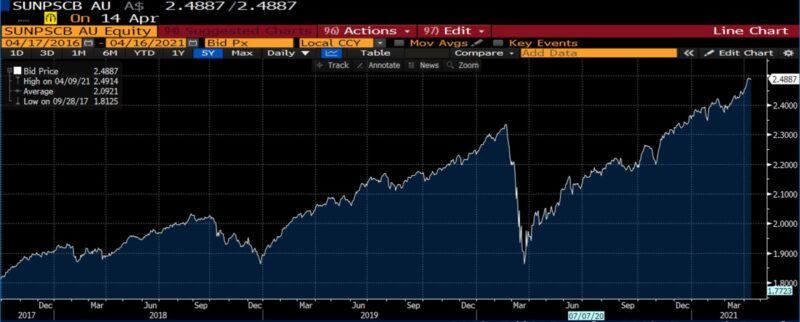
SunSuper Socially Conscious Balanced Fund (AU)
(Source: Bloomberg Finance, LP)
Economic Calculation with Woke Capital
An issue with decidedly larger implications is whether or to what
extent corporate management decisions made along political lines will
impact potential uses of capital. Ludwig von Mises, in his writings
about economic calculation, noted that private property in the means of production, and subsequently money prices established for those capital goods,
provide…a guide amid the
bewildering throng of economic possibilities. [They] enable us to extend
judgement of value which apply directly only to consumption goods––or
at best to production goods of the lowest order––to all goods of higher
orders. Without it, all production by lengthy and roundabout processes
would be so many steps in the dark.
A large number of economically significant firms deciding to sell
important assets, engage in select transactions, or limit their
investments exclusively to projects managed by and firms owned by
minority citizens or women may seem innocuous. And in some cases, it
likely is. But to the extent that such transactions are appreciable and
done in ways which preempt or confound market processes (which is to
say, if they are done at prices which do not reflect the actual
subjective valuation of market participants at a point in time) they
will likely result in less rational allocations and overall losses of
efficiency in the economy at large.
Fad or Principle?
Though consumers seem on balance to prefer activist firms, companies largely miss the mark. A 2018 survey covering 35 countries showed that 64 percent of consumers would gladly reward firms engaged in activism of some type––proving that corporate consciousness has become an essential part of many companies’ bottom lines. However, a 2020 opinion poll
conducted by Gallup in the United States indicated that public
confidence in big business was laughably low. Only 19 percent of
respondents reported having a “great deal” or “quite a lot” of trust in
large firms. Sentiments have been tepid for decades now, with confidence
lingering around the 20 percent mark since the early 2000s. And the
leftward shift of business has especially alienated Republicans, with their satisfaction with big business falling to 31 percent––a 26-point decline since 2020.
Whether corporate America’s commitment to woke capital will last
remains to be seen, but one questions who truly prefers this state of
affairs. Companies feel obligated to offer value statements to their
customers, despite often having records of conduct contrary to the
socially acceptable view; consumers sense the game being played and
accordingly, chafe. Structural changes, most of which involve more
opportunities and less state interference, are desirable and attainable,
and the lack of genuineness here suggests unsustainability. Rather than
a sign of the times, the embracing of woke capital may simply come to
be a relic of the times.
Peter C. Earle is an economist and
writer who joined AIER in 2018 and prior to that spent over 20 years as a
trader and analyst in global financial markets on Wall Street.
His research focuses on financial markets, monetary issues, and
economic history. He has been quoted in the Wall Street Journal,
Reuters, NPR, and in numerous other publications.
Pete holds an MA in Applied Economics from American University, an
MBA (Finance), and a BS in Engineering from the United States Military
Academy at West Point. Follow him on Twitter.
 Peter C. Earle
– October 2, 2021 @ American Institute for Economic Research


 Print