Search This Blog

De Omnibus Dubitandum - Lux Veritas

Showing posts with label Bretton Woods. Show all posts

Thursday, November 7, 2024

Tariffs: We Don't Need Them, They Need Us!

Trump gets that!

By Rich Kozlovich 

Dan Mitchell is a Libertarian and one of the economic wonks at the Cato Institute, which if you read his history, it's impressive.  Dan has allowed me to publish his work for a number of years, and he's prolific.  Having been heavily involved with economic policy in America he clearly understands the ins and outs of government economics, which is an unending slight of hand game. I like much of his work, so I publish his articles.... unless I don't agree with them.   

I know, I can hear it now.   Who does this bugman think he is to disagree with a man with Mitchell's vast experience and knowledge?  Well, I will admit, much of the economics I read makes my eyes roll up into the back of my head, and truth be told, I think economists make it that complicated deliberately.  

I've been a history buff and an avid reader for all of my life, and I have some qualities I think are important in order to understand anything.  First, life is all about patterns, and the patterns of life repeat over and over again.  The natural function of the human mind is to see those patterns, but that means striving to attain as much knowledge, on as many subjects as there are, filling your mind with a lot of seemingly extraneous information.  But as your doing this your mind will unconscionably be filing, collating, and correlating that information into useful patterns, ultimately giving you worthwhile insights.  

I see patterns more quickly than most and I see things farther, deeper, and wider than most, and the fact is, most economists have no idea what they're talking about.  Here are four of my commentaries dealing with economics, I especially like number four.

  1.  The E-Myth
  2.  What is the Proper Definition for "Opportunity Economics"? Capitalism! 
  3.  When An Accident is Waiting to Happen, It Eventually Does
  4.  Preconceptual Economics

His article goes on to offer five suggestions on how the GOP can fix government, and it's clear some of his suggestions are good ones, until he comes to number three, saying: 

I am terrified about the prospect of more protectionism. If Trump merely targeted China, it might be possible to justify his actions because of national security. But he wants to be “Tariff Man” for all cross-border commerce. Didn’t work for Hoover. Won’t work for Trump."

What he's citing is the Smoot/Hawley Tariff bill, and he's not alone in that, as John Hinderaker called Trump's efforts, Smoot-Hawley II saying:

I don’t suppose many people care, but Donald Trump’s latest venture into trade policy is idiotic. Trump’s tariff plan is so dumb that for once, the Washington Post is actually right: “Trump vows massive new tariffs if elected, risking global economic war.” ........ Protectionism has never been politically unpopular. Trump apparently is going for the lowest common denominator, appealing to the least informed voters. I guess we shouldn’t be surprised.

Why do I object to that? Because when Hoover signed the Smoot/Hawley Tariff bill in 1930 the world's economy was far different than today.   Entirely too many think in terms of the Smoot-Hawley tariff, which triggered a trade war that was an important instrument in starting the Great Depression, as the lesson we need to take seriously today.  Wrong!  

America's economy and the world’s economies in 1930 were far different then than now. We needed them and they needed us in proportion.   Now?   We don’t need them, they need us, and the point that we have a major trade deficit with these nations makes us stronger in such a battle is critical. If we stop buying their products they collapse.  

We have five criteria that makes us the winner in any trade war.   

  1. We can feed ourselves
  2. Fuel ourselves
  3. Arm ourselves
  4. Defend ourselves 
  5. We can create our own internal market.

We don't need them....they....need ...us!  

To save our allies after WWII, economically and militarily, we created the Bretton Woods hegemony, where we opened our markets to our allies and we protected them militarily since they were totally broke even before the war's end.  The only time in world history where a nation created an hegemony that was for the benefit of others.  As a result capitalism became redefined as meaning America would go on forever letting our trading partners impose tariffs and trade protections while not protecting American workers and our industrial base with tariffs.      

A philosophy that predicated one of the worst economic and political decisions ever made by a President of the United States, Nixon opening China up to world trade, and western civilization has been funding it's own destruction ever since. 

Those days are over!

One last point.  Dan admits Libertarians like him who are all in on open borders but have no idea what to do about the consequences of open borders.   in so many ways, and so very often, are just like economists.  They have no idea what they're talking about.  

Update, 10:55 AM:   This just appeared at American Thinker, Trump’s tariffs will contribute to the US economic boom, November 7, 2024 by Howard Richman,

U.S. stock markets anticipate Trump’s upcoming economic boom, but few economists realize that it will be partly due to his tariff plans.  Among those few are Peter Navarro, Trump’s adviser and author of 20 economics books; Art Laffer, America’s premier supply-side economist; and Oren Cass, author of several recent commentaries.

Trump’s tariffs (coupled with his reduction in the corporate income tax for American producers) would encourage businesses to build new factories in the United States.  In his commentary “Trump’s Most Misunderstood Policy Proposal,” Cass pointed out that Americans, not foreign workers, get the wages when products are produced in the United States.  He also pointed out that manufacturing drives long-term growth:.....

Thursday, March 2, 2023

The Reckoning That Wasn’t

Why America Remains Trapped by False Dreams of Hegemony 

By  

Over the course of many evenings in 1952 and 1953, when I was a kindergartner, my family gathered around a hand-me-down TV in the Chicago housing project where we lived to watch Victory at Sea. With stirring music and solemn narration, this 26-part documentary produced by NBC offered an inspiring account of World War II as a righteous conflict in which freedom had triumphed over evil, in large part thanks to the exertions of the United States. The country had waged a people’s war, fought by millions of ordinary citizens who had answered the call of duty. The war’s outcome testified to the strength of American democracy.

Here was history in all its seductive and terrible magnificence. Here, too, was truth: immediate, relevant, and compelling, albeit from a strictly American point of view. If the series had an overarching message, it was this: the outcome of this appalling conflict had inaugurated a new age in which the United States was destined to reign supreme.

The series had a profound effect on me, reinforced by the fact that both of my parents had served in the war. For them and for others of their generation, the great crusade against Germany and Japan was to remain the defining event of their lives and seemed destined to define the lives of future generations, as well...........To Read More..

My Take - The era is over.  We can no longer afford to patrol the world...for everyone else's benefit.  Before America gets involved in foreign interdiction one question must be asked.  How does this benefit America?  Involvement in this Russo/Ukrainian War does not benefit America.  None of this was our fault, nor our responsibility, and it's costing us hundreds of billion of dollars and weakening our own national defense, for a completely corrupt dictatorial government that has Joe Biden and his crime family in their pockets. 


Friday, October 8, 2021

Beyond Bretton Woods: When It Comes to Money, We Need a Common Discipline

The latest in our series on the 50th anniversary of the collapse of the post-World War II monetary system
 
By , Special to the Sun | October 6, 2021 @ New York Sun

What was Bretton Woods? A fixed exchange rate system? Yes. A gold exchange standard? Yes. More importantly, though, the agreement struck in 1944 was a macro-economic cooperative framework to promote international stability.

The great merit of Bretton Woods was to subject member countries to a common discipline. Countries could not, under that regime, choose to overspend, to expand their borrowing beyond reason. Indeed, devaluations — which were the result of such lax policies — were under the control and conditionality of the International Monetary Fund, which was itself a creation of Bretton Woods.

The system prohibited the repeated devaluations that had undermined international relations in the 1930s and had contributed to the second world war. The Bretton Woods system collapsed in 1971, when the United States was caught in the “Triffin dilemma” — named for economist Robert Triffin, who wrote of the predicament of a country whose money becomes a reserve currency.

The United States had engaged in such huge borrowings to finance, at the same time, its welfare state and the Vietnam war that the convertibility of the dollar into gold became questionable: too much dollar-denominated debt for an insufficient and dwindling stock of gold. Gold convertibility was therefore abandoned.

What happened since the Bretton Woods system collapsed on August 15, 1971? Initially, a feeling of relief. At last, the constraint of a fixed exchange rate system had disappeared. Countries could, henceforth, regain their freedom to run their policy mix as they wanted. Capital movements had been freed, economic policies were liberated, and the markets would solve any remaining exchange rate problems.

Most economists, at the time, thought that this new floating system was far superior to the former. Yet, in fact, the new paradigm was, in no way, a proper “system”:

  • It was not a “pure floating” system because member countries were free to “manage” their exchange rate and intervene on the market in order to keep their competitiveness and avoid — if their current account was in surplus — an appreciation of their currency ;
  • It did not include any form of organized international cooperation in terms of macroeconomic and exchange rate discipline ;
  • It allowed — and even encouraged — fiscal laxity and unlimited borrowing and it incited governments to defer structural reforms.

This is perhaps the most worrisome consequence of the demise of Bretton Woods — that countries were free to expand their budgetary spending, because deep and innovative capital markets were able to finance such fiscal slippages.

There is no doubt that the end of Bretton Woods discipline gave way to the “financialization” phenomenon that has overwhelmed our world for the last four decades.

So the world at large welcomed the collapse of Bretton Woods as a “liberation.” In reality, though, the world was not free. It became more and more dependent on financial markets which are now the financiers and decision makers of our system.

Cycles are today determined by the monetary impulses given by a few important central banks and are heavily dependent on the reactions of capital markets to monetary policy. In such an environment it would seem reasonable to assess the validity of monetary impulses and to examine their likely consequences on financial stability.

Is there any form of such an international framework? The answer is “no.” Is it worrisome? The answer is, as I see it, “yes.”

Indeed when real interest rates are kept negative for decades, when global borrowing has reached the record of three times world GDP, when asset bubbles proliferate, when the very notion of stable money has disappeared from the computer screens of our central bankers, there are good reasons to get worried.

Without going as far as the restoration of a new fixed exchange rate system, one say that it is essential to reach at least a minimum of international understanding and cooperation on these matters. Is it reasonable to turn a blind eye to:

  • the dangers of trade wars and protectionism linked to exchange rate practices and monetary policies (misadjustment);
  • the fact that balance of payment adjustment falls exclusively on weak debtors and never on structural surplus countries,
  • the destabilizing consequences of our “non system,” which does not even consider the issue of providing the world with an adequate amount of liquidity?

The answer, to me, is “no,” this is not reasonable. Such a benign neglect is fraught with dangers of repeated crises and instability.

All too few economists are paying sufficient attention to the above — important — issues. One economist who seems to have broken through the silence is Judy Shelton, and her thoughtful views should be sought and discussed. It’s time, too, for others, and not just in the United States, to pick up this issue before it’s too late.

________

Mr. de Larosière, a former managing director of the International Monetary Fund, president of the Bank of France. Image: Detail from a photograph of the author and the chairman of the United States Federal Reserve, Paul Volcker. Courtesy of the author.


Thursday, August 19, 2021

Nixonomics in Retrospect: Devaluation and Wage-Price Controls, August 15, 1971

Alan ReynoldsAlan Reynolds  – August 18, 2021 @ American Institute for Economic Research


Fifty years ago, July 1971, I wrote “The Case Against Wage and Price Control” and sent it to National Review. I was early because I could see it coming. Sure enough, on August 15, President Nixon announced a 90-day freeze on wages, prices, and rents. One year earlier, Congress had granted the President a blanket power to sabotage the price system, micromanage business and labor contracts, and replace free markets with frozen markets. 

Helped by good timing, the second article I had written (the first was about Milton Friedman in Reason) was quickly accepted as a cover feature. Soon after, editor William F. Buckley Jr. invited me to lunch in San Francisco and hired me. 

Barron’s publisher Robert Bleiberg later shared the following exquisite example from Pierre Rinfret of the maniacal cheerleading that greeted Nixon’s economic coup d’état: 

“On August 15, 1971, Richard Nixon introduced a daring, dynamic, and delightful economic program. With one broadside blast, he attacked the international problem of the dollar, the domestic problem of inadequate capital investment, the problem of jobs in the industrial cities, the inflation, the technological problem, the problem of lagging consumer demand, and last but not least, the confidence problem. No one could ask for more. I praise the program. I support the program. I applaud the program. I have a sense of joy and elation. I am proud of a President who had the courage, stamina, and strength to move forward vigorously.”

President Nixon and his Cost of Living Council spent the next three years trying to dictate to workers what their work was worth and to businesses how their products must be priced. This bossy task soon proved as impossible as it was hubristic and tyrannical. 

The whole endeavor was quixotic. American price czars could not possibly regulate prices of international traded commodities, priced in dollars, which were bound to soar with a deliberately devalued dollar. They could not possibly police millions of deals for services bought with cash. They couldn’t control prices of used goods. They couldn’t control prices of new goods either: If something is new, there is no way to tell if its price has increased. 

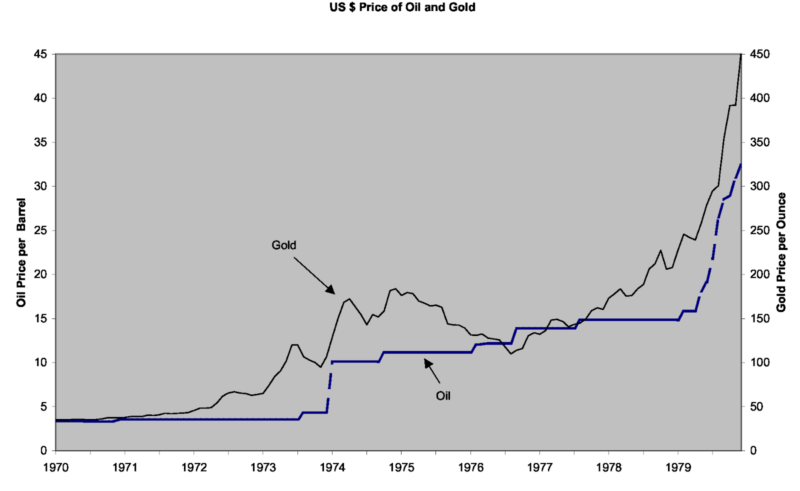
Behind the distractive smokescreen of price controls, President Nixon abandoned the Bretton Woods pledge to redeem official foreign holdings of dollars for gold, and levied a temporary 10% tariff. The dollar was first officially devalued against gold from $35 to $38 and then $42.22 an ounce in 1972, with that gold/dollar ratio later invited to sink (“float”) ceaselessly to $183 by the end of 1973 and $675 by September 1980. 

The Administration welcomed the closely related devaluation of the dollar against more stable currencies, arguing that a cheapened dollar would make U.S. goods more “competitive.” They imagined a feeble dollar would “improve” the real terms of trade (other countries would take more of our products in exchange for fewer of theirs). They did not foresee that deep devaluation would inflate dollar prices of both imports and exports.

In January 1971 a dollar would buy more than 3.6 German marks and 357 Japanese yen in January 1971, but by December 1979 a dollar was worth only 1.7 marks and 240 yen. 

Since internationally traded commodities are priced in dollars, the falling dollar made stockpiling metals, grains and oil appear cheaper to foreigners who bid their prices up in dollars. That demand-side effect inflated commodity prices so long as the dollar fell, which meant many years. But it also had a big supply-side impact on the sellers of commodities, because it encouraged suppliers of storable commodities such as oil and crude oil to withhold supplies until they got more dollars per barrel (or per ounce) to compensate for the dollar’s shrinking buying power. 

The first Graph “U.S. $ Price of Oil and Gold” is from a crucial 2003 study –”Black Gold: The End of Bretton Woods and the Oil Price Shocks of the 1970s“– by David Hammes and Douglas Wills, who persuasively argued that, “The conditions that brought about the demise of Bretton Woods also made the increases in the US dollar price of oil inevitable. Furthermore, the two dramatic US dollar price increases, in 1973 and then in 1979, only brought the ‘real’ or gold price of oil back within its historical range. 

As Boston Fed economist Michael Corbett explained, “The devaluation of the dollar that was experienced in the early 1970s was also a central factor in the price increases instituted by OPEC. Since the price of oil was quoted in dollar terms, the falling value of the dollar effectively decreased the revenues that OPEC nations were seeing from their oil. OPEC nations resorted to pricing their oil in terms of gold and not the dollar. Due to the ending of the Bretton Woods agreement, which had pegged gold to a price of $35, the price of gold rose to $455 an ounce by the end of the 1970s. This drastic change in the value of the dollar is an undeniably important factor in the oil price increases of the 1970s.”

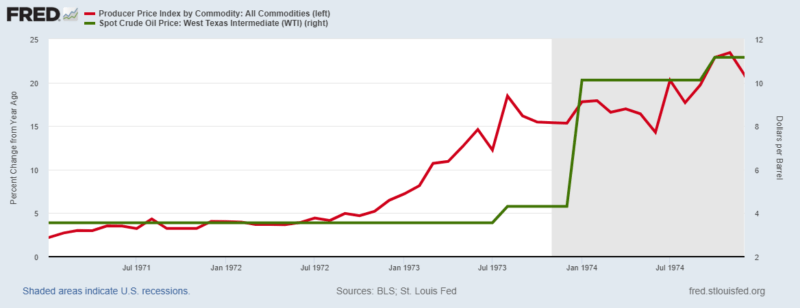
Many economic journalists and economists still try to excuse Presidents Nixon, Ford, and Carter for debasing the dollar with assistance from politicized Fed Chairmen like Arthur Burns. They try to blame a prolonged general inflation in the average of dollar prices on spurts in just one price – the price of crude oil. But the second graph clearly shows that most commodity prices (not just gold) began rising in late 1972 – long before sticky oil price contracts belatedly caught up. 


How could a U.S. President surrounded by ostensibly intelligent advisers end up debauching the dollar and trying to disguise the effects with wage and price controls? Most likely that happened because terrible theories encourage and excuse terrible policies. 

Determined to blame inflation on anything except fiscal or monetary policy, media pop stars like Rinfret and Galbraith fell back on primitive fallacies about most prices rising because some prices rose (cost-push), or because wages rose (wage-push), or because people simply expected most prices to rise and were somehow willing and able to keep paying more and more for everything without growing transfer payments and/or a reckless Fed giving everyone more and more money to spend. 

Even Fed Chairman Arthur Burns testified in June 1971 that because “a substantial increase of unemployment has failed to check the rapidity of wage advances. . . I have therefore come to believe that our Nation must supplement monetary and fiscal policy with specific policies to moderate wage and price increases.” If you don’t like the message the price system is sending, shoot the messenger. 

Herb Stein once confessed that before he came chairman of the Nixon’s CEA in 1972, he and other Nixon advisers simply bowed to Fed and media pressure to “do something,” even something stupid. The Council of Economic Advisers, he wrote, “found itself involved in helping devise measures that would meet the rising demand to do something— which meant incomes policy.” But by 1972, he lamented, “we were living in a new world of price and wage controls and a devalued dollar.” 

That poisonous policy stew was doomed to fail horribly. Artificially low prices boost demand and discourage supply, resulting in apparent shortages of everything but money. As Schuettinger and Butler documented, wage and price controls have been repeatedly inflicted for 4,000 years and always ended in disaster. 

President Nixon unleashed an inflationary hurricane in 1971 by letting the dollar collapse in terms of gold and relatively sound currencies. Inflation remained frighteningly high from 1973 to 1982, with unemployment often much higher than before the price control fiasco. The Fed put the Fed funds rate up from 9% in June 1980 to 19% in January 1981 when President Reagan took office. A 30-year mortgage rate topped 18.6% that October. It took until 1983 (when Reagan tax rate relief really started) to start getting things back to normal. 

Many costly tax and other economic policy mistakes were made in the seventies, but the worst problems of the 1973-82 stagflationary era by far were the legacy of terrible monetary and regulatory blunders made in 1971.

Alan Reynolds

Alan Reynolds

Economist Alan Reynolds is a senior fellow at the Cato Institute, and former vice president of the First National Bank of Chicago. He served as research director with Jack Kemp’s 1995-96 Tax Reform Commission, and with Larry Kudlow and Alan Greenspan as a member of President Reagan’s 1981 transition team. He is a former columnist with Forbes, Reason, and Creators Syndicate. He is also a past member of the Blue Chip and Wall Street Journal forecasters.

Author of the 2006 book Income and Wealth, Alan Reynolds has written for countless publications since 1971, including the Wall Street Journal, New York Times, Harvard Business Review, The Public Interest, National Review, Regulation and The Cato Journal.

Get notified of new articles from Alan Reynolds and AIER.


Wednesday, August 18, 2021

Beyond Bretton Woods: The Constitutional Questions on Money Need To Be Answered

Edwin Vieira, in Part Nine of Our Series, Says the ‘Silence Is Deafening’ 

Any close observer of contemporary discussions of monetary policy must become disheartened by the tendency to treat that subject as a matter of politics, economics, and social effects, with little to no consideration of its necessary foundation in monetary law — and, even more to the point, of the dependence of monetary law on the Constitution of the United States.

Yet it would seem axiomatic that, to be taken seriously, any monetary policy must be based upon the legally (rather than merely politically) correct answers to certain salient questions, such as:...........To Read More....


Friday, July 30, 2021

Beyond Bretton Woods -- A New Series in the Sun

Editorial of The New York Sun July 29, 2021

The New York Sun launches, with Judy Shelton's op-ed this evening, a series on the 50th anniversary of the collapse of the monetary system that had been established at Bretton Woods at the end of World War II. That system, centered on America's promise to redeem dollars presented to it by foreign governments at a 35th of an ounce of gold, was far from perfect. Yet its collapse, in the summer of 1971, opened up a new and far more dangerous moment -- the era of fiat money. 

We regard the drama of money without a definition in specie as among the most newsworthy stories of our time. This is not a view widely shared among the bien-pensant economists and politicians. It turns out that inflation has a vast constituency of those who count as a virtue fiat money’s ability to enable the expansion of government and the funding of the socialist state. All the more compelling is the current crisis. 

Our own introduction to this story began at a newspaper called the Berkshire Courier, in Great Barrington, Massachusetts, where we landed in the summer of 1965. One of our tasks was to operate the stapling machine in the job printing shop, where we bound the newsletter of one of the heroes of the struggle for honest money, Colonel E.C. Harwood of the American Institute for Economic Research. We became an avid reader. .........Continue Reading

Friday, September 4, 2020

Everything You Know About Global Order Is Wrong

If Western elites understood how the postwar liberal system was created, they'd think twice about asking for its renewal.

By January 30, 2019

Klaus Schwab, impresario of the World Economic Forum, released a manifesto in the run-up to this year’s annual meeting at Davos, Switzerland, in which he called for a contemporary equivalent to the postwar conferences that established the liberal international order. “After the Second World War, leaders from across the globe came together to design a new set of institutional structures to enable the post-war world to collaborate towards building a shared future,” he wrote. “The world has changed, and as a matter of urgency, we must undertake this process again.” Schwab went on to call for a new moment of collective design for globalization’s alleged fourth iteration (creatively labeled Globalization 4.0).

Schwab is not the first to make this kind of appeal. Since the financial crisis, there have been repeated calls for a “new Bretton Woods”—the conference in 1944 at which, in Schwab’s words, “leaders from across the globe came together to design” a financial system for the postwar era, establishing the International Monetary Fund (IMF) and the World Bank in the process. It was the moment at which U.S. hegemony proved its most comprehensive and enlightened by empowering economist-statesmen, foremost among them John Maynard Keynes, to lead the world out of the postwar ruins and the preceding decades of crisis. Under Washington’s wise leadership, even rancorous Europe moved toward peaceful and prosperous integration.......To Read More...

Sunday, October 13, 2019

Bretton Woods is Over

Today's Editon of Paradigms and Demographics is devoted to the Syrian "pullout". 

By Rich Kozlovich

Many of you will remember I've said over and over again that the Bretton Woods era is over.  Bretton Woods was the agreement made toward the end of WWII where America created the first hegemony in the world where the hegemony benefited more than did the hegemon, that being the United States. 

America met with nations and said after we won they were going to be broke and broken, so we would protect them, patrol the world's oceans against piracy and open our markets to them.

The cold war gave impitus to the idea of defending the world against communism.   We did it, we saved the world militarily and economically.  Communism failed in Russia and China, except we bailed out China with trade agreements that were based on Bretton Woods concepts. 

We opened our markets to them and gave them the financial success that fueled their military expansion, and their desire to control Asia and defeat the United States.   

Well, it's time we picked up our marbles and went home and worried more about  protecting our society, our culture, our economy and stop wasting American lives and dollars on fruitless military adventures that never end.  These Muslim cultures are never going to be stable, and they're never going to be reliable allies and they're always going to hate America, all the while smiling while picking our pockets.  That's Islam, get over it!

It's time for them to step up on their own hind legs and take care of themselves, and if they can't, or won't, then that's not our problem.  Our pull out of Syria is just another good example of our interfering in the Middle East quicksand that's a never ending story.  A story where we won't write the ending, and if we step in a make one side victorious, they'll turn on us as soon as they don't need us any longer, and that included the Kurds.

The reality is America is going to stop wasting American lives and American wealth for the dubious benefit of others.  If America does anything it will be because it directly benefits America. 

Trump gets it!  Bretton Woods is over!

Tuesday, July 30, 2019

The IMF’s Brexit Analysis: Predictably Shoddy and Politicized

July 28, 2019 by Dan Mitchell @ International Liberty
 
Back in 2016, I wrote “The Economic Case for Brexit.”

My argument was based on the fact the European Union was a slowly sinking ship, both because of grim demographics and bad public policy.


Getting in a lifeboat can be unnerving, but Brexit was – and still is – better than the alternative of continued E.U. membership.

But not everyone shared my perspective.

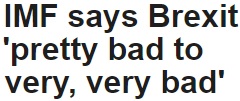
The BBC reported that year that Brexit would produce terrible consequences according to the International Monetary Fund.
Christine Lagarde said she had “not seen anything that’s positive” about Brexit and warned that it could “lead to a technical recession”. …The IMF said in a report on the UK economy that a leave vote could have a “negative and substantial effect”. It has previously said that such an outcome could lead to “severe regional and global damage”. The Fund said a Brexit vote would result in a “protracted period of heightened uncertainty” and could result in a sharp rise in interest rates, cause volatility on financial markets and damage London’s status as a global financial centre.
Yet none of these bad predictions were accurate.

Not right away and not in the three years since U.K. voters opted for independence.

Not that we should be surprised. The IMF has a very bad track record on economic forecasting. And the forecasts are probably especially inaccurate when the bureaucrats, given the organization’s statist bias, are trying to influence the outcome (the IMF was part of “Project Fear”).

But a history of bias and inaccuracy hasn’t stopped the IMF from continuing to interfere with British politics. Here are some excerpts from a story earlier this week.
Boris Johnson has been warned that a No Deal Brexit is one of the biggest risks facing the global economy. In a broadside against the new Prime Minister’s ‘do or die’ pledge to leave the European Union at the end of October with or without a deal, the International Monetary Fund said a chaotic departure could cause havoc across the world. …No Deal is one of the gravest threats to international economic performance, the IMF said. …Eurosceptics have long criticised the IMF for anti-Brexit rhetoric and it has been one of the loudest opponents of No Deal, saying in April that it could trigger a lengthy UK recession.
I was both disgusted and upset when I read this story.

I don’t like when the IMF subsidizes bad policy with bailouts, and I also don’t like when it promotes bad policy with analysis.

Fortunately, I don’t need to do any substantive number crunching because Professor Steve Hanke of Johns Hopkins University has a superb Forbes column on this exact issue.
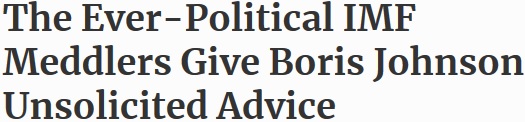
No sooner than Boris Johnson put his foot over the threshold of 10 Downing Street, the International Monetary Fund (IMF) offered its unsolicited advice… In a preemptive strike, the Philosopher Kings threw cold water on the idea of a no deal, asserting that it would be a disaster. …such meddling is nothing new for the IMF. Indeed, a bipartisan Congressional commission (The International Financial Advisory Commission, known as the Meltzer Commission) concluded in 2000 that the IMF interferes too much in the domestic politics of member countries.
Professor Hanke is perplexed that anyone would listen to IMF bureaucrats given their awful track record.
…the IMF’s ability to…thrive…is quite remarkable in light of the IMF’s performance.  
As Harvard University’s Robert Barro put it, the IMF reminds him of Ray Bradbury’s Fahrenheit 451 “in which the fire department’s mission is to start fires.” Barro’s basis for that conclusion is his own extensive research.   
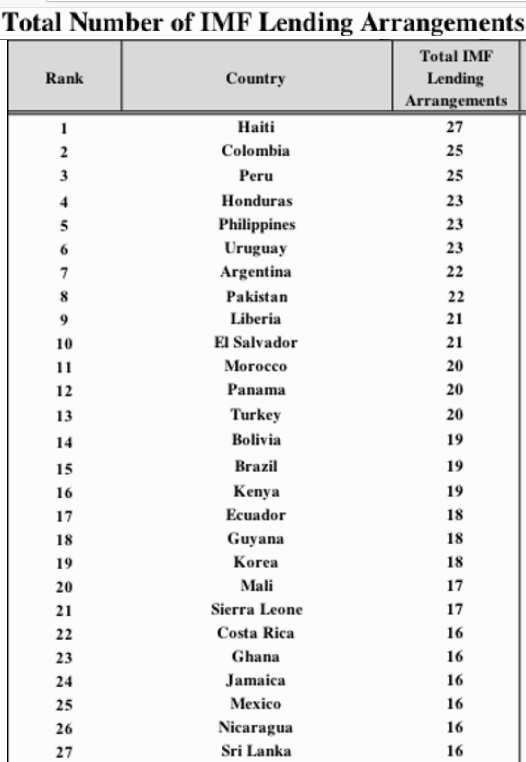
His damning evidence finds that: A higher IMF loan participation rate reduces economic growth. IMF lending lowers investment. A greater involvement in IMF programs lowers the level of the rule of law and democracy. And if that’s not bad enough, countries that participate in IMF programs tend to be recidivists. In short, IMF programs don’t provide cures, but create addicts.
This is why I’ve referred to the IMF as the “dumpster fire” of the world economy and also called the bureaucracy the “Dr. Kevorkian” of international economic policy.

By the way, here’s Professor Hanke’s table of the IMF’s main addicts.


I wrote just two weeks ago about the IMF’s multiple bailouts of Pakistan, the net effect of what have been to subsidize bigger government.

Let’s close with more of Professor Hanke’s analysis.

The original reason for its creation has completely vanished.
The IMF, which was born in 1944, was designed to provide short-term assistance on the cheap to countries whose currencies were pegged to the U.S. dollar via the Bretton Woods Agreement. …But, in 1971, when President Richard Nixon closed the gold window, the Bretton Woods exchange-rate system collapsed. And, with that, the IMF’s original purpose was swept into the dustbin. However, since then, the IMF has used every rationale under the sun to reinvent itself and expand its scope and scale. …And, in the process of acquiring more power, it has become more political.
Sadly, he is not optimistic about shutting down this destructive – and cossetted – bureaucracy.
The IMF should have been mothballed and put in a museum long ago. After all, its original function was buried in 1971, and its performance in its new endeavors has been less than stellar. But, a museum for the IMF is not in the cards. …About all we can do is realize that the IMF is a political hydra with an agenda to serve the wishes of the political elites who allow it to grow new heads.
P.S. Here’s my explanation of how the U.K. can prosper in a post-Brexit world.

P.P.S. Here’s some academic research explaining how E.U. membership has undermined prosperity for member nations.

P.P.P.S. If you want Brexit-related humor, click here and here.

Wednesday, June 26, 2019

Peter Zeihan on Geopolitics: The American Retreat, Part I: Oil

By Peter Zeihan @ Geopolitics

I’m going to do something I loathe and quote something I read on Twitter June 24. In a pair of posts U.S. President Donald Trump asserted:


Diction and statistical issues aside, these tweets comprise the 92 most important words used by anyone in the past three decades. Trump just made clear the days of America protecting global shipping – particularly of oil shipping in the Middle East – are over.

There is an easy argument to be made that the United States’ shale revolution will make the United States a net exporter of crude oil in the current calendar year, but to understand just how critical that is for the Americans we must first pick apart just how horrible that is for everyone else.

Let’s talk importance:

In the pre-Order world if you couldn’t obtain fossil fuels yourself, first coal and later oil, you failed to industrialize. Your manufacturing would at most be a step above cottage industries, so no mass education and no consumer goods (aka peasantry and mass poverty). Lack of fuel condemned you to having an at-best rudimentary transport system meaning your cities were very small, only able to exist in regions that could grow their own food (aka high living costs and low quality of life).

The handful of locations that could secure fossil fuels – either by producing it locally or by seizing it from others – could advance into something we today recognize to broadly mean “civilization,” which includes among other things homes that don’t leak and gadgets and full bellies.

This all changed in the late 1940s. After World War II the Americans created a global Order – a mix of security and trade guarantees which they used as a bribe to induce others to join their side in the Cold War against the Soviet Union. With global security now a thing, oil could be shipped safely and at volume without military escort, meaning that countries that didn’t have a military capable of escorting could now access fossil fuels. BAM! Civilization goes global.

Remove the Order, remove global oil markets, and civilization itself goes into screaming reverse in any location that lacks either the ability to produce oil locally, or the ability to venture forth and secure someone else’s.

Let’s talk vulnerability:

Crude tankers are huge. A modern supertanker can shuttle around oil weighing more than four Nimitz-class aircraft carriers. They are so big expressly because of the Order.

Pre-Order, merchant shipping used small, fast vessels because they needed to be able to scatter and hopefully outrun predators whether those predators wore eyepatches or naval uniforms. The Order ended such predation under the watchful eye of the U.S. Navy. Instead of commercial advantage coming as a result of speed and distributed risk, it instead came from efficiencies and economies of scale. Ships evolved to became slower to save on fuel costs, and bigger to get more bang for the buck. Today’s oil tankers are the slowest and biggest of them all and are nearly 50 times the size of some of the biggest cargo ships of the WWII era.

A similar logic holds with ports: size generates economies of scale. In addition, as ships have gotten larger, ports had to expand to match – a city with a small dock simply cannot handle a ship that is longer than the Empire State building is tall. Bigger, slower ships forced fewer, larger ports. Disrupt anything within the system and the damage quickly becomes extreme.

Between oil’s criticality to and ubiquitousness in modern life, oil is by far the most commonly traded product on Earth comprising some 18% of all maritime shipping traffic (by volume). About a third of all waterborne crude and product shipments originate in the Persian Gulf.

Let’s talk stickiness:

There are no shortages of politicians out there who agitate for relocating manufacturing capacity to their countries, provinces or cities. Making a speech is one thing, but actually building industrial plant and infrastructure is another. It costs billions and takes years for large industrial shifts, and even then there is no guarantee that a new industrial park will prove economically viable.

But at least manufacturing can be relocated. Commodity production cannot. Either you have it or you don’t, and the Persian Gulf has the greatest concentrations and volumes of easily-produced conventional crude oil on the planet. It can never not matter.

There’s also the impossibility of substitution.

Simply put, greentech isn’t ready. Most advances in greentech have to do with electricity generation, and since so few countries burn oil for electricity greentech’s impact upon oil markets has been negligible. As a rule greentech is shit for transport. High cost combined with insufficient energy density makes electric cars little more than a niche sector for early adopters, with Tesla’s recent sales figures crash indicating that market may already be saturated.

Even if the medium for most modern batteries – lithium – was sufficiently energy-dense to provide a viable long-term improvement in capacity (it isn’t), the stuff still needs to be mined and processed and fabricated into battery assemblies. Each step along the value-chain is so energy- and transport-intensive that very little of it can even be attempted without fossil-fuel-based energy for processing and transport across the world. As counterintuitive as it sounds, we need more carbon-heavy fuels to get to a lighter-carbon world. And that means coal and oil. A lot of oil.

There’s also the issue of lifespan. Most vehicles put on the roads since 1990 have a long lifespan to the point that even if every passenger vehicle sold from now on was an EV, we’d not see an end to oil in passenger transport for another two decades. Even then, even if every passenger vehicle and light truck were an EV right now, that would only make a dent in global oil demand. About 2/5ths of oil is used for transporting people and heating. The rest is much more difficult to do away with. Another 1/3rd is used for air transport, industry, and other modes that require far more range or power than electric engines can manage. And another 1/5th isn’t going anywhere ever, as it is what makes petrochemicals as varied as paints, plastics and pesticides possible.

(None of which means greentech won’t eventually solve the petroleum problem, but all of which means technology needs another couple decades to give it a go – and even that assumes the capital and educational structures around the world which have made the Digital Revolution possible hold steady at their current historical highs.)

Let’s talk protection:


At the end of World War II every nation of consequence aside from the United Kingdom had lost its navy. The United States in essence inherited the global ocean. America’s creation of the Order gave everyone aside from the Soviets a vested economic interest in not floating a new one. Fast forward to today and the American Navy is over ten times as powerful as the combined blue water fleets of every other country combined. Putting that force disconnect at the service of the global commons is what makes the Order work, and what makes global energy shipments and markets possible.

The world’s second- through sixth-most powerful navies in terms of long-range power projection are (roughly in order) Japan, the United Kingdom, France, China, and Russia. Of these only Russia need not sail forth for oil, as it has plenty of its own. France and the United Kingdom can secure what they need from the North Sea and North and West Africa. China has only 30  combat-capable surface ships of size that can effectively operate over 1000 miles from shore; unfortunately (for the Chinese) Southern China is a cool 5800 or so miles distant from the Persian Gulf. Only India – keeper of the world’s seventh-strongest navy – is even remotely proximate.

End result? Today’s oil markets comprise the greatest concentration of risk in the most critical economic sector at the most vulnerable part of the global system and no one can do anything about it if the Americans leave.

And that’s just the beginning.

By the way, for more on oil’s role in a world without American strategic oversight, I’m happy to refer you to my 2016 book, The Absent Superpower: the Shale Revolution and a World Without America. 


BOOK PETER FOR YOUR NEXT EVENT
BUY A SIGNED COPY OF THE ABSENT SUPERPOWER

Monday, December 24, 2018

Trump Decided To Withdraw From Syria After Stumping John Bolton With One Question

December 24, 2018 Scott Morefield

President Donald Trump reportedly stumped nationwide safety adviser John Bolton with one essential query earlier than making his heavily-criticized resolution to withdraw U.S. forces from Syria. The president agreed to the withdrawal throughout a December 14 cellphone name with Turkish President Recep Tayyip Erdogan, two officers informed NBC Information, however the authentic objective of the decision had been “for Trump to inform Erdogan to again off” threats to assault American supported Kurdish rebels, NBC reported.

However Trump went off-script in the course of the name and agreed with Erdogan, significantly when the Turkish president requested Trump, “Why are you continue to there?” when the Islamic State had been 99 % defeated………The president’s resolution to withdraw U.S. forces from Syria and Afghanistan has been roundly criticized by neoconservative politicians, navy brass, and even Democrats usually against struggle however desirous to discover a level with which to hammer the president. Nonetheless, it does symbolize Trump’s want to maintain a key marketing campaign promise, and has not been without its defenders, together with Kentucky Senator Rand Paul.

“One international coverage blunder after one other in Iraq and Afghanistan and Libya hasn’t labored out for our nationwide curiosity.”.............. “And let’s speak about Syria,” he added. “Let’s speak concerning the truth — ISIS is the enemy of Russia. ISIS is the enemy of Assad. ISIS is the enemy of Turkey."

"Are we supposed to remain in Syria for era after era, spilling American blood to combat the enemies of all these nations? Wolf, when did the American individuals signal as much as be in each struggle in each place in each facet of each battle throughout planet earth?”…………To Read More…

My Take - "Wolf, when did the American people sign up to be in every war in every place in every side of every conflict all over planet earth?”

July 1944 at Bretton Woods, and although that agreement officially ended in the 50's the concept has continued ever since and was the foundational concept for the IMF and the United Nations, all of which followed after, all of which need to be scrapped. We're coming to the end of the Bretton Woods era, and all those who've benefited are upset. I like Bolton for the most part, but he still has one foot in the Bretton Woods pond. The Neo-con will either convert or be gone. And the problem with so many surrounding Trump is they don't want to convert, they want to convert Trump.

Comey, of all people, has said it must be a shock to Trump to have so many people working for him to leave on principle, talking about Mattis. No, I don't think it's a shock. It's a warm and fuzzy feeling to have them quit.

When Trump came into office, he had only those he brought in with him on his side, and some of them had to be purged. It's impossible to purge as many as need to be purged when you're view of how the world should work is so different from those around you, and I'm not meaning the Democrats. I hope more people leave as a matter of "principle."

All of those people are now clearly defining what the difference is between the Republican neo-cons and the Republican conservatives. That's been the biggest reason the Republicans are called the stupid party, the party rank and file (that basket full of deplorables) were being either lied to or at best misled.  John McCain, Flake, Corker, George Will, Bill Kristol, Krauthammer and a host of others were all part of that cabal.  That's going to change. As for how much?

We'll see!

Tuesday, September 4, 2018

Europe’s Quislings Unmasked

Europe’s resentment of its longtime defense provider leads it to appease Iran in the most cynical,
shameless manner.

Jed Babbin September 3, 2018

One of President Trump’s overlooked achievements is the unmasking of our false allies in Europe. The governing elite of Europe — the same people who lead the most powerful members of both the European Union and NATO — so intensely and personally dislike Trump they no longer pretend to respect his pro-American policies. Their rebellion against their obligations toward the Atlantic Alliance has reached a dangerous level.

On August 23, the European Commission — the EU’s ruling body — agreed to give Iran €18 million (about $20 million) in “development aid” as part of a larger grant totaling €50 million. The purpose? To offset the effects of Trump’s cancellation of Obama’s nuclear weapons deal with Iran (the “Joint Cooperative Plan of Action”).

The EU’s aid package won’t have its intended effect. It’s far too small to offset the enormous damage to Iran’s economy that our sanctions are accomplishing. Moreover, it is totally mis-directed. Iran’s economy is entirely controlled by the ayatollahs and Iran’s military. Whatever funds are sent in aid to any entity in Iran is under their control.

Earlier in August, the EU had passed what it called a “blocking statute,” which was supposed to prevent European companies from complying with the newly revived U.S. economic sanctions against Iran by requiring that they get the EU’s permission to do so. The “blocking statute” will have no effect because the EU’s companies, having to choose between trading with Iran and trading with the U.S., will have to choose the latter..........To Read More...

My Take - These "allies" have always been leaky vessels at best.  The Bretton Woods era is over and these Euro "allies" haven't quite caught on. In fact, it seems the only one who understands the ramifications of that is Donald Trump.   It's time to bring the boys home!

Tuesday, June 12, 2018

Peter Zeihan on Geopolitics


I Think They Get It Now, Part I

U.S. President Donald Trump made a… let’s call it a splash, at the G7 summit in Canada June 9. The G7 comprises the seven largest industrialized democracies – the United States, Canada, Japan, Germany, the United Kingdom, France and Italy – who also form the core of the entire American alliance network. Their leaders and finance ministers meet regularly to discuss challenges to the global order. Normally, the G7 is a bit of a lovefest with leaders agreeing to push this bit of financial stability or that bit of poverty reduction.

This time was different. The Trump administration is busy belittling and/or wrecking parts of the international order, and a mere week before the summit the United States levied steel and aluminum tariffs on nearly all the G7 members themselves. As such the summit was preceded and followed by quite aggressive statements out of most of the G7 members, most notably from Canada and France, about how American tariffs would not be allowed to stand in specific and a general dissatisfaction with the position of the White House on global affairs in general.

In essence, ahead of the summit the G7 leaders were showing concern that Trump’s rhetoric wasn’t simply rhetoric. And in the summit’s aftermath the emotion could best be summed up as defiant despair that Trump really, truly, means what he says.

I can see why they’re all pretty bummed.

The Americans created, supported, subsidized, and maintained the global order since the end of World War II. Under that order the industrialized world in general and the other G7 countries in specific have done very well for themselves, rebuilding after the war’s devastation in an environment of absolute physical security.

Maintaining a global order is far from “normal” when viewed from the long stretch of American history. In fact, it has only been the dominant strain since the end of World War II. Before that the United States had other foreign policy themes that competed for top billing.

In the post-revolutionary era it was all about standing up to the established European empires, with former imperial master Britain in general triggering a near-dehabilitating mix of obsessive paranoia and narcissistic fear.

The competing ideology back then was that the United States should be one of those imperial powers.

Theme1 nudged the Americans into the War of 1812, and led the Americans to encourage the independence of the European’s imperial colonies throughout the Western Hemisphere.

Theme2 birthed the Monroe Doctrine and set the Americans on their own pseudo-colonial drives.

But as the world – and America – changed, American foreign policy changed with it. The American Civil War and Reconstruction removed all appetite and bandwidth for meaningful foreign policy, triggering a shift to hard isolationism. Once the Americans finally had their (second) coming out party with the Spanish-American War in the 1890s, isolation gave way to a mercantile-driven dollar diplomacy where the Americans would fence off swathes of the world in a corporate-driven foreign policy designed to maximize American economic penetration. The Depression and World War I convinced Americans the world was no fun at all; isolationism came back into vogue.

The great upheavals of the World Wars left the US the pre-eminent power in every respect that matters. Over the course of fifty years, the Americans had gone from almost no navy, stealing Britain’s IP, and being a major global debtor to having the only navy, the technological edge, and to being an economic power on an unprecedented scale. The US had a choice: seek isolation once again and watch its only real competitor - the Soviets - slowly eat away at the periphery until they could challenge the US or find a way to take a ragtag group with long lists of mutual historical grievances a mile long and get them to work together. A real life Magnificent Seven.

The new idea was as straightforward as it was revolutionary: use America’s newfound and historically unprecedented economic power to pay all the previous competing powers of eras gone by to be on the same side. Any country that had any meaningful imperial presence could only do so if it also had a significant naval force. These empires’ clashes — over resources, populations and trade routes — were the root causes of nearly every significant military conflict of the entire industrial period, and they culminated into the First and Second World Wars.

In response, the Americans launched a broad system of what was collectively known as Bretton Woods, named after the location where the deals were first hammered out.

Bretton Woods provided global security for all the maritime and industrial powers, enabling all of them to access any resource anywhere at anytime safely, and then export finished goods to the American market. Bretton Woods puts all the world’s competing naval / maritime / trading powers on the same side by providing them with everything they had ever fought to attain. In exchange the Americans only demanded one thing: alliance against the Soviets.

All those purchased allies are all still powers of significance today, and it should come as no surprise that the most powerful of them now comprise the G7. All were represented at the G7 summit in Canada this past weekend.

The Bretton Woods strategy is notable in American diplomatic history in that it had no counterpoint. No other policy oscillated with it. Bretton Woods was both bipartisan and served as the norm for seven decades. But longevity and broad support are not the same thing as sustainability or permanence. The world is changed since the Cold War’s end, and now – belatedly and until now piecemeal – the Americans are finally changing with it. Trump’s foreign-policy beliefs are not a bug in the American system, they are a feature. Under Trump the Americans are firmly – finally – abandoning Bretton Woods, and in doing so flirting with all four of their pre-Bretton Woods foreign policies.

Trump’s hardball on NAFTA is most definitely neo-imperial. He is attempting nothing less than the forcible change of the economic structure of America’s neighbors to meet specific American structural needs. Also fitting the mold is Trump’s suggestion that Russia be re-admitted to the G7. In a post-Bretton Woods world Russia is less a foe to be contained as it is a potential partner to leverage against other competitors.

Trump’s position on Syria is flat out isolationist. As are many of his inklings on U.S. basing and strategic stances in Western Europe and East Asia. It isn’t as crazy as it sounds. Something that no one has ever been able to explain to me about American involvement in Syria is what-does-the-winner-get? And the idea that the Americans should defend the Europeans from Russia so that they can use Russian energy en masse has always been an awkward sale.

Trump’s pending trade war with China has overtones of the anti-British policies of America’s early decades. And there are more than mere echoes of the general anti-British paranoia in Trump’s overall feelings about foreigners whether they be Chinese, Mexican, Iranian or Arab.

Trump’s willingness to flirt with North Korea most certainly has a dollar diplomacy feel to it, and Trump has directed Commerce Secretary Wilbur Ross on a never-ending road-show for American goods… and linking potential sales to ongoing trade negotiations with, well, everyone.

Viewed through the prism of Bretton Woods all these goals and methods are inane. But viewed through the lens of anything other than the strategic environment for which Bretton Woods was designed, Bretton Woods itself is ridiculous.

It isn’t that these goals – or even methods – are good or bad. It is that they are different. It is that they better reflect America’s current situation than the Bretton Woods situation does. The Americans are done paying for alliance.

Courtesy of the G7 show this past Saturday, I think they get it now. I think America’s closest allies realize the shift in the White House is, indeed, real. I think they understand Trump is not bluffing. I think they’ve internalized that Trump’s rhetoric is the American position. I think they finally believe Bretton Woods will not magically regenerate when Trump is gone.

And that means it is high time for the allies to figure out where they fit into the scared new world that is tumbling open right in front of them.

In this series we will go through the other six members of the Group of Seven. These are the powers that the Americans co-opted to make the Bretton Woods system work. They are the countries with the greatest long-term potential to shape and re-shape their worlds. Many may be out of practice, but that is far from saying they are done with history.


BOOK PETER FOR YOUR NEXT EVENT
BUY A SIGNED COPY OF ABSENT SUPERPOWER
VISIT THE ARCHIVES TO RE-READ AND SHARE