Search This Blog

De Omnibus Dubitandum - Lux Veritas

Showing posts with label Hoover. Show all posts

Wednesday, November 20, 2024

Blame Washington for the Great Depression, Part II

November 19, 2024 by Dan Mitchell @ International Liberty

With regards to economic policy, Herbert Hoover and Franklin Roosevelt were two peas in a pod. They both responded to an economic downturn by dramatically expanding the size and scope of government. As a result of those mistakes, they turned a recession into the Great Depression.

But that statement doesn’t come close to capturing the terrible consequences of their statism. So I went to the Maddison database and created two charts that illustrate the utter failure of Hoover’s interventionism and FDR’s New Deal.

The first chart is very straightforward, showing that there was almost zero growth in per-capita GDP between 1929 and 1940.
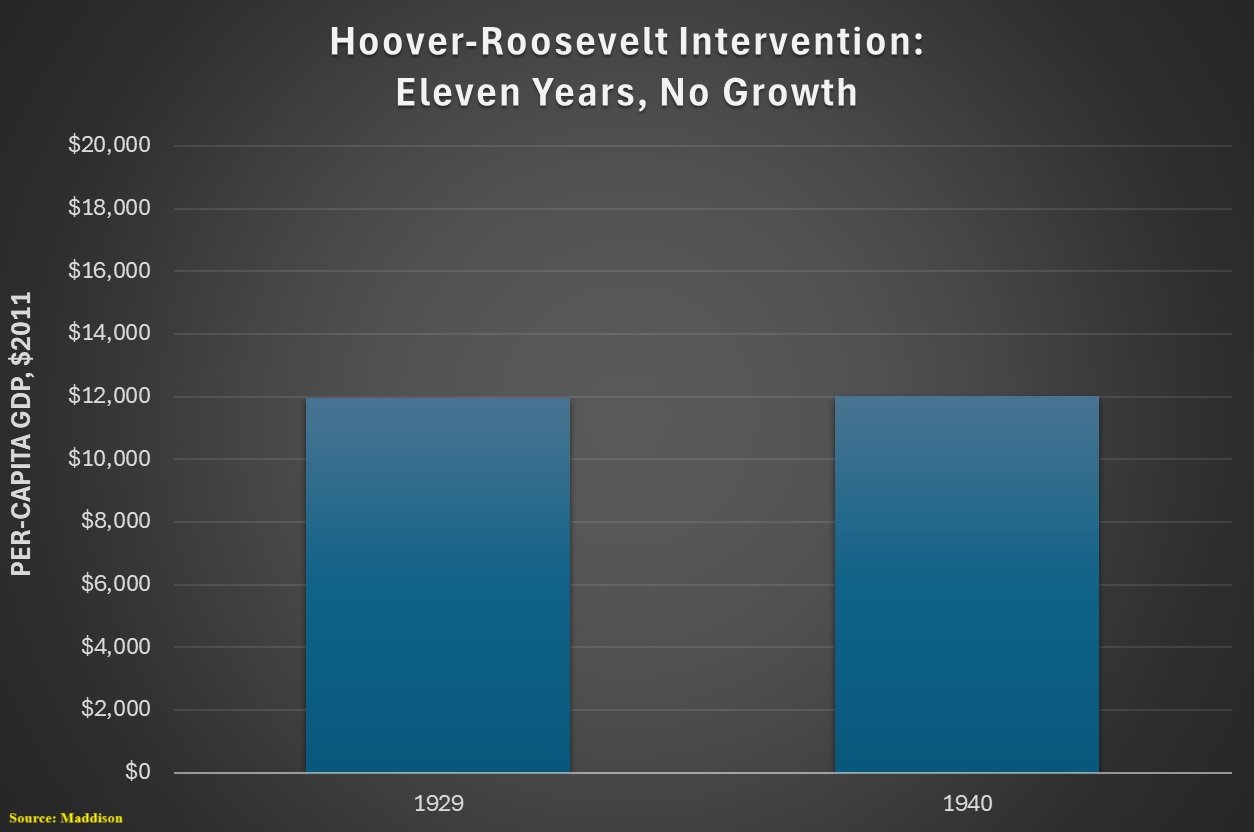
That’s a miserable performance, and it is also is a massive historical anomaly.

Here’s another chart comparing the 11-year change in per-capita GDP during the Hoover-Roosevelt era of statism with the average of every other 11-year period from the end of the Civil War until today.
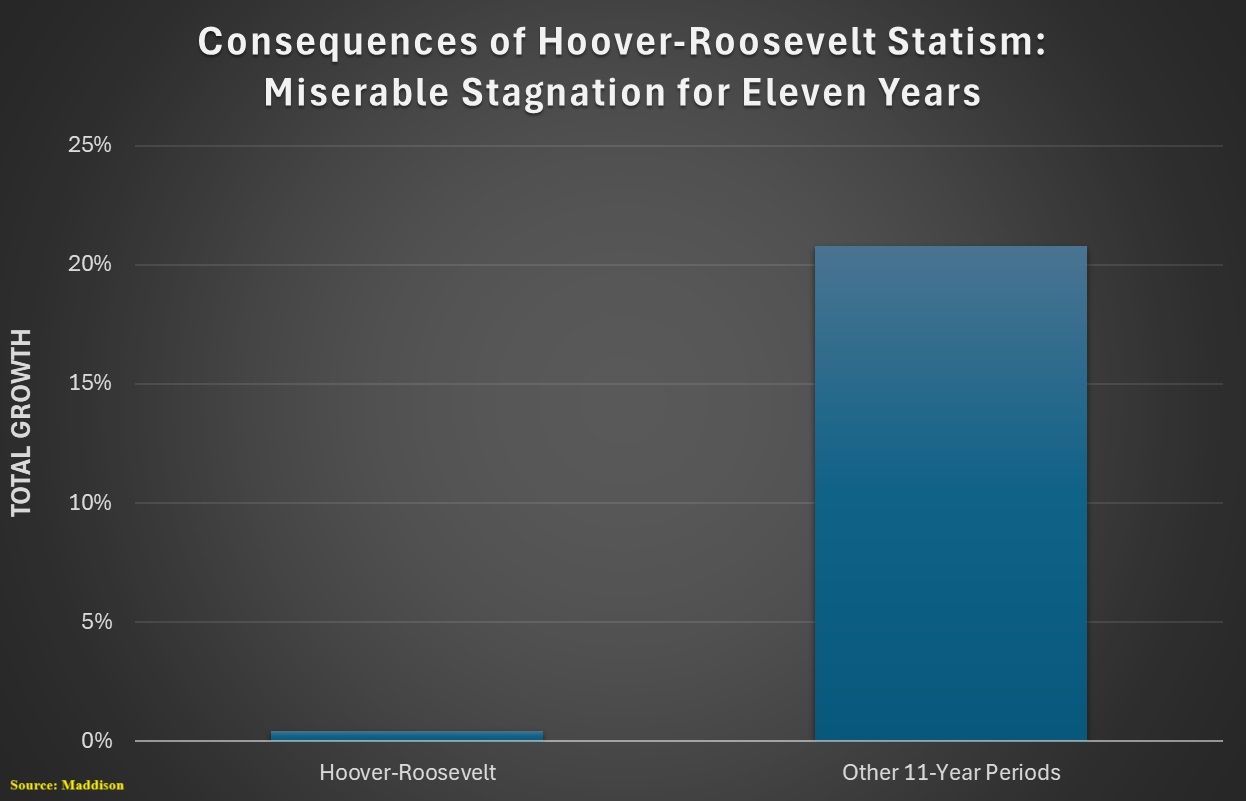
The bottom line is that there have been plenty of recessions in American history, but they usually have not lasted very long and they’ve been more than offset by periods of growth.
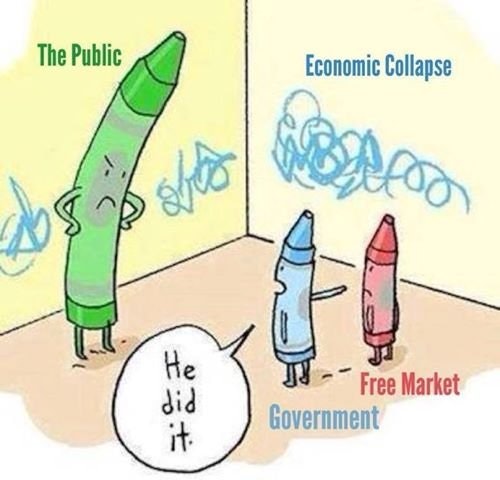
 

It was only when Hoover and Roosevelt delivered 11 years of statism that America suffered 11 years of stagnation. Let’s now augment GDP data with some analysis. In a column for Law & Liberty, Amity Shlaes wrote about how the Hoover-Roosevelt policies were a failure that deepened and lengthened the Great Depression.

If you’re in a rush, these excerpts summarize her findings.

…many historians have been unwilling to probe the effect of Roosevelt’s multi-year recovery program, the New Deal. …Why did recovery not return after five years, or after seven? …It was the duration that made the Depression great. …These days, politicians routinely invoke the New Deal as a model of inspiration…even though the New Deal never…“put America back to work.” …other factors, well documented by the extensive studies of the early years, exacerbated the subsequent downturn: the young Fed’s missteps, an international crisis, the collapse of vulnerable small banks across the land. …

Historian Robert Higgs has developed a useful thesis to explain this lost decade: “regime uncertainty,” the notion that an erratic, aggressive government can terrify businesses into slowdown. …the downturn after 1929 would not have become the Great Depression had Presidents Hoover and Roosevelt replayed the restrained federal policy of the early 1920s: reduce uncertainty and allow the market to take the lead.

She documents some of Hoover’s failures.

Congress passed, and President Herbert Hoover went along with, a damaging tariff, Smoot-Hawley. …Hoover, unlike Harding or his successor Calvin Coolidge, was inclined to action. …Hoover therefore turned to measures his “do less” predecessors would have eschewed. …

Hoover loaded burdens on business with a large tax hike, raising the top income tax rate to 63% from 25%. Even Hoover’s smaller interventions today look perverse: At a time when transactions were difficult, Hoover threw sand in the gears by introducing a tax on checks. …Hoover likewise tried to manage prices in another new area: labor. …Under a then-novel theory, higher wages would prompt recovery because they would invigorate workers and enable workers to spend more, stimulating the economy.

Amity then explains that Roosevelt delivered more of the same.

Like Hoover before him, …Roosevelt promised..new interventions. …With his New Deal, the President claimed that license. In the famous 100 Days, his first legislative drive, Roosevelt established dozens of large programs to oversee or alter virtually every sector of the economy. The National Recovery Administration, tasked with managing the industry, became the centerpiece of the New Deal. …

Under statutes bearing visible traces of Benito Mussolini’s syndicalism, the NRA assigned large firms and industry leaders, to draft codes to promote efficiency in their markets. These codes spelled out in magnificent detail right down to what price a cleaner might charge to press pants, or which chicken a butcher must kill first — every aspect of daily business. …the NRA’s corollary agency in agriculture, the Agricultural Adjustment Administration both forced and paid farmers to destroy their crops, again on the principle that less product would drive up prices. …Though Hoover had raised taxes, Roosevelt boosted them yet again, specifically targeting those who were most likely to create jobs through investment: top earners.

Amen. Amity is right (and historians are wrong) about the destructive policies of the 1930s.

P.S. Amity also includes some discussion of what happened during the “Forgotten Depression” shortly after the end of World War I. Harding did the opposite of Hoover and Roosevelt and got infinitely better results.

In the early 1920s, …Washington and the young Fed addressed a severe downturn by halving federal spending and raising interest rates. These moves would today be considered counterintuitive, to put it politely. …a new president, Warren Harding, sent a signal: there was no need for grand reform from the government, despite the downturn. …

Assailing the heavy burden of taxes postwar, Harding, once elected, made it clear to the public that he intended to reduce taxes wherever and whenever he could. Fewer burdens would free the private sector to pull the country forward. It did. Indeed, the economy recovered so rapidly that the early 1920s downturn is today known as The Forgotten Depression. Stock prices rose dramatically, more than tripling over the decade. Jobs materialized, and most importantly, the standard of living increased. Productivity gains meant the old six-day work week could drop to five days. That gave America a gift we still enjoy: Saturday.

P.P.S. Fortunately, FDR was not able implement his “Second Bill of Rights” or his proposal for a 100 percent tax rate.

P.P.P.S. Some claim that World War II spending shows that Keynesian economics can work, but proponents of that view have never been able to explain why the economy didn’t fall back into depression when the war ended.


Thursday, November 7, 2024

Tariffs: We Don't Need Them, They Need Us!

Trump gets that!

By Rich Kozlovich 

Dan Mitchell is a Libertarian and one of the economic wonks at the Cato Institute, which if you read his history, it's impressive.  Dan has allowed me to publish his work for a number of years, and he's prolific.  Having been heavily involved with economic policy in America he clearly understands the ins and outs of government economics, which is an unending slight of hand game. I like much of his work, so I publish his articles.... unless I don't agree with them.   

I know, I can hear it now.   Who does this bugman think he is to disagree with a man with Mitchell's vast experience and knowledge?  Well, I will admit, much of the economics I read makes my eyes roll up into the back of my head, and truth be told, I think economists make it that complicated deliberately.  

I've been a history buff and an avid reader for all of my life, and I have some qualities I think are important in order to understand anything.  First, life is all about patterns, and the patterns of life repeat over and over again.  The natural function of the human mind is to see those patterns, but that means striving to attain as much knowledge, on as many subjects as there are, filling your mind with a lot of seemingly extraneous information.  But as your doing this your mind will unconscionably be filing, collating, and correlating that information into useful patterns, ultimately giving you worthwhile insights.  

I see patterns more quickly than most and I see things farther, deeper, and wider than most, and the fact is, most economists have no idea what they're talking about.  Here are four of my commentaries dealing with economics, I especially like number four.

  1.  The E-Myth
  2.  What is the Proper Definition for "Opportunity Economics"? Capitalism! 
  3.  When An Accident is Waiting to Happen, It Eventually Does
  4.  Preconceptual Economics

His article goes on to offer five suggestions on how the GOP can fix government, and it's clear some of his suggestions are good ones, until he comes to number three, saying: 

I am terrified about the prospect of more protectionism. If Trump merely targeted China, it might be possible to justify his actions because of national security. But he wants to be “Tariff Man” for all cross-border commerce. Didn’t work for Hoover. Won’t work for Trump."

What he's citing is the Smoot/Hawley Tariff bill, and he's not alone in that, as John Hinderaker called Trump's efforts, Smoot-Hawley II saying:

I don’t suppose many people care, but Donald Trump’s latest venture into trade policy is idiotic. Trump’s tariff plan is so dumb that for once, the Washington Post is actually right: “Trump vows massive new tariffs if elected, risking global economic war.” ........ Protectionism has never been politically unpopular. Trump apparently is going for the lowest common denominator, appealing to the least informed voters. I guess we shouldn’t be surprised.

Why do I object to that? Because when Hoover signed the Smoot/Hawley Tariff bill in 1930 the world's economy was far different than today.   Entirely too many think in terms of the Smoot-Hawley tariff, which triggered a trade war that was an important instrument in starting the Great Depression, as the lesson we need to take seriously today.  Wrong!  

America's economy and the world’s economies in 1930 were far different then than now. We needed them and they needed us in proportion.   Now?   We don’t need them, they need us, and the point that we have a major trade deficit with these nations makes us stronger in such a battle is critical. If we stop buying their products they collapse.  

We have five criteria that makes us the winner in any trade war.   

  1. We can feed ourselves
  2. Fuel ourselves
  3. Arm ourselves
  4. Defend ourselves 
  5. We can create our own internal market.

We don't need them....they....need ...us!  

To save our allies after WWII, economically and militarily, we created the Bretton Woods hegemony, where we opened our markets to our allies and we protected them militarily since they were totally broke even before the war's end.  The only time in world history where a nation created an hegemony that was for the benefit of others.  As a result capitalism became redefined as meaning America would go on forever letting our trading partners impose tariffs and trade protections while not protecting American workers and our industrial base with tariffs.      

A philosophy that predicated one of the worst economic and political decisions ever made by a President of the United States, Nixon opening China up to world trade, and western civilization has been funding it's own destruction ever since. 

Those days are over!

One last point.  Dan admits Libertarians like him who are all in on open borders but have no idea what to do about the consequences of open borders.   in so many ways, and so very often, are just like economists.  They have no idea what they're talking about.  

Update, 10:55 AM:   This just appeared at American Thinker, Trump’s tariffs will contribute to the US economic boom, November 7, 2024 by Howard Richman,

U.S. stock markets anticipate Trump’s upcoming economic boom, but few economists realize that it will be partly due to his tariff plans.  Among those few are Peter Navarro, Trump’s adviser and author of 20 economics books; Art Laffer, America’s premier supply-side economist; and Oren Cass, author of several recent commentaries.

Trump’s tariffs (coupled with his reduction in the corporate income tax for American producers) would encourage businesses to build new factories in the United States.  In his commentary “Trump’s Most Misunderstood Policy Proposal,” Cass pointed out that Americans, not foreign workers, get the wages when products are produced in the United States.  He also pointed out that manufacturing drives long-term growth:.....