Search This Blog

De Omnibus Dubitandum - Lux Veritas

Showing posts with label Keynesian Economics. Show all posts

Monday, December 2, 2024

Understanding Consumer Spending and the Economy

November 30, 2024 by Dan Mitchell @ International Liberty

Almost exactly 14 years ago, the Center for Freedom and Prosperity released a video explaining why consumer spending does not drive the economy.

Here’s John Papola (a.k.a., Dad Saves America) with similar analysis.

Understanding this issue is not merely a matter of recognizing causality (in other words, a strong economy leads to more consumer spending, not the other way around).

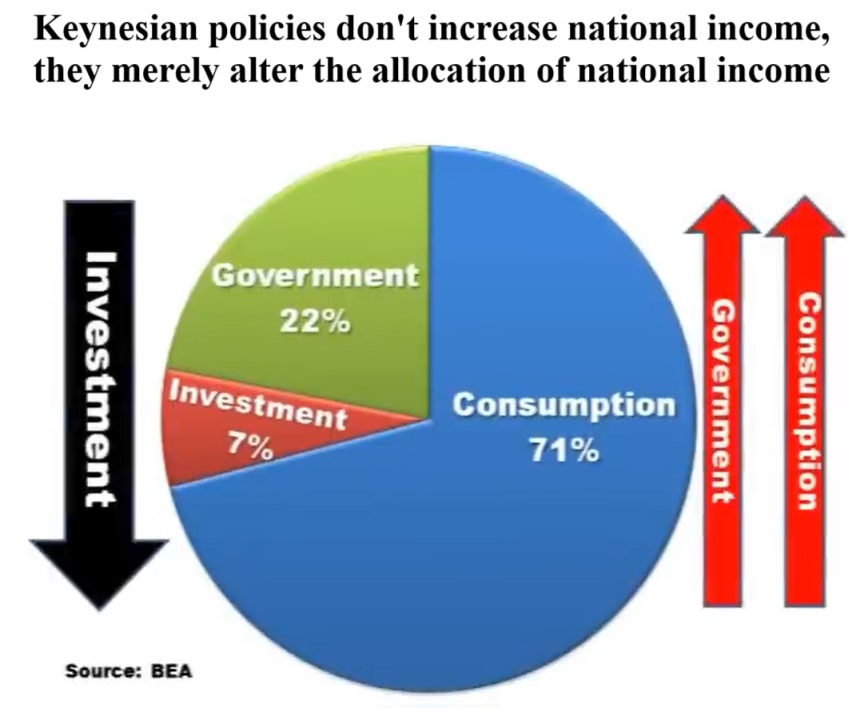
It also helps to understand why Keynesian economics is misguided. Simply stated, you don’t increase national income by having the government divert money from capital markets (investment) in order to artificially stimulate consumption (either directly or indirectly).


For those who want to get wonky, this is why the CF&P video explains the difference between gross domestic income (GDI) and gross domestic product (GDP).

Better policy is more likely if lawmakers focus on how national income is earned (GDI) rather than how it is allocated (GDP).

I’ll conclude by stating that it would be nice to debunk Keynesianism once and for all so that it doesn’t come back to life (like a monster in a horror film) whenever politicians are looking for an excuse to spend more money.

P.S. Since we’re now in the holiday shopping season, click here for John Papola’s economically themed Christmas carols.

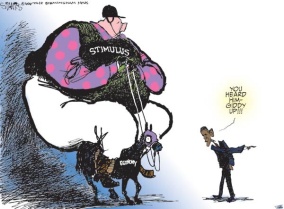
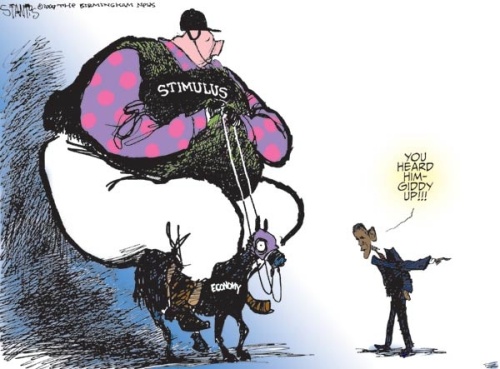
P.P.S. If you want to enjoy some cartoons about Keynesian economics, click here, here, here, and here. Here’s some clever mockery of Keynesianism. And, since I’m publicizing John’s excellent work, here’s the famous video showing the Keynes v. Hayek rap contest, followed by the equally enjoyable sequel, which features a boxing match between Keynes and Hayek.


Wednesday, November 20, 2024

Blame Washington for the Great Depression, Part II

November 19, 2024 by Dan Mitchell @ International Liberty

With regards to economic policy, Herbert Hoover and Franklin Roosevelt were two peas in a pod. They both responded to an economic downturn by dramatically expanding the size and scope of government. As a result of those mistakes, they turned a recession into the Great Depression.

But that statement doesn’t come close to capturing the terrible consequences of their statism. So I went to the Maddison database and created two charts that illustrate the utter failure of Hoover’s interventionism and FDR’s New Deal.

The first chart is very straightforward, showing that there was almost zero growth in per-capita GDP between 1929 and 1940.
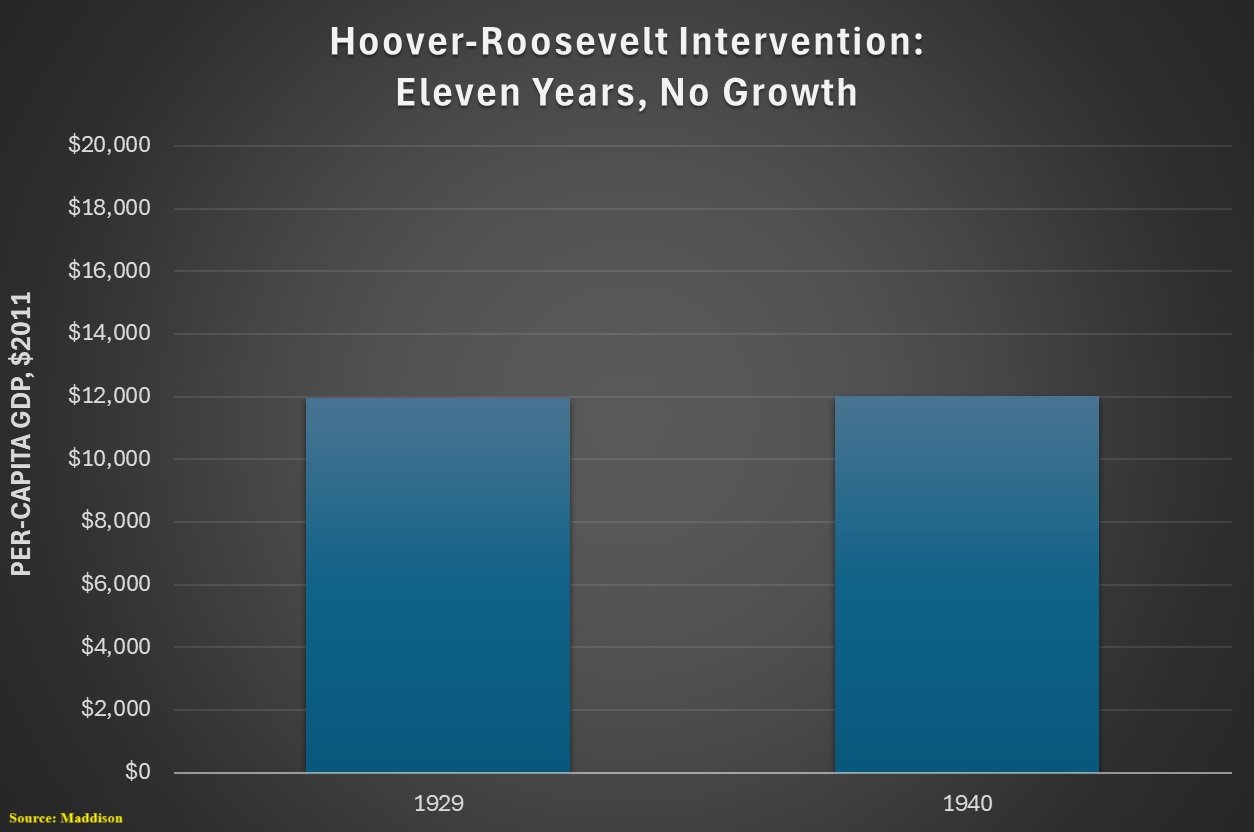
That’s a miserable performance, and it is also is a massive historical anomaly.

Here’s another chart comparing the 11-year change in per-capita GDP during the Hoover-Roosevelt era of statism with the average of every other 11-year period from the end of the Civil War until today.
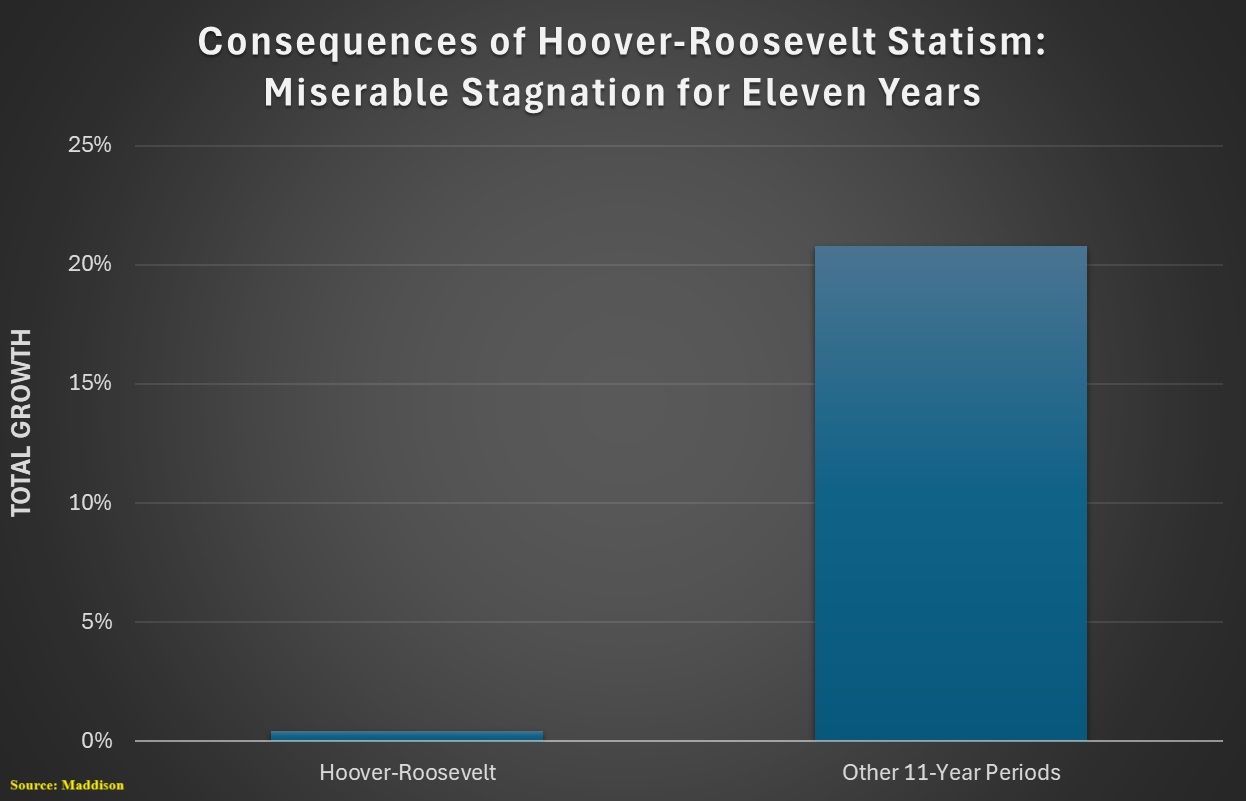
The bottom line is that there have been plenty of recessions in American history, but they usually have not lasted very long and they’ve been more than offset by periods of growth.
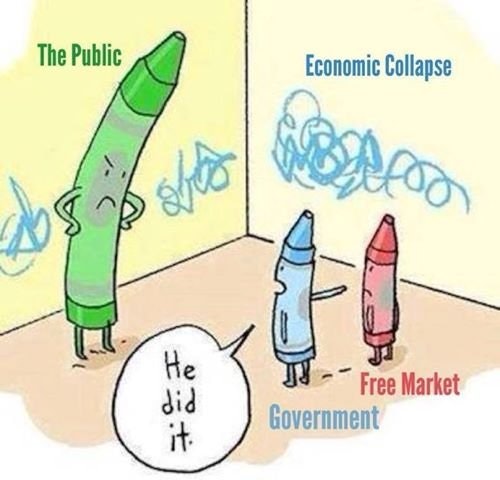
 

It was only when Hoover and Roosevelt delivered 11 years of statism that America suffered 11 years of stagnation. Let’s now augment GDP data with some analysis. In a column for Law & Liberty, Amity Shlaes wrote about how the Hoover-Roosevelt policies were a failure that deepened and lengthened the Great Depression.

If you’re in a rush, these excerpts summarize her findings.

…many historians have been unwilling to probe the effect of Roosevelt’s multi-year recovery program, the New Deal. …Why did recovery not return after five years, or after seven? …It was the duration that made the Depression great. …These days, politicians routinely invoke the New Deal as a model of inspiration…even though the New Deal never…“put America back to work.” …other factors, well documented by the extensive studies of the early years, exacerbated the subsequent downturn: the young Fed’s missteps, an international crisis, the collapse of vulnerable small banks across the land. …

Historian Robert Higgs has developed a useful thesis to explain this lost decade: “regime uncertainty,” the notion that an erratic, aggressive government can terrify businesses into slowdown. …the downturn after 1929 would not have become the Great Depression had Presidents Hoover and Roosevelt replayed the restrained federal policy of the early 1920s: reduce uncertainty and allow the market to take the lead.

She documents some of Hoover’s failures.

Congress passed, and President Herbert Hoover went along with, a damaging tariff, Smoot-Hawley. …Hoover, unlike Harding or his successor Calvin Coolidge, was inclined to action. …Hoover therefore turned to measures his “do less” predecessors would have eschewed. …

Hoover loaded burdens on business with a large tax hike, raising the top income tax rate to 63% from 25%. Even Hoover’s smaller interventions today look perverse: At a time when transactions were difficult, Hoover threw sand in the gears by introducing a tax on checks. …Hoover likewise tried to manage prices in another new area: labor. …Under a then-novel theory, higher wages would prompt recovery because they would invigorate workers and enable workers to spend more, stimulating the economy.

Amity then explains that Roosevelt delivered more of the same.

Like Hoover before him, …Roosevelt promised..new interventions. …With his New Deal, the President claimed that license. In the famous 100 Days, his first legislative drive, Roosevelt established dozens of large programs to oversee or alter virtually every sector of the economy. The National Recovery Administration, tasked with managing the industry, became the centerpiece of the New Deal. …

Under statutes bearing visible traces of Benito Mussolini’s syndicalism, the NRA assigned large firms and industry leaders, to draft codes to promote efficiency in their markets. These codes spelled out in magnificent detail right down to what price a cleaner might charge to press pants, or which chicken a butcher must kill first — every aspect of daily business. …the NRA’s corollary agency in agriculture, the Agricultural Adjustment Administration both forced and paid farmers to destroy their crops, again on the principle that less product would drive up prices. …Though Hoover had raised taxes, Roosevelt boosted them yet again, specifically targeting those who were most likely to create jobs through investment: top earners.

Amen. Amity is right (and historians are wrong) about the destructive policies of the 1930s.

P.S. Amity also includes some discussion of what happened during the “Forgotten Depression” shortly after the end of World War I. Harding did the opposite of Hoover and Roosevelt and got infinitely better results.

In the early 1920s, …Washington and the young Fed addressed a severe downturn by halving federal spending and raising interest rates. These moves would today be considered counterintuitive, to put it politely. …a new president, Warren Harding, sent a signal: there was no need for grand reform from the government, despite the downturn. …

Assailing the heavy burden of taxes postwar, Harding, once elected, made it clear to the public that he intended to reduce taxes wherever and whenever he could. Fewer burdens would free the private sector to pull the country forward. It did. Indeed, the economy recovered so rapidly that the early 1920s downturn is today known as The Forgotten Depression. Stock prices rose dramatically, more than tripling over the decade. Jobs materialized, and most importantly, the standard of living increased. Productivity gains meant the old six-day work week could drop to five days. That gave America a gift we still enjoy: Saturday.

P.P.S. Fortunately, FDR was not able implement his “Second Bill of Rights” or his proposal for a 100 percent tax rate.

P.P.P.S. Some claim that World War II spending shows that Keynesian economics can work, but proponents of that view have never been able to explain why the economy didn’t fall back into depression when the war ended.



Saturday, August 31, 2024

The Economic Damage of the New Deal and the Progressive Era

August 27, 2024 by Dan Mitchell @ International Liberty

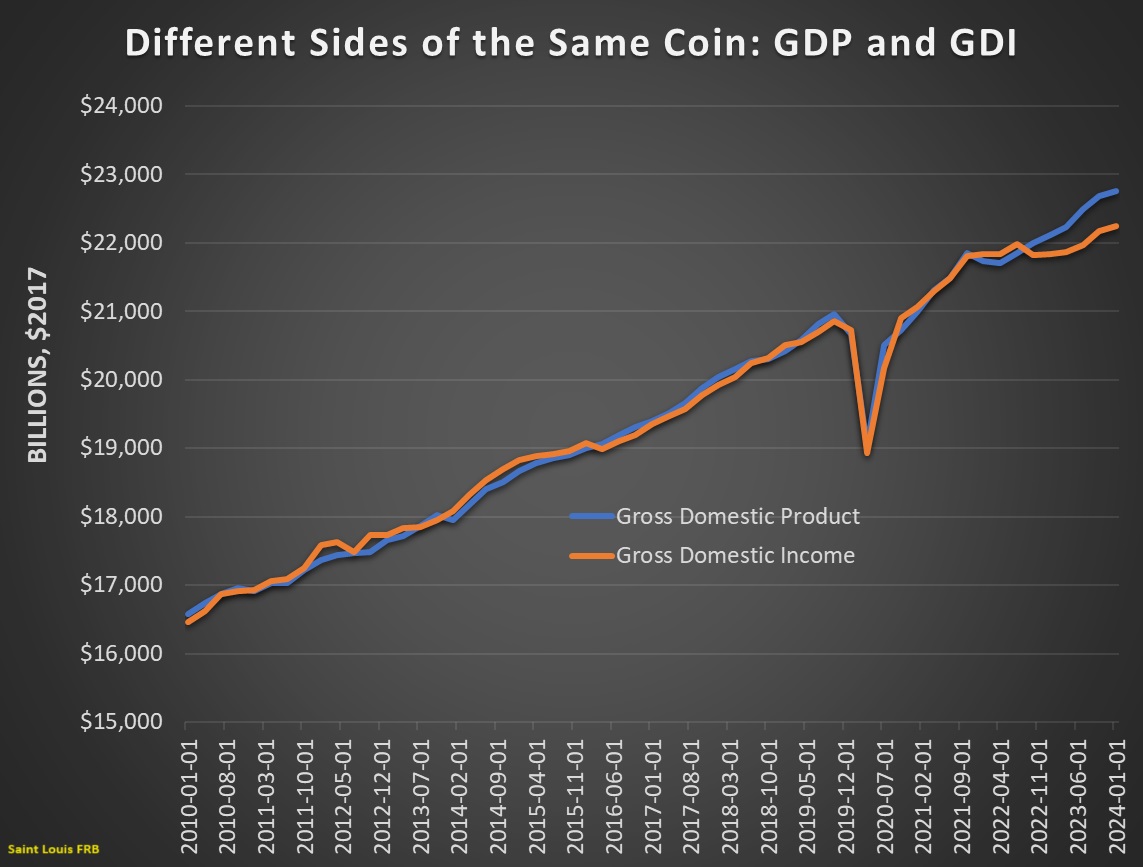
I periodically write wonky columns explaining that gross domestic income (GDI) is a better measure than gross domestic product (GDP) because it is more useful to focus on how income is earned rather than how it is allocated.


There’s not a meaningful difference between GDP numbers and GDI numbers, as illustrated by the chart. But that’s hardly a surprise because they are basically different ways of measuring the same thing.

That being said, understanding the distinction between GDI and GDP is especially useful when debunking Keynesian economics (Keynesians think increasing government spending boosts national income, which is just as illogical as thinking that spending more at the local bar increases household income).

While GDI is better than GDP for those who want to understand the shortcomings of Keynesianism, it is not a perfect measure.

The salaries and benefits of government bureaucrats are part of the equation, for instance, even though such expenditures probably detract from national prosperity.

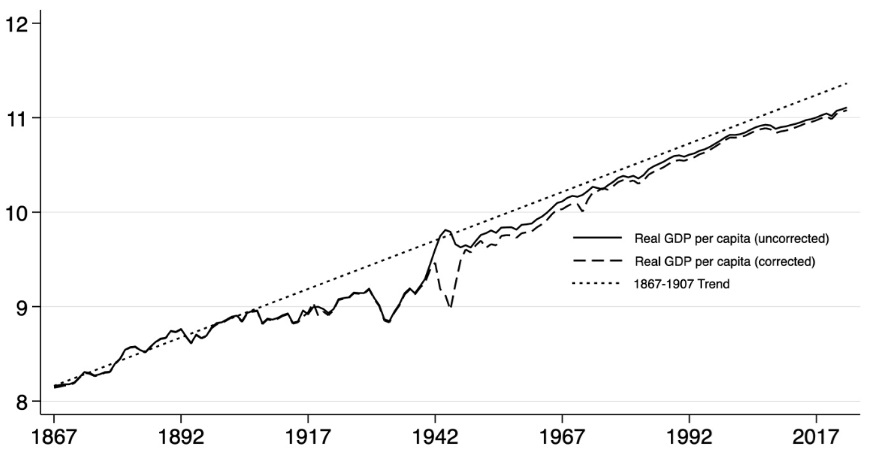
So I was very interested to see some new research, authored by Professors Vincent Geloso and Chandler Reilly, that looks at economic history using an improved measure of economic output. Here is their explanation of the methodology.

Traditionally, GDP and GNP calculations assume that market prices accurately reflect the value of all goods and services produced. However, this assumption fails when it comes to government services. Government goods and services are rarely directly priced in markets. Instead, their value is often estimated as the sum of spending on public sector salaries and government purchases of goods and services (e.g., computers, furniture, public office workers, etc.). This method is problematic because a hypothetical government worker hired to “do nothing” ends up being considered as producing “something”. …we revised national accounts for the United States from 1790 to today by correcting price indexes in war and removing military outlays. The goal was to arrive at a truer measure of living standards.

And here are some of their results.

Our corrections suggest that the period from 1867 to 1907, the U.S. economy experienced incredibly fast growth, with per capita income rising by an average of 2.1% to 2.5% annually… for the period from 1907 to 1948, our adjustments indicate that the economy experienced repeated severe contractions.

For example, uncorrected statistics suggest that living standards increased massively during World War I and World War II. Our revisions, however, suggest they fell moderately during World War I and significantly during World War II. …lthough the economy did begin to enjoy fast growth rates after 1947—comparable to the pre-1907 period—it did not return to the previous trend “path.”  …The permanent setbacks during the interceding four decades led to a long-term reduction in living standards, relative to what would have been achieved had the pre-1907 growth path continued.

This finding suggests that the period from 1907 to 1947, which encompasses the Progressive and New Deal era, represents a “great deviation” from America’s economic potential. …The Progressive and New Deal eras, with their emphasis on government intervention and regulation, set the stage for this permanent deviation.

The authors include this chart, which shows that growth suffered beginning with the so-called Progressive Era.

Sub-par economic performance also characterized the Great Depression and World War II, with the economy finally getting back to normal growth afterwards (but never returning to the long-run trend).

Give the bad policies of the Progressive Era (including income tax, central bank, antitrust) and Woodrow Wilson, I’m not surprised that growth slowed down, especially when you add the resource misallocation of World War I.

And Hoover and Roosevelt were very bad as well, so their policies also hurt the economy, as did the resource misallocation associated with World War II.

I’ll close by noting that growth sort of returned to normal after World War II because bad policies in some areas were offset (and perhaps then some) by good policies in other areas.

P.S. Looking at the chart, it is worrisome that economic performance has tailed off in recent years. I hope that is just a statistical blip, but I worry that all the bad policies this century (Bush, Obama, Trump, and Biden) are having a cumulatively bad effect.

Monday, July 29, 2024

Journalism + Keynesian Economics = Media Malpractice

July 28, 2024 by Dan Mitchell @ International Liberty

He’s only been in office since late last year, but President Javier Milei of Argentina is doing an amazing job, dramatically reducing inflation in a very short time.

And he’s also significantly reduced the burden of government spending, leading to the nation’s first balanced budget in a long time.

Unsurprisingly, Argentina’s economy is beginning to recover and the currency has strengthened.

In other words, good policy is paying dividends.

Though it’s worth noting that some people are surprised by this outcome.

Here are some excerpts from a Bloomberg report by Manuela Tobias.


Argentina’s economy recorded its best month in May since President Javier Milei took office late last year… Economic activity rose 1.3% from April, above the 0.1% median estimate from analysts in a Bloomberg survey and the first month of growth since Milei’s term began in December. From a year ago, the proxy for gross domestic product grew 2.3%, defying expectations for a decline of similar magnitude… Milei has implemented drastic spending cuts that have helped cool monthly inflation to 4.6% in June from a three decade high of 25.5% at the end of 2023.

While the article is reasonable, notice the headline. It acknowledges that Milei’s policies are producing good outcomes, but we’re supposed to believe those good results are happening “despite cuts” to government.

I don’t know if the reporter deserves the blame (after all, editors sometimes are in charge of headlines), but Keynesian economics deserves the blame for this example of media bias.

Keynesians, after all, think government spending is pro-growth even thought that approach has never worked in the real world. It didn’t work for Hoover or FDR. It didn’t work for Japan. It didn’t work for Obama.

But apparently this misguided theory is still being taught in journalism schools. Maybe the reporter and/or editor can sue for education malpractice?

I already stated that sensible people have not been surprised  about Argentina’s economic renaissance. That’s because we’ve repeatedly seen evidence that Keynesians are wrong about the consequences of spending restraint.

  • They were wrong about growth after World War II (and would have been wrong, if they were around at the time, about growth when Harding slashed spending in the early 1920s).
  • They were wrong about Thatcher in the 1980s.
  • They were wrong about Reagan in the 1980s.
  • They were wrong about Canada in the 1990s.
  • They were wrong after the sequester in 2013.
  • They were wrong about unemployment benefits in 2020.

P.S. Since today’s column is about Keynesian economics, click here, here, and here for some amusing cartoons. Here’s some clever mockery of Keynesianism. And here’s the famous video showing the Keynes v. Hayek rap contest, followed by the equally enjoyable sequel, which features a boxing match between Keynes and Hayek. And even though it’s not the right time of year, here’s the satirical commercial for Keynesian Christmas carols.


Tuesday, September 26, 2023

Keynesian Economics and Transitory, Beggar-Thy-Neighbor Stimulus

April 4, 2018 by Dan Mitchell @ International Liberty
 
When I give speeches on Keynesian economics, I usually begin with a theoretical discussion on why consumer spending is a consequence of growth rather than the cause of growth.

I then focus on two reasons to be skeptical about borrow-and-spend schemes to artificially boost growth.
  • In the short run, it makes no sense to “stimulate” an economy by borrowing from one group of people and giving the money to another group of people. It’s like trying to become richer by taking money out of your left pocket and putting it in your right pocket.
  • In the long run, so-called stimulus creates a ratchet effect for larger government since politicians rarely obey Keynes’ admonition to cut back on government spending and run surpluses when the economy is in an expansion phase.
But I oftentimes include a caveat when discussing the first point.

It is possible, I hypothesize, to increase your short-run consumption if you take money out of a foreigner’s left pocket and put it in your right pocket.

I hasten to add that this is probably not be a wise course of action since the money may be squandered and you simply wind up further in debt, but I admit that the short-run consumption data will be better.

Well, there’s a new academic study on exactly this issue from the European Stability Mechanism (sort of an IMF for eurozone countries).

Here’s what the authors decided to investigate.
In this paper, we argue that there is a natural and largely unexplored connection between fiscal multipliers and the foreign holdings of public debt. The intuition is simple….fiscal expansions can…have crowding-out effects on the domestic private sector. Probably the most important among the latter is that the resources used by the domestic private sector to acquire public debt can detract from consumption and investment. This implies that the crowding-out effect of fiscal expansions is likely to be stronger when they are financed by selling public debt to domestic (as opposed to foreign) residents.
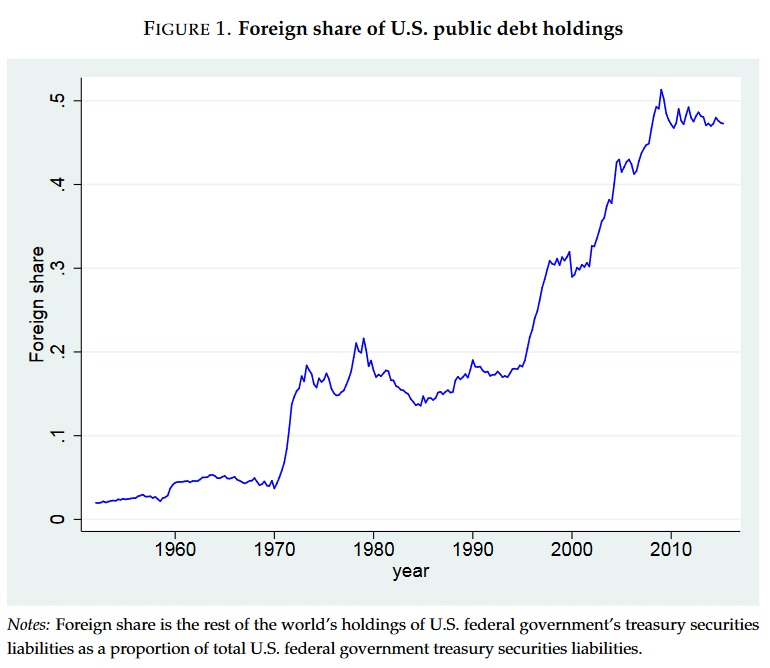
Here’s some of the data on foreign holdings of national debt.
Our data on foreign holdings of public debt reveals interesting patterns. First of all, there is significant variation across countries: in some countries, such as Canada and Japan, the share of public debt held by foreigners is consistently low, whereas in others, such as Finland and Austria, foreigners hold more than 75% of public debt towards the end of the sample. Over time, in line with the rise of financial globalization, the general pattern is one of increasing public debt in the hands of foreigners. In the United States, for instance, the share of public debt held by foreigners has increased from less than 5% in the 1950s to close to 50% today.
And here’s a chart from the study showing how foreign holdings of U.S. government debt have increased over time.


And their conclusions, after crunching all the numbers, is that nations can boost short-run consumption if a significant share of new debt is financed by foreigners.
Our main result is that, consistent with the previous argument, the estimated size of fiscal multipliers is increasing in the share of public debt that is in the hands of foreigners. This result holds both for the United States during the postwar period, and for a panel of advanced (OECD) economies over the last few decades. …We find that the average foreign share, i.e., the share of public debt held by foreigners before a fiscal shock, …reflect capital inflows, which help finance fiscal expansions thereby minimizing their crowding-out effects on domestic investment.
Incidentally, the authors acknowledge that this creates a beggar-thy-neighbor effect.
Our findings…point to a potentially negative spillover: to the extent that fiscal expansions are financed via foreign borrowing, their crowding-out effects are exported and consumption and investment are reduced elsewhere.
In other words, any transitory benefit one country experiences will be offset by losses elsewhere.

But politicians barely care about their own voters, much less those who live in other countries, so that certainly would not be an effective argument against Keynesian spending binges.

For what it’s worth, I still think the most persuasive argument is that Keynesian economics has an awful track record, even if there’s some ability to shift part of the short-run cost onto foreigners. After all, ask Keynesians to identify an example of successful government stimulus.
And let’s not forget that the long-run costs are always negative because larger government sectors necessarily lead to smaller productive sectors.

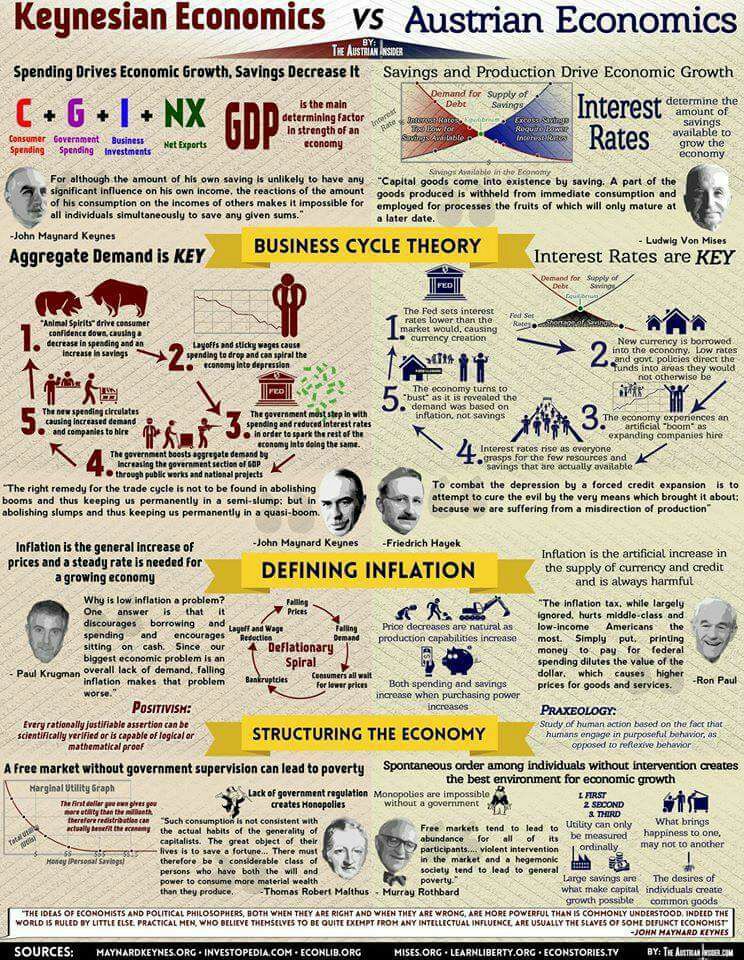
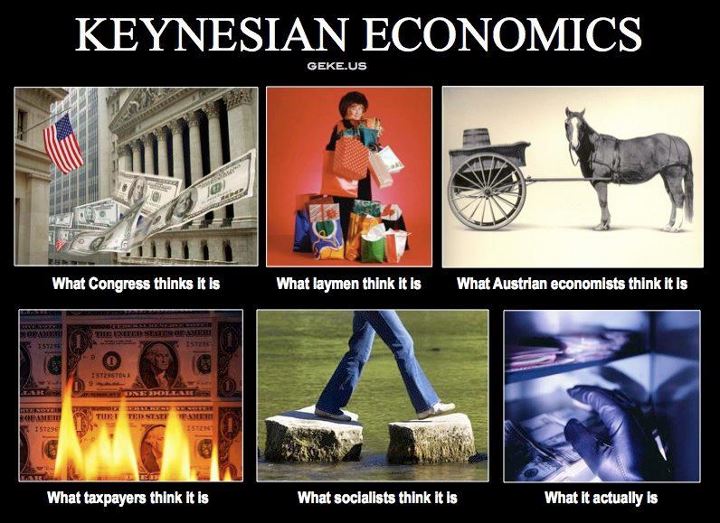
P.S. I feel somewhat guilty for writing a column that acknowledges a potential benefit (albeit transitory and unneighborly) of Keynesian economics, so allow me to expiate my sins by sharing this comparison of Keynesian economics and Austrian economics.


For what it’s worth, I think the Austrians over-emphasize the importance of interest rates. But there’s no question they are much closer to the truth than the Keynesians.

P.P.S. If you want to enjoy some cartoons about Keynesian economics, click here, here, here, and here. Here’s some clever mockery of Keynesianism. And here’s the famous video showing the Keynes v. Hayek rap contest, followed by the equally enjoyable sequel, which features a boxing match between Keynes and Hayek. And even though it’s not the right time of year, here’s the satirical commercial for Keynesian Christmas carols.


Friday, April 7, 2023

Understanding Keynesian Economics

March 29, 2023 by Dan Mitchell

While speaking last week at the Acton Institute in Michigan, I responded to a question about the perpetual motion machine of Keynesian economics.

For purposes of today’s column, let’s try to understand the Keynesian viewpoint.

First and foremost, they think spending drives the economy, whether consumer spending or government spending.

Critics like me argue that the focus should be on income and production. We want to increase saving, investment, entrepreneurship, and labor supply. Simply stated, money has to be earned before anyone spends it.

Do Keynesian economists, by contrast, think it is very important to distinguish between the long run and short run. In the long run, they generally would agree with the previous paragraph.

But they would argue that “stimulus” policies can be desirable in the short run if there is an economic downturn.

More specifically, they argue you can stop or minimize a recession with fiscal Keynesianism (politicians borrowing in order to boost spending) and/or monetary Keynesianism (the central bank creating money to boost spending).

I then point out that Keynesianism has a history of failure when looking at real-world evidence.

It’s also worth pointing out that Keynesians have been consistently wrong with predicting economic damage during periods of spending restraint.

  • They were wrong about growth after World War II (and would have been wrong, if they were around at the time, about growth when Harding slashed spending in the early 1920s).
  • They were wrong about Thatcher in the 1980s.
  • They were wrong about Reagan in the 1980s.
  • They were wrong about Canada in the 1990s.
  • They were wrong after the sequester in 2013.
  • They were wrong about unemployment benefits in 2020.

As you might expect, Keynesians would claim I’m misreading the evidence. They would argue that their policies prevented even-deeper recessions. Or that periods of spending restraint prevented the economy from growing faster.

So you can see why the debate never gets settled.

I’ll close with the observation that Keynesian policies actually can impact the economy. As I pointed out in the video, we can artificially boost overall consumption and spending in the short run if politicians finance a so-called stimulus by borrowing money from overseas. And we can lure people and businesses into borrowing and spending in the short run by having a central bank create more money.

But that’s sugar-high economics, the kind of approach that only helps vote-buying politicians.

Tuesday, April 12, 2022

Another Failure for Keynesian Economics and Interventionist Government

April 11, 2022 by Dan Mitchell @ International Liberty

Keynesian economics is based on the misguided notion that consumption drives the economy.

In reality, high levels of consumption should be viewed an indicator of a strong economy.

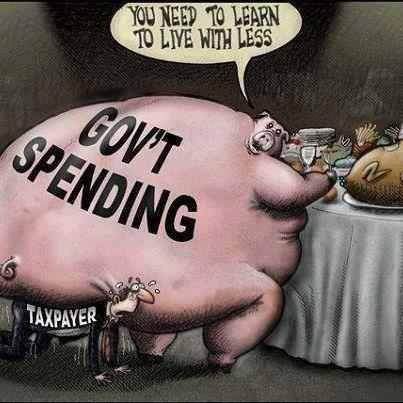
https://danutm.files.wordpress.com/2012/03/keynesian-economics.jpg

The real drivers of economic strength are private investment and private production.

After all, we can’t consume unless we first produce.*

Not everyone agrees with these common-sense observations. The Biden Administration, for instance, claimed the economy would benefit if Congress approved a costly $1.9 trillion “stimulus” plan last year.

Yet we wound up with 4 million fewer jobs than the White House projected. We even wound up with fewer jobs than the Administration estimated if there was no so-called stimulus.

So what did we get for all that money?

Some say we got inflation. In a column for the Hill, Professor Carl Schramm from Syracuse is unimpressed by Biden’s plan. And he’s even less impressed by the left-leaning economists who claimed it is a good idea to increase the burden of government.


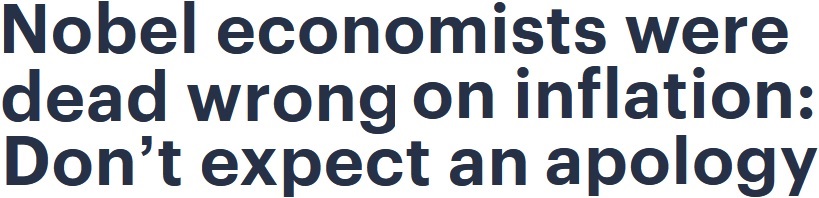
Nobel Laureate economist Joseph Stiglitz rounded up another 16 of the 36 living American Nobel Prize economists to declare, in an open letter, that…there was no threat of inflation. …The Nobelists’ letter showed that those signing had bought Team Biden’s novel argument that its enormous expansion of social welfare programs really was just a different form of infrastructure investment, just like roads and bridges. …The laureates seemed to have overlooked that previous COVID benefits had often exceeded what tens of millions of workers regularly earned and that recipients displaced by COVID were never required to look for other work. While the high priests of economic “science” were cheering on higher federal spending, larger deficits and increased taxes, employers were and are continuing to deal with inflation face-to-face. …The Nobelists assured that we would see a robust recovery because of President Biden’s “active government interventions.” Their presumed authority was used to give credence to the president’s continuously twisting storyline on inflation — that it was “transitory,” good for the economy, a “high-class problem,” Putin’s fault for invading Ukraine, and the greed of oil and food companies… Today’s fashionable goals seem to have displaced the no-nonsense pragmatism that has long characterized economics as a discipline. …Don’t expect a mea culpa from Stiglitz or his coauthors any time soon. …They can be wrong, really wrong, and never pay a price.

The New York Post editorialized about Biden’s economic missteps and reached similar conclusions.


President Joe Biden loves to blame our sky-high inflation on corporate greed and Vladimir Putin. But a new study from the San Francisco Fed shows it was Biden himself who put America on this grim trajectory. …other advanced economies…haven’t seen anything like the soaring prices now punishing workers across America. Which means that the spike is due to something US-specific, rather than global prevailing conditions. That policy, was, of course, Biden’s signature economic “achievement.” …The damage it did has been massive. …inflation…to 7%… Put in concrete terms, a recent Bloomberg calculation translates this to an added $433 per month in household expenses for 2022. And historic producer price inflation, a shocking 10%, guarantees even more pain ahead.

For what it’s worth, I don’t fully agree with Professor Schramm or the New York Post.

They are basically asserting that Biden’s wasteful spending is responsible for today’s grim inflation numbers.

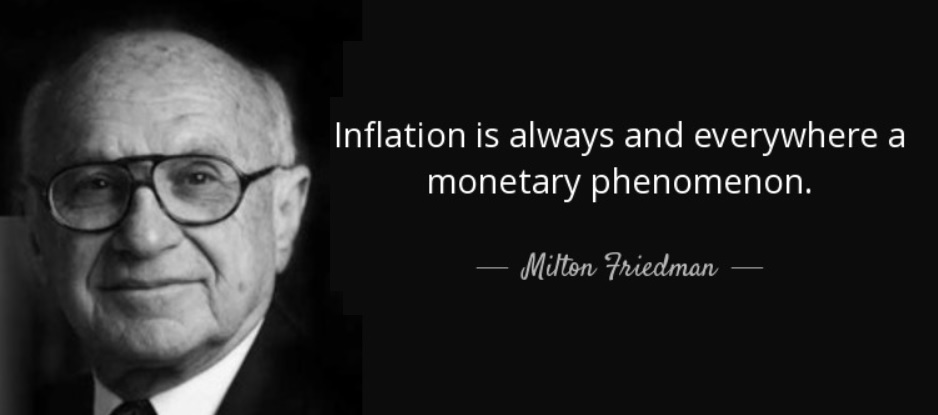
I definitely don’t like Biden’s spending agenda, but I agree with Milton Friedman that it is more accurate to say that inflation is a monetary phenomenon.

In other words, the Federal Reserve deserves to be blamed.

The bottom line is that Keynesian monetary policy produces inflation and rising prices while Keynesian fiscal policy produces more wasteful spending and higher levels of debt.

I’ll close with a couple of caveats.

  • First, Friedman also points out that there’s “a long and variable lag” in monetary policy. So it is not easy to predict how quickly (or how severely) Keynesian monetary policy will produce rising prices.
  • Second, Keynesian deficit spending can lead to Keynesian monetary policy if a central bank feels pressure to help finance deficit spending by buying government bonds (think Argentina).

*Under specific circumstances, Keynesian policy can cause a short-term boost in consumption. For instance, a government can borrow lots of money from overseas lenders and use that money to finance more consumption of things made in places such as China. The net result of that policy, however, is that American indebtedness increases without any increase in national income.

P.S. You can read the letter from the pro-Keynesian economists by clicking here. And you can read a letter signed by sensible economists (including me) by clicking here.

P.P.S. Keynesianism is a myth with a history of failure in the real world. 

It’s also worth pointing out that Keynesians have been consistently wrong with predicting economic damage during periods of spending restraint.


  • They were wrong about growth after World War II (and would have been wrong, if they were around at the time, about growth when Harding slashed spending in the early 1920s).
  • They were wrong about Thatcher in the 1980s.
  • They were wrong about Reagan in the 1980s.
  • They were wrong about Canada in the 1990s.
  • They were wrong after the sequester in 2013.
  • They were wrong about unemployment benefits in 2020.

Call me crazy, but I sense a pattern. Maybe, just maybe, Keynesian economics is wrong.


Friday, August 20, 2021

Primitive Keynesianism from the Joint Economic Committee

August 19, 2021 by Dan Mitchell @ International Liberty 

Washington is filled with dishonest and self-serving analysis. Much of that shoddy output is driven by privileged groups seeking bailouts, subsidies, protectionism, or a tilted playing field.

But that’s not the only type of dishonest and self-serving you find in Washington.

Let’s take the example of President Biden’s proposal to gut welfare reform with per-child handouts.


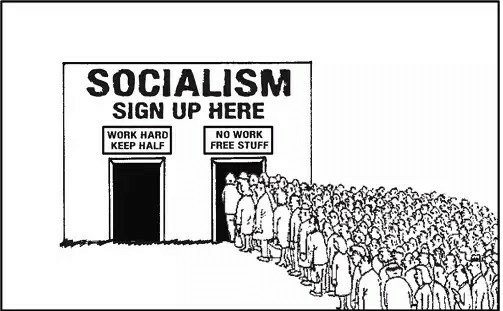
The micro-economic problem with that policy is that it reduces incentives to work – as illustrated by this Wizard-of-Id parody or this cartoon about socialism.

The macro-economic problem with that policy is that it’s part of a radical expansion in the burden of government that will make the U.S. more like Europe.

For today’s topic, though, I want to call attention to a recent report by the Democratic staff of the Joint Economic Committee. It relies on the sloppiest and most disingenuous analysis imaginable.

To recycle a term from 2015, let’s call it primitive Keynesianism.

Here’s the relevant excerpt.

The Treasury Department released information on how much money went to each state, which allows us to estimate the impact of the newly expanded CTC on local economies. Using an estimated multiplier of 1.25—or how much additional spending each $1 in CTC payments will generate, as people use their funds to buy goods and services that in turn generate income for other people and businesses—implies that the expanded CTC will generate nearly $19.3 billion in spending in local economies each month. This increased economic activity is a boon to local businesses, creating jobs in communities across the United States.

You’ll notice an astounding omission.

Nowhere in the JEC “report” is there any acknowledgement that politicians can’t “inject” money into local economies without first taxing or borrowing the money from the private sector.

Honest Keynesians acknowledge that there’s no magic money tree. They know the government can’t put money in our right pocket without first removing from our left pocket.

So they make arguments about things such as the “marginal propensity to consume.”

I disagree with that argument, but at least the folks making that case are being ethical.

The JEC report, by contrast, is utter garbage.

But I guess we shouldn’t be surprised. They’re trying to sell very bad policy, so the staff have no choice but to produce nonsensical “research.”

P.S. Arthur Okun would be very disappointed.


Wednesday, September 16, 2020

It’s not Just Campaign Rhetoric, Hillary Clinton Actually Believes Keynesian Economics

October 15, 2016 by Dan Mitchell @ International Liberty Originally published in 2016
 
Since it’s very likely that Hillary Clinton will be our next President, I’m mentally preparing myself for upcoming fights over her agenda of bigger government and class warfare. But the silver lining to this dark cloud is that I don’t think I’ll be distracted by also having to fight against protectionist policies.

My tiny bit of optimism is based on the fact that hackers at Wikileaks got access to the secret speeches she gave to Wall Street and other corporate bigwigs and we learned that, when she can speak freely with no cameras and outside observers, she believes in “open trade.”
In other words, I was right when I said on TV that she was lying about being in favor of protectionism.

Since I don’t think bureaucrats and politicians should have the power to interfere with our buying decisions, I’m glad Hillary is a secret supporter of free trade.
That’s the good news.

The bad news is that she also is a genuine and sincere supporter of the perpetual motion machine of Keynesian economics (i.e., the theory that more government spending is a form of “stimulus” notwithstanding all the evidence of failure from the spending binges of Obama, Hoover and Roosevelt, and Japan).

Here’s what the Daily Caller is reporting about one of her secret speeches to a corporate audience.
Hillary Clinton argued that expanding food stamps and other safety net programs is essential to fuel economic growth at a speech to General Electric executives, according to an excerpt of the transcript made public by WikiLeaks Friday. “Economic growth will take off when people in the middle feel more secure again and start spending again,” Clinton said in her speech at General Electric’s Global Leadership Meeting in January, 2014. …Giving people income assistance, like the food stamps program, would help the economy because families on food stamps will have more money to spend, Clinton argued.
Wow, this is depressing. If this was an off-the-record speech to the Democratic National Committee, a George Soros group, or some other left-leaning outfit, I’d be tempted to dismiss her remarks as rhetoric.

But GE executives presumably aren’t big fans of income redistribution (other than to themselves, of course). So Hillary’s comments were not a form of pandering. She presumably really believes that Keynesian economics is some sort of elixir, that you actually can boost economic performance by taking money out of the economy’s right pocket and putting it in the economy’s left pocket.
Not only is this wrong, it’s backwards.
  • When the crowd in Washington spends money, much of it is lost to bureaucracy and waste. This may not matter to Keynesians since they just want there to be spending (no joke, Keynes actually did write that  it would be good policy to bury money in the ground so that people would get paid to dig it out). Sensible people, by contrast, understand that it matters for the economy whether money is spent wisely.
  • Moreover, redistribution spending tends to be especially harmful since it subsidizes people for not working or for having low levels of income, which is why research has shown that policies such as Obamacare, jobless benefits, and food stamps are associated with lower levels of employment. In other words, redistribution is bad for economic performance.
The bottom line is that we shouldn’t expect any sort of economic renaissance if Hillary is our next president. Just another four years of the kind of anemic performance we’ve experienced under Obama.

P.S. Click here to learn more about the failure of Keynesian economics.

P.S. If you want both substance and entertainment, here’s the famous video showing the Keynes v. Hayek rap contest, followed by the equally entertaining sequel, which features a boxing match between Keynes and Hayek. And even though it’s not the right time of year, here’s the satirical commercial for Keynesian Christmas carols.

Friday, August 28, 2020

The Economic History of the 20th Century


 It’s not often (actually, only once) that I share a video lasting nearly two hours. But this video – revolving around the intellectual rivalry between pro-market Hayek and pro-intervention Keynes – is an excellent summary of 20th-century economic policy.


We learn about the growth of socialism and communism during and after World War I.  This then led economists from the Austrian school – including Hayek – to explain why that approach (genuine socialism, meaning government ownershipcentral planning, and price controls) was doomed to failure.

But other forms of intervention and redistribution gained new adherents, especially when Keynes argued that the Great Depression was the fault of capitalism (for what it’s worth, I think the video fails to include analysis on how the New Deal actually lengthened and deepened the downturn).

Unfortunately, the Keynesian narrative dominated and the video informs us that the people of the United Kingdom voted for a socialist government when World War II ended. Which then led to the nationalization of the economy’s “commanding heights” and the enactment of the welfare state.
The United States didn’t veer as sharply to the left after the war, but there was no meaningful challenge to the the statist consensus that arose in the 1930s.

On the bright side, Germany rejected socialism by getting rid of price controls and allowing markets to flourish (the video overstated the degree to which a welfare state was imposed). But that was the exception to the rule. The world was gravitating to statism, including the developing world.
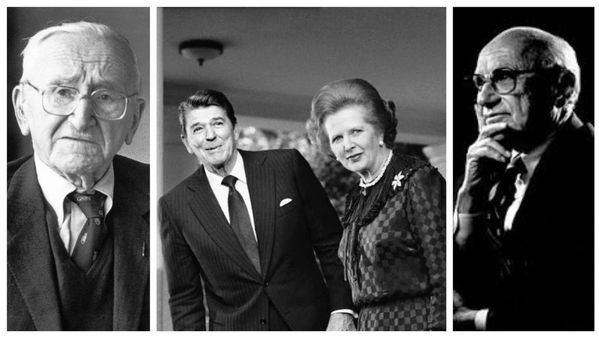
My favorite part of the video is that we learn about the creation of the Mont Pelerin Society and the emergence of Milton Friedman and the Chicago School.

That was the start of the laissez-faire counterrevolution. But it didn’t yield immediate results.  The left was in charge of economic policy from the end of the war through the 1970s in the USA and UK, regardless of which political party held power. But bad policy sooner or later leads to bad results.  And that changed the political environment.


The latter part of the video tells the very happy story on how the sensible ideas of Hayek and Friedman eventually translated into the historic elections of Ronald Reagan and Margaret Thatcher.  If you watch the entire video, you’ll learn about how Reagan and Thatcher successfully overcame major challenges as they shifted their nations toward economic liberty (most notably, Reagan tamed inflation and Thatcher denationalized state-run companies).

And you’ll see that most of the world then followed – including the collapse of the Soviet Empire.
You even get some sympathetic quotes about capitalism from leftists such as Gordon Brown, Larry Summers, and Jeffrey Sachs at the end of the video.

So it seems like a happy ending. And capitalism indeed was the dominant force in economic policy about 20 years ago when the video was released.

Sadly, the track record of the 21st century (Bush II, Obama, and Trump) has not been overly favorable for believers in economic liberty.

Monday, August 17, 2020

Anti-Keynesian Growth after World War II

August 14, 2020 by Dan Mitchell @ International Liberty

 Last week, I shared some data showing how the economy enjoyed a strong recovery from recession in the early 1920s when President Warren Harding cut government spending.

(And these were genuine cuts, not the nonsense we get from today’s politicians, who claim they’ve cut spending simply because the budget increases by 5 percent rather than 7 percent.)

What happened nearly 100 years ago is very relevant today since we still have advocates of Keynesian economics who claim that more spending (especially debt-financed spending) is a recipe for more growth.  To show why this view is misguided, let’s now look at what happened in the 1940s after World War II came to an end.  In a column for today’s Wall Street Journal, Professor Richard Vedder explains that the Keynesians predicted economic disaster because of big reductions in government spending.
…many Americans assumed the end of the war would mean a resumption of the Depression, which was cut off by the World War II military buildup. In the middle of the fighting, America’s leading Keynesian economist, Alvin Hansen of Harvard, said: “When the war is over, the government cannot just disband the Army, close down munitions factories, stop building ships, and remove economic controls.” …When the sudden end of combat became apparent in late August 1945, economist Everett Hagen predicted that the unemployment rate in the first quarter of 1946 would be 14.8%.
So what actually happened? Vedder points out that the Keynesian predictions of massive unemployment were wildly inaccurate.
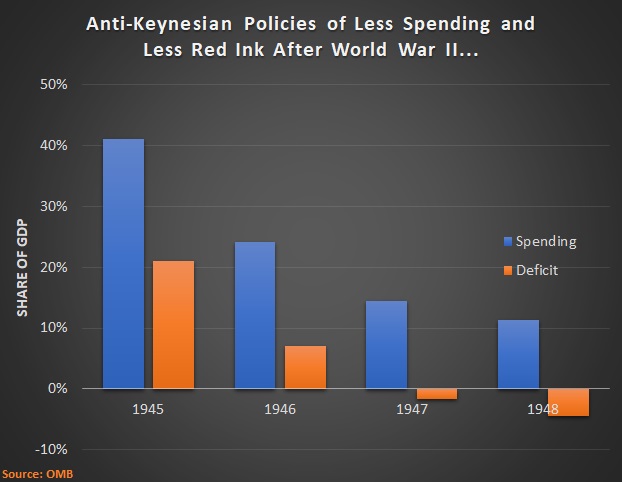
Millions of military personnel did become jobless within months and defense spending plummeted, putting more out of work. In June 1946 federal employment was almost precisely 10 million less than a year earlier. Yet the sharp rise in overall unemployment didn’t occur. The total unemployment rate for 1946 was 3.9%… Perhaps most interesting for today, all this occurred as the U.S. moved from an extremely expansionary fiscal policy—with budget deficits equal to almost 25% of gross domestic product in 1944 (the equivalent of more than $5 trillion today)—to an extremely contractionary one. The U.S. by 1947 was running a budget surplus exceeding 5% of output—the equivalent of more than $1 trillion today. …This was the complete reverse of the expectation of the newly dominant Keynesian economists.
In the following chart, you can see the numbers from the Office of Management and Budget’s Historical Tables (Table 1.2), which show that fiscal policy between 1945 and 1948 was very contractionary, at least as defined by the Keynesians. There definitely were huge spending cuts (the real kind, not the fake kind) during those years, and big deficits also became big surpluses.


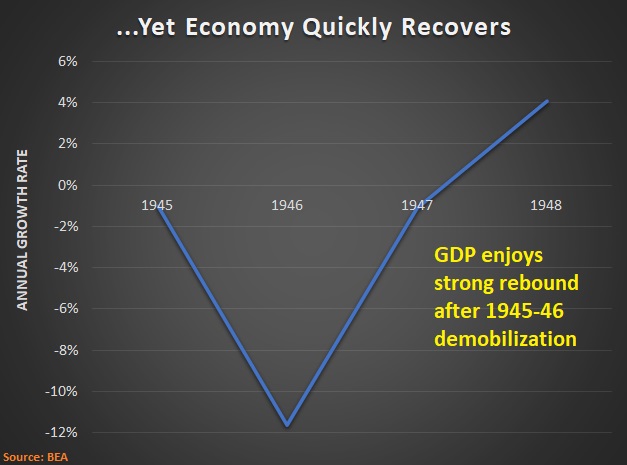
Professor Vedder’s column explained that this anti-Keynesian policy didn’t produce mass unemployment.  But what about economic growth?  Well, you’ll see in the chart below the data from the Bureau of Economic Analysis for the 1945-48 period. There was a recession in 1946, which could be interpreted as evidence for Keynesianism.  But then look what happened in the next couple of years. There were more budget cuts, deficits became surpluses, and the economy enjoyed a strong rebound.


According to Keynesian theory, these two charts can’t exist. There can’t be an economic recovery when spending and deficits are falling.  Yet that’s exactly what happened after World War II (just as it happened under Harding, as Thomas Sowell observed).  Maybe, just maybe, Keynesianism is simply wrong. Maybe it’s nothing more than the economic version of a perpetual motion machine?

P.S. It’s also worth noting that huge increases in spending and debt under Hoover and Roosevelt didn’t produce good results in the 1930s.

Friday, July 3, 2020

FDR’s New Deal Exacerbated the Great Depression

July 2, 2020 by Dan Mitchell  @ International Liberty
In an interview with an economic organization from India last month, I discussed many of the economic issues associated with coronavirus (fiscal fallout, excess regulation, subsidized unemployment, etc). But I want to highlight this short clip since I had an opportunity to explain how the “New Deal” made the Great Depression deeper and longer.  For newcomers to this issue, “New Deal” is the term used to describe the various policies to expand the size and scope of the federal government adopted by President Franklin Delano Roosevelt (a.k.a., FDR) during the 1930s.

And I’ve previously cited many experts to show that his policies undermined prosperity. Indeed, one of my main complaints is that he doubled down on many of the bad policies adopted by his predecessor, Herbert Hoover.  Let’s revisit the issue today by seeing what some other scholars have written about the New Deal. Let’s start with some analysis from Robert Higgs, a highly regarded economic historian.
…as many observers claimed at the time, the New Deal did prolong the depression. …FDR and Congress, especially during the congressional sessions of 1933 and 1935, embraced interventionist policies on a wide front. With its bewildering, incoherent mass of new expenditures, taxes, subsidies, regulations, and direct government participation in productive activities, the New Deal created so much confusion, fear, uncertainty, and hostility among businessmen and investors that private investment, and hence overall private economic activity, never recovered enough to restore the high levels of production and employment enjoyed in the 1920s. …the American economy between 1930 and 1940 failed to add anything to its capital stock: net private investment for that eleven-year period totaled minus $3.1 billion. Without capital accumulation, no economy can grow. …If demagoguery were a powerful means of creating prosperity, then FDR might have lifted the country out of the depression in short order. But in 1939, ten years after its onset and six years after the commencement of the New Deal, 9.5 million persons, or 17.2 percent of the labor force, remained officially unemployed.
Writing for the American Institute for Economic Research, Professor Vincent Geloso also finds that FDR’s New Deal hurt rather than helped.
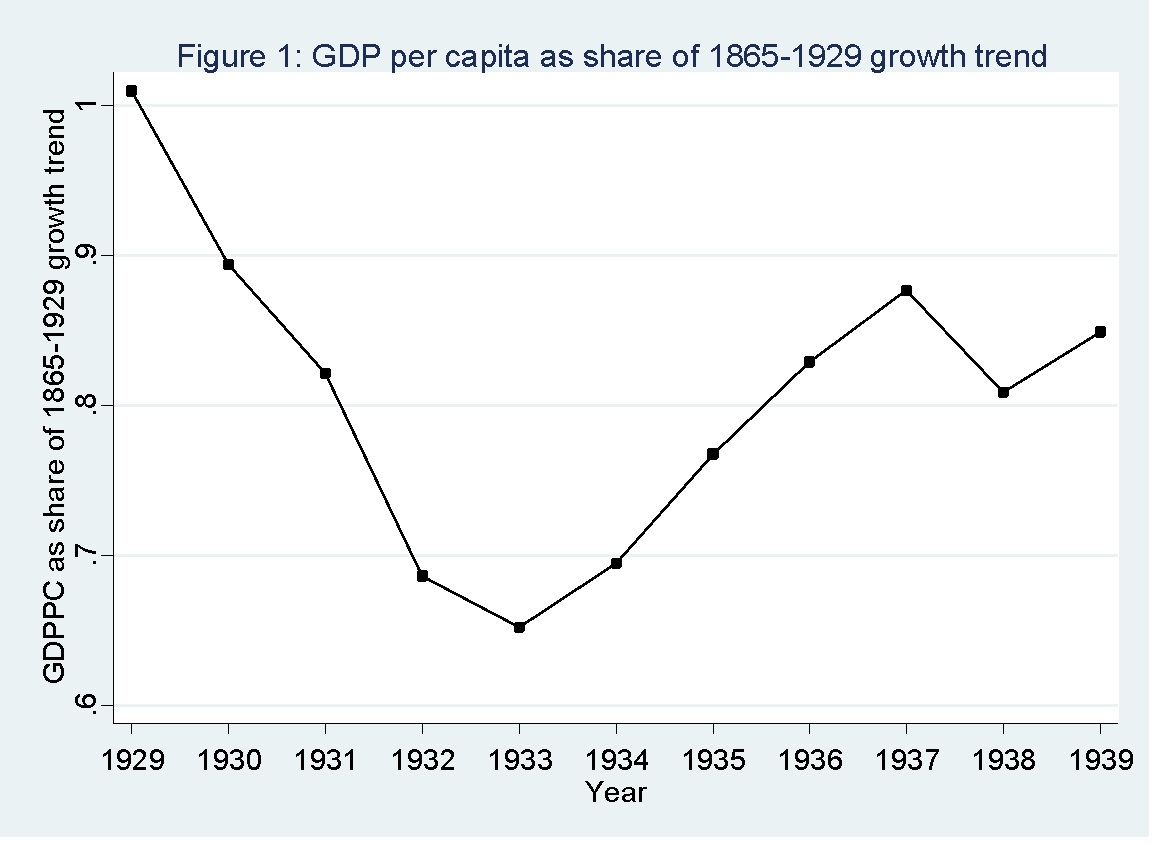
…let us state clearly what is at stake: did the New Deal halt the slump or did it prolong the Great Depression? …The issue that macroeconomists tend to consider is whether the rebound was fast enough to return to the trendline. …The…figure below shows the observed GDP per capita between 1929 and 1939 expressed as the ratio of what GDP per capita would have been like had it continued at the trend of growth between 1865 and 1929. On that graph, a ratio of 1 implies that actual GDP is equal to what the trend line predicts. …As can be seen, by 1939, the United States was nowhere near the trendline. …Most of the economic historians who have written on the topic agree that the recovery was weak by all standards and paled in comparison with what was observed elsewhere. …there is also a wide level of agreement that other policies lengthened the depression. The one to receive the most flak from economic historians is the National Industrial Recovery Act (NIRA). …In essence, it constituted a piece of legislation that encouraged cartelization. By definition, this would reduce output and increase prices. As such, it is often accused of having delayed recovery. …other sets of policies (such as the Agricultural Adjustment Act, the National Labor Relations Act and the National Industrial Recovery Act)…were very probably counterproductive.
Here’s one of the charts from his article, which shows that the economy never recovered lost output during the 1930s.
In a column for CapX, Professor Philip Booth adds some interesting evidence on how the United Kingdom adopted a smarter approach in the 1930s.
…the UK had a relatively good Great Depression by international standards. There was an extremely conservative fiscal policy (much more so than during the so-called austerity after 2008) and yet the economy bounced back. In the period 1930-1933, the average public sector deficit was just 1.1% of GDP. And there were only two years of negative GDP growth (1930 and 1931). By 1938, GDP growth had been sufficiently rapid, that the country had returned to trend national income as if the Great Depression had never happened. …In the UK, we had a stable regulatory environment, a liberalised market for land for building purposes and fiscal austerity. …though Roosevelt is often regarded as the great saviour, he is nothing of the sort. …taking the period 1929-1939 as a whole, real GDP growth was only 1% per annum. There was no return to trend national income levels. …unemployment in the US was much higher than in the UK. For the economy to be operating at those levels of unemployment for so long requires some very bad policies. …Arbitrary regulation damaged business and created “policy uncertainty” and top marginal tax rates were raised.
For what it’s worth, I also think it’s worth comparing what happened in the 1930s with the genuine economic recovery from the deep recession in 1920-21.

Or, look at how the economy boomed after World War II even though the Keynesians predicted the economy would fall back into depression without a massive expansion of domestic spending.

Nonetheless, as illustrated by this cartoon, some people still want to blame capitalism for problems caused by government.

P.S. FDR not only wanted a 100-percent tax rate, he actually tried to impose it without legislative approval.

P.P.S. FDR also wanted an “Economic Bill of Rights” that would have created a far-reaching entitlements to other people’s money.

P.P.P.S. This video summarizes the awful policies of Hoover and FDR.